

Submitted:
31 July 2026
Posted:
03 August 2026
You are already at the latest version
Abstract
Oral frailty has emerged as an important geriatric syndrome characterized by subtle, multifactorial declines in oral function that precede clinically apparent oral dysfunction. Accumulating evidence indicates that oral frailty is closely associated with physical frailty, sarcopenia, malnutrition, cognitive decline, cardiovascular disease, and mortality, suggesting its potential role as an early indicator of multisystem functional deterioration. However, practical approaches for early detection and intervention remain challenging because conventional assessments of oral function require specialized equipment and professional expertise. This review summarizes recent advances in the assessment, clinical significance, and management strategies of oral frailty. We discuss the utility and limitations of questionnaire-based screening tools, including the Oral Frailty Index-8 (OFI-8) and Oral Frailty 5-item Checklist (OF-5), which enable simple identification of individuals at increased risk in community and clinical settings. Furthermore, we introduce our findings from the FESTA study demonstrating that cystatin C–related indices, including the creatinine-to-cystatin C ratio and the estimated glomerular filtration rate cystatin C-to-creatinine ratio, reflect skeletal muscle mass and are associated with oral functional decline, particularly reduced tongue pressure. Comparative and longitudinal analyses further suggest that oral frailty is independently associated with progression of physical frailty and that OF-5 may serve as a predictive marker for future functional decline. Given the bidirectional relationship between oral dysfunction and physical frailty, integrated management involving dental care, nutritional support, physical exercise, and medical intervention is essential. Combining simple oral frailty screening tools with objective systemic biomarkers may facilitate early detection and promote medical–dental collaboration aimed at preventing frailty progression and extending healthy life expectancy.
Keywords:
oral frailty
; sarcopenia
; screening
; cystatin C
; medical–dental collaboration
Introduction
In recent years, accumulating evidence has demonstrated that even subtle declines in oral function are closely associated with systemic health deterioration and adverse health outcomes among older adults. Consequently, oral frailty has gained increasing recognition as an important geriatric syndrome representing an early and potentially reversible stage preceding clinically apparent oral dysfunction. Oral frailty is characterized by mild but multifactorial impairments across several oral domains, including tooth loss, masticatory function, swallowing ability, speech function, and salivary secretion. Similar to physical frailty, it represents a transitional state between optimal health and overt functional decline, in which timely identification and intervention may prevent further deterioration. [1,2,3]
In 2024, a joint statement issued by the Japan Geriatrics Society, the Japanese Society of Gerodontology, and the Japanese Association on Sarcopenia and Frailty defined oral frailty as an intermediate condition between healthy oral status and oral functional decline [1]. The statement emphasized that the accumulation of subtle impairments in multiple oral functions—including eating and communication abilities—increases the risk of subsequent functional decline while remaining potentially modifiable through appropriate interventions [1]. This conceptual framework has positioned oral frailty as an important target for promoting healthy aging and extending healthy life expectancy.
The clinical significance of oral frailty extends far beyond oral health itself. A growing body of evidence has demonstrated close associations between oral frailty and physical frailty, sarcopenia, malnutrition [4,5,6], cognitive impairment [7], and social vulnerability [8]. The Kashiwa Study conducted by the University of Tokyo showed that older adults with both physical frailty and oral frailty had the highest cumulative risks of disability and mortality [9]. Furthermore, oral frailty has been identified as an independent predictor of physical frailty, sarcopenia, long-term care dependency, and all-cause mortality [3]. These findings suggest that oral frailty reflects multisystem functional decline rather than isolated deterioration of oral function.
Recent research has further expanded the clinical relevance of oral frailty by demonstrating its association with a wide range of chronic diseases and geriatric outcomes. Oral frailty is frequently observed in older adults with cardiovascular disease, particularly those with multimorbidity, suggesting that oral function assessment may contribute to cardiovascular risk stratification and comprehensive geriatric care [10]. In addition, impaired oral function has been associated with poorer psychological well-being and an increased risk of cognitive decline [11], raising the possibility that oral frailty may serve as an early clinical indicator of neurodegenerative processes. Longitudinal studies have also shown that oral functional decline precedes the development of physical frailty and locomotor dysfunction [12], potentially initiating a vicious cycle of reduced food intake, impaired communication, social isolation, physical inactivity, and progressive functional deterioration. Collectively, these findings support the concept that oral frailty is a multidimensional condition involving biological, psychological, and social domains.
Despite increasing recognition of its clinical importance, several challenges remain regarding the assessment and early identification of oral frailty. Various screening tools have been developed to facilitate risk assessment, yet their clinical utility and limitations continue to be investigated. Furthermore, the mechanisms linking oral frailty to systemic health remain incompletely understood, and strategies for effective prevention and intervention have not been fully established.
In this review, we summarize recent advances in the understanding of oral frailty, with particular emphasis on its epidemiology, pathophysiological mechanisms, associations with systemic diseases and geriatric outcomes, and current approaches to screening and assessment, including the questionnaire-based tools OF-5 and OFI-8. We also discuss emerging biomarkers and future perspectives for integrating oral frailty assessment into multidisciplinary preventive strategies aimed at promoting healthy aging.
Assessment, Screening, and Management Strategies for Oral Frailty
Despite growing evidence linking oral frailty to adverse health outcomes, the optimal strategies for screening and intervention remain under investigation. Therefore, effective management requires a multidisciplinary approach integrating comprehensive dental care, oral functional training, nutritional support, physical exercise, and interventions that promote social participation.
Given its high prevalence and significant clinical implications, the development of simple and practical screening methods for oral frailty has become increasingly important. A recent systematic review estimated that the prevalence of oral frailty among older adults is approximately 34.0% [13], indicating that a substantial proportion of the aging population may be affected [2]. Although comprehensive oral examinations and objective assessments of oral function—including tongue pressure, occlusal force, masticatory performance, and swallowing function—provide valuable diagnostic information, they are often impractical in community-based settings, primary care, and large-scale epidemiological studies because they require specialized equipment and trained personnel. Consequently, validated questionnaire-based screening tools have attracted increasing attention as accessible methods for identifying individuals at risk of oral frailty.
The concept of oral hypofunction has been established as an objective framework for evaluating age-related decline in oral function [2]. Oral hypofunction is diagnosed when impairment is present in at least three of the following seven domains: poor oral hygiene, oral dryness, reduced occlusal force, decreased tongue–lip motor function, low tongue pressure, impaired masticatory function, and impaired swallowing function [2]. Although this framework provides a comprehensive assessment of oral function, its routine application remains limited because evaluation of these domains generally requires specialized dental equipment and professional expertise. These practical limitations have prompted the development of simpler questionnaire-based screening tools.
Among the currently available screening tools, the Oral Frailty Index-8 (OFI-8) and the Oral Frailty 5-item Checklist (OF-5) are the most widely used in Japan. OFI-8 was developed as a comprehensive index that evaluates multiple aspects of oral health and behavior, including dental attendance, dentition status, chewing ability, dietary habits, oral functional problems, and awareness of oral health [14]. Population-based studies have demonstrated that higher OFI-8 scores are associated with an increased risk of oral frailty and subsequent functional disability. Furthermore, greater awareness of oral frailty, as assessed by OFI-8 in community-based studies, has been associated with health-promoting behaviors, including regular exercise, balanced nutrition, and increased oral health awareness [15]. These findings suggest that OFI-8 provides broader information encompassing not only oral functional status but also lifestyle-related factors relevant to healthy aging.
In contrast, OF-5 was developed as a simpler screening tool for the rapid identification of oral functional decline. It is a brief self-administered questionnaire consisting of five domains: fewer teeth, difficulty in chewing, difficulty in swallowing, low articulatory oral motor skills, and dry mouth [9]. Recent studies have demonstrated that OF-5 is useful for detecting impaired masticatory function, swallowing dysfunction, tongue dysfunction, and oral dryness [16]. However, because it does not adequately assess oral hygiene–related conditions, such as periodontal disease and plaque accumulation, it should be regarded as a screening tool that complements rather than replaces comprehensive dental examinations.
Despite these advances, current screening methods still rely primarily on questionnaire-based assessments or specialized functional tests. Given the limitations of conventional assessments, there is increasing interest in developing simple and objective indicators that can be applied in routine clinical practice and population-based screening. Traditional measurements, such as tongue pressure, masticatory performance, salivary secretion, and articulatory function, provide valuable information but are not always feasible outside specialized dental settings. Accordingly, the identification of novel oral function-related biomarkers based on readily obtainable clinical parameters, including blood biomarkers combined with simple questionnaire-based assessments, represents a promising direction for future research.
Assessment of Muscle Mass and Oral Function Using Cystatin C–Related Indices
Although questionnaire-based screening tools are practical and widely used, objective biomarkers capable of reflecting both physical frailty and oral functional decline remain limited. Using data from the FESTA study, a community-based cohort study conducted by Hyogo Medical University in Tamba-Sasayama, we previously demonstrated that the creatinine-to-cystatin C ratio (Cr/CysC ratio)—which combines creatinine (Cr), a biomarker influenced by muscle mass, and cystatin C (CysC), which is relatively independent of muscle mass—is significantly associated with skeletal muscle mass [17,18]. We further reported that cystatin C–based estimated glomerular filtration rate (eGFRcys), as well as the ratio of eGFRcys to creatinine-based estimated glomerular filtration rate (eGFRcre) (eGFRcys/eGFRcre ratio), are associated with skeletal muscle mass and the risk of sarcopenia, suggesting that cystatin C–related indices may serve as useful biomarkers of systemic muscle mass [19].
Building on these findings, we subsequently investigated whether cystatin C–related indices are associated not only with systemic muscle mass but also with oral function. Focusing on tongue pressure, one of the most objective components of the diagnostic criteria for oral hypofunction, we examined its relationships with physical function parameters. Tongue pressure showed a strong negative correlation with age in both sexes and was significantly positively correlated with skeletal muscle mass, muscle strength, and maximum gait speed. Furthermore, tongue pressure, like skeletal muscle mass, was significantly positively associated with eGFRcys, whereas no significant association was observed with eGFRcre. These findings suggest that cystatin C–related indices may reflect not only systemic muscle mass but also age-related oral functional decline, particularly reduced tongue pressure [20].
Taken together, these observations raise the possibility that cystatin C–related biomarkers may serve as simple and objective indicators of oral frailty. However, whether these biomarkers are associated with established questionnaire-based screening tools for oral frailty, such as the Oral Frailty 5-item Checklist (OF-5) and the Oral Frailty Index-8 (OFI-8), remains unclear.
Comparison of Oral Frailty Assessment Tools and Their Clinical Utility
As summarized in the previous section, the OFI-8 is a comprehensive eight-item questionnaire, whereas the OF-5 is a simpler five-item screening tool. Despite differences in their structure and scope, both instruments share three core components—mastication, swallowing, and oral dryness—which are recognized as key elements of oral frailty and are also included in the basic frailty checklist recommended by the Japan Geriatrics Society (Figure 1).
To compare these two screening approaches, we developed a questionnaire that enabled the simultaneous assessment of both OFI-8 and OF-5 (Table 1) and conducted oral frailty screening among patients attending a general internal medicine outpatient clinic [21]. Using this combined assessment, we stratified OFI-8 risk categories according to OF-5 scores. Although women tended to show slightly higher scores than men, a strong concordance was observed between the two instruments in both sexes. Most individuals with an OF-5 score ≥2 also had an OFI-8 score ≥4, and all participants with OF-5 scores ≥3 were classified as high risk for oral frailty according to the OFI-8 (Figure 2).

Table 1.
Questionnaire enabling simultaneous assessment of OFI-8 and OF-5.
| Questions | OFI-8 | OF-5 | ||
|---|---|---|---|---|
| Yes | No | Yes | No | |
|
Difficulty in chewing Do you have any difficulties eating tough foods compared with 6 months ago? (Yes) |
2 | 0 | 1 | 0 |
|
Difficulty in swallowing Have you choked on your tea or soup recently? (Yes) |
2 | 0 | 1 | 0 |
|
Tooth Loss Do you use dentures? (Yes) |
2 | 0 | ||
|
Dry mouth Do you often experience having a dry mouth? (Yes) |
1 | 0 | 1 | 0 |
|
Social participation Do you go out less frequently than you did last year? (Yes) |
1 | 0 | ||
|
Masticatory function Can you eat hard foods like squid jerky or pickled radish? (No) |
0 | 1 | ||
|
Oral hygiene–related behaviors How many times do you brush your teeth in a day? (<2 times/day) |
0 | 1 | ||
|
Oral hygiene–related behaviors Do you visit a dental clinic at least annually? (No) |
0 | 1 | ||
|
Fewer teeth How many of your natural teeth are left? (<20 natural teeth) |
0 | 1 | ||
|
Low articulatory oral motor skills Have you had difficulty with clear pronunciation recently? (Yes) |
1 | 0 | ||
| Total score | ||||
| Total OFI-8 Score | Risk of Oral Frailty |
| 0–2 points | Low risk of oral frailty |
| 3 points | At risk of oral frailty |
| ≥4 points | High likelihood of oral frailty |
| OF-5: A score of ≥2 indicates oral frailty. | |
We further examined the clinical characteristics of individuals classified as high risk by the OFI-8. These participants exhibited significantly lower handgrip strength, and male participants additionally showed lower erythrocyte counts and serum albumin levels. Importantly, lower values of the cystatin C–related indices that we previously identified as markers of muscle mass—namely, the Cr/CysC ratio and the eGFRcys/eGFRcre ratio—also tended to be observed in the OFI-8 high-risk group [22]. Taken together, these findings suggest that cystatin C–related indices may reflect not only systemic muscle mass but also declines in oral function, supporting their potential utility as simple objective biomarkers for oral frailty.
Longitudinal Findings and Predictive Factors in a Community-Based Cohort
Consistent findings were obtained in the FESTA study. Participants classified as having oral frailty (OF-5 score ≥2) were older and exhibited significantly lower skeletal muscle mass, handgrip strength, knee extension strength, and gait speed than those without oral frailty. They also demonstrated poorer physical performance, as reflected by longer Timed Up and Go (TUG) and Five-Times Sit-to-Stand (5CS) test times. Blood analyses revealed lower Cr/CysC ratios and eGFRcys/eGFRcre ratios in the oral frailty group, while women additionally exhibited lower serum albumin and hemoglobin levels [23]. Furthermore, oral frailty was strongly associated with physical frailty status according to the Japanese version of the Cardiovascular Health Study (J-CHS) criteria, with affected individuals showing a lower prevalence of robust status and a higher prevalence of prefrailty and frailty. Together, these findings indicate that oral frailty is closely linked to physical frailty-related domains, including muscle mass, physical performance, nutritional status, and renal function.
To determine whether oral frailty also predicts future functional decline, a longitudinal analysis of the same cohort followed 329 participants (105 men and 224 women) for 2–3 years. Approximately one-quarter experienced worsening of physical frailty during follow-up according to the J-CHS criteria. At baseline, body composition, handgrip strength, and gait speed did not differ significantly between participants whose frailty status deteriorated and those who remained stable. In contrast, the total OF-5 score was significantly higher in the deterioration group, indicating that poorer oral function preceded measurable declines in overall physical function.
Logistic regression analyses further demonstrated sex-specific predictors of frailty progression. In men, decreased handgrip strength and tooth loss were significant risk factors, whereas impaired mastication and swallowing were significant predictors in women. Importantly, after adjustment for potential confounders, the OF-5 score remained an independent predictor of frailty progression in both sexes. Collectively, these findings suggest that oral frailty is not merely a localized decline in oral function but an early clinical marker of physical frailty and subsequent physical frailty progression.
Integrated Frailty Management Through Medical–Dental Collaboration
Oral frailty, physical frailty, and sarcopenia are closely interconnected and are thought to constitute a self-reinforcing vicious cycle. Declines in masticatory and swallowing function can reduce dietary intake, leading to malnutrition and subsequent losses in muscle mass, physical activity, and metabolic function, thereby accelerating the progression of physical frailty. Conversely, worsening physical frailty and sarcopenia may further impair oral function through reductions in occlusal force, tongue pressure, and oral motor performance. Breaking this cycle therefore requires early identification and intervention through close collaboration between medical and dental professionals.
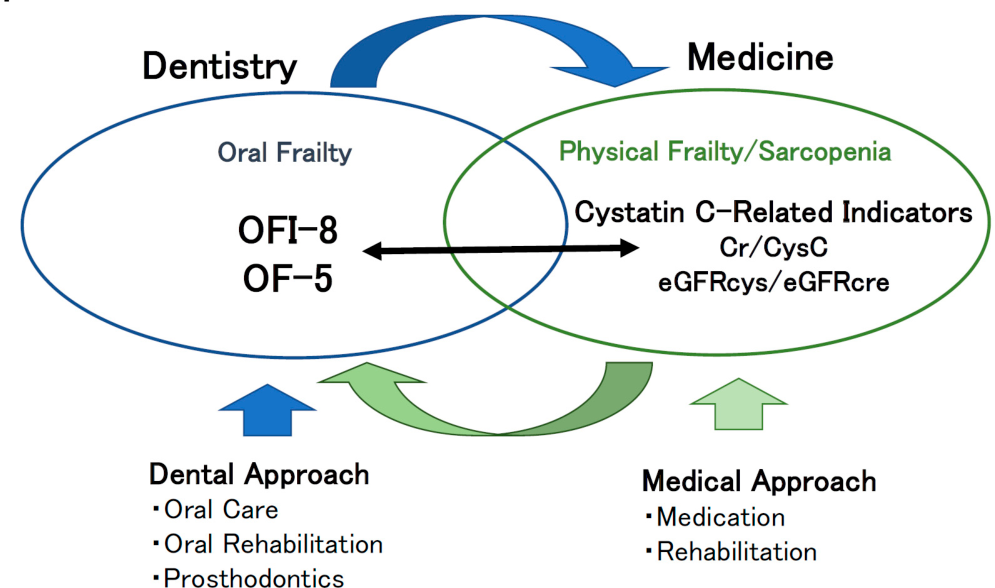
The roles of dentistry and medicine in this process are complementary. Dental care primarily focuses on preserving and improving oral function through oral hygiene management, oral rehabilitation, and prosthodontic treatment, whereas medical care addresses physical frailty and sarcopenia through nutritional management, physical rehabilitation, and pharmacological interventions. Likewise, assessment strategies should integrate both oral and systemic perspectives. Questionnaire-based screening tools such as the OFI-8 and OF-5 can be used to evaluate oral frailty, while cystatin C–related indices, including the Cr/CysC ratio and the eGFRcys/eGFRcre ratio, may serve as practical objective biomarkers of physical frailty. The significant associations observed between these measures suggest that they provide complementary information for identifying individuals at risk (Figure 3).
Accordingly, establishing an integrated clinical model that combines assessment of oral and physical frailty with coordinated medical–dental interventions represents an important future goal. Such an approach may facilitate earlier detection and intervention, ultimately helping to prevent the progression of frailty and extend healthy life expectancy.
Conclusions
This review highlights recent advances in oral frailty assessment, objective biomarkers, and multidisciplinary management. Among the available screening tools, the Oral Frailty Five-item Checklist (OF-5) and the Oral Frailty Index-8 (OFI-8) provide practical approaches for identifying individuals at increased risk of oral frailty. While the OFI-8 offers a more comprehensive assessment that incorporates oral health behaviors and lifestyle-related factors, the OF-5 provides a simpler and more rapid evaluation of oral functional decline, making both tools valuable for different clinical and community settings.
Our recent findings suggest that cystatin C–related indices, including the creatinine-to-cystatin C ratio and the eGFRcys/eGFRcre ratio, may serve as objective biomarkers reflecting not only skeletal muscle status but also oral functional decline. These biomarkers have the potential to complement questionnaire-based screening and facilitate the integration of oral and physical frailty assessment in routine clinical practice.
Future studies should validate these assessment strategies in larger and more diverse populations, establish standardized screening algorithms, and determine whether early identification and intervention for oral frailty can prevent or delay the progression of physical frailty and other adverse health outcomes. Integrating simple oral frailty screening tools with objective biomarkers through close medical–dental collaboration may provide an effective strategy for promoting healthy aging and extending healthy life expectancy.
References
- Tanaka, T.; Hirano, H.; Ikebe, K.; Ueda, T.; Iwasaki, M.; Minakuchi, S.; Arai, H.; Akishita, M.; Kozaki, K.; Iijima, K. Consensus statement on “Oral frailty” from the Japan Geriatrics Society, the Japanese Society of Gerodontology, and the Japanese Association on Sarcopenia and Frailty. Geriatr. Gerontol. Int. 2024, 24(11), 1111–9. [Google Scholar] [CrossRef] [PubMed]
- Minakuchi, S.; Tsuga, K.; Ikebe, K.; Ueda, T.; Tamura, F.; Nagao, K.; Furuya, J.; Matsuo, K.; Yamamoto, K.; Kanazawa, M.; Watanabe, Y.; Hirano, H.; Kikutani, T.; Sakurai, K. Oral hypofunction in the older population: Position paper of the Japanese Society of Gerodontology in 2016. Gerodontology 2018, 35(4), 317–24. [Google Scholar] [CrossRef] [PubMed]
- Tanaka, T.; Takahashi, K.; Hirano, H.; Kikutani, T.; Watanabe, Y.; Ohara, Y.; Furuya, H.; Tetsuo, T.; Akishita, M.; Iijima, K. Oral frailty as a risk factor for physical frailty and mortality in community-dwelling elderly. J. Gerontol. A Biol. Sci. Med. Sci. 2018, 73(12), 1661–7. [Google Scholar] [PubMed]
- Yamagata, E.; Watanabe, Y.; Mitsuhashi, M.; Hashimoto, H.; Sugihara, Y.; Murata, N.; Komatsu, M.; Ebine, N.; Kimura, M. The Frailty, Fitness, and Psychophysical/Social Condition of Community-Dwelling Older Adults-Analysis of 5-Year Longitudinal Data. Geriatrics 2025, 10(3), 82. [Google Scholar] [CrossRef] [PubMed]
- Yu, J.; Shang, L.; Yang, X.; Zhu, H.; Zhao, X.; Wang, N.; Zhang, Y.; Cao, W. Oral frailty in older adults: A scoping review of risk factors, adverse outcomes, and interventions. BMC Geriatr. 2026, 26(1), 747. [Google Scholar] [CrossRef] [PubMed]
- Yoshimura, Y.; Wakabayashi, H.; Matsumoto, A.; Nagano, F.; Shimazu, S.; Shiraishi, A. A triad strategy of rehabilitation, nutrition, and oral management for malnutrition, sarcopenia, and frailty in super-aged societies. Nutrition 2026, 142, 112959. [Google Scholar] [CrossRef] [PubMed]
- Murahashi, M.; Ono, K.; Noguchi-Shinohara, M.; Ishimiya-Jokaji, M.; Ide, K.; Kawano, T.; Tokuchi, S.; Suzuki, R.; Isa, M.; Kawashiri, S.; Nakamura, H. Validating a Revised Oral Frailty 5-Item Checklist (OF-5) to Detect Pre-Symptomatic Brain Changes in Cognitively Unimpaired Older Adults. Nutrients 2025, 17(19), 3058. [Google Scholar] [CrossRef] [PubMed]
- Susanti, I.; Abbas, H.; Takeuchi, K.; Aida, J.; Osaka, K. Oral Frailty and Social Frailty Among Older Japanese. Gerodontology 2026, 43(2), 252–260. [Google Scholar] [CrossRef] [PubMed]
- Tanaka, T.; Hirano, H.; Ikebe, K.; Ueda, T.; Iwasaki, M.; Shirobe, M.; Minakuchi, S.; Akishita, M.; Arai, H.; Iijima, K. Oral frailty five-item checklist to predict adverse health outcomes in community-dwelling older adults: A Kashiwa cohort study. Geriatr. Gerontol. Int. 2023, 23(9), 651–9. [Google Scholar] [CrossRef] [PubMed]
- Ohashi, N.; Yoshizawa, A.; Matsubara, C.; Saigusa, Y.; Aida, J.; Tohara, H.; Chiba, Y. Impact of Heart Disease and Multimorbidity on Oral Frailty in Japanese Community-Dwelling Older Adults. Circ. Rep. 2026, 8(6), 917–925, eCollection 2026 Jun 10. [Google Scholar] [CrossRef] [PubMed]
- Tanaka, T.; Lyu, W.; Hirano, H.; Shirobe, M.; Iijima, K. Oral frailty and the trajectories of psychological well-being and cognitive function: Findings from the 12-year community-based Kashiwa study. J. Gerontol. A Biol. Sci. Med. Sci. 2026, 81(3), glag006. [Google Scholar] [CrossRef] [PubMed]
- Sato, E.; Ohi, T.; Komiyama, T.; Sato, M.; Hattori, Y. Association between oral frailty and locomotive syndrome among community-dwelling older adults. BMC Oral Health. Online ahead of print. 21 May 2026. [CrossRef]
- Huang, P.; Wu, L.; Zhang, R.; Chen, S.; Zhang, Y.; Chen, Y. Systematic review and meta-analysis on the prevalence and risk factors of oral frailty among older adults. Front Med. 2025, 12, 1512927, eCollection 2025. [Google Scholar] [CrossRef] [PubMed]
- Tanaka, T.; Hirano, H.; Ohara, Y.; et al. Oral Frailty Index-8 in the risk assessment of new-onset oral frailty and functional disability among community-dwelling older adults. Arch. Gerontol. Geriatr. 2021, 94, 104340. [Google Scholar] [CrossRef] [PubMed]
- Irie, K.; Mochida, Y.; Altanbagana, N.U.; Fuchida, S.; Yamamoto, T. Relationship between risk of oral frailty and awareness of oral frailty among community-dwelling adults: A cross-sectional study. Sci. Rep. 2024, 14(1), 433. [Google Scholar] [CrossRef] [PubMed]
- Tabata, T.; Hatanaka, Y.; Teraoka, M.; Hirayama, M.; Koyanagi, K.; Suzuki, H.; Furuya, J. Clinical Validity of the Oral Frailty Five-Item Checklist (OF-5) for the Diagnosis of Oral Hypofunction. Gerodontology 2026. [Google Scholar] [CrossRef] [PubMed]
- Kusunoki, H.; Tsuji, S.; Wada, Y.; Fukai, M.; Itoh, M.; Sano, K.; et al. Relationship between sarcopenia and the serum creatinine/cystatin C ratio in Japanese rural community-dwelling older adults. JCSM Clin. rep. 2018, 3(1), 1–14. [Google Scholar] [CrossRef]
- Kusunoki, H.; Tabara, Y.; Tsuji, S.; Wada, Y.; Tamaki, K.; Nagai, K.; Itoh, M.; Sano, K.; Amano, M.; Maeda, H.; Sugita, H.; Hasegawa, Y.; Kishimoto, H.; Shimomura, S.; Igase, M.; Shinmura, K. Estimation of muscle mass using creatinine/cystatin C ratio in Japanese community-dwelling older people. J. Am. Med. Dir. Assoc. 2022, 23(5), 902.e21–31. [Google Scholar] [CrossRef] [PubMed]
- Kusunoki, H.; Tsuji, S.; Kusukawa, T.; Wada, Y.; Tamaki, K.; Nagai, K.; Itoh, M.; Sano, K.; Amano, M.; Maeda, H.; Sugita, H.; Hasegawa, Y.; Kishimoto, H.; Shimomura, S.; Shinmura, K. Relationships between cystatin C- and creatinine-based eGFR in Japanese rural community- dwelling older adults with sarcopenia. Clin. Exp. Nephrol. 2021, 25(3), 231–239. [Google Scholar] [CrossRef] [PubMed]
- Kusunoki, H.; Hasegawa, Y.; Tsuji, S.; Wada, Y.; Tamaki, K.; Nagai, K.; Mori, T.; Matsuzawa, R.; Kishimoto, H.; Shimizu, H.; Shinmura, K. Relationships between cystatin C and creatinine-based eGFR with low tongue pressure in Japanese rural community-dwelling older adults. Clin. Exp. Dent. Res. 2022, 8(5), 1259–1269. [Google Scholar] [CrossRef] [PubMed]
- Kusunoki, H.; Tsuji, S.; Ekawa, K.; Kato, N.; Yamasaki, K.; Yoshihara, F.; Shimizu, H. Comparative Analysis of the Oral Frailty Five-item Checklist and Oral Frailty Index-8 Tools in Assessing Oral Frailty and Their Association with Systemic Health Indicators. JMA J. 2025, 8(4), 1250–1260. [Google Scholar] [CrossRef] [PubMed]
- Kusunoki, H.; Ekawa, K.; Kato, N.; Yamasaki, K.; Motone, M.; Shinmura, K.; Yoshihara, F.; Shimizu, H. Association between oral frailty and cystatin C-related indices-a questionnaire (OFI-8) study in general internal medicine practice. PLoS ONE 2023, 18(4), e0283803. [Google Scholar] [CrossRef] [PubMed]
- Kusunoki, H.; Hasegawa, Y.; Nagasawa, Y.; Shojima, K.; Yamazaki, H.; Mori, T.; Tsuji, S.; Wada, Y.; Tamaki, K.; Nagai, K.; Matsuzawa, R.; Kishimoto, H.; Shimizu, H.; Shinmura, K. Oral frailty and its relationship with physical frailty in older adults: A longitudinal study using the oral frailty five-item checklist. Nutrients 2024, 17(1), 17. [Google Scholar] [CrossRef] [PubMed]
Figure 1.
Overlap between the OFI-8 and OF-5. Created by the authors based on References 9 and 14.
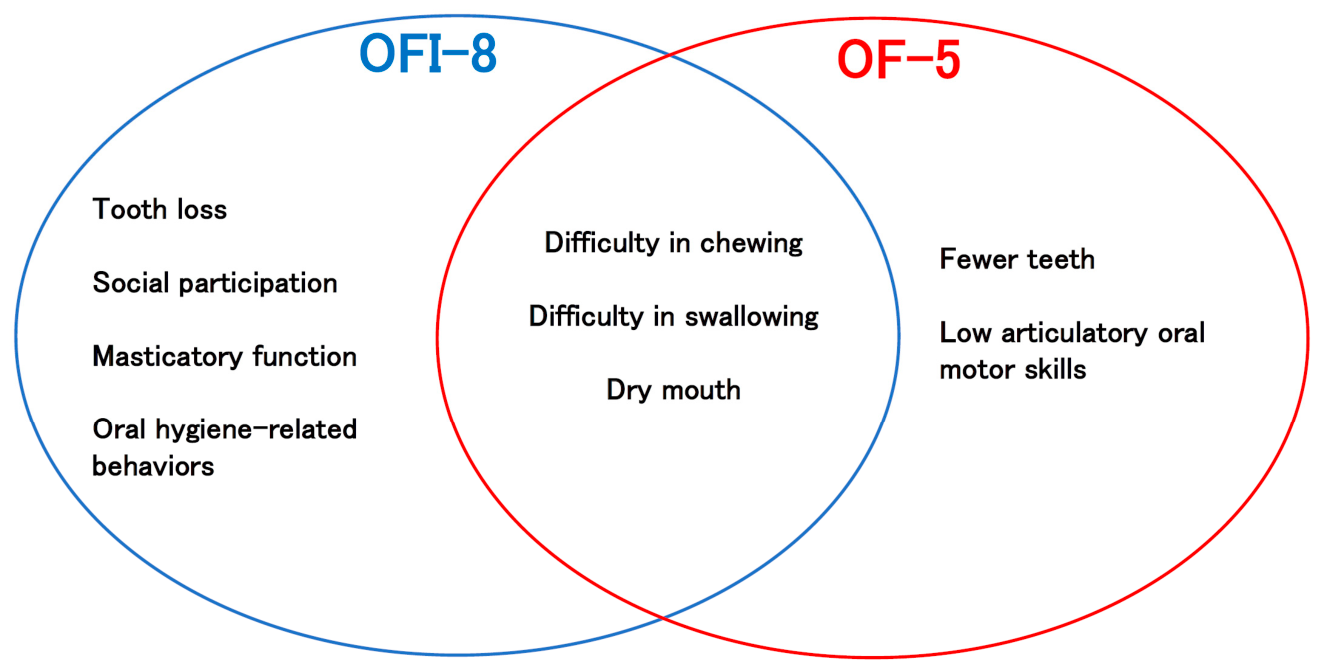
Figure 2.
Risk stratification of OFI-8 according to OF-5 scores in general internal medicine outpatients. Reproduced from Reference 21.
Figure 2.
Risk stratification of OFI-8 according to OF-5 scores in general internal medicine outpatients. Reproduced from Reference 21.
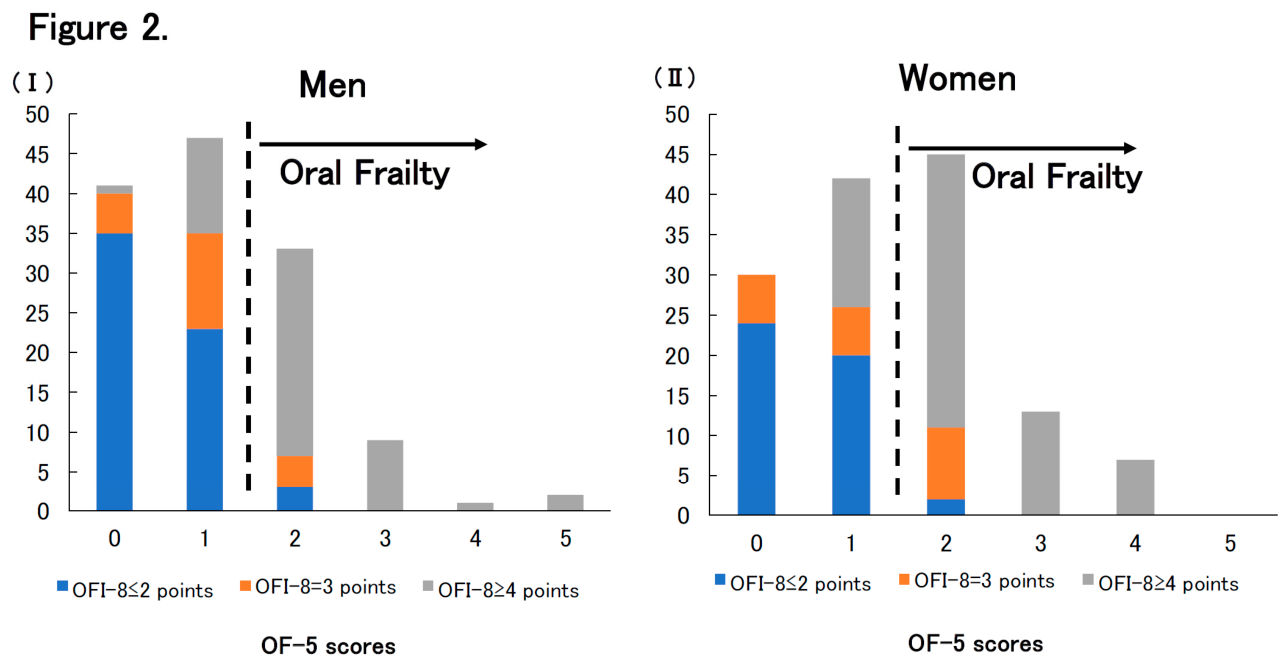
Figure 3.
Conceptual framework for the integrated assessment of oral and physical frailty. Questionnaire-based screening tools (OFI-8 and OF-5) are used to assess oral frailty, while cystatin C–related indices provide objective biomarkers reflecting skeletal muscle status and physical frailty. Integrating these complementary approaches may enable earlier detection of frailty and promote multidisciplinary medical–dental collaboration. Reproduced from Reference 22.
Figure 3.
Conceptual framework for the integrated assessment of oral and physical frailty. Questionnaire-based screening tools (OFI-8 and OF-5) are used to assess oral frailty, while cystatin C–related indices provide objective biomarkers reflecting skeletal muscle status and physical frailty. Integrating these complementary approaches may enable earlier detection of frailty and promote multidisciplinary medical–dental collaboration. Reproduced from Reference 22.
Disclaimer/Publisher’s Note: The statements, opinions and data contained in all publications are solely those of the individual author(s) and contributor(s) and not of MDPI and/or the editor(s). MDPI and/or the editor(s) disclaim responsibility for any injury to people or property resulting from any ideas, methods, instructions or products referred to in the content. |
© 2026 by the authors. Licensee MDPI, Basel, Switzerland. This article is an open access article distributed under the terms and conditions of the Creative Commons Attribution (CC BY) license.
Copyright: This open access article is published under a Creative Commons CC BY 4.0 license, which permit the free download, distribution, and reuse, provided that the author and preprint are cited in any reuse.