Preprint
Article

This version is not peer-reviewed.

Total and Inorganic Arsenic in Sargassum spp.: Implications for Waste Classification under the Mexican Regulatory Framework and its Use as a Raw Material

Submitted:

31 July 2026

Posted:

03 August 2026

You are already at the latest version

Abstract

The macro algae Sargassum spp. reaching the beaches of Quintana Roo, Mexico, has represented an environmental problem since 2011 due to its massive influx and the lack of adequate instruments for its management, treatment and final disposal. Physicochemical parameters of the macroalgae were evaluated in samples collected from three beaches in Quintana Roo during 2020, 2023 and 2025. Total and inorganic arsenic concentrations were determined using an alternative method based on hydride generation atomic absorption spectrometry coupled with an automated cryotrapping system and flow injection analysis system (HG-AAS-AC-FIAS). From the perspective of Mexican waste regulations, sargassum is classified as Special Management Waste (SMW) and is considered non-hazardous waste since arsenic concentrations in aqueous phase did not exceed the maximum permitted limit of 5 mg/L established by NOM-052-SEMARNAT-2005. Therefore, its management should comply with NOM-061-SEMARNAT-2011 that deals with SMW. However, as a potential raw material, sargassum contained total arsenic concentrations of 22.272 ± 0.598 mg/kg dw (2020), 12.46 ± 0.5 mg/kg dw (2023) and 170.67 ± 13.614 mg/kg dw (2025). Inorganic arsenic was detected in 2023 and 2025 samples at 10.005 ± 0.042 mg/kg dw and 68.63 ± 0.106 mg/kg dw, respectively. These findings highlight the need for specific management, treatment, disposal and clear guidelines for its use as a raw material for sargassum valorization.

Keywords: 
;  ;  ;  ;  ;  

1. Introduction

1.1. Sargassum Influxes and Environmental Problems

Sargassum is a type of brown and pelagic macroalgae that is not rooted to the ocean floor and floats freely depending on the movements of ocean currents. It belongs to the genus Sargassum spp. and in the Caribbean region the predominant species are Sargassum fluitans and Sargassum natans [1]. The geographical region affected by the presence of sargassum ranges from Barbados to the Dominican Republic and Mexico [2] that are affected by the algae mantle every year [3]. Regarding the origin of the recent massive sargassum influxes in the Caribbean, some hypotheses have been proposed. The first and traditional postulates that sargassum originated in the Sargasso Sea was transported to the Caribbean by changes in marine movements because of variations driven by climatic variability. However, a second hypotheses stablished by [4] demonstrated that satellite observations identified a new source region located in the north of the Amazon River mouth, off the Brazilian coast, where extensive sargassum blooms were first detected in 2011 before spreading westward to the Caribbean and eastward to the coast of West Africa. Subsequently, (5) this hypothesis was supported by reporting that the morphology of the dominant sargassum population and the unprecedented biomass recorded in the Caribbean differed from those of the Sargasso Sea population. They further proposed a third hypothesis which postulates that the nutrient rich waters of the Amazon basin and the North Atlantic recirculation region, enriched mainly with Nitrogen (N) and Phosphorus (P), promote rapid macroalgal growth, allowing Sargassum fluitans and Sargassum natans to double their biomass in approximately 11 days compared with about 50 days under the oligotrophic conditions of the Sargasso Sea (5). Finally, (6) expanded this hypothesis by proposing that the blooms develop within the North Equatorial Recirculation Region (NERR), a large recirculation system connected to the Amazon plume and the Gulf of Guinea, explaining the simultaneous transport of sargassum toward the Caribbean and the western coast of Africa.
In Mexico, where the presence of sargassum dates from 2011 to date on some beaches of Yucatan and Quintana Roo states in the Mexican Caribbean region. This represents an ecological, touristic, economic, and health problem (7) that manifests especially in the state of Quintana Roo, where tons of seaweed residues from the landing of sargassum have become a problem of management, treatment and final disposal. Although the problem of abundant seaweed residues that land on the beaches of Quintana Roo is already a natural phenomenon expected during the autumn and winter months (2), it was around 2011 that increments in sargassum were noticed and it was in mid-2014 and before the end of 2015 when the effects of excessive amounts of sargassum on the beaches were reflected by emitting a fetid aroma from decomposition of this macroalgae and by the generation of turbid brown waters in the vicinity; these were called “the brown tides of sargassum” (8). Quantifications of the amounts of sargassum arriving in Quintana Roo state have been officially reported since 2016 on the websites of the Ministry of the Environment of the state (9)(SEMA after its Spanish acronym) and the Ministry of the Navy (10) (SEMAR after its Spanish acronym). Figure 1 shows a summary of the amounts reported over the last ten years.
To compare the information shown in Figure 1 above, we outline how some previous studies have documented the unprecedented increase of pelagica sargassum influexes since 2011 and have reported the magnitude of individual stranding events ussing diferent metrics, including floating biomass coverage, beach-cast biomass density, or localized accumulation volumes (11), (12), (13), (14). Most of the article sources about quantities of sargassum in the Caribbean have been focused on massive influexes that become recurrent in the Great Atantic Sargassum Belt in the complete region of the Caribbean (not only Quintana Roo, Mexico), where millions of tonnes of stranded biomass and generating significant environmental and socioeconomic impacts. In the Mexican Caribbean, biomass accumulation has been reported at up to 2,360 m3/km during the 2014-2015 events, while stranded biomass reached up to 20 kg wet weight m2 during 2018-2019 (5), (14).

1.2. Transition from Biomass to Waste?,

The entire beach region of the Mexican Caribbean where high volumes of sargassum arrive has complications due to the macroalgae management and treatment as waste since its removal from the ocean. Because sargassum reduces the circulation of water and fresh nutrients, it begins to decompose and its coloration changes to a dark brown in all sections of the plant releasing gases and moisture. This decomposition process can occur in a few days or up to a week additionally producing a foul odor (15). Decomposition can also occur even on localized coastal water if it remains immobile for a prolonged period.
The problem of the presence of sargassum also causes a severe economic impact due to low influx in the tourism sector and beach cleaning expenses (16). In Mexico, tourism activity in this region amounts to half of the national income of the entire tourism sector; as an example, in 2018 the income amounted to 11.5 billion dollars. As for the impact on health, the presence of sargassum represents a danger as it remains as an accumulated residue on the beaches because after 48 hours, large amounts of toxic gases are produced by decomposing organic matter; including hydrogen sulfide (H2S) and ammonia (NH3), causing severe effects in humans (17).

1.3. Current and Emerging Valorization Pathways

In the search of alternatives for the sargassum that arrives in abundant quantities on beaches in Mexico and other countries, there are precedents in research that have already used macroalgae of the genus Sargassum spp., the same genus as the sargassum that arrives in the Mexican Caribbean in Quintana Roo. The diversity of products that used macroalgae as a raw material have characteristics of energy value, construction materials, animal feed, fertilizers or soil improvers, and extraction of elements for pharmaceutical and cosmetic purposes. The specific uses that have been applied are shown in Table 1.
Although the purpose of implementing sargassum as a raw material is diverse, and its functionality covers different areas, it is necessary to consider the physicochemical properties of the macroalgae, since it has a high content of heavy metals, especially arsenic (As) ((28), (29)), a highly toxic and carcinogenic metalloid. This characteristic, in addition to limiting its use as raw material, can be considered an indicator that alerts about the type of waste that sargassum becomes.

1.4. Sources, Uptake, and Speciation of Arsenic in Sargassum spp.: implications for environmental risk
As is classified as group A of human carcinogens; the main sources of As are volcanic emissions containing this element and process industries such as chromed copper arsenate smelting to treat wood, solid mining waste and agrochemicals (30). As can be found in different oxidation states: arsenate (As (V)), arsenite (As (III)), As elemental (0) and arsenide (As (-III)); however, it is being found more frequently as species in their inorganic form of As (V) or As (III), the latter being 70 times more toxic than methylated species and 10 times more toxic than arsenate; both are water soluble forms toxic to living organisms (31).
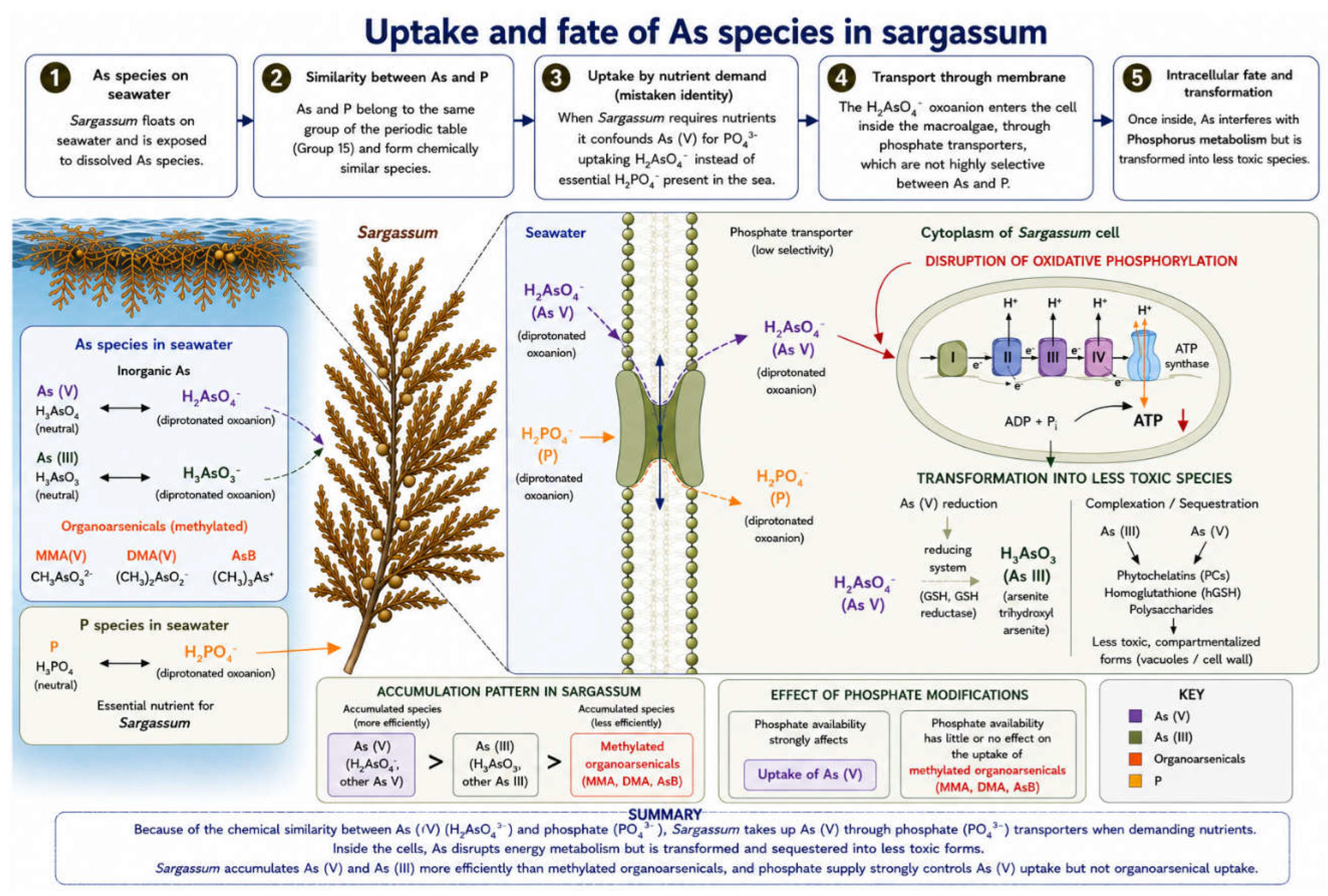
Brown sargassum species commonly contain higher total As and relatively larger inorganic As fractions compared with many red/green seaweeds, but absolute values vary by species and sampling context; the uptake is driven largely by phosphate (PO43-) mimicry and modified by salinity, PO43- presence and macroalgae biotransform As (V) via reduction and methylation while employing detoxification and sequestration pathways (32), (33), (34) . As (V) and As (III) are the inorganic As species that pose the greatest toxicological risk associated with As in water; even more than organic species (35). The aforementioned As species are introduced into the sargassum system when it is floating at sea; this process occurs due to the similarity between As and P, those two elements form similar species because those are in the same group of the periodic table and when sargassum requires nutrients it confounds P species with As species in seawater founding As (V) as deprotonated oxoanion H2AsO4- instead of a fundamental nutrient present in seawater as the deprotonated oxoanion H2PO4-. Then, the oxoanion H2AsO4- goes through the sargassum's membrane transport system that is not very selective when differentiating between As and P species, so, the As specie is disrupted by the oxidative phosphorylation process, however, the macroalgae have the ability to transform inorganic As into less toxic species (36). The macroalgae accumulates As (V) and As (III) more efficiently than methylated organoarsenicals, and PO43- absorption is strongly affected by As (V) uptake but not by organoarsenicals uptake (37), (14). The As bioaccumulation is enhanced under phosphorus-limited conditions, this condition is demonstrated by the experiment of (14) who showed that there is a competence between As (V) and PO43- for the same cellular transporter.
Figure 2. Diagram of the uptake, intracellular transformation, and accumulation of arsenic species in sargassum. Design developed by authors based on the present study and published literature cited in the description provided before.
Preprints 226009 g002
The presence of As in sargassum complicates its use as a raw material for any purpose due to the risk of producing hazardous products. Simultaneously, there is a growing interest about its physicochemical properties to get a characterization to transform this complex biomass into a reliable raw material (38), (39), (40), (37), (14). When considering the toxicity factors involved in the contact of As through sargassum or any of these destinations, the maximum permissible limits of As in different media and popular products detected are shown below (Table 2).
Although the presence of TAC in sargassum has been previously reported, the occurrence and of IAC species remain insufficiently documented and require confirmation. Since both total and inorganic As may determine compliance with maximum permissible limits established for different applications, their quantification is essential for evaluating the potential use of sargassum. When this information is integrated with the basic physicochemical profile of the macroalgae, it provides a basis for assessing whether sargassum can be considered a suitable raw material or should instead be managed according to a specific waste classification. Therefore, this study focuses on the premise that TAC and IAC with the physicochemical profile of biomass constitute key parameters for supporting regulatory classification and for defining appropriate strategies for the collection, management, utilization, and final disposal of sargassum in Mexico.

2. Materials and Methods

Primary and secondary data were used in this research. Secondary sources included international and national scientific literature, legal documents, technical guidelines, environmental regulations, and other relevant documentary sources. In addition to supporting the experimental component of the study, these documents were systematically reviewed to analyze the regulatory framework applicable to sargassum management and arsenic related criteria in Mexico. This documentary and regulatory framework analysis was conducted to identify the legal instruments governing waste classification, management, treatment, final disposal, and potential valorization pathways for sargassum biomass.
The review documentary sources were chronologically and thematically evaluated and was integrated with the experimental results obtained from physicochemical characterization and As determinations. This way the interpretation of analytical findings was made following environmental regulations which facilitated the assessment of whether current regulatory instruments adequately address the dual condition of sargassum as waste and a potential raw material.
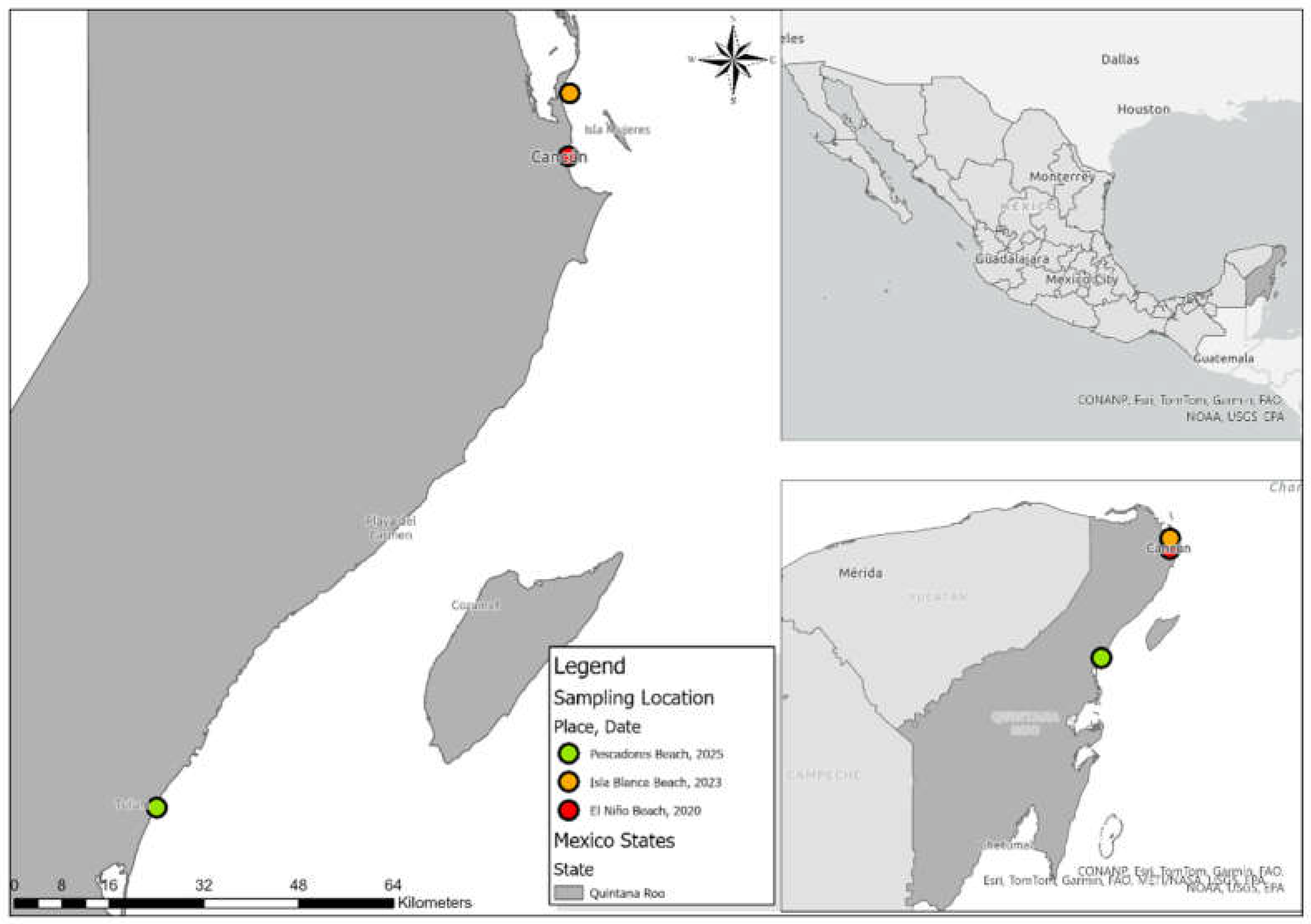
The experimental determinations were conducted using subsamples of fresh sargassum (mixed species of Sargassum fluitans and Sargassum natans) collected while floating at sea near the beach; subsamples were taken at equidistant points, both horizontally and vertically to ensure representations across heights and depths within a batch, thereby yielding a homogeneous sample derived from these subsamples, with a total sample weight of 5 to 8 kilograms per sampling location; the standard that was taken as a basis was the Mexican standard (53). Figure 3 shows the location of the collection points of the samples analyzed in three different years and the corresponding beaches, which were selected for their accessibility to sargassum. The reason for selecting these sites was for specific collections of batches of homogenized sargassum samples for general physicochemical analysis. The first sample was collected on July 2020 at "El Niño" beach (coordinates 21°11 ́ 36.4" N and 86°48 ́ 22.1" W) in Quintana Roo-Mexico, the second sample was collected on August 2023 at "Isla Blanca" beach (coordinates 21°17 ́ 20.4" N and 86°48 ́13.4" W) and the third sample was collected on November 2025 at “Pescadores” beach (coordinates 20°12'18.69" N and 87° 25' 50.73" W).
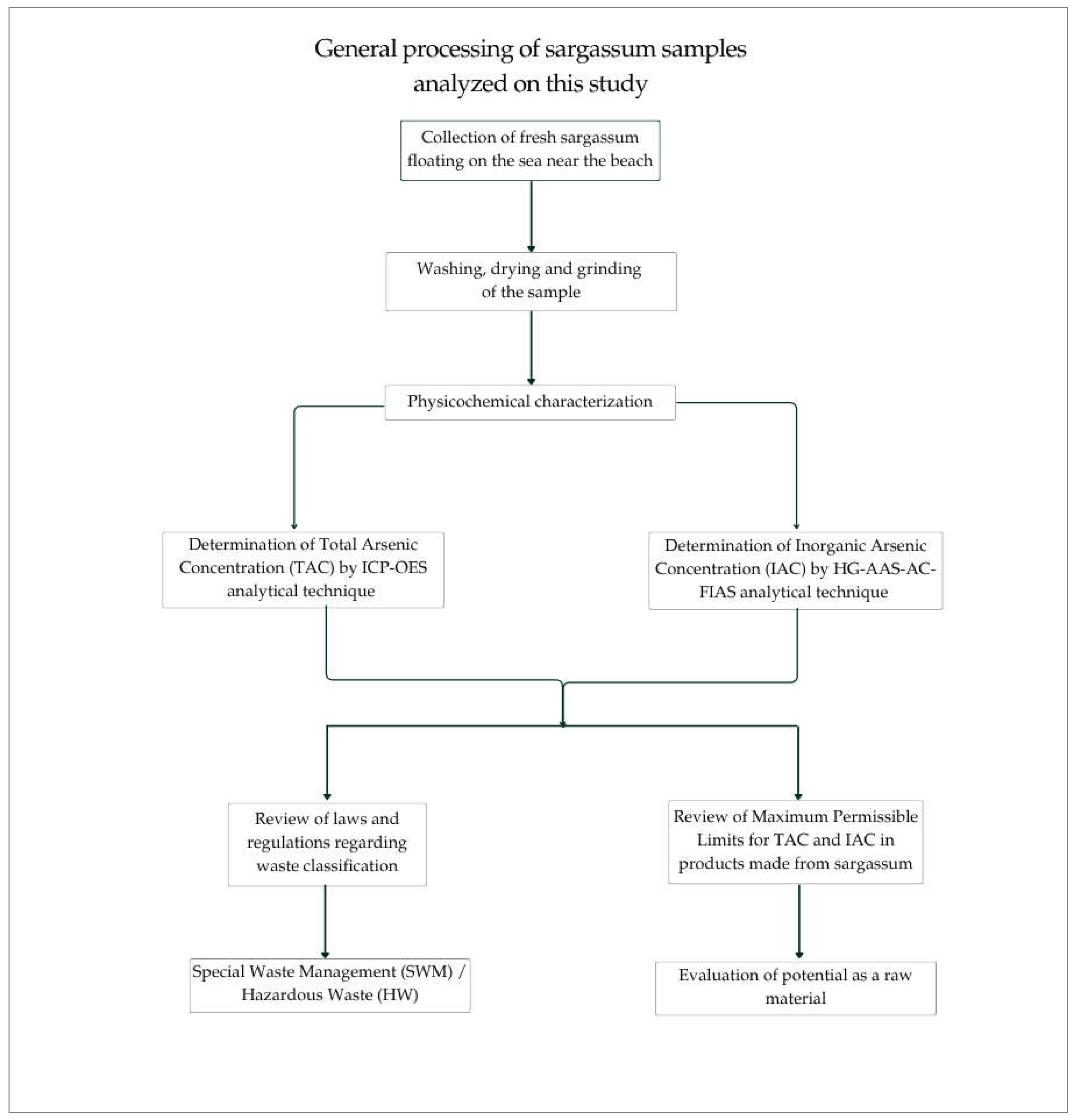
The methods used at the laboratory level were determined according to (54), in which a portion 1:5 of wet sargassum and distilled water was used to quantify the parameter of pH, conductivity and oxidation-reduction potential (ORP). Fresh sargassum was used to determine percentage of moisture content by gravimetric methods and drying, amount of total solids by calcination in an oven at 70 °C and volatile solids by calcination in muffle at 550 °C; for each determination, a triplicate was made. The determination of the TAC was performed according to the plate digestion method (55), it was quantified by Inductive Coupled Plasma Optical Emission Spectroscopy (ICP-OES), Agilent 5800, PerkinElmer, following acid digestion with HCl, H2O2, HNO3. The proportion of potentially toxic arsenic species was estimated by comparing the sum of inorganic As (iAs), monomethyl As (MAs), and dimethyl As (DMAs) with total As (TAs) with triplicate in all the samples. The general processing of collected sargassum samples in this study is shown in Figure 4, the details on every physicochemical parameter and As determination are described on the paragraphs following the diagram.

2.1. Determination of Inorganic Arsenic Species and Methylated Derivatives

Dried and powder sargassum samples collected in 2023 and 2025 were analyzed in triplicate at the Toxicology Department of the Center for Research and Advanced Studies (CINVESTAV, by its Spanish acronym) following an adapted methodology based on (56). Prior to analysis, samples were digested with 2M H3PO4, followed by dilution and reduction with cysteine (final concentration 2%).
Arsenic speciation (iAs, MAs and DMAs) was determined using hydride generation atomic absorption spectrometry coupled with an automated cryotrapping system (HG-AAS-AC) equipped with a flow injection analysis system (FIAS) (PerkinElmer) and an electrodeless discharge lamp (390 mA).
Under acid conditions (pH < 2), arsines corresponding to iAs (III +V), MAs (III+V), and DMAs (III+V) were generated via reaction with NaBH4 and separated in gas-liquid system using helium (He) as carrier gas (100 mL min-1). Arsines were subsequently trapped and thermally released using a cryotrapping system with a temperature gradient from -293 °C to 50°C. Species specific detection was achieved based on release temperatures: iAs (-55°C), MAs (2°C), and DMAs (36°C). Quality control was ensured using the certified reference material SRM 3639 (NIST). The method showed high precision (CV < 10%) and accuracy values of 99% (iAs, 98% (MAs), and 101% (DMAs)).
The proportion of potentially toxic arsenic species was estimated by comparing the sum of iAs, MAs, and DMAs with total arsenic. The percentage of inorganic arsenic relative to total arsenic was calculated as:
i A s T A s x 100
This approach allows differentiation between toxic As species and non-toxic organic forms (e.g., arsenobetaine, arsenosugars, and arsenolipids), providing a robust assessment of As speciation in sargassum samples.

3. Results and Discussion

3.1. Review of current mechanisms implemented for the management of seaweed residues from sargassum in Quintana Roo-Mexico.

In order to avoid ecological impacts when burying or dumping the collected sargassum residues on the beaches, the Mexican Government, with the support of scientists and tourism entrepreneurs, implemented strategies for the containment and management of sargassum through the Ministry of the Environment and Natural Resources (SEMARNAT after its Spanish acronym) with the guidelines in 2015 that allow the disposal of the macroalgae collected on the beach (57). In 2019 these Technical and Management Guidelines for the Contingency caused by Sargassum in the Mexican Caribbean and the Gulf of Mexico ( LTGACSCMGM after its Spanish acronym) continued in discussion with experts on the subject and while defining an emerging standard; the document stipulates in detail the aspects to be complied with to execute six main activities: 1. Collection of sargassum on the high seas, 2. Containment of sargassum in marine areas near the coast, 3. Removal of sargassum in the containment barriers, 4. Removal of sargassum from the beach, 5. Management and final disposal of sargassum, and 6. Protection of turtle camps and nesting areas. The latter focuses on the preservation of adequate conditions on beaches assigned for turtle nesting and avoiding harming them due to the presence of machinery for collecting sargassum, while also promoting knowledge on the management of this fauna that may be present among the sargassum that is collected.
All the actions mentioned in the guidelines are mainly focused on preserving the beaches and the tourist image, as well as the preservation of turtles, all through physical containment barriers, strategies with equipment and personnel for collection, but not with the implementation of processing that is effective in order to minimize negative impacts and also take advantage of the sargassum waste. It is important to note that these guidelines are not part of any emerging regulations that make them mandatory.
Another mechanism that has been developed at the local level for the management of sargassum is the creation of the “Comprehensive Strategy for the Management and Use of Sargassum in Quintana Roo” (EIMAS after its Spanish acronym) (58), whose objective is to establish actions for comprehensive management that serves protocols and decision-making, a public/private synergy to address the sargassum problem through implemented and improved practices for the benefit of the environment, human health and tourism, and promote productive development, investment and prioritize the use of the macroalgae. However, the actions mentioned above focus on administrative procedures for implementing actions for the transfer, final disposal, or utilization of sargassum, as well as local procedures when sargassum arrives on the beaches. The EIMAS mentions the removal of sand from sargassum that is already dry or semi-dry, a drying process before its disposal as bio-waste or polluting residue in the case of fresh sargassum if it is in a state of decomposition. It should be noted that the disposal sites established in EIMAS are declared to be temporary.
In the case of landed and collected sargassum, in accordance with Article 69 of the “Law for the Prevention, Integral Management and Circular Economy of Waste of the State of Quintana Roo “(59) (LPGIECREQR after its Spanish acronym), it is considered a bio-waste, whose management is an obligation of the State.

3.2. Analysis of the Mexican legislative framework, standards and regulations applicable to sargassum residues for classification and management.

This section explores the current Mexican regulatory framework in which we can place sargassum as a residue (waste). It should be noted that no standard was found for sargassum and its integral management, which is why, in the first instance, it was considered (due to its plant structure) as an organic waste that arrives at the state of Quintana Roo in high volumes. The regulations that were analyzed were in environmental matters, especially those referring to waste. Federal, state and municipal jurisdiction were investigated.
In order to deepen and specify the guidelines and law for the management and handling of sargassum as a waste, a search for a classification was carried out in the environmental law, official and voluntary standard, specifically all about waste classification and management. Table 3 shows a summary of the jurisdiction to which each law, rule or regulation analyzed to classify the sargassum waste belongs. The absence of regulations for its correct management and handling is considered an impediment, therefore, the determination and inclusion of sargassum as waste is a necessity. It is important to note that, as a courtesy to the reader, the authors are providing non-official translations of the legal documents.
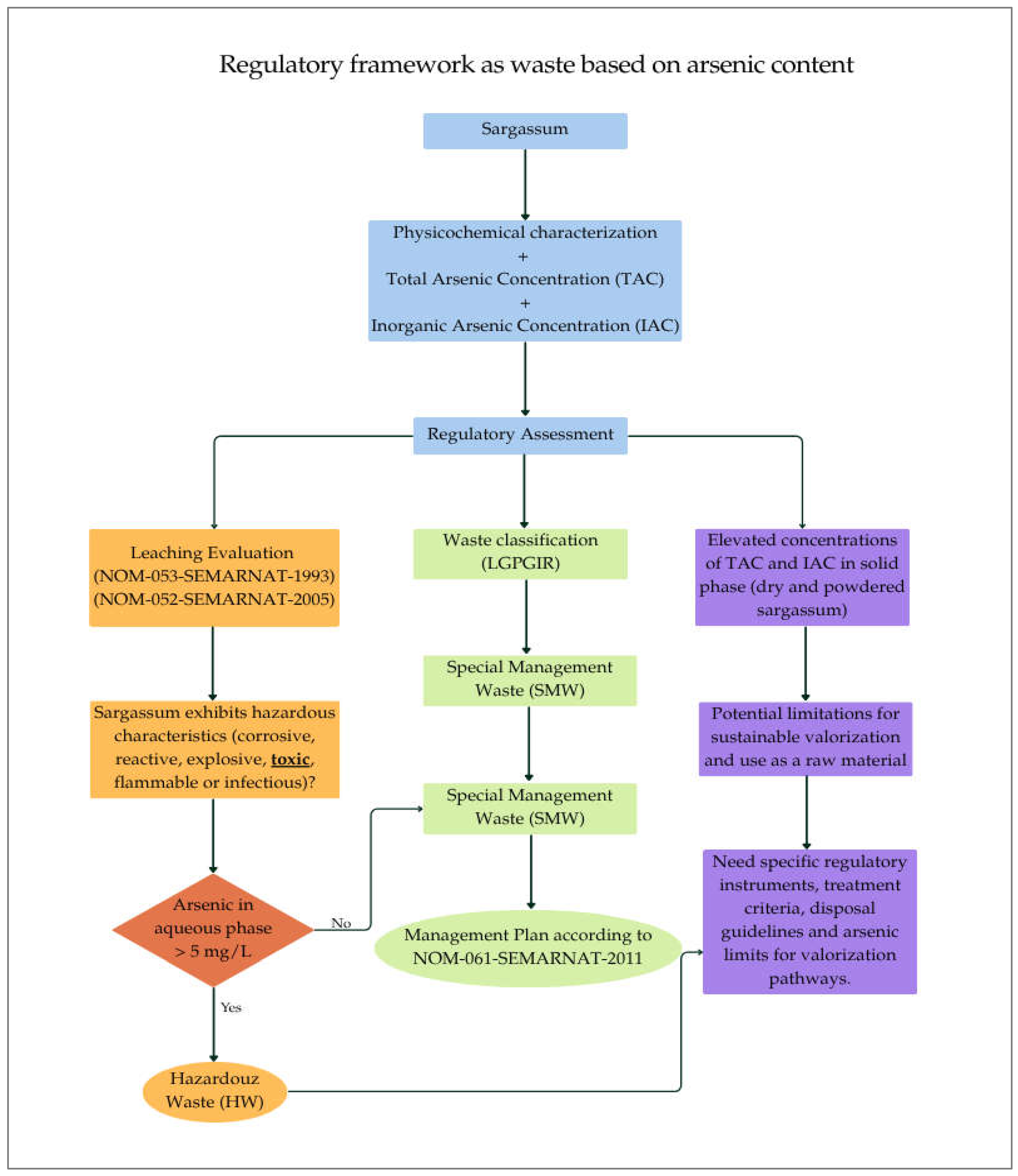
As a result of the above, the management of sargassum is a complicated issue because the authority on whom such responsibility befalls depends on the area in which the sargassum is located; that is, in principle, sargassum floating in the ocean (considered as flora found in its habitat) which is the maritime zone of Mexico, is the responsibility of the Navy when managing it as a fishing resource and, from a waste management perspective, it would be a Federal attribution to classify it as Hazardous Waste (HW) if it met any of the characteristics determined by such definition. However, in the case of sargassum that reaches the beaches and is deposited on the sand within the territory), it is considered a category of non–hazardous waste that requires specific management measures because it is organic and arrives in high volume quantities; this classification in Mexico is called Special Management Waste (SMW) due to its composition and structure, therefore the responsibility lies with the municipal government where the affected beach is located. Figure 5 summarizes the ways in which sargassum can be classified as waste based on its TAC and IAC.
According to the analysis of Table 3 and following the diagram in Figure 5, the suggestion to classify sargassum as an organic type and SMW is reaffirmed, therefore, NOM-061-SEMARNAT-2011 (63) is applicable and establishes the criteria for classifying this kind of waste and determining the procedures for the formulation of management plans. The amount of waste generated in order to carry out its management is for quantities greater than 10 tons per year considering that a cubic meter of sargassum is approximately 0.275 tons in weight. According to NOM-161-SEMARNAT-2011, the management plan is the instrument for increasing resource recovery, reducing final disposal, and ensuring an accurate environmental management. In the case of the sargassum management plan, it should include at least the following elements: 1. Waste assessment; 2. Plan objectives; 3. Stakeholders (state and municipal authorities, collection and recovery companies, as well as collection centers and final disposal sites); 4. Comprehensive management framework. 5. Criteria for utilization; 6. Monitoring mechanisms. Regarding the cost of the management plan and its implementation, given the nature of massive sargassum arrival, the most legally and technically viable option would be a hybrid management plan financed by many stakeholders, such as the government of the State of Quintana Roo, coastal municipalities, the tourism sector, companies seeking to recover value from sargassum, and Federal funding.
Additionally, to confirm or refute whether sargassum is a HW, it is necessary to apply NOM-052-SEMARNAT-2005 (46); if a waste is hazardous it must check any option of the Mexican standard lists. Arsenic appears in lists two and three with a maximum concentration of As of 5 mg/L. It is worth noting that, in order to compare with waste regulations, the data used must be in aqueous phase, so in the case of the results of TAC in sargassum from 2020, 2023 and 2025 data were obtained directly from the readings of the ICP-OES equipment and those are expressed in mg/L, and then those were transformed into mg/Kg for solid-phase.
The results in aqueous phase from samples collected in 2020 resulted with 0.4454 ± 0.0120 mg/L, a sample from 2023 with 0.0128 ± 0.0005 mg/L and a sample collected in 2025 with 1.707 ± 0.136, so, in accordance to numeral 5.1.4 from NOM-053-SEMARNAT-1993 (64) when characterizing a residue to classify it as hazardous or not, arsenic concentration can be compared directly to the list of NOM-052-SEMARNAT-2005 (46) and samples are not classified as hazardous waste because none of them go up the maximum concentration of 5 mg/L for As.
The importance of considering the aqueous phase of sargassum to characterize the leachate it produces during and after its decomposition lies in the fact that applicable regulations focus on this leachate to assess the toxicological risk that can result from the improper disposal of waste. To illustrate that As could migrate in the leachate, the study of (65) found in their leaching experiment from Sargassum spp. the lowest TAC of 7.49 mg/L and the highest concentrations of 14.34 mg/L; therefore, when those concentrations are compared to the same criteria of our samples, both concentrations reveal that Sargassum spp. could be a HW. The same occurs with the study of (66) with TAC of 12.81 mg/L. Other authors who report information from the leachate of sargassum which comes from the Caribbean were (67) found initially 10 mg/L of TAC and 1.5 mg/L after 90 days of experimental monitoring of As in aqueous phase; according to NOM-052-SEMARNAT-2005, this value is classified as hazardous waste at the start of the experiment. Hence the need to characterize sargassum and its leachate by regions and season, in order to consolidate a more conclusive result regarding the management and disposal currently given to it because as it is declared in the study of (66), in the Caribbean region, especially in the Yucatan Peninsula in Mexico that includes the state of Quintana Roo, the ground-water flow occurs from the inland aquifer toward the coast through an extensive network of underground rivers and, as a consequence, a fraction of the leaching product of sargassum decomposition infiltrates into the subsurface representing a serious risk to the aquifer when sargassum is on the beaches and then when it is deposited in dump sites without geomembranes and with the incorrect infrastructure for the treatment and management of leachates.

3.3. Basic characterization of physicochemical parameters of sargassum

A mechanism to avoid the indiscriminate and uninformed use of sargassum as a raw material in a process or product is to generate information on the physicochemical parameters that the macroalgae possesses and, thus, define its profile and the functionality for which it can be used. Regarding the concentrations of As, it is important to verify that, depending on the use, the minimum concentration allowed by different agencies must be met. Table 4 below shows the results of the parameters determined on representative samples of sargassum collected on 2020 at El Niño beach, on 2023 at Isla Blanca beach and on 2025 at Pescadores beach; all of them in the state of Quintana Roo, Mexico. Data are reported as mean ± standard deviation. The results of other authors who reported some samples collected of the same species of sargassum on beaches in the same region of the state are also shown.
The physicochemical parameters measured in this study: pH, conductivity, oxidation-reduction potential (ORP), moisture content, and solid fractions, provide a critical environmental context for interpreting As accumulation and speciation patterns. Environmental conditions experienced by sargassum biomass and the biochemical processes ocurring within and around the macroalgal tissues are reflected by this parameters.

3.3.1. pH values and arsenic speciation

The pH value in the sample collected at El Niño beach in 2020 tends to a basic value (8.12 ± 0.150) and is similar to the typical seawater pH (approximately 8.1-8.2) and suggests a relatively fresh biomass or minimal decomposition at the time of sampling. The pH value found in the sample collected in Isla Blanca beach in 2023 is an alkaline value (9.35±0.05) and it could indicate active photosynthesis and CO2 consumption in relatively fresh biomass; the value found in Pescadores beach in 2025 is practically neutral (7.75 ± 0.208) and it reflected a possible partial decomposition with organic acid production of microbial respiration generating CO2 or exposure to more acidic environmental conditions. The significant contrast in 2023 suggests changes in the chemical composition of sargassum, possibly due to the degradation of organic matter or the presence of carbonates released during its decomposition (71).
There is a close relationship between pH variations and the As speciation, bioavailability, and blinding chemistry in aqueous systems; this occurs because the influence of the protonation state of As (V) and As (III) species affects their charge, solubility, mobility and bioavailability. In this study the pH range observed goes from 7.75 - 9.35 because As (V) exists as HAsO42- and AsO43- species (the pKa values for As (V) are approximately 2.2, 6.9 and 11.5) because As (III) exists primarily as the neutral species H3AsO3 at pH < 9.2 and begins to deprotonate to H2AsO3- at higher pH values (pKa ≈ 9.2). In the case of a high pH level, like Isla Blanca sample (9.35 ± 0.05), it would favor the deprotonated As (V) form (AsO43-) and partial deprotonation of As (III), binding to cell wall functional groups, and intracellular speciation. For a lower pH value, in the case of Pescadores beach (7.75 ± 0.208), it would favor the dominant As (V) species in the HAsO42- form and maintain arsenite in its neutral form affecting membrane permeability and transport dynamics.

3.3.2. Oxidation-Reduction Potential and the arsenic redox chemistry

The speciation between As (V) and As (III) is monitoring with ORP parameter for the identification of reducing or oxidizing conditions in the medium. While oxidizing conditions that thermodynamically favor the predominance of speciation for As (V) over As (III), negative ORP values indicate reducing conditions that favor As (III) formation. According to (72) the change in the value of ORP at El Niño beach (90.57 ± 2.411 mV) shows an oxidizing environment, which would maintain As (III) form. In the case of the sample from Isla Blanca, the ORP reading is in a reducing environment with -16.33 ± 2.050 mV and then -33.67 ± 2.517 mV in the sample of Pescadores beach; this change in reducing conditions suggests oxygen depletion within biomass aggregations, decomposition of the macroalgae due to the presence of anaerobic microorganisms or exposure to anoxic sediments (73).
The relationship of arsenic speciation and ORP values is influenced by kinetic as well as thermodynamic factors and as documented by (73), As (V) to As (III) reduction during sargassum culture experiments, where intracellular reduction processes varies across salinity treatments and species. The environmental redox conditions can also influence arsenic speciation in the surrounding water and within biomass microenvironments; this factors provides information to associate the negative ORP in Pescadores sample (-33.67 ± 2.517 mV), combined with the high total arsenic concentration with 170.67 ± 13.614 mg/kg dw and lower inorganic arsenic proportion (40.2%), which suggest a complex redox environment potentially involving both arsenate uptake under aerobic conditions during the floating phase of sargassum and subsequent reduction and biotransformation under reducing conditions during stranding and decomposition. In the case of the negative ORP value at the Isla Blanca sample (-16.33 ± 2.050), despite its high inorganic arsenic proportion (80.3 %), it suggests that reducing conditions alone do not necessarily drive extensive conversion to organic arsenicals; other factors can play a role, such as metabolic activity, microbial community composition, and residence time. The positive ORP at El Niño sample (90.57 ± 2.411 mV) is consistent with the moderate total arsenic concentration with 12.46 ± 0.5 mg/kg dw and agrees with the biomass state, which was sampled under relatively fresh, aerobic conditions with limited decomposition.

3.3.4. Conductivity, salinity, and arsenic uptake kinetics

Ionics strength, conductivity and salinity are connected in the aqueous environment because they are present surrounding and into the biomass. In the case of salinity, this is a critical environmental modulator of arsenic uptake in marine algae, the study made by (73) found that higher salinity promoted more rapid arsenic uptake across all species, their experiments were made with other sargassum species which presented a faster uptake kinetics at higher salinities and it demonstrated different mechanisms like transforming processes increasing sodium and chloride concentrations; those may influence electrochemical gradients driving As (V) uptake, and higher salinity may alter the activity and speciation of As (V) in solution thus affecting its bioavailability (73).
In this study, variations in conductivity results shows dramatically across the collection sites. Conductivity in sargassum from El Niño beach is extremely high with 1258.33 ± 8.852 μS/cm, which relates to the presence of salts, attributed to the washing of this sample to remove sand reflecting recent arrival from the open ocean and it explaining the moderate total arsenic concentration obtained at this beach (22.272 mg/kg dw). Samples collected in 2023 from Isla Blanca beach register a conductivity value of 58.33 ± 1.528 µS/cm, which indicates freshwater dilution or a leaching process (29) with rainfall or rainwater exposure mobilizing soluble ions from biomass which reduces conductivity and potentiates leaching some arsenic species. The low salinity level refers to a slow As uptake kinetics, this information based on the experiments of (73) and explains the lowest TAC (12.46 ± 0.5 mg/kg dw) obtained on this sample. The value from Pescadores beach collected in 2025 presents 504.000 ± 28.00 μS/cm indicating substantial differences in salinity and ionic composition related to the highest TAC (170.67 ± 13.614 mg/kg dw), indicating that factors beyond salinity could control TAs accumulation.

3.3.5. Moisture content, decomposition state, and arsenic mobilization

There is an association between the percentage of moisture and the amount of total solids in the samples where the results on a dry basis increased significantly from the samples collected in 2020 and 2025 they contrast with the sample collected in 2023 which is attributed to greater water retention in degraded tissues or differences in the sampling conditions in which it could have been executed after the rains (74). In the case of El Niño beach moisture of 24.25 ± 6.70% indicates substantial drying and prolonged beach exposure or suggest that sampling was made from the upper beach zone. Isla Blanca beach present high moisture contents of 84.05 ± 0.373% and Pescadores beach presents 77.71 ± 1.26 % which are related to fresher samples or that they were collected from a region near the sea or lower beach where sargassum remains hydrated. The moisture influences As mobility and its speciation because hydrated biomass maintains active metabolic processes that can drive As biotransformation; high moisture also facilitates microbial activity and water content affects the partitioning of As between solid and aqueous phases.
To better understand this relation between moisture and its effect on As behavior a study by (75) showed that fresh sargassum with TAC of 85 mg/kg dw released approximately 50 % of its initial As to leachate over 120 days with residual biomass containing 55 mg/kg dw (75).
Another study related to moisture and TAC is the one of (76) where they calculated that 1 tonne of fresh sargassum decomposing at 27°C produces approximately 316 L of leachate containing ≈ 5.67 g of As, representing substantial mobilization of As from solid biomass to aqueous phase. These investigations showed that the decomposition process of sargassum can significantly alter As concentrations in residual biomass through differential loss of organic matter versus retention of As in recalcitrant fractions, and that microbial activity drives methylation and volatilization pathways (76).
On the other hand the total solids also contrast between all the samples, the discrepancy between these data is related to the presence of inorganic material such as sand (77). The ash content, shows fewer variations between the readings reported by our study with the sample collected in 2025 with respect to another author with a sample from Puerto Morelos in 2020 (61). This high ash content is attributed to the high content of minerals such as carbonates and silica, a common content in degraded sargassum (74).
Additional information about biomass composition and decomposition state is given with the two values of the volatile solid to total solid ratios (SV/ST). The lowest ration detected was 78.79 ± 0.16 % in El Niño beach sample and combined with the high ash content (75.77%), indicates more advanced mineralization or desiccation, potentially reflecting longer beach residence time or exposure to more extreme drying conditions. The higher SV/ST ratio at Pescadores beach sample with 85.42 ± 0.79 %, combined with the high total arsenic concentration, suggests that this biomass retained substantial organic matter despite potentially undergoing some biotransformation processes that converted iAs to organic forms (75), (76). The sample of the year 2020, with an amount of 2,210.1 ± 5 cal/g, is the only report of higher heating value as well as the reported lignin content of 26%.

3.4. Total arsenic concentrations and inorganic arsenic content in sargassum samples

The results on this research about TAC and IAC allow the observation of a trend of a temporal and spatial analysis of As characterization in sargassum biomass collected from three different beaches along the Quintana Roo, México, coast. The observed TAC ranged dramatically from 22.272 ± 0.598 mg/kg (dw) at El Niño beach, then with 12.46 ± 0.5 mg/kg (dw) at Isla Blanca beach and finally 170.67 ± 13.614 mg/kg dw at Pescadores beach. These values span nearly the range previously documented by other authors (mentioned in Table 3) for sargassum in Quintana Roo, Mexico and provide critical insights into the dynamic nature of As accumulation in this macroalgae.
The first study to report similarities in the values of TAC with samples from El Niño beach and Isla Blanca beach, is the one made by (29), who documented values from 24 to 172 mg/kg dw across 63 pelagic sargassum samples collected along approximate of 370 km of the Mexican Caribbean coastline between August 2018 and June 2019 (29). It is worth nothing that 86% of samples exceeded most of the maximum permissible limits of TAC given for different products mentioned in Table 2, so sargassum reported by those authors could have only been used for industrial land with a maximum TAC of 260 mg/kg dw.
Furthermore, recent studies of the geographical site provide additional information, (78) reported in sargassum sample TAC of 62.2 mg/kg dw on December 2023 sample and 89.0 mg/kg dw on March 2024 sample, both collected from the Mexican Caribbean prior to treatment (78). As it is observed, those values are intermediate between our samples from Isla Blanca beach and Pescadores beach, further confirming the substantial temporal and special variability characteristic of this system. Also, such results are similar to the results of (75), who reported 85 mg/kg dw TAC in fresh sargassum and this measure falls between El Niño beach and Pescadores beach.
In comparison to other sargassum species from other geographical regions, ecological and biochemical distinctions can be observed, an example is the study of (79) with Sargassum horridum from the Gulf of California, presenting a TAC value of 4.33 ± 0.20 mg/kg dw; this represents a small proportion of the Pescadores beach concentration (3%) and ten more times the value of Isla Blanca beach (35%). Those differences are attributed to habitat, hydrodynamic exposure, water column As availability, and residence time in As enriched environments. Other authors (80) reported similar TAC to our result from El Niño beach, but they worked with Sargassum gusiforme (hijiki), which is harvested for human consumption in Asian waters, so it allows to compare these cross-regional underscore that TAs accumulation in sargassum is not solely species-dependent, is strongly modulated by environmental bioavailability, oceanographic history and ecological context (80), (79).
In contrast, in Pescadores beach we obtained high value (170.67 ± 13.614 mg/kg dw). Some factor which may explain this value to the assumption that, Pescadores sargassum may have originated from a pelagic mat that traversed waters with elevated dissolved As concentrations, potentially influenced by upwelling zones, riverine inputs, or geothermal sources along its trajectory. In particular, one study of (29) attributed special variability in As content to differences in the prior trajectories of pelagic mats and whether they had traversed contaminated or As enriched waters before stranding. Another consideration in Pescadores beach is that the sampling was on November, which may reflect seasonal or inter-annual oceanographic patterns that favor As accumulation, such as changes in nutrient availability, water column stratification, or biological productivity that influence As uptake. Other hypotheses may consider that sargassum from this sampling may have experienced prolonged residence time on the beach or in nearshore waters prior to collection, allowing for continued As uptake from sediment pore water or decomposition related concentration effects. A study by (75) demonstrated that decomposition processes can alter As concentrations in residual sargassum due to differential loss of organic matter versus retention of As in recalcitrant fractions, although their experiment showed a decrease from 85 to 55 mg/kg dw over 120 days due to mass loss and leaching (75). However, we present different environmental contentions, concentration effects could theoretically increase residual As content. Finally, the high standard deviation we obtained (± 13.614) suggests substantial heterogeneity within the sample of sargassum, possibly reflecting mixing of material from different source mats or microenvironments with varying As exposure histories (29), (75).

3.4.1. Inorganic arsenic concentrations and speciation ratios, the toxicological significance

TAC results provide an important baseline information for exposure assessment and sargassum management decisions, concentrations of iAs species (As (III) and As (V)) are the paramount toxicological and regulatory significance. The present study quantified iAs in samples from Isla Blanca beach (10.005 ± 0.042 mg/kg dw, representing 80.3% of TAs) and Pescadores beach (68.63 ± 0.106 mg/kg dw, representing 40.2% of TAs), revealing a striking inverse relationship between TAC and the proportional contribution of inorganic species.
The iAs proportion of 80.3% in the sample of Isla Blanca exhibited the vast majority of accumulated As remained in inorganic forms. This result is close to that of several recent studies documenting high iAs fractions in brown seaweeds; the first study (80) reported 68% of iAs in Sargassum fusiforme (hijiki), a different sargassum species from the one we analyzed. The second study determined IAC in sargassum from different species and found that As (V) accounted for 81% of TAs in Sargassum oligocystum samples from Hainan (81). The third study (82) demonstrated that iAs in pelagic sargassum extracts is almost entirely present as As (V), with minimal As (III) detected in the analyzed extracts. The result in Isla Blanca beach suggests that high iAs proportions (70-80% of TAs) represent a characteristic feature of certain sargassum populations under specific environmental conditions.
In the case of Pescadores beach sample, it exhibited an iAs proportion with 40.2%, despite containing an absolute IAC with 68.63 ± 0.106 mg/kg dw nearly seven times higher than Isla Blanca beach (10.005 ± 0.042 mg/kg dw). It is relevant to mention that this sample was the only one where we detected 0.31 % of methylated iAs (DMAs and MAs).
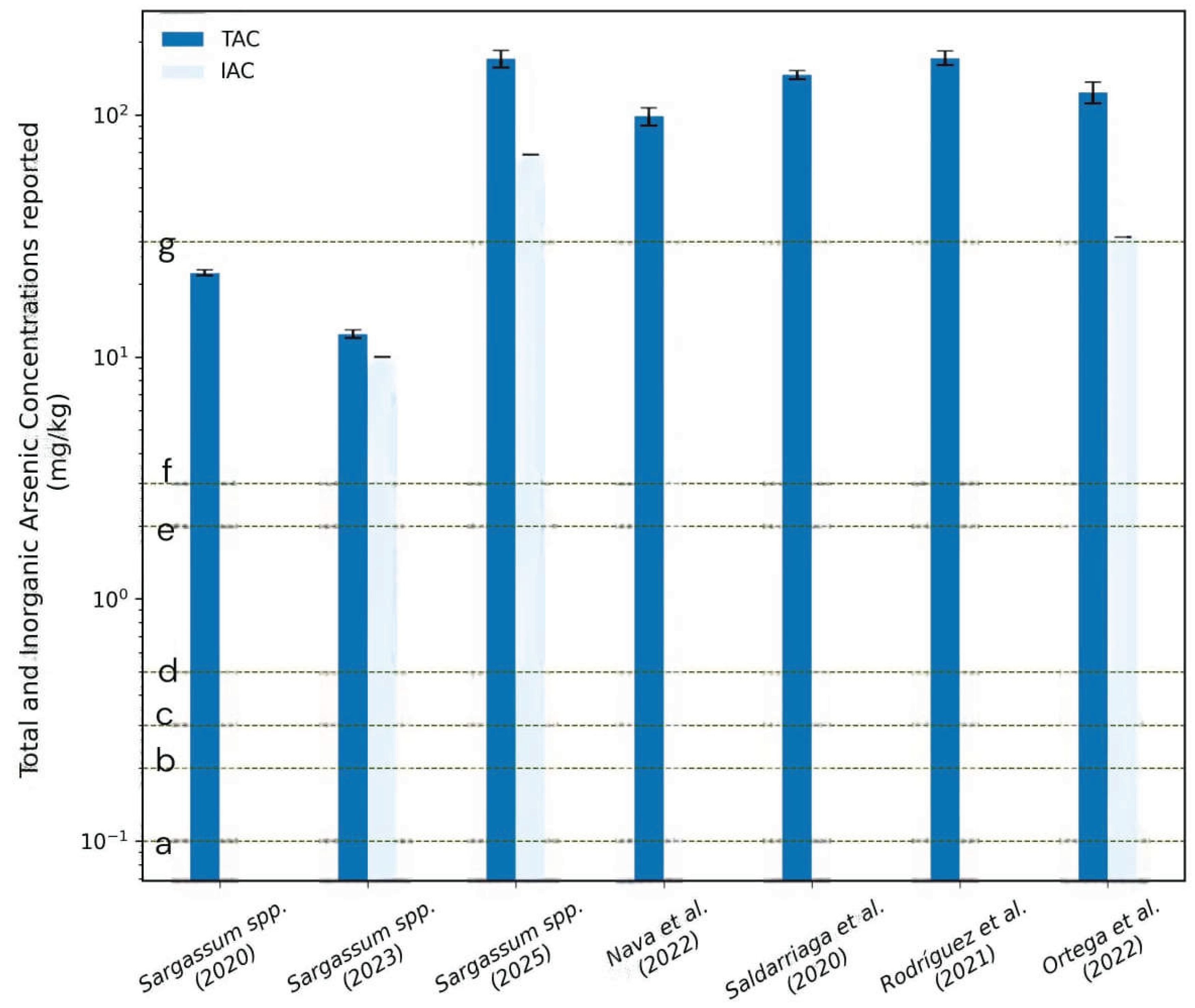
The only study where IAC in Sargassum spp. is reported was made by (70) who reported an average value of 31.3 mg/kg dw (25 %) contain of iAs; and TAs of 124 ±12.38 mg/kg dw (28); those differences in proportions and concentrations represent substantially higher absolute iAs of oceanographic trajectories, biochemical processes, environmental physicochemical parameters, and temporal dynamics that govern As accumulation and speciation in sargassum. The results of this study are shown in Figure 6 where TAC and IAC are compared to those of other authors and to some of the most common uses of sargassum as a raw material including their maximum permissible limits (mentioned in Table 2); these are indicated by dotted lines.
Dotted lines in Figure 4 indicates: a. IAC: 0.1 mg/kg dw in Fish and fish products like condiments (44), b. TAC: 0.2 mg/kg dw in Leather goods and footwear (49), c. IAC: 0.3 mg/kg dw in Aquatic product and animal liver derived foods (44), d. TAC: 0.5 mg/kg dw in Cosmetics (47) and Complementary food supplement (44) e. TAC: 2 mg/kg dw in Compost (52), f. TAC: 3 mg/kg dw in Algae supplements (50), g. TAC: 30 mg/kg dw in Livestock feed (51).
From a toxicological and regulatory point of view, the IAC is the critical parameter for risk assessment, regardless of its proportional contribution to TAs. The IAC at Pescadores beach (68.63 ± 0.106 mg/kg dw) substantially exceeds the concentration in Isla Blanca beach (10.005 ± 0.042 dw), indicating a much higher toxicological burden at Pescadores beach despite the lower proportional contribution. Both values raise significant concerns for potential sargassum utilization pathways. As Figure 5 shows, most of the values of TAC and IAC exceed the different maximum permissible limits that would be the ideals before “valorizing” sargassum as a raw material intended for a specific product.
As showed before, there is total and inorganic As in Sargassum spp. samples from Isla Blanca beach and Pescadores beach. This information prompts reflection in alternatives for the reduction of As through processes of treatment that promise biomass valorization. The study made by (78) demonstrated that sequential hot water and citric acid treatments could reduce TAC from 62.2 and 89.0 mg/kg dw to less than 3 mg/kg dw, with one treated sample achieving as low as 0.8 mg/kg dw, achieving 95% removal efficiency, which might suggest that appropriate pre-treatment protocols could render even highly contaminated sargassum biomass suitable for certain applications. However, the efficacy of this treatments are complicated because the economic feasibility of large-scale implementation remains critical questions requiring further research. The high iAs proportions observed at Isla Blanca beach and the substantial concentration at Pescadores beach underscore the necessity of As speciation analysis, not only TAs quantification, for comprehensive risk assessment and informed decision-making regarding sargassum biomass management (78).

4. Conclusions

The samples of sargassum collected in three different beaches from Quintana Roo, Mexico, and in three different years, allows an analysis of the parameters obtained from the physicochemical characterization of sargassum, including the identification and quantification of TAC and the confirmation of IAC content in sargassum. According to the information of aqueous phase As concentration in our sargassum samples, it was classified as a Special Management Waste (SMW), a nonhazardous waste that requires a well-designed and well-executed management plan because arrives in high volumetric quantities. Considering that other authors have provided data with concentrations that suggest leachate as a hazardous waste, sargassum is a waste located on the border of these two types of waste and then the first stage of the analysis of Mexican laws and regulations on waste revealed that it is necessary to classify sargassum as a residue in order to minimize the damage caused by its improper management and disposal; such actions become a problem of unawareness in different areas.
The characterization of As in Sargassum spp. from samples collected in 2020, 2023 and 2025 revealed marked differences in TAC (12.46 ± 0.5 to 170.67 ± 13.614 mg/kg dw) and iAs proportions (40.2% to 80.3%) among sampling dates, suggesting considerable variability that deserves further research. These findings align with and extend the existing literature, confirming that pelagic sargassum on the Caribbean Basin commonly carries As concentrations in the tens to low hundreds of mg/kg dw range, with substantial site-to-site and temporal variation. The mechanistic framework integrating environmental modulation by salinity, pH, ORP, and decomposition dynamics provides a coherent explanation for the observed patterns and variability. The high IAC and the proportions documented at Isla Blanca beach (80.3%) and the substantial absolute IAC at Pescadores beach (68.63 ± 0.106 mg/kg dw) underscore the toxicological significance of As contamination in this system and the critical importance of iAs analysis for risk assessment, taking into account alternative analytical methods such as the one we performed in this study.
TAC and IAC in the solid phase of sargassum provided information to address the other important perspectives on the impact of sargassum: its use as a raw material in an uninformed way, and its indiscriminate use in products due to their unknown physicochemical properties. Thus it is first necessary to generate a) a regulatory instrument exclusive for its correct waste classification in order to specify its management plan including the regulations for its final destination of sargassum and the ideal conditions at the disposal sites and b) an exclusive legal regulatory instrument for sargassum as a raw material indicating the maximum permissible limits of total and inorganic As that should not be exceeded depending on the product to be developed (as provided in this study). Additionally, this study allowed to propose an alternative of As removal treatment, however, this can be difficult to implement due to issues of economic efficiency and scalability.

Author Contributions

Conceptualization, M.D.M.A. and L.R.T.; methodology, M.A.M.; formal analysis, M.A.M.; investigation, M.D.M.A.; resources, M.A.M., L.R.T. and E.C.; data curation, M.A.M.; writing—original draft preparation, M.A.M.; writing—review and editing, M.A.M., L.R.T. and E.C.; supervision, L.R.T. and E.C.; project administration, M.A.M. and L.R.T.; funding acquisition, M.A.M. and L.R.T. All authors have read and agreed to the published version of the manuscript.

Funding

This research was funded by Ph Scholarship by Secretaría de Ciencia, Humanidades, Tecnología e Innovación and Instituto Politécnico Nacional by the Proyecto de Innovación: 2025-B037.

Institutional Review Board Statement

Not applicable.

Data Availability Statement

The data presented in this study are available in the article and the supplementary material.

Acknowledgments

We gratefully acknowledge Secretaría de Ciencia, Humanidades, Tecnología e Innovación and Instituto Politécnico Nacional.

Conflicts of Interest

The authors declare no conflicts of interest.

Abbreviations

The following abbreviations are used in this manuscript:
As Arsenic
As (V) Arsenate
As (III) Arsenite
As (0) Elemental arsenic
As (-III) Arsenide
HW Hazardous Waste
iAs Inorganic Arsenic
IAC Inorganic Arsenic Concentration
ORP Oxidation-Reduction Potential
PO43- Phosphate
pH Hydrogen potential
SMW Special Management Waste
TAs Total Arsenic
TAC Total Arsenic Concentration

References

  1. Caribbean Alliance for Sustainable Tourism. Sargassum. A Resource Guide for the Caribbean [Internet]. 2015. Available from: https://repository.oceanbestpractices.org/server9/api/core/bitstreams/146c1efd-4f36-46e3-a635-3fffdce35312/content.
  2. Louime C, Fortune J, Gervais G. Sargassum invasion of coastal environments: A growing concern [Internet]. Vol. 13. 2017;13(1):58–64. [CrossRef]
  3. Castillo C. Potencial impacto del Sargazo en América Latina y el Caribe. Empírica, Centro de Aplicaciones Económicas-Economía Aplicada [Internet]. 2023 Aug 14. Available from: https://empirica.do/7866/potencial-impacto-del-sargazo-en-america-latina-y-el-caribe.
  4. Gower J, Young E, King S. Satellite images suggest a new Sargassum source region in 2011 [Internet]. Vol. 4. 2013 Jun 3;4(8):764–73. [CrossRef]
  5. Rodríguez Martínez RE, Van Tussenbroek B, Jordan-Dahlgren E. Afluecia masiva de sargazo pelagico a la costa del Caribe Mexicano. In: Florecimientos Algales Nocivos en México [Internet]. Quintana Roo, México.: CICESE; 2016. p. 352–65. Available from: images/pdf/capitulos_libros/F09ISlOVElawRogftlqbNYhQYkrPtX7VYa6FDucn.pdf.
  6. Franks JS, Johnson DR, Ko DS. Pelagic Sargassum in the Tropical North Atlantic. Gulf Caribb Res. 2016 Jan 1;27(1). [CrossRef]
  7. Paredes-Camacho RM, González-Morales S, González-Fuentes JA, Rodríguez-Jasso RM, Benavides-Mendoza A, Charles-Rodríguez AV, et al. Characterization of Sargassum spp. from the Mexican Caribbean and its Valorization through Fermentation Process. Processes. 2023 Feb 23;11(3):685. [CrossRef]
  8. Van Tussenbroek BI, Hernández Arana HA, Rodríguez-Martínez RE, Espinoza-Avalos J, Canizales-Flores HM, González-Godoy CE, et al. Severe impacts of brown tides caused by Sargassum spp. on near-shore Caribbean seagrass communities. Mar Pollut Bull. 2017 Sep;122(1–2):272–81. [CrossRef]
  9. SEMA. Gobierno de Quintana Roo intensifica acciones para contener el sargazo en los litorales [Internet]. SEMA Quintana Roo. Available from: https://qroo.gob.mx/sema/elementor-39695/.
  10. SEMAR. Histórico de los boletines diarios de sargazo en el Mar Caribe. [Internet]. [cited 2026 Jul 8]. SEMAR. Available from: https://diredimoat.semar.gob.mx/OpSargazo/SargazoBoletinDiario.html.
  11. Vázquez-Delfín E, Freile-Pelegrín Y, Salazar-Garibay A, Serviere-Zaragoza E, Méndez-Rodríguez LC, Robledo D. Species composition and chemical characterization of Sargassum influx at six different locations along the Mexican Caribbean coast. Sci Total Environ. 2021 Nov;795:148852. [CrossRef]
  12. Devault DA, Pierre R, Marfaing H, Dolique F, Lopez PJ. Sargassum contamination and consequences for downstream uses: a review. J Appl Phycol. 2021 Feb;33(1):567–602. [CrossRef]
  13. Devault DA, Modestin E, Cottereau V, Vedie F, Stiger-Pouvreau V, Pierre R, et al. The silent spring of Sargassum. Environ Sci Pollut Res. 2021 Apr;28(13):15580–3. [CrossRef]
  14. Gobert T, Gautier A, Connan S, Rouget ML, Thibaut T, Striger-Pouvreau V, et al. Trace metal content from holopelagic Sargassum spp. sampled in the tropical North Atlantic Ocean: Emphasis on spatial variation of arsenic and phosphorus. Chemosphere. 2022;308(136186):1–9. [CrossRef]
  15. Walsh KT, Waliczek TM. Examining the Quality of a Compost Product Derived from Sargassum [Internet]. Vol. 3. 2020;3:331–6. [CrossRef]
  16. Aguirre Muñoz A. Sargassum in the Mexican Caribbean: From Denial and Voluntarism to Reality. Gaceta Digital del Centro Interdisciplinario de Biodiversidad y Ambiente, A.C. CeIBA [Internet]. 2019 Sep 5;2. Available from: https://secihti.mx/sargazo/images/pdfs/El_Sargazo_en_el_Caribe_Mexicanopdf.pdf.
  17. Resiere D, Valentino R, Nevière R, Banydeen R, Gueye P, Florentin J, et al. Sargassum seaweed on Caribbean islands: an international public health concern. In: Vol. 392. Available from: https://sargcoop.org/en/sg-monitorings/dabor-resiere-2018-sargassum-seaweed-on-caribbean-islands_-an-international-public-health-concern/.
  18. Marin A, Casas-Valdez M, Carrillo S, Hernandez H, Monroy A, Sangines L, et al. The marine algae Sargassum Spp. (Sargassaceae) as feed for sheep in tropical and subtropical regions. Biologia Tropical [Internet]. 2009 Dec;57. Available from: https://www.scielo.sa.cr/scielo.php?script=sci_arttext&pid=S0034-77442009000400030.
  19. Velazco Gonzalez O, Echavarria Almeida S, Sifuentes Diaz A, Casas-Valdez M. Use of the seaweed Sargassum spp. added to wheat flour to prepare biscuits for human consumption. Bioagro 25 [Internet]. 2013;3:189–94. Available from: https://www.researchgate.net/publication/287487560_Using_seaweed_Sargassum_spp_Added_to_wheat_flour_to_make_cookies_for_human_consumption.
  20. Milledge J J, Nielsen BV, Bailey D. High-value products from macroalgae: the potential uses of the invasive brown seaweed, Sargassum muticum. [Internet]. Vol. 1. 2015;1:67–88. [CrossRef]
  21. Flores Álvarez MÁ. Evaluación de diferentes tecnologías para el aprovechamiento potencial de las macroalgas pardas Sargassum sp. [Ciudad de México]: Instituto Politécnico Nacional; 2016.
  22. Maneein S, Milledge JJ, Nielsen BV, Harvey PJ. A Review of Seaweed Pre-Treatment Methods for Enhanced Biofuel Production by Anaerobic Digestion or Fermentation. Fermentation. 2018 Nov 29;4(4):100. [CrossRef]
  23. Amador Castro F, García Cayuela T, Hal S. A, Rodríguez Martínez V, Carrillo Nieves D. Valorization of pelagic sargassum biomass into sustainable applications: Current trends and challenges. [Internet]. 2021. [CrossRef]
  24. Cox SA, Degia K, C. Lopez I. Sargassum white paper: Turning the crisis into an opportunity [Internet]. Available from: https://www.unep.org/cep/resources/publication/sargassum-white-paper-turning-crisis-opportunity.
  25. Santillan ML. New use for sargassum, from pest to contaminant remover. Ciencia UNAM. 2022 Apr 18.
  26. Leyva J. Mexicans use sargassum to make houses, shoes and notebooks. Editorial [Internet]. 2023 Aug 13. Available from: https://www.debate.com.mx/estiloyvida/Mexicanos-usan-el-sargazo-para-fabricar-casas-zapatos-y-libretas-20230813-0094.html.
  27. Environmental Protection Agency [Internet]. 2025. Planning for and Managing Sargassum Inundation Events (SIEs). Available from: https://www.epa.gov/habs/planning-and-managing-sargassum-inundation-events-sies.
  28. Ortega-Flores PA, Serviere-Zaragoza E, De Anda-Montañez JA, Freile-Pelegrín Y, Robledo D, Méndez-Rodríguez LC. Trace elements in pelagic Sargassum species in the Mexican Caribbean: Identification of key variables affecting arsenic accumulation in S. fluitans. Sci Total Environ. 2022 Feb;806:150657. [CrossRef]
  29. Rodríguez-Martínez RE, Roy PD, Torrescano-Valle N, Cabanillas-Terán N, Carrillo-Domínguez S, Collado-Vides L, et al. Element concentrations in pelagic Sargassum along the Mexican Caribbean coast in 2018-2019. PeerJ. 2020 Feb 26;8:e8667. [CrossRef]
  30. Tsang S, Phu F, Bahum MM, Gregory A. P. Determination of phosphate/arsenate by a modified molybdenum blue method and reduction of arsenate by S2O42− [Internet]. Vol. 71. 2016;71:1560–8. [CrossRef]
  31. Rangel Montoya AE, Montañez Hernandez LE, Luevanos Escareño MP, Balagurusamy N. Impacto del arsénico en el ambiente y su transformación por microorganismos. Terra Latinoam [Internet]. 33:103–18. Available from: https://www.terralatinoamericana.org.mx/index.php/terra/article/view/51.
  32. Rani Datta R, Islam Papry R, Asajura Y, Kagaya R, Hong Wong K, Suzuki Mashio A, et al. Arsenic biotransformation by macroalgae Srgassum thunbergii: Influence of growth stages and phosphate availability on uptake and reductive methylation. Chemosphere. 2025 Mar;377:1–7. [CrossRef]
  33. Whyte J, Englar J. Analysis of inorganic and organic-bound arsenic in marine brown algae. Bot Mar. 1983;26(4):159–64. [CrossRef]
  34. Datta RR, Islam Papry R, Asakura Y, Kagaya R, Teneda M, Hong Wong K, et al. Arsenate biotransformation in six marine macroalgae species under dual salinity regimes: Comparative insights across phyla. Sci Total Environ. 2025;1003:1–12. [CrossRef]
  35. Hung DQ, Nekrassova O, Compton RG. Analytical methods for inorganic arsenic in water: a review [Internet]. Vol. 64. 2004 Oct 8;64(2):269–77. [CrossRef]
  36. Garcia Salgado S. Arsenic speciation and metal accumulation studies in environmental samples [Internet]. Universidad Politécnica de Madrid; 2013. Available from: https://oa.upm.es/15311/1/SARA_GARCIA_SALGADO.pdf.
  37. Gobert T, Chatelain B, Connan S, Renoul C, Striger-Pouvreau V, Thouard E, et al. Temporal dynamics of trace metals and arsenic in holopelagic Sargassum spp. during their retention in coastal waters. [Internet]. Vol. 217. 2026;217(107944):1–10. [CrossRef]
  38. Marquez GPB, Santiañez WJE, Trono Jr. GC, Montaño MNE, Araki H, Takeuchi H, et al. Seaweed biomass of the Philippines: Sustainable feedstock for biogas production. Renew Sustain Energy Rev. 2014;38:1056–68. [CrossRef]
  39. Trivedi, Gupta V, Reddy CRK, Jha B. Marine Macroalgal Biomass as a Renewable Source of Bioethanol. In: Marine Bioenerfy, Trends and Development [Internet]. CRC Press. 2015. Available from: https://www.taylorfrancis.com/chapters/edit/10.1201/b18494-16/marine-macroalgal-biomass-renewable-source-bioethanol-nitin-trivedi-vishal-gupta-reddy-bhavanath-jha.
  40. T. Valencia JM, Demafelis RB, Borines MG, Gatdula KM. Bioethanol Potential of Brown Macroalgae Sargassum spp. Philippine Journal of Crop Science [Internet]. 2015;40. Available from: https://www.ukdr.uplb.edu.ph/journal-articles/4958/.
  41. World Health Organization-Arsenic [Internet]. 2025. World Health Organization. Available from: https://www.who.int/news-room/fact-sheets/detail/arsenic.
  42. MICROWAVE ASSISTED ACID DIGESTION OF SEDIMENTS, SLUDGES, SOILS, AND OILS [Organismo gubernamental] [Internet]. 2025. Environmental Protection Agency. Available from: https://www.epa.gov/sites/default/files/2015-12/documents/3051a.pdf.
  43. Secretaria de Salud. Norma Oficial Mexicana NOM-127-SSA1-2021, Agua para uso y consumo humano. Límites permisibles de la calidad del agua. [Internet]. 2021 [cited 2025 Nov 15]. Available from: https://www.dof.gob.mx/nota_detalle_popup.php?codigo=5650705.
  44. National Health Commission of the People’s Republic of China. National Food Safety Standard: Maximum Levels of Contaminants in Foods [National Food Safety Standard] [Internet]. Beijing, China: National Health Commission of the People’s Republic of China; 2022. Available from: https://www.mast.is/static/files/Serleyfismarkadir/Kina/Log_og_reglugerdir/gb-2762-2022-1-.pdf.
  45. Parlamento Europeo y Consejo de la Unión Europea. Reglamento (CE) n.o 1223/2009 sobre los productos cosméticos. Reglamento (CE) n.o 1223/2009 [Internet]. p. 59–092. Available from: https://www.boe.es/doue/2009/342/L00059-00209.pdf.
  46. Secretaría de Medio Ambiente y Recursos Naturales. Norma Oficial Mexicana NOM-052-SEMARNAT-2005, Que establece las características, el procedimiento de identificación, clasificación y los listados de los residuos peligrosos [Norma Oficial Mexicana] [Internet]. 2005. Available from: https://www.dof.gob.mx/normasOficiales/1055/SEMARNA/SEMARNA.htm.
  47. Bund B. Technically avoidable heavy metal contents in cosmetic products. J Consum Prot Food Saf. 2017 Mar;12(1):51–3. [CrossRef]
  48. Secretaria de Salud. Norma Oficial Mexicana Norma Oficial Mexicana NOM-147-SSA1-1996, Bienes y servicios. Cereales y sus productos. Harinas de cereales, alimentos a base de cereales, de semillas comestibles, harinas o sus mezclas y productos de panificación. Disposiciones y especificaciones sanitarias y nutrimentales. [Internet]. 1996 [cited 2025 Nov 17]. Available from: https://salud.gob.mx/unidades/cdi/nom/147ssa16.html.
  49. Bielak E, Marcinkowska E. Heavy metals in leathers, artificial leathers, and textiles in the context of quality and safety of use. Sci Rep. [CrossRef]
  50. CEVA. Macroalgues et microalgues alimentaires – Statut règlementaire en France et en Europe [Rapport technique] [Internet]. France; 2025 Jan [cited 2026 May 28]. p. 21. Rapport technique Synthèse CEVA 2024. Available from: https://www.ceva-algues.com/wp-content/uploads/2019/10/V14-synthese-reglementaire2024-1.pdf.
  51. National Research Council. Mineral Tolerance of Animals: Second Revised Edition, 2005 [Internet]. Washington, DC: The National Academies Press; 2005. Available from: . [CrossRef]
  52. Secretaría del Medio Ambiente del Distrito Federal. Norma Ambiental para el Distrito Federal NADF-020-AMBT-2011, que establece los requerimientos mínimos para la producción de composta a partir de la fracción orgánica de los residuos sólidos urbanos, agrícolas, pecuarios y forestales, así como las especificaciones mínimas de calidad de la composta producida y/o distribuida en el Distrito Federal. NADF-020-AMBT-2011 [Internet]. 2012 Nov 30. Available from: http://data.sedema.cdmx.gob.mx/padla/images/stories/normatividaddf/nadf_020_ambt_2011.pdf.
  53. Dirección General de Normas. Protección al ambiente – Contaminación del suelo – Residuos sólidos municipales – Muestreo – Método de cuarteo. NMX-AA-015-1985 [Internet]. Available from: https://biblioteca.semarnat.gob.mx/janium/Documentos/Ciga/agenda/DOFsr/NMX-AA-015-1985.pdf.
  54. Sadzawka R. A, Carrasco R. MA, Grez Z. R, Mora G. M de LL. Métodos de análisis de compost. Centro Regional de Investigacion La Platina Santiago; 2005. (30).
  55. Microwave Assisted Acid Digestion of Siliceous and Organically Based Matrices. Environmental protection Agency-Method 3052 [Internet]. 1997 Dec [cited 2021 Jul 2]. Available from: https://www.epa.gov/sites/default/files/2015-12/documents/3052.pdf.
  56. Hernández-Zavala A, Matoušek T, Drobná Z, Paul DS, Walton F, Adair BM, et al. Speciation analysis of arsenic in biological matrices by automated hydride generation-cryotrapping-atomic absorption spectrometry with multiple microflame quartz tube atomizer (multiatomizer). J Anal Spectrom. 2008;23(3):342–51. [CrossRef]
  57. Secretaría de Medio Ambiente y Recursos Naturales (SEMARNAT). Lineamientos Técnicos y de Gestión para la Atención de la Contingencia Ocasionada por Sargazo en el Caribe Mexicano y el Golfo de México [Internet]. Secretaría de Medio Ambiente y Recursos Naturales (SEMARNAT); 2021. Report Instituto Nacional de Ecología y Cambio Climático (INECC). Available from: https://www.gob.mx/semarnat.
  58. Rodríguez-Martínez RE, van Tussenbroek BI, Navarro-Guerrero G, Mora-Domínguez G, González-Rivera LI. Estrategia Integral para el Manejo y Aprovechamiento del Sargazo (EIMAS) en Quintana Roo [Internet]. Secretaría de Ecología y Medio Ambiente de Quintana Roo (SEMA); 2023. Available from: https://qroo.gob.mx/sema/.
  59. Congreso del Estado de Quintana Roo. Ley para la Prevención, Gestión Integral y Economía Circular de los Residuos del Estado de Quintana Roo. Periódico Oficial del Estado de Quintana Roo. 2023 Dec 22.
  60. Congreso de los Estados Unidos Mexicanos. Ley General del Equilibrio Ecológico y la Protección al Ambiente. Diario Oficial de la Federación (DOF) [Internet]. Available from: https://www.diputados.gob.mx/LeyesBiblio/pdf/LGEEPA.pdf.
  61. Congreso de los Estados Unidos Mexicanos. Ley General para la Prevención y Gestión Integral de los Residuos. Diario Oficial de la Federación (DOF) [Internet]. Available from: https://www.diputados.gob.mx/LeyesBiblio/ Nueva Ley publicada el 8 de octubre de 2003.
  62. Congreso del Estado de Quintana Roo (o Honorable XI Legislatura Constitucional del Estado Libre y Soberano de Quintana Roo). Ley para la Prevención y la Gestión Integral de Residuos del Estado de Quintana Roo. Decreto por el que se expide la Ley para la Prevención y la Gestión Integral de Residuos del Estado de Quintana Roo (si el decreto aparece en las últimas páginas puedes incluir su número; si no, este campo puede quedar vacío). 2015 Mar 30.
  63. Secretaría de Medio Ambiente y Recursos Naturales (SEMARNAT). Norma Oficial Mexicana NOM-161-SEMARNAT-2011, Que establece los criterios para clasificar a los residuos de manejo especial y determinar cuáles están sujetos a plan de manejo; el listado de los mismos, el procedimiento para la inclusión o exclusión a dicho listado; así como los elementos y procedimientos para la formulación de los planes de manejo. NOM-161-SEMARNAT-2011 [Internet]. 2013 Feb 1. Available from: https://www.profepa.gob.mx/innovaportal/file/6633/1/nom-161-semarnat-2011.pdf.
  64. Secretaría de Medio Ambiente y Recursos Naturales (SEMARNAT). Norma Oficial Mexicana NOM-053-SEMARNAT-1993 que establece el procedimiento para llevar a cabo la prueba de extracción para determinar los constituyentes que hacen a un residuo peligroso por su toxicidad al ambiente. NOM-053-SEMARNAT-1993 [Internet]. 1993 Oct 18. Available from: https://www.imss.gob.mx/sites/all/statics/profesionalesSalud/investigacionSalud/cbis/nom-053-semarnat-1993.pdf.
  65. Leal-Bautista RM, Rodríguez-García JC, Chablé-Villacis R, Acosta-González G, Bautista-García JE, Tapia-Tussell R, et al. Assessment of Leachate Generated by Sargassum spp. in the Mexican Caribbean: Part 2, Mobility of Metals. Water. 2024 Sep 24;16(19):2719. [CrossRef]
  66. Manuel OMP, Victor CM, Maribel EMA, Antonio AMA, Germán GV, Germán NMJ, et al. The chemical composition of Sargassum leachate reveals a potential threat to the aquifer of the Yucatan Peninsula, Mexico. Mar Pollut Bull. 2026 Mar;224:119143. [CrossRef]
  67. Thouin H, Fikrat M, Battaglia-Brunet F, Joulian C, Charron M, Mestrot A, et al. Temporal change of arsenic in leachates from Sargassum spp. biomass deposit: mass balance, speciation and microbial biotransformation pathways. Sci Total Environ. 2025 Nov;1005:180840. [CrossRef]
  68. Nava-Jiménez IA, Tejeda-Vega S, Cortina-Ramírez GE, Zarazúa-Ortega G, Berriozabal-Islas C, Sánchez-Hernández H. Macro and microelement analysis of Sargassum fluitans and Sargassum natans arriving in the coastal zone of Cancun, Quintana Roo, Mexico: Análisis de macro y microelementos de Sargassum fluitans y Sargassum natans que arriban a la zona costera de Cancún, Quintana Roo, México. Rev Biol Mar Oceanogr. 2022 Sep 28;57(1). [CrossRef]
  69. Saldarriaga-Hernandez S, Najera-Martinez EF, Martinez-Prado MA, Melchor-Martinez EM. Sargassum-based potential biosorbent to tackle pollution in aqueous ecosystems – An overview [Internet]. Vol. 2. Manager; 2020. (Case Studies in Chemical and Environmental Engineering (2020)). Available from: https://www.sciencedirect.com/science/article/pii/S266601642030030X.
  70. Ortega-Flores PA, Gobert T, Méndez-Rodríguez LC, Serviere-Zaragoza E, Connan S, Robledo D, et al. Inorganic arsenic in holopelagic Sargassum spp. stranded in the Mexican Caribbean: Seasonal variations and comparison with international regulations and guidelines. Aquat Bot. 2023 Sep;188:103674. [CrossRef]
  71. Davis D, Simister R, Campbell S, Marston M, Bose S, McQueen-Mason SJ, et al. Biomass composition of the golden tide pelagic seaweeds Sargassum fluitans and S. natans (morphotypes I and VIII) to inform valorisation pathways. Sci Total Environ. 2021 Mar;762:143134. [CrossRef]
  72. Davis D, Simister R, Campbell S, Marston M, Bose S, McQueen-Mason SJ, et al. Biomass composition of the golden tide pelagic seaweeds Sargassum fluitans and S. natans (morphotypes I and VIII) to inform valorisation pathways. Sci Total Environ. 2021 Mar;762:143134. [CrossRef]
  73. Datta RR, Papry RI, Asakura Y, Kato Y, Hong WK, Mashio AS, et al. Effect of salinity on arsenic uptake, biotransformation, and time-dependent speciation pattern by Sargassum species. Chemosphere. 2024 Aug;362:142712. [CrossRef]
  74. Milledge J, Harvey P. Golden Tides: Problem or Golden Opportunity? The Valorisation of Sargassum from Beach Inundations. J Mar Sci Eng. 2016 Sep 13;4(3):60. [CrossRef]
  75. Thouin H, Fikrat M, Battaglia-Brunet F, Joulian C, Charron M, Mestrot A, et al. Temporal change of arsenic in leachates from Sargassum spp. biomass deposit: mass balance, speciation and microbial biotransformation pathways. Sci Total Environ. 2025 Nov;1005:180840. [CrossRef]
  76. Olguin-Maciel E, Leal-Bautista RM, Alzate-Gaviria L, Domínguez-Maldonado J, Tapia-Tussell R. Environmental impact of Sargassum spp. landings: an evaluation of leachate released from natural decomposition at Mexican Caribbean coast. Environ Sci Pollut Res. 2022 Dec;29(60):91071–80. [CrossRef]
  77. Thompson TM, Young BR, Baroutian S. Pelagic Sargassum for energy and fertiliser production in the Caribbean: A case study on Barbados. Renew Sustain Energy Rev. 2020 Feb;118:109564. [CrossRef]
  78. Cisneros-Ramos KI, Gutiérrez-Castañeda M, Magaña-Gallegos E, Villegas-Pañeda AG, Monroy-Velázquez LV, Barba-Santos MG, et al. From Inundations to Golden Opportunity: Turning Holopelagic Sargassum spp. into a Valuable Feed Ingredient through Arsenic Removal. Phycology. 2024 Aug 7;4(3):384–93. [CrossRef]
  79. Mazariegos-Villarreal A, Serviere-Zaragoza E, López-Vivas JM, Freile-Pelegrín Y, Reyes-Bonilla H, León-Cisneros K, et al. Relationship between arsenic content and macroelements, microelements, and polysaccharides in Sargassum horridum (Ochrophyta, Phaeophyceae) in the Gulf of California, Mexico. Aquat Bot. 2024 Mar;191:103730. [CrossRef]
  80. Huang SX, Jiang Q, Ding YF, Wang FJ, Zhu C. ARSENIC CONTENTS AND SPECIATION AT DIFFERENT GROWTH STAGES OF SARGASSUM FUSIFORME [HARV.] SETCHELL (HIJIKI), AN EDIBLE SEAWEED. Appl Ecol Environ Res. 2020;18(1):1941–52. [CrossRef]
  81. Peng Z, He Y, Guo Z, Wu Q, Li S, Zhu Z, et al. Species-specific arsenic species and health risk assessment in seaweeds from tropic coasts of South China Sea. Ecotoxicol Environ Saf. 2023 Nov;267:115634. [CrossRef]
  82. Gobert T, Connan S, Salaün P, Eikelboom M, Riso RD, Stiger-Pouvreau V, et al. Simple and Rapid Voltammetric Method Using a Gold Microwire Electrode to Measure Inorganic Arsenic in Holopelagic Sargassum (Fucales, Phaeophyceae). Anal Lett. 2024 Sep;57(13):2050–66. [CrossRef]
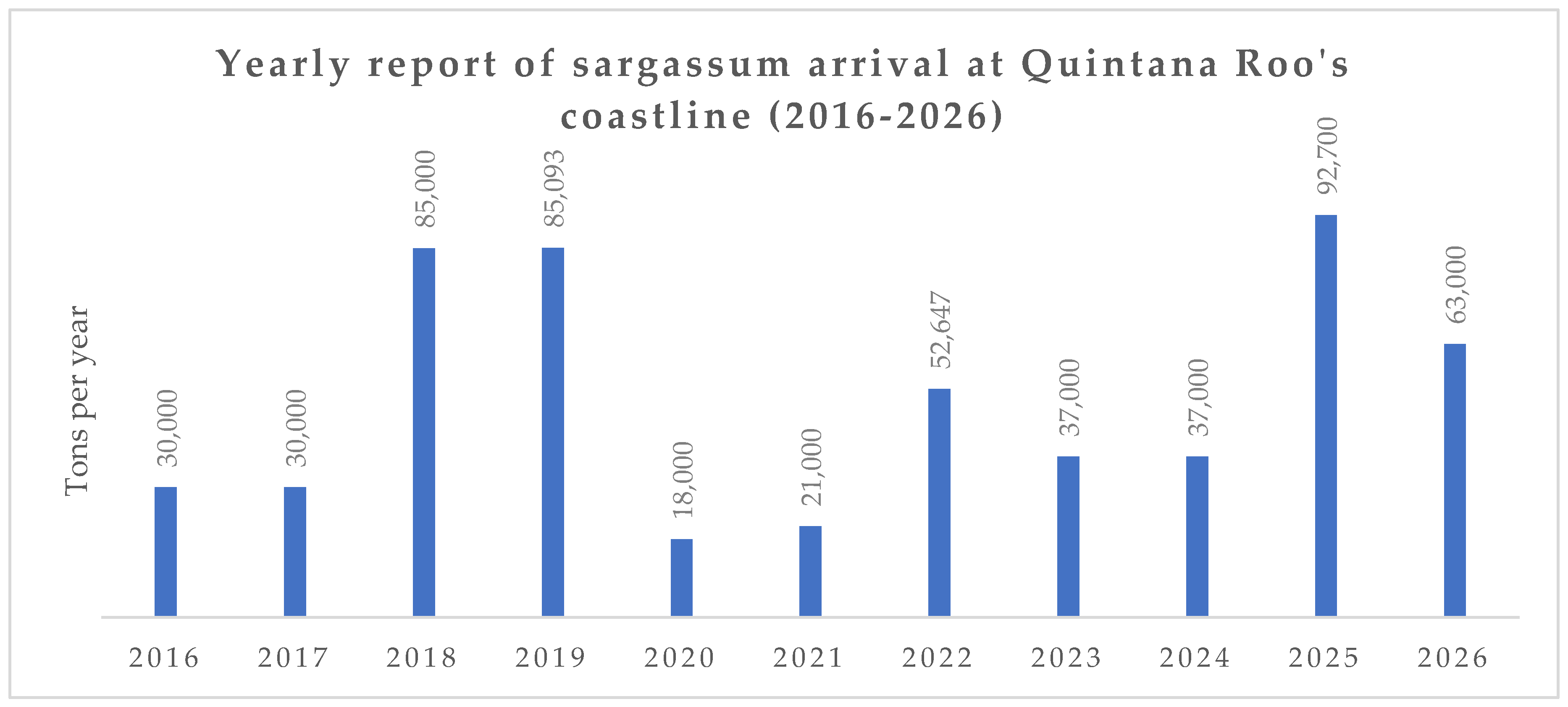
Figure 1. Yearly report of sargassum arrival at Quintana Roo's coastline (2016-2026). Source: Data from SEMA and SEMAR processed by the authors.
Preprints 226009 g001
Figure 3. Location of sargassum sampling points along the Quintana Roo State beaches: “El Niño”, “Isla Blanca” and “Pescadores”. Source: Own elaboration.
Preprints 226009 g003
Figure 4. General processing of sargassum samples analyzed on this study. Source: designed by the authors.
Preprints 226009 g004
Figure 5. Diagram of the regulatory framework as waste based on arsenic content. Source: Made with documental analysis by the authors.
Preprints 226009 g005
Figure 6. Results of this study and the comparison of Total Arsenic Concentrations (TAC) and Inorganic Arsenic Concentrations (IAC) with other authors and to some of the most common uses of sargassum as a raw material including their maximum permissible limits.
Preprints 226009 g006
Table 1. Different applications reported of Sargassum spp.as raw material.
Application of sargassum as raw material Type of human exposure by material Country Year, reference
Cattle feed Ingestion Mexico 2009, (18)
Cookie flour Ingestion Mexico 2013, (19)
Biofuel, pharmaceutical uses (antioxidants, anti-inflammatories, anti-tumors), cosmetics, bioadsorbents in water treatment, fertilizer and feed for aquaculture, insecticide. Ingestion, skin contact United Kingdom 2015, (20)
Biogas generation, soil improver, papermaking Inhalation Mexico 2016, (21)
Biogas generation, heating values, electricity and biomethane, soil improver. Inhalation United Kingdom 2018, (22)
Processing paper, building blocks, bioplastics, fertilizers, biofuels, extraction of compounds to make beauty products, and phenolic compounds as a natural alternative to antibiotics. Skin contact Mexico 2021, (23)
Fertilizers and compost, biofuels, construction materials, cosmetics, animal feed, paper and cardboard products and pharmaceuticals.

Ingestion, skin contact and inhalation Caribbean region 2021, (24)
Water filter Ingestion, skin contact Mexico 2022, (25)
Paper production, shoe manufacturing. Skin contact Mexico 2023, (26)
Fertilized, bioadsorbent, bioplastic, coal/ biochar briquettes, adobe bricks, cement additive (for strength and elasticity), chipboard, livestock, and fish feed, biofuels, nanostructured materials, soap, drugs and food supplements. Ingestion USA 2025, (27)
Source: Prepared by the authors with information from different references mentioned on this table.
Table 2. Maximum permissible limits of Total Arsenic Concentrations (TAC) and Inorganic Arsenic Concentrations (IAC) in different ways of consumption.
Reference Concentration Arsenic location or product
TAC IAC
Aqueous matrices
WHO-(41) 10 μg/liter - Water
EPA- (42) 10 μg/liter - Drinking water
NOM-127-SSA1-1994- (43) 25 μg/liter - Drinking water
National Food Safety Standard of the People's Republic of China (44) 0.01 mg/liter - Beverages (packaged drinking water)
Regulation EU 1223/2009 (45) < 3 mg/liter - Cosmetics
NOM-052-SEMARNAT-2005 (46) 5 mg/liter - Industrial waste (in landfill leachate)
Solid matrices
The German Federal Office for Consumer Protection and Food Safety (47) < 0.5 mg/kg - Cosmetics
< 2.5 mg/kg - Theatrical or carnival make-up
NOM-147-SSA1-1994- (48) 22 mg/kg - Agricultural use and commercial use
260 mg/kg - Industrial land
National Food Safety Standard of the People's Republic of China (44) - 0.5 mg/kg Aquatic animal and its derivatives (excluding fish and fish products)
- 0.1 mg/kg Fish and fish products like condiments
- 0.5 mg/kg Condiments derived from aquatic products (excluding fish condiments)
- 0.3 mg/ kg Aquatic product (and animal liver) derived foods
0.5 mg / kg - Food supplement
0.5 mg / kg - Semi solid sports nutritional food
0.5 mg / kg - Nutrient supplementary food for pregnant and lactating women
OEKO-TEX. STANDARD 100 (49) 0.2 g/kg - Leather goods/footwear
Regulatory status in France and Europe in Food macroalgae and microalgae (50) 3 mg/kg - Algae supplements
National Research Council EU (51) 30 mg/kg - Livestock feed
Mexican environmental standard of quality in compost (52) 2 mg/kg - Compost
Source: Prepared by the authors with information from different references mentioned on this table.
Table 3. Regulatory framework for the management of sargassum as waste in Mexico.
Reference document or Mexican regulatory framework Type of document Mandatory and applicable jurisdiction in Mexico Potential Classification of sargassum Conditions for Application Regulatory Implications
Technical and Management Guidelines for Addressing the Contingency caused by Sargassum in the Mexican Caribbean and the Gulf of Mexico (57) Locally issued document (not mandatory)
Applicable in the Mexican Caribbean and Gulf of Mexico. Applicable locally in the area where sargassum is found. Fishery Resource Fresh and floating biomass collected in the open sea or near the coast. Resource utilization
Special Management Waste (SMW) If it is collected in a state of decomposition in containment barriers, transfer sites or final disposal sites. Final disposal
Comprehensive Strategy for the Management and Use of Sargassum in Quintana Roo (EIMAS) (58) Applicable locally in the area where sargassum is found. Bio-waste Fresh, dried, semi-dried, if fresh sargassum will undergo a drying process before its disposal, if it has landed and has been collected. Valorization, recovery and environmental management measures of sargassum
Polluting Residue Biomass undergoing decomposition
General Law of Ecological Balance and Environmental Protection (LGEEPA) (60) Federal law Mandatory in the entirety of the Mexican territory. Hazardous Waste (HW) If it has any of these characteristics: corrosive, reactivity, explosiveness, toxicity, flammability, or contains infectious agents. In specific about toxicity-maximum permissible limit for As concentration (>5 mg/L). Characterization under numeral 5.1.4 from NOM-053-SEMARNAT-1993 to classify it as hazardous or not under NOM-052-SEMARNAT-2005.
General Law for the Prevention and Comprehensive Management of Waste (LGPGIR) (61) Federal law on waste management Special Management Waste (SMW) Large-volume generation and absence of hazardous characteristics. The responsibility of the management of this classification falls to the municipal government. Applies a Special Management Plan according to NOM-161-SEMARNAT-2011
Law for the Prevention and Comprehensive Management of Waste in the State of Quintana Roo (62) State law on waste management Mandatory in the State of Quintana Roo (regional application). Organic Waste Due to its characteristic of disintegrating or degrading rapidly, transforming into another type of organic matter. Municipal waste management
Law for the Prevention and Comprehensive Management and Circular Economy of Waste in the State of Quintana Roo (59) Mandatory within the State of Quintana Roo. Bio-waste Biodegradable organic substrate of plant origin, susceptible to biological degradation, and is derived from the drift of ocean currents. Circular economy and valorization strategies
Environmental Standard-NADF-020-AMBT-2011 for compost quality (52) Municipal issued standard Mandatory in Mexico City. Material requiring characterization The characterization of sargassum can be compared to the physicochemical parameters mentioned in this environmental standard; sargassum needs its basic characterization. Technical reference for characterization
Note: English titles of laws, regulations, and official documents presented in this table are unofficial translations provided by the authors for the convenience of the reader.
Table 4. Results of the physicochemical characterization of Sargassum spp. collected in 2020, 2023, 2025 and their comparison to other samples from different authors in the same geographic region.
Information and parameter determined Physicochemical characterization carried out
This study Nava, I. et al. (68) Saldarriaga, S. et al. (69) Rodríguez, R. et al. (29) Ortega, P. et al. (28), (70)
Place of collection “El Niño” Beach-Quintana Roo-Mexico “Isla Blanca” Beach-Quintana Roo-Mexico “Pescadores”
Beach-Quintana Roo-Mexico
“Las Perlas” Beach-Quintana Roo- Mexico. Puerto Morelos, Quintana Roo- Mexico. Puerto Morelos, Quintana Roo- Mexico. Puerto Morelos, Quintana Roo- Mexico.
Date of collection August 2020 July 2023 November 2025 October-November 2018 July 2020 2022 August 2022
Genus/Species Sargassum spp. Sargassum spp. Sargassum spp. S. fluitans III, S. natans I, and S. natans VIII. Sargassum S. fluitans, S. natans I and S. natans VIII S. natans VIII
pH 8.12 ± 0.150 9.35 ± 0.059 7.75 ± 0.208 - - - -
Conductivity (µS/cm) 1258.33 ± 8.852 58.33 ± 1.528 504.000 ± 28.00 - - - -
Oxidation-Reduction Potential (ORP), (mV) 90.57 ± 2.411 -16.33 ± 2.050 -33.67 ± 2.517 - - - -
% Moisture-(%, dry base) 24.25 ± 6.70 84.05 ± 0.373 77.71 ± 1.26 - 7.3±0.5 - -
Total solids (g/kg)-(%, dry base) 757.51 ± 66.96 15.95 ± 0.373 222.94 ± 12.57 - - - -
Volatile solids (g/kg)-(%, dry base) 596.74 ± 51.57 61.01 ± 0.022 190.38 ± 8.99 - - - -
Volatile solids/Total solids (%)-(%,dry base) 78.79 ± 0.16 - 85.42 ± 0.79 - - - -
Ashes(%)- (%,dry base) 75.75 ± 6.70 39.99 ± 2.18 22.294 ± 1.26 - 24.1±1.8/29.6±0.9 - -
Lignin (%) 26 ± 0.2 - - - - - -
Higher heating value (cal/g) 2210.1 ± 5 - - - 2900±10.9/2800±9.9 -
Lower heating value (cal/g) 2039.9 ± 4.1 - - - - - -
TAC (mg/kg, dry weight) 22.272 ± 0.598 12.46 ± 0.5 170.67 ± 13.614 98.7 ± 8.3 146.3±6.1 172 124 ±12.38
IAC (mg/kg) - 10.005 ± 0.042 68.63 ± 0.106 - - - 31.3
Disclaimer/Publisher’s Note: The statements, opinions and data contained in all publications are solely those of the individual author(s) and contributor(s) and not of MDPI and/or the editor(s). MDPI and/or the editor(s) disclaim responsibility for any injury to people or property resulting from any ideas, methods, instructions or products referred to in the content.
Copyright: This open access article is published under a Creative Commons CC BY 4.0 license, which permit the free download, distribution, and reuse, provided that the author and preprint are cited in any reuse.