
Submitted:
30 July 2026
Posted:
31 July 2026
You are already at the latest version
Abstract
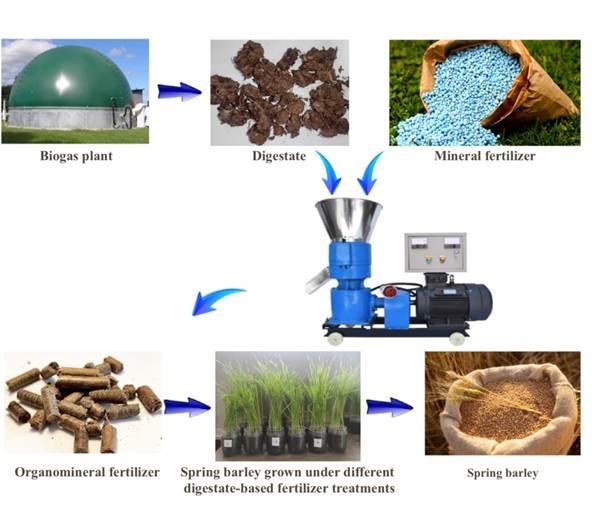
This study evaluates the potential of solid digestate as a feedstock for granulated organo-mineral fertilizers (OMF). The aim was to improve nutrient density, safety, and soil conditioning properties while supporting circular bioeconomy principles. Digestate was enriched with ammonium sulfate, monoammonium phosphate, and potassium chloride to produce OMF. The granules were analyzed for nutrient content, heavy metals, and functional group stabilization (FTIR). Soil incubation tests assessed the cation exchange capacity (CEC), while spring barley pot experiments evaluated biomass production and nutrient uptake. OMF granules achieved nutrient levels of N = 5.0%, P2O5 = 5.9%, and K2O = 4.7%, with dry matter of 95.9% and ash content of 32.4%. Heavy metals (Cd < 0.5, Pb < 5, As < 1.0 mg/kg) were well below EU safety thresholds. Compared to digestate pellets (C:N ≈20:1), OMF (C:N ≈7.8:1) showed faster mineralization. Soil incubation revealed increased CEC from 26.1 to 32.1 cmol(+)/kg. Barley biomass rose by 6.8–9.6%, with P and K accumulation strongly correlated with growth (r = 0.960 and r = 0.828). Uptake efficiencies reached 14.6% for P2O5 and 86.9% for K2O. Digestate valorization through organo-mineral granulation provides a safe and effective fertilizer pathway that enhances soil fertility, nutrient efficiency, and crop performance, while contributing to sustainable circular agriculture.
Keywords:
nutrient recovery
; soil amendment
; soil health
; crop productivity
; fertilizer
; waste valorization
; granulation
; sustainable development
Copyright: This open access article is published under a Creative Commons CC BY 4.0 license, which permit the free download, distribution, and reuse, provided that the author and preprint are cited in any reuse.


