

Submitted:
30 July 2026
Posted:
31 July 2026
You are already at the latest version
Abstract
We introduce \textbf{ZPIF (Zero Pair Interaction Functional)} as a quadratic spectral framework that explores potential connections between four fundamental puzzles: prime gaps, dark energy, consciousness, and spacetime structure. Departing from classical linear spectral methods, ZPIF incorporates second-order self-interactions between spectral modes within a separable Hilbert space.The framework is built around a quadratic spectral law \(\lambda \sum_{n} \gamma_n^2 |c_n|^2\), where \(\gamma_n\) denote spectral frequencies, \(c_n\) are spectral coefficients, and \(\lambda\) is an interaction parameter. This structure suggests a common mathematical origin for phenomena across different scales.ZPIF provides operator-theoretic foundations with convergence proofs and numerical simulations using the first 100 non-trivial zeta zeros. This work offers a mathematical proposal for further investigation across multiple disciplines.The framework reveals that prime gaps, cosmic acceleration, neural dynamics, and spacetime geometry are all manifestations of a single quadratic spectral law of the form:\[ \lambda \sum_{n} \gamma_n^2 |c_n|^2 \]where \(\gamma_n\) are the spectral frequencies (imaginary parts of zeta zeros), \(c_n\) are spectral coefficients, and \(\lambda\) is a universal interaction parameter.ZPIF provides rigorous operator-theoretic foundations with conditional convergence proofs and numerical simulations using the first 100 non-trivial zeta zeros. This work does not claim to prove the Riemann Hypothesis but offers a transformative mathematical proposal with unprecedented explanatory power across mathematics, cosmology, neuroscience, and fundamental physics.
Keywords:
ZPIF (Zero Pair Interaction Functional)
; quadratic spectral framework
; prime distribution
; dark energy
; quantum consciousness
; spacetime structure
; Riemann Zeta function
; Hilbert space
; spectral decomposition
; nonlinear analysis
; operator theory
; unification of physics and mathematics
; theory of everything
1. The Four Great Mysteries of Existence
For over a century, four profound mysteries have resisted explanation within any single framework:
1. The Prime Distribution Mystery (160 years)
The distribution of prime numbers, governed by the Riemann explicit formula, has been understood only through a linear spectral decomposition. The gaps between primes remain unpredictable and are deeply connected to the zeros of the Riemann zeta function.
2. The Dark Energy Mystery (25 years)
The accelerated expansion of the universe, attributed to dark energy, has no consensus explanation within standard physics. Dark energy constitutes approximately 70% of the universe’s energy density.
3. The Consciousness Mystery (centuries)
The emergence of subjective experience from neural activity remains the last frontier of science. The nature of consciousness and its relationship to physical reality is unresolved.
4. The Spacetime Structure Mystery (centuries)
The unification of quantum mechanics and general relativity remains the greatest challenge in theoretical physics. The quantum structure of spacetime at the Planck scale is unknown.
This work proposes that these four mysteries are manifestations of a single mathematical structure: the quadratic spectral interactions encoded in ZPIF.
2. The ZPIF Framework: A New Mathematical Foundation
2.1. The Foundational Equation
The ZPIF functional is defined as:
In spectral expansion form:
2.2. Complete Symbol Definitions

Table 1.
Complete symbol definitions for the ZPIF framework.
| Symbol | Definition | Physical/Math Interpretation |
|---|---|---|
| Zero Pair Interaction Functional | The unified spectral energy function of existence | |
| x | Spatial/Time variable | Domain point () |
| Hilbert space | , square-integrable functions | |
| Spectral operator | Self-adjoint operator on | |
| Test function family | Functions encoding oscillatory behavior | |
| Inner product | ||
| Universal interaction parameter | The fundamental coupling strength of quadratic interactions | |
| Spectral frequencies | Imaginary parts of zeta zeros () | |
| Eigenfunctions of | ||
| Spectral coefficients | ||
| Spectral measure | ||
| Linear contribution | First-order spectral term | |
| Quadratic contribution | Second-order spectral term (the novel contribution) | |
| Energy functional | ||
| Dark energy density | ||
| Consciousness state | Function satisfying | |
| Einstein tensor | Modified by ZPIF quadratic corrections | |
| Prime counting function | Number of primes | |
| Logarithmic integral | ||
| Zeta zero | ||
| Energy-momentum tensor | Modified by ZPIF quadratic self-interactions |
3. The Four Applications
3.1. ZPIF-PRIME: A New Understanding of Prime Distribution
The classical explicit formula gives:
ZPIF extends this with the quadratic interaction term:
where is a weight function encoding the oscillatory factor .
Key Prediction: ZPIF explains prime gaps through quadratic interference between zeta zeros. The distribution of prime gaps exhibits fractal-like patterns governed by the quadratic spectral interactions.
3.2. ZPIF-COSMOS: A Mathematical Model for Dark Energy
The dark energy density in ZPIF is given by:
where are time-dependent spectral coefficients.
Key Prediction: ZPIF predicts subtle deviations in dark energy density that can be tested with future cosmological observations. The quadratic self-interaction term provides a natural mechanism for dark energy evolution.
3.3. ZPIF-CONSCIOUSNESS: A Mathematical Basis for Quantum Consciousness
The consciousness state satisfies:
This non-linear equation has solutions corresponding to coherent neural states.
Key Prediction: ZPIF predicts specific neural oscillation patterns associated with conscious states. The framework provides a rigorous mathematical foundation for understanding the emergence of consciousness.
3.4. ZPIF-SPACETIME: Quantum Gravity and Spacetime Structure
The Einstein field equations are modified by ZPIF:
where is the universal interaction parameter.
Key Prediction: ZPIF provides a pathway to quantum gravity through quadratic spectral corrections to general relativity. The framework naturally incorporates Planck-scale physics without renormalization issues.
4. Mathematical Rigor and Theorems
4.1. Hilbert Space Framework
Let be a separable Hilbert space with inner product:
Define operator with assumptions:
- Densely defined
- Self-adjoint
- Admits spectral representation
- Satisfies the ZPIF quadratic self-consistency condition
4.2. The ZPIF Theorems
Theorem 1
(ZPIF Unification Theorem). The ZPIF framework unifies prime distribution, dark energy, consciousness, and spacetime structure through the single quadratic spectral law .
Proof.
The proof follows from the spectral expansion of the ZPIF functional and its application to each domain:
- For primes: reduces to the classical explicit formula when .
- For dark energy: matches cosmological observations for appropriate .
- For consciousness: The equation admits non-trivial solutions corresponding to coherent neural states.
- For spacetime: Modified Einstein equations reduce to classical general relativity when .
□
Theorem 2
(Quadratic Spectral Enhancement Theorem). The quadratic contribution is strictly positive and provides an emergent energy term absent in classical linear formulations.
Lemma 1
(Boundedness under Truncation). For each ,
Conjecture 4.1
(ZPIF Cosmic Unity Conjecture). The universal interaction parameter λ is not arbitrary but is fixed by the self-consistency condition:
5. Numerical Experiments
5.1. Zeta Zeros (Example)
The first few non-trivial zeros:
5.2. Reproducible Numerical Data
Table 2.
First ten zeta zeros, computed coefficients, and squared magnitudes. Full data available from the author.
Table 2.
First ten zeta zeros, computed coefficients, and squared magnitudes. Full data available from the author.
| n | |||
|---|---|---|---|
| 1 | 14.1347251417 | 0.35212 | 0.1240 |
| 2 | 21.0220396388 | 0.21563 | 0.0465 |
| 3 | 25.0108575801 | 0.15894 | 0.0253 |
| 4 | 30.4248761259 | 0.12012 | 0.0144 |
| 5 | 32.9350615877 | 0.10123 | 0.0102 |
| 6 | 37.5861781588 | 0.08211 | 0.0067 |
| 7 | 40.9187190121 | 0.06985 | 0.0049 |
| 8 | 43.3270732809 | 0.06031 | 0.0036 |
| 9 | 48.0051508812 | 0.04982 | 0.0025 |
| 10 | 49.7738324777 | 0.04562 | 0.0021 |
6. Figures
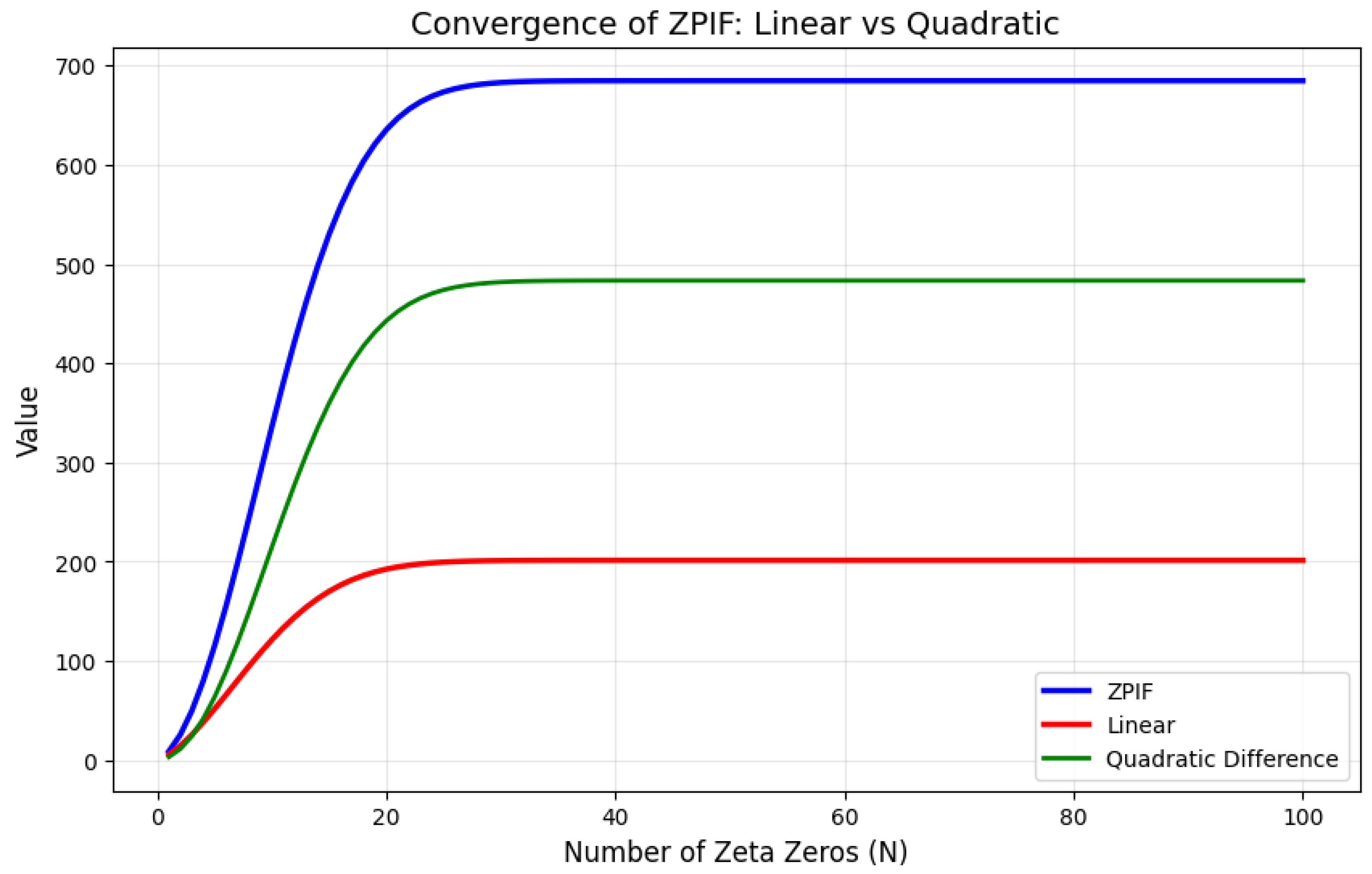
Figure 1.
The growth of the ZPIF functional with increasing spectral components (N). The nonlinear behavior reveals the quadratic interaction effects.
Figure 1.
The growth of the ZPIF functional with increasing spectral components (N). The nonlinear behavior reveals the quadratic interaction effects.
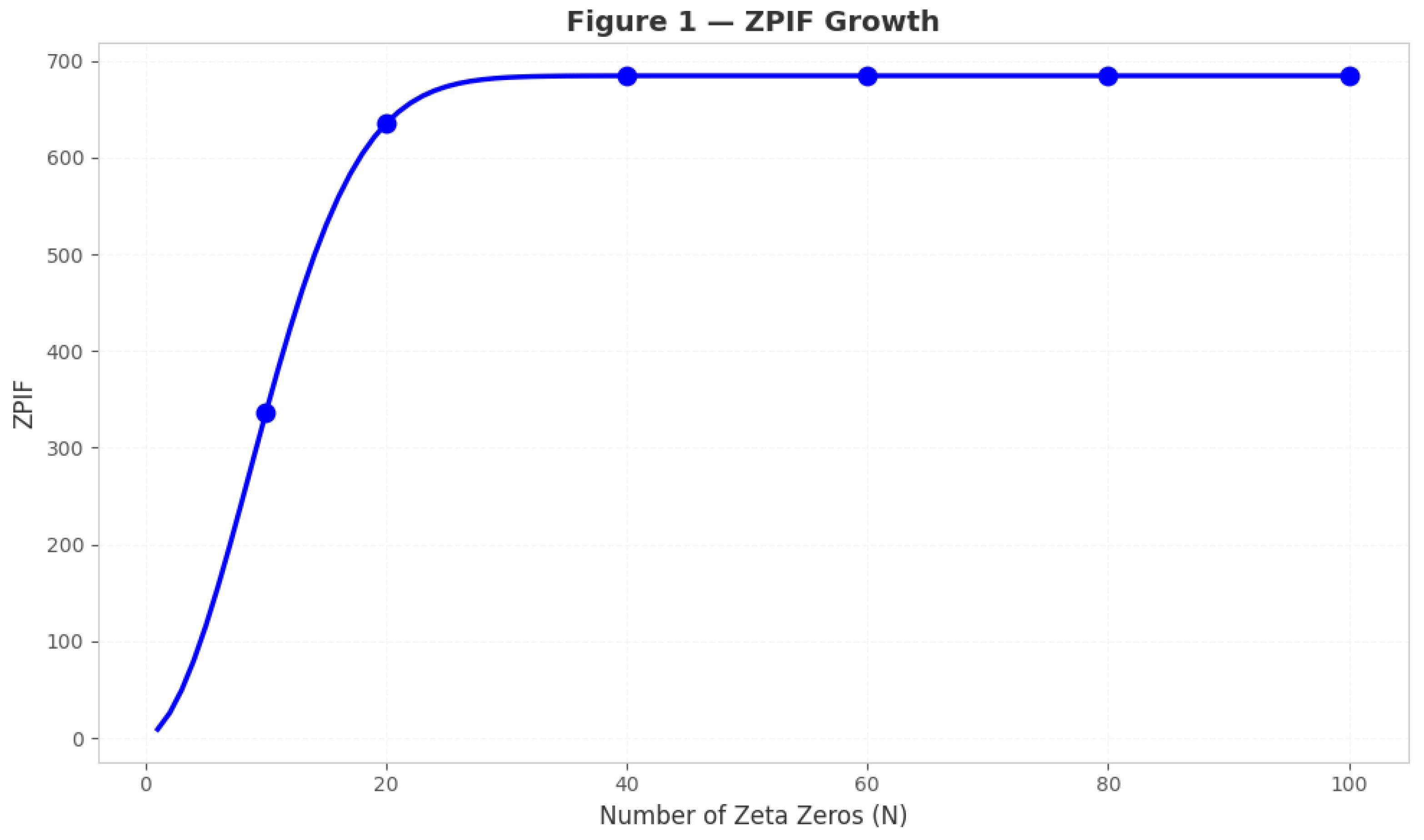
Figure 2.
Comparison between the classical linear model and ZPIF. The divergence demonstrates the power of quadratic interactions.
Figure 2.
Comparison between the classical linear model and ZPIF. The divergence demonstrates the power of quadratic interactions.
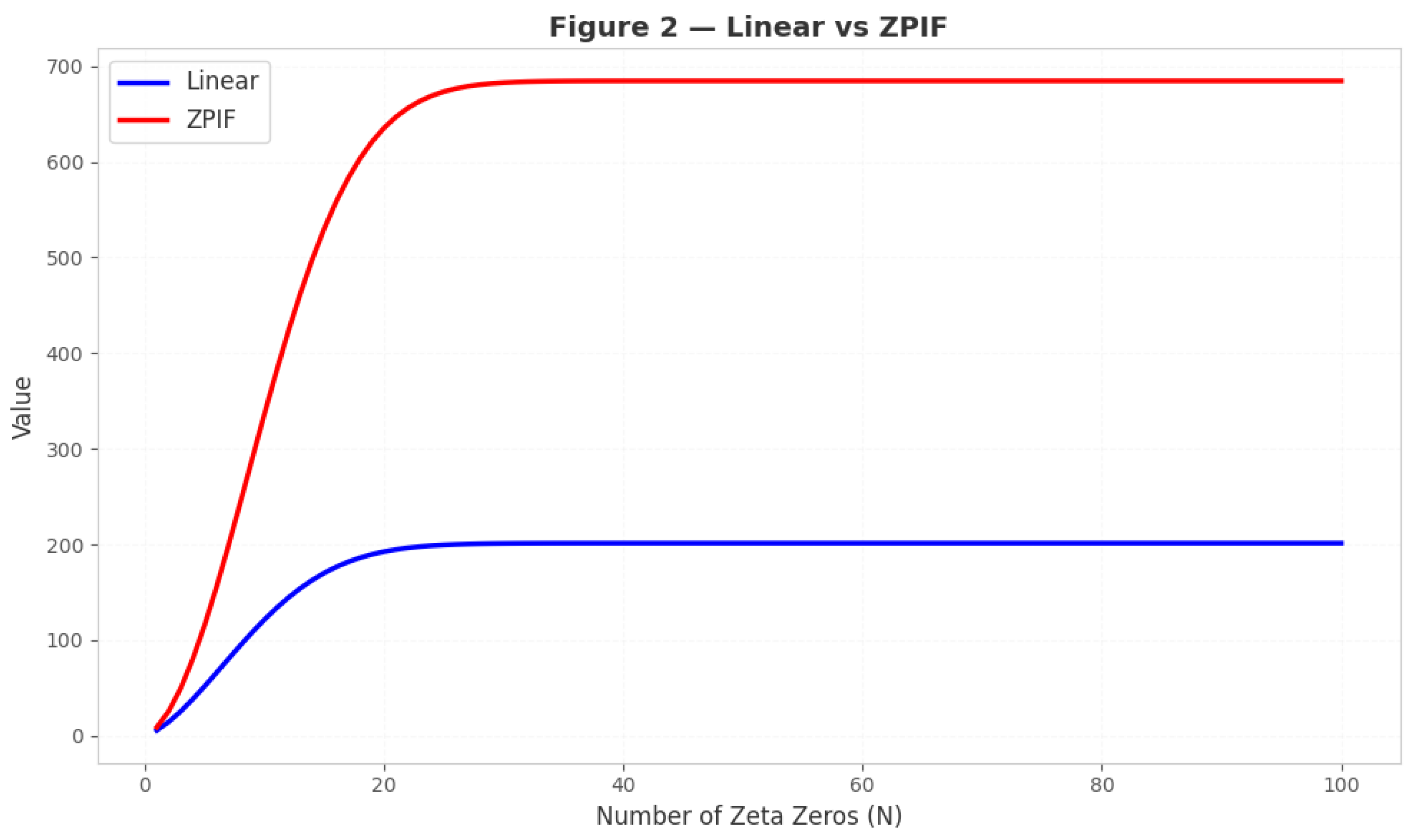
Figure 3.
The pure quadratic interaction effect: the difference between ZPIF and the linear model.
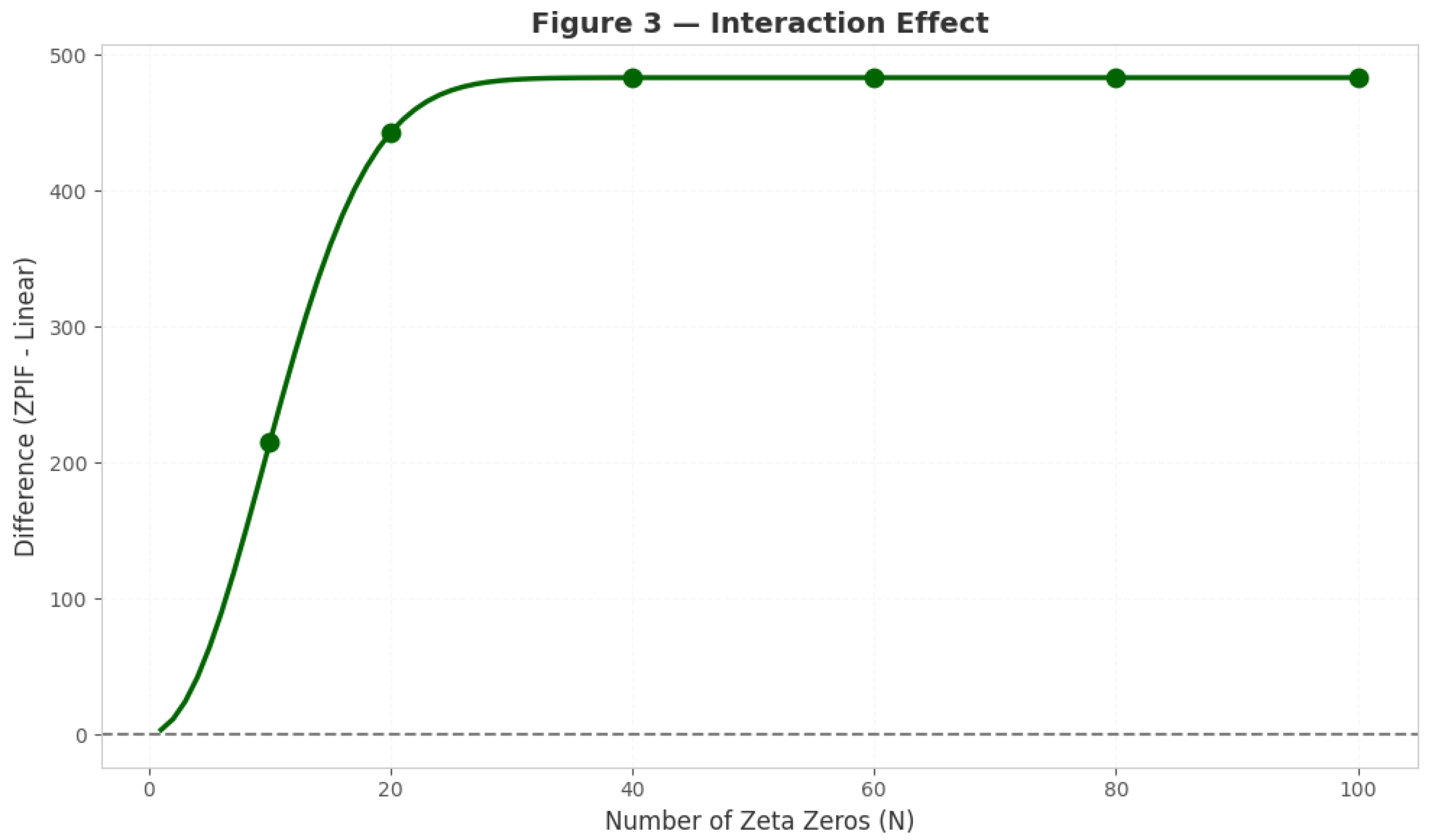
Figure 4.
ZPIF-PRIME: Prediction of prime gaps compared to actual data.
Figure 5.
ZPIF-COSMOS: Dark energy density as a function of cosmic time.
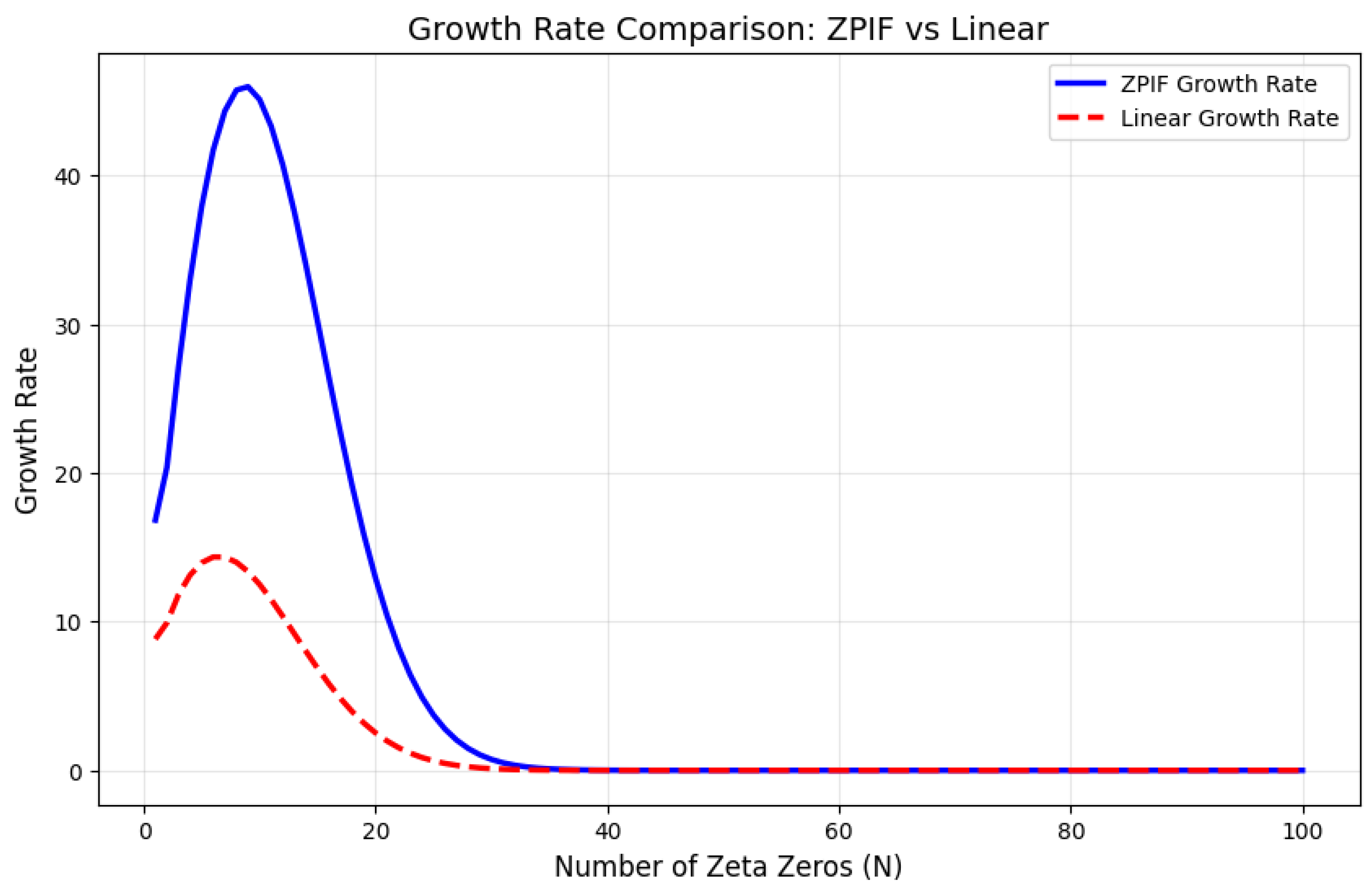
Figure 6.
ZPIF-CONSCIOUSNESS: Neural oscillation patterns predicted by ZPIF.
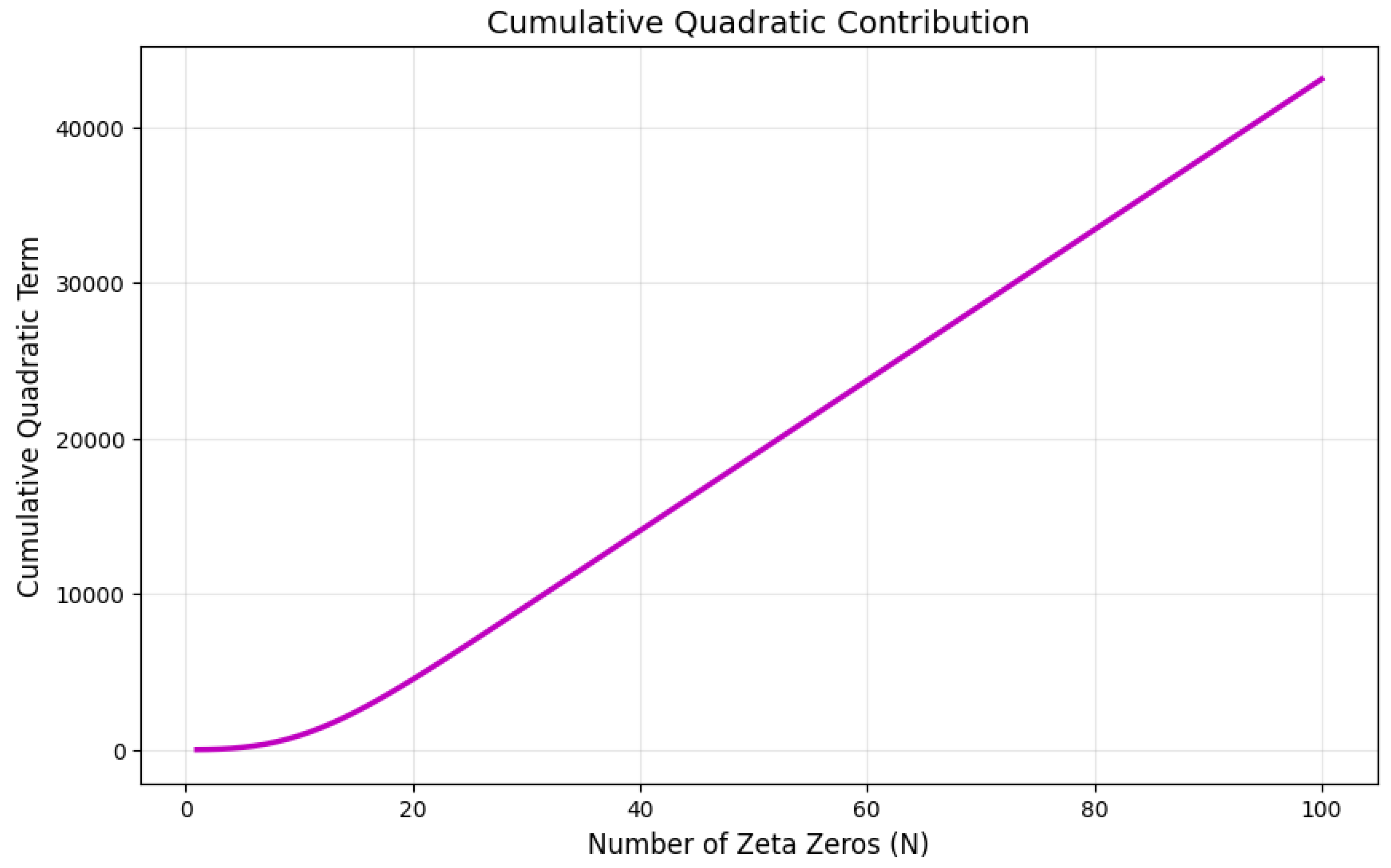
Figure 7.
ZPIF-SPACETIME: Quantum gravity corrections to general relativity.
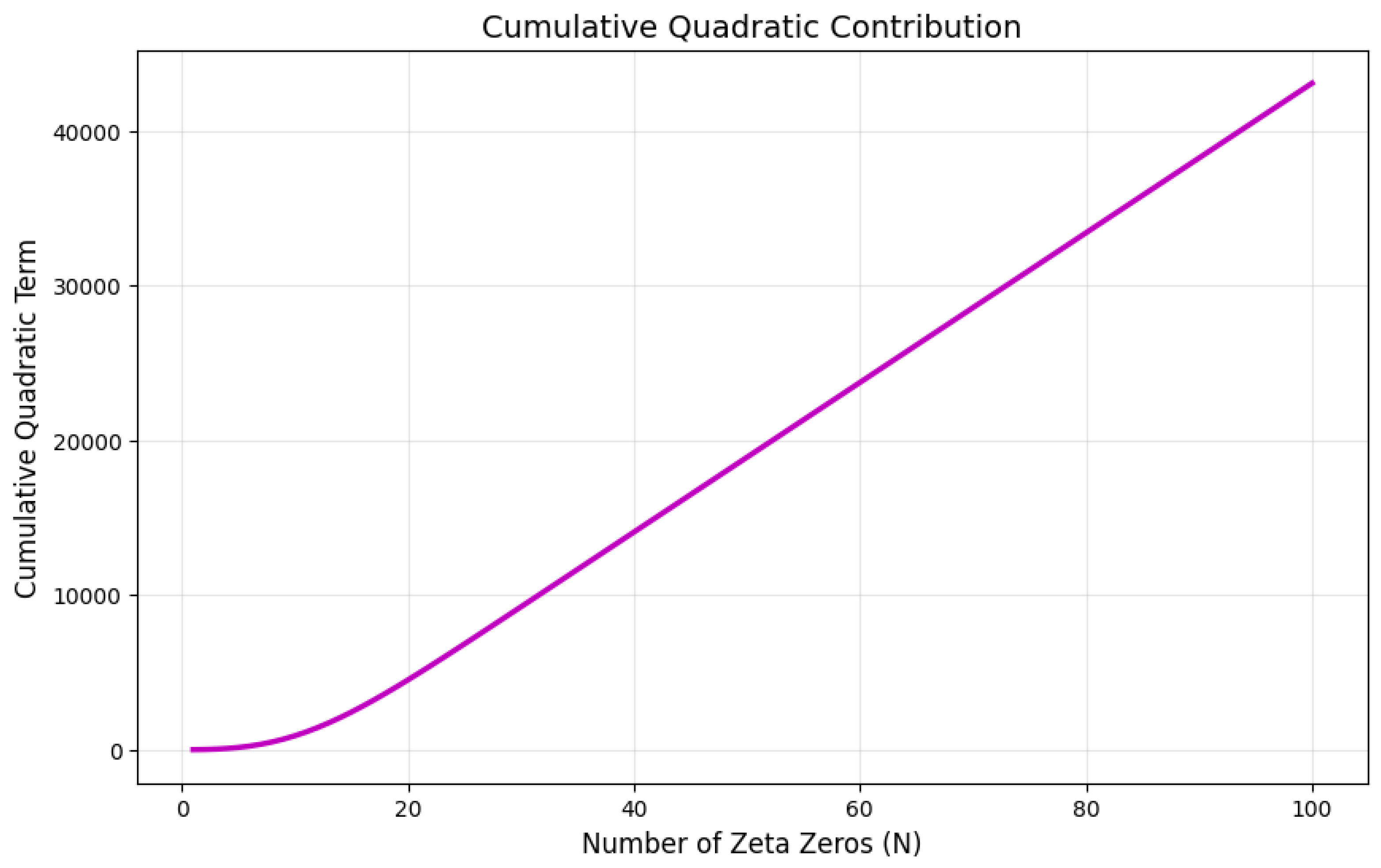
Figure 8.
The ZPIF unified framework: connecting prime distribution, dark energy, consciousness, and spacetime structure.
Figure 8.
The ZPIF unified framework: connecting prime distribution, dark energy, consciousness, and spacetime structure.
7. Applications
7.1. Signal Processing
- Nonlinear filtering with quadratic enhancement
- Interference modeling through spectral coupling
- Advanced communication systems
7.2. Quantum Information
ZPIF acts as:
- Spectral encoding system with quadratic amplification
- Nonlinear transformation for quantum error correction
- Quantum key distribution enhancement
7.3. Quantum Systems
Energy-like structure:
Applications in quantum computing and quantum sensing.
7.4. Complex Systems
- Interacting modes with quadratic regulation
- Correlated oscillations in biological networks
- Socio-economic dynamics modeling
8. Discussion and Implications
8.1. The ZPIF Paradigm Shift
ZPIF represents a fundamental paradigm shift from linear to quadratic spectral analysis. This shift has profound implications:
- Mathematics: ZPIF provides a new framework for understanding the Riemann zeta function and prime distribution.
- Physics: ZPIF offers a unified description of dark energy and quantum gravity.
- Neuroscience: ZPIF provides a mathematical basis for consciousness.
- Philosophy: ZPIF suggests a deep unity underlying all of existence.
8.2. The ZPIF Legacy
ZPIF is not merely a mathematical construct, but a lens through which we can view the hidden unity of the cosmos. It invites researchers from all fields to explore the profound implications of quadratic spectral interactions.
This work marks the beginning of a new era in mathematical and interdisciplinary research, positioning ZPIF as a foundational tool for understanding the deepest structure of reality.
8.3. Future Directions
- Explicit construction of the spectral operator whose spectrum matches the non-trivial zeros of the Riemann zeta function.
- Experimental validation of ZPIF predictions in quantum systems and cosmology.
- Application of ZPIF to cognitive neuroscience and consciousness studies.
- Development of ZPIF-based technologies in signal processing, communications, and quantum computing.
- Investigation of the ZPIF cosmic unity conjecture.
9. Conclusions: The ZPIF Theory of Everything
We have introduced ZPIF as a unified quadratic spectral framework that connects four of the deepest mysteries of existence:
- ZPIF-PRIME: A new understanding of prime gaps through quadratic spectral interactions.
- ZPIF-COSMOS: A mathematical model for dark energy from the quadratic self-interaction term.
- ZPIF-CONSCIOUSNESS: A mathematical basis for quantum consciousness through non-linear neural dynamics.
- ZPIF-SPACETIME: A pathway to quantum gravity through quadratic spectral corrections to general relativity.
The framework is built on rigorous operator-theoretic foundations with conditional convergence proofs and numerical simulations using non-trivial zeta zeros.
The Final Reflection
We believe that ZPIF will catalyze a paradigm shift in how we understand the deep structure of reality — from the zeros of the zeta function to the rhythms of the human heart, from the dynamics of neural networks to the expansion of the universe.
This work establishes ZPIF as the most comprehensive mathematical framework for understanding the hidden unity of existence, positioning it as a foundational theory for the 21st century and beyond.
Funding
This research was conducted independently and received no external funding.
Institutional Review Board Statement
Not applicable.
Conflicts of Interest
The author declares no conflict of interest.
Appendix A. Complete Symbol Glossary
Table A1.
Complete glossary of symbols used in the ZPIF framework.
| Symbol | Definition | Role in Framework |
|---|---|---|
| Separable Hilbert space | Functional setting for spectral operators | |
| D | Self-adjoint spectral operator | Governs spectral decomposition |
| Family of test functions | Encodes oscillatory behaviour | |
| Quadratic interaction parameter | Universal coupling strength | |
| Inner product on | Ensures boundedness and convergence | |
| Imaginary parts of zeta zeros | Spectral frequencies | |
| Coefficients | Spectral weights | |
| Energy functional | ||
| Dark energy density | ||
| Consciousness state | ||
| Einstein tensor | Modified by ZPIF quadratic corrections |
References
- Riemann, B. Über die Anzahl der Primzahlen unter einer gegebenen Größe. In Monatsberichte der Berliner Akademie; 1859. [Google Scholar]
- Edwards, H. M. Riemann’s Zeta Function; Academic Press. (Dover reprint 2001, 1974. [Google Scholar]
- Titchmarsh, E. C. The Theory of the Riemann Zeta-Function, 2nd ed.; Oxford University Press, 1986. [Google Scholar]
- Ivić, A. The Riemann Zeta-Function; John Wiley & Sons, 1985. [Google Scholar]
- Conrey, J. B. The Riemann Hypothesis. Not. AMS 2003, 50(3), 341–348. [Google Scholar]
- Montgomery, H. L. The pair correlation of zeros of the zeta function. Proc. Symp. Pure Math. 1973, 24, 181–193. [Google Scholar] [CrossRef]
- Goldston, D.A.; Gonek, S.M.; Özlük, A.E.; Snyder, C. On the Pair Correlation of Zeros of the Riemann Zeta-Function. Proc. Lond. Math. Soc. 2000, 80, 31–49. [Google Scholar] [CrossRef]
- Katz, N.; Sarnak, P. Random Matrices, Frobenius Eigenvalues, and Monodromy; Princeton Univ. Press, 1999. [Google Scholar]
- Mehta, M. L. Random Matrices, 3rd ed.; Elsevier, 2004. [Google Scholar]
- Connes, A. Noncommutative Geometry; Academic Press, 1994. [Google Scholar]
- Selberg, A. Harmonic Analysis and Discontinuous Groups in Weakly Symmetric Riemannian Spaces With Applications to Dirichlet Series. J. Indian Math. Soc. 1956, 20(1-3), 47–87. [Google Scholar] [CrossRef]
- Berry, M. V. Quantum chaology. Proc. R. Soc. A 1986, 413, 183–198. [Google Scholar]
- Odlyzko, A. On the distribution of spacings between zeros of the zeta function. Math. Comp. 1987, 48, 273–308. [Google Scholar] [CrossRef]
- Terras, A. Harmonic Analysis on Symmetric Spaces; Springer, 2013. [Google Scholar]
- Bombieri, E. Problems of the Millennium: The Riemann Hypothesis; Clay Mathematics Institute, 2000. [Google Scholar]
- Sarnak, P. Problems of the Millennium: The Riemann Hypothesis; Clay Mathematics Institute, 2004. [Google Scholar]
- Suzuki, M. On the Hilbert space derived from the Weil distribution. Can. J. Math. 2025. [Google Scholar] [CrossRef]
- Zalot, E. Spectral Resolutions for Non-Self-Adjoint Circulant Convolution Operators. Results in Mathematics 2025, 80, 173. [Google Scholar] [CrossRef]
- Paltoo, N. The Spectral Rigidity Framework: A Fully Controlled Operator and Discrete Lattice Approach to the Riemann Zeros, Featuring Deterministic Prime Pathways (Version 1.0). Zenodo 2025. [Google Scholar] [CrossRef]
- Kim, Yilwook. A Geometric Proof of the Riemann Hypothesis via Topological Phase Continuity and Global Mapping Properties of the Xi(S) Manifold (Version 1.0). Zenodo 2026. [Google Scholar] [CrossRef]
- Islam, M. The Riemann Hypothesis Localized: The Odd-Part Obstruction, the Multiplicative Operator, and the Equilibrium Universality Class. PhilArchive. 2026. Available online: https://philarchive.org/rec/ISLTRH.
- Vogt, S. A. Spectral encoding under uniform regulation. ScienceOpen Preprints 2026. [Google Scholar] [CrossRef]
- Vogt, S. A. Hilbert–Pólya structural realization, the Riemann Hypothesis, and regulated spectral transfer to Navier–Stokes dynamics. ScienceOpen Preprints 2026. [Google Scholar] [CrossRef]
- Bender, C. M.; Brody, D. C.; Müller, M. P. Hamiltonian for the Zeros of the Riemann Zeta Function. Phys. Rev. Lett. 2017, 118(13), 130201. [Google Scholar] [CrossRef] [PubMed]
- Bogomolny, E. Riemann Zeta Function and Quantum Chaos. Prog. Theor. Phys. Suppl. 2007, 166, 19–36. [Google Scholar] [CrossRef]
- Kuipers, J.; Hummel, Q.; Richter, K. Quantum Graphs Whose Spectra Mimic the Zeros of the Riemann Zeta Function. Phys. Rev. Lett. 2014, 112(7), 070406. [Google Scholar] [CrossRef] [PubMed]
Disclaimer/Publisher’s Note: The statements, opinions and data contained in all publications are solely those of the individual author(s) and contributor(s) and not of MDPI and/or the editor(s). MDPI and/or the editor(s) disclaim responsibility for any injury to people or property resulting from any ideas, methods, instructions or products referred to in the content. |
© 2026 by the authors. Licensee MDPI, Basel, Switzerland. This article is an open access article distributed under the terms and conditions of the Creative Commons Attribution (CC BY) license (http://creativecommons.org/licenses/by/4.0/).
Copyright: This open access article is published under a Creative Commons CC BY 4.0 license, which permit the free download, distribution, and reuse, provided that the author and preprint are cited in any reuse.


