
Submitted:
30 July 2026
Posted:
31 July 2026
You are already at the latest version
Abstract
Background. The Lambre is a plug occluder for left atrial appendage closure (LAAC) in patients with atrial fibrillation (AF), but direct comparisons of the most used Watchman FLX and Lambre devices are lacking. Objectives. To compare the safety and efficacy of Lambre and the well-established Watchman FLX occluder for left atrial appendage (LAA) closure Methods. Between January 2023 and April 2025, a cohort of 253 consecutive patients who underwent LAAC with Lambre or Watchman FLX at Umberto I Hospital of Siracusa were included. The primary safety endpoint included major peri-procedural complications while the primary efficacy endpoint included all cause stroke, cardiovascular/unexplained death, systemic embolism and bleedings at a mean follow up of 12 months. 1:1 propensity score matching (PSM) was performed. Results. After PSM, 152 patients were included: Lambre group (n=76) and Watchman FLX group (n=76). The mean CHA2DS2-VASc score was 4.5 ± 1.3 (Lambre) vs. 4.5 ± 1.4( Watchman FLX), p=0.97; and the HAS-BLED score was 2.7 ± 0.9 vs. 2.7± 0.8, p=0.97. At a mean follow-up of 12 months, the primary efficacy endpoint (14.9% vs. 12.5%; HR, 1.57; 95% CI, 0.52–4.72; P = 0.77) and the primary safety endpoint (3.9% vs. 2.6%; HR, 1.51; CI 0.25-9.03; P=1) were similar between groups. Conclusions. LAAC with the Lambre device has demonstrated similar efficacy and safety to the Watchman devices. In a high-volume center, experienced operators, using both singleand double-element devices, can adopt a customized strategy based on each patient’s anatomy and achieve 100% successful left atrial closure.
Keywords:
atrial fibrillation
; left atrial appendage occlusion
; Lambre device
; watchman
; FLX device
1. Introduction
Atrial fibrillation (AF) is the most common cardiac arrhythmia, resulting in a 3to 5-fold increased risk of ischemic stroke [1,2]. Left atrial append age closure (LAAC) can mechanically exclude the left atrial appendage (LAA) from circulation, effectively preventing cardioembolic strokes in patients with non-valvular AF, considering that 91% of thrombi are lo cated in the LAA [3]. LAAC showed similar efficacy and safety compared with oral anticoagulation (OAC)[4]. The 2024 ESC guidelines [5]recom mend LAAC as a class IIb intervention for the management of patients with AF. The Watchman FLX device (Boston Scientific, Natick, MA, USA) received its CE mark and FDA approval in 2015 and it is the most fre quently used plug-type occluders for LAAC. It is a self-expanding nitinol frame structure with twelve “J” shaped fixation anchors in two rows to ensure greater stability during implantation in different anatomies of the LAA, and a permeable polyester fabric cover facing the LAA. The proxi mal surface is flat and features a small metal screw facing the left atrium, which promotes endothelialization and reduces post-implantation throm bus formation. It is available in 5 sizes (20, 24, 27, 31 and 35 mm) for ostia measuring from 15 mm to 32 mm in width. Once deployed, the device does not contact the left atrial wall, reducing the risk of device erosion and minimizing interference with the left upper pulmonary vein and mi tral valve, (Figure 1B). The 14 French delivery system is compatible with any size FLX device and it is available in two curvature configurations: single and double, for different LAA orientations. The Watchman FLX can be totally recaptured into the access sheath, re-maneuvered and repositioned either proximally, or advanced distally several times before device release due to atraumatic closed distal end using the “ball technique” which helps to find the ideal placement[6].The LAmbre™ LAA Closure System (Lifetech Scientific, Shenzhen, China) received the CE mark in June 2016. It is a self-expanding LAA occluder consisting of an umbrella and a cover connected by a short central constriction that acts as a flexible, articulat ing connection allowing the cover to self-orient toward the cardiac wall. The polyethylene terephthalate (PET) fabric cover is 4 to 6 mm larger in diameter than the umbrella, covers the LAA orifice, and provides apposi tion against the chamber wall under gentle tension. The distal umbrella includes 8 claws with individual hooks that facilitate anchoring to the LAA wall and an additional PET to ensure a seal of the LAA in the event that the cover fails to achieve optimal occlusion. Several sizes of the de vice (16–36 mm) have been developed to accommodate the variation of LAA anatomy [7]. The main advantage of this design is the very proximal implantation, with an implantation depth of only 1 mm from the ostium, (Figure 1A). The device is delivered by an 8-10 French sheath and has full re-capture and repositioning capabilities. It is not yet clear whether the de-sign differences of these two devices translate into different clinical out-comes. This study aims to compare the clinical efficacy and safety of the Lambre device with the widely studied Watchman FLX device [8] for the LAA.
2. Materials and Methods
Study Population
Between January 2023 and April 2025, a cohort of 253 consecutive patients who underwent LAAC with Lambre or Watchman FLX at Umberto I Hospital of Siracusa were included. The implantation of LAAC devices were done by experienced and certified implanters and according to the recommendation of ESC Guidelines and the Munich consensus document [5,9]. The choice of device type was left to operator discretion according to anatomy of LAA and/or experience of the operator. Analysis was con ducted retrospectively and data were anonymized for analysis. To adjust for baseline differences between the 2 groups, patients were matched 1:1 as reported in Figure 2 and Table 1. The study was conducted in accordance with the Declaration of Helsinki and was approved by the local ethics board. All patients provided informed consent to the procedure before intervention.
Definition of Endpoints
The primary safety endpoint included periprocedural major complica tion. The primary efficacy endpoint consisted of all-cause stroke, systemic embolism,cardiovascular/unexplained death and bleedings at follow-up. Periprocedural and follow-up complications, Device, Technical and Pro cedural success was defined based on the Munich consensus paper[9].
Laac Procedure
All the patients underwent periprocedural Intracardiac Echocardio graphic probe via transesophageal route (TE-ICE) according to Contarini Technique [10,11] to rule out LAA thrombi and to assess shape, number of lobes, ostium diameter and depth of the LAA. All procedures were performed under local anesthesia. An inferior-posterior transeptal punc ture was performed under fluoroscopic and TE-ICE guidance. Intrave nous heparin was administered to maintain an activated clotting time of >300 s throughout the procedure and normal saline was transfused to maintain left atrial medium pressure about 10mmHg. Optimal device type and size was determined after TE-ICE ( 45°-90°-110° transesophageal echocardiography (TEE) analogous views) and angiographic visualiza tion (right anterior oblique-caudal projection analogous of 135° TEE views)[11]. Device implantation followed the PASS criteria (Position: con firm location; Anchoring: stability by tug test; Size: compression rate 10– 30%; Seal: peri-device leak (PDL) ≤ 5 mm) for both devices.
Postprocedural Management and Follow Up Visits
Transthoracic echocardiography was performed at the first post-proce dural day to rule out pericardial effusion and device migration in all pa tients. Based on the patient’s individual ischemic/hemorrhagic risk, per sonalized antithrombotic therapy was prescribed. Usually, OAC or dual antiplatelet (DAPT) therapy was continued until successful LAAC was confirmed by the next follow-up TEE. Subsequently, in patients with no mandatory indication for OAT or DAPT, downgraded single antiplatelet therapy (SAPT) was maintained. Follow-up visits with TEE were per formed between 6 to 12 weeks after the procedure to assess peridevice leakage, device thrombosis and the occurrence of other adverse events. Afterwards, regular outpatient or telephone follow-up visits were per formed every 6 to 12 months.
Statistical Analysis
Statistical analyses were performed using Python with the libraries pan das and NumPy for data management, SciPy for non-parametric statisti cal testing, scikit-learn for propensity score estimation, lifelines for sur vival and Cox regression analyses, and matplotlib for graphical output. Continuous variables were summarized as mean ± standard deviation with full distribution range, while categorical variables were reported as counts and percentages. Between-group comparisons were performed us ing the Mann–Whitney U test for continuous variables and Fisher’s exact test for categorical variables. Covariate balance before and after matching was assessed using standardized mean differences (SMDs). Propensity scores were estimated through multivariable logistic regression including baseline clinical characteristics, with covariates standardized prior to model fitting. Patients were matched using a nearest-neighbor 1:2 match ing algorithm without replacement, applying a caliper of 0.10 on the propensity score. Balance improvement after matching was visually as sessed using SMD bar plots. Time-to-event analyses were conducted us ing Kaplan–Meier methods. Cox proportional hazards models were used to estimate hazard ratios (HRs), reported both as log-hazard coefficients and exponentiated HRs with 95% confidence intervals. A P-value <0.05 was considered statistically significant.
3. Results
Patient and Procedural Characteristics
Between January 2023 and April 2025, a cohort of 253 consecutive patients who underwent LAAC with Lambre or Watchman FLX at Umberto I Hospital of Siracusa were included. After matching the patients as reported in Table 1 there were no significant differences in patient characteristics between both groups. The procedural device implantation success was achieved in 100% of procedure with only one patient switching from Watchman to Lambre device due to severe femoral vein tortuosity, with failure to pass with 14F delivery system but success with 10F delivery system. Both groups displayed similar procedural characteristics and the overall rate of major periprocedural complications did not differ significantly as shown in Table 2, with only one hemorrhagic stroke and subsequent death in Watchman group (0.0% Lambre group, 1.3% Watchman group, p=1); a total of three pericardial effusion, two in Lambre group and one in Watchman group, but none required pericardiocentesis (2.6% Lambre group, 1.3% Watchman group, p=1); and three right coronary artery air embolism with ST-segment elevation (1.3% Lambre group, 2.6% Watchman group, p=1).
Tee Follow-Up and Clinical Outcome
As listed in Table 3, TEE follow-up data are available for 95 patients (47 for Lambre vs. 48 for Watchman, P = 1). The PDL were all <5 mm and comparable in two groups (2.1% vs. 2.1%, P = 1). One device related thrombosis (DRT) was found in Lambre group (2.1% vs 0.0% Watchman group, P=1) without statistically significant differences. Kaplan–Meier curve illustrating the primary efficacy endpoint is shown in Figure 3A. The primary endpoint of efficacy and its single components were not significantly different between the two device groups [14.9% vs. 12.5%, hazard ratio (HR), 1.57; 95% confidence interval (CI), 0.52–4.72; P = 0.77]. Stroke (1/47, 2.1% vs. 0/48, 0.0%; P = 0.49), systemic embolism (1/47, 2.1% vs. 0/48, 0.0%;P = 0.49), all cause death (6/47, 12.8% vs. 7/48, 10.4%, HR, 1.54; 95% CI, 0.47-5.11; P=0.76), CV death ( 1/47, 2.1% vs. 2/48, 4.2%, HR, 0.52; 95% CI, 0.05-5.76; P=1) and bleedings (0/47, 0.0% vs. 1/48, 2.1%; P= 1) occurred with similar frequencies in the Lambre and Watchman groups. The primary endpoint of safety did not differ between the groups (3/76, 3.9% vs. 2/ 79, 2.6%, HR, 1.51; 95% CI, 0.25–9.03; P = 1.0) Figure 3B.
4. Discussion
To our knowledge, this is the first industry-independent, real-world co hort study comparing the Lambre device to the Watchman device. Our data showed a high 100% success rate for both devices. The implantation procedures for both devices were similar, making the learning curve for the new device quick; however, the Lambre’s delivery sheath is more likely to trap air; therefore, special care is required to ensure all trapped air is expelled. In the present report, Watchman and Lambre devices of fered comparable efficacy and safety on long-term follow-up in patients with non-valvular atrial fibrillation. No statistically significant differences were found in terms of deaths (total and cardiac), thromboembolic and bleeding events at follow-up. The stroke rate at follow-up was 0.0% in pa tients who were treated with Watchman and 2.1% in patients who were treated with Lambre consistent with the 5-year outcomes of the PRO TECT-AF and PREVAIL trials for the Watchman occluder [12]. In our real-world study, the incidence rate of periprocedural Major Adverse Cardiovascular and Cerebrovascular Events (MACCE) for our cohort was 7.2%, with an incidence of 6.5% in the Lambre group and 7.8% in the Watchman group. In the previously published Watchman studies, the rates of 7-day procedure-related serious adverse events were 8.7% in PROTECT-AF trial, 4.2% in the PREVAIL trial [13,14]. The incidence rate of device-thrombus with the Watchman device was 0.0%, which is lower than the rates observed in the PROTECT AF and ASAP (ASA Plavix Fea sibility Study with Watchman Left Atrial Appendage Closure Technol ogy) studies [12,15], which were 4.2% and 4%, respectively. We reported a death rate of 12.8% in the Lambre group and 10.4% in the Watchman group. These mortality rates are higher than in other studies [8,14,16] and this was mainly attributed to the advanced age and considerable comor bidities of the study patients. In our opinion, having operators experi enced with both types of closure devices (single and double element) al lows to develop a customized strategy based on the anatomy of each pa tient, which allows for 100% closure of the LAA.
Limitations
The main limitations of the present study were the small sample size, se lection of the LAAC device according to the operator decision and exper tise and different post-interventional anti-coagulations strategies over the time of study period. Potential differences in safety and efficacy in the long-term need to be assessed in a larger number of patients. Further more, because of the non-randomized study design, selection bias cannot be excluded.
5. Conclusions
Our results of a single high-volume center, industry-independent real world registry demonstrate comparable efficacy and safety on short and long-term follow-up with both Lambre and Watchman devices. A person alized strategy is essential to ensure the success of the procedure, in all anatomical variables of the the population.
Author Contributions
Conceptualization, Silvia Crescenzia Motta and Marco Contarini; methodology, Silvia Crescenzia Motta; software, Giovanni Ruscica; validation, Paolo Mazzone, Davide Landolina and Valentina Frittitta; formal analysis, Andrea Caruso; investigation, Marco Bono; resources, Giombattista Barrano; data curation, Claudia Artale; writing—original draft preparation, Silvia Crescenzia Motta; writing—review and editing, Marco Contarini; visualization, Giorgio Sacchetta; supervision, Giorgio Sacchetta; project administration, Andrea Sole;All authors have read 275 and agreed to the published version of the manuscript.
Funding
This research received no external funding.
Informed Consent Statement
Written informed consent has been obtained from the patients to publish this paper.
Conflicts of Interest
The authors declare no conflicts of interest.
Abbreviations
The following abbreviations are used in this manuscript:
| AF: Atrial Fibrillation DAPT: Dual antiplatelet DRT: Device related thrombosis LAA: Left atrial appendage LAAC: Left atrial appendage closure MACCE: Major Adverse Cardiovascular and Cerebrovascular Events OAC: Oral anticoagulation PDL: Peri-device leak PET: polyethylene terephthalate PSM: Propensity score matching SAPT: Single antiplatelet TE-ICE: Intracardiac Echocardiographic probe via transesophageal route TEE: Transesophageal echocardiography |
References
- Chugh, S.S.; Havmoeller, R.; Narayanan, K.; Singh, D.; Rienstra, M.; Benjamin, E.J.; et al. Worldwide epidemiology of atrial fibrillation: A global burden of disease 2010 study. Circulation;PubMed 2014, 129(8), 837–47. [Google Scholar] [CrossRef] [PubMed]
- Wolf, P.A.; Abbott, R.D.; Kannel, W.B. Original Contributions Atrial Fibrillation as an Independent Risk Factor for Stroke: The Framingham Study [Internet]. Report. Available online: http://ahajournals.org.
- Blackshear JL, Odell JA. Appendage Obliteration to Reduce Stroke in Cardiac Surgical Patients with Atrial Fibrillation. 1996. Report.
- Oliva, A.; Ioppolo, A.M.; Chiarito, M.; Cremonesi, A.; Azzano, A.; Miccichè, E.; et al. Left Atrial Appendage Closure Compared with 306 Oral Anticoagulants for Patients with Atrial Fibrillation: A Systematic Review and Network Meta-Analysis. J. Am. 307 Heart Assoc.;PubMed 2024, 13(16). [Google Scholar] [CrossRef] [PubMed]
- Van Gelder IC, Kotecha D, Rienstra M, Bunting K V., Casado-Arroyo R, Caso V, et al. 2024 ESC Guidelines for the management of atrial fibrillation developed in collaboration with the European Association for Cardio-Thoracic Surgery (EACTS). Eur Heart J. 2024 Sep 21;45(36):3314–414. [CrossRef] [PubMed]
- Grygier, M.; Olasińska-Wiśniewska, A.; Araszkiewicz, A.; Trojnarska, O.; Babicz-Sadowska, A.; Lesiak, M. The Watchman FLX-a new device for left atrial appendage occlusion-design, potential benefits and first clinical experience. Postep. W Kardiol. Interwencyjnej 2017, 13(1), 62–6. [Google Scholar] [CrossRef] [PubMed]
- Lam, Y.Y. A new left atrial appendage occluder (Lifetech LAmbreTM Device) for stroke prevention in atrial fibrillation. Cardiovasc. Revascularization Med.;PubMed 2013, 14(3), 134–6. [Google Scholar] [CrossRef] [PubMed]
- Holmes, D.R.; Kar, S.; Price, M.J.; Whisenant, B.; Sievert, H.; Doshi, S.K.; et al. Prospective Randomized Evaluation of the Watchman Left Atrial Appendage Closure Device in Patients With Atrial Fibrillation Versus Long-Term Warfarin Therapy: The PREVAIL Trial. J. Am. Coll. Cardiol.;PubMed 2014, 64(1), 1–12. [Google Scholar] [CrossRef] [PubMed]
- Tzikas, A.; Holmes, D.R.; Gafoor, S.; Ruiz, C.E.; Blomstrom-Lundqvist, C.; Diener, H.C.; et al. Percutaneous left atrial appendage occlusion: The Munich consensus document on definitions, endpoints, and data collection requirements for clinical studies. Europace.;PubMed 2017, 19(1), 4–15. [Google Scholar] [CrossRef] [PubMed]
- Laterra, G.; Sacchetta, G.; Artale, C.; Barrano, G.; Mazzone, P.; Ruscica, G.; et al. Intracardiac Echocardiographic Probe Used Via Transesophageal to Guide Left Atrial Appendage Occlusion: The DIONISO Study. In JACC: Cardiovascular Interventions;PubMed; Elsevier Inc., 2024; pp. 1855–7. [Google Scholar] [CrossRef] [PubMed]
- Sacchetta, G.; Laterra, G.; Barrano, G.; Artale, C.; Contarini, M. Chiusura dell’auricola sinistra guidata da sonda ecocardiografica intracardiaca con approccio transesofageo Report. 2024, Vol. 25. [Google Scholar]
- Reddy VY, Doshi SK, Kar S, Gibson DN, Price MJ, Huber K, et al. 5-Year Outcomes After Left Atrial Appendage Closure from the PREVAIL and PROTECT AF Trials on behalf of the PREVAIL and PROTECT AF Investigators ABSTRACT BACKGROUND The PROTECT AF (WATCHMAN Left Atrial Appendage System for Embolic Protection in Patients With. 2017. Report.
- Holmes, D.R.; Reddy, V.Y.; Turi, Z.G.; Doshi, S.K.; Sievert, H.; Buchbinder, M.; et al. Percutaneous closure of the left atrial appendage versus warfarin therapy for prevention of stroke in patients with atrial fibrillation: a randomised non-inferiority trial. The Lancet;PubMed 2009, 374(9689), 534–42. [Google Scholar] [CrossRef] [PubMed]
- Holmes, D.R.; Kar, S.; Price, M.J.; Whisenant, B.; Sievert, H.; Doshi, S.K.; et al. Prospective Randomized Evaluation of the Watchman Left Atrial Appendage Closure Device in Patients with Atrial Fibrillation Versus Long-Term Warfarin Therapy: The PREVAIL Trial. J. Am. Coll. Cardiol.;PubMed 2014, 64(1), 1–12. [Google Scholar] [CrossRef] [PubMed]
- Reddy, V.Y.; Möbius-Winkler, S.; Miller, M.A.; Neuzil, P.; Schuler, G.; Wiebe, J.; et al. Left atrial appendage closure with the watchman device in patients with a contraindication for oral anticoagulation: The ASAP study (ASA plavix feasibility study with watchman left atrial appendage closure technology). J. Am. Coll. Cardiol.;PubMed 2013, 61(25), 2551–6. [Google Scholar] [CrossRef] [PubMed]
- Chen S, Chun KRJ, Bordignon S, Weise FK, Nagase T, Perrotta L, et al. Left atrial appendage occlusion using LAmbre Amulet and Watchman in atrial fibrillation. J Cardiol. 2019 Apr 1;73(4):299–306. [CrossRef] [PubMed]
Figure 1.
A) Lambre; B) Watchman FLX.
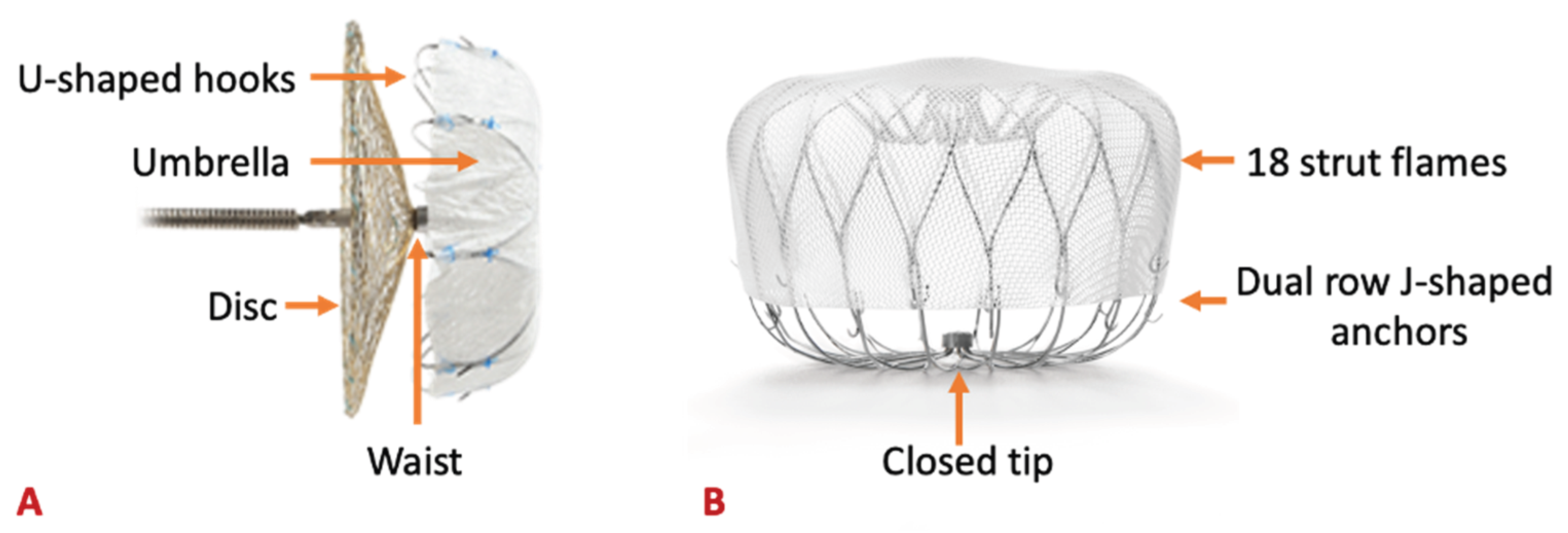
Figure 2.
Study Flow chart. CKD= chronic kidney disease; CAD=coronary artery disease; HF= Heart Failure; TIA= transient ischemic attack; LVEF= left ventrical ejection fraction.
Figure 2.
Study Flow chart. CKD= chronic kidney disease; CAD=coronary artery disease; HF= Heart Failure; TIA= transient ischemic attack; LVEF= left ventrical ejection fraction.
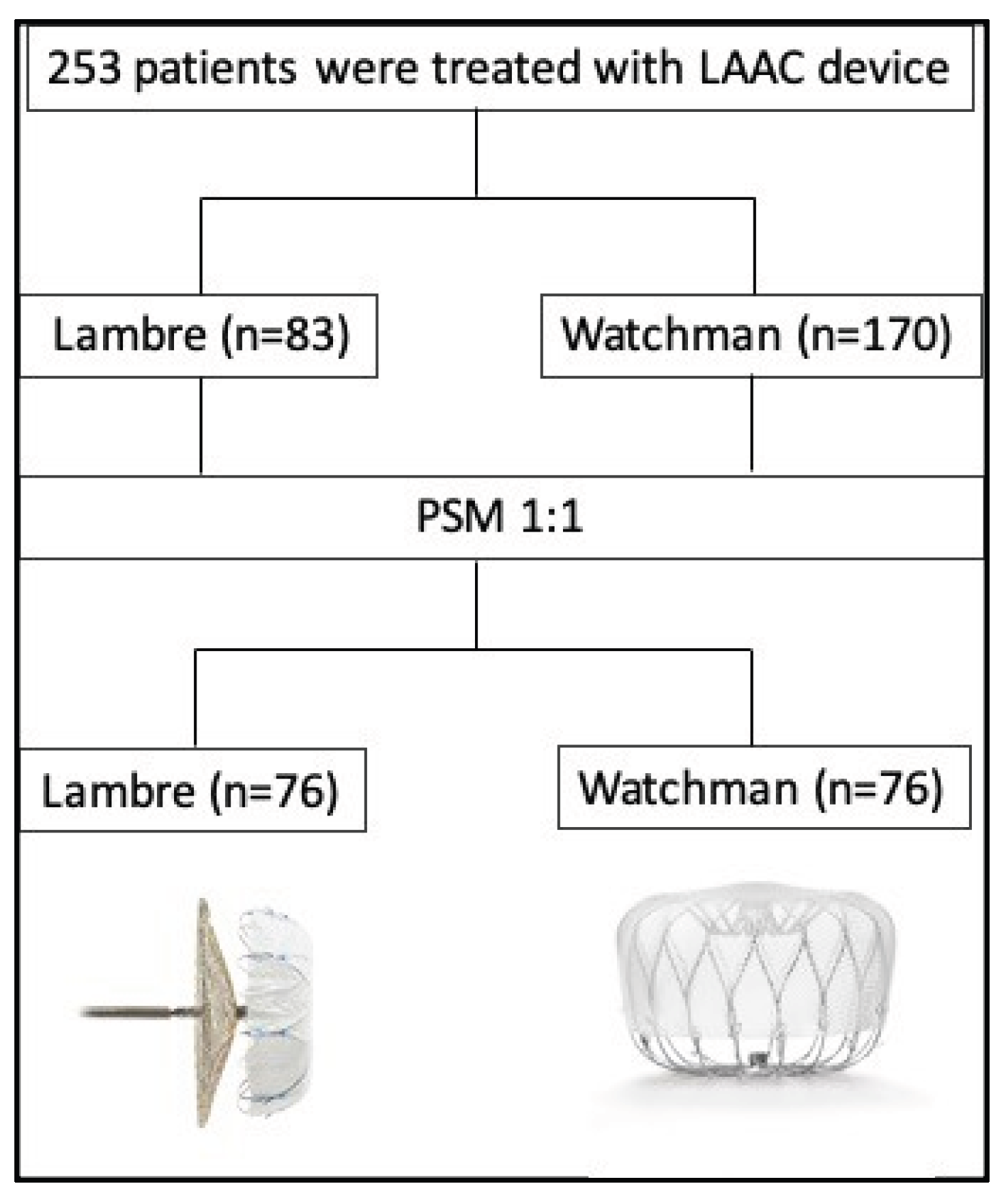
Figure 3.
Primary endpoints of efficacy(a) and safety(b).
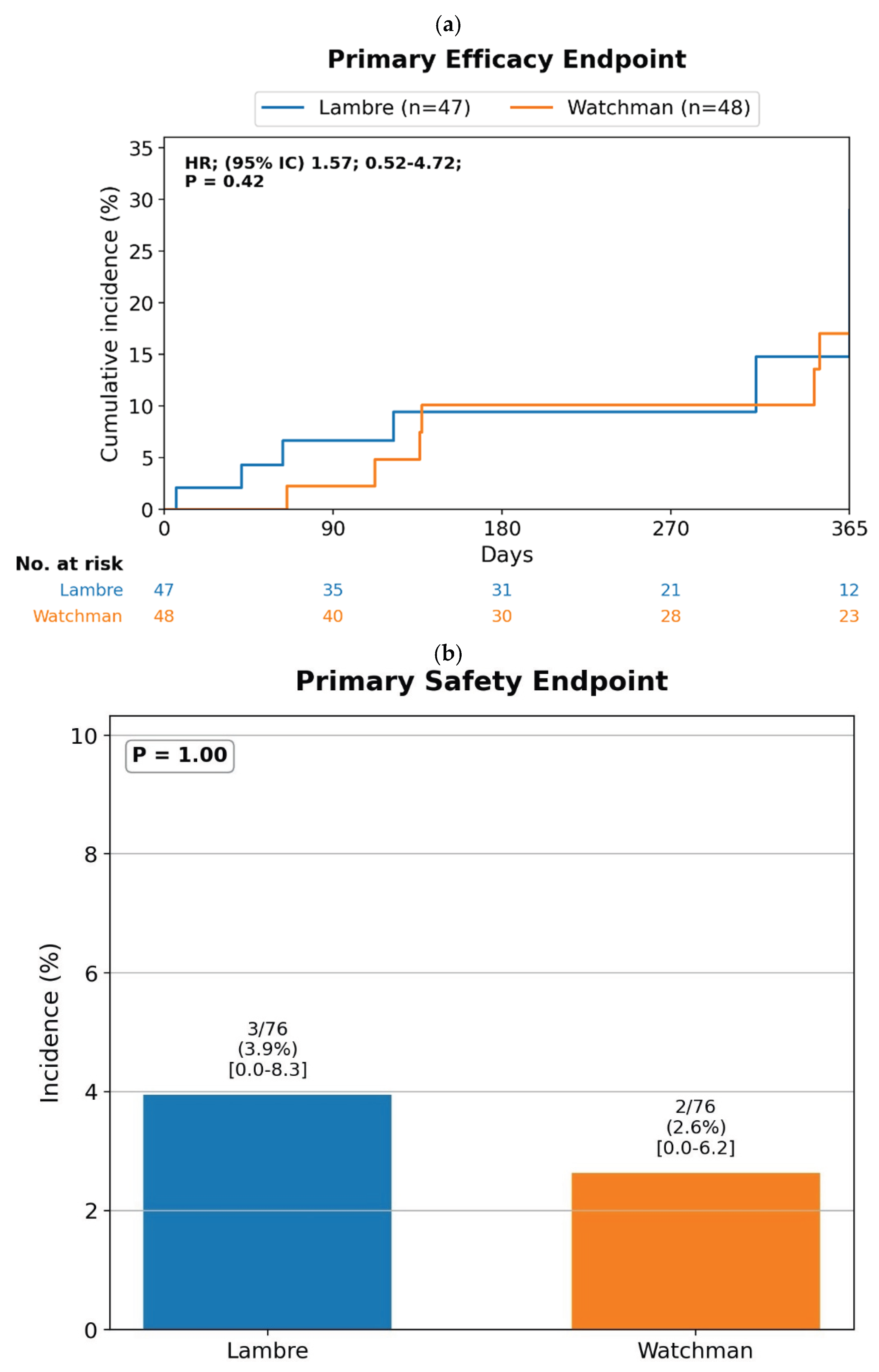

Table 1.
Baseline characteristics of the matched population. CKD= chronic kidney disease; CAD=coronary artery disease; TIA= transient ischemic attack.
Table 1.
Baseline characteristics of the matched population. CKD= chronic kidney disease; CAD=coronary artery disease; TIA= transient ischemic attack.
| Lambre (n=76) | Watchman (n=76) | P-value | SMD | |
|---|---|---|---|---|
| Age | 77.7 ± 8.2 (56.0-72.0-78.0-84.0-92.0) | 77.3 ± 8.3 (56.0-73.0-77.0-83.2-96.0) | 0.65 | 0.04 |
| Female sex | 27 (35.5%) | 24 (31.6%) | 0.73 | 0.08 |
| CKD | 35 (46.1%) | 32 (42.1%) | 0.74 | 0.08 |
| Liver disease | 7 (9.2%) | 4 (5.3%) | 0.53 | 0.15 |
| CAD | 41 (53.9%) | 43 (56.6%) | 0.87 | 0.05 |
| Prior stroke/TIA | 25 (32.9%) | 25 (32.9%) | 1.0 | 0.0 |
| CHA2DS2-VASc score | 4.5 ± 1.3 (1.0-3.0-5.0-5.0-7.0) | 4.5 ± 1.4 (1.0-4.0-4.0-5.2-7.0) | 0.97 | 0.0 |
| HAS-BLED score | 2.7 ± 0.9 (1.0-2.0-3.0-3.0-4.0) | 2.7 ± 0.8 (1.0-2.0-3.0-3.0-5.0) | 0.97 | 0.03 |
| Prior bleeding | 24 (31.6%) | 26 (34.2%) | 0.86 | 0.06 |
Table 2.
Procedural characteristics and periprocedural complications. IP= Intraprocedural, TIA= transient ischemic attack, AMI= Acute Myocardial Infarction, DRC= Device Related Complication, DRT= Device Related Thrombosis.
Table 2.
Procedural characteristics and periprocedural complications. IP= Intraprocedural, TIA= transient ischemic attack, AMI= Acute Myocardial Infarction, DRC= Device Related Complication, DRT= Device Related Thrombosis.
| Lambre (n=76) | Watchman (n=76) | P- value |
|
|---|---|---|---|
| LAAC alone | 74 (97.4%) | 75 (98.7%) | 1.0 |
| LAAC combined | 2 (2.6%) | 1 (1.3%) | 1.0 |
| Device success | 54 (100.0%) | 49 (100.0%) | 1.0 |
| Technical success | 51 (94.4%) | 46 (93.9%) | 1.0 |
| Procedural success | 51 (94.4%) | 46 (93.9%) | 1.0 |
| Number of devices changed | 0 (0.0%) | 1 (1.3%) | 1.0 |
| Chicken wings | 24 (31.6%) | 16 (21.1%) | 0.2 |
| Cactus | 4 (5.3%) | 12 (15.8%) | 0.06 |
| Windsock | 18 (23.7%) | 20 (26.3%) | 0.85 |
| Cauliflower | 30 (39.5%) | 28 (36.8%) | 0.87 |
| Maximum Diameter | 18.0 ± 3.6 (12.0-15.0-17.0-21.0- 31.0) |
19.0 ± 3.2 (14.0-17.0-18.5-22.0- 28.0) |
0.04 |
| IP Death | 0 (0.0%) | 1 (1.3%) | 1.0 |
| IP Stroke | 0 (0.0%) | 1 (1.3%) | 1.0 |
| IP TIA | 1 (1.3%) | 0 (0.0%) | 1.0 |
| IP Pericardial Effusion | 2 (2.6%) | 1 (1.3%) | 1.0 |
| IP Bleeding | 0 (0.0%) | 0 (0.0%) | 1.0 |
| IP Pericarditis | 1 (1.3%) | 1 (1.3%) | 1.0 |
| IP AMI | 1 (1.3%) | 2 (2.6%) | 1.0 |
| Vascular access-related complica- tion |
0 (0.0%) | 0 (0.0%) | 1.0 |
| DRC | 0 (0.0%) | 0 (0.0%) | 1.0 |
| DRT_PROC | 0 (0.0%) | 0 (0.0%) | 1.0 |
| LEAK_PROC | 0 (0.0%) | 0 (0.0%) | 1.0 |
| Primary Safety Endpoint | 3 (3.9%) [0.0-8.3] | 2 (2.6%) [0.0-6.2] | 1.0 |
Table 3.
TEE Follow-up and clinical outcome. DRT= Device Related Thrombosis, AMI= Acute Myocardial Infarction, TIA= Transient Ischemic Attack, BARC= Bleeding Academic Research Consortium.
Table 3.
TEE Follow-up and clinical outcome. DRT= Device Related Thrombosis, AMI= Acute Myocardial Infarction, TIA= Transient Ischemic Attack, BARC= Bleeding Academic Research Consortium.
| Lambre (n=47) | Watchman (n=489 | P-value | Exp-HR (Risk) [95% CI] | |
|---|---|---|---|---|
| No leak | 46 (97.9%) | 47 (97.9%) | 1.0 | - |
| Leak 3-5mm | 1 (2.1%) | 1 (2.1%) | 1.0 | - |
| Leak >5mm | 0 (0.0%) | 0 (0.0%) | 1.0 | - |
| DRT | 1 (2.1%) | 0 (0.0%) | 0.49 | - |
| Pericardial effusion | 0 (0.0%) | 0 (0.0%) | 1.0 | - |
| Embolization | 0 (0.0%) | 0 (0.0%) | 1.0 | - |
| Primary Efficacy Endpoint | 7 (14.9%) [4.7-25.1] | 6 (12.5%) [3.1-21.9] | 0.77 | 1.57 [0.52; 4.72] |
| All-cause death | 6 (12.8%) | 5 (10.4%) | 0.76 | 1.54 [0.47; 5.11] |
| CV death | 1 (2.1%) | 2 (4.2%) | 1.0 | 0.52 [0.05; 5.76] |
| Non-CV death | 4 (8.5%) | 3 (6.2%) | 0.71 | 1.94 [0.43; 8.76] |
| AMI | 0 (0.0%) | 3 (6.2%) | 0.24 | 0.00 [0.00; inf] |
| Stroke | 1 (2.1%) | 0 (0.0%) | 0.49 | - |
| TIA | 1 (2.1%) | 0 (0.0%) | 0.49 | - |
| Systemic embolism | 1 (2.1%) | 0 (0.0%) | 0.49 | - |
| Any bleeding | 0 (0.0%) | 1 (2.1%) | 1.0 | - |
| BARC 1 | 0 (0.0%) | 1 (2.1%) | 1.0 | - |
| BARC 2 | 0 (0.0%) | 0 (0.0%) | 1.0 | - |
| BARC 3a | 0 (0.0%) | 0 (0.0%) | 1.0 | - |
| BARC 3b-c | 0 (0.0%) | 0 (0.0%) | 1.0 | - |
| BARC 4 | 0 (0.0%) | 0 (0.0%) | 1.0 | - |
| BARC 5 | 0 (0.0%) | 0 (0.0%) | 1.0 | - |
Disclaimer/Publisher’s Note: The statements, opinions and data contained in all publications are solely those of the individual author(s) and contributor(s) and not of MDPI and/or the editor(s). MDPI and/or the editor(s) disclaim responsibility for any injury to people or property resulting from any ideas, methods, instructions or products referred to in the content. |
© 2026 by the authors. Licensee MDPI, Basel, Switzerland. This article is an open access article distributed under the terms and conditions of the Creative Commons Attribution (CC BY) license (http://creativecommons.org/licenses/by/4.0/).
Copyright: This open access article is published under a Creative Commons CC BY 4.0 license, which permit the free download, distribution, and reuse, provided that the author and preprint are cited in any reuse.


