

Submitted:
30 July 2026
Posted:
31 July 2026
You are already at the latest version
Abstract
This study investigates the resistance responses of polypyrrole (PPy), titanium dioxide (TiO₂) single layers, and PPy/TiO₂ bilayer, a heterostructure, to rectangular pulses of monochromatic LED illumination under controlled humidity. Exposure to moisture increases the resistance of TiO₂ while rapidly decreasing that of PPy, reflecting opposite influences of electron donation from hydroxyl groups in adsorbed H₂O on the intrinsic carrier densities of the two materials. Under monochromatic illumination, PPy exhibits a simple decrease in resistance, whereas TiO₂ displays a resistance increase accompanied by a brief transient at excitation wavelengths near its optical edge (367 nm and 398 nm). This behavior is assigned to photoinduced carrier density modification through two oposite processes; photogeneration releasing while H₂O photodesorption eliminating charge carriers. The PPy/TiO₂ heterostructure demonstrates a mixed photoresponse arising from the contrasting behaviors of its p‑type PPy and n‑type TiO₂ components, together with charge exchange across the p–n junction. When subjected simultaneously to moisture and monochromatic light, differences in photoinduced carrier generation in two components dynamically modulate the depletion region, producing a wavelength‑dependent resistance response. This complementary “push–pull” interaction results in a synergistic enhancement of photocatalytic and sensing performance in the PPy/TiO₂ heterostructure.
Keywords:
TiO2
; PPy
; PPy/TiO2 heterostructure
; photocatalysis
; photoresponse
1. Introduction
Many nanostructured wide-bandgap semiconductors ranging from inorganic such as TiO₂, ZnO, SnO₂, WO₃, SiO₂, Nb₂O₃, Fe₂O₃, CdS to organic compounds such as semiconducting polymers of PANi, PPy, PEDOT, etc., exhibit unique photoactive feature [1,2,3,4,5]. Upon exposure to light, these materials generate electron–hole pairs that act as potent redox agents, subsequently initiating the formation of diverse reactive free radicals [1,2]. Owing to high activity, the radical species can drive electrochemical processes such as water splitting for hydrogen production, pollutant degradation, and microbial sterilization, etc [5,6,7,8,9,10,11]. Building on this mechanism, photocatalysis has emerged as a promising, sustainable approach for addressing energy and environmental challenges such as air pollution and wastewater contamination. Accordingly, the development of highly effective semiconductor photocatalysts is being pursued at both fundamental and applied levels.
Titanium dioxide (TiO₂) is widely regarded as a cornerstone photocatalyst owing to its chemical stability, affordability, low toxicity, and favorable band-edge positions. However, its photocatalytic activity is largely confined to the UV region (< 400 nm), and it suffers from high electron–hole recombination rates and limited surface absorption. To overcome these limitations, heterostructures formed by coupling TiO₂, an inorganic sminiconductor, with partners possessing complementary electronic properties have been developed as one of the most effective strategies for improving the photocatalystic peromance [12,13,14,15,16]. Among potential candicates, semiconducting polymers such as PANi and PPy are particularly attractive due to their narrow and tunable bandgaps, strong visible-light absorption, and efficient charge transport [17,18,19,20,21,22,23]. PPy was selected over PANi in this study due to its superior environmental stability, better interfacial compatibility with TiO₂, and its ability to form uniform thin layers, which are advantageous for bilayer heterostructure fabrication. When integrated with TiO₂, PPy extends the absorption range into the visible spectrum while simultaneously facilitating charge separation and reducing recombination losses. As a result, TiO₂/PPy heterostructures can achieve enhanced photocatalytic performance compared to TiO₂ alone [22,23]. Nevertheless, the majority of studies on photocatalysts in general, and on PPy/TiO₂ in particular, have predominantly emphasized synthesis methodologies and overall photocatalytic performance. In contrast, mechanistic investigations of photocatalytic processes within the structure remain limited and require further experimental work to validate existing concepts or to propose alternative mechanisms pathway [21].
From a photoelectrochemical perspective, photocatalytic behavior in semiconductor nanostructures such as TiO₂ can be understood through a sequence of fundamental processes. Upon photon absorption, electron–hole (e⁻–h⁺) pairs are generated, separated, and migrate to the semiconductor surface, where they drive redox reactions with adsorbed O₂ and H₂O to yield secondary reactive species (e.g., •OH, O₂•⁻, H⁺). The formation of these radicals is governed by the local availability of oxygen and moisture; for instance, photocatalytic performance in ambient air is strongly humidity-dependent and differs markedly from that in aqueous environments. Beyond environmental factors, the photocatalytic activity in semiconductor nanostructures is fundamentally governed by their electronic configuration, encompassing carrier type, bandgap, and the relative positions of the conduction and valence bands. Accordingly, the deliberate tailoring of electronic structure has emerged as a pivotal strategy for optimizing and enhancing photocatalytic performance. In heterostructures, the coupling of complementary semiconductors (e.g., n-type TiO₂ with p-type PPy) induces modifications in the electronic structure, which are manifested in altered conductance characteristics. In turn, the conductance response of such heterostructures to light excitation under controlled humidity conditions can serve as a sensitive and informative parameter for probing photoelectrochemical processes, particularly in ambient air, where humidity and oxygen play critical roles in governing photocatalytic activity.
Motivated by this rationale, the present study investigates the resistance response of PPy, TiO₂ single layers, and PPy/TiO₂ bilayers to rectangular pulses of monochromatic LED illumination under controlled humidity. This experimental framework enables systematic exploration of moisture-induced electronic effects and charge-transfer mechanisms. By correlating time-resolved conductance with underlying photoelectrochemical processes, the joint modulation of photocatalytic activity in the PPy/TiO₂ bilayer by humidity and illumination is evaluated. The findings are expected to provide new insights into design principles for photocatalytic and optoelectronic materials responsive to coupled light-and-moisture stimuli.
2. Experimental Section
TiO₂ and PPy layers were synthesized by chemical methods following routine procedures [24,25]. TiO₂ was prepared via thermal decomposition of a TiCl₃ precursor (Aldrich), while PPy was synthesized by oxidation of pyrrole (Py, 99.5%, Aldrich) using ammonium persulfate (APS, Kanto Chemical Co. Inc.) as the oxidant. The test samples were fabricated as thin layers on glass substrates, as described below:
PPy Layer: Synthesized by oxidation of pyrrole (Py, 99.5%, Aldrich) using ammonium persulfate (APS). A glass plate was immersed in an acidic solution of 0.1 M HCl and 0.1 M pyrrole. A 0.1 M APS solution was added dropwise, initiating pyrrole oxidation and deposition onto the plate surface.
TiO2 Layer: Prepared via thermal decomposition of a TiCl3 precursor (Aldrich). A glass plate was dipped into a solution of 40 mM TiCl3 and heated to 80 °C to initiate pyrolysis, resulting in TiO2 deposition on the plate surface. After 2 h, the plate was washed, rinsed, and dried.
Heterostructure: PPy/TiO2 bilayers were made by combining the two procedures sequentially on the same glass plate.
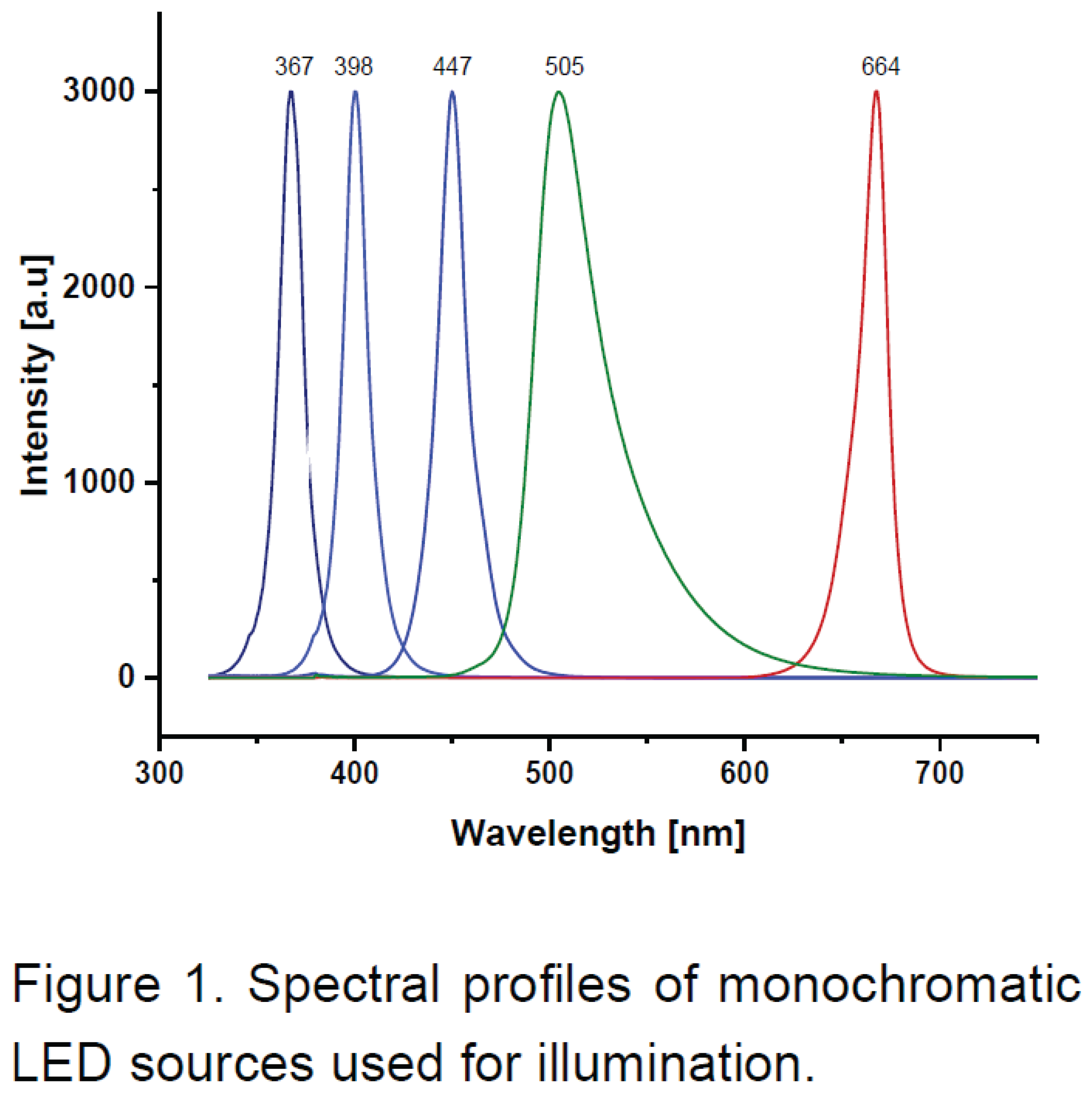
Morphology and structure were characterized using Field-Emission Scanning Electron Microscopy (FESEM, Hitachi S-4800), Raman spectroscopy (Cary), and UV-Vis reflectance spectroscopy (V-750). Illumination was performed using a set of monochromatic LEDs to irradiate the layers in rectangular pulses with 3600 s duration on/off alternatively. The spectral profiles and characteristics of these monochromatic LEDs are presented in Figure 1 and Table 1, respectively.
The overall experiment procedure used to make the PPy, TiO2 and PPy/TiO2 blayer and determine its light response are shown in Figure 2. Electrical resistance was measured under ambient air conditions at relative humidity (RH) levels of approximately 60% and 100% using a programmable Keithley 2000 digital multimeter. The light response of the layers was normalized to the photon flux given in Table 1 and expressed as the ratio ΔR/R₀, representing the relative change in resistance. Here, ΔR = R − R₀, where R₀ is the initial resistance of the layer at the onset of illumination, and R is the resistance measured during illumination.
3. Results and Discussion
FESEM images of the surface morphology and cross-sections of the PPy, TiO₂, and PPy/TiO₂ bilayer are presented in Figure 3. The PPy layer, with a thickness of approximately 90–110 nm, consists of uniformly distributed grains with mean sizes of 20–30 nm, deposited on the surface of glass substrate (Figure 3a,b). On the other hand, the TiO₂ layer, with a thickness of 360 nm, is composed of 15–20 nm grains forming clusters that randomly cover the surface of the glass plate. The PPy/TiO₂ structure consists of two distinct layers—TiO₂ and PPy—each with a thickness corresponding to its respective component (Figure 3c,d). Notably, the presence of an air gap at the PPy–glass interface indicates weak mechanical adhesion, which may limit the stability of the PPy layer when deposited directly on glass. However, the continuous and smooth PPy/TiO₂ interface demonstrates strong bonding, suggesting that TiO₂ acts as an effective intermediate layer that promotes heterostructure formation. This improved interfacial contact is expected to enhance electronic coupling between PPy and TiO₂, thereby contributing to better charge transport across the interface.
Raman profiles taken from the PPy, TiO₂, and PPy/TiO₂ bilayer show identical vibrational modes corresponding to PPy and TiO₂ as presented in Figure 4. The Raman spectrum of the TiO₂ layer reveals three strong Raman shift bands at 232, 446, and 609 cm⁻¹, which agree with the spectra of the rutile phase [26, 27.]. The predominance of the rutile structure in the resulting TiO₂ deposition is resulting from the effect of additional HCl in the medium during pyrolysis of the TiO₂ precursor [28,29]. The Raman spectrum of PPy exhibits distinct vibrational modes at 1589, 1348, and 986 cm⁻¹, indicating that certain sites of the PPy chain remain in the benzoid form (reduced state). The vibrational mode at 938 -945 cm⁻¹ assigned to C–C ring deformation in the quinoid form, corresponds to oxidized sites of the PPy (bipolarons) [30,31,32,33]. The bands at 1054 and 1086 cm⁻¹ that appears in the PPy and PPy/TiO2 spectrum, respectively asigned to the C–H in-plane deformation corresponding to the polaron and bipolaron state of PPy. In addition, coupling TiO₂ and PPy in the PPy/TiO₂ bilayer causes changes in relative intensity and a shift of the vibrational bands associated with each component. Regarding to those of the PPy component in the PPy/TiO2, the vibrational modes of the C=C bond exhibit a blue-shift from 1348 and 1589 cm⁻¹ to 1338 and 1590 cm⁻¹ respectively, indicating that PPy transitions toward a higher oxidated structure, i.e., the PPy component is partly oxidated as a result of coupling with the TiO₂.
UV-Vis absorption profiles of the PPy, TiO₂, and PPy/TiO₂ layers are depicted in Figure 5a. The UV-Vis spectrum of the TiO₂ layer exhibits a broadened absorption edge ranging between 380–420 nm, reflecting contributions from the absorption bands of the anatase (3.2 eV) and rutile (3.0 eV) phases. Both UV-Vis spectra of the PPy and PPy/TiO₂ bilayer, spreading over the UV-Vis region, contain three broad bands centered around 415 nm, 476 nm, and 670 nm, which correspond to the typical absorption bands of PPy. The 415 nm absorption band represents the π–π* transition, while the 476 nm and 670 nm absorption bands correspond to allowed polaronic and bipolaronic transitions, characteristic of the oxidized state of PPy component (Figure 6b) [34,35,36]. As seen from the spectra, when TiO₂ is introduced, the π–π* band (VB to CB) undergoes a slight shift from 415 to 417 nm, while the transition bands at 476 nm and 670 nm increases in intensity indicating an increase in polaron and bipolaron levels in PPy bandgap. In addition to the conclusions derived from Raman analysis, the UV–Vis spectrum further corroborates that, upon coupling with TiO₂, the oxidative state of PPy is enhanced.
Figure 6 depicts the resistance response of single-layer TiO₂ and PPy to moisture, revealing opposite behaviors. As the relative humidity increases from 60% to 100% RH, the resistance of TiO₂ decreases abruptly by more than two orders of magnitude, from ~10⁹ Ω to ~5 × 10⁷ Ω. In sharp contrast, the resistance of PPy shows only a modest increase of about 20–30% (from ~35 kΩ to ~40 kΩ). These modifications in resistance are assigned to electron transfer from hydroxyl (–OH) groups in adsorbed water molecules to the TiO₂ and PPy layers. In TiO₂, an n-type semiconductor, electron transfer enhances the electron density, thereby lowering the resistance. In contrast, in the p-type PPy layer, the injected electrons reduce the hole concentration, leading to an increase in resistance. The rapid recovery of resistance in both TiO₂ and PPy upon returning to ~60% RH indicates that adsorbed water is quickly desorbed from their surfaces. The fast desorption at ambient temperature suggests that TiO₂–OH and PPy–OH interactions are primarily governed by physisorption, with binding energies comparable to the thermal kinetic energy (~kT).
Upon irradiation with monochromatic light, the electrical resistances of TiO₂, PPy, and the PPy/TiO₂ bilayers exhibit distinct and mixed light response modes. As illustrated in Figure 7a and Figure 7b, the resistance of the PPy layer increases as the relative humidity rises from 60% to 100% RH and the light response is negative, the resistance decreases when the light is switched on and returns to its baseline value when the light is switched off. The light response of the PPy layer appears to be dependent on the excitation wavelength, showing its highest magnitude under 367 nm illumination and gradually diminishing at longer wavelengths. This feature can be derived from the wavelength dependence of allowed transition band observed in the UV–Vis spectra. The presence of moisture significantly enhances this response; for instance, under 367 nm illumination at 100% RH, the TiO₂ response reaches approximately –120%, compared to only –16% at 60% RH, representing an order of increase in magnitude. In contrast, Figure 7c show that the light response of the TiO₂ layer decreases sharply from an initially near-infinite value when the relative humidity swiches from 60% to 100% RH, and exhibits a wavelength-dependent transitional behavior. Under excitation light at long wavelengths (664 and 505 nm), the TiO₂ response is simple, decreasing when the light is on and increasing when the light is off. However, under short-wavelength excitation (447, 398, and 367 nm), the TiO₂ layer displays an transient response during on/off switching, with most pronounced under 367 nm illumination. On the other hand, the PPy/TiO₂ bilayer (Figure 7d) commbine features of both components, showing a wavelength- and cycle-dependent response. Similar to the TiO₂ single layer, its resistance decreases sharply from an initially very high value when the relative humidity increases from 60% to 100% RH. At long wavelength light as 664 nm, the bilayer response resembles that of PPy, characterized by a simple decrease and a decrease respectively following the light on and off. Under 505 nm illumination, a pronounced bilayer peak in the response of the bilayer was observed, similar to the TiO₂ layer response. As shown in Figure 7c and Figure 7d, the responses of both the TiO₂ layer and the bilayer exhibit distinct features compared with other wavelengths. This behavior is consistent with an experimental observations of hydrogel evaporation under visible-light illumination, which revealed a peak rate at 520 nm [37]. Under short-wavelength excitation, however the bilayer undergoes a transient response during the initial on/off cycles before stabilizing into TiO₂-like behavior with higher light response, typically more than 50% in response magnitude. As a result, the heterostructure reveals a conversion from the positive to negative response mode analoguos to PANi/TiO2 system [38,39]. This feature can be assigned to photoinduced charge transfer processes within the PPy/TiO₂ heterostructure, occurring in the individual TiO₂ and PPy components as well as across the p–n junction.
3.1. Discussion
The changes in resistance of the PPy, TiO₂, and the PPy/TiO₂ bilayer under moisture and light exposure can be attributed to photoelectrochemical processes involving charge exchange and transfer within the materials. As individual components, PPy and TiO₂ exhibit intrinsic conductivity characteristics of p-type and n-type semiconductors, respectively, and their conductance is modified by agents or processes that donate or withdraw electrons or holes from their conduction and valence bands. Oxidative or reductive species in the surrounding environment, such as O₂ and H₂O, can act as secondary dopants, further influencing the conductance of both PPy and TiO₂. The physical adsorption of oxidative or reductive gases available in ambient air show to affect the PPy conductance, which in turn enables the development of various gas sensors [40,41,42].
With respect to moisture interaction, H₂O molecules (via hydroxyl groups) tend to donate or withdraw electrons during absorption and desorption, thus modulating the conductance of p-type PPy and n-type TiO₂ in opposite directions. A proposed mechanism of charge exchange within the individual PPy and TiO₂ layers during H₂O sorption and desorption, together with the corresponding longitudinal resistance shown in Figure 8a and Figure 8b, provides an explanation for the resistance responses observed in Figure 6. Upon exposure to moisture, absorbed H₂O molecules donate electrons to the conduction band of TiO₂ and interact with the valence band of PPy. The donation increases electron density in the n-type TiO₂ layer while reducing hole density in the p-type PPy layer, thereby enhancing the TiO₂ layer conductance and decreasing the PPy layer conductance. When moisture is removed, desorption of H₂O reverses the process, consiquentely restoring the conductance of both PPy and TiO₂ to their original values.
Upon exposure to excitation light, the photoinduced modifications in PPy, TiO₂, and the heterostructure exhibit a a common pattern synchronized with light on/off switching but differ significantly depending to light wavelength, giving rise to a mixed photoresponse. In PPy, the overlap between the absorption band of the PPy layer (Figure 5) and the emission spectra of the monochromatic LEDs (Figure 1) facilitates electron transitions from the valence band into polaron and bipolaron states, thereby simply increasing hole density and enhancing the electrical conductance of the PPy layer. The illumination are also assumed to induce the photodesorption of physisorbed H₂O molecules (with weak bonding strength on the order of ~kT) from the PPy surface; the removal of these electron-donating adsorbates elevates the hole concentration in p-type PPy, further augmenting its conductance. The magnitude of the response reflects the combined influence of the rate of allowed electronic transitions and the photoinduced desorption of H₂O in the PPy layer, a factor that is independent of wavelength.
For the TiO₂ layer, illumination typically produces an increase in resistance or a decrease in conductance similar to the response caused by desorption of absorbed H₂O. Over a broad wavelength range, the response of TiO₂ layer exhibits a light-synchronized cyclic increase–decrease pattern, with two notable deviations: an immediate transient drop followed by a rise at staring of light-on following a delayed hysteresis after light-off, where conductance remains above its original value under 367, 398, and 447 nm illumination, and a distinct peak under 505 nm illumination. The transient feature observed at the onset of light illumination reflects the competition between electron generation by photoexcitation and electron removal through photoinduced desorption of H₂O from the TiO₂ surface, whereas the transient following light-off corresponds to enhanced re-adsorption of H₂O beyond the normal level, i.e., the photoinduced superhydrophilicity of TiO₂. The distinct peak in the light response observed under 505 nm illumination can be interpreted as a modification of the photomolecular effect on the evaporation rate, which has exhibited a maximum at 520 nm in hydrogel materials. This peak in evaporation has been assigned to a resonance between photon energy and the bonding energy of water clusters interacting with surrounding molecules [37].
When PPy and TiO₂ layers are combined, the couple typically forms a p–n heterojunction, where a depletion region and an internal electric field are established as a result of diffusion and neutralization of opposite charge carriers across the junction. The depletion region acts like a capacitor, with its junction capacitance determined by the contact area, the depletion width, and the dielectric constant of the material, where PPy serves as the positive electrode and TiO₂ as the negative electrode. Since the depletion region extends into both components, with its width in each inversely proportional to the carrier density and directly proportional to the dielectric constant (ε ≈ 2–5 for PPy, ε ≈ 80–240 for TiO₂), it preferably penetrates more deeply into TiO₂ than into PPy. Under illumination and moisture, the carrier density of the PPy and TiO₂ layers is altered, shifting the charge distribution toward either the PPy or TiO₂ side. The variation in depletion width alters the junction capacitance, causing the junction to behave as a varicap diode. Consequently, the heterostructure’s response reflects the overall combined modifications in the junction as well as in both individual components. The proposed mechanism of charge transfer and exchange in the heterostructure, together with the corresponding longitudinal resistance, is presented in Figure 8c. When the relative humidity increases from 60% to 100%, the heterostructure exhibits a moisture response resembling that of the TiO₂ layer, characterized by a rapid decline from an almost infinite value (i.e., beyond the measurement range limit). This behavior can be rationalized by the dominant influence of the TiO₂ layer, owing to its greater thickness and its upper position relative to the PPy layer within the heterostructure. Under ambient relative huminity of 100%, the light response of the heterostructure generally resembles that of the TiO₂ except at 664 nm. At 664 nm illumination, well below the optical absorption edge of TiO₂, the photoexcitation is expected to take place predominantly in the PPy layer, while being negligible in the TiO₂. Consequently, the PPy component dominates the electrical conductance of the PPy/TiO₂ heterostructure, and the light response, ΔR/R₀, is negative. At shorter wavelengths, the heterostructure exhibits a transient response characterized by a convex curve during the initial light on/off cycles, gradually shifting from negative to positive mode in a manner similar to the light response of the TiO₂ [38,39]. The transient response is attributed to a combined effects of the presence of photogenerated carrier density in TiO₂, secondary radical species, and the competing photoelectrochemical processes within the heterostructure. The transient response remains observable under 505 nm illumination, indirectly suggesting that the PPy/TiO₂ coupling enables the extension of photocatalytic activity within the heterostructure into the visible region. The response peak at 505 nm observed in the heterostructure, similar to that of TiO₂, can also be ascribed to the photomolecular effect [37]. In summary, the combination of opposite responses from PPy and TiO₂ resembles a “push–pull amplifier,” producing a synergistic effect that enhances both the photocatalytic performance and the humidity sensitivity of the system.
4. Conclusions
Upon exposure to moisture, the resistance of n-type TiO₂ decreases fast, whereas the resistance of p-type PPy increases with slower rate and both return to baseline once the moisture is reduced. This contrasting behavior arises from water adsorption and desorption on the respective surfaces: hydroxyl (–OH) groups act as electron donors, enhancing conductivity in n-type TiO₂ but suppressing in p-type PPy.
Under light excitation, the PPy layer resistance exhibits a decrease, while TiO₂ shows a tendency increase, the behavior attributable to the combined effects of photoinduced H₂O desorption and photogenerated carriers. The PPy response is wavelength-dependent, as all excitation wavelengths employed are shorter than its optical edge, whereas TiO₂ displays a brief inverted transient at short wavelengths due to competition between H2O photodesorption-induced hole release and electron photogeneration near the band edge.
In the PPy/TiO₂ heterostructure, coupling of the p-type PPy and n-type TiO₂ layers forms a p–n junction with a depletion region that neutralize carrier densities across the interface and internal electric field. Esposure to light and moisture alter electron and hole density in each component, expanding the depletion region toward either the PPy or TiO₂ side and thereby modulating the overall resistance. Under 664 nm excitation, the heterostructure response reflects that of PPy due to its dominant conductance contribution. At shorter wavelengths, the increasing electron density in TiO₂ drives the heterostructure response to resemble that of TiO₂. Collectively, the heterostructure displays a mixed photoresponse arising from the interplay between PPy and TiO₂ dominance, with the p–n depletion region serving as a dynamic regulator of balance. This complementary “push–pull” interaction produces a synergistic effect, enhancing the photocatalystic and humidity sensing of the PPy/TiO₂ system.
Author Contributions
DNH: methodology, funding acquisition, conceptualization, supervision, writing—original draft, review and editing; NTT: software, investigation, visualization, validation; HTT: investigation, visualization, validation; LVT: supervision, data curation, w review and editing.
Data Availability Statement
The pictures, Raman, UV-Vis and data on light response are provided upon request.
Acknowledgments
The work is carried on thanks to the basic research grand from Industrial University of Hochiminh City (IUH).
Conflicts of Interest
The authors declare no competing interests.
References
- Fujishima, A.; Honda, K. Electrochemical photolysis of water at a semiconductor electrode. Nature 1972, 238, 37–38. [CrossRef]
- Hashimoto, K.; Irie, H.; Fujishima, A. TiO2 photocatalysis: A historical overview and future prospects. Jpn. J. Appl. Phys. 2005, 44, 8269. [CrossRef]
- Danish, M.S.S.; Bhattacharya, A.; Stepanova, D.; Mikhaylov, A.; Grilli, M.L.; Khosravy, M.; Senjyu, T. A systematic review of metal oxide applications for energy and environmental sustainability. Metals 2020, 10(12), 1604. [CrossRef]
- Medhi, R.; Marquez, M.D.; Lee, T.R. Visible-light-active doped metal oxide nanoparticles: Review of their synthesis, properties, and applications. ACS Appl. Nano Mater. 2020, 3, 6156–6179. [CrossRef]
- Ghosh, S.; Kouamé, N.; Ramos, L.; et al. Conducting polymer nanostructures for photocatalysis under visible light. Nat. Mater. 2015, 14, 505–511. [CrossRef]
- Ahasan, T.; Edirisooriya, E.M.N.T.; Senanayake, P.S.; Xu, P.; Wang, H. Advanced TiO2-based photocatalytic systems for water splitting: Comprehensive review from fundamentals to manufacturing. Molecules 2025, 30(5), 1127. [CrossRef]
- Matsunaga, T.; Tomoda, R.; Nakajima, T.; Wake, H. Photoelectrochemical sterilization of microbial cells by semiconductor powders. FEMS Microbiol. Lett. 1985, 29, 211–214. [CrossRef]
- Trapalis, C.; Keivanidis, P.; Kordas, G.; Zaharescu, M.; Crisan, M.; Szatvanyi, A.; Gartner, M. TiO2(Fe3+) nanostructured thin films with antibacterial properties. Thin Solid Films 2003, 433, 186–190. [CrossRef]
- Wang, J.; Polleux, J.; Lim, J.; Dunn, B. Pseudocapacitive contributions to electrochemical energy storage in TiO2 (anatase) nanoparticles. J. Phys. Chem. C 2007, 111, 14925–14931. [CrossRef]
- Ghamarpoor, R.; Fallah, A.; Jamshidi, M. A review of synthesis methods, modifications, and mechanisms of ZnO/TiO2-based photocatalysts for photodegradation of contaminants. ACS Omega 2024, 9(24), 25457–25472. [CrossRef]
- Dong, H.; Zeng, G.; Tang, L.; Fan, C.; Zhang, C.; He, X.; He, Y. An overview on limitations of TiO2-based particles for photocatalytic degradation of organic pollutants and the corresponding countermeasures. Water Res. 2015, 79, 128–146. [CrossRef]
- Fan, F.R.; Bard, A.J. Spectral sensitization of the heterogeneous photocatalytic oxidation of hydroquinone in aqueous solution at phthalocyanine-coated TiO2 powders. J. Am. Chem. Soc. 1979, 101, 6139–6140. [CrossRef]
- Herrmann, J.M. Heterogeneous photocatalysis: Fundamentals and applications to the removal of various types of aqueous pollutants. Catal. Today 1999, 53, 115. [CrossRef]
- Marschall, R. Semiconductor composites: Strategies for enhancing charge carrier separation to improve photocatalytic activity. Adv. Funct. Mater. 2014, 24, 2421–2440. [CrossRef]
- Wang, H.; Zhang, L.; Chen, Z.; et al. Semiconductor heterojunction photocatalysts: Design, construction, and photocatalytic performances. Chem. Soc. Rev. 2014, 43, 5234–5244. [CrossRef]
- Wang, H.; Li, X.; Zhao, X.; Li, C.; Song, X.; Zhang, P.; Huo, P.; Xin, X. A review on heterogeneous photocatalysis for environmental remediation: From semiconductors to modification strategies. Chin. J. Catal. 2022, 43, 178. [CrossRef]
- Saianand, G.; Gopalan, A.I.; Wang, L.; Venkatramanan, K.; Roy, V.A.; Sonar, P.; Lee, D.; Naidu, R. Conducting polymer based visible light photocatalytic composites for pollutant removal: Progress and prospects. Environ. Technol. Innov. 2022, 28, 10698. [CrossRef]
- Namsheer, K.; Rout, C.S. Conducting polymers: A comprehensive review on recent advances in synthesis, properties and applications. RSC Adv. 2021, 11, 5659–5697. [CrossRef]
- Ekande, O.S.; Kumar, M. Review on polyaniline as reductive photocatalyst for the construction of the visible light active heterojunction for the generation of reactive oxygen species. J. Environ. Chem. Eng. 2021, 9, 105725. [CrossRef]
- Reddy, K.R.; Karthik, K.V.; Benaka Prasad, S.B.; Sarvesh, K.S.; Han, M.J.; Anjanapura, V.R. Enhanced photocatalytic activity of nanostructured titanium dioxide/polyaniline hybrid photocatalysts. Polyhedron 2016, 120, 169–174. [CrossRef]
- Fu, Y.; Janczarek, M. Polyaniline–titanium dioxide heterostructures as efficient photocatalysts: A review. Crystals 2023, 13, 1637. [CrossRef]
- Amorim, S.M.; Steffen, G.; de S Junior, J.M.; Brusamarello, C.Z.; Romio, A.P.; Domenico, M.D. Synthesis, characterization, and application of polypyrrole/TiO2 composites in photocatalytic processes: A review. Polym. Polym. Compos. 2021, 29, 1055. [CrossRef]
- Puerres, J.; Ortiz, P.; Cortés, M.T. Stability of TiO2–polypyrrole heterojunctions for photoelectrochemical water oxidation. Electrochem 2025, 6, 31. [CrossRef]
- Nguyen, T.T.; Duong, N.H. Effect of TiO2 rutile additive on electrical properties of PPy/TiO2 nanocomposite. J. Nanomater. 2016, Article ID 4283696. [CrossRef]
- Duong, N.H.; Nguyen, T.P.; Nguyen, T.T. Effect of TiO2 anatase nanocrystallite on electrical properties of PPy/TiO2 nanocomposite. Commun. Phys. 2018, 28, 87. [CrossRef]
- Balachandran, U.P.; Eror, N.G. Raman spectra of titanium dioxide. J. Solid State Chem. 1982, 42, 276. [CrossRef]
- Choi, H.C.; Jung, Y.M.; Kim, S.B. Size effects in the Raman spectra of TiO2 nanoparticles. Vib. Spectrosc. 2005, 37, 33–38. [CrossRef]
- Nguyen, T.T.; Duong, N.H. Effect of HCl on the formation of TiO2 nanocrystallites. J. Nanomater. 2016, Article ID 6547271. [CrossRef]
- Duong, N.H.; Mai, X.D.; Mai, V.T. Effect of pH on the formation of amorphous TiO2 complexes and TiO2 anatase during the pyrolysis of an aqueous TiCl4 solution. Catalysts 2020, 10, 1187. [CrossRef]
- Kostić, R.; Raković, D.; Stepanyan, S.A.; Davidova, I.E.; Gribov, L.A. Vibrational spectroscopy of polypyrrole, theoretical study. J. Chem. Phys. 1995, 102, 3104. [CrossRef]
- Trchová, M.; Stejskal, J. Resonance Raman spectroscopy of conducting polypyrrole nanotubes: Disordered surface versus ordered body. J. Phys. Chem. A 2018, 122, 9298. [CrossRef]
- Šetka, M.; Calavia, R.; Vojkůvka, L.; Llobet, E.; Drbohlavová, J.; Vallejos, S. Raman and XPS studies of ammonia sensitive polypyrrole nanorods and nanoparticles. Sci. Rep. 2019, 9, 8465. [CrossRef]
- Liu, Y.C.; Hwang, B.J. Identification of oxidized polypyrrole on Raman spectrum. Synth. Met. 2000, 113, 203. [CrossRef]
- Kaufman, J.H.; Colaneri, N.; Scott, J.C.; Street, G.B. Evolution of polaron states into bipolarons in polypyrrole. Phys. Rev. Lett. 1984, 53, 1005. [CrossRef]
- Kepas, A.; Grzeszczuk, M.; Kvarnstrom, C.; Lindfors, T.; Ivaska, A. UV-Vis and Raman spectroelectrochemistry of electrodeposited polypyrrole in hexafluorophosphate. Pol. J. Chem. 2007, 81, 2207.
- Çamurlu, P. Polypyrrole derivatives for electrochromic applications. RSC Adv. 2014, 4, 55832. [CrossRef]
- Tu, Y.; Zhou, J.; Lin, S.; Alshrah, M.; Zhao, X.; Chen, G. Plausible photomolecular effect leading to water evaporation exceeding the thermal limit. Proc. Natl. Acad. Sci. U.S.A. 2023, 120(45), e2312751120. [CrossRef]
- Duong, N.H.; Le, V.T. Effect of photoinduction in PANi/TiO2 heterogeneous structure on conductance of PANi component. Heliyon 2025, 11, e42807. [CrossRef]
- Duong, N.H.; Mai, V.T.; Mai, X.D. Charge photogeneration and transfer in polyaniline/titanium dioxide heterostructure. Catalysts 2024, 14, 585. [CrossRef]
- Bai, H.; Shi, G. Gas sensors based on conducting polymers. Sensors (Basel) 2007, 7, 267–307. PMCID: PMC3756721.
- Das, M.; Roy, S. Polypyrrole and associated hybrid nanocomposites as chemiresistive gas sensors: A comprehensive review. Mater. Sci. Semicond. Process. 2021, 121, 105332. [CrossRef]
- Husain, A.; Shariq, M.U. Polypyrrole nanocomposites as promising gas/vapour sensing materials: Past, present and future prospects. Sens. Actuators A Phys. 2023, 359, 114504. [CrossRef]
Figure 2.
Schematic representation of the experimental procedure used to fabricate PPy, TiO₂, and PPy/TiO₂ bilayers and to determine their light response.
Figure 2.
Schematic representation of the experimental procedure used to fabricate PPy, TiO₂, and PPy/TiO₂ bilayers and to determine their light response.
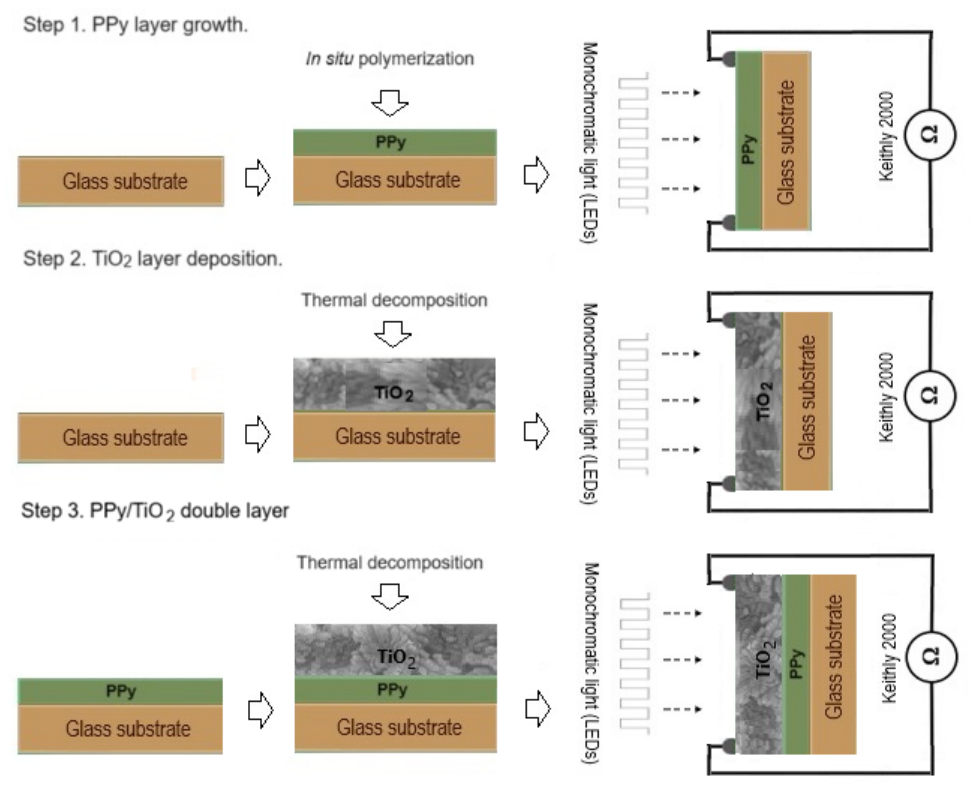
Figure 3.
SEM images of (a) PPy thin-layer surface, (b) PPy layer cross-section, (c) PPy/TiO₂ bilayer surface, and (d) PPy/TiO₂ bilayer cross-section.
Figure 3.
SEM images of (a) PPy thin-layer surface, (b) PPy layer cross-section, (c) PPy/TiO₂ bilayer surface, and (d) PPy/TiO₂ bilayer cross-section.
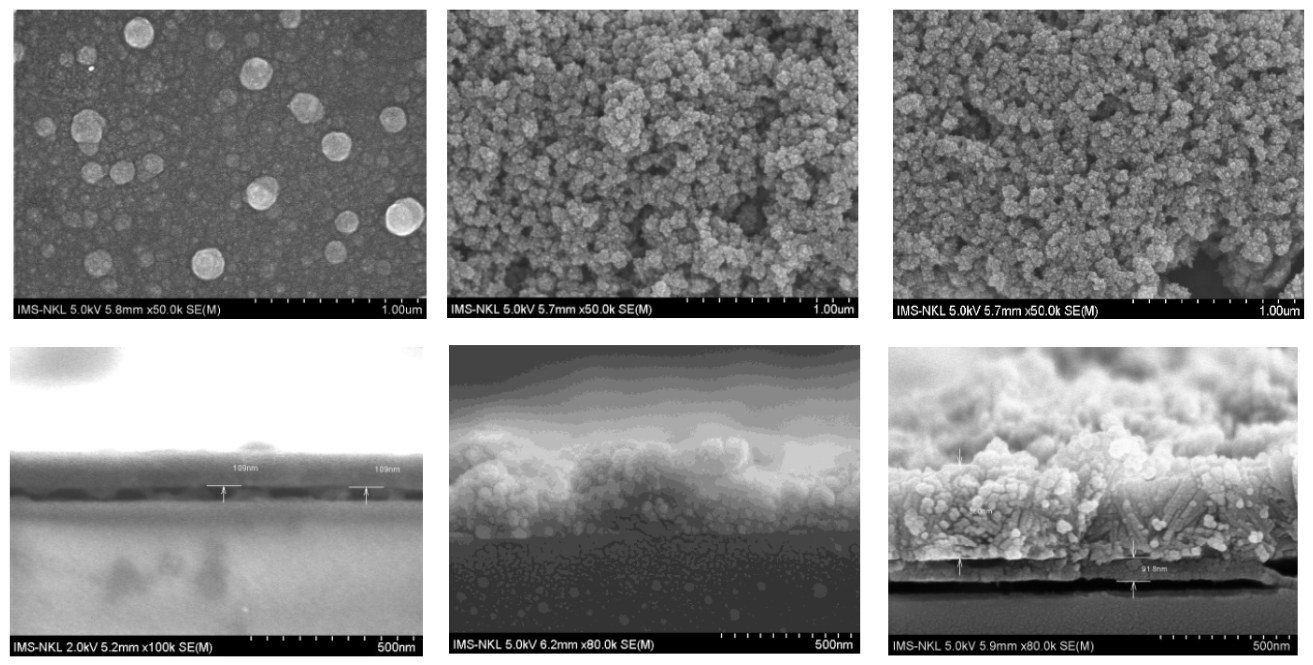
Figure 4.
Raman profiles of TiO2, PPy and PPy/TiO2 bilayer.
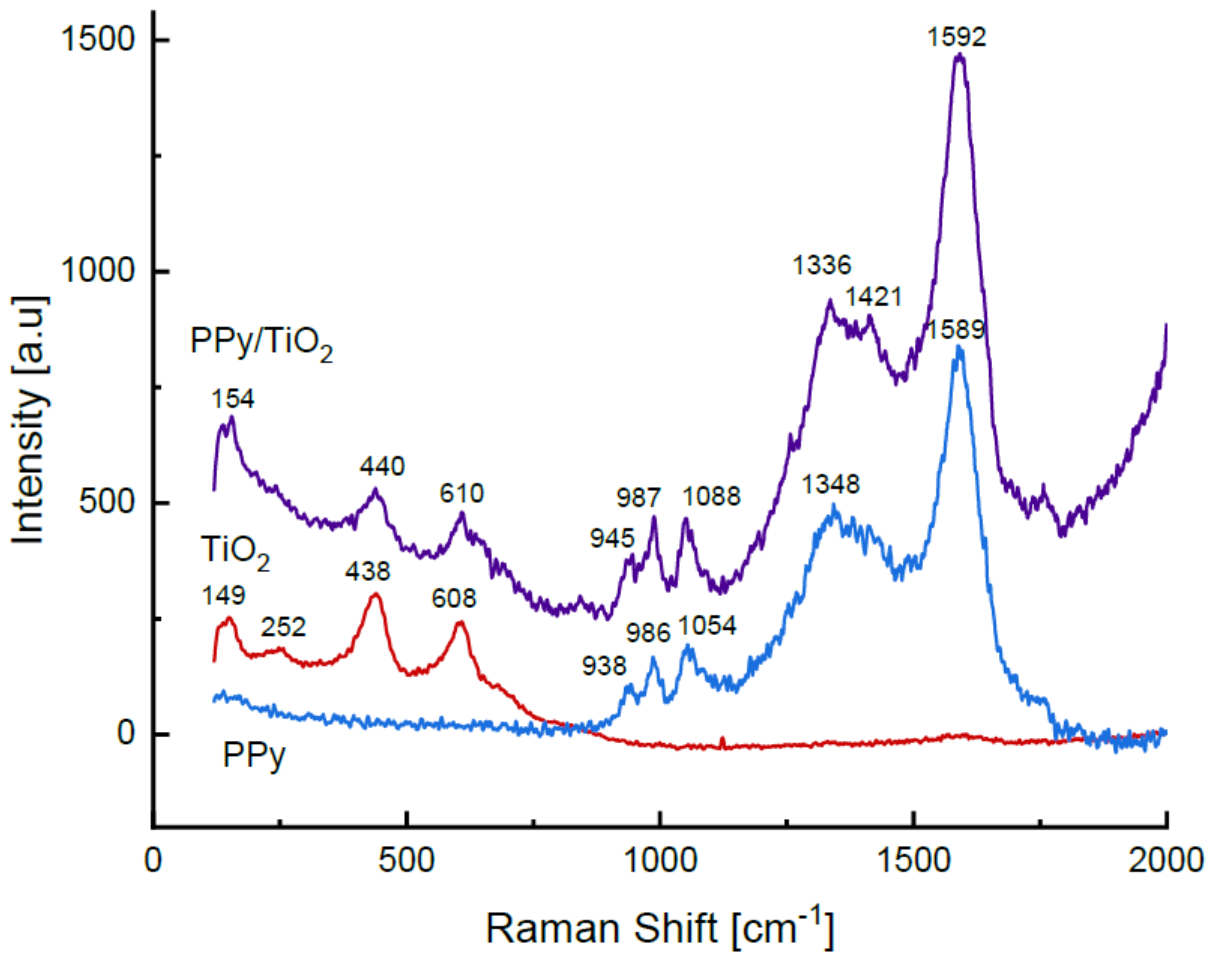
Figure 5.
a) UV-Vis spectra of TiO2, PPy and PPy/TiO2 bilayer; b) allowed transitions in PPy adsortion band [31,33].
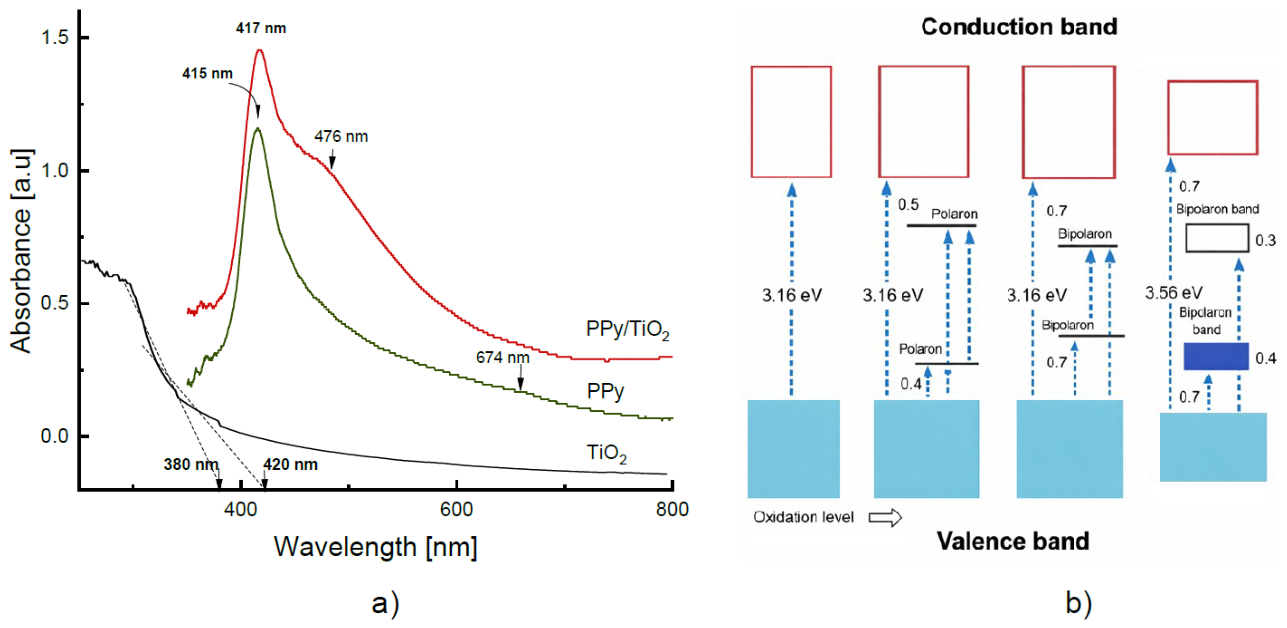
Figure 6.
Resistance response of single-layer TiO₂ and PPy under relative humidity (RH) conditions shifting between 60% and 100%.
Figure 6.
Resistance response of single-layer TiO₂ and PPy under relative humidity (RH) conditions shifting between 60% and 100%.
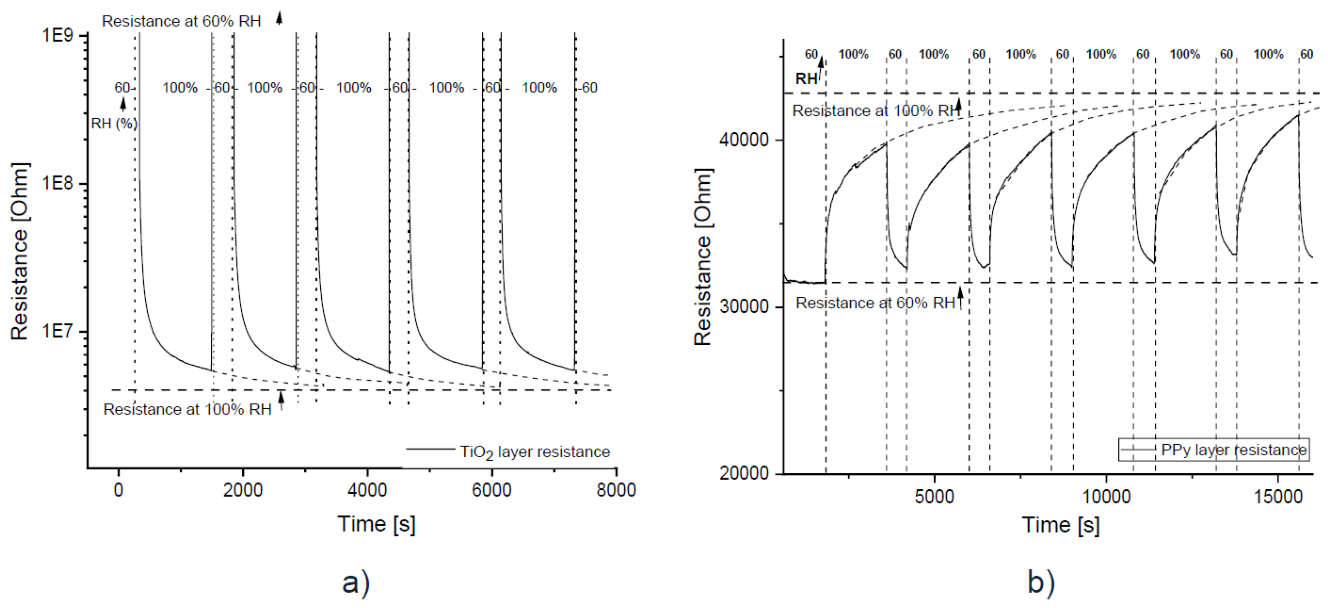
Figure 7.
(a) Light response of the PPy layer under 60% RH; (b) PPy layer under 100% RH; (c) TiO₂ layer under 60% RH; and (d) PPy/TiO₂ bilayer under 100% RH.
Figure 7.
(a) Light response of the PPy layer under 60% RH; (b) PPy layer under 100% RH; (c) TiO₂ layer under 60% RH; and (d) PPy/TiO₂ bilayer under 100% RH.
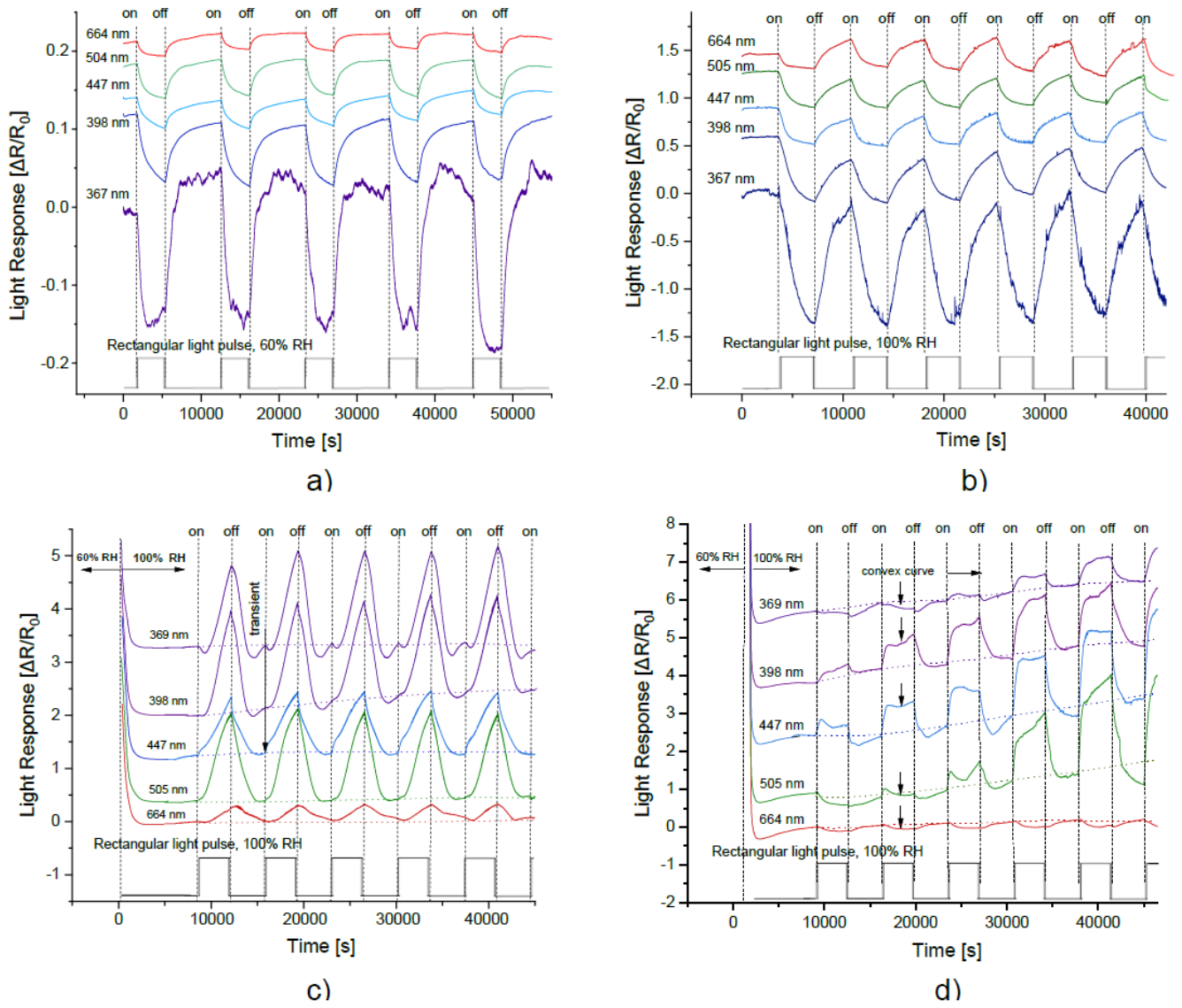
Figure 8.
Schematic illustration of charge exchange processes in PPy, TiO₂, and PPy/TiO₂ heterostructures upon exposure to illumination and moisture, along with their equivalent l longitudinal resistance.
Figure 8.
Schematic illustration of charge exchange processes in PPy, TiO₂, and PPy/TiO₂ heterostructures upon exposure to illumination and moisture, along with their equivalent l longitudinal resistance.
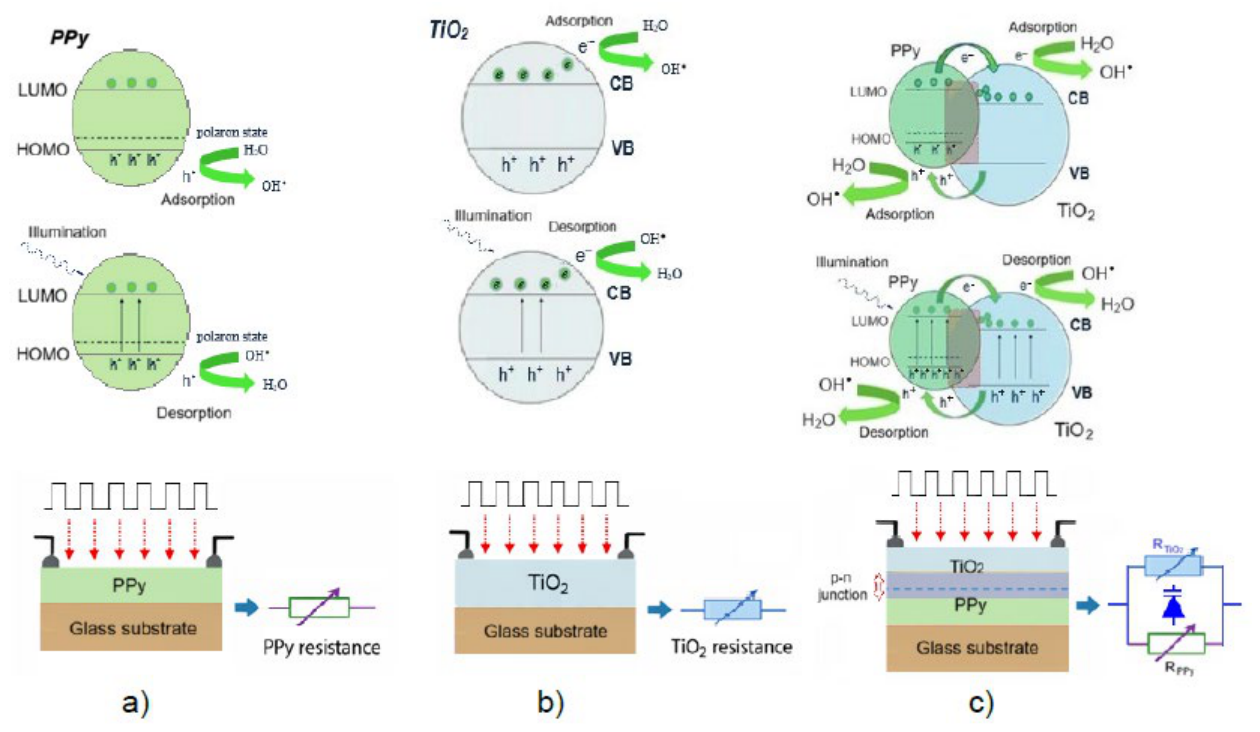

Table 1.
Spectral characteristics of the monochromatic LEDs used for illumination.
| LED wavelenth (nm) | 664 | 505 | 447 | 398 | 367 |
|---|---|---|---|---|---|
| Radiation flux (mW) | 454.39 | 805.1 | 863.7 | 534.4 | 192.6 |
| Half width (nm) | 14.5 | 39.6 | 14.8 | 14.4 | 14.2 |
| E- photon (eV) | 1.87 | 2.46 | 2.77 | 3.12 | 3.38 |
| Photon flux (mW/eV) | 242.99 | 327.28 | 311.81 | 171.28 | 56.98 |
Disclaimer/Publisher’s Note: The statements, opinions and data contained in all publications are solely those of the individual author(s) and contributor(s) and not of MDPI and/or the editor(s). MDPI and/or the editor(s) disclaim responsibility for any injury to people or property resulting from any ideas, methods, instructions or products referred to in the content. |
© 2026 by the authors. Licensee MDPI, Basel, Switzerland. This article is an open access article distributed under the terms and conditions of the Creative Commons Attribution (CC BY) license (http://creativecommons.org/licenses/by/4.0/).
Copyright: This open access article is published under a Creative Commons CC BY 4.0 license, which permit the free download, distribution, and reuse, provided that the author and preprint are cited in any reuse.