

Submitted:
29 July 2026
Posted:
31 July 2026
You are already at the latest version
Abstract
Background/Objectives: Alpine destinations combine high tourism intensity with location-bound natural health resources that position them as potentially salutogenic settings; however, the evidence connecting tourism, public health, and well-being in this context has never been systematically mapped. This scoping review charts the concepts, evidence, and knowledge gaps at this intersection, focusing on South Tyrol (Italy). Methods: This review followed the Joanna Briggs Institute methodology and PRISMA-ScR. Five databases (PubMed, Embase, CINAHL, Web of Science, and Scopus) were searched, supplemented by Publish or Perish searches of Google Scholar, Crossref, and OpenAlex. Records were screened against a Population–Concept–Context framework, with geographic restrictions applied at screening. Data were synthesized descriptively without aggregating effect estimates. Results: Of 4,163 records identified, 3,343 were screened, and 128 were assessed in full text; 33 sources were included (22 conceptual, 11 empirical), divided almost evenly between tourism and health science journals. Empirical evidence has concentrated on residents' quality of life and subjective well-being, with findings differing by outcome, scale, and tourism intensity. None of the included studies measured mental health outcomes. Only four empirical studies originated from the Alpine region, each addressing a different level of the destination system, and none from South Tyrol; evidence on tourism workers and older populations was exclusively conceptual. Conclusions: The field rests mainly on conceptual work distributed across two largely separate literatures. The evidence gap map identifies measured resident health outcomes, worker health, and population-specific groups as research priorities for tourism-intensive Alpine regions, for which South Tyrol offers a suitable setting.
Keywords:
overtourism
; residents' quality of life
; subjective well-being
; mental health
; salutogenesis
; health promotion
; destination management
; evidence gap map
; Alps
1. Introduction
International tourism has returned to sustained growth, with approximately 1.5 billion international tourist arrivals recorded in 2025 [1]. For the regions that receive these flows, tourism is not only an economic quantity; it alters the physical, social, and economic environments in which destination populations live, work, and age, and it does so in both directions. Travel and vacations can function as resources for health and well-being, while the presence of visitors changes living costs, housing, public space, workloads, and environmental exposures for those who stay [2,3]. Research on tourism and well-being has consolidated into an established field over the past decade, with reviews documenting the effects of tourism experiences on tourists’ quality of life and tourism development on residents [2,4]. In contrast, public health has engaged with tourism only selectively, most visibly where specific risks, such as medical travel, were at stake [5].
The result is a field distributed across two largely separate literatures. Tourism and hospitality research examines destination well-being from the perspectives of tourists, destination communities, and the destination itself [6], and has produced a substantial body of work on residents’ quality-of-life perceptions [7]. Public health research contributes to population-level outcomes and determinants but rarely addresses tourism as a structural exposure. The empirical evidence connecting the two is ambivalent: pan-European analyses associate higher tourist arrivals with lower resident life satisfaction [8], while regional studies find effects that differ by age, urbanization, and outcomes [9]. Public debate has condensed these tensions into the notion of overtourism; however, its socio-psychological conceptualization shows that the pathways from visitor pressure to resident outcomes are heterogeneous and context-dependent [10]. Therefore, this review uses tourism intensity—a measurable ratio of visitor volume to resident population—as its guiding concept rather than the evaluative vocabulary of the overtourism debate. Recent horizon analyses of mental health and well-being in tourism confirm the fragmentation of the field and the marginal position of residents and tourism workers relative to tourists [11,12], echoing an argument made more than a decade earlier when the destination itself was first proposed as a health-promoting setting [6].
Alpine destinations address these questions in a distinctive manner. Tourism-dependent mountain communities combine small resident populations with high visitor volumes, are exposed to climate change as a structural risk to their economic base [13], and simultaneously hold location-bound natural health resources—climate, thermal springs, and terrain that position them as potentially salutogenic settings in the sense of health-promoting environments [14,15]. Evidence from Tyrol indicates that residents’ social carrying capacity varies systematically with regional tourism intensity [16]. South Tyrol, an autonomous province in the Italian Alps, is a paradigmatic case: it ranks among the most tourism-intensive Alpine regions, sustains a long-standing policy debate on managing visitor volumes, and simultaneously markets itself as a destination for health-oriented and nature-based tourism [17]. For the public health system of such a region, the question of what is known about the effects of tourism on population health and well-being is of direct planning relevance.
Despite this constellation, no review has yet mapped the evidence connecting tourism, public health, and well-being in Alpine destinations. Relevant knowledge is dispersed across disciplines, rests on heterogeneous concepts of health and well-being, and combines conceptual contributions with empirical studies of diverse designs—a constellation for which scoping reviews, rather than effectiveness-oriented systematic reviews, are the appropriate instrument [18,19].
Therefore, this scoping review maps the scientific literature at the intersection of tourism, public health, and well-being in Alpine destinations, focusing on South Tyrol. Following the Population–Concept–Context framework, it addresses destination populations, tourists, and tourism workers (population); health and well-being outcomes, determinants, and salutogenic potentials associated with tourism (concept); and Alpine destinations, complemented by pan-European and transferable European evidence (context). Four questions guide the review: how the field is conceptually structured, what is known about tourism intensity and resident health, what evidence exists on salutogenic settings in Alpine destinations, and which population groups are covered by the evidence. On this basis, the review identifies knowledge gaps in the form of an evidence gap map and specifies where South Tyrol stands within the mapped evidence.
2. Materials and Methods
2.1. Study Design
A scoping review was conducted in accordance with the Joanna Briggs Institute (JBI) Manual for Evidence Synthesis [18,20] and reported following the Preferred Reporting Items for Systematic Reviews and Meta-Analyses Extension for Scoping Reviews (PRISMA-ScR) [19]. A scoping review was chosen over a systematic review because the literature at the intersection of tourism, public health, and well-being is methodologically and disciplinarily heterogeneous, spanning conceptual frameworks, policy analyses, and empirical studies with diverse designs. The objective was to map this evidence and identify knowledge gaps rather than estimate pooled effects.
An a priori protocol was developed and pre-specified before screening, comprising database search strategies (Supplementary File S1) and screening criteria and procedures (Supplementary File S2). The protocol was subsequently deposited in the Open Science Framework as an open-ended registration under a CC-BY 4.0 license (https://doi.org/10.17605/OSF.IO/UVJPC; associated project: https://osf.io/6fzs5). This deposit was made retrospectively after the searches and screening had begun to ensure transparency of methodology and reporting; the eligibility criteria and synthesis approach were not modified as a function of records already retrieved.
The review followed the JBI methodology for scoping reviews and was reported in accordance with the PRISMA-ScR. The full search strategies are provided in Supplementary File S1, the screening criteria and procedures in Supplementary File S2, the complete list of the 128 records assessed at the full-text level, including all screening decisions, in Supplementary File S3, and the data charting table in Supplementary File S4.
2.2. Review Question
The review question was structured according to the Population–Concept–Context (PCC) framework recommended by JBI [18]: What evidence, conceptual frameworks, and policy approaches does the scientific literature describe regarding the impact of tourism on the public health and well-being of residents, travelers, and tourism workers in Alpine destinations, and what knowledge gaps exist with respect to South Tyrol?
2.3. Eligibility Criteria
Eligible sources were peer-reviewed original articles, reviews, and conference reports with substantive methodology, published in English between January 2010 and December 2026, addressing the relationship between tourism and at least one public health or well-being dimension. Following a methodological review of the initial criteria, the health and well-being dimension was specified to include physical health, mental health, social or environmental determinants of health, health policy, the occupational health and well-being of tourism workers, and salutogenic place-based settings such as spa towns, climate therapy resorts, and therapeutic landscapes. The publication window reflects the consolidation of tourism and well-being as public health discourse after Smith and Diekmann [3]; earlier seminal literature was captured through backward citation tracking. Institutional reports (WHO, OECD, EEA) and German- and Italian-language grey literature were considered as contextual background only and were not included in the PRISMA flow or formal synthesis.
Studies dealing exclusively with medical tourism (treatment-motivated cross-border travel) without a public health, community well-being, or salutogenic framing; travel medicine in the narrow sense without a population-level perspective; and editorials, letters, commentaries, case reports, and conference abstracts were excluded. Book chapters were not eligible, as the review was restricted to peer-reviewed journal articles and substantive conference papers. Records whose full texts could not be retrieved after two documented attempts were excluded and reported separately in the PRISMA flow diagram; in this case, all full texts were retrieved, and no record was excluded on this basis. Studies on health tourism in the broader sense (climate therapy, spa settings, and wellness as a public health setting) were retained for full-text assessment on a case-by-case basis. The search strategies applied a global geographical scope; the geographical restriction to Alpine and comparable European contexts was operationalized as a uniform eligibility criterion at the screening stage rather than within the search strings, to avoid excluding conceptual and methodological contributions without geographical binding (reviews, frameworks, research agendas), pan-European analyses covering Alpine countries, and transferable comparative contexts with substantive public health mechanisms.
2.4. Information Sources
Five bibliographic databases were searched: PubMed (National Library of Medicine), Embase (Elsevier, Embase.com), CINAHL Plus with Full Text (EBSCOhost), Web of Science Core Collection (Clarivate), and Scopus (Elsevier). PubMed, Embase, and CINAHL cover health sciences literature, while Web of Science and Scopus index core tourism research journals that are under-represented in medical databases. Web of Science and Scopus were searched on 11 June 2026 (757 and 828 records, respectively) through institutional access at the Free University of Bozen-Bolzano; PubMed, which is freely accessible, was searched on 18 June 2026 (582 records), and Embase and CINAHL were searched on 18 June 2026 (223 and 118 records, respectively) through the Virtual Medical Library (VMB) of the Autonomous Province of Bolzano–South Tyrol (Department of Health). The full search strategies and per-database yields are presented in Supplementary File S1 (Table 1).
As a supplementary search layer, three additional searches were conducted with Publish or Perish [21] to capture literature not indexed in or surfaced by the five databases: Google Scholar, Crossref Metadata Search, and OpenAlex. These searches used the string tourism (“public health” OR “well-being” OR overtourism). For Google Scholar, the first 200 results were screened following the convention established by Haddaway et al. [22] (200 records). Crossref Metadata Search was queried in the title-words field with a journal-article filter and contributed 585 of up to 1,000 records. OpenAlex contributed 870 records; because the Publish or Perish implementation accepts only a single search term for OpenAlex, the query was reduced to “tourism” and the thematic restriction was shifted entirely to the screening stage, a tool-induced asymmetry reported in Supplementary File S1. The parameters and yields of the three supplementary searches are listed in Supplementary File S1 (Table 2).
In total, 4,163 records were identified (2,508 from the five databases and 1,655 from the three Publish or Perish searches). Of the supplementary strategies foreseen in Supplementary File S1 (Section 9), only backward citation tracking was performed, applied to the reference lists of the seminal studies (Supplementary File S1, Section 9.2) ; it identified no additional records beyond those already retrieved. Forward citation tracking and hand-searching of key journals (Supplementary File S1, Section 9.1 and Section 9.2) were not performed; these deviations from the pre-specified search protocol are disclosed in accordance with PRISMA-ScR.
2.5. Search Strategy
The search strategy was developed iteratively. An initial broad PubMed strategy combining the medical subject heading (MeSH) headings “Tourism” and “Travel” with public-health outcome headings retrieved more than 18,000 records and was refined in four documented stages: (i) restriction of the core tourism terms (tourism, tourist*, overtourism) to the title field, while broader operationalizations (tourist destination*, host communit*) remained searchable in title and abstract, and removal of the MeSH heading “Travel”; (ii) removal of the MeSH heading “Quality of Life”, with the free-text term retained in the title field only; (iii) exclusion of medical tourism through a NOT clause targeting the title field and exclusion of non-substantive publication types; and (iv) restriction to English and to the publication window 2010–2026. In the second refinement, the tourism block was extended by heritage-related place-based terms (health resort*, spa town*, climate therap*, alpine resort*), the health block was extended by occupational health, tourism worker*, therapeutic landscape*, and salutogen*, and the NOT clause was tightened to “medical tourism” in the title only. The final PubMed strategy was transposed to Embase, CINAHL, Web of Science, and Scopus with database-specific syntax adjustments, while preserving the conceptual structure. The verbatim search strings for all five databases, refinement rationale, and supplementary search procedures are documented in Supplementary File S1, which constitutes the authoritative record of the search methodology.
2.6. Study Selection, Inter-Rater Reliability, and Full-Text Eligibility Coding
2.6.1. Screening and inter-rater reliability
Records from five bibliographic databases (PubMed, n = 582; Embase, n = 223; CINAHL, n = 118; Web of Science Core Collection, n = 757; Scopus, n = 828; 2,508 in total) and three supplementary bibliographic searches conducted with Publish or Perish [21] (Google Scholar, n = 200; Crossref, n = 585; OpenAlex, n = 870; 1,655 in total) were imported into Rayyan [23] for deduplication and screening (4,163 records identified in total). After the removal of 820 duplicates, 3,343 unique records entered title-and-abstract screening, of which 3,215 were excluded and 128 were retained for full-text assessment. One reviewer (C.J.W.) screened all records against the eligibility criteria; screening followed the two-stage Rayyan procedure (title-and-abstract, then full text) specified in Supplementary File S2 (Screening Criteria and PRISMA-ScR Procedures).
To assess screening reliability, a random 20% subsample (n = 669, drawn with a fixed seed for reproducibility; n = 666 after import deduplication) was screened independently by a second reviewer (P.R.) in a separate blinded Rayyan review. Title-level matching against the main review export was exact for all 666 records. The observed agreement was 96.5% (643/666). Cohen’s κ was 0.47 (95% CI 0.26–0.68), with positive agreement of 0.49 and negative agreement of 0.98. The moderate κ despite near-complete agreement reflects the extreme exclude prevalence characteristic of screening data (2 × 2 cell counts a = 11, b = 10, c = 13, d = 632) rather than poor concordance, the κ paradox [24]. The prevalence-adjusted bias-adjusted κ (PABAK) was 0.93, and the prevalence did not differ between reviewers (3.2% vs. 3.6%). Agreement statistics were computed using IBM SPSS Statistics version 29.0.2.0 (IBM Corp., Armonk, NY, USA). The 23 discrepancies were resolved by consensus; two discrepancies bearing on the final corpus were referred to the arbiter (G.P.), who ratified the exclusion of Lovelock et al. 2026 [25] (EXC-CONTEXT, geographical criterion) and the inclusion of Sánchez-Ledesma et al. 2020 [26].
2.6.2. Full-text eligibility coding
A total of 128 full texts were retrieved through institutional licenses and the interlibrary document exchange (NILDE) service. Full-text eligibility decisions were documented using seven operationalized exclusion codes applied at the full-text stage: EXC-DUP (residual duplicates), EXC-CT (trial registrations), EXC-PUBTYPE (ineligible or non-substantive publication types, comprising book chapters, conference abstracts, and congress proceedings without substantive methodology, and editorials and commentaries without empirical or conceptual substance), EXC-PUBTYPE-DISS (dissertations), EXC-MEDTOUR (medical or health tourism without a public-health framing), EXC-INDEX (journals not indexed in MEDLINE, Embase, CINAHL, Web of Science Core Collection, or Scopus), and EXC-CONTEXT (content outside the PCC framework, including the geographical criterion). “Europe” was operationalized as geographic Europe together with the territory of EU member states (hence including Cyprus and the insular Mediterranean); Turkey and other predominantly non-European states were classified as outside Europe. One record identified as retracted was removed in accordance with the Cochrane guidance on retracted evidence [27] and was reported as a single retraction-based removal rather than under the exclusion codes. Borderline decisions were documented in the formal internal memoranda.
A complete list of all 128 full-text records, with citations, decisions, and PRISMA-aligned exclusion reasons, is provided in Supplementary File S3. The final corpus comprised 33 studies.
2.7. Data Charting Process and Data Items
Data were charted using a structured extraction table developed a priori and piloted in the first thematic domain (Supplementary File S4). For each source, the following items were charted: bibliographic citation; contribution type (conceptual, empirical, or combined conceptual–empirical, with combined contributions counted as conceptual in aggregate figures); study design and method; geographical setting and screening-derived geographical class; population or stakeholder group; operationalization of tourism; health and well-being dimensions; sample or data basis; key findings; reported research gaps; assignment to one of four thematic result domains; and the corresponding cell of the evidence gap map. Charting was performed by one reviewer (C.J.W.)AI-assisted draft extractions were verified against the full texts and ratified or corrected by the reviewer. Discrepancies between bibliographic metadata and full texts identified during charting were resolved against the version of the record and documented. Consistent with the JBI guidance for scoping reviews, no critical appraisal of individual sources was performed [18].
2.8. Synthesis of Results
Results were synthesized descriptively and numerically without aggregating effect estimates. The selection process is illustrated in a PRISMA-ScR flow diagram. The characteristics of the included sources are summarized by publication year, contribution type, disciplinary venue, geography, and study design. The thematic mapping was structured into four domains derived from the charted material and ordered along the three-stakeholder systematics of recent horizon analyses of the field (tourists, tourism workers, and destination communities) [12,28]: (1) the conceptual architecture of the field; (2) tourism intensity and resident health; (3) salutogenic settings and Alpine destinations; and (4) population-specific evidence. Knowledge gaps were visualized in an evidence gap map cross-tabulating health and well-being dimensions against stakeholder groups, with cell shading distinguishing cells that contain conceptual sources only, cells that include empirical evidence from non-Alpine settings, and cells that include empirical evidence from the Alpine Convention perimeter. The geographical distribution of the empirical evidence is reported in the source characteristics to address the South Tyrol-related component of the review question.
3. Results
3.1. Selection of Sources
The searches yielded 4,163 records, of which 3,343 remained after de-duplication and underwent title and abstract screening. Full texts were obtained for all 128 reports that proceeded to the eligibility assessment. Of these, 95 were excluded, most frequently as empirical studies conducted outside Europe (n = 47), followed by formal grounds (book chapters, conference abstracts, residual duplicates, a trial registration, and a dissertation; n = 17) and the remaining content-level reasons detailed in Figure 1 One retracted article was removed. The final corpus comprised 33 studies. The selection process is summarized in Figure 1 The record-level documentation of all 128 full-text decisions, with complete citations and exclusion reasons, is provided in Supplementary File S3.
3.2. Characteristics of the Included Sources
Table 1 summarizes the 33 included sources. Conceptual contributions dominated the corpus (n = 22, including two combined conceptual–empirical contributions), comprising narrative and systematic reviews, framework papers, and research agendas; 11 sources were empirical contributions. Publication venues were divided almost evenly between tourism and hospitality journals (n = 14) and public health or medical journals (n = 13), with the remaining six in interdisciplinary outlets, indicating a body of literature distributed across two largely separate disciplinary conversations.
Geographically, the 22 conceptual contributions were not geographically bound. Of the 11 empirical studies, five were pan-European, multi-country analyses; four originated from the Alpine core (Trentino, the Swiss Gotthard region, the Austrian Alps, and a six-country comparison of Alpine health destinations); and two were urban case studies from Barcelona with transferable public health mechanisms. No empirical study has originated from South Tyrol. Across the four thematic domains, eight sources addressed the conceptual architecture of the field, ten tourism intensity and resident health, nine salutogenic settings and Alpine destinations, and six population-specific evidence (Section 3.3.1, Section 3.3.2, Section 3.3.3 and Section 3.3.4).
The temporal distribution shows late consolidation of the field (Figure 2). Twenty-six sources (79%) appeared in 2019 or later, no eligible source was published in 2013–2016 or in 2018, and the empirical strand emerged essentially from 2017 onwards; the single peak year, 2022, combined three conceptual and three empirical contributions.
3.3. Mapping of the Evidence Across Four Thematic Domains
The 33 sources were mapped to four thematic domains: the conceptual architecture of the field (n = 8), tourism intensity and resident health (n = 10), salutogenic settings and Alpine destinations (n = 9), and population-specific evidence (n = 6). Each source was assigned to one primary domain, and thematic overlaps were noted within the subsections where they informed the map. The subsections are ordered from conceptual foundations to empirical and population-specific evidence, following the three-stakeholder perspective of recent horizon analyses [12,28]. The distribution across domains is itself informative: of the eleven empirical studies, six fall within the tourism-intensity domain and four within the salutogenic/alpine domain, whereas the conceptual-architecture domain contains a single empirical study and the population-specific domain contains none.
3.3.1. Conceptual Architecture of the Field
The earliest programmatic contribution in the corpus (n = 8), Hartwell et al. [6], framed the destination itself as a health-promoting setting (“wellville”) and argued that the relocation of public health into UK local government opened a strategic window for alliances between tourism and public health planning. Two later conceptual papers extended this agenda in different directions: Alipour et al. [30] positioned tourism as a preventive public health instrument, combining a personalist ethics framing with bottom-up spillover theory to argue that travel-related gains in personal, mental, and social well-being aggregate to community welfare, while Dwyer [32] applied a beyond-gross domestic product (GDP) “well-being lens” to destination competitiveness, proposing that resident well-being—nominally the ultimate objective of competitiveness frameworks—be measured through generic and contextual indicator sets rather than treated ad hoc.
Two Horizon 2050 papers consolidated the field around three-stakeholder systematics. Chen et al. [11] found research on mental health and well-being in tourism dominated by tourist outcomes viewed through positive psychology and tourism therapy, with residents and tourism workers remaining marginal; Gedecho and Kim [12] mapped the same terrain by stakeholder group and derived research directions towards tourism as a prescribable mental-health intervention, linking the field to the United Nations Sustainable Development Goals (SDGs) 3 and 8. Both identified community and workers’ mental health as the least developed strands.
The remaining contributions provide critical and empirical counterweights. Bauer [31] argued that tourism’s claimed role in poverty elimination can perpetuate poverty, powerlessness, and “ill-being” in host communities and warned public health professionals against accepting unexamined tourism benefit claims. Zhou et al. [34] approached public health from the demand side, showing across a 196-country panel (2000–2019) that structural destination public-health vulnerability significantly reduces tourist arrivals, with effects persisting up to three years—”health as the new safety”. The single empirical study assigned to this domain, Godovykh et al. [33], linked national tourist arrivals in a three-country EU panel (Slovenia, Croatia, and Hungary) to residents’ health directly and indirectly through income (positive) and emissions (negative). Across the domain, the most frequently reported gaps were the neglect of residents’ and workers’ outcomes relative to tourists’, the predominance of curative over preventive framings, and the absence of longitudinal and experimental designs.
3.3.2. Tourism Intensity and Resident Health
This domain holds the largest empirical cluster of the corpus (n = 10; six of the 11 empirical studies). Its conceptual frame was set early by Hall [5], whose general review of health and medical tourism distinguished the field’s sub-forms along wellness–illness and promotive–curative continua and observed that the individual and population-level health risks of medical tourism—biosecurity, antimicrobial resistance, and regulatory gaps—are rarely incorporated into assessments of its economic benefits.
The four pan-European studies reached findings that differed by outcome, scale, and intensity rather than converging in a single direction. Using six waves of the European Social Survey across 32 countries, Ivlevs [8] found that international tourist arrivals reduce residents’ life satisfaction—the evaluative component of subjective well-being— at higher tourism intensity and more strongly among rural residents, while the affective component (happiness) remained unaffected. Bornioli et al. [9] reported conditional effects across 76 Nomenclature of Territorial Units for Statistics (NUTS) regions: higher overnight stay pressure was associated with worse self-reported health among urban residents under 50 but with better perceived health among older residents of towns and rural areas. In contrast, Bulchand-Gidumal et al. [38] found that tourism development was positively associated with OECD well-being indicators across 197 European regions—most strongly in industrially based regions and least in quinary (public-administration-based, typically capital regions) economies —with civic engagement as the only negative association. Badulescu et al. [36] reversed the analytical direction, showing in an EU27 panel that national happiness and public health and environmental expenditure support long-run tourism arrivals and receipts, with a bidirectional relationship between arrivals and happiness.
Two studies conducted in Barcelona provide mechanism-level evidence with transferable relevance for high-frequency destinations. Puigcorbé et al. [40] found that census tracts in the highest tourism-pressure quartile had 2.5 times more alcohol outlets and 2.3 times more alcohol promotion per 1,000 residents than those in the lowest quartile. Sánchez-Ledesma et al. [26] identified seven resident-perceived pathways linking tourism gentrification to health, six of which were detrimental (spanning respiratory illness, nutrition, sleep deprivation, stress, anxiety, and depression), with residents’ activism perceived as the sole buffering factor.
Three syntheses complete this domain. Brooks et al. [37] concluded from 102 studies that heritage tourism benefits or harms host community health primarily depends on community participation in governance. Nopiyani and Wirawan [39] found that residents’ quality of life was positively affected in economic and cultural domains but negatively affected in health, safety, environment, and cost of living. Bacos et al. [35] mapped Asia-centered literature on air pollution and community well-being in urban tourist destinations. Reported gaps recur across the domain: the absence of longitudinal designs and objective health outcomes, limited subnational granularity, and unresolved causal directions. Notably, none of the six empirical studies in this domain were conducted in an Alpine setting.
3.3.3. Salutogenic Settings and Alpine Destinations
This domain combines the conceptual literature on nature-based restoration with the only Alpine empirical evidence retained during screening (n = 9). On the conceptual side, Lehto and Lehto [44] reframed vacations as a public health resource, distinguishing four wellness functions of travel—protective, restorative, instorative, and transformative—and proposing a traveler-wellness-centered design framework in which destinations design, deliver, communicate, and sustain wellness value, supported by industrial-engineering instruments such as wellness indexes. The mechanisms assumed by this design perspective are consolidated in two reviews: Qiu et al. [45], synthesizing 34 studies, found visitor restoration explained predominantly through attention restoration theory, stress recovery theory, and the biophilia hypothesis, with outcomes spanning physical, psychological, psychosocial, and spiritual domains, and concluded that nature-based tourism can be regarded as a “public-wellness product” Sailesh [46] reviewed the same mechanisms by activity type, from forest bathing to mountain hiking, reporting reductions in physiological stress markers alongside gains in affect and life satisfaction. Buckley and Cooper [43] moved the argument from mechanism to delivery, positioning commercial tourism as a scalable channel for nature-based mental health interventions—citing reported doses of two to four hours of nature contact per week and an estimated global mental health value of protected areas in the trillions of US dollars—while observing that green-prescription schemes have so far remained small. A scientometric analysis by Acevedo-Duque et al. [41] documented the rapid expansion of the underlying research field, with publications on hiking tourism growing at roughly 32% per year since the 1990s, and well-being emerging as a distinct but not yet consolidated thematic cluster.
The four empirical studies are the corpus’s only Alpine core evidence, and each addresses a different link in the destination–health chain.
On the visitor side, Schlemmer et al. [47] followed guests of a four-star hotel in the Austrian Alps across arrival, departure, and a post-vacation follow-up (n = 101) and found that the vacation improved mood, with effects persisting two to three weeks after return, whereas physical activity moderated only the activation subscale; well-being gains were largely independent of how active guests were. On the supply side, Schmude et al. [14] compared six health destinations across six Alpine countries and concluded that location-bound natural health resources remain foundational (“geography matters”) but that success increasingly depends on the medically verifiable effectiveness of the natural resource, longer stays, low seasonality, and clear positioning. Strikingly, evidence-based studies have played hardly any role in health tourism marketing.
On the resident side, Brida et al. [42] segmented the population of Folgaria (Trentino) into five attitude clusters—from environmental supporters (approximately 40%) to protectionists (14%)—with household employment in the tourism sector as the strongest determinant of cluster membership. At the governance level, Luthe et al. [13] mapped the tourism supply chain network of the Swiss Gotthard region and found a cohesive but centralized structure whose low density and uneven power distribution constrain the innovative capacity needed for climate change adaptation, including a reported lock-in against ideas from peripheral actors.
Reported gaps converge on the evidence base itself: reliance on self-reports without physiological validation or control groups in the restoration literature, single-site and Destination Management Organization (DMO)-only designs in Alpine studies, and the absence of direct guest-level health measurement in nature-oriented health destinations. None of the four Alpine studies were conducted in South Tyrol.
3.3.4. Population-Specific Evidence
The final domain assembles the corpus’s evidence on defined population groups—older adults, people living with dementia, and tourism workers—and consists entirely of conceptual contributions (n = 6); no empirical study of a specific population in an alpine setting was identified.
Four sources addressed older adults. Sedgley et al. [53] set the critical baseline, arguing that tourism and ageing research had been reduced to quantitative market typologies that homogenize older people, and proposed a four-part transformative agenda built on critical gerontology, participatory methods, personalized accounts, and advocacy scholarship. A decade later, Patterson and Balderas-Cejudo [52] reviewed 62 studies (1984–2022) within the Tourism Agenda 2030 framework and organized the evidence into four wellness dimensions—physical, psychological, social, and spiritual—reporting the largest benefits in the psychological domain and deriving destination-management implications from accessible design to nature-based “soft adventure” They also noted a lack of recent studies, particularly since 2016. Bahrevar et al. [48] reached a compatible conclusion from the health-sciences side: their scoping review of 23 studies found positive associations between tourism participation and all six senior-health domains examined, while identifying no longitudinal cohort study on tourism and elderly health. Carrera [49], a combined conceptual–empirical contribution, developed the concept of “age tourism” beyond medical-geriatric and “sun, sea, sand” offers and, drawing on 102 interviews with older residents of Puglia, derived four elderly-tourist types; relational poverty—having no one to travel with—rather than health status emerged as the key obstacle to converting travel desire into travel experience.
The two remaining sources widen the population’s view. Page et al. [51] operationalized transformative tourism for people living with dementia, showing through 40 business interviews and 11 site audits in the UK how outdoor and nature-based visitor attractions become dementia-friendly—typically through individual champions and values-based organizational change—and what barriers remain, from staff training to fears of deterring other visitors. Ciarlante et al. [50] turned to those who produce tourism rather than consume it: their content analysis of 531 articles found that hospitality-and-tourism research has largely substituted job satisfaction and turnover intention for genuine occupational safety and health outcomes, with only 16% of studies occupational health and safety (OHS)-centric, and proposed an interdisciplinary framework linking working conditions to worker and enterprise outcomes.
Across the domain, the reported gaps are structural rather than incidental: a recency gap in the evidence on older tourists, the absence of longitudinal and experimental designs for every population examined, missing validated well-being measures for tourism workers, and—for the purposes of this review—the complete absence of Alpine empirical research on any of these populations, which marks the emptiest region of the evidence gap map.
3.4. Evidence-Gap Map
To locate where evidence exists and where it is absent, each of the 33 sources was mapped onto a combination of health dimensions and stakeholder groups it primarily addresses, as charted in Supplementary File S4 (Figure 3). The resulting matrix is sparse: the corpus occupies 17 of the 50 possible combinations, leaving two-thirds of the field without a single source.
Three structural patterns have emerged. First, the empirical evidence is concentrated on residents: nine of the eleven empirical studies sit in the resident’s column, and the densest cell of the matrix—quality of life and subjective well-being of residents (n = 6)—also contains the only empirical study of residents’ attitudes in the Alpine region [42]. Second, mental health, the health dimension with the largest number of sources overall (n = 6), rests exclusively on conceptual contributions; the corpus contains no empirical study measuring mental health outcomes for any stakeholder group, including residents of high-intensity destinations. Third, Alpine-core empirical evidence appears in only four cells, each occupied by a single study and addressing a different level of the destination system—resident attitudes [42], visitor well-being [47], community resilience [13], and destination supply [14] —so that no Alpine cell contains replicated evidence. Tourism workers are represented by one conceptual research agenda [50] and no empirical study, and the population-specific sources on older adults and people living with dementia (Section 3.3.4) all fall into the conceptual cells. No source in any cell originated from South Tyrol. These unpopulated and single-study regions of the matrix, rather than the distribution of reported findings, constitute the review’s principal result.
4. Discussion
This review mapped 33 sources at the intersection of tourism, public health, and well-being in Alpine destinations and found a field that is conceptually productive but empirically thin: two-thirds of the sources are conceptual, the empirical evidence is concentrated on residents’ quality of life and subjective well-being, and the unpopulated regions of the evidence-gap map—measured mental health outcomes, tourism workers, population-specific groups, and Alpine settings generally—constitute the principal result. Three aspects of this pattern merit further interpretation.
The first is the persistence of disciplinary divides. The proposal to treat the destination itself as a health-promoting setting is more than a decade old [6], and recent horizon analyses restate the same integration agenda in almost identical terms [11,12]. The venues of the included sources are still almost evenly divided between tourism and health science journals, suggesting that this agenda has been repeatedly formulated but not structurally taken up: public health contributes population-level methods without treating tourism as a structural exposure, while tourism research measures well-being largely through satisfaction constructs rather than health outcomes. The occupational strand shows the same substitution at the level of a single stakeholder group, with management proxies standing in for the measured worker health [50].
Second, the empirical evidence on tourism intensity and residents’ health is heterogeneous rather than contradictory. Higher arrivals are associated with lower evaluative life satisfaction across European countries [8], with conditional effects by age and urbanization at the regional level [9] and predominantly positive associations across objective regional well-being indicators [38]. Collectively, these findings indicate that the direction of the association depends on the outcome construct, spatial scale, and intensity level, which is precisely why aggregate reassurance at the regional level cannot rule out local harm. The mechanism-level evidence from Barcelona, where tourism pressure was linked to the alcohol environment [40] and residents identified predominantly detrimental pathways from tourism gentrification to health [26], specifies testable pathways that high-intensity Alpine municipalities share in principle, but for which no Alpine data exist.
Third, the review documents a gap between salutogenic claims and evidence-based practice. The conceptual literature offers mature mechanisms for nature-based restoration [45] and a delivery argument that positions tourism infrastructure as a channel for population-level mental health benefits [43]. Alpine destinations hold the corresponding location-bound resources; however, the only supply side study found that evidence-based studies play hardly any role in how these destinations market their health offers [14], and the only Alpine guest-level study measured mood rather than health outcomes [47]. Destinations that position themselves through health thus rest their positioning on resources whose benefits are plausible, partially evidenced elsewhere, but unmeasured on site—a gap that is as much an opportunity as a deficit, since the infrastructure for measurement (guests, providers, health services) is already in place.
For research, the evidence-gap map translates these interpretations into priorities: studies measuring resident health outcomes beyond self-reported quality of life, with mental and physical health foremost; occupational health of tourism workers; and empirical work on specific population groups in alpine settings. South Tyrol offers a suitable setting for this agenda—tourism intensity is high and varies across municipalities, and a regionally organized health system provides the data infrastructure that such studies require—while the absence of any South Tyrolean source in the corpus marks the distance that still needs to be covered.
This review has some limitations. Title and abstract screening was performed by a single reviewer, with a 20% double-screened subsample indicating high raw agreement but moderate chance-corrected reliability. Misclassification at screening cannot be excluded. The geographic restriction applied at screening deliberately excluded non-European empirical work, which may contain transferable mechanisms beyond those retained in this study. Assigning sources to single cells of the gap map required judgement where contributions spanned several health dimensions or groups, and the distinction between conceptual and empirical contributions involved two borderline cases that were resolved by explicit rule. Finally, consistent with the scoping review methodology, no critical appraisal of individual sources was performed; therefore, the map describes the presence of evidence, not its quality.
5. Conclusions
This scoping review provides the first systematic map of the evidence connecting tourism, public health, and well-being in Alpine destinations. The field is rich in conceptual work but rests on a narrow empirical base: of 33 included sources, 11 are empirical, only four originate from the Alpine region, and none from South Tyrol. Existing evidence concentrates on residents’ quality of life and subjective well-being, whereas mental and physical health outcomes, the health of tourism workers, and specific population groups remain uncharted. For destinations that position themselves through location-bound natural health resources, the review identifies a gap between salutogenic claims and evidence practice that on-site measurement could close. The evidence gap map specifies where such work should begin, and tourism-intensive regions with established health systems—South Tyrol among them—offer the conditions to begin it. Closing these gaps requires the two literatures that this review found running in parallel to design studies.
Supplementary Materials
The supporting information can be downloaded at the website of this paper posted on Preprints.org. File S1: Database search strategies (PRISMA-ScR compliant); File S2: Screening criteria and PRISMA-ScR procedures; File S3: Records assessed at the full-text eligibility stage (n = 128); File S4: Data charting table for the 33 included sources.
Author Contributions
Conceptualization, C.J.W. and P.R.; methodology, C.J.W.; formal analysis, C.J.W.; writing—original draft preparation, C.J.W.; writing—review and editing, P.R., G.P. and D.H.v.S.P.; supervision, G.P. and D.H.v.S.P. All authors have read and agreed to the published version of the manuscript.
Funding
This research received no external funding.
Institutional Review Board Statement
Not applicable.
Informed Consent Statement
Not applicable.
Data Availability Statement
No new data were created.
Acknowledgments
During the preparation of this manuscript, the authors used Claude Opus 4.8 (Anthropic, San Francisco, CA, USA) for drafting and language-editing support, for the structuring of summary tables, and for consistency checking of the reference list against author-supplied sources. The authors have reviewed and edited the output and take full responsibility for the content of this publication.
Conflicts of Interest
The authors declare no conflicts of interest.:
Abbreviations
The following abbreviations are used in this manuscript:
| ARDL | Autoregressive distributed lag |
| CINHAL | Cumulative Index to Nursing and Allied Health Literature |
| DMO | Destination Management Organization |
| DPHV | Destination public health vulnerability (composite index) |
| EU27 | 27 member states of the European Union |
| GLS | Generalized least squares |
| JBI | Joanna Briggs Institute |
| LMIC | Low- and middle-income countries |
| MeSH | Medical Subject Heading |
| NILDE | Network Inter-Library Document Exchange |
| NUTS | Nomenclature of Territorial Units for Statistics |
| OECD | Organization for Economic Co-operation and Development |
| PABAK | Prevalence-Adjusted Bias-Adjusted Kappa |
| PCC | Population–Concept–Context |
| PRISMA-ScR | Preferred Reporting Items for Systematic Reviews and Meta-Analyses Extension for Scoping Reviews |
| VMB | Virtual Medical Library |
| WHO | World Health Organization |
References
- UN Tourism World Tourism Barometer and Statistical Annex, January 2026. World Tourism Barometer 2026, 24, 1–40. [CrossRef]
- Uysal, M.; Sirgy, M.J.; Woo, E.; Kim, H. (Lina) Quality of Life (QOL) and Well-Being Research in Tourism. Tourism Management 2016, 53, 244–261. [CrossRef]
- Kay Smith, M.; Diekmann, A. Tourism and Wellbeing. Annals of Tourism Research 2017, 66, 1–13. [CrossRef]
- Hartwell, H.; Fyall, A.; Willis, C.; Page, S.; Ladkin, A.; Hemingway, A. Progress in Tourism and Destination Wellbeing Research. Current Issues in Tourism 2018, 21, 1830–1892. [CrossRef]
- Hall, C.M. Health and Medical Tourism: A Kill or Cure for Global Public Health? Tourism Review 2011, 66, 4--15. [CrossRef]
- Hartwell, H.; Hemingway, A.; Fyall, A.; Filimonau, V.; Wall, S. Tourism Engaging with the Public Health Agenda: Can We Promote ‘Wellville’ as a Destination of Choice? Public Health 2012, 126, 1072--1074.
- Andereck, K.L.; Nyaupane, G.P. Exploring the Nature of Tourism and Quality of Life Perceptions among Residents. Journal of Travel Research 2011, 50, 248–260. [CrossRef]
- Ivlevs, A. Happy Hosts? International Tourist Arrivals and Residents’ Subjective Well-Being in Europe. Journal of Travel Research 2017, 56, 599–612. [CrossRef]
- Bornioli, A.; Vermeulen, S.J.; van Haaren, J.; Valente, R.; Mingardo, G. The Impacts of Tourism Stays on Residents’ Self-Reported Health: A Pan-European Analysis on the Role of Age and Urbanization Level. Sustainability 2022, 14, 1157. [CrossRef]
- Gössling, S.; McCabe, S.; Chen, N. (Chris) A Socio-Psychological Conceptualisation of Overtourism. Annals of Tourism Research 2020, 84, 102976. [CrossRef]
- Chen, G.; Zhao, C.; Li, C. Mental Health and Well-Being in Tourism: A Horizon 2050 Paper. Tourism Rev 2025, 80, 139–150. [CrossRef]
- Gedecho, E.K.; Kim, S. (Sam) Mental Health and Well-Being in Tourism Scholarship: A Horizon 2050 Paper. Tourism Review 2025, 80, 108–120. [CrossRef]
- Luthe, T.; Wyss, R.; Schuckert, M. Network Governance and Regional Resilience to Climate Change: Empirical Evidence from Mountain Tourism Communities in the Swiss Gotthard Region. Regional Environmental Change 2012, 12, 839--854. [CrossRef]
- Schmude, J.; Pillmayer, M.; Witting, M.; Corradini, P. Geography Matters, But… Evolving Success Factors for Nature-Oriented Health Tourism within Selected Alpine Destinations. International Journal of Environmental Research and Public Health 2021, 18, 5389. [CrossRef]
- Antonovsky, A. The Salutogenic Model as a Theory to Guide Health Promotion. Health Promot Int 1996, 11, 11–18. [CrossRef]
- Fecker, D.; Mitterer-Leitner, T.; Bosio, B.; Siller, H. How Much Is Too Much? Tourism Intensity and the Role of Social Carrying Capacity in Tourism Development. Tourism Planning & Development 2026, 23, 41–62. [CrossRef]
- Scuttari, A.; Volgger, M.; Pechlaner, H. Transition Management towards Sustainable Mobility in Alpine Destinations: Realities and Realpolitik in Italy’s South Tyrol Region. Journal of Sustainable Tourism 2016, 24, 463–483. [CrossRef]
- Peters, M.D.; Godfrey, C.; McInerney, P.; Munn, Z.; Khalil, H.; Larsen, P.; Marnie, C. Scoping Reviews. In JBI Manual for Evidence Synthesis; JBI. https://jbi-global-wiki. refined. site/space/MANUAL/355862497/10.+ …: Adelaide, 2024.
- Tricco, A.C.; Lillie, E.; Zarin, W.; O’Brien, K.K.; Colquhoun, H.; Levac, D.; Moher, D.; Peters, M.D.J.; Horsley, T.; Weeks, L.; et al. PRISMA Extension for Scoping Reviews (PRISMA-ScR): Checklist and Explanation. Ann Intern Med 2018, 169, 467–473. [CrossRef]
- Aromataris, E.; Lockwood, C.; Porritt, K.; Pilla, B.; Jordan, Z. JBI Manual for Evidence Synthesis; JBI: Adelaide, Australia, 2024;
- Harzing, A.-W. Publish or Perish 2007.
- Haddaway, N.R.; Collins, A.M.; Coughlin, D.; Kirk, S. The Role of Google Scholar in Evidence Reviews and Its Applicability to Grey Literature Searching. PLoS One 2015, 10, e0138237. [CrossRef]
- Ouzzani, M.; Hammady, H.; Fedorowicz, Z.; Elmagarmid, A. Rayyan—a Web and Mobile App for Systematic Reviews. Syst Rev 2016, 5, 210. [CrossRef]
- Byrt, T.; Bishop, J.; Carlin, J.B. Bias, Prevalence and Kappa. Journal of Clinical Epidemiology 1993, 46, 423–429. [CrossRef]
- Lovelock, B.; Houge Mackenzie, S.; Mei Pung, J. Linking Wellness Tourism and Community Well-Being within a Regenerative Tourism Paradigm. Tourism Recreation Research 2026, 51, 939–954. [CrossRef]
- Sánchez-Ledesma, E.; Vásquez-Vera, H.; Sagarra, N.; Peralta, A.; Porthé, V.; Díez, È. Perceived Pathways between Tourism Gentrification and Health: A Participatory Photovoice Study in the Gòtic Neighborhood in Barcelona. Social Science and Medicine 2020, 258. [CrossRef]
- Higgins, J.P.T.; Thomas, J.; Chandler, J.; Cumpstone, M.; Li, T.; Page, M.; Welch, V. Chapter 4: Searching for and Selecting Studies. In Cochrane Handbook for Systematic Reviews of Interventions; Cochrane: London, UK, 2024.
- Chen, X.; Hoek, G.; Gehring, U.; Nieuwenhuijsen, M. Positioning Subjective Well-Being in Environmental Health Impact Assessments. In Proceedings of the European Journal of Public Health; Oxford University Press (OUP), 2025; Vol. 35.
- Page, M.J.; McKenzie, J.E.; Bossuyt, P.M.; Boutron, I.; Hoffmann, T.C.; Mulrow, C.D.; Shamseer, L.; Tetzlaff, J.M.; Akl, E.A.; Brennan, S.E.; et al. The PRISMA 2020 Statement: An Updated Guideline for Reporting Systematic Reviews. BMJ 2021, 372, n71. [CrossRef]
- Alipour, H.; Rezapouraghdam, H.; Esmaeili, B. Public Health and Tourism; A Personalist Approach to Community Well-Being: A Narrative Review. Iran J Public Health 2020, 49, 447–453. [CrossRef]
- Bauer, I.L. Improving Global Health - Is Tourism’s Role in Poverty Elimination Perpetuating Poverty, Powerlessness and “Ill-Being”? Glob Public Health 2017, 12, 45–64. [CrossRef]
- Dwyer, L. Destination Competitiveness and Resident Well-Being. Tourism Management Perspectives 2022, 43, 100996--100996. [CrossRef]
- Godovykh, M.; Fyall, A.; Pizam, A.; Ridderstaat, J. Evaluating the Direct and Indirect Impacts of Tourism on the Health of Local Communities. Academica Turistica 2022, 15, 43–52. [CrossRef]
- Zhou, Y.B.; Huang, Z.; Zhang, C.J.; Xia, M. Health Is the New Safety: Destination Public Health Vulnerability, Resilience, and International Tourism. Journal of Destination Marketing & Management 2026, 41, 101121. [CrossRef]
- Bacos, I.B.; Veres, C.; Curta, P.A.; Gabor, M.R.; Oltean, F.D. Impacts of Air Pollution on Community Well-Being in the Tourism Sector: A Comprehensive Literature Review. Sustainability 2024, 16, 10752. [CrossRef]
- Badulescu, D.; Simut, R.; Simut, C.; Badulescu, A.-V. Tourism at the Crossroads between Well-Being, Public Health and the Environment: Panel Data Evidence from the European Union. International Journal of Environmental Research and Public Health 2022, 19, 12066--12066. [CrossRef]
- Brooks, C.; Waterton, E.; Saul, H.; Renzaho, A. Exploring the Relationships between Heritage Tourism, Sustainable Community Development and Host Communities’ Health and Wellbeing: A Systematic Review. PLoS One 2023, 18, e0282319. [CrossRef]
- Bulchand-Gidumal, J.; Melián-González, S.; González-Betancor, S. Impacts of Tourism Associated with Residents’ Well-Being: An Analysis in 197 European OECD Regions. Tourism Rev 2026, 81, 1136–1152. [CrossRef]
- Nopiyani, N.M.S.; Wirawan, I.M.A. The Impact of Tourism on the Quality of Life of Communities in Tourist Destination Areas: A Systematic Review. Open Access Macedonian Journal of Medical Sciences 2021, 9, 129--136.
- Puigcorbé, S.; Villalbí, J.R.; Sureda, X.; Bosque-Prous, M.; Teixidó-Compañó, E.; Franco, M.; Bartroli, M.; Espelt, A. Assessing the Association between Tourism and the Alcohol Urban Environment in Barcelona: A Cross-Sectional Study. BMJ Open 2020, 10, e037569. [CrossRef]
- Acevedo-Duque, Á.; Llanos-Herrera, G.R.; García-Salirrosas, E.E.; Simón-Isidoro, S.; Álvarez-Herranz, A.P.; Álvarez-Becerra, R.; Sánchez Díaz, L.C. Scientometric Analysis of Hiking Tourism and Its Relevance for Wellbeing and Knowledge Management. Int J Environ Res Public Health 2022, 19, 8534. [CrossRef]
- Brida, J.G.; Osti, L.; Barquet, A. Segmenting Resident Perceptions towards Tourism — a Cluster Analysis with a Multinomial Logit Model of a Mountain Community. International Journal of Tourism Research 2010, 12, 591--602. [CrossRef]
- Buckley, R.C.; Cooper, M.-A. Tourism as a Tool in Nature-Based Mental Health: Progress and Prospects Post-Pandemic. International Journal of Environmental Research and Public Health 2022, 19, 13112. [CrossRef]
- Lehto, X.; Lehto, M. Vacation as a Public Health Resource: Toward a Wellness-Centered Tourism Design Approach. Journal of Hospitality & Tourism Research 2019, 43, 109634801984968. [CrossRef]
- Qiu, M.; Sha, J.; Scott, N. Restoration of Visitors through Nature-Based Tourism: A Systematic Review, Conceptual Framework, and Future Research Directions. International Journal of Environmental Research and Public Health 2021, 18, 2299. [CrossRef]
- Sailesh, B. Impact of Nature-Based Tourism on Psychological Well-Being: A Comprehensive Review. Journal of Psychosocial Wellbeing 2024, 5, 24–39.
- Schlemmer, P.; Blank, C.; Schnitzer, M. Does Physical Activity during Alpine Vacations Increase Tourists’ Well-Being? International Journal of Environmental Research and Public Health 2019, 16, 1707. [CrossRef]
- Bahrevar, V.; Zanjari, N.; Hosseini, S.; Fattahi Ardakani, M.; Kazemi, S. The Role of Tourism in Enhancing Domains of Health for Seniors: A Scoping Review. Med J Islam Repub Iran 2025. [CrossRef]
- Carrera, L. Age Tourism: Going beyond Health and “Triple S” Tourism toward a New Request of Journey. Front. Sociol. 2025, 9. [CrossRef]
- Ciarlante, K.; Mejia, C.; Broker, E. A Research Agenda for Occupational Safety, Health, & Well-Being in Hospitality & Tourism Management. International Journal of Hospitality … 2024.
- Page, S.J.; Connell, J.; Price, S.; Owen, S.; Ledingham, K.; Clare, L. Operationalizing Transformative Tourism: Creating Dementia-Friendly Outdoor and Nature-Based Visitor Experiences. Journal of Travel Research 2025, 64, 337–359. [CrossRef]
- Patterson, I.; Balderas-Cejudo, A. Tourism towards Healthy Lives and Well-Being for Older Adults and Senior Citizens: Tourism Agenda 2030. Tourism Review 2023.
- Sedgley, D.; Pritchard, A.; Morgan, N. Tourism and Ageing: A Transformative Research Agenda. Annals of Tourism Research 2011, 38, 422–436. [CrossRef]
Figure 1.
Flow diagram of the source selection process, following the PRISMA 2020 template [29] and reported according to the PRISMA-ScR [19]. Records from the five bibliographic databases and three Publish or Perish supplementary searches were pooled before de-duplication and screened as a single set. The exclusion categories correspond to the record-level documentation in Supplementary File S3.
Figure 1.
Flow diagram of the source selection process, following the PRISMA 2020 template [29] and reported according to the PRISMA-ScR [19]. Records from the five bibliographic databases and three Publish or Perish supplementary searches were pooled before de-duplication and screened as a single set. The exclusion categories correspond to the record-level documentation in Supplementary File S3.
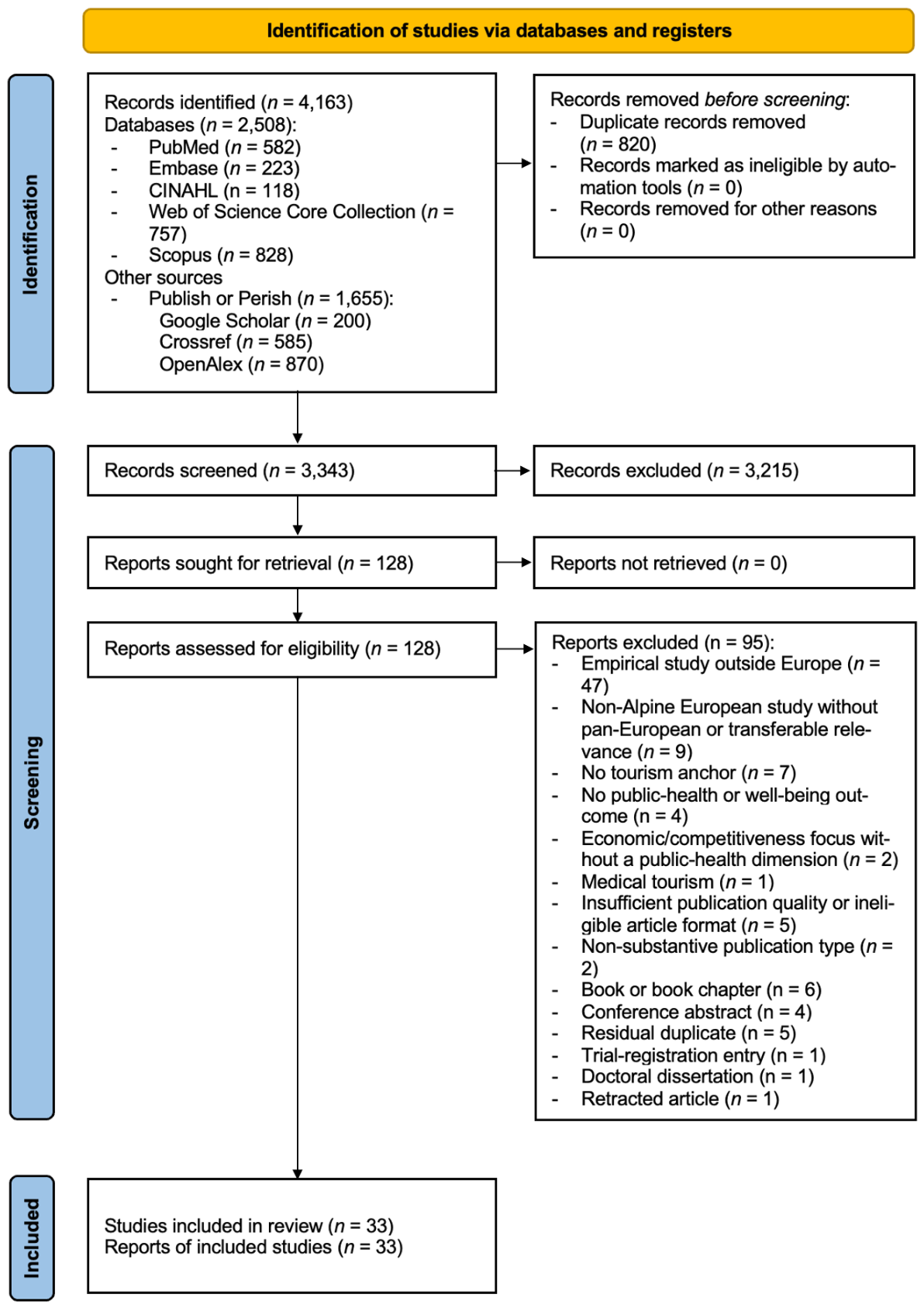
Figure 2.
Temporal distribution of the studies. The included sources were categorized by publication year and contribution type (n = 33). Publication years refer to the year of the version of the record (journal issue). The two combined conceptual–empirical contributions (Zhou et al., 2026 [34]; Carrera, 2025 [49]) were counted as conceptual. No eligible sources were published in 2013–2016 or in 2018; the count for 2026 comprised sources published or assigned to issues up to the search date (June 2026).
Figure 2.
Temporal distribution of the studies. The included sources were categorized by publication year and contribution type (n = 33). Publication years refer to the year of the version of the record (journal issue). The two combined conceptual–empirical contributions (Zhou et al., 2026 [34]; Carrera, 2025 [49]) were counted as conceptual. No eligible sources were published in 2013–2016 or in 2018; the count for 2026 comprised sources published or assigned to issues up to the search date (June 2026).
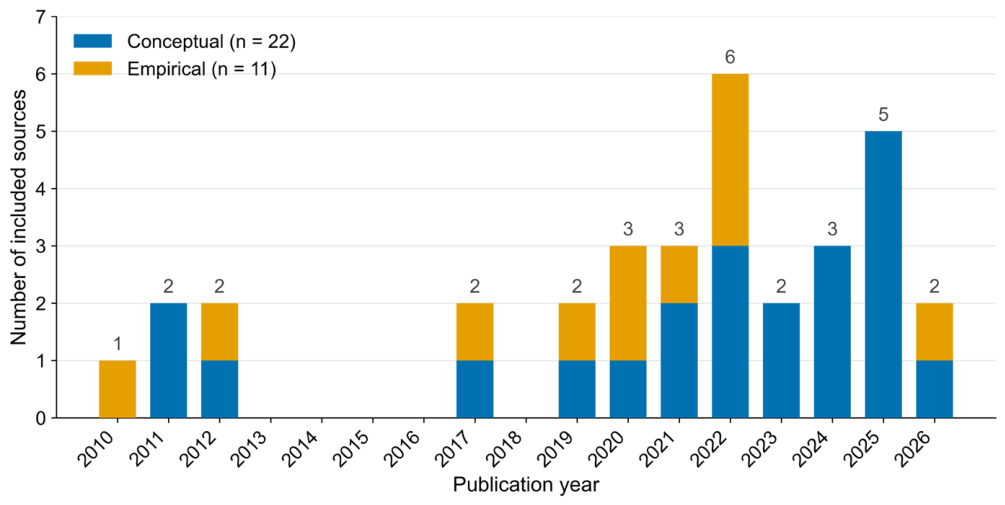
Figure 3.
Evidence-gap map of the 33 included sources by primary health dimension (rows) and primary stakeholder group (columns). The cell values are the source counts. Shading indicates the evidence level present in a cell: light blue, conceptual sources only; medium blue, empirical evidence from non-Alpine settings; dark blue, empirical evidence from the Alpine core (Alpine Convention perimeter); white, no source identified. The two combined conceptual–empirical contributions (Zhou et al., 2026 [34]; Carrera, 2025 [49]) were counted as conceptual, consistent with Table 1. Abbreviations: SWB, subjective well-being.
Figure 3.
Evidence-gap map of the 33 included sources by primary health dimension (rows) and primary stakeholder group (columns). The cell values are the source counts. Shading indicates the evidence level present in a cell: light blue, conceptual sources only; medium blue, empirical evidence from non-Alpine settings; dark blue, empirical evidence from the Alpine core (Alpine Convention perimeter); white, no source identified. The two combined conceptual–empirical contributions (Zhou et al., 2026 [34]; Carrera, 2025 [49]) were counted as conceptual, consistent with Table 1. Abbreviations: SWB, subjective well-being.
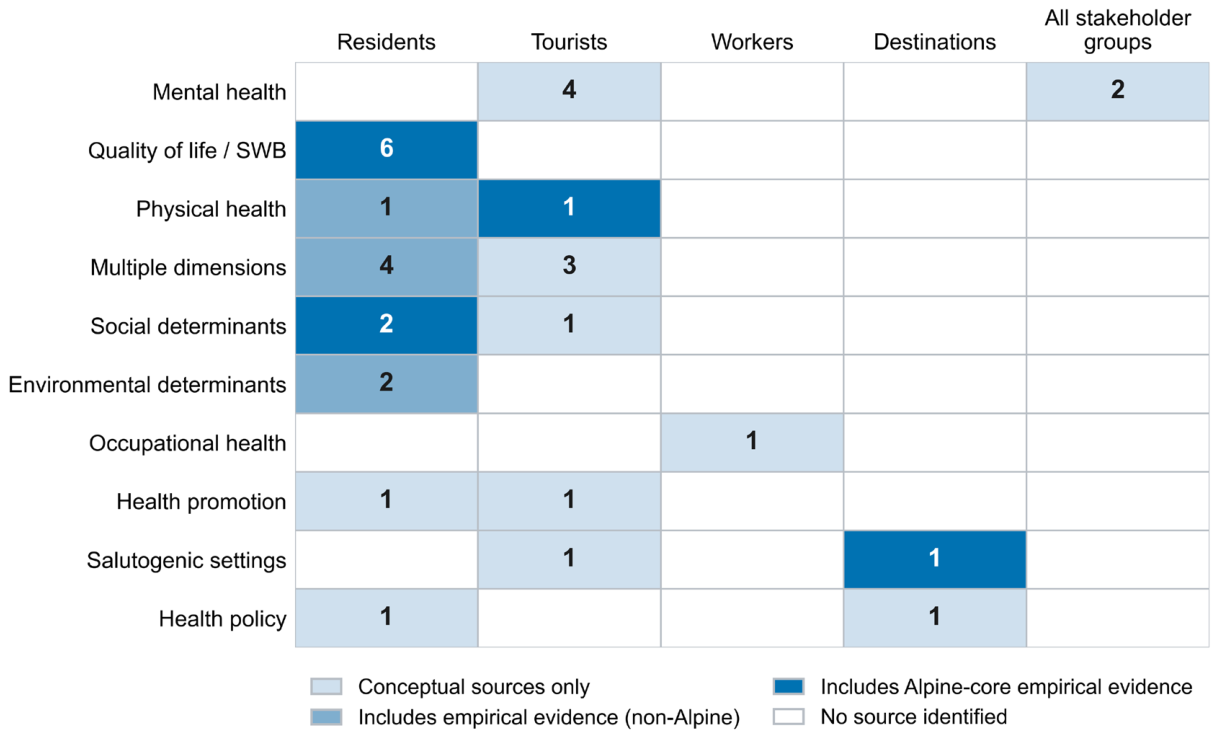

Table 1.
Characteristics of the 33 included studies.
| No. | Source (year) | Type | Design / data basis | Geography (class) 1 | Population / stakeholder group | Thematic domain 2 |
|---|---|---|---|---|---|---|
| 1 | Alipour et al. (2020) [30] | Conceptual | Narrative review | Global (conceptual) | Community | Conceptual architecture |
| 2 | Bauer (2017) [31] | Conceptual | Critical review | Global (conceptual) | Host communities (LMIC) | Conceptual architecture |
| 3 | Chen et al. (2025) [11] | Conceptual | Horizon 2050 paper | Global (conceptual) | Tourists; workers; community | Conceptual architecture |
| 4 | Dwyer (2022) [32] | Conceptual | Conceptual paper (well-being lens) | Global (conceptual) | Residents | Conceptual architecture |
| 5 | Gedecho & Kim (2025) [12] | Conceptual | Horizon 2050 paper | Global (conceptual) | Tourists; employees; community | Conceptual architecture |
| 6 | Godovykh et al. (2022) [33] | Empirical | Panel analysis (GLS, three EU countries) | Slovenia, Croatia, Hungary (pan-European) | Local communities | Conceptual architecture |
| 7 | Hartwell et al. (2012) [6] | Conceptual | Conceptual paper (‘Wellville’) | UK (conceptual) | Destination populations | Conceptual architecture |
| 8 | Zhou et al. (2026) [34] | Conceptual–empirical 3 | Composite index (DPHV) with global panel (196 countries) | Global (incl. Europe) (conceptual) | Countries/destinations | Conceptual architecture |
| 9 | Bacos et al. (2024) [35] | Conceptual | Systematic literature review with bibliometrics | Global (conceptual) | Community; tourists | Tourism intensity |
| 10 | Badulescu et al. (2022) [36] | Empirical | Panel analysis (ARDL), EU27, 2000–2019 | EU27 (pan-European) | Populations of EU member states | Tourism intensity |
| 11 | Bornioli et al. (2022) [9] | Empirical | Pan-European multilevel analysis, 76 NUTS regions | Europe (34 countries) (pan-European) | Residents | Tourism intensity |
| 12 | Brooks et al. (2023) [37] | Conceptual | Systematic review (102 studies) | Global (conceptual) | Host communities | Tourism intensity |
| 13 | Bulchand-Gidumal et al. (2026) [38] | Empirical | Regional analysis, 197 European OECD regions | Europe (21 countries) (pan-European) | Residents | Tourism intensity |
| 14 | Hall (2011) [5] | Conceptual | Critical (general) review | Global (conceptual) | Populations; patients | Tourism intensity |
| 15 | Ivlevs (2017) [8] | Empirical | Repeated cross-sections, European Social Survey | Europe (32 countries) (pan-European) | Residents | Tourism intensity |
| 16 | Nopiyani & Wirawan (2021) [39] | Conceptual | Systematic review (18 studies) | Global (conceptual) | Communities | Tourism intensity |
| 17 | Puigcorbé et al. (2020) [40] | Empirical | Cross-sectional ecological study | Barcelona, Spain (transferable) | Residents (census tracts) | Tourism intensity |
| 18 | Sánchez-Ledesma et al. (2020) [26] | Empirical | Photovoice (participatory qualitative) | Barcelona (Gòtic), Spain (transferable) | Residents | Tourism intensity |
| 19 | Acevedo-Duque et al. (2022) [41] | Conceptual | Scientometric review | Global (conceptual) | Hiking tourists | Salutogenic/Alpine settings |
| 20 | Brida et al. (2010) [42] | Empirical | Cluster analysis with multinomial logit | Folgaria, Trentino, Italy (Alpine core) | Residents | Salutogenic/Alpine settings |
| 21 | Buckley & Cooper (2022) [43] | Conceptual | Review | Global (conceptual) | Tourists; patients | Salutogenic/Alpine settings |
| 22 | Lehto & Lehto (2019) [44] | Conceptual | Design framework | Global (conceptual) | Travelers | Salutogenic/Alpine settings |
| 23 | Luthe et al. (2012) [13] | Empirical | Network analysis (governance) | Gotthard region, Switzerland (Alpine core) | Mountain tourism communities | Salutogenic/Alpine settings |
| 24 | Qiu et al. (2021) [45] | Conceptual | Systematic review with framework | Global (conceptual) | Visitors | Salutogenic/Alpine settings |
| 25 | Sailesh (2024) [46] | Conceptual | Comprehensive review | Global (conceptual) | Tourists | Salutogenic/Alpine settings |
| 26 | Schlemmer et al. (2019) [47] | Empirical | Quantitative survey | Tyrol, Austria (Alpine core) | Alpine vacationers | Salutogenic/Alpine settings |
| 27 | Schmude et al. (2021) [14] | Empirical | Comparative destination analysis | Alpine destinations (DE/AT) (Alpine core) | Destinations; visitors | Salutogenic/Alpine settings |
| 28 | Bahrevar et al. (2025) [48] | Conceptual | Scoping review | Global (conceptual) | Seniors | Population-specific |
| 29 | Carrera (2025) [49] | Conceptual–empirical 3 | Conceptual paper with qualitative interview component | Global (conceptual) | Seniors | Population-specific |
| 30 | Ciarlante et al. (2024) [50] | Conceptual | Research agenda | Global (conceptual) | Tourism and hospitality workers | Population-specific |
| 31 | Page et al. (2025) [51] | Conceptual | Operationalization framework | UK (conceptual) | People with dementia; carers | Population-specific |
| 32 | Patterson & Balderas-Cejudo (2023) [52] | Conceptual | Agenda paper (Tourism Agenda 2030) | Global (conceptual) | Older adults | Population-specific |
| 33 | Sedgley et al. (2011) [53] | Conceptual | Transformative research agenda | Global (conceptual) | Older people | Population-specific |
1 Geographic class as assigned at screening: conceptual = no geographical binding; pan-European = multi-country European analysis; Alpine core = Alpine Convention perimeter; transferable = non-Alpine European setting with transferable public health mechanisms. 2 Thematic domains (corresponding to Section 3.3.1, Section 3.3.2, Section 3.3.3 and Section 3.3.4): conceptual architecture of the field, tourism intensity and resident health, salutogenic settings and Alpine destinations, and population-specific evidence. 3 Combined conceptual–empirical contributions; counted as conceptual in aggregate figures. Abbreviations: ARDL, autoregressive distributed lag; AT, Austria; DE, Germany; DPHV, destination public health vulnerability (composite index); EU27, the 27 member states of the European Union; GLS, generalized least squares; LMIC, low- and middle-income countries; NUTS, Nomenclature of Territorial Units for Statistics; OECD, Organization for Economic Cooperation and Development; UK, United Kingdom.
Disclaimer/Publisher’s Note: The statements, opinions and data contained in all publications are solely those of the individual author(s) and contributor(s) and not of MDPI and/or the editor(s). MDPI and/or the editor(s) disclaim responsibility for any injury to people or property resulting from any ideas, methods, instructions or products referred to in the content. |
© 2026 by the authors. Licensee MDPI, Basel, Switzerland. This article is an open access article distributed under the terms and conditions of the Creative Commons Attribution (CC BY) license (http://creativecommons.org/licenses/by/4.0/).
Copyright: This open access article is published under a Creative Commons CC BY 4.0 license, which permit the free download, distribution, and reuse, provided that the author and preprint are cited in any reuse.