
Submitted:
28 July 2026
Posted:
31 July 2026
You are already at the latest version
Abstract
This study examines how green marketing and sustainability information overload shape consumers' perceptions of greenwashing and behavioral intentions toward green hotels in Vietnam. Integrating Stimulus-Organism-Response theory and Media Richness Theory, the study models green marketing and information overload as external stimuli, perceived greenwashing, green trust, and green attitude as organism states, and intention to stay, word of mouth, and willingness to pay as behavioral responses. Data were collected from 248 Vietnamese consumers aged 20 years and above after exposure to a simulated green hotel website video. Green marketing reduced perceived greenwashing, whereas information overload increased it. Perceived greenwashing did not affect green trust or green attitude but had a positive direct effect on behavioral intention. Green attitude and green trust significantly strengthened behavioral intention, and perceived greenwashing mediated the information overload-behavioral intention relationship. The findings highlight the need for concise, verifiable, and credible sustainability communication in green hospitality marketing.
Keywords:
greenwashing
; green marketing
; green hotel
; information overload
; behavioral intention
Introduction
Sustainability has become a central strategic concern for hotels because travelers increasingly evaluate accommodation providers not only through price, comfort, and location, but also through the perceived credibility of environmental claims. Green hotels use messages about energy conservation, waste reduction, renewable energy, low-impact design, and responsible consumption to differentiate themselves in competitive hospitality markets. These messages can improve brand image and create positive expectations when they are clear and supported by visible practices (Han & Kim, 2010; Lee et al., 2010). However, the same communication environment also creates a risk that consumers will perceive hotels as exaggerating their environmental performance or using sustainability as a promotional label rather than a substantive commitment.
Greenwashing is especially important in hospitality because hotel services are intangible and environmental practices are difficult for consumers to verify before purchase. Customers often rely on websites, booking platforms, social media, certifications, and user-generated content to interpret whether a hotel is genuinely sustainable. When environmental messages appear vague, inconsistent, overly promotional, or difficult to verify, consumers may form a perception of greenwashing (Chen et al., 2019; Majeed & Kim, 2022). Such perceptions can affect trust, attitude, word of mouth, willingness to pay, and stay intention, although prior findings are not fully consistent across markets and research designs.
Digital communication has intensified this problem. Sustainable hospitality messages are no longer limited to a short description of environmental practices; they can include videos, visual symbols, environmental certificates, carbon-reduction data, technical descriptions of energy systems, social media posts, and online reviews. These rich media formats may help consumers understand green practices, but they can also create information overload when the volume, complexity, or repetition of sustainability information exceeds consumers' processing capacity (Bawden & Robinson, 2020; Font et al., 2025). In that situation, information that should clarify environmental performance can become informational noise and increase skepticism toward green claims.
Research on hospitality greenwashing has generally focused on the consequences of perceived greenwashing, including trust, perceived value, and behavioral intention (Chen et al., 2019; Rahman et al., 2015). Less attention has been given to the antecedents that shape consumers' greenwashing perceptions in digital hotel booking environments, particularly the combined influence of green marketing and information overload. This gap is important because managers may assume that more sustainability information is always better, while recent work suggests that excessive or complex information can reduce clarity and increase suspicion (Font et al., 2025).
Vietnam provides an appropriate context for this study. Sustainable hospitality is growing in importance, and digitally active consumers, especially Generation Z and Millennials, are frequently exposed to environmental claims through hotel websites and social media. Yet evidence on how Vietnamese consumers interpret sustainability-related hotel communication remains limited. This study addresses this gap by integrating the Stimulus-Organism-Response (SOR) framework with Media Richness Theory (MRT). It examines green marketing and information overload as stimuli, perceived greenwashing, green trust, and green attitude as organism states, and behavioral intention as the response. The study contributes to hospitality marketing by explaining how green communication can either reduce skepticism through credibility or increase skepticism when sustainability information becomes excessive.
Literature Review and Hypotheses
Theoretical framework
The SOR framework explains how external stimuli influence individuals' internal psychological states and, through these states, generate behavioral responses (Mehrabian & Russell, 1974; Woodworth, 1929). In hospitality research, SOR is useful because consumers respond to environmental cues such as service design, online information, social media content, and sustainability claims before forming attitudes and intentions (Nieves-Pavón et al., 2023). In this study, green marketing and information overload represent stimuli. Perception of greenwashing, green trust, and green attitude represent internal organism states. Behavioral intention, reflected through intention to stay, positive word of mouth, and willingness to pay, represents the response.
MRT complements SOR by explaining why information characteristics matter. Daft and Lengel (1986) argued that richer media can reduce ambiguity by transmitting multiple cues and enabling shared understanding. However, rich information does not always improve communication effectiveness. When sustainability information becomes excessive, technical, repetitive, or difficult to interpret, the same richness can create cognitive burden instead of clarity (Otondo et al., 2008). Font et al. (2025) applied this logic to hospitality and showed that sustainability information overload can increase greenwashing perceptions. Therefore, information overload is treated in this study as a distinct stimulus that affects consumers' evaluation of hotel sustainability claims.
Green marketing and perceived greenwashing
Green marketing refers to marketing activities that communicate environmental responsibility through product design, communication, pricing, and distribution practices intended to reduce environmental harm (Pride & Ferrell, 1993). In hotels, green marketing is visible through messages about resource conservation, renewable energy, eco-friendly amenities, local sourcing, environmental certifications, and green consumption guidance (Chan, 2014; Lee & Cheng, 2018). Because hotel customers often cannot directly verify back-stage environmental practices, these messages function as signals of credibility.
When green marketing is clear, evidence-based, and aligned with observable practices, it can reduce perceived greenwashing by helping customers interpret the hotel's sustainability commitment as authentic (Chen & Chang, 2013; Gatti et al., 2019). Conversely, vague or unsupported claims may be interpreted as self-serving persuasion. Attribution Theory suggests that consumers infer motives behind corporate claims; when claims seem inconsistent or exaggerated, they may attribute them to impression management rather than genuine environmental responsibility (Heider, 1958; Kelley, 1967). Accordingly, the study proposes: H1: Green marketing has a negative effect on perceived greenwashing.
Information overload and perceived greenwashing
Information overload occurs when the amount or complexity of information exceeds an individual's ability to process it effectively (Jones et al., 2004; Matthes et al., 2020). In the green hotel context, consumers may face multiple certificates, technical explanations of energy systems, sustainability metrics, visual symbols, videos, and user-generated comments. While each element may be useful in isolation, the combined volume can make evaluation more difficult and encourage reliance on simple heuristics (Phillips-Wren & Adya, 2020; Roetzel, 2019).
From an MRT perspective, highly rich sustainability communication can become counterproductive when it exceeds the consumer's decision needs. Rather than reducing ambiguity, excessive cues may make claims seem strategically overloaded and difficult to verify. In this condition, consumers may interpret dense environmental information as an attempt to conceal weak performance or manufacture a green image (Font et al., 2025; Shen et al., 2020). Therefore: H2: Information overload has a positive effect on perceived greenwashing.
Perceived greenwashing, trust, attitude, and behavioral intention
Perceived greenwashing refers to the consumer's belief that a firm misleads customers through environmental claims or signals (Chen et al., 2019; Parguel et al., 2011). Green trust is the willingness to rely on a firm's environmental claims and green performance (Chen, 2010). Green attitude reflects consumers' favorable or unfavorable evaluation of environmentally friendly products or services (Teng et al., 2013). Prior hospitality research generally suggests that greenwashing damages trust and attitude because it increases perceived risk and weakens credibility (Alyahia et al., 2024; Chen & Chang, 2013). Therefore: H3: Perceived greenwashing has a negative effect on green attitude. H4: Perceived greenwashing has a negative effect on green trust.
Behavioral intention in this study is conceptualized as a second-order construct comprising intention to stay, word of mouth, and willingness to pay. This multidimensional approach is appropriate because customer commitment to green hotels involves booking behavior, recommendation behavior, and economic willingness to support environmentally responsible services (Baker et al., 2013; Han et al., 2009; Zeithaml et al., 1996). When consumers perceive a hotel's claims as misleading, they should be less willing to engage in supportive behaviors. Thus: H5: Perceived greenwashing has a negative effect on behavioral intention.
Perceived greenwashing may also mediate the link between information overload and behavioral intention. Information overload can create ambiguity and skepticism, and perceived greenwashing may become the psychological lens through which consumers translate that overload into behavior-related judgments (Font et al., 2025). Accordingly: H6: Perceived greenwashing mediates the relationship between information overload and behavioral intention.
Green trust and green attitude are expected to strengthen behavioral intention. Trust reduces uncertainty in service decisions, while attitude captures motivational readiness to support green consumption (Chen, 2010; Han et al., 2010; Sirdeshmukh et al., 2002). In green hotel studies, consumers who trust a hotel's environmental claims and hold favorable attitudes toward green accommodation are more likely to stay, recommend, and pay more (Nimri et al., 2020; Wang et al., 2018). Thus: H7: Green trust has a positive effect on behavioral intention. H8: Green attitude has a positive effect on behavioral intention. Figure 1 presents the conceptual model.
Methodology
This study used a quantitative, cross-sectional survey design with a simulated hotel information-search task. Participants first watched a standardized five- to six-minute first-person video presenting the website and sustainability communication of WoCAL Retreat, a green hospitality model in Phan Thiet, Vietnam. The video included green landscapes, eco-friendly structures, renewable energy references, electric charging facilities, and other sustainability-related cues. This design created a consistent high media richness context, enabling participants to evaluate both green marketing and information overload under the same stimulus conditions.
The target population comprised Vietnamese consumers aged 20 years and above with monthly income of at least 5 million VND and awareness of or interest in green hotel concepts. This broader age criterion was adopted because green hotel consumption decisions involve consumers across different demographic groups rather than only younger digital consumers. This age range captures consumers from younger and older demographic groups who increasingly encounter sustainability communication through hotel websites, booking platforms, and social media. A mixed non-probability sampling strategy combining purposive, convenience, and snowball sampling was used. Screening questions ensured that participants had some interest in environmental conservation and prior familiarity with green hotel concepts. Participation was voluntary. Before viewing the research stimulus and completing the questionnaire, respondents received information explaining the purpose of the study, the research procedures, the confidentiality and anonymity of their responses, and their right to discontinue participation at any stage. Only participants who indicated their informed consent were permitted to proceed with the survey.
The questionnaire measured all constructs using a five-point Likert scale. Green marketing items were adapted from Lee and Cheng (2018) and Chan (2014), information overload from Font et al. (2025) and Otondo et al. (2008), perceived greenwashing from Chen et al. (2019) and Font et al. (2025), green trust from Chen (2010) and Chen et al. (2019), green attitude from Teng et al. (2013), and behavioral intention from Baker et al. (2013), Han et al. (2009), and Chen et al. (2013). Behavioral intention was modeled as a higher-order construct formed by intention to stay, word of mouth, and willingness to pay. The complete measurement instrument is provided as Supplementary File S1.
Minimum sample size was estimated using G*Power with f2 = 0.15, alpha = 0.05, power = 0.95, and six predictors, producing a minimum requirement of 146 observations. Data collection yielded 248 valid responses after screening, exceeding the threshold for PLS-SEM and supporting estimation of the second-order behavioral intention construct. Data were analyzed with PLS-SEM using 5,000 bootstrap resamples for path significance, indirect effects, and confidence interval estimation (Hair et al., 2019, 2021).
Results
The sample was sufficiently diverse for hypothesis testing. Generation Z respondents aged 20–25 represented the largest group, while Millennials accounted for 34.96% of the sample. Respondents above 45 years constituted 9.29%, indicating participation from consumers across multiple age categories. Female respondents constituted 57.08% and male respondents 41.15%, with a small proportion identifying as another gender. Most respondents had monthly income between 5 and 10 million VND, while more than 41% reported income above 10 million VND. Students represented 45.13% of the sample, and employed participants, including office employees, business owners, and self-employed respondents, represented a substantial share. Table 1 summarizes the sample profile.
Indicator reliability was assessed through outer loadings. Most loadings exceeded the recommended 0.708 threshold. Three indicators, GCOM2, GPRO1, and IO2, were retained despite loadings between 0.682 and 0.693 because they preserved theoretical coverage of green communication, green product, and information overload. For the second-order behavioral intention construct, the first-order components intention to stay, willingness to pay, and word of mouth loaded at 0.835, 0.822, and 0.812, respectively, supporting the higher-order specification.
Internal consistency reliability and convergent validity were acceptable. Composite reliability values ranged from 0.768 to 0.868, exceeding the 0.70 threshold, while AVE values ranged from 0.526 to 0.687, exceeding the 0.50 minimum. Cronbach's alpha values for green marketing, green trust, and green attitude were below 0.70, but this is acceptable in PLS-SEM when composite reliability and AVE satisfy recommended criteria and constructs have few indicators (Hair et al., 2019). Table 2 reports reliability and convergent validity results.
Discriminant validity was supported by the Fornell-Larcker criterion. The square roots of AVE for all constructs exceeded their inter-construct correlations. The highest correlation was between behavioral intention and green attitude (r = 0.645), which remained below the diagonal values for both constructs. The correlation between information overload and perceived greenwashing (r = 0.525) was theoretically meaningful but below the square roots of AVE for both constructs, indicating empirical distinctiveness rather than redundancy. Table 3 presents the Fornell-Larcker matrix.
Before structural testing, inner-model multicollinearity was assessed using VIF values. All VIF values ranged from 1.000 to 1.413, below the conservative threshold of 5, indicating no multicollinearity concern. Behavioral intention produced moderate explanatory power (R2 = 0.505; adjusted R2 = 0.499), while perceived greenwashing showed weak-to-moderate explanatory power (R2 = 0.292; adjusted R2 = 0.286). Green attitude and green trust had near-zero R2 values when predicted by perceived greenwashing, consistent with the nonsignificant H3 and H4 paths.
Hypothesis testing produced mixed but theoretically informative results. Green marketing had a significant negative effect on perceived greenwashing (beta = -0.128, t = 2.374, p = 0.018), supporting H1. Information overload had a strong positive effect on perceived greenwashing (beta = 0.510, t = 7.818, p < 0.001), supporting H2 and identifying information overload as the most influential antecedent of perceived greenwashing. Perceived greenwashing did not significantly affect green attitude (beta = 0.023, p = 0.753) or green trust (beta = 0.077, p = 0.309), so H3 and H4 were rejected.
Contrary to the proposed negative direction, perceived greenwashing had a small but significant positive direct effect on behavioral intention (beta = 0.108, t = 2.540, p = 0.011). H5 was therefore statistically significant but not supported in the hypothesized direction. Green attitude (beta = 0.470, p < 0.001) and green trust (beta = 0.321, p < 0.001) positively affected behavioral intention, supporting H7 and H8. Table 4 reports structural path results.
The mediation analysis showed one significant indirect effect. Information overload affected behavioral intention through perceived greenwashing (beta = 0.055, p = 0.016), supporting H6. Indirect pathways involving green attitude and green trust were nonsignificant, which is consistent with the rejection of H3 and H4. Indirect effects originating from green marketing were also nonsignificant at the 5% level. Table 5 summarizes indirect effects.
Discussion
The findings show that green marketing and information overload have different roles in shaping perceived greenwashing. Green marketing reduced perceived greenwashing, indicating that clear and credible sustainability communication can serve as a reassuring signal rather than a source of suspicion. This supports prior work showing that transparency and authenticity can limit skepticism toward environmental claims (Alyahia et al., 2024; Chen & Chang, 2013). Nevertheless, the effect was modest, suggesting that green marketing alone cannot fully overcome consumer doubt, particularly among digitally exposed consumers who frequently encounter sustainability claims online.
Information overload was the strongest predictor of perceived greenwashing. This finding supports the integration of SOR and MRT. Sustainability communication may be intended to reduce uncertainty, but when consumers are exposed to too many environmental claims, technical details, visual cues, or certifications, the information becomes harder to interpret. In that situation, consumers may perceive the communication as strategic persuasion or an attempt to create a green image rather than as evidence of genuine environmental performance. This result extends Font et al. (2025) by demonstrating the same mechanism in an emerging Southeast Asian hospitality context.
The nonsignificant effects of perceived greenwashing on green attitude and green trust are notable. They suggest that a short simulated information-search experience may not be strong enough to change relatively stable psychological states. Green attitude may be rooted in broader environmental values, and green trust may depend on accumulated experience, certifications, or prior knowledge rather than one exposure to hotel communication. This finding is consistent with the value-action gap literature, which shows that environmental beliefs and behavior-related judgments do not always shift in a linear way (Kollmuss & Agyeman, 2002).
The positive direct effect of perceived greenwashing on behavioral intention contradicts the original negative hypothesis but can be interpreted contextually. In the Vietnamese green hotel setting, consumers may still respond favorably to a hotel that appears environmentally oriented even when they recognize some ambiguity or exaggeration in its sustainability communication. The perceived attractiveness, novelty, and symbolic value of a green hotel may outweigh skepticism, particularly when the green image aligns with personal aspirations or social signaling. This result should not be read as evidence that greenwashing is beneficial; rather, it indicates that weak or moderate greenwashing perceptions may coexist with positive behavioral intention when green attitude and green trust remain intact.
Green attitude was the strongest direct predictor of behavioral intention, followed by green trust. This confirms that consumers' favorable evaluation of green accommodation and their confidence in environmental claims are central drivers of stay intention, word of mouth, and willingness to pay. In practice, hotels should not treat sustainability communication as a purely promotional issue. Consumer behavior is more likely to be strengthened when green messages reinforce pre-existing environmental values and are supported by credible evidence.
The mediation result further clarifies the role of information overload. Overload did not influence behavior through green trust or green attitude; instead, it worked through perceived greenwashing. This suggests that excessive sustainability information creates an immediate evaluative shortcut: consumers interpret information density as a signal of possible greenwashing and translate that perception directly into behavioral judgment. Theoretically, this supports a modified SOR mechanism in which some organism states may influence responses directly without necessarily altering deeper trust or attitude.
Theoretical Implications
This study contributes to hospitality marketing theory in three ways. First, it extends greenwashing research by identifying information overload as a major antecedent of perceived greenwashing in a digital hotel communication environment. Second, it integrates SOR and MRT to explain why the richness and volume of sustainability information can become a stimulus that shapes consumer skepticism. Third, it identifies a boundary condition in the SOR model: perceived greenwashing can influence behavioral intention directly even when green trust and green attitude remain unaffected. This finding suggests that organism states in green hospitality decisions may operate at different levels of psychological stability.
Managerial Implications
The results offer practical guidance for hotel managers and marketers. First, hotels should avoid the assumption that more sustainability information always improves credibility. Communication should be concise, specific, and verifiable. A small number of clear claims supported by observable practices, third-party certifications, or measurable outcomes is preferable to dense technical descriptions. Second, managers should design digital sustainability content around customer decision needs. Visual formats such as short videos and infographics can be effective, but they should not overload customers with repetitive claims or unnecessary technical details. Third, because green attitude and green trust strongly drive behavioral intention, hotels should invest in consistency between messages and service delivery. Employees, websites, booking platforms, and on-site cues should communicate the same environmental commitments. Finally, hotels targeting Vietnamese Gen Z and Millennial consumers should use authentic behind-the-scenes content rather than abstract promotional language.
Limitations and Future Research
This study has limitations that create opportunities for future research. First, the use of a simulated video stimulus improves control but cannot fully reproduce an actual hotel stay. Future studies should test the model using real booking behavior or field experiments. Second, the non-probability sample limits generalizability. Future research should use probability sampling and compare different regions or countries. Third, the study focused on one green hotel case. Research across multiple hotels with different certification levels would help clarify whether credibility cues moderate the relationship between information overload and perceived greenwashing. Fourth, the unexpected positive effect of perceived greenwashing on behavioral intention should be examined further, particularly through moderators such as environmental concern, prior green hotel experience, skepticism, social media engagement, and perceived value.
Conclusion
This study examined how green marketing and information overload shape perceived greenwashing and behavioral intention in Vietnam's sustainable hospitality industry. The findings show that credible green marketing can reduce greenwashing perceptions, but information overload can substantially increase them. Green attitude and green trust remain central drivers of behavioral intention, while perceived greenwashing mediates the information overload-behavioral intention relationship. The study therefore emphasizes a practical balance: hotels should communicate sustainability clearly, but they should avoid overwhelming consumers with excessive or difficult-to-verify information. For hospitality marketers, transparency is not only a matter of providing more information; it also requires selecting the right information, presenting it in an accessible form, and ensuring that communicated claims are supported by visible and credible practices.
Institutional Review Board Statement
Ethical review and approval were not required for this study because the research involved an anonymous questionnaire survey with adult participants, used a simulated hotel information-search task, collected no personally identifiable information, and involved minimal risk to participants.
Informed Consent Statement
Informed consent was obtained from all subjects involved in the study. Participants were informed about the purpose of the research, the voluntary nature of participation, and their right to discontinue participation before completing the questionnaire.
References
- Ajzen, I. (1991). The theory of planned behavior. Organizational Behavior and Human Decision Processes, 50(2), 179-211. [CrossRef]
- Alyahia, M., Azazz, A. M. S., Fayyad, S., Elshaer, I. A., & Mohammad, A. A. (2024). Greenwashing behavior in hotels industry: The role of green transparency and green authenticity. Sustainability, 16(3), 1050. [CrossRef]
- Baker, M. A., Davis, E. A., & Weaver, P. A. (2013). Eco-friendly attitudes, barriers to participation, and differences in behavior at green hotels. Cornell Hospitality Quarterly, 55(1), 89-99. [CrossRef]
- Bawden, D., & Robinson, L. (2020). Information overload: An introduction. Oxford Research Encyclopedia of Politics. [CrossRef]
- Chan, E. S. W. (2013). Managing green marketing: Hong Kong hotel managers' perspective. International Journal of Hospitality Management, 34, 442-461. [CrossRef]
- Chan, E. S. W. (2014). Green marketing: Hotel customers' perspective. Journal of Travel & Tourism Marketing, 31(8), 915-936. [CrossRef]
- Chen, H., Bernard, S., & Rahman, I. (2019). Greenwashing in hotels: A structural model of trust and behavioral intentions. Journal of Cleaner Production, 206, 326-335. [CrossRef]
- Chen, Y.-S. (2010). The drivers of green brand equity: Green brand image, green satisfaction, and green trust. Journal of Business Ethics, 93(2), 307-319. [CrossRef]
- Chen, Y.-S., & Chang, C.-H. (2013). Greenwash and green trust: The mediation effects of green consumer confusion and green perceived risk. Journal of Business Ethics, 114(3), 489-500. [CrossRef]
- Daft, R. L., & Lengel, R. H. (1986). Organizational information requirements, media richness and structural design. Management Science, 32(5), 554-571. [CrossRef]
- Font, X., Andreu, L., Mattila, A. S., & Aldas-Manzano, J. (2025). Sustainability information overload: Its effect on customers' greenwashing perceptions, perceived value, and behavioral intentions. Journal of Hospitality and Tourism Management, 62, 196-204. [CrossRef]
- Gatti, L., Seele, P., & Rademacher, L. (2019). Grey zone in-greenwash out: A review of greenwashing research and implications for the voluntary-mandatory transition of CSR. International Journal of Corporate Social Responsibility, 4, Article 6. [CrossRef]
- Hair, J. F., Hult, G. T. M., Ringle, C. M., & Sarstedt, M. (2019). A primer on partial least squares structural equation modeling (PLS-SEM) (2nd ed.). Sage.
- Hair, J. F., Hult, G. T. M., Ringle, C. M., Sarstedt, M., Danks, N. P., & Ray, S. (2021). Partial least squares structural equation modeling (PLS-SEM) using R. Springer. [CrossRef]
- Han, H., Hsu, L.-T. J., & Lee, J.-S. (2009). Empirical investigation of the roles of attitudes toward green behaviors, overall image, gender, and age in hotel customers' eco-friendly decision-making process. International Journal of Hospitality Management, 28(4), 519-528. [CrossRef]
- Han, H., Hsu, L.-T. J., & Sheu, C. (2010). Application of the theory of planned behavior to green hotel choice: Testing the effect of environmental friendly activities. Tourism Management, 31(3), 325-334. [CrossRef]
- Han, H., & Kim, Y. (2010). An investigation of green hotel customers' decision formation: Developing an extended model of the theory of planned behavior. International Journal of Hospitality Management, 29(4), 659-668. [CrossRef]
- Heider, F. (1958). The psychology of interpersonal relations. Wiley. [CrossRef]
- Jones, Q., Ravid, G., & Rafaeli, S. (2004). Information overload and the message dynamics of online interaction spaces: A theoretical model and empirical exploration. Information Systems Research, 15(2), 194-210. [CrossRef]
- Kelley, H. H. (1967). Attribution theory in social psychology. Nebraska Symposium on Motivation, 15, 192-238.
- Kollmuss, A., & Agyeman, J. (2002). Mind the gap: Why do people act environmentally and what are the barriers to pro-environmental behavior? Environmental Education Research, 8(3), 239-260. [CrossRef]
- Lee, J.-S., Hsu, L.-T. J., Han, H., & Kim, Y. (2010). Understanding how consumers view green hotels: How a hotel's green image can influence behavioural intentions. Journal of Sustainable Tourism, 18(7), 901-914. [CrossRef]
- Lee, W.-H., & Cheng, C.-C. (2018). Less is more: A new insight for measuring service quality of green hotels. International Journal of Hospitality Management, 68, 32-40. [CrossRef]
- Majeed, S., & Kim, W. G. (2022). A reflection of greenwashing practices in the hospitality industry: A scoping review. International Journal of Contemporary Hospitality Management, 35(3), 1125-1146. [CrossRef]
- Matthes, J., Karsay, K., Schmuck, D., & Stevic, A. (2020). "Too much to handle": Impact of mobile social networking sites on information overload, depressive symptoms, and well-being. Computers in Human Behavior, 105, 106217. [CrossRef]
- Mehrabian, A., & Russell, J. A. (1974). An approach to environmental psychology. MIT Press.
- Nieves-Pavón, S., López-Mosquera, N., & Jiménez-Naranjo, H. V. (2023). The factors influencing STD through SOR theory. Journal of Retailing and Consumer Services, 75, 103533. [CrossRef]
- Nimri, R., Patiar, A., & Jin, X. (2020). The determinants of consumers' intention of purchasing green hotel accommodation: Extending the theory of planned behaviour. Journal of Hospitality and Tourism Management, 45, 535-543. [CrossRef]
- Otondo, R. F., Van Scotter, J. R., Allen, D. G., & Palvia, P. (2008). The complexity of richness: Media, message, and communication outcomes. Information & Management, 45(1), 21-30. [CrossRef]
- Parguel, B., Benoit-Moreau, F., & Larceneux, F. (2011). How sustainability ratings might deter greenwashing: A closer look at ethical corporate communication. Journal of Business Ethics, 102(1), 15-28. [CrossRef]
- Phillips-Wren, G., & Adya, M. (2020). Decision making under stress: The role of information overload, time pressure, complexity, and uncertainty. Journal of Decision Systems, 29(1), 1-13. [CrossRef]
- Pride, W. M., & Ferrell, O. C. (1993). Marketing: Concepts and strategies (8th ed.). Houghton Mifflin.
- Rahman, I., Park, J., & Chi, C. G. (2015). Consequences of greenwashing. International Journal of Contemporary Hospitality Management, 27(6), 1054-1081. [CrossRef]
- Roetzel, P. G. (2019). Information overload in the information age: A review of the literature from business administration, business psychology, and related disciplines with a bibliometric approach and framework development. Business Research, 12(2), 479-522. [CrossRef]
- Shen, L., Qian, J., & Chen, S. C. (2020). Effective communication strategies of sustainable hospitality: A qualitative exploration. Sustainability, 12(17), 6920. [CrossRef]
- Sirdeshmukh, D., Singh, J., & Sabol, B. (2002). Consumer trust, value, and loyalty in relational exchanges. Journal of Marketing, 66(1), 15-37. [CrossRef]
- Teng, Y.-M., Wu, K.-S., & Liu, H.-H. (2013). Integrating altruism and the theory of planned behavior to predict patronage intention of a green hotel. Journal of Hospitality & Tourism Research, 39(3), 299-315. [CrossRef]
- Wang, S., Wang, J., Wang, Y., Yan, J., & Li, J. (2018). Environmental knowledge and consumers' intentions to visit green hotels: The mediating role of consumption values. Journal of Travel & Tourism Marketing, 35(9), 1261-1271. [CrossRef]
- Woodworth, R. S. (1929). Psychology (rev. ed.). Henry Holt.
- Zeithaml, V. A., Berry, L. L., & Parasuraman, A. (1996). The behavioral consequences of service quality. Journal of Marketing, 60(2), 31-46. [CrossRef]
Figure 1.
Conceptual model. Source: Authors' compilation based on the literature review.
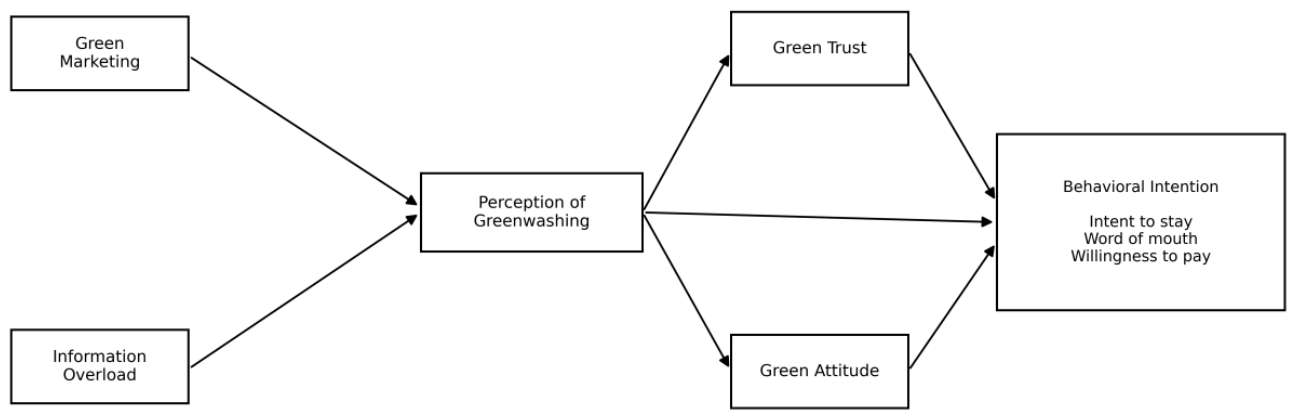

Table 1.
Sample profile.
| Characteristic | Category | Share/Description |
|---|---|---|
| Age group | Generation Z (20-25) | Largest subgroup |
| Age group | Millennials (26-45) | 34.96% |
| Age group | Above 45 | 9.29% |
| Gender | Female | 57.08% |
| Gender | Male | 41.15% |
| Monthly income | 5-10 million VND | 44.25% |
| Monthly income | Above 10 million VND | More than 41% |
| Occupation | University students | 45.13% |
| Occupation | Employed/business/self-employed | Substantial active-consumer group |
Note. Percentages are based on 248 valid responses. Source: Authors' analysis.
Table 2.
Measurement model summary.
| Construct | Retained indicators/components | Loading range | Cronbach alpha | Composite reliability | AVE |
|---|---|---|---|---|---|
| Behavioral Intention | Intent to Stay; Willingness to Pay; Word of Mouth | 0.812-0.835 | 0.763 | 0.863 | 0.678 |
| Green Attitude | ATT1-ATT3 | 0.775-0.782 | 0.676 | 0.822 | 0.607 |
| Green Marketing | GCOM2; GPRO1; GPRO3 | 0.682-0.796 | 0.548 | 0.768 | 0.526 |
| Green Trust | TRU1-TRU3 | 0.731-0.740 | 0.578 | 0.780 | 0.542 |
| Information Overload | IO1-IO3 | 0.693-0.871 | 0.706 | 0.835 | 0.630 |
| Perceived Greenwashing | PoG1-PoG3 | 0.746-0.880 | 0.774 | 0.868 | 0.687 |
Note. BI = Behavioral Intention; AVE = average variance extracted. Source: Authors' analysis.
Table 3.
Fornell-Larcker discriminant validity criterion.
| Construct | BI | ATT | GM | TRU | IO | PoG |
|---|---|---|---|---|---|---|
| Behavioral Intention (BI) | 0.823 | |||||
| Green Attitude (ATT) | 0.645 | 0.779 | ||||
| Green Marketing (GM) | 0.383 | 0.437 | 0.725 | |||
| Green Trust (TRU) | 0.582 | 0.537 | 0.339 | 0.736 | ||
| Information Overload (IO) | 0.107 | 0.061 | -0.117 | 0.034 | 0.794 | |
| Perceived Greenwashing (PoG) | 0.144 | 0.023 | -0.187 | 0.077 | 0.525 | 0.829 |
Note. Diagonal values are square roots of AVE. Source: Authors' analysis.
Table 4.
Structural path coefficients and hypothesis testing.
| Hypothesis | Path | Beta | t | p | Decision |
|---|---|---|---|---|---|
| H1 | GM -> PoG | -0.128 | 2.374 | 0.018 | Supported |
| H2 | IO -> PoG | 0.510 | 7.818 | <0.001 | Supported |
| H3 | PoG -> ATT | 0.023 | 0.314 | 0.753 | Rejected |
| H4 | PoG -> TRU | 0.077 | 1.017 | 0.309 | Rejected |
| H5 | PoG -> BI | 0.108 | 2.540 | 0.011 | Significant; opposite direction |
| H7 | ATT -> BI | 0.470 | 8.075 | <0.001 | Supported |
| H8 | TRU -> BI | 0.321 | 5.639 | <0.001 | Supported |
Note. GM = Green Marketing; IO = Information Overload; PoG = Perceived Greenwashing; ATT = Green Attitude; TRU = Green Trust; BI = Behavioral Intention. Source: Authors' analysis.
Table 5.
Indirect effects.
| Indirect path | Beta | STDEV | p | Result |
|---|---|---|---|---|
| IO -> PoG -> BI | 0.055 | 0.023 | 0.016 | Significant; H6 supported |
| GM -> PoG -> BI | -0.014 | 0.008 | 0.096 | Not significant |
| PoG -> ATT -> BI | 0.011 | 0.035 | 0.756 | Not significant |
| PoG -> TRU -> BI | 0.025 | 0.025 | 0.320 | Not significant |
| IO -> PoG -> ATT -> BI | 0.005 | 0.018 | 0.758 | Not significant |
| IO -> PoG -> TRU -> BI | 0.013 | 0.013 | 0.320 | Not significant |
Note. Only selected theoretically relevant indirect effects are reported. Source: Authors' analysis.
Disclaimer/Publisher’s Note: The statements, opinions and data contained in all publications are solely those of the individual author(s) and contributor(s) and not of MDPI and/or the editor(s). MDPI and/or the editor(s) disclaim responsibility for any injury to people or property resulting from any ideas, methods, instructions or products referred to in the content. |
© 2026 by the authors. Licensee MDPI, Basel, Switzerland. This article is an open access article distributed under the terms and conditions of the Creative Commons Attribution (CC BY) license (http://creativecommons.org/licenses/by/4.0/).
Copyright: This open access article is published under a Creative Commons CC BY 4.0 license, which permit the free download, distribution, and reuse, provided that the author and preprint are cited in any reuse.