
Submitted:
30 July 2026
Posted:
31 July 2026
You are already at the latest version
Preprints on COVID-19 and SARS-CoV-2
Abstract
Background/Objectives: The COVID-19 pandemic created demand for interhospital transfers of ill patients to balance intensive care capacity. Evidence on the safety, logistics, and outcomes of transfers in Germany remained limited. This study analyzed transport characteristics and factors influencing transfer quality and outcomes. Methods: This multicenter retrospective study included 414 interhospital intensive care transfers of adult patients with COVID-19 in Germany between January 2020 and June 2021. Data were extracted from transport reports and records. Primary outcomes were transport instability and clinical deterioration between takeover and handover. Secondary outcomes included the duration of transfer phases. Logistic regression identified factors associated with instability and deterioration, while linear regression assessed factors associated with transfer duration. Results: Most transfers were ground-based (92.5%). Mechanical ventilation was required in 75% of patients, catecholamines in 64%, extracorporeal membrane oxygenation (ECMO) in a small subset. Mean takeover, transport, and handover times were 53, 59, and 64 minutes, respectively. Transport instability occurred in 44% of patients, with multiple unstable events in 16%, while clinical deterioration occurred in 16.4%. Catecholamine therapy was associated with transport instability (odds ratio, 2.04; 95% CI, 1.30–3.19). Obesity and a P/F ratio below 100 mmHg were associated with clinical deterioration. Catecholamine therapy, ECMO, obesity, and mechanical ventilation prolonged transfer phases. Conclusions: Transport instability and clinical deterioration were common during interhospital transfers of critically ill patients with COVID-19. Catecholamine dependency, obesity, and severe hypoxemia were associated with adverse events. These findings support improved coordination, monitoring, staff training, and standardized documentation to enhance overall transport safety.
Keywords:
COVID-19
; SARS-CoV-2
; Critical Care
; Patient Transfer
; Transportation of Patients
; Risk Factors
; Time Factors
; Treatment Outcome
; Emergency Medical Services
1. Introduction
The COVID-19 pandemic posed an unprecedented challenge to healthcare systems worldwide. The rapid spread of SARS-CoV-2 led to a surge in critically ill patients requiring advanced respiratory support and intensive care. Early reports from Italy and France highlighted the overwhelming burden on regional hospitals, with capacity shortages forcing patient transfers across regions and even national borders [1]. These developments underscored the importance of safe interhospital transport for critically ill patients during the pandemic.
In Germany, healthcare provision is highly decentralized, with intensive care transport services regulated at the state level and delivered by a mix of public and private providers, including fire brigades, aid organizations, and aeromedical services such as ADAC and DRF Luftrettung. Despite Germany’s high intensive care capacity, uneven regional resource distribution necessitated large-scale COVID-19 patient transfers during infection peaks.
Before COVID-19, literature on intensive care transfers focused on intrahospital transport complications [2], air transport safety [3], or logistics for acute respiratory distress syndrome (ARDS) patients [4]. Complication rates in critically ill patient transfers varied widely, with some studies reporting up to 38% deterioration in outcomes [5] and others suggesting that, under structured conditions, interhospital transfers were safe and did not increase mortality [6,7]. However, comprehensive data on large-scale, pandemic-related interhospital transports were lacking at the outset of COVID-19. International studies showed that large-scale interhospital transfers were feasible but logistically challenging [8,9,10].
For Germany, however, systematic analyses of COVID-19 patient transfers were absent at the beginning of the pandemic. The “cloverleaf” system introduced in late 2020 established regional coordination hubs to facilitate cross-state redistribution of patients, but its effectiveness and clinical impact had not been empirically assessed. Particularly vulnerable were patients requiring invasive ventilation, extracorporeal membrane oxygenation (ECMO), or vasopressor support — interventions associated with high risk during transport. Moreover, there was no unified national documentation system for intensive care transfers, despite earlier recommendations by the German Interdisciplinary Association for Intensive and Emergency Medicine (DIVI) [11]. The absence of standardized data limited opportunities to evaluate outcomes, quality, and risk factors.
Against this backdrop, the present study was designed as the first nationwide investigation of interhospital transfers of critically ill COVID-19 patients in Germany. The study aimed to describe transport characteristics, patient status at takeover and handover, complication rates, and patient- and system-related factors associated with outcomes. In addition, the study sought to identify organizational determinants of transport duration and quality, such as takeover and handover times, as well as clinical predictors of instability.
The study aimed to identify factors associated with transport instability, deterioration, and transfer logistics (Figure 1).
The study improves understanding of intensive care transport under pandemic conditions and provides evidence for quality assurance and future preparedness. The findings are of direct public health relevance, as they highlight systemic challenges and risks in the interhospital transfer of critically ill patients, informing preparedness, resource allocation, and coordination strategies during large-scale health emergencies such as pandemics.
2. Materials and Methods
2.1. Study Design
This investigation was conducted as a multicentred, retrospective, cross-sectional study within the field of health services research. The study analysed the characteristics and outcomes of interhospital intensive care transports of COVID-19 patients in Germany. The study combined retrospective analysis of transport reports with prospective collection of supplementary organizational data from participating providers.
2.2. Patient Population
The study included adult patients with confirmed COVID-19 who underwent intensive care transport between January 2020 and June 2021. A total of 414 transport reports were obtained and analysed. Cases were contributed by six ground-based intensive care transport vehicle (ITW) providers (Augsburg, Regensburg, Warendorf, Kiel, Hamburg, Cambs) and one aeromedical provider (Cologne). Data on helicopter transfers were not available. Participation was voluntary, and providers were contacted repeatedly to maximize response rates. Only anonymized or pseudonymized data were used.
2.3. Data Collection
The primary data source was the DIVI intensive care transport report, where available (see supplementary material, translated). In 46% of cases the DIVI form was used, while the remainder were documented using alternative formats. The DIVI report captures clinical status, interventions, monitoring, and transport outcomes. In addition, a short supplementary questionnaire was distributed to providers, addressing reasons for transfer, distances, coordination structures, and special resource requirements. All data were digitized, standardized, and coded for analysis. Free-text entries were categorized using predefined groups.
2.4. Definitions and Variables
Three composite variables were defined:
- Severe illness at transport start, defined by the presence of one or more of the following: catecholamine therapy, FiO2 ≥ 0.5, P/F ratio <100 mmHg, mean arterial pressure (MAP) ≤60 mmHg, or PEEP >12 cmH2O.
- Transport instability, defined as two or more critical deviations in heart rate <50 bpm / >100 bpm, blood pressure <90 mmHg / >160 mmHg, oxygen saturation <90%, or end-tidal CO2 <33 mmHg / >43 mmHg during transfer.
- Outcome deterioration, defined as MAP decrease by ≥20%, Glasgow Coma Scale decline by ≥2 points, oxygen desaturation by ≥4%, or initiation of catecholamines during transport.
The definitions of transport instability and deterioration were based on clinically relevant thresholds derived from prior literature on critical care transport and ARDS severity and were adapted to reflect the specific context of COVID-19-related respiratory and circulatory failure. Demographic variables (age, sex), clinical factors (ventilation, comorbidities, ECMO), and operational parameters (priority, transfer times) were also included. In addition, a new variable “Severe Impairment” was created because of the markedly reduced number of eligible cases, to identify patients with physiological impairment defined as MAP < 60 mmHg and/or a P/F ratio < 100 mmHg.
2.5. Outcome
The primary outcome was patient instability and deterioration during transfer. Secondary outcomes included takeover time at the sending hospital, duration of transportation, handover time at the receiving hospital, frequency of necessary interventions during transport, monitoring adequacy, and factors influencing delays.
2.6. Statistical Analysis
Data were entered into SPSS statistical software (version 29, IBM Inc., Armonk, NY, USA). Continuous variables were checked for plausibility, corrected where necessary, and summarized as mean with standard deviation, or median with quartiles, and range (minimum to maximum), depending on the distribution. Categorical data were reported as frequencies and percentages. Logistic regression models were used to identify predictors of transport instability and outcome deterioration, while multiple linear regression was applied to evaluate factors affecting transfer times. Variables were selected for multivariable models based on clinical relevance and univariate associations, to balance statistical robustness and avoidance of overfitting given the sample size. Given the retrospective and heterogeneous data sources, missing data were expected and handled using complete case analysis for regression models. The proportion of missing values varied across variables and was reported transparently.
2.7. Ethical Considerations
The study was approved by the Ethics Committee of the Medical Faculty of Christian-Albrechts-University of Kiel (D 573/20). As only anonymized retrospective data were analyzed, no patient consent was required. Data handling complied with relevant data protection and confidentiality regulations.
3. Results
3.1. Operational and Tactical Data
Most transports (93%) were conducted with intensive care transport vehicles, while 3% (n=10) involved fixed-wing aircraft. Despite frequent use, no data on helicopter transports could be provided within the scope of this study. The largest contribution came from Augsburg (43%) and Regensburg (38%), with smaller numbers from Warendorf, Kiel, Hamburg, Cambs, and Cologne.
Physician staffing was dominated by anaesthesiologists (98% of reported cases). Where qualification was specified, 80% were specialists and 20% were residents in training.
Transfer timing varied widely. Patient takeover averaged 53 minutes (range 4 - 279), pure transport time averaged 59 minutes (range 6 - 415), and handover at the receiving facility averaged 64 minutes (range 0 - 241) (Figure 2).
Linear regression analysis indicated that high priority (as stated in the patient care report) shortened takeover time by ~10 minutes, while unconsciousness/sedation (+7 minutes), catecholamine therapy (+9 minutes), obesity (+14 minutes), and ECMO support (+21 minutes) prolonged the process (Table 1).
For handover, catecholamine therapy (+11 minutes) and ECMO (+20 minutes) were significant prolonging factors. No significant associations were found for hypertension (as comorbidity), age, sex or physician seniority (Table 2).
Most transfers (94%) occurred during pandemic “wave” phases as defined by the Robert Koch Institute, with the majority in the second wave (51%) and third wave (28%).
3.2. Priority for Transfer
Priority as per patient care report was documented in 67% of cases (n = 277): 48% were deemed transferable within 24 hours, 40% required urgent transfer within two hours, and 11% required immediate transfer within 30 minutes.
3.3. Patient Demographics
Age and sex were inconsistently reported. Of patients with available data, 67% were male and 33% female. The largest age group was 60–69 years (28%), followed by 50–59 (23%) and 70–79 (22%). Only 16% were under 50, and 11% were 80 years or older.
3.4. Patient Status at Takeover
Neurological assessment showed that three-quarters of patients were sedated, with 19% alert and oriented. The Glasgow Coma Scale (GCS) was reported in 71% of cases: 60% scored 3 (deep coma) and 25% scored 15 (fully awake).
Cardiovascular data were more complete: median systolic blood pressure was 123 mmHg, median MAP 81 mmHg, and median heart rate 82 bpm. However, 64% of patients required catecholamines, and only 34% were hemodynamically stable. Respiratory support was common. Three-quarters of patients were documented as mechanically ventilated (n=310), most frequently with BiPAP (48%), CPAP (17%), or PCV (10%). Median FiO2 was 0.6 (range 0.2-1.0), and median PEEP 12 cmH2O (range 4-22 cmH2O), consistent with ARDS. Median oxygen saturation at takeover was 94% (range 39–100%). The median P/F ratio was 155 mmHg (range 39-440 mmHg).
3.5. Measures and Monitoring
Patients frequently required invasive lines: peripheral intravenous catheters, central venous catheters, and arterial lines were common. ECMO was initiated in a small but critical subgroup, significantly prolonging takeover and handover times.
Medication use reflected high disease severity. Monitoring typically included continuous hemodynamic and respiratory surveillance, but missing entries limited analysis of completeness.
3.6. Instability During Transport
Transport instability, defined as two or more critical deviations in vital parameters, was observed in 44% of patients (n=182). Of these, 16% experienced multiple unstable events. Instability was most frequent among severely ill patients—over half of those classified as severe had at least one episode, compared to markedly fewer among less severe cases.
Logistic regression identified preexisting catecholamine therapy as the strongest predictor of instability (odds ratio 2.04; 95% CI 1.30–3.19; p=0.002). Other contributing factors included ECMO and high ventilatory requirements, though these did not always reach statistical significance.
3.7. Outcome Deterioration
Outcome deterioration occurred in 16.4% of patients (n=68), most commonly as MAP drops, reduced GCS, oxygen desaturation, or new catecholamine therapy. Obesity (p=0.020) and severe hypoxemia (P/F ratio <100 mmHg; p=0.010) were significant predictors of deterioration. Analgesics were associated with a twofold increased risk; however, this finding did not reach statistical significance (Table 3). Ventilation, sedation, catecholamines, and according to statistical analysis that seniority of the attending physician showed trends toward increased risk but were not statistically significant.
3.8. Summary of Key Results
- Takeover and handover times were prolonged by patient complexity, particularly ECMO and catecholamines.
- The majority of patients were critically ill, requiring ventilation and vasopressors.
- Instability occurred in nearly half of transports; deterioration in one in six.
- Key predictors of adverse events included catecholamines, obesity, and severe hypoxemia.
4. Discussion
4.1. Immediate Post-Transport Deterioration
The key finding of this study is that interhospital transfer of critically ill COVID-19 patients is feasible but associated with a substantial rate of physiological instability, with identifiable clinical risk factors that can inform future transfer strategies. A total of 16.4% of patients (n=68) showed deterioration immediately after transport. Previous studies generally found no increase in mortality associated with interhospital transfer, although transient physiological deterioration has been reported [6,7,10,12,13,14].
Other investigations documented substantially higher rates of deterioration. Differences in reported deterioration rates across studies are likely explained by heterogeneity in definitions, transport modalities (e.g., ground vs. air), patient selection, and the extraordinary operational conditions during the COVID-19 pandemic. In one study, 38% of patients worsened after transfer [5], while evacuations from Mayotte to Réunion showed deterioration of the P/F ratio in 34% of cases, particularly in patients with hypertension or diabetes [12]. In France, 82% of critically ill patients transported by air had worsening oxygenation, correlated with transport duration [12]. It should be noted that P/F ratio values were sometimes estimated from SpO2/FiO2 rather than PaO2/FiO2 [12,13,14]. Additional research linked P/F ratio <100 mmHg and hemodynamic instability to higher three-month mortality after transfer [12].
Signs of deterioration were reported immediately after transport in 16.4% of patients, despite previous reports describing intensive care transport as generally safe. The comparative studies, however, indicate that adverse outcomes like transport instability or outcome deterioration do occur, particularly in COVID-19 patients who may rapidly develop ARDS with high morbidity and mortality. The findings may also reflect selective documentation of unstable patients. Overall, the results point to the combined impact of disease severity, novelty of COVID-19, and heterogeneous standards in intensive care transport and documentation.
4.2. Instability During Transport
Unstable events in this study were frequent during transfer: 51% of patients with high illness severity experienced up to four unstable episodes, representing 89% of all instabilities. Transport instability was strongly associated with disease severity, consistent with previous studies identifying vasopressor use and severe hypoxemia as key risk factors [15,16,17].
4.3. Transfer Durations
4.4. Strategic Transfers
Strategic transfers were an important component of the pandemic response. Previous studies and national frameworks suggest that careful patient selection and coordination enable safe strategic transfers, although criteria vary across settings [6,21,22,23,24]. However, a consistent differentiation between capacity-driven and clinically indicated transfers was not available in the dataset, limiting further subgroup analysis.
4.5. Study Limitations
Several limitations must be considered. First, participation was voluntary and limited to selected providers, introducing potential selection bias, as described in observational transport research [25,26].
Second, documentation was heterogeneous and incomplete, introducing potential reporting bias. Inconsistent documentation is a known limitation in interhospital transport studies [25,26,27].
Third, the use of different documentation formats (DIVI vs. alternative records) has affected comparability, reflecting the lack of standardized national reporting despite prior recommendations [11,25].
4.6. Practical Recommendations
Based on these results, several practical recommendations can be drawn. First, interhospital transfers of critically ill patients should be regarded as high-risk interventions requiring specialized training, redundant monitoring, and structured preparation. Second, standardized, preferably digital, documentation patient care reports must be implemented nationwide to ensure complete data capture, facilitate quality assurance, and enable ongoing research. Third, risk stratification should be systematically applied: patients with catecholamine dependence, severe hypoxemia, or obesity require heightened preparation and may benefit from enhanced staffing or additional safeguards during transfer. Fourth, supra-regional coordination mechanisms, such as the German “cloverleaf” model, should be further developed to integrate local and national resources, ensuring equitable care distribution during future crises.
5. Conclusions
This study provides the first nationwide analysis of interhospital intensive care transport of COVID-19 patients in Germany based on 414 transport records. The findings highlight measurable risks of deterioration, frequent instability, extended transfer times, and challenges in documentation. They align with international evidence and underscore the need for further refinement of transport reports and strategic transfer criteria.
The findings show that transfers were feasible but associated with considerable risks. Nearly half of the patients experienced instability during transport, and about one in six deteriorated by objective measures. Predictors of adverse events included catecholamine therapy, obesity, and severe hypoxemia. Operationally, takeover and handover phases were prolonged by clinical complexity, especially when patients were sedated, receiving vasopressors, or supported with ECMO.
Despite these challenges, most patients were safely transferred. Documentation remained inconsistent, limiting systematic evaluation.
Improving documentation, coordination, and preparation for high-risk patients may further enhance the safety of future large-scale transfers. Although conducted in Germany, the findings are internationally relevant and contribute to the evidence base for intensive care transport.
Supplementary Materials
The following supporting information can be downloaded at https://www.mdpi.com/article/doi/s1, English translation of the German DIVI intensive care transport report (Version 1.1) used for data collection.
Author Contributions
Conceptualization, Leonie Hannappel, Jan Wnent and Jan-Thorsten Gräsner; methodology, Leonie Hannappel, Jan Wnent and Rolf Lefering; validation, Rolf Lefering and Janina Bathe; formal analysis, Leonie Hannappel and Rolf Lefering; investigation, Leonie Hannappel; data curation, Rolf Lefering; writing—original draft preparation, Leonie Hannappel; writing—review and editing, Jan Wnent, Janina Bathe and Jan-Thorsten Gräsner; supervision, Jan-Thorsten Gräsner. All authors have read and agreed to the published version of the manuscript.
Funding
This research received no external funding.
Institutional Review Board Statement
The study was conducted in accordance with the Declaration of Helsinki and was reviewed by the Ethics Committee of the Medical Association of Schleswig-Holstein (Ethik-Kommission der Ärztekammer Schleswig-Holstein). The Ethics Committee raised no ethical or professional concerns regarding the conduct of the study (protocol code D573/20, 1 September 2020).
Informed Consent Statement
Patient consent was waived because the study was based exclusively on fully anonymized routine data, with no access to identifiable patient information. Therefore, obtaining informed consent was neither required nor feasible.
Data Availability Statement
The data are not publicly available because the original study records exist only as paper-based documentation held by the corresponding author and cannot be shared under the applicable institutional and data governance regulations.
Acknowledgments
The authors thank the ground-based intensive care transport (ITW) providers in Augsburg, Regensburg, Warendorf, Kiel, Hamburg, and Cambs, as well as the aeromedical intensive care transport provider in Cologne, for contributing data to this study.
Conflicts of Interest
The authors declare no conflicts of interest.
Generative AI Statement
No AI or AI-assisted technology was used in the conception, design, data collection, data analysis, interpretation of the results, or drafting of the scientific content of this manuscript. During the final preparation of the manuscript, the authors used ChatGPT (OpenAI) solely to assist with translation into English, language refinement, and the identification of duplicated wording. The authors reviewed and edited all AI-generated output as necessary and take full responsibility for the content of this publication.
Abbreviations:
The following abbreviations are used in this manuscript:
| ARDS | Acute Respiratory Distress Syndrome |
| BiPAP | Bilevel Positive Airway Pressure |
| CI | Confidence Interval |
| COVID-19 | Coronavirus Disease 2019 |
| CPAP | Continuous Positive Airway Pressure |
| DIVI | German Interdisciplinary Association for Intensive and Emergency Medicine (Deutsche Interdisziplinäre Vereinigung für Intensiv- und Notfallmedizin) |
| ECMO | Extracorporeal Membrane Oxygenation |
| FiO2 | Fraction of Inspired Oxygen |
| GCS | Glasgow Coma Scale |
| ICU | Intensive Care Unit |
| ITW | Intensive Care Transport Vehicle (Intensivtransportwagen) |
| MAP | Mean Arterial Pressure |
| OR | Odds Ratio |
| PaO2 | Partial Pressure of Arterial Oxygen |
| PCV | Pressure-Controlled Ventilation |
| PEEP | Positive End-Expiratory Pressure |
| P/F ratio | Ratio of Arterial Oxygen Partial Pressure to Fraction of Inspired Oxygen (PaO2/FiO2) |
| SARS-CoV-2 | Severe Acute Respiratory Syndrome Coronavirus 2 |
| SpO2 | Peripheral Oxygen Saturation |
| SPSS | Statistical Package for the Social Sciences |
References
- Hannappel, L.; Gräsner, J.-T.; Renzing, N.; Scholz, J. Die Operation MoRPHEE. Zeitgleiche Verlegung mehrerer Intensivpatienten. Management & Krankenhaus kompakt 2021, Sonderheft, 28-29.
- Waydhas, C. Intrahospital transport of critically ill patients. Crit. Care 1999, 3, R83–89. [Google Scholar] [CrossRef] [PubMed]
- Graf, J.; Seiler, O.; Pump, S.; Gunther, M.; Albrecht, R. [Long-haul intensive care transports by air]. Anasthesiol. Intensivmed. Notfallmed Schmerzther. 2013, 48, 76–82. [Google Scholar] [CrossRef] [PubMed]
- Blecha, S.; Dodoo-Schittko, F.; Brandstetter, S.; Brandl, M.; Dittmar, M.; Graf, B.M.; Karagiannidis, C.; Apfelbacher, C.; Bein, T.; Group, D.S. Quality of inter-hospital transportation in 431 transport survivor patients suffering from acute respiratory distress syndrome referred to specialist centers. Ann. Intensive Care 2018, 8, 5. [Google Scholar] [CrossRef] [PubMed]
- Wiegersma, J.S.; Droogh, J.M.; Zijlstra, J.G.; Fokkema, J.; Ligtenberg, J.J. Quality of interhospital transport of the critically ill: impact of a Mobile Intensive Care Unit with a specialized retrieval team. Crit. Care 2011, 15, R75. [Google Scholar] [CrossRef] [PubMed]
- Oras, J.; Strube, M.; Rylander, C. The mortality of critically ill patients was not associated with inter-hospital transfer due to a shortage of ICU beds - a single-centre retrospective analysis. J. Intensive Care 2020, 8, 82. [Google Scholar] [CrossRef] [PubMed]
- Strauch, U.; Bergmans, D.C.; Winkens, B.; Roekaerts, P.M. Short-term outcomes and mortality after interhospital intensive care transportation: an observational prospective cohort study of 368 consecutive transports with a mobile intensive care unit. BMJ Open 2015, 5. [Google Scholar] [CrossRef] [PubMed]
- Barratt, H.; Harrison, D.A.; Rowan, K.M.; Raine, R. Effect of non-clinical inter-hospital critical care unit to unit transfer of critically ill patients: a propensity-matched cohort analysis. Crit. Care 2012, 16, R179. [Google Scholar] [CrossRef] [PubMed]
- Nguyen, C.; Montcriol, A.; Janvier, F.; Cungi, P.J.; Esnault, P.; Mathais, Q.; Vallet, C.; Boussen, S.; Cordier, P.Y.; Serpin, L.; et al. Critical COVID-19 patient evacuation on an amphibious assault ship: feasibility and safety. A case series. BMJ Mil. Health 2021, 167, 224–228. [Google Scholar] [CrossRef] [PubMed]
- Painvin, B.; Messet, H.; Rodriguez, M.; Lebouvier, T.; Chatellier, D.; Soulat, L.; Ehrmann, S.; Thille, A.W.; Gacouin, A.; Tadie, J.M. Inter-hospital transport of critically ill patients to manage the intensive care unit surge during the COVID-19 pandemic in France. Ann. Intensive Care 2021, 11, 54. [Google Scholar] [CrossRef] [PubMed]
- DIVI. Intensivtransport-Protokoll. Empfehlung der DIVI und des Bayerischen Staatsministeriums des Innern. Anästhesiologie Intensiv. 2003, 2000, 789–792. [Google Scholar]
- Chen, E.; Longcoy, J.; McGowan, S.K.; Lange-Maia, B.S.; Avery, E.F.; Lynch, E.B.; Ansell, D.A.; Johnson, T.J. Interhospital Transfer Outcomes for Critically Ill Patients With Coronavirus Disease 2019 Requiring Mechanical Ventilation. Crit. Care Explor 2021, 3, e0559. [Google Scholar] [CrossRef] [PubMed]
- Cini, C.; Neto, A.S.; Burrell, A.; Udy, A.; investigators, S.-S.A. Inter-hospital transfer and clinical outcomes for people with COVID-19 admitted to intensive care units in Australia: an observational cohort study. Med. J. Aust. 2023, 218, 474–481. [Google Scholar] [CrossRef] [PubMed]
- Huq, F.; Manners, E.; O’Callaghan, D.; Thakuria, L.; Weaver, C.; Waheed, U.; Stumpfle, R.; Brett, S.J.; Patel, P.; Soni, S. Patient outcomes following transfer between intensive care units during the COVID-19 pandemic. Anaesthesia 2022, 77, 398–404. [Google Scholar] [CrossRef] [PubMed]
- Flemming, A.; Otto, A.; Ruff, S.; Reinhardt, K.; Ringe, B.; Reifferscheid, F. Intensivverlegungen in der COVID-19-Pandemie – eine Analyse aus einem landesweit koordinierten Intensivverlegungssystem. Notarzt 2022. [Google Scholar] [CrossRef]
- Fredriksson Sundbom, M.; Sangfelt, A.; Lindgren, E.; Nystrom, H.; Johansson, G.; Brandstrom, H.; Haney, M. Respiratory and circulatory insufficiency during emergent long-distance critical care interhospital transports to tertiary care in a sparsely populated region: a retrospective analysis of late mortality risk. BMJ Open 2022, 12. [Google Scholar] [CrossRef] [PubMed]
- Ligtenberg, J.J.; Arnold, L.G.; Stienstra, Y.; van der Werf, T.S.; Meertens, J.H.; Tulleken, J.E.; Zijlstra, J.G. Quality of interhospital transport of critically ill patients: a prospective audit. Crit. Care 2005, 9, R446–451. [Google Scholar] [CrossRef] [PubMed]
- Jeyanathan, J.; Bootland, D.; Al-Rais, A.; Leung, J.; Wijesuriya, J.; Banks, L.; Breen, T.; DeCoverly, R.; Curtis, L.; McHenry, A.; et al. Lessons learned from the first 50 COVID-19 critical care transfer missions conducted by a civilian UK Helicopter Emergency Medical Service team. Scand. J. Trauma Resusc. Emerg. Med. 2022, 30, 6. [Google Scholar] [CrossRef] [PubMed]
- Köser, A.; Eimer, C.; Feth, M.; Lorenzen, U.; Seewald, S.; Lehn, H.; Corzillius, M.; Schmalbach, B.; Reifferscheid, F. Arztbegleitete Interhospitaltransporte - eine Analyse aus Schleswig-Holstein. Med. Klin. Intensivmed. Notfmed 2024. [Google Scholar] [CrossRef] [PubMed]
- Rzonca, P.; Tomaka, P.; Rzonca, E.; Galazkowski, R. Experience of the Polish Medical Air Rescue Service During the First Year of the COVID-19 Pandemic and Measures Taken to Protect Patients, Medical Staff, and Air Crew from SARS-CoV-2 Infection. Med. Sci. Monit. 2022, 28, e935474. [Google Scholar] [CrossRef] [PubMed]
- Dahine, J.; Hebert, P.C.; Ziegler, D.; Chenail, N.; Ferrari, N.; Hebert, R. Practices in Triage and Transfer of Critically Ill Patients: A Qualitative Systematic Review of Selection Criteria. Crit. Care Med. 2020, 48, e1147–e1157. [Google Scholar] [CrossRef] [PubMed]
- Gräsner, J.-T.; Hannappel, L.; Zill, M.; Alpers, B.; Weber-Carstens, S.; Karagiannidis, C. COVID-19-Intensivpatienten. Innerdeutsche Verlegungen. Dtsch. Ärztebl 2020, 117(48), A 2321–2323. [Google Scholar]
- Gräsner, J.-T.; Wnent, J.; Hannappel, L.; Uhrig, A.; Brandenburger, T.; Karagiannidis, C. COVID-19-Intensivpatienten. Kriterien für eine Verlegung innerhalb Deutschlands. Dtsch. Ärztebl 2021, 118(17), A 870–872. [Google Scholar]
- Turc, J.; Dupre, H.L.; Beaussac, M.; Murris, S.; Koch, L.; Paris, R.; Di Filippo, J.; Distinguin, B.; Muller, V.; Boutonnet, M. Collective aeromedical transport of COVID-19 critically ill patients in Europe: A retrospective study. Anaesth. Crit. Care Pain Med. 2021, 40, 100786. [Google Scholar] [CrossRef] [PubMed]
- Droogh, J.M.; Smit, M.; Absalom, A.R.; Ligtenberg, J.J.; Zijlstra, J.G. Transferring the critically ill patient: are we there yet? Crit. Care 2015, 19, 62. [Google Scholar] [CrossRef] [PubMed]
- Feth, M.; Zeiner, C.; Danziger, G.; Eimer, C.; Mang, S.; Kuhn, S.; Villalobos, N.; Muellenbach, R.M.; Horsch, S.I.; Lepper, P.M. [Interhospital critical care transport]. Notf. Rett. Med. 2023, 26, 227–237. [Google Scholar] [CrossRef] [PubMed]
- Gottschalk, A.; Hannappel, L.; Jacobsen, N. Interhospitaltransfer. Notfallmedizin up2date 2024, 1-2024, 29–45. [Google Scholar] [CrossRef]
Figure 1.
Study Objectives.
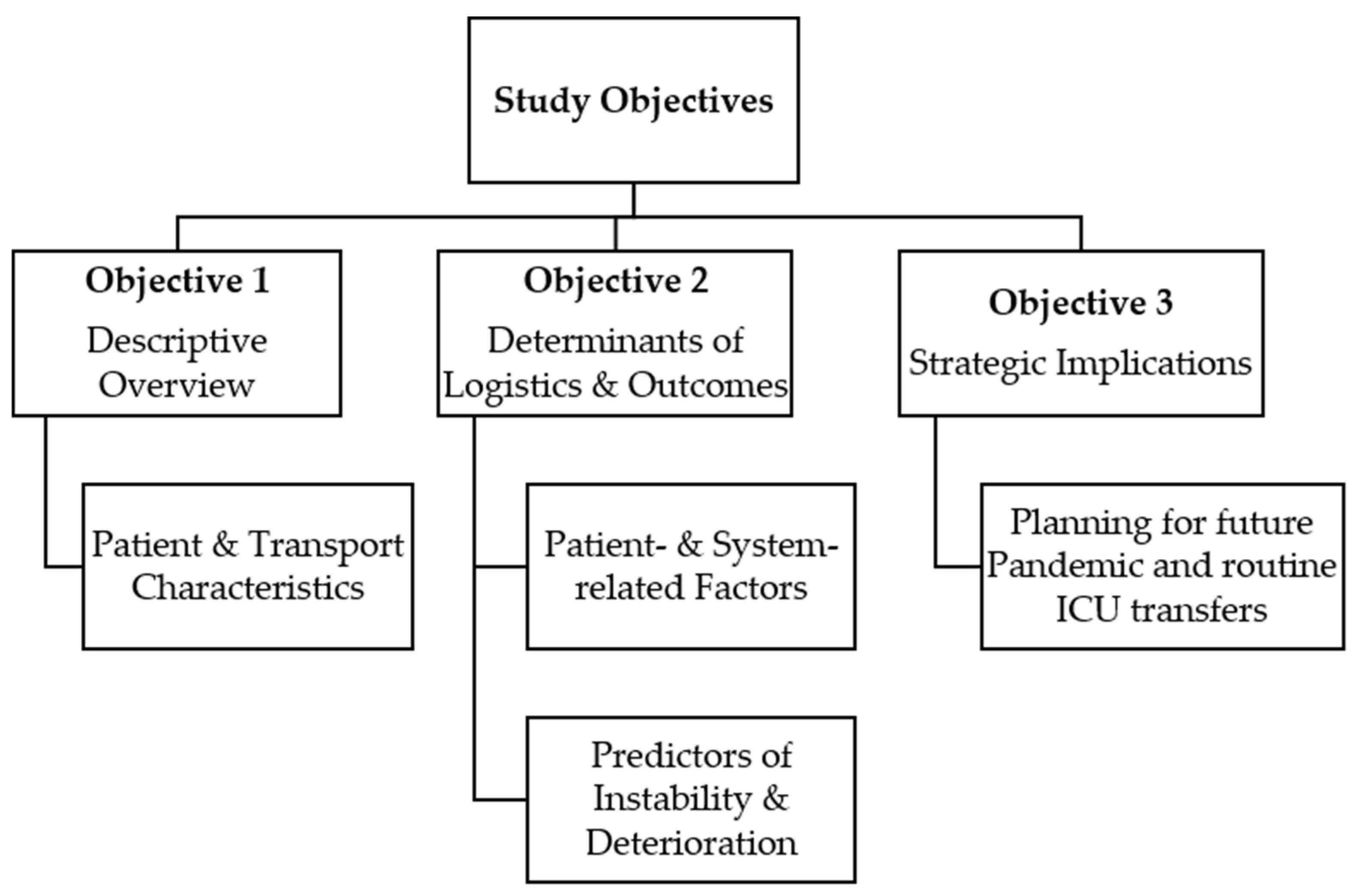
Figure 2.
Takeover times compared to handover times for all ground-transported patients (Pearson’s r = .223).
Figure 2.
Takeover times compared to handover times for all ground-transported patients (Pearson’s r = .223).
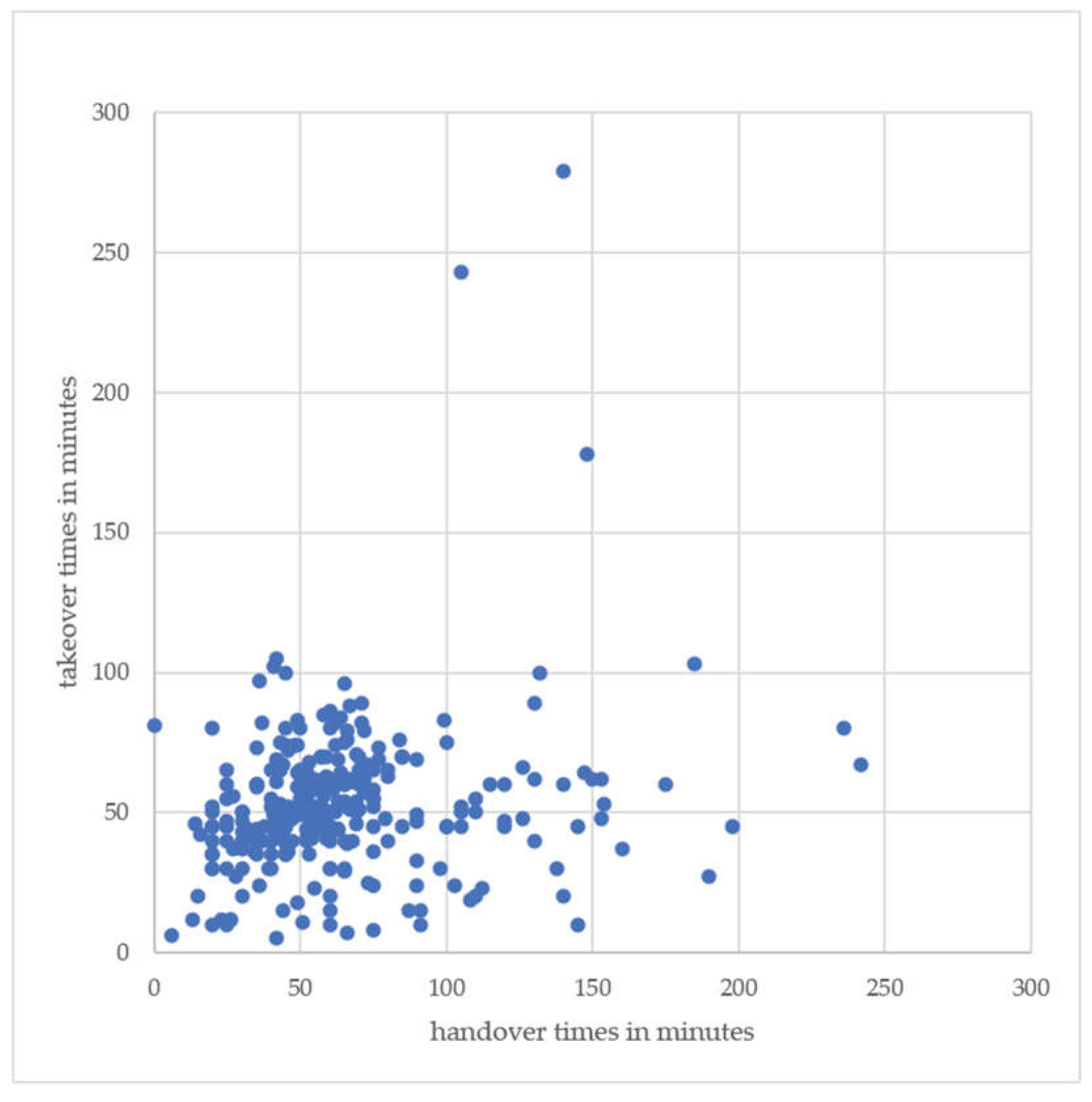

Table 1.
Linear regression analysis with takeover time (minutes) as dependant variable (n = 414).
| regression coefficient (minutes) | 95% CI | p-value | |
|---|---|---|---|
| intercept | 31.8 | 22.4 – 41.1 | <.001 |
| physician seniority | -3.9 | -9.1 – 1.4 | 0.147 |
| high priority | -9.9 | -19.0 - -0.9 | 0.032 |
| catecholamine therapy | 9.4 | 3.6 – 15.2 | 0.002 |
| unconsciousness/sedation | 7.5 | 0.3 – 14.6 | 0.041 |
| ECMO | 21.2 | 11.6 – 30.9 | <.001 |
| obesity | 14.2 | 5.1 – 23.4 | 0.002 |
| Diabetes | 7.5 | -1.2 – 16.3 | 0.092 |
| ventilation | 7.8 | -2.6 – 18.2 | 0.14 |
| Severe Impairment | 3.8 | -1.9 – 9.4 | 0.192 |
Table 2.
Linear regression analysis with handover time (minutes) as dependant variable (n = 414).
| regression coefficient (minutes) | 95% CI | p-value | |
|---|---|---|---|
| intercept | 47.8 | 31.5 – 64.0 | <.001 |
| physician seniority | 5.6 | -3.2 – 14.4 | 0.211 |
| high priority | -1.3 | -16.0 – 13.4 | 0.859 |
| catecholamine therapy | 10.6 | 0.5 – 20.7 | 0.039 |
| unconsciousness/sedation | -6.8 | -19.0 – 5.5 | 0.279 |
| ECMO | 19.8 | 3.4 – 36.1 | 0.018 |
| obesity | 12.3 | -3.0 – 27.5 | 0.115 |
| Diabetes | -0.8 | -15.3 – 13.7 | 0.915 |
| ventilation | 13.7 | -4.6 – 32.0 | 0.141 |
| transport instability | -5.1 | -13.5 – 3.2 | 0.227 |
Table 3.
Logistic regression analysis with deterioration as dependent variable (n = 414).
| OR | 95% CI | p-value | |
|---|---|---|---|
| Analgesics | 2.0 | 0.9 – 4.4 | .088 |
| Crystalloids/Colloids | 1.5 | 0.8 – 2.6 | .174 |
| Obesity | 2.7 | 1.2 – 6.1 | .020 |
| P/F ratio < 100 | 2.4 | 1.2 – 4.5 | .010 |
| Catecholamines | 1.0 | 0.5 – 1.9 | .997 |
| Ventilation | 0.8 | 0.2 – 2.3 | .611 |
Disclaimer/Publisher’s Note: The statements, opinions and data contained in all publications are solely those of the individual author(s) and contributor(s) and not of MDPI and/or the editor(s). MDPI and/or the editor(s) disclaim responsibility for any injury to people or property resulting from any ideas, methods, instructions or products referred to in the content. |
© 2026 by the authors. Licensee MDPI, Basel, Switzerland. This article is an open access article distributed under the terms and conditions of the Creative Commons Attribution (CC BY) license (http://creativecommons.org/licenses/by/4.0/).
Copyright: This open access article is published under a Creative Commons CC BY 4.0 license, which permit the free download, distribution, and reuse, provided that the author and preprint are cited in any reuse.


