

Submitted:
29 July 2026
Posted:
31 July 2026
You are already at the latest version
Abstract
Tuberculous meningitis (TBM) is a critically severe form of extrapulmonary tuberculosis in pediatric patients. Presents a significant diagnostic challenge during the early stages of clinical manifestation. Delayed recognition of meningeal tuberculous inflammation leads to the involvement of the brain parenchyma (encephalitis) and may result in irreversible neurological sequelae. Objective: To evaluate the clinical features, the spectrum of complications, and the outcomes of tuberculous meningitis in pediatric patients under current epidemiological conditions. Materials and Methods: A retrospective analysis of 21 medical records was conducted for pediatric patients aged 3 months to 17 years (mean age: 6.7 ± 5.8 years) with a confirmed TBM diagnosis. The study included pediatric patients treated in the tuberculosis department or evaluated through the telemedicine consultation system between January 2017 and May 2025. Results: A history of contact with a tuberculosis patient was established in 62% (13/21) of cases. At initial presentation, fever was recorded in 67% (14/21) of patients, headache and nausea/vomiting in 52% (11/21), and meningeal signs in 38% (8/21). The majority of patients (52%, 11/21) had not received BCG vaccination. Mycobacterium tuberculosis (MBT) was identified in 19 patients (90%). MTB DNA was detected in the cerebrospinal fluid (CSF) in 79% of patients (15/21). Drug resistance (DR) was confirmed in 57.9% of patients (11/19), including MDR/XDR strains in 81.8% (9/11) of the DR subgroup. Complications included motor deficits in 38% (8/21), hydrocephalus in 47.6% (10/21), and epileptic syndrome in 19% (4/21). Four patients (19%) with an unfavorable outcomes were transitioned to palliative care. Conclusion: In pediatric patients; TBM delayed diagnosis results in a more severe clinical course characterized by the development of profound neurological deficits. This study demonstrates that TBM has evolved from a predominantly meningeal disease into a severe form of meningoencephalitis; frequently accompanied by hydrocephalus; epilepsy; and motor deficits. Notably; seizure disorder serves as a critical predictor of an unfavorable outcome. These findings underscore the urgent need to optimize early diagnostic strategies within general healthcare networks.
Keywords:
tuberculous meningitis
; encephalitis
; children
; multidrug resistance (MDR-TB)
; complications
; BCG vaccination
; outcomes
1. Introduction
Tuberculous meningitis (TBM) is the most severe form of extrapulmonary tuberculosis (TB) in children, resulting from the hematogenous dissemination of Mycobacterium tuberculosis (MTB), to the leptomeninges, where it triggers a specific inflammatory response [1]. TBM remains the most debilitating and life-threatening form of extrapulmonary TB in pediatric practice. When diagnosis is delayed, the case fatality rate can exceed 60%, and the incidence of neurological complications can reach 50% or higher [2]. Despite an overall decline in TB incidence across the Russian Federation, the incidence rate in 2023 among children aged 0–14 years was 6.7 per 100,000, and among adolescents aged 15–17 years, it stood at 12.7 per 100,000 age-matched population. Concurrently, TBM is diagnosed in 0.5–1% of cases (mean: 0.86%) of all newly diagnosed pediatric TB patients [3,4].
Early detection of MTB is challenging and heavily relies on the clinical index of clinical suspicion among general practitioners, as pediatricians are typically the first point of contact for these patients.
In contemporary clinical practice, the classic triad of meningeal symptoms (headache, vomiting, and fever) is increasingly absent or attenuated. Instead, atypical, indolent courses are frequently observed, where diffuse cerebral symptoms predominate over classic meningeal manifestations [2,5]. Furthermore, in infants and young children, the clinical presentation is often dominated by equivalents of meningeal signs such as hyperkinesis, paroxysmal events, and inconsolable crying, necessitating optimized diagnostic algorithms [2,5]. In addition, an increasing proportion of tuberculosis cases is caused by multidrug-resistant (MDR) strains of MTB [2,6,7]. Research indicates that TBM caused by MDR strains is associated with a more severe clinical course, delayed resolution of neurological symptoms, and the necessity to prescribe anti-tuberculosis drugs with limited blood-brain barrier (BBB) penetration, all of which may adversely affect the prognosis [8]. In addition, an increasing number of children remain unvaccinated with BCG or BCG-M, resulting in a growing subpopulation of immunologically unprotected young children. In these individuals, TB often presents as a disseminated disease with a high risk of rapid progression to meningoencephalitis [9,10]. Concurrently, the diagnosis of TBM remains highly challenging due to the paucity of cerebrospinal fluid (CSF) findings during the early stages of the disease. Specifically, lymphocytic pleocytosis often does not become apparent until days 5–7 of illness, and the sensitivity of smear microscopy remains low [9,10,11]. Although the implementation of molecular genetic methods (PCR) reduces the detection time for MTB DNA, their sensitivity remains far from 100% and varies according to the stage of the disease [12,13]. For instance, a study by Sehgal et al. (2023) demonstrated that the sensitivity of PCR methods (Pab PCR and IS6110 PCR) in TBM was 82% and 76%, respectively, failing to reach absolute values even under optimal conditions [12]. According to Ghimire et al. (2023), the sensitivity of GeneXpert MTB/RIF in CSF analysis ranges between 50% and 80%, demonstrating that a diagnosis of TBM cannot be excluded on the basis of a negative PCR result alone [13].
Taken together, these factors underscore the urgent relevance of a comprehensive evaluation of the clinical and laboratory features, as well as the outcomes, of tuberculous meningitis in pediatric patients within modern tuberculosis care.
2. Materials and Methods
The study was conducted in accordance with the principles of biomedical ethics set forth in the 1964 Declaration of Helsinki and its subsequent amendments. They [the study procedures/protocols] were also approved by the Ethics Committee of Sechenov University (Moscow), Protocol No. 11-26 dated May 21, 2026г.
This is retrospective observational study (case series). The medical records of 21 pediatric patients with tuberculous meningitis (meningoencephalitis) were retrospectively analyzed. Of these, 6 patients(28%) were treated at the Pediatric Tuberculosis Department of the National Medical Research Center of Phthisiopulmonology and Infectious Diseases between 2017 and 2025, whereas 15 patients (71.4%) were evaluated through the telemedicine consultation system between 2023 and 2025. Female patients accounted for 57.1% of the cohort. Children younger than 7 years comprised 66.7% of the cohort, with those younger than 3 years accounting for 52.4% (11/21) (Table 1). The mean age was 6.7 ± 5.8 years (range, 3 months–17 years).
A history of contact with a tuberculosis patient was established in 13 children (62%); in 7 of these cases (54%), MDR or pre-XDR strains were reported in the suspected source cases. Ten children (48%) had a history of BCG vaccination.
All patients underwent a standard clinical and laboratory evaluation, which included:
Complete blood counts, routine urinalysis, and serum biochemical panels;
Chest computed tomography (CT);
Lumbar puncture with CSF analysis, including cell count, protein, glucose, real-time PCR (RT-PCR), and culture on liquid media using the BACTEC MGIT 960 system;
Neuroimaging (contrast-enhanced brain MRI/CT);
Immunodiagnostic testing for tuberculosis infection, including the Mantoux test with 2 tuberculin units (TU), the recombinant tuberculosis allergen (RTA) skin test (Diaskintest), and interferon-gamma release assays (IGRAs);
Specialist consultations, including ophthalmologist, neurologist, neurosurgeon, etc.
Statistical processing of the data was performed using the Statistica 12.0 software package for Windows (StatSoft Inc., USA).
Descriptive statistics were applied based on the variable type. Quantitative variables were summarized using the arithmetic mean and standard deviation (M ± SD), as well as minimum and maximum values. Qualitative (categorical) variables were expressed as absolute frequencies and percentages (%) of the total.
To analyze the association between categorical variables, non-parametric methods were applied. Statistical significance was evaluated using Fisher’s exact test. To estimate the strength of association, the odds ratio (OR) was calculated with a 95% confidence interval (95% CI). Differences were considered statistically significant at p < 0.05.
3. Results
Almost all children (20/21; 95.2%) were referred to tuberculosis departments from general healthcare network (GHN) facilities, indicating a high rate of initial medical consultations at non-specialized medical organizations. Only one patient (4.8%) was identified during contact tracing at a community tuberculosis dispensary.
BCG vaccination prevents the dissemination of tuberculosis and the development of meningitis in infants and young children aged under 3 years. As shown in Table 1 and 81.8% (9/11) of patients in this age group who developed meningitis had not received BCG vaccination; furthermore, 10 of 11 children (91%) had a confirmed history of contact with a tuberculosis patient.
A significant number of patients had an irregular history of immunodiagnostic testing prior to the final diagnosis. Specifically, the Mantoux test with 2 TU was performed in only 9/21 patients (43%) during routine screening. Among these, positive results (an induration equal to or greater than 5 mm in at least one measurement) were observed in 7/9 patients (77.7%), while negative results (all measurements less than 5 mm or completely negative) were recorded in 2/9 patients (22.3%). The recombinant tuberculosis allergen (RTA) skin test was performed in only 10/21 patients (47%), even when tuberculosis was suspected. Positive results (the presence of an induration of any size or erythema greater than 5 mm) were found in 6/10 patients (60%), and negative results were noted in 4 patients (40%).
The clinical presentation was characterized by constitutional symptoms, such as fever (14 patients, 67%) and marked lethargy/weakness (9 patients, 43%). Vomiting is a frequent sign of increased intracranial pressure (ICP). This symptom was observed in 11 patients (52%). Headache was reported in 7 patients (33%). Meningeal signs were documented at initial presentation in only 8 patients (38%), suggesting a potentially blunted onset or the predominance of diffuse cerebral symptoms over meningeal signs during the early stage of pediatric tuberculous meningoencephalitis. Seizures and focal neurological deficits (motor deficits) were less common at admission, occurring in approximately 19% of patients (4/21). However, these manifestations subsequently developed in a larger number of patients, as confirmed by symptom progression analysis (Table 2). The disease onset was most frequently subacute or acute, mimicking acute respiratory viral infections (ARVI) or gastroenteritis. At the peak of the disease, neurological manifestations included meningeal syndrome (nuchal rigidity, Kernig and Brudzinski signs, which were not always fully expressed, particularly in infants and young children), focal deficits, brainstem and subcortical syndromes, altered consciousness (ranging from stupor to grade I-II coma), and hydrocephalic syndrome. Cytological and biochemical analysis of the CSF revealed classic signs of tuberculous involvement in all 21/21 patients (100%), characterized by pleocytosis with a two- to threefold increase in cell count, elevated protein levels, and decreased glucose and chloride concentrations.
The causative agent was definitively identified in 19 patients (90%), whereas microbiological findings were inconclusive for the remaining 2 patients. Specifically, MTB was detected in CSF of 15 patients (79%) by RT-PCR, in urine samples of 4 patients (21%), and in sputum, throat swabs, and gastric lavage fluid of 3 patients (16% each). Furthermore, MTB was confirmed in the bronchoalveolar lavage fluid (BALF) in 1 patient (5%) and in the ear discharge of another patient (5%), confirming the disseminated nature of the disease process (Figure 1).
DR was confirmed in 11 patients (58%) among those with a definitively identified causative agent. Notably, a subset of these individuals had multidrug-resistant (MDR), pre-extensively drug-resistant (pre-XDR), and extensively drug-resistant (XDR) strains (Table 3).
Neuroimaging (brain CT/MRI) revealed signs of hydrocephalus in 10/21 patients (48%), including obstructive hydrocephalus (3 patients, 14%), communicating (compensatory / ex vacuo) hydrocephalus (2 patients, 10%), triventricular hydrocephalus (1 patient, 5%), quadriventricular hydrocephalus (1 patient, 5%), shunted hydrocephalus (1 patient, 5%), and trapped ventricle syndrome (1 patient, 5%). Structural brain changes were identified in 4/21 patients (19%), presenting as cystic-gliotic transformations, multiple parabrainstem cysts, cortical subatrophy, and central pontine myelinolysis. Concurrently, 6 patients (28%) required surgical management of hydrocephalus involving the placement of external ventricular drains or internal shunts (including one case utilizing an Ommaya reservoir).
Disseminated tuberculosis with multiorgan involvement (affecting more than two organs and systems) was diagnosed in 20 patients (95%), whereas isolated TBM was observed in only one patient (5%). The majority of children (62%, 13 patients) had comorbidities, including hypoxic-ischemic brain injury, central nervous system (CNS) depression syndrome, and Dandy-Walker malformation (the latter identified in 2 children, 10%). Notably, no patients were HIV-positive. All patients received treatment in accordance with the current national clinical guidelines “Tuberculosis in Children,” with regimen adjustments performed upon receiving drug susceptibility testing (DST) results. Glucocorticosteroids (dexamethasone) were administered to all patients to mitigate cerebral edema and inflammation.
The primary complications associated with delayed diagnosis included (Table 4):
Motor deficits (paresis/paralysis): observed in 8 of 21 patients (38%), presenting as spastic asymmetric central tetraparesis, left- or right-sided hemiparesis, inferior paraparesis, and diplegia;
Hydrocephalus: identified in 10 of 21 patients (48%), presenting as obstructive (3 patients, 14%), communicating (compensatory / ex vacuo) (2 patients, 10%), triventricular (1 patient, 5%), quadriventricular (1 patient, 5%), shunted (1 patient, 5%), and trapped (1 patient, 5%) ventricle syndrome. In 6 patients (29%), this condition required neurosurgical intervention (shunt placement or drainage);
Cranial nerve palsies and sensory organ involvement: documented in 9 patients (43%);
Optic nerve atrophy and optic neuropathy: descending or partial optic nerve atrophy was noted in 3 patients (14%);
Epileptic syndrome: reported in 4 patients (19%), including focal, tonic-clonic, and bilateral seizures, as well as epileptic spasms;
Respiratory disorders and respiratory failure: observed in 5 patients (24%);
Brainstem and subcortical syndromes: identified in 4 patients (19%), including bulbar palsy, brainstem syndrome, dystonic storms, and subcortical syndrome;
Contractures and orthopedic deformities: noted in 2 patients (10%) as long-term sequelae of severe neurological deficits, including spasticity, adductor and flexion contractures, equinovarus deformity, and positional kyphosis;
Shunt dysfunction: reported in 2 patients (10%) as a specific complication requiring repeated shunt revisions in patients with ventriculoperitoneal shunts.
Table 5 presents data on the time to diagnosis, BCG vaccination status, and treatment outcomes in 21 pediatric patients stratified according to the diagnostic period duration. The final diagnosis was established more than 14 days after initial symptoms onset in the majority of patients (57%). Diagnosis was achieved within 7 days in 24% of cases, and between 7 and 14 days in 19%. Treatment outcomes analysis demonstrated that, in the earliest diagnosis group (within 7 days), 80% of patients completed treatment with a favorable clinical response, defined as clinical and radiological improvement followed by transfer to dispensary monitoring. In contrast, among patients with a diagnostic delay exceeding 14 days, only 42% achieved a similarly favorable outcome. Furthermore, 33% of these children (4 patients) were transitioned to palliative care. These findings underscore the critical importance of early TBM detection, given the severe disease course and the limited efficacy of etiotropic therapy in the advanced stages.
According to the analysis of treatment outcomes, critically severe, irreversible brain injury was documented in 4 of 21 patients (19%), who were subsequently transitioned to palliative care. These patients presented with persistent vegetative state, profound tetraparesis, optic nerve atrophy, and coma.
In 6 of 21 children (29%), persistent neurological deficits remained, including spastic paresis/paralysis (hemiparesis or tetraparesis), psychomotor retardation, seizure disorder, optic nerve atrophy, and shunt-dependent hydrocephalus.
Clinical improvement was recorded in 10 of 21 (48%) patients. However, residual sequelae (such as hemiparesis and hydrocephalus) persisted even within this subgroup.
Correlation analysis between complications and treatment outcomes (palliative care vs. clinical improvement) demonstrated a weak trend toward a higher incidence of hydrocephalus in patients with a palliative outcome. However, no statistically significant association was found (Fisher’s exact test: p = 0.105 for hydrocephalus, p = 0.266 for paresis).
Concurrently, for epilepsy and seizures, the p-value was 0.052, which closely approaches the significance threshold of 0.05. This suggests a potential trend wherein seizures occur more frequently in patients with a palliative outcome (75% vs. 11%). The odds ratio was OR = 24 (95% confidence interval [CI]: 1.02–1364); however, the confidence interval is extremely wide due to the small sample size, highlighting the need for further validation in a larger patient cohort. Furthermore, an aggregate analysis of the relationship between any of the three major complications (hydrocephalus, paresis, or seizures) and clinical outcomes revealed no statistically significant association (p = 0.228), which is likely attributable to the limited sample size and missing data regarding certain patients’ vaccination status and long-term outcomes.
In summary, no statistically significant associations were identified between BCG vaccination status and clinical outcomes, nor between vaccination and most complications. However, a distinct trend was noted toward a higher seizure frequency in unvaccinated patients (p = 0.092) and in patients with a palliative outcome (p = 0.052). The latter result closely approaches statistical significance, suggesting that seizure disorder serves as an unfavorable prognostic marker; nevertheless, expanding the sample size is necessary to confirm these trends. In the studied cohort of patients (n = 21) with disseminated tuberculosis and CNS involvement, neurological complications predominated, with motor deficits (paresis/tetraparesis) and hydrocephalus being the most prevalent. Additionally, a substantial proportion of patients developed epileptic syndrome or sensory organ impairment (ophthalmic pathology and risk of hearing loss), emphasizing the severely debilitating nature of the disease course.
4. Discussion
The present study confirms that TBM remains a severe, debilitating disease characterized by an exceptionally high incidence of neurological complications. Of particular note is the low BCG vaccination coverage within the study cohort (only 48%), which represents a well-established risk factor for the development of TBM [9,10]. Although no statistically significant association was found between vaccination status and clinical outcomes (p = 0.266), a visible trend toward a more severe disease course was observed in unvaccinated individuals, particularly regarding seizure activity (p = 0.092). This underscores the crucial role of vaccination as a protective factor. The absence of reliable data regarding contact with tuberculosis patients in a substantial proportion of individuals highlights the significant contribution of hidden, undetected infectious sources, which complicates the timely identification of high-risk groups and implementation of preventive measures.
In this study, the initial clinical course of tuberculous meningitis was frequently characterized by attenuated classic meningeal symptoms, with meningeal signs documented at admission in only 38% of patients. In infants and young children, diagnostic confirmation was further confounded by the predominance of unique meningeal syndrome equivalents, manifesting as seizures or paroxysmal events.
The difficulty of timely TBM diagnosis was also driven by immune anergy, which may reduce the sensitivity of immunodiagnostic tests. The Mantoux test (2 TU) yielded negative results in nearly one-quarter of patients (22.3%), while the RTA skin test was negative in 40%. These findings highlight the persistent challenge of false-negative results in microbiological TB diagnostics, even with advanced methods such as PCR and the BACTEC system [11,12,13]. Under these circumstances, a comprehensive assessment integrating neuroimaging findings, clinical presentation, and epidemiological history becomes imperative.
Furthermore, the high prevalence of DR represents a highly alarming factor. The cumulative proportion of patients with MDR, pre-XDR, and XDR strains accounted for 47% of those with a definitively identified pathogen. The presence of XDR-TB, including resistance to bedaquiline and linezolid, represents a major therapeutic challenge, as it markedly limits treatment options and may worsen outcomes due to the poor BBB penetration of many second-line and reserve drugs. [8,14,15].
Outcome analysis revealed a frequency of disabling complications. Motor deficits, hydrocephalus (with several cases requiring neurosurgical intervention), and epileptic syndrome emerged as the primary sequelae of the experienced meningoencephalitis. Statistical analysis demonstrated a trend toward an association between seizure disorder as a primary marker of encephalitis, as its presence could be closely associated with critically severe outcomes (palliative care or persistent vegetative state) (p = 0.052). However, larger studies are required to conclusively establish this relationship. Although the confidence interval for the odds ratio (OR = 24) was wide due to the limited sample size, this trend fundamentally aligns with clinical logic, according to which refractory seizures exacerbate hypoxia and secondary brain injury.
5. Conclusions
Infants and young children who are unvaccinated with BCG represent a high-risk group for the development of severe forms of tuberculosis, including meningitis. Bi-annual immunodiagnostic screening is mandatory for this subpopulation in our opinion.
The appearance of clinical signs of meningeal irritation in BCG-unvaccinated children requires immediate and comprehensive screening for tuberculosis.
Tuberculous meningitis in children exhibits a critically severe clinical course with multiple complications. A substantial proportion of patients develop motor deficits (paresis/paralysis), hydrocephalus, and epileptic syndrome. In 19% of cases, the disease results in irreversible brain damage, requiring a transition to palliative care.
The presence of a seizure disorder in patients with TBM serves as a potential predictor of a critically severe outcome (p = 0.052), which demands rigorous monitoring and control of epileptic activity during the acute phase of the disease.
A trend toward a higher seizure frequency was observed in unvaccinated children (p = 0.092), corroborating the protective role of BCG vaccination against the most severe forms of tuberculous CNS involvement.
In contemporary clinical practice, pediatric tuberculous meningitis is characterized by a severe course that results in profound neurological deficits in a substantial proportion of patients. The most critical challenges associated with a poor prognosis include delayed diagnosis driven by an attenuated clinical presentation and a low clinical index of suspicion, high rates of anti-tuberculosis drug resistance (MDR/XDR-TB), and the absence of BCG vaccination in many affected children. Our findings indicate that TBM evolved from a predominantly meningeal disease into a severe meningoencephalitis with systemic dissemination, frequently accompanied by hydrocephalus, epilepsy, and motor deficits. Furthermore, seizure disorder acts as a predictor of an unfavorable outcome. These findings underscore the urgent need to optimize early diagnostic strategies within general healthcare networks.
Author Contributions
Conceptualization, Irina Vasilyeva and Nadezhda Klevno; methodology, Nadezhda Klevno, Aleksey Kazakov; software, Alexandr D. Chuishchev; validation, Aziza Pakhlavonova, Elena Prikhodko, Ekaterina Sokolskaya; formal analysis, Nadezhda Klevno, Aleksey Kazakov; investigation, Nadezhda Klevno, Aleksey Kazakov; data curation, Nadezhda I. Klevno, Alexey V. Kazakov; writing—review and editing, Elizaveta Zakharova, Ksenia Rudakova; visualization, Alexandr D. Chuishchev, Inga Enilenis; super-vision, Irina Vasilyeva; project administration, Ivan I. Martel; funding acquisition, Ivan I. Martel. All authors have read and agreed to the published version of the manuscript.
Funding
This study received no specific grant or financial support from public, commercial, or not-for-profit funding agencies.
Institutional Review Board Statement
The study was conducted in accordance with the principles of biomedical ethics as set out in the 1964 Declaration of Helsinki and its subsequent amendments. They were also approved by the Ethics Committee of Sechenov University (Moscow), protocol No. 11-26 of 05/21/2026.
Conflicts of Interest
The authors declare no conflicts of interest, either explicit or potential, regarding the publication of this article.
References
- Huynh, J.; Abo, Y.N.; du Preez, K.; Solomons, R.; Dooley, K.E.; Seddon, J.A. Tuberculous Meningitis in Children: Reducing the Burden of Death and Disability. Pathogens 2021, 11(1), 38. [Google Scholar] [CrossRef] [PubMed] [PubMed Central]
- du Preez, K.; Jenkins, H.E.; Martinez, L.; Chiang, S.S.; Dlamini, S.S.; Dolynska, M.; Aleksandrin, A.; Kobe, J.; Graham, S.M.; Hesseling, A.C.; Starke, J.R.; Seddon, J.A.; Dodd, P.J. Global burden of tuberculous meningitis in children aged 0-14 years in 2019: a mathematical modelling study. Lancet Glob. Health 2025, 13(1), e59–e68. [Google Scholar] [CrossRef] [PubMed] [PubMed Central]
- Kulikova, I.B.; Vasilyeva, I.A.; Kazakov, A.V.; et al. [The epidemiological situation of tuberculosis in children in the Russian Federation during the end of the COVID-19 pandemic]. Tuberk. I Bolezn. Legk. (Tuberculosis and Lung Diseases) (In Russ.). 2025, 103(3), 8–16. [Google Scholar] [CrossRef]
- Fedorova, E.V.; Bendorsh, K.I.; An, R.N.; et al. Features of the long-term dynamics of the development of the tuberculosis epidemic process in the megalopolis of the Sverdlovsk region. In Profilakticheskaya i Klinicheskaya Meditsina (Preventive and Clinical Medicine); (In Russ.); GEHFWS: EDN, 2025; Volume 3, 96, pp. 56–65. [Google Scholar]
- du Preez, K.; Jenkins, H.E.; Donald, P.R.; Solomons, R.S.; Graham, S.M.; Schaaf, H.S.; Starke, J.R.; Hesseling, A.C.; Seddon, J.A. Tuberculous Meningitis in Children: A Forgotten Public Health Emergency. Front Neurol. 2022, 13, 751133. [Google Scholar] [CrossRef] [PubMed] [PubMed Central]
- Wulandari, D.A.; Hartati, Y.W.; Ibrahim, A.U.; Pitaloka, D.A.E.; Irkham. Multidrug-resistant tuberculosis. Clin. Chim. Acta 2024, 559, 119701. [Google Scholar] [CrossRef] [PubMed]
- Singh Dewhare, S. Drug resistant tuberculosis: Current scenario and impending challenges. Indian J. Tuberc. Epub. 2022, 69(2), 227–233. [Google Scholar] [CrossRef] [PubMed]
- Inbaraj, L.R.; Daniel, B.D.; Padmapriyadarsini, C. Drug resistant tuberculous meningitis: A neglected foe in ending tuberculosis epidemic. Indian J. Tuberc. Epub. 2025, 72(3), 401–406. [Google Scholar] [CrossRef] [PubMed]
- van Ettekoven, C.N.; Liechti, F.D.; Brouwer, M.C.; Bijlsma, M.W.; van de Beek, D. Global Case Fatality of Bacterial Meningitis During an 80-Year Period: A Systematic Review and Meta-Analysis. JAMA Netw. Open 2024, 7(8), e2424802. [Google Scholar] [CrossRef] [PubMed] [PubMed Central]
- Martyshova, O.S.; Velikaya, O.V.; Lushnikova, A.V.; Khoroshilova, N.E. [Outcomes of tuberculous meningitis in children and adolescents depending on the timeliness of diagnosis]. In Sistemnyy Analiz i Upravlenie v Biomeditsinskikh Sistemakh (Systems Analysis and Management in Biomedical Systems); (In Russ.); EDN: QJHUEF, 2018; Volume 17, 1, pp. 214–218. [Google Scholar]
- Klochkova, L.V.; Lozovskaya, M.E.; Vasilyeva, E.B.; Yarovaya, YuA. Tuberculous meningitis in children: modern requirements for diagnostics. Zhurnal Infektologii (In Russ.). 2017, 9(4), 85–92. [Google Scholar] [CrossRef]
- Sehgal, V.; Sharma, M.; Lnu, P.; Sharma, K.; Sharma, A.; Sharma, N.; Modi, M. Comparison of Protein B Polymerase Chain Reaction (PCR) With IS6110 PCR for Diagnosis of Tuberculous Meningitis Patients. Cureus 2023, 15(1), e33783. [Google Scholar] [CrossRef] [PubMed] [PubMed Central]
- Ghimire, B.; Thapaliya, I.; Yadav, J.; Bhandari, S.; Paudyal, M.B.; Mehta, N.; Bhandari, S.; Adhikari, Y.R.; Sapkota, S.; Bhattarai, M. Diagnostic challenges in tuberculous meningitis: a case report with negative genexpert result. Ann. Med. Surg. (Lond) 2023, 85(11), 5731–5735. [Google Scholar] [CrossRef] [PubMed] [PubMed Central]
- Valafar, S.J. Systematic Review of Mutations Associated with Isoniazid Resistance Points to Continuing Evolution and Subsequent Evasion of Molecular Detection, and Potential for Emergence of Multidrug Resistance in Clinical Strains of Mycobacterium tuberculosis. Antimicrob. Agents Chemother. 2021, 65(3), e02091-20. [Google Scholar] [CrossRef] [PubMed] [PubMed Central]
- Pei, S.; Song, Z.; Yang, W.; He, W.; Ou, X.; Zhao, B.; He, P.; Zhou, Y.; Xia, H.; Wang, S.; Jia, Z.; Walker, T.M.; Zhao, Y. The catalogue of Mycobacterium tuberculosis mutations associated with drug resistance to 12 drugs in China from a nationwide survey: a genomic analysis. Lancet Microbe Epub 2024 Sep 28. 2024, 5(11), 100899. [Google Scholar] [CrossRef] [PubMed] [PubMed Central]
Figure 1.
Detection of Mycobacterium tuberculosis in the study cohort.
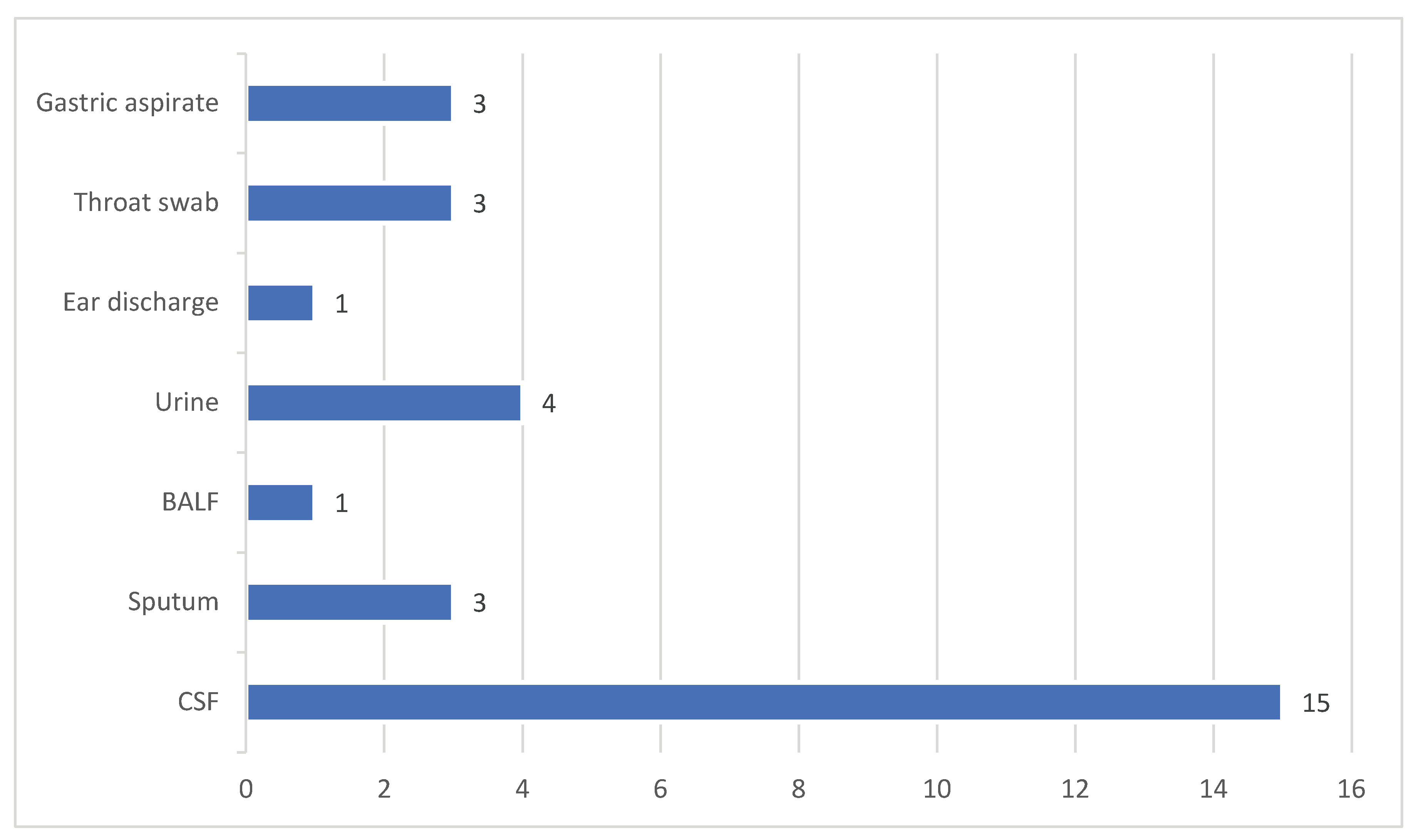

Table 1.
Clinical and demographic characteristics of the patients (n=21).
| 0-3 years | 4-6 years | 7-11 years | 12-17 years | ||||
| М | F | М | F | М | F | М | F |
| 5 (45%) | 6 (55%) | 2 (67%) | 1 (33%) | 1 (50%) | 1 (50%) | 1 (20%) | 4 (80%) |
| Total 11 (52%) | Total3 (14%) | Total2 (10%) | Total 5 (23%) | ||||
| BCG vaccination status | |||||||
| BCG-vaccinated - 2 (18%) | BCG-vaccinated - 3 (100%) | BCG-vaccinated - 2 (100%) | BCG-vaccinated - 3 (60%) | ||||
| History of TB contact | |||||||
| Presence – 10 (91%) | Presence – 1 (67%) | Presence – 1 (50%) | Presence – 1 (20%) | ||||
Table 2.
Analysis of patient complaints at initial medical presentation (n=21).
| Clinical Manifestation | Number of patients (n = 21) | (%) |
|---|---|---|
| Fever (elevated body temperature) | 14 | 67 |
| Fatigue, lethargy, malaise | 9 | 43 |
| Nausea and/or vomiting | 11 | 52 |
| Cephalgia | 7 | 33 |
| Cough, rhinorrhea, and upper respiratory tract symptoms | 5 | 24 |
| Altered level of consciousness (drowsiness, lethargy, loss of consciousness) | 6 | 29 |
| Abdominal pain and dyspepsia | 11 | 52 |
| Loss of appetite and food refusal | 4 | 19 |
| Seizures (including focal seizures) | 4 | 19 |
| Motor impairments (weakness in limbs, gait instability) | 8 | 38 |
| Meningeal signs (nuchal rigidity, hyperesthesia) | 8 | 38 |
| Other (pallor, cyanosis, hypernasality, weight loss, etc.) | 5 | 24 |
Table 3.
Drug resistance spectrum of Mycobacterium tuberculosis in the study cohort.
| Resistance pattern | Identified mutations and drug resistance profiles | No. of patients, n (%) |
|---|---|---|
| DS | Drug-susceptible | 7 (37%) |
| MDR | Resistance to H and R (frequently combined with S, E) | 3 (16%) |
| Pre-XDR | MDR + resistance to a fluoroquinolone (FQ) or an aminoglycoside (AG) | 3 (16%) |
| XDR | MDR + resistance to FQ and second-line injectables (AG/polypeptides) | 3 (16%) |
| ND / Pending (No Data / Pending) | Culture in progress or data unavailable | 3 (16%) |
Table 4.
Summary analysis of complications ranked by frequency of occurrence (from most to least frequent).
Table 4.
Summary analysis of complications ranked by frequency of occurrence (from most to least frequent).
| Type of complication | No. of patients, n | Complication rate (%) |
|---|---|---|
|
8 | 38 |
|
10 | 48 |
|
9 | 43 |
|
4 | 19 |
|
5 | 24 |
|
5 | 24 |
|
4 | 19 |
|
6 | 29 |
|
4 | 19 |
|
2 | 10 |
|
2 | 10 |
|
3 | 14 |
Table 5.
Time to diagnosis verification, BCG vaccination status, and treatment outcomes.
| Time to final diagnosis (mean, days) | Number of patients, n (%) | BCG vaccination, n (%) | Outcomes at the end of treatment, n (%) |
|---|---|---|---|
| Up to 7 days | 5 (24%) | 2 (40%) | Clinical and radiological improvement, treatment completion, transfer to dispensary surveillance group III – 4 (80%); Continuing treatment – 1 (20%) |
| 7 to 14 days | 4 (19%) | 1 (25%) | Continuing treatment – 1 (25%); Clinical and radiological improvement, treatment completion, transfer to dispensary surveillance group III – 1 (25%); No data – 2 (50%) |
| Over 14 days | 12 (57%) | 7 (58%) | Transfer to palliative care – 4 (33%); Continuing treatment – 1 (8%); Clinical and radiological improvement, treatment completion, transfer to dispensary surveillance group III – 5 (42%); No data – 2 (17%) |
Disclaimer/Publisher’s Note: The statements, opinions and data contained in all publications are solely those of the individual author(s) and contributor(s) and not of MDPI and/or the editor(s). MDPI and/or the editor(s) disclaim responsibility for any injury to people or property resulting from any ideas, methods, instructions or products referred to in the content. |
© 2026 by the authors. Licensee MDPI, Basel, Switzerland. This article is an open access article distributed under the terms and conditions of the Creative Commons Attribution (CC BY) license (http://creativecommons.org/licenses/by/4.0/).
Copyright: This open access article is published under a Creative Commons CC BY 4.0 license, which permit the free download, distribution, and reuse, provided that the author and preprint are cited in any reuse.


