
Submitted:
27 July 2026
Posted:
30 July 2026
You are already at the latest version
Abstract
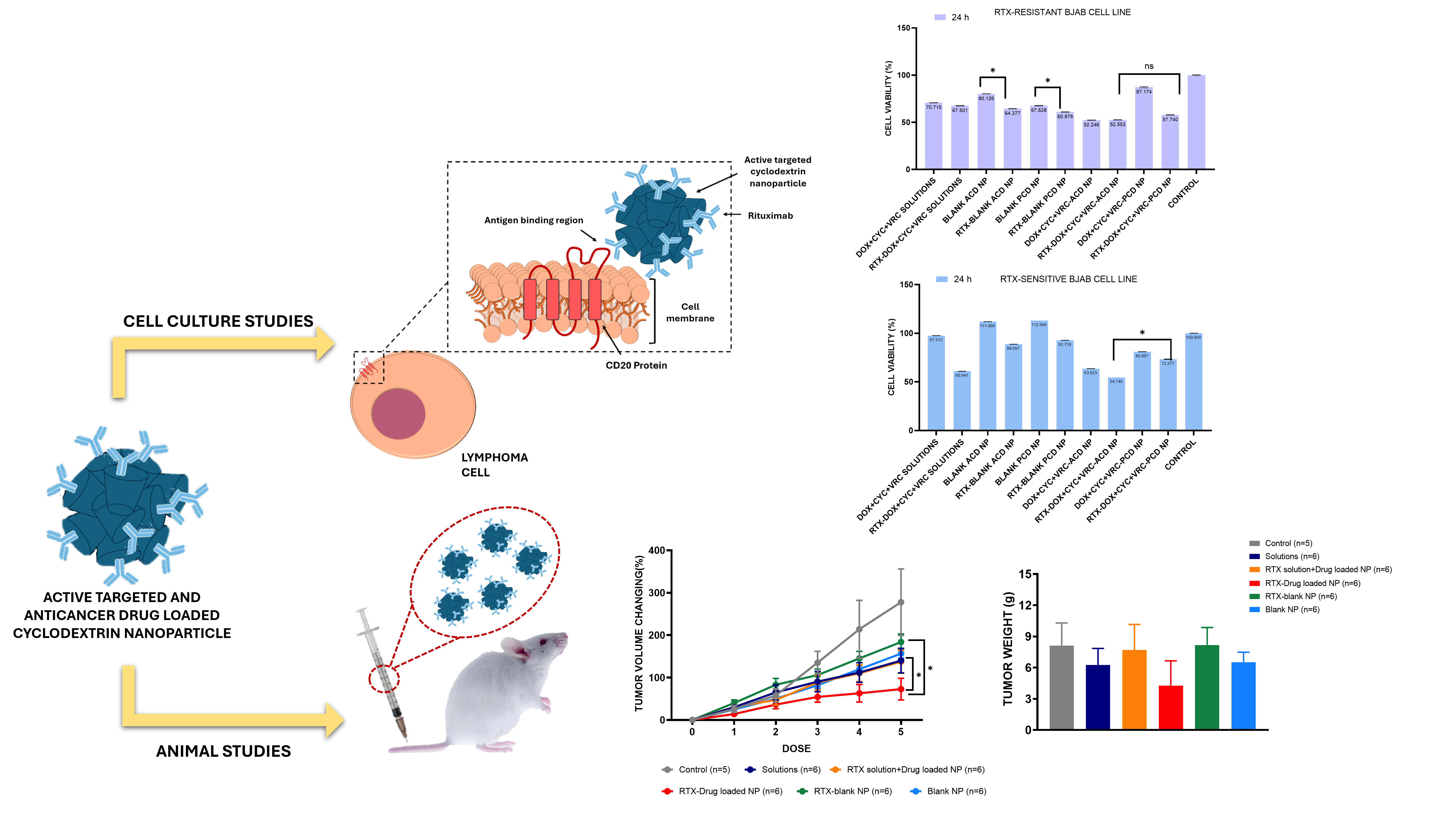
Background/Objectives: Non-Hodgkin Lymphoma (NHL) remains a challenging malignancy where treatment success is often limited by drug resistance and severe side effects, even with the standard R-CHOP regimen. In this study, rituximab (RTX)-conjugated nanoparticles (NPs) enhance mitochondrial accumulation of their cargo, which are the standard regimen chemotherapeutics cyclophosphamide, doxorubicin, and vincristine. Methods: These nanoparticles, based on guanidine-amphiphilic cyclodextrin (ACD) or guanidine-cyclodextrin polymer (PCD), underwent comprehensive in vitro characterization, including particle size, surface charge, drug-loading efficiency, and drug release profiles as reported in our previous article. Two- and three-dimensional cell culture studies, involving both RTX-resistant and sensitive models, were conducted. Additionally, in vivo studies on BALB/c mice included plasma pharmacokinetic profiling for nanoparticle-bound RTX, doxorubicin, cyclophosphamide, and vincristine in comparison to free drugs, safety evaluations after single and multiple dose administrations, and antitumoral efficacy tests in NHL tumor-induced animals. Results: RTX-conjugated drug-loaded NPs significantly reduced the viability of lymphoma cell lines compared to multidrugs in solution form (p < 0.05). These experiments highlighted the superior therapeutic performance of the RTX-conjugated Gua-CD nanoparticle formulations, particularly in improving therapeutic outcome by overcoming drug resistance, when compared to conventional therapies. Conclusions: These novel rituximab-conjugated, multi-drug-loaded nanoparticles present a promising strategy for improving the current NHL treatment and set a precedent for nanoparticle-bound delivery of combination therapies in malignancies.
Keywords:
Non-Hodgkin’s Lymphoma
; drug resistance
; active targeting
; subcellular targeting
; rituximab
; cyclodextrin
Copyright: This open access article is published under a Creative Commons CC BY 4.0 license, which permit the free download, distribution, and reuse, provided that the author and preprint are cited in any reuse.


