
Submitted:
29 July 2026
Posted:
30 July 2026
You are already at the latest version
Abstract
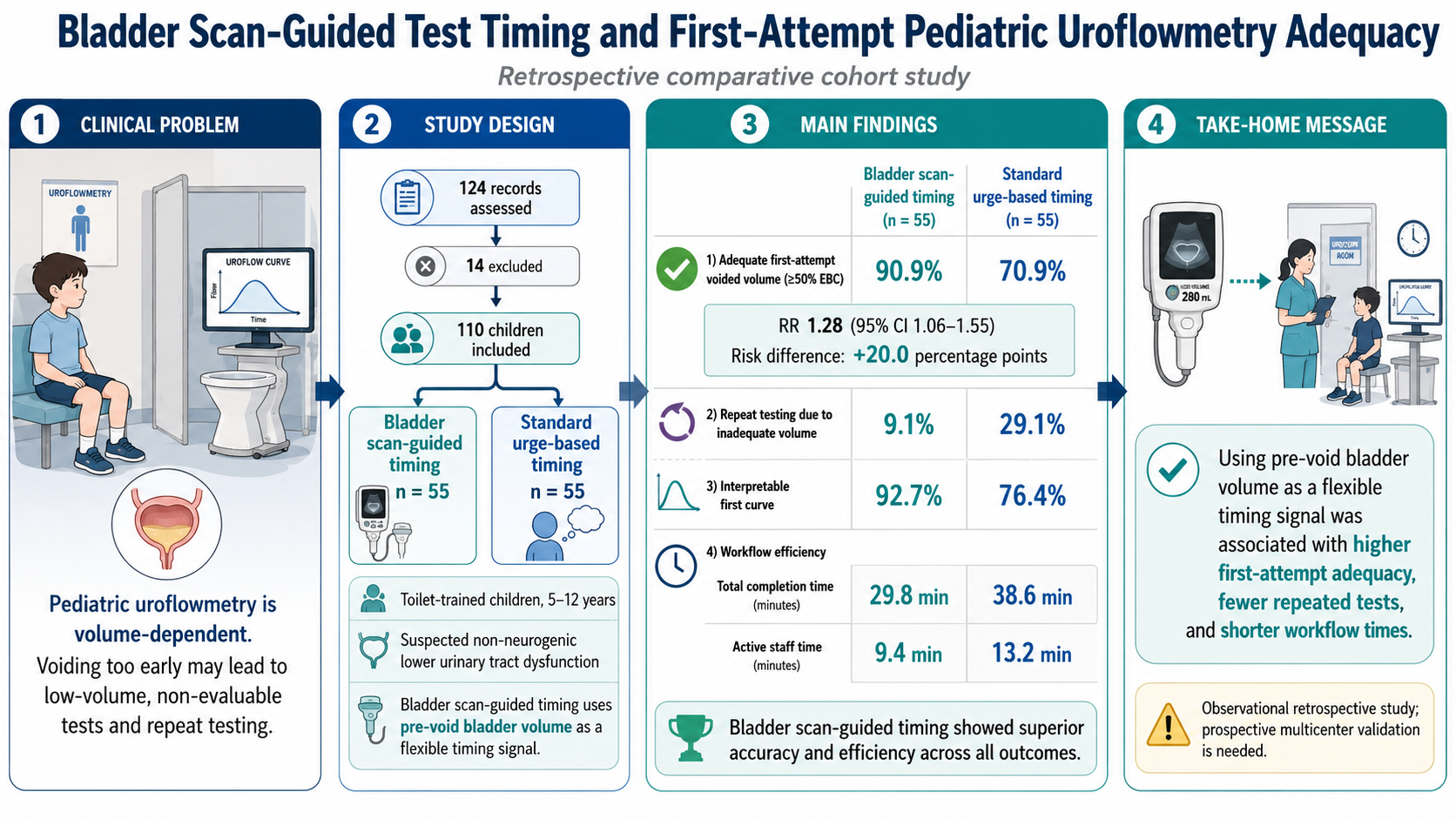
Introduction: Pediatric uroflowmetry is volume dependent, and low-volume voids can yield recordings that require repetition or cannot be interpreted confidently. Objective: To evaluate the association between documented bladder scan-guided test timing and first-attempt uroflowmetry adequacy in children. Study design: This single-center retrospective workflow cohort included 110 toilet-trained children aged 5-12 years who underwent uroflowmetry for suspected non-neurogenic lower urinary tract dysfunction. The exposure was defined from contemporaneous pre-test documentation as bladder scan-guided timing (n=55) or standard urge-based timing (n=55). Expected bladder capacity (EBC) was calculated as (age + 1) × 30 mL. The primary outcome was first-attempt voided volume ≥50% EBC. Key secondary outcomes were repetition because of inadequate volume and workflow time. Analyses were observational and effect estimates were interpreted as associations. Results: Adequate first-attempt voided volume was documented in 50/55 children (90.9%) in the scan-guided cohort and 39/55 (70.9%) in the standard cohort (unadjusted risk ratio 1.28, 95% confidence interval [CI] 1.06-1.55; risk difference 20.0 percentage points, 95% CI 5.8-34.2). Repetition because of inadequate volume, the direct workflow consequence of primary-outcome failure, occurred in 9.1% versus 29.1%. Scan-guided timing was also associated with a higher voided volume/EBC ratio (mean difference 15.1 percentage points, 95% CI 7.2-23.0), shorter total completion time (-8.8 min, 95% CI -14.9 to -2.7), and shorter documented active staff time (-3.8 min, 95% CI -5.6 to -2.0). Discussion: Objective bladder-volume information was associated with greater first-attempt volume adequacy and shorter workflow times. However, the retrospective exposure definition, uncertain workflow-selection mechanism, unadjusted primary analysis, and reliance on routine documentation prevent causal interpretation. Conclusion: Documented bladder scan-guided timing was associated with greater first-attempt pediatric uroflowmetry adequacy than standard urge-based preparation. The findings should be considered hypothesis-generating pending adjusted patient-level analyses and prospective validation.
Keywords:
bladder capacity
; bladder scan
; child
; lower urinary tract dysfunction
; uroflowmetry
; voided volume
Copyright: This open access article is published under a Creative Commons CC BY 4.0 license, which permit the free download, distribution, and reuse, provided that the author and preprint are cited in any reuse.


