

Submitted:
29 July 2026
Posted:
30 July 2026
You are already at the latest version
Abstract
Chronic kidney disease (CKD) is sustained by a network of sterile inflammation, oxidative and metabolic stress, uremic toxin retention, gut barrier dysfunction, and maladaptive immune activation. These processes contribute to tubulointerstitial fibrosis and loss of kidney function, endothelial dysfunction, vascular calcification, wasting, and excess cardiovascular mortality. Yet inflammation in CKD is biologically heterogeneous, and association does not establish that suppressing a biomarker will improve outcomes. This narrative review critically appraises mechanistic and therapeutic evidence through an explicit translational hierarchy. Renin-angiotensin system inhibitors, sodium-glucose cotransporter-2 inhibitors, finerenone, and glucagon-like peptide-1 receptor agonists improve cardiorenal outcomes and have plausible anti-inflammatory actions, although inflammation has not been established as the principal mediator of benefit. Interleukin-1 and interleukin-6 inhibition provide human proof of target engagement; the biomarker reductions achieved with ziltivekimab and clazakizumab have moved the field into cardiovascular outcome testing. By contrast, NLRP3 inflammasome inhibitors, senescence-directed approaches, and microbiota-based interventions remain predominantly preclinical or supported by small heterogeneous trials. We propose that future progress requires inflammatory endotyping, repeated biomarker assessment, mechanistically aligned outcomes, and rigorous infection surveillance. Targeting inflammation may become a clinically relevant component of CKD care, but only if pathway suppression delivers benefits beyond contemporary standard therapy.
Keywords:
chronic kidney disease
; inflammation
; innate immunity
; NLRP3 inflammasome
; interleukin-6
; cardiovascular risk
; SGLT2 inhibitors
; precision medicine
1. Introduction
Chronic kidney disease (CKD) has become a defining non-communicable disease of the twenty-first century. The Global Burden of Disease 2023 analysis estimated that 788 million adults were living with CKD in 2023, corresponding to an age-standardized prevalence of 14.2%. CKD was the ninth leading cause of death worldwide, directly accounting for 1.48 million deaths, while impaired kidney function contributed to an estimated 11.5% of cardiovascular deaths [1]. Despite this burden, CKD is still frequently conceptualized as progressive nephron loss driven primarily by hemodynamic and metabolic injury. Contemporary evidence supports a broader view: CKD is also a systemic inflammatory disorder in which kidney injury, maladaptive immunity, vascular pathology, and impaired host defense coexist and reinforce one another [2,3,4,5,6,7,8].
This reframing is clinically relevant. Renin-angiotensin system (RAS) blockade, sodium-glucose cotransporter-2 (SGLT2) inhibitors, nonsteroidal mineralocorticoid receptor antagonism, and glucagon-like peptide-1 receptor agonists (GLP-1RAs) have substantially improved cardiorenal outcomes. Nevertheless, residual risks of kidney failure, heart failure, atherosclerotic events, infection, and death remain high, particularly in advanced CKD and dialysis [2,3,4,5,6,7,8]. Inflammation is an attractive candidate contributor to this residual risk because it is biologically connected to fibrosis, endothelial dysfunction, atherothrombosis, calcification, anemia, protein-energy wasting, and immune dysfunction.
The therapeutic inference is not straightforward. Elevated high-sensitivity C-reactive protein (hsCRP), interleukin (IL)-6, soluble tumor necrosis factor receptors, or other inflammatory markers may identify patients at high risk without proving that the measured pathway is causal or safely modifiable. Conversely, drugs that improve CKD outcomes may lower inflammation as a downstream consequence rather than through the mechanism responsible for benefit. A clinically useful review must therefore distinguish association from causality, biomarker reduction from disease modification, and preclinical promise from outcome-proven therapy.
The aim of this narrative review is to integrate the inflammatory biology of CKD with the current therapeutic landscape while preserving this evidentiary distinction. We first describe the principal upstream drivers and signaling hubs, then examine how they contribute to renal and cardiovascular complications. We subsequently evaluate established and emerging interventions according to translational maturity and conclude with a precision-medicine framework for clinical trials and future implementation.
2. Review Scope and Evidence Framework
A targeted narrative search of PubMed/MEDLINE and ClinicalTrials.gov was performed for English-language literature available through July 2026. Search concepts combined “chronic kidney disease” or “dialysis” with “inflammation”, “innate immunity”, “NLRP3”, “interleukin-1”, “interleukin-6”, “oxidative stress”, “uremic toxins”, “gut microbiota”, “SGLT2 inhibitor”, “finerenone”, “GLP-1 receptor agonist”, “JAK inhibitor”, “CCR2 inhibitor”, “pentoxifylline”, “colchicine”, and “clinical trial”. Priority was given to clinical practice guidelines, landmark randomized outcome trials, randomized studies demonstrating human target engagement, systematic reviews, and recent high-quality mechanistic reviews. Preclinical studies were included when human efficacy data were absent.
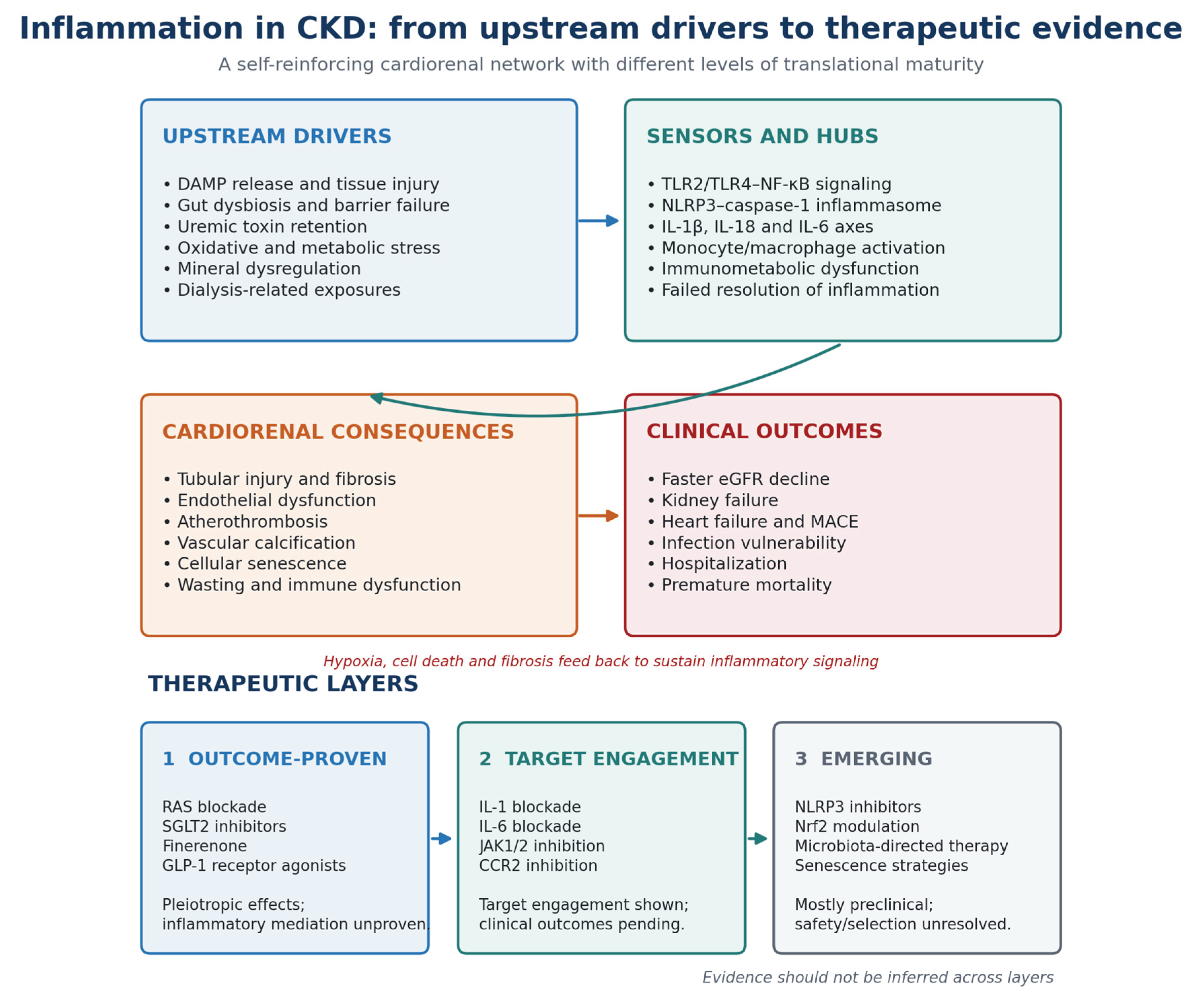
Therapeutic evidence was interpreted across three layers (Figure 1). Layer 1 comprises drugs with demonstrated cardiorenal outcome benefit but without proof that inflammation is the dominant mediator. Layer 2 comprises agents with human evidence of pathway engagement, biomarker reduction, or surrogate kidney effects, but without definitive CKD outcome data. Layer 3 comprises strategies supported mainly by animal studies, early-phase programs, or small heterogeneous clinical trials. This hierarchy avoids two common errors: labelling all outcome-proven cardiorenal therapies as anti-inflammatory treatments, and presenting biomarker suppression as equivalent to clinical benefit.
3. The Inflammatory Architecture of CKD
3.1. Sterile Danger Sensing and Innate Immune Activation
Innate immunity is a principal interface between kidney injury and chronic inflammation. Pattern-recognition receptors identify pathogen-associated molecular patterns during infection and damage-associated molecular patterns (DAMPs) released by stressed or dying cells. In CKD, tubular epithelial cells, podocytes, endothelial cells, fibroblasts, resident macrophages, and circulating myeloid cells are repeatedly exposed to endogenous ligands such as high-mobility group box 1, extracellular ATP, mitochondrial DNA, heat-shock proteins, urate, calprotectin, and extracellular matrix fragments [3,4,9,10].
Toll-like receptors (TLRs), particularly TLR2 and TLR4, activate MyD88-dependent and alternative signaling pathways that converge on NF-κB and interferon-regulatory programs. The resulting transcriptional response increases tumor necrosis factor (TNF), IL-6, IL-1 family cytokines, chemokines, adhesion molecules, and profibrotic mediators. This response is initially protective, but persistent danger signaling prevents normal inflammatory resolution. Monocyte recruitment, macrophage polarization, tubular injury, and fibroblast activation then become components of a self-reinforcing tissue circuit rather than a transient response to damage [3,4,9,10].
3.2. The NLRP3 Inflammasome as an Integrative Hub
The NLRP3 inflammasome integrates structurally diverse signals that are abundant in CKD, including mitochondrial reactive oxygen species, potassium efflux, lysosomal injury, cholesterol and calcium-phosphate crystals, hyperglycemia, lipotoxicity, ischemia, and uremic toxins [11,12,13]. Canonical activation is commonly described as a two-step process. Priming increases transcription of NLRP3 and pro-IL-1β, often through NF-κB; a second signal promotes assembly of NLRP3 with the adaptor ASC and pro-caspase-1. Activated caspase-1 cleaves pro-IL-1β and pro-IL-18 and promotes gasdermin D-mediated pyroptosis [11,12,13].
This pathway is relevant across diabetic kidney disease, crystal nephropathies, immune-mediated glomerular injury, obstructive nephropathy, and tubulointerstitial fibrosis. NLRP3 may also exert inflammasome-independent effects on tubular apoptosis, mitochondrial function, and fibrotic remodeling [11,12]. However, the strength of evidence differs by context: genetic and pharmacological inhibition is consistently protective in experimental models, whereas human CKD data largely document pathway activation rather than clinical efficacy of direct inhibition. NLRP3 is therefore a biologically compelling target, but it remains in an early translational layer.
3.3. Cytokine Networks: IL-1, IL-18, and IL-6
IL-1β amplifies local leukocyte recruitment, endothelial activation, and profibrotic signaling, whereas IL-1α can function as an alarmin released from necrotic cells [14]. IL-18, produced by tubular and immune cells after inflammasome activation, has been implicated in hypertension, maladaptive repair, fibrosis, and cardiovascular injury [15]. These cytokines are interconnected rather than isolated: IL-1 promotes downstream IL-6 production, and both influence hepatic acute-phase responses and vascular inflammation.
IL-6 has particular translational importance because it connects renal injury with systemic consequences. Classical signaling through membrane-bound IL-6 receptor participates in host defense and regenerative responses, whereas trans-signaling through soluble IL-6 receptor can broaden pro-inflammatory effects across endothelial and other gp130-expressing cells [16]. In observational CKD cohorts, higher circulating IL-6 is consistently associated with cardiovascular events, CKD progression, and mortality [16,17]. In dialysis populations, systematic reviews likewise support an association between systemic IL-6 and all-cause and cardiovascular mortality, although between-study heterogeneity and non-standardized reporting limit precise risk estimation [66]. The central uncertainty is no longer whether IL-6 marks risk, but whether sufficiently selective and safe inhibition can modify that risk.
3.4. Immune Dysregulation Is More Than Immune Activation
CKD produces the paradoxical combination of chronic inflammation and impaired antimicrobial immunity. Pro-inflammatory intermediate monocytes expand, endothelial adhesion increases, and monocyte/macrophage responses become metabolically reprogrammed [24]. At the same time, uremia is associated with dendritic-cell dysfunction, lymphocyte exhaustion, impaired vaccine responses, and susceptibility to infection. This coexistence is critical for treatment: indiscriminate immunosuppression may reduce inflammatory markers while worsening the outcome that patients with advanced CKD are already predisposed to experience.
Adaptive immunity also participates in CKD progression. Imbalances among effector T-cell subsets, regulatory T cells, B-cell signaling, and tissue-resident immune populations vary according to the primary kidney disease and stage. Such heterogeneity argues against a universal “inflammatory CKD” phenotype. A patient with active immune-complex glomerulonephritis, a patient with diabetic CKD and elevated hsCRP, and a patient receiving dialysis through an infected catheter may all have inflammation, but the dominant mechanisms and appropriate interventions are fundamentally different.
3.5. Oxidative Stress, Mitochondrial Injury, and Defective Resolution
Oxidative stress and inflammation form a reciprocal circuit. Mitochondrial dysfunction, NADPH oxidases, uncoupled nitric oxide synthase, and activated immune cells increase reactive oxygen species, while antioxidant defenses governed partly by nuclear factor erythroid 2-related factor 2 (Nrf2) are impaired [18,19]. Reactive oxygen species activate NF-κB, facilitate NLRP3 assembly, oxidize lipids and proteins, and injure podocytes, tubular cells, and endothelium. Inflammatory cytokines, in turn, impair mitochondrial function and increase pro-oxidant enzyme activity.
This circuit helps explain why oxidative stress is detectable before kidney failure and why it persists despite conventional dialysis. It also illustrates a translational hazard. Restoring a cytoprotective pathway can improve a laboratory measure or even alter creatinine-based eGFR without necessarily improving structural kidney outcomes. Therapeutic manipulation of Nrf2 therefore requires evaluation of fluid balance, blood pressure, albuminuria, cardiovascular safety, and measured kidney function rather than reliance on eGFR alone.
3.6. Uremic Toxins and the Gut-Kidney Axis
Protein-bound uremic toxins such as indoxyl sulfate, p-cresyl sulfate, and indole-3-acetic acid accumulate as kidney function declines and are incompletely removed by conventional dialysis [20,21,22]. These compounds activate aryl hydrocarbon receptor and NF-κB signaling, increase oxidative stress, disrupt endothelial function, and modify immune-cell behavior. They should therefore be regarded as biologically active mediators, not merely filtration markers [20,21,22].
The gut is an upstream source of several of these solutes. CKD-associated dysbiosis includes expansion of proteolytic metabolic pathways, reduced generation of beneficial short-chain fatty acids, and altered bile-acid and tryptophan metabolism. Urea and other retained solutes disrupt epithelial tight junctions, facilitating translocation of microbial products and low-grade endotoxemia [20,21,22,23]. Experimental transfer studies support a causal contribution of dysbiotic microbiota to inflammation and fibrosis, but clinical translation remains incomplete. Diet, medications, geographic variation, residual kidney function, and dialysis modality all shape the microbiome, making a single “CKD microbiota signature” unlikely.
3.7. Dialysis-Related Amplification
Inflammation becomes particularly complex in kidney failure. Recurrent blood-membrane interaction, endotoxin exposure, vascular access infection, periodontal and other occult infection, extracellular volume excess, intravenous iron, bioincompatibility, and loss of residual kidney function may all contribute. In peritoneal dialysis, local peritoneal and systemic inflammatory processes may be partly dissociated. In hemodialysis, intradialytic complement and leukocyte activation can coexist with chronic systemic cytokine elevation.
The dialysis setting also exposes the central therapeutic trade-off most clearly. Patients with persistent hsCRP or IL-6 elevation have high cardiovascular risk, yet they also have high rates of bacteremia, hospitalization, impaired vaccine response, and frailty. Direct cytokine inhibition in this population must therefore demonstrate not only target engagement but also a favorable net clinical benefit.
4. From Renal Inflammation to Systemic Disease
4.1. Maladaptive Repair and Fibrosis
Inflammation promotes CKD progression when a regenerative response fails to resolve. Recurrent tubular injury activates macrophages, pericytes, fibroblasts, and endothelial cells; cytokines and DAMPs then sustain transforming growth factor-β, chemokine, and extracellular matrix programs. Hypoxia caused by capillary rarefaction and increasing diffusion distance further injures tubular cells, while matrix stiffness and cellular senescence reinforce inflammatory and profibrotic signaling. The relevant therapeutic target may therefore change over time: suppressing an initiating immune pathway in early disease may not reverse established scar in advanced CKD.
This temporal dimension is frequently underappreciated in trials. Albuminuria can respond rapidly to hemodynamic or anti-inflammatory intervention, whereas meaningful separation in eGFR slopes or kidney-failure events may require longer follow-up. Conversely, a short-term eGFR increase may reflect altered creatinine handling or glomerular dynamics rather than nephron preservation. Mechanistic trials should therefore align the biomarker, disease stage, and duration with the biological process being targeted.
4.2. Endothelial Dysfunction and Atherothrombosis
CKD-related cardiovascular risk is not fully captured by LDL cholesterol or conventional risk scores. Activated monocytes adhere more readily to endothelium, inflammatory cytokines impair nitric oxide bioavailability, and oxidative modifications render lipoproteins dysfunctional [3,4,5,6,24,25]. Carbamylated and oxidized lipoproteins promote foam-cell formation and vascular inflammation even when measured LDL cholesterol is not markedly elevated. IL-6-driven acute-phase signaling also increases fibrinogen, serum amyloid A, secretory phospholipase A2, and prothrombotic activity.
These mechanisms provide the rationale for cytokine-directed cardiovascular outcome trials in CKD. Importantly, such trials primarily test whether inflammation contributes causally to atherosclerotic and heart-failure outcomes in a CKD-enriched population; they do not automatically establish a direct effect on intrinsic kidney disease.
4.3. Vascular Calcification and Premature Aging
Vascular calcification in CKD is an active cell-mediated process. Hyperphosphatemia, oxidative stress, inflammatory cytokines, and uremic toxins promote osteogenic transdifferentiation of vascular smooth-muscle cells, extracellular-vesicle release, and loss of endogenous calcification inhibitors [26,27,28]. IL-1β, IL-6, and TNF interact with reactive oxygen species and mineral stress to accelerate this transition. Medial calcification, arterial stiffness, left ventricular afterload, and microvascular dysfunction then amplify cardiovascular risk.
CKD also resembles accelerated biological aging. Mitochondrial dysfunction, phosphate toxicity, Klotho deficiency, DNA damage, and chronic inflammation induce cellular senescence in endothelium, vascular smooth-muscle cells, podocytes, and tubular cells [29,30]. Senescent cells adopt a senescence-associated secretory phenotype rich in IL-6, chemokines, proteases, and profibrotic mediators. Senescence is therefore both a consequence and an amplifier of CKD inflammation, although senolytic and senomorphic strategies remain experimental.
4.4. Anemia, Wasting, Frailty, and Infection Vulnerability
Inflammation impairs iron mobilization through hepcidin, blunts erythropoietin responsiveness, promotes muscle catabolism, suppresses appetite, and lowers hepatic albumin synthesis. These processes link systemic inflammation to anemia, protein-energy wasting, and frailty. The resulting phenotype is prognostically adverse but difficult to dissect because comorbidity, occult infection, volume overload, and inadequate nutrition may produce similar biomarker patterns.
Inflammatory activation must also be interpreted alongside immune dysfunction. A fall in hsCRP after targeted therapy may be biologically desirable, but the clinically relevant result is the balance among cardiovascular events, kidney outcomes, serious infection, cytopenia, wound healing, and patient-reported function. This multidimensional endpoint framework is especially important in dialysis.
5. Therapeutic Strategies Across the Translational Continuum
5.1. Outcome-Proven Therapies with Pleiotropic Anti-Inflammatory Actions
5.1.1. RAS Blockade
Angiotensin II promotes oxidative stress, NF-κB activation, endothelial dysfunction, and leukocyte recruitment. ACE inhibitors and angiotensin receptor blockers can reduce inflammatory markers in addition to lowering intraglomerular pressure and albuminuria [31]. Their established clinical role, however, derives from kidney and cardiovascular outcome evidence, not from demonstration that cytokine suppression mediates benefit. This distinction provides a useful model for interpreting other pleiotropic therapies.
5.1.2. SGLT2 Inhibitors
SGLT2 inhibitors have transformed CKD care across diabetic and non-diabetic etiologies. In DAPA-CKD, dapagliflozin reduced the primary composite of sustained eGFR decline of at least 50%, kidney failure, or renal/cardiovascular death by 39% (hazard ratio [HR] 0.61, 95% confidence interval [CI] 0.51-0.72) [32]. In EMPA-KIDNEY, empagliflozin reduced kidney disease progression or cardiovascular death by 28% (HR 0.72, 95% CI 0.64-0.82) across a broader CKD population [33].
Mechanistically, SGLT2 inhibition reduces tubular workload, intraglomerular pressure, hypoxia, oxidative stress, and inflammatory signaling. Experimental studies suggest suppression of macrophage activation and NLRP3 signaling, including immunometabolic pathways involving tubular itaconate [34,35]. These observations strengthen biological plausibility but do not establish inflammatory mediation of the clinical benefit. Hemodynamic, metabolic, erythropoietic, and heart-failure effects operate concurrently.
5.1.3. Finerenone
Mineralocorticoid receptor overactivation promotes sodium retention, endothelial dysfunction, macrophage recruitment, oxidative stress, and fibrosis. In FIDELIO-DKD, finerenone reduced the primary kidney composite in patients with type 2 diabetes and CKD (HR 0.82, 95% CI 0.73-0.93) [36]. The prespecified FIDELITY pooled analysis confirmed reductions in the cardiovascular composite (HR 0.86, 95% CI 0.78-0.95) and kidney composite (HR 0.77, 95% CI 0.67-0.88) [37]. Translational data support anti-inflammatory and antifibrotic actions [38], but, as with SGLT2 inhibitors, the trials were not designed to prove that inflammation was the causal mediator.
Combination therapy is clinically attractive because RAS blockade, SGLT2 inhibition, and finerenone act on complementary pathways. Available analyses suggest preserved finerenone benefit with background SGLT2 inhibitor use, but the number of participants receiving both agents in the original trials was limited [64]. Future mechanistic studies should determine whether combination therapy reduces residual inflammatory risk or primarily delivers additive hemodynamic and antifibrotic effects.
5.1.4. GLP-1 Receptor Agonists
GLP-1RAs influence weight, glycemia, endothelial biology, macrophage phenotype, and inflammatory signaling. Experimental studies report attenuation of receptor for advanced glycation end-products and TLR4/MyD88/NF-κB pathways and modulation of adaptive immune activation [40,41,65]. The FLOW trial moved the class firmly into kidney outcome therapy: semaglutide reduced major kidney disease events by 24% (HR 0.76, 95% CI 0.66-0.88), cardiovascular death by 29%, and all-cause death by 20% in participants with type 2 diabetes and CKD [39].
The anti-inflammatory contribution to these outcomes remains uncertain because weight loss, glycemic improvement, blood pressure, natriuresis, and direct vascular effects are intertwined. GLP-1RAs should therefore be described as outcome-proven cardiorenal-metabolic drugs with anti-inflammatory actions, not as targeted anti-inflammatory agents.
5.2. IL-1 Pathway Inhibition: Proof of Principle Without CKD Outcome Confirmation
Canakinumab provided cardiovascular proof that selective anti-inflammatory therapy can reduce atherosclerotic events independently of lipid lowering. In the CANTOS CKD subgroup, participants with eGFR 30-60 mL/min/1.73 m² experienced an 18% reduction in major adverse cardiovascular events (HR 0.82, 95% CI 0.68-1.00), with greater benefit among those achieving on-treatment hsCRP below 2 mg/L [42]. Canakinumab did not improve eGFR, and fatal infection was an important class-related safety concern in the parent trial.
In maintenance hemodialysis, an early pilot study of anakinra showed substantial reductions in hsCRP and IL-6 [43]. The subsequent ACTION pilot randomized 80 patients with hsCRP at least 2 mg/L to anakinra or placebo for 24 weeks. Anakinra was feasible and reduced IL-6, but the primary hsCRP endpoint was neutral and the study was not powered for cardiovascular events or mortality [44]. Collectively, these data establish biological activity and trial feasibility, but not routine clinical utility in CKD.
5.3. IL-6 Inhibition: The Leading Targeted Strategy
IL-6 inhibition has generated the strongest human target-engagement signal. In the phase 2 RESCUE trial, 264 patients with CKD, established atherosclerotic cardiovascular disease, and hsCRP at least 2 mg/L received ziltivekimab or placebo. Median hsCRP fell by 77%, 88%, and 92% at 12 weeks with 7.5, 15, and 30 mg, respectively, compared with 4% on placebo; fibrinogen, serum amyloid A, secretory phospholipase A2, haptoglobin, and lipoprotein(a) also declined [45]. RESCUE-2 confirmed biomarker efficacy in a Japanese population [46].
These findings led to ZEUS, an event-driven cardiovascular outcome trial that randomized 6376 participants with atherosclerotic cardiovascular disease, CKD, and hsCRP at least 2 mg/L to monthly ziltivekimab 15 mg or placebo. Mean baseline eGFR was 44.5 mL/min/1.73 m², median hsCRP was 4.5 mg/L, and the primary outcome is three-point MACE; a secondary kidney composite includes sustained kidney-function decline, kidney failure, and cardiovascular or kidney death [47]. As of July 2026, ZEUS was active but no clinical outcome results had been reported.
Clazakizumab extends the IL-6 strategy to maintenance dialysis. In the phase 2b component of POSIBIL6ESKD, participants with cardiovascular disease and/or diabetes, dialysis dependence, and hsCRP at least 2 mg/L were randomized to clazakizumab 2.5, 5, or 10 mg or placebo every four weeks. Each active group included 32 participants and placebo included 31. At week 12, hsCRP fell by approximately 86-92%, and 79-82% of treated participants achieved hsCRP below 2 mg/L compared with none receiving placebo [48]. Secondary analyses suggested favorable effects on anemia and iron parameters and a reduction in neutrophil-to-lymphocyte ratio, further supporting pathway engagement [49,50].
Serious infections were numerically more frequent at the highest clazakizumab dose, emphasizing the need for dose selection and surveillance. The ongoing phase 2b/3 POSIBIL6ESKD program is designed to determine whether clazakizumab reduces cardiovascular events and death in approximately 2190 dialysis patients with systemic inflammation [51]. Until ZEUS and POSIBIL6ESKD report clinical outcomes, IL-6 inhibition should be considered the most advanced targeted strategy, not an established CKD treatment.
5.4. Chemokine and JAK-STAT Inhibition
Human studies targeting inflammatory cell recruitment or downstream cytokine signaling have produced surrogate signals but have not progressed to outcome-proven CKD therapy. In a phase 2 trial in diabetic kidney disease, the JAK1/JAK2 inhibitor baricitinib reduced albuminuria, but safety concerns intrinsic to systemic JAK inhibition—including infection, cytopenia, and thrombosis—are particularly relevant in CKD [52]. The selective CCR2 antagonist CCX140-B reduced albuminuria by approximately 18% compared with 2% on placebo in type 2 diabetes and nephropathy, supporting the contribution of CCL2-mediated monocyte recruitment [53]. Neither program established an effect on kidney failure or cardiovascular outcomes.
These studies remain informative because they show that pathway-specific inflammation can modify a renal surrogate. They also illustrate why albuminuria reduction must not be treated as sufficient proof for immunomodulatory therapy: durability, off-target immune effects, and net clinical benefit require longer and larger trials.
5.5. NLRP3 Inhibition and Nrf2 Modulation
Direct NLRP3 inhibition is attractive because it lies upstream of IL-1β and IL-18 and integrates metabolic, crystal, mitochondrial, and uremic danger signals. MCC950 and CY-09 reduce inflammation, tubular injury, and fibrosis in experimental CKD models [13,54,55]. However, no direct NLRP3 inhibitor has demonstrated kidney or cardiovascular outcome benefit in a CKD population. Human programs with agents such as dapansutrile in other inflammatory and metabolic conditions may inform safety and pharmacology, but extrapolation to CKD is premature.
Nrf2 activation illustrates the difference between pathway rationale and clinical success. Bardoxolone methyl increased eGFR in earlier studies, yet the BEACON trial in stage 4 diabetic CKD was terminated because heart-failure hospitalization or death from heart failure was increased (HR 1.83, 95% CI 1.32-2.55), without reduction in kidney failure or cardiovascular death [56]. The mechanism likely involved acute sodium and volume retention in susceptible patients. The lesson is broader than one drug: therapies that alter filtration markers or antioxidant pathways require rigorous cardiovascular and volume-safety assessment.
5.6. Pentoxifylline, Colchicine, and Accessible Repurposing
Pentoxifylline inhibits phosphodiesterase activity and can reduce TNF-related signaling. In PREDIAN, adding pentoxifylline to RAS blockade in diabetic CKD slowed two-year eGFR decline and reduced albuminuria and urinary TNF [57]. Meta-analyses suggest favorable effects on inflammatory markers, albuminuria, and eGFR, but the evidence is limited by small samples, older background therapy, heterogeneity, and absence of definitive kidney-failure outcomes [58]. Pentoxifylline may be an accessible adjunct in selected settings, but it is not a substitute for contemporary standard therapy.
Low-dose colchicine reduces ischemic events in chronic coronary disease [59], but CKD-specific inference is limited. Colchicine has a narrow therapeutic window, interacts with CYP3A4 and P-glycoprotein inhibitors, and accumulates as kidney function declines. Current cardiovascular guidance recommends dose adjustment or avoidance in severe CKD depending on indication and concomitant therapy [60]. In the absence of a dedicated CKD outcome trial, routine colchicine prescription solely to reduce “residual inflammatory risk” in CKD is not justified.
5.7. Microbiota-Directed Interventions
Prebiotics, probiotics, synbiotics, resistant starch, and dietary strategies seek to reduce microbial generation of uremic toxins, restore short-chain fatty-acid production, and improve gut barrier integrity [61,62,63]. Meta-analysis of small randomized trials suggests reductions in CRP and oxidative-stress markers, but interventions, doses, CKD stages, diets, and outcome definitions are highly heterogeneous [62]. Effects on indoxyl sulfate and p-cresyl sulfate are inconsistent, and convincing evidence for slower CKD progression or fewer cardiovascular events is absent.
The microbiome remains an important upstream target, but future studies require standardized interventions, detailed dietary and medication phenotyping, metabolomic confirmation of target engagement, and clinically meaningful outcomes. Precision may be especially important because baseline microbiota composition and residual kidney function strongly influence response.
5.8. Comparative Therapeutic Evidence

Table 1.
Anti-inflammatory therapeutic strategies in CKD according to translational maturity.
| Strategy | Principal inflammatory leverage | Highest level of CKD-relevant evidence | Main limitation | Current interpretation |
|---|---|---|---|---|
| RAS inhibitors | Angiotensin II-driven oxidative and inflammatory signaling | Outcome-proven renoprotection; supportive biomarker effects [2,31] | Inflammation is not an established mediator | Foundational therapy |
| SGLT2 inhibitors | Tubular immunometabolism, oxidative stress, macrophage and NLRP3 signaling | Large kidney outcome trials across diabetic and non-diabetic CKD [32,33,34,35] | Mechanistic effects are pleiotropic | Cornerstone cardiorenal therapy |
| Finerenone | Mineralocorticoid receptor-driven inflammation and fibrosis | Kidney and cardiovascular outcome benefit in type 2 diabetes with CKD [36,37,38] | Hyperkalemia; evidence strongest in diabetic CKD | Outcome-proven add-on |
| GLP-1RAs | Metabolic, endothelial, macrophage, and NF-κB modulation | FLOW kidney and cardiovascular outcome benefit [39,40,41] | Evidence concentrated in type 2 diabetes | Outcome-proven cardiorenal-metabolic therapy |
| IL-1 blockade | IL-1-dependent cytokine amplification | CANTOS CKD subgroup; dialysis pilot trials [42,43,44] | No definitive CKD outcome trial; infection risk | Proof of principle |
| IL-6 blockade | Acute-phase, endothelial, thrombotic, and anemia pathways | Profound biomarker lowering; phase 3 outcome trials ongoing [45,46,47,48,49,50,51] | Clinical benefit and long-term safety unproven | Most advanced targeted strategy |
| JAK1/2 or CCR2 inhibition | Cytokine signal transduction or monocyte recruitment | Phase 2 albuminuria reduction [52,53] | Surrogate outcomes; systemic immune toxicity | Developmental evidence |
| NLRP3 inhibition | Upstream inflammasome activation | Consistent experimental renoprotection [13,54,55] | No CKD outcome evidence in humans | Preclinical/early translational |
| Nrf2 activation | Antioxidant and cytoprotective transcription | Human efficacy signal offset by cardiovascular harm in BEACON [56] | Fluid retention and cardiovascular safety | Cautionary precedent |
| Pentoxifylline | TNF-related and hemorheologic effects | Small trials and heterogeneous meta-analyses [57,58] | Older background therapy; no hard outcomes | Optional/adjunctive |
| Colchicine | Microtubule-dependent innate immune and inflammasome effects | Cardiovascular benefit outside CKD-specific trials [59,60] | Accumulation, interactions, neuromyotoxicity | Not established for CKD inflammation |
| Microbiota-directed therapy | Toxin generation and gut barrier dysfunction | Small heterogeneous biomarker trials [61,62,63] | No consistent kidney or cardiovascular outcomes | Investigational adjunct |
Table 2.
Selected human studies of targeted inflammatory therapy relevant to CKD.
| Agent/pathway | Study and population | Principal finding | What the study establishes | What remains unknown |
|---|---|---|---|---|
| Canakinumab/IL-1β | CANTOS CKD subgroup; prior myocardial infarction, eGFR 30-60 mL/min/1.73 m² | MACE HR 0.82; greater benefit in hsCRP responders [42] | Cardiovascular proof of inflammatory causality in CKD-adjacent disease | Kidney benefit; net benefit in broader CKD |
| Anakinra/IL-1 receptor | ACTION; 80 hemodialysis patients with hsCRP ≥2 mg/L | Feasible; IL-6 reduced; primary hsCRP endpoint neutral [44] | Dialysis feasibility and biological activity | Cardiovascular or mortality benefit |
| Ziltivekimab/IL-6 ligand | RESCUE; 264 patients with CKD, ASCVD, and inflammation | Dose-dependent hsCRP reduction of 77-92% with broad biomarker effects [45] | Robust human target engagement | Clinical outcomes |
| Ziltivekimab/IL-6 ligand | ZEUS; 6376 patients with ASCVD, CKD, and hsCRP ≥2 mg/L | Testing monthly 15 mg versus placebo [47] | Outcome-trial framework with biomarker enrichment | MACE, kidney outcomes, long-term safety |
| Clazakizumab/IL-6 ligand | POSIBIL6ESKD phase 2b; 127 dialysis patients | hsCRP reduction of approximately 86-92%; anemia and NLR signals [48,49,50] | Potent target engagement in dialysis | Cardiovascular benefit and infection trade-off |
| Clazakizumab/IL-6 ligand | POSIBIL6ESKD phase 3; inflammatory ESKD on dialysis | Cardiovascular outcome trial in progress [51] | Direct test in the highest-risk population | Net clinical benefit |
| Baricitinib/JAK1/2 | Phase 2 diabetic kidney disease trial | Albuminuria reduction [52] | Surrogate kidney effect | Hard outcomes and CKD-specific safety |
| CCX140-B/CCR2 | Phase 2 type 2 diabetes with nephropathy | Albuminuria reduced by approximately 18% versus 2% with placebo [53] | Role of monocyte recruitment in a human surrogate | Kidney failure and cardiovascular outcomes |
6. Toward Precision Anti-Inflammatory Nephrology
6.1. Inflammation Is an Endotype, Not a Diagnosis
The key therapeutic challenge is not finding a drug that lowers CRP; it is identifying patients in whom a specific inflammatory pathway is causal, active, and safely modifiable. CKD stage and albuminuria do not provide this information. Inflammatory endotyping should incorporate etiology, comorbidity, infection status, dialysis modality, vascular access, body composition, medication exposure, and longitudinal biomarkers.
At least three broad phenotypes can be distinguished conceptually. A tissue-dominant phenotype includes active immune or inflammatory kidney disease in which intrarenal pathways drive damage. A systemic metabolic-vascular phenotype includes diabetic or atherosclerotic CKD with persistent hsCRP/IL-6 elevation despite optimized standard therapy. A dialysis-amplified phenotype includes kidney failure with recurrent extracorporeal exposure, vascular access-related signals, wasting, and marked cardiovascular risk. These phenotypes may overlap, but they should not be assumed to respond identically.
6.2. Biomarkers for Enrichment and Response
hsCRP is inexpensive, standardized, and already used for enrichment in RESCUE, ZEUS, ACTION, and POSIBIL6ESKD. It is nevertheless downstream, nonspecific, and influenced by infection, obesity, access complications, and intercurrent illness. IL-6 is mechanistically closer to several relevant pathways and strongly prognostic, but assays and thresholds are less standardized [16,17,66]. Neutrophil-to-lymphocyte ratio is accessible and may reflect systemic inflammatory balance, but it is similarly nonspecific; the 2026 clazakizumab analysis supports pharmacodynamic responsiveness rather than validated predictive utility [50].
Urinary biomarkers may better reflect intrarenal activity. CCL2/MCP-1, TNF receptors, tubular injury markers, and urinary cytokines are plausible candidates, but few have been prospectively validated to select treatment. Gut-derived metabolites can characterize an upstream uremic-toxin phenotype, while multi-omics, immune-cell phenotyping, and single-cell tissue analysis may eventually identify pathway-specific signatures. For clinical implementation, a biomarker must do more than predict risk: it should identify differential treatment benefit or reliably confirm target engagement.
Table 3.
Candidate tools for inflammatory enrichment in CKD trials.
| Candidate | Strength | Major limitation | Most appropriate current use |
|---|---|---|---|
| hsCRP | Standardized, inexpensive, repeated measurement feasible | Downstream and nonspecific | Trial enrichment and pharmacodynamic response |
| Circulating IL-6 | Mechanistically aligned with leading targeted programs | Assay variability; affected by infection and comorbidity | Pathway characterization and exploratory prediction |
| Neutrophil-to-lymphocyte ratio | Universally available and low cost | Strongly affected by infection, corticosteroids, and hematologic factors | Exploratory risk and pharmacodynamic marker |
| Urinary CCL2/MCP-1 | Potentially reflects intrarenal monocyte recruitment | Depends on albuminuria, urine concentration, and etiology | Mechanistic trials of chemokine-directed therapy |
| TNF receptors and tubular injury markers | Strong prognostic associations in several CKD cohorts | Predictive value for anti-inflammatory treatment unproven | Risk stratification and composite endotyping |
| Uremic toxin/metabolomic profile | Links gut metabolism, clearance, and vascular biology | Limited standardization and strong dietary dependence | Microbiota and toxin-targeted studies |
| Immune-cell or transcriptomic signatures | Greater pathway specificity | Cost, complexity, and limited external validation | Early-phase precision trials |
6.3. Safety Must Be Integrated into Biological Selection
Advanced CKD changes drug exposure and immune risk. Reduced renal clearance, altered protein binding, dialysis removal, and polypharmacy can narrow the therapeutic window. Before cytokine or inflammasome inhibition, protocols should explicitly address latent and active infection, vascular access, vaccination, cytopenia, liver disease, concomitant immunosuppression, and drug interactions. Repeated surveillance is required because inflammatory biomarkers can fall even when infection risk rises.
Dose selection should prioritize net benefit rather than maximal biomarker suppression. The numerical infection imbalance at the highest clazakizumab dose is a reminder that near-complete pathway inhibition may not be necessary or desirable [48]. Similarly, treatment interruption rules and adjudication of infection-related hospitalization should be integral trial components, not secondary safety details.
7. Priorities for the Next Generation of Trials
First, clinical outcomes must replace biomarker reduction as the decisive standard. For systemic anti-inflammatory therapy, appropriate outcomes include MACE, heart-failure events, kidney failure, sustained eGFR decline, infection-related hospitalization, and all-cause death. Biomarker and proteomic changes remain valuable for mediation analysis but cannot substitute for these outcomes.
Second, trials should test treatment on top of contemporary CKD therapy. Earlier inflammatory studies predated widespread SGLT2 inhibitor, finerenone, and GLP-1RA use. A therapy that lowers hsCRP may have limited incremental value if optimized cardiorenal treatment already reduces the relevant pathway. Conversely, persistent inflammation despite guideline-directed therapy may define the population most likely to benefit.
Third, repeated measurements should distinguish persistent inflammatory endotypes from transient elevations. A single hsCRP value may capture occult infection or an acute event. Run-in confirmation, exclusion of remediable sources, and longitudinal response thresholds can improve biological enrichment.
Fourth, kidney-specific and cardiovascular objectives should be separated when appropriate. A drug may reduce atherothrombotic events without altering intrinsic CKD progression, as suggested by CANTOS, or may reduce albuminuria without proven cardiovascular benefit, as in early JAK/CCR2 programs. Composite outcomes should not obscure these distinct biological questions.
Fifth, mechanistic trials should incorporate tissue, imaging, and multi-omic substudies without allowing complexity to impede clinical interpretability. Prespecified mediation analyses can test whether changes in IL-6, hsCRP, fibrinogen, anemia, or immune-cell signatures account for outcome effects. Such analyses will help determine whether a biomarker is merely prognostic, pharmacodynamic, or truly on the causal pathway.
Finally, implementation and cost must be considered. Monoclonal antibodies may be justified in a highly enriched, high-risk population if they reduce major events, but broad use would require durable safety, feasible monitoring, and health-economic value. Lower-cost approaches such as dietary modification, optimized dialysis practice, or repurposed drugs remain attractive, yet they require the same evidentiary discipline.
8. Conclusions
Inflammation is neither an incidental laboratory abnormality nor a single therapeutic target in CKD. It is a heterogeneous network connecting tissue injury, uremic retention, oxidative and metabolic stress, gut barrier failure, maladaptive immunity, fibrosis, vascular disease, and premature aging. This network helps explain residual kidney and cardiovascular risk, but it does not justify indiscriminate immunosuppression.
The therapeutic landscape is best understood as a continuum. RAS inhibitors, SGLT2 inhibitors, finerenone, and GLP-1RAs have proven cardiorenal benefits and plausible anti-inflammatory actions, although those actions have not been established as the dominant mechanism of benefit. IL-1 blockade provides proof of principle, while IL-6 inhibition has achieved unusually strong target engagement and is now being tested in adequately powered outcome trials. JAK/CCR2 inhibition, NLRP3 blockade, Nrf2 modulation, and microbiota-directed strategies remain earlier in translation or constrained by safety and evidentiary limitations.
The field will advance if it moves from the broad label of “inflammatory CKD” to reproducible, pathway-aligned endotypes. Positive results from ZEUS or POSIBIL6ESKD would establish targeted inflammation reduction as a new component of cardiorenal care; neutral or harmful results would be equally informative by defining the limits of biomarker-guided therapy. In either case, the standard must remain clinical benefit beyond optimized contemporary treatment, achieved without worsening the infection and frailty risks intrinsic to CKD.
Author Contributions
Conceptualization, A.T. and P.C.D.; methodology, A.T. and P.C.D.; investigation, A.T. and P.C.D.; writing - original draft preparation, A.T. and P.C.D.; writing - review and editing, A.T. and P.C.D.; visualization, A.T. and P.C.D. Both authors contributed equally to this work. Both authors have read and agreed to the published version of the manuscript.
Funding
This research received no external funding.
Data Availability Statement
No new data were created or analyzed in this study.
Acknowledgments
None.
Conflicts of Interest
The authors declare no conflicts of interest.
References
- Wang, Y. GBD 2023 Chronic Kidney Disease Collaborators. Global, regional, and national burden of chronic kidney disease in adults, 1990-2023, and its attributable risk factors: a systematic analysis for the Global Burden of Disease Study 2023. Lancet 2025, 406, 2461–2482. [Google Scholar] [CrossRef] [PubMed]
- Kidney Disease: Improving Global Outcomes (KDIGO) CKD Work Group. KDIGO 2024 Clinical Practice Guideline for the Evaluation and Management of Chronic Kidney Disease. Kidney Int. 2024, 105 (Suppl. 4S), S117–S314. [CrossRef] [PubMed]
- Speer, T.; Dimmeler, S.; Schunk, S.J.; Fliser, D.; Ridker, P.M. Targeting innate immunity-driven inflammation in CKD and cardiovascular disease. Nat. Rev. Nephrol. 2022, 18, 762–778. [Google Scholar] [CrossRef] [PubMed]
- Zoccali, C.; Mallamaci, F. Innate immunity system in patients with cardiovascular and kidney disease. Circ. Res. 2023, 132, 915–932. [Google Scholar] [CrossRef] [PubMed]
- Matsushita, K.; Ballew, S.H.; Wang, A.Y.; et al. Epidemiology and risk of cardiovascular disease in populations with chronic kidney disease. Nat. Rev. Nephrol. 2022, 18, 696–707. [Google Scholar] [CrossRef] [PubMed]
- Sarnak, M.J.; Amann, K.; Bangalore, S.; et al. Chronic kidney disease and coronary artery disease: JACC state-of-the-art review. J. Am. Coll. Cardiol. 2019, 74, 1823–1838. [Google Scholar] [CrossRef] [PubMed]
- Kadatane, S.P.; Satariano, M.; Massey, M.; Mongan, K.; Raina, R. The role of inflammation in CKD. Cells 2023, 12, 1581. [Google Scholar] [CrossRef] [PubMed]
- Nowak, K.L.; Chonchol, M. Targeting inflammation in CKD. Am. J. Kidney Dis. 2025, 86, 803–813. [Google Scholar] [CrossRef] [PubMed]
- Plonsky-Toder, M.; Magen, D.; Pollack, S. Innate immunity and CKD: is there a significant association? Cells 2023, 12, 2714. [Google Scholar] [CrossRef] [PubMed]
- Mazzarino, M.; Cetin, E.; Bartosova, M.; et al. Therapeutic targeting of CKD-associated DAMPs in vascular pathology. Front. Immunol. 2023, 14, 1240679. [Google Scholar] [CrossRef] [PubMed]
- Komada, T.; Muruve, D.A. The role of inflammasomes in kidney disease. Nat. Rev. Nephrol. 2019, 15, 501–520. [Google Scholar] [CrossRef] [PubMed]
- Mulay, S.R. Multifactorial functions of the inflammasome component NLRP3 in pathogenesis of chronic kidney diseases. Kidney Int. 2019, 96, 58–66. [Google Scholar] [CrossRef] [PubMed]
- Luo, Y.; Long, M.; Wu, X.; Zeng, L. Targeting the NLRP3 inflammasome in kidney disease: molecular mechanisms, pathogenic roles, and emerging small-molecule therapeutics. Front. Immunol. 2025, 16, 1703560. [Google Scholar] [CrossRef] [PubMed]
- Anders, H.J. Of inflammasomes and alarmins: IL-1β and IL-1α in kidney disease. J. Am. Soc. Nephrol. 2016, 27, 2564–2575. [Google Scholar] [CrossRef] [PubMed]
- Thomas, J.M.; Huuskes, B.M.; Sobey, C.G.; Drummond, G.R.; Vinh, A. The IL-18/IL-18R1 signalling axis in hypertension and chronic kidney disease. Pharmacol. Ther. 2022, 239, 108191. [Google Scholar] [CrossRef] [PubMed]
- Gubernatorova, E.O.; Samsonov, M.Y.; Drutskaya, M.S.; et al. Targeting interleukin-6 for renoprotection. Front. Immunol. 2024, 15, 1502299. [Google Scholar] [CrossRef] [PubMed]
- Abdel-Rahman, S.M.; Ozbek, L.; Narin, A.E.; et al. Association between interleukin-6, C-reactive protein and chronic kidney disease outcomes: a systematic review and meta-analysis. Eur. J. Intern. Med. 2026, 145, 106669. [Google Scholar] [CrossRef] [PubMed]
- Ruiz, S.; Pergola, P.E.; Zager, R.A.; Vaziri, N.D. Targeting the transcription factor Nrf2 to ameliorate oxidative stress and inflammation in chronic kidney disease. Kidney Int. 2013, 83, 1029–1041. [Google Scholar] [CrossRef] [PubMed]
- Aranda-Rivera, A.K.; Cruz-Gregorio, A.; Pedraza-Chaverri, J.; Scholze, A. Nrf2 activation in chronic kidney disease: promises and pitfalls. Antioxidants 2022, 11, 1112. [Google Scholar] [CrossRef] [PubMed]
- Chermiti, R.; Burtey, S.; Dou, L. Role of uremic toxins in vascular inflammation associated with chronic kidney disease. J. Clin. Med. 2024, 13, 7149. [Google Scholar] [CrossRef] [PubMed]
- Brito, J.S.; Borges, N.A.; Anjos, J.S.D.; et al. Aryl hydrocarbon receptor and uremic toxins from the gut microbiota in chronic kidney disease. Biochemistry 2019, 58, 2054–2060. [Google Scholar] [CrossRef] [PubMed]
- Harlacher, E.; Wollenhaupt, J.; Baaten, C.C.F.M.J.; Noels, H. Impact of uremic toxins on endothelial dysfunction in chronic kidney disease: a systematic review. Int. J. Mol. Sci. 2022, 23, 531. [Google Scholar] [CrossRef] [PubMed]
- Andersen, K.; Kesper, M.S.; Marschner, J.A.; et al. Intestinal dysbiosis, barrier dysfunction, and bacterial translocation account for CKD-related systemic inflammation. J. Am. Soc. Nephrol. 2017, 28, 76–83. [Google Scholar] [CrossRef] [PubMed]
- Cormican, S.; Negi, N.; Naicker, S.D.; et al. Chronic kidney disease is characterized by expansion of a distinct proinflammatory intermediate monocyte subtype and by increased monocyte adhesion to endothelial cells. J. Am. Soc. Nephrol. 2023, 34, 793–808. [Google Scholar] [CrossRef] [PubMed]
- Speer, T.; Ridker, P.M.; von Eckardstein, A.; Schunk, S.J.; Fliser, D. Lipoproteins in chronic kidney disease: from bench to bedside. Eur. Heart J. 2021, 42, 2170–2185. [Google Scholar] [CrossRef] [PubMed]
- Siracusa, C.; Carabetta, N.; Morano, M.B.; et al. Understanding vascular calcification in chronic kidney disease: pathogenesis and therapeutic implications. Int. J. Mol. Sci. 2024, 25, 13096. [Google Scholar] [CrossRef] [PubMed]
- Ding, N.; Lv, Y.; Su, H.; et al. Vascular calcification in chronic kidney disease: new insights into its mechanisms. J. Cell. Physiol. 2023, 238, 1160–1182. [Google Scholar] [CrossRef] [PubMed]
- Agharazii, M.; St-Louis, R.; Gautier-Bastien, A.; et al. Inflammatory cytokines and reactive oxygen species as mediators of chronic kidney disease-related vascular calcification. Am. J. Hypertens. 2015, 28, 746–755. [Google Scholar] [CrossRef] [PubMed]
- Hobson, S.; Arefin, S.; Witasp, A.; et al. Accelerated vascular aging in chronic kidney disease: the potential for novel therapies. Circ. Res. 2023, 132, 950–969. [Google Scholar] [CrossRef] [PubMed]
- Fang, Y.P.; Zhao, Y.; Huang, J.Y.; et al. The functional role of cellular senescence during vascular calcification in chronic kidney disease. Front. Endocrinol. 2024, 15, 1330942. [Google Scholar] [CrossRef] [PubMed]
- Awad, K.; Zaki, M.M.; Mohammed, M.; et al. Effect of renin-angiotensin system inhibitors on inflammatory markers: a systematic review and meta-analysis of randomized controlled trials. Mayo Clin. Proc. 2022, 97, 1808–1823. [Google Scholar] [CrossRef] [PubMed]
- Heerspink, H.J.L.; Stefánsson, B.V.; Correa-Rotter, R.; et al. Dapagliflozin in patients with chronic kidney disease. N. Engl. J. Med. 2020, 383, 1436–1446. [Google Scholar] [CrossRef] [PubMed]
- The EMPA-KIDNEY Collaborative Group. Empagliflozin in patients with chronic kidney disease. N. Engl. J. Med. 2023, 388, 117–127. [Google Scholar] [CrossRef] [PubMed]
- Ke, Q.; Shi, C.; Lv, Y.; et al. SGLT2 inhibitor counteracts NLRP3 inflammasome via tubular metabolite itaconate in fibrosis kidney. FASEB J. 2022, 36, e22078. [Google Scholar] [CrossRef] [PubMed]
- Chen, X.; Hocher, C.F.; Shen, L.; Krämer, B.K.; Hocher, B. Reno- and cardioprotective molecular mechanisms of SGLT2 inhibitors beyond glycemic control: from bedside to bench. Am. J. Physiol. Cell Physiol. 2023, 325, C661–C681. [Google Scholar] [CrossRef] [PubMed]
- Bakris, G.L.; Agarwal, R.; Anker, S.D.; et al. Effect of finerenone on chronic kidney disease outcomes in type 2 diabetes. N. Engl. J. Med. 2020, 383, 2219–2229. [Google Scholar] [CrossRef] [PubMed]
- Agarwal, R.; Filippatos, G.; Pitt, B.; et al. Cardiovascular and kidney outcomes with finerenone in patients with type 2 diabetes and chronic kidney disease: the FIDELITY pooled analysis. Eur. Heart J. 2022, 43, 474–484. [Google Scholar] [CrossRef] [PubMed]
- Barrera-Chimal, J.; Gerarduzzi, C.; Rossignol, P.; Jaisser, F. The non-steroidal mineralocorticoid receptor antagonist finerenone is a novel therapeutic option for patients with type 2 diabetes and chronic kidney disease. Clin. Sci. 2022, 136, 1005–1017. [Google Scholar] [CrossRef] [PubMed]
- Perkovic, V.; Tuttle, K.R.; Rossing, P.; et al. Effects of semaglutide on chronic kidney disease in patients with type 2 diabetes. N. Engl. J. Med. 2024, 391, 109–121. [Google Scholar] [CrossRef] [PubMed]
- Sourris, K.C.; Ding, Y.; Maxwell, S.S.; et al. Glucagon-like peptide-1 receptor signaling modifies the extent of diabetic kidney disease through dampening receptor for advanced glycation end products-induced inflammation. Kidney Int. 2024, 105, 132–149. [Google Scholar] [CrossRef] [PubMed]
- Wong, C.K.; Drucker, D.J. Antiinflammatory actions of glucagon-like peptide-1-based therapies beyond metabolic benefits. J. Clin. Investig. 2025, 135, e194751. [Google Scholar] [CrossRef] [PubMed]
- Ridker, P.M.; MacFadyen, J.G.; Glynn, R.J.; et al. Inhibition of interleukin-1β by canakinumab and cardiovascular outcomes in patients with chronic kidney disease. J. Am. Coll. Cardiol. 2018, 71, 2405–2414. [Google Scholar] [CrossRef] [PubMed]
- Hung, A.M.; Ellis, C.D.; Shintani, A.; Booker, C.; Ikizler, T.A. IL-1β receptor antagonist reduces inflammation in hemodialysis patients. J. Am. Soc. Nephrol. 2011, 22, 437–442. [Google Scholar] [CrossRef] [PubMed]
- Dember, L.M.; Hung, A.; Mehrotra, R.; et al. A randomized controlled pilot trial of anakinra for hemodialysis inflammation. Kidney Int. 2022, 102, 1178–1187. [Google Scholar] [CrossRef] [PubMed]
- Ridker, P.M.; Devalaraja, M.; Baeres, F.M.M.; et al. IL-6 inhibition with ziltivekimab in patients at high atherosclerotic risk (RESCUE): a double-blind, randomised, placebo-controlled, phase 2 trial. Lancet 2021, 397, 2060–2069. [Google Scholar] [CrossRef] [PubMed]
- Wada, Y.; Jensen, C.; Meyer, A.S.P.; Zonoozi, A.A.M.; Honda, H. Efficacy and safety of interleukin-6 inhibition with ziltivekimab in patients at high risk of atherosclerotic events in Japan (RESCUE-2): a randomized, double-blind, placebo-controlled, phase 2 trial. J. Cardiol. 2023, 82, 279–285. [Google Scholar] [CrossRef] [PubMed]
- Ridker, P.M.; Baeres, F.M.M.; Hveplund, A.; et al. Rationale, design, and baseline clinical characteristics of the ziltivekimab cardiovascular outcomes trial. JAMA Cardiol. 2026, 11, 89–97. [Google Scholar] [CrossRef] [PubMed]
- Chertow, G.M.; Chang, A.M.; Felker, G.M.; et al. IL-6 inhibition with clazakizumab in patients receiving maintenance dialysis: a randomized phase 2b trial. Nat. Med. 2024, 30, 2328–2336. [Google Scholar] [CrossRef] [PubMed]
- Neuen, B.L.; Catanese, B.; Chang, A.M.; et al. Effects of clazakizumab on anemia and iron metabolism in patients with kidney failure. J. Am. Soc. Nephrol. 2025, 36, 923–925. [Google Scholar] [CrossRef] [PubMed]
- Catanese, B.; Heise, M.; Chang, A.M.; et al. Effect of clazakizumab on neutrophil-lymphocyte ratio in patients receiving hemodialysis: secondary analysis of the POSIBIL6ESKD phase 2b trial. Clin. J. Am. Soc. Nephrol. 2026, 21, 860–862. [Google Scholar] [CrossRef] [PubMed]
- ClinicalTrials.gov. Combined Dose-Finding and CV Outcomes Study with CSL300 (Clazakizumab) in Adult Subjects with ESKD Undergoing Dialysis (POSIBIL6ESKD); NCT05485961. Available online: https://clinicaltrials.gov/study/NCT05485961 (accessed on 24 July 2026).
- Tuttle, K.R.; Brosius, F.C.; Adler, S.G.; et al. JAK1/JAK2 inhibition by baricitinib in diabetic kidney disease: results from a phase 2 randomized controlled clinical trial. Nephrol. Dial. Transplant. 2018, 33, 1950–1959. [Google Scholar] [CrossRef] [PubMed]
- de Zeeuw, D.; Bekker, P.; Henkel, E.; et al. The effect of CCR2 inhibitor CCX140-B on residual albuminuria in patients with type 2 diabetes and nephropathy: a randomised trial. Lancet Diabetes Endocrinol. 2015, 3, 687–696. [Google Scholar] [CrossRef] [PubMed]
- Sabra, M.S.; Hemida, F.K.; Allam, E.A.H. Adenine model of chronic renal failure in rats to determine whether MCC950, an NLRP3 inflammasome inhibitor, is a renopreventive. BMC Nephrol. 2023, 24, 377. [Google Scholar] [CrossRef] [PubMed]
- Yang, M.; Zhao, L. The selective NLRP3-inflammasome inhibitor CY-09 ameliorates kidney injury in diabetic nephropathy by inhibiting NLRP3-inflammasome activation. Curr. Med. Chem. 2023, 30, 3261–3270. [Google Scholar] [CrossRef] [PubMed]
- de Zeeuw, D.; Akizawa, T.; Audhya, P.; et al. Bardoxolone methyl in type 2 diabetes and stage 4 chronic kidney disease. N. Engl. J. Med. 2013, 369, 2492–2503. [Google Scholar] [CrossRef] [PubMed]
- Navarro-González, J.F.; Mora-Fernández, C.; Muros de Fuentes, M.; et al. Effect of pentoxifylline on renal function and urinary albumin excretion in patients with diabetic kidney disease: the PREDIAN trial. J. Am. Soc. Nephrol. 2015, 26, 220–229. [Google Scholar] [CrossRef] [PubMed]
- Zhang, M.; Wang, Y.; Fu, W.; Sun, L. The effect of a methylxanthine vasodilator, pentoxifylline, on the treatment of diabetic nephropathy: a meta-analysis. Naunyn Schmiedebergs Arch. Pharmacol. 2024, 397, 2777–2791. [Google Scholar] [CrossRef] [PubMed]
- Nidorf, S.M.; Fiolet, A.T.L.; Mosterd, A.; et al. Colchicine in patients with chronic coronary disease. N. Engl. J. Med. 2020, 383, 1838–1847. [Google Scholar] [CrossRef] [PubMed]
- Virani, S.S.; Newby, L.K.; Arnold, S.V.; et al. 2023 AHA/ACC/ACCP/ASPC/NLA/PCNA guideline for the management of patients with chronic coronary disease. J. Am. Coll. Cardiol. 2023, 82, 833–955. [Google Scholar] [CrossRef] [PubMed]
- Sumida, K.; Lau, W.L.; Kovesdy, C.P.; Kalantar-Zadeh, K. Microbiome modulation as a novel therapeutic approach in chronic kidney disease. Curr. Opin. Nephrol. Hypertens. 2021, 30, 75–84. [Google Scholar] [CrossRef] [PubMed]
- Zheng, H.J.; Guo, J.; Wang, Q.; et al. Probiotics, prebiotics, and synbiotics for the improvement of metabolic profiles in patients with chronic kidney disease: a systematic review and meta-analysis of randomized controlled trials. Crit. Rev. Food Sci. Nutr. 2021, 61, 577–598. [Google Scholar] [CrossRef] [PubMed]
- Wakino, S.; Hasegawa, K.; Tamaki, M.; Minato, M.; Inagaki, T. Kidney-gut axis in chronic kidney disease: therapeutic perspectives from microbiota modulation and nutrition. Nutrients 2025, 17, 1961. [Google Scholar] [CrossRef] [PubMed]
- Rossing, P.; Anker, S.D.; Filippatos, G.; et al. Finerenone in patients with chronic kidney disease and type 2 diabetes by sodium-glucose cotransporter 2 inhibitor treatment: the FIDELITY analysis. Diabetes Care 2022, 45, 2991–2998. [Google Scholar] [CrossRef] [PubMed]
- Moschovaki Filippidou, F.; Kirsch, A.H.; Thelen, M.; et al. Glucagon-like peptide-1 receptor agonism improves nephrotoxic serum nephritis by inhibiting T-cell proliferation. Am. J. Pathol. 2020, 190, 400–411. [Google Scholar] [CrossRef] [PubMed]
- Istanbuly, O.; Belcher, J.; Tabinor, M.; Solis-Trapala, I.; Lambie, M.; Davies, S.J. Estimating the association between systemic interleukin-6 and mortality in the dialysis population: re-analysis of the GLOBAL Fluid Study, systematic review and meta-analysis. BMC Nephrol. 2023, 24, 312. [Google Scholar] [CrossRef] [PubMed]
Figure 1.
Inflammation in CKD: from upstream drivers to therapeutic evidence. Tissue injury, uremic retention, gut barrier dysfunction, oxidative and metabolic stress, mineral dysregulation, and dialysis-related exposures converge on innate immune sensors and cytokine hubs. These pathways contribute to renal fibrosis and systemic cardiovascular injury, which in turn sustain inflammatory signaling. Therapeutic evidence should be interpreted by translational layer: outcome-proven cardiorenal treatment, human target engagement without definitive outcomes, and emerging or predominantly preclinical strategies. Abbreviations: CKD, chronic kidney disease; DAMP, damage-associated molecular pattern; eGFR, estimated glomerular filtration rate; GLP-1, glucagon-like peptide-1; IL, interleukin; JAK, Janus kinase; MACE, major adverse cardiovascular events; NF-κB, nuclear factor kappa-light-chain-enhancer of activated B cells; NLRP3, NOD-like receptor family pyrin domain-containing 3; RAS, renin-angiotensin system; SGLT2, sodium-glucose cotransporter-2; TLR, Toll-like receptor.
Figure 1.
Inflammation in CKD: from upstream drivers to therapeutic evidence. Tissue injury, uremic retention, gut barrier dysfunction, oxidative and metabolic stress, mineral dysregulation, and dialysis-related exposures converge on innate immune sensors and cytokine hubs. These pathways contribute to renal fibrosis and systemic cardiovascular injury, which in turn sustain inflammatory signaling. Therapeutic evidence should be interpreted by translational layer: outcome-proven cardiorenal treatment, human target engagement without definitive outcomes, and emerging or predominantly preclinical strategies. Abbreviations: CKD, chronic kidney disease; DAMP, damage-associated molecular pattern; eGFR, estimated glomerular filtration rate; GLP-1, glucagon-like peptide-1; IL, interleukin; JAK, Janus kinase; MACE, major adverse cardiovascular events; NF-κB, nuclear factor kappa-light-chain-enhancer of activated B cells; NLRP3, NOD-like receptor family pyrin domain-containing 3; RAS, renin-angiotensin system; SGLT2, sodium-glucose cotransporter-2; TLR, Toll-like receptor.
Disclaimer/Publisher’s Note: The statements, opinions and data contained in all publications are solely those of the individual author(s) and contributor(s) and not of MDPI and/or the editor(s). MDPI and/or the editor(s) disclaim responsibility for any injury to people or property resulting from any ideas, methods, instructions or products referred to in the content. |
© 2026 by the authors. Licensee MDPI, Basel, Switzerland. This article is an open access article distributed under the terms and conditions of the Creative Commons Attribution (CC BY) license (http://creativecommons.org/licenses/by/4.0/).
Copyright: This open access article is published under a Creative Commons CC BY 4.0 license, which permit the free download, distribution, and reuse, provided that the author and preprint are cited in any reuse.


