

Submitted:
29 July 2026
Posted:
30 July 2026
You are already at the latest version
Abstract
Eco anxiety commonly known as distress relating to perceived climate and ecological crises is increasingly reported among young people, particularly in high income and highly climate exposed contexts such as Australia and other OECD countries. While empirical research on eco anxiety has expanded rapidly, the underlying conceptual and theoretical frameworks remain fragmented, with limited consensus on definitions, mechanisms, and normative implications. This systematic conceptual review synthesises and critically evaluates the theoretical and conceptual models used to study eco anxiety and related constructs among young adults (approximately 18–35 years) in Australia and across OECD nations. By conducting a systematic search of multidisciplinary databases, the paper explores English language studies published up to March 2026 that explicitly applied, developed, or implied conceptual frameworks of eco anxiety or climate change anxiety in young adult samples. A broad array of models are grouped into a typology of seven families: (1) clinical and psychopathology oriented models, (2) environmental attitudes and concern models, (3) risk perception and appraisal models, (4) existential and phenomenological frameworks, (5) socio ecological and political–economy models, (6) coping and resilience frameworks, and (7) integrative and emergent eco anxiety–specific frameworks. Across these families, eco anxiety is variously conceptualised as a maladaptive symptom, a rational moral emotion, a driver of climate engagement, or a sociopolitical affect rooted in structural injustice. Major gaps include conflicting definitions, limited attention to developmental specificity in young adulthood, sparse cross cultural and Indigenous perspectives in the Australian context, and insufficient theorisation of digital media, colonial histories, and policy in shaping eco anxiety. The paper proposes a conceptual typology that locates eco anxiety at the intersection of emotional, cognitive, relational, and sociopolitical processes. A future research trajectory underpinned by pragmatic theoretical bases that prioritise pluralistic, context sensitive models and mixed methods designs is suggested. Implications for measurement, intervention, and climate and mental health policy are discussed, with particular attention to young adults in Australia and OECD settings.
Keywords:
eco-anxiety
; climate change
; young adults
; OECD
; Australia
; critique of conceptual frameworks
1. Introduction
1.1. Eco-Anxiety and Young Adults
The climate and environmental crises are increasingly recognised as existential threats to human survival (Lamain et al., 2026; New Scientist, 2026; Intergovernmental Panel on Climate Change [IPCC], 2026 ) and as significant drivers of mental health burdens across the globe (Hickman et al., 2021; Corvalán et al., 2022). Intensifying and more frequent extreme weather events, together with anticipated long-term disruptions to living conditions, give rise to substantial anxiety and a range of other distressing emotions, even among individuals who have not yet been directly affected (Hickman et al., 2021; Corvalán et al., 2022). Within this context, eco-anxiety has been defined as anxiety focused on the potentially devastating consequences of the climate and environmental crises for life on Earth (Pihkala, 2020; Hogg et al., 2021).
Eco-anxiety is generally understood as an umbrella construct that encompasses “climate change anxiety,” referring to anxiety specifically related to anthropogenic climate change (Clayton, 2020; Clayton & Karazsia, 2020), as well as anxiety about a broader range of environmental calamities that may or may not be directly attributable to climate change, including the destruction of entire ecosystems, the loss of plant and animal species, global pollution, and deforestation (Hogg et al., 2021, p. 3).
Eco-anxiety has been defined as a sociopsychological state of fluctuating worry, distress, and apprehension in response to actual and anticipated environmental changes and perceived inadequacy of societal responses (Coffey et al., 2021; Pihkala , 2022; Clayton, 2020). It is commonly distinguished from general anxiety by its specific focus on environmental threats and its dual value-laden and political dimensions (Clayton, 2020; Pihkala, 2022; Hickman et al., 2021). However, recent reviews note that there is limited consensus on what climate or eco-anxiety is, and how it should be differentiated from related constructs such as environmental concern, worry, fear, grief, or depression (Coffey et al.,2021; van Dijk et al., 2025; Pihkala, 2022).
Young people across the globe report high levels of worry, fear, anger, guilt, and helplessness about climate change and ecological degradation (Hickman et al., 2021; Coffey et al. 2021; Pihkala, 2022). A large international survey of 10,000 16–25-year-olds in ten countries found that nearly 60% were “very” or “extremely” worried about climate change, and over 45% reported that climate-related emotions negatively affected their daily functioning (Hickman et al., 2021). In Australia, media reports and expert commentary suggest that approximately two-thirds of young Australians feel that climate-change anxiety often termed eco-anxiety, eco-grief, or climate doom affects their mental health and outlook on the future (National Tribune, 2024; SBS News, 2025; UNSW Sydney,2024; The Illawarra Flame, 2025; Joshi, 2024). Policy-oriented analyses similarly highlight that youth aged 18–35 show heightened psychological responses to climate threats, including anxiety, pessimism, and sleep disturbance (Nusche et al., , 2024); Galvin, 2025; Joshi, 2024).
1.2. Rationale and Significance
Given growing policy, clinical, and public interest, conceptual clarity around eco-anxiety has important implications for assessment, intervention, and communication with young adults (Coffey et al., 2021; Boivin et al., 2025; Royal Society for Public Health, 2024). Clinical discourse sometimes frames eco-anxiety as a potential emerging disorder, while many scholars caution against medicalising legitimate moral and political emotions (Christodoulou et al.,, 2024; Pihkala, 2022; Frommberger et al., 2024). The way eco-anxiety is framed, or at times reported in mainstream media amplify these tensions (Nature News, 2024; Royal Society for Public Health, 2024). For instance, pathology versus rational concern, risk factor versus motivator, shapes whether young people are treated, empowered, or mobilised (Boivin et al., 2025; Van Valkengoed et al., 2023; Frommberger et al., 2024).
Articles and podcasts across international outlets describe eco-anxiety as a “mental toll of the climate crisis”, a “chronic fear of environmental doom”, and a “new form of psychological distress” especially affecting youth and parents, while simultaneously highlighting its potential to motivate sustainable action (Down To Earth, 2025; Mental Health Commission of Canada, 2025; WION, 2025; Wellevatr, 2023; Frommberger et al., 2024). Australian news platforms report experts warning that climate-change anxiety is affecting “young Aussies”, not only undermining wellbeing but also shaping life decisions about education, work, and family planning (National Tribune, 2024; SBS News, 2025; ABC News, 2024).
Despite this attention, existing empirical work on eco-anxiety often imports frameworks from environmental psychology, clinical psychology, risk perception, and existential philosophy without systematically articulating their assumptions or tensions (Coffey et al., 2021; Pihkala, 2022; Clayton, 2020; Van Valkengoed et al., 2023). Recent scoping reviews and conceptual papers have begun to propose unified definitions and high-level models of eco-anxiety, but they rarely focus on young adulthood or the specific sociocultural context of Australia and other OECD countries (Boivin et al., 2025; Coffey et al., 2021; Nusche et al.;, 2024; Galvin, 2025). Therefore, a systematic conceptual review is needed to map, compare, and critique these frameworks in relation to young adults in Australia and OECD settings.
1.3. Aims and Scope
This paper provides a systematic conceptual review and a critique of the theoretical and conceptual frameworks used to understand eco-anxiety and climate change anxiety in young adults in Australia and OECD countries. Specifically, we aim to:
- Identify and map the range of conceptual and theoretical models used in empirical and theoretical studies addressing eco-anxiety among young adults.
- Develop a conceptual typology of these frameworks, grouping them into coherent families and characterising their core assumptions about u, functions, and implications of eco-anxiety.
- Critically examine how these frameworks have been applied to young adults in Australia and other OECD contexts, highlighting strengths and limitations.
- Identify major conceptual gaps and propose a way forward for theory development, measurement, and intervention.
Our focus is explicitly conceptual and theoretical; we do not synthesise effect sizes or prevalence estimates in research but rather examine how eco-anxiety is theorised, operationalised, and positioned across disciplines.
2. Review Methodology
2.1. Search Strategy and Sources
We followed best-practice guidance for scoping and conceptual reviews, including PRISMA-ScR principles, while adapting our strategy to focus on theoretical content rather than quantitative synthesis (Coffey et al., 2021; Tricco et al., 2018). We searched PsycINFO, MEDLINE, Scopus, Web of Science Core Collection, ERIC, and ProQuest Dissertations & Theses for publications up to 31 March 2026 (Coffey et al., 2021; Boivin et al., 2025). Search strings combined terms for eco-anxiety and related constructs (e.g., “eco-anxiety”, “climate anxiety”, “climate change anxiety”, “environmental worry”, “climate distress”, “eco-distress”, “eco-grief”) with terms capturing theory and young people (e.g., “model”, “framework”, “theoretical”, “conceptual”, “young adults”, “university students”, “emerging adults”) (Coffey et al., 2021; Pihkala, 2022).
To capture policy-relevant and emergent conceptualisations, we conducted targeted searches of grey literature and policy databases (e.g., OECD, WHO, EU climate–health reports) and professional association materials (e.g., American Psychological Association reports on climate change and mental health) (American Psychological Association , 2022; Clayton et al., 2021 & 2023; Galvin, 2025; Nusche et al, 2024). We also searched for English-language media pieces in major newspapers and outlets (e.g., The Conversation, national and international news sites) using terms such as “eco-anxiety”, “climate anxiety”, and “young people” (Hickman et al., 2021; Pihkala, 2022).
2.2. Inclusion and Exclusion Criteria
Studies were eligible if they: (1) explicitly used the terms “eco-anxiety”, “climate anxiety”, or closely related constructs; (2) included young people within approximately 18–35 years, or reported age-stratified analyses including this group; (3) were conducted in Australia or an OECD country, or included cross-national samples with OECD participation; and (4) presented, applied, or implicitly relied on a conceptual or theoretical framework related to eco-anxiety (Coffey et al., 2021; Hickman et al., 2021; Boivin et al., 2025). We included empirical (quantitative, qualitative, mixed-methods), conceptual, and review articles, as well as doctoral theses that developed or tested models of eco-anxiety (Coffey et al., 2021; Pihkala, 2022).
We excluded purely descriptive prevalence reports with no identifiable theoretical framing, non-OECD samples without relevance to our context, and opinion pieces without substantive conceptual content (Coffey et al., 2021; Boivin et al., 2025).
2.3. Screening and Data Extraction
Titles and abstracts were screened for relevance, followed by full-text review (Tricco et al., 2018). For each included article, we extracted: (1) study characteristics (country, sample, age range, design), (2) main construct labels (e.g., eco-anxiety, climate worry), (3) explicit theoretical frameworks (e.g., appraisal theory, existential framework), (4) measurement models (e.g., specific scales and their dimensional structure), and (5) implied conceptual assumptions (e.g., eco-anxiety as risk factor vs motivator) (Coffey et al., 2021; Clayton, 2020; Pihkala, 2022).
2.4. Conceptual Coding and Framework Mapping
We used an iterative, theory-driven and inductive coding approach to map frameworks, informed by previous scoping reviews and conceptual analyses (Coffey et al., 2021; Boivin et al., 2025; van Dijket al., 2025). Initial codes captured broad theoretical traditions (e.g., clinical, environmental psychology, existential, socio-ecological), which were refined into a typology of seven families through constant comparison and discussion (Boivin et al., 2025; Van Valkengoed et al., 2023). Within each family, we catalogued named models and frameworks (e.g., specific scales, theories of change, structural models) and noted how they were applied to young adults in Australia or OECD contexts (Hogg et al., 2021; Hickman et al., 2021; Nusche et al.,, 2024).
3. Findings: Conceptual Typology of Eco-Anxiety Frameworks
3.1. Overview of Framework Families
Across the corpus, we identified more than 100 distinct conceptual or theoretical models and frameworks used to make sense of eco-anxiety or climate anxiety in young adults (Coffey et al., 2021; Boivin et al., 2025; van Dijk et al., 2025; Pihkala, 2022; Van Valkengoed et al., 2025).
These are clustered into seven major families:
- clinical and psychopathology-oriented models,
- environmental attitudes and concern models,
- risk perception and appraisal models,
- existential and phenomenological frameworks,
- socio-ecological and political–economy models,
- coping and resilience frameworks, and
- integrative and eco-anxiety–specific models
In Table 1 Below, we summarise each family, highlighting key frameworks and their applications to young adults in Australia and OECD countries; the accompanying table gives a simplified overview (illustrative rather than exhaustive) (Hogg et al., 2021; Hickman et al., 2021; Nusche et al.,, 2024).
3.1.1. Clinical and Psychopathology-Oriented Models
A substantial subset of studies situates eco-anxiety within clinical or psychopathology frameworks, often borrowing constructs and instruments from anxiety research (Coffey et al., 2021; Clayton, 2020; Pihkala, 2022). Some treat eco-anxiety as a potential subtype of anxiety disorder or as part of broader internalising symptomatology, emphasising distress (Coffey et al., 2021; Pihkala, 2022; Hickman et al., 2021).
For example, some young adult studies use general anxiety measures (e.g., GAD-7) alongside climate-specific items to model bidirectional relationships between climate anxiety and general anxiety, finding strong positive associations (Clayton & Karazsia, 2020; Hogg et al., 2024; van der Linden, 2024). Some studies applying structural equation models in university student samples suggest that self-compassion is negatively associated with general anxiety, which in turn mediates climate change anxiety, implying that eco-anxiety can be embedded within transdiagnostic vulnerability models (Innocenti et al., 2023; Hogg et al., 2024).
Other clinical approaches propose symptom-based models, focusing on sleep disturbance, concentration difficulties, intrusive thoughts, and functional impairment linked to climate concerns (Clayton, 2020; Coffey et al., 2021; Clayton & Karazsia, 2020). Some opinion and media pieces extrapolate from these findings to suggest eco-anxiety might constitute an emerging disorder, although this is contested and not widely accepted in diagnostic manuals (Christodoulou et al.,, 2024; Hickman et al., 2021; Representations of Youth Climate Anxiety, 2025).

Table 2.
An indicative sample of clinical and Psychopathological models.
| Framework / model | Family | Core idea / basis | Eco-anxiety positioned as | Typical context | Key reference(s) | |
|---|---|---|---|---|---|---|
| 1 | Symptom-based eco-anxiety (generalised anxiety analogue) | Clinical | Draws on generalized anxiety disorder symptom criteria and worry literature | Subtype of anxiety marked by persistent, difficult-to-control worry about climate change | Young adults and adults; OECD | Van Valkengoed et al., (2023) “Climate anxiety: A research agenda inspired by emotion research”, Current Opinion in Psychology, 54, 101678. |
| 2 | Eco-anxiety as a transdiagnostic vulnerability factor | Clinical | Transdiagnostic models of internalising disorders | Vulnerability factor co-occurring with depression, GAD, PTSD | Adolescents, young adults exposed to climate disasters | Existential anxiety and youth disaster study- Weems, C. F., Poleacovsch, C., Feinstein, S., & Nartey, M. (2025). Existential anxiety, psychological flexibility, and deep resilience to climate crises. Frontiers in psychology, 16, 1628080. |
| 3 | Medical model of eco-anxiety (clinical proposal) | Clinical | Psychiatry-oriented proposal for medical classification | Emerging non-debilitating condition with eco-anger, eco-grief, eco-worry dimensions | Adults and young people; Western contexts | Christodoulou N, Laaidi K, Geoffroy PA. Eco-anxiety: Towards a medical model and the new framework of ecolalgia. Bipolar Disord. 2024 Sep;26(6):532-547. doi: 10.1111/bdi.13446. Epub 2024 May 13. PMID: 38740550. |
| 4 | Eco-anxiety–depression comorbidity model | Clinical | Comorbidity models in mood/anxiety disorders | Co-occurring with depression; eco-anxiety as maintaining factor | Young adults in disaster-exposed regions | Disaster-exposed adolescents and existential anxiety – Weems, C. F., Poleacovsch, C., Feinstein, S., & Nartey, M. (2025). Existential anxiety, psychological flexibility, and deep resilience to climate crises. Frontiers in psychology, 16, 1628080. |
| 5 | Eco-anxiety–PTSD linkage | Clinical | PTSD models applied to climate events | Eco-anxiety intensified by disaster exposure; interacts with trauma symptoms | Youth after climate-related disasters | Existential anxiety, PTSD and depression associations - Weems, C. F., et al;, (2025) |
| 6 | Eco-anxiety within dimensional psychopathology | Clinical | Dimensional mental health frameworks | Positioning eco-anxiety on internalising spectrum (severity continuum) | Adolescents and young adults | Eco-anxiety continuum study - Hannachi, T., Yakimova, S., & Somat, A. (2024). A follow up on the continuum theory of eco-anxiety: Analysis of the climate change anxiety scale using item response theory among French speaking population. International Journal of Environmental Research and Public Health, 21(9), 1158. https://doi.org/10.3390/ijerph21091158 |
| 7 | Self-compassion–general anxiety–climate anxiety SEM | Clinical | Structural equation models of anxiety and self-compassion | Climate anxiety partly mediated by general anxiety, moderated by self-compassion | Young adults, likely OECD; thesis work | Cottam, N. (2024). Young adults and climate change anxiety: The role of self-compassion (Unpublished doctoral thesis). School of Psychology. |
| 8 | Eco-anxiety as functional vs dysfunctional in clinical care | Clinical | Clinical decision frameworks | Distinguishes proportionate vs impairing eco-anxiety for treatment planning | Youth and adults in practice settings | Eco-anxiety across lifespan review (clinical guidance) - Samarawickrama, S. K., Richmond, S., Freeman, N. C., & Kirk, H. (2025). Assessing eco-anxiety across the lifespan: A systematic review of current global scales. The journal of climate change and health, 26, 100595. https://doi.org/10.1016/j.joclim.2025.100595 |
Source: Literature review and analysis3.1.2. Environmental attitudes and concern models.
Many early and survey-based studies conceptualise climate worry as an extension of environmental concern, grounded in environmental attitude and behaviour models (Clayton, 2020; Dunlap et al., 2000; Verplanken & Roy, 2013). These frameworks draw on established constructs such as the New Environmental Paradigm and environmental concern scales, treating eco-anxiety as intense concern about environmental degradation, embedded in value systems and identity (Dunlap et al., 2000; Calyton, 2020; Ojala et al, 2021; Hogg et al., 2024; Whitmarsh et al., 2022).
In young adult samples across OECD countries, eco-anxiety is often examined in relation to pro-environmental behaviour, activism, and sustainable lifestyle choices, under the assumption that greater worry can motivate action up to a point (Helm et al., 2018; Maddison, 2024; Calyton, 2020; Wullenkord et al., 2023; Ogunbode et al., 2022). Here, eco-anxiety is generally positioned as a morally appropriate, even desirable, emotional response signalling environmental awareness and commitment, rather than as pathology (Clayton, 2020; Helms et al., 2018; Ojala, 2013; Ogunbode et al., 2022;Verplanken et al., 2020).
3.1.3. Risk Perception and Appraisal Models
Risk perception and appraisal models view emotions as arising from cognitive evaluations of threat, probability, and efficacy (Lazarus & Folkman, 1984; van Valkengoed et al., 2023). In the climate domain, researchers have applied appraisal theories of emotion and related models such as Protection Motivation Theory and the Extended Parallel Process Model to understand how perceived severity and controllability of climate change shape anxiety and subsequent behaviour (Grothmann et al., 2005; van Valkengoed et al., 2025).
One conceptual paper explicitly links climate anxiety to appraisal theories, arguing that climate-related worry, fear, and concern can be understood as appraisals of future harm under uncertainty, influenced by information exposure and trust in institutions (Verplanken et al., 2025; van Valkengoed et al., 2023). Empirical studies in OECD youth samples model eco-anxiety as mediating between perceived climate risk and behavioural responses (e.g., activism, avoidance), suggesting that threat appraisals and efficacy beliefs jointly determine whether eco-anxiety leads to constructive engagement or paralysis (Helm et al., 2018; Ogunbode et al., 2022;Wullenkord et al., 2021; Xie et al., 2024).
3.1.4. Existential and Phenomenological Frameworks
Existential frameworks conceptualise eco-anxiety as rooted in fundamental concerns about death, meaning, isolation, and freedom/responsibility, rather than as a discrete clinical symptom (Pihkala, 2022; Yusoff & Gabay, 2025). Qualitative studies using semi-structured interviews with adults and young people highlight themes of anticipated loss of ecosystems, intergenerational injustice, guilt about personal impact, and chronic uncertainty about what to do, analysed through an existential lens (Pihkala, 2022; Cunsolo & Ellis, 2018; Weems et al., 2025).
One study explicitly uses an existential framework to conceptualise eco-anxiety through four core concerns (death, meaning, isolation, and responsibility) arguing that distress about climate change can be appropriately understood as existential anxiety that challenges basic assumptions about life and the future (Pihkala, 2022). Related work on ecological grief and climate-related mourning among young people frames eco-emotions as grief responses to anticipated or actual ecological loss and cultural disruption, resonating strongly in Indigenous and rural communities, including in Australia (Cunsolo & Ellis, 2018; Middleton et al., 2020; Rigby et al., 2011).
Table 3.
An indicative sample of environmental attitudes and concern models.
| Framework / model | Family | Core idea / basis | Eco-anxiety positioned as | Typical context | Key reference(s) | |
|---|---|---|---|---|---|---|
| 9 | Environmental concern as proto-eco-anxiety | Env. attitudes | Environmental concern scales and NEP | Intense, value-based concern about environment; not inherently pathological | Students, OECD | Climate anxiety conceptual considerations - Sangervo, J., Jylhä, K. M., & Pihkala, P. (2022). Climate anxiety: Conceptual considerations, and connections with climate hope and action. Global Environmental Change, 76, 102569. https://doi.org/10.1016/j.gloenvcha.2022.102569 |
| 10 | Eco-anxiety as high environmental concern with action link | Env. attitudes | Attitude–behaviour models in environmental psychology | Concern that may motivate pro-environmental behaviour | Young adults and adults | Sangervo, J., Jylhä, K. M., & Pihkala, P. (2022). |
| 11 | Nature connectedness–eco-anxiety link | Env. attitudes | Nature connectedness theories | Strong connection to nature may amplify eco-anxiety yet motivate care | Youth with high nature orientation | Watson, D., Hogg, T., Crandon, T., Vercammen, A., Watfern, C., Aruta, J. J. B., Charlson, F., & Lawrance, E. L. (2025). Conceptualizing young people’s experiences of climate change awareness: A narrative review. Annals of the New York Academy of Sciences, 1554(1), 45–65. https://doi.org/10.1111/nyas.15243 |
| 12 | Environmental identity and moral self-concept model | Env. attitudes | Environmental identity frameworks | Eco-anxiety as threat to environmental self-identity | Young environmentalists in OECD | Grénman, M., Nyrhinen, J., Pihkala, P., Honkanen, A., & Räikkönen, J. (2025). Rethinking the good life amid the ecological crisis: The interplay between eco-anxiety, nature connection and well-being. People and Nature, 7, 1738–1748. https://doi.org/10.1002/pan3.70075 |
| 13 | Environmental values (biospheric vs egoistic) | Env. attitudes | Value–belief–norm approaches | Biospheric values heighten eco-anxiety but also commitment to action | Youth in high-income countries | Sangervo, J., Jylhä, K. M., & Pihkala, P. (2022). Climate anxiety: Conceptual considerations, and connections with climate hope and action. Global Environmental Change, 76, 102569. https://doi.org/10.1016/j.gloenvcha.2022.102569 |
| 14 | Eco-anxiety as “deep concern” typology | Env. attitudes | Intensity typology of eco-anxiety | Mild, medium, significant, severe levels of concern and distress | Mixed ages; conceptual typology | Boivin, M., Gousse-Lessard, A. S., & Hamann Legris, N. (2025). Towards a unified conceptual framework of eco-anxiety: mapping eco-anxiety through a scoping review. Cogent mental health, 4(1), 2490524. https://doi.org/10.1080/28324765.2025.2490524 |
| 15 | Pro-environmental norm conflict model | Env. attitudes | Cognitive dissonance and norm conflict | Eco-anxiety as distress from norm–behaviour gap | Young adults in consumerist contexts | Sangervo, J., Jylhä, K. M., & Pihkala, P. (2022). |
Table 4.
An indicative sample of risk perception and appraisal models.
| # | Framework / model | Family | Core idea / basis | Eco-anxiety positioned as | Typical context | Key reference(s) |
|---|---|---|---|---|---|---|
| 16 | Appraisal theory of climate emotions | Risk/appraisal | Cognitive appraisal theories of emotion | Result of appraisals of climate threat and controllability | General population, including youth | van Valkengoed, A. M., Steg, L., & de Jonge, P. (2023). Climate anxiety: A research agenda inspired by emotion research. Emotion Review, 15(4), 258–262. https://doi.org/10.1177/17540739231193752 |
| 17 | Climate risk perception → climate anxiety → action model | Risk/appraisal | Risk perception frameworks | Eco-anxiety mediates between perceived risk and behaviour | Young adults, OECD | Sangervo, J., Jylhä, K. M., & Pihkala, P. (2022). |
| 18 | Protection Motivation Theory adaptation | Risk/appraisal | PMT (threat and coping appraisals) | Eco-anxiety arises from high threat, low coping appraisal | Adults and youth in climate communication studies | Davidson, D. J., & Kecinski, M. (2022). Emotional pathways to climate change responses. WIREs Climate Change, 13(2), Article e751. https://doi.org/10.1002/wcc.751 |
| 19 | Extended Parallel Process Model in climate communication | Risk/appraisal | EPPM fear-appeal models | Eco-anxiety as outcome of high threat, variable efficacy (danger vs fear control) | Media exposure contexts | Davidson, D.J., & Kecinski, M. (2022). |
| 20 | Anticipatory anxiety about future climate harms | Risk/appraisal | Anticipatory emotion models | Future-oriented worry about uncertain harm events | Students in OECD | van Dijk, S., van Schie, K., Smeets, T., & Mertens, G. (2025). Limited consensus on what climate anxiety is: Insights from content overlap analysis on 12 questionnaires. Journal of Anxiety Disorders, 109, 102957. https://doi.org/10.1016/j.janxdis.2024.102957 |
| 21 | Uncertainty-focused eco-anxiety model | Risk/appraisal | Uncertainty and intolerance of uncertainty theories | Eco-anxiety linked to chronic uncertainty about climate futures | Young people globally | Boivin, M., Gousse-Lessard, A. S., & Hamann Legris, N. (2025). Towards a unified conceptual framework of eco-anxiety: mapping eco-anxiety through a scoping review. Cogent mental health, 4(1), 2490524. https://doi.org/10.1080/28324765.2025.2490524 |
| 22 | Attribution and trust in authorities | Risk/appraisal | Risk governance and trust literature | Eco-anxiety influenced by perceived institutional (un)trustworthiness | Youth in cross-national samples | Hickman, C., Marks, E., Pihkala, P., Clayton, S., Lewandowski, R. E., Mayall, E. E., Wray, B., Mellor, C., & van Susteren, L. (2021). Climate anxiety in children and young people and their beliefs about government responses to climate change: A global survey. The Lancet Planetary Health, 5(12), e863–e873. https://doi.org/10.1016/S2542-5196(21)00278-3 |
Table 5.
An indicative sample of existential and phenomenological frameworks.
| # | Framework / model | Family | Core idea / basis | Eco-anxiety positioned as | Typical context | Key reference(s) |
|---|---|---|---|---|---|---|
| 23 | Explicit existential framework (death, meaning, isolation, freedom/responsibility) | Existential | Classical existential psychotherapy theory | Eco-anxiety as existential anxiety refracted through climate crisis | Adults and youth | Szadejko, K., Fioravanzo, R. E., Sheshi, F. (2025). Understanding the Mental Health Impacts of Climate Change for Italian Young Adults: A Mixed-methods Study. Journal of Health and Environmental Research, 11(4), 99-120. https://doi.org/10.11648/j.jher.20251104.11 |
| 24 | Ecological grief model | Existential | Grief and bereavement theories | Grief reactions to ecological losses, species extinction, place loss | Young people in rural and Indigenous communities | Szadejko, K., Fioravanzo, R. E., Sheshi, F. (2025). |
| 25 | Meaning-making in climate distress | Existential | Meaning-making and post-traumatic growth literature | Eco-anxiety as catalyst for meaning search and re-orientation | Youth engaged in activism | Szadejko, K., Fioravanzo, R. E., Sheshi, F. (2025). |
| 26 | Existential anxiety–deep resilience framework | Existential | Deep resilience and existential anxiety theory | Distinguishes adaptive vs maladaptive existential anxiety in climate context | Adolescents exposed to disasters | Weems, C. F., Poleacovsch, C., Feinstein, S., & Nartey, M. (2025). Existential anxiety, psychological flexibility, and deep resilience to climate crises. Frontiers in psychology, 16, 1628080. https://doi.org/10.3389/fpsyg.2025.1628080 |
| 27 | Future of humanity and species-level threat | Existential | Terror management and global catastrophic risk theories | Threat to continuation of humanity and civilisation as driver of eco-anxiety | Youth globally | van Dijk, S., van Schie, K., Smeets, T., & Mertens, G. (2025). Limited consensus on what climate anxiety is: Insights from content overlap analysis on 12 questionnaires. Journal of Anxiety Disorders, 109, 102957. https://doi.org/10.1016/j.janxdis.2024.102957 |
| 28 | Responsibility/freedom burden in youth | Existential | Responsibility and freedom in existential development | Chronic uncertainty about “what to do” and guilt for inaction | Young adults aware of climate injustice | Rehling, J. T. (2022). Conceptualising eco-anxiety using an existential framework. South African Journal of Psychology, 52(4), 481–491. https://doi.org/10.1177/00812463221130825 |
3.1.5. Socio-Ecological and Political–Economy Models
Socio-ecological frameworks situate eco-anxiety within multi-level models that link individual experiences to family, community, institutional, and structural factors (Bronfenbrenner, 1979; Galvin, 2025). From this perspective, eco-anxiety among young adults reflects not only personal vulnerability but also unequal exposure to climate risks, policy failures, economic precarity, and intergenerational injustice (Hickman et al., 2021; Ojala & Lakew, 2023; Nusche et al.,, 2024).
Policy-oriented papers and reports emphasise that young people’s climate-related distress is shaped by schooling, media narratives, government communication, and perceived betrayal by political leaders (Hickman et al., 2021; Galvin, 2025; Nusche et al.,, 2024). Large cross-national surveys show that young people’s belief that governments are failing to respond adequately to climate change is strongly associated with higher climate anxiety and feelings of powerlessness and betrayal (Hickman et al., 2021). Conceptual models emerging from this work link eco-anxiety to climate justice frameworks and political–economy analyses of extractivism and neoliberalism, especially in OECD contexts with high per-capita emissions and contested climate policies (Galvin, 2025; Ojala & Lakew, 2023; Tuana, 2019).
3.1.6. Coping and Resilience Frameworks
Coping-oriented models focus on how young people manage climate-related distress, drawing on stress and coping theory and resilience frameworks (Lazarus & Folkman, 1984; Masten, 2014; Ojala, 2013). These distinguish between problem-focused, emotion-focused, and meaning-focused coping strategies, and increasingly highlight collective and action-oriented coping as crucial for eco-anxiety (Ojala, 2013; van Valkengoed, & Steg, L. 2024; Nimo et al., 2025).
Reviews of climate-related worry in children and young people identify meaning-focused coping (finding positive aspects and a sense of hope while acknowledging the problem) as associated with better wellbeing, life satisfaction, and pro-environmental behaviour (Joshi, 2024; Ojala, 2012, 2013). Conceptual models propose that eco-anxiety can be adaptive when accompanied by coping strategies that foster agency, connection, and hope, but may become debilitating when combined with low efficacy and social isolation (van Valkengoed, & Steg., 2024; Nimo et al., 2025; Ojala & Lakew, 2023). Some empirical work in young adults suggests that self-compassion may buffer general and climate-specific anxiety, providing a possible mechanism for ‘psychological cushioning’.
Table 6.
An indicative sample of Socio-ecological and political–economy models.
| # | Framework / model | Family | Core idea / basis | Eco-anxiety positioned as | Typical context | Key reference(s) |
|---|---|---|---|---|---|---|
| 29 | Socio-ecological model of climate-related wellbeing | Socio-ecological | Bronfenbrenner-inspired multi-level models | Eco-anxiety shaped by individual, family, school, community, societal levels | Children and youth; policy focus | Nusche, D., Fuster Rabella, M., & Lauterbach, S. (2024). Rethinking education in the context of climate change: Leverage points for transformative change (OECD Education Working Papers, No. 307). OECD Publishing. https://doi.org/10.1787/f14c8a81-en |
| 30 | Climate justice–eco-anxiety model | Socio-ecological | Climate justice and intergenerational equity frameworks | Eco-anxiety as response to injustice and inequitable burdens | Young people globally, incl. Australia | Hickman, C., Marks, E., Pihkala, P., Clayton, S., Lewandowski, R. E., Mayall, E. E., Wray, B., Mellor, C., & van Susteren, L. (2021). Climate anxiety in children and young people and their beliefs about government responses to climate change: A global survey. The Lancet Planetary Health, 5(12), e863–e873. https://doi.org/10.1016/S2542-5196(21)00278-3 |
| 31 | Intergenerational betrayal and trust model | Socio-ecological | Trust and betrayal in intergenerational contracts | Eco-anxiety linked to feelings of betrayal by governments and adults | Youth in 10-country sample, incl. Australia | Hickman, C., Marks, E., Pihkala, P., Clayton, S., Lewandowski, R. E., Mayall, E. E., Wray, B., Mellor, C., & van Susteren, L. (2021). |
| 32 | Policy failure and structural eco-anxiety | Socio-ecological | Policy analysis and structural violence | Distress arising from perceived policy inaction and extractive economies | Australian and OECD youth | Galvin, C. (2025). Addressing eco-anxiety and fostering well-being in EU climate policy. Publications Office of the European Union. |
| 33 | Education system as context for eco-anxiety | Socio-ecological | Critical education and curriculum theories | Schooling both triggers and contains eco-anxiety via curricula | Students in OECD systems | Nusche, D., Fuster Rabella, M., & Lauterbach, S. (2024). |
| 34 | Urban vs rural exposure models | Socio-ecological | Environmental exposure and place-based health models | Different forms of eco-anxiety based on exposure to heat, fires, floods | Young Australians in different regions | European Commission. (2023). Eco-anxiety and wellbeing [Policy Brief/Wiki Background Paper]. EU Policy Lab; Joint Research Centre. Wikis.ec.europa.eu. |
| 35 | Indigenous relational ontologies (Country) | Socio-ecological | Indigenous health and Country-based frameworks | Eco-anxiety intertwined with cultural loss and relational rupture | Indigenous youth in Australia | Szadejko, K., Fioravanzo, R. E., Sheshi, F. (2025). |
| 36 | Political–economy model (neoliberalism, extractivism) | Socio-ecological | Political–economy of climate crisis | Eco-anxiety as sociopolitical affect rooted in neoliberal extractive systems | Climate-aware youth in OECD | European Commission. (2023). Eco-anxiety and wellbeing [Policy Brief/Wiki Background Paper]. EU Policy Lab; Galvin, C. (2025) |
| 37 | Socio-material futures model | Socio-ecological | Futures studies and sociology of expectations | Eco-anxiety as anticipation of constrained future opportunities | Young adults deciding about family, work | Watson, D., Hogg, T., Crandon, T., Vercammen, A., Watfern, C., Aruta, J. J. B., Charlson, F., & Lawrance, E. L. (2025). Conceptualizing young people’s experiences of climate change awareness: A narrative review. Annals of the New York Academy of Sciences, 1554(1), 45–65. https://doi.org/10.1111/nyas.15243 |
Table 7.
An indicative sample of Coping and resilience frameworks.
| Framework / model | Family | Core idea / basis | Eco-anxiety positioned as | Typical context | Key reference(s) | |
|---|---|---|---|---|---|---|
| 38 | Problem- vs emotion-focused eco-coping | Coping | Lazarus & Folkman coping typology | Eco-anxiety as stressor managed via problem or emotion focus | Children and youth | Joshi, A. (2024, October). Climate change-related worry in children and young people: What does the research evidence say? Emerging Minds; Australian Institute of Family Studies. https://emergingminds.com.au/resources/climate-change-related-worry-in-children-and-young-people/ |
| 39 | Meaning-focused coping with climate worry | Coping | Meaning-focused coping theory | Emphasis on positive re-appraisal and meaning to manage eco-anxiety | Children and young people | Joshi (2024) |
| 40 | Coping strategies for climate change anxiety | Coping | Health psychology coping models | Distinguishes constructive vs unconstructive coping; promotes engagement | Adults and young people | Nimo TKOA, Akoto-Baako H, Antiri EO, Ansah EW. Coping strategies for climate change anxiety: a perspective on building resilience through psychological capital. BMJ Mental Health. 2025;28:e301421. https://doi.org/10.1136/bmjment-2024-301421 |
| 41 | Climate Anxiety Compass | Coping | New integrative coping framework | Maps coping strategies along 3 axes: problem vs emotion, mitigation vs adaptation, individual vs collective | General population; scalable for youth | van Valkengoed, A., & Steg, L. (2024). The Climate Anxiety Compass: A framework to map the solution space for coping with climate anxiety. Dialogues on Climate Change, 1(1), 39-48. https://doi.org/10.1177/29768659241293226 |
| 42 | Self-compassion as buffer model | Coping | Self-compassion and resilience theory | Eco-anxiety indirectly reduced via improved coping and reduced general anxiety | Young adults | Cottam, N. (n.d.). Young adults and climate change anxiety: The role of self-compassion (Unpublished doctoral thesis). School of Psychology. |
| 43 | Deep resilience framework | Coping | Deep resilience concept | Eco-anxiety can be channelled into deep resilience at community/societal level | Adolescents in disaster-prone areas | Weems, C. F., Poleacovsch, C., Feinstein, S., & Nartey, M. (2025). Existential anxiety, psychological flexibility, and deep resilience to climate crises. Frontiers in psychology, 16, 1628080. https://doi.org/10.3389/fpsyg.2025.1628080 |
| 44 | Agency-oriented eco-anxiety interventions | Coping | Behavioural activation and empowerment | Transforming eco-anxiety into action via “face it, feel it, act on it” steps | Public talks, youth interventions | TEDx Talks. (2025, June 25). How facing climate change can protect your mental health | Karen Holtmaat | TEDxVUAmsterdam [Video]. YouTube. https://www.youtube.com/watch?v=qa75fsKIqk0 |
| 45 | Collective coping and peer support | Coping | Social support and collective coping theories | Group-based processing of eco-anxiety via activism, peer groups | Activist and youth groups | Mental Elf. (2024, August 23). Eco anxiety to agency mental health in the age of climate change [Video]. YouTube. https://www.youtube.com/watch?v=FIlx54ljaqg |
3.1.7. Integrative and Eco-Anxiety–Specific Frameworks
Finally, a rapidly growing body of work seeks to develop eco-anxiety–specific conceptual frameworks and measurement models that integrate insights from the above traditions (Coffey et al., 2021; Boivin et al., 2025; Van Dijk et al., 2025).
The Hogg Eco-Anxiety Scale (HEAS), developed and validated in Australia and New Zealand, proposes a four-dimensional model capturing affective symptoms, rumination, behavioural symptoms, and anxiety about one’s negative impact on the planet, and demonstrates that these factors are distinct from general stress, anxiety, and depression (Hogg et al., 2021). This scale functions both as a measurement tool and an implicit conceptual framework for eco-anxiety as a multidimensional construct (Hogg et al., 2021; Henschel et al., 2025).
A comprehensive scoping review recently proposed a unified conceptual framework of eco-anxiety, defining it as a sociopsychological state rooted in feelings of uncertainty and uncontrollability and encompassing internal emotional responses and social factors such as inequalities and perceived deficiencies in governmental responses (Boivin et al., 2025; Coffey et al., 2021). This framework positions eco-anxiety at the intersection of mental health, environmental engagement, and sociopolitical context (Boivin et al., 2025; Van Dijk et al., 2025).
Emerging grounded theory work conceptualises eco-anxiety as a signal of disrupted relational ecology, emphasising that eco-anxiety reflects damaged relationships with place, community, and nonhuman nature rather than solely individual pathology (Hogg, et al., 2021; Hickman et al. 2021; Ojala,2012; Ojala,2013). Cross-national studies on eco-anxiety in young people propose multi-level frameworks integrating individual factors (e.g., personality, nature connectedness), micro-contexts (family, peers), and macro-contexts (media, policy, culture) (Hickman et al., 2021; Ojala & Lakew, 2023; Nusche et al.,, 2024).
3.1.8. Cross-Cutting, Youth-specific, and Australian/OECD Related Conceptual Narratives
As show in table 9, cross-cutting, youth-specific, and Australian/OECD-anchored conceptual pieces bring together insights that span multiple theoretical families while focusing explicitly on young people in high-income contexts like Australia and other OECD countries. These contributions are “cross-cutting” because they do not sit neatly in a single quadrant or framework family, instead, they integrate emotional, cognitive, relational, and sociopolitical dimensions of eco-anxiety as they appear in youth lives.
First, large cross-national surveys of 16–25-year-olds (such as the Lancet Planetary Health study by Hickman and colleagues) show that climate-related emotions among young people are tightly linked to beliefs about government inaction, intergenerational injustice, and compromised future life prospects, illustrating the intersection of clinical distress, risk appraisals, justice concerns, and political trust for this age group. These studies anchor eco-anxiety in the specific developmental window of adolescence and young adulthood and highlight how institutional responses shape emotional experience.
Second, policy and education-focused reports from OECD and related bodies frame eco-anxiety as both a mental health challenge and an educational/participatory issue. They stress that schooling, curricula, and youth participation in climate policy processes are crucial contexts for understanding eco-anxiety, thereby connecting socio-ecological and political–economy models with coping and resilience perspectives. In Australian settings, similar documents and practitioner resources emphasise climate-related worry and eco-anxiety among young people, linking psychological responses to national climate politics (Perera & Hewege, 2013; Perera, 2014), exposure to extreme events, and cultural narratives about the future.
Third, youth-centred conceptual work and commentaries, including media analyses, think-tank pieces, and qualitative studies, depict eco-anxiety as part of broader climate futures and identity work. Here, eco-anxiety is described as a catalyst for activism, international engagement, and re-thinking career, family, and lifestyle decisions, while also acknowledging risks of paralysis and despair. These frameworks highlight the dual nature of eco-anxiety as both a burden and a source of motivation, and they foreground youth agency (Perera et al., 2018) and voice rather than treating young people only as patients or survey respondents.
Together, these cross-cutting, youth-specific, and Australian/OECD-anchored conceptual frameworks perform three key functions: they (1) emphasise the developmental specificity of eco-anxiety in young adulthood; (2) situate eco-anxiety within concrete institutional and policy environments characteristic of OECD societies, including Australia; and (3) show how youth experiences of eco-anxiety traverse emotional–symptomatic, cognitive–appraisal, relational–existential, and sociopolitical–structural dimensions simultaneously. This makes them especially valuable for grounding your typology in real-world contexts and for arguing that any future conceptual framework must be multi-level, youth-informed, and sensitive to national and regional climate politics.
Table 8.
An indicative sample of Integrative and eco-anxiety–specific frameworks.
| Framework / model | Family | Core idea / basis | Eco-anxiety positioned as | Typical context | Key reference(s) | |
|---|---|---|---|---|---|---|
| 46 | Hogg Eco-Anxiety Scale (HEAS) – original 4-factor model | Integrative/scale | Mixed-methods development and factor analysis | Multidimensional construct: affective symptoms, rumination, behavioural symptoms, personal impact anxiety | Adults and young adults; Australia & NZ | Hogg et al., (2021) |
| 47 | HEAS – German adaptation | Integrative/scale | Cross-cultural psychometric validation | Confirms 4-factor structure in German-speaking adults | Adults; OECD | Henschel, L. D., Franke, G. H., & Jagla-Franke, M. (2025). Psychometric properties of the German Hogg Eco-Anxiety scale and its associations with psychological distress, self-efficacy and social support. BMC public health, 25(1), 1624. https://doi.org/10.1186/s12889-025-22849-3 |
| 48 | HEAS – lifespan recommendations | Integrative/scale | Systematic review of eco-anxiety scales | HEAS recommended scale for young adults and adults | Young adults, adults | Samarawickrama, S. K., Richmond, S., Freeman, N. C., & Kirk, H. (2025). Assessing eco-anxiety across the lifespan: A systematic review of current global scales. The journal of climate change and health, 26, 100595. https://doi.org/10.1016/j.joclim.2025.100595 Hannachi, T., & Somat, A. (2026) |
| 49 | Unified conceptual framework of eco-anxiety | Integrative | Scoping review and conceptual synthesis | Eco-anxiety as sociopsychological state linked to uncertainty, uncontrollability, social factors | General population including youth | Boivin, M., Gousse-Lessard, A. S., & Hamann Legris, N. (2025). Towards a unified conceptual framework of eco-anxiety: mapping eco-anxiety through a scoping review. Cogent mental health, 4(1), 2490524. https://doi.org/10.1080/28324765.2025.2490524 |
| 50 | Eco-anxiety continuum calibration model | Integrative/scale | Psychometric calibration across instruments | Positions eco-anxiety on continuum from mild to severe using CCAS and HEAS | Adults and youth | Hannachi, T., Yakimova, S., & Somat, A. (2024). A follow up on the continuum theory of eco-anxiety: Analysis of the climate change anxiety scale using item response theory among French speaking population. International Journal of Environmental Research and Public Health, 21(9), 1158. https://doi.org/10.3390/ijerph21091158 |
| 51 | Climate Change Anxiety Scale (CCAS) | Integrative/scale | Climate anxiety subscale from Inventory of Climate Emotions | Measures cognitive–emotional climate anxiety; robust psychometrics | Adults and young adults | Samarawickrama, S. K., Richmond, S., Freeman, N. C., & Kirk, H. (2025). Assessing eco-anxiety across the lifespan: A systematic review of current global scales. The journal of climate change and health, 26, 100595. https://doi.org/10.1016/j.joclim.2025.100595; (Marczak et al., 2023; Rice et al., 2025) |
| 52 | Inventory of Climate Emotions (ICE) | Integrative/scale | Multidimensional climate emotion model | Includes climate anxiety as one facet among several emotions | Adults and youth | Samarawickrama, S., Richmond, S., Freeman, N. C., & Kirk, H. (2025). Assessing eco-anxiety across the lifespan: A systematic review of current global scales. The Journal of Climate Change and Health, 26, Article 100595. https://doi.org/10.1016/j.joclim.2025.100595; (Marczak et al., 2023; Rice et al., 2025) |
| 53 | Eco-anxiety–eco-guilt–eco-grief scales triplet | Integrative/scale | Development of three interrelated scales | Distinguishes eco-anxiety from related eco-emotions | Adults; conceptual medical model | Christodoulou, N., Laaidi, K., & Geoffroy, P. A. (2024). Eco-anxiety: Towards a medical model and the new framework of ecolalgia. Bipolar Disorders, 26(6), |
| 54 | Climate emotions framework | Integrative | Emotion theory applied to climate | Eco-anxiety embedded in network of climate emotions (anger, guilt, hope) | General population, youth | Global Heat Health Information Network. (2022). Climate anxiety: A research agenda inspired by emotion research. ClimaHealth. https://climahealth.info/resource-library/climate-anxiety-a-research-agenda-inspired-by-emotion-research/; (Marczak et al., 2023, 2025) |
| 55 | Grounded theory of eco-anxiety as relational disruption | Integrative | Grounded theory qualitative study | Eco-anxiety as disruption of relationships with nature, others, future | Adults; applicable to youth | Aston, N., Tribe, R., Narvaez, J. C. d. M., & Moura, H. F. (2026). Eco-anxiety in the times of climate crisis: A grounded theory inquiry. Geopsychiatry. |
Table 9.
An indicative sample of Cross-cutting models.
| Framework / model | Family | Core idea / basis | Eco-anxiety positioned as | Typical context | Key reference(s) | |
|---|---|---|---|---|---|---|
| 56 | Global youth eco-anxiety belief–emotion model | Cross-cutting | Large cross-national survey integrating beliefs and emotions | Eco-anxiety linked to beliefs about governmental failure, future doom, and betrayal | 16–25-year-olds in 10 countries incl. Australia | Hickman, C., Marks, E., Pihkala, P., Clayton, S., Lewandowski, R. E., Mayall, E. E., Wray, B., Mellor, C., & van Susteren, L. (2021). Climate anxiety in children and young people and their beliefs about government responses to climate change: A global survey. The Lancet Planetary Health, 5(12), e863–e873. https://doi.org/10.1016/S2542-5196(21)00278-3 |
| 57 | Youth climate futures framework | Cross-cutting | Framework for young people’s experiences of climate change | Eco-anxiety part of broader climate emotions and future imaginaries | Young people; conceptual review | Watson, D., Hogg, T., Crandon, T., Vercammen, A., Watfern, C., Aruta, J. J. B., Charlson, F., & Lawrance, E. L. (2025). Conceptualizing young people’s experiences of climate change awareness: A narrative review. Annals of the New York Academy of Sciences, 1554(1), 45–65. https://doi.org/10.1111/nyas.15243; (Marczak et al., 2023; Rice et al., 2025) |
| 58 | OECD education-climate-wellbeing framework | Cross-cutting | OECD policy framework | Eco-anxiety as educational and wellbeing issue requiring system response | Students across OECD | Nusche, D., Fuster Rabella, M., & Lauterbach, S. (2024). Rethinking education in the context of climate change: Leverage points for transformative change (OECD Education Working Papers, No. 307). OECD Publishing. https://doi.org/10.1787/f14c8a81-en |
| 59 | Eco-anxiety and wellbeing policy challenges | Cross-cutting | Policy input paper | Eco-anxiety as policy challenge involving wellbeing, justice, and participation | Policy-makers in Europe/OECD | European Commission. (2023). Eco-anxiety and wellbeing [Policy Brief/Wiki Background Paper]. EU Policy Lab; Joint Research Centre. Wikis.ec.europa.eu; Galvin, C. (2025) |
| 60 | Australian HEAS-based conceptualisation | Cross-cutting | HEAS work with Australian samples | Eco-anxiety as distinct multidimensional state among Australians | Young adults and adults in Australia | Hogg, T. L., Stanley, S. K., O'Brien, L. V., Wilson, M. S., & Walker, I. (2021). The Hogg Eco-Anxiety Scale: Development and validation of a multidimensional scale. Global Environmental Change, 71, Article 102391. https://doi.org/10.1016/j.gloenvcha.2021.102391 |
| 61 | Australian youth media discourse model | Cross-cutting | Media framing analysis (implied) | Eco-anxiety framed as threat to “young Aussies’” mental health | Australian youth | Expert warns ‘climate-change anxiety’ is affecting young Aussies. (2024, October 25). National Tribune. [https://www.nationaltribune.com.au/expert-warns-climate-change-anxiety-is-affecting-young-aussies/] |
| 62 | Clinical guidance on eco-anxiety across lifespan | Cross-cutting | Systematic review with clinical implications | Positions eco-anxiety as normative yet sometimes clinically significant | Children to adults | Samarawickrama, S. K., Richmond, S., Freeman, N. C., & Kirk, H. (2025). Assessing eco-anxiety across the lifespan: A systematic review of current global scales. The journal of climate change and health, 26, 100595. https://doi.org/10.1016/j.joclim.2025.100595 |
4. Discussion
4.1. Fragmentation and Partial Integration of Frameworks
Our synthesis shows that more than 100 models and frameworks have been applied to eco-anxiety among young adults, yet they remain fragmented across disciplinary silos (Coffey et al., 2021; Boivin et al., 2025; Van Dijk et al., 2025). In essence, clinical models foreground individual symptoms and comorbidity; environmental attitude and risk models emphasise concern and behaviour; existential frameworks highlight meaning and mortality; socio-ecological models stress structural drivers; coping frameworks focus on regulation and resilience; and integrative models attempt to bridge these dimensions (Clayton, 2020; Pihkala, 2022; Van Valkengoed et al., 2023).
This fragmentation leads to conceptual ambiguities. Some models implicitly treat eco-anxiety as synonymous with climate worry or concern, while others reserve the term for intense symptom clusters with functional impairment (Clayton, 2020; Coffey et al., 2021; Van Dijk et al., 2025). Many studies do not clearly state whether they view eco-anxiety as adaptive, maladaptive, or both, leading to inconsistent interpretations of similar empirical findings (Helm et al., 2018; Ojala, 2013; Ogunbode et al., 2022; Wullenkord et al., 2021).
4.2. Young Adulthood, Development, and OECD Contexts
Young adulthood is a period of identity exploration, future planning, and increased exposure to global information, making it a critical developmental window for eco-anxiety, yet most conceptual frameworks are not developmentally specific (Arnett, 2015; Ojala & Lakew, 2023). Large surveys show that climate anxiety and pessimism about the future intensify during adolescence and young adulthood, coinciding with increased awareness of climate risks and socio-political dynamics (Hickman et al., 2021; Nusche et al., 2024). However, few models explicitly incorporate developmental psychology or emerging adulthood theory (Arnett, 2014; Ojala & Lakew, 2023).
In OECD countries, including Australia, young adults often experience eco-anxiety against a backdrop of relatively high material security but heightened awareness of their nations’ contribution to emissions and perceived policy inaction, creating distinctive moral and political tensions (Galvin, 2025; Hickman et al., 2021; Nusche et al.,, 2024). Socio-ecological and justice-oriented frameworks capture these dynamics better than purely clinical or individual-level models, but are under-utilised in empirical studies, especially in Australia where Indigenous perspectives on Country and ecological loss are highly relevant (Cunsolo & Ellis, 2018; Emergent Minds, 2024; Rigby et al., 2021).
4.3. Normative and Political Dimensions
Many frameworks underplay the normative and political dimensions of eco-anxiety (Coffey et al., 2021; Pihkala, 2022). Young people frequently interpret their distress as a rational response to real threats and institutional failures, and some view eco-anxiety as a form of moral conscience or political emotion (Hickman et al., 2021; Ojala & Lakew, 2023; Verplanken et al., 2025). Media and public discourse oscillate between pathologising eco-anxiety as a mental health problem and celebrating it as a sign of awareness, further complicating clinical and policy responses (Nature News, 2024; National Tribune, 2024; WION, 2025).
Conceptual frameworks that integrate political economy, climate justice, and intergenerational ethics are better equipped to address these tensions, but they are not yet widely embedded in measurement or intervention models used with young adults (Galvin, 2025; Tuana, 2019; Ojala & Lakew, 2023).
4.4. Measurement and Definitional Challenges
Measurement instruments embody implicit conceptual models. The HEAS and other climate anxiety scales offer multidimensional operationalisations, but they differ in scope (climate-specific vs broader ecological threats) and in the weight given to impairing symptoms versus normative emotions (Clayton & Karazsia, 2020; Hogg et al., 2021; Henschel et al., 2025). A recent review emphasises limited consensus on definitions, noting that terms such as climate anxiety, eco-anxiety, and environmental worry are used inconsistently across studies (Coffey et al., 2021; Van Dijk et al., 2025; Pihkala, 2022).
For young adults in OECD contexts, measurement models must differentiate between high but non-pathological concern, clinically significant distress, and politically charged moral emotions, while accounting for cultural and contextual factors (Hickman et al., 2021; Galvin, 2025; Nusche et al.,, 2024).
4.5. Major Gaps in Existing Conceptual Frameworks
Across the typology, we identify several cross-cutting gaps:
4.5.1. Lack of definitional consensus: There is no widely accepted definition of eco-anxiety; frameworks variously emphasise symptoms, concern, existential distress, or sociopolitical affect, hampering cumulative knowledge and cross-study comparability (Coffey et al., 2021; Pihkala, 2022; Van Dijk et al., 2025).
4.5.2 Limited developmental specificity: Few models explicitly address developmental processes in young adulthood, such as identity formation, life course expectations, or transitions in education and work, despite clear relevance (Arnett, 2015; Ojala & Lakew, 2023; Hickman et al., 2021).
4.5.3 Under-theorisation of digital and media ecologies: Media and online environments strongly shape young adults’ exposure to climate information and narratives, yet conceptual models rarely incorporate media ecologies or algorithmic amplification as determinants of eco-anxiety (Nature News, 2024; Ojala & Lakew, 2023; WION, 2025).
4.5.4 Insufficient attention to Indigenous and culturally diverse perspectives: In Australia and other OECD nations, Indigenous and minority communities experience distinctive forms of ecological grief, cultural loss, and climate injustice, but most frameworks are developed from Western, majority perspectives and do not incorporate Indigenous relational ontologies (Cunsolo & Ellis, 2018; Rigby et al., 2011; Galvin, 2025).
4.5.5 Limited integration of political–economy and justice perspectives: While some socio-ecological and justice-oriented frameworks exist, many empirical models remain individualistic, focusing on personal coping and resilience without addressing structural drivers or policy contexts (Galvin, 2025; Ojala & Lakew, 2023; Tuana, 2019).
4.5.6 Ambivalence about adaptiveness: There is limited theorisation of when eco-anxiety is adaptive (e.g., motivating engagement) versus maladaptive (e.g., debilitating distress), and which moderators (e.g., efficacy, social support, self-compassion) are crucial, especially for young adults (Helm et al., 2018; Nimo et al., 2025; Cottam, 2024); Ojala, 2013; Ogunbode et al., 2022).
4.5.7 Measurement constraints: Existing scales may not capture the full relational and sociopolitical dimensions of eco-anxiety, and have been validated primarily in limited samples, with few rigorous cross-cultural validations in Australia and diverse OECD contexts (Clayton & Karazsia, 2020; Hogg et al., 2021; Henschel et al., 2025; Coffey et al., 2021).
4.6. A Conceptual Typology and Future Trajectory
Building on the mapped frameworks and gaps, we propose a conceptual typology that positions eco-anxiety among young adults at the intersection of four interacting dimensions:
- Emotional–symptomatic (e.g., affective and physiological symptoms, rumination, functional impairment)
- Cognitive–appraisal (e.g., risk perception, uncertainty, efficacy, future expectations)
- Relational–existential (e.g., connection to nature, place attachment, meaning in life, intergenerational identity, responsibility)
- Sociopolitical–structural (e.g., policy trust, climate justice perceptions, exposure to climate events, media and education context)
Within this multi-dimensional space, existing framework families can be seen as emphasising particular quadrants, for example, clinical models foreground emotional–symptomatic aspects; risk and environmental psychology models highlight cognitive–appraisal and behavioural pathways; existential frameworks emphasise relational–existential concerns; socio-ecological and justice-oriented models foreground sociopolitical–structural drivers (See Figure 1).
Quadrant 1: Emotional–symptomatic (focus on affective symptoms, distress, and regulation)
Clinical and psychopathology-oriented models primarily conceptualise eco-anxiety in terms of emotional and somatic symptoms (worry, tension, sleep disturbance, intrusive thoughts, and functional impairment) directly mirroring symptom clusters used in anxiety and mood disorders. These models often assess eco-anxiety via symptom checklists and examine comorbidity with depression and generalised anxiety, clearly aligning them with the emotional–symptomatic quadrant (Clayton, 2020; Coffey et al., 2021; Pihkala, 2022). Eco-anxiety is sometimes treated as a potential subtype of anxiety disorder or as part of broader internalising symptomatology, with an emphasis on distress and impairment rather than on cognitive appraisals or sociopolitical context (Clayton & Karazsia, 2020; Hickman et al., 2021).
Coping and resilience frameworks also sit primarily in this quadrant because they focus on how emotional distress is regulated and transformed. Stress-and-coping models describe problem-focused, emotion-focused, and meaning-focused strategies to manage climate-related worry, emphasising emotional outcomes such as reduced anxiety, improved wellbeing, and resilience (Lazarus & Folkman, 1984; Ojala, 2013). Work on eco-anxiety highlights that coping strategies such as meaning-focused coping, collective action, and self-compassion can buffer emotional distress and prevent eco-anxiety from becoming debilitating, further underscoring the centrality of emotional regulation (van Valkengoed et al., 2024; Joshi, 2024; Cottam, 2024).
Quadrant 2: Cognitive–Appraisal (focus on perceptions of threat, efficacy, risk, values, and beliefs)
Environmental attitudes and concern models primarily conceptualise eco-anxiety as an intense form of environmental concern grounded in value–belief structures. These frameworks draw on constructs such as the New Environmental Paradigm, environmental concern scales, and environmental identity, emphasising beliefs about ecological degradation, perceived personal responsibility, and moral evaluation rather than symptoms per se (Dunlap et al., 2000; Calyton, 2020). In this tradition, eco-anxiety is often represented as heightened concern that mediates between environmental values and pro-environmental behaviour, clearly positioning it as a cognitive–appraisal state linked to beliefs, norms, and identity (Clayton, 2020; Helm et al., 2018; Ogunbode et al., 2022; Ojala et al, 2021; Whitmarsh et al., 2022).
Risk perception and appraisal models explicitly view climate-related emotions as products of cognitive evaluations of threat, probability, severity, and efficacy. Protection Motivation Theory and the Extended Parallel Process Model, for example, conceptualise anxiety as arising when perceived climate threat is high and coping efficacy is low, and they model climate anxiety as an anticipatory emotion shaped by appraisals of future harm under uncertainty (Grothmann et al., 2005; van Valkengoed et al., 2023). Conceptual work on climate anxiety emphasises that worry and fear about climate change can be understood as appraisals of risk and control, influenced by information exposure and trust in institutions, which situates these frameworks squarely in the cognitive–appraisal quadrant (van Dijk et al., 2025; van Valkengoed et al., 2025).
Quadrant 3: Relational–existential (focus on meaning, identity, relationships with nature, and existential concerns)
Existential and phenomenological frameworks explicitly conceptualise eco-anxiety as rooted in fundamental concerns about death, meaning, isolation, and freedom/responsibility, rather than as a discrete clinical syndrome (Pihkala, 2022). Qualitative studies using semi-structured interviews with adults and young people describe eco-anxiety in terms of anticipated loss of ecosystems, intergenerational injustice, guilt about personal impact, and chronic uncertainty about how to live ethically, emphasising meaning-making and identity rather than symptom counts (Cunsolo & Ellis, 2018; Weems et al., 2025). One existential framework explicitly organises eco-anxiety around four core concerns—death, meaning, isolation, and responsibility—arguing that climate-related distress challenges basic assumptions about life and the future, which is paradigmatic of the relational–existential quadrant (Pihkala, 2022).
Related constructs such as ecological grief and solastalgia also belong in this quadrant because they focus on relational rupture with specific places, species, and cultural practices. Ecological grief work shows that young people, especially in Indigenous and rural communities, experience climate-related distress as grief over anticipated or actual ecological loss and cultural disruption, foregrounding relationships with land, community, and nonhuman nature (Cunsolo & Ellis, 2018; Middleton et al., 2020; Rigby et al., 2011). These frameworks treat eco-anxiety as embedded in relational worlds and existential narratives, matching the relational–existential dimension of the typology.
Quadrant 4: Sociopolitical–structural (focus on systems, institutions, justice, and policy)
Socio-ecological and political–economy models explicitly locate eco-anxiety within multi-level systems that include family, community, institutions, and political–economic structures (Bronfenbrenner, 1979; Galvin, 2025). Policy-oriented reports emphasise that young people’s climate-related distress is shaped by schooling, media narratives, government communication, and perceived betrayal by political leaders, framing eco-anxiety as a response to structural conditions rather than purely individual vulnerability (Hickman et al., 2021; Nusche et al.,, 2024). Cross-national surveys show that beliefs about governmental failure and intergenerational injustice are strongly associated with climate anxiety and feelings of powerlessness and betrayal, highlighting the sociopolitical drivers of eco-anxiety (Hickman et al., 2021).
Political–economy analyses and justice-oriented frameworks further conceptualise eco-anxiety as a sociopolitical affect linked to extractivism, neoliberalism, and climate injustice, particularly in OECD countries with high per-capita emissions and contested climate policies (Galvin, 2025; Tuana, 2019; Wray, 2022). These approaches argue that eco-anxiety reflects not only fear of environmental degradation but also anger and disillusionment with political systems perceived as inadequate or disingenuous in addressing the crisis, aligning them strongly with the sociopolitical–structural quadrant (Davidson, 2024; Hickman et al., 2021).
Integrative and eco-anxiety–specific frameworks as cross-quadrant (Multidimensional)
Integrative and eco-anxiety–specific frameworks, such as the Hogg Eco-Anxiety Scale (HEAS) and unified conceptual models, deliberately span all four quadrants. The HEAS operationalises eco-anxiety as a four-dimensional construct comprising affective symptoms, rumination, behavioural symptoms, and anxiety about one’s personal impact on the planet, thereby capturing emotional–symptomatic, cognitive–appraisal, and behaviourally oriented aspects in a single model (Hogg et al., 2021; Henschel et al., 2025). A lifespan review of eco-anxiety measures notes that many scales incorporate affective, cognitive, and functional dimensions, which cuts across quadrants 1 and 2 and hints at relational and functional impacts as well (Coffey et al., 2021; Samarawickrama et al., 2025).
Recent conceptual work explicitly defines eco-anxiety as a sociopsychological state that encompasses internal emotional responses and social factors such as inequalities and perceived deficiencies in governmental responses, grounding it simultaneously in emotional–symptomatic, cognitive–appraisal, relational, and sociopolitical processes (Boivin et al., 2025; Van Dijk et al., 2025). Emerging grounded theory studies conceptualise eco-anxiety as a signal of disrupted “relational ecology”, emphasising damaged relationships with place, community, and nonhuman nature, while also linking distress to structural failures and inequalities, thereby straddling the relational–existential and sociopolitical–structural quadrants (Hogg et al.,, 2021; Hickman et al. 2021; Ojala,2012; Ojala,2013). Cross-national work on “eco-anxiety without borders” integrates cognitive, emotional, and political dimensions, offering multi-level frameworks that explicitly connect individual experience to sociopolitical context, again bridging all four quadrants (Hickman et al., 2021; Nusche et al.,, 2024).
Taken together, these rationales justify allocating each of the seven families primarily to one quadrant, while recognising that integrative and eco-anxiety–specific frameworks are deliberately multi-dimensional and therefore occupy the intersections of all four.
5. Conclusion and Implications
5.1. Conceptual Implications
It could be said that the current landscape of eco-anxiety research in young adults is rich but conceptually disjointed. Our review suggests that moving from fragmented frameworks toward pluralistic, integrative models is necessary to capture the complexity of eco-anxiety in Australia and other OECD contexts. Rather than seeking a single definitive model, future work should embrace eco-anxiety as a multi-dimensional sociopsychological state rooted in real environmental threats, developmental tasks, and sociopolitical structures.
5.2. Measurement and Implications for Future Research
Researchers should adopt and refine multidimensional measures such as the HEAS while expanding them to better capture relational and sociopolitical dimensions, and validating them in diverse young adult populations. Longitudinal and mixed-methods designs are needed to understand trajectories of eco-anxiety and its interplay with coping, engagement, and mental health over time.
5.3. Clinical, Educational, and Policy Implications
Clinicians working with young adults should avoid reflexive pathologisation of eco-anxiety, instead distinguishing between debilitating distress and proportionate moral emotion, and incorporating coping, meaning-making, and collective action into interventions. Educators and policy makers in Australia and other OECD countries should recognise eco-anxiety as a legitimate response to climate risk and policy uncertainty and design climate education and communication that fosters agency, efficacy, and hope without minimising threats. Policy frameworks addressing climate and mental health should include young people’s voices and acknowledge climate justice concerns that underlie much eco-anxiety.
6. Potential Direction for Future Research in Australia and OECD Contexts
- Develop multi-level, mixed-methods models that empirically integrate all four dimensions, for example by combining symptom scales (e.g., HEAS), risk perception measures, nature connectedness and meaning scales, and indicators of policy trust and perceived justice.
- Pursue developmentally informed frameworks that consider how eco-anxiety interacts with emerging adulthood tasks (education, work, relationships, family planning) and how this differs across cultural and socioeconomic groups.
- Co-produce models with young people and Indigenous communities, embedding relational understandings of Country, intergenerational responsibility, and collective healing.
- Incorporate media and digital ecologies as explicit components, mapping how information exposure, online communities, and climate narratives shape appraisals and emotional responses.
Author Contributions
Conceptualization, CH and CP; methodology, CH and CP; software, CH.; validation, BG and CH.; formal analysis, CH, BG and CP; investigation, CH,CP and BG; resources, BG and CH; data curation, CH and CP; writing—original draft preparation, CH and CP.; writing—review and editing, BG; visualization, CH and BG.; supervision, CH; project administration, CH; funding acquisition, BG and CH. All authors have read and agreed to the published version of the manuscript.
Funding
Authors acknowledge the institutional support (in kind) provided by the Institute of Health and Management (IHM), Australia.
Institutional Review Board Statement
Not applicable.
Informed Consent Statement
Not applicable.
Data Availability Statement
Links to secondary data sources used in the study can be found in the reference list.
Conflicts of Interest
The authors declare no conflict of interest.
Acknowledgments
Authors acknowledge the institutional support provided by the Institute of Health and Management (IHM), Australia. During the preparation of this manuscript/study, the authors used Perplexity.ai institutional version for the purposes of data base search, editing language and flow, smart classifications and category versifications. The authors have reviewed and edited the output and take full responsibility for the content of this publication.
References
- American Psychological Association; APA Task Force on Climate Change. Addressing the climate crisis: An action plan for psychologists (Report of the APA Task Force on Climate Change); American Psychological Association, 2022; Available online: https://www.apa.org/science/about/publications/climate-crisis-action-plan.pdf.
- Arnett, J. J. Emerging adulthood: The winding road from the late teens through the twenties Adaptive capacity and human cognition: The process of individual adaptation to climate change. In Global Environmental Change, 2nd ed.; Grothmann, T., Patt, A., Eds.; Oxford University Press, 2015; Volume 15, 3, pp. 199–213. [Google Scholar] [CrossRef]
- Aston, N.; Tribe, R.; Narvaez, J. C. d. M.; Moura, H. F. Eco-anxiety in the times of climate crisis: A grounded theory inquiry. Geopsychiatry 3 2026, 100051. [Google Scholar] [CrossRef]
- Davidson, J. P. L. The politics of eco-anxiety: Anthropocene dread from depoliticisation to repoliticisation. Anthr. Rev. 2024, 11(2), 427–441. [Google Scholar] [CrossRef]
- Boivin, M.; Gousse-Lessard, A. S.; Hamann Legris, N. Towards a unified conceptual framework of eco-anxiety: mapping eco-anxiety through a scoping review. Cogent Ment. Health 2025, 4(1), 2490524. [Google Scholar] [CrossRef] [PubMed]
- Bronfenbrenner, U. The ecology of human development: Experiments by nature and design; Harvard University Press, 1979. [Google Scholar]
- Hannachi, T.; Somat, A. Exploring the eco-anxiety continuum: Calibrating scales with item response theory. Meas. Instrum. Soc. Sci. 2026, 100271. [Google Scholar] [CrossRef]
- Christodoulou, N.; Laaidi, K.; Geoffroy, P. A. Eco-anxiety: Towards a medical model and the new framework of ecolalgia. Bipolar Disord. 2024, 26(6), 532–547. [Google Scholar] [CrossRef] [PubMed]
- Clayton, S. Climate anxiety: Psychological responses to climate change. J. Anxiety Disord. 74 2020, 102263. [Google Scholar] [CrossRef] [PubMed]
- Clayton, S.; Karazsia, B. T. Development and validation of a measure of climate change anxiety. J. Environ. Psychol. 69 2020, 101434. [Google Scholar] [CrossRef]
- Clayton, S. Climate anxiety: Psychological responses to climate change. J. Anxiety Disord. 2020, 74, 102263. [Google Scholar] [CrossRef] [PubMed]
- Clayton, S.; Manning, C. M.; Speiser, M.; Hill, A. N. Mental health and our changing climate: Impacts, inequities, responses; American Psychological Association and ecoAmerica, 2021; Available online: https://www.apa.org/news/press/releases/mental-health-climate-change.pdf.
- Clayton, S.; Manning, C. M.; Hill, A. N.; Speiser, M. Mental health and our changing climate: Children and youth report 2023; American Psychological Association and ecoAmerica, 2023; Available online: https://www.apa.org/news/press/releases/2023/10/mental-health-youth-report-2023.pdf.
- Coffey, Y.; Bhullar, N.; Durkin, J.; Islam, M. S.; Usher, K. Understanding eco-anxiety: A systematic scoping review of current literature and identified knowledge gaps. J. Clim. Change Health 2021, 3, 100047. [Google Scholar] [CrossRef]
- Cottam, N. Young adults and climate change anxiety: The role of self-compassion. Doctoral dissertation, University of Plymouth, 2024. Available online: https://researchportal.plymouth.ac.uk/en/studentTheses/young-adults-and-climate-change-anxiety-the-role-of-self-compassi/.
- Cunsolo, A.; Ellis, N. R. Ecological grief as a mental health response to climate change-related loss. Nat. Clim. Change 2018, 8(4), 275–281. [Google Scholar] [CrossRef]
- Davidson, D. J.; Kecinski, M. Emotional pathways to climate change responses. WIREs Clim. Change 2022, 13(2), e751. [Google Scholar] [CrossRef]
- Down To Earth. Eco-anxiety explained: Fear of the future due to climate change, environmental doom. Down To Earth. 19 August 2025. Available online: https://www.downtoearth.org.in.
- Dunlap, R. E.; Van Liere, K. D.; Mertig, A.; Jones, R. Measuring endorsement of the New Ecological Paradigm: A revised NEP scale. J. Soc. Issues 2000, 56(3), 425–442. [Google Scholar] [CrossRef]
- Joshi, A. Climate change-related worry in children and young people: What does the research evidence say? Emerging Minds; Australian Institute of Family Studies, October 2024; Available online: https://emergingminds.com.au/resources/climate-change-related-worry-in-children-and-young-people/.
- European Commission. Eco-anxiety and wellbeing [Policy Brief/Wiki Background Paper]. EU Policy Lab; Joint Research Centre. Wikis.ec.europa.eu. 2023. Available online: https://op.europa.eu/en/publication-detail/-/publication/8c27fc7d-e389-11ef-be2a-01aa75ed71a1/.
- Global Heat Health Information Network. Climate anxiety: A research agenda inspired by emotion research. ClimaHealth. 2022. Available online: https://climahealth.info/resource-library/climate-anxiety-a-research-agenda-inspired-by-emotion-research/.
- Grénman, M.; Nyrhinen, J.; Pihkala, P.; Honkanen, A.; Räikkönen, J. Rethinking the good life amid the ecological crisis: The interplay between eco-anxiety, nature connection and well-being. People Nat. 2025, 7, 1738–1748. [Google Scholar] [CrossRef]
- Hannachi, T.; Yakimova, S.; Somat, A. A follow up on the continuum theory of eco-anxiety: Analysis of the climate change anxiety scale using item response theory among French speaking population. Int. J. Environ. Res. Public Health 2024, 21(9), 1158. [Google Scholar] [CrossRef] [PubMed]
- Helm, S. V.; Pollitt, A.; Barnett, M. A.; Curran, M. A.; Craig, Z. R. Differentiating environmental concern in the context of psychological adaptation to climate change. Glob. Environ. Change 2018, 48, 158–167. [Google Scholar] [CrossRef]
- Henschel, L. D.; Franke, G. H.; Jagla-Franke, M. Psychometric properties of the German Hogg Eco-Anxiety scale and its associations with psychological distress, self-efficacy and social support. BMC Public Health 2025, 25(1), 1624. [Google Scholar] [CrossRef] [PubMed]
- Hickman, C.; Marks, E.; Pihkala, P.; Clayton, S.; Lewandowski, R. E.; Mayall, E. E.; Wray, B.; Mellor, C.; van Susteren, L. Climate anxiety in children and young people and their beliefs about government responses to climate change: A global survey. Lancet Planet. Health 2021, 5(12), e863–e873. [Google Scholar] [CrossRef] [PubMed]
- Hogg, T. L.; Stanley, S. K.; O'Brien, L. V.; Wilson, M. S.; Walker, I. The Hogg Eco-Anxiety Scale: Development and validation of a multidimensional scale. Glob. Environ. Change 2021, 71, 102391. [Google Scholar] [CrossRef]
- Hogg, T. L.; Stanley, S. K.; O'Brien, L. V.; Watsford, C. R.; Walker, I. Clarifying the nature of the association between eco-anxiety, wellbeing and pro-environmental behaviour. J. Environ. Psychol. 2024, 95, 102249. [Google Scholar] [CrossRef]
- Intergovernmental Panel on Climate Change. IPCC news comment. 20 May 2026. Available online: https://www.ipcc.ch/2026/05/20/ipcc-news-comment-scenarios/.
- Galvin, C. 2025. Eco-anxiety and wellbeing: The policy challenges: Input paper (Catalogue No. NC-01-25-007-EN-N). https://op.europa.eu/en/publication-detail/-/publication/8c27fc7d-e389-11ef-be2a-01aa75ed71a1/. Publications Office of the European Union. [Google Scholar]
- Lamain, C.; Marijnen, E.; Edwards, N.; Jeursen, T. Picking up arms against a collapsing planet: militarised ecologies on a planetary scale. Geoforum 2026, 173, 104636. [Google Scholar] [CrossRef]
- Lazarus, R. S.; Folkman, S. Stress, appraisal, and coping; Springer, 1984. [Google Scholar]
- Marczak, M.; Wierzba, M.; Zaremba, D.; Kulesza, M.; Szczypiński, J.; Kossowski, B.; Budziszewska, M.; Michałowski, J. M.; Klöckner, C. A.; Marchewka, A. Beyond climate anxiety: Development and validation of the Inventory of Climate Emotions (ICE): A measure of multiple emotions experienced in relation to climate change. Glob. Environ. Change 2023, 83, 102764. [Google Scholar] [CrossRef]
- Rice, K.; Usher, K.; Schutte, N. S.; Austin, E. J.; Patrick, R.; Fatema, K.; Kabir, A.; Rock, V.; Jones, S.; Davies, E. Eco-emotions: Validation of the multi-dimensional inventory of climate emotions in an Australian sample. Front. Clim. 2025, 7, 1560820. [Google Scholar] [CrossRef]
- Masten, A. S. Ordinary magic: Resilience in development; Guilford Press, 2014. [Google Scholar]
- Mental Elf. Eco anxiety to agency mental health in the age of climate change. Video; YouTube, 23 August 2024. Available online: https://www.youtube.com/watch?v=FIlx54ljaqg.
- Middleton, J.; Cunsolo, A.; Jones-Bitton, A.; Wright, C. J.; Harper, S. L. Indigenous mental health in a changing climate: A systematic scoping review of the global literature. Environ. Res. Lett. 2020, 15(5), 053001. [Google Scholar] [CrossRef]
- National Tribune. Expert warns ‘climate-change anxiety’ is affecting young Aussies. 24 October 2024. Available online: https://www.nationaltribune.com.au/expert-warns-climate-change-anxiety-is-affecting-young-aussies/.
- Nature News. The rise of eco-anxiety: Scientists wake up to the mental-health toll of climate change. Nature. 9 April 2024. Available online: https://www.nature.com/articles/d41586-024-00998-6e.
- New Scientist. Global warming already causing crop losses of over $20 billion a year. New Scientist. 10 July 2026. Available online: https://www.newscientist.com/article/2533593-global-warming-already-causing-crop-losses-of-over-20-billion-a-year/.
- Nimo, T. K. O. A.; Akoto-Baako, H.; Antiri, E. O.; Ansah, E. W. Coping strategies for climate change anxiety: A perspective on building resilience through psychological capital. BMJ Ment. Health 2025, 28(1), e301421. [Google Scholar] [CrossRef] [PubMed]
- Nusche, D.; Fuster Rabella, M.; Lauterbach, S. Rethinking education in the context of climate change: Leverage points for transformative change . In OECD Education Working Papers; OECD Publishing, 2024; Volume No. 307. [Google Scholar] [CrossRef]
- Ojala, M. Hope and climate change: The importance of hope for environmental engagement among young people. Environ. Educ. Res. 2012, 18(5), 625–642. [Google Scholar] [CrossRef]
- Ojala, M. Coping with climate change among adolescents: Implications for subjective well-being and environmental engagement. Sustainability 2013, 5(5), 2191–2209. [Google Scholar] [CrossRef]
- Ojala, M.; Lakew, Y. Children’s and young people’s emotions about climate change: Learning, agency, and justice. In Handbook of Climate Change and Society; Routledge, 2023; pp. 233–250. [Google Scholar]
- Ojala, M.; Kuntsman, A.; Whitmarsh, L. Climate anxiety, hope, and eco-grief: Connecting emotions, mental health, and emotional coping with climate action. Curr. Opin. Environ. Sustain. 2021, 52, 107–115. [Google Scholar] [CrossRef]
- Ogunbode, C. A.; Doran, R.; Hanss, D.; Ojala, M.; Salmela-Aro, K.; van den Broek, K. L.; Bhullar, N.; Aquino, S. D.; Marot, T.; Schermer, J. A.; Wlodarczyk, A.; Lu, S.; Jiang, F.; Maran, D. A.; Yadav, R.; Ardi, R. Climate anxiety, wellbeing and pro-environmental action: Correlates of negative emotional responses to climate change in 32 countries. J. Environ. Psychol. 2022, 84, 101887. [Google Scholar] [CrossRef]
- Perera, L. C. R.; Hewege, C. R. Climate change risk perceptions and environmentally conscious behaviour among young environmentalists in Australia. Young Consum. 2013, 14(2), 139–154. [Google Scholar] [CrossRef]
- Perera, L. C. R. A processual theory of green identity formation: The case of young environmentalists in Australia. International Journal of Consumer Studies, 38(3), 289–296. https://doi.org/10.1111/ijcs.12096 Perera, C., Auger, P.; Klein, J. (2018). Green consumption practices among young environmentalists: A practice theory perspective. Journal of Business Ethics, 152(3), 843–864. https://doi.org/10.1007/s10551-016-3376-3 Pihkala, P. (2022). Conceptualising eco-anxiety using an existential framework. In South African Journal of Psychology; 2014; Volume 52, pp. 455–467. [Google Scholar] [CrossRef]
- Pihkala, P. Eco-anxiety: What it is and why it matters. Front. Psychol. 13 2022, 981814. [Google Scholar] [CrossRef] [PubMed]
- Rigby, C. W.; Rosen, A.; Berry, H. L.; Hart, C. R. If the land’s sick, we’re sick: The impact of prolonged drought on the social and emotional well-being of Aboriginal communities in rural New South Wales. Aust. J. Rural Health 2011, 19(5), 249–254. [Google Scholar] [CrossRef] [PubMed]
- Royal Society for Public Health. Public health 2040: Health protection in a warming world . (Policy Briefing); Royal Society for Public Health, 2024. Available online: https://www.rsph.org.uk/insights/heres-how-climate-change-is-affecting-our-health-and-what-we-can-do-to-manage-it/.
- Samarawickrama, S. K.; Richmond, S.; Freeman, N. C.; Kirk, H. Assessing eco-anxiety across the lifespan: A systematic review of current global scales. J. Clim. Change Health 2025, 26, 100595. [Google Scholar] [CrossRef] [PubMed]
- Sangervo, J.; Jylhä, K. M.; Pihkala, P. Climate anxiety: Conceptual considerations, and connections with climate hope and action. Glob. Environ. Change 2022, 76, 102569. [Google Scholar] [CrossRef]
- SBS News. How climate anxiety is impacting young Australians’ choices. SBS News. 9 February 2025. Available online: https://www.sbs.com.au/news.
- Szadejko, K.; Fioravanzo, R. E.; Sheshi, F. Understanding the Mental Health Impacts of Climate Change for Italian Young Adults: A Mixed-methods Study. J. Health Environ. Res. 2025, 11(4), 99–120. [Google Scholar] [CrossRef]
- TEDx Talks. How facing climate change can protect your mental health | Karen Holtmaat | TEDxVUAmsterdam . Video; YouTube, 25 June 2025. Available online: https://www.youtube.com/watch?v=qa75fsKIqk0.
- TEDxHSG. How your climate emotions can save the world [Video]; YouTube, 11 January 2022; Available online: https://www.youtube.com/watch?v=ZE_TMzLCI_Y.
- The Illawarra Flame. The eco-anxiety epidemic: Why so many young people are anxious about climate change. The Illawarra Flame. 18 October 2025. Available online: https://www.theillawarraflame.com.au.
- Tricco, A. C.; Lillie, E.; Zarin, W.; O’Brien, K. K.; Colquhoun, H.; Levac, D.; Moher, D.; Peters, M. D. J.; Horsley, T.; Weeks, L.; Hempel, S.; Akl, E. A.; Chang, C.; McGowan, J.; Stewart, L.; Hartling, L.; Aldcroft, A.; Wilson, M. G.; Garritty, C.; …; Straus, S. E. PRISMA extension for scoping reviews (PRISMA-ScR): Checklist and explanation. Ann. Intern. Med. 2018, 169(7), 467–473. [Google Scholar] [CrossRef] [PubMed]
- Tuana, N. Climate apartheid: The forgetting of race in the Anthropocene. Crit. Philos. Race 2019, 7(1), 1–31. [Google Scholar] [CrossRef]
- van Dijk, S.; van Schie, K.; Smeets, T.; Mertens, G. Limited consensus on what climate anxiety is: Insights from content overlap analysis on 12 questionnaires. J. Anxiety Disord. 109 2025, 102957. [Google Scholar] [CrossRef] [PubMed]
- van Valkengoed, A. M.; Steg, L.; de Jonge, P. Climate anxiety: A research agenda inspired by emotion research. Emot. Rev. 2023, 15(4), 258–262. [Google Scholar] [CrossRef]
- van Valkengoed, A.; Steg, L. The Climate Anxiety Compass: A framework to map the solution space for coping with climate anxiety. Dialogues Clim. Change 2024, 1(1), 39–48. [Google Scholar] [CrossRef]
- Watson, D.; Hogg, T.; Crandon, T.; Vercammen, A.; Watfern, C.; Aruta, J. J. B.; Charlson, F.; Lawrance, E. L. Conceptualizing young people’s experiences of climate change awareness: A narrative review. Ann. N. Y. Acad. Sci. 2025, 1554(1), 45–65. [Google Scholar] [CrossRef] [PubMed]
- Weems, C. F.; Russell, J. D.; Neill, E. L. Existential anxiety, psychological flexibility, and deep resilience to climate crises. Front. Psychol. 2025, 16, 1628080. [Google Scholar] [CrossRef] [PubMed]
- Wellevatr. Eco-Anxiety: The impact of climate change on our mental health . [Audio podcast]. Wellevatr. 4 July 2023. Available online: https://podcast.wellevatr.com/emotional-numbness-and-giving-ourselves-room-to-grieve.
- Whitmarsh, L.; Player, L.; Jiongco, A.; James, M.; Williams, M.; Marks, E.; Kennedy-Williams, P. Climate anxiety: What predicts it and how is it related to climate action? J. Environ. Psychol. 83 2022, 101866. [Google Scholar] [CrossRef]
- Wildya. Hogg Eco-Anxiety Scale: What is it & how does it work? Wildya Blog. 2025. Available online: https://wildya.earth/blog/hogg-eco-anxiety-scale-2/.
- WION. Eco-Anxiety: Mental toll of climate crisis . [Audio podcast]. WION Podcasts. 5 June 2025. Available online: https://www.youtube.com/watch?v=eA1NuYTJjP0#:~:text=Experts%20urge%20sustainable%20living%2C%20collective%20action%2C%20and,We%20deliver%20information%20that%20is%20not%20biased.
- Wray, B. Generation dread: Finding purpose in an age of climate crisis Anxiety and climate change: A validation of the Climate Anxiety Scale in a German-speaking quota sample and an investigation of psychological correlates. In Climatic Change; Wullenkord, M. C., Tröger, J., Hamann, K. R. S., Loy, L. S., Reese, G., Eds.; Knopf Canada, 2022; Volume 168, 3, p. 20. [Google Scholar] [CrossRef]
- Young, L. How is concern about climate change taking a toll on young people? UNSW Newsroom. 2 July 2024. Available online: https://www.unsw.edu.au/newsroom/news/2024/07/how-is-concern-about-climate-change-taking-a-toll-on-young-people.
Figure 1.
Conceptual Typology.
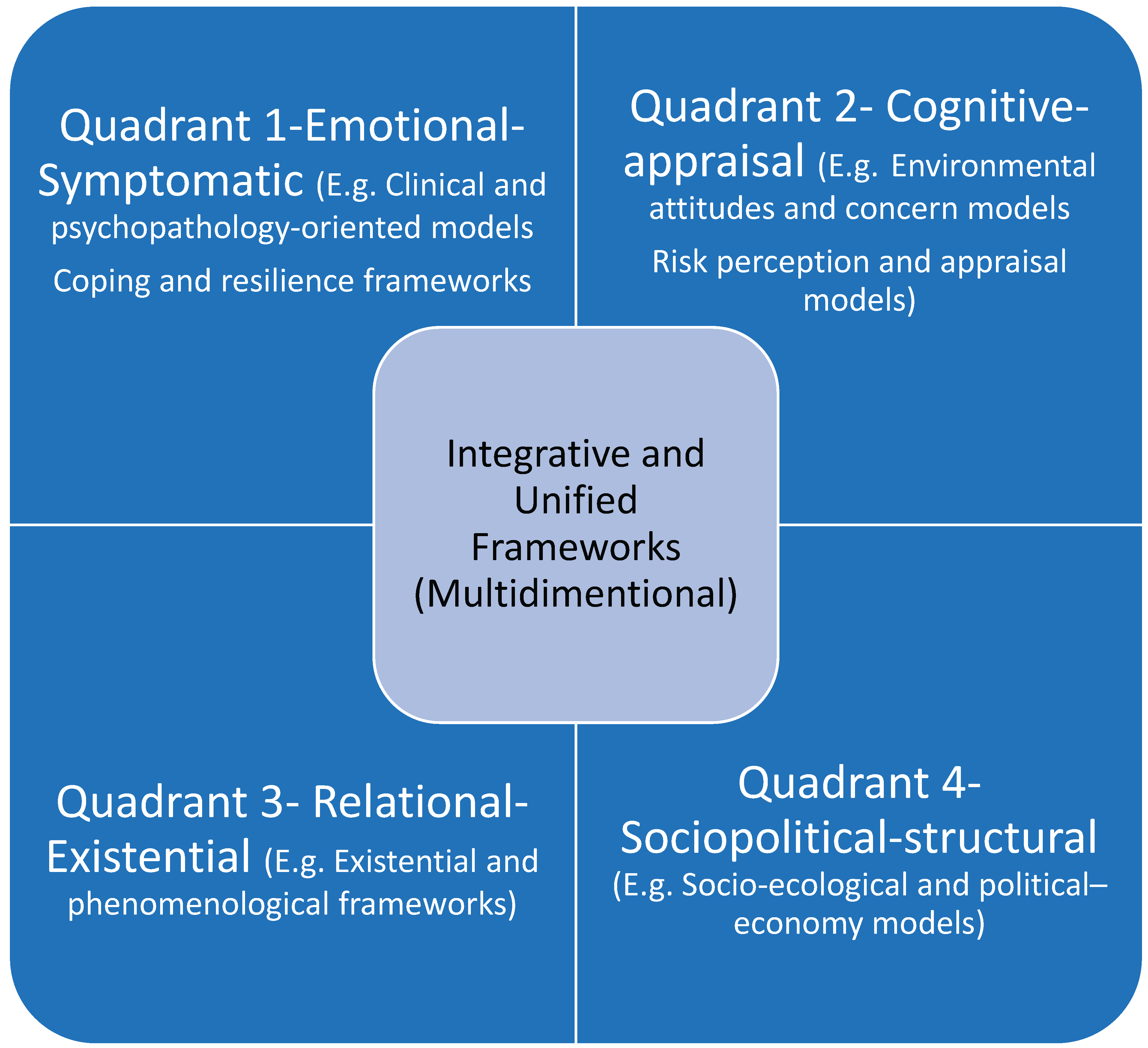
Table 1.
Illustrative typology of eco-anxiety frameworks.
| Family | Example frameworks/models (illustrative) | How eco-anxiety is conceptualised (illustrative) |
|
Symptom-based climate anxiety models; comorbidity models with GAD, depression; self-compassion–anxiety structural models; DSM-inspired proposals | As anxiety-like distress; potential clinical condition or transdiagnostic symptom cluster; focus on individual symptoms and impairment |
|
New Environmental Paradigm; environmental concern scales; pro-environmental attitudes–behaviour models | As intense environmental concern or worry; linked to pro-environmental values and behaviour; not necessarily pathological |
|
Appraisal theories of emotion; Protection Motivation Theory; Extended Parallel Process Model; climate risk perception models | As emotional response to cognitive appraisals of climate threat, efficacy, and control; can motivate action or avoidance |
|
Existential framework (death, meaning, isolation, freedom/responsibility); ecological grief models; meaning-making frameworks | As existential distress confronting finitude, loss, purpose, and responsibility; often morally and politically charged |
|
Socio-ecological models of health; climate justice frameworks; structural violence and inequality models; policy-oriented frameworks | As sociopolitical affect shaped by structural injustices, policy failures, and collective risk; emphasis on youth and intergenerational inequity |
|
Coping typologies (problem-focused, emotion-focused, meaning-focused); eco-coping frameworks; agency-oriented models | As stressor that can be buffered or transformed through coping strategies, self-compassion, and collective agency |
|
Hogg Eco-Anxiety Scale (HEAS); climate change anxiety scales; unified conceptual eco-anxiety frameworks; grounded theory of eco-anxiety | As multidimensional sociopsychological state with affective, cognitive, behavioural, and relational dimensions; bridging clinical, ecological, and political perspectives |
Source: Literature Review.
Disclaimer/Publisher’s Note: The statements, opinions and data contained in all publications are solely those of the individual author(s) and contributor(s) and not of MDPI and/or the editor(s). MDPI and/or the editor(s) disclaim responsibility for any injury to people or property resulting from any ideas, methods, instructions or products referred to in the content. |
© 2026 by the authors. Licensee MDPI, Basel, Switzerland. This article is an open access article distributed under the terms and conditions of the Creative Commons Attribution (CC BY) license (http://creativecommons.org/licenses/by/4.0/).
Copyright: This open access article is published under a Creative Commons CC BY 4.0 license, which permit the free download, distribution, and reuse, provided that the author and preprint are cited in any reuse.


