

Submitted:
28 July 2026
Posted:
30 July 2026
You are already at the latest version
Abstract
Static stretching is widely used in sports medicine, rehabilitation, and exercise science to improve joint range of motion (ROM) and flexibility. However, its effects on human movement remain incompletely understood because previous research has primarily examined individual outcomes—including ROM, passive stiffness, force production, power output, stretch–shortening cycle function, jumping performance, landing biomechanics, and balance—in isolation. Consequently, the relationship between tissue-level mechanical adaptations and functional performance has remained fragmented. This integrative review synthesizes current evidence on the biomechanical adaptations induced by static stretching and proposes a conceptual framework linking tissue mechanics, neuromechanical regulation, and human movement. Current evidence demonstrates that repeated static stretching consistently increases ROM while reducing passive stiffness, particularly within skeletal muscle. Acute stretching may transiently reduce maximal force after prolonged stretching durations, whereas chronic interventions generally produce neutral or modestly beneficial effects on maximal strength. In contrast, adaptations in power output, stretch–shortening cycle performance, jumping ability, landing biomechanics, and postural stability remain inconsistent and appear to depend on the interaction between mechanical, neural, and task-specific factors rather than on passive tissue mechanics alone. The proposed framework suggests that the functional consequences of static stretching emerge through a hierarchical continuum extending from tissue mechanical adaptations to neuromechanical regulation and ultimately to human movement. As movement complexity increases, the contribution of isolated mechanical variables progressively decreases, whereas coordinated sensorimotor regulation and task-specific movement organization become increasingly important determinants of performance. Overall, static stretching should be regarded not merely as an intervention for improving flexibility but as a biomechanical stimulus whose functional effects arise from the interaction between tissue mechanics and neuromuscular regulation. This integrative perspective provides a unified framework for interpreting the heterogeneous effects of static stretching in sport and rehabilitation.
Keywords:
static stretching
; human movement
; range of motion
; passive stiffness
; stretch–shortening cycle
; movement performance
; landing biomechanics
; postural stability
; neuromechanics
1. Introduction
Improving joint range of motion (ROM) is a fundamental objective in sports medicine, rehabilitation, and exercise science, making static stretching one of the most widely prescribed interventions for enhancing flexibility [1,2,3]. Consequently, static stretching has become an integral component of athletic training, rehabilitation, physical therapy, and general exercise programs across diverse populations, ranging from recreationally active individuals to elite athletes [3,4]. Despite its widespread application and decades of research, however, the broader biomechanical and functional consequences of static stretching remain incompletely understood, and considerable debate persists regarding its influence on neuromuscular performance and human movement [3,5].
In recent years, stretching research has expanded beyond its traditional focus on flexibility and joint range of motion to encompass tissue mechanics, neuromechanical function, and movement performance. Contemporary systematic reviews and meta-analyses demonstrate that static stretching influences passive tissue stiffness, maximal strength, muscle hypertrophy, power production, stretch–shortening cycle (SSC) function, sprinting, jumping performance, and postural control [5,6,7]. Collectively, these findings indicate that the biomechanical effects of static stretching extend beyond increases in flexibility and involve multiple interconnected mechanical and neuromuscular determinants of human movement.
Nevertheless, the current evidence remains inconsistent. Acute static stretching is frequently associated with transient reductions in maximal force production, power output, and explosive performance, particularly following prolonged stretching durations [2,3,8]. In contrast, chronic stretching interventions generally demonstrate neutral or beneficial effects on maximal strength, muscle hypertrophy, sprinting, and jumping performance when sufficient stretching intensity, duration, and training volume are applied [9,10,11,12]. Similar inconsistencies have also been reported for balance, movement quality, and overall functional performance, suggesting that the biomechanical effects of static stretching reflect the interaction of multiple mechanical and neuromuscular factors rather than improvements in joint range of motion alone.
One explanation for these apparently conflicting findings is that previous reviews have predominantly examined individual biomechanical outcomes in isolation. Joint range of motion, passive stiffness, muscle strength, power, jumping performance, balance, and injury prevention have typically been investigated as separate entities rather than as mechanically interconnected determinants of human movement [2,3,4,5]. Although this reductionist approach has substantially advanced our understanding of individual adaptations, it provides only limited insight into how changes in tissue mechanical properties are translated into neuromechanical function and ultimately expressed during functional movement.
From a biomechanical perspective, the adaptations induced by static stretching are more appropriately interpreted as a hierarchical continuum rather than as isolated physiological responses. Mechanical changes at the tissue level, including increases in joint range of motion and alterations in passive stiffness, modify the mechanical behavior of the neuromusculoskeletal system and establish the conditions under which force is generated and transmitted. These tissue-level adaptations subsequently influence neuromechanical characteristics, including maximal force production, power generation, and stretch–shortening cycle (SSC) function, which are ultimately expressed during complex motor tasks such as jumping, landing, and balance control [3,5,6,7]. This integrative perspective provides a coherent framework for understanding why identical stretching interventions may produce different functional outcomes depending on tissue mechanical properties, movement demands, and training context.
The aim of the present review is to synthesize the current evidence on the biomechanical and functional consequences of static stretching and to integrate these findings into a unified conceptual framework linking tissue mechanical adaptations, neuromechanical function, and movement performance. By organizing the available evidence within this hierarchical biomechanical model, the review provides a comprehensive framework for understanding how tissue-level mechanical adaptations are progressively translated into neuromechanical function and ultimately expressed as functional human movement.
2. Tissue Mechanical Adaptations
2.1. Changes in Range of Motion
Improved joint range of motion (ROM) is the most consistent biomechanical adaptation to static stretching and remains the primary reason for its widespread application in sports, rehabilitation, and clinical practice [1,3]. Although increases in ROM were traditionally attributed to enhanced muscle extensibility, contemporary evidence indicates that flexibility gains result from the interaction of multiple mechanical and neural adaptations, including reductions in passive tissue stiffness and increased stretch tolerance, whereas substantial structural elongation of skeletal muscle is rarely observed following conventional stretching interventions [5,10,11,12].
- Acute Adaptations
Immediately following a single bout of static stretching, joint range of motion (ROM) typically increases despite the absence of detectable structural remodeling. A recent systematic review and meta-analysis demonstrated that acute improvements in ROM are primarily associated with reductions in passive tissue stiffness, whereas the relative contribution of increased stretch tolerance becomes more pronounced following chronic stretching interventions [12]. These findings support the conceptual framework proposed by Weppler and Magnusson [13] and are consistent with the systematic review by Freitas et al. [10], both of which concluded that immediate flexibility gains cannot be explained by permanent structural elongation of skeletal muscle. Although acute stretching also transiently influences neural regulation [2,3], current evidence indicates that acute improvements in ROM primarily reflect reversible changes in tissue mechanical properties and neural regulation rather than structural remodeling.
- Chronic Adaptations
Repeated static stretching produces sustained improvements in joint range of motion (ROM) through the combined effects of reduced passive tissue stiffness and increased stretch tolerance [12]. Current evidence indicates that these mechanisms independently contribute to long-term flexibility gains, whereas changes in muscle fascicle length exert only a limited influence [12]. This interpretation is supported by previous systematic reviews demonstrating substantial improvements in ROM despite only minimal structural adaptations following conventional stretching interventions [10,11]. In contrast, exceptionally high-volume stretching protocols may induce measurable morphological adaptations, although these interventions represent models of prolonged mechanical loading rather than routine stretching practice [14]. Collectively, the available evidence indicates that chronic static stretching consistently improves flexibility, whereas its effects on muscle strength and power are generally smaller and depend on the characteristics of the stretching protocol [5].
- Neural and Structural Contributions
Current evidence indicates that adaptations in joint range of motion (ROM) arise from the interaction between neural and mechanical mechanisms rather than from a single physiological process. Acute improvements are primarily associated with reversible changes in tissue mechanical properties and neural regulation, whereas the relative contribution of increased stretch tolerance becomes more pronounced following chronic stretching interventions [10,11,12,13].
Accordingly, increased ROM should not be interpreted simply as evidence of muscle elongation. Instead, flexibility represents the integrated outcome of tissue mechanical and neuromechanical adaptations, the relative contribution of which depends on stretching volume, intervention duration, and training context. Although exceptionally high-volume stretching protocols may induce measurable structural adaptations, these responses are not representative of conventional stretching practice [14].
2.2. Changes in Passive Stiffness
Passive stiffness is one of the principal mechanical determinants of joint mobility because it reflects the resistance of the muscle–tendon–fascia system to passive elongation. Traditionally, reductions in passive stiffness have been considered a primary mechanism underlying stretching-induced increases in joint range of motion (ROM). However, contemporary evidence demonstrates that passive stiffness is a tissue-specific biomechanical property that differs substantially between skeletal muscle, tendons, and the muscle–tendon unit (MTU), rather than a uniform mechanical characteristic of the entire musculoskeletal system. Recent systematic reviews and meta-analyses consistently identify reductions in passive stiffness as one of the principal mechanical mechanisms contributing to improved ROM, although the magnitude of adaptation varies according to tissue type, stretching protocol, and intervention duration [11,12,15,16].
- Acute Adaptations
Immediately following a single bout of static stretching, passive stiffness decreases, representing one of the earliest mechanical adaptations associated with increased joint range of motion (ROM). Recent systematic reviews and meta-analyses consistently demonstrate that these acute reductions are transient and highly tissue-specific, with their magnitude depending on the tissue examined, stretching duration, intensity, and assessment methodology [15,16]. Acute decreases in passive stiffness are observed predominantly within skeletal muscle, whereas tendon stiffness generally exhibits considerably smaller or no measurable changes following conventional stretching protocols [15,16].
Experimental evidence further supports the dose-dependent nature of acute passive stiffness adaptation. Kataura et al. demonstrated that greater stretching intensity produced larger reductions in hamstring muscle–tendon unit stiffness [17]. Likewise, Takeuchi et al. showed that both greater stretching intensity and longer stretching duration enhanced reductions in muscle–tendon unit stiffness, whereas Hatano et al. confirmed that higher stretching intensities resulted in greater decreases in hamstring passive stiffness and larger increases in range of motion [18,19]. Similarly, Kay and Blazevich demonstrated that acute static stretching primarily reduced the stiffness of the muscular component of the muscle–tendon unit, whereas more pronounced tendon adaptations were observed following contract–relax stretching [2].
Collectively, the available evidence indicates that acute reductions in passive stiffness are transient, dose-dependent, and primarily localized within skeletal muscle rather than representing uniform adaptations across the entire muscle–tendon unit.
- Chronic Adaptations
Repeated static stretching produces more persistent reductions in passive stiffness than a single stretching session and represents one of the principal mechanical mechanisms underlying long-term improvements in ROM. Unlike acute adaptations, chronic changes develop progressively through repeated mechanical loading and are accompanied by increased stretch tolerance.
Current evidence consistently demonstrates that chronic static stretching improves ROM primarily through reductions in skeletal muscle passive stiffness and enhanced stretch tolerance rather than substantial structural alterations of the muscle–tendon unit [10,11,12,15]. In particular, reductions in passive stiffness and increases in maximum tolerable passive resistive torque independently contribute to long-term flexibility gains, whereas changes in muscle fascicle length exert only a minor influence [12]. Likewise, chronic stretching predominantly decreases skeletal muscle stiffness, while consistent adaptations in tendon or whole muscle–tendon unit stiffness remain limited [15]. The magnitude of these adaptations is further influenced by stretching volume, intensity, intervention duration, and the targeted muscle group [11]. Collectively, these findings indicate that sustained improvements in ROM are explained predominantly by changes in muscle mechanical behavior and stretch tolerance rather than by substantial modifications in muscle architecture or tendon mechanical properties [10].
Experimental evidence nevertheless suggests that exceptionally high stretching volumes may induce more pronounced structural adaptations. Specifically, six weeks of one-hour daily plantar-flexor stretching resulted in significant increases in flexibility, maximal strength, and muscle thickness [14]. However, such interventions represent models of prolonged mechanical loading rather than conventional stretching practice and therefore should not be considered representative of routine flexibility training.
- Tissue-Specific Mechanical Adaptations
The heterogeneous response of passive stiffness reflects the mechanical complexity of the myofascial system. Rather than responding uniformly, muscles, tendons, and the muscle–tendon unit (MTU) exhibit distinct adaptive behaviors following static stretching. Current evidence consistently demonstrates that skeletal muscle stiffness is the most responsive mechanical property, whereas tendon stiffness remains comparatively resistant to change under conventional stretching protocols [12,15,16].
These tissue-specific responses indicate that passive stiffness should not be interpreted as a single biomechanical property. Instead, the mechanical effects of static stretching depend on the relative contribution of individual tissues to overall resistance during passive elongation. Consequently, reductions in passive stiffness are expressed differently across the components of the muscle–tendon unit, helping to explain the variability in flexibility adaptations reported across stretching studies.
These tissue-specific mechanical adaptations provide the biomechanical foundation upon which subsequent neuromechanical responses develop. Consequently, understanding how static stretching modifies passive stiffness is essential for interpreting its effects on force production, power generation, and stretch–shortening cycle performance.
3. Neuromechanical Adaptations
3.1. Adaptations in Force Production
Force production is a fundamental determinant of human movement, influencing functional capacity, movement efficiency, and athletic performance. Consequently, understanding how static stretching affects force production remains a central question in stretching research. Current evidence indicates that these effects cannot be interpreted as uniformly beneficial or detrimental but instead depend on stretching duration, cumulative mechanical loading, participant characteristics, and the specific performance outcome assessed [2,3,5,6,7].
A clear distinction has emerged between the acute and chronic effects of static stretching. Whereas a single stretching session may transiently reduce maximal force production, repeated stretching performed over several weeks can produce modest improvements in maximal strength under appropriate loading conditions [5,6,9]. These apparently contradictory findings indicate that acute physiological responses and long-term biological adaptations arise through fundamentally different mechanisms and therefore should be interpreted separately.
- Acute Force Deficit
The transient reduction in maximal force production immediately following static stretching, commonly referred to as the stretch-induced force deficit, has long been regarded as one of the principal limitations of static stretching. Early experimental studies and subsequent systematic reviews consistently reported reductions in maximal strength and explosive performance following prolonged stretching, leading to the widespread recommendation that static stretching should be avoided immediately before activities requiring maximal force or power [2,3].
Recent evidence, however, has substantially refined this interpretation. A multilevel meta-analysis demonstrated that acute reductions in force production are neither universal nor of uniform magnitude. Instead, meaningful impairments are primarily observed after prolonged stretching durations, particularly when cumulative stretching exceeds approximately 60 s per muscle group [20]. Furthermore, the magnitude of the force deficit differs across performance outcomes. Maximal voluntary strength exhibits the most consistent reductions, whereas explosive strength, rate of force development, sprint performance, and vertical jump performance show considerably smaller or inconsistent effects [20].
Collectively, these findings indicate that the acute effects of static stretching are both dose-dependent and task-specific. Static stretching appears to affect isolated maximal force production more consistently than complex functional movements, in which multiple neuromuscular and biomechanical factors interact to determine performance. Consequently, short-duration static stretching incorporated into a comprehensive warm-up generally produces little or no practically meaningful reduction in force production, whereas prolonged isolated stretching is more likely to induce measurable performance decrements [3,20].
- Mechanisms of the Acute Force Deficit
Despite decades of investigation, no single physiological mechanism adequately explains the acute stretch-induced force deficit. Instead, current evidence supports a multifactorial model in which neural regulation, mechanical alterations, motor coordination, and localized fatigue interact to determine the immediate response to static stretching.
Neural inhibition was historically considered the principal mechanism underlying the acute decline in force production, largely based on reported reductions in electromyographic activity following prolonged stretching. However, this interpretation has become increasingly difficult to support. A recent meta-analytical review demonstrated that although acute static stretching may reduce maximal voluntary force, these changes are not consistently accompanied by alterations in corticospinal or spinal reflex excitability [21]. Consequently, generalized neural inhibition is unlikely to represent the sole mechanism responsible for the acute force deficit.
Rather than producing a global depression of neuromuscular function, acute stretching may instead induce subtle modifications in motor coordination. Following a 60-s static stretching intervention, alterations in the temporal contribution of individual lower-limb muscles during squat jumping were observed despite preservation of the overall muscle synergy structure [22]. These findings suggest a task-specific reorganization of motor control rather than generalized suppression of muscle activation.
Collectively, the available evidence indicates that the acute force deficit is best explained as the result of interacting neural and mechanical processes rather than a single inhibitory mechanism. The relative contribution of these mechanisms appears to depend on stretching duration, intensity, and the mechanical demands of the subsequent motor task [20,21,22].
Mechanical factors are also likely to contribute to the acute response. As discussed in the previous section, static stretching transiently reduces passive muscle stiffness and increases musculotendinous compliance, potentially decreasing the efficiency of force transmission from contractile elements to the skeleton. However, current evidence does not support a direct causal relationship between reduced passive stiffness and impaired force production, indicating that mechanical alterations alone cannot fully explain the observed performance decrements.
An additional explanation has recently been proposed based on the observation that prolonged high-intensity static stretching and fatiguing resistance exercise produce comparable acute reductions in maximal force production [8]. These findings suggest that part of the acute force deficit may reflect localized fatigue induced by sustained mechanical loading rather than a physiological response unique to stretching itself, providing a plausible explanation for the larger force deficits consistently observed following prolonged stretching protocols.
Collectively, the available evidence indicates that the acute stretch-induced force deficit should be interpreted as a transient, multifactorial response rather than the consequence of a single inhibitory mechanism. Neural regulation, musculotendinous mechanical behavior, motor coordination, and localized fatigue appear to contribute simultaneously to the immediate reduction in maximal force production, with their relative importance depending on stretching duration, intensity, and the mechanical demands of the subsequent task [8,20,21,22]. This multifactorial perspective also explains why the transient responses observed after a single stretching session cannot be extrapolated to the long-term adaptations that develop following repeated mechanical loading.
- Chronic Adaptations
In contrast to the transient reductions observed immediately after static stretching, repeated stretching performed over several weeks may induce modest improvements in maximal force production. This distinction represents one of the most important conceptual advances in stretching research, demonstrating that acute physiological responses should not be extrapolated to predict long-term training adaptations. Whereas a single stretching session elicits transient neural and mechanical responses, repeated tensile loading provides a cumulative mechanical stimulus capable of promoting structural and functional adaptations [5,6,9].
Evidence supporting chronic improvements in force production has strengthened considerably over the past decade. The systematic review and multilevel meta-analysis of Arntz et al. demonstrated that chronic static stretching can produce small but significant increases in maximal strength, although the magnitude of these adaptations depends on participant characteristics and training status [5]. Greater improvements were generally observed in sedentary and older individuals than in recreationally active or well-trained populations, suggesting that baseline neuromuscular capacity influences the adaptive response to repeated stretching [5].
These findings were further reinforced by the systematic review and meta-analysis of Warneke et al., which reported that long-term static stretching can also induce modest hypertrophic adaptations in parallel with improvements in maximal strength [6]. Meta-regression analyses further identified stretching duration and cumulative weekly stretching volume as significant moderators of the adaptive response, indicating that the effectiveness of stretching depends primarily on the magnitude of the mechanical stimulus rather than simply the number of stretching sessions performed. Nevertheless, these improvements remain substantially smaller than those typically achieved through conventional resistance training.
The mechanisms underlying chronic improvements in force production differ fundamentally from those responsible for the acute force deficit. Rather than reflecting transient neural responses, repeated stretching provides sustained mechanical loading that progressively induces structural and functional adaptations within the muscle–tendon unit. Through mechanotransduction-mediated remodeling of muscle tissue and the extracellular matrix, these biological adaptations provide a plausible explanation for the gradual improvements in maximal strength observed following prolonged stretching interventions.
Although chronic static stretching may improve maximal force production under appropriate conditions, greater strength does not necessarily translate into superior athletic performance. Current evidence indicates that modest increases in maximal strength are not consistently accompanied by corresponding improvements in sprinting, jumping, or stretch–shortening cycle performance [7]. Consequently, static stretching should be considered a complementary strategy for improving force capacity rather than a substitute for conventional strength training.
- Long-Duration Stretching
One of the most important developments in recent stretching research has been the investigation of exceptionally high-volume stretching protocols involving one to two hours of daily static stretching. These interventions differ substantially from conventional flexibility training and therefore provide valuable insight into the adaptive potential of sustained passive mechanical loading rather than the effects of routine stretching practice.
Experimental studies have demonstrated that prolonged daily static stretching may simultaneously increase maximal voluntary strength, muscle thickness, and flexibility [14,23]. These findings suggest that sufficiently prolonged passive loading can provide a mechanical stimulus capable of inducing structural adaptations within skeletal muscle. Similar conclusions were reached by a recent systematic review and meta-analysis, which identified small but significant hypertrophic adaptations following long-term stretching, particularly when cumulative stretching duration was high [24].
From a mechanobiological perspective, these findings support the concept that sustained mechanical tension may represent a common stimulus for musculoskeletal adaptation, irrespective of whether it is generated through active muscle contraction or prolonged passive stretching. Nevertheless, the adaptive response to passive stretching remains substantially smaller than that achieved through conventional resistance training and requires considerably greater cumulative loading. Consequently, these prolonged stretching protocols should be regarded primarily as experimental models demonstrating the adaptive potential of sustained passive mechanical loading rather than as practical recommendations for athletes or clinical populations.
Collectively, current evidence indicates that the effects of static stretching on force production are fundamentally determined by the duration and cumulative magnitude of mechanical loading. Whereas acute stretching elicits transient neural and mechanical responses that may temporarily reduce maximal force production, repeated stretching provides a sustained mechanical stimulus capable of inducing modest improvements in maximal strength. This distinction between acute and chronic responses provides the conceptual basis for understanding whether changes in force production are accompanied by corresponding adaptations in power output and stretch–shortening cycle performance.
3.2. Power Output
Power output represents the ability of the neuromuscular system to generate force rapidly and is a key determinant of explosive athletic performance. Unlike maximal strength, which reflects the greatest force that can be produced irrespective of time, muscular power depends on the interaction between force production, contraction velocity, and neuromuscular coordination. Consequently, changes in maximal strength do not necessarily translate into proportional changes in power output, making the effects of static stretching on explosive performance considerably more complex than its influence on force production [2,3].
- Acute Adaptations
Acute static stretching has traditionally been considered detrimental to muscular power because early experimental studies frequently reported reductions in explosive performance immediately following prolonged stretching. These observations led to the widespread assumption that static stretching should be avoided before activities requiring maximal power output [2,3].
More recent evidence, however, indicates that the acute effects on power are considerably smaller and more variable than those observed for maximal force production. A systematic review with multilevel meta-analysis demonstrated that impairments in explosive performance are largely dependent on stretching duration and testing conditions [20]. Meaningful reductions are primarily observed following prolonged stretching protocols, whereas short-duration stretching incorporated into a comprehensive warm-up generally has little or no practically relevant effect on muscular power [20].
These findings are consistent with the systematic review and meta-analysis of dos Reis et al., which reported considerable heterogeneity among studies, indicating that the acute effects of static stretching on power-related performance are largely influenced by stretching volume, participant characteristics, and the specific performance tests employed [25].
Collectively, current evidence indicates that acute static stretching produces only modest and context-dependent alterations in power output. When stretching duration remains moderate and is incorporated into an appropriately designed warm-up, any reductions in explosive performance are generally small and unlikely to be of practical significance for most sporting activities [3,20,25].
- Chronic Adaptations
The chronic effects of static stretching on muscular power differ substantially from the acute response. Whereas repeated stretching may produce modest improvements in maximal strength, corresponding improvements in power output are considerably less consistent. This distinction highlights the multifactorial nature of explosive performance, which depends not only on force-generating capacity but also on contraction velocity, intermuscular coordination, and efficient storage and release of elastic energy.
A systematic review and multilevel meta-analysis reported that chronic static stretching can improve maximal strength under appropriate training conditions but provides limited evidence for parallel improvements in explosive performance [5]. Similarly, a recent systematic review and meta-analysis demonstrated that long-term stretching may induce modest increases in maximal strength and muscle hypertrophy [6]. However, these structural adaptations are not consistently accompanied by meaningful improvements in power-related tasks. This conclusion is further supported by a multilevel meta-analysis showing no consistent enhancements in jumping or sprinting performance following chronic static stretching interventions [7].
Several factors may explain this apparent dissociation. Increases in maximal strength represent only one component of power production, whereas explosive movements additionally require rapid motor unit recruitment, high rates of force development, effective musculotendinous stiffness, and precise neuromuscular coordination. Consequently, improvements in force capacity alone may be insufficient to substantially enhance muscular power unless accompanied by specific high-velocity training adaptations.
Current evidence therefore suggests that chronic static stretching should not be regarded as an effective stand-alone intervention for improving muscular power. Instead, any beneficial effects are likely to occur when stretching is combined with resistance or plyometric training, which provide the high-velocity neuromuscular stimulus required for optimizing explosive performance.
- Mechanical Interpretation
Collectively, the available evidence demonstrates that the relationship between static stretching and power output is fundamentally more complex than its effect on maximal strength. Acute stretching may produce small, dose-dependent reductions in explosive performance, whereas chronic stretching generally has neutral or only modest effects on power despite improving maximal force under appropriate loading conditions. These findings indicate that power output is determined by the integrated interaction of multiple neuromechanical factors, including force-generating capacity, contraction velocity, musculotendinous stiffness, elastic energy utilization, and neuromuscular coordination, rather than by maximal force production alone. This distinction provides a logical transition to the next section, which examines stretch–shortening cycle function, where the coordinated interaction between force generation, elastic energy storage and release, and neuromuscular control becomes even more critical.
3.3. Stretch–Shortening Cycle Function
The stretch–shortening cycle (SSC) is a fundamental neuromechanical mechanism that enhances movement efficiency by coupling rapid eccentric and concentric muscle actions. Efficient SSC function enables the storage and reutilization of elastic energy while facilitating rapid force production through the coordinated interaction of contractile tissues, tendons, neural activation, and musculotendinous mechanical properties. Consequently, SSC performance emerges from the integrated behavior of the neuromusculoskeletal system rather than from any single biomechanical property.
Because static stretching influences several mechanical and neuromuscular determinants of SSC function, including maximal force production, power output, passive stiffness, musculotendinous compliance, and neural regulation, its effects on SSC performance have long been debated. Early studies frequently interpreted reductions in explosive performance following acute stretching as evidence of impaired SSC function. Contemporary systematic reviews, however, indicate that these effects are considerably smaller and more context-dependent than previously assumed, suggesting that SSC performance reflects the interaction of multiple biomechanical determinants rather than alterations in a single physiological mechanism [2,3,20].
From this perspective, SSC performance represents the functional expression of the biomechanical adaptations discussed in the preceding sections. Changes in force-generating capacity, power output, rate of force development, musculotendinous stiffness, tendon elastic behavior, and neuromuscular coordination collectively influence the efficiency with which elastic energy is stored, transferred, and reutilized during dynamic movement. This integrative framework provides the basis for understanding how static stretching ultimately influences explosive tasks such as jumping and sprinting.
- Neuromechanical Determinants of Stretch–Shortening Cycle Function
Efficient stretch–shortening cycle (SSC) function depends on the coordinated interaction of multiple neuromechanical factors. During SSC movements, force must be generated rapidly, transmitted efficiently through the musculotendinous system, temporarily stored as elastic energy, and subsequently released during the concentric phase. Consequently, SSC performance emerges from the integration of maximal force production, rate of force development (RFD), musculotendinous stiffness, tendon elastic recoil, and neuromuscular coordination.
Among these determinants, maximal force production provides the mechanical foundation for explosive movement. However, maximal force alone is insufficient because dynamic athletic tasks require force to be generated within very short time intervals. Accordingly, the rate of force development (RFD) is a critical determinant of SSC efficiency, particularly during movements involving ground contact times of less than 200 ms, where the ability to generate force rapidly may be more important than maximal force capacity itself.
The mechanical behaviour of the muscle–tendon unit further influences SSC performance by regulating force transmission and the storage and reutilization of elastic energy. Appropriate musculotendinous stiffness facilitates efficient force transfer while allowing tendinous tissues to temporarily store mechanical energy during the eccentric phase and release it during the subsequent concentric contraction. Conversely, excessive compliance may reduce force transmission, whereas excessive stiffness may limit elastic energy storage. Supporting this mechanical interpretation, acute static stretching has been shown to reduce both muscle and Achilles tendon stiffness while simultaneously decreasing maximal torque and rate of torque development, indicating that alterations in musculotendinous mechanical behaviour may contribute to changes in SSC efficiency [26].
Neural regulation represents an additional determinant of SSC performance. Efficient motor unit recruitment, intermuscular coordination, and the temporal organization of muscle activation patterns are essential for synchronizing eccentric braking with concentric propulsion. Recent evidence indicates that acute static stretching does not simply suppress neural activation but may induce subtle task-specific modifications in motor coordination while preserving the overall organization of muscle synergies [21,22]. These findings suggest that changes in SSC performance are more likely to reflect altered integration of neuromechanical processes than generalized neural inhibition.
Taken together, the available evidence indicates that SSC function is best interpreted as the integrated expression of interacting mechanical and neural determinants. This perspective provides the conceptual basis for understanding how acute and chronic static stretching influence SSC performance through coordinated changes in force production, rapid force generation, musculotendinous mechanical behaviour, and neuromuscular control, which are examined in the following sections.
- Acute Adaptations
The acute effects of static stretching on stretch–shortening cycle (SSC) function have traditionally been considered detrimental because early experimental studies reported reductions in explosive athletic performance following prolonged stretching. These findings led to the widespread assumption that static stretching compromises SSC efficiency and should therefore be avoided before activities requiring rapid force production [2,3].
Contemporary evidence, however, provides a more nuanced interpretation. A recent multilevel meta-analysis demonstrated that acute impairments in SSC-related performance are substantially smaller than previously believed [20]. Although prolonged stretching (>60 s per muscle group) consistently reduces isolated maximal strength, complex SSC-dependent tasks such as jumping, sprinting, and explosive movements generally exhibit trivial or non-significant changes, indicating that they are considerably less susceptible to acute static stretching than isolated force production.
These findings are further supported by a recent systematic review, which reported substantial heterogeneity across studies, with differences in stretching protocols, participant characteristics, and outcome measures contributing to the variability of the observed effects [25]. Accordingly, reductions in SSC performance should not be regarded as a universal response to static stretching but rather as context-dependent adaptations influenced by multiple neuromechanical factors.
Overall, current evidence indicates that acute static stretching has only a limited influence on SSC function when applied within the durations commonly used in athletic warm-ups. Rather than causing a generalized impairment of explosive movement, prolonged stretching appears to affect isolated force-generating capacity more consistently than complex SSC-dependent tasks, which depend on the coordinated interaction of force production, rapid force development, musculotendinous mechanics, tendon elastic recoil, and neuromuscular coordination [3,20,25].
- Chronic Adaptations
Unlike the transient responses observed following a single stretching session, repeated static stretching may induce modest improvements in maximal strength and muscle morphology when sufficient mechanical loading is applied [5,6]. However, current evidence indicates that these adaptations do not consistently translate into corresponding improvements in stretch–shortening cycle (SSC) function.
A recent systematic review and meta-analysis demonstrated that although chronic static stretching can produce small but significant increases in maximal strength, evidence for improvements in explosive performance remains limited [5]. Similarly, a multilevel meta-analysis reported modest gains in maximal force production and muscle hypertrophy, whereas adaptations in sprinting, jumping, and other SSC-dependent tasks were generally small, inconsistent, or absent [6].
This apparent dissociation reflects the multifactorial nature of SSC performance. Efficient stretch–shortening cycle function depends on the coordinated interaction of rapid force generation, musculotendinous mechanical behaviour, tendon elastic recoil, neuromuscular coordination, and sufficient force-generating capacity. Consequently, improvements in a single mechanical component are unlikely to produce substantial enhancements in SSC performance unless accompanied by coordinated adaptations throughout the neuromusculoskeletal system.
Overall, current evidence suggests that chronic static stretching alone is unlikely to represent an effective intervention for improving SSC function. Rather, any beneficial effects are more likely to emerge when stretching is combined with resistance or plyometric training, which specifically target the neuromechanical requirements of explosive movement.
- Integrated Mechanical Interpretation
The available evidence indicates that the effects of static stretching on stretch–shortening cycle (SSC) function cannot be explained by changes in a single biomechanical variable. Instead, SSC performance reflects the coordinated interaction of force-generating capacity, rate of force development, musculotendinous stiffness, tendon elastic recoil, and neuromuscular coordination. Consequently, alterations in one component do not necessarily produce proportional changes in overall SSC performance.
This integrative perspective explains why acute static stretching may reduce isolated maximal force production while producing only limited or inconsistent changes in complex SSC-dependent tasks such as jumping and sprinting. Likewise, modest improvements in maximal strength following chronic stretching do not automatically translate into enhanced SSC function because efficient SSC performance requires coordinated adaptations across multiple mechanical and neural systems.
From a biomechanical perspective, the SSC should therefore be regarded as the functional expression of the integrated neuromusculoskeletal system rather than the consequence of isolated muscular adaptations. This framework provides a mechanistic basis for understanding the heterogeneous performance outcomes reported following static stretching and serves as a logical transition to the next section, which examines how these integrated biomechanical adaptations are ultimately expressed during jump performance.
4. Movement Adaptations
4.1. Jump Performance
Jump performance represents one of the most comprehensive functional expressions of the biomechanical adaptations induced by static stretching. Unlike isolated measures of flexibility, passive stiffness, maximal strength, or power output, vertical jump tasks assess the integrated interaction of joint mobility, musculotendinous mechanical behaviour, force production, rapid force development, stretch–shortening cycle (SSC) function, and neuromuscular coordination. Consequently, they provide a highly sensitive functional model for examining how tissue-level mechanical and neural adaptations are expressed during dynamic human movement.
Different jump tasks impose distinct mechanical and neuromuscular demands on the lower extremities. Countermovement jumps (CMJ) rely heavily on the effective utilization of the SSC and coordinated eccentric–concentric muscle actions, whereas squat jumps (SJ) largely minimize the contribution of stored elastic energy and primarily assess concentric force-generating capacity. In contrast, drop jumps (DJ) require greater reactive strength, rapid force development, musculotendinous stiffness, and tendon elastic recoil because of their short ground-contact times and high eccentric loading. These biomechanical differences help explain why the effects of static stretching may vary across jump tasks despite similar stretching protocols.
Early experimental studies frequently reported reductions in jump performance following prolonged static stretching, contributing to the long-standing assumption that stretching impairs explosive movement. However, contemporary systematic reviews and meta-analyses indicate that these effects are considerably smaller and more context-dependent than previously believed. Rather than uniformly reducing performance, static stretching appears to influence the mechanical and neuromuscular determinants of jumping according to stretching duration, cumulative loading, warm-up structure, participant characteristics, and the specific jump task being performed [2,3,20,27].
From a biomechanical perspective, jump performance should therefore be interpreted as the functional expression of the tissue-level mechanical and neuromuscular adaptations described throughout the preceding sections rather than as an isolated performance outcome. The following sections examine the current evidence regarding the effects of static stretching on countermovement jump, squat jump, and drop jump performance before integrating these findings within a unified neuromechanical framework.
- Countermovement Jump
The countermovement jump (CMJ) is the most widely used functional test for evaluating the effects of static stretching on explosive lower-limb performance. Unlike isolated measures of maximal strength or power output, the CMJ reflects the coordinated interaction of joint mobility, musculotendinous mechanical behaviour, rapid force generation, stretch–shortening cycle (SSC) function, and neuromuscular coordination. Consequently, it provides a comprehensive functional assessment of how tissue-level biomechanical and neural adaptations are ultimately expressed during dynamic movement.
Early experimental studies consistently reported reductions in CMJ performance following prolonged static stretching, contributing to the long-standing assumption that stretching impairs explosive performance and should therefore be avoided before athletic activity [2,3]. Contemporary evidence, however, provides a more nuanced interpretation. A recent systematic review and multilevel meta-analysis demonstrated that chronic static stretching produces only trivial overall improvements in jump performance despite the modest gains in maximal strength and muscle hypertrophy described in previous sections [7]. Importantly, subgroup analyses revealed no significant improvements in countermovement jump, squat jump, or drop jump performance, indicating that these mechanical adaptations do not consistently translate into enhanced explosive movement. Similarly, a recent systematic review highlighted substantial methodological heterogeneity across studies, suggesting that outcomes depend on stretching volume, intervention duration, participant characteristics, and testing protocols rather than representing a uniform physiological response [25].
Individual experimental studies further illustrate this variability. Several investigations reported reductions in CMJ performance following prolonged static stretching, particularly when stretching was performed immediately before explosive activity [28,29,30]. In contrast, intermittent stretching protocols largely preserved jump performance after a brief recovery period, emphasizing the importance of stretching configuration rather than stretching per se [31]. Likewise, studies involving young flexibility-trained gymnasts reported minimal or no detrimental effects, suggesting that sport-specific training background and long-term exposure to flexibility training may attenuate the acute influence of stretching [32]. An additional perspective was provided by antagonist muscle stretching, which improved jump performance, indicating that neuromechanical responses may also depend on the muscle groups being stretched [33].
Collectively, the available evidence indicates that static stretching does not exert a uniform effect on countermovement jump performance. Instead, outcomes appear to be highly context-dependent, reflecting the interaction between stretching volume, recovery time, training status, and task-specific mechanical demands. From a biomechanical perspective, these findings support the interpretation that CMJ performance represents the integrated functional expression of multiple tissue-level mechanical and neuromuscular adaptations rather than the consequence of changes in any single biomechanical variable.
Although most studies have evaluated CMJ performance primarily through changes in jump height, this outcome alone may not fully capture the biomechanical adaptations induced by chronic static stretching. Detailed biomechanical analyses have demonstrated improvements in eccentric braking characteristics, braking and propulsive impulse, countermovement depth, and lower-limb movement strategy despite minimal or no changes in overall jump performance [34,35]. These findings indicate that chronic static stretching may influence the neuromechanical determinants of CMJ by enhancing movement execution and force application rather than by increasing jump height itself. Consequently, comprehensive biomechanical assessment of CMJ performance, including force-time characteristics and movement mechanics, provides a more sensitive evaluation of chronic stretching adaptations than jump height alone.
- Squat Jump
Unlike the countermovement jump, the squat jump (SJ) largely eliminates the contribution of the stretch–shortening cycle (SSC) by removing the rapid eccentric preloading phase. Consequently, the SJ primarily reflects concentric force-generating capacity and provides a useful model for examining whether the biomechanical adaptations induced by static stretching translate into improvements in concentric explosive performance.
Current evidence indicates that static stretching exerts only a limited influence on squat jump performance. The multilevel meta-analysis of chronic static stretching interventions reported no significant overall improvement in SJ performance [7]. These findings contrast with the modest increases in maximal strength observed after prolonged stretching protocols, indicating that improvements in force-generating capacity do not necessarily translate into enhanced concentric jumping performance [6].
Individual experimental studies further support this interpretation. Different stretching interventions generally produced little or no meaningful improvement in squat jump performance [29,30]. Additional biomechanical investigations have demonstrated that stretching may modify movement mechanics without substantially altering jump height. One study reported changes in force–velocity characteristics, including alterations in peak ground reaction force and peak velocity despite preserved peak power [36], whereas another observed no significant change in jump height but identified longer ground contact times together with task-specific modifications in muscle coordination [37].
Collectively, these findings indicate that static stretching has only a limited effect on squat jump performance itself but may influence the neuromechanical strategy underlying concentric propulsion. The preservation of jump height despite subtle alterations in force transmission, force–velocity characteristics, and motor coordination supports the concept that concentric explosive performance emerges from the coordinated interaction of multiple mechanical and neural factors rather than from isolated changes in muscle flexibility or maximal force-generating capacity.
- Drop Jump
The drop jump (DJ) provides one of the most demanding assessments of stretch–shortening cycle (SSC) function because it requires rapid eccentric braking followed by immediate concentric propulsion within a very short ground-contact time. Compared with the countermovement and squat jumps, the DJ relies more heavily on reactive strength, efficient tendon elastic recoil, rapid force development, and neuromuscular coordination. Consequently, it has been proposed as one of the most sensitive functional models for detecting changes in SSC efficiency following static stretching.
Despite these theoretical considerations, current evidence indicates that static stretching exerts only limited effects on drop jump performance. The multilevel meta-analysis of chronic static stretching interventions found no significant overall improvement in DJ performance [7]. These findings contrast with the modest increases in maximal strength reported after prolonged stretching protocols, indicating that improvements in force-generating capacity do not necessarily translate into enhanced reactive performance [6]. Likewise, evidence examining the acute effects of static stretching suggests that reactive performance is generally preserved when stretching durations remain within those commonly used in athletic warm-up routines [2,3,20].
Individual experimental studies further support this interpretation. Different stretching interventions generally produced little or no meaningful improvement in reactive jump performance [30]. However, intermittent stretching protocols combined with an appropriate recovery period largely preserved DJ performance, emphasizing that reactive performance is influenced more by stretching configuration than by stretching itself [31]. Collectively, these findings indicate that DJ performance depends primarily on the interaction among stretching volume, recovery duration, subsequent activity, and the neuromechanical demands of the task.
From a biomechanical perspective, the preservation of drop jump performance despite modest alterations in musculotendinous mechanical behavior supports the interpretation that SSC efficiency is maintained through coordinated neuromuscular regulation. Rather than reflecting isolated changes in tendon stiffness or elastic energy storage, reactive performance appears to emerge from the coordinated interaction of multiple mechanical and neural determinants. These findings further reinforce the concept that static stretching alone is unlikely to meaningfully alter SSC function under conventional training conditions.
- Neuromechanical Interpretation
The evidence presented throughout this section indicates that the effects of static stretching on jump performance cannot be explained by changes in a single biomechanical variable. Although stretching may modify joint range of motion, passive stiffness, force-generating capacity, musculotendinous mechanical behavior, and neuromuscular regulation, these adaptations do not consistently translate into improvements in countermovement, squat, or drop jump performance. Instead, the available evidence demonstrates that jump performance emerges from the coordinated interaction of multiple mechanical and neural determinants rather than from the isolated contribution of any single physiological mechanism.
This interpretation helps explain the apparent discrepancy between the mechanical adaptations discussed in the preceding sections and the relatively small changes in jump height reported throughout the contemporary literature. While prolonged static stretching may induce modest improvements in maximal strength and muscle morphology, these adaptations alone appear insufficient to enhance explosive performance because successful jumping also depends on rapid force development, efficient stretch–shortening cycle function, tendon elastic recoil, intermuscular coordination, and task-specific motor control. Consequently, improvements in one component of the neuromusculoskeletal system are unlikely to produce proportional gains in overall functional performance.
Furthermore, the experimental evidence synthesized in this section suggests that static stretching may influence how a jump is performed rather than how high an individual jumps. Alterations in force–velocity characteristics, ground-contact time, braking mechanics, and muscle coordination have been reported despite unchanged jump height, indicating that movement strategy may adapt even when overall performance remains stable. These observations support a shift from interpreting jump height as the primary outcome of stretching interventions toward considering movement quality, movement strategy, and neuromechanical organization as equally important indicators of functional adaptation.
From a biomechanical perspective, jump performance should therefore be regarded as the functional expression of an integrated neuromusculoskeletal system rather than the consequence of isolated muscular adaptations. This integrative framework provides a mechanistic explanation for the heterogeneous findings reported throughout the stretching literature and establishes a logical transition to the following section, which examines how these coordinated mechanical and neural adaptations are expressed during landing biomechanics.
4.2. Landing Biomechanics
Landing biomechanics represent a critical component of athletic performance because they determine how mechanical loads are absorbed, distributed, and controlled following ground contact. Unlike jump performance, which primarily reflects the outcome of explosive movement, landing mechanics provide insight into movement quality by evaluating joint kinematics, impact attenuation, and neuromuscular control during deceleration. Consequently, landing tasks provide an important functional model for understanding how the biomechanical adaptations induced by static stretching are expressed during dynamic movement.
Efficient landing depends on the coordinated interaction of joint mobility, eccentric muscle function, musculotendinous mechanical behavior, sensorimotor regulation, and intermuscular coordination. Rather than being determined by the mechanical properties of individual tissues, landing mechanics emerge from the integrated function of the neuromusculoskeletal system, which coordinates impact absorption while maintaining lower-limb stability [38,39].
From the perspective of static stretching, alterations in tissue mechanical behavior could theoretically influence landing mechanics by modifying joint motion, force attenuation, and movement coordination. However, contemporary evidence suggests that these effects are generally modest and highly task-specific, reflecting the interaction among passive tissue mechanics, neuromuscular regulation, and movement strategy rather than changes in any single biomechanical characteristic [40].
The following sections examine the current evidence regarding the effects of static stretching on joint kinematics, dynamic knee valgus, and movement strategy to provide an integrated interpretation of how tissue-level mechanical and neuromuscular adaptations are functionally expressed during landing.
- Joint Kinematics
Joint kinematics describe the coordinated motion of the hip, knee, and ankle during landing and play a fundamental role in impact attenuation and movement efficiency. Adequate lower-limb flexion allows impact forces to be distributed across multiple joints, reducing peak mechanical loading while facilitating controlled deceleration. Consequently, joint kinematics represent one of the principal functional expressions of the neuromechanical mechanisms underlying effective landing.
Theoretically, the acute increase in joint range of motion and the reduction in passive musculotendinous stiffness induced by static stretching could influence lower-limb kinematics by increasing the available movement excursion. However, current evidence suggests that these mechanical adaptations do not consistently translate into measurable changes during dynamic tasks. Rather, landing kinematics appear to be preserved through coordinated neuromuscular regulation, allowing movement patterns to remain relatively stable despite alterations in passive tissue mechanical behavior.
Recent biomechanical investigations further support this interpretation. Coordinated load distribution across the hip, knee, and ankle has been shown to play a greater role in landing mechanics than the mechanical behavior of any individual joint or tissue [39]. Likewise, normative analyses of male and female athletes demonstrate that landing quality is best interpreted as an integrated movement pattern rather than as isolated joint positions [41]. Experimental evidence further suggests that static stretching may modify muscle coordination without altering overall jump performance, indicating that adaptive changes occur primarily in neuromuscular organization rather than in gross movement kinematics [37]. From a clinical perspective, integrated movement assessment provides a practical framework for evaluating landing quality under dynamic conditions [42].
Collectively, the available evidence indicates that static stretching has only a limited influence on lower-limb joint kinematics during landing. Instead, landing mechanics emerge from the coordinated interaction of joint mobility, eccentric muscle function, sensorimotor regulation, and task-specific neuromuscular control. This integrated perspective provides the foundation for examining one of the most extensively investigated aspects of landing biomechanics—dynamic knee valgus.
- Dynamic Knee Valgus
Dynamic knee valgus (DKV) is one of the most extensively investigated biomechanical characteristics of landing because it reflects the coordinated interaction of lower-limb alignment, neuromuscular control, and impact attenuation during dynamic tasks. Rather than representing excessive motion at the knee alone, DKV emerges from the combined movement of the hip, knee, ankle, and trunk and is therefore considered a whole-limb movement pattern rather than an isolated joint deviation.
Early prospective investigations identified excessive dynamic knee valgus as a biomechanical characteristic associated with an increased risk of non-contact anterior cruciate ligament injury, emphasizing the importance of neuromuscular control during landing [38]. Subsequent video analyses further demonstrated that ACL injury mechanisms involve complex multiplanar movement patterns rather than isolated frontal-plane knee motion, highlighting the integrated nature of landing biomechanics [43].
From the perspective of static stretching, alterations in joint mobility and musculotendinous mechanical behavior could theoretically influence lower-limb alignment during landing. However, contemporary evidence indicates that the relationship between joint kinematics and injury-related movement patterns is considerably more complex than previously assumed. A recent systematic review and meta-analysis concluded that individual kinematic variables during landing do not consistently predict future non-contact knee injuries, suggesting that dynamic knee valgus should be interpreted within the broader context of whole-body movement coordination rather than as an isolated biomechanical risk factor [44]. Likewise, the most recent systematic review and meta-analysis demonstrated that dynamic knee valgus is influenced by multiple interacting factors, further reinforcing the multifactorial nature of landing mechanics [40].
Collectively, the available evidence indicates that dynamic knee valgus should not be interpreted as the consequence of a single mechanical adaptation induced by static stretching. Instead, lower-limb alignment during landing emerges from the coordinated interaction of joint mobility, neuromuscular regulation, movement strategy, and task-specific mechanical demands. From this perspective, static stretching is more likely to influence how movement is organized and controlled than to produce consistent changes in isolated joint positions, reinforcing the importance of evaluating movement quality rather than individual kinematic variables.
- Movement Strategy
The evidence presented throughout this section indicates that the influence of static stretching on landing biomechanics cannot be explained by changes in isolated kinematic variables. Although stretching may modify tissue mechanical properties and joint range of motion, these adaptations do not consistently translate into predictable alterations in lower-limb alignment during landing. Instead, the available evidence suggests that effective landing emerges from the coordinated interaction of joint mobility, eccentric muscle function, sensorimotor regulation, and task-specific neuromuscular control.
This interpretation helps explain why improvements in tissue flexibility or reductions in passive stiffness are not necessarily accompanied by measurable changes in landing biomechanics or dynamic knee alignment. Rather than relying on fixed joint positions, the neuromusculoskeletal system appears to preserve movement efficiency through adaptive modifications in intermuscular coordination and segmental movement patterns. Consequently, similar functional outcomes may be achieved through different movement strategies depending on the interaction between mechanical constraints and neural regulation.
Recent evidence further supports this concept by demonstrating that static stretching may alter muscle coordination and movement organization despite producing little or no change in overall performance outcomes [37]. Likewise, contemporary biomechanical investigations indicate that efficient landing is characterized by coordinated load distribution across multiple joints rather than by the mechanical behavior of individual structures [39]. Together, these findings support the interpretation that static stretching primarily influences the organization and control of movement rather than isolated biomechanical variables.
From a biomechanical perspective, landing should therefore be regarded as the functional expression of an integrated neuromusculoskeletal system rather than the consequence of individual joint mechanics. This integrative framework provides a logical transition to the following section, which examines postural stability and balance as higher-level manifestations of sensorimotor regulation during human movement.
4.3. Balance and Postural Stability
Postural stability represents one of the highest functional expressions of neuromusculoskeletal integration because it requires the continuous coordination of sensory information, central nervous system processing, and motor output to maintain or restore equilibrium. Unlike isolated biomechanical variables, balance performance reflects the combined interaction of the visual, vestibular, somatosensory, and musculoskeletal systems during both static and dynamic tasks. Consequently, postural control provides an important functional model for examining how the biomechanical and neuromuscular adaptations induced by static stretching are translated into whole-body movement regulation.
Efficient balance depends on the coordinated interaction of joint mobility, musculotendinous mechanical behavior, proprioceptive feedback, sensorimotor integration, and task-specific neuromuscular control. Rather than being determined by the mechanical properties of individual tissues, postural stability emerges from the integrated function of the neuromusculoskeletal system, which continuously adapts motor output to changing environmental and mechanical demands.
From the perspective of static stretching, acute alterations in passive tissue mechanics and proprioceptive input could theoretically influence postural control by modifying sensorimotor regulation. However, contemporary evidence indicates that these effects are generally small and highly dependent on stretching duration, participant characteristics, and the specific balance task being evaluated. Acute static stretching produces only trivial-to-small changes in static balance, whereas chronic stretching may modestly improve static postural control without consistently enhancing dynamic balance [45]. Furthermore, comparisons between stretching modalities suggest that dynamic stretching is generally more favorable than static stretching for the immediate preservation of static balance, while differences in dynamic balance remain inconsistent [22].
The following sections examine the current evidence regarding the effects of static stretching on static balance, dynamic balance, and sensorimotor regulation to provide an integrated interpretation of how biomechanical and neuromuscular adaptations are functionally expressed during postural control.
- Static Balance
Static balance describes the ability to maintain the body’s center of mass within the base of support during quiet standing through the continuous integration of sensory input and neuromuscular control. Although frequently assessed under stationary conditions, static postural control represents a complex functional process requiring the coordinated interaction of visual, vestibular, somatosensory, and musculoskeletal systems. Consequently, static balance provides a useful model for examining whether the biomechanical and neuromuscular adaptations induced by static stretching influence postural regulation.
Current evidence indicates that static stretching exerts only limited effects on static balance. A systematic review with multilevel meta-analysis demonstrated that acute static stretching produces only trivial-to-small changes in postural sway, whereas chronic stretching interventions may result in modest improvements in static balance [45]. However, these adaptations were influenced by participant characteristics, stretching duration, and assessment methodology, indicating that postural control cannot be explained by changes in flexibility alone. Likewise, comparative evidence suggests that dynamic stretching is generally more favorable than static stretching for the immediate preservation of static balance, although the observed differences are small and highly dependent on stretching duration [22].
From a biomechanical perspective, these findings suggest that static balance is maintained through adaptive sensorimotor regulation despite transient alterations in passive tissue mechanics. The central nervous system continuously integrates proprioceptive, visual, and vestibular information to preserve postural stability, thereby limiting the functional consequences of modest changes in joint mobility or passive musculotendinous stiffness. Consequently, improvements in flexibility should not be interpreted as direct predictors of enhanced static balance.
Collectively, the available evidence indicates that static stretching has only a modest influence on static postural control. Rather than reflecting isolated changes in passive mechanical properties, static balance emerges from the coordinated interaction of sensory integration, neuromuscular regulation, and task-specific postural control.
- Dynamic Balance
Dynamic balance describes the ability to maintain postural stability while the body is in motion or when responding to external perturbations. Unlike static balance, which is assessed under relatively stable conditions, dynamic balance requires the continuous integration of sensory feedback, anticipatory and reactive neuromuscular control, and coordinated whole-body movement. Consequently, dynamic balance represents a higher-level functional expression of sensorimotor regulation during athletic and everyday activities.
Current evidence indicates that static stretching has little influence on dynamic balance performance. A systematic review with multilevel meta-analysis found no consistent improvements in dynamic balance following either acute or chronic static stretching interventions, despite the modest benefits observed for static postural control [45]. Likewise, comparative evidence indicates no significant differences between static and dynamic stretching for dynamic balance outcomes, suggesting that movement-related postural control is largely preserved irrespective of the stretching modality [22].
From a biomechanical perspective, these findings suggest that dynamic balance depends predominantly on the coordinated interaction of sensorimotor integration, anticipatory postural adjustments, and task-specific neuromuscular coordination rather than on isolated changes in passive tissue mechanics. Although static stretching may transiently modify joint mobility and musculotendinous mechanical behavior, these adaptations appear insufficient to meaningfully alter the complex neural processes governing dynamic postural control.
Collectively, the available evidence indicates that dynamic balance is largely unaffected by conventional static stretching. Rather than reflecting changes in flexibility or passive stiffness alone, dynamic postural control emerges from the integrated interaction of sensory feedback, motor coordination, and movement-specific neuromuscular regulation.
- Sensorimotor Regulation
Sensorimotor regulation represents the physiological mechanism through which the central nervous system continuously integrates sensory information and generates coordinated motor responses to maintain postural stability. During both static and dynamic balance tasks, proprioceptive input arising from muscles, tendons, joint receptors, and cutaneous mechanoreceptors is integrated with visual and vestibular information to regulate postural adjustments and maintain equilibrium. Consequently, balance performance reflects not only the mechanical properties of the musculoskeletal system but also the efficiency of sensorimotor integration.
From the perspective of static stretching, acute alterations in passive tissue mechanics, muscle tension, and stretch perception could theoretically modify proprioceptive input and postural regulation. However, contemporary evidence suggests that these transient mechanical changes are largely compensated for through adaptive neuromuscular control. Experimental and review evidence indicates that acute stretching produces only modest changes in spinal and corticospinal excitability, whereas longer-term adaptations are more consistently associated with altered stretch tolerance and sensorimotor regulation rather than generalized neural inhibition [13,21,27].
This interpretation is consistent with the findings of recent systematic reviews demonstrating that conventional static stretching has only limited effects on balance performance despite consistently improving joint range of motion [22,45]. Rather than reflecting isolated changes in passive mechanical behavior, postural control appears to be maintained through the continuous interaction of sensory feedback, central motor processing, and task-specific neuromuscular coordination.
From a biomechanical perspective, sensorimotor regulation provides the mechanistic link between the tissue-level adaptations discussed throughout the preceding sections and their functional expression during postural control. Accordingly, balance should be regarded as an emergent property of the integrated neuromusculoskeletal system rather than the consequence of isolated changes in flexibility or passive tissue mechanics.
5. Integrative Biomechanical Model
5.1. From Tissue Mechanics to Functional Movement
The evidence synthesized throughout this review indicates that the biomechanical consequences of static stretching cannot be understood by examining individual adaptations in isolation. Rather than representing independent physiological responses, changes in joint range of motion, passive stiffness, force production, power output, and movement performance constitute successive levels of a coordinated adaptive process through which tissue-level mechanical changes are translated into functional human movement.
This progression begins with alterations in the passive mechanical behavior of the muscle–tendon–fascia system. Repeated static stretching consistently increases joint range of motion while producing tissue-specific changes in passive stiffness, particularly within skeletal muscle. These mechanical adaptations influence the conditions under which force is generated and transmitted, yet they do not directly determine functional performance. Instead, their functional consequences depend on the continuous interaction between passive tissue properties and neuromuscular regulation during movement.
At the functional level, these biomechanical adaptations are expressed differently according to the mechanical demands of the task. Maximal force production, power output, jumping performance, landing biomechanics, and postural stability represent progressively more complex manifestations of the same underlying adaptive continuum. As task complexity increases, the contribution of isolated mechanical variables becomes progressively smaller, whereas the importance of coordinated neuromuscular regulation, sensorimotor integration, and movement organization becomes increasingly evident.
Accordingly, the functional consequences of static stretching should be interpreted as a continuum extending from tissue mechanics to whole-body movement rather than as independent biomechanical outcomes. This integrative perspective provides the conceptual foundation for unifying the mechanical and neural adaptations discussed throughout the present review into a comprehensive biomechanical model.
5.2. Interaction Between Mechanical and Neural Adaptations
The evidence synthesized throughout the present review demonstrates that the functional consequences of static stretching arise from the continuous interaction between mechanical and neural adaptations rather than from either process operating independently. Although repeated stretching consistently modifies passive tissue properties, including joint range of motion and passive stiffness, these mechanical changes alone do not adequately explain the variability observed in force production, power output, jump performance, landing biomechanics, or postural stability.
This interaction is evident across all levels of functional performance. Mechanical adaptations alter the physical properties of the muscle–tendon–fascia system, influencing joint mobility, force transmission, and musculotendinous behavior. Simultaneously, neural mechanisms regulate motor unit recruitment, proprioceptive processing, intermuscular coordination, and movement execution, allowing the neuromusculoskeletal system to continuously adapt motor behavior according to the mechanical demands of each task. Consequently, similar mechanical adaptations may produce different functional outcomes depending on how they are integrated through sensorimotor regulation.
The progressively less direct relationship between isolated mechanical variables and complex movement performance further supports this interpretation. While changes in passive stiffness are closely associated with improvements in joint range of motion, their influence becomes progressively less direct as task complexity increases. Explosive movements, landing control, and postural stability depend on the coordinated interaction of multiple mechanical and neural components, enabling compensatory adaptations that preserve overall movement efficiency despite measurable alterations in individual biomechanical properties.
Accordingly, the biomechanical consequences of static stretching should not be interpreted as the direct outcome of isolated tissue adaptations. Instead, functional performance emerges from the coordinated integration of passive mechanical behavior and adaptive neuromuscular regulation operating across multiple levels of biological organization. This interaction provides the mechanistic basis for understanding why identical stretching interventions may produce different functional responses according to the mechanical and neuromuscular demands of the movement being performed.
5.3. Task-Specific Functional Expression
The evidence synthesized throughout the present review demonstrates that the functional consequences of static stretching are highly task-specific. Although repeated stretching induces broadly similar mechanical adaptations, including increased joint range of motion and reduced passive stiffness, their functional expression depends on the biomechanical and neuromuscular demands of the movement being performed. Consequently, identical tissue-level adaptations may produce different outcomes across distinct motor tasks.
This task specificity becomes increasingly evident as movement complexity increases. Relatively simple outcomes, such as joint range of motion, are closely related to passive tissue mechanics, whereas more demanding tasks progressively rely on the coordinated interaction of multiple physiological systems. Force production, power generation, jumping performance, landing biomechanics, and postural stability each require distinct combinations of mechanical behavior, neuromuscular coordination, sensorimotor integration, and movement organization. Consequently, improvements observed at one level of function should not be expected to translate directly into superior performance at higher levels of motor complexity.
This perspective also provides a framework for interpreting the heterogeneous findings reported throughout the stretching literature. Rather than reflecting contradictory physiological responses, this variability is more likely to arise from differences in task demands, participant characteristics, stretching protocols, and testing conditions. Accordingly, the effects of static stretching should be interpreted within the specific biomechanical context in which movement is performed rather than as universal adaptations applicable across all forms of human movement.
From an integrative biomechanical perspective, static stretching should therefore be regarded as a stimulus that modifies the conditions under which movement is performed rather than as an intervention that directly determines functional performance. Instead, functional outcomes depend on how mechanical and neural adaptations are integrated to satisfy the specific demands of each motor task. This task-dependent interaction provides the conceptual basis for the unified biomechanical model presented in the following section.
5.4. Conceptual Model
The evidence synthesized throughout this review supports a unified biomechanical model describing how the functional consequences of static stretching emerge across progressively higher levels of movement organization. Rather than representing isolated physiological responses, the adaptations induced by static stretching constitute a continuous adaptive continuum extending from tissue-level mechanical changes to complex functional performance.
Within this framework, repeated static stretching initially modifies the passive mechanical behavior of the muscle–tendon–fascia system, resulting in increased joint range of motion and tissue-specific reductions in passive stiffness. These mechanical adaptations subsequently influence force production and power generation; however, their functional expression becomes increasingly dependent on neuromuscular regulation as movement complexity increases.
At higher levels of motor performance, including jumping, landing, and postural control, mechanical adaptations alone no longer determine functional outcomes. Instead, movement performance emerges from the coordinated interaction of passive tissue mechanics, sensorimotor integration, intermuscular coordination, and task-specific movement organization. Consequently, similar tissue-level adaptations may produce different functional responses depending on the biomechanical and neuromuscular demands of the movement being performed.
The conceptual model presented in Figure 1 summarizes this integrative perspective by illustrating the progressive transition from tissue mechanics to functional movement. It emphasizes that the biomechanical consequences of static stretching should be interpreted as the product of continuous interactions between mechanical and neural adaptations operating across multiple levels of biological organization rather than as isolated changes in individual physiological variables.
Figure 1 illustrates the integrative biomechanical framework developed throughout the present review. The model depicts the progressive transition from tissue mechanical adaptations to neuromechanical and functional movement adaptations, emphasizing that functional performance emerges from the continuous interaction between passive tissue mechanics and neuromuscular regulation across increasing levels of movement complexity.
5. Conclusions
Static stretching has traditionally been regarded as a flexibility intervention whose primary purpose is to increase joint range of motion. However, the evidence synthesized throughout the present review demonstrates that its biomechanical consequences extend far beyond improvements in flexibility alone. Contemporary evidence indicates that static stretching influences multiple components of the neuromusculoskeletal system, including passive tissue mechanics, force-generating capacity, power production, stretch–shortening cycle function, movement quality, landing biomechanics, and postural stability. These adaptations should not be interpreted as isolated physiological responses but rather as interconnected components of a coordinated biomechanical continuum.
The integrative biomechanical framework proposed in this review suggests that the functional consequences of static stretching develop progressively across successive levels of movement organization. Repeated stretching consistently modifies the passive mechanical behavior of the muscle–tendon–fascia system by increasing joint range of motion and reducing passive stiffness, particularly within skeletal muscle. These tissue-level adaptations subsequently influence neuromechanical characteristics, including force production, power generation, and stretch–shortening cycle function. However, their contribution becomes progressively less direct as movement complexity increases. Functional tasks such as jumping, landing, and postural control depend increasingly on the coordinated interaction between passive tissue mechanics, neuromuscular regulation, sensorimotor integration, and task-specific movement organization rather than on any single biomechanical variable.
This integrative perspective also provides a coherent explanation for the heterogeneous findings reported throughout the stretching literature. Acute static stretching may transiently alter isolated measures of maximal force or power, particularly following prolonged stretching durations, whereas chronic stretching generally produces neutral or modestly beneficial functional adaptations. Importantly, improvements in tissue mechanical properties do not necessarily translate into proportional improvements in complex movement performance because functional outcomes emerge from the interaction of multiple mechanical and neural determinants. Consequently, the effects of static stretching should be interpreted within the biomechanical context of the specific movement task rather than as universal responses applicable across all forms of physical performance.
Overall, static stretching should no longer be viewed solely as a flexibility intervention but rather as a biomechanical stimulus that modifies the mechanical conditions under which movement is generated, transmitted, and controlled. Its functional consequences emerge through continuous interactions between tissue mechanical adaptations and neuromuscular regulation across multiple levels of biological organization. By integrating current evidence on tissue mechanics, neuromechanical adaptations, and task-specific functional performance into a unified conceptual framework, this review provides a more comprehensive understanding of how static stretching influences human movement and offers a biomechanical basis for interpreting its diverse functional effects in sports performance, rehabilitation, and exercise science.
Author Contributions
Conceptualization, G.R. and I.M.I.; methodology, G.R.; investigation, G.R.; writing—original draft preparation, G.R.; writing—review and editing, G.R. and I.M.I.; visualization, G.R.; supervision, I.M.I. All authors have read and agreed to the published version of the manuscript.
Funding
This research received no external funding.
Institutional Review Board Statement
Not applicable.
Informed Consent Statement
Not applicable.
Data Availability Statement
No new data were created or analyzed in this study.
Acknowledgments
During the preparation of this manuscript, the authors used ChatGPT (OpenAI) to assist with language refinement, manuscript organization, and editorial revision. All scientific interpretation, literature selection, critical evaluation, and final approval of the present manuscript were performed by the authors, who take full responsibility for its accuracy and integrity.
Conflicts of Interest
The author declares no conflicts of interest.
References
- Page, P. Current concepts in muscle stretching for exercise and rehabilitation. Int. J. Sports Phys. Ther. 2012, 7, 109–119.
- Kay, A.D.; Blazevich, A.J. Effect of acute static stretch on maximal muscle performance: A systematic review. Med. Sci. Sports Exerc. 2012, 44, 154–164. [CrossRef]
- Behm, D.G.; Blazevich, A.J.; Kay, A.D.; McHugh, M. Acute effects of muscle stretching on physical performance, range of motion, and injury incidence in healthy active individuals: A systematic review. Appl. Physiol. Nutr. Metab. 2016, 41, 1–11. [CrossRef]
- Behm, D.G.; Chaouachi, A. A review of the acute effects of static and dynamic stretching on performance. Eur. J. Appl. Physiol. 2011, 111, 2633–2651. [CrossRef]
- Arntz, F.; Markov, A.; Behm, D.G.; Behrens, M.; Negra, Y.; Nakamura, M.; Moran, J.; Chaabene, H. Chronic effects of static stretching exercises on muscle strength and power in healthy individuals across the lifespan: A systematic review with multi-level meta-analysis. Sports Med. 2023, 53, 723–745. [CrossRef]
- Warneke, K.; Lohmann, L.H.; Behm, D.G.; Wirth, K.; Keiner, M.; Schiemann, S.; Wilke, J. Effects of chronic static stretching on maximal strength and muscle hypertrophy: A systematic review and meta-analysis with meta-regression. Sports Med. Open 2024, 10, 45. [CrossRef]
- Warneke, K.; Freundorfer, P.; Plöschberger, G.; Behm, D.G.; Konrad, A.; Schmidt, T. Effects of chronic static stretching interventions on jumping and sprinting performance: A systematic review with multilevel meta-analysis. Front. Physiol. 2024, 15, 1372689. [CrossRef]
- Warneke, K.; Turau, K.; Lohmann, L.H.; Hillebrecht, M.; Behm, D.G.; Konrad, A.; Schmidt, T. Resistance training causes the stretch-induced force deficit: A randomized cross-over study. Sports 2024, 12, 145. [CrossRef]
- Kokkonen, J.; Nelson, A.G.; Eldredge, C.; Winchester, J.B. Chronic static stretching improves exercise performance. Med. Sci. Sports Exerc. 2007, 39, 1825–1831. [CrossRef]
- Freitas, S.R.; Mendes, B.; Le Sant, G.; Andrade, R.J.; Nordez, A.; Milanovic, Z. Can chronic stretching change the muscle-tendon mechanical properties? A review. Scand. J. Med. Sci. Sports 2018, 28, 794–806. [CrossRef]
- Konrad, A.; Alizadeh, S.; Daneshjoo, A.; Hadjizadeh Anvar, S.; Graham, A.; Zahiri, A.; Goudini, R.; Edwards, C.; Scharf, C.; Behm, D.G. Chronic effects of stretching on range of motion with consideration of potential moderating variables: A systematic review with meta-analysis. J. Sport Health Sci. 2024, 13, 186–194. [CrossRef]
- Ingram, L.A.; Tomkinson, G.R.; d’Unienville, N.M.A.; Gower, B.; Gleadhill, S.; Boyle, T.; Bennett, H. Mechanisms underlying range of motion improvements following acute and chronic static stretching: A systematic review, meta-analysis and multivariate meta-regression. Sports Med. 2025, 55, 1449–1466. [CrossRef]
- Weppler, C.H.; Magnusson, S.P. Increasing muscle extensibility: A matter of increasing length or modifying sensation? Phys. Ther. 2010, 90, 438–449. [CrossRef]
- Warneke, K.; Wirth, K.; Keiner, M.; Lohmann, L.H.; Hillebrecht, M.; Brinkmann, A.; Wohlann, T.; Schiemann, S. Comparison of the effects of long-lasting static stretching and hypertrophy training on maximal strength, muscle thickness and flexibility in the plantar flexors. Eur. J. Appl. Physiol. 2023, 123, 1773–1787.
- Takeuchi, K.; Nakamura, M.; Fukaya, T.; Konrad, A.; Mizuno, T. Acute and long-term effects of static stretching on muscle–tendon unit stiffness: A systematic review and meta-analysis. J. Sports Sci. Med. 2023, 22, 465–475. [CrossRef]
- Nakamura, M.; Takeuchi, K.; Fukaya, T.; Nakao, G.; Konrad, A.; Mizuno, T. Acute effects of static stretching on passive stiffness in older adults: A systematic review and meta-analysis. Arch. Gerontol. Geriatr. 2024, 117, 105256. [CrossRef]
- Kataura, S.; Suzuki, S.; Matsuo, S.; Hatano, G.; Iwata, M.; Yokoi, K.; Fukaya, T.; Nakamura, M. Acute effects of the intensity of static stretching on passive properties of the hamstring muscles. Eur. J. Appl. Physiol. 2017, 117, 2503–2510. [CrossRef]
- Takeuchi, K.; Akizuki, K.; Nakamura, M. Acute effects of different intensity and duration of static stretching on the muscle–tendon unit stiffness of the hamstrings. J. Sports Sci. Med. 2022, 21, 528–535. [CrossRef]
- Hatano, G.; Suzuki, S.; Matsuo, S.; Kataura, S.; Yokoi, K.; Fukaya, T.; Sato, S.; Nakamura, M. The intensity of static stretching influences the acute changes in hamstring passive stiffness and range of motion. Front. Physiol. 2022, 13, 878854. [CrossRef]
- Warneke, K.; Lohmann, L.H. Revisiting the stretch-induced force deficit: A systematic review with multilevel meta-analysis of acute effects. J. Sport Health Sci. 2024, 13, 805–819. [CrossRef]
- Shah, R.; Samuel, M.W.; Son, J. Acute and chronic effects of static stretching on neuromuscular properties: A meta-analytical review. Appl. Sci. 2023, 13, 11979. [CrossRef]
- Guo, W.; Kim, Y.; Wang, J.; Dong, T.; Tang, X.; Kim, S. 60-second static stretching of lower limb muscles disrupts muscular performance and control in active male adults. J. Sports Sci. Med. 2025, 24, 195–204. [CrossRef]
- Warneke, K.; Brinkmann, A.; Hillebrecht, M.; Schiemann, S. Influence of long-lasting static stretching on maximal strength, muscle thickness and flexibility. Front. Physiol. 2022, 13, 878955. [CrossRef]
- Arntz, F.; Behrens, M.; Wilke, J.; Schoenfeld, B.J.; Behm, D.G.; Moran, J.; Nakamura, M.; Warneke, K. Chronic effects of static stretching exercises on skeletal muscle hypertrophy in healthy individuals: A systematic review and meta-analysis. Sports Med. Open 2024, 10, 90. [CrossRef]
- dos Reis, A.L.; Oliveira, L.C.; Souza, A.Y.V.; Stabelini Neto, A.; Oliveira, R.G. Effects of stretching on muscle strength, endurance, and power performance: A systematic review and meta-analysis. Isokinet. Exerc. Sci. 2024, 32, 181–197. [CrossRef]
- Ikeda, N.; Yonezu, T.; Kawakami, Y. Minute oscillation stretching: A novel modality for reducing musculo-tendinous stiffness and maintaining muscle strength. Scand. J. Med. Sci. Sports 2021, 31, 104–114. [CrossRef]
- Behm, D.G.; Kay, A.D.; Trajano, G.S.; Blazevich, A.J. Mechanisms underlying performance impairments following prolonged static stretching without a comprehensive warm-up. Eur. J. Appl. Physiol. 2021, 121, 67–94. [CrossRef]
- Islamoglu, I.; Atan, T.; Ünver, Ş.; Cavusoglu, G. Effects of Different Durations of Static Stretching on Flexibility, Jumping, Speed and Agility Performance. Anthropologist 2016, 23, 454–461. [CrossRef]
- Montalvo, S.; Dorgo, S. The Effect of Different Stretching Protocols on Vertical Jump Measures in College Age Gymnasts. J. Sports Med. Phys. Fitness 2019, 59, 1956–1962. [CrossRef]
- Melocchi, I.; Filipas, L.; Lovecchio, N.; De Nardi, M.; La Torre, A.; Codella, R. Effects of Different Stretching Methods on Vertical Jump Ability and Range of Motion in Young Female Artistic Gymnastics Athletes. J. Sports Med. Phys. Fitness 2021, 61, 527–533. [CrossRef]
- Bogdanis, G.C.; Donti, O.; Tsolakis, C.; Smilios, I.; Bishop, D.J. Intermittent but Not Continuous Static Stretching Improves Subsequent Vertical Jump Performance in Flexibility-Trained Athletes. J. Strength Cond. Res. 2019, 33, 203–210. [CrossRef]
- Papia, K.; Bogdanis, G.C.; Toubekis, A.; Donti, A.; Donti, O. Acute Effects of Prolonged Static Stretching on Jumping Performance and Range of Motion in Young Female Gymnasts. Sci. Gymnastics J. 2018, 10, 217–226. [CrossRef]
- Sandberg, J.B.; Wagner, D.R.; Willardson, J.M.; Smith, G.A. Acute Effects of Antagonist Stretching on Jump Height, Torque, and Electromyography of Agonist Musculature. J. Strength Cond. Res. 2012, 26, 1249–1256. [CrossRef]
- Rusimova, G.; Ivanov, I.M. Changes in countermovement jump biomechanics following an eight-week static stretching program in adolescent male basketball players. J. Appl. Sports Sci. 2026, 10, 112–126. [CrossRef]
- Ivanov, I.; Glavev, B.; Ranchev, S.; Rusimova, G. Biomechanical jump characteristics of adolescent basketball female players after an isometric stretching program. J. Theor. Appl. Mech. 2024, 54, 502–510. [CrossRef]
- Li, M.; Meng, X.; Guan, L.; Kim, Y.; Kim, S. Comparing the Effects of Static Stretching Alone and in Combination with Post-Activation Performance Enhancement on Squat Jump Performance at Different Knee Starting Angles. J. Sports Sci. Med. 2023, 22, 769–777. [CrossRef]
- Li, M.; Dong, M.; Wang, T.; Lu, Y.; Bum, C.-H.; Kim, S. Effects of Static Stretching and Its Combination with Conditioning Contractions on Lower Limb Muscle Synergy and Squat Jump Performance at Two Initial Knee Joint Angles. J. Men’s Health 2024, 20, 101–110. [CrossRef]
- Hewett, T.E.; Myer, G.D.; Ford, K.R.; Heidt, R.S., Jr.; Colosimo, A.J.; McLean, S.G.; van den Bogert, A.J.; Paterno, M.V.; Succop, P. Biomechanical Measures of Neuromuscular Control and Valgus Loading of the Knee Predict Anterior Cruciate Ligament Injury Risk in Female Athletes: A Prospective Study. Am. J. Sports Med. 2005, 33, 492–501. [CrossRef]
- Toussaint, T.D.; Schepens, B. Biomechanical Behavior of the Lower Limbs and of the Joints When Landing from Different Heights. J. Biomech. 2024, 165, 112014. [CrossRef]
- Abbasi, S.; Rahmatzadeh, D.; Minoonejad, H.; Mousavi, S.H. The Effect of Fatigue on Dynamic Knee Valgus during Landing Tasks: A Systematic Review and Meta-Analysis. BMC Sports Sci. Med. Rehabil. 2025, 17, 166. [CrossRef]
- Turner, J.A.; Hartshorne, M.; Cameron, K.L.; Padua, D.A. Jump Landing Kinematics: Establishing Normative Ranges for Male and Female Athletes. J. Athl. Train. 2025, 60, 523–532. [CrossRef]
- Padua, D.A.; Marshall, S.W.; Boling, M.C.; Thigpen, C.A.; Garrett, W.E., Jr.; Beutler, A.I. The Landing Error Scoring System (LESS) Is a Valid and Reliable Clinical Assessment Tool of Jump-Landing Biomechanics: The JUMP-ACL Study. Am. J. Sports Med. 2009, 37, 1996–2002. [CrossRef]
- Krosshaug, T.; Nakamae, A.; Boden, B.P.; Engebretsen, L.; Smith, G.; Slauterbeck, J.R.; Hewett, T.E.; Bahr, R. Mechanisms of Anterior Cruciate Ligament Injury in Basketball: Video Analysis of 39 Cases. Am. J. Sports Med. 2007, 35, 359–367. [CrossRef]
- Romero-Franco, N.; Ortego-Mate, M.C.; Molina-Mula, J. Knee Kinematics during Landing: Is It Really a Predictor of Acute Noncontact Knee Injuries in Athletes? A Systematic Review and Meta-Analysis. Orthop. J. Sports Med. 2020, 8, 2325967120966952. [CrossRef]
- Lohmann, L.H.; Zech, A.; Plöschberger, G.; Oraže, M.; Jochum, D.; Warneke, K. Acute and Chronic Effects of Stretching on Balance: A Systematic Review with Multilevel Meta-Analysis. Front. Med. 2024, 11, 1451180. [CrossRef]
Figure 1.
Integrative biomechanical model of static stretching.
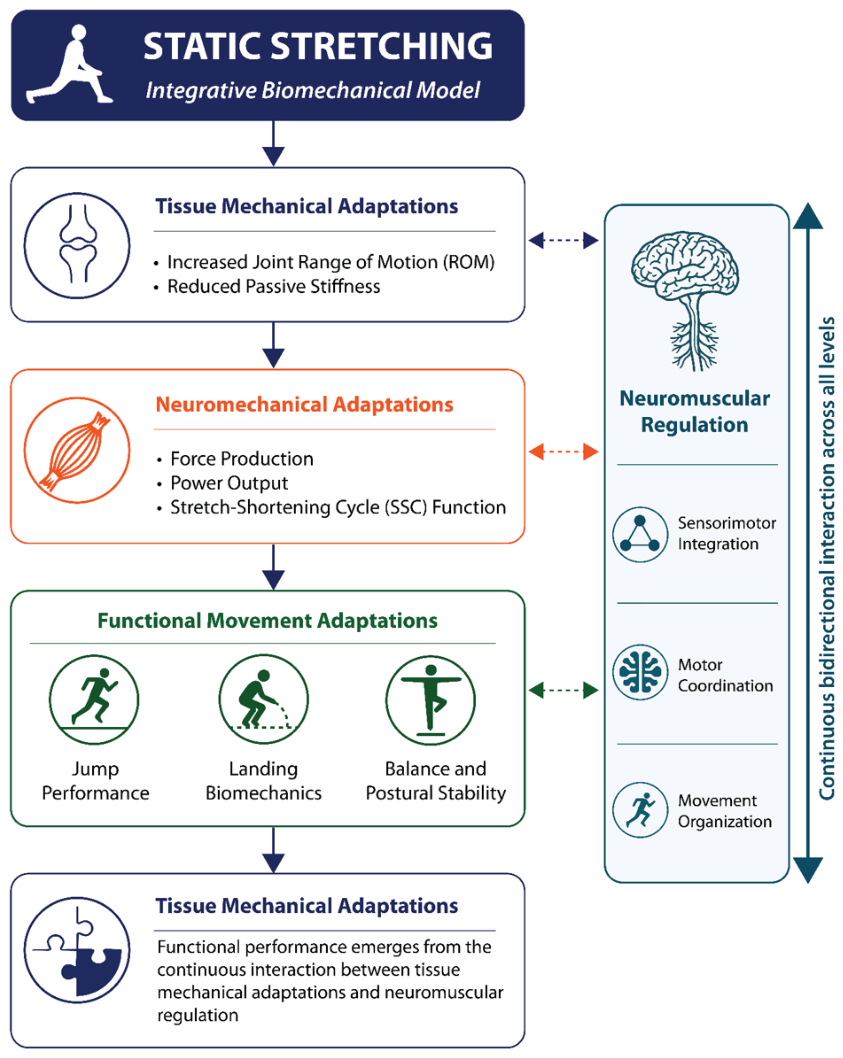
Disclaimer/Publisher’s Note: The statements, opinions and data contained in all publications are solely those of the individual author(s) and contributor(s) and not of MDPI and/or the editor(s). MDPI and/or the editor(s) disclaim responsibility for any injury to people or property resulting from any ideas, methods, instructions or products referred to in the content. |
© 2026 by the authors. Licensee MDPI, Basel, Switzerland. This article is an open access article distributed under the terms and conditions of the Creative Commons Attribution (CC BY) license (http://creativecommons.org/licenses/by/4.0/).
Copyright: This open access article is published under a Creative Commons CC BY 4.0 license, which permit the free download, distribution, and reuse, provided that the author and preprint are cited in any reuse.