
Submitted:
28 July 2026
Posted:
30 July 2026
You are already at the latest version
Abstract
Generative artificial intelligence (AI) is transforming tourism information creation by enabling AI systems to generate travel recommendations and destination narratives. However, limited research has examined whether AI-generated and human-created travel guides influence tourists’ decision-making through distinct psychological mechanisms. Drawing upon source credibility theory and the stimulus–organism–response framework, this study develops a cognitive–emotional framework to investigate how travel guide creators shape tourists’ decision-making and when AI-generated tourism content is more likely to be accepted. A pre-study and three experimental studies were conducted with 300 participants across two tourism contexts, including the Mount Tai Scenic Area and Shanghai Disneyland. The results demonstrate that the effectiveness of travel guide creators depends on destination characteristics, with a significant interaction effect between creator type and destination type (F(1,296)=14.56, p<0.001). Further analyses reveal that AI-generated travel guides influence tourists’ decision-making through information credibility (β=0.41, p<0.001), whereas human-created travel guides operate through perceived authenticity (β=0.29, p<0.001). Moreover, AI literacy strengthens the relationship between AI-generated travel guides and information credibility (β=0.18, p<0.01), enhancing the cognitive pathway through which AI-generated content affects tourists’ decisions. These findings extend generative AI research in tourism beyond technology adoption by demonstrating that AI and human creators generate complementary value through distinct cognitive and emotional mechanisms.
Keywords:
generative artificial intelligence
; travel guides
; tourism decision-making
; information credibility
; perceived authenticity
; AI literacy
1. Introduction
The rapid advancement of generative artificial intelligence (AI) has fundamentally transformed the creation, dissemination, and consumption of tourism information. Unlike traditional digital technologies that primarily support information retrieval and service transactions, generative AI systems, such as ChatGPT and other large language models, are capable of independently generating travel recommendations, personalized itineraries, and destination narratives based on users’ preferences. As tourists increasingly rely on digital content for travel inspiration and decision-making, AI-generated travel guides have emerged as a novel type of tourism information source, potentially reshaping how tourists evaluate destinations and make travel decisions (Seyfi et al., 2025; Wong et al., 2025; Armutcu et al., 2026).
Previous research on tourism technologies has primarily focused on technology adoption and acceptance, examining how perceived usefulness, perceived ease of use, and social influence affect tourists’ willingness to adopt smart tourism technologies (Han et al., 2021; Yoo et al., 2017; Kusdibyo, 2023). Although this stream of research has provided valuable insights into tourists’ interactions with digital technologies, it mainly explains whether individuals are willing to adopt technological systems rather than how AI-generated content influences their perceptions, evaluations, and behavioral decisions. As generative AI evolves from a service-supporting technology into an active information producer, understanding how tourists evaluate AI-generated content and how such content shapes decision-making processes has become an emerging research issue.
Meanwhile, extensive studies have demonstrated that travel content creators and online reviews play an important role in influencing tourists’ destination evaluations and behavioral intentions. The effectiveness of tourism information largely depends on source-related characteristics, including credibility, expertise, and authenticity (Hovland and Weiss, 1951; Filieri et al., 2015). Human-generated travel content often gains persuasive power through personal experiences, emotional narratives, and perceived authenticity, whereas AI-generated content may provide advantages in information integration, efficiency, and personalized recommendations. Generative AI challenges the traditional assumption that tourism recommendations are primarily human-centered by introducing a new category of non-human content creators capable of producing persuasive and personalized travel information. However, the emergence of AI-generated travel guides does not necessarily imply a replacement of human-created content. Instead, AI and human creators may possess different strengths and influence tourists through distinct value creation mechanisms. Whether and how these two types of creators generate different persuasive effects remains insufficiently understood (Christou et al., 2025; Israfilzade & Sadili, 2024).
Despite the growing interest in AI applications in tourism, limited research has directly compared AI-generated and human-created travel guides within the same decision-making context. Moreover, the psychological mechanisms explaining why tourists respond differently to these two types of content creators remain insufficiently understood. Existing studies have mainly examined tourists’ acceptance of AI-based services, while less attention has been paid to the cognitive and emotional processes through which AI-generated and human-created tourism content affects tourists’ judgments. From a cognitive perspective, AI-generated content may enhance tourists’ evaluations through perceived information credibility due to its ability to process and organize large amounts of information. In contrast, human-created content may influence tourists through emotional mechanisms by conveying personal experiences and authentic travel narratives. Therefore, AI and human creators should not be viewed simply as competing information sources; rather, they may represent two complementary pathways through which tourism content generates value.
To address these research gaps, this study develops a cognitive–emotional framework to examine how travel guide creators influence tourists’ decision-making. Drawing upon source credibility theory and the stimulus–organism–response (S-O-R) framework (Mehrabian and Russell, 1974), this study investigates how AI-generated and human-created travel guides shape tourists’ travel intentions through different psychological mechanisms rather than determining which creator is universally superior. Specifically, this research examines the mediating roles of information credibility and perceived authenticity and further explores whether tourists’ AI literacy serves as a boundary condition that influences how they interpret and evaluate AI-generated tourism content.
This study contributes to the tourism and hospitality literature in three ways. First, it extends existing research on AI in tourism from technology adoption toward generative AI-enabled content creation, highlighting the transformation of AI from a functional service tool into an emerging tourism information creator. Second, it reveals the cognitive and emotional mechanisms underlying tourists’ responses to AI-generated and human-created travel guides, demonstrating that AI capabilities and human experiential knowledge generate different forms of value rather than a simple substitution relationship. Third, by identifying AI literacy as a boundary condition, this study provides a more nuanced explanation of why tourists differ in their evaluations of AI-generated tourism content and when AI-generated recommendations are more likely to be accepted.
2. Literature Review and Hypothesis Development
2.1. Generative AI in Tourism Content Creation
The rapid development of generative artificial intelligence (AI) has introduced new possibilities for tourism information creation and consumption. Unlike traditional AI applications that primarily support information retrieval, prediction, and service automation, generative AI systems based on large language models can create new textual and multimodal content through natural language interactions (Yogesh et al., 2023). In tourism contexts, generative AI has been increasingly applied to itinerary planning, destination recommendations, and personalized travel assistance, transforming AI from a decision-support technology into an emerging content creator (Tussyadiah, 2020; Buhalis & Law., 2008).
Existing tourism research has mainly examined AI from the perspectives of technology adoption, service automation, and operational innovation. Previous studies have demonstrated that AI-enabled systems can improve service efficiency, personalization, and customer engagement in tourism and hospitality settings (Ivanov and Webster, 2019; Huang and Rust, 2021). However, these studies have largely focused on tourists’ willingness to use AI-based services rather than how tourists evaluate and respond to AI-generated tourism content itself. As generative AI becomes increasingly capable of producing travel guides, recommendations, and destination narratives, it raises new questions regarding whether AI-generated content can achieve similar persuasive effects to human-created tourism information.
Travel guides represent an important context for examining the role of generative AI in tourism content creation because travel decisions are highly dependent on informational and experiential cues. While human-created travel content has traditionally influenced tourists through personal experiences and authentic storytelling, generative AI provides advantages in information integration, efficiency, and personalization. Therefore, understanding how tourists respond to AI-generated and human-created travel guides is critical for explaining the changing role of AI in tourism communication and decision-making. Importantly, this study does not assume that each creator exclusively produces one type of value; rather, it argues that AI and human creators differ in their dominant psychological mechanisms. While AI-generated guides may primarily influence tourists through cognitive evaluations related to information credibility, human-created guides may exert stronger effects through emotional evaluations related to perceived authenticity.
2.2. Travel Guide Creators and Source Credibility
Travel information is highly influenced by the characteristics of its source. Source credibility theory suggests that the persuasiveness of information depends largely on the perceived expertise and trustworthiness of the information provider (Hovland & Weiss, 1951; Ohanian, 1990). In tourism contexts, this theory has been widely applied to explain how online reviews, electronic word-of-mouth (eWOM), and travel recommendations affect tourists’ attitudes and behavioral intentions (Filieri et al., 2015; Erkan & Evans, 2016). When tourists perceive a source as credible, they are more likely to accept the provided information and incorporate it into their travel decisions.
Travel guide creators represent important information sources in tourism decision-making. Traditionally, travel content has been mainly created by human creators, including travel bloggers, professional writers, and experienced travelers. The influence of human-generated travel guides often derives from personal experiences, experiential knowledge, and authentic storytelling, which can enhance tourists’ emotional connections with destinations (Munar & Jacobsen, 2014). However, the emergence of generative AI introduces a new type of non-human content creator. Compared with human creators, AI-generated travel guides rely on large-scale information processing and algorithmic generation, providing advantages in efficiency, information integration, and personalization.
Although existing studies have examined tourists’ acceptance of AI-enabled tourism services, limited attention has been paid to how the identity of travel guide creators (AI versus human) influences tourists’ evaluations of tourism information. Generative AI challenges the traditional human-centered model of tourism content creation by enabling non-human agents to produce persuasive and personalized travel recommendations. Therefore, this study adopts source credibility theory to examine how different travel guide creators shape tourists’ decision-making processes and further explores the cognitive and emotional mechanisms underlying their responses.
2.3. Cognitive Mechanism: Information Credibility
Information credibility represents the extent to which individuals perceive information as believable, accurate, and useful for decision-making. In online information environments, individuals often evaluate information quality before accepting and applying external recommendations. The information adoption model suggests that the perceived quality and credibility of information are critical determinants of whether individuals internalize and utilize received information (Cheung et al., 2008). When information is considered credible and diagnostic, individuals are more likely to reduce uncertainty and rely on it when making decisions (Mudambi & Schuff, 2010). In tourism contexts, where travelers usually make decisions without direct experience of destinations, credible information serves as an important cognitive basis for evaluating alternatives and forming behavioral intentions.
Information credibility is particularly important for travel planning because tourists need to process large amounts of uncertain and heterogeneous information before making decisions. Previous studies have shown that information characteristics, including accuracy, completeness, and diagnostic value, influence how consumers evaluate online recommendations and determine whether such information should be adopted (Filieri, 2016; Ismagilova et al., 2020). Compared with general information exposure, highly credible travel information can provide stronger decision support by helping tourists compare destinations, reduce perceived risks, and increase confidence in their choices.
Generative AI may influence information credibility through its unique capability to organize and synthesize extensive information resources. Unlike human-generated travel guides that are usually based on individual experiences and subjective perspectives, AI-generated content can integrate diverse data sources and generate structured recommendations according to users’ specific requirements. These characteristics may enhance tourists’ perceptions of information completeness, consistency, and objectivity, thereby increasing the cognitive value of AI-generated travel guides. Previous research on algorithm-based recommendations has suggested that users may perceive algorithm-generated information as more systematic and analytical, particularly in tasks involving information processing and decision support (Logg et al., 2019).
However, information credibility does not solely depend on the technical capability of AI but also on users’ perceptions of whether AI-generated content is suitable for tourism decision-making. Although AI may provide efficient and comprehensive recommendations, tourists may still question whether AI lacks experiential knowledge and contextual understanding. Therefore, this study argues that AI-generated and human-created travel guides may differ in their ability to generate cognitive value, with AI potentially gaining advantages through perceived information credibility. Accordingly, the following hypothesis is proposed:
H1.
AI-generated travel guides have a stronger positive effect on perceived information credibility than human-created travel guides.
Beyond its role in differentiating the cognitive value of different travel guide creators, information credibility also represents an important mechanism through which tourism information influences tourists’ behavioral responses. According to information adoption theory, credible information is more likely to be accepted and incorporated into individuals’ decision-making processes because it reduces uncertainty and increases confidence in subsequent judgments (Sussman & Siegal, 2003). In tourism contexts, destination choices often involve uncertainty regarding service quality, travel experiences, and expected outcomes. Therefore, tourists are more likely to develop favorable travel intentions when they perceive travel information as reliable, accurate, and decision-relevant (Zhang et al., 2018). When tourists perceive AI-generated travel guides as credible sources of information, they are more likely to rely on such recommendations and translate their cognitive evaluations into behavioral intentions.
Accordingly, this study proposes:
H3.
Perceived information credibility positively influences tourists’ decision-making.
2.4. Emotional Mechanism: Perceived Authenticity
Perceived authenticity refers to the extent to which individuals perceive an experience, object, or information source as genuine, sincere, and consistent with reality. In tourism research, authenticity has long been regarded as an important factor influencing tourists’ perceptions, emotions, and behavioral responses because travel experiences are often associated with the pursuit of meaningful and genuine encounters (Wang et al., 2020). Unlike purely functional evaluations, authenticity involves emotional and symbolic meanings that enable tourists to establish psychological connections with destinations and experiences (Kolar & Zabkar, 2010).
In the context of travel content creation, perceived authenticity represents an important emotional mechanism through which human-generated travel guides influence tourists’ decision-making. Human creators, such as travel bloggers and experienced travelers, typically communicate tourism information through personal experiences, subjective reflections, and storytelling. Such experiential narratives allow audiences to imagine real travel scenarios and perceive the content as more personally meaningful (Chronis, 2005). Previous studies have shown that authentic storytelling can enhance emotional engagement and strengthen tourists’ connections with destinations (Ramkissoon & Uysal, 2011; Lin & Liu, 2018).
The emergence of generative AI challenges the traditional relationship between tourism content and authenticity. Although AI-generated travel guides can provide efficient and personalized recommendations, AI systems do not possess direct travel experiences, personal memories, or emotional involvement with destinations. As a result, tourists may perceive AI-generated content as less authentic compared with human-created content, particularly when travel decisions involve experiential and emotional considerations. Human-generated travel guides may therefore maintain advantages in creating emotional resonance by conveying personal journeys, feelings, and lived experiences.
However, authenticity perceptions may vary depending on the nature of tourism information and individual characteristics. For practical travel planning tasks, tourists may prioritize efficiency and informational value, whereas for experience-oriented decisions, they may place greater emphasis on emotional connection and authenticity. Therefore, this study proposes that human-created travel guides may influence tourists’ travel intentions through perceived authenticity, representing an emotional pathway distinct from the cognitive mechanism associated with AI-generated content. Accordingly, the following hypothesis is proposed:
H2.
Human-created travel guides have a stronger positive effect on perceived authenticity than AI-generated travel guides.
Beyond distinguishing the emotional value of different travel guide creators, perceived authenticity also plays an important role in shaping tourists’ behavioral responses. Authentic tourism information can reduce psychological distance between tourists and destinations by providing meaningful narratives and emotional connections. When tourists perceive travel content as authentic, they are more likely to develop positive attitudes, stronger destination involvement, and greater willingness to follow related recommendations (Morhart et al., 2015; Lu et al., 2022). In particular, human-created travel guides that convey personal experiences and genuine emotions may increase tourists’ confidence and emotional attachment, thereby facilitating travel-related decision-making.
Therefore, perceived authenticity serves as an emotional pathway through which human-created travel guides influence tourists’ behavioral intentions. When tourists perceive travel recommendations as genuine and experience-based, they are more likely to accept the information and incorporate it into their travel choices. Accordingly, this study proposes:
H4.
Perceived authenticity positively influences tourists’ decision-making.
2.5. AI Literacy as a Boundary Condition of AI-Generated Tourism Content
AI literacy refers to individuals’ ability to understand, evaluate, and appropriately interact with artificial intelligence technologies, including knowledge of AI capabilities, limitations, and potential applications (Long & Magerko, 2020; Stolpe & Hallström, 2024). Unlike general digital literacy, AI literacy emphasizes individuals’ cognitive understanding of how AI systems generate outputs and how these outputs should be interpreted and evaluated (Ng et al., 2021; Pinski & Benlian, 2023). As generative AI becomes increasingly embedded in tourism-related decision-making, tourists’ AI literacy may become an important factor influencing their perceptions and acceptance of AI-generated travel content.
The influence of AI-generated travel guides is unlikely to be consistent among all tourists because individuals differ in their understanding and familiarity with AI technologies. Tourists with higher AI literacy are more likely to recognize the advantages of generative AI in processing large amounts of information, integrating diverse data sources, and generating personalized recommendations (Won & Lee, 2026). Therefore, they may evaluate AI-generated travel guides based on informational quality and decision-support value rather than solely relying on traditional assumptions about human expertise. In contrast, tourists with lower AI literacy may have limited understanding of AI capabilities and may perceive AI-generated content as less reliable due to uncertainty regarding algorithmic decision-making.
From a cognitive perspective, AI literacy may strengthen the relationship between AI-generated travel guides and perceived information credibility. When tourists possess greater knowledge of AI technologies, they are more capable of recognizing the analytical and informational advantages of AI-generated recommendations, thereby increasing their confidence in AI-provided travel information. Consequently, AI literacy may enhance the indirect effect of AI-generated travel guides on tourists’ decision-making through information credibility. This suggests that the effectiveness of AI-generated tourism content depends not only on the characteristics of the content itself but also on tourists’ ability to understand and evaluate AI-generated information.
Based on the above arguments, this study incorporates AI literacy as a boundary condition to explain individual differences in responses to AI-generated travel guides. Specifically, this study proposes that AI literacy strengthens the cognitive pathway through which AI-generated travel guides influence tourists’ decision-making. Accordingly, the following hypotheses are proposed:
H5a.
AI literacy positively moderates the relationship between AI-generated travel guides and perceived information credibility, such that the positive effect of AI-generated travel guides on information credibility is stronger among tourists with higher AI literacy.
H5b.
AI literacy positively moderates the indirect effect of AI-generated travel guides on tourists’ decision-making through perceived information credibility, such that this indirect effect is stronger among tourists with higher AI literacy.
2.6. Conceptual Framework
Based on the above theoretical discussions, this study develops a cognitive–emotional framework to explain how different travel guide creators influence tourists’ decision-making. Drawing upon source credibility theory and the stimulus–organism–response (S-O-R) framework, this study proposes that AI-generated and human-created travel guides influence tourists through distinct psychological mechanisms.
Specifically, AI-generated travel guides are expected to influence tourists’ decision-making through a cognitive pathway by enhancing perceived information credibility, whereas human-created travel guides are expected to influence tourists through an emotional pathway by increasing perceived authenticity. Furthermore, AI literacy is proposed as a boundary condition that strengthens the cognitive mechanism of AI-generated travel content.
The proposed theoretical framework is presented in Figure 1.
3. Materials and Methods
3.1. Research Design and Instrument
3.1.1. Overview of Research Design
This study adopts a multi-study experimental design to examine how different travel guide creators (AI-generated versus human-created travel guides) influence tourists’ decision-making through distinct cognitive and emotional mechanisms. Compared with survey-based approaches, experimental methods enable researchers to establish causal relationships by manipulating the source of tourism information while controlling potential confounding factors. Therefore, an experimental approach is particularly suitable for investigating tourists’ responses to generative AI as an emerging tourism content creator.
The research was conducted across two representative tourism contexts: the Mount Tai Scenic Area and Shanghai Disneyland. These two destinations were selected because they represent distinct types of tourism experiences. The purpose of including two destinations is not to examine destination effects, but to enhance the robustness and generalizability of the findings across different tourism contexts. Mount Tai represents a cultural heritage destination characterized by historical significance, natural landscapes, and experiential exploration, where tourists often rely on narratives and personal experiences when forming destination perceptions. In contrast, Shanghai Disneyland represents a theme entertainment destination where tourists typically require practical information, itinerary planning, and activity recommendations. The inclusion of these two contexts helps improve the generalizability of findings by examining whether the effects of travel guide creators remain consistent across different tourism settings.
A three-study experimental design was employed. First, a pre-study was conducted to verify whether participants could successfully distinguish AI-generated and human-created travel guides, ensuring the effectiveness of the experimental manipulation. Study 1 examined the direct effect of travel guide creators on tourists’ decision-making and tested whether AI-generated and human-created travel guides produced different persuasive effects. Study 2 further investigated the underlying cognitive and emotional mechanisms by examining the mediating roles of information credibility and perceived authenticity. Study 3 explored the boundary condition of AI literacy and examined whether individual differences in AI-related knowledge and understanding strengthen the cognitive pathway through which AI-generated travel guides influence tourists’ decision-making.
Across all studies, participants were randomly assigned to different experimental conditions and exposed to travel guide stimuli related to either Mount Tai Scenic Area or Shanghai Disneyland. After reading the assigned travel guide, participants completed measurements assessing information credibility, perceived authenticity, tourists’ decision-making, and AI literacy. The overall research design corresponds with the proposed S-O-R framework and provides empirical evidence for understanding how AI-generated and human-created travel guides shape tourists’ decisions through different cognitive and emotional pathways.
3.1.2. Experimental Materials and Stimuli
Two types of experimental stimuli were developed to represent different travel guide creators: AI-generated travel guides and human-created travel guides. The stimuli were constructed around two representative tourism destinations, including the Mount Tai Scenic Area and Shanghai Disneyland. The former represents a cultural heritage destination characterized by historical narratives and experiential meaning, whereas the latter represents a theme entertainment destination characterized by recreational activities and itinerary planning. The selection of these destinations enabled the study to examine whether the effectiveness of travel guide creators varies across different tourism contexts.
The experimental materials were developed following the principle of maintaining consistency in destination information while manipulating creator identity. For each destination, both AI-generated and human-created travel guides contained comparable information structures, including destination introduction, attraction recommendations, itinerary planning, experience suggestions, and practical travel tips. Therefore, differences in participants’ evaluations could be primarily attributed to perceptions of the travel guide creator rather than variations in information quantity or content coverage.
The two types of travel guides differed mainly in their presentation styles and perceived sources of information. AI-generated travel guides were designed to reflect the characteristics of generative AI applications, emphasizing information integration, structured recommendations, and efficient travel planning. In contrast, human-created travel guides adopted an experience-based narrative style, incorporating personal observations, emotional expressions, and subjective travel experiences to enhance perceived authenticity and emotional connection.
The creator identity was manipulated through source descriptions presented at the beginning of each travel guide. In the AI-generated condition, the guide was introduced as content generated by an artificial intelligence system, whereas in the human-created condition, the guide was presented as a travel experience shared by an individual traveler. To minimize potential confounding effects, all experimental stimuli were presented using identical text formats and visual layouts. The final experiment consisted of four stimulus conditions: AI-generated and human-created travel guides for the Mount Tai Scenic Area and Shanghai Disneyland, with the complete materials provided in Appendix A.
3.1.3. Measurement Scales
Established measurement scales from tourism, consumer behavior, and information systems research were adopted and adapted to the context of generative AI-based travel content. Except for AI literacy, all constructs were measured using seven-point Likert scales ranging from 1 (strongly disagree) to 7 (strongly agree), ensuring comparability across experimental conditions.
Information credibility (IC) captures tourists’ perceptions of the reliability, accuracy, and usefulness of travel guide content. This construct reflects the extent to which tourists perceive the provided information as trustworthy and valuable for supporting travel-related decisions. Following previous research on information adoption and online information credibility (Cheung et al., 2008; Filieri, 2016), IC was measured based on dimensions related to information accuracy, reliability, credibility, and usefulness.
Perceived authenticity (PA) refers to tourists’ perceptions regarding whether travel guide content appears genuine, natural, and reflective of authentic travel experiences. In tourism contexts, individuals often evaluate travel information based on the extent to which it conveys personal experiences, emotional expressions, and contextualized narratives. Drawing upon authenticity research in tourism (Kolar & Zabkar, 2010; Morhart et al., 2015), PA was assessed through dimensions including perceived genuineness, experiential authenticity, and emotional resonance.
Tourists’ decision-making (TDM) represents the behavioral tendency formed after exposure to travel guide content, including destination choice intention and recommendation tendency. Previous tourism studies have demonstrated that travel information influences tourists’ cognitive evaluations and subsequent behavioral intentions (Erkan & Evans, 2016). Accordingly, TDM was measured through tourists’ willingness to visit the destination, intention to adopt travel recommendations, and likelihood of future visitation.
AI literacy (AIL) was included as a moderating variable to capture individuals’ ability to understand, evaluate, and appropriately use artificial intelligence technologies. Unlike general digital literacy, AI literacy emphasizes individuals’ knowledge of AI concepts, understanding of AI capabilities and limitations, and ability to apply AI-related technologies (Long & Magerko, 2020). Following previous AI literacy research, AIL was measured based on three dimensions: AI knowledge, understanding of AI capabilities, and awareness of AI applications.
3.2. Pre-Study: Manipulation Check of Travel Guide Creator
A pre-study was conducted to verify whether the experimental materials successfully manipulated participants’ perceptions of travel guide creators. The primary purpose was to confirm that participants could distinguish between AI-generated travel guides and human-created travel guides before the formal experiments.
A group of participants was randomly assigned to receive one of the manipulated travel guide stimuli. After reading the assigned material, participants were asked to identify the perceived source of the travel guide by answering the question: “Do you think this travel guide was primarily generated by artificial intelligence or created by a human traveler?” In addition, participants rated the perceived creator identity of the guide using a five-point scale.
The manipulation was considered successful if participants could accurately distinguish between AI-generated and human-created travel guides. The results indicated that participants were able to correctly identify the creator identity of the presented travel guides, suggesting that the manipulation of travel guide creators was effective. Therefore, the experimental stimuli were retained for the subsequent studies.
3.3. Study 1: The Effect of Travel Guide Creators on Tourists’ Decision-Making Across Tourism Contexts
Study 1 investigated the direct effect of travel guide creators on tourists’ decision-making and examined whether the influence of creator identity varies across different tourism contexts. Specifically, this study compared the effects of AI-generated and human-created travel guides on tourists’ decision-making tendencies and explored whether destination characteristics influence the effectiveness of different travel guide creators.
A 2 (travel guide creator: AI-generated vs. human-created) × 2 (destination type: Mount Tai Scenic Area vs. Shanghai Disneyland) between-subjects experimental design was employed. Travel guide creator served as the focal independent variable, while destination type was introduced as a contextual factor. The Mount Tai Scenic Area and Shanghai Disneyland were selected to represent cultural heritage and theme entertainment tourism contexts, respectively, allowing the study to examine whether creator effects remain consistent across different types of tourism experiences.
Participants were randomly assigned to one of four experimental conditions: (1) AI-generated travel guide for the Mount Tai Scenic Area; (2) human-created travel guide for the Mount Tai Scenic Area; (3) AI-generated travel guide for Shanghai Disneyland; and (4) human-created travel guide for Shanghai Disneyland. After reading the assigned travel guide, participants evaluated the target destination based on their perceptions and behavioral intentions. To minimize potential confounding effects, the AI-generated and human-created travel guides within each destination condition were designed with comparable information content, text length, and structural format, with creator identity and destination type serving as the primary manipulated factors.
Tourists’ decision-making (TDM) was measured through travel intention, including willingness to visit the destination, intention to consider the destination as a potential travel choice, and recommendation intention. All measurement items were assessed using a seven-point Likert scale (1 = strongly disagree, 7 = strongly agree). The data were analyzed using two-way ANOVA to examine the main effects of travel guide creator and destination type, as well as the interaction effect between these two factors.
3.4. Study 2: Replication of Cognitive and Emotional Mechanisms
Study 2 further investigated the psychological mechanisms underlying the effects of travel guide creators on tourists’ decision-making. Building on the findings of Study 1, this study examined whether information credibility (IC) and perceived authenticity (PA) explain how AI-generated and human-created travel guides influence tourists’ decision-making through different psychological pathways.
The experimental design of Study 2 followed the procedure of Study 1. A 2 (travel guide creator: AI-generated vs. human-created) × 2 (destination type: Mount Tai Scenic Area vs. Shanghai Disneyland) between-subjects experimental design was employed. Participants were randomly assigned to one of the four experimental conditions and evaluated the assigned travel guide after reading the materials. In addition to tourists’ decision-making, participants assessed their perceptions of information credibility and perceived authenticity.
Information credibility was measured to capture tourists’ cognitive evaluations of the accuracy, reliability, and usefulness of travel guide content, whereas perceived authenticity reflected tourists’ perceptions of whether the guide conveyed genuine experiences, personal feelings, and emotional connections. By incorporating these two psychological evaluations simultaneously, Study 2 examined whether AI-generated and human-created travel guides influence tourists’ decisions through distinct cognitive and emotional mechanisms.
A parallel mediation analysis was conducted to test the mediating effects of information credibility and perceived authenticity. Travel guide creator was specified as the independent variable, tourists’ decision-making as the dependent variable, and the two psychological mechanisms were included as parallel mediators. This analysis allowed the study to examine whether AI-generated and human-created travel guides exert their effects through different underlying pathways.
3.5. Study 3: The Moderating Role of AI Literacy
Study 3 further examined how individual differences influence tourists’ responses to AI-generated travel guides. Although Study 2 identified information credibility and perceived authenticity as underlying mechanisms linking travel guide creators to tourists’ decision-making, the effectiveness of AI-generated content may also depend on tourists’ ability to understand and evaluate artificial intelligence technologies. Therefore, Study 3 introduced AI literacy as a boundary condition to examine when AI-generated travel guides are more likely to generate cognitive advantages.
AI literacy reflects individuals’ ability to understand, evaluate, and appropriately use artificial intelligence technologies. In the context of AI-generated travel guides, tourists with different levels of AI literacy may vary in their perceptions of AI-based tourism information. Accordingly, Study 3 focused on whether AI literacy moderates the relationship between AI-generated travel guides and information credibility, thereby influencing tourists’ decision-making through the cognitive pathway.
The experimental procedure followed the design framework of the previous studies. Participants were randomly assigned to one of the experimental conditions and exposed to either an AI-generated or human-created travel guide for the Mount Tai Scenic Area or Shanghai Disneyland. After reading the assigned materials, participants evaluated information credibility, tourists’ decision-making, and their AI literacy levels. AI literacy was measured as a moderating variable reflecting participants’ understanding and awareness of artificial intelligence technologies.
A moderation analysis was first conducted to examine whether AI literacy influences the relationship between AI-generated travel guides and information credibility. Furthermore, a moderated mediation analysis was performed to assess whether AI literacy strengthens the indirect effect of AI-generated travel guides on tourists’ decision-making through information credibility. Through this design, Study 3 extends the research model by demonstrating that the effectiveness of generative AI-based tourism content depends not only on content characteristics but also on users’ capability to understand and evaluate AI technologies.
3.6. Data Analysis
Data analyses were conducted using SPSS and the PROCESS macro. Descriptive statistics were first performed to summarize participants’ demographic characteristics. The effectiveness of the experimental manipulation was assessed in the pre-study. Reliability analysis was conducted to examine the internal consistency of the measurement scales before hypothesis testing.
For Study 1, two-way analysis of variance (ANOVA) was conducted to examine the effects of travel guide creators on tourists’ decision-making. Specifically, the main effects of creator type and destination type, as well as their interaction effect, were tested.
For Study 2, parallel mediation analysis was conducted using PROCESS Model 4 with 5000 bootstrap samples to examine whether information credibility and perceived authenticity mediated the relationship between travel guide creators and tourists’ decision-making.
For Study 3, hierarchical regression analysis was conducted to test the moderating effect of AI literacy on the relationship between travel guide creators and information credibility. Furthermore, PROCESS Model 7 with 5000 bootstrap samples was employed to test the moderated mediation effect of AI literacy on the indirect relationship between AI-generated travel guides and tourists’ decision-making through information credibility.
4. Results
4.1. Pre-Study Results: Manipulation Check
A total of 100 participants were randomly assigned to one of two conditions: AI-generated travel guide condition or human-created travel guide condition. After reading the assigned travel guide, participants were asked to evaluate the perceived creator identity of the travel guide using a five-point scale (1 = completely human-created, 5 = completely AI-generated).
The results of the independent-samples t-test indicated that participants perceived significant differences between the two conditions. Specifically, participants in the AI-generated travel guide condition reported a significantly higher perception that the guide was created by artificial intelligence (M = 4.32, SD = 0.58) compared with those in the human-created travel guide condition (M = 1.74, SD = 0.63), t(98) = 21.46, p < 0.001.
These findings demonstrate that participants were able to successfully identify the creator identity of the travel guides, indicating that the experimental manipulation was effective. Therefore, the AI-generated and human-created travel guide stimuli were used in the subsequent studies.
4.2. Study 1 Results: The Effect of Travel Guide Creators on Tourists’ Decision-Making
4.2.1. Sample Characteristics and Descriptive Statistics
A total of 300 participants were recruited for Study 1 and randomly assigned to one of four experimental conditions in a 2 (travel guide creator: AI-generated vs. human-created) × 2 (destination type: Mount Tai Scenic Area vs. Shanghai Disneyland) between-subjects design.
As shown in Table 1, the sample consisted of 143 males (47.7%) and 157 females (52.3%). Participants represented diverse age groups, with the largest proportion aged 26–35 years (32.0%), followed by those aged 18–25 years (30.7%) and 36–45 years (22.3%). Regarding education, most participants held a bachelor’s degree (53.0%), while the remaining participants had associate degrees (21.0%), high school education or below (14.0%), or master’s degrees and above (12.0%). Overall, the sample demonstrated sufficient demographic diversity and tourism experience, making it appropriate for examining tourists’ responses to AI-generated and human-created travel guides.
4.2.2. Experimental Manipulation Validation
To examine whether travel guide creators influence tourists’ decision-making and whether this effect varies across tourism contexts, a two-way ANOVA was conducted with travel guide creator type and destination type as independent variables and tourists’ decision-making as the dependent variable.
The descriptive statistics are presented in Table 2. The results indicated that the effectiveness of travel guide creators differed across destination contexts. In the Mount Tai Scenic Area condition, participants exposed to human-created travel guides reported higher decision-making scores (M = 5.86, SD = 0.73) than those exposed to AI-generated travel guides (M = 5.18, SD = 0.82). In contrast, in the Shanghai Disneyland condition, participants who received AI-generated travel guides reported higher decision-making scores (M = 5.82, SD = 0.77) than those who received human-created travel guides (M = 5.36, SD = 0.85).
The two-way ANOVA results showed that the main effect of travel guide creator type was not significant, F(1, 296) = 2.31, p = 0.130. This finding suggests that neither AI-generated nor human-created travel guides consistently demonstrated overall superiority in influencing tourists’ decision-making. Similarly, the main effect of destination type was not significant, F(1, 296) = 0.12, p = 0.730, indicating that tourists’ overall decision-making tendencies did not significantly differ between Mount Tai Scenic Area and Shanghai Disneyland.
More importantly, the interaction effect between travel guide creator type and destination type was significant, F(1, 296) = 14.56, p < 0.001. This result indicates that the persuasive effectiveness of travel guide creators depends on destination characteristics. Specifically, human-created travel guides generated stronger decision-making effects in the cultural heritage context of Mount Tai Scenic Area, where tourists may place greater emphasis on personal experiences, emotional narratives, and experiential meanings. In contrast, AI-generated travel guides demonstrated stronger effects in the entertainment-oriented context of Shanghai Disneyland, where tourists may prioritize practical information, itinerary planning, and decision efficiency.
Overall, Study 1 provides initial evidence that AI-generated and human-created travel guides do not have universally superior persuasive effects. Instead, their effectiveness is contingent upon the experiential characteristics of tourism contexts. These findings support the argument that AI and human creators generate different forms of value in tourism communication, providing the foundation for further examining the cognitive and emotional mechanisms underlying these effects in Study 2.
4.3. Study 2 Results: Cognitive and Emotional Mechanisms Underlying Tourists’ Responses
4.3.1. Reliability and Descriptive Statistics
To assess the reliability of the measurement scales and examine the basic characteristics of the key variables, reliability analysis and descriptive statistics were conducted in Study 2. The analysis included three major constructs: information credibility (IC), perceived authenticity (PA), and tourists’ decision-making (TDM).
As shown in Table 3, all measurement scales demonstrated satisfactory internal consistency. The Cronbach’s alpha coefficients for information credibility, perceived authenticity, and tourists’ decision-making were 0.89, 0.91, and 0.88, respectively, exceeding the recommended threshold of 0.70. These results indicate that the measurement instruments possessed good reliability and were suitable for subsequent hypothesis testing.
Regarding descriptive statistics, participants reported relatively high levels of information credibility (M = 5.31, SD = 0.83), perceived authenticity (M = 5.16, SD = 0.86), and tourists’ decision-making (M = 5.58, SD = 0.80). Overall, the results suggest that participants positively evaluated the travel guide information and demonstrated relatively strong travel intentions after exposure to the experimental stimuli.
4.3.2. Correlation Analysis
Before conducting the mediation analysis, Pearson correlation analysis was performed to examine the relationships among information credibility (IC), perceived authenticity (PA), and tourists’ decision-making (TDM).
As shown in Table 4, information credibility was positively correlated with tourists’ decision-making (r = 0.56, p < 0.01). Similarly, perceived authenticity was also positively associated with tourists’ decision-making (r = 0.47, p < 0.01). In addition, information credibility and perceived authenticity were positively correlated with each other (r = 0.41, p < 0.01).
These findings indicate that both cognitive evaluations (information credibility) and emotional evaluations (perceived authenticity) are positively related to tourists’ decision-making. The significant correlations among the key constructs provide preliminary support for further examining the parallel mediating effects of information credibility and perceived authenticity.
4.3.3. Parallel Mediation Analysis
To examine the underlying mechanisms through which travel guide creators influence tourists’ decision-making, a parallel mediation analysis was conducted using PROCESS Model 4 with 5000 bootstrap samples. Travel guide creator type was dummy coded (0 = AI-generated travel guide, 1 = human-created travel guide), while information credibility and perceived authenticity were included as parallel mediators and tourists’ decision-making was treated as the dependent variable.
The results showed that travel guide creator type significantly influenced both cognitive and emotional evaluations of tourism information (see Table 5). Specifically, creator type had a negative effect on information credibility (β = −0.32, SE = 0.08, p < 0.001), indicating that AI-generated travel guides were perceived as more credible in terms of information processing and decision support. In contrast, creator type positively influenced perceived authenticity (β = 0.38, SE = 0.08, p < 0.001), suggesting that human-created travel guides generated stronger perceptions of authenticity and experiential value.
Furthermore, both information credibility and perceived authenticity significantly predicted tourists’ decision-making. Information credibility showed a positive effect on tourists’ decision-making (β = 0.41, p < 0.001), while perceived authenticity also positively influenced decision-making (β = 0.29, p < 0.001). These findings indicate that both cognitive and emotional evaluations play important roles in shaping tourists’ responses to travel guides.
The bootstrap results further confirmed the mediating effects of the two psychological mechanisms. The indirect effect of travel guide creator type on tourists’ decision-making through information credibility was significant (indirect effect = −0.13, 95% CI [−0.22, −0.06]). The indirect effect through perceived authenticity was also significant (indirect effect = 0.11, 95% CI [0.05, 0.19]). Since both confidence intervals excluded zero, the parallel mediation effects were supported.
Overall, Study 2 demonstrates that AI-generated and human-created travel guides influence tourists’ decision-making through distinct psychological pathways. AI-generated travel guides primarily create value by enhancing perceived information credibility, whereas human-created travel guides exert influence by strengthening perceived authenticity. These findings provide empirical support for the proposed cognitive–emotional framework and explain why different travel guide creators may demonstrate advantages under different tourism contexts.

Table 6.
Bootstrap Results of Indirect Effects.
| Mediation Path | Indirect Effect | Boot SE | 95% Confidence Interval |
|---|---|---|---|
| Creator Type → Information Credibility → Tourists’ Decision-Making | −0.13 | 0.04 | [−0.22, −0.06] |
| Creator Type → Perceived Authenticity → Tourists’ Decision-Making | 0.11 | 0.03 | [0.05, 0.19] |
Note. Bootstrap confidence intervals were estimated based on 5000 bootstrap samples. An indirect effect is considered significant when the confidence interval does not include zero.
4.4. Study 3 Results: The Moderating Role of AI Literacy
4.4.1. Reliability Analysis
To ensure the reliability of the measurement instruments used in Study 3, reliability analysis was conducted before testing the moderating effect of AI literacy. The analysis included information credibility (IC), tourists’ decision-making (TDM), and AI literacy (AIL).
As shown in Table 7, all constructs demonstrated satisfactory internal consistency. The Cronbach’s alpha coefficients for information credibility, tourists’ decision-making, and AI literacy were 0.89, 0.88, and 0.91, respectively, all exceeding the recommended threshold of 0.70. These results indicate that the measurement scales showed good reliability and were appropriate for subsequent moderation and moderated mediation analyses.
4.4.2. Moderation Analysis
To examine whether AI literacy changes tourists’ evaluations of AI-generated travel guides, a hierarchical regression analysis was conducted to test the moderating effect of AI literacy on the relationship between travel guide creator type and information credibility. Travel guide creator type was dummy coded (0 = human-created travel guide, 1 = AI-generated travel guide), and the interaction term between creator type and AI literacy was included in the regression model.
The results of the moderation analysis are presented in Table 8. In Model 1, travel guide creator type and AI literacy were entered as predictors of information credibility. The results indicated that AI literacy was positively associated with information credibility, suggesting that tourists with higher levels of AI literacy tended to form more favorable evaluations of tourism information generated by intelligent systems.
In Model 2, the interaction term between travel guide creator type and AI literacy was added. The interaction effect was significant, and the increase in explained variance was also significant (ΔR2 = 0.03, p < 0.01). This finding indicates that AI literacy significantly moderates the relationship between travel guide creator type and information credibility. Specifically, tourists’ understanding and familiarity with AI technologies influence whether the informational advantages of AI-generated travel guides can be effectively recognized.
To further interpret the interaction effect, a simple slope analysis was conducted. As illustrated in Figure 3, among tourists with high AI literacy, AI-generated travel guides resulted in significantly higher perceived information credibility compared with human-created travel guides. However, this difference was weaker among tourists with low AI literacy. These findings suggest that AI-generated travel guides are more likely to gain cognitive advantages among individuals who possess sufficient knowledge and understanding of AI technologies.
Overall, the results support H5a. AI literacy serves as an important boundary condition that determines when AI-generated travel guides can enhance tourists’ perceived information credibility. Rather than universally improving the persuasive effect of AI-generated content, AI literacy enables tourists to better recognize and evaluate the informational value provided by generative AI.
4.4.3. Moderated Mediation Analysis
To further examine whether AI literacy strengthens the cognitive pathway through which AI-generated travel guides influence tourists’ decision-making, a moderated mediation analysis was conducted using PROCESS Model 7 with 5000 bootstrap samples. Specifically, this analysis examined whether the indirect effect of AI-generated travel guides on tourists’ decision-making through information credibility varied across different levels of AI literacy.
The results of the moderated mediation analysis are presented in Table 9. Consistent with the moderation results, the interaction between AI-generated travel guides and AI literacy significantly influenced information credibility. Meanwhile, information credibility remained a significant predictor of tourists’ decision-making, indicating that cognitive evaluations of tourism information represent an important mechanism through which AI-generated travel guides affect behavioral responses.
The conditional indirect effects further revealed that the mediating effect of information credibility varied depending on tourists’ AI literacy levels. As shown in Table 9, the indirect effect of AI-generated travel guides on tourists’ decision-making through information credibility was stronger among participants with high AI literacy, whereas this indirect effect was relatively weaker among participants with low AI literacy. The index of moderated mediation was significant, as the bootstrap confidence interval excluded zero, confirming that AI literacy significantly moderated the indirect effect.
Overall, these findings provide support for H5b. AI literacy serves as an important boundary condition that determines when AI-generated travel guides can effectively influence tourists’ decision-making through cognitive evaluation. Specifically, tourists with higher AI literacy are more likely to recognize the informational advantages of generative AI, thereby strengthening the pathway from AI-generated travel guides to information credibility and ultimately enhancing travel decision-making.
5. Discussion
5.1. Discussion of Main Findings
This study examines how AI-generated and human-created travel guides influence tourists’ decision-making through different psychological mechanisms. Across three experimental studies, the findings demonstrate that AI-generated and human-created travel guides do not have universally superior persuasive effects; instead, their effectiveness depends on destination characteristics and the psychological pathways activated by different creators.
The first key finding is that the effects of travel guide creators are context-dependent. Study 1 shows that human-created travel guides generate stronger decision-making effects in the Mount Tai Scenic Area context, whereas AI-generated travel guides perform better in the Shanghai Disneyland context. This finding suggests that human-created content may be more effective for cultural heritage destinations where tourists value personal experiences and emotional narratives, while AI-generated content may provide greater value in entertainment-oriented contexts where tourists prioritize information integration, itinerary planning, and decision efficiency.
The second key finding concerns the underlying mechanisms and boundary conditions of creator effects. Study 2 reveals that AI-generated and human-created travel guides influence tourists through distinct pathways: AI-generated guides primarily operate through information credibility, whereas human-created guides influence tourists through perceived authenticity. Study 3 further demonstrates that AI literacy strengthens the cognitive pathway of AI-generated travel guides by enhancing the effect of AI content on information credibility. Together, these findings indicate that AI and human creators represent complementary rather than substitutive sources of tourism value, with AI contributing through cognitive efficiency and humans contributing through emotional connection.
5.2. Theoretical Contributions
This study contributes to the literature on artificial intelligence and tourism information communication by extending research beyond AI adoption and service acceptance. Previous studies have mainly examined tourists’ willingness to use AI-enabled services, whereas this study highlights generative AI as an emerging tourism content creator that actively shapes tourists’ evaluations and decisions.
This study further advances understanding of tourism content effectiveness by revealing the cognitive and emotional mechanisms underlying different creator effects. By integrating information credibility and perceived authenticity into a unified framework, the findings demonstrate that AI-generated travel guides primarily influence tourists through cognitive evaluations of information credibility, while human-created travel guides operate through emotional evaluations of authenticity. This perspective provides a more nuanced explanation of the complementary roles of AI and human creators in tourism communication.
In addition, this study identifies AI literacy as an important boundary condition in AI-based tourism experiences. Rather than assuming that AI-generated content produces uniform effects across users, the findings show that tourists’ knowledge and familiarity with AI technologies influence how they evaluate AI-generated information. This contributes to a deeper understanding of when and why AI-generated travel guides can create value in tourism decision-making.
5.3. Practical Implications
The findings of this study provide several practical implications for tourism platforms, destination managers, and tourists in the context of generative AI-enabled tourism information.
For tourism platforms and AI developers, the findings suggest that AI-generated travel guides should not be positioned as simple replacements for human-created content. Instead, AI and human creators can serve complementary roles in tourism information production. AI-generated content can be particularly valuable for tasks requiring information integration, itinerary optimization, and personalized recommendations, while human-created content remains important for conveying personal experiences, emotional narratives, and authentic travel meanings. Therefore, tourism platforms may benefit from developing hybrid content strategies that combine AI-driven efficiency with human-centered storytelling.
For destination management organizations and tourism enterprises, the effectiveness of travel content should be aligned with destination characteristics. Cultural heritage destinations may place greater emphasis on human-generated narratives to strengthen emotional connections and authenticity perceptions, whereas entertainment-oriented destinations may utilize AI-generated content to improve visitors’ planning efficiency and decision convenience. Rather than adopting a uniform AI strategy, destination managers should consider how different content sources match the experiential attributes and decision-making needs of target visitors.
The findings also highlight the importance of improving tourists’ AI literacy. As AI-generated tourism information becomes increasingly common, tourists’ ability to understand, evaluate, and appropriately use AI-generated content will influence the value they obtain from such technologies. Tourism organizations and educational institutions may provide AI literacy training to enhance users’ understanding of generative AI capabilities and limitations, thereby helping tourists make more informed decisions when interacting with AI-based tourism services.
5.4. Limitations and Future Research Directions
Although this study provides insights into how AI-generated and human-created travel guides influence tourists’ decision-making, several limitations should be acknowledged. The experimental design adopted in this study improves causal inference by controlling potential confounding factors; however, the use of simulated travel guide materials and specific destination contexts may limit the generalizability of the findings. Future research could examine additional tourism settings, including natural landscapes, urban tourism, and rural tourism destinations, to further validate whether the identified creator effects remain consistent across different experiential contexts.
Another limitation concerns the format of tourism content examined in this study. The experimental stimuli mainly focused on text-based travel guides, while current generative AI applications increasingly involve multimodal content, such as AI-generated images, videos, and virtual travel assistants. Future studies could extend this research by comparing different forms of AI-generated tourism content and exploring how content modality influences tourists’ cognitive and emotional responses.
In addition, generative AI technologies continue to evolve rapidly, and tourists’ familiarity with AI applications may change over time. Although this study identifies AI literacy as an important boundary condition, future research could further investigate how different levels of AI experience, trust in technology, and long-term interactions with AI systems shape tourists’ acceptance of AI-generated tourism information. Such efforts would provide a more dynamic understanding of the evolving relationship between artificial intelligence and human creativity in tourism.
6. Conclusions
This study investigates how AI-generated and human-created travel guides influence tourists’ decision-making through different cognitive and emotional mechanisms. By developing a cognitive–emotional framework and conducting three experimental studies across the Mount Tai Scenic Area and Shanghai Disneyland contexts, this research examines the persuasive effects of different travel guide creators and the underlying psychological processes.
The findings demonstrate that AI-generated and human-created travel guides do not have universally superior effects but create value through different pathways. Human-created travel guides are more effective in cultural heritage contexts by enhancing perceived authenticity, whereas AI-generated travel guides show advantages in entertainment-oriented contexts by improving information credibility and decision efficiency. Furthermore, AI literacy strengthens tourists’ responses to AI-generated tourism content by enhancing the cognitive pathway based on information credibility.
Overall, this study advances understanding of generative AI in tourism by shifting attention from AI adoption toward AI-enabled content creation. The findings suggest that AI and human creators should not be viewed as substitutes, but rather as complementary sources of tourism value, with AI contributing through information processing capabilities and humans contributing through emotional connection and experiential authenticity.
Author Contributions
Conceptualization, Z.Z. and O.B.; methodology, Z.Z.; software, Z.Z.; validation, Z.Z., A.K. and S.N.; formal analysis, Z.Z.; investigation, Z.Z.; data curation, Z.Z.; writing—original draft preparation, Z.Z.; writing—review and editing, Z.Z., O.B., A.K. and S.N.; visualization, Z.Z.; supervision, Z.Z.; project administration, Z.Z. All authors have read and agreed to the published version of the manuscript.
Funding
This research received no external funding.
Institutional Review Board Statement
Ethical review and approval were waived for this study due to the anonymous and non-invasive nature of the survey-based research.
Informed Consent Statement
Informed consent was obtained from all subjects involved in the study.
Data Availability Statement
The raw data supporting the conclusions of this article will be made available by the authors on request.
Acknowledgments
The authors would like to thank all participants who voluntarily participated in the experimental study and provided valuable responses for this research. The authors also appreciate the support and assistance received during the data collection process.
Conflicts of Interest
The authors declare no conflicts of interest.
Appendix A. Experimental Stimuli
Appendix A.1. Mount Tai AI-Generated
AI-generated Travel Guide for Mount Tai Scenic Area
Overview of Mount Tai Scenic Area
Mount Tai, located in Tai’an City, Shandong Province, is one of China’s most famous cultural and natural heritage destinations. As the first of China’s Five Great Mountains, Mount Tai is recognized for its magnificent mountain landscape, historical monuments, ancient inscriptions, and profound cultural significance.
Based on tourism information, visitor preferences, and commonly used travel routes, this AI-generated travel guide provides an optimized climbing plan for tourists visiting Mount Tai for the first time. The recommended itinerary combines cultural exploration, mountain scenery appreciation, and summit experiences.
1. Early Morning Preparation and Departure
For tourists planning to climb Mount Tai, an early start is recommended.
Preparation suggestions:
Have sufficient breakfast before departure.
Wear comfortable hiking shoes.
Prepare water and energy supplies.
Check weather conditions in advance.
Early departure can help visitors avoid peak crowds and provide sufficient time to complete the climbing route.
2. Hongmen: Beginning the Classic Route
Hongmen is the traditional starting point of the main climbing route.
From Hongmen, visitors can gradually experience the transition from the urban environment to the mountain landscape. The route contains many historical inscriptions and cultural sites, allowing tourists to appreciate both natural scenery and cultural heritage.
Recommended visiting time:
Approximately 20–30 min.
3. Zhongtianmen: Adjusting the Climbing Pace
Zhongtianmen is an important rest point located along the climbing route.
Visitors can choose to continue hiking or use the cable car service depending on their physical condition.
Travel recommendation:
For tourists with sufficient time and physical ability, continuing the hiking route provides a more complete Mount Tai experience.
4. Eighteen Bends: The Most Challenging Section
The Eighteen Bends is one of the most famous sections of Mount Tai. This area contains steep steps and requires considerable physical effort.
The section is approximately 842 m in elevation difference and includes more than 1600 stone steps.
Recommended strategy:
Maintain a steady climbing speed.
Take short breaks when necessary.
Avoid rushing during steep sections.
Although physically demanding, reaching the top of Eighteen Bends provides visitors with a strong sense of achievement.
5. Nantianmen: Entering the Summit Area
After passing through Eighteen Bends, visitors arrive at Nantianmen, which represents the entrance to the summit area.
At this point, the surrounding scenery becomes more open, and visitors can enjoy views of mountains, clouds, and distant landscapes.
Recommended experience:
Take photographs and allow sufficient time to appreciate the panoramic scenery.
6. Tianjie: Experiencing Mountain Culture
Tianjie is an important sightseeing area near the summit.
Unlike the steep climbing sections, Tianjie provides restaurants, shops, and rest areas where visitors can relax.
Travel suggestions:
Visitors can:
Enjoy local food;
Take a short rest;
Observe the unique mountain atmosphere.
The combination of commercial facilities and mountain scenery makes Tianjie an important stop during the summit experience.
7. Jade Emperor Peak: The Final Destination
Jade Emperor Peak is the highest point of Mount Tai, with an elevation of 1545 m.
It is one of the most popular locations for sunrise viewing. Visitors can enjoy panoramic views and experience the symbolic cultural meaning of Mount Tai.
Sunrise recommendation:
Check sunrise time before departure.
Arrive at the summit in advance.
Prepare warm clothing because temperatures are lower at high altitude.
Personalized Travel Recommendations
For first-time visitors:
The Hongmen climbing route is recommended because it includes the most representative attractions of Mount Tai.
For visitors with limited physical strength:
Using the cable car between Zhongtianmen and Nantianmen can reduce climbing difficulty while maintaining the summit experience.
For visitors interested in sunrise:
An overnight stay near the summit or an early morning climbing plan is recommended.
Practical Travel Tips
Best seasons:
Spring and autumn are recommended because of comfortable temperatures and clear mountain scenery.
Necessary preparation:
Wear suitable hiking shoes.
Carry enough water and energy food.
Monitor weather changes.
Arrange sufficient time for the complete route.
Appendix A.2. Mount Tai Human-Created
Human-created Travel Guide for Mount Tai Scenic Area
My Journey to Mount Tai: A Personal Travel Guide Based on My Experience
1. Hongmen (Red Gate)
I started my journey from the Tourist Center and took a sightseeing bus to Hongmen. The distance was not far, and I arrived at around 9:00 a.m.
Let’s begin the climb!
The weather was perfect that day. There was sunshine but almost no wind, and there were not many visitors around. It felt like a pure mountain hiking experience.
If you have seen the crowded photos of Mount Tai during holidays, you will definitely appreciate how comfortable this moment was.
The steps in this section were relatively wide and not too steep, so the climb was quite relaxing.
Along the way, I even saw some lovely cats on the mountain.
The people who climbed Mount Tai at night and then walked down the mountain were truly brave.
2. Zhongtianmen
I arrived at Zhongtianmen around 11:00 a.m.
I stopped for a while to take photos and was amazed by how magnificent Nantianmen looked from a distance.
There was no feeling of regret at all—I was simply surprised and excited 😯
The cable car at Zhongtianmen was under maintenance, so I continued climbing on foot.
After passing through the “Yingke Pine” area and seeing the ancient inscriptions along the route, I could not help but imagine the footprints left by countless scholars and travelers throughout history.
I also stopped to appreciate the stone inscriptions along the way. The ancient calligraphy carved into the rocks seemed to preserve the traces of past generations.
Around 12:25 p.m., I finally reached the famous “Eighteen Bends”.
The Eighteen Bends is one of the most challenging sections of Mount Tai. It contains more than 1600 stone steps, and the steepest legend suggests that even the emperor had to rely on assistance when climbing this section.
The remaining snow on both sides of the path made the air colder, and the increasing altitude made the climb more difficult.
After passing the “Dragon Gate” and “Ascending Immortal Square”, I looked up and finally saw Nantianmen.
At that moment, I felt that I needed to slow down and adjust my breathing. As the saying goes, “The last part of the journey is always the hardest.”
The most important thing was not to rush, but to climb at a pace suitable for my own physical condition.
At around 1:05 p.m., I finally arrived at Nantianmen.
3. Nantianmen
The distant scenery in the photos was finally right in front of me!
There was much more snow accumulated here, so I stopped for a while and took many photos.
After continuing forward to Tianjie, I was surprised to discover that this mountain street was much livelier than I expected.
There were even shops selling ice cream.
I did not expect Mount Tai to be so rich in both scenery and facilities. There were many interesting foods, including local specialties, pancakes, grilled sausages, and even crispy chicken.
The tea eggs on Tianjie were only a few yuan each, and many shops were directly supplied with goods, so visitors did not need to carry too many snacks while climbing.
However, I was not sure whether the shops would remain open during nighttime climbs, so visitors planning to hike at night may need to prepare supplies in advance.
“A Single Step Beyond Heaven, Endless Scenery Ahead”
If you have reached Nantianmen, I believe you will enjoy continuing forward.
Walking toward the summit and experiencing the magnificent scenery of nature is truly worthwhile.
The Eighteen Bends was already impressive, but after entering Tianjie, I unexpectedly saw another world.
The sunlight passed through the clouds, creating a golden glow across the mountain peaks.
At that moment, there was no feeling of exhaustion anymore—only excitement and happiness.
From the summit, I could see famous scenic spots such as:
Fuqiu Peak,
Qingdi Palace,
Sunrise Peak,
Bixia Temple,
and other historical sites.
The cliffs behind these places were almost empty, with only two white snow-covered peaks standing quietly in the distance, surrounded by continuous mountains.
But the most unforgettable moment was definitely the breathtaking scenery in front of me.
A Journey Filled with Happiness.
I am grateful for everything I experienced during this journey.
I hope I can continue to stay curious, explore freely, and pursue the things I love.
Appendix A.3. Shanghai Disneyland AI-Generated
AI-generated Travel Guide for Shanghai Disneyland
Destination Overview
Shanghai Disneyland is one of the most popular theme park destinations in China, combining entertainment, immersive storytelling, themed attractions, and cultural experiences. The park includes several themed areas featuring advanced technologies, interactive experiences, and family-oriented entertainment.
Based on attraction popularity, visitor preferences, estimated waiting times, and park layout, this AI-generated travel guide provides an optimized itinerary to help visitors efficiently experience the major attractions of Shanghai Disneyland.
Recommended One-Day Travel Route
Route Overview
Tomorrowland → TRON Lightcycle Power Run → Zootopia: Hot Pursuit → Pirates of the Caribbean: Battle for the Sunken Treasure → Peter Pan’s Flight → Fantasyland → Nighttime Fireworks Show
This route prioritizes high-demand attractions earlier in the day while reducing unnecessary walking distance. It is suitable for first-time visitors who want to experience the major attractions within one day.
1. Tomorrowland: Starting the Adventure
Tomorrowland is recommended as the starting point because it contains some of Shanghai Disneyland’s most popular and technology-oriented attractions.
Visitors can begin their journey by experiencing futuristic entertainment environments and preparing for the following high-demand attractions.
Recommended visiting time: Morning hours.
2. TRON Lightcycle Power Run: Experiencing High-Speed Technology
TRON Lightcycle Power Run is one of the most popular attractions at Shanghai Disneyland.
The attraction combines advanced visual effects, immersive lighting design, and high-speed movement to create a futuristic riding experience.
Recommendation:
Visitors who prefer exciting attractions are advised to experience TRON earlier in the day to avoid longer waiting times during peak periods.
3. Zootopia: Hot Pursuit: Exploring an Immersive Digital World
Zootopia: Hot Pursuit provides an interactive experience based on the popular animated film.
Through 3D visual effects, themed environments, and interactive technology, visitors can experience a highly immersive attraction.
Recommendation:
This attraction is suitable for visitors who prefer storytelling-based experiences and family-friendly entertainment.
4. Pirates of the Caribbean: Battle for the Sunken Treasure
Pirates of the Caribbean is one of the most representative immersive attractions in Shanghai Disneyland.
The attraction combines multimedia technology, special effects, and storytelling elements to create an adventure experience.
Recommendation:
Visitors interested in fantasy themes and cinematic experiences should include this attraction in their itinerary.
5. Fantasyland: Relaxing and Exploring Classic Attractions
Fantasyland provides a relatively relaxed environment compared with high-intensity attractions.
Visitors can explore themed areas, take photographs, and experience classic attractions such as Peter Pan’s Flight.
Recommendation:
Fantasyland is suitable for visitors who want to balance exciting rides with relaxing activities.
6. Nighttime Fireworks Show: Ending the Visit
The nighttime fireworks show is one of the most popular closing experiences at Shanghai Disneyland.
Visitors are advised to reserve sufficient time before the show begins to find suitable viewing locations.
Recommendation:
Checking the performance schedule in advance can help visitors arrange their route efficiently.
Personalized Travel Recommendations
For first-time visitors:
The recommended route prioritizes the most popular attractions, including TRON Lightcycle Power Run, Zootopia: Hot Pursuit, and Pirates of the Caribbean.
For visitors seeking higher efficiency:
Visitors should:
Enter the park early.
Experience high-demand attractions before peak hours.
Use the official park application to check attraction information and waiting times.
Arrange attractions according to geographic location to reduce walking distance.
For visitors traveling with families:
A balanced itinerary combining exciting attractions and relaxing experiences is recommended.
Practical Travel Information
Transportation
Shanghai Disneyland can be conveniently accessed by Metro Line 11.
Visitors arriving from Shanghai Hongqiao International Airport, Shanghai Pudong International Airport, or Shanghai Railway Station can transfer to Metro Line 11 and reach Disney Resort Station.
After arrival, the entrance of the park is within walking distance.
Photography Suggestions
Visitors are encouraged to:
Use portrait mode when taking personal photos.
Capture multiple photos to improve the chance of obtaining satisfactory images.
Avoid using flash during indoor attractions and nighttime performances to reduce disturbance to other visitors.
Appendix A.4. Shanghai Disneyland Human-Created
Human-created Travel Guide for Shanghai Disneyland
My Ultimate Shanghai Disneyland Guide: A First-Time Visitor’s Personal Experience.
Recently, I prepared a detailed guide for friends who were planning their first trip to Shanghai Disneyland. If this is your first visit, I hope my experience can help you enjoy the park more smoothly!
Even if you are visiting Shanghai Disneyland for the first time, don’t worry. Just follow this guide and you can easily experience many of the most popular attractions.
Must-Experience Attractions
1. TRON Lightcycle Power Run
This was definitely one of the highlights of my visit!
The ride was incredibly exciting and full of speed. The futuristic design of the attraction was impressive, and the feeling of moving through the digital world was unforgettable.
The entire experience was thrilling but not frightening, making it suitable for visitors who enjoy exciting rides.
2. Zootopia: Hot Pursuit
The Zootopia area completely exceeded my expectations.
The 3D interactive experience was amazing, and it really felt like I had entered the world of the movie.
The details of the scenery, character designs, and atmosphere were carefully created, making the whole area feel immersive.
This is definitely a must-visit attraction, especially for fans of Zootopia.
3. Pirates of the Caribbean: Battle for the Sunken Treasure
This was another attraction that impressed me greatly.
The combination of scenes, special effects, and storytelling created a strong sense of immersion.
The experience felt like stepping into a real adventure movie.
I especially recommend this attraction for visitors who enjoy exploring fantasy worlds.
4. Fantasyland
For visitors who enjoy a relaxing atmosphere, Fantasyland is also worth exploring.
Walking through the small paths and taking photos around the area creates a wonderful atmosphere.
It is a great place for taking memorable pictures and enjoying a slower pace after experiencing exciting rides.
My Recommended Route
If you are visiting Shanghai Disneyland for the first time, I recommend following this route:
Tomorrowland → TRON Lightcycle Power Run → Zootopia: Hot Pursuit → Pirates of the Caribbean → Peter Pan’s Flight → Fantasyland → Watch the Nighttime Fireworks
This route allows you to experience the major attractions while avoiding unnecessary walking and wasting time.
Following this route, you can complete the main attractions without constantly rushing around the park.
Before leaving, I also recommend staying until nighttime to enjoy the fireworks show. The atmosphere at the end of the day is truly unforgettable.
Photography Tips
When taking photos, remember to turn on the portrait mode on your phone.
Taking several photos instead of only one can increase the chance of capturing the best moment.
However, please pay attention when photographing attractions and nighttime shows. Avoid using flash because it may affect other visitors’ experiences.
Transportation Tips
Whether you arrive from Hongqiao Airport, Pudong Airport, or Shanghai Railway Station, taking Metro Line 11 is a convenient choice.
After arriving at Disney Resort Station, the entrance is only about a five-minute walk away.
The transportation is very convenient, making it easy for visitors to reach the park.
Final Thoughts
Shanghai Disneyland is not only a theme park but also a place full of happiness and memories.
Although walking around the park can be tiring, every moment of excitement, surprise, and joy makes the journey worthwhile.
I hope everyone can capture their own unforgettable memories at Shanghai Disneyland and enjoy a wonderful trip!
Appendix B. Measurement Items
Table A1.
Measurement Items of Information Credibility (IC).
| Construct | Items | References |
|---|---|---|
| Information Credibility (IC) | IC1: I believe that the information provided in this travel guide is accurate. | Cheung et al. (2008); Filieri (2016) |
| IC2: I believe that the information in this travel guide is trustworthy. | ||
| IC3: I believe that this travel guide provides valuable information for travel decision-making. | ||
| IC4: I believe that the information in this travel guide is highly reliable. |
Table A2.
Measurement Items of Perceived Authenticity (PA).
| Construct | Items | References |
|---|---|---|
| Perceived Authenticity (PA) |
PA1: I believe that this travel guide presents an authentic travel experience. | Kolar and Zabkar (2010); Morhart et al. (2015) |
| PA2: I believe that the experiences described in this travel guide are authentic and trustworthy. | ||
| PA3: I believe that this travel guide reflects a genuine travel context. | ||
| PA4: After reading this travel guide, I can feel the authenticity conveyed in the content. |
Table A3.
Measurement Items of Tourists’ Decision-Making (TDM).
| Construct | Items | References |
|---|---|---|
| Tourists’ Decision-Making (TDM) | TDM1: After reading this travel guide, I am willing to further explore the destination. | Erkan and Evans (2016); Zhang et al. (2018) |
| TDM2: After reading this travel guide, I am willing to consider this destination as one of my future travel choices. | ||
| TDM3: If I plan to travel, I will consider adopting the recommendations provided in this travel guide. | ||
| TDM4: I would like to recommend this travel destination to others. |
Table A4.
Measurement Items of AI Literacy (AIL).
| Construct | Items | References |
|---|---|---|
| AI Literacy (AIL) | AIL1: I understand the basic functions and applications of artificial intelligence technologies. | Long and Magerko (2020); Ng et al. (2021) |
| AIL2: I understand the basic principles underlying the generation of AI-generated content. | ||
| AIL3: I can evaluate the advantages and limitations of AI-generated information. | ||
| AIL4: I have the ability to assess the quality of AI-generated content. |
Table A5.
Manipulation Check Items.
| Construct | Items |
|---|---|
| Creator Recognition | MC1: This travel guide was mainly generated by artificial intelligence. |
| MC2: This travel guide was mainly written by a real traveler/human creator. |
References
- Armutcu, B.; Göngör, H.Y.; Ramkissoon, H. ChatGPT for travel planning and decisions. In A Research Agenda for Using Generative AI in Tourism and Hospitality; Edward Elgar Publishing: Cheltenham, UK, 2026; pp. 37–52. [Google Scholar]
- Buhalis, D.; Law, R. Progress in information technology and tourism management: 20 years on and 10 years after the Internet—The state of eTourism research. Tour. Manag. 2008, 29, 609–623. [Google Scholar] [CrossRef]
- Cheung, C.M.; Lee, M.K.; Thadani, D.R. The impact of positive electronic word-of-mouth on consumer online purchasing decision. In World Summit on Knowledge Society; Springer: Berlin/Heidelberg, Germany, 2009; pp. 501–510. [Google Scholar]
- Chronis, A. Coconstructing heritage at the Gettysburg storyscape. Ann. Tour. Res. 2005, 32, 386–406. [Google Scholar] [CrossRef]
- Christou, E.; Fotiadis, A.; Giannopoulos, A. Generative AI as a tourism actor: Reconceptualising experience co-creation, destination governance and responsible innovation in the synthetic experience economy. J. Tour. Herit. Serv. Mark. 2025, 11, 16–41. [Google Scholar]
- Erkan, I.; Evans, C. The influence of eWOM in social media on consumers’ purchase intentions: An extended approach to information adoption. Comput. Hum. Behav. 2016, 61, 47–55. [Google Scholar] [CrossRef]
- Filieri, R. What makes an online consumer review trustworthy? Ann. Tour. Res. 2016, 58, 46–64. [Google Scholar] [CrossRef]
- Filieri, R.; Alguezaui, S.; McLeay, F. Why do travelers trust TripAdvisor? Antecedents of trust towards consumer-generated media and its influence on recommendation adoption and word of mouth. Tour. Manag. 2015, 51, 174–185. [Google Scholar] [CrossRef]
- Han, D.; Hou, H.; Wu, H.; Lai, J.H. Modelling tourists’ acceptance of hotel experience-enhancement Smart technologies. Sustainability 2021, 13, 4462. [Google Scholar] [CrossRef]
- Hovland, C.I.; Weiss, W. The influence of source credibility on communication effectiveness. Public Opin. Q. 1951, 15, 635–650. [Google Scholar] [CrossRef] [PubMed]
- Huang, M.H.; Rust, R.T. A strategic framework for artificial intelligence in marketing. J. Acad. Mark. Sci. 2021, 49, 30–50. [Google Scholar]
- Ismagilova, E.; Slade, E.L.; Rana, N.P.; Dwivedi, Y.K. The effect of electronic word of mouth communications on intention to buy: A meta-analysis. Inf. Syst. Front. 2020, 22, 1203–1226. [Google Scholar]
- Israfilzade, K.; Sadili, N. Beyond interaction: Generative AI in conversational marketing—Foundations, developments, and future directions. J. Life Econ. 2024, 11, 13–29. [Google Scholar] [CrossRef]
- Ivanov, S.; Webster, C. Economic Fundamentals of the Use of Robots, Artificial Intelligence, and Service Automation in Travel, Tourism, and Hospitality; Emerald Publishing Limited: Leeds, UK, 2019. [Google Scholar]
- Kolar, T.; Zabkar, V. A consumer-based model of authenticity: An oxymoron or the foundation of cultural heritage marketing? Tour. Manag. 2010, 31, 652–664. [Google Scholar] [CrossRef]
- Kusdibyo, L.; Rafdinal, W.; Susanto, E.; Suprina, R.; Nendi, I. How smart are you at traveling? Adoption of smart tourism technology in influencing visiting tourism destinations. J. Environ. Manag. Tour. 2023, 14, 2015–2028. [Google Scholar] [CrossRef] [PubMed]
- Lin, Y.C.; Liu, Y.C. Deconstructing the internal structure of perceived authenticity for heritage tourism. J. Sustain. Tour. 2018, 26, 2134–2152. [Google Scholar] [CrossRef]
- Logg, J.M.; Minson, J.A.; Moore, D.A. Algorithm appreciation: People prefer algorithmic to human judgment. Organ. Behav. Hum. Decis. Process. 2019, 151, 90–103. [Google Scholar] [CrossRef]
- Long, D.; Magerko, B. What is AI literacy? Competencies and design considerations. In Proceedings of the 2020 CHI Conference on Human Factors in Computing Systems, Honolulu, HI, USA, 25–30 April 2020; 2020; pp. 1–16. [Google Scholar]
- Lu, A.C.C.; Gursoy, D.; Lu, C.Y. Antecedents and outcomes of tourists’ perceived authenticity in tourism experiences: A meta-analysis. Tour. Manag. 2022, 91, 104511. [Google Scholar]
- Mehrabian, A.; Russell, J.A. An Approach to Environmental Psychology; MIT Press: Cambridge, MA, USA, 1974. [Google Scholar]
- Morhart, F.; Malär, L.; Guèvremont, A.; Girardin, F.; Grohmann, B. Brand authenticity: An integrative framework and measurement scale. J. Consum. Psychol. 2015, 25, 200–218. [Google Scholar] [CrossRef]
- Mudambi, S.M.; Schuff, D. What makes a helpful online review? A study of customer reviews on Amazon.com. MIS Q. 2010, 34, 185–200. [Google Scholar] [CrossRef]
- Munar, A.M.; Jacobsen, J.K.S. Motivations for sharing tourism experiences through social media. Tour. Manag. 2014, 43, 46–54. [Google Scholar] [CrossRef]
- Ng, D.T.K.; Leung, J.K.L.; Chu, S.K.W.; Qiao, M.S. Conceptualizing AI literacy: An exploratory review. Comput. Educ. Artif. Intell. 2021, 2, 100041. [Google Scholar] [CrossRef]
- Ohanian, R. Construction and validation of a scale to measure celebrity endorsers’ perceived expertise, trustworthiness, and attractiveness. J. Advert. 1990, 19, 39–52. [Google Scholar] [CrossRef]
- Pinski, M.; Benlian, A. AI literacy—Towards measuring human competency in artificial intelligence. In Proceedings of the 56th Hawaii International Conference on System Sciences (HICSS), Lahaina, HI, USA, 3–6 January 2023. [Google Scholar]
- Ramkissoon, H.; Uysal, M.S. The effects of perceived authenticity, information search behaviour, motivation and destination imagery on cultural behavioural intentions of tourists. Curr. Issues Tour. 2011, 14, 537–562. [Google Scholar] [CrossRef]
- Seyfi, S.; Gorji, A.S.; Vo-Thanh, T.; Zaman, M. Travel virtual assistant or untrusted advisor? Developing a typology of resistance to AI-generated travel advice. Int. J. Tour. Res. 2025, 27, e70082. [Google Scholar] [CrossRef]
- Stolpe, K.; Hallström, J. Artificial intelligence literacy for technology education. Comput. Educ. Open 2024, 6, 100159. [Google Scholar] [CrossRef]
- Sussman, S.W.; Siegal, W.S. Informational influence in organizations: An integrated approach to knowledge adoption. Inf. Syst. Res. 2003, 14, 47–65. [Google Scholar] [CrossRef]
- Tussyadiah, I. A review of research into automation in tourism: Launching the Annals of Tourism Research Curated Collection on Artificial Intelligence and Robotics in Tourism. Ann. Tour. Res. 2020, 81, 102883. [Google Scholar] [CrossRef]
- Wang, C.; Liu, J.; Wei, L.; Zhang, T. Impact of tourist experience on memorability and authenticity: A study of creative tourism. J. Travel Tour. Mark. 2020, 37, 48–63. [Google Scholar] [CrossRef]
- Wong, J.W.C.; Lai, I.K.W.; Lin, Y. The perceived reliability and adoption intention towards human-generated content vs. AI-generated content for travel planning: A moderating role of travel persona. J. Travel Tour. Mark. 2025, 42, 461–478. [Google Scholar] [CrossRef]
- Won, J.; Lee, C.H. Sustaining tourists’ adoption of generative AI for travel planning: The role of information quality and AI literacy. J. Hosp. Tour. Technol. 2026, 1–25. [Google Scholar] [CrossRef]
- Yogesh, K.; Kshetri, N.; Hughes, L.; Slade, E.L.; Jeyaraj, A.; Kar, A.K.; et al. “So what if ChatGPT wrote it?” Multidisciplinary perspectives on opportunities, challenges and implications of generative conversational AI for research, practice and policy. Int. J. Inf. Manag. 2023, 71, 102642. [Google Scholar] [CrossRef]
- Zhang, K.Z.K.; Zhao, S.J.; Cheung, C.M.K.; Lee, M.K.O. Examining the influence of online reviews on consumers’ decision-making: A heuristic-systematic model. Decis. Support Syst. 2018, 67, 78–89. [Google Scholar]
Figure 1.
Proposed conceptual model of cognitive and emotional mechanisms underlying the effects of travel guide creators on tourists’ decision-making. Note. The model is developed based on the stimulus–organism–response (S–O–R) framework, positioning travel guide creators (AI-generated versus human-created travel guides) as the stimulus (S). The model proposes two parallel psychological mechanisms: information credibility as a cognitive mechanism and perceived authenticity as an emotional mechanism, through which travel guide creators influence tourists’ decision-making. AI literacy is incorporated as a boundary condition that moderates the relationship between AI-generated travel guides and information credibility, as well as the indirect effect through this cognitive pathway.
Figure 1.
Proposed conceptual model of cognitive and emotional mechanisms underlying the effects of travel guide creators on tourists’ decision-making. Note. The model is developed based on the stimulus–organism–response (S–O–R) framework, positioning travel guide creators (AI-generated versus human-created travel guides) as the stimulus (S). The model proposes two parallel psychological mechanisms: information credibility as a cognitive mechanism and perceived authenticity as an emotional mechanism, through which travel guide creators influence tourists’ decision-making. AI literacy is incorporated as a boundary condition that moderates the relationship between AI-generated travel guides and information credibility, as well as the indirect effect through this cognitive pathway.
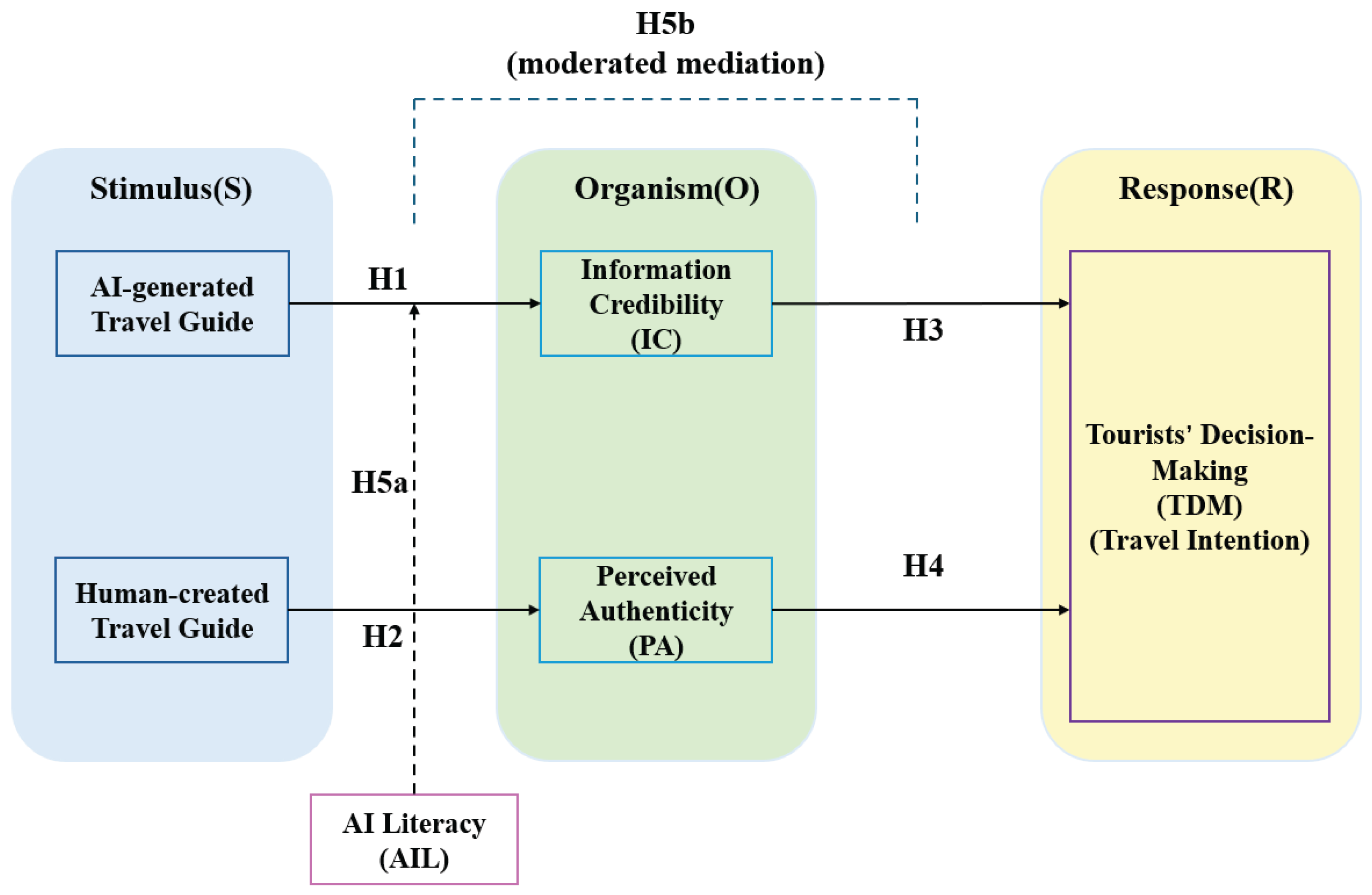
Table 1.
Demographic Characteristics of Participants.
| Variable | Category | N | Percentage (%) |
|---|---|---|---|
| Gender | Male | 143 | 47.7% |
| Female | 157 | 52.3% | |
| Age | 18–25 years | 92 | 30.7% |
| 26–35 years | 96 | 32.0% | |
| 36–45 years | 67 | 22.3% | |
| 46–55 years | 36 | 12.0% | |
| Above 55 years | 9 | 3.0% | |
| Education | High school or below | 42 | 14.0% |
| Associate degree | 63 | 21.0% | |
| Bachelor’s degree | 159 | 53.0% | |
| Master’s degree or above | 36 | 12.0% | |
| Monthly income | Below 3000 RMB | 51 | 17.0% |
| 3000–6000 RMB | 104 | 34.7% | |
| 6001–10,000 RMB | 91 | 30.3% | |
| Above 10,000 RMB | 54 | 18.0% | |
| Travel frequency (per year) | 0–1 times | 48 | 16.0% |
| 2–3 times | 117 | 39.0% | |
| 4–5 times | 86 | 28.7% | |
| More than 5 times | 49 | 16.3% |
Table 2.
Means and Standard Deviations of Tourists’ Decision-Making.
| Destination | Creator Type | N | Mean | SD |
|---|---|---|---|---|
| Mount Tai Scenic Area | AI-generated | 75 | 5.18 | 0.82 |
| Human-created | 75 | 5.86 | 0.73 | |
| Shanghai Disneyland | AI-generated | 75 | 5.82 | 0.77 |
| Human-created | 75 | 5.36 | 0.85 |
Table 3.
Reliability and Descriptive Statistics of Key Constructs.
| Construct | Items | Mean | SD | Cronbach’s α |
|---|---|---|---|---|
| Information Credibility (IC) | 4 | 5.31 | 0.83 | 0.89 |
| Perceived Authenticity (PA) | 4 | 5.16 | 0.86 | 0.91 |
| Tourists’ Decision-Making (TDM) | 3 | 5.58 | 0.80 | 0.88 |
Table 4.
Correlations Among Key Constructs.
| Variables | IC | PA | TDM |
|---|---|---|---|
| Information Credibility (IC) | 1 | ||
| Perceived Authenticity (PA) | 0.41 ** | 1 | |
| Tourists’ Decision-Making (TDM) | 0.56 ** | 0.47 ** | 1 |
Table 5.
Regression Results of the Parallel Mediation Model.
| Path | Effect | SE | t-Value | p-Value |
|---|---|---|---|---|
| Creator Type → Information Credibility | −0.32 | 0.08 | −4.00 | <0.001 |
| Creator Type → Perceived Authenticity | 0.38 | 0.08 | 4.75 | <0.001 |
| Information Credibility → Tourists’ Decision-Making | 0.41 | 0.07 | 5.86 | <0.001 |
| Perceived Authenticity → Tourists’ Decision-Making | 0.29 | 0.07 | 4.14 | <0.001 |
| Creator Type → Tourists’ Decision-Making (Total Effect) | 0.21 | 0.09 | 2.32 | 0.021 |
| Creator Type → Tourists’ Decision-Making (Direct Effect) | 0.10 | 0.08 | 1.25 | 0.214 |
Note. Creator type was dummy coded (0 = AI-generated travel guide, 1 = human-created travel guide).
Table 7.
Reliability Analysis of Constructs.
| Construct | Items | Cronbach’s α |
|---|---|---|
| Information Credibility (IC) | 4 | 0.89 |
| Tourists’ Decision-Making (TDM) | 3 | 0.88 |
| AI Literacy (AIL) | 6 | 0.91 |
Table 8.
Hierarchical Regression Results of the Moderating Effect of AI Literacy on Information Credibility.
Table 8.
Hierarchical Regression Results of the Moderating Effect of AI Literacy on Information Credibility.
| Variables | Model 1 | Model 2 |
|---|---|---|
| Dependent Variable | Information Credibility | Information Credibility |
| Travel Guide Creator Type | 0.09 | 0.07 |
| AI Literacy | 0.32 *** | 0.31 *** |
| Creator Type × AI Literacy | — | 0.18 ** |
| R2 | 0.18 | 0.21 |
| ΔR2 | — | 0.03 ** |
| F-value | 32.47 *** | 26.91 *** |
Note: * p < 0.05, ** p < 0.01, *** p < 0.001.
Table 9.
Moderated Mediation Results of AI Literacy on the Indirect Effect through Information Credibility.
Table 9.
Moderated Mediation Results of AI Literacy on the Indirect Effect through Information Credibility.
| AI Literacy Level | Indirect Effect | Boot SE | 95% Bootstrap CI |
|---|---|---|---|
| Low AI Literacy (−1 SD) | 0.06 | 0.03 | [0.01, 0.12] |
| Mean AI Literacy | 0.11 | 0.04 | [0.04, 0.19] |
| High AI Literacy (+1 SD) | 0.18 | 0.05 | [0.09, 0.28] |
Disclaimer/Publisher’s Note: The statements, opinions and data contained in all publications are solely those of the individual author(s) and contributor(s) and not of MDPI and/or the editor(s). MDPI and/or the editor(s) disclaim responsibility for any injury to people or property resulting from any ideas, methods, instructions or products referred to in the content. |
© 2026 by the authors. Licensee MDPI, Basel, Switzerland. This article is an open access article distributed under the terms and conditions of the Creative Commons Attribution (CC BY) license (http://creativecommons.org/licenses/by/4.0/).
Copyright: This open access article is published under a Creative Commons CC BY 4.0 license, which permit the free download, distribution, and reuse, provided that the author and preprint are cited in any reuse.


