

Submitted:
28 July 2026
Posted:
29 July 2026
You are already at the latest version
Abstract
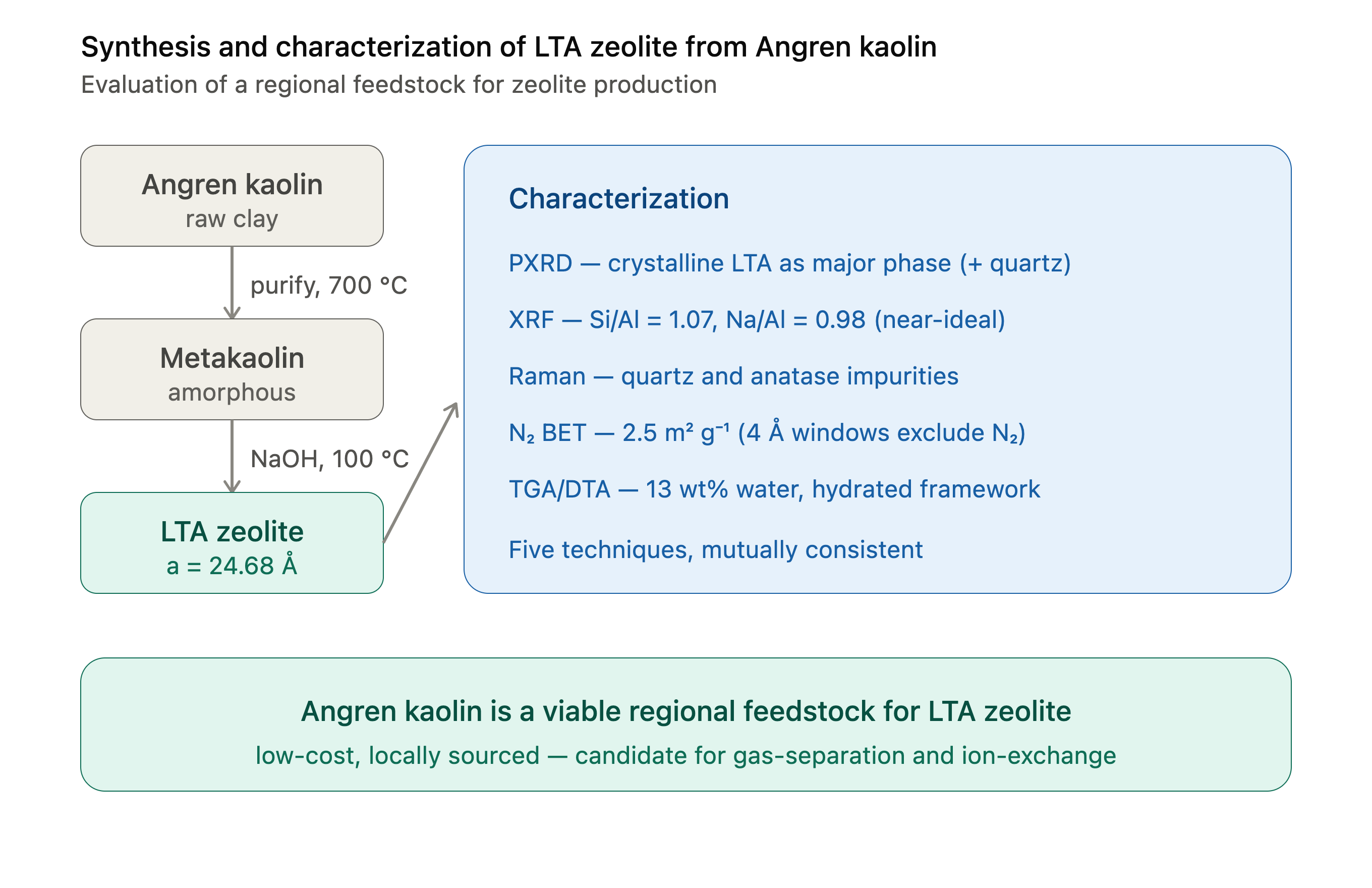
Linde Type A (LTA) zeolite was synthesized from purified Angren kaolin (Uzbekistan) by a metakaolin route. Raw kaolin was beneficiated by dispersion–decantation to reduce iron, calcined at 700 °C, and crystallized in NaOH solution at 100 °C. Products were characterized by powder X-ray diffraction (PXRD), X-ray fluorescence (XRF), Raman spectroscopy, N₂ physisorption and thermal analysis (TGA/DTA). PXRD confirmed crystalline LTA as the major phase (cubic lattice parameter a = 24.68 ± 0.02 Å), with residual quartz from the precursor. XRF gave a near-ideal bulk composition (Si/Al = 1.07, Na/Al = 0.98), confirming sodium incorporation, and Raman corroborated minor quartz and anatase impurities. The low N₂ BET area (~2.5 m² g⁻¹) reflects restricted access of the 4 Å LTA windows to N₂ at −196 °C rather than absence of microporosity. Thermogravimetric analysis showed a ~13 wt% loss of zeolitic water below 300 °C, confirming a hydrated microporous framework. Locally sourced Angren kaolin can thus be converted into crystalline LTA, a candidate material for gas-separation and ion-exchange applications.
Keywords:
kaolin
; metakaolin
; LTA zeolite
; hydrothermal synthesis
; X-ray diffraction
; Angren
1. Introduction
Kaolin is a widely distributed aluminosilicate clay whose principal mineral, kaolinite, possesses a 1:1 tetrahedral–octahedral (TO) layered structure built mainly from aluminium and silicon oxides. Depending on geological conditions, accessory species such as iron, titanium and manganese may be incorporated by isomorphic substitution or occur as separate mineral phases. Because of its comparatively low cation-exchange capacity and limited specific surface area, raw kaolin shows restricted adsorption performance. Converting it into crystalline zeolites is therefore an attractive route to higher-value materials, since zeolites combine ordered microporosity with large ion-exchange capacities, while the use of abundant natural kaolin provides a low-cost and sustainable aluminosilicate feedstock for their production [1,2].
Zeolites are crystalline aluminosilicates whose three-dimensional frameworks contain uniform molecular-sized pores and channels that impart molecular-sieving, adsorption and ion-exchange properties [3,4]. Among these materials, Linde Type A (LTA) is one of the most extensively used because of its well-defined cubic framework, uniform ~4 Å pore windows and high sodium-exchange capacity. These narrow apertures make the LTA/4A framework and its cation-exchanged forms particularly suitable for the adsorption and separation of small gas molecules such as CO₂, N₂ and CH₄ [5,6,7,8]. In such applications, molecular accessibility is governed by the relationship between adsorbate size and framework aperture dimensions.
LTA zeolite can be synthesised from kaolin by first dehydroxylating the clay to reactive amorphous metakaolin and subsequently crystallising it under alkaline hydrothermal conditions without the addition of external silica or alumina sources [1,9]. The characteristics of the resulting zeolite depend on both the precursor mineralogy and the synthesis conditions. Calcination temperature controls the reactivity of the metakaolin and influences the zeolite phase that crystallises [10], whereas the alkalinity of the reaction medium governs whether LTA or denser phases such as sodalite are preferentially formed [11,12]. Quartz present in the raw kaolin is largely unreactive under mild hydrothermal conditions and commonly persists as an impurity unless more aggressive activation methods, such as alkaline fusion, are employed [2]. Consequently, the suitability of a particular kaolin deposit for zeolite production depends not only on the synthesis procedure but also on the intrinsic mineralogical composition and impurity profile of the raw material.
Although the synthesis of LTA zeolite from kaolin is well established [1,9,10,13,14,15], the suitability of individual kaolin deposits for this purpose must be evaluated on a deposit-specific basis because variations in mineralogy and impurity content influence framework formation, product purity and final material properties. The Angren deposit in Uzbekistan represents a large and locally available source of kaolin whose conversion to LTA zeolite has not previously been characterised in detail. In the present study, purified Angren kaolin was converted to LTA zeolite through a metakaolin route and characterised by powder X-ray diffraction (PXRD), X-ray fluorescence (XRF), Raman spectroscopy, N₂ physisorption and thermal analysis (TGA/DTA). These complementary techniques were used to establish the phase composition, framework chemistry, textural characteristics and thermal behaviour of the product, thereby assessing the suitability of Angren kaolin as a regional feedstock for zeolite production. For comparison, a red kaolin from the Samarkand region—distinguished by its higher iron content and characteristic colour—was included as a compositional reference to evaluate the influence of precursor iron content alongside the Angren material.
2. Materials and Methods
2.1. Raw Materials
White kaolin from the Angren deposit and red kaolin from the Samarkand region (Uzbekistan) were used as the starting materials. The clays were supplied by local mining enterprises extracting kaolinitic clay associated with coal-bearing strata. Sodium hydroxide (NaOH) was used as the alkaline activator, and distilled water was used throughout the study. All chemicals were used as received without further purification.
2.2. Purification of Kaolin
The raw kaolins were purified by a dispersion–settling–decantation procedure to enrich the kaolinite fraction and reduce coarse mineral particles and iron-bearing impurities. The clay was dispersed in distilled water under continuous mechanical stirring and allowed to settle, after which the finer suspended fraction was recovered by decantation. This dispersion–settling–decantation cycle was repeated several times until a visibly cleaner clay fraction was obtained. The recovered material was dried and gently ground prior to further processing. The purified white (Angren) and red (Samarkand) kaolins were designated An-K and Sa-K, respectively. The procedure produced a distinct colour change from brown to off-white (Figure 1), consistent with the removal of iron-bearing impurities.
2.3. Calcination to Metakaolin
The purified kaolins were calcined in air in a muffle furnace at 700 °C for 12 h to convert crystalline kaolinite into reactive amorphous metakaolin through dehydroxylation, after which they were allowed to cool naturally to room temperature within the furnace. This temperature was selected in accordance with previous studies demonstrating efficient dehydroxylation of kaolinite into a reactive amorphous phase while avoiding recrystallisation into less reactive high-temperature phases such as spinel or mullite [1,2]. The metakaolin prepared from Angren kaolin was designated An-Mk; that prepared from Samarkand kaolin, Sa-Mk.
2.4. Hydrothermal Synthesis of LTA Zeolite
The synthesis conditions adopted in this study (3 mol L⁻¹ NaOH, 100 °C, and 24 h) were selected on the basis of previously reported hydrothermal protocols that favour crystallisation of the LTA framework from metakaolin under moderate alkaline conditions [9,11].
LTA zeolite was synthesised from An-Mk by static alkaline hydrothermal crystallisation. The metakaolin precursor was activated with aqueous sodium hydroxide using a NaOH-to-metakaolin molar ratio of 8:1, taking the nominal composition of metakaolin as Al₂Si₂O₇. The mixture was stirred to obtain a homogeneous aluminosilicate gel and then crystallised statically at 100 °C for 24 h in a sealed reaction vessel. The solid product was recovered by filtration, washed repeatedly with distilled water to remove residual alkali, and dried at 110 °C. The resulting material was designated Zeo-An. The same synthesis procedure was applied to the Samarkand metakaolin (Sa-Mk) to give a second product, designated Zeo-Sa; this material was examined by XRF only, as a compositional reference.
2.5. Characterisation
The mineralogical, chemical, spectroscopic, and textural properties of the synthesised materials were characterised using complementary analytical techniques.
Powder X-ray diffraction (PXRD). Patterns were collected on a Rigaku diffractometer equipped with a D/teX Ultra 250 detector, using Cu Kα radiation (λ = 1.5406 Å) operated at 40 kV and 50 mA with a Ni Kβ filter. Data were recorded over the 2θ range of 5–100° with a step size of 0.01° at a scan rate of 5° min⁻¹. Crystalline phases were identified by comparison with standard reference patterns for LTA zeolite, kaolinite, and quartz [4]. The cubic lattice parameter of the LTA phase was determined by indexing eight well-resolved reflections according to 1/d² = (h² + k² + l²)/a², and averaging the calculated values.
X-ray fluorescence (XRF). Bulk chemical compositions of the kaolins and synthesised zeolites were determined by X-ray fluorescence and are reported as oxide weight percentages normalised to 100% on a dry basis.
Raman spectroscopy. Raman spectra were acquired using 532 nm laser excitation over the range of approximately 100–3300 cm⁻¹ to identify the principal crystalline phases present.
N₂ physisorption. Nitrogen adsorption–desorption isotherms were measured at −196 °C; samples were degassed under vacuum prior to analysis. The specific surface area was calculated by the Brunauer–Emmett–Teller (BET) method over the relative-pressure range p/p₀ = 0.05–0.30.
Thermal analysis (TGA/DTA). Thermogravimetric and differential thermal analysis were carried out from room temperature to ~900 °C in air at a constant heating rate.
3. Results
3.1. Chemical Composition (XRF)
The bulk chemical compositions of the kaolins and the synthesised zeolites are summarised in Table 1. The purified kaolins are predominantly aluminosilicate, comprising ~54 wt% SiO₂ and ~42 wt% Al₂O₃, with only minor alkali- and alkaline-earth-oxide content. After purification, the Angren kaolin (An-K) contains marginally less Fe₂O₃ (1.51 wt%) than the Samarkand red kaolin (Sa-K, 1.59 wt%), and both kaolins contain ~1 wt% TiO₂; the pronounced colour contrast between the raw clays reflects primarily the state and distribution of the iron-bearing phases rather than the small difference in total iron content of the beneficiated fractions.
Conversion of An-K to the zeolite (Zeo-An) is accompanied by a pronounced rise in Na₂O content, from 0.02 to 20.59 wt%, while SiO₂ and Al₂O₃ decrease to 43.52 and 34.39 wt%, respectively. Expressed on a molar basis, the bulk Si/Al ratio of Zeo-An is 1.07, close to the value of unity expected for the LTA framework (the residual quartz identified by PXRD contributes to the SiO₂ content, so the Si/Al ratio of the zeolite framework itself lies marginally below this bulk value), and the Na/Al ratio is 0.98, closely matching the 1:1 stoichiometry required for charge compensation of framework aluminium by sodium in the fully sodium-exchanged form [4]. The Si/Al ratio is effectively preserved on conversion (1.08 in An-K versus 1.07 in Zeo-An), as expected because both silicon and aluminium are retained in the solid framework, whereas the large sodium uptake reflects incorporation of Na⁺ as the extra-framework charge-balancing cation [9].
A simple mass balance clarifies the behaviour of the minor oxides. Dilution by the ~20.6 wt% of added Na₂O alone would reduce each kaolin-derived oxide to ~79% of its original value; the observed SiO₂ and Al₂O₃ contents match this prediction, confirming framework retention. In contrast, Fe₂O₃ (1.51 → 0.67 wt%), TiO₂ (1.01 → 0.55 wt%) and K₂O (0.41 → 0.14 wt%) fall below the dilution line, indicating that a fraction of these species was additionally removed by partial dissolution during alkaline treatment and by washing.
The Samarkand-derived zeolite (Zeo-Sa) shows the same conversion signature—a comparable Na₂O uptake (19.82 wt%) and near-ideal framework stoichiometry (Si/Al = 1.11, Na/Al = 0.96)—confirming that LTA-type framework composition is obtained from both kaolin sources. Its slightly higher residual Fe₂O₃ (0.96 versus 0.67 wt% for Zeo-An) tracks the higher iron content of the Samarkand precursor, indicating that precursor iron is only partially removed during synthesis.
Detailed structural, spectroscopic and textural characterisation (PXRD, Raman, N₂ physisorption) was carried out on the Angren-derived zeolite (Zeo-An); the Samarkand material is considered here only at the level of bulk composition.
3.2. Phase Composition and Crystal Structure (PXRD)
The diffraction patterns of the precursor and the product are compared in Figure 2. The Angren kaolin precursor (Figure 2a) is dominated by kaolinite reflections—the basal 001 reflection near 12.3° 2θ (d ≈ 7.2 Å) and the 002 reflection near 24.8° 2θ—together with an intense quartz reflection at 26.6° 2θ. Following calcination and hydrothermal treatment, the kaolinite reflections disappear and are replaced by the characteristic diffraction pattern of LTA (Figure 2b), with sharp low-angle reflections at 7.15, 10.12, 12.41, 16.05, 21.60, 23.92, 27.04 and 29.87° 2θ, indexed respectively as the (200), (220), (222), (420), (600), (622), (642) and (644) planes of cubic LTA [4,13,15].
Indexing these eight reflections according to the cubic relation gives a lattice parameter of a = 24.68 ± 0.02 Å, in close agreement with the accepted value for the LTA framework (a ≈ 24.6 Å) and consistent with the Si/Al ≈ 1 composition determined by XRF. The narrow reflection widths indicate a well-crystallised material; a Scherrer estimate from the low-angle peaks corresponds to coherent scattering domains larger than ~80 nm, although the widths approach the instrumental resolution and this value should be regarded as a lower bound rather than a precise crystallite size.
A quartz reflection at 26.6° 2θ persists in the product and remains the single most intense peak in the pattern, showing that quartz inherited from the kaolin is retained alongside the zeolite. The prominence of this reflection overstates the quartz mass fraction, however, since quartz is a strong X-ray scatterer whereas the hydrated LTA phase scatters comparatively weakly; the bulk Si/Al ratio of 1.07 from XRF constrains the quartz content to only a few weight percent. No reflections attributable to sodalite or other competing zeolite phases were detected. The product is therefore described as crystalline LTA as the major phase, accompanied by residual quartz.
3.3. Raman Spectroscopy
The Raman spectra of Zeo-An (Figure 3) are weak and are dominated by three features: an intense low-frequency band near 142 cm⁻¹ and two weaker bands near 460 and 635 cm⁻¹. These positions do not correspond to the principal LTA framework modes but instead to the crystalline impurities present in the sample. The bands at ~142 and ~635 cm⁻¹ correspond to the two strongest Raman modes of anatase (TiO₂, at 144 and 639 cm⁻¹) [16], while the band at ~460 cm⁻¹ corresponds to the principal Raman band of quartz (≈464 cm⁻¹) [17,19]. Because anatase is an exceptionally strong Raman scatterer, even the ~1 wt% TiO₂ measured by XRF dominates the spectrum. The diagnostic LTA framework bands are comparatively weak under the conditions used and are not clearly resolved above the background. Vibrational characterisation in the present study was therefore carried out primarily by Raman spectroscopy; complementary FT-IR analysis, which probes the framework T–O–T (T = Si, Al) stretching and bending vibrations more directly, would provide additional confirmation of framework formation and is identified as a useful extension in future work. The Raman data thus provide an independent confirmation of the quartz and anatase impurities identified by PXRD and XRF, rather than a direct probe of the zeolite framework.
The diagnostic LTA framework bands are comparatively weak under the conditions used and are not clearly resolved above the background. Vibrational characterisation in the present study was therefore carried out primarily by Raman spectroscopy; complementary FT-IR analysis, which probes the framework T–O–T (T = Si, Al) stretching and bending vibrations more directly, would provide additional confirmation of framework formation and is identified as a useful extension in future work. The Raman data thus provide an independent confirmation of the quartz and anatase impurities identified by PXRD and XRF, rather than a direct probe of the zeolite framework.
3.4. Textural Properties (N₂ Physisorption)
The N₂ adsorption isotherm of Zeo-An, measured at −196 °C (Figure 4), shows very low uptake across most of the relative-pressure range, with a pronounced rise only as saturation is approached. The corresponding BET surface area is approximately 2.5 m² g⁻¹. Such a low apparent surface area is characteristic of as-synthesised sodium LTA and does not indicate an absence of microporosity. The eight-membered-ring windows of the LTA framework have an effective aperture of ~4 Å, and at −196 °C the diffusion of N₂ (kinetic diameter ≈ 0.36 nm) through apertures of this size is severely restricted, rendering the intracrystalline micropore volume effectively inaccessible to the probe molecule on the timescale of the measurement [6,18,20]. The measured surface area therefore reflects primarily the external crystal surfaces and the interparticle voids, while the shape of the isotherm—with its sharp uptake near saturation—is consistent with capillary condensation in the macroporous spaces between aggregated crystals rather than adsorption within the zeolite framework micropores.
3.5. Thermal Behaviour (TGA/DTA)
The thermal behaviour of the Angren kaolin precursor and the synthesised zeolite is compared in Figure 5. The kaolin precursor (An-K) shows a small mass loss of ~1% below 300 °C from desorption of physisorbed water, followed by a principal mass loss of ~8–10% between ~300 and 650 °C accompanied by a well-defined DTA endotherm centred at ~450 °C. This endotherm corresponds to the dehydroxylation of kaolinite and its conversion to amorphous metakaolin, and its completion below ~650 °C confirms that the calcination temperature of 700 °C used in this work is sufficient to fully dehydroxylate the clay. The measured structural-water loss is somewhat below the value expected for pure kaolinite (~14 wt% for ideal Al₂Si₂O₅(OH)₄), consistent with dilution of the kaolinite by the residual quartz identified by PXRD and XRF.
The synthesised zeolite (Zeo-An) shows a markedly different thermal profile. Its dominant feature is a large mass loss of ~13% below 300 °C, accompanied by a strong DTA endotherm peaking at ~121 °C, which is attributed to the desorption of zeolitic and loosely bound water from the LTA framework. A water content of this magnitude is characteristic of hydrated sodium LTA and provides independent, thermogravimetric evidence that the product is a hydrated microporous zeolite rather than a dehydroxylated or dense phase. Above 300 °C the zeolite loses only a further ~3% of its mass to 900 °C, indicating that the framework retains no significant hydroxyl content and is thermally stable once dehydrated. A weak DTA feature near ~450 °C, coincident with the dehydroxylation temperature of the precursor, is consistent with a minor amount of incompletely reacted aluminosilicate remaining in the product.
Taken together, the thermal data reinforce the picture established by the other techniques: the precursor is a quartz-bearing kaolinite that dehydroxylates cleanly below 700 °C, while the product is a hydrated, thermally stable LTA framework. The contrast between the ~450 °C dehydroxylation endotherm of the precursor and the ~121 °C dehydration endotherm of the product provides a clear thermal signature of the transformation from clay to zeolite.
4. Discussion
4.1. Formation of the LTA phase from Angren kaolin
The combined results establish that crystalline LTA zeolite forms from Angren kaolin through the conventional metakaolin route. Calcination at 700 °C dehydroxylates kaolinite to amorphous, reactive metakaolin; this temperature is high enough to complete dehydroxylation yet below the range in which metakaolin recrystallises to less reactive phases such as spinel, nepheline or mullite [1,10]. The choice of metakaolinisation temperature is known to influence the zeolite product: less fully transformed precursors tend to favour zeolite P, whereas more completely dehydroxylated metakaolin favours LTA [10,13,15]. The disappearance of all kaolinite reflections in the product (Figure 2) confirms that dehydroxylation and subsequent framework reorganisation proceeded to completion under the conditions employed.
The convergence of complementary structural and chemical evidence provides strong support for successful framework assembly. PXRD identifies the characteristic LTA diffraction pattern with a = 24.68 Å, while XRF gives a bulk Si/Al ratio of 1.07 and, critically, Na/Al = 0.98; these results are mutually consistent because a near-unity framework requires approximately one charge-balancing sodium cation per framework aluminium, as observed. The near-ideal Na/Al stoichiometry is a particularly robust indicator that the sodium incorporated during synthesis functions as the framework-compensating cation rather than as an adventitious surface phase. The preservation of the Si/Al ratio between precursor and product further indicates that the transformation is primarily a reorganisation of the existing aluminosilicate into the zeolitic framework, with sodium and water incorporated during crystallisation rather than substantial loss or gain of silicon or aluminium.
The single set of synthesis conditions used here (3 mol L⁻¹ NaOH, 100 °C, 24 h) lies within the moderate-alkalinity regime reported to favour LTA formation. Higher hydroxide concentrations are known to promote recrystallisation of LTA into the denser sodalite framework, whereas concentrations in the ~2–4 mol L⁻¹ range typically yield LTA as the dominant phase [9,11]. The transformation of LTA to sodalite under more strongly caustic conditions is well documented and is sensitive to solution chemistry [12]. The absence of sodalite reflections in the present product therefore indicates that the synthesis conditions remained within the LTA-favouring crystallisation window.
4.2. Residual quartz and the limits of phase purity
The principal factor limiting the phase purity of the product is the residual quartz inherited from the kaolin precursor. It remains the most intense reflection in the PXRD pattern of the zeolite (Figure 2b), is detected as the ~460 cm⁻¹ Raman band (Figure 3), and contributes to the SiO₂ content measured by XRF. Quartz is largely unreactive under the mild alkaline conditions employed in this study and therefore survives both calcination and hydrothermal treatment essentially unchanged. Its persistence indicates that the beneficiation procedure, although effective at reducing iron-bearing impurities (as evidenced by the colour change in Figure 1 and the decrease in Fe₂O₃ shown in Table 1), does not remove the finely intergrown quartz associated with the raw kaolin. Reducing the residual quartz would require either more selective beneficiation of the raw material or more aggressive activation. Alkaline fusion of the precursor before hydrothermal treatment, for example, dissolves quartz much more completely than direct hydrothermal activation; however, this more aggressive approach also alters the silica-to-alumina balance available for crystallisation and may shift the product towards other framework types, such as zeolites X and Y, rather than guaranteeing higher-purity LTA [2,14]. Such modifications fall outside the scope of the present study but represent a logical direction for improving phase purity.
4.3. Textural Behaviour and Its Implications
The very low N₂-derived BET surface area (~2.5 m² g⁻¹) warrants careful interpretation because it could otherwise be mistaken as evidence of a poorly porous material. The PXRD and XRF results demonstrate, however, that a well-crystallised LTA framework has formed, and the LTA framework is intrinsically microporous. The apparent contradiction is resolved by recognising that N₂ at −196 °C cannot readily diffuse through the ~4 Å windows of sodium LTA on the timescale of the measurement. This low-temperature diffusion limitation is well established for nitrogen sorption on narrow-pore zeolites, where uptake is governed by activated transport through the framework apertures rather than by the intrinsic micropore volume [6,18,20]. The N₂ adsorption isotherm reported here should therefore be interpreted as a measure of the external crystal surface and interparticle voids rather than of the intrinsic microporosity of the zeolite framework.
This distinction is directly relevant to the intended applications of the material. The narrow, uniform ~4 Å windows of sodium LTA that restrict N₂ diffusion at −196 °C are precisely the feature that makes the LTA/4A framework valuable as a molecular sieve, and zeolite A together with its cation-exchanged forms has been widely investigated for the adsorption and separation of small gas molecules such as CO₂, N₂ and CH₄ [5,6,7,8]. The adsorption performance of the present material for such applications will therefore depend primarily on the accessibility of the framework and its cation composition rather than on the N₂-derived BET surface area, and should ultimately be evaluated using probe molecules and experimental conditions appropriate to the target adsorbate.
4.4. Comparison with Previous Work and Outlook
The behaviour observed here is consistent with previous reports of LTA synthesis from kaolin and metakaolin by the hydrothermal route, in which calcination of kaolin followed by dissolution in NaOH and crystallisation at ~100 °C for ~24 h yields LTA without the addition of external silica or alumina sources [1,9,13].
Taken together, the results establish that Angren kaolin is a suitable regional feedstock for LTA zeolite synthesis. Although residual quartz and minor iron- and titanium-bearing phases remain after processing, purified Angren kaolin is successfully converted by a conventional metakaolin route into a well-crystallised LTA framework with near-ideal Si/Al and Na/Al stoichiometry. This conclusion is supported consistently by complementary structural, chemical, spectroscopic, textural and thermal characterisation.
The distinguishing feature of the present study is therefore not the synthesis route itself, which is well established, but the demonstration that this locally available Uzbek kaolin can serve as an effective precursor for producing well-crystallised LTA zeolite with near-ideal Si/Al and Na/Al stoichiometry using a straightforward hydrothermal process. Building on this fully characterised material, future work will focus on reducing the residual quartz through improved beneficiation or modified activation, completing the characterisation by FT-IR spectroscopy and electron microscopy, and directly evaluating the gas-adsorption behaviour of the material (for example, towards CO₂ and N₂) under controlled equilibrium and kinetic conditions.
5. Conclusions
Crystalline LTA zeolite was synthesised from purified Angren kaolin (Uzbekistan) through a metakaolin route involving dispersion–decantation beneficiation, calcination at 700 °C, and static hydrothermal crystallisation in NaOH solution at 100 °C. The product was characterised by a combination of PXRD, XRF, Raman spectroscopy, N₂ physisorption and TGA/DTA, and these complementary techniques provide a mutually consistent picture of the material. PXRD identified LTA as the dominant crystalline phase, with a refined cubic lattice parameter of a = 24.68 ± 0.02 Å, while XRF yielded a near-ideal bulk composition (Si/Al = 1.07; Na/Al = 0.98), confirming that sodium is incorporated as the charge-balancing cation of the zeolite framework. Raman spectroscopy did not resolve the characteristic LTA framework modes but independently confirmed the presence of minor quartz and anatase impurities also detected by XRF. The low N₂-derived BET surface area (~2.5 m² g⁻¹) was shown to reflect the restricted diffusion of N₂ through the ~4 Å windows of sodium LTA at −196 °C rather than an absence of framework microporosity. Thermogravimetric analysis further demonstrated a ~13 wt% loss of zeolitic water below 300 °C, confirming a hydrated microporous framework, while the precursor exhibited the characteristic kaolinite dehydroxylation endotherm near 450 °C.
The principal limitation of the product is the residual quartz inherited from the kaolin precursor, which survives the synthesis essentially unchanged and prevents complete phase purity. Nevertheless, the results demonstrate that low-cost, locally sourced Angren kaolin is a viable regional feedstock for LTA zeolite synthesis, yielding a well-crystallised product with near-ideal Si/Al and Na/Al stoichiometry and providing a fully characterised foundation for further development. Future work will focus on reducing the residual quartz through more selective beneficiation or modified activation, completing the characterisation by FT-IR spectroscopy and electron microscopy, and directly evaluating the gas-adsorption performance of the material, for example towards CO₂ and N₂, under controlled equilibrium and kinetic conditions.
Author Contributions
Conceptualization, synthesis and investigation, A.A.; characterization and data analysis, O.E. and B.T.; writing—original draft, A.A.; writing—review and editing, all authors. All authors have read and agreed to the published version of the manuscript.
Funding
This research received no external funding.
Data Availability Statement
The data supporting the findings of this study are available from the corresponding author upon reasonable request.
Conflicts of Interest
The authors declare no conflict of interest.
References
- Miao, Q.; Zhou, Z.; Yang, J.; Lu, J.; Yan, S.; Wang, J. Synthesis of NaA zeolite from kaolin source. Front. Chem. Eng. China 2009, 3, 8–11. [Google Scholar] [CrossRef]
- Otieno, S.O.; Kengara, F.O.; Kemmegne-Mbouguen, J.C.; Langmi, H.W.; Kowenje, C.B.O.; Mokaya, R. The effects of metakaolinization and fused-metakaolinization on zeolites synthesized from quartz rich natural clays. Microporous Mesoporous Mater. 2019, 290, 109668. [Google Scholar] [CrossRef]
- E.M. Flanigen, Zeolites and molecular sieves: An historical perspective. In Stud. Surf. Sci. Catal.; Elsevier: Amsterdam, 2001; vol. 137, pp. 11–35. [CrossRef]
- McCusker, L.B.; Baerlocher, C. Zeolite structures. In Stud. Surf. Sci. Catal.; Elsevier: Amsterdam, 2007; vol. 168, pp. 13–37. [Google Scholar] [CrossRef]
- Hernández-Huesca, R.; Díaz, L.; Aguilar-Armenta, G. Adsorption equilibria and kinetics of CO₂, CH₄ and N₂ in natural zeolites. Sep. Purif. Technol. 1999, 15, 163–173. [Google Scholar] [CrossRef]
- Aguilar-Armenta, G.; Hernandez-Ramirez, G.; Flores-Loyola, E.; Ugarte-Castaneda, A.; Silva-Gonzalez, R.; Tabares-Munoz, C.; Jimenez-Lopez, A.; Rodriguez-Castellon, E. Adsorption kinetics of CO₂, O₂, N₂, and CH₄ in cation-exchanged clinoptilolite. J. Phys. Chem. B 2001, 105, 1313–1319. [Google Scholar] [CrossRef]
- Tao, Z.; Tian, Y.; Wu, W.; Liu, Z.; Fu, W.; Kung, C.-W.; Shang, J. Development of zeolite adsorbents for CO₂ separation in achieving carbon neutrality. npj Mater. Sustain. 2024, 2 20. [Google Scholar] [CrossRef]
- Choi, H.L.; Jeong, Y.; Ha, S.; Bae, T.-H. Hierarchical core–shell CaA zeolite fillers via impregnation-assisted synthesis for enhanced CO₂/N₂ separation in mixed-matrix membranes. J. Membr. Sci. 2025, 736, 124714. [Google Scholar] [CrossRef]
- Sazali, N.; Harun, Z. One shot of the hydrothermal route for the synthesis of zeolite LTA using kaolin. In Inorg. Organomet. Polym. Mater.; J., Ed.; 2022; Volume 32, pp. 3508–3520. [Google Scholar] [CrossRef]
- Novembre, D.; di Sabatino, B.; Gimeno, D.; Pace, C. Synthesis and characterization of Na-X, Na-A and Na-P zeolites and hydroxysodalite from metakaolinite. Clay Miner. 2011, 46, 339–354. [Google Scholar] [CrossRef]
- Gordina, N.E.; Prokof'ev, V.Y.; Kul'pina, Y.N.; Hmylova, O.E.; Gazahova, S.I.; Petuhova, N.V. Synthesis of granulated binder-free LTA zeolite from metakaolin using ultrasonic treatment. J. Porous Mater. 2017, 24, 667–678. [Google Scholar] [CrossRef]
- Wang, S.; Vaughan, J.; Xia, F.; Etschmann, B.; Brugger, J.; Brand, H.; Peng, H. Revealing the effect of anions on the formation and transformation of zeolite LTA in caustic solutions: An in situ synchrotron PXRD study. Cryst. Growth Des. 2023, 23, 3660–3670. [Google Scholar] [CrossRef]
- Rios, C.A.; Williams, C.D.; Fullen, M.A. Nucleation and growth history of zeolite LTA synthesized from kaolinite by two different methods. Appl. Clay Sci. 2009, 42, 446–454. [Google Scholar] [CrossRef]
- Salimkhani, S.; Siahcheshm, K.; Kadkhodaie, A.; Salimkhani, H. Structural analysis and the effect of chromium on LTA (Na) zeolite synthesized from kaolin. Mater. Chem. Phys. 2021, 271, 124957. [Google Scholar] [CrossRef]
- Fotsop, C.G.; Lieb, A.; Scheffler, F. Tailoring the water vapor adsorption properties and thermal performance analysis of post-synthetically ion-exchanged LTA zeolite derived from Cameroonian kaolin. J. Ind. Eng. Chem. 2025, 155, 683–698. [Google Scholar] [CrossRef]
- Ohsaka, T.; Izumi, F.; Fujiki, Y. Raman spectrum of anatase, TiO₂. J. Raman Spectrosc. 1978, 7, 321–324. [Google Scholar] [CrossRef]
- Schmidt, C.; Ziemann, M.A. In-situ Raman spectroscopy of quartz: A pressure sensor for hydrothermal diamond-anvil cell experiments at elevated temperatures. Am. Mineral. 2000, 85, 1725–1734. [Google Scholar] [CrossRef]
- Hernández, M.A.; Rojas, F.; Lara, V.H. Nitrogen-sorption characterization of the microporous structure of clinoptilolite-type zeolites. J. Porous Mater. 2000, 7, 443–454. [Google Scholar] [CrossRef]
- Stacey, P.; Hall, S.; Stagg, S.; Clegg, F.; Sammon, C. Raman spectroscopy and X-ray diffraction responses when measuring health-related micrometre and nanometre particle size fractions of crystalline quartz and the measurement of quartz in dust samples from the cutting and polishing of natural and artificial stones. J. Raman Spectrosc. 2021, 52, 1095–1107. [Google Scholar] [CrossRef]
- Zelenka, T. Adsorption and desorption of nitrogen at 77 K on micro- and mesoporous materials: Study of transport kinetics. Microporous Mesoporous Mater. 2016, 227, 202–209. [Google Scholar] [CrossRef]
Figure 1.
Purification of Angren kaolin.
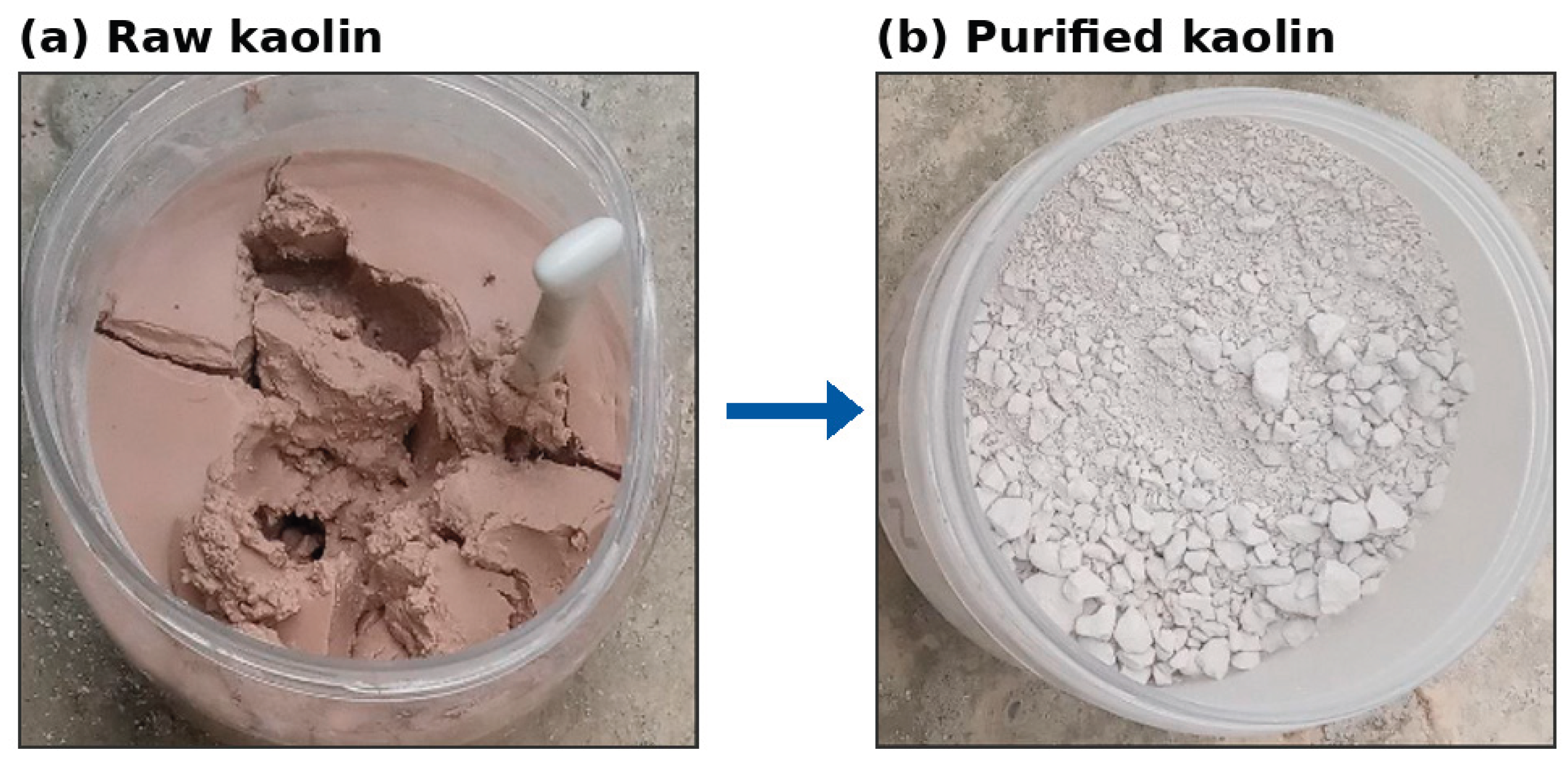
Figure 2.
PXRD patterns of the kaolin precursor and the LTA product.
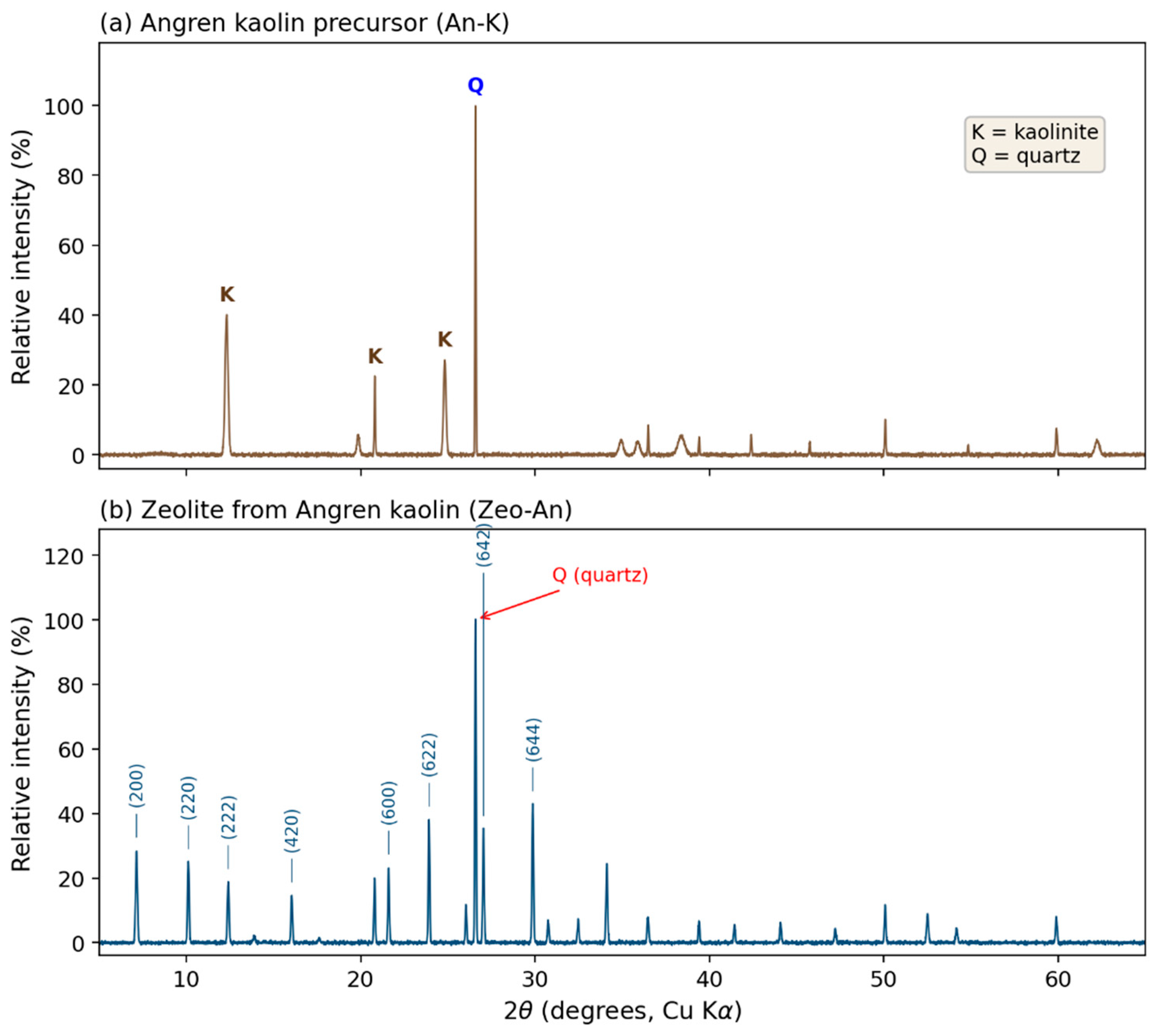
Figure 3.
Raman spectra of the synthesized zeolite.
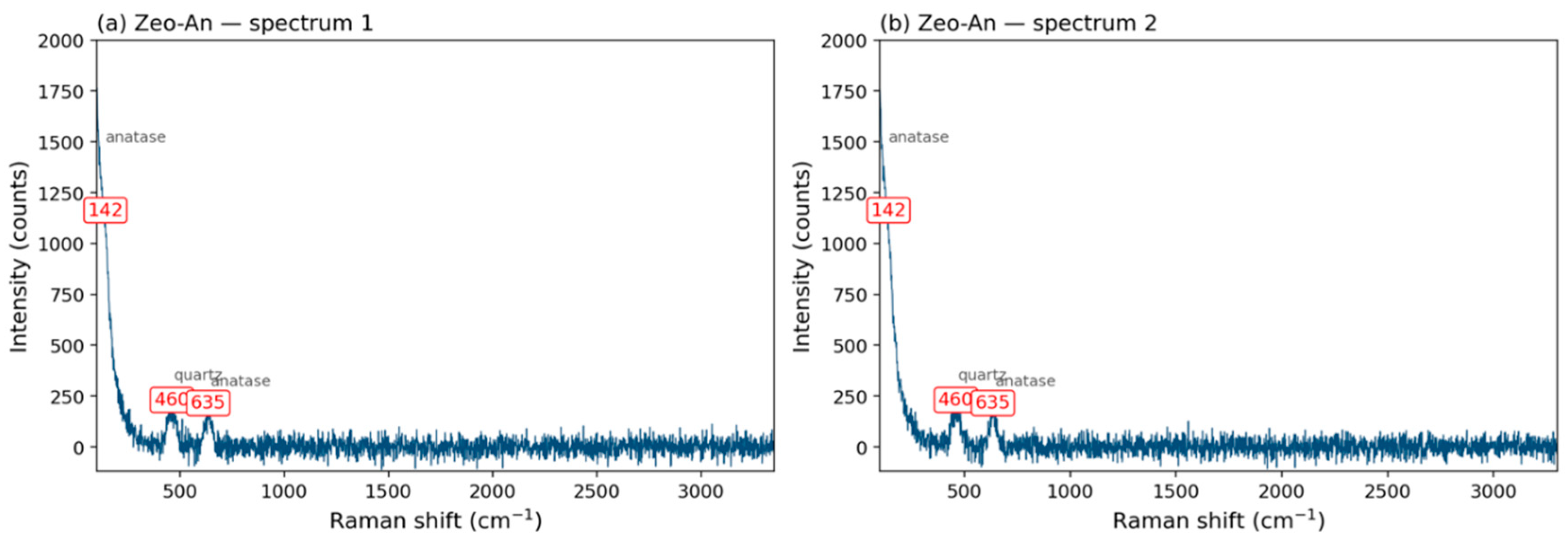
Figure 4.
N₂ adsorption isotherm of Zeo-An.
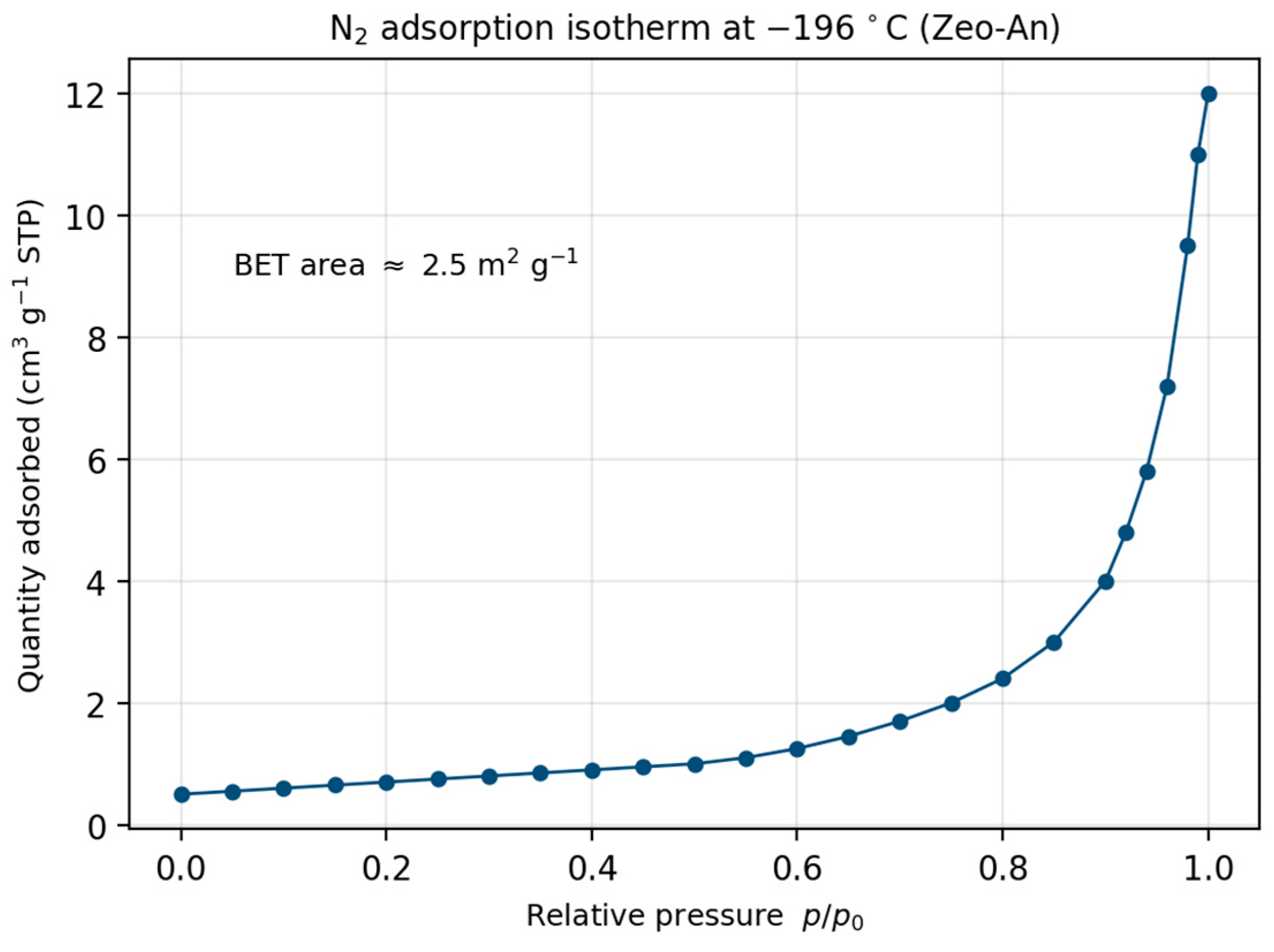
Figure 5.
TGA/DTA curves of the Angren kaolin precursor (An-K) and the synthesized zeolite (Zeo-An).
Figure 5.
TGA/DTA curves of the Angren kaolin precursor (An-K) and the synthesized zeolite (Zeo-An).
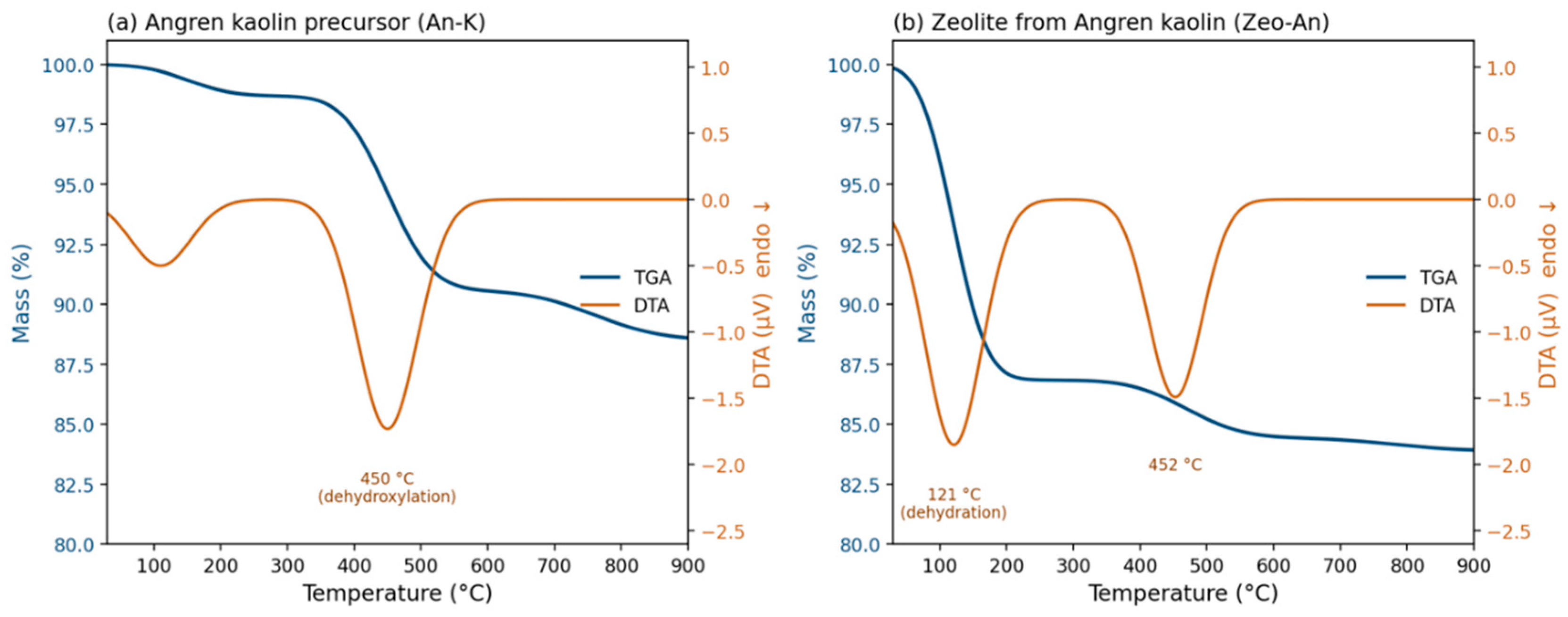

Table 1.
Chemical composition and molar ratios of the kaolins (An-K, Sa-K) and synthesized zeolites (Zeo-An, Zeo-Sa) by XRF.
Table 1.
Chemical composition and molar ratios of the kaolins (An-K, Sa-K) and synthesized zeolites (Zeo-An, Zeo-Sa) by XRF.
| Sample | SiO₂ | Al₂O₃ | Fe₂O₃ | MgO | CaO | Na₂O | K₂O | TiO₂ | Si/Al | Na/Al |
| An-K | 54.24 | 42.61 | 1.51 | 0.15 | 0.04 | 0.02 | 0.41 | 1.01 | 1.08 | 0.00 |
| Sa-K | 54.06 | 42.60 | 1.59 | 0.18 | 0.13 | 0.02 | 0.41 | 1.00 | 1.08 | 0.00 |
| Zeo-An | 43.52 | 34.39 | 0.67 | 0.11 | 0.03 | 20.59 | 0.14 | 0.55 | 1.07 | 0.98 |
| Zeo-Sa | 44.35 | 33.82 | 0.96 | 0.11 | 0.02 | 19.82 | 0.26 | 0.66 | 1.11 | 0.96 |
Note: Oxide values in wt%, normalized to 100% on a dry basis; MnO < 0.01 wt% in all samples. Si/Al and Na/Al are molar ratios calculated from the oxide compositions.
Disclaimer/Publisher’s Note: The statements, opinions and data contained in all publications are solely those of the individual author(s) and contributor(s) and not of MDPI and/or the editor(s). MDPI and/or the editor(s) disclaim responsibility for any injury to people or property resulting from any ideas, methods, instructions or products referred to in the content. |
© 2026 by the authors. Licensee MDPI, Basel, Switzerland. This article is an open access article distributed under the terms and conditions of the Creative Commons Attribution (CC BY) license (http://creativecommons.org/licenses/by/4.0/).
Copyright: This open access article is published under a Creative Commons CC BY 4.0 license, which permit the free download, distribution, and reuse, provided that the author and preprint are cited in any reuse.