
Submitted:
28 July 2026
Posted:
29 July 2026
You are already at the latest version
Abstract
The aim of this scientific article is to identify the key aspects of the concept of corporate social responsibility (CSR) and to quantify their impact on employee stability (ES). The subject of the research was selected aspects of CSR (strategic CSR management; effective implementation & communication; financial commitment; internal use & employee satisfaction; internal dissemination) and ES (organizational image; ethical corporate culture; safety and health protection; rewards, KPI and loyalty; growth through training). The quantitative research was carried out using a uniquely created questionnaire. The research sample contained 442 key managers from the business environment of the Czech Republic. The statistical hypotheses were evaluated using the structural equation modeling (SEM) method. The quantitative research revealed interesting findings. There are direct positive effects of the use of the aspects of the CSR concept on employee stability. Effective implementation & communication, together with financial commitment, are the most significant determinants that directly influence employee stability. A surprising finding is that growth through training has no links to employee stability. On the contrary, organizational image, together with rewards and loyalty, are the key aspects with links to employee stability. The findings bring new impulses for owners and top managers, who are the key persons responsible for the management and sustainable growth of the enterprise and its activities.
Keywords:
corporate social responsibility
; employee stability
; human resource management
; structural equation modeling
; small and medium-sized enterprises
1. Introduction
Human resource management (HRM) has, over the past decade, shifted from an administrative support function to a strategic discipline whose primary goal is to ensure the competitiveness of the enterprise through the acquisition, development, and retention of qualified workers [1,2,3,4,5,6]. One of the key indicators of the effectiveness of this function is employee stability, that is, the organization’s ability to retain workers over the long term and minimize their voluntary turnover. Turnover represents a significant economic burden for the enterprise, associated with the costs of recruitment, adaptation, and the loss of institutional knowledge [7,8]. Extensive meta-analyses confirm that the strongest predictors of the intention to leave an organization are job satisfaction and organizational commitment [1,7,9,10,11], while work-environment factors such as disrespectful behavior or an unhealthy work climate also have a negative effect [12]. Employee stability is therefore not the result of a single instrument but of the synergistic action of strategic HRM practices. A special role in this process is played by the fit between the values of the individual and the values of the organization (person–organization fit), which is a proven predictor of job satisfaction, engagement, and lower intention to leave [4,5,13,14].
It is precisely in the connection between the values of the employee and the values of the enterprise that space opens up for the concept of corporate social responsibility (CSR). Meta-analytic evidence shows that employees’ perception of CSR activities is positively related to organizational identification, engagement, and satisfaction, and negatively related to the intention to leave the enterprise [10,15,16,17]. This relationship is explained primarily by social identity theory: a socially responsible firm increases the prestige of membership and strengthens the worker’s affective bond to the organization [18,19,20]. Attitudes toward CSR differ according to employees’ demographic characteristics, for example by age, gender, and educational attainment [21]. Research also suggests that internal CSR aimed directly at employees reduces the intention to leave more strongly than externally oriented CSR [5,10,19,22,23,24]. The linkage of HRM and CSR thus becomes an independent source of positive performance outcomes for the enterprise [25].
The motivation for writing this article is the growing strategic urgency of this relationship in the current business environment. European enterprises face a long-term shortage of qualified labour and intensified competition for talent, which increases the importance of instruments for attracting and retaining them [26]. At the same time, the reporting of social and environmental impacts is changing from a voluntary activity into a regulatory obligation; the EU Corporate Sustainability Reporting Directive (CSRD) significantly expands the range of firms that must transparently report their CSR activities [4,27,28]. Understanding how CSR influences employee stability therefore acquires not only an academic but also a practical and normative dimension [29].
The empirical research of this article is spatially anchored in the Central European environment, specifically in the Czech Republic. This region has its specifics stemming from the transformation from centrally planned economies to market economies, as a result of which CSR was introduced into the region later and predominantly from the outside — through multinational enterprises and institutional pressure [30]. The business structure of the Visegrad Group (V4) countries is dominantly formed by small and medium-sized enterprises, for which CSR represents a relatively newer challenge than for large corporations [30,31,32]. Newer research also confirms that under V4 conditions, HRM and CSR, together with financial management, constitute significant determinants of the long-term sustainability of small and medium-sized enterprises [33].
Despite the growing number of studies on the relationship between CSR and employee attitudes, Central and Eastern Europe remains insufficiently explored in this area [30,32]. Moreover, most of the existing evidence examines individual attitudes (satisfaction, engagement, identification) in isolation, while an integrated and quantified model that would comprehensively connect selected aspects of the CSR concept with employee stability under the conditions of Central European enterprises is lacking [34]. Our article fills this gap by identifying, on a representative sample of Czech enterprises, the key aspects of corporate social responsibility and, through factor analysis and structural equation modeling (SEM), quantifying their impact on employee stability. The aim of the scientific article is therefore to identify the key aspects of the concept of corporate social responsibility and to quantify their impact on employee stability.
Employee satisfaction is an important aspect of business, and this is especially the case in the Central European countries (Poland, the Czech Republic, Hungary, Slovakia). These countries are undergoing significant structural changes in the areas of human resources due to unfavourable demographic and social challenges. These include: the declining birth rate; the level of language literacy of Generation Z; the proximity to strong Western economies with better salary conditions. The concept and aspects of CSR are a possible path for enterprises to improve and stabilize the quality of human resources in the context of their sustainability. The uniquely created questionnaire reflects the significant elements of the CSR and ES aspects. The model of relationships proposed by us is the subject of statistical evaluation using structural equation modeling. The verification of the proposed model will contribute to the discussion and analysis of the key elements of employee stability with regard to the determination and quantification of the effects of the selected aspects of CSR.
2. Theoretical Background
2.1. Corporate Social Responsibility
The concept of corporate social responsibility (CSR) of firms has, in the modern business environment, transformed from a purely voluntary activity into a strategic necessity that defines the organization’s moral commitment toward both internal and external stakeholders [3,35,36,37,38]. Although research in the past focused primarily on the institutional level and impacts on external subjects, employees are today perceived as key stakeholders of any CSR program [17,39,40]. In the international context, CSR serves as an effective instrument for building partnerships and preventing social crises, thereby contributing to the sustainable development of civilization [37].
2.1.1. The Use of CSR in the Enterprise
The use of CSR in the enterprise is no longer perceived merely as an ethical gesture but as an instrument for building shared value that brings benefit both to society and to the firm itself. Enterprises use CSR to strengthen their reputation, increase customer trust, and achieve a competitive advantage [14,31,38,41]. In a broader sense, CSR represents a powerful statement about who the organization is and what it stands for [42]. These activities are often aimed at building goodwill within the community, which goes beyond the scope of legal obligations [42]. For modern firms, CSR is a necessity that directly affects success in recruiting and retaining employees [15,41,43,44,45,46]. Especially among the millennial generation and Generation Z, CSR initiatives have a stronger impact on the perception of alignment between personal values and the firm’s values [21,28,42,46]. Firms involved in CSR are moreover more attractive to innovative candidates, which strengthens their creative potential [47]. Individuals more often identify with organizations that display social and environmental sensitivity [43,48]. This process of identification directly influences employees’ motivation and commitment toward the enterprise [42,49,50,51,52]. The use of CSR thus becomes a key element of the micro-foundations of strategy, where individual employee perspectives shape the effectiveness of company-wide initiatives [43,48]. The effect of CSR on employee attitudes is often explained in the literature through social identity theory, whereby a socially responsible firm increases the prestige and self-esteem of its workers [1,16,39,41,52,53]. Research shows that employees’ perception of external CSR activities has a stronger positive impact on their satisfaction if these activities are combined with high-quality internal CSR [39].
2.1.2. Implementation of CSR in the Enterprise
The implementation of CSR requires a deep strategic shift in how the organization thinks about its culture and daily operations [36,54,55]. Rather than remaining at the level of communication or public relations, effective implementation reaches into management systems, the development of employees’ competencies, and organizational learning. The CSR strategy therefore ceases to be perceived as an external supplement and becomes part of the organizational identity [56]. The human resources department plays an essential role in this process, because it is entrusted with educating employees about the values of responsibility [16,42]. HR professionals create action plans and ensure control over the introduction of sustainable practices [42]. Within CSR management, management must prioritize activities on the basis of a materiality analysis that maps the interests of stakeholders [57]. The structure of the board of directors and ethical leadership are key to overseeing CSR practices and ensuring a corporate culture free of discrimination [43,58,59,60,61]. For effective implementation, it is essential that the rules and procedures governing employee behavior be in line with CSR values, whereby hierarchical cultures tend to use more formalized structures and policies [62]. Effective CSR management moreover includes monitoring social impacts, such as education or the health and safety of employees [47,63,64,65]. It turns out that supporting a culture of safety through CSR increases job satisfaction and loyalty [64,65,66]. CSR simultaneously serves as prevention of deviant behavior in the workplace [16,67].
2.1.3. Economic Aspects and Dissemination of CSR
The financing and economic impact of CSR are the subject of intense debate, with modern research suggesting a positive correlation between CSR and the market value of the firm [15,38,68,69]. Large enterprises often have specific budgets for CSR and place emphasis on measuring the return on investment in order to demonstrate that CSR expenditures are not wasteful. According to modern financial analyses, firms with high performance in the area of CSR tend to attract more investors [43,55,69]. Investors increasingly rely, in their decision-making, on the reporting of social and environmental factors [43]. The disclosure of CSR activities helps reduce the information asymmetry between managers and shareholders, which subsequently lowers the cost of capital [69]. Investment in employee education appears, within CSR, to be a more cost-effective instrument for reducing turnover than raising wages [70,71], whereby an effective reward system and employee welfare (wellbeing) programmes form the backbone of a human resource policy that, in the long run, fundamentally influences the overall performance of the organization [72].
Dissemination, that is, the communication of CSR activities, is essential for realizing business benefits but carries the risk of skepticism or accusations of greenwashing [15,42,45]. The success of initiatives depends on the organization’s ability to communicate activities comprehensibly and transparently [16,42]. The use of standardized frameworks increases the credibility of reports in the eyes of investors and employees [28,55,69]. The use of modern technologies for text mining from reports enables a deeper analysis of social impacts and their comparability across sectors [47]. In the context of recruitment, CSR serves as an important signal to potential candidates about the working conditions and culture of the firm [16,45,73].
2.2. Personnel Management and Employee Stability
Employee stability represents a key indicator of the success and long-term sustainability of enterprises, which includes the organization’s ability to retain qualified workers and minimize turnover [44,74]. In the context of CSR, employee stability is understood as a manifestation of a responsible approach to human resources and an investment in long-term relationships with employees [75,76].
2.2.1. Strategic HRM Practices and Their Influence on Stability
Employee stability, defined as the process of encouraging workers to remain in the organization for the maximum possible time, is key to the enterprise’s competitiveness [2,38]. High turnover can cost a firm up to double the annual salary of the departing worker, which makes retention a priority especially in technology sectors [77]. Strategic HRM practices, such as high-quality recruitment, selection, and subsequent onboarding, form the basis for retaining talent [8]. Investment in education and professional development is identified as one of the strongest factors influencing employees’ intention to stay in the organization [8,70,71,78]. Employees who have access to development programs feel the necessary reciprocity to return to the organization the investment made in the employee themselves, which increases their identification with the organization and reduces turnover [8,79].
2.2.2. Organizational Image and Employer Branding
An attractive image of the organization is, in the current highly competitive environment, an indispensable precondition for attracting and retaining talented workers [41,73]. Companies use CSR activities as a strategic instrument to strengthen their reputation and to differentiate themselves from the competition, which directly influences the intention of job applicants to work in the enterprise [45,46]. Employer attractiveness is formed by several dimensions: social value, economic value, development value, and the possibility of creativity [80]. Research conducted on a sample of 445 job applicants combining a quantitative experiment and 36 focus-group discussions showed that consistent positive signals from the employer’s website increase its attractiveness, whereas contradictory information on review portals can damage it [73]. Another study on a sample of 490 respondents from Germany, Switzerland, and Austria confirmed that for multinational firms from emerging markets CSR is a key signal for overcoming negative prejudices about the country of origin and for increasing applicants’ willingness to work for them [45]. The image of the organization as a source of competitive advantage was also confirmed by research among 253 large Polish enterprises, where a direct correlation between the implementation of CSR and positive perception of the firm in the market was demonstrated [38]. The perception of employer brand attractiveness is moreover, among Generation Z and millennials, strongly linked to ethical leadership and diversity in the workplace [20,46,81]. The availability of information about the firm on social media additionally strengthens the relationship between the enterprise’s reputation and applicants’ willingness to apply for a job [80].
2.2.3. Reward Systems and Benefits
Remuneration remains a critical factor influencing employee stability across generations [78,82,83]. An effective reward system must combine financial and non-financial components [63,78]. While a competitive wage is an essential foundation, lucrative benefit packages act as a long-term retention tool [8,82]. Within internal employer branding, reward and recognition play a key role in increasing worker engagement [77]. Highly valued benefits include private health care, flexible working hours, and support for work–life balance [1,15]. Fairness and transparency in remuneration policy further strengthen employee trust and reduce turnover [78].
2.2.4. Work Wellbeing as Pillars of Retention
Modern approaches to personnel management emphasize wellbeing and a holistic approach to employee care [2,6]. Employee stability is closely linked to their job satisfaction and engagement, which are influenced by the quality of the work environment and the meaningfulness of tasks [2,84]. An important factor of stability in times of crisis is psychological safety, which helps mitigate stress and burnout caused by a lack of resources [85]. A positive influence is also exerted by the behavior of superiors toward the family problems of the employee, which helps employees better manage tasks between work and family, and thus increases their subjective sense of wellbeing [86].
An important element is also effective stress management and the prevention of psychosocial risks [56]. Organizations that implement intervention programs at both the enterprise and individual levels (e.g., ergonomics, support for relaxation, participative management) show a lower turnover rate and higher work morale [56].
Support for an inclusive and positive work environment, where the concept of happiness management is applied, creates a stronger emotional bond to the organization [84]. Leaders play a key role in this process, since the quality of the relationship between superior and subordinate is one of the most reliable causes of turnover [2,78]. Overall employee stability is thus the result of the synergistic action of ethical leadership, fair remuneration, and active interest in the needs and wellbeing of the worker [6,8,23,78].
2.2.5. Corporate Culture and Happiness Management
Corporate culture represents a set of shared values and norms that define the identity of the enterprise and influence both the satisfaction and stability of employees [54]. Modern approaches to culture emphasize the concept of happiness management and wellbeing, which aim to prevent stress and burnout syndrome [84,87]. A quantitative survey in the environment of Slovak firms showed that a culture of openness toward innovation, including artificial intelligence, increases worker engagement [84]. An extensive study among 236 medium-sized and large enterprises in Slovakia using the OCAI methodology found that while a hierarchical culture focused on control dominates in domestic firms, enterprises with foreign participation prefer a clan culture based on communication and the development of people [54]. The type of organizational culture directly determines the level of human resource development; clan and adhocratic cultures support worker stability more intensively than cultures focused solely on market results [54]. Ethical leadership within corporate culture moreover serves as prevention against undesirable behavior in the workplace and strengthens the stability of work teams [16,67].
2.2.6. Occupational Health and Safety (OHS) and Stress Management
Ensuring a healthy and safe work environment is, within the social pillar of CSR, perceived as both a moral and an economic commitment of the organization [56,63]. Research confirms that factors such as vibration, noise, or extreme temperatures have a direct negative influence on job satisfaction, whereby their elimination is perceived as “smart business” [88]. Research among 194 Czech small and medium-sized manufacturing enterprises revealed that 86.6% of firms implement at least one form of intervention for stress management, most often measures at the organizational level, such as flexible working hours or ergonomic improvements [56]. This study also pointed out that the lack of information about psychosocial risks in the Czech Republic is among the highest in the EU, which complicates effective stress prevention [56]. Integrating safety into the CSR strategy increases the overall value of the organization and is associated with higher employee loyalty, as shown by a case study in a medium-sized medical enterprise [64]. The statistical concordance in employee evaluation (W = 0.865) in this study confirmed that creating a safe workplace and stimulating a proactive approach to safety are key to long-term retention [64]. Organizations that implement intervention programs at both the enterprise and individual levels (e.g., ergonomics, support for relaxation, participative management) show a lower turnover rate and higher work morale [56]. Employers should perceive safety as an investment in the regeneration of the workforce, which reduces turnover and turnover costs [56].
2.2.7. Education and Professional Development
Investment in education is considered a more economical instrument for reducing turnover than simply raising wages [70,71,89]. Lifelong learning is associated with a lower risk of premature exit from the labour market and enables a faster return to employment after illness [90]. A secondary analysis of data from the European CVTS survey covering 113,000 enterprises showed that the most-used method of development in Europe is continuing education courses, whereby large firms show a more systematic approach in this area than small and medium-sized enterprises [71]. Education directly influences employees’ intention to stay in the organization if they perceive alignment between development programs and their career visions [8,71]. The effectiveness of formal education can be maximized by supporting knowledge sharing among colleagues after completing training, which increases individual organizational results [89]. A quantitative analysis on a sample of 332 university employees in Pakistan using structural equation modeling (PLS-SEM) confirmed that strategic HRM practices including training and development significantly increase engagement and job satisfaction [8]. Career development is moreover a strong predictor of work performance and organizational commitment [91]. The development of skills within CSR must also reflect modern challenges, such as digitalization and Industry 4.0, since unpreparedness for these changes becomes a significant stressor for employees [56,92]. High quality onboarding and continuous education thus form the backbone of the retention policy of every stable organization [8]. CSR activities moreover show a positive correlation with the firm’s ability to innovate, whereby social impacts can serve as a significant driver of this capacity [5,47].
Figure 1 presents a unique conceptual model based on a critical literature review.
3. Aim, Data Collection and Methods
The aim of the scientific article is to identify the key aspects of the concept of corporate social responsibility and to quantify their impact on employee stability.
3.1. Data Collection
To ascertain the subjective attitudes of respondents, a unique questionnaire was created. For the purposes of processing the scientific article, the term respondent refers to a key person (e.g., the owner of the enterprise, a senior manager of the enterprise, the executive director of the enterprise, a self-employed person, the financial director of the enterprise, or an HR specialist) who is responsible for managing the processes in the enterprise. The quantitative research was carried out under the conditions of the business environment in one Central European country: the Czech Republic (CR).
The data collection was carried out in the month of 06/2024 using the external agency MNFORCE. This was done in order to obtain a representative sample of respondents and greater transparency, objectivity, and quality of the acquired data set. MNFORCE, as an agency specialized in market surveys, is a renowned agency for the collection and analysis of primary data, operating in the countries of Central Europe (Poland, Slovakia, the Czech Republic, Germany, Austria). Respondents’ attitudes were obtained by the Computer-Assisted Web Interviewing method. The collection of the questionnaire data set took place on the basis of predefined research criteria. Criteria:
- The questionnaire could be completed only by an enterprise carrying out business activity primarily in the business environment of the Czech Republic.
- The questionnaire could be completed only by a competent person with the authority to make decisions for the management of the enterprise or part of it (e.g., the finance department, the HR department).
- The sample of respondents from the segment of small and medium-sized enterprises (SMEs) at least 50% of enterprises (reason: the large representation of SMEs in the business environment of the CR);
- The research sample of respondents had to contain at least 385 respondents (reason: ensuring a minimal and representative sample of respondents).
- Respondents had to grant consent to the use of the questionnaire for research purposes.
- The external agency committed to carrying out the collection of questionnaires in accordance with the code of ethics.
3.2. Questionnaire and Items Definition
The final version of the questionnaire was the result of several activities that contributed to its creation. First, a critical literature review was carried out in the individual areas of CSR activities and factors determining employee stability from scientific articles published in the globally recognized databases Web of Science and Scopus. In the second step, the authors of the article prepared a draft of the questionnaire, which was distributed by the snowball method to 20 respondents. The goal was to obtain respondents’ feedback on the questionnaire and to analyze its strengths and weaknesses.
The questionnaire consisted of a total of 35 closed questions, which were sorted into several separate parts. At the beginning of the questionnaire, attention was devoted to ascertaining the demographic characteristics of respondents (e.g., age, gender, the respondent’s job position in the enterprise, the highest attained education) and the demographic characteristics of the enterprise in which the respondent works (size of the enterprise; legal form of the enterprise; sector of business). The questions were formulated on the basis of obtaining a representative sample of respondents. The main part of the questionnaire consisted of selected aspects of corporate social responsibility (strategic CSR management (SM); effective implementation & communication (EIC); financial commitment (FC); internal use & employee satisfaction (IUES); internal dissemination (ID)) and employee stability (organizational image (OI); ethical corporate culture (ECC); safety and health protection (SHP); rewards, KPI and loyalty (RKL); growth through training (GTT)). The conclusion contained thanks to respondents for their time and truthfulness in completing the questionnaire. The exact formulations of the statements in the questionnaire are the content of Table 1.
For the formulated questions in the main part of the questionnaire, the respondent had to answer by choosing one of the following options (Likert scale — 5 points): 1 – completely agree; …; 5 – completely disagree. To improve the questionnaire, a control question was formulated to increase the homogeneity of the respondent’s answers. The external agency also declared the security and anonymity of the respondent when completing the questionnaire. The questionnaire was secured against automatic completion by a computer.
3.3. Hypotheses and Statistical Methods
To fulfill the aim of the scientific article, the following statistical hypotheses were formulated:
SH1: The formulated statements for strategic CSR management (SM); effective implementation & communication (EIC); financial commitment (FC); internal use & employee satisfaction (IUES); internal dissemination (ID) create a unique factor of the CSR concept.
SH2: The formulated statements for organizational image (OI); ethical corporate culture (ECC); safety and health protection (SHP); rewards, KPI and loyalty (RKL); growth through training (GTT) create a unique factor of employee stability.
SH3: There is a statistically significant positive influence of selected aspects of the concept of corporate social responsibility on selected aspects of employee stability in the enterprise.
To verify the formulated hypotheses, several methods of mathematical statistics were used, such as selected characteristics of descriptive statistics (mean, standard deviation, skewness, kurtosis, variance, etc.). Subsequently, exploratory and confirmatory factor analysis was used to verify the consistency of the individual statements with the factor. Among the basic calculated characteristics of the reliability and validity of the statements in the questionnaire are: the value of factor loading (FL), Cronbach alpha value (CA), value of communality (COM); correlation item-total correlation (CI-TC), composite reliability (CR), average variance extracted (AVE), KMO test, Bartlett’s test of sphericity (BTS). To verify the causal relationship between the factors, structural equation modeling (SEM modeling) was used. The SEM model consisted of two latent factors (CSR and ES).
3.4. Structure of HR Managers
The structure of the key managers (n = 442) is as follows: i. size of enterprise: 53.4% micro-enterprise, 17.2% small enterprise, 14.0% medium enterprise, 15.4% large enterprise; ii. legal form: 51.8% self-employed, 33.5% limited liability company, 9.3% joint stock company, 5.4% other forms of business; iii. time period in business: 28.7% less than 5 years, 30.1% from 5 to 10 years, 22.6% from 10 to 20 years, 18.6% more than 20 years; iv. gender of respondent: 50.2% female, 49.8% male; v. the highest education: 18.1% primary and secondary education without diploma, 46.8% secondary education with diploma, 35.1% university education; vi. age of respondent: 17.9% aged between 18–29 years, 22.4% aged between 30–39 years, 27.6% aged between 40–49 years, 20.8% aged between 50–59 years, 11.3% older than 60 years.
4. Empirical Results and Findings
4.1. Descriptive Statistics
The empirical results of descriptive statistics of items (e.g., SM1, OI3, SHP2) are shown in Table 2.
From the results of descriptive statistics, it follows that respondents most strongly agreed with the statement that a corporate culture exists in their enterprise (ECC2: M = 1.83). Statements relating to ethical corporate culture were evaluated most positively (M = 2.16). In general, statements relating to employee stability (M = 2.43) were evaluated statistically significantly more positively than statements relating to selected aspects of CSR (M = 2.81; p-value = 0.000). On the other hand, statement SM3 (M = 2.95) indicates that respondents do not know or slightly disagree that their enterprise has a strategic document on CSR. The assumption of a multivariate normal distribution of the statements was confirmed given the fact that the values of skewness and kurtosis lie in the interval of values from -2 to 2.
4.2. Reliability and Validity of Items
The results of verification of SH1 and SH2 according to the characteristics of reliability and validity (R-V) of items are shown in Table 3 (the best solution according to the minimum acceptable value of the R-V characteristic).
Table 3 does not contain the following statements, ECC2 and RKL3. These statements were removed because neither ECC2 nor RKL3, in their relationship to ES, reached the minimum values of the R-V characteristics (ECC2: FL = 0.216; CI-TC = 0.215; COM = 0.108; RKL3: FL = 0.301; CI-TC = 0.314; COM = 0.212). In general, given the larger number of statements in both factors (ES – 11 statements and CSR – 16 statements), the individual characteristics of variability and validity of the examined factors are at a very good level. There is a strong assumption (see Table 3) that the factors thus defined have internal homogeneity and consistency.
4.3. Verification of Final Model
The following table (Table 4) presents the empirical research results of the rotated component matrix and the verification of multicollinearity in the final model. The results of the confirmatory factor analysis with 27 items are as follows: KMO = 0.969; BTS = 12153.4; df = 351; p-value = 0.000.
The verification of multicollinearity using VIF values confirmed that the undesirable effect of dependence among the statements within a factor is not present (see Table 4). In questionnaire surveys, VIF values lower than 6.000 are at an acceptable level. Evaluation of SH1: The statements for SM; EIC; FC; IUES; ID create a unique factor, the CSR concept (the factor loadings are linked to the CSR factor). From the results it is evident that SH1 was accepted.
An interesting finding is the fact that the statements GTT1 and GTT2, through the rotation of factor loadings, are identified with the CSR factor and not, as they were designed, with the ES factor. For this reason, due to their weak linkage, they will not be included in the final model of relationships (see Figure 2). Evaluation of SH2: The statements for OI; ECC; SHP; RKL create a unique factor, ES (the factor loadings are linked to the ES factor). The statements for GTT are not linked to the ES factor. Also, the statements ECC2 and RKL3 were removed. From the results it is evident that SH2 was partially accepted.
Table 5 presents the results of verification of the discriminant validity of the factors, namely Corporate social responsibility (CSR) and employees’ stability (ES).
These research results (see Table 5) confirmed that the assumption of discriminant validity of the factors (ES and CSR) in the process of presenting the SEM methodology was accepted. The Fornell-Larcker criterion and also the HTMT ratio confirmed that the factors are different and that respondents were able to distinguish between them in the questionnaire.
The total variance explained of the SEM model shows that the final SEM model with 2 defined factors (CSR and ES) explains 69.95% of the total variability of respondents’ opinions on the statements in the questionnaire (CSR explains 41.30% of the total variability; ES explains 24.65% of the total variability). Both factors (CSR and also ES) are factors with the highest eigenvalues after Varimax rotation (CSR: eigenvalue = 10.864; ES: eigenvalue = 7.538).
The final SEM model (see Figure 2) presents the results of the quantitative estimation of coefficients between manifest variables (items) and latent variables (factors).
The graphical visualization of the relationship between selected aspects of corporate social responsibility and employee stability confirmed a positive and direct estimation. The values of the estimation are very high, which indicates strong connections between the aspects of corporate social responsibility, as can be seen in Figure 2.
The verification of the statistical significance of the final model (with 2 latent variables, CSR and ES) and the verification of the statistical hypotheses is presented in Table 6. Fit summary characteristics: number of distinct sample moments = 325; number of distinct parameters to be estimated = 50; Df. = 275; Chi-square = 522.1; Sig. = 0.000.
The results of the verification of the SEM model confirmed that this final model (see Figure 2) is statistically significant. All fit characteristics (CMIN/Df; RMSEA, CFI, NFI, GFI) are within the values of acceptance (see Table 6). Finally, the economic interpretation: There is a statistically significant relationship between the selected aspect of corporate social responsibility and the selected aspect of employee stability (see Table 6; critical ratio = 18.258; p-value = 0.000). The statistical hypothesis SH3 was accepted.
5. Findings, Discussion and Implications
The central empirical result of this study, namely a strong, direct and statistically significant effect of the CSR construct on employee stability (β = 0.961; C.R. = 18.258; p < 0.001), is consistent with the direction reported in recent enterprise-level evidence, although the magnitude estimated here is at the upper end of the published range. In the banking sector, the ethical and philanthropic dimensions of CSR were found to raise both employee satisfaction and the intention to remain with the organization [83], and a comparable positive CSR and retention link was confirmed on a sample of banking employees, with innovative leadership acting as a moderator that strengthens the relationship [22]. Our finding that value congruence underpins this effect echoes evidence that CSR translates into employee loyalty partly through person to organization fit and employee trust [14], and that internal CSR practices raise organizational commitment via perceived organizational attractiveness [24]. The present model thus corroborates these partial findings within a single integrated CSR-to-stability structure and extends them to the under-researched Central European SME context.
At the same time, the directness of the effect estimated in our SEM deserves a nuanced reading against studies that model the underlying mechanisms explicitly. Research on internal auditors reported no direct association between internal CSR and turnover intention, with the effect operating instead through the mediators of job satisfaction and organizational commitment [65,93]. Because our latent CSR factor aggregates strategic, communicative, financial and internal-use facets, the strong path coefficient observed here is best interpreted as a composite relationship that most probably subsumes such mediating channels rather than contradicting them. This interpretation aligns with recent syntheses identifying job satisfaction, organizational commitment and work–life balance as the proximal antecedents of turnover intention [1], and it clarifies why aggregated CSR perceptions can exhibit a large total effect on stability even when individual mechanisms are only partially mediated.
A notable structural finding is that the “growth through training” items (GTT1, GTT2) loaded onto the CSR factor rather than onto the employee-stability factor for which they were designed. This is theoretically coherent: employee development is increasingly conceptualized as a core component of socially responsible human resource management rather than as a downstream retention outcome, and the recent literature explicitly locates training and skills development inside the CSR and HRM nexus [5]. The observed cross-loading therefore reflects a substantive conceptual overlap identified elsewhere, rather than a mere measurement artefact, and it is consistent with evidence that the “people” pillar of sustainability remains the least formalized and most porous in its boundaries [5].
The composition of the stability factor, namely organizational image, ethical corporate culture, safety and health protection, and rewards, is likewise supported by contemporary evidence. Employer branding built on authentic CSR communication has been shown to be decisive for attracting and retaining younger cohorts, particularly Generation Z [81], which reinforces the prominence of the organizational-image dimension in our model. The role of ethical corporate culture is the most positively evaluated area in our descriptive results which resonates with findings that employee well-being mediates the CSR–performance relationship and that a supportive organizational culture moderates it [59]. Importantly, the relationship is not universal: in enterprises located in rural depopulation areas, CSR did not significantly improve employees’ mental well-being, an effect attributed to resource constraints and weaker community embeddedness [87]. This boundary condition tempers the generalization of our results and points to context (firm size, location and resource endowment) as a moderator worth modelling in future SME-focused research.
The topicality of the question addressed here is difficult to overstate. The intensity of recent scholarly output (with several of the studies above published in 2024–2026 in leading sustainability and management journals) signals that the relationship between CSR and stability has become a live research front rather than a settled one. Three developments make it particularly urgent for Central European enterprises: the persistent shortage of qualified labour and the associated competition for talent; the generational shift that ties employer attractiveness ever more tightly to demonstrable social responsibility [81]; and the regulatory transition from voluntary to mandatory sustainability disclosure, which converts CSR reporting into a compliance obligation and thereby raises the strategic stakes of getting the CSR–HR linkage right. Against this background, our weakest descriptive result concerned respondents' limited agreement that their enterprise possesses a strategic CSR document (SM3). This result carries a clear practical implication: many SMEs realize CSR informally and reactively, and formalizing CSR strategy is likely to be the marginal investment with the highest return for stability. For practitioners, that is, owners, senior managers and HR specialists in Czech SMEs, who constitute the intended readership of this article, the model offers an actionable message. Internal, employee-directed CSR, embedded in an ethical culture and credible employer brand, is not a peripheral cost but a strategic instrument of workforce retention [5,83].
The principal theoretical contribution of this article lies in the construction and empirical validation of a comprehensive, integrated model that links the multidimensional concept of corporate social responsibility to the equally multidimensional construct of employee stability within a single structural framework. Whereas the prevailing body of micro-level research has tended to isolate individual employee attitudes like satisfaction, engagement, or organizational identification and to examine them one variable at a time, the present study consolidates the strategic, communicative, financial, internal-use, and dissemination facets of corporate social responsibility on the one side, and the image-, culture-, safety-, and reward-related facets of stability on the other, and then quantifies the causal relationship between the two latent constructs. The analysis thereby shifts the discussion from fragmented, single-attitude evidence toward a coherent explanatory structure in which corporate social responsibility operates as a strong and direct antecedent of workforce stability, accounting for a substantial share of the variance in respondents’ perceptions.
Beyond the conceptual model itself, the study delivers a validated and parsimonious measurement instrument. The two resulting factors demonstrated high internal consistency, convergent validity, and what is most important, the discriminant validity, confirming that corporate social responsibility and employee stability are empirically distinct yet strongly connected phenomena rather than a single, undifferentiated construct. This instrument is directly replicable and provides subsequent researchers with a tested basis for measurement in comparable settings. A further, more granular theoretical refinement emerges from the behavior of the education-and-development items, which migrated empirically toward the corporate-social-responsibility factor rather than clustering with stability as originally hypothesized. This result invites a reconceptualization of employee development as an intrinsic element of responsible corporate conduct rather than as a downstream outcome of retention policy, and it sharpens the theoretical boundary between what enterprises do responsibly and what they achieve in terms of workforce continuity. Finally, by anchoring the analysis in a representative sample of enterprises operating in the Czech Republic, the article extends micro-level evidence into the Central European small- and medium-sized enterprise environment. This is a setting whose transition-economy heritage and distinctive ownership structures have remained comparatively underexamined, and in which human-resource management and corporate social responsibility have been shown to be significant determinants of long-term sustainability [32,33].
The practical value of these findings is addressed, in the first instance, to the decision-makers who shape enterprise processes in day-to-day practice: owners, executive and senior managers, human-resource specialists, financial directors, and self-employed entrepreneurs, that is, precisely the population of competent, decision-empowered respondents from which the data were obtained. For this primary readership the model functions as a diagnostic and prioritization tool. The validated questionnaire can be used as a structured self-assessment through which an enterprise gauges the maturity of its own corporate social responsibility and the perceived stability of its workforce, identifies the facets that lag behind, and directs its typically limited resources toward the areas with the greatest leverage. This is a consideration of particular weight for small and medium-sized enterprises, for which corporate social responsibility remains a comparatively newer challenge than for large corporations [31].
The descriptive evidence is instructive in this respect: because ethical corporate culture was evaluated most favorably while the existence of a formal strategic corporate social responsibility document was the weakest-rated item, the clearest practical recommendation is to convert an already-present ethical culture into an explicit, documented, and managed strategy. The results likewise reframe internal, employee-directed responsibility not as a discretionary cost but as a strategic instrument of retention. A secondary readership may draw on the model as an evidence-based framework for advisory services and for designing support measures. This audience includes business-support organizations, management consultants, professional associations, and policymakers responsible for the small and medium-sized enterprise segment. Such use becomes particularly relevant as sustainability reporting shifts from a voluntary practice toward a regulatory expectation. The academic community constitutes a third audience, for whom the validated constructs and the quantified relationship provide a platform for replication and extension. Several avenues for further inquiry follow directly from the design and boundaries of this study. First, the model should be re-estimated on an independent sample of enterprises within the Czech Republic, ideally through a longitudinal design that would test the temporal stability of the CSR and stability relationship and, where feasible, complement the perception-based stability measure with objective turnover data.
Second, the framework invites cross-national verification across the remaining Visegrad Group countries (Slovakia, Poland, and Hungary) which share a common transition heritage and a business landscape dominated by small and medium-sized enterprises [31], yet in which the anchoring and implementation of corporate social responsibility have been shown to differ, including between neighboring economies such as Slovakia and the Czech Republic [30,55]. Multi-group structural equation modelling, accompanied by formal tests of measurement and structural invariance, would establish whether the identified relationship holds uniformly across the region or is contingent on national context.
Third, future research should examine the moderating role of the demographic characteristics of both the enterprise (size, sector, legal form, and years in business) and the owner or manager (age, gender, educational attainment, and managerial tenure). This would reveal for whom, and under which organizational conditions, corporate social responsibility most strongly reinforces stability. Such an inquiry also connects to the broader question of business ethics in the small and medium-sized enterprise sector of the Visegrad region [58].
Fourth, the aggregate direct path estimated here could be decomposed at the mechanism level by incorporating candidate mediators, namely job satisfaction, organizational commitment, trust, and person-to-organization fit, so as to trace the pathways through which responsible conduct is translated into workforce continuity. Pursued together, these directions would move the field from confirming that corporate social responsibility supports employee stability toward explaining how, where, and for whom this effect is strongest.
6. Conclusions
The aim of the scientific article was to identify the key aspects of the concept of corporate social responsibility and to quantify their impact on employee stability.
The concept of corporate social responsibility determines employee stability. This causal influence is direct, positive and strong. The enterprise's financial commitment to CSR, together with its effective implementation, constitutes the most significant elements of the CSR concept. Employee stability explains, to the greatest extent, employee rewards and the organizational image. On the other hand, however, employee stability does not explain the education and training of employees, which is an interesting finding.
The research findings achieved have certain specifics and limitations. The empirical research was carried out only on a limited sample of respondents from a single Central European country. The subject of the analysis was only the attitudes of key managers, who may hold attitudes different from those of enterprise owners. The consistency of the attitudes of managers may depend on several external and internal factors (the reputation of the enterprise; the financial remuneration of the manager; the climate within the enterprise; the HR characteristics of the employee), which were not the subject of the research. The data collection was carried out using an external agency and a questionnaire. The estimates of the causal relationships (see Table 6; UN and ST) between the factors were calculated within the SEM method using the maximum likelihood method.
The repeated verification of the findings on a different sample of respondents over time (longitudinal data), or the realization of the research in other countries (Western countries, the other countries of the Visegrad Group), would contribute to the greater applicability of the findings. The factors determining employee stability will be the subject of research in the future as well. The advent and level of implementation of artificial intelligence in the enterprise, together with its rapid adoption in the routine activities of employees, will give rise to new challenges for all the parties involved. The authors believe that, for managers, knowledge and experience in this area will be the key to sustainable management in business entities.
Author Contributions
Conceptualization, I.C.D. and J.D.; methodology, J.D.; software, J.D.; validation, I.C.D. and J.D.; formal analysis, J.D.; investigation, I.C.D.; resources, I.C.D.; data curation, J.D.; writing—original draft preparation, I.C.D.; writing—review and editing, J.D.; visualization, I.C.D.; supervision, J.D.; project administration, I.C.D. All authors have read and agreed to the published version of the manuscript.
Funding
This research received no external funding.
Data Availability Statement
We encourage all authors of articles published in MDPI journals to share their research data. In this section, please provide details regarding where data supporting reported results can be found, including links to publicly archived datasets analyzed or generated during the study. Where no new data were created, or where data is unavailable due to privacy or ethical restrictions, a statement is still required. Suggested Data Availability Statements are available in section “MDPI Research Data Policies” at https://www.mdpi.com/ethics.
Acknowledgments
The authors thank the external agency MNFORCE for the professional collection of the primary data set.
Conflicts of Interest
The authors declare no conflicts of interest.
Abbreviations
The following abbreviations are used in this manuscript:
| CSR | Corporate social responsibility |
| ES | Employee stability |
| HRM | Human resource management |
| SME | Small and medium-sized enterprise |
| SEM | Structural equation modeling |
| EFA/CFA | Exploratory / Confirmatory factor analysis |
| CAWI | Computer-Assisted Web Interviewing |
| OHS | Occupational health and safety |
| KPI | Key performance indicator |
| V4 | Visegrad Group (Czechia, Slovakia, Poland, Hungary) |
| CSRD | Corporate Sustainability Reporting Directive |
References
- Ahmad Saufi, R.; Aidara, S.; Che Nawi, N.B.; Permarupan, P.Y.; Zainol, N.R.B.; Kakar, A.S. Turnover intention and its antecedents: The mediating role of work–life balance and the moderating role of job opportunity. Front. Psychol. 2023, 14, 1137945. [Google Scholar] [CrossRef] [PubMed]
- Gelencsér, M.; Szabó-Szentgróti, G.; Kőmüves, Z.S.; Hollósy-Vadász, G. The holistic model of labour retention: The impact of workplace wellbeing factors on employee retention. Adm. Sci. 2023, 13, 121. [Google Scholar] [CrossRef]
- Bustamante-Ubilla, M.A.; Carvache-Franco, M.; Carvache-Franco, O.; Carvache-Franco, W. Model of dimensions and variables of corporate social responsibility updated through structural equations. PLoS ONE 2024, 19, e0296761. [Google Scholar] [CrossRef] [PubMed]
- Miah, M.; Szabó-Szentgróti, G.; Walter, V. A systematic literature review on green human resource management (GHRM): An organizational sustainability perspective. Cogent Bus. Manag. 2024, 11, 2371983. [Google Scholar] [CrossRef]
- Zhao, X.; Chutipattana, N.; Mohd-Shamsudin, F. Socially responsible human resource management and employee innovation performance: The roles of person-organization fit, work engagement and individualism orientation. Cogent Bus. Manag. 2024, 11, 2424483. [Google Scholar] [CrossRef]
- Kurniawan, B.; Marnis; Samsir; Jahrizal. A conceptual framework for sustainable human resource management: Integrating green practices, ethical leadership, and digital resilience to advance the SDGs. Sustainability 2025, 17, 9904. [Google Scholar] [CrossRef]
- Griffeth, R.W.; Hom, P.W.; Gaertner, S. A meta-analysis of antecedents and correlates of employee turnover: Update, moderator tests, and research implications for the next millennium. J. Manag. 2000, 26, 463–488. [Google Scholar] [CrossRef]
- Shahzad, M.F.; Martins, J.M.; Rita, J.; Xu, S.; Mushtaq, H.M. Assessing the impact of strategic HR practices on talent retention through job satisfaction and work engagement: Moderating role of psychological empowerment. SAGE Open 2024, 14, 1–18. [Google Scholar] [CrossRef]
- Özkan, A.H.; Elci, M.; Karabay, M.E.; Kitapci, H.; Garip, C. Antecedents of turnover intention: A meta-analysis study in the United States. E&M Ekon. Manag. 2020, 23, 93–110. [Google Scholar] [CrossRef]
- Paruzel, A.; Klug, H.J.P.; Maier, G.W. The relationship between perceived corporate social responsibility and employee-related outcomes: A meta-analysis. Front. Psychol. 2021, 12, 607108. [Google Scholar] [CrossRef] [PubMed]
- Kim, J.Y.; Keane, A. Corporate social responsibility and performance in the workplace: a meta-analysis. Int. J. Educ. Vocat. Guid. 2023, 24, 781–807. [Google Scholar] [CrossRef] [PubMed]
- Namin, B.H.; Øgaard, T.; Røislien, J. Workplace incivility and turnover intention in organizations: A meta-analytic review. Int. J. Environ. Res. Public Health 2022, 19, 25. [Google Scholar] [CrossRef] [PubMed]
- Kristof-Brown, A.L.; Zimmerman, R.D.; Johnson, E.C. Consequences of individuals’ fit at work: A meta-analysis of person–job, person–organization, person–group, and person–supervisor fit. Pers. Psychol. 2005, 58, 281–342. [Google Scholar] [CrossRef]
- Jin, H.; Li, X.; Li, G. Impact of corporate social responsibility on employee loyalty: Mediating role of person–organization fit and employee trust. PLoS ONE 2024, 19, e0300933. [Google Scholar] [CrossRef] [PubMed]
- Marcinkowska, E.; Sawicka, J. CSR initiatives in SMEs: Employee perception and their influence on employment decisions. Cent. Eur. Manag. J. 2023, 31, 495–510. [Google Scholar] [CrossRef]
- Yassin, Y.; Beckmann, M. CSR and employee outcomes: A systematic literature review. Manag. Rev. Q. 2024, 75, 595–641. [Google Scholar] [CrossRef]
- Yestrepsky, J.M.; Piszczek, M.M. A systematic review of employees’ corporate social responsibility attributions and their impact. Hum. Resour. Manag. Rev. 2026, 36, 101163. [Google Scholar] [CrossRef]
- Bouraoui, K.; Bensemmane, S.; Ohana, M. Corporate social responsibility and employees’ affective commitment: A moderated mediation study. Sustainability 2020, 12, 5833. [Google Scholar] [CrossRef]
- Zhang, H. Corporate social responsibilities, psychological contracts and employee turnover intention of SMEs in China. Front. Psychol. 2021, 12, 754183. [Google Scholar] [CrossRef] [PubMed]
- Shaikh, E.; Brahmi, M.; Thang, P.C.; Watto, W.A.; Trang, T.T.N.; Loan, N.T. Should I stay or should I go? Explaining the turnover intentions with corporate social responsibility (CSR), organizational identification and organizational commitment. Sustainability 2022, 14, 6030. [Google Scholar] [CrossRef]
- Mas-Manchón, L.; Fernández-Cavia, J.; Estanyol, E.; Van-Bergen, P. Differences across generations in the perception of the ethical, social, environmental, and labor responsibilities of the most reputed Spanish organizations. Prof. Inf. 2024, 33, e330302. [Google Scholar] [CrossRef]
- Rawshdeh, Z.A.; Makhbul, Z.K.M.; Rawshdeh, M.; Sinniah, S. Perceived socially responsible-HRM on talent retention: The mediating effect of trust and motivation and the moderating effect of other-regarding value orientation. Front. Psychol. 2023, 13, 1087065. [Google Scholar] [CrossRef] [PubMed]
- Olejniczak-Szuster, K. The role of internal CSR in the life satisfaction of employees of the city housing manager. Sci. Pap. Silesian Univ. Technol. Organ. Manag. Ser. 2024, 199, 471–482. [Google Scholar] [CrossRef]
- Nguyen Ngoc, P.; Mai Viet, D.; Nguyen Ngoc, T. The impact of internal CSR practices on organizational commitment in the construction industry of Vietnam. Discov. Sustain. 2025, 6, 722. [Google Scholar] [CrossRef]
- Bučiūnienė, I.; Kazlauskaitė, R. The linkage between HRM, CSR and performance outcomes. Balt. J. Manag. 2012, 7, 5–24. [Google Scholar] [CrossRef]
- Boštjančič, E.; Slana, Z. The role of talent management comparing medium-sized and large companies – major challenges in attracting and retaining talented employees. Front. Psychol. 2018, 9, 1750. [Google Scholar] [CrossRef] [PubMed]
- Hummel, K.; Jobst, D. An overview of corporate sustainability reporting legislation in the European Union. Account. Eur. 2024, 21, 320–355. [Google Scholar] [CrossRef]
- Azevedo, G.; Oliveira, J.; Sousa, I.; Borges, M.F.; Tavares, M.C.; Vale, J. Disclosure of sustainability information under the Corporate Social Responsibility Directive: The degree of compliance of Portuguese stock index companies. Int. J. Financ. Stud. 2025, 13, 13. [Google Scholar] [CrossRef]
- Amengual, M.; Distelhorst, G.; Tobin, D. Global Purchasing as Labor Regulation: The Missing Middle. ILR Rev. 2020, 73, 817–840. [Google Scholar] [CrossRef]
- Jurská Tešovičová, Z.; Krchová, H. Implementation of corporate social responsibility environmental actions in comparison of small, medium, and large enterprises in the Slovak Republic. Sustainability 2022, 14, 5712. [Google Scholar] [CrossRef]
- Belas, J.; Çera, G.; Dvorský, J.; Čepel, M. Corporate social responsibility and sustainability issues of small- and medium-sized enterprises. Corp. Soc. Responsib. Environ. Manag. 2021, 28, 721–730. [Google Scholar] [CrossRef]
- Horváth, R.; Csíki, O. Drivers for Corporate Social Responsibility: Analysis of Romanian Companies. J. East Eur. Manag. Stud. 2025, 30, 39356. [Google Scholar] [CrossRef]
- Belas, J.; Dvorský, J.; Hlawiczka, R.; Smrčka, L.; Khan, K.A. SMEs sustainability: The role of human resource management, corporate social responsibility and financial management. Oecon. Copernic. 2024, 15, 307–342. [Google Scholar] [CrossRef]
- Chmielová Dalajková, I.; Dvorský, J.; Hajdú, Z.; Oláh, J. The effect of corporate image in employee stability. Case study from the business environment of the Czech Republic. J. Int. Stud. 2026, 19, 40–66. [Google Scholar] [CrossRef] [PubMed]
- Carroll, A.B. A three-dimensional conceptual model of corporate performance. Acad. Manag. Rev. 1979, 4, 497–505. [Google Scholar] [CrossRef]
- Juric, A.; Zupanc, A.; Štrukelj, T. Impact of Social Responsibility on the Quality of Company Governance. Naše Gospod. Our Econ. 2019, 65, 52–64. [Google Scholar] [CrossRef]
- Safonchyk, O.; Vitman, K. Regulation of corporate social responsibility policy: experience of the EU member states. Balt. J. Econ. Stud. 2019, 5, 213–220. [Google Scholar] [CrossRef]
- Betakova, J.; Pietrzak, M. B.; Iglinski, B. Effect of demographic characteristics of enterprises on the implementation of corporate social responsibility in SMEs context. J. Bus. Sect. 2023, 1, 53–62. [Google Scholar] [CrossRef]
- Ahsan, M.J.; Khalid, M.H. Linking corporate social responsibility to organizational commitment: the role of employee job satisfaction. J. Glob. Responsib. 2024, 15, 345–367. [Google Scholar] [CrossRef]
- Olejniczak-Szuster, K. Is it worth reporting CSR data? The importance of socially responsible information. Sci. Pap. Silesian Univ. Technol. Organ. Manag. Ser. 2024, 196, 385–398. [Google Scholar] [CrossRef]
- Greening, D.W.; Turban, D.B. Corporate Social Performance As a Competitive Advantage in Attracting a Quality Workforce. Bus. Soc. 2000, 39, 254–280. [Google Scholar] [CrossRef]
- Turner, M.R.; McIntosh, T.; Reid, S.W.; Buckley, M.R. Corporate implementation of socially controversial CSR initiatives: Implications for human resource management. Hum. Resour. Manag. Rev. 2019, 29, 125–136. [Google Scholar] [CrossRef]
- Bhattacharyya, S.S.; Jha, S.; Sharma, D. Development of a Scale on Individual Perspectives on Corporate Social Responsibility Constructs: Based on Microfoundation Theory. Vision 2020, 24, 47–59. [Google Scholar] [CrossRef]
- Bode, C.; Rogan, M.; Singh, J. Up to No Good? Gender, Social Impact Work, and Employee Promotions. Adm. Sci. Q. 2022, 67, 82–130. [Google Scholar] [CrossRef]
- Le, B.N.; Morschett, D. Employer attractiveness of EMNEs: The role of CSR in overcoming country-of-origin image constraints in developed host countries. Manag. Int. Rev. 2023, 63, 313–346. [Google Scholar] [CrossRef] [PubMed]
- Gintale, G.; Correia, R.; Venciute, D.; Lapinskiene, R. Sustainability and beyond: Decoding the influences of corporate social responsibility on employer brand attractiveness. Cogent Bus. Manag. 2024, 11, 2429799. [Google Scholar] [CrossRef]
- Nechaev, I.; Hain, D.S. Social impacts reflected in CSR reports: Method of extraction and link to firms innovation capacity. J. Clean. Prod. 2023, 429, 139256. [Google Scholar] [CrossRef]
- Jamali, D.R.; El Dirani, A.M.; Harwood, I.A. Exploring human resource management roles in corporate social responsibility: The CSR–HRM co-creation model. Bus. Ethics Eur. Rev. 2014, 24, 125–143. [Google Scholar] [CrossRef]
- Turker, D. Measuring Corporate Social Responsibility: A Scale Development Study. J. Bus. Ethics 2009, 85, 411–427. [Google Scholar] [CrossRef]
- Ng, T.W.H.; Yam, K.C.; Aguinis, H. Employee perceptions of corporate social responsibility: Effects on pride, embeddedness, and turnover. Pers. Psychol. 2019, 72, 107–137. [Google Scholar] [CrossRef]
- Shah, S.H.A.; Al-Ghazali, B.M.; Bhatti, S.; Aman, N.; Fahlevi, M.; Aljuaid, M.; Hasan, F. The Impact of Perceived CSR on Employees’ Pro-Environmental Behaviors: The Mediating Effects of Environmental Consciousness and Environmental Commitment. Sustainability 2023, 15, 4350. [Google Scholar] [CrossRef]
- Schaefer, S.D.; Cunningham, P.; Diehl, S.; Terlutter, R. Employees’ positive perceptions of corporate social responsibility create beneficial outcomes for firms and their employees: Organizational pride as a mediator. Corp. Soc. Responsib. Environ. Manag. 2024, 31, 2574–2587. [Google Scholar] [CrossRef]
- Hameed, I.; Riaz, Z.; Arain, G.A.; Farooq, O. How Internal and External CSR Affect Employee Outcomes: A Social Identity Perspective. Front. Psychol. 2016, 7, 788. [Google Scholar] [CrossRef] [PubMed]
- Vetráková, M.; Smerek, L. Diagnosing organizational culture in national and intercultural context. E&M Ekon. Manag. 2016, 19, 35–49. [Google Scholar] [CrossRef]
- Kozáková, J.; Urbánová, M.; Skypalova, R. Differences in corporate social responsibility implementation between Slovak and Czech companies. Probl. Perspect. Manag. 2024, 22, 353–365. [Google Scholar] [CrossRef]
- Soukupová, N.; Kocourková, M.; Drahotová, K. Current approaches to stress management in the Czech business environment. Cent. Eur. Bus. Rev. 2024, 13, 95–124. [Google Scholar] [CrossRef]
- Lorincova, S.; Stasiak-Betlejewska, R.; Streimikis, J.; Fulajtarova, Z. Identifying Corporate Culture Using the Organizational Culture Assessment Instrument. J. Bus. Sect. 2024, 2, 11–20. [Google Scholar] [CrossRef]
- Zvarikova, K.; Jurkowska-Gomułka, A.; Dvorsky, J.; Belas, J. Business ethics in the SME sector – do firm size and the gender and education level of entrepreneurs play a role? Intellect. Econ. 2023, 17. [Google Scholar] [CrossRef]
- Khan, S.; Alonazi, W.B.; Malik, A.; Zainol, N.R. Does corporate social responsibility moderate the nexus of organizational culture and job satisfaction? Sustainability 2023, 15, 8810. [Google Scholar] [CrossRef]
- Kouassi, G.; Wei, X.; Tou, J.S.; Soro, G.A.; Toure, T.A. Corporate Management practices inclusive Organizational Behavior. J. Bus. Sect. 2025, 3, 35–45. [Google Scholar] [CrossRef]
- Taamneh, A.; Taamnh, M.; Abu Haija, A.; Almutairi, O. The impact of corporate social responsibility on environmental sustainability in the hospitality sector through green human resource management and organizational climate. Discov. Sustain. 2026, 7, 295. [Google Scholar] [CrossRef]
- Addisalem, T.B.; Debela, K.L. Organizational culture: a systematic review. Cogent Bus. Manag. 2024, 11, 2340129. [Google Scholar] [CrossRef]
- Li, C.; Kuruvilla, S. Corporate codes of conduct and labour turnover in global apparel supply chains. Br. J. Ind. Relat. 2023, 61, 481–505. [Google Scholar] [CrossRef]
- Tan, Z.C.; Tan, C.E.; Choong, Y.O. Occupational Safety & Health Management and Corporate Sustainability: The Mediating Role of Affective Commitment. Saf. Health Work 2023, 14, 415–424. [Google Scholar] [CrossRef] [PubMed]
- Sam-Mensah, R.; Bingab, B.B.B.; Boakye, K.O.; Boateng, R.K. Safety first, retention forever: Enhancing commitment and reducing turnover through safety practices. Future Bus. J. 2025, 11, 52. [Google Scholar] [CrossRef]
- Memon, M.A.; Salleh, R.; Mirza, M.Z.; Cheah, J.H.; Ting, H.; Ahmad, M.S.; Tariq, A. Satisfaction matters: The relationships between HRM practices, work engagement and turnover intention. Int. J. Manpow. 2021, 42, 21–50. [Google Scholar] [CrossRef]
- Memon, K.R.; Zada, M.; Ghani, B.; Ullah, R.; Azim, M.T.; Mubarik, M.S.; Vega-Muñoz, A.; Castillo, D. Linking corporate social responsibility to workplace deviant behaviors: Mediating role of job satisfaction. Front. Psychol. 2021, 12, 803481. [Google Scholar] [CrossRef] [PubMed]
- Cochran, P.L.; Wood, R.A. Corporate Social Responsibility and Financial Performance. Acad. Manag. J. 1984, 27, 42–56. [Google Scholar] [CrossRef] [PubMed]
- Abdelqader, M.; Uyar, A.; Kuzey, C. CSR transparency and firm value: Is the connection differential for cost leaders and differentiators? J. Clean. Prod. 2024, 443, 141102. [Google Scholar] [CrossRef]
- Kosteas, V.D. Job satisfaction and employer-sponsored training. Br. J. Ind. Relat. 2023, 61, 771–795. [Google Scholar] [CrossRef]
- Trávníčková, H. Training methods strategies across European companies. ACC J. 2024, 30, 76–85. [Google Scholar] [CrossRef]
- Ampong, I. Assessing the effect of employee welfare and compensation on organizational performance: a case of Sahel Sahara Bank Ghana limited. Cogent Bus. Manag. 2024, 11, 2315690. [Google Scholar] [CrossRef]
- Pernkopf, K.; Latzke, M.; Mayrhofer, W. Effects of mixed signals on employer attractiveness: A mixed-method study based on signalling and convention theory. Hum. Resour. Manag. J. 2021, 31, 392–413. [Google Scholar] [CrossRef]
- Hinčica, V.; Maliková, M.; Řezanková, H. Logistics social responsibility: Understanding and development of the concept in the Slovak Republic. Management 2021, 26, 111–128. [Google Scholar] [CrossRef]
- Maj, J. Embedding diversity in sustainability reporting. Sustainability 2018, 10, 2487. [Google Scholar] [CrossRef]
- Mercadé-Melé, P.; Molinillo, S.; Fernández-Morales, A.; Porcu, L. CSR activities and consumer loyalty: The effect of the type of publicizing medium. J. Bus. Econ. Manag. 2018, 19, 431–455. [Google Scholar] [CrossRef]
- Alonderienė, R.; Urbelė, J. The Impact of Internal Employer Branding on Employee Engagement and Retention. Org. Vadyb. Sist. Tyrim. 2024, 91, 1–22. [Google Scholar] [CrossRef]
- Khan, M.A.; Farooqi, M.R.; Ahmad, M.F.; Haque, S.; Alkhuraydili, A. Influence of compensation, performance feedback on employee retention in Indian retail sector. SAGE Open 2024, 14, 1–15. [Google Scholar] [CrossRef]
- Bharadwaj, S. Influence of training and development interventions on employee retention – an employer brand-based agenda. LBS J. Manag. Res. 2023, 21, 157–170. [Google Scholar] [CrossRef]
- Thang, N.N.; Trang, P.T. Employer branding, organization’s image and reputation, and intention to apply: the moderating role of the availability of organizational information on social media. Front. Sociol. 2024, 9, 1256733. [Google Scholar] [CrossRef] [PubMed]
- Vieira, J.; Gomes da Costa, C.; Santos, V. Talent management and Generation Z: A systematic literature review through the lens of employer branding. Adm. Sci. 2024, 14, 49. [Google Scholar] [CrossRef]
- Kanchana, L.; Jayathilaka, R. Factors impacting employee turnover intentions among professionals in Sri Lankan startups. PLoS ONE 2023, 18, e0281729. [Google Scholar] [CrossRef] [PubMed]
- Malik, A. Does corporate social responsibility dimensions effects on employees’ satisfaction and retention for sustainability? J. Infrastruct. Policy Dev. 2024, 8, 5154. [Google Scholar] [CrossRef]
- Ostrihoňová, M.; Hajduová, Z. Modern strategies for employee motivation and corporate culture. Oecon. Univ. Selye 2024, 13, 241–256. [Google Scholar]
- Bahadurzada, H.; Edmondson, A.; Kerrissey, M. Psychological Safety as an Enduring Resource Amid Constraints. Int. J. Public Health 2024, 69, 1607332. [Google Scholar] [CrossRef] [PubMed]
- Guo, Y.; Wang, S.; Rofcanin, Y.; Las Heras, M. A meta-analytic review of family supportive supervisor behaviors (FSSBs): Work-family related antecedents, outcomes, and a theory-driven comparison of two mediating mechanisms. J. Vocat. Behav. 2024, 151, 103988. [Google Scholar] [CrossRef]
- Cachón-Rodríguez, G.; Blanco-González, A.; Díez-Martín, F.; Ortegón, L. From corporate social responsibility to employee mental well-being: The differential role of social and psychological capital in companies’ rural depopulation areas. Corp. Soc. Responsib. Environ. Manag. 2025, 32, 5606–5620. [Google Scholar] [CrossRef]
- Erro-Garcés, A.; Ferreira, S. Do better workplace environmental conditions improve job satisfaction? J. Clean. Prod. 2019, 219, 936–948. [Google Scholar] [CrossRef]
- Mehner, L.; Rothenbusch, S.; Kauffeld, S. How to maximize the impact of workplace training: a mixed-method analysis of social support, training transfer and knowledge sharing. Eur. J. Work Organ. Psychol. 2025, 34, 201–217. [Google Scholar] [CrossRef]
- Shiri, R.; El-Metwally, A.; Sallinen, M.; Pöyry, M.; Härmä, M.; Toppinen-Tanner, S. The role of continuing professional training or development in maintaining current employment: A systematic review. Healthcare 2023, 11, 2900. [Google Scholar] [CrossRef] [PubMed]
- Hosen, S.; Hamzah, S.R.; Ismail, I.A.; Alias, S.N.; Aziz, M.F.A.; Rahman, M.M. Training & development, career development, and organizational commitment as the predictor of work performance. Heliyon 2024, 10, e23903. [Google Scholar] [CrossRef] [PubMed]
- Ye, D.; Xu, B.; Wei, B.; Zheng, L.; Wu, Y.J. Employee work engagement in the digital transformation of enterprises: A fuzzy-set qualitative comparative analysis. Humanit. Soc. Sci. Commun. 2024, 11, 35. [Google Scholar] [CrossRef]
- Al Shbail, M.O.; Alshurafat, H.; Ensour, W.; Al Amosh, H.; Al-Hazaima, H. Exploring the impact of internal CSR on auditor turnover intentions: The mediating and moderating roles of job satisfaction, organisational commitment, and job complexity. Acta Psychol. 2025, 256, 105012. [Google Scholar] [CrossRef] [PubMed]
Figure 1.
Conceptual model of the effect of CSR on the stability of employees.
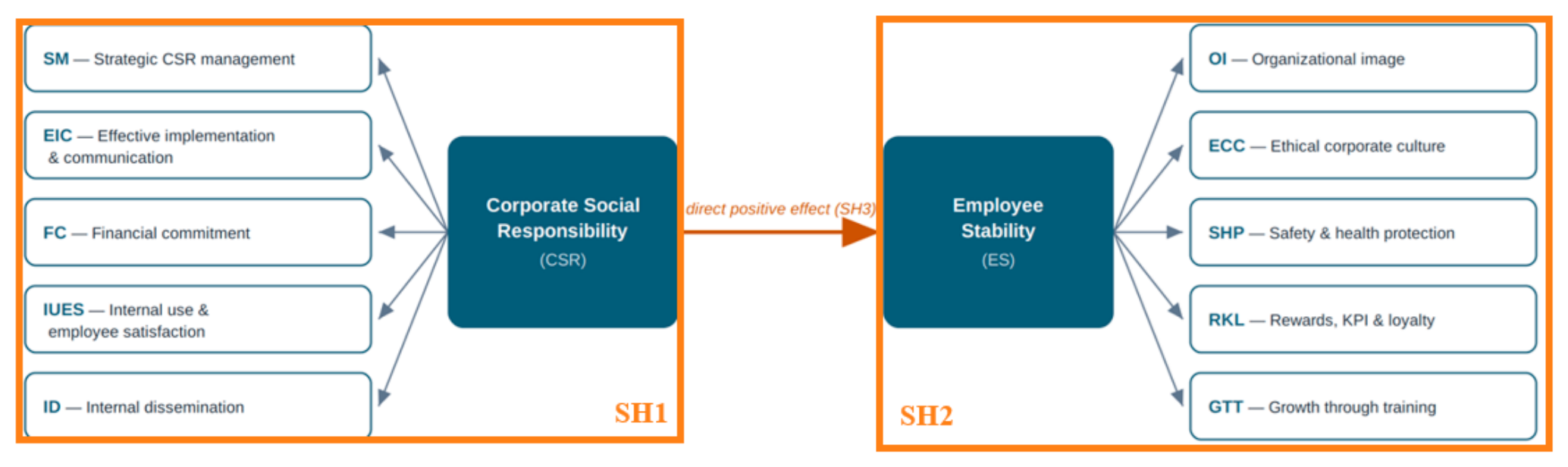
Figure 2.
Final SEM model with standardized path coefficients.
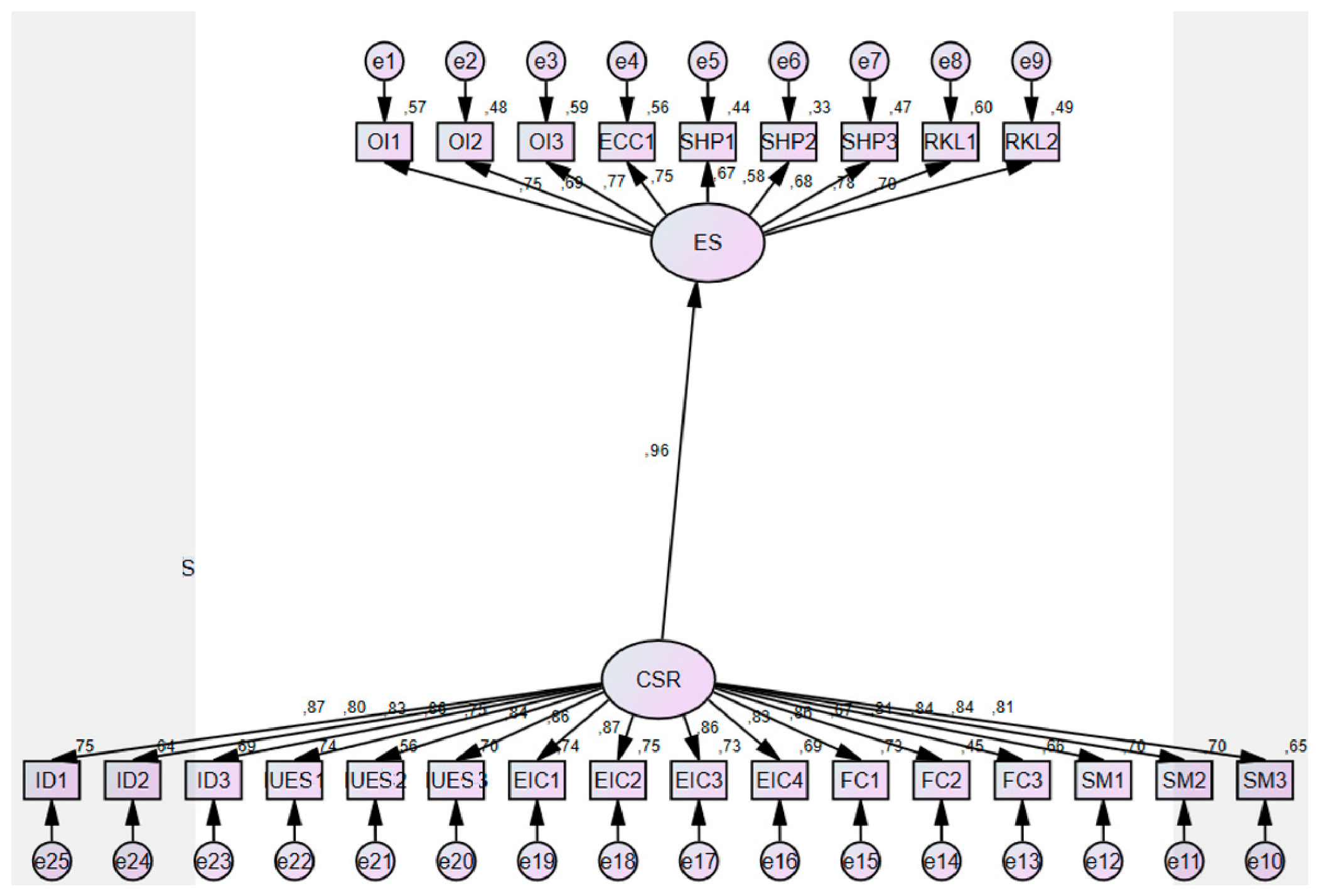

Table 1.
Formulation of statements in the main part of the questionnaire.
| Items | Statement formulation |
|---|---|
| ES | Employee stability |
| OI1 | The organization’s image significantly influences the CSR program of our enterprise |
| OI2 | The organization’s image has an influence on employee stability |
| OI3 | The organization’s image significantly influences the CSR program of our enterprise |
| ECC1 | Some elements of CSR are connected with the corporate culture |
| ECC2 | A corporate culture exists in the enterprise |
| ECC3 | The enterprise has at least one instrument for corporate culture (values, code of ethics). |
| SHP1 | The enterprise regularly trains employees on safety |
| SHP2 | Business activities always take place in accordance with the protection of employees |
| SHP3 | The enterprise regularly supports the protection of health at work (benefits) |
| RKL1 | Employee benefits cover the needs of employees and correspond to the enterprise’s CSR |
| RKL2 | The KPI system or reward system is realistically set |
| RKL3 | The wage is regularly increased |
| GTT1 | CSR is taught and employees have undergone training on CSR at least once |
| GTT2 | Education is a key benefit of our enterprise |
| CSR | Social corporate responsibility |
| ID1 | Dissemination of CSR in the enterprise takes place |
| ID2 | Dissemination of CSR in the enterprise is managed by employees |
| ID3 | The elements of CSR are known to me and I apply them in my work |
| IUES1 | In the activities inside the enterprisoe, CSR activities are used |
| IUES2 | CSR activities are used rather for external communication |
| IUES3 | Employees are satisfied here in our company precisely thanks to CSR |
| EIC1 | The implementation of CSR in the enterprise is perceptible in processes |
| EIC2 | The implementation of CSR in the enterprise is perceptible in communication |
| EIC3 | The implementation of CSR in the enterprise takes place in a managed way by management |
| EIC4 | CSR enables our company to gain a competitive advantage in the market, and therefore I remain in the enterprise |
| FC1 | The financing of CSR in the enterprise is purposefully ensured already in the budget plan |
| FC2 | The financing of the enterprise’s CSR is ensured only for external enterprise activities |
| FC3 | CSR in the enterprise is also financially supported for activities inside the enterprise |
| SM1 | The management of the enterprise uses the CSR program in its decision-making |
| SM2 | Management directs the enterprise in its plans in accordance with the established CSR policy |
| SM3 | Our enterprise has a strategic document on CSR |
Source: own research collection.
Table 2.
Descriptive statistics of items of questionnaire.
| DS | OI1 | OI2 | OI3 | ECC1 | ECC2 | SHP1 | SHP2 | SHP3 | RKL1 | RKL2 |
|---|---|---|---|---|---|---|---|---|---|---|
| M | 2.61 | 2.62 | 2.72 | 2.48 | 1.83 | 2.31 | 2.18 | 2.33 | 2.54 | 2.56 |
| SE | 0.05 | 0.05 | 0.05 | 0.05 | 0.04 | 0.05 | 0.05 | 0.05 | 0.05 | 0.05 |
| SD | 1.15 | 1.11 | 1.13 | 1.02 | 0.82 | 1.15 | 0.99 | 1.07 | 1.10 | 1.07 |
| V | 1.31 | 1.23 | 1.27 | 1.04 | 0.66 | 1.32 | 0.98 | 1.14 | 1.21 | 1.15 |
| K | -0.53 | -0.26 | -0.49 | 0.00 | -1.43 | -0.09 | 0.65 | -0.05 | -0.34 | -0.18 |
| S | 0.41 | 0.48 | 0.33 | 0.53 | 0.31 | 0.76 | 0.83 | 0.62 | 0.44 | 0.48 |
| DS | RKL3 | GTT1 | GTT2 | ID1 | ID2 | ID3 | IUES1 | IUES2 | IUES3 | EIC1 |
| M | 2.39 | 2.65 | 2.44 | 2.76 | 2.94 | 2.80 | 2.80 | 2.89 | 2.83 | 2.69 |
| SE | 0.09 | 0.05 | 0.05 | 0.05 | 0.05 | 0.05 | 0.05 | 0.05 | 0.05 | 0.05 |
| SD | 1.87 | 1.15 | 1.07 | 1.04 | 1.01 | 1.02 | 1.00 | 1.00 | 1.06 | 1.06 |
| V | 3.50 | 1.32 | 1.15 | 1.08 | 1.02 | 1.03 | 1.01 | 1.00 | 1.12 | 1.13 |
| K | -0.41 | -0.55 | -0.14 | -0.27 | -0.33 | -0.35 | -0.19 | -0.29 | -0.45 | -0.43 |
| S | 1.09 | 0.39 | 0.51 | 0.17 | 0.01 | 0.13 | 0.21 | 0.06 | 0.10 | 0.23 |
| DS | EIC2 | EIC3 | EIC4 | FC1 | FC2 | FC3 | SM1 | SM2 | SM3 | |
| M | 2.67 | 2.70 | 2.81 | 2.78 | 2.91 | 2.72 | 2.81 | 2.81 | 2.95 | |
| SE | 0.05 | 0.05 | 0.05 | 0.05 | 0.05 | 0.05 | 0.05 | 0.05 | 0.05 | |
| SD | 1.05 | 1.06 | 1.12 | 1.09 | 1.10 | 1.05 | 1.01 | 1.03 | 1.12 | |
| V | 1.10 | 1.12 | 1.27 | 1.18 | 1.21 | 1.10 | 1.02 | 1.07 | 1.25 | |
| K | -0.30 | -0.41 | -0.65 | -0.45 | -0.65 | -0.33 | -0.36 | -0.42 | -0.68 | |
| S | 0.30 | 0.28 | 0.15 | 0.19 | 0.03 | 0.33 | 0.21 | 0.16 | 0.09 |
Note: DS – Descriptive statistics; M – Mean; SE – Standard Error; SD – Standard Deviation; V – Variance; K – Kurtosis; S – Skewness. Source: Own research collection.
Table 3.
Reliability and validity of items in questionnaire.
| Factor | Items | FL | CI-TC | COM | CA | CR | AVE |
|---|---|---|---|---|---|---|---|
| ES | OI1 | 0.835 | 0.757 | 0.821 | 0.941 | 0.943 | 0.602 |
| OI2 | 0.799 | 0.727 | 0.772 | ||||
| OI3 | 0.865 | 0.787 | 0.871 | ||||
| ECC1 | 0.813 | 0.779 | 0.689 | ||||
| SHP1 | 0.732 | 0.721 | 0.690 | ||||
| SHP2 | 0.681 | 0.676 | 0.743 | ||||
| SHP3 | 0.768 | 0.765 | 0.728 | KMO | BTS | p-value | |
| RKL1 | 0.828 | 0.806 | 0.833 | 0.922 | 3938.1 | 0.000 | |
| RKL2 | 0.770 | 0.752 | 0.742 | ||||
| GTT1 | 0.775 | 0.766 | 0.698 | ||||
| GTT2 | 0.640 | 0.639 | 0.588 | ||||
| Factor | Items | FL | CI-TC | COM | CA | CR | AVE |
| CSR | ID1 | 0.867 | 0.851 | 0.829 | 0.972 | 0.973 | 0.696 |
| ID2 | 0.802 | 0.792 | 0.730 | ||||
| ID3 | 0.833 | 0.816 | 0.757 | ||||
| IUES1 | 0.872 | 0.849 | 0.860 | ||||
| IUES2 | 0.754 | 0.747 | 0.710 | ||||
| IUES3 | 0.842 | 0.828 | 0.773 | ||||
| EIC1 | 0.870 | 0.848 | 0.861 | ||||
| EIC2 | 0.876 | 0.854 | 0.832 | KMO | BTS | p-value | |
| EIC3 | 0.864 | 0.849 | 0.784 | 0.966 | 7455.7 | 0.000 | |
| EIC4 | 0.846 | 0.828 | 0.793 | ||||
| FC1 | 0.868 | 0.850 | 0.823 | ||||
| FC2 | 0.682 | 0.676 | 0.660 | ||||
| FC3 | 0.818 | 0.807 | 0.742 | ||||
| SM1 | 0.849 | 0.839 | 0.804 | ||||
| SM2 | 0.855 | 0.837 | 0.836 | ||||
| SM3 | 0.828 | 0.813 | 0.767 |
Note: FL – Factor loading; CA – Cronbach alpha value; COM – Communality; CI-TC – Correlation item-total correlation; CR – Composite reliability; AVE – Average variance extracted; KMO – KMO test; BTS – Bartlett’s test of sphericity. Source: Own research collection.
Table 4.
Rotated component matrix with two factors and verification of multicollinearity.
| Items | Factors | VIF | COM | |
|---|---|---|---|---|
| CSR | ES | |||
| ID1 | 0.729 | 0.470 | 2.825 | 0.841 |
| ID2 | 0.687 | 0.409 | 3.500 | 0.743 |
| ID3 | 0.728 | 0.408 | 4.279 | 0.769 |
| IUES1 | 0.767 | 0.409 | 3.108 | 0.875 |
| IUES2 | 0.643 | 2.734 | 0.727 | |
| IUES3 | 0.741 | 2.835 | 0.781 | |
| EIC1 | 0.756 | 0.432 | 3.254 | 0.885 |
| EIC2 | 0.787 | 4.145 | 0.852 | |
| EIC3 | 0.776 | 3.050 | 0.810 | |
| EIC4 | 0.780 | 3.160 | 0.799 | |
| FC1 | 0.787 | 2.251 | 0.838 | |
| FC2 | 0.610 | 4.847 | 0.670 | |
| FC3 | 0.743 | 3.293 | 0.766 | |
| SM1 | 0.773 | 3.686 | 0.818 | |
| SM2 | 0.792 | 5.139 | 0.844 | |
| SM3 | 0.778 | 2.883 | 0.781 | |
| OI1 | 0.795 | 3.813 | 0.856 | |
| OI2 | 0.790 | 5.328 | 0.795 | |
| OI3 | 0.832 | 4.985 | 0.901 | |
| ECC1 | 0.439 | 0.693 | 4.234 | 0.727 |
| SHP1 | 0.432 | 0.561 | 4.029 | 0.720 |
| SHP2 | 0.545 | 4.657 | 0.788 | |
| SHP3 | 0.445 | 0.582 | 2.393 | 0.773 |
| RKL1 | 0.571 | 0.567 | 3.498 | 0.834 |
| RKL2 | 0.499 | 0.640 | 4.221 | 0.755 |
| GTT1 | 0.598 | 0.497 | 4.670 | 0.736 |
| GTT2 | 0.527 | 3.647 | 0.627 | |
Note: CSR – Corporate social responsibility; ES – Employee’s stability; COM – Communality; VIF – Variance Inflation Factor. Rotation method: Varimax with Kaiser Normalization; Extraction method: Principal components. Source: Own research collection.
Table 5.
Discriminant validity of factors using the Fornell-Larcker criterion and HTMT.
| Fornell–Larcker criterion | HTMT | ||||
|---|---|---|---|---|---|
| Factors | ES | CSR | Factors | ES | CSR |
| ES | 0.776 | 0.549 | ES | 1 | 0.801 |
| CSR | 0.549 | 0.834 | CSR | 0.801 | 1 |
Source: Own research collection.
Table 6.
SEM model verification and the statistical hypotheses verification.
| Fit summary | Df. | CMIN | CMIN/Df. | RMSEA | CFI | NFI | GFI | ||||||
|---|---|---|---|---|---|---|---|---|---|---|---|---|---|
| SEM model | 275 | 522.1 | 1.898 | 0.045 | 0.984 | 0.991 | 0.962 | ||||||
| Accepted value | <-2.0;2.0> | <0;0.08> | >0.95 | >0.90 | >0.95 | ||||||||
| SH | Causal relationship | Path coeff. (UN) | Path coeff. (ST) | Standard Error | Critical ratio | p-value | |||||||
| SH3 | CSR >> ES | 0.957 | 0.961 | 0.052 | 18.258 | 0.000 | |||||||
Note: UN – Unstandardized; ST – Standardized path coefficients. Source: Own research collection.
Disclaimer/Publisher’s Note: The statements, opinions and data contained in all publications are solely those of the individual author(s) and contributor(s) and not of MDPI and/or the editor(s). MDPI and/or the editor(s) disclaim responsibility for any injury to people or property resulting from any ideas, methods, instructions or products referred to in the content. |
© 2026 by the authors. Licensee MDPI, Basel, Switzerland. This article is an open access article distributed under the terms and conditions of the Creative Commons Attribution (CC BY) license.
Copyright: This open access article is published under a Creative Commons CC BY 4.0 license, which permit the free download, distribution, and reuse, provided that the author and preprint are cited in any reuse.


