

Submitted:
27 July 2026
Posted:
29 July 2026
You are already at the latest version
Abstract
Background/Objectives: Persistent infection with high-risk HPV genotypes accounts for the development of a substantial portion of anogenital and oropharyngeal malignancies. Patients with primary and secondary immunodeficiency or those receiving immunosuppressive therapy, including transplant recipients and patients affected by rare diseases, are vulnerable to particularly severe clinical manifestations of infection. While HPV vaccination constitutes primary prevention, patients with HPV-associated disease remain at risk of reinfection or subsequent infection with alternative genotypes following surgical treatment and may benefit from peri-operative vaccination regimens. This study aimed to evaluate long-term outcomes of HPV vaccination following surgical management of condyloma acuminata in patients with concurrent high-risk genotype infection. Methods: 350 patients with condyloma acuminata and HPV-16 or -18 co-infection confirmed by histopathological examination and PCR genotyping (oral cavity, vulva, vagina, penis, anoderma), including a subgroup with primary or acquired immunodeficiency or chronic immunosuppressive regimens, underwent surgical treatment, receiving simultaneous immunization with the first dose (subsequent completion of full regimen over 12 months) of the bivalent Cervarix vaccine (170 patients) or the quadrivalent Gardasil vaccine (180 patients). A follow-up examination including HPV genotyping (16/18/31/35) was performed after 6 and 12 months following regimen completion. After 36 months a standard clinical examination was performed, and in doubtful cases, supplemented with genotyping with biopsy/cytology. Observation was continued in subsequent years (5, 10, and >15 years). Results: Condyloma acuminata requiring removal were observed in 5% of the patients in follow-up at 36 months, with no significant statistical difference between vaccine groups. No cellular atypia or malignant transformation in the form of squamous cell carcinoma was observed. Genotyping did not detect HPV-16/18/31/35 infection in the follow-up examinations. Conclusions: In this uncontrolled, single-arm cohort, peri-operative initiation of either the bivalent or quadrivalent HPV vaccine was associated with a low rate of clinically apparent condyloma acuminata recurrence and no detectable HPV-16/18/31/35 infection during follow-up.
Keywords:
peri-operative vaccination
; human papillomavirus
; condyloma acuminata
; anogenital
; oropharyngeal
1. Introduction
Human papillomavirus (HPV) infection results in a wide array of clinical manifestations, impacting a variety of anatomical sites. Condyloma acuminata are associated with low-risk HPV (LR-HPV) genotypes 6 and 11. These benign lesions of varying appearance can occur at any site of sexual contact, with the virus infecting mucosal or cutaneous epithelium, affecting the penis, vulva, vagina, cervix, anoderma, oropharynx, or the surrounding skin [1].
HPV genotypes 16 and 18 have the highest oncogenic potential and are those most commonly detected subtypes in cases of cervical and anal cancers, and of their precursor lesions, globally. High-risk HPV (HR-HPV) genotypes, comprising genotypes 16, 18, 31, 33, 35, 39, 45, 51, 52, 56, 58, 59, 68, 73, and 82, are also associated with malignancies of the vulva (70%), vagina (75%), head and neck (26–30%) including oropharynx (30%), and penis (60% of penile cancers, 79.8% of penile intraepithelial neoplasia) [2].
While anal cancer is rare in the general population, certain populations are significantly impacted, including transgender people assigned male at birth (TG-AMAB) and men who have sex with men (MSM). A 2024 study found HR-HPV prevalence in a TG-AMAB cohort to be comparable to literature values reported for MSM. Among individuals with HIV, HR-HPV prevalence was 80% in the TG-AMAB cohort compared to 74% reported in MSM. Among HIV-negative individuals, the values were 62% and 41% respectively. The prevalence figures are substantially higher than those reported in literature for men who have sex with women (27% HIV+, 7% HIV-) [3].
While 90% of HPV infections are estimated to clear naturally within two years of detection, persistent infection may progress to cytological abnormality. This supports vaccination efforts, with evidence from pre- and post-licensure clinical trials and studies supporting vaccine safety and efficacy [4].
HPV vaccination programmes led to significant population-level declines in incidence of cervical and vaginal precancerous and cancerous lesions, as well as of condyloma acuminata among young women [5]. A meta-analysis showed significant and substantial impact of HPV vaccination on HPV-16 and 18 infections, condyloma acuminata diagnoses, and high-grade squamous intraepithelial lesions (HSIL) among girls and women [6].
Similar trends have been observed in oropharyngeal and anal infection rate reduction, translating to prevention of subsequent malignancy development. Systematic review studies have shown a 82.7% relative risk reduction for oropharyngeal infections after vaccination and a 58% relative risk reduction of anal cancer incidence after vaccination compared to unvaccinated control groups [7].
Currently five HPV vaccines are WHO-prequalified: three bivalent (genotypes 16 and 18), including the Cervarix vaccine (in a one- and two-dose regimen), one quadrivalent (genotypes 6, 11, 16, and 18) – the Gardasil vaccine (in a one-dose regimen), and one nonavalent (genotypes 6, 11, 16, 18, 31, 33, 45, 52, and 58) vaccine [8].
Both the Cervarix bivalent vaccine and the Gardasil quadrivalent vaccine have a long history of use, high immunogenicity (seroconversion rates of nearly 100%), and a track record of safety and efficacy – demonstrating prophylactic efficacy against a range of HPV-related endpoints, and some evidence for cross-protection incidence for closely related genotypes [9]. Cross-protection has been shown to be inconsistent across non-vaccine HPV types, with data suggesting effect for 31 and 45 for the bivalent and 31 for the quadrivalent vaccine, differing between studies and with wide confidence intervals. While one trial showed moderate cross-protection against HPV types 6- and 11-related persistent infection from the bivalent vaccine, several subsequent real-world studies found no such protective effect [10].
Randomized trials in women have demonstrated strong prophylactic vaccine efficacy against persistent cervical HPV-16 and -18 infection and associated cervical intraepithelial neoplasia (CIN) grade 2 or worse lesions. The Costa Rica Vaccine Trial found this protection extended to anal and oral infection as well, with multisite efficacy highest among women naïve to HPV-16 and -18 at vaccination (83.5%), and a lower but still statistically significant multisite efficacy (57.8%) among women with serologic evidence of prior HPV-16 and -18 exposure. However, no significant vaccine efficacy against anal or oral infection was reported among women with current cervical infection at vaccination [11].
While HPV vaccines have been primarily studied and used in primary prevention, patients with clinically-apparent HPV-associated disease, including condyloma acuminata, remain at risk of reinfection or subsequent infection with alternative genotypes following management. Vaccination should be recommended to reduce oncogenic risk [12].
This study aimed to evaluate long-term outcomes of HPV vaccination following surgical management of condyloma acuminata in patients with HR-HPV (16 or 18) genotype co-infection.
2. Materials and Methods
350 patients (age range: 16–55) with clinical diagnosis of condyloma acuminata in the area of the oral cavity, vulva, vagina, penis, or anoderma, and simultaneous HPV-16 or -18 co-infection confirmed by histopathological examination and PCR genotyping, underwent surgical treatment. The patient population included a subgroup of patients with primary (PID) or acquired immunodeficiency (AID), including patients undergoing chemotherapy (8 patients; age range: 28–42), or subject to chronic immunosuppression after organ transplantation (OTx) (25 patients; age range 25–62). On the day of the surgical removal of the lesions, the patients received immunization with the first dose of the bivalent Cervarix vaccine (170 patients: 150 women and 20 men) or the quadrivalent Gardasil vaccine (180 patients: 150 women and 30 men), with subsequent completion of the full respective vaccination regimen (three doses) over the following 12 months. The follow-up examination included HPV genotyping (genotypes 16, 18, 31, and 35) and was performed after 6, 12, and 36 months from the last vaccination. The 36-month follow-up included a standard clinical examination, and in doubtful cases, biopsy/cytology.
Clinical observation was continued in subsequent years (5, 10, and >15 years). Management shifted to patient-initiated follow-up, with clinical evaluations performed on appearance of clinically relevant concerns or symptoms.
Partners of patients included in the study were independently vaccinated. Partners did not show clinical signs of infections and HPV genotyping was not performed.
The surgical procedures and vaccinations were not carried out with the aim of conducting a head-to-head study.
3. Results
After 36 months 100 patients in the Cervarix vaccine group and 120 patients in the Gardasil vaccine group remained under observation. After 5 years, the number of patients under observation was 60 and 40 respectively.
Up to the 36 months mark, 5% of the patients (11 out of 220 patients, 6 in the Cervarix bivalent vaccine group and 5 in the Gardasil quadrivalent vaccine group; difference not statistically significant, p > 0.05) had developed a clinical picture of condyloma acuminata requiring removal.
The most frequent recurrence or recrudescence/relapse was observed in the anogenital area. The 11 patients with observed recurrence or recrudescence/relapse were patients undergoing chronic immunosuppression after OTx (kidney, liver) or undergoing planned chemotherapy due to cancer.
Repeated genotyping on follow-up did not detect HPV-16, -18, -31, or -35 infection and no cases of cellular atypia or malignant transformation in the form of squamous cell carcinoma (SCC) were observed during the follow-up examinations. No serious adverse events of either vaccine were reported by the patients in the follow-up period.
Two patients included in the study are presented below.
Figure 1 presents severe clinical manifestation of condyloma acuminata and SCC in a PID patient, positive for HPV genotypes 6, 11, 16 and 18, prior to and during the initial surgical treatment.
Figure 2 presents severe clinical manifestation of condyloma acuminata, anal intraepithelial neoplasia (AIN 3), and vulvar intraepithelial neoplasia (VIN 3) in a patient after kidney OTx, on long-term immunosuppression, prior to [13], and after surgical treatment. Control of HPV infection required adjusting immunosuppressive medication, including a switch from brand name to generic drugs.
4. Discussion
Clinicians surveyed on ideal HPV vaccination recommendations broadly indicated their support for vaccination of patients treated for cervical precancerous lesions (61.15–85.2%, dependent on the age group), treated for vaginal, vulvar or anal cancer (50.3–73.2%, dependent on the age group), and treated for cervical cancer (47.7–67.8%, dependent on the age group). The most-supported timing for HPV vaccination in patients with CIN is during admission for treatment, with a minority of surveyed clinicians opting for postponement of vaccination, non-administration or an alternative approach [14]. Population studies on HPV vaccination for primary cancer prophylaxis show simultaneous significant reduction in the incidence of condyloma acuminata. The effect is particularly apparent for younger patients. The Australian vaccination programme resulted in a 92.6% decrease in incidence in women younger than 21 years. Quadrivalent and nonavalent vaccines include the 6 and 11 genotypes. Previous studies in patients with a history of condyloma acuminata showed conflicting results of use of HPV vaccination in combination treatment (with cryotherapy, imiquimod, intralesional Candida antigen, podophyllotoxin), delayed onset and reduction in number of lesions during the recurrence. The available literature suggests that HPV vaccination may mitigate, but not eliminate, the risk of recurrence [12].
The clinical picture of reappearance of condyloma acuminata in 5% of the studied population could be attributed to a recrudescence/relapse following incomplete surgical excision in the margin or to a true recurrence.
In a previous study, OTx patients had a higher morbidity of HPV-related cancer in the first 5 years after symptomatic HPV infection observation compared to patients free from immunosuppressive therapy, due to more rapid onset of high-grade intraepithelial neoplasia and invasive carcinoma [15]. Our previous experience points to higher rates of recurrence of HPV-dependent lesions among patients with PID or AID, as compared to patients receiving immunosuppression after OTx [16].
Table 1 presents a brief review of current literature data on HPV and HPV vaccination in immunocompromised patients.
Our observation of patients with HPV-16 or -18 infection and accompanying condyloma acuminata in the oral cavity, vulva, vagina, penis, or anoderma showed that simultaneous surgical removal of lesions and initiation of vaccination with a bivalent or quadrivalent vaccine provides a satisfactory clinical effect in patients without significant immune response disorders in both the short- and long-term observation periods (>6 months up to 15 years). While clinical observations reported in the literature, most often indicate rates of recurrence/relapse/recrudescence of up to 50% within 6-24-36 months, in the studied group only 5% of patients (11 patients, all belonging to the immunocompromised subgroup) vaccinated around the time of surgery developed a clinical picture of condyloma acuminata requiring removal. The clinical picture of condyloma acuminata requiring removal, be that recurrence or recrudescence/relapse, was observed in patients regardless of the surgical procedure performed and whether they received the bivalent or quadrivalent vaccine around the time of surgery. This is consistent with previous studies associating occurrence, remission, relapse, and cancerization of condyloma acuminata with immune response competence or disorders [21].
HPV-16 E6/E7 oncoproteins have been recently shown, in a murine tumor model, to drive upregulation of the transcription factor KLF2 in tumor-associated macrophages, increasing local secretion of IL-23, suppressing proliferative capacity, cytotoxicity, and interferon-γ production of HPV-specific CD8+ T-lymphocytes. Neutralization of IL-23 restored HPV-specific T-cell infiltration and synergized with therapeutic vaccination [22].
Our study did not confirm that either vaccine can fully and effectively protect immunocompromised patients from recurrence/recrudescence/relapse of condyloma acuminata. Due to the small sample size in the study further observational studies are needed. Future studies would benefit from inclusion of in-depth investigation into the immunocompetence of patients with recurrence/recrudescence/relapse of condyloma acuminata post-removal, particularly in the case of quadrivalent vaccine administration.
On the other hand, the observed sustained absence of detectable HPV-16, -18, -31, or -35 infection and lack of cellular atypia or malignant transformation in the form of SCC observed on the 36-month follow-up examinations, including in the immunocompromised subgroup, is consistent with recommendations and literature-reported seroconversion rates.
It should be emphasized that the medical procedures and vaccinations carried out were not aimed at conducting a head-to-head study. A direct comparison of the two vaccines, particularly assessing the effectiveness of the quadrivalent vaccine in cases of condyloma acuminata and postoperative recurrence/recrudescence/relapse of HPV-6 and -11-dependent lesions within 6-12 months, could be planned as an observation/phase IV clinical trial, with particular regard for patients with impaired immune response and chronic immunosuppression, including those after HSCT or solid OTx.
5. Conclusions
The prophylactic efficacy of both the bivalent Cervarix and quadrivalent Gardasil vaccines is well established in randomized trials. Our observations extend this evidence by supporting the safety and feasibility of initiating vaccine immediately after surgical treatment, with a low rate of clinically apparent condyloma acuminata recurrence during follow-up.
Future studies could expand on the precise timing of initiation of the vaccination regimen in the peri-operative period, assessing whether a delay or initiation of vaccination prior to treatment would affect long-term outcomes.
The immunocompromised subgroup follow-up suggests the need for development and/or broader implementation into clinical practice of standards for patients with PID and AID (transplant recipients, patients undergoing chemotherapy or dialysis procedures, or awaiting such interventions), with focus on indications and precise timing of HPV vaccination regimen initiation.
Vaccination against oncogenic HPV viruses before a planned OTx may reduce the development/recurrence/relapse/recrudescence of condyloma acuminata and the activity of HPV types 16 and 18 in patients with weakened immunity after surgery. Adjusting or changing the immunosuppression regimen is an important factor in lowering cancer risk.
Initiation of vaccination regimen immediately following treatment for condyloma acuminata in patients simultaneously positive for high-risk HPV-16 or -18 genotypes appears to be associated with low overall recurrence of condyloma acuminata and sustained absence of detectable HPV-16 and 18 infection during the long-term follow-up period.
Author Contributions
Conceptualization, J.W. and P.F.; methodology, J.W., P.F. and M.B.; validation, M.B., M.W. and P.F.; resources, J.W. and P.S.; data curation, P.F.; writing—original draft preparation, J.W., M.B. and M.W.; writing—review and editing, J.W., P.S., G.S. and P.F.; supervision, G.S. and P.F. All authors have read and agreed to the published version of the manuscript.
Funding
This research received no external funding.
Institutional Review Board Statement
Procedures were performed within the framework of hospital-based interventions covered by public health insurance reimbursement.
Informed Consent Statement
Patient consent was waived due to the retrospective nature of the study, which utilized fully anonymized data collected during routine clinical care, ensuring that no identifiable personal information was accessible to the investigators.
Data Availability Statement
The raw data supporting the conclusions of this article will be made available by the authors on request.
Conflicts of Interest
The authors declare no conflicts of interest.
Abbreviations
The following abbreviations are used in this manuscript:
| AID | Acquired immunodeficiency |
| AIN | Anal intraepithelial neoplasia |
| CIN | Cervical intraepithelial neoplasia |
| HPV | Human papillomavirus |
| HR-HPV | High-risk human papillomavirus |
| HSCT | Hematopoietic stem cell transplantation |
| HSIL | High-grade squamous intraepithelial lesion |
| LR-HPV | Low-risk human papillomavirus |
| MSM | Men who have sex with men |
| OTx | Organ transplantation |
| PID | Primary immunodeficiency |
| SCC | Squamous cell carcinoma |
| TG-AMAB | Transgender people assigned male at birth |
| VIN | Vulvar intraepithelial neoplasia |
References
- Kohli, M.; Bunker, C.B.; Kravvas, G. Human papillomavirus: An update. Clin. Dermatol. 2026, 44(1), 54–66. [Google Scholar] [CrossRef] [PubMed]
- Włoszek, E.; Krupa, K.; Skrok, E.; Budzik, M.P.; Deptała, A.; Badowska-Kozakiewicz, A. HPV and Cervical Cancer—Biology, Prevention, and Treatment Updates. Curr. Oncol. 2025, 32, 122. [Google Scholar] [CrossRef] [PubMed]
- Harfouch, O.; Lisco, A.; Omari, H.; Eyasu, R.; Davis, A.; Zoltick, M.; Ebah, E.; Cover, A.; Bijole, P.; Silk, R.; Sternberg, D.; Liu, T.; Garrett, G.; Jones, M.; Kier, R.; Masur, H.; Kottilil, S.; Kattakuzhy, S.; Rosenthal, E.S. High Rates of High-risk HPV Anal Infection and Abnormal Cytology in a Cohort of Transgender People Assigned Male at Birth. Open Forum Infect. Dis. 2024. [Google Scholar] [CrossRef] [PubMed]
- Bednarczyk, R.A. Addressing HPV vaccine myths: Practical information for healthcare providers. Hum. Vaccin. Immunother. 2019, 15, 1628–1638. [Google Scholar] [CrossRef] [PubMed]
- Goodman, E.; Reuschenbach, M.; Viering, T.; Luzak, A.; Greiner, W.; Hampl, M.; Jacob, C. The Impact of Germany's Human Papillomavirus Immunization Program on HPV-Related Anogenital Diseases: A Retrospective Analysis of Claims Data from Statutory Health Insurances. Arch. Gynecol. Obstet. 2024, 310, 2639–2646. [Google Scholar] [CrossRef] [PubMed]
- Drolet, M.; Bénard, É.; Pérez, N.; Brisson, M. Population-level impact and herd effects following the introduction of human papillomavirus vaccination programmes: Updated systematic review and meta-analysis. Lancet 2019, 394, 497–509. [Google Scholar] [CrossRef] [PubMed]
- Jensen, J.E.; Becker, G.L.; Jackson, J.B.; Rysavy, M.B. Human Papillomavirus and Associated Cancers: A Review. Viruses 2024, 16, 680. [Google Scholar] [CrossRef] [PubMed]
- World Health Organization. Prequalified Vaccines. Available online: https://extranet.who.int/prequal/vaccines/prequalified-vaccines (accessed on 11 June 2026).
- de Sanjosé, S.; Alemany, L.; Castellsagué, X.; Bosch, F.X. Human papillomavirus vaccines and vaccine implementation. Women's Health 2008, 4, 595–604. [Google Scholar] [CrossRef] [PubMed]
- Brown, D.R.; Joura, E.A.; Yen, G.P.; Kothari, S.; Luxembourg, A.; Saah, A.; Walia, A.; Perez, G.; Khoury, H.; Badgley, D.; et al. Systematic literature review of cross-protective effect of HPV vaccines based on data from randomized clinical trials and real-world evidence. Vaccine 2021, 39, 2224–2236. [Google Scholar] [CrossRef] [PubMed]
- Beachler, D.C.; Kreimer, A.R.; Schiffman, M.; Herrero, R.; Wacholder, S.; Rodriguez, A.C.; Lowy, D.R.; Porras, C.; Schiller, J.T.; Quint, W.; Jimenez, S.; Safaeian, M.; Struijk, L.; Schussler, J.; Hildesheim, A.; Gonzalez, P. for the Costa Rica HPV Vaccine Trial (CVT) Group. Multisite HPV16/18 Vaccine Efficacy Against Cervical, Anal, and Oral HPV Infection. J. Natl. Cancer Inst. 2016, 108, djv302. [Google Scholar] [CrossRef] [PubMed]
- Ong, M.M.; Blasiak, R.C.; Joura, E.A.; Joura, M.I.; Rossi, A. Human papillomavirus vaccine for the prevention and treatment of warts: A clinical review. JAAD Rev. 2025, 6. [Google Scholar] [CrossRef]
- Mucha, K.; Foroncewicz, B.; Dębska-Ślizień, A.; Durlik, M.; Grenda, R.; Horban, A.; Fiedor, P.; Krajewska, M.; Kwiatkowski, A.; Lerut, J.; Małyszko, J.; Małyszko, J.; Przybyłowski, P.; Zieniewicz, K.; Ciszek, M.; Kamińska, D.; Kosieradzki, M.; Perkowska-Ptasińska, A.; Czerniawska, J.; Dęborska, D.; Kwieciński, R.; Kwapisz, M.; Moszczuk, B.; Iesari, S.; Pączek, L. Viruses in Transplantology. Pol. Arch. Intern. Med. 2019, 129 (Special(Issue 3), 1–36. [Google Scholar] [CrossRef] [PubMed]
- Kacperczyk-Bartnik, J.; Arbyn, M.; Denoël, S.; Bilir, E.; Dhollander, N.; Razumova, Z.; Gasimli, K.; Cokan, A.; Hajj, H.E.; Zwimpfer, T.A.; et al. Prophylactic HPV Vaccination in Gynaecological Practice: Recommendations, Practices, and Challenges Reported in the ESGO-PERCH HPV Survey. Vaccines 2026, 14, 269. [Google Scholar] [CrossRef] [PubMed]
- Suwalska, A.; Smolarczyk, K.; Kosieradzki, M.; Fiedor, P. Correlation of Cancer Development and Human Papilloma Virus Infection in Patients After Organ Transplantation. Transplant. Proc. 2020, 52, 1982–1984. [Google Scholar] [CrossRef] [PubMed]
- Prokop, P.; Bartoszewicz, M.; Gardyszewska, A.; Kosieradzki, M.; Fiedor, P. Comparison of long-term outcomes of surgical treatment of human papillomavirus-dependent neoplastic lesions in patients with chronic immunosuppression after allogenic organ transplantation and patients with primary or acquired immunodeficiency—A one-center experience. Transplant. Proc. 2024, 56, 953–956. [Google Scholar] [CrossRef] [PubMed]
- Branda, F.; Pavia, G.; Ciccozzi, A.; Quirino, A.; Marascio, N.; Gigliotti, S.; Matera, G.; Romano, C.; Locci, C.; Azzena, I.; et al. Human Papillomavirus (HPV) Vaccination: Progress, Challenges, and Future Directions in Global Immunization Strategies. Vaccines 2024, 12, 1293. [Google Scholar] [CrossRef] [PubMed]
- Viganò, M.; Beretta, M.; Lepore, M.; Abete, R.; Benatti, S.V.; Grassini, M.V.; Camagni, S.; Chiodini, G.; Vargiu, S.; Vittori, C.; et al. Vaccination Recommendations in Solid Organ Transplant Adult Candidates and Recipients. Vaccines 2023, 11, 1611. [Google Scholar] [CrossRef] [PubMed]
- Olofsson, C.; Hansson, M.; Lagging, M.; Ljungman, P.; Einarsdottir, S. Human Papillomavirus Vaccination (HPV) in Immunocompromised Adults: Rationale, Evidence, and Clinical Guidance. Vaccine X 2026, 30, 100806. [Google Scholar] [CrossRef]
- Kapp, P.; Siemens, W.; Gorenflo, L.; Schulz, H.; Chi, Y.; Röbl-Mathieu, M.; Askar, M.; Brotons, M.; Andersen, P.H.; Konopnicki, D.; Lynch, J.; Ruţă, S.; Saare, L.; Swennen, B.; Tachezy, R.; Takla, A.; Učakar, V.; Vänskä, S.; Zavadska, D.; Ali, K.A.; Olsson, K.; Harder, T.; Meerpohl, J.J. Effectiveness, Immunogenicity and Safety of Human Papillomavirus Vaccination in Non-HIV Immunocompromised Individuals: A Systematic Review. eClinicalMedicine 2026, 94, 103865. [Google Scholar] [CrossRef] [PubMed]
- Stuqui, B.; Provazzi, P.J.S.; Lima, M.L.D.; Cabral, Á.S.; Leonel, E.C.R.; Candido, N.M.; Taboga, S.R.; da Silva, M.G.; Lima, F.d.O.; Melli, P.P.d.S.; Quintana, S.M.; Calmon, M.d.F.; Rahal, P. Condyloma acuminata: An evaluation of the immune response at cellular and molecular levels. PLoS ONE 2023, 18, e0284296. [Google Scholar] [CrossRef] [PubMed]
- Prins, R.; Fernandez, D.J.; Akbari, O.; Da Silva, D.M.; Kast, W.M. HPV16 E6 and E7 Expressing Cancer Cells Suppress the Antitumor Immune Response by Upregulating KLF2-Mediated IL-23 Expression in Macrophages. J. Immunother. Cancer 2025, 13, e011915. [Google Scholar] [CrossRef] [PubMed]
Figure 1.
Severe clinical manifestation of anogenital condyloma acuminata and surgical treatment in a patient with PID.
Figure 1.
Severe clinical manifestation of anogenital condyloma acuminata and surgical treatment in a patient with PID.
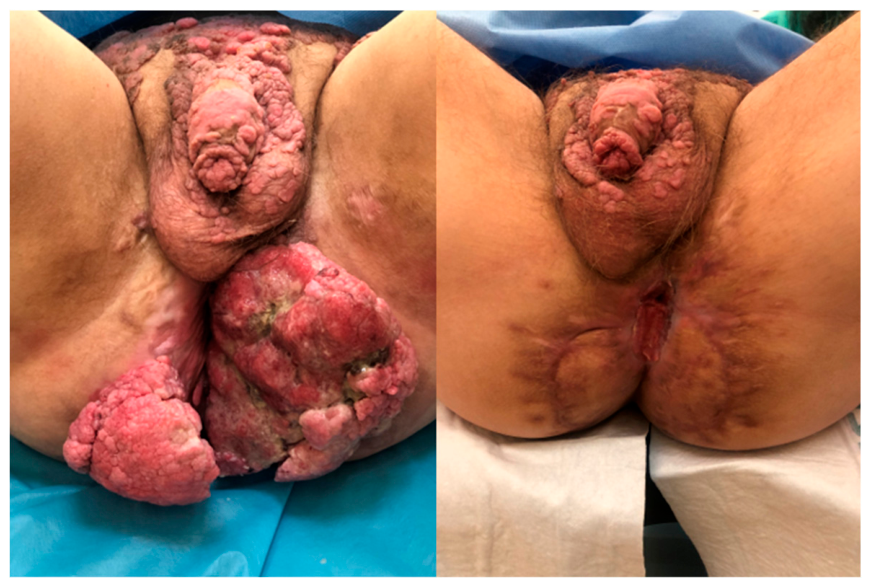
Figure 2.
Severe clinical manifestation of anogenital condyloma acuminata and surgical treatment in a patient after kidney OTx.
Figure 2.
Severe clinical manifestation of anogenital condyloma acuminata and surgical treatment in a patient after kidney OTx.
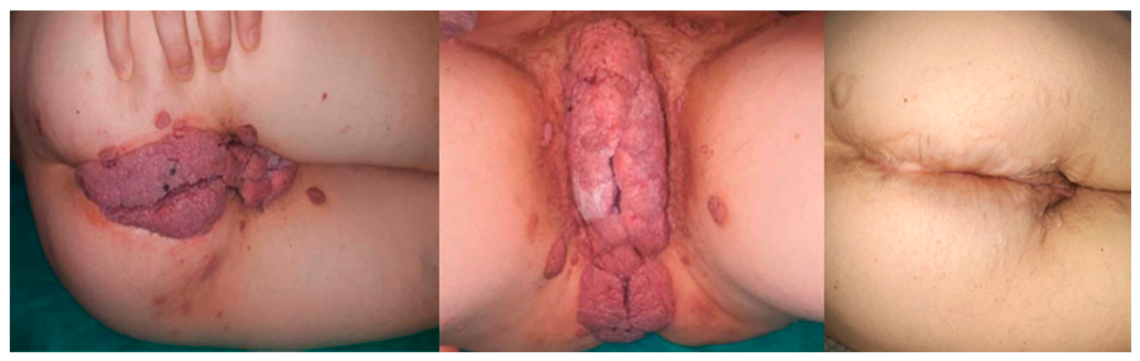

Table 1.
HPV vaccines and immunocompetence.
| Relevant information / recommendations | Group | Source |
|---|---|---|
| There is an increased risk of HPV-related malignancy in immunocompromised patients. | Overall immunocompromised | [17] |
| Quadrivalent HPV vaccination (in three-dose regimen) is recommended prior to lung OTx for all individuals between the ages of 9 and 26. HPV vaccination is safe and effective in the lung OTx group, but high daily immunosuppressive therapy hamper response. | Lung OTx candidates | [18] |
| Lower immune response is observed in kidney OTx recipients compared to patients with chronic kidney disease or undergoing dialysis. HPV vaccination is preferred prior to OTx but is safe and effective both pre- and post-OTx. | Kidney OTx candidates/recipients | |
| There is an increased risk of HPV-associated cancers of the anogenital area and oropharynx after liver OTx. A three-dose regimen of HPV vaccination is recommended. | Liver OTx candidates/recipients | |
| Most studies in immunocompromised patients involve the use of the quadrivalent HPV vaccine (in a standard three-dose regimen). Immune responses are robust but attenuated in older patients and patients receiving immunosuppressive therapy. |
Overall immunocompromised | [19] |
| Routine revaccination (HPV) is recommended post-HSCT. HPV vaccination is safe and effective, but lower immunogenicity is noted for patients receiving immunosuppressive therapy or rituximab. | HSCT recipients | |
| HPV vaccination results in high seroconversion rates, comparable to healthy controls. | Biologic treatment for inflammatory bowel diseases | |
| HPV vaccination is associated with high to very high rates of seropositivity for HPV-16 and -18 in cancer survivors, HSCT and solid OTx recipients, and healthy participants. Little to no difference in seropositivity rates is observed in immunocompromised groups compared to healthy participants for HPV-16 and -18 at 7 months. | Overall immunocompromised (non-HIV) | [20] |
| Most studies did not identify serious adverse events of HPV vaccination in the immunocompromised populations. | Overall immunocompromised (non-HIV) |
Disclaimer/Publisher’s Note: The statements, opinions and data contained in all publications are solely those of the individual author(s) and contributor(s) and not of MDPI and/or the editor(s). MDPI and/or the editor(s) disclaim responsibility for any injury to people or property resulting from any ideas, methods, instructions or products referred to in the content. |
© 2026 by the authors. Licensee MDPI, Basel, Switzerland. This article is an open access article distributed under the terms and conditions of the Creative Commons Attribution (CC BY) license (http://creativecommons.org/licenses/by/4.0/).
Copyright: This open access article is published under a Creative Commons CC BY 4.0 license, which permit the free download, distribution, and reuse, provided that the author and preprint are cited in any reuse.