

Submitted:
28 July 2026
Posted:
29 July 2026
You are already at the latest version
Abstract
This article examines the relationship between theology and board games as a framework for understanding how religious narratives, doctrinal imaginaries, and theological practices are constructed, negotiated, and contested. The study addresses the limited attention given to board games within theological research, arguing that they should be understood not merely as recreational artifacts but as cultural texts that reveal symbolic structures, pedagogical functions, and relations of power within religious traditions. The article aims to develop a situated and critical theological hermeneutic capable of interpreting both games and theology through the logic of play. Methodologically, the study employs an interdisciplinary qualitative approach that combines theological hermeneutics, cultural analysis, situated epistemology, and queer/cuir/marica and liberationist theological perspectives. The analysis proceeds through a double interpretive movement: examining board games with explicit theological content and interpreting theology itself as a symbolic and strategic form of play. The theoretical framework draws on play theory, theology of play, and queer/cuir/marica and indecent theologies. Through the analysis of various games, the article argues that theology operates as a dynamic field structured by rules, exclusions, and interpretive struggles. Its principal contribution lies in showing how bodies, sexualities, and gender dissidences disrupt dominant theological frameworks and open possibilities for more inclusive and transformative theological imaginaries.
Keywords:
theology of play
; board games and religion
; queer theology
; gender and sexuality in religion
; religious narratives
; ludic culture
; theological imagination
1. Introduction
Board games have long accompanied human societies as spaces of imagination, strategy, conflict, and symbolic worldmaking. Through rules, movements, roles, and narrative structures, they do more than organize recreational activity: they also reflect cultural values, social tensions, political imaginaries, and forms of collective meaning-making. In this sense, board games may be understood as performative and interpretive devices through which identities are negotiated, moral frameworks rehearsed, and alternative worlds imagined. Approaching board games theologically, therefore, requires recognizing that play is not merely entertainment, but also a symbolic arena where cosmologies are constructed, ethical visions contested, and horizons of transcendence articulated.
During the last decades, interdisciplinary scholarship has increasingly explored the relationship between games, cultures, education, and religion. Within these discussions, play has gradually ceased to be viewed as a trivial or secondary activity and has instead emerged as a privileged site for philosophical, pedagogical, and theological reflection. Authors working within the fields of theology of play, cultural hermeneutics, and religious studies have suggested that play constitutes a central dimension of human symbolic life, one capable of revealing how communities imagine order, negotiate conflict, and construct meaning. Simultaneously, recent pedagogical developments surrounding gamification and serious games have demonstrated that ludic structures can mediate processes of learning, ethical formation, and communal participation within religious contexts.
Despite these developments, the relationship between theology and board games remains significantly underexplored within contemporary theological scholarship. Existing studies have often treated games merely as pedagogical tools or recreational supplements for religious education, without fully considering their broader hermeneutical, cultural, and political implications. This article argues that board games should instead be approached as cultural texts capable of revealing how theological imaginaries are constructed, embodied, contested, and transformed. At the same time, the article proposes that theology itself may be interpreted through the logic of play: as a historically situated symbolic practice structured by rules, strategies, exclusions, negotiations, and interpretive struggles.
This reflection emerges from a situated and autobiographical point of departure that functions not merely as personal recollection but as a hermeneutical locus. I was about nine years old when I first watched the film Jumanji, directed by Joe Johnston (1995). I watched it repeatedly and eventually memorized fragments of its script. Its impact was so profound that I created my own improvised version of the game on loose sheets of paper torn from school notebooks. At that stage of my life, I was navigating multiple forms of vulnerability: the early loss of my mother, the absence of a father, and experiences of school bullying directed at a gender expression perceived as “effeminate” (queer/cuir/marica) (The refusal to use the term queer in isolation, opting instead for queer/cuir/marica, seeks to signal in a situated manner what Paul B. Preciado (2003) referred to as the “queer multitudes.” In this way, we join broader efforts to sentipensar queer beyond the Anglo-Saxon context, specifically from/in Latin America and the Caribbean. Accordingly, we continue to reclaim situated enunciations, contextual epistemologies, and decolonial methodologies that move beyond those produced in the so-called “First World.” Several scholars have insisted that references to cuir/marica experiences within Latin American and Caribbean contexts tend to be erased when the particularities of these communities are subsumed uncritically under the category of queer, as though the experiences of Latin American dissidences were identical in every respect to those articulated by authors writing from the Global North.). Within this context, my grandmother’s house became a refuge—a fragile yet resistant space where affection, religion, storytelling, and play converged.
My grandmother (nona) also introduced me to Catholic Christianity. Her small house stood in an impoverished neighborhood directly across from a popular church that she and other women from the community had helped build with their own hands. For years, that domestic environment became a threshold connecting two worlds that would deeply shape my life: religion and games. Biblical narratives, practices of faith, family memories, grief, imagination, and hours of play became intertwined within the everyday rhythms of the household.
The autobiographical dimension that opens this article, therefore, functions as more than a literary device. It constitutes a situated epistemological starting point that shapes the study’s methodological and theological orientation. The article adopts a critical and situated hermeneutical perspective that understands theological reflection as embodied, historically located, and mediated through concrete experiences of life. From this perspective, theology never emerges from a neutral or disembodied standpoint, but from subjects whose bodies, memories, desires, affections, and social locations shape the production of meaning itself.
Building on this framework, the article develops a theological reflection on board games and ludic culture through an interdisciplinary dialogue among theology of play, cultural analysis, queer/cuir/marica and indecent theologies, liberationist perspectives, and reflections on embodiment and power. Its central hypothesis is that theological systems operate as symbolic “games”: historically situated structures regulated through rules, legitimized moves, exclusions, and struggles over meaning. Within these theological game boards, bodies and sexualities are not neutral participants. Rather, doctrinal traditions have historically determined which bodies may legitimately occupy the board, which desires become intelligible, and which forms of life are relegated to invisibility or exclusion. In this context, queer/cuir/marica, indecent, transfeminist, and liberationist theologies emerge as disruptive interventions capable of unsettling inherited rules, destabilizing hegemonic narratives, and opening alternative possibilities for imagining theological communities and embodied forms of life (Althaus-Reid, 2003; Santos Meza, 2023; Córdova Quero & Santos Meza, 2025).
Methodologically, the study proceeds through a double hermeneutical movement. First, it examines board games with explicit religious or theological content as cultural artifacts that communicate doctrinal imaginaries, moral pedagogies, and spiritual narratives. Second, it employs the metaphor and logic of play itself as an interpretive framework for understanding theology, ecclesial power, doctrinal conflict, and processes of exclusion and transformation. The analysis focuses particularly on four games—The Pilgrim’s Progress, The Mansion of Happiness, Journey to Bethlehem, and Nicaea—which represent different intersections between theology and ludic culture, including pilgrimage, moral formation, biblical narration, and doctrinal dispute.
The article is organized into four major movements. Following this introduction and the theoretical-methodological framework, the first major section —“Theology and Board Games”— examines the relationship between theology and ludic culture through four interconnected dimensions: the emergence of theology of play; the presence of theological imaginaries within board games; the interpretation of theology itself as a symbolic form of play; and the recognition that no theological “game” is ever played in exactly the same way, since every historical context reconfigures inherited rules and meanings. This section culminates with a reflection on theology, historicity, and normativity, emphasizing that the situated character of theological interpretation does not eliminate ethical responsibility or the search for justice.
The second major section —“Bodies, Sexualities, and Dissent on Theological Game Boards”— develops the article’s central critical argument by exploring how bodies, sexualities, and gender dissidence disrupt dominant theological configurations. Drawing on metaphors of chess, strategy, and gameplay developed by authors such as Walter Benjamin, Jorge Luis Borges, and Omar Khayyam, the study argues that theology functions as a contested field structured by relations of power, institutional negotiations, and struggles over legitimacy. Within this framework, queer/cuir/marica and indecent theologies do not merely seek inclusion within existing systems; they question the rules themselves and open alternative possibilities for imagining bodies, desires, communities, and divine presence.
The article concludes by synthesizing the principal findings of the study and reflecting on the epistemological and political implications of interpreting theology through the metaphor of play. Finally, the text culminates in a poetic-theological epilogue inspired by the image of the child who creates improvised game boards to survive, imagine, and open new worlds.
1.1. Theoretical and Methodological Framework
This article brings theological hermeneutics into dialogue with situated knowledge, cultural analysis, and queer/cuir/marica and critical theological perspectives to examine the relationship between board games and theological discourse. Rather than treating games merely as recreational artifacts, the study approaches them as cultural texts that reveal symbolic structures, moral imaginaries, and relations of power embedded within religious traditions.
Methodologically, the analysis operates through a double hermeneutical movement. First, it examines specific board games as historical and cultural objects that communicate theological narratives. Second, it employs the logic of play itself as an interpretive framework for understanding theology, doctrine, and ecclesial power. In this sense, the metaphor of the game functions heuristically, allowing theological traditions to be interpreted as historically situated systems structured by rules, legitimized movements, exclusions, and possibilities for transformation.
The investigation develops its argument across three interconnected dimensions: (1) the historical analysis of religious board games and their pedagogical functions; (2) the interpretation of play as a symbolic and imaginative practice; and (3) the critical examination of theological discourses regulating bodies, sexualities, and gender identities. The four games analyzed—The Pilgrim’s Progress, The Mansion of Happiness, Journey to Bethlehem, and Nicaea—were selected because they represent distinct intersections between theology and ludic culture, including moral pedagogy, biblical narration, spiritual pilgrimage, and doctrinal conflict.
The study adopts a situated epistemological perspective, recognizing that theological reflection emerges from embodied and historically located experiences. Consequently, the analysis engages queer/cuir/marica, transfeminist, and liberationist theological approaches to explore how theological systems include certain bodies while marginalizing others. From this perspective, doctrinal traditions are understood not as fixed abstractions but as contested symbolic systems continually negotiated within concrete communities.
The article, therefore, moves from the analysis of games in theology to theology itself as a form of symbolic play. Through categories such as rules, strategies, exclusions, and transformations, the metaphor of play becomes a critical framework for examining how theological meaning is produced, embodied, and contested. In this way, the study argues that theology functions as a situated symbolic practice through which communities negotiate norms, imagine possible worlds, and struggle over the conditions of collective life.
2. Theology and Board Games
Since the late twentieth century, several interdisciplinary approaches have begun to explore the relationship between games, cultures, and religions. Within this context, play has gradually ceased to be viewed merely as a recreational activity and has instead become an object of philosophical, pedagogical, and theological reflection. As early as the 1970s, David L. Miller argued in Gods and Games: Toward a Theology of Play that play constitutes a central dimension of both the human spirit and human culture, inviting scholars to consider the ludic phenomenon in philosophical and religious terms. This perspective later gave rise to expressions such as “play theology” or “theology of play,” approaches that recognize play as a privileged space for exploring the symbolic, spiritual, and creative dimensions of human existence (Ellis, 2014).
Within this line of thought, some authors have suggested that theology itself can be understood as a multiplicity of ideological and sociocultural forms of play. Rather than attempting to capture the divine through definitive concepts, theology—much like play—mobilizes imagination, narrative, and interpretation. Jürgen Moltmann (1981), for instance, emphasizes the imaginative dimension of theological discourse, while Rubem Alves (2008) similarly argues that theology, like play, is fundamentally an exercise of imagination: it does not seek to imprison God within rigid concepts but rather to open spaces for mystery. From this perspective, play can even be interpreted as a symbol of divine freedom and creativity, leading some scholars to speak of “the God who plays” as a way of expressing the dynamic, open, and unpredictable character of religious experience, as suggested by Brian Edgar (2017).
These insights have also found resonance in contemporary pedagogical research. A growing body of scholarship advocates the incorporation of ludic strategies and gamification processes within theological education. In general terms, “gamification” refers to the application of game-design principles to non-game contexts (Boskic and Hu, 2015). Within educational environments—particularly in higher education—this approach has fostered the development of “serious games” and imaginative pedagogical practices based on gameplay (Oliver, 2017; Han, 2024). For example, in South Africa, the integration of serious games and gamification into curriculum design has begun to appear in schools and universities as part of transformative learning initiatives. Willem H. Oliver (2024) describes these approaches as an innovative and disruptive expedition capable of opening new pathways for theological reflection.
It should be emphasized, however, that contemporary interest in the ludic dimension of religion and theology is not entirely new. Even within the medieval tradition, thinkers such as Thomas Aquinas reflected on the meaning of play. Scholars have noted the difficulty of interpreting the Latin term ludo in his writings due to its semantic range, as it may refer to recreational games, wordplay, or even forms of mockery (Whidden III, 2016). Nevertheless, what remains evident is that Aquinas was deeply concerned with understanding why and how play forms part of human life.
Within contemporary theology, several scholars have emphasized the need to recover what has been described as the “playful spirit” of theological reflection (Teismann, 2010). B. Edgar (2017) provocatively argues that only a playful form of life can do justice to the seriousness of life itself. In a similar vein, the Latin American theologian Nicolás Panotto (2019), drawing on the thought of Rubem Alves, suggests that theology may be understood as a game whose rules are constantly being subverted, precisely because God delights in play and refuses to be confined within rigid conceptual boundaries.
From this perspective, theology can no longer be conceived as a closed system of doctrinal propositions. Rather, it emerges as a creative field shaped by surprise, imagination, and interpretive risk. Accordingly, theology is far more than a collection of rational discourses and systematic practices, since its primary object—the divine—remains an inexhaustible mystery and an immeasurable transcendence. In this tension between rational inquiry and mystery, theology inhabits a productive paradox: it keeps its feet firmly grounded in human experience while simultaneously opening imaginative, symbolic, mystical, and even magical horizons that carry human existence toward previously unimagined dimensions.
2.1. Theology in Board Games
The relationship between play and theology is not limited to a conceptual analogy or an interpretive metaphor. Throughout modern history, numerous board games have explicitly incorporated religious narratives, becoming pedagogical devices, tools of spiritual formation, and cultural technologies for narrating faith. These games do more than entertain; they organize symbolic experiences through which religious journeys are dramatized, biblical characters are embodied, and processes of conversion, pilgrimage, and salvation are reenacted in ludic form.
One of the most influential examples in this tradition is the game inspired by The Pilgrim’s Progress (1678–1684), the allegorical work written by the Puritan preacher John Bunyan (1628–1688). Widely regarded as one of the most significant theological allegories in English literature—translated into more than two hundred languages—the book narrates the spiritual journey of a character named Christian from the “City of Destruction” to the “Celestial City.” This allegorical itinerary was later adapted into several ludic formats, including board game versions that invite players to embody pilgrims traversing landscapes filled with spiritual trials and moral challenges (McLoughlin Brothers, 1875; Family Time, 1994).
In this game (Figure 1), each participant begins the journey symbolically carrying the burden of sin. The objective is to be freed from this weight and ultimately attain salvation. Throughout the journey, players must traverse dangerous territories, confront temptations, and overcome spiritual obstacles. The board reproduces emblematic locations from Bunyan’s narrative: players may become trapped in the “Slough of Despond,” climb the “Hill Difficulty,” rest in the Arbor, be seduced by “Vanity Fair,” or face enemies such as Apollyon or the “Giant Despair.” To progress, they must employ symbolic cards representing virtues and spiritual resources—faith, prayer, encouragement, or the armor of God—which enable them to resist the malevolent forces seeking to hinder their advancement.
The logic of the game thus reproduces, in ludic form, the believer’s spiritual itinerary. As several studies have noted, the game establishes a parallel between the experience within the board and the spiritual life beyond it. As Gregory S. Jackson explains, The Pilgrim’s Progress invites players to interpret their own trials through the narrative structure of the game: moments of temptation, despair, struggle, and perseverance become legible through the allegorical figures and events encountered during gameplay (Jackson, 2013, pp. 456–457).
This double register—the simultaneity between the game and the player’s spiritual life—is central to understanding the hermeneutical function of religious games. As Gregory S. Jackson argues, the board game relies on a reading practice that involves three interrelated acts: identification with a character’s journey, interpretation of that journey according to established typological models, and participation within a community of players who, in turn, narrate their own spiritual trajectories (Jackson, 2013, p. 457). In this sense, the board is not merely a site of entertainment but also an interpretive device that encourages players to read their own lives through theological narratives. Religious board games, therefore, function as pedagogical tools that translate abstract doctrines into embodied and experiential forms.
Jackson (2013, p. 458) further identifies several hermeneutical principles that structure these ludic–theological experiences. First, such games compensate for the communal fragmentation that accompanied the Protestant shift away from liturgical ritual and clerical mediation toward more individualized forms of spirituality. Second, players adopt a kind of “vicarious ego” associated with the game pieces, enabling them to identify with the spiritual struggles of the protagonist. Third, these games reinforce the believer’s historical consciousness by situating personal experience within a broader narrative of redemption. Fourth, the simulation of a ludic para-reality allows players to imagine a spiritual dimension that transcends everyday life. Finally, these games organize religious time as a cumulative succession of spiritual stages, consistent with the biblical narrative of salvation history.
The spatial structure of the board reinforces this narrative logic. Unlike abstract strategy games such as chess—where squares are homogeneous, and conflict unfolds primarily through strategic confrontation—religious board games construct symbolic landscapes saturated with meaning. In the case of The Pilgrim’s Progress, the ninety-nine spaces of the board function as episodes within an unfolding spiritual story (Figure 1). Each space represents a meaningful moment in the process of redemption: some allow rapid advancement, while others require players to retreat or pause, thus reproducing the uncertain and progressive nature of the spiritual journey.
The tradition of religious games inspired by the work of John Bunyan has antecedents that predate many of the later adaptations. In the 1830s, Anne Abbott designed The Mansion of Happiness, one of the earliest American board games explicitly centered on moral and religious themes (Figure 2). Published in 1843, the game invited players to advance through sixty-six spaces toward the “Celestial City,” conceived as the “Seat of Happiness,” the throne prepared by Christ for the faithful. Similarly, subsequent editions of games inspired by Bunyan—including several commercial versions produced during the nineteenth century—continued to represent the believer’s journey as a topographical path filled with trials, temptations, and spiritual rewards.
Moreover, some scholars have argued that The Pilgrim’s Progress functions as an “intertextual palimpsest.” The opening chapter of Little Women (1868) by Louisa May Alcott introduces readers to the practice of “playing pilgrims,” which becomes a central narrative device and a heuristic paradigm through which the March sisters structure their spiritual development. After their mother gives each of the sisters a copy of Bunyan’s book, she encourages them to imagine their daily lives as if they were accompanying Christian—the protagonist of Bunyan’s narrative—on his journey from the present world toward the world to come. In this way, Alcott’s narrative gradually intertwines with the existential and spiritual trajectories of the four March sisters: Beth finds the “Palace Beautiful,” Amy situates herself in the “Valley of Humiliation,” Jo encounters “Apollyon,” and Meg visits “Vanity Fair,” among other examples.
To play The Pilgrim’s Progress today is to be reminded that no game—just like no theology—produces identical lessons for every participant. The board may remain the same, with its trials, temptations, and promises of salvation, yet the experiences of those who traverse it profoundly transform the meaning of the game. For a conservative white man, the game may reaffirm a moral narrative centered on individual perseverance; for an extremely wealthy right-wing woman, it might confirm a vision of salvation associated with merit or social order. By contrast, for a Latin American feminist theologian, the pilgrim’s path may reveal the structures of exclusion that have shaped both religious and continental histories. Meanwhile, for a queer/cuir/marica theologian who has survived forms of spiritual violence, each square may evoke the ambiguous relationship between faith, pain, and resistance (Santos Meza, 2023; 2024; 2025; 2026a; 20206b). It is from this latter location that the present reflection emerges.
In this sense, the game becomes a theological–hermeneutical mirror: it does not merely narrate a path toward salvation but also reveals how every body, every story, and every wound reinterprets the rules of the board. Perhaps the most relevant theological insight offered by this game today is not the promise of a single final destination but rather the recognition that even the most classical narratives of Christianity change meaning when they are traversed by different pilgrims.
A further development of this tradition can be observed in Journey to Bethlehem, published by Parker Brothers in 1923 (Figure 3). In this game, players move across a topographical representation of ancient Palestine with the goal of reaching the site of Christ’s birth. The board includes the location of more than one hundred and forty historical places associated with biblical history, transforming the movement of the pieces into an experience that is simultaneously geographical, historical, and theological.
The course of the game also reflects a complex conception of religious time. While the Magi depart from cities in the eastern regions and travel around the Dead Sea before arriving in Bethlehem, the shepherds follow alternative routes that lead them to the same destination from the north. This multiplicity of trajectories not only recreates the biblical landscape but also articulates a typological narrative in which different historical moments symbolically converge in the Christological event. In this sense, the journey toward Bethlehem becomes an anticipation of the path toward Calvary: the birth of Christ already contains within it the promise of death and resurrection.
These examples illustrate how board games have functioned as cultural technologies capable of translating complex theological narratives into accessible ludic experiences. The board becomes a narrative space where religious stories materialize, where players embody spiritual itineraries, and where the experience of faith is dramatized through rules, movements, and strategic decisions.
Consequently, religious board games do more than transmit doctrinal content; they also shape ways of imagining spiritual life. Through their rules and narratives, they teach players to interpret existence as a journey, to understand time as a process of moral transformation, and to conceive human life as a pilgrimage between the fragility of the present world and the promise of redemption. In this sense, the game becomes a space in which theology is transformed into lived experience, narrative practice, and embodied interpretation.
Yet playing Journey to Bethlehem today inevitably introduces a tension that its designers in 1923 could scarcely have imagined. The board represents ancient Palestine as a stable, almost timeless biblical landscape through which pieces move peacefully toward Bethlehem. However, contemporary players cannot ignore that this same territory is now marked by political conflict, forced displacement, and extreme violence. As a result, the experience of the game can no longer be the same for everyone. Do those who celebrate nationalist or militaristic projects learn the same lessons as those who contemplate the board through the memory of suffering peoples? Can someone who defends policies of war traverse these routes with the same innocence as someone who has experienced religious exclusion or spiritual violence in their own body?
Even a seemingly neutral square —“Palestine”— acquires a radically different symbolic weight when players recall that this historical territory is currently shaped by colonial and military dynamics associated with the government of Benjamin Netanyahu and supported by international political alliances such as those involving Donald Trump. In this context, the game reveals something decisive: religious boards are never innocent. Each movement across their spaces becomes an act of political and ethical interpretation, in which the question of the road to Bethlehem can no longer be separated from another, more urgent one—who can inhabit that land today, and who is being expelled from it.
2.2. Board Games in Theology
If some board games explicitly incorporate theological content, it is also possible to reverse the perspective: theologies themselves can be understood as forms of play—some more serious than others, yet games nonetheless. This intuition has been developed within several contemporary approaches that speak of play theology or a theology of play, recognizing that theological reflection shares with play a number of fundamental features, including imagination, creativity, symbolic experimentation, and openness to mystery. From this perspective, theology should not be understood solely as a closed conceptual system but rather as an interpretive practice which—much like play—creates spaces for exploring possibilities of meaning without claiming to capture the divine definitively.
Among the most suggestive proposals in this line of thought is that of the Brazilian Protestant theologian and poet Rubem Alves (1933–2014), who developed a remarkably original reflection on the playful character of theology. Inspired by the novel The Glass Bead Game by Hermann Hesse (Nobel Prize, 1946), Alves proposed understanding theological activity as a creative practice similar to a symbolic game. Hesse’s novel portrays an intellectual order devoted to a complex game of glass beads in which ideas, symbols, and knowledge from multiple disciplines are combined to form aesthetic and conceptual compositions. This image serves Alves as a powerful metaphor for describing the work of the theologian.
In La teología como juego, Alves (1981) invites readers to imagine the theologian as a player approaching a chest filled with symbols, narratives, and human experiences. Within it, the theologian encounters a diversity of “beads” drawn from religious and cultural traditions: myths, rituals, poems, prayers, stories, gestures, bodies, tears, and hopes (p. 7). From these elements, the theologian begins to weave a symbolic network that seeks to make sense of human experience in the face of the mystery of the divine. In this image, theological work appears less as the construction of rigid conceptual systems and more as an aesthetic and narrative practice akin to artistic creation. The theologian does not produce definitive truths; rather, they organize symbols, stories, and experiences to build networks of meaning that enable human beings to dwell within mystery.
For this reason, Alves (1981) suggests that theologians are, in a certain sense, players. To say that theologians participate in such a symbolic game is to acknowledge that their work remains grounded in human life: like any game, theology is constructed from the ground up through imagination, ingenuity, and—above all—love.
The playful character of theology also becomes visible in the way religious language operates. According to Alves, theological words are not merely analytical instruments but seeds filled with desire that possess the power to generate symbolic worlds. Even when religious symbols are dismissed as empty or powerless, the theological “game of beads” demonstrates that entire universes can be constructed through words pregnant with longing (1981, p. 20). In this sense, theology is a practice that seeks to choose and cultivate those living words capable of opening new horizons of meaning.
Alves describes this process through a particularly evocative image: the art and power of the theological game consist in learning to distinguish between stones and seeds—between inert words and those capable of generating life. Significantly, the words that truly build worlds are not abstract formulas but the groans of those who suffer (Alves, 1981, p. 24).
This claim reveals a crucial dimension of theology understood as play: its ethical and political character. The “beads” of the game are not merely abstract concepts but concrete human lives marked by pain, desire, and hope. For this reason, Alves insists that theologians work with what he calls “inflammable material”: the bodies and lives of those who seek happiness and freedom beyond the ideologies and doctrines imposed by religious institutions.
At this point, the theological game departs radically from traditional models of knowledge. Rubem Alves explicitly contrasts what he calls the “game of knowledge” with the “game of theology.” Whereas the former is governed by the logic of objectivity and verification, the latter unfolds within the realm of hope and symbolic creation. As Alves explains, the pursuit of truth in the epistemological sense often demands the repression of desire and love; by contrast, within the theological game, every encounter with truth resonates with laughter and lament alike, because its rules are different. In the game of knowledge, only what already exists can be considered true; in the game of theology, however, what merely is cannot yet be the whole truth, precisely because tears still exist and the entire universe awaits redemption. In this sense, every truthful word becomes an act of creation.
This playful understanding of theology also entails a profound critique of the attempt to capture God through doctrinal concepts. In a later reflection, Alves acknowledged the provisional character of all theological discourse. Looking back on his earlier work, he remarked that he would begin by telling readers that theology is, in a sense, a playful undertaking—similar to the enchanted game of glass beads described in The Glass Bead Game by Hesse. Theology, he suggests, is practiced for the sheer joy of weaving meanings, even while recognizing that God remains far beyond the webs of human language. Theology is therefore not a net cast to capture God—for God is not a fish but the wind that cannot be contained (Alves, 1987). Rather, it is a symbolic network that human beings weave for themselves, a place where they may lay down their own bodies and dwell within meaning.
This metaphor underscores the profoundly human character of theology. The task of theology is not to possess God through dogmatic definitions but to create symbolic networks in which human beings can rest, interpret their experiences, and open themselves to mystery.
Furthermore, the theological game also acquires a distinctly embodied dimension. For Alves (1981), the body possesses fundamental theological significance, particularly when it is freed from its instrumentalization. In the games of love, he argues, bodies attain their highest meaning, precisely because they cease to function as mere means and become ends in themselves (p. 132). Each body becomes a joyful play that both delights and is delighted.
Such an affirmation reconnects theology with aesthetic, erotic, and affective dimensions that have often been repressed within institutional religious traditions. For Alves, recovering the playful character of theology also means reclaiming the human capacities for joy, pleasure, and imagination. Consequently, he proposes a profound transformation of theological sensibility: theology should begin to operate through an aesthetics of beauty—an imagination shaped by paradise, play, joy, and pleasure—capable of awakening the dreams that lie dormant within human beings (Alves 1993).
From this perspective, to think of theology as play does not trivialize it; rather, it reveals its creative, narrative, and embodied character. Through his own praxis, Alves demonstrated that it is possible to transform the very way theology is “played,” as later emphasized by Marcella Althaus-Reid (2006, p. 15). The theological game thus allows symbols, experiences, and desires to intertwine in the construction of possible worlds. In this process, theology becomes a space in which imagination, memory, and the body actively participate in the search for meaning. Consequently, rather than appearing as a closed system of doctrines, theology emerges as an open board where narratives, words, and bodies intersect in their attempt to inhabit the mystery of the divine.
2.3. One Never Plays the Same Game…
Understanding theology through a ludic lens leads to a fundamental intuition: no game is ever played in exactly the same way. Even when the board, the rules, and the pieces appear stable, each match produces singular configurations of strategies, decisions, and outcomes. In other words, play is always an unrepeatable event that emerges from the interaction between preexisting rules and the creativity of those who participate in it. This characteristic proves particularly suggestive for thinking about theological practice. Theology likewise unfolds within a field where traditions, doctrines, and institutions establish certain rules, yet where every generation of believers—and every community—reinterprets those rules through specific historical contexts, cultural sensibilities, and embodied experiences.
From this perspective, play offers a powerful metaphor for understanding the dynamic and contingent character of the doctrinal history of Christianity. Although theological formulations are often presented as universal and immutable truths, they in fact emerge within historical contexts shaped by interpretive disputes, institutional negotiations, and relations of power. Just as in a game each move alters the configuration of the board, so too in the history of theology every interpretation, every council, and every controversy reconfigures the doctrinal field.
A particularly revealing contemporary example of this dynamic can be found in the board game Nicaea, designed by Amabel Holland (Figure 4). The game recreates the historical context of the fourth-century First Council of Nicaea, yet it does so by stripping away the sacralized narrative through which the event is often portrayed in traditional ecclesiastical accounts. Rather than depicting the council as a harmonious gathering guided solely by the pursuit of doctrinal truth, the game exposes the complex human dynamics that shaped it: strategic alliances, theological disputes, political negotiations, rhetorical maneuvers, and even betrayals (Santos Meza, 2026b).
On the board, each player assumes the role of an ecclesiastical figure attempting to influence the formulation of doctrinal definitions. Significantly, however, the objective of the game is not necessarily to discover theological “truth” but rather to achieve orthodoxy—understood as an institutional consensus emerging from negotiation among divergent positions. Success depends on a player’s ability to build alliances, interpret opponents’ strategies, and adapt to shifting balances of power within the council.
In doing so, the game reveals a dimension of Christian doctrinal history that is often muted in traditional narratives. As the historian Jaroslav Pelikan (1971) observed, the Nicene consensus was largely a complex historical construction shaped by political and ecclesial processes that cannot be reduced to a simple divine intervention in history. In this sense, Holland’s game functions as a critical mirror that highlights the human dimension of theology: doctrines do not emerge within a purely spiritual vacuum but within contexts shaped by institutional interests, cultural sensibilities, and power relations (Santos Meza, 2026b).
One of the game’s most provocative rules introduces a particularly meaningful element: the player with the fewest points may initiate a schism capable of radically altering the course of the match. This ludic mechanism introduces a dimension of instability that echoes the historical trajectory of Christianity, marked by divisions, heresies, and reforms. From a theological perspective, this rule suggests a powerful metaphor: heresy may be understood not only as doctrinal deviation but also as a gesture of dissent that challenges dominant consensuses and opens new possibilities of interpretation.
Consequently, the game invites a reconsideration of the relationship between orthodoxy and power. Christian history demonstrates that many doctrinal formulations were consolidated through processes of exclusion, silencing, or marginalization of alternative voices. The board of Nicaea dramatizes this reality by showing that orthodoxy may emerge from contingent agreements, always susceptible to reversal or transformation through new configurations of power. Theology, therefore, appears not merely as abstract contemplation of divine mystery but also as a historically situated practice.
The experience of playing Nicaea acquires an additional layer of meaning when the identity of its designer is considered. Holland, a trans woman dedicated to designing historical games, introduces into the ludic field a perspective emerging from the margins of dominant traditions. Her project not only revisits a central event in Christian history but also subjects it to a critical reading that challenges official narratives of orthodoxy. In this sense, the game may be interpreted as a hermeneutical gesture that demonstrates how doctrinal histories can be rewritten from peripheral perspectives.
This critical dimension helps explain why board games can become privileged spaces for contemporary theological reflection. Unlike systematic discourses that seek to stabilize definitions, games introduce a logic of experimentation and openness. In every match, rules interact with players’ creativity to generate unprecedented configurations. Play, therefore, does not merely reproduce existing structures; it also generates new possibilities.
Contemporary scholarship on play has emphasized precisely this transformative potential. In her study of the cultural power of games, Jane McGonigal (2011) argues in Reality Is Broken that ludic experiences mobilize collective imagination and create new ways of understanding social reality. Games allow participants to experiment with alternative models of cooperation, conflict, and creativity that may inspire transformations beyond the game itself. Applied to the theological field, this insight suggests that board games can function as hermeneutical laboratories in which new interpretations of religious tradition are tested. By dramatizing doctrinal conflicts, institutional disputes, or historical processes, play allows observers to see how theological “rules” may be reinterpreted, questioned, or transformed.
Within this same horizon, it is helpful to recall the reflections of the Dutch cultural historian Johan Huizinga (2008) in Homo Ludens. Huizinga famously argued that every game unfolds within a designated play space—whether materially or symbolically defined—set apart from ordinary life. The arena, the card table, the temple, the stage, the screen, the courtroom, or the sports field all function as forms of what he called the “magic circle”: spaces marked by special rules that temporarily suspend everyday reality. Within these bounded environments, alternative worlds emerge—temporary yet meaningful realms dedicated to the enactment of a distinct form of action.
Seen in this light, thinking theology through board games reveals something fundamental: reflection on God, bodies, and human communities always unfolds within a symbolic board whose rules are never completely closed. Each generation returns to the game of theology from its own historical context, introducing new questions, new languages, and new sensibilities.
It is precisely within this space—between inherited rules and unexpected moves—that honest, critical, and dissenting theologies emerge. Whenever certain bodies, experiences, or voices have been excluded from the dominant theological game, their irruption can alter the configuration of the board. Just as an unexpected move can change the outcome of a match, so too marginalized voices have repeatedly reshaped the horizons of theological interpretation throughout religious history.
To recognize that the same game is never played twice, therefore, is to acknowledge the historical, plural, and dynamic character of theology. This recognition does not require abandoning tradition; rather, it invites us to understand that every tradition functions as a field of play in which rules are continually reinterpreted. On this open board, the questions concerning God, bodies, and justice remain in motion—moves still being played, and a game that is far from finished.
2.4. A Note on Theology, Historicity, and Normativity
Recognizing the historical and socially mediated character of theology does not imply reducing theological discourse to a purely arbitrary or relativistic construction. Throughout this article, the emphasis on power relations, doctrinal disputes, and historical contingency seeks to highlight the situated character of theological interpretation, not to deny the possibility of theological truth or normative commitment.
From the perspective adopted here, revelation is not understood as a static deposit detached from history, but as a reality interpreted within concrete historical, cultural, and embodied contexts. Consequently, theological truth does not emerge outside interpretation; rather, it is discerned through historically situated processes of communal reflection, ethical responsibility, and hermeneutical critique. This understanding does not eliminate normativity but relocates it within a dynamic relationship between tradition, lived experience, critical reflection, and the ongoing search for justice, dignity, and liberation.
Accordingly, doctrinal formulations are approached neither as immutable abstractions nor as merely subjective inventions. They are understood as historically mediated attempts to articulate experiences of faith and transcendence within specific cultural worlds. Critical, decolonial, queer/cuir/marica, and liberation theologies, therefore, do not entirely reject theological normativity (for example, the vast majority end up legitimizing their theology through the institutional framework itself); rather, they question how normative statements and decisions have served to legitimize the exclusion, violence, or silencing of marginalized bodies and voices (Santos Meza, 2026a).
Within this framework, theological critique becomes inseparable from ethical responsibility. The question is not simply whether theological systems preserve coherence with inherited traditions, but also whether they foster forms of life consistent with justice, relationality, dignity, and the flourishing of human communities. In this sense, the article proposes a critical and situated theological hermeneutic that remains open to transcendence while simultaneously attentive to the historical realities in which theology is embodied and contested.
3. Bodies, Sexualities, and Dissent on Theological Game Boards
If the previous section demonstrated that theology may be understood as a strategic game in which rules, positions, and moves continually produce new configurations, this second part proposes to take a further step: to explore what happens when bodies, sexualities, and gender dissidence erupt onto theological game boards. In other words, what occurs when the pieces that have traditionally been rendered invisible or expelled from the game claim their place within the match?
To address this question, it is helpful to return to an ancient metaphor that has accompanied philosophical and literary reflection on play: chess as an image of human life. The Persian poet Omar Khayyam (1048–1122) wrote in one of his celebrated Rubaiyat of Omar Khayyam:
Tis all a chequer-board of nights and daysWhere Destiny with men for pieces plays;Hither and thither moves, and mates, and slays, And one by one back in the closet lays (Coenen and Ghasemi, 2020, p. 198).
The image is powerful: existence appears as a game in which the pieces—human beings—move within a system of rules that often seems to escape their control. Yet the metaphor becomes even more complex when we ask who truly moves the pieces and what invisible forces operate behind the board.
In the first thesis of Über den Begriff der Geschichte, the German philosopher Walter Benjamin (1973) evokes the famous chess-playing automaton known as The Mechanical Turk. Although the machine appeared capable of winning matches autonomously, it actually concealed a hidden operator—a hunchbacked dwarf who secretly controlled the moves. Benjamin writes:
“One can imagine a philosophical counterpart to this device. The puppet called ‘historical materialism’ is always supposed to win. It can easily be a match for anyone if it enlists the services of theology, which today, as we know, is small and ugly and must keep out of sight.”
Benjamin’s allegory exposes the hidden mechanisms operating behind apparently autonomous systems. Applied to theology, the metaphor reveals how doctrinal discourses are shaped by institutions, power structures, cultural assumptions, and social hierarchies that determine which voices are allowed to participate and which are excluded from the theological field. At the same time, a critical analysis of ecclesial institutions should not obscure their ambivalent character. Throughout history, Christian communities have functioned not only as spaces of doctrinal regulation, but also as sites of solidarity, pastoral care, collective memory, hospitality, and resistance.
Consequently, this critique does not reduce religious traditions to purely oppressive structures. Rather, it emphasizes their contested nature: the same institutions capable of producing exclusion may also become spaces for protection, liberation, and transformative reinterpretation. It is precisely within this tension that theological struggles concerning bodies, sexualities, and justice continue to unfold.
Read through contemporary debates on bodies and sexuality, Benjamin’s metaphor becomes especially illuminating. For centuries, many theological traditions constructed their doctrinal systems as though certain bodies did not exist. Women, queer/cuir/maricas subjects, trans/travestis bodies, and non-normative sexualities were frequently treated as anomalies or threats to the supposed order of the theological board (Córdova Quero & Santos Meza, 2025). As a result, entire groups were symbolically placed outside the game and denied the capacity to participate in shaping theological meaning.
However, the emergence of transfeminist, queer/cuir/marica, and liberation theologies has begun to alter this configuration. These perspectives introduce new pieces into the game—voices and experiences that refuse to remain hidden beneath the board. Their presence does not merely add diversity to an otherwise stable system; rather, it transforms the logic of the game itself. When marginalized bodies begin to move, the structure of the board changes.
In this sense, gender and sexual dissidence can be understood as a form of theological play that challenges inherited strategies. Like unexpected moves in a chess match, these interventions disrupt established patterns and compel the entire field to reorganize itself. Theological discourse, once presented as a fixed system of immutable truths, begins to appear instead as a dynamic arena in which interpretations, identities, and power relations are constantly renegotiated.
Seen from this perspective, the theological board becomes a contested space. Orthodoxy, far from representing a purely neutral or universal truth, often reflects the outcome of historical struggles over who is allowed to participate in the game. When dissident bodies claim their place within this arena, they do more than challenge specific doctrines; they expose the rules themselves as historically constructed and therefore open to transformation.
Thus, the game metaphor returns with renewed force. Theology is not simply a closed system in which all moves have already been predetermined. Rather, it resembles an ongoing match whose outcome remains undecided. Each time new players enter the board—bringing with them different bodies, experiences, and desires—the configuration of the game shifts.
In this open and dynamic field, theological reflection becomes an invitation to imagine alternative moves. The question is no longer merely which doctrine will prevail, but also who is allowed to play, under what rules, and with what possibilities for transformation. Bodies, sexualities, and dissident identities therefore do not simply occupy spaces within theology; they actively reshape the board on which the game of theology continues to be played.
The allegory reveals a crucial element: behind the visible player, there is always a hidden instance guiding the match. As Michael Löwy (2003) observes in his commentary on Walter Benjamin, Benjamin suggests that “theology and historical materialism […] need one another” (p. 51). In other words, even when it appears to have been expelled from the board of modernity, theology continues to operate as a subterranean force that guides the moves of history.
The image of chess thus allows theology—and theological practice—to be understood as a strategic field in which forces, interests, and worldviews confront one another. The board is composed of squares that possess different strategic values; the pieces move according to previously established rules; and every move alters the existing balance of forces. Strictly speaking, a move is nothing other than the manipulation of units of power within the board.
But let us now imagine that we alter one of the rules of the game. Suppose that the knight, which normally moves in an L-shape, were able to move instead in a T-shape. A seemingly minimal modification would produce a profound transformation in all the possible configurations of the board. The available moves would change, and the number of strategic combinations would increase.
Something similar occurs when new variables are introduced into social and theological analysis. Gender studies and intersectional perspectives have shown that identities are not constructed solely through the binary opposition between masculine and feminine. As the Colombian sociologist Mara Viveros Vigoya (2016) notes, “masculine norms, positions, and identities were not constructed in relation to a preexisting femininity, but in relation to categories of class and race” (p. 11). The incorporation of these dimensions radically transforms the analytical field, just as a change in the rules transforms the logic of a chess match.
Literature has explored this intuition with particular depth. In his poem Ajedrez, the Argentine writer Jorge Luis Borges (1960) describes an infinite chain of boards in which each player is, in turn, a piece moved by a higher player. In the poem, Borges writes:
Seated in their serious corners, the players
Align the slow pieces. The board
Holds them until dawn in its severe
Enclosure, two colours hating each other.
The game magically enforces discipline
Upon its forms: Homeric castle, light-
Footed knight, warring queen, the king
In the rear, his bishop at a slant, pawns advancing.
When the players have gone away,
When time at last consumes them,
The ritual is certainly not over.
It was the Orient that sparked this war
And now the whole earth is its theatre.
As with that other game, this one is forever.
Frail king, slippery bishop, bloody-minded
Queen, single-minded rook, smooth-tongued
Pawn, both the black and the white, seek the path
That finds the other out, armed to the teeth.
What they do not know is that the pointing
Hand of the player is governor of destiny.
Nor do they know what adamantine ways
Bind their will and shape their journey.
The player, however, is also a prisoner
(The saying of Omar’s) of yet another
Checkerboard of nights and days.
God moves the player as he the pieces
But what god behind God plots the adven
Of dust and time and dreams and agonies?”
Borges’s reflection pushes the metaphor even further. The game is not limited to the visible board; it unfolds across multiple layers of agency and power, where each player may simultaneously function as both strategist and piece. Applied to theology, this poetic vision underscores the complex networks of influence that shape doctrinal discourses. Theological systems do not emerge from a neutral or purely contemplative realm; they are embedded within broader structures—historical, cultural, political, and symbolic—that continually reposition the players and redefine the rules of the game.
Within this layered configuration, the emergence of bodies, sexualities, and gender dissidence can be understood as a disruptive intervention in the established order of the board. When new actors enter the field—actors whose experiences were previously excluded or rendered invisible—they do not merely add additional pieces to the game. Rather, they transform the very logic according to which the game is played, opening the possibility for new moves, new alliances, and new interpretations of the theological tradition.
Borges’s question introduces a radical theological dimension: if the pieces are conditioned by the players, and the players themselves by even greater forces, where is human freedom actually located? Who ultimately defines the rules of the game?
Throughout the history of Christianity, a common response has been to imagine God as the “Grand Chess Master” who guides history toward its outcome (Geach, 1977; Boyd, 2000; Hebblethwaite, 2005; Sanders, 2007). Philosophers and theologians such as Peter Geach, Greg Boyd, Brian Hebblethwaite, and John Sanders have explored variations of this analogy. Yet such an image proves insufficient for grasping the complexity of historical and theological processes. Rather than imagining a divine player who controls every move, it may be more accurate to speak of the strategic moves of theologians themselves, who have configured doctrinal boards according to their historical contexts and ideological projects. As José Moreno Rejón (1990) observes, from a Christian perspective, “ethical matters are not merely human, for in them God is also at stake” (p. 284).
It is therefore not accidental that chess has been, since the Middle Ages, one of the favorite pastimes within ecclesiastical environments. The historian Robert Bubczyk (2015) has shown that the game enjoyed particular popularity among medieval clergy. This historical detail reveals a deeper affinity between the strategic logic of chess and the intellectual dynamics of theology.
In this sense, it becomes suggestive to interpret certain chess moves as theological metaphors. A particularly meaningful example is the so-called “II Vatican” move, in which two bishops cross paths and exchange positions without capturing any pieces. Although it may appear to be a minor maneuver, this displacement can significantly transform the strategic structure of the board. Applied to theology, such a gesture may symbolize hermeneutical shifts that reconfigure tradition without destroying it. Indecent, transfeminist, and queer/cuir/marica theologies, for instance, do not necessarily seek to abandon Christianity; rather, they seek to shake the board, reposition the pieces, question the rules of the game, include missing tokens, and create space for other players—thus opening new narrative possibilities concerning the body, sexuality, desire, and human dignity.
A related critique appears in the work of the Spanish theologian Juan José Tamayo. In his contribution to the influential liberation theology volume Mysterium Liberationis, Tamayo (1990) argues that as long as European theology understands itself from the geopolitical center of the world, it will remain incapable of perceiving the reality of misery and will ultimately serve—often unconsciously—the interests of Western capitalist society (p. 53).
This observation can easily be extended to the field of sexuality. As long as theology understands itself exclusively from the geopolitical center of cisheterosexuality, it will remain unable to perceive the violence experienced by sexual and gender minorities. In doing so, it risks reproducing—often unconsciously—the structures of the cisheteropatriarchal system.
Theological elaborations, therefore, are never a neutral exercise. As several authors within Latin American liberation theology have emphasized, the supposed neutrality of scientific inquiry often functions as a myth or ideological game. In a conflictive and pluralistic society, the interplay of forces, interests, and ideologies inevitably shapes any reflection on reality (Libanio and Taborda, 1990).
From this perspective, theology can be understood as a game in which distinct historical projects confront one another. In the language of the Latin American liberation tradition, what is ultimately at stake is the confrontation between the Kingdom of God and the anti-kingdom: between the values of sharing, service, and justice, and the counter-values of possession, domination, and injustice (Aguirre and Vitoria, 1990). This confrontation also extends to questions related to the body and sexuality. Within the field of queer/cuir/marica theology, several scholars have emphasized that sexuality cannot be reduced to a private moral issue; rather, it forms part of a broader web of social, political, and economic relations.
The Uruguayan theologian Juan Luis Segundo (1990) expressed this intuition through a particularly evocative ludic image: God itself participates in a game. According to Segundo, the divine game consists in making the human being “better than they were” (p. 451). This insight opens a fertile horizon for thinking about the relationship between play and transformation. If play always implies the possibility of new moves, then theological history remains open to reinterpretations and shifts.
Within queer/cuir/marica and indecent theologies, this openness has been explored extensively by thinkers such as Marcella Althaus-Reid (2003). Her work argues that sexual dissidence cannot be reduced to particular sexual practices; rather, it constitutes a broader critique of the economic, cultural, and religious systems that regulate bodies and desires. In this context, Althaus-Reid provocatively writes: “There is more to being a Sodomite than having a particular kind of sexual relationship. (…) If God finds Godself at home in a culture of grace (…) then also in cultural terms God is a Sodomite” (p. 86). Through this claim, sexuality becomes inseparable from wider questions of power, desire, and liberation (Santos Meza, 2023).
At the same time, queer/cuir/marica theology warns that the mere inclusion of LGBTQ+ identities does not necessarily produce structural transformation. As the theologian Linn Marie Tonstad (2016) asks, Everything Queer, Nothing Radical? (From this perspective, and in light of the whitewashing (decent) of the historical, spiritual, and theological portrayals of figures such as Mary Magdalene, Hugo Córdova Quero (2006) asks: “Are the feminist attempts to make her a decent woman another game of hetero-patriarchalism?” (p. 83).) The question highlights that “queer” signifies more than a sexual identity; it represents an existential, political, and theological position that challenges established doctrinal frameworks. Queer/cuir/maricas perspectives, therefore, do not simply seek inclusion within the existing theological game; they question the rules themselves and open alternative ways of imagining bodies, desires, communities, and divine presence.
At the same time, not every form of resistance or dissidence is inherently liberative. History demonstrates that theological, political, and cultural resistance can also reproduce violence, exclusion, or new forms of domination. For this reason, the disruption of established norms cannot function as an absolute ethical criterion in itself.
Within the framework proposed in this article, transformative forms of theological dissidence are evaluated according to their capacity to foster justice, relational dignity, communal flourishing, critical self-reflection, and the protection of vulnerable lives. Conversely, forms of resistance that reinforce dehumanization, hatred, exclusion, or symbolic violence cannot be considered liberative merely because they oppose dominant structures. Theological critique, therefore, requires ethical and pastoral discernment attentive not only to acts of resistance but also to their concrete effects on embodied communities.
4. Closing Reflections
This article has explored the relationship between theology and board games through an interdisciplinary dialogue among theology of play, cultural hermeneutics, queer/cuir/maricas and sexual theologies, and reflections on embodiment and power. Its central argument is that board games are not merely recreational or pedagogical artifacts; they also provide a productive analytical framework for understanding how theological systems organize bodies, identities, exclusions, and possibilities for transformation.
The study first examined how religious board games such as The Pilgrim’s Progress, The Mansion of Happiness, Journey to Bethlehem, and Nicaea translate theological narratives into ludic experiences. Through rules, movements, and forms of participation, these games materialize moral pedagogies, spiritual itineraries, and doctrinal conflicts. From there, the article shifted perspective by interpreting theology itself as a form of symbolic play. Drawing on thinkers such as Rubem Alves and Hermann Hesse, theology was understood as a dynamic interpretive field in which symbols, traditions, and embodied experiences are continually negotiated.
Building on this framework, the article then addressed the irruption of bodies, sexualities, and gender dissidence onto theological “game boards.” Through the metaphor of chess—developed through figures such as Omar Khayyam, Walter Benjamin, and Jorge Luis Borges—the study showed how doctrinal systems historically regulated participation by defining which bodies could be recognized as legitimate theological subjects. Within this context, queer/cuir/marica, indecent, and transfeminist theologies emerge as disruptive interventions that challenge inherited rules and open alternative interpretive possibilities.
The findings suggest that the metaphor of play possesses significant epistemological and hermeneutical value. Like games, theological traditions operate through rules, negotiations, and conflicts, yet these structures remain open to reinterpretation, particularly when marginalized bodies and experiences expose the historical contingency of supposedly universal norms. At the same time, theological openness should not be confused with arbitrariness. Not every form of resistance is inherently liberative, nor does every reinterpretation produce ethical transformation. Theological critique, therefore, requires discernment attentive to justice, embodied dignity, communal flourishing, and the concrete effects of doctrine on vulnerable lives.
In this sense, the metaphor of play does not eliminate limits but relocates them within ongoing processes of communal, ethical, and historical discernment. Theological imagination remains capable of generating new moves, yet such creativity must remain accountable to the worlds, relationships, and forms of life it helps to produce.
Finally, the article returns to the image that opened the discussion: Jumanji. In the film, the game unleashes hidden and unpredictable forces that disrupt the apparent order of reality. Something similar occurs when questions of sexual and gender dissidence enter theological discourse without euphemism. Established certainties begin to fracture, silenced experiences become visible, and inherited structures are forced to confront what they had long excluded. Yet this disruption is not merely destructive. It also opens possibilities for imagining new theological worlds, new forms of community, and new ways of inhabiting faith.
What emerges, therefore, is an embodied and sentipensante (From the perspective of Orlando Fals-Borda, sentipensar (feeling-thinking) is a methodological approach that seeks to integrate emotional and rational knowledge into the process of social research (Santos Meza, 2025)) form of theologizing—one that, in the words of Marcella Althaus-Reid (2003), is “diasporic, self-disclosing, autobiographical and responsible for its own words” (p. 8). Theology, understood as a living and contested game, is never fully complete. New players continue to enter the board, new interpretations emerge, and new moves remain possible. Perhaps the task of contemporary theology is not to preserve an immutable board, but to create spaces in which different bodies, experiences, and voices may participate in reshaping the game itself.
5. Epilogue: An Unpublished Poem for the Child I Once Was…
Child,
mariquita from a poor neighborhood,
I write to you from the other side of the board.
Many games have passed—
like candles trembling before they go out—
and I still keep your dice
in my pocket of fire.
I remember you on the kitchen floor of your grandmother’s house:
knees opened like unfinished maps,
a heart scraped raw by words thrown
like stones that never return:
marica, rarito, afeminado.
But you did not ask for an exit.
You invented squares.
In the notebook where the world wanted only to add and subtract
you drew jungles, traps, bridges, monsters,
and a small square that simply said:
survive.
You did not know it yet,
but that was the beginning of your theology:
graphite pencil, silence,
a faith made of tiny ovals
where pain learned to move.
The board was not a game.
It was Jumanji without the film—
more real than reality itself.
The absent mother appeared
and the air became an ocean without name.
The father who is not there appeared
and the world lost its temperature.
The school appeared
and fear obeyed rules.
But there were also shelters:
Your nona,
sancocho in the kitchen,
a God hidden in the corner of the neighborhood
like a small flame
resisting water.
Child,
the great gods also play boards.
They decide who enters, who stays out,
which bodies become pieces,
which bodies are errors.
You were an expelled piece.
And still—you played.
Now I know:
that was theology.
Not the one of thick books,
but the one of wounded hands
drawing futures.
Keep throwing the dice, child.
The world ends before poetry does,
but there are still squares that say:
survive.
References
- Aguirre, R.; Vitoria, F. Justicia. In Mysterium Liberationis: conceptos fundamentales de la teología de la liberación II; Ellacuría, I., Sobrino, J., Eds.; UCA Editores, 1990; pp. 539–577. [Google Scholar]
- Alcott, L. Little Women; Showalter, Elaine, Ed.; Penguin Classics, 1989. [Google Scholar]
- Althaus-Reid, M. The Queer God; Routledge, 2003. [Google Scholar]
- Althaus-Reid, M. “Let Them Talk...!” Doing Liberation Theology from Latin American Closets. In Liberation Theology and Sexuality; Althaus-Reid, M., Ed.; Ashgate; pp. 5–17.
- Alves, R. La teología como juego; La Aurora, 1981. [Google Scholar]
- Alves, R. Da esperança; Papirus, 1987. [Google Scholar]
- Alves, R. From Liberation Theologian to Poet. A Plea that the Church Move from to Ethics to Aesthetics, from Doing to Beauty. Church Soc. 1993, 83, 20–24. [Google Scholar]
- Alves, R. Saborear el infinito. Antología de textos. In Ediciones Dabar–Centro Basilea de Investigación y Apoyo; 2008. [Google Scholar]
- Benjamin, W. Über den Begriff der Geschichte; Suhrkamp, 2010. [Google Scholar]
- Boskic, N.; Hu, S. Gamification in Higher Education: How we Changed Roles. Proc. Eur. Conf. Games Based Learn. 2015, 9, 1741–1748. [Google Scholar]
- Boyd, G. The God of the Possible; Baker, 2000. [Google Scholar]
- Bubczyk, R. “Ludus Inhonestus Et Illicitus?” Chess, Games, and the Church in Medieval Europe. In Games and Gaming in Medieval Literature; Patterson, Serina, Ed.; Palgrave Macmillan, 2015; pp. 23–43. [Google Scholar] [CrossRef] [PubMed]
- Coenen, E.; Ghasemi, S. Omar’s Game of Chess (about a Persian Quatrain which Borges Admired). 1616 Anu. De Lit. Comp. 2020, 10, 163–189. [Google Scholar]
- Córdova Quero, H.; Santos Meza, A. Trans and Queer Latin American Theologies. In The Palgrave Handbook of Queer and Trans Studies in Religion; Wilcox, M., Ed.; Palgrave Macmillan, 2025; p. 371−389. [Google Scholar]
- Córdova Quero, H. The Prostitutes Also Go into the Kingdom of God: A Queer Reading of Mary of Magdala. In Liberation Theology and Sexuality; Althaus-Reid, M., Ed.; Ashgate, 2006; pp. 81–110. [Google Scholar]
- Edgar, B. The God Who Plays: A Playful Approach to Theology and Spirituality; Wipf and Stock Publishers, 2017. [Google Scholar]
- Ellis, R. The Games People Play: Theology, Religion, and Sport; The Lutterworth Press, 2014. [Google Scholar]
- Geach, P. Providence and Evil; Cambridge University Press, 1977. [Google Scholar]
- Han, Y. Divine Play: Religious Interpretation of Play Philosophy. HTS Theol. Stud. 2024, 80(1). [Google Scholar] [CrossRef]
- Hebblethwaite, B. Philosophical Theology and Christian Doctrine; Blackwell, 2005. [Google Scholar]
- Huizinga, J. Homo ludens, proeve eener bepaling van het spel-element der cultuur; Amsterdam University Press, 2008. [Google Scholar]
- Jackson, G. A Game Theory of Evangelical Fiction. Crit. Inq. 2013, 39(3), 451–485. [Google Scholar] [CrossRef] [PubMed]
- Libanio, J.; Taborda, F. Ideología. In Mysterium Liberationis: conceptos fundamentales de la teología de la liberación II; Ellacuría, I., Sobrino, J., Eds.; UCA Editores, 1990; pp. 579–600. [Google Scholar]
- Löwy, M. Walter Benjamin: aviso de incendio. Una lectura de las tesis ‘sobre el concepto de historia’; Fondo de cultura Económica, 2003. [Google Scholar]
- McGonigal, J. Reality Is Broken: Why Games Make Us Better and How They Can Change the World; Penguin Press, 2011. [Google Scholar]
- Miller, D. Gods & Games: Toward a Theology of Play; Stillpoint/Athena, 2013. [Google Scholar]
- Moltmann, J. Un nuevo estilo de vida; Sígueme, 1981. [Google Scholar]
- Moreno Rejón, F. Moral fundamental en la teología de la liberación. In Mysterium Liberationis: conceptos fundamentales de la teología de la liberación I; Ellacuría, I., Sobrino, J., Eds.; UCA Editores, 1990; pp. 273–286. [Google Scholar]
- Oliver, W. Serious Games in Theology. HTS Theol. Stud. 2019, 75(4), a5465. [Google Scholar] [CrossRef]
- Oliver, W. Serious Games in Service of Theology. Verbum Et. Eccles. 2024, 45(1). [Google Scholar] [CrossRef]
- Panotto, N. De juegos que hablan de Dios: Hacia una teología desde la niñez latinoamericana; World Vision, 2019. [Google Scholar]
- Pelikan, J. The Emergence of the Catholic Tradition; University of Chicago Press, 1971. [Google Scholar]
- Preciado, P. Multitudes queer. Notes pour une politiques des « anormaux ». Multitudes 2003, 12(2), 17–25. [Google Scholar] [CrossRef]
- Sanders, J. The God Who Risks; InterVarsity Press, 2007. [Google Scholar]
- Santos Meza, A. Walking Indecently with Marcella Althaus-Reid: Doing Dissident and Liberative Theologies from the South. Religions 2023, 14(2), 270. [Google Scholar] [CrossRef]
- Santos Meza, A. Queering John of the Cross: Sanjuanist Contributions to the Fight against Phobias towards Queer People. Religions 2024, 15(3), 336. [Google Scholar] [CrossRef]
- Meza, Santos; Fabián, Anderson. ‘En nombre de Dios, del amor y la inclusión’. Fundamentalismo religioso y homonormatividad como dispositivos del genocidio en Palestina. Vida Y Pensam. 2024, 44(no. 2), 153–204. Available online: https://revistas.ubl.ac.cr/index.php/vyp/article/view/706 (accessed on 2 January 2025).
- Santos Meza, A. Conjurar la catástrofe: escrituras disfóricas, hechizos con la palabra y rituales disidentes. Cuad. De Música Artes. Vis. Y Artes. Escénicas 2025, 20(2), 16–37. [Google Scholar] [CrossRef]
- Meza, Santos; Fabián, Anderson. Invadiendo y pervirtiendo etnografías para maricomprendernos: apuntes para repensar las prácticas etnográficas desde el horizonte de lo queer/cuir/marica. Jangwa Pana 2025a, 24(no. 3), 1–27. [Google Scholar] [CrossRef]
- Santos Meza, Anderson Fabián. “Folding, (Un)Folding, and (Re)Folding the World. An Approach to the Intellectual Itinerary of Darío García Garzón.”. In Dare Primer on Global Queer Theologies; Isherwood, Lisa, Quero, Hugo Córdova, Eds.; SCM Press: London, 2025b; pp. 329–352. [Google Scholar]
- Santos Meza, A. Detoxifying Theology. Theological Pathologies and Liberative Antidotes from Palestine and Queer/Cuir/Marica Dissidence. Berkeley J. Relig. Theol. 2026a, 10(1). [Google Scholar]
- Santos Meza, A. Jugando seriamente con Nicaea. Concilium 2026b, 416(3), 87–98. [Google Scholar]
- Segundo, J. L. Revelación, fe, signos de los tiempos. In Mysterium Liberationis: conceptos fundamentales de la teología de la liberación I; Ellacuría, I., Sobrino, J., Eds.; UCA Editores, 1990; pp. 443–466. [Google Scholar]
- Tamayo, J. J. Recepción en Europa de la teología de la liberación. In Mysterium Liberationis: conceptos fundamentales de la teología de la liberación I; Ellacuría, I., Sobrino, J., Eds.; UCA Editores, 1990; pp. 51–77. [Google Scholar]
- Teismann, M. A Playful Spirit: Exploring the Theology, Philosophy, and Psychology of Play; Bloomsbury Publishing, 2020. [Google Scholar]
- Tonstad, L. M. Everything Queer, Nothing Radical? Svensk Teologisk Kvartalskrift. Årg 2016, 92, 118–129. [Google Scholar]
- Trites, R.; Shealy, D. Louisa May Alcott’s Emersonian Use of The Pilgrim’s Progress: Little Women as Palimpsest. In Little Women at 150; Trites, R., Shealy, D., Eds.; University Press of Mississippi, 2022; pp. 37–64. [Google Scholar] [CrossRef]
- Viveros, M. La interseccionalidad: una aproximación situada a la dominación. Debate Fem. 2016, 52, 1–17. [Google Scholar] [CrossRef]
- Whidden, D., III. The Theology of Play and the Play of Theology in Thomas Aquinas. Thomist A Specul. Q. Rev. 2016, 80, 273–284. [Google Scholar] [CrossRef]
- Johnston, J. Jumanji. In Interscope Communications Teitler Film.; 1995. [Google Scholar]
- Hesse, H. Nobel Prize in Literature. 1946. Available online: https://www.nobelprize.org/prizes/literature/1946/hesse/biographical/.
- Althaus-Reid, M. “Let Them Talk...!” Doing Liberation Theology from Latin American Closets. In Liberation Theology and Sexuality; Althaus-Reid, M., Ed.; Ashgate, 2006; pp. 5–17. [Google Scholar]
- Holland, A. Nicaea; Hollandspiele, 2021; Available online: https://hollandspiele.com/products/nicaea.
- Benjamin, W. Über den Begriff der Geschichte; Suhrkamp, 2010. [Google Scholar]
- Borges, J. L. Ajedrez. 1960. Available online: https://www.poemas-del-alma.com/ajedrez.htm.
Figure 1.
A collage of images from various editions of The Pilgrim’s Progress board game.
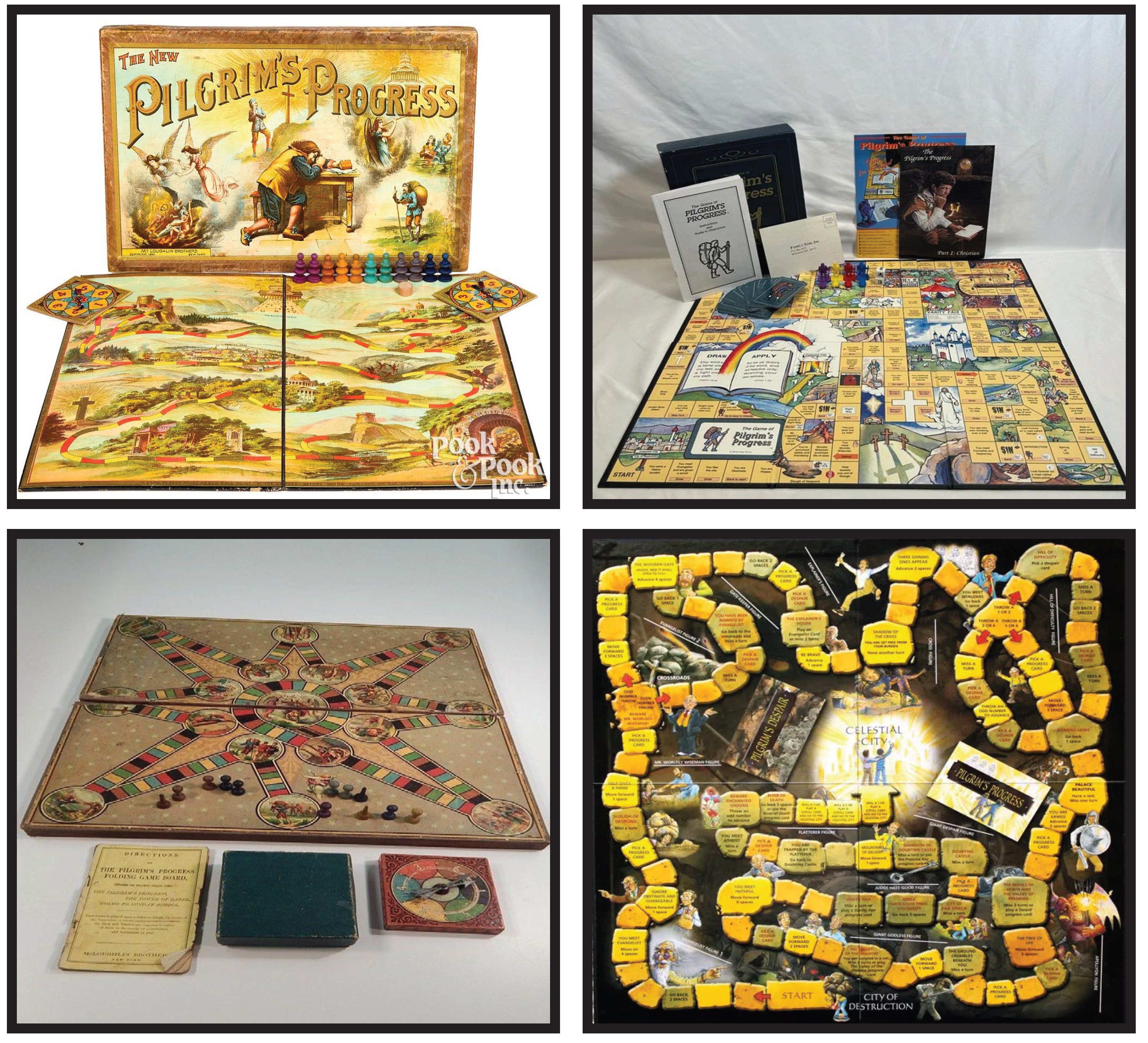
Figure 2.
Image from the 1843 edition of The Mansion of Happiness (W. & S. B. Ives).
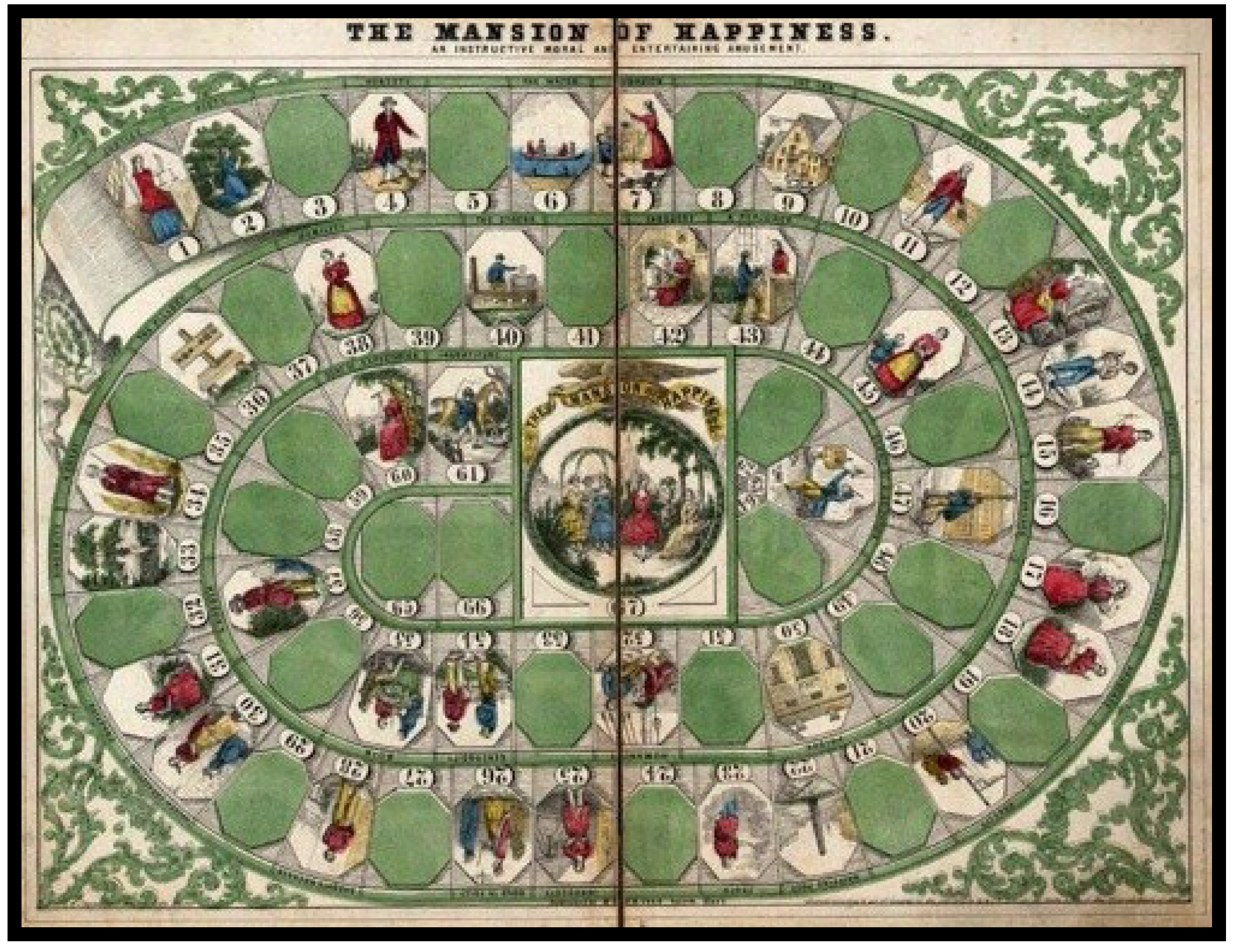
Figure 3.
Images from the board game Journey to Bethlehem, 1923 edition (Parker Brothers).
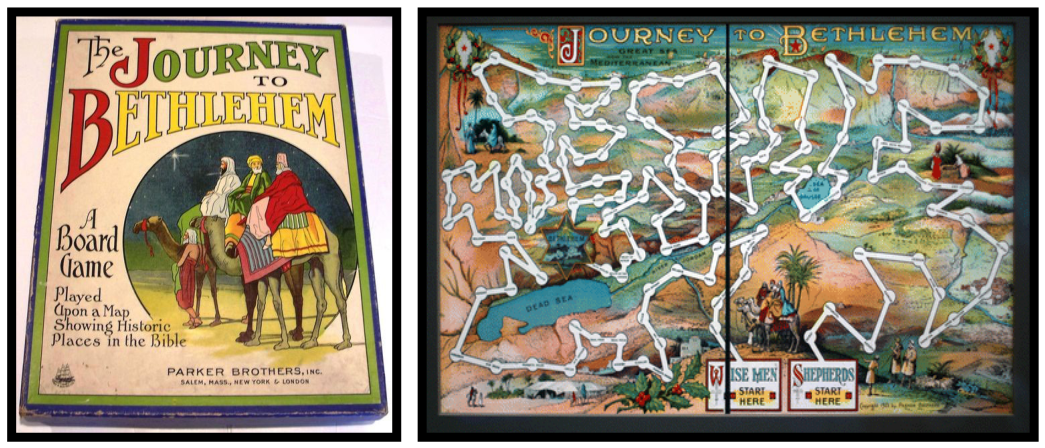
Figure 4.
Images from the board game Nicaea, 2021 edition (Hollandspiele).
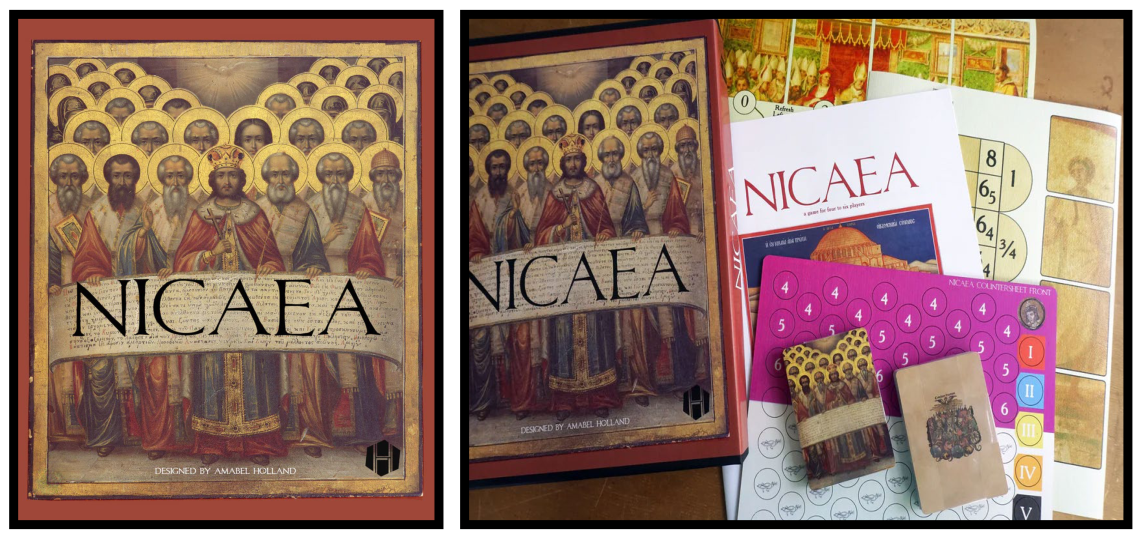
Disclaimer/Publisher’s Note: The statements, opinions and data contained in all publications are solely those of the individual author(s) and contributor(s) and not of MDPI and/or the editor(s). MDPI and/or the editor(s) disclaim responsibility for any injury to people or property resulting from any ideas, methods, instructions or products referred to in the content. |
© 2026 by the authors. Licensee MDPI, Basel, Switzerland. This article is an open access article distributed under the terms and conditions of the Creative Commons Attribution (CC BY) license (http://creativecommons.org/licenses/by/4.0/).
Copyright: This open access article is published under a Creative Commons CC BY 4.0 license, which permit the free download, distribution, and reuse, provided that the author and preprint are cited in any reuse.