
Submitted:
27 July 2026
Posted:
29 July 2026
You are already at the latest version
Abstract
Industrial heritage is increasingly reused for cultural consumption, yet sites embedded in difficult institutional histories also require the governance of difficult memories and the reorganisation of site narratives. This study examines the transformation of the former Hefei Prison into Hechai 1972 Cultural and Creative Park. Using a qualitative interpretive single-case design, it analyses historical and policy documents, official and media texts, spatial materials, field observations, and interviews through the perspectives of critical heritage studies, memory governance, and spatial production. The findings show that industrial production was historically embedded within prison administration and the reform-through-labour system, whereas these attributes were reordered in contemporary public narratives. Prison memory was retained through selective retention, low-intensity interpretation, targeted access, externalisation, and reframing. Industrial memory was foregrounded but detached from prison institutions, labour relations, and historical actors, producing a de-institutionalised representation. Urban industrial memory, nostalgia for everyday urban life, and cultural and creative consumption subsequently functioned as substitute narratives and were reproduced through exhibitions, commercial uses, visitor practices, and social-media circulation. The regeneration therefore operates through an interlocking mechanism of heritage-attribute ordering, memory governance, narrative substitution, and spatial reproduction. The study argues that material conservation alone cannot ensure interpretive integrity. Culture-led reuse requires a coherent and publicly accessible system connecting material remains with institutional history and historical actors. These findings clarify the regeneration mechanisms and ethical boundaries of dissonant heritage in China and provide insights for comparable sites with difficult institutional pasts.
Keywords:
dissonant heritage
; carceral–industrial composite heritage
; memory governance
; narrative substitution
; spatial reproduction
; Hechai 1972
1. Introduction
In recent years, industrial heritage has increasingly been incorporated into urban regeneration, cultural tourism, and place branding. Former factories, workshops, warehouses, and production landscapes are frequently converted into cultural and creative parks, exhibition spaces, and leisure and consumption venues because of their large spatial dimensions and distinctive industrial character. Principles of industrial heritage conservation emphasise that industrial heritage encompasses not only buildings, machinery, and production landscapes but also the historical, technological, social, and cultural values associated with industrial production [1,2]. The reuse of industrial heritage is therefore not merely a process of material conservation and functional conversion; it also entails value selection, historical interpretation, and spatial reorganisation.
In culture-led regeneration, industrial aesthetics, nostalgic experiences, and creative consumption tend to be foregrounded, whereas systems of production, labour processes, labouring subjects, and power relations may be marginalised or repackaged [3,4]. In the Chinese heritage context, industrial heritage is also frequently incorporated into frameworks of government-led urban regeneration, image-making, and capital-oriented redevelopment [5]. When industrial remains are simultaneously embedded in institutional histories of incarceration, discipline, and reform through labour, culture-led regeneration extends beyond the “reuse of former factories” to encompass how difficult memories are governed and spatially articulated.
This study examines the transformation of the former Hefei Prison site into Hechai 1972 Cultural and Creative Park. Historically, the site simultaneously accommodated incarceration and prison administration, reform through labour, industrial production, and educational rehabilitation. Following the relocation of Hefei Prison in its entirety, the former site was redeveloped as a cultural and creative park integrating exhibitions, dining, retail, leisure, performances, and creative offices. Although the surviving factory buildings and production spaces provide the principal material basis for its contemporary regeneration, further investigation is required into the positions accorded to intangible histories and historical actors within contemporary heritage interpretation.
Accordingly, this study is concerned not with how former factory buildings were converted into cultural and creative spaces but with how a site characterised by a composite carceral–industrial history has been renamed, interpreted, and spatially articulated through contemporary regeneration. The characterisation of Hefei Prison as a carceral–industrial site, with its prison function constituting the site’s foundational attribute, is supported by three lines of evidence drawn from official texts and oral accounts provided by knowledgeable informants. First, industrial production at the site was consistently subordinated to the prison’s administrative system. Second, incarcerated persons, prison officers, technical personnel, and administrators jointly constituted the production system. Third, production, everyday life, and the movement of people were all governed by the prison regime. The carceral system therefore constituted the institutional precondition for understanding the site’s industrial history.
Focusing on the culture-led regeneration of the former Hefei Prison site, this study addresses three research questions and further considers the implications of its findings for the integrity and ethical boundaries of heritage interpretation.
How are the site’s different historical attributes—including incarceration, reform through labour, industrial production, and educational rehabilitation—ordered within contemporary public narratives and spatial practices?
What levels of visibility and forms of interpretation are accorded to prison memory, reform-through-labour production, industrial achievements, and historical actors across official texts, media narratives, and spatial practices?
What configuration of mechanisms links memory governance, the dominant public narrative, and spatial reproduction in the culture-led regeneration of the former site?
On this basis, the study further discusses the implications of these findings for material conservation, interpretive integrity, and ethical boundaries in the regeneration of dissonant heritage.
This study adopts a qualitative, interpretive single-case study design to examine the relationships among the mechanisms involved in the reuse of complex heritage sites, rather than to pursue statistical generalisation [6,7].
More specifically, the former Hefei Prison site should not be classified simply as conventional industrial heritage; it is better understood as a composite heritage site characterised by structural dissonance. Dissonance does not necessarily manifest itself as overt contestation. Rather, it refers here to a structural imbalance among the site’s historical attributes, contemporary uses, and public narratives [8] (pp. 20–21). Histories associated with punishment, discipline, and difficult memories are often difficult to integrate fully into consumption-oriented urban spaces [9,10] (pp. 17–19). Accordingly, this study adopts an analytical pathway linking heritage-attribute analysis, memory governance, and spatial reproduction to identify the mechanisms underlying the site’s culture-led regeneration and to reflect on the relationships among material conservation, historical interpretation, and heritage ethics [3,11].
The theoretical contribution of this study lies in bringing former prison sites and their associated industrial production spaces in the Chinese context into the purview of critical heritage studies. Existing industrial heritage scholarship has largely focused on material conservation, adaptive reuse, and culture-led urban regeneration, whereas prison heritage studies have more frequently examined prison museums, prison tourism, and the interpretation of difficult memories. This study connects these two strands of scholarship by examining a particular condition in which a former prison enters culture-led regeneration primarily through its surviving industrial buildings. It investigates how different historical attributes are governed and spatially articulated under these conditions, and how these processes together reproduce the carceral–industrial site.
2. Literature Review and Theoretical Framework
2.1. Critical Heritage Studies, Authorised Heritage Discourse, and Memory Governance
A major contribution of critical heritage studies has been to challenge the conventional understanding of heritage as the intrinsic value of material remains [3] (pp. 11–13). Heritage is not simply a collection of buildings, places, or objects preserved from the past; rather, it is a process through which the past is selected, interpreted, and used within particular social, political, and cultural contexts [12] (pp. 38–40). Smith (2006) [3] introduced the concept of authorised heritage discourse (AHD), arguing that heritage values are often legitimised through the institutional language, professional standards, interpretive systems, and spatial practices of governments, experts, conservation organisations, and cultural management bodies. More recent scholarship has further emphasised that AHD does not operate solely at the textual level but interacts with institutional action, material space, and governance practices [11].
From this perspective, heritage narration is itself a form of memory governance. In this study, memory governance refers to the ensemble of practices through which relevant actors continually regulate the public visibility, interpretive intensity, and affective risks of different historical contents by means of naming, exhibition, communication, spatial access, and functional allocation [13,14]. It differs from memory politics, which primarily concerns identity formation, struggles over power, and contemporary mobilisation around interpretations of the past [15]. It also differs from heritage governance, which focuses on decision-making relations and participatory structures among governments, markets, experts, and the public [16]. Strategic forgetting and selective remembrance are understood here as specific mechanisms of memory governance [14].
Trouillot’s (1995) [17] discussion of “silences” in the production of history reminds us that power operates not only through the narration of history but also through what is left untold, narrated only minimally, or presented in particular ways. Heritage research must therefore examine not only what is displayed but also which histories, historical actors, and experiences remain insufficiently represented. The relationship between authorised heritage discourse and memory governance is particularly significant for heritage involving difficult memories or conflicting interpretations. Tunbridge and Ashworth’s (1996) [8] concept of dissonant heritage highlights the incompatibilities that may arise among different values, social groups, and interpretations of the past. Macdonald’s (2009) [9] work on difficult heritage similarly demonstrates that pasts associated with violence, shame, trauma, or institutionally troubling legacies are often difficult for contemporary societies to confront fully. The central issue in heritage reuse is therefore not limited to material conservation; equally important is how relationships among historical interpretation, the representation of historical actors, and the ethical boundaries of interpretation are negotiated. This is especially pertinent in culture-led and consumption-oriented regeneration, where narratives that are more readily communicated and publicly accepted may be foregrounded, while complex and difficult histories may be abstracted, externalised, or represented through substitute narratives [18,19] (pp. 1–14).
This issue also relates to the debate between material conservation and interpretive integrity in heritage conservation. Conventional conservation practices have generally prioritised the continuity of built fabric, spatial morphology, and visible physical remains. Contemporary heritage theory, however, increasingly emphasises that interpretive integrity resides not only in material form but also in the connections among objects, places, memories, and social relations [20,21] (pp.166–193). For sites containing institutionally difficult memories, the preservation of physical remains does not necessarily entail the preservation of heritage meaning. Where the relevant historical contexts, labour relations, and lived experiences of historical actors remain unexplained, material remains may be reduced to visual resources or backdrops for consumption.
2.2. Reuse of Prison Heritage and the Interpretation of Difficult Memories
Scholarship on prison heritage examines how former prisons, detention centres, re-education-through-labour institutions, penal colonies, and other spaces associated with systems of punishment are conserved, exhibited, developed for tourism, or adaptively reused. Unlike conventional architectural heritage, prison heritage possesses not only architectural and institutional significance but also complex histories of punishment, confinement, discipline, labour, rehabilitation, and social exclusion. The reuse of former prison sites therefore involves more than the functional conversion of space; it also concerns how difficult memories are interpreted, pedagogically reframed, commodified, or marginalised [18,22].
International experience suggests that the reuse of prison heritage has generated several distinct interpretive pathways. Eastern State Penitentiary exemplifies an explicitly critical approach: its exhibitions connect historical systems of incarceration with the contemporary problem of mass incarceration, thereby positioning prison heritage as a site of public reflection [22,23] (pp.1–12). Lorton Reformatory / Workhouse Arts Center represents an arts- and community-oriented pathway, in which former prison buildings have been converted into spaces for arts education and community cultural activities while retaining a degree of interpretation of the site’s prison history [24,25]. Chiayi Old Prison / Prison Museum is more closely aligned with a museum-based and institutionally focused educational pathway; its narratives emphasise architectural conservation, the history of prison administration, and the value of public education [26]. By contrast, Pentridge Prison reveals pronounced tensions between commercial development and the interpretation of prison memory. Related studies suggest that prison tourism and themed experiences may transform histories of violence, death, resistance, and trauma into a consumable ambience, thereby raising ethical concerns associated with dissonant heritage [10].
Taken together as heuristic reference cases, these examples indicate that the reuse of former prisons is persistently shaped by a narrative tension between adaptive reuse and the ethics of interpreting difficult memories. Strange and Kempa’s (2003) [27] comparison of Alcatraz and Robben Island demonstrates that prison tourism cannot be reduced simply to a form of “dark tourism”; the central issue is how histories of punishment are interpreted, marketed, and politicised. Wilson (2008) [28] (pp. 1–3) further observes that prison heritage interpretation frequently excludes, others, or marginalises the narratives of incarcerated people. The reuse of prison buildings does not therefore possess inherent ethical legitimacy. Only when penal systems, custodial relations, and the experiences of incarcerated people are adequately interpreted can spatial revitalisation avoid reducing difficult memories to mere ambience, spectacle, or consumable symbols.
In summary, research on prison heritage should not be confined to architectural conservation, tourism development, or spatial redevelopment. It should further examine how different historical contents are selectively represented, how historical actors and institutional relations are interpreted or marginalised, and the extent to which difficult memories are incorporated into public interpretation. For the regeneration of heritage sites shaped by intertwined histories of prison administration and labour production, this perspective moves the analysis beyond the “display of punitive space” towards an integrated examination of labour, discipline, lived experience, and the ethics of commodification [9] (pp. 94–99) [10,22] (pp. 140–166).·
2.3. Industrial Heritage Reuse and Urban Regeneration in China
In recent years, the conservation and reuse of industrial heritage in China have become increasingly institutionalised, accompanied by a shift from a primary emphasis on material preservation towards an integrated approach combining conservation, interpretation, revitalisation, and adaptive use. National-level policies on industrial heritage management emphasise its historical, scientific and technological, social, and artistic values, while encouraging cultural interpretation, industrial tourism, public education, and industrial transformation through heritage reuse on the basis of conservation [29,30]. This orientation is broadly consistent with international principles of industrial heritage conservation, according to which industrial heritage encompasses not only buildings, machinery, and production landscapes but also the social memories, technological systems, and cultures of labour associated with industrial production [1,2].
In the context of urban regeneration in China, authorised heritage discourse (AHD) also frequently operates as a discursive mechanism embedded in local governance. The recognition and communication of heritage values depend not only on professional conservation discourse but are also incorporated into local government-led regeneration policies, the introduction of cultural industries, city branding, and public education objectives. Existing research indicates that industrial heritage regeneration in China is often intertwined with urban regeneration, mega-events, capital accumulation, and the reproduction of space oriented towards cultural consumption. Consequently, industrial remains, technological achievements, and urban memories are more readily reframed as affirmative, development-oriented, and publicly communicable narratives [5,31]. Accordingly, this study approaches AHD not only through textual representations but also by examining how local development objectives, risk avoidance, and operational logics shape the visibility and interpretive intensity of different historical contents.
In practice, numerous former factories, warehouses, and industrial districts in China have been converted into cultural and creative parks, arts districts, commercial complexes, exhibition spaces, and tourism-oriented consumption settings. Such projects can extend the material life of industrial spaces, enhance the cultural image of cities, and provide new spatial platforms for local industrial restructuring. Cases such as Shanghai Red Town demonstrate that culture-led industrial heritage regeneration is frequently employed to construct urban distinctiveness and attract capital and consumer groups (Wang, 2009) [31]. More recent research has further shown that, in the context of mega-events and urban regeneration in China, industrial heritage is often incorporated into government-led development narratives and assigned multiple functions related to capital accumulation, urban regeneration, and image renewal [5].
From the perspective of the production of space, industrial heritage regeneration involves more than functional replacement; it entails the simultaneous reconstruction of spatial practice, representations of space, and representational spaces. Planning and capital reorganise spatial uses, design and communication reshape meanings, and visitor activities transform these spaces into everyday experiences of consumption [32,33]. Culture-led industrial heritage regeneration, however, also creates new interpretive challenges. Because former factories, machinery, and production landscapes are highly visible, they can readily be transformed into industrial aesthetics, nostalgic symbols, and atmospheres of consumption. By contrast, systems of production, labour processes, labouring subjects, and the complex social relations embedded within these sites may not receive an equivalent degree of representation [4,5] (pp. 4–11). Industrial heritage research should therefore examine not only whether buildings have been conserved and spaces reused, but also which histories are authorised for public display as memory, which actors and institutional relations are marginalised, and how material industrial remains participate in the production of heritage narratives that are more readily accepted by the public.
This issue is particularly pronounced at sites with a composite carceral–industrial history. International principles of industrial heritage emphasise that industrial heritage possesses not only architectural, technological, and landscape values but also records the lives, memories, and social relations of ordinary workers [1,2]. When industrial production is embedded within systems of prison administration and reform through labour, however, “industrial achievement” cannot be understood merely as a history of enterprise development or technological progress. It also involves coercive forms of labour organisation, custodial systems, and those subjected to institutional control. Industrial narratives consequently perform a dual role: they provide a recognisable material basis and a publicly legible point of entry for the regeneration of former sites, yet their heightened visibility may also obscure the institutional conditions and relationships among labouring actors underlying production [4]. This study is therefore concerned not with whether industrial narratives are factually authentic, but with how they are accorded a higher interpretive position in culture-led regeneration and how this positioning shapes public understanding of the institutional history of incarceration and labour.
2.4. Literature Synthesis and the Integrative Research Gap
Taken together, the existing literature provides three foundations for this study. First, critical heritage studies and scholarship on authorised heritage discourse, dissonant heritage, and difficult heritage demonstrate that heritage values do not arise naturally from material remains but are selectively constructed through institutional power, professional knowledge, public communication, and memory governance [3,8,9]. Second, research on prison heritage shows that the reuse of former prison sites concerns not only architectural conservation and tourism development but also penal systems, the lived experiences of historical actors, difficult memories, and the ethics of interpretation [10,18,22]. Third, studies of industrial heritage reuse in China indicate that former factories and industrial landscapes are frequently incorporated into urban regeneration, cultural consumption, and place branding, while systems of production, labouring actors, and complex social relations may be marginalised in the process of revitalisation [4,5,31].
Nevertheless, a clear integrative gap remains between these bodies of scholarship. Industrial heritage research has largely focused on factory conservation, functional adaptation, cultural and creative parks, and city branding, with comparatively limited attention to the institutional histories and labour relations underlying material industrial remains. Prison heritage research, by contrast, has concentrated primarily on sites explicitly presented as prison museums, prison tourism, and the interpretation of penal spaces. Much less attention has been paid to a particular condition in which a site’s foundational historical identity is carceral, while its most visible and readily reusable remains consist of factories, workshops, and industrial landscapes. Under these circumstances, industrial narratives may provide the principal point of public entry into the regenerated site, while also reordering or even obscuring histories of incarceration, reform-through-labour production, and the experiences of historical actors. Addressing this gap, the present study examines the ordering of heritage attributes, memory governance, narrative substitution, and spatial reproduction in the culture-led regeneration of the former Hefei Prison site [5,34].
Accordingly, this study conceptualises the former Hefei Prison site as a carceral–industrial composite form of dissonant heritage. It focuses on how different historical attributes are ordered through culture-led regeneration, how prison memory and reform-through-labour production are governed, and how industrial narratives, urban nostalgia, and cultural and creative consumption jointly contribute to the reproduction of space.
2.5. Analytical Framework
Drawing on the literature reviewed above, this study develops an analytical framework comprising three interconnected dimensions: historical attributes and material foundations—memory governance and narrative substitution—spatial reproduction. The framework rests on the premise that the historical contents of heritage sites are not naturally, comprehensively, or evenly represented through regeneration. Rather, the public visibility, interpretive intensity, and spatial positioning of different historical attributes are reconfigured through the interplay among authorised heritage discourse, the conditions of surviving material remains, and contemporary objectives for site use [3,8,11] (Figure 2-5).
Figure 2-5.
Research framework. Source: Authors’ own work.
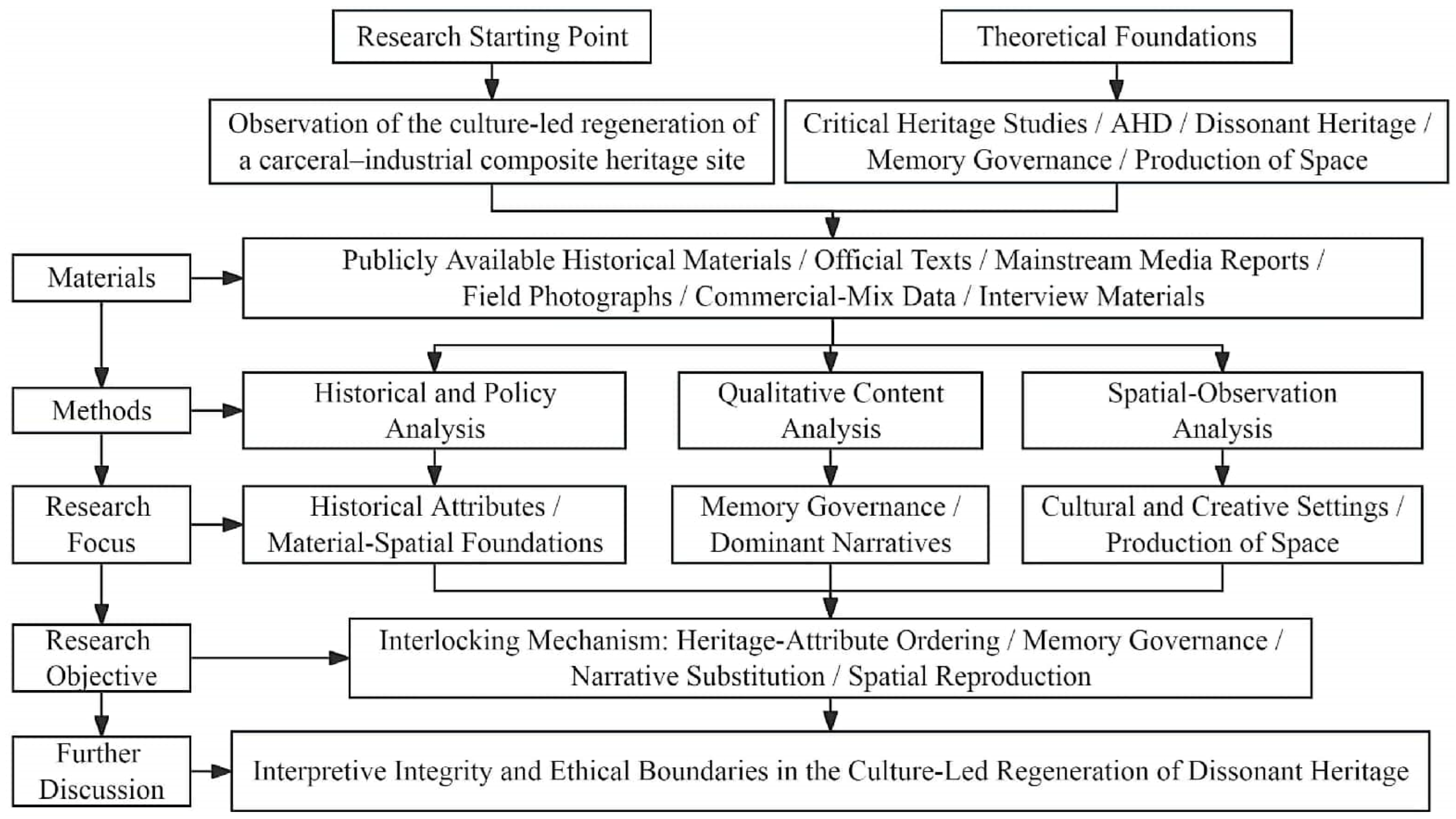
The first dimension concerns historical attributes and material foundations. The analysis begins by identifying the histories of prison administration, reform-through-labour production, industrial manufacturing, and educational rehabilitation associated with the former Hefei Prison site. It then examines how material remains—including factory buildings, workshops, perimeter walls, watchtowers, access-control facilities, and cell blocks—have been retained, interpreted, and functionally converted. This dimension demonstrates that different historical attributes do not possess equal visibility and that material remains do not constitute neutral historical evidence.
The second dimension focuses on memory governance and narrative substitution. Drawing on official texts, media narratives, spatial observations, and interview materials, the study analyses the specific ways in which prison memory, reform-through-labour production, industrial achievements, and historical actors are governed and, in some instances, represented through substitute narratives. Here, “substitution” refers to the greater interpretive prominence accorded to narratives of urban industrial memory, everyday urban life, and cultural and creative consumption, which are more readily accepted by the public [3,17].
The third dimension addresses spatial reproduction and its ethical implications. Space is not a passive container; it also functions as a medium through which selectively configured narratives are translated into everyday experience. The study therefore examines how architectural adaptation, exhibition organisation, visitor routes, the insertion of commercial and cultural functions, and consumption settings consolidate a particular order of memory. It further considers the relationships among material retention, historical interpretation, and the ethics of heritage interpretation [10,32,35].
3. Materials and Methods
3.1. Study Design
This study adopts a qualitative interpretive single-case study design. Rather than seeking statistical representativeness, a single-case study uses a theoretically informative empirical case to examine relational mechanisms within complex social, historical, and spatial processes [6,7]. The culture-led regeneration of the former Hefei Prison site was selected because the site encompasses multiple dimensions, including prison administration, reform through labour, industrial manufacturing, educational rehabilitation, and contemporary cultural and creative use. It therefore provides a concentrated setting in which to examine the processes of memory governance, narrative organisation, and spatial reproduction that occur when a site with a composite history undergoes urban regeneration.
The object of this study is neither industrial heritage regeneration alone nor the history of China’s prison system or the historical evolution of its reform-through-labour system. Rather, it is the reorganisation of heritage memory, public narratives, and spatial functions during the transformation of the former Hefei Prison site into Hechai 1972 Cultural and Creative Park. The scope of the study is defined in three respects. First, it focuses on historical attributes, narrative representation, and spatial transformation in the regeneration of the former site. Second, the prison system and the reform-through-labour system are considered only insofar as they provide the necessary background for understanding the site’s history. Third, Eastern State Penitentiary, Lorton Reformatory / Workhouse Arts Center, Chiayi Old Prison / Prison Museum, and Pentridge Prison are used solely as comparative references in the literature review and discussion; they do not constitute empirical cases in this study.
3.2. Case Background
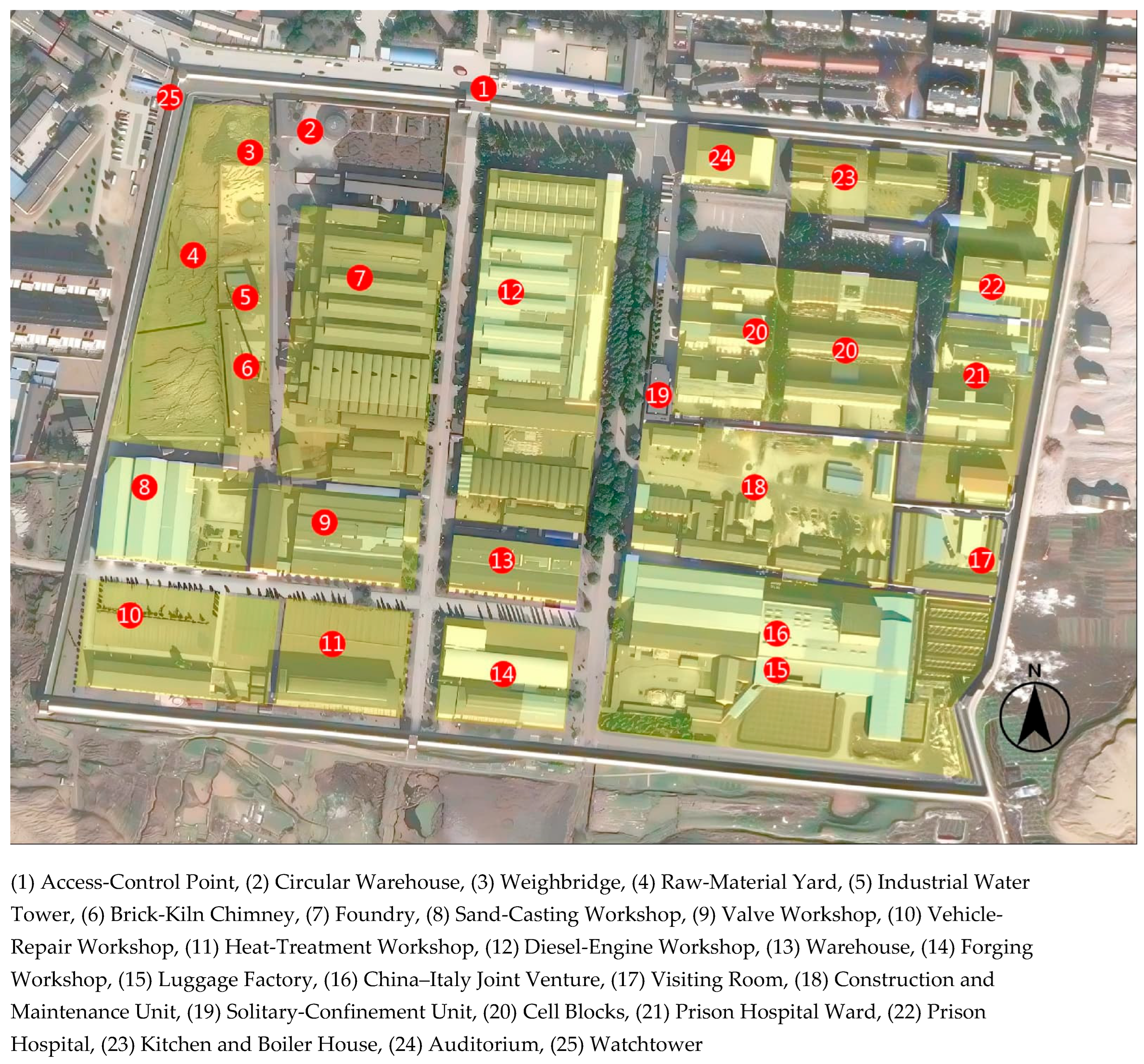
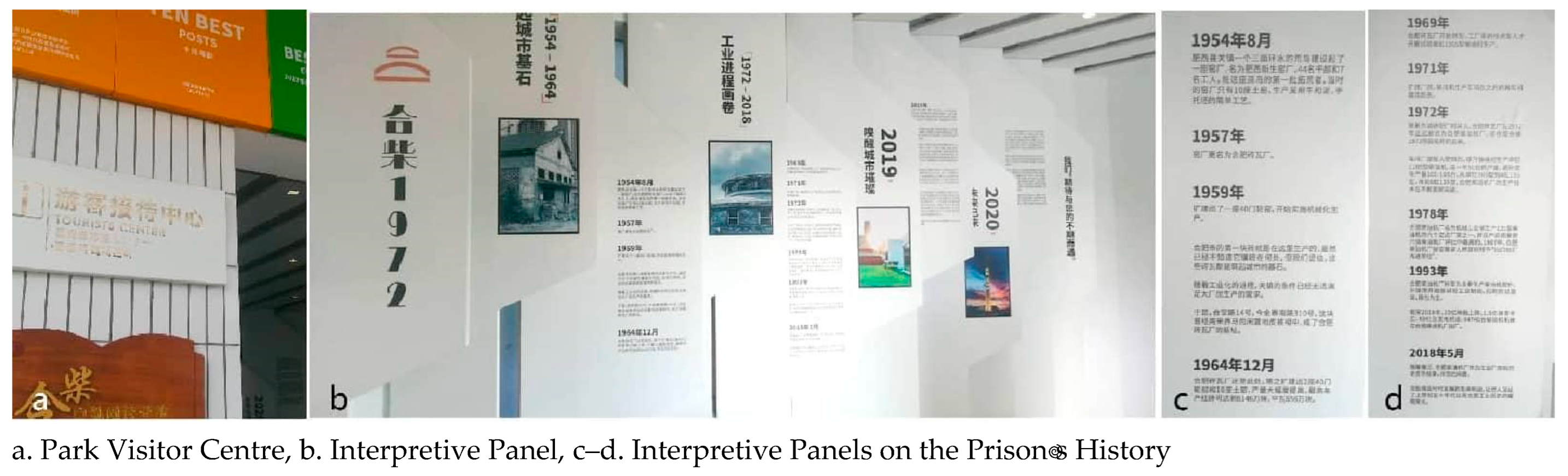
According to the interpretive panels at the Hechai 1972 Visitor Centre and oral accounts provided by knowledgeable informants, the former Hefei Prison site is located at 310 South Jinzhai Road, Hefei. Its history can be traced to the development of Anhui Province’s reform-through-labour system in the mid-twentieth century. In 1964, the Anhui Provincial No. 5 Reform-through-Labour Detachment and its affiliated brick-and-tile factory relocated to the present site. In 1972, the Hefei Diesel Engine Factory commenced operations there, while brick and tile production continued. In 1974, the institution was reorganised as the Anhui Provincial No. 2 Reform-through-Labour Detachment, and in 1996 it was renamed Anhui Provincial Hefei Prison. For many years, Hefei Prison performed functions including the confinement and supervision of prisoners convicted of serious offences, educational rehabilitation, and the organisation of production. Large-scale production activities involving bricks and tiles, diesel engines, and generator sets were conducted at the site. Recorded outputs included approximately 2 billion clay bricks, 150 million grey flat roof tiles, 4,241 generator sets, and 64,740 diesel-engine blocks. The prison also established an Education Section and the Tuohuang Cultural School, and provided incarcerated people with sustained legal, moral, general, and technical education (Figure 3-2).
Hefei Prison was relocated in its entirety in 2018. From 2019 onwards, the former site was gradually regenerated as Hechai 1972 Cultural and Creative Park. According to the interpretive panels at the Hechai 1972 Visitor Centre, the project combined industrial heritage conservation with cultural and creative use, transforming the former prison site into a cultural and creative industries park primarily accommodating art, exhibitions, leisure, and consumption. The contemporary park contains art exhibition venues, reading spaces, cultural and creative retail, dining and leisure facilities, live music and performance venues, creative offices, and spaces for public events.
Figure 3-2.
Functional Layout and Annotated Facilities at Hefei Prison. Note: The basemap is derived from World Imagery Wayback historical imagery [36], dated 20 December 2016. Facility names were identified and annotated by the authors based on interviews with three knowledgeable informants. Copyright and data-source attribution for the basemap are as shown in the original imagery. Adapted and annotated by the authors.
Figure 3-2.
Functional Layout and Annotated Facilities at Hefei Prison. Note: The basemap is derived from World Imagery Wayback historical imagery [36], dated 20 December 2016. Facility names were identified and annotated by the authors based on interviews with three knowledgeable informants. Copyright and data-source attribution for the basemap are as shown in the original imagery. Adapted and annotated by the authors.
3.3. Data Collection
This study draws on multiple sources of evidence to develop a comprehensive understanding of the historical context, public narratives, spatial representation, and modes of reception associated with the culture-led regeneration of the former Hefei Prison site. The materials comprise historical and policy documents, official and media texts, spatial data and field-observation records, semi-structured interview materials, and reference materials concerning international cases of prison heritage reuse. The use of multiple sources strengthens the chain of evidence and enhances the interpretive robustness of the single-case study [7,37].
3.3.1. Historical and Policy Materials
- (1)
- Historical materials: publicly available materials concerning the history of Hefei Prison, including written accounts, photographic records, and documentary video footage.
- (2)
- Policy materials: international conventions and principles concerning heritage conservation and use, as well as laws, regulations, and administrative documents issued by Chinese authorities concerning heritage conservation and utilisation.
Two principal historical sources and seven highly relevant policy documents were collected. The historical materials were used primarily to reconstruct the institutional development, production activities, relocation, and subsequent regeneration of the former Hefei Prison site. The policy documents were used to analyse relevant policy orientations in China and to contextualise the case within authorised heritage discourse (AHD).
3.3.2. Official Texts and Mainstream Media Coverage
The official texts comprised planning documents, park introductions, exhibition and display texts, and visitor-guidance information. The mainstream media materials consisted of reports on Hechai 1972 Cultural and Creative Park published by Chinese central-level, sector-specific, and local official media outlets. After duplicate, low-information, and weakly relevant materials had been excluded, five official texts were selected: one park-planning document, two official introductory texts, one on-site exhibition text, and one on-site visitor-guidance text. A further 18 mainstream media reports were included (Table A4). The official texts were used to examine how the site’s historical information and material spaces were named, interpreted, represented, and valorised. The mainstream media materials were used to analyse how broader authorised heritage discourse framed and circulated interpretations of the case.
3.3.3. Spatial Data and Field-Observation Materials
The spatial data and field-observation materials were used primarily to document the relationships among the site’s historical spaces, contemporary functions, and opportunities for visitor encounter. Four rounds of field observation were conducted at Hechai 1972 Cultural and Creative Park between October 2024 and May 2025, including two visits on weekdays and two on weekends or public holidays. This arrangement captured both routine patterns of use and periods of peak consumption. The observations covered the park entrances, principal visitor routes, the former production zone, the former custodial area, exhibition spaces, commercial spaces, public-event areas, perimeter walls, watchtowers, access-control facilities, solitary-confinement cells, and other locations marked by historical remains or interpretive signage.
During the observations, the researchers recorded the principal visitor routes, locations where visitors stopped or took photographs, exhibition texts, wayfinding signs, historical information panels, the distribution of commercial uses, and the contemporary functions of surviving historical remains. The resulting dataset comprised field photographs, route records, and 32 observation points grouped into five categories. In addition, pre-regeneration satellite imagery obtained from World Imagery Wayback [36], functional annotations provided by knowledgeable informants (Figure 3-2), and a facility-distribution map published through the park’s official WeChat account were used to assist in identifying the site’s original spatial configuration, contemporary functional distribution, and consumer-oriented commercial mix. Together, these materials formed the empirical basis of the spatial-observation analysis.
3.3.4. Semi-Structured Interview Materials
- (1)
- Interview Team
The interview team comprised five graduate students and two faculty members from the institutions affiliated with the first and corresponding authors. All team members had received training in qualitative data collection and coding. They were selected on the basis of their academic backgrounds in public heritage and tourism studies, as well as their relevant fieldwork experience.
- (2)
- Interview Design and Data
Between 1 October 2024 and 5 May 2025, the research team conducted four rounds of semi-structured interviews at Hechai 1972 Cultural and Creative Park and the residential compound for Hefei Prison staff. All participants were adults aged 18 years or above. They comprised park management and operational personnel (M), business owners and employees (B), retired prison employees (I), and visitors, including non-local visitors (OV) and local visitors (LV). The interviews with these four groups focused respectively on: (1) the background to the regeneration project, operational positioning, and the organisation of interpretation and display; (2) spatial use, perceptions of the business mix, and everyday operations; (3) historical functions, production activities, and spatial changes; and (4) historical awareness, narrative and consumption experiences, and impressions of the site.
The sampling procedures and numbers of valid participants were as follows. First, park management and operational personnel and retired prison employees were recruited through purposive sampling supplemented by snowball recruitment. The aim was to identify key informants familiar with the park’s regeneration and current spatial use or with its historical development and functional changes (Figure 3-2). Four valid interviews were obtained from each of these two groups. Second, maximum-variation sampling was used to recruit business owners and employees across a range of activities, including catering, retail, exhibitions, office-based work, performances, and photography. This produced nine valid interviews and enabled a diverse understanding of the park’s everyday operations and practices of spatial consumption. Third, visitors were recruited through on-site intercept sampling within a stratified quota design, with local and non-local visitors each intended to account for approximately half of the sample. Potential participants were approached randomly on site, yielding 13 valid interviews with non-local visitors and 15 with local visitors. Each interview lasted approximately 5–15 min, and a total of 45 valid interviews were collected. All interviews were transcribed and cross-checked by two reviewers to ensure consistency and semantic integrity in the transcription of the oral accounts.
The interview materials were not included in the subsequent qualitative coding. Instead, they served as supplementary evidence for verifying historical facts and examining spatial perceptions and the reception of site narratives. Visitor responses were further synthesised under themes including “initial impressions of the site,” “awareness of the site’s prison history,” and “recollections of the principal exhibition venues.”
Because the participants were drawn from different target groups and the number within each group was relatively small, no demographic analysis of the interview sample was conducted. The relevant research ethics statement is provided in Section 3.5.
3.3.5. International Reference Materials
Materials were collected on four international cases of prison heritage reuse: Eastern State Penitentiary, Lorton Reformatory / Workhouse Arts Center, Chiayi Old Prison, and Pentridge Prison. These materials were obtained from the cases’ official websites and relevant academic publications. They were used as comparative references in the discussion to analyse differences in approaches to prison heritage interpretation across institutional and cultural contexts; they did not form part of the empirical dataset of this study.
3.4. Analytical Methods
This study employed an integrated analytical procedure combining historical and policy analysis, qualitative content analysis informed by critical heritage theory, and spatial-observation analysis. Historical and policy analysis was used to reconstruct changes in the site’s institutional names, functions, production activities, institutional arrangements, relocation, and contemporary reuse. Qualitative content analysis informed by critical heritage theory examined how different historical attributes, historical actors, and institutional relations were represented and interpreted in official and media texts. Spatial-observation analysis was used to assess how textual narratives were materialised and functionally transformed within the physical site. Together, these three methods addressed the research questions concerning historical attributes, memory governance, and spatial reproduction [37].
3.4.1. Historical and Policy Analysis
Historical and policy analysis was used to reconstruct the historical evolution of the former Hefei Prison site and to establish the background and policy basis of its regeneration. Publicly available historical materials on Hefei Prison, relevant policy documents, and oral accounts provided by knowledgeable informants were reviewed and organised to develop a chronological account of the site’s transformation. The purpose of this analysis was not to produce a comprehensive reconstruction of the history of the prison system, but to provide a factual and policy basis for the subsequent qualitative content and spatial analyses. The information examined included changes in the institution’s name, shifts in site functions and production activities, institutional developments, contemporary reuse, and relevant policy support [37].
3.4.2. Qualitative Content Analysis
This study employed qualitative content analysis informed by critical heritage theory. Critical heritage studies, authorised heritage discourse (AHD), and memory governance provided the interpretive framework, while qualitative content analysis supplied the basic analytical procedures through which recurring patterns of meaning were identified by means of classification, comparison, and induction. The analysis focused on how heritage values were selected, ordered, and publicly articulated, and how different historical attributes, historical actors, and institutional relations were assigned unequal positions of representation [3,11,38]. Its purpose was therefore not to count the occurrence of particular words, but to examine the visibility, interpretive intensity, and interrelationships of narratives concerning the prison, reform-through-labour production, industry, educational rehabilitation, and cultural and creative consumption.
The textual corpus comprised: (a) park-planning documents; (b) official media introductions produced by the park; (c) on-site exhibition and visitor-guidance texts; and (d) mainstream media reports. The planning documents were used to analyse the site’s formal positioning, proposed functions, and value attribution. The park’s official media introductions and on-site exhibition and guidance texts were examined to identify the historical information accessible to ordinary visitors and the ways in which it was interpreted. Mainstream media reports were used to analyse how the park’s positioning and site narratives were repeated and disseminated in the public domain. In addition, (e) historical materials were used to establish a reference chronology of institutional changes, production activities, and transformations in spatial functions. These materials were not combined with contemporary public texts in assessments of visibility. The analysis combined deductive and inductive procedures (Table 3-4).

Table 3-4.
Framework for Qualitative Content Analysis. Source: Authors’ own work.
| Analytical Dimension | Core Question | Primary Materials |
|---|---|---|
| Naming practices | How are the site and its historical attributes named and identified? | a; b; c |
| Chronological organisation | Which historical periods are foregrounded, compressed, or omitted? | a; b; c; e |
| Representation of historical content | How are prison administration, reform-through-labour production, industrial manufacturing, and educational rehabilitation interpreted? | a; b; c |
| Representation of historical actors | Are incarcerated people, prison officers, technical workers, and other historical actors represented, and if so, how? | b; c; d |
| Value attribution | What historical and contemporary values are attributed to the site? | a; b; c; d |
Note: a: park-planning documents; b: official park media; c: on-site exhibition and visitor-guidance texts; d: mainstream media reports; e: historical materials.
- (1)
- Establishing the analytical categories: Initial categories were developed from the research questions and theoretical framework. The historical content of the texts was classified into four attributes—prison, reform-through-labour production, industry, and educational rehabilitation—which were analysed alongside contemporary narratives of cultural and creative consumption (Table A1). Coding was conducted across five dimensions: naming practices, chronological organisation, the representation of historical content, the representation of historical actors, and value attribution (Tables 3-4 and A2). The smallest coding unit was a title, sentence, short paragraph, or figure caption capable of conveying a relatively complete meaning. Multiple coding was permitted when a single unit concerned more than one attribute or analytical dimension. The type of material, publishing body, date, and textual location were also recorded.
- (2)
- Main coding procedure: First, the materials were stratified by type, and two researchers independently coded 30% of the coding units. They compared differences in their judgements concerning historical attributes, analytical dimensions, and modes of representation, and subsequently revised the code definitions, inclusion and exclusion criteria, and illustrative examples. Second, one of the researchers coded the remaining materials in accordance with the revised rules. Third, units involving multiple possible interpretations, conflicting evidence, or findings central to the study’s conclusions were reviewed by both researchers and resolved through discussion and consensus. Double coding was intended to improve the consistency, transparency, and traceability of the analytical process rather than to eliminate the interpretive judgement inherent in qualitative research [38,39].
- (3)
- Inductively identifying modes of representation: Through constant comparison across different materials and coding units, the analysis identified the following modes of representation: foregrounding; chronological compression or omission; conflation; abstraction; de-institutionalisation; pedagogical reframing; externalisation; narrative substitution; aestheticisation; and commodification (Table A3). These categories were used to describe the specific strategies through which historical content was organised and represented.
In the final analysis, word frequency was not treated as the sole indicator of discursive significance. Instead, the analysis considered whether particular content appeared in titles, opening passages, or principal exhibition areas; whether it occupied substantial textual or spatial prominence; whether it recurred across different media; and whether it was accessible and intelligible to ordinary visitors. Interpretive claims concerning “silence,” “substitution,” “externalisation”, or “de-institutionalisation” were, in principle, required to be supported by at least two types of material and cross-checked against historical sources, spatial observations, and interview findings. This process resulted in a qualitative coding matrix informed by critical heritage theory (Table A4). Where conflicting information across sources could not be reconciled, the discrepancies were retained, and the limitations of the evidence and plausible competing interpretations were reported in the findings.
3.4.3. Spatial-Observation Analysis
Spatial-observation analysis was used to examine how heritage narratives were represented, attenuated, or transformed into everyday experiences of consumption within the site. Drawing on pre-regeneration satellite imagery, spatial annotations provided by knowledgeable informants (Figure 3-2), a facility-distribution map published through the park’s official WeChat account (Figure 4-1), and field-observation records, the study treated space as a medium through which heritage memories are organised, distributed, and experienced. The analysis focused on the spatial locations, accessibility, opportunities for visitor encounter, and interpretive intensity of different historical remains and forms of memory within the contemporary park [35] (pp. 93–169) [40] (pp. 249–283).
Based on the designated observation points, the spatial representation of different historical attributes was compared across three dimensions: accessibility, visibility, and interpretive intensity. Accessibility referred to the extent to which visitors could physically encounter the relevant spaces. Visibility indicated how readily historical remains or forms of memory could be recognised. Interpretive intensity referred to the extent to which on-site information explained the relevant historical contexts, institutional relations, and historical actors. The rating scales and assessment criteria for the three dimensions are presented in Table B1.
Throughout the analysis, findings from textual analysis, spatial observation, and interview materials were triangulated to assess the degree of correspondence among textual narratives, spatial representation, and visitor perceptions. This comparison was also used to explain differences in the visibility of historical attributes and shifts in their narrative positioning during culture-led regeneration. All information concerning personal experiences or sensitive histories was anonymised. These procedures were intended to enhance the transparency, traceability, and interpretive credibility of the single-case study [39,40].
3.5. Research Ethics Statement
This study was approved by the academic ethics committee of the first author’s institution. All research procedures described in this study were conducted in accordance with applicable laws and regulations, institutional guidelines, and internationally recognised ethical standards for academic research.
(1) Sources and Authorisation of Sensitive Historical Information
The information concerning the history of Hefei Prison and reform through labour was obtained from two principal sources. First, publicly available materials were used, with the relevant sources cited in all instances. Second, supplementary information was derived from oral accounts provided by knowledgeable informants. These accounts were reviewed to ensure that they contained no material prohibited under Chinese law or inconsistent with internationally recognised principles of heritage ethics. The relevant content was also reviewed by the participants and used with their permission.
(2) Informed Consent Procedures
Before each on-site interview, participants were informed orally that: (1) the data collected would be used exclusively for academic research and would not be used for commercial purposes or other interests; and (2) the interview findings might be reported anonymously in academic monographs and journal articles, without disclosing any personally identifiable information. With the participants’ consent, all interviews were audio-recorded and supplemented by field notes. The interview records were assigned anonymised identifiers and stored securely.
During the fieldwork, 15 participants voluntarily signed written informed-consent forms on site. Given the noisy field conditions and the preference of some participants not to provide written consent, the interview team read the oral informed-consent script approved by the ethics committee of the first author’s institution to the remaining participants and obtained their oral informed consent before proceeding with the interviews.
4. Results and Analysis
This study integrated historical and policy analysis, qualitative content analysis informed by critical heritage theory, and spatial-observation analysis. Qualitative content analysis constituted the principal analytical method. Drawing on multiple sources of evidence, the study conducted qualitative coding informed by critical heritage theory to compare the historical attributes of the prison, reform-through-labour production, industry, and educational rehabilitation with post-regeneration narratives of cultural and creative consumption across five dimensions: naming practices, chronological organisation, the representation of historical content, the representation of historical actors, and value attribution. This analysis revealed differences in the public visibility, interpretive intensity, and representational strategies associated with different historical contents (Tables 4-0 and A4). The qualitative findings were subsequently compared and cross-checked against historical materials and spatial observations. The results show that, following the transformation of Hefei Prison into a cultural and creative park, industrial remains became the material and spatial foundation of culture-led regeneration; prison memory and the industrial memory institutionally subordinate to the prison were subjected to processes of memory governance; and substitute narratives, once introduced into the site, combined with practices of cultural and creative consumption to sustain its spatial reproduction.
Table 4-0.
Differential Representation of Historical Attributes and Contemporary Cultural and Creative Narratives. Source: Authors’ own work.
Table 4-0.
Differential Representation of Historical Attributes and Contemporary Cultural and Creative Narratives. Source: Authors’ own work.
| Analytical Dimension | Prison Attribute | Reform-through-Labour Production Attribute | Industrial Attribute | Educational Rehabilitation Attribute | Contemporary Cultural and Creative Consumption Narratives |
|---|---|---|---|---|---|
| Naming practices | Presented as a secondary label | Largely absent | Highly foregrounded | Not incorporated into the site’s naming | Terms such as “cultural and creative park” and “arts district” are foregrounded |
| Chronological organisation | Institutional milestones are compressed | The reform-through-labour period is largely omitted | The industrial milestone of 1972 is foregrounded | Presented only sporadically | The regeneration process since 2019 is presented in detail |
| Representation of historical content | Focuses primarily on the site’s former prison identity and custodial facilities | Systems of production and labour relations have low visibility | Products, production figures, and factory buildings are represented in detail | Presented only sporadically | Business types, activities, and visitor experiences are presented in detail |
| Representation of historical actors | Incarcerated people and prison officers have low visibility | The labour identity of incarcerated people is attenuated | Technical workers and production managers receive limited representation | Recipients of educational rehabilitation are represented as an undifferentiated group | Not coded as historical actors |
| Value attribution | Rule-of-law and educational values | Economic and social value of production achievements | Urban industrial memory and urban-development values are foregrounded | Educational and rehabilitative value is emphasised | Urban regeneration, public culture, artistic experiences, and consumption |
4.1. Representation and Role of Industrial Material Remains
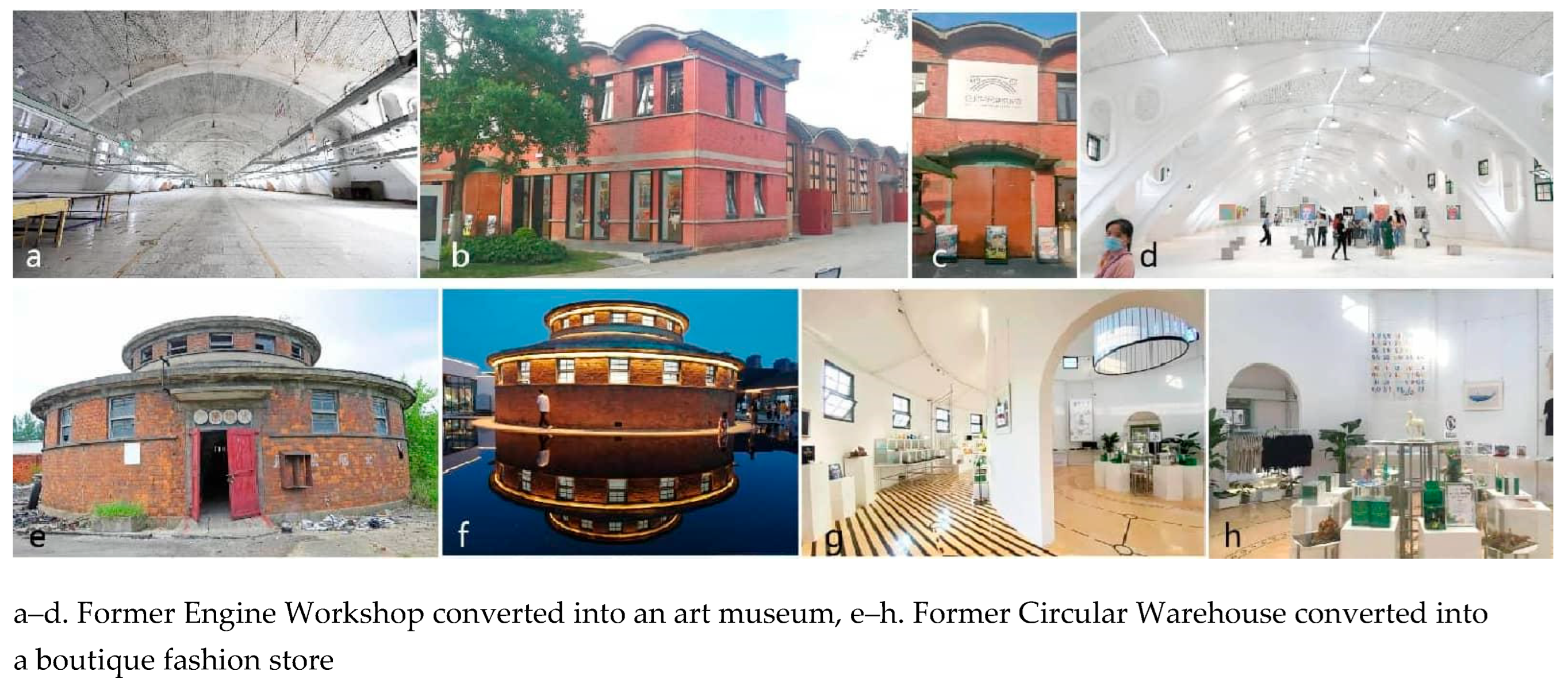
Spatial observations and comparisons of pre- and post-regeneration imagery indicate that the former Hefei Prison site originally comprised a production zone, storage areas, outdoor material yards, a custodial zone, and principal internal roads. Following regeneration, exhibition, dining, commercial, event, and leisure facilities serving visitors and consumers became concentrated primarily within the former production zone. Large-span workshops and warehouses were converted into art galleries, a craft museum, the Hefei Household Appliance Story Museum, Time Street, and associated commercial spaces, while the former outdoor yards were transformed into venues for markets, festivals, and large-scale events (Figures 3-2 and 4-1). By contrast, the former custodial zone—the residential area for incarcerated people—was converted into a cultural and creative office district. Its original spatial characteristics are now difficult to identify, and the area does not form part of the principal visitor itinerary through the park’s consumption spaces. Although custodial structures such as perimeter walls, watchtowers, and access-control facilities have been retained, they are presented largely as symbolic features.
Figure 4-1.
Comparison of Major Heritage Remains and Contemporary Functions. Note: For each labelled feature, the text in parentheses indicates its function or designation during the prison period. The figure was prepared by the authors based on a panoramic map of Hechai 1972 Cultural and Creative Park originally published on the park’s official WeChat account.
Figure 4-1.
Comparison of Major Heritage Remains and Contemporary Functions. Note: For each labelled feature, the text in parentheses indicates its function or designation during the prison period. The figure was prepared by the authors based on a panoramic map of Hechai 1972 Cultural and Creative Park originally published on the park’s official WeChat account.
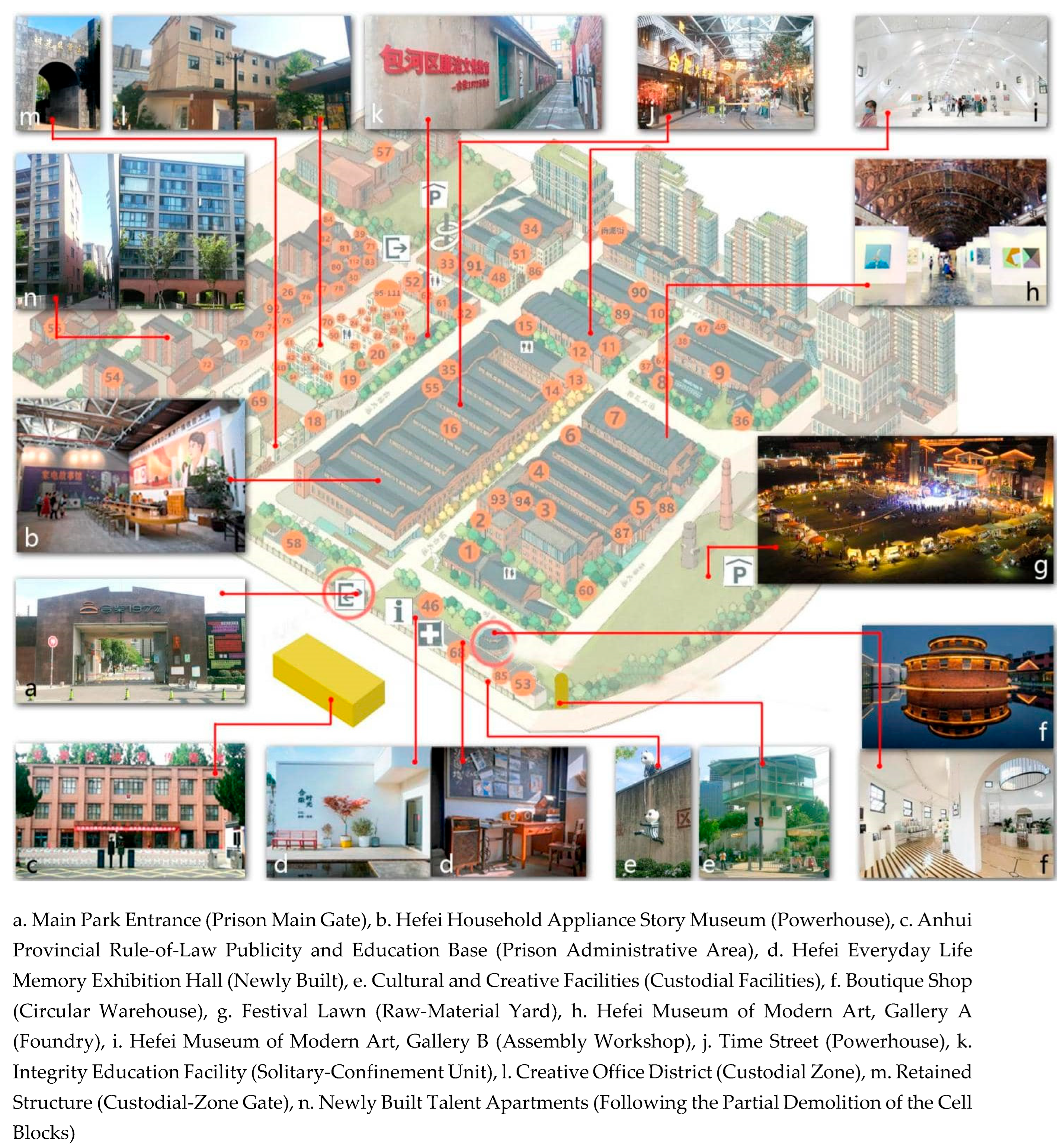
The recurrent use of terms such as “industrial remains,” “old factory buildings,” “cultural and creative park,” and “industrial style” in park introductions and media reports repeatedly frames the site for the public. Consequently, the site is presented primarily as a public space characterised by industrial nostalgia, rather than as a heritage interpretation space structured around the history of the carceral system.
The interview materials reveal a similar tendency. Of the 28 visitors interviewed, 25 described their initial impressions of the site in terms such as “old factory buildings,” “industrial style,” “a good place for taking photographs,” and “a cultural and creative park.” A local visitor, LV-09, stated: “When we drive along the elevated road, we often see this factory complex and know that it was a diesel engine factory, but we had never noticed that it was also a prison.” Although some interviewees were aware that the site had formerly been a prison, this identity was generally treated as background information rather than as the principal interpretive lens through which the site was understood. As a local visitor, LV-04 explained: “When people learn that the park was converted from a prison, they think it will be quite striking, but you cannot really perceive that history when you are here.” These responses indicate that industrial material remains not only accommodate contemporary reuse but also shape the public’s initial understanding of the site’s character.
Taken together, these findings reveal clear differences between industrial remains and custodial remains in terms of functional transformation, accessibility, interpretive intensity, and public legibility during the culture-led regeneration of the former Hefei Prison site. Owing to their spatial scale, adaptability to new uses, and visual appeal, industrial material remains have acquired greater public visibility. Custodial remains, by contrast, persist primarily as symbolic markers and discrete spatial nodes. This asymmetry provides the spatial precondition for the subsequent processes of memory governance and narrative substitution [35] (Table 4-1).
Table 4-1.
Functional Transformation and Interpretive Intensity of Major Heritage Remains. Source: Authors’ own work.
Table 4-1.
Functional Transformation and Interpretive Intensity of Major Heritage Remains. Source: Authors’ own work.
| Space / Heritage Remains | Historical Function | Contemporary Function | Accessibility | Interpretive Intensity | Representational Effect |
|---|---|---|---|---|---|
| Factory buildings and workshops | Industrial production spaces | Exhibitions, dining, and retail | High | Medium | Principal spaces for visiting and consumption |
| Chimneys, domed roofs, and red-brick walls | Industrial facilities and architectural fabric | Landscape features and photographic backdrops | High | Medium | Reinforce the perception of an industrial aesthetic |
| Outdoor material yards | Ancillary spaces for production and storage | Markets, festivals, and public events | High | Low–Medium | Transformed into settings for leisure and consumption |
| Perimeter walls and watchtowers | Custodial boundaries and security facilities | Retained boundary features and visual landmarks | Medium | Low–Medium | Signal the site’s former prison identity |
| Access-control facilities, cell blocks, and solitary-confinement facilities | Custodial and punitive spaces | Landscape features, creative offices, and warning-education facilities | Low | Low / limited to designated groups | Do not form part of ordinary visitors’ principal routes |
4.2. The Governance of Prison Memory: Selective Retention, Low-Intensity Interpretation, Targeted Access, Externalisation, and Value Reframing
Spatial observations showed that factory buildings, warehouses, and other structures with substantial potential for adaptive reuse were extensively retained and converted to accommodate a range of new functions. By contrast, readily identifiable traces of carceral infrastructure were limited, consisting primarily of perimeter walls, watchtowers, and access-control facilities. A non-local visitor, OV-06, stated: “When I saw such high walls topped with barbed wire, I assumed that the site had previously been a military factory.” This pattern suggests that the regeneration involved selective retention: factory buildings were more readily adapted to exhibition and commercial uses, whereas many custodial facilities offered more limited potential for functional reuse.
In official textual representations, the park’s own media introductions frequently employed terms such as “cultural and creative park,” “industrial remains,” and “industrial memory” when constructing its public narrative. Mainstream media reports generally described the value of the regeneration through terms such as “urban regeneration” and “cultural creativity.” When prison history was mentioned, however, it was more commonly framed through the value-laden language of “rule-of-law education,” “warning education,” and “integrity education.” Such representations do not necessarily indicate that prison history was ignored. Rather, complex histories of the carceral system, everyday life in confinement, disciplinary spaces, and reform-through-labour production were reframed within educational frameworks more readily accorded public legitimacy [17] (pp. 95–130).
Spatial-observation analysis also revealed the low interpretive intensity accorded to prison memory. A comparison of World Imagery Wayback satellite imagery with field observations indicated that, although most buildings in the former custodial zone had been retained, their contemporary functions had shifted towards creative offices, artists’ studios, and talent apartments. Following the removal of the original internal walls and iron gates, the area became more open and visually permeable, making it difficult for ordinary visitors to recognise the functional traces of the former cell blocks. Comparisons of photographs taken before and after regeneration further showed that the original sign reading “Custodial Zone” above the entrance was replaced by “Time Custodial Zone”. Visitor interviews indicated that the background and meaning of this new designation were not generally understood. Meanwhile, the former solitary-confinement facility was converted into an educational space providing disciplinary and legal warning education for public-sector personnel (Figure 4-2), while its original function remained difficult for ordinary visitors to identify. Prison-related exhibits—including custodial equipment, prisoners’ uniforms, everyday objects, and cultural works—were externalised to the provincial-level rule-of-law publicity and education base outside the park walls (Figure 4-2e–h), which was accessible only to organised groups of public-sector personnel. Thus, prison memories considered incompatible with the park’s cultural and creative atmosphere were not eliminated; rather, they were managed through targeted access and spatial externalisation, separating them from the principal routes used by the general visiting public.
Figure 4-2.
Representation of Surviving Custodial Facilities
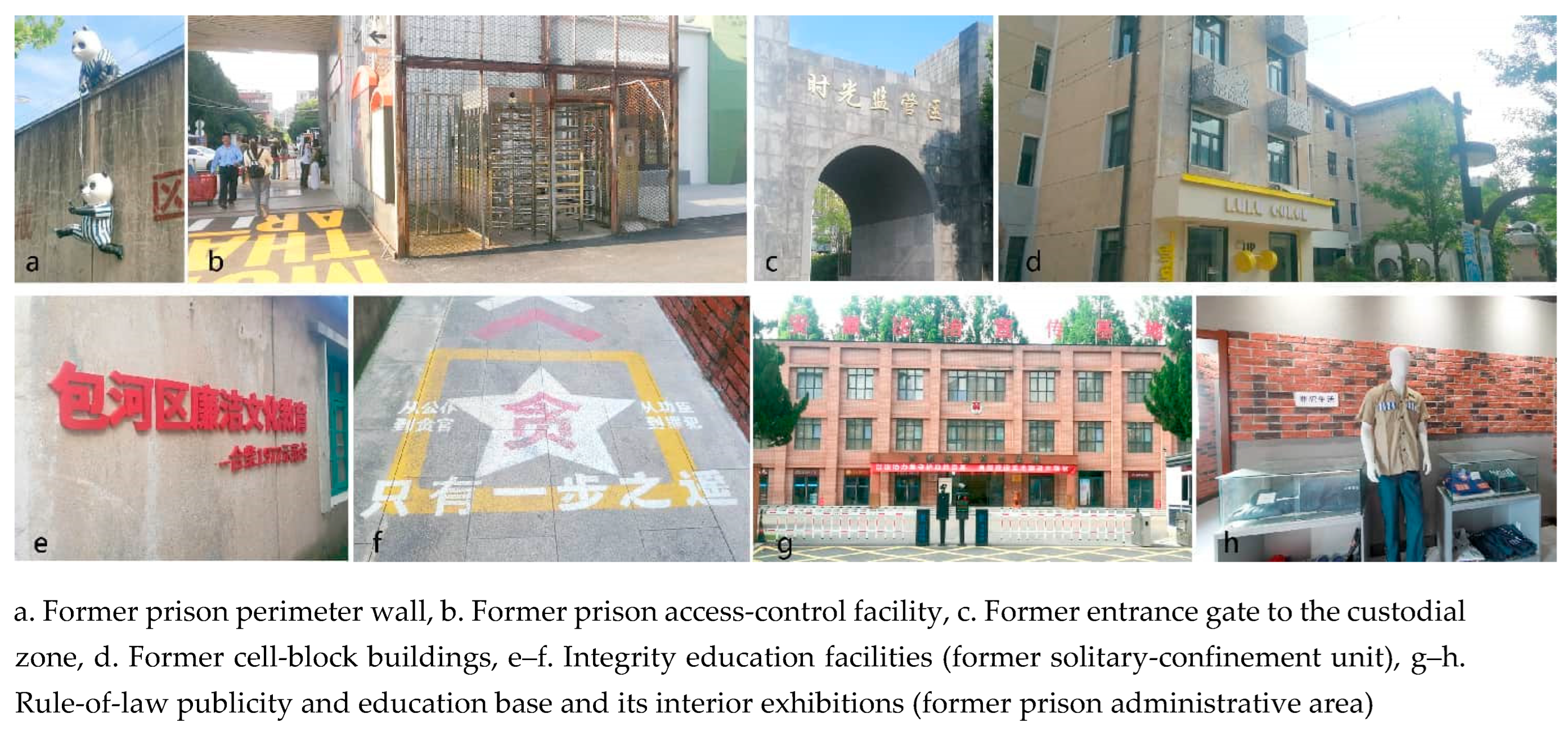
Field observations identified two related phenomena. On the one hand, solitary confinement, custodial control, and experiences of incarceration were reframed in terms of disciplinary warning and rule-of-law education at the Baohe District Integrity Education Demonstration Site and the Anhui Provincial Rule-of-Law Publicity and Education Base, both of which were open to organised groups of public-sector personnel (Figure 4-2e–h). On the other hand, carceral symbols such as perimeter walls and watchtowers were transformed into landscape features intended for viewing, photography, and even consumption. For example, a guard post was converted into a café. An image of a panda climbing over the prison wall introduced a light-hearted and humorous visual symbol, recoding a structure originally associated with confinement and control as a social-media-friendly consumption landscape (Figure 4-2a). This study conceptualises these two modes of governance as value reframing and symbolic reframing, respectively.
The interview materials further showed that the public was not entirely unaware of the site’s former prison identity, but that ordinary visitor experiences provided relatively few historical cues. Some participants knew that the site had once been a prison, but generally understood it as either “a cultural and creative park with a prison background” or “a redevelopment project involving old factory buildings”. Few could explain the relationships among the cell blocks, solitary-confinement facilities, reform-through-labour production, and the labour performed by incarcerated people. A local visitor, LV-05, stated: “I knew that this place had apparently once been a prison, but after entering the park, what I saw were still the old factory buildings; I did not see any prison cells.” Interviews with management further indicated that the operator’s priority was to transform prison spaces and facilities for cultural and creative use rather than to expose visitors to an unmediated prison environment. Management representative M-3 explained: “We held a contemporary video-art exhibition in the former solitary-confinement room for several days, and visitors could enter the interior. However, the experiment appealed to too narrow an audience, so it was discontinued, and the door has remained closed ever since.”
The findings of this section therefore do not indicate that prison memory was completely erased. Instead, it was configured through four modes of treatment. First, selected identity markers, including perimeter walls, watchtowers, and access-control facilities, were retained. Second, prison memory was externalised and made accessible to designated groups through rule-of-law, warning, and integrity education. Third, it received only low-intensity interpretation along the principal routes of cultural and creative consumption. Fourth, it underwent both value and symbolic reframing within the contexts of rule-of-law education and cultural and creative reuse. Through these processes, prison memory remained present at the site but did not become the dominant interpretive thread in ordinary visitors’ everyday experiences of touring and consumption. This combination of low-intensity interpretation, targeted access, externalisation, and reframing created the conditions for subsequent narrative substitution and spatial reproduction [9,35] (pp. 136–168) (Table 4-2).
Table 4-2.
Spatial Positioning, Modes of Access, and Interpretive Intensity of Prison Memory. Source: Authors’ own work.
Table 4-2.
Spatial Positioning, Modes of Access, and Interpretive Intensity of Prison Memory. Source: Authors’ own work.
| Material / Spatial Carrier | Historical Significance | Contemporary Location / Function | Visibility / Mode of Access | Interpretive Intensity | Mode of Representation |
|---|---|---|---|---|---|
| Perimeter walls and watchtowers | Custodial boundaries and security facilities | Park boundaries and visual landmarks | Highly visible | Low–Medium | Symbolic retention |
| Access-control facilities and entrance remains | Control of movement and custodial order | Entrances or nodal spaces | Highly visible | Low | Marker of the site’s former identity |
| Former custodial-zone buildings | Everyday life in confinement and custodial spaces | Offices, workshops, apartments, and related functions | Limited access | Low | Functional conversion |
| Solitary-confinement unit | Punitive and disciplinary space | Rule-of-law and integrity education space | Targeted access | Medium | Pedagogical reframing |
| Former prison administrative area outside the perimeter wall | Everyday prison administration | Dedicated space for rule-of-law and integrity education | Group visits by appointment | Medium–High | Externalised representation |
4.3. The De-Institutionalised Representation of Industrial Memory: Abstracted Production Achievements and the Absence of Labouring Actors
Textual materials and on-site displays indicate that the contemporary park primarily presents industrial names, the architectural shells of former production buildings, and production achievements. Industrial memory is therefore concentrated at the levels of naming, branding, and measurable outputs. The name “Hechai 1972” foregrounds the Hefei Diesel Engine Factory and the industrial milestone of 1972, making the site’s industrial attribute its most readily recognisable historical reference (Figure 4-3-1). Exhibition and promotional materials likewise frequently establish the site’s value through references to bricks and tiles, diesel engines, generator sets, production figures, and contributions to local industrial development (Figure 4-3-1). These elements help establish the site’s identity as industrial heritage, but the narrative emphasis falls primarily on products, technologies, and achievements rather than on systems of production, labour processes, and production relations. By contrast, field observations identified no explicit interpretation of reform-through-labour production, labour organisation, or the labouring actors closely associated with these activities and achievements.
Figure 4-3-1.
Interpretation of the Prison’s History and the Regeneration Process
Spatial observations further showed that, although the shells of factories, workshops, and storage buildings were extensively retained, there was comparatively little continuous interpretation of machinery, production processes, or systems of labour management. This imbalance makes industrial memory more readily legible as a visually consumable industrial-style landscape than as a historical point of entry into the industrial production system subordinate to the prison [4,5] (pp. 4–6) (Figure 4-3-2). The rationale underlying this pattern was reflected in management representative M-1’s account of the park’s positioning: “The government made such a major commitment, and the companies invested so much money, that the project had to generate economic and social value. Factors that did not contribute to this objective had to be excluded.”
Figure 4-3-2.
Contemporary Functional Transformation of Former Production Spaces
The interview materials provide a counterpoint to this public representation, showing that industrial production at the site combined a commercial enterprise dimension within the market economy with a complex system of supervision, division of labour, and labour management. Retired prison employee I-01, who had participated in production management, stated: “Incarcerated people performed a substantial proportion of the labour, while administrative personnel and prison officers organised production, supervised the workforce, and maintained production order.” Retired prison employee I-02 further recalled: “When demand for bricks and tiles was high, trucks waiting to collect them lined up along the roadside.” This account indicates that production at the site was closely connected to the market. Together, these materials reveal a complex organisation of labour underlying the site’s industrial production; yet this complexity has not been systematically interpreted in its contemporary public displays.
Industrial memory at the former Hefei Prison site has therefore not been obscured; rather, it has been rendered selectively and highly visible. Architectural shells, industrial names, and production achievements receive prominent representation, whereas systems of production, labour processes, and relationships among labouring actors remain insufficiently interpreted. The site’s industrial memory is consequently partially detached from its specific institutional conditions and labour relations, resulting in a de-institutionalised form of representation. It is transformed into a set of industrial symbols that serve industrial nostalgia [41], social identification, and spatial aesthetics. This finding demonstrates that memory governance in culture-led regeneration operates not only upon prison memory but also upon industrial memory itself [35] (pp. 119–143) (Table 4-3).
Table 4-3.
Representation of Industrial Memory and Associated Interpretive Gaps. Source: Authors’ own work.
Table 4-3.
Representation of Industrial Memory and Associated Interpretive Gaps. Source: Authors’ own work.
| Dimension of Industrial Memory | Historical Content |
Contemporary Representation |
Interpretive Gap |
| Names and branding | Hefei Diesel Engine Factory; the industrial milestone of 1972 | Park name, brand symbols, and promotional texts | Insufficient connection to the prison system and reform-through-labour production |
| Architecture and space | Factory buildings, workshops, chimneys, and red-brick walls | Exhibition, dining, commercial, and event spaces | Insufficient interpretation of production processes, workshop organisation, and technical processes |
| Products and achievements | Bricks and tiles, diesel engines, generator sets, and production figures | Interpretive panels at the park visitor centre, focusing on product names and production figures | Lack of a continuous narrative connecting product history, technological history, and the production system |
| Production system | Labour and production system organised under custodial conditions | No explicit interpretation identified | Insufficient interpretation of labour organisation, management systems, and production planning |
| Labouring actors | Incarcerated people, prison officers, technical workers, and production managers | No explicit interpretation identified | Low visibility of relationships among historical actors, the division of labour, and everyday experiences |
4.4. Narrative Substitution: The Ascendance of Urban Industrial Memory and Nostalgia for Everyday Urban Life
The Hefei Household Appliance Story Museum and the Time Exhibition Hall are repeatedly promoted through the park’s official WeChat account, Douyin account, and other official communication channels. Spatial observations showed that both venues are located close to the park’s main entrance and occupy prominent positions along the principal visitor routes of touring and consumption (Figure 4-1). Through these publicly oriented exhibition facilities, the project developer positions Hechai 1972 as a window onto the city’s industrial memory and residents’ nostalgia for everyday urban life. According to the venue descriptions, the Hefei Household Appliance Story Museum covers approximately 5,000 m² and primarily presents Hefei’s achievements in the development of the household-appliance industry over the past three to four decades. Its narrative emphasis lies on the city’s industrial development as a centre of household appliance manufacturing, its local manufacturing capacity, and its process of urban modernisation. The museum therefore connects the former prison site to Hefei’s household appliance industry, local manufacturing, and industrial modernisation. The approximately 2,000 m² Time Exhibition Hall, by contrast, uses old objects, household items, and memories of consumption to construct nostalgic scenes of urban life during the transition from the planned economy to a market-oriented way of life. These narratives possess genuine value as forms of urban memory, but they are not organised primarily around Hefei Prison, reform-through-labour production, the labour of incarcerated people, or the production system of the diesel engine factory. The interpretive emphasis of the site consequently shifts from the specific relationships among incarceration, reform through labour, and industrial production towards broader and less contentious narratives of urban industrial development and domestic life (Figure 4-4).
Figure 4-4.
Exhibition Settings in the Hefei Household Appliance Story Museum and the Time Exhibition Hall
Figure 4-4.
Exhibition Settings in the Hefei Household Appliance Story Museum and the Time Exhibition Hall
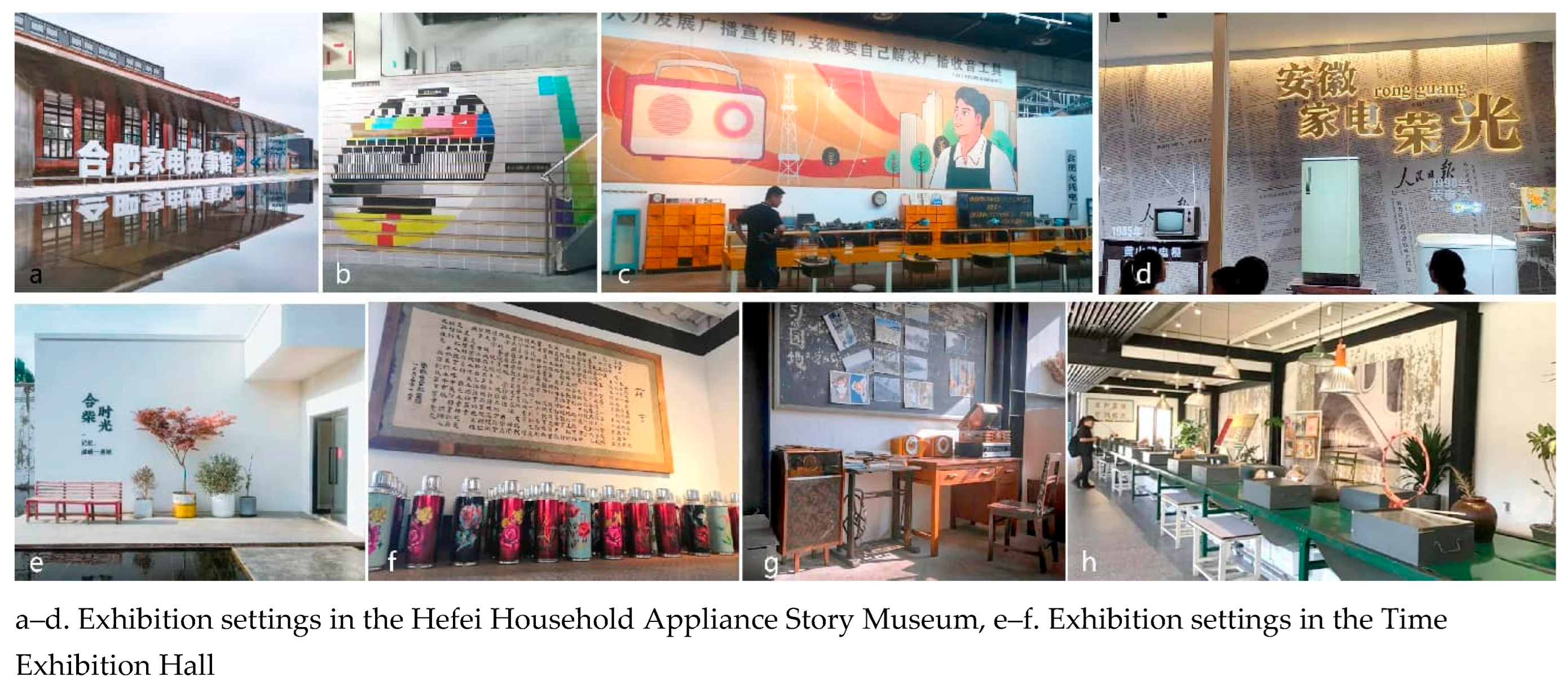
The interview materials reveal a similar pattern. Of the 28 visitors interviewed, 19 readily developed a sense of familiarity through displays of old television sets, sewing machines, historic street-number plaques, old furniture, and reconstructed scenes of domestic life. They were less likely, however, to connect these displays with the custodial system of the former prison, reform-through-labour production, or the labour performed by incarcerated people. Local visitor LV-11 stated: “What impressed me most was the Household Appliance Story Museum and the scenes of everyday life in old Hefei. The site feels like a space of urban memory.” Similarly, local visitor LV-07 commented: “This place is more suitable for bringing children to see exhibitions, take photographs, and have a meal. The sense that it used to be a prison is not particularly strong.”
Taken together, these materials clarify the defining characteristics of Hechai 1972’s public narrative. Against a background of low-intensity interpretation of prison memory and the absence of a systematic account of industrial production, broader narratives of urban industrial memory and nostalgia for everyday urban life have been introduced to organise the site’s overarching public narrative and enhance the project’s public appeal and communicability. In this study, “substitution” refers to the process through which these broader city-scale and everyday-life narratives effectively displace the site-specific narrative themes and structures, gaining greater opportunities for public encounter and higher interpretive prominence. The site’s prison attributes and associated memories are consequently repositioned as background elements within its contemporary narrative.
This does not imply that narratives of urban industry or nostalgia for everyday urban life lack public value. The problem arises when they are insufficiently connected to the site’s specific history, in which case they may partially overlay its place-based memory. Hechai 1972 is consequently perceived less as a site of incarceration, reform through labour, and industrial production than as a cultural and creative space accommodating urban industrial memory and nostalgic experiences of everyday life [35] (pp. 119–143).
4.5. Scene-Based Spatial Reproduction: Industrial Aesthetics, Nostalgia for Everyday Life, and Cultural and Creative Consumption
Field observations showed that factory shells, red-brick walls, surviving machinery, and custodial structures had become visual backdrops for photography, events, and commercial displays. Visitor LV-13 commented: “Photographs taken against these old factory buildings are particularly striking and receive many likes on social media.” In the reuse of industrial heritage, the retention of rough and visually weighty industrial building shells, combined with the insertion of new decorative elements and functional interfaces, has produced what may be termed a “decorative industrial style” [42,43]. As described in mainstream media coverage, the renovated industrial remains appear considerably more fashionable than in their original form, while retaining the underlying character of the old industrial architecture and thereby expressing an “industrial aesthetic” [41]. This framing indicates that industrial remains function not only as historical evidence but also as resources for visual consumption in the social-media era [35] (pp. 160–168) [44] (pp. 35–43).
As shown in Table C1, nostalgia-themed businesses and commercial names constitute a noticeable component of the park’s commercial mix. For example, Goodone Vintage Warehouse brings together old furniture, everyday utensils, and other second-hand objects, transforming fragmented personal memories into the collective memory of a generation. Here, memory is materialised as merchandise, while nostalgic affect is directly converted into a marketing medium. Non-local visitor OV-04 stated: “Seeing old television sets and sewing machines in the vintage shop felt very familiar, so I bought a key ring made from an old house-number plaque” (Figure 4-5). In this setting, nostalgia is no longer experienced as a burden but as a light, readily accessible form of consumption.
Figure 4-5.
Industrial Aesthetics and Cultural and Creative Consumption Settings.
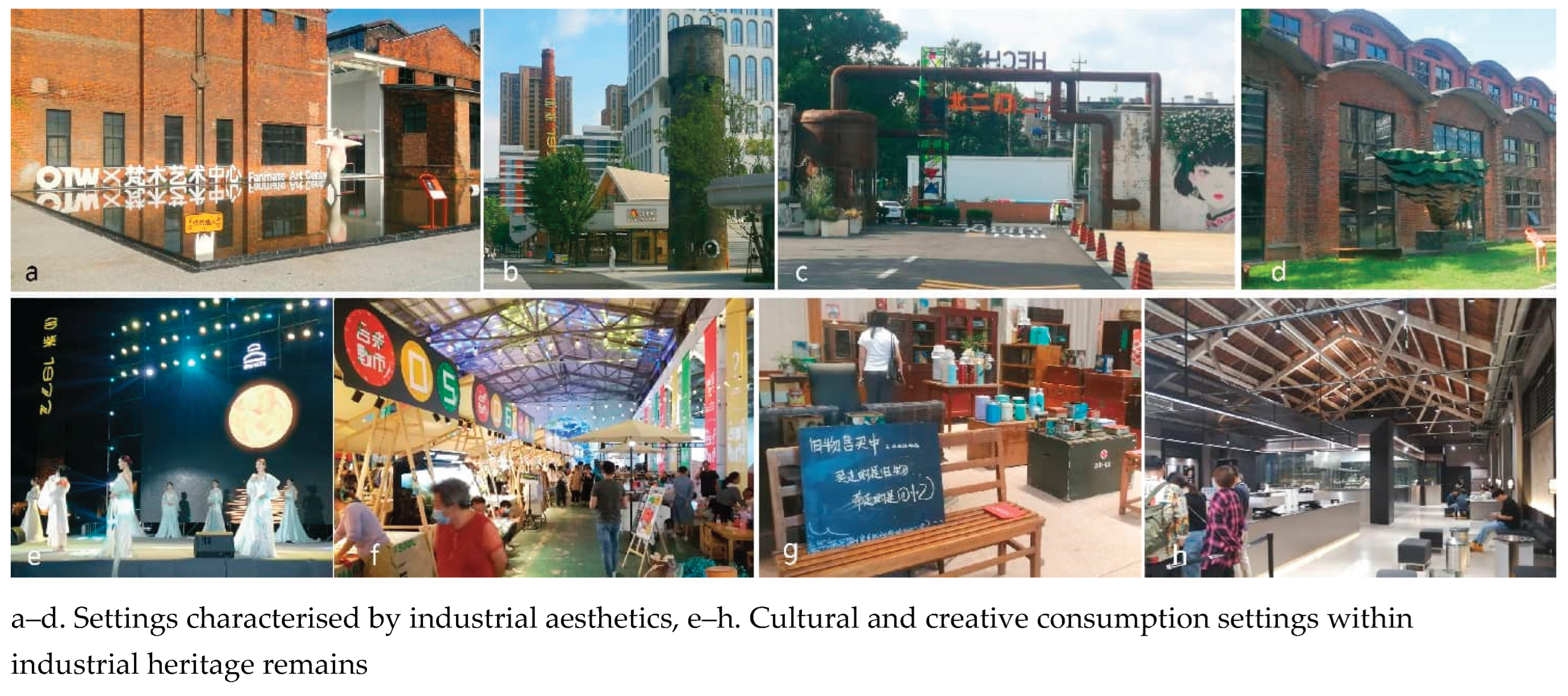
Spatial observations and an inventory of business types showed that restaurants, cafés, exhibitions, bookshops, retail outlets, performances, photography businesses, and festival activities enabled a formerly enclosed, disciplinary, and production-oriented site to be experienced as an open, relaxed, and linger-friendly cultural and creative community (Figure 4-1 and Table C1). As management representative M-2 explained: “Hechai is like a large box. We have placed creativity, everyday life, fashion, and art inside this large historical container; here, you can find almost anything you are looking for.” Table C1 indicates that the park’s cultural and creative consumption practices are supported by a selectively assembled commercial mix, which collectively produces an everyday, aestheticised, and consumption-oriented spatial order. Much of this aesthetic, however, is not rooted in the local culture of Hefei. As in many other cultural and creative parks, commercially successful globalised templates—including Nordic-style design, Japanese-inspired aesthetics, trendy brands, and combinations of cafés, exhibitions, and retail—underpin the park’s revenue-generating activities. Cultural and creative retail employee B-04 observed, “Our local handicrafts, such as southern Anhui woodcarving and Wuhu iron painting, do not sell as well as Chinese-chic, Nordic-style, or Japanese-style products.” Non-local visitor OV-07 similarly stated, “The architecture here is distinctive, there are many art exhibitions, and the products on sale are very fashionable.” These materials suggest that some of the park’s consumption settings adopt aesthetic and commercial templates common across cultural and creative parks. Such templates enhance the site’s accessibility, familiarity, and convenience for consumption, but may weaken the distinctiveness of local culture and the site’s specific history (Figure 4-5 and Table C1).
Taken together, these findings show that visitors’ practices of touring, photography, consumption, and media sharing continually reproduce an image of the site structured around “industrial aesthetics—nostalgia for everyday life—cultural and creative consumption.” These everyday practices mutually reinforce the park’s spatial transformation and communicative positioning.
Viewed across the regeneration process as a whole, the park’s naming, planning position, and promotional texts constructed representations of space centred on industrial memory, urban nostalgia, and cultural and creative consumption. The adaptation of factory buildings, the substitution of dominant narratives, and the insertion and organisation of commercial functions then translated these representations into reproducible spatial practices. Finally, through consumption, photography, and media circulation, visitors experienced and reproduced Hechai 1972 as a representational space characterised by “industrial nostalgia” and an artistic and cultural ambience [32,33,45] (pp. 12–53).
5. Discussion
5.1. The Heritage Character of the Former Hefei Prison Site: From a Composite History to a Structural Imbalance Among Heritage Attributes
The analysis presented in Section 4 demonstrates that the culture-led regeneration of the former Hefei Prison site cannot be understood simply as the reuse of conventional industrial heritage, nor can it be adequately characterised solely as “multi-attribute heritage.” The site did indeed encompass multiple historical and contemporary dimensions, including prison administration, reform-through-labour production, industrial manufacturing, educational rehabilitation, and cultural and creative consumption. Following regeneration, however, these attributes did not coexist on equal terms; rather, they were reordered. As a result, different historical attributes acquired unequal levels of visibility, interpretive intensity, and value positioning.
From a historical perspective, prison administration and the reform-through-labour system constituted the site’s foundational institutional context, within which industrial production was embedded. The manufacture of bricks and tiles, diesel engines, and generator sets did not constitute ordinary enterprise production operating independently of the custodial system. Instead, these activities were intertwined with the labour of incarcerated people, custodial organisation, technical management, and production planning. The site’s industrial attribute should therefore not be interpreted solely through the lens of conventional industrial heritage, but should be situated within the composite relationship among incarceration, reform through labour, and industrial production. Otherwise, its factories, workshops, and industrial achievements may be detached from their institutional context and transformed into industrial symbols more readily displayed, aestheticised, and commodified.
In this sense, “multi-attribute heritage” functions only as a descriptive concept, whereas dissonant heritage more effectively captures the theoretical problem posed by this case. As conceptualised by Tunbridge and Ashworth (1996) [8] (pp. 20–30), dissonant heritage does not necessarily manifest itself through overt public controversy or clearly defined groups in conflict. It may also take the form of misalignment among heritage values, claims to memory, and contemporary uses. At the former Hefei Prison site, this dissonance is manifested primarily in three respects: memories of incarceration and reform through labour are difficult to accommodate seamlessly within an open and leisure-oriented environment of cultural and creative consumption; a value imbalance exists between the institutional context of the prison and the discourse of industrial heritage; and the relationship between industrial achievements and the identities of labouring actors presents a persistent institutional and narrative difficulty.
At the same time, the site also exhibits characteristics of difficult heritage. Macdonald (2009) [9] (pp. 1–12) argues that pasts associated with trauma, shame, violence, or institutional unease are often difficult for contemporary societies to confront fully. Although the former Hefei Prison site differs from sites associated with wartime atrocities or colonial oppression, its history involves incarceration, punishment, reform through labour, and the labour of incarcerated people, and therefore presents ethical difficulties for public interpretation. By comparison, exhibitions at Eastern State Penitentiary connect historical prison systems with contemporary issues of criminal justice, mass incarceration, and social inequality, thereby transforming prison heritage into a space for public reflection [22,46] (pp. 79–108). The regeneration of the former Hefei Prison site, by contrast, has not adopted the history of the prison system as its principal interpretive framework. Instead, cultural and creative consumption has become the primary point of entry through which the public encounters and understands the site. This study therefore conceptualises the former Hefei Prison site as dissonant heritage with characteristics of difficult heritage. The central issue is not how much material fabric has been retained, but which historical attribute has been placed at the centre of the public narrative and which attributes have been marginalised, externalised, reframed, or interpreted only at low intensity.
5.2. Memory Governance Is Not Mere Erasure: Prison Memory, Industrial Memory, and Substitute Narratives
As demonstrated in Section 4, prison memory has not disappeared entirely. Perimeter walls, watchtowers, access-control facilities, and solitary-confinement spaces continue to provide traces of the site’s former identity. These memories, however, have not been incorporated into the core narrative encountered by ordinary visitors during their everyday use of the park. Through selective retention, low-intensity interpretation, targeted access, externalisation, and value reframing, they have instead been reconfigured as symbolic markers of site identity, warning-education spaces accessible to designated groups, and an externalised rule-of-law publicity and education base. Prison memory has therefore been retained, but the intensity of its public interpretation has been substantially reduced.
Industrial memory at the site has itself also been subjected to a process of de-institutionalisation. Hechai 1972 does not provide a comprehensive account of diesel-engine, brick-and-tile, and generator-set manufacturing or of the broader system of reform-through-labour production. Instead, it retains the factory name, selected production milestones, the architectural shells of industrial buildings, and an industrial aesthetic. Specific workshop regimes, technical processes, the labour of incarcerated people, supervision by prison officers, collabouration with technical workers, and relations of production management receive little explicit interpretation. What is reinforced, therefore, is an abstracted, aestheticised, and de-laboured set of industrial symbols rather than a comprehensive history of industrial production at the site. This absence should not be attributed solely to a lack of historical materials. It may also reflect a cautious approach, within the contemporary rule-of-law framework of prison governance, towards the punishment, supervision, labour ethics, and institutional evaluation associated with the former reform-through-labour system. A comprehensive presentation of the affiliated factories’ industrial achievements would inevitably raise questions concerning the historical assessment of that system.
Following this dual governance of prison and industrial memory, the elements that remain most visible are the material manifestations of the site’s industrial attribute, while memories of discipline, production relations, and institutional organisation have become comparatively attenuated. Narratives of urban industrial development and nostalgia for everyday urban life have subsequently entered the site as substitute narratives. The Hefei Household Appliance Story Museum connects the former prison site to Hefei’s household-appliance industry and urban industrial modernisation, while the Time Exhibition Hall uses old objects, domestic life, and memories of consumption to construct an approachable nostalgic setting centred on urban residents’ everyday lives. These narratives enhance the park’s public accessibility and communicative reach, but they also further shift the historical centre of gravity of the site.
This mechanism can be further understood by situating it within international pathways of prison heritage reuse. Lorton Reformatory / Workhouse Arts Center demonstrates that arts- and community-oriented reuse does not necessarily exclude prison history. Alongside its Arts Center, the site retains a prison museum, historical exhibitions, and related interpretive tours, indicating that cultural and creative functions can coexist with the interpretation of prison history (Butticci, 2025) [47]. Chiayi Old Prison / Prison Museum represents a relatively typical museum-based and institutionally oriented educational pathway in the East Asian context. Its principal strength lies in integrating prison architecture, the history of prison administration, and rule-of-law education within a comparatively coherent interpretive system (Murphy, 2022) [48]. By comparison, the distinctive feature of the culture-led regeneration of the former Hefei Prison site is that prison history has not become one of the principal interpretive threads within the park’s everyday visitor and consumption spaces. Instead, it exists primarily through symbols of site identity, specialised educational spaces, and contextual information positioned in the background.
This comparison demonstrates that memory governance in the culture-led regeneration of the former site does not operate by simply deleting “the past.” Rather, by rearranging the visibility and interpretive hierarchy of different memories, it produces a version of the past that is more readily narratable within particular spatial and institutional settings [17,19,34,35] (pp. 25–29; pp. 119–143).
5.3. An Interlocking Mechanism of Culture-Led Heritage Regeneration: Memory Governance, Narrative Substitution, and Spatial Reproduction
The culture-led regeneration of the former Hefei Prison site does not comprise three independent processes of memory governance, narrative substitution, and spatial reproduction. Rather, these processes constitute an interlocking mechanism that unfolds sequentially and becomes progressively embedded. Memory governance establishes the boundaries of what can be made publicly visible and interpretable from the past; narrative substitution fills the interpretive space created through the attenuation and reframing of particular histories; and spatial reproduction translates the resulting narrative order into everyday experiences of visiting, consumption, and communication.
Within this mechanism, memory governance operates as the antecedent stage. Through a series of practices, it regulates the representational intensity and interpretive positioning of different historical contents. Prison memory receives low-intensity interpretation; reform-through-labour production is pedagogically reframed or spatially externalised; industrial memory is de-institutionalised; and relationships among labouring actors rarely enter a continuous system of interpretation. In this way, histories that are less readily accommodated within leisure-oriented consumption are relocated into lower-intensity and more tightly managed interpretive frameworks. This finding is consistent with the argument in critical heritage studies that heritage values are selected, authorised, and organised through discursive and institutional practices [11].
Narrative substitution constitutes the mediating link between memory governance and spatial reproduction. Once histories of incarceration, reform through labour, and complex labour relations have been compressed or reframed, space becomes available for narratives of urban industrial memory, nostalgia for everyday urban life, and cultural and creative consumption. These narratives neither fabricate history nor completely displace the site’s past. Instead, they provide more approachable and readily communicable points of entry into public interpretation. The problem arises when they remain insufficiently connected to the site-specific relationships among the prison, reform-through-labour production, and industrial manufacturing. Under such conditions, they may acquire greater interpretive prominence and partially overlay the site’s pre-existing memory.
Spatial reproduction further materialises and routinises this narrative order. Exhibitions, the commercial mix, visitor routes, photographic locations, festivals, and social-media circulation make “industrial aesthetics—nostalgia for everyday life—cultural and creative consumption” the spatial experience most readily encountered and repeatedly enacted by visitors. Space therefore does not merely serve as a passive container for memory; it continually produces the ways in which the public understands the former site [32] (pp. 26–48) [35] (pp. 119–139). Visitors’ practices of lingering, photography, consumption, and media sharing, in turn, stabilise this narrative framework, creating a feedback loop within the process of culture-led regeneration. The theoretical implication of this case is that the culture-led regeneration of dissonant heritage often proceeds not through the direct erasure of difficult memories, but through a sequential mechanism of boundary-setting through memory governance, interpretive gap-filling through narrative substitution, and consolidation through spatial reproduction.
5.4. Interpretive Integrity and Ethical Boundaries: Can the Preservation of Material Remains Substitute for Historical Interpretation?
The case of the former Hefei Prison site raises a further practical and ethical question: can the preservation of material remains be equated with the preservation of heritage memory? This study argues that it cannot. The retention of factory buildings, perimeter walls, watchtowers, access-control facilities, and other spatial traces provides only the material precondition for historical interpretation; it does not automatically generate an adequate interpretation of the site’s heritage. In the absence of a clear, continuous, and publicly accessible interpretive pathway, material remains may be transformed into visual styles, spatial atmospheres, or consumption settings rather than serving to explain the site’s complex history. The ICOMOS (2008) principles concerning the interpretation and presentation of cultural heritage sites similarly emphasise that the significance of a heritage place should be communicated through a multilayered, intelligible, and participatory interpretive system.
Interpretive integrity, as used here, requires contemporary displays to communicate the relationships between material remains and the history of the site. At the former Hefei Prison site, the significance of factories, workshops, perimeter walls, and watchtowers should not be interpreted solely as that of industrial remains or landscape symbols. These elements should also be connected to prison administration, reform-through-labour production, industrial manufacturing, and the relationships among historical actors. Fredheim and Khalaf (2016) [49] argue that heritage values reside not only in material objects but also in social relations, processes of meaning-making, and practices of valuation. Interpretive integrity therefore concerns not only “what has been preserved” but also “how what has been preserved is interpreted.”
Culture-led revitalisation is not inherently problematic. Former prisons can be opened to the public, made socially accessible, and adaptively reused to accommodate exhibitions, education, leisure, and cultural consumption. The ethical boundary of interpretation concerns whether cultural and creative narratives persistently occupy the position of the site’s core historical content, whether difficult memories appear only in symbolised, sensationalised, or warning-oriented forms, and whether historical actors are abstracted or rendered minimally visible. The commercial reuse of Pentridge Prison demonstrates that, even where buildings are conserved and guided interpretation is provided, prison memory may still be packaged as a consumable tourism atmosphere [10]. This case indicates that material conservation and public access alone are insufficient to ensure the responsible interpretation of difficult heritage [50]. Research on hotels developed through the adaptive reuse of penal heritage sites similarly suggests that whether such projects can function as “sites of conscience” depends on their willingness to confront the ethical complexities of penal history rather than merely transforming spaces of punishment into distinctive visitor experiences.
Accordingly, the regeneration of carceral–industrial composite heritage that is both socially responsible and historically meaningful should establish an independent, coherent, and publicly accessible system of historical interpretation. Such a system should resituate industrial production within the contexts of the prison system, reform-through-labour production, and the complex relationships among labouring actors. Factory buildings, products, perimeter walls, watchtowers, and production achievements could then serve as media through which institutional history is understood, rather than merely as resources for industrial nostalgia and spatial consumption. Only when material conservation, historical interpretation, and ethical reflection are connected can culture-led revitalisation avoid reducing dissonant heritage to a mere industrial-style consumption space.
6. Conclusions
6.1. Principal Findings
Taking the transformation of the former Hefei Prison site into Hechai 1972 Cultural and Creative Park as its case, this study employed a qualitative interpretive single-case study design and integrated historical and policy materials, official and media texts, spatial observations, and interview materials. In response to the three research questions posed in the Introduction, together with the associated discussion of interpretive ethics, the study draws four principal conclusions.
- (1)
- Heritage attributes are characterised by historical institutional nesting and contemporary reordering.
The site’s heritage attributes do not coexist as parallel and equivalent elements. Instead, they exhibit historical institutional nesting and contemporary reordering within the public narrative. Industrial production was embedded for an extended period within systems of prison administration, spatial control, and labour organisation, making the carceral system the institutional precondition for understanding the site’s industrial history. In contemporary regeneration, however, factory buildings, workshops, and industrial landscapes have acquired relatively high visibility, whereas the prison system, reform-through-labour production, and the associated historical actors occupy less prominent interpretive positions. Research on carceral–industrial composite heritage should therefore move beyond identifying multiple attributes to examine how different attributes are ordered, valued, and made publicly visible and interpretable [3,8,9].
- (2)
- Prison and industrial memories have undergone differentiated configurations of visibility.
Memories of the prison and reform-through-labour production have not been completely erased. Instead, differentiated practices of memory governance have altered their visibility and interpretive status. Perimeter walls, watchtowers, and access-control facilities have been retained primarily as symbolic markers of site identity, while the former custodial zone, solitary-confinement facilities, and related displays have been incorporated into the contemporary site through functional conversion, low-intensity interpretation, targeted access, externalisation, and pedagogical reframing. At the same time, industrial names, factory exteriors, products, and production figures are prominently represented, but their connections to the prison system, labour organisation, and the labour of incarcerated people are not explained through a continuous interpretive narrative. Memory governance thus operates upon both prison memory and industrial memory itself [3,17].
- (3)
- The public narrative has shifted upward in scale and relocated its interpretive emphasis.
The site’s public narrative has shifted upward in scale and relocated its interpretive emphasis, while spatial reproduction has embedded this shift in everyday experience. Public interpretation has moved from the specific histories of the carceral system, reform-through-labour production, and historical actors towards the broader scales of urban industrial development, residents’ memories of everyday life, and cultural and creative regeneration. These city-scale narratives occupy the principal exhibition venues, major visitor routes, and dominant communication channels, thereby acquiring greater interpretive prominence. Although the histories of the prison and reform through labour have not disappeared, they are more commonly presented as background information, interpreted at low intensity, or made accessible only to designated groups. Architectural adaptation, exhibition organisation, the insertion of commercial and cultural functions, visitor photography, and social-media circulation further translate this narrative order into everyday spatial experience [32,35].
- (4)
- Material conservation does not automatically ensure interpretive integrity.
Material conservation and culture-led revitalisation can maintain a degree of material continuity and historical legibility, but they cannot automatically ensure interpretive integrity. Surviving factory buildings, perimeter walls, watchtowers, and access-control facilities provide a basis from which the public may recognise aspects of the site’s history. Whether the site can be adequately understood, however, depends on whether these remains are interpreted within the contexts of the prison system, reform-through-labour production, labour organisation, and the relationships among historical actors. For dissonant heritage of this kind, an independent, coherent, multilayered, and publicly accessible interpretive system should be established. Such a system would enable material remains to continue connecting space, institutional history, and the lived experiences of historical actors, rather than serving merely as a backdrop for industrial nostalgia and cultural consumption [9,49,51].
6.2. Theoretical Contributions
The theoretical contributions of this study are reflected primarily in the following three respects.
- (1)
- Advancing from the descriptive identification of multi-attribute heritage to the analysis of attribute ordering.
Existing research on dissonant and difficult heritage has revealed conflicts among different historical values, stakeholder claims, and contemporary uses, but has paid less attention to how different attributes within composite heritage acquire unequal positions in the public sphere. Using a carceral–industrial composite site as its case, this study distinguishes between historical institutional nesting and the ordering of attributes within contemporary narratives, demonstrating that material visibility is not equivalent to interpretive prominence. Research on multi-attribute heritage should therefore move beyond identifying what a site “contains” to examine how its different attributes are valued, ordered, and made publicly visible and interpretable.
- (2)
- Specifying memory governance through differentiated interpretive pathways.
This study demonstrates that the governance of difficult memories does not operate through a simple choice between preservation and erasure. Rather, it regulates opportunities for public encounter with different historical contents and historical actors through selective retention, low-intensity interpretation, targeted access, spatial externalisation, and reframing [3,17,19]. This analysis extends the operation of authorised heritage discourse beyond textual naming and value attribution to encompass spatial access, exhibition organisation, and functional configuration. It further shows that memory governance acts not only upon prison history but may also detach industrial achievements from their institutional conditions and labour relations, thereby producing a de-institutionalised representation of industrial memory.
- (3)
- Revealing the relationship between narrative substitution and spatial reproduction.
Narratives of urban industrial memory and nostalgia for everyday urban life entered the site and “substituted for” its place-specific memory and pre-existing narrative structure. The public narrative consequently shifted upward from the specific histories of the prison system, reform-through-labour production, and historical actors towards the broader scales of urban industrial development, residents’ everyday lives, and culture-led regeneration. Through their positioning in principal exhibition venues, major visitor routes, and dominant communication channels, these city-scale narratives acquired greater interpretive prominence and were translated into everyday spatial experience through architectural adaptation, the insertion of commercial and cultural functions, visitor consumption, and social-media circulation [32,35]. This finding connects the selective organisation of heritage memory with research on the production of space, demonstrating that spatial reproduction is not merely a passive outcome of narrative change but a practical process through which a particular order of memory is stabilised and repeatedly enacted.
6.3. Practical and Ethical Implications
- (1)
- Establish a multilayered, continuous, and publicly accessible system of site interpretation.
Material remains can serve as media through which the public understands a site’s history only when they are incorporated into a coherent interpretive framework. Regeneration projects involving heritage of this kind should provide basic historical information at principal entrances and along major visitor routes. A unified chronology should connect the development of the prison, reform-through-labour production, industrial manufacturing, and culture-led regeneration, while thematic exhibitions, guided tours, and digital media should provide more detailed information. For spaces that cannot be opened on a regular basis, such as the former custodial zone and solitary-confinement facilities, alternative forms of interpretation—including visual reconstruction, digital displays, and pre-booked guided tours—should be employed to prevent important histories from remaining inaccessible because of spatial restrictions [49,51].
- (2)
- Recontextualise industrial remains within institutional history and the relationships among historical actors.
Factory buildings, products, and production achievements possess genuine industrial heritage value, but their interpretation should not remain confined to architectural form, production figures, and industrial nostalgia. Relevant displays should explain the relationships between industrial production, prison administration, the reform-through-labour system, and labour organisation, while also representing the positions occupied by incarcerated people, prison officers, technical workers, and production managers during different historical periods. Only by reconnecting material remains, production processes, and historical actors can industrial memory be prevented from being detached from its institutional context and reduced to a visual style and consumption backdrop lacking site specificity [9,18].
- (3)
- Establish ethical boundaries for interpretation between public accessibility and historical complexity.
Memories of imprisonment and prison labour should neither be sensationalised nor rendered as entertainment. Nor should they be excessively sanitised because of their emotional weight or their tension with the site’s contemporary operational positioning. A more appropriate approach is to adopt contextualised, multilayered, and carefully calibrated interpretation. At a basic level, visitors should be able to identify the character of the site and understand its essential history. At a thematic level, interpretation should provide further explanation of institutional contexts, labour relations, and the experiences of historical actors. When addressing punishment, discipline, and experiences of suffering, interpretation should avoid reducing them to visually stimulating attractions. Ethical responsibility does not require every difficult history to occupy a dominant position. Rather, it requires the maintenance of minimum standards of interpretive integrity, the visibility of historical actors, and public accessibility, so that cultural and creative reuse does not come at the cost of the prolonged marginalisation of complex histories [18,22,51].
6.4. Research Limitations and Future Directions
This study has several limitations. First, as a qualitative single-case study, it seeks to achieve analytical rather than statistical generalisation. The proposed mechanism therefore requires further examination through comparative research involving multiple cases of similar carceral–industrial heritage sites. The four international cases discussed in this article serve only as heuristic reference points and do not constitute evidence derived from a systematic comparative design [6,7]. Second, owing to restrictions on archival access and the limited availability of historical materials, this study was unable to reconstruct fully the processes of reform-through-labour production and internal prison administration. Nor did it incorporate direct accounts from formerly incarcerated people. The analysis therefore focuses primarily on the visibility of historical actors within contemporary narratives rather than on their experiences in their full complexity. Online texts may also be revised or removed; future research should therefore strengthen the use of archival materials, oral histories, web archiving, and systematic version records [37]. Third, spatial observation and the assessment of visibility and interpretive intensity inevitably involve researcher interpretation. Interviews conducted by different researchers may also vary because of differences in questioning and probing. Subsequent studies could improve analytical consistency through repeated observations, independent assessment by two researchers, standardised training, and procedural review [52,53]. Finally, the researchers’ critical heritage perspective may have heightened their attention to power relations, silences, and the absence of historical actors. Future research could employ reflexive memoranda, negative case analysis, and external review to enhance the rigour and explanatory power of the coding and theoretical interpretation [54].
Author Contributions
Conceptualization: G.S., J.Z. and L.B.; Data curation: G.S., L.B. and Z.Y.; Formal analysis: G.S., J.Z. and L.B.; Funding acquisition: J.Z. and L.B.; Investigation: G.S., J.Z., L.B. and Z.Y.; Methodology: G.S., J.Z. and L.B.; Project administration: J.Z.; Resources: J.Z.; Software: G.S. and Z.Y.; Supervision: J.Z.; Validation: G.S., J.Z. and Z.Y.; Visualization: G.S., L.B. and Z.Y.; Writing—original draft: G.S., J.Z., L.B. and Z.Y.; Writing—review and editing: All authors have read and agreed to the published version of the manuscript.
Funding
This work was supported by: (1) National Office for Philosophy and Social Sciences. http://www.nopss.gov.cn.(No.24VWB009). (2) Anhui Province Federation of Social Sciences, China.http://ahskj.org.cn. (2022CX548). (3) Philosophy and Social Sciences Planning Office of Anhui Province, China. http://www.ahshkx.com. (AHSKY2023D105).
Informed Consent Statement
Informed consent was obtained from all subjects involved in the study.
Acknowledgments
The authors sincerely thank all anonymous interview participants for generously sharing their time, knowledge, and perspectives. Their contributions were invaluable to this study.
Data Availability Statement
The data presented in this study are available on request from the corresponding author.
Note on Photograph Sources
All photographs were taken by the authors unless otherwise indicated.
Conflicts of Interest
The authors declare no conflicts of interest.
Appendix A
Catalogue of Analytical Materials and Qualitative Coding of Representative Materials
Table A1.
Codes for Historical Attributes and the Contemporary Narrative.
| Code | Category | Operational Definition |
|---|---|---|
| P | Carceral attribute | References to the prison institution, confinement and supervision, punitive spaces, prison compounds, perimeter walls, guard towers, access-control facilities, prison officers, and related elements. |
| L | Reform-through-labour production attribute | References to reform through labour, the productive labour of incarcerated people, labour organisation, production supervision, and the associated institutional relations. |
| I | Industrial attribute | References to bricks and tiles, diesel engines, generators, factory buildings, workshops, machinery, products, technologies, and industrial achievements. |
| E | Correctional education attribute | References to legal, moral, cultural, and technical education, as well as the Education Division, the Tuohuang Cultural School, and related institutions and activities. |
| C | Contemporary cultural and creative narrative | References to cultural and creative facilities, art exhibitions, food and retail services, performances and festivals, tourism experiences, and city branding. |
Table A2.
Codes for Analytical Dimensions.
| Code | Analytical Dimension | Operational Definition |
|---|---|---|
| N | Naming and identification | How the site, buildings, historical periods, and events are named, identified, or redefined. |
| T | Chronological organisation | Which historical milestones are foregrounded, compressed, omitted, or reordered? |
| H | Representation of historical content | The scope and depth of interpretation accorded to different historical attributes and the relationships constructed between them. |
| S | Representation of historical actors | How incarcerated people, prison officers, technical workers, and production managers are represented or omitted. |
| V | Value framing | How the site is assigned values associated with industrial achievement, education, urban regeneration, cultural consumption, or city branding. |
Table A3.
Codes for Principal Representational Strategies.
| Code | Representational Strategy | Operational Definition |
|---|---|---|
| EMP | Foregrounding | Emphasising particular content through headlines, initial placement, repetition, greater textual space, or visually prominent display. |
| COM | Compression or chronological omission | Treating a historical period, event, or institutional relationship only briefly, or omitting it from the chronology. |
| CON | Conflation | Combining different institutions, historical periods, spatial attributes, or relationships between historical actors into an indistinct whole. |
| ABS | Abstraction | Replacing specific historical identities, experiences, or relationships with generalised labels or broad formulations. |
| DEI | De-institutionalisation | Presenting factory buildings, products, or industrial achievements without explaining the production system, labour organisation, or supervisory relations in which they were embedded. |
| EDU | Educational reframing | Recasting carceral or reform-through-labour history primarily as a narrative of legal education, integrity education, or cautionary instruction. |
| EXT | Spatial externalisation | Locating particular historical content in peripheral, enclosed, restricted-access, or appointment-only spaces that are difficult for ordinary visitors to encounter. |
| SUB | Narrative substitution | Assigning greater interpretive prominence to narratives of urban industrial development, everyday urban life, or cultural and creative consumption. |
| AES | Aestheticisation | Transforming industrial or carceral remains into visual landscapes, industrial-style settings, photographic backdrops, or social-media attractions. |
| COMS | Commodification | Incorporating the site and its historical imagery into tourism, food and beverage services, retail, performances, and brand communication. |
Table A4.
Representative Coding Examples.
| ID | Source, Date, and Text Type | Historical Attribute(s) / Contemporary Narrative | Principal Analytical Dimension(s) | Principal Representational Strategy | Rationale for Code Assignment | Source Excerpt |
|---|---|---|---|---|---|---|
| PL01-01 | Hechai 1972 regeneration planning text; date unavailable; planning document | P, C | N, T | SUB | “Hefei Prison” denotes the site’s former institutional identity, whereas “Hechai 1972 Cultural and Creative Park” denotes its post-regeneration identity, indicating a shift in site identification. | “After 2019, the former site was gradually regenerated as Hechai 1972 Cultural and Creative Park.” |
| PL01-02 | Same as above | I, C | H, V | EMP, SUB | Industrial heritage conservation and cultural and creative reuse are jointly established as the project’s principal direction, foregrounding an industrial heritage–creative industry framework. | “The project combines industrial heritage conservation with cultural and creative reuse.” |
| PL01-03 | Same as above | P, C | N, H, V | SUB | The former prison is retained as the site of origin, while the regenerated site is formally identified as a cultural and creative industrial park. | “The former Hefei Prison site was redeveloped into a cultural and creative industrial park.” |
| PL01-04 | Same as above | C | H, V | EMP, COMS | Art, leisure, and consumption are explicitly designated as the site’s principal contemporary functions, supporting codes for the cultural-consumption narrative and commodification. | “Its principal functions include art, exhibitions, leisure, and consumption-oriented activities.” |
| PL01-05 | Same as above | C | H, V | EMP, COMS | The successive listing of cultural and creative businesses foregrounds and specifies the park’s contemporary functional structure. | “Art exhibitions, reading spaces, cultural and creative retail, food and leisure, music performances, creative offices, and public events.” |
| EX01-01 | Visitor-centre interpretive panel at Hechai 1972; date unavailable; on-site interpretive text | P, L | N, T, H | EMP | The site’s history is traced to the development of the provincial reform-through-labour system, explicitly identifying its institutional origins. | “The site’s history can be traced to the development of Anhui Province’s reform-through-labour system in the mid-twentieth century.” |
| EX01-02 | Same as above | P, L, I | T, H | EMP | The reform-through-labour unit and its affiliated brick-and-tile factory appear in the same statement, establishing the organisational relationship between confinement and industrial production. | “The Anhui No. 5 Reform-through-labour Unit and its affiliated brick-and-tile factory relocated to the present site.” |
| EX01-03 | Same as above | I, L | T, H | EMP | The opening of the diesel engine factory is presented as a major chronological milestone, while the continuity of brick-and-tile production is retained. | “In 1972, the Hefei Diesel Engine Factory began operating on the site.” |
| EX01-04 | Same as above | P, L | N, T | EMP | The formal institutional name is incorporated into the chronology, confirming that the site remained within the reform-through-labour organisational system. | “In 1974, the institution was generalisedreorganised as the Anhui No. 2 Reform-through-labour Detachment.” |
| EX01-05 | Same as above | P | N, T | EMP | “Hefei Prison” appears as the institution’s formal name and marks a distinct stage in its organisational history. | “In 1996, it was renamed Hefei Prison of Anhui Province.” |
| EX01-06 | Same as above | P, L, E | H, S | EMP | Confinement, supervision, education, and production organisation are listed together, presenting the prison as a multifunctional institutional complex. | “Hefei Prison was responsible for the confinement and supervision of serious offenders, correctional education, and the organisation of production.” |
| EX01-07 | Same as above | I, L | H, V | EMP | Several industrial sectors are listed together, giving strong visibility to production scale and industrial achievement. | “Production activities included bricks and tiles, diesel engines, and generator sets.” |
| EX01-08 | Same as above | I | H, V | EMP | Quantitative data construct an explicitly measurable narrative of industrial achievement. DEI is not assigned solely on the basis of this sentence and requires comparison with the broader absence of institutional and labour relations. | “Approximately 2 billion clay bricks, 150 million flat green tiles, 4,241 generator sets, and 64,740 diesel engine blocks.” |
| EX01-09 | Same as above | E, P | T, H | EMP | The naming of specific educational institutions gives correctional education a relatively concrete position in the historical narrative. | “The prison established an Education Division and the Tuohuang Cultural School.” |
| EX01-10 | Same as above | E, P | H, S, V | EMP | Incarcerated people are explicitly identified as the recipients of education, and the educational content is specified. | “Legal, moral, cultural, and technical education was provided to incarcerated people.” |
| M01-01 | Workers’ Daily, 13 November 2019, “Old Buildings: The Best Protection Is Reuse”; industrial heritage reuse report | P, I | N, T | EMP | The prison and diesel engine factory identities are presented together, acknowledging the site’s layered institutional and industrial history. | “It was once Hefei Prison and also the former Hefei Diesel Engine Factory.” |
| M01-02 | Same as above | I, C | H, V | AES, COMS | Industrial fabric is combined with cultural and creative products, indicating the Aestheticisation and creative reuse of industrial space. | “The site preserves its industrial memory while incorporating a wide range of cultural and creative products.” |
| M01-03 | Same as above | I, L | N, H | ABS, DEI | The phrase “special factory” alludes to a distinctive institutional background without explicitly explaining reform-through-labour production or its historical actors. DEI is confirmed only through comparison with the full text. | “The historical traces of this ‘special factory’.” |
| M02-01 | People.cn Anhui, 8 June 2020, “Yang Chongguang Solo Exhibition Opens at Hechai 1972”; exhibition news | C | H, V | EMP, COMS | The report primarily presents the park as a venue for contemporary art exhibitions. | “‘Ruins of Time: Yang Chongguang Solo Exhibition’ has opened.” |
| M02-02 | Same as above | I, C | H, V | AES | The domed industrial space functions as the physical setting for an art exhibition, while its original use is not discussed in this report. | “The Small Dome of Gallery C at the Hefei Museum of Contemporary Art.” |
| M03-01 | Anhui Daily, republished by People.cn, 10 November 2020, “Hechai 1972: Revitalising Industrial Heritage and Reawakening Urban Memory”; feature report | I, C | N, V | EMP, SUB | The headline explicitly defines the site through industrial heritage and urban memory, strongly foregrounding an industrial–urban narrative. | “Revitalising industrial heritage and reawakening urban memory.” |
| M03-02 | Same as above | I | N, T, H | EMP, COM | The diesel engine factory is described as the site’s “principal label,” giving the industrial phase interpretive priority. | “‘Diesel engine factory’ became the principal label attached to this site.” |
| M03-03 | Same as above | P, I | N, H | CON | Guard towers are grouped with workshops and chimneys as “industrial remains,” conflating carceral and industrial spatial attributes. | “Guard towers, domed structures, workshops, chimneys, and other industrial remains have been preserved.” |
| M03-04 | Same as above | I, C | V | SUB | The site-specific past is rescaled as a broader narrative of Hefei’s industrial development and urban memory. | “To search for and experience the city’s memory.” |
| M04-01 | People.cn Anhui, 12 November 2021, “Hello, Anhui Life: Nighttime Cultural Districts Await Your Visit”; tourism promotion report | P, C | N, V | EMP, COMS | The former prison identity functions as a marker of distinctiveness while being incorporated into a tourism and social-media narrative. | “China’s first cultural and creative park converted from a former prison site.” |
| M04-02 | Same as above | P, C | H, V | AES, COMS | Prison walls, murals, and sculptures are organised as photographic attractions, indicating the Aestheticisation of carceral remains and public space. | “The high walls are covered with distinctive murals.” |
| M04-03 | Same as above | I, C | H, V | SUB, AES | Domestic appliances, nostalgia, and art exhibitions jointly provide visitors with an experiential entry point into the past. | “Old times and contemporary art converge here.” |
| M05-01 | China Culture Daily, published by Xinhua News, 25 April 2022, “‘Culture Plus Space’ Creates New Possibilities for Cultural Tourism Consumption”; cultural tourism report | I, C | N, T | EMP, SUB | The chronology is organised around the conversion of the diesel engine factory into an arts and creative park; the prison’s institutional history is absent from this passage. | “The former Hefei Diesel Engine Factory became the Hechai 1972 arts and cultural creative park.” |
| M05-02 | Same as above | I, C | H, V | AES, COMS | Industrial remains are juxtaposed with cafés and creative retail, combining industrial nostalgia with fashionable consumption. | “Visitors experience contemporary trends in cafés and cultural and creative shops.” |
| M05-03 | Same as above | P, I | N, H | CON | Guard towers are again grouped with typical industrial structures under the category of “industrial remains.” | “Guard towers, domed structures, workshops, chimneys, and other industrial remains.” |
| M06-01 | People.cn Anhui, 20 May 2022, “Yiguo Culture Group Relocates to Hechai 1972”; corporate relocation report | P, I, C | N, H, V | SUB | The former prison, industrial heritage, and cultural and creative park identities appear together, but the emphasis is placed on the contemporary project positioning. | “The former Hefei Prison site was redeveloped into a cultural and creative industrial park.” |
| M06-02 | Same as above | C | H, V | EMP, COMS | Film production, cafés, cinema, and cultural salons are listed in detail, foregrounding creative offices and cultural industry operations. | “Studios, a café bar, a cinema, and creative collabouration spaces.” |
| M07-01 | CCTV.com, 6 October 2022, “Hechai 1972 Cultural and Creative Park: China’s First Cultural and Creative Park Converted from a Prison”; consumer television program | P, C | N, V | EMP, COMS | The title uses the contrast between a former prison and a cultural and creative park to attract a consumer-program audience. | “China’s first cultural and creative park converted from a prison.” |
| M07-02 | Same as above | P, C | N, H | COM | The webpage provides only a concise contrast between the site’s former and current identities, without further interpretation of the prison system or historical actors. | “Hechai 1972 Cultural and Creative Park.” |
| M08-01 | China National Radio, 1 July 2023, “A National First: Hechai Fanmu Art centre Launches a Summer Audiovisual Program”; performance venue report | C | H, V | EMP, COMS | The LiveHouse is explicitly presented as a professional performance venue, indicating the expansion of youth culture and entertainment consumption. | “A professional LiveHouse performance venue.” |
| M08-02 | People.cn Anhui, 3 July 2023, republication of the same report; cultural industry news | C | H, V | EMP, COMS | Trend culture, social-media visibility, holographic experiences, and artist performances constitute new forms of cultural consumption. | “Trends, online popularity, online holographic experiences, and artist performances.” |
| M08-03 | Same as above | C | V | COMS | The project is evaluated in terms of stimulating the consumption market and creating an urban cultural landmark. | “To stimulate the potential of the music consumption market.” |
| M09-01 | Anhui Daily, republished by People.cn, 18 September 2023, “Urban Regeneration Creates New Cultural Spaces in Hefei”; urban regeneration report | I, C | N, V | EMP, SUB | Hechai 1972 is defined as a successful case of industrial heritage regeneration and cultural space production. | “One of Hefei’s most successful industrial heritage regeneration projects.” |
| M09-02 | Same as above | C | H, V | EMP, COMS | Four contemporary spatial identities are listed together, demonstrating the park’s multifunctional and public character. | “An integrated park, tourist attraction, commercial district, and community.” |
| M09-03 | Same as above | P, C | H, V | AES, COMS | The preservation of the prison’s former appearance is framed as a means of stimulating visitor curiosity and recreational interest. | “The former appearance of Hefei Prison has largely been retained.” |
| M09-04 | Same as above | I, C | H, V | SUB, COMS | Domestic-appliance history, urban industrial stories, and cultural events jointly produce a new narrative of the site. | “It contains both ‘old Hefei’ and ‘new stories’.” |
| M10-01 | Xinhua News, 31 July 2024, “When Technology Meets Art”; exhibition news | C | H, V | EMP, COMS | An industrial building within the park is used as a venue for scientific photography and artificial intelligence art exhibitions. | “The scientific photography exhibition opened at the Pi Factory in Hechai 1972 Cultural and Creative Park.” |
| M10-02 | Same as above | C | H | COMS | Photography and artificial intelligence works demonstrate the incorporation of technology–art content into the park. | “Eighty-one photographic works and thirty AI-generated works.” |
| M11-01 | CCTV.com, 3 August 2024, Focus Report: “Turning Idle Land into Productive Urban Space”; report on redevelopment of underused land | I, C | N, T, H | COM, SUB | The site is identified as a former diesel engine factory and underused industrial land; the prison’s institutional history is absent from this passage. | “The old factory buildings of the former Hefei Diesel Engine Factory.” |
| M11-02 | Same as above | I, C | H, V | AES, COMS | Red-brick factory buildings, photography, and landmark-making organise the contemporary experience of industrial space. | “The red-brick factory buildings attract many young people to take photographs and check in on social media.” |
| M11-03 | Same as above | C | H, V | EMP, COMS | The introduction of new industries and firms is used to demonstrate the effectiveness of land regeneration. | “New businesses in art exhibitions, digital media, and related sectors were introduced.” |
| M11-04 | Same as above | C | V | COMS | Economic revenue is used as a principal indicator of regeneration success. | “Revenue reached CNY 350 million in 2023.” |
| M12-01 | Xinhua News, republished by People.cn, 13 September 2024, “What Is New about Anhui’s Emerging Public Cultural Spaces?”; public culture report | I, C | N, V | EMP, SUB | The site is formally defined as a new public cultural space derived from industrial heritage. | “A new type of public cultural space emerging from the city’s industrial heritage.” |
| M12-02 | Same as above | I, C | T, H | COM, SUB | The chronology moves directly from the vacated diesel engine factory site to in situ conservation and the introduction of new uses. | “The vacant site left after the relocation of the old Hefei Diesel Engine Factory was revitalised.” |
| M12-03 | Same as above | I, C | H, V | SUB, COMS | The cultural meanings of industrial remains are mobilised to assign new value to public cultural space. | “Endowing public cultural space with new value.” |
| M13-01 | Market Star, republished by People.cn, 3 December 2024, “Anhui Proposes Seven New National 4A Tourist Attractions”; tourism classification report | C | N, V | EMP, COMS | “Tourist attraction” becomes a new formal identity, indicating the park’s increasing incorporation into the tourism system. | “Hechai 1972 Scenic Area, Baohe District, Hefei.” |
| M13-02 | Same as above | I, C | H, V | COMS | Commercial creativity, exhibitions, offices, and leisure are identified as the principal components of the tourist attraction. | “Cultural and creative commerce, exhibitions, innovation-oriented offices, and fashionable leisure.” |
| M14-01 | China Daily Online, 15 December 2024, “Hechai 1972 Integrates Historical Culture with Contemporary Urban Life”; comprehensive park report | P, I, C | N, H, V | SUB | The report acknowledges the former prison site but adopts industrial heritage conservation and cultural creativity as the park’s principal contemporary positioning. | “The former Hefei Prison site was redeveloped into a cultural and creative industrial park.” |
| M14-02 | Same as above | C | H, V | EMP, COMS | Visitor numbers, events, and food-and-beverage brands are used to explain the park’s attractiveness. | “Hechai 1972 attracts exceptionally high visitor numbers.” |
| M15-01 | China National Radio, 17 December 2024, “The Cultural Rebirth of an Old Industrial District”; industrial heritage regeneration report | I, C | N, V | EMP, SUB | The title constructs a conventional transformation narrative from an old industrial district to cultural renewal. | “The cultural rebirth of an old industrial district.” |
| M15-02 | Same as above | I, C | H, V | AES | The contrast between ruins and new buildings is foregrounded as a visual experience. | “The contrast creates a powerful visual impact and stimulates the imagination.” |
| M15-03 | Same as above | P, I, C | H, V | CON, AES | Prison buildings and domed industrial structures are jointly converted into the park’s “distinctive landscape.” | “Prison buildings and domed structures have become distinctive features of the landscape.” |
| M15-04 | Same as above | I, C | V | COMS | Regeneration is assigned industrial-economic and cultural revitalisation value. | “New economic value is beginning to emerge here.” |
| M16-01 | Xinhua News, 5 February 2025, report on the Spring Festival consumer market; festival consumption news | I, C | H, V | AES, COMS | Industrial remains and intangible cultural heritage performances are combined as a Spring Festival consumption experience. | “Industrial remains and cultural creativity generate new consumption formats, including intangible cultural heritage performances.” |
| M16-02 | Same as above | C | V | COMS | The park is incorporated into a nationwide narrative of holiday-consumption innovation. | “Providing visitors with a distinctive Spring Festival experience.” |
| M17-01 | People.cn, 18 February 2025, “What Is New about Urban Regeneration in Anhui?”; urban regeneration commentary | I, C | N, T | COM, SUB | The site’s past is summarised directly as a diesel engine factory, while its regenerated identity is that of a popular cultural and creative destination. | “It was formerly the Hefei Diesel Engine Factory.” |
| M17-02 | Same as above | P, I, C | H, V | CON, AES, COMS | Guard towers are grouped with industrial structures as industrial remains and linked to tourism, visitor flows, and consumption growth. | “Guard towers, domed structures, workshops, chimneys, and other industrial remains have been retained.” |
| M17-03 | Same as above | C | V | COMS | The phrase “growth pole” explicitly assigns the park an economic function in increasing visitor numbers and consumption. | “A consumption ‘growth pole’ that increases visitor numbers and commercial vitality.” |
| M18-01 | Xinhua News, 13 March 2025, report on emerging public cultural spaces; public culture news | P, I, C | H, V | CON, AES | Guard towers, workshops, and chimneys are jointly described as urban historical symbols, weakening the distinction between their original institutional attributes. | “Old-style guard towers, domed structures, workshops, chimneys, and other symbols of urban history.” |
| M18-02 | Same as above | I, C | H, V | SUB, COMS | Industrial remains are converted into museums and public cultural facilities, supporting the park’s new urban-cultural identity. | “It has become a new landmark of urban cultural space.” |
Notes:
- (1)
- PL denotes a planning document, EX an on-site interpretive text, and M a mainstream media text. The suffixes “-01,” “-02,” and so forth identify different sentence-level or meaning-unit-level coding entries extracted from the same source.
- (2)
- The translated excerpts preserve the meaning of the Chinese source texts but are not necessarily official English translations. The manuscript therefore state:All Chinese-language source excerpts were translated into English by the authors.
- (3)
- EMP denotes foregrounding; COM, compression or omission; CON, conflation; ABS, abstraction; DEI, de-institutionalisation; EDU, educational reframing; EXT, spatial externalisation; SUB, narrative substitution; AES, Aestheticisation; and COMS, commodification.
- (4)
- Strategy codes such as DEI, SUB, and EXT involve a higher degree of interpretation. They should not be treated as conclusions derived from isolated sentences. Their validity depends on comparison with adjacent passages, other texts, on-site observations, and interview material.
Appendix B
Table B1.
Spatial-Observation Indicators and Assessment Criteria.
| Indicator | Rating | Assessment Criterion |
|---|---|---|
| Accessibility | High | Ordinary visitors can freely enter, remain in, and use the space. |
| Medium | Visitors can approach or view the space, but entry is restricted by opening hours, activities, or current functions. | |
| Low | Visitors can only view the space from a distance, pass by it, or access it partially. | |
| Inaccessible | Ordinary visitors cannot enter, or access is restricted to pre-booked visits, organised groups, or internal users. | |
| Visibility | High | Located along principal visitor routes or within core public spaces, with a strong visual presence. |
| Medium | Located along secondary routes or at localised spatial nodes; visible to visitors but offering limited opportunities for encounter. | |
| Low | Located in a peripheral position with weak visual cues; recognition requires guided interpretation or prior contextual knowledge. | |
| None | No identifiable material traces or interpretive information are present. | |
| Interpretive Intensity | High | Continuous exhibitions and textual interpretation explain the historical context and historical actors. |
| Medium | Signage or brief interpretation is provided, but explanations of the institutional context, labour relations, or historical actors are insufficient. | |
| Low | The feature functions primarily as a landscape symbol, photographic backdrop, or component of a consumption-oriented atmosphere. | |
| None | No identifiable signage, guided interpretation, or interpretive text is provided. |
Appendix C
Table C1.
Representative Facilities and Their Roles in Spatial Production at Hechai 1972 Cultural and Creative Park.
Table C1.
Representative Facilities and Their Roles in Spatial Production at Hechai 1972 Cultural and Creative Park.
| Functional Category | Number / Area | Representative Facilities | Role in Spatial Production |
|---|---|---|---|
| Dining facilities | 31 | District Coffee; M Stand; Qiuming; Jiashi Coffee; Time Street | Extends visitor dwell time and creates an everyday leisure atmosphere |
| Exhibitions / Books | 7 / approx. 12,000 m² | Renmin Cultural and Creative Bookstore; Hefei Household Appliance Story Museum; Hefei Museum of Contemporary Art, Galleries A and B; Time Exhibition Hall | Produces spaces of urban memory and public cultural display |
| Entertainment / Experiences | 10 | Muyu Forest; Goodone Life Vintage Warehouse; 7C Skatepark; Gorilla’s Box | Transforms the former industrial area into spaces of experiential consumption |
| Retail / Lifestyle aesthetics | 29 | Mengmei Flower House; Pearl Island ART STORE; botanical-dyeing, floral-art, and lampworking studios | Constructs lifestyle-oriented consumption and aestheticised settings |
| Music / Performing arts | 7 / approx. 9,000 m² | Fanmu Arts Center; π Factory; 9 Live; People’s Theatre | Reinforces nighttime consumption, festival activities, and youth culture |
| Creative industries / Offices | 28 / approx. 18,000 m² | EPAI Yipai; Gongmei Design Alliance; architectural design studios; art and design offices | Transforms the former custodial zone into a space of creative production |
| Media / Weddings / Photography | 11 | Xiaoman Photo Studio; Geleliya Art Centre; Studio No. 1; TOUFU Photography Space | Transforms industrial remains into settings for image production |
| Scenic facilities | 12 | High perimeter walls; barbed wire; guard posts; surviving machinery; murals; production slogans; work-duty plaques | Provides visual media for industrial aesthetics and carceral symbols |
| Themed festivals and events | 3 | Hechai Art Season; City Coffee Festival; Hechai Wild Market | Organises periodic visitor flows and event-based communication |
| Community amenities | 4 | Neighbourhood Centre; primary school; Taoranli residential complex | Embeds the cultural and creative park within an everyday residential community |
Source: Data on representative facilities were collected from the official WeChat account of Hechai 1972. Additional facility data were obtained through fieldwork. Data collection was completed on 8 May 2025.
References
- TICCIH. The Nizhny Tagil Charter for the Industrial Heritage. Available online: https://ticcih.org/about/charter/ (accessed on 5 July 2026).
- TICCIH. Dublin Principles—Joint ICOMOS–TICCIH Principles for the Conservation of Industrial Heritage Sites, Structures, Areas and Landscapes. Available online: https://ticcih.org/about/about-ticcih/dublin-principles/ (accessed on 5 July 2026).
- Smith, L. Uses of Heritage; Routledge: London, UK, 2006.
- Mieg, H.A.; Oevermann, H., Eds. Industrial Heritage Sites in Transformation: Clash of Discourses; Routledge: New York, NY, USA, 2014.
- Zhang, M. The state-led approach to industrial heritage in China’s mega-events: Capital accumulation, urban regeneration, and heritage preservation. Built Heritage 2024, 8, 30. [CrossRef]
- Flyvbjerg, B. Five misunderstandings about case-study research. Qualitative Inquiry 2006, 12, 219–245. [CrossRef]
- Yin, R.K. Case Study Research and Applications: Design and Methods, 6th ed.; SAGE: Thousand Oaks, CA, USA, 2018.
- Tunbridge, J.E.; Ashworth, G.J. Dissonant Heritage: The Management of the Past as a Resource in Conflict; Wiley: Chichester, UK, 1996.
- Macdonald, S. Difficult Heritage: Negotiating the Nazi Past in Nuremberg and Beyond; Routledge: London, UK, 2009.
- Carlton, B. Heritage, resistance and dissonance: Reconstructing Pentridge in a prison tourism theme park. International Journal of Heritage Studies 2024, 30, 1304–1323. [CrossRef]
- Thouki, A.; Skrede, J. Re-framing authorised heritage discourse (AHD) within a realist explanatory framework: Towards a dialectical relationship between discourse and the extra-discursive. International Journal of Heritage Studies 2025, 31, 407–424. [CrossRef]
- Harrison, R. Heritage: Critical Approaches; Routledge: London, UK, 2013.
- Michel, J. Du centralisme à la gouvernance des mémoires publiques. Sens Public 2013. Available online: https://sens-public.org/articles/726/ (accessed on 14 July 2026).
- Joseph, A.; Kearns, R.; Moon, G. Re-imagining psychiatric asylum spaces through residential redevelopment: Strategic forgetting and selective remembrance. Housing Studies 2013, 28, 135–153. [CrossRef]
- Sierp, A. The politics of memory: Between history, identity and conflict. Government and Opposition 2025, 60, 1464–1483. [CrossRef]
- Sokka, S.; Badia, F.; Kangas, A.; Donato, F. Governance of cultural heritage: Towards participatory approaches. European Journal of Cultural Management and Policy 2021, 11, 4–19. [CrossRef]
- Trouillot, M.-R. Silencing the Past: Power and the Production of History; Beacon Press: Boston, MA, USA, 1995.
- Logan, W.; Reeves, K., Eds. Places of Pain and Shame: Dealing with “Difficult Heritage”; Routledge: London, UK, 2009.
- Waterton, E.; Smith, L. The recognition and misrecognition of community heritage. International Journal of Heritage Studies 2010, 16, 4–15. [CrossRef]
- Jones, S. Negotiating authentic objects and authentic selves: Beyond the deconstruction of authenticity. Journal of Material Culture 2010, 15, 181–203. [CrossRef]
- Muñoz Viñas, S. Contemporary Theory of Conservation; Elsevier Butterworth-Heinemann: Oxford, UK, 2005.
- Welch, M. Escape to Prison: Penal Tourism and the Pull of Punishment; University of California Press: Oakland, CA, USA, 2015.
- Eastern State Penitentiary Historic Site. America’s First Penitentiary. Available online: https://easternstate.org/ (accessed on 5 July 2026).
- Workhouse Arts Center. Available online: https://www.workhousearts.org/ (accessed on 6 July 2026).
- Workhouse Arts Center. Mission, History & Future. Available online: https://www.workhousearts.org/mission-history-future (accessed on 6 July 2026).
- Ministry of Culture, Taiwan. Prison Museum. Available online: https://www.moc.gov.tw/en/News_Content2.aspx?n=506&s=18409 (accessed on 6 July 2026).
- Strange, C.; Kempa, M. Shades of dark tourism: Alcatraz and Robben Island. Annals of Tourism Research 2003, 30, 386–405. [CrossRef]
- Wilson, J.Z. Prison: Cultural Memory and Dark Tourism; Peter Lang: New York, NY, USA, 2008.
- Ministry of Industry and Information Technology of the People’s Republic of China. Measures for the Administration of National Industrial Heritage [in Chinese]. Available online: https://wap.miit.gov.cn/zwgk/zcwj/wjfb/tz/art/2023/art_0e305c01a0d14f8fbada2924c26ebdb2.html (accessed on 4 April 2026).
- National Development and Reform Commission of the People’s Republic of China. Implementation Plan for Promoting the Protection and Utilization of Industrial Heritage in Old Industrial Cities [in Chinese]. Available online: https://www.ndrc.gov.cn/xxgk/zcfb/tz/202006/t20200609_1231025.html (accessed on 10 April 2026).
- Wang, J. “Art in capital”: Shaping distinctiveness in a culture-led urban regeneration project in Red Town, Shanghai. Cities 2009, 26, 318–330. [CrossRef]
- Lefebvre, H. The Production of Space; Nicholson-Smith, D., Transl.; Blackwell: Oxford, UK, 1991.
- Zukin, S. The Cultures of Cities; Blackwell: Cambridge, MA, USA, 1995.
- Zhang, M.; Lenzer, J.H., Jr. Mismatched canal conservation and the authorized heritage discourse in urban China: A case of the Hangzhou section of the Grand Canal. International Journal of Heritage Studies 2020, 26, 105–119. [CrossRef]
- Dicks, B. Culture on Display: The Production of Contemporary Visitability; Open University Press: Maidenhead, UK, 2003.
- Esri. World Imagery Wayback. Available online: https://livingatlas.arcgis.com/wayback/ (accessed on 6 July 2026).
- Bowen, G.A. Document analysis as a qualitative research method. Qualitative Research Journal 2009, 9, 27–40. [CrossRef]
- Schreier, M. Qualitative Content Analysis in Practice; SAGE: London, UK, 2012.
- Tracy, S.J. Qualitative quality: Eight “big-tent” criteria for excellent qualitative research. Qualitative Inquiry 2010, 16, 837–851. [CrossRef]
- Rose, G. Visual Methodologies: An Introduction to Researching with Visual Materials, 5th ed.; SAGE: London, UK, 2022.
- Hechai 1972 Cultural and Creative Park—Preserving a Touch of “Industrial Nostalgia” for the City [in Chinese]. Available online: http://planning.cn/view.php?id=923 (accessed on 14 July 2026).
- Çakır, H.Y.; Edis, E. A database approach to examine the relation between function and interventions in the adaptive reuse of industrial heritage. Journal of Cultural Heritage 2022, 58, 74–90. [CrossRef]
- Shin, Y.-J. The adaptive reuse design strategies—Focused on the case of the Tate Modern architectural competition. Journal of Asian Architecture and Building Engineering 2025, 24, 554–569. [CrossRef]
- Edensor, T. Industrial Ruins: Spaces, Aesthetics, and Materiality; Berg: Oxford, UK, 2005.
- Silver, D.A.; Clark, T.N. Scenescapes: How Qualities of Place Shape Social Life; University of Chicago Press: Chicago, IL, USA, 2016.
- Knackmuhs, E.; Farmer, J.; Knapp, D. Addressing contemporary criminal justice issues as interpretive outcomes at a prison museum. Visitor Studies 2021, 24, 1–16. [CrossRef]
- Butticci, A. Lorton Prison’s contentious heritage: Between consumption and historical justice. Heritage & Society 2025, 18, 323–340. [CrossRef]
- Murphy, H.; Chang, Y.-L. Saints and ghosts: Nation-building and narratives of punishment in Taiwan’s prison museums. International Journal of Tourism Cities 2023, 9, 348–361. [CrossRef]
- Fredheim, L.H.; Khalaf, M. The significance of values: Heritage value typologies re-examined. International Journal of Heritage Studies 2016, 22, 466–481. [CrossRef]
- Wyatt, B. Penal heritage hotels as sites of conscience? Exploring the use and management of penal heritage through adaptive reuse. Tourism Management 2025, 106, 105026. [CrossRef]
- ICOMOS. ICOMOS Charter for the Interpretation and Presentation of Cultural Heritage Sites. International Journal of Cultural Property 2008, 15, 377–383. [CrossRef]
- Matteson, S.M.; Lincoln, Y.S. Using multiple interviewers in qualitative research studies: The influence of ethic of care behaviors in research interview settings. Qualitative Inquiry 2009, 15, 659–674. [CrossRef]
- O’Brien, B.C.; Harris, I.B.; Beckman, T.J.; Reed, D.A.; Cook, D.A. Standards for reporting qualitative research: A synthesis of recommendations. Academic Medicine 2014, 89, 1245–1251. [CrossRef]
- Berger, R. Now I see it, now I don’t: Researcher’s position and reflexivity in qualitative research. Qualitative Research 2015, 15, 219–234. [CrossRef]
Disclaimer/Publisher’s Note: The statements, opinions and data contained in all publications are solely those of the individual author(s) and contributor(s) and not of MDPI and/or the editor(s). MDPI and/or the editor(s) disclaim responsibility for any injury to people or property resulting from any ideas, methods, instructions or products referred to in the content. |
© 2026 by the authors. Licensee MDPI, Basel, Switzerland. This article is an open access article distributed under the terms and conditions of the Creative Commons Attribution (CC BY) license (http://creativecommons.org/licenses/by/4.0/).
Copyright: This open access article is published under a Creative Commons CC BY 4.0 license, which permit the free download, distribution, and reuse, provided that the author and preprint are cited in any reuse.


