

Submitted:
27 July 2026
Posted:
28 July 2026
You are already at the latest version
Abstract
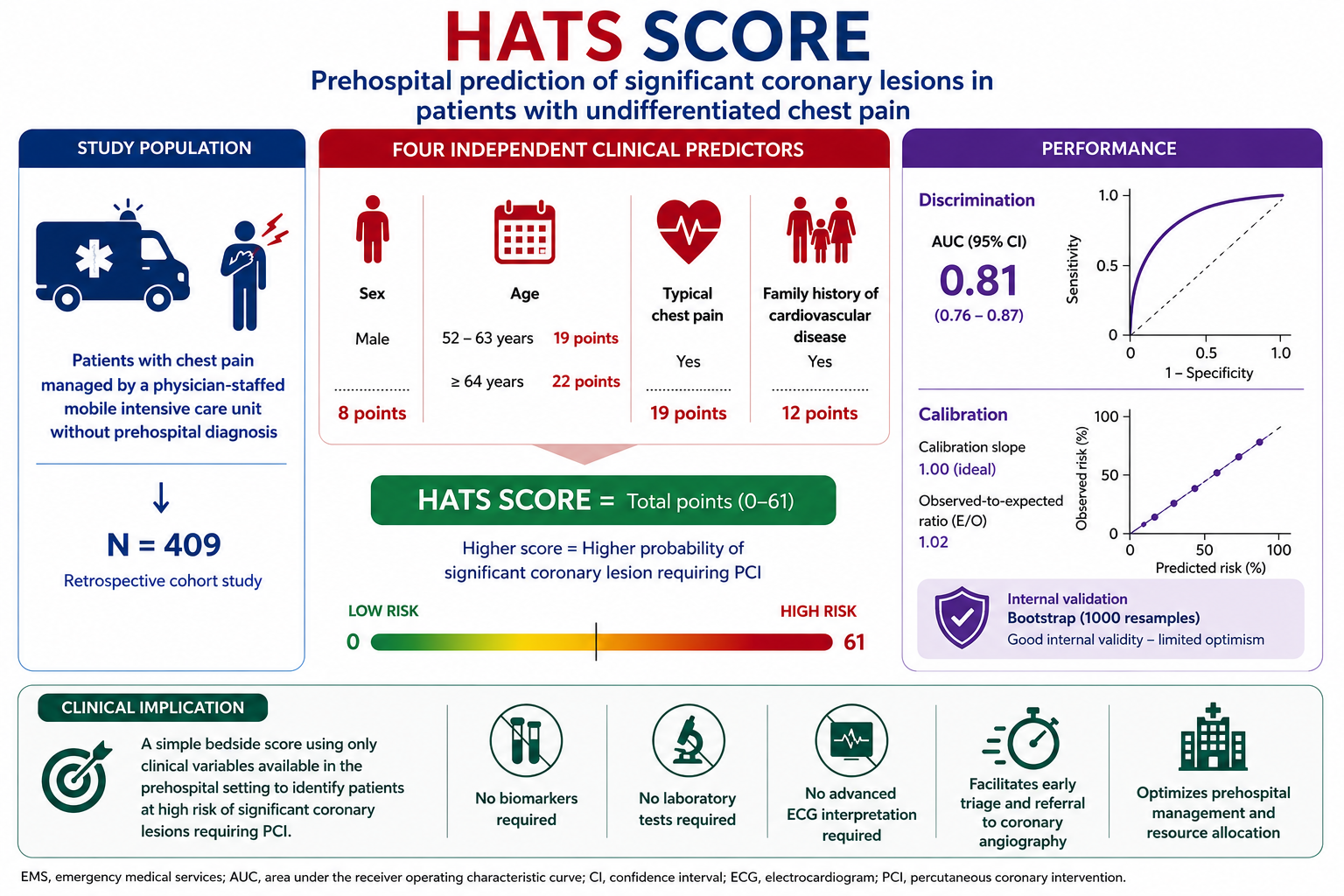
Background: Undifferentiated chest pain is one of the most common reasons for emergency medical service (EMS) activation, yet its aetiological spectrum remains poorly characterised in the prehospital setting. Furthermore, no clinical prediction model has been specifically developed to identify patients at risk of significant coronary lesions using only information available before hospital arrival. This study aimed to describe the aetiologies of undifferentiated prehospital chest pain and develop a proof-of-concept clinical prediction model. Methods: We conducted a retrospective, single-centre study including 409 consecutive patients managed by the Orléans Mobile Intensive Care Unit (MICU) for undifferentiated chest pain between January and June 2024. Predictors of significant coronary lesions requiring coronary revascularisation were identified using multivariable logistic regression. Model performance was assessed by discrimination and calibration, and internally validated using 1000 bootstrap resamples. Results: Cardiological aetiologies accounted for 19% of cases, including 53 patients (13%) with significant coronary lesions. Four independent predictors were identified: age (OR 6.7–8.9 according to category), male sex (OR 2.2), typical chest pain (OR 6.6), and a positive family history of cardiovascular disease (OR 3.4). These variables were combined to develop the HATS (History, Age, Typical chest pain, Sex) model. The model demonstrated good discrimination (AUC 0.81), excellent calibration (Hosmer–Lemeshow P=0.88), and satisfactory internal validity after bootstrap validation. Conclusions: This study characterises the aetiological spectrum of undifferentiated prehospital chest pain and proposes the HATS model as a proof-of-concept clinical prediction tool. Prospective multicentre external validation is required before routine clinical implementation.
Keywords:
chest pain
; prehospital care
; coronary lesions
; predictive score
1. Introduction
Chest pain is one of the most frequent reasons for calls to emergency medical dispatch centres and for Mobile Intensive Care Unit (MICU) deployment. In France, approximately one third to one half of MICU missions are related to chest pain, [1,2,3] and this proportion reached 33% at the Orléans emergency medical dispatch centre in 2024. The immediate priority is to recognise patients with time-sensitive cardiac disease while avoiding unnecessary use of scarce prehospital resources.
This task is particularly difficult when the initial electrocardiogram is non-diagnostic and no clear aetiology can be established before hospital arrival. Clinical presentation is heterogeneous, and access to biomarkers, serial testing, and prolonged observation is limited in the field. Consequently, transport and medicalisation decisions rely largely on symptoms, cardiovascular history, initial examination, and physician judgement. [4,5,6,7] The final diagnostic spectrum of this undifferentiated prehospital population remains incompletely characterised.
Established scores such as TIMI, HEART, and GRACE were developed mainly for in-hospital or emergency-department assessment and may require biomarkers or information not routinely available before hospital arrival. [8,9,10] Although prehospital risk-stratification approaches have been explored, [11] evidence remains limited for a model based exclusively on immediately available clinical variables and focused on coronary lesions requiring revascularisation. A preliminary model could help define candidate predictors and inform the design of prospective multicentre research, but should not be interpreted as ready for clinical use.
The objectives of this study were therefore (1) to describe the final hospital aetiologies among patients managed by a physician-staffed MICU for chest pain without a definitive prehospital diagnosis and (2) to develop and internally validate an exploratory, proof-of-concept clinical prediction model for significant coronary lesions.
2. Materials and Methods
2.1. Study Design
This was a retrospective, observational, single-centre study including all patients managed by the Orléans MICU for chest pain without a definitive prehospital etiological diagnosis. Data were collected over a six-month period from January 1 to June 30, 2024.
2.2. Study Population
Inclusion criteria:
All adult patients presenting with chest pain who required MICU intervention and for whom no definitive etiological diagnosis was established prehospital.
Exclusion criteria:
- Patients under 18 years of age
- Patients with a definitive prehospital etiological diagnosis
2.3. Data Collection
Data were collected from MICU intervention reports, SAMU dispatch records (e-RS/EXOS), and hospital electronic medical records from Orléans University Hospital (EASILY software) and Oréliance Clinic (Dopasoins software). All data were anonymised.
2.4. Primary Outcome
The primary outcome was the presence of significant coronary lesions, defined as lesions requiring coronary angioplasty with or without stent implantation.
2.5. Statistical Analysis
Data were analysed using STATA 11. Descriptive statistics were expressed as medians or percentages. Univariate analysis was performed using Fisher’s exact test. Variables with p < 0.20 in univariate analysis were included in multivariate logistic regression. Model performance was assessed using receiving operating characteristic (ROC) curve analysis with the area under the curve (AUC), along with the Hosmer–Lemeshow goodness-of-fit test. A predictive score (HATS) was derived from the regression coefficients (β), which were multiplied by 10 to assign a weighted value to each variable included in the model. Internal validation of the final multivariable logistic regression model was performed using bootstrap resampling with 1000 iterations. For each bootstrap sample, the model was refitted and evaluated on both the bootstrap and original datasets in order to estimate optimism. Optimism-corrected estimates of discrimination (area under the receiver operating characteristic curve [AUC]), calibration slope, Brier score, Nagelkerke R², and the observed-to-expected (E/O) ratio were then calculated.
2.6. Ethical Approval
This retrospective observational study was conducted in accordance with the Declaration of Helsinki. In accordance with the French data protection authority’s reference methodology (MR-004), the study qualified as non-interventional research and did not require approval from an institutional ethics committee under the French Loi Jardé. The study was approved by the Research Ethics Committee of Orléans University Hospital (CERO 2602-14) and declared to the French Data Protection Authority (CNIL). All data were anonymised before analysis. In accordance with French regulations, all eligible patients received written information describing the study and its objectives and were informed of their right to object to the use of their data for research purposes. Patients were given a one-month period to exercise their right to refuse participation. Patients who objected were excluded from the analysis.
3. Results
3.1. Study Flow and Population Description
Between January 1 and June 30, 2024, a total of 543 patients were managed by the Orléans MICU for chest pain. After exclusion of minors and patients with a clearly established prehospital diagnosis, 409 patients were included in the final analysis (Figure 1).
Among excluded cases, three patients had a final diagnosis established prehospital (ventricular tachycardia in a patient with known ischemic heart disease, hypertensive acute pulmonary oedema, and clinically suspected pericarditis supported by history and ECG findings).
Baseline demographic, clinical, and prehospital characteristics are summarised in Table 1. A total of 409 patients were included, of whom 53 (13.0%) had significant coronary lesions. The median age was 61 years (IQR, 49–74), and 259 patients (63.3%) were male. Compared with patients without significant coronary lesions, those with coronary lesions were older (median age 69 [IQR, 61–77] vs. 59 [IQR, 48–72] years; p<0.001) and more frequently male (77.4% vs. 61.2%; p=0.034). They also had a higher prevalence of previous ischemic heart disease (49.1% vs. 28.7%; p=0.004), hypertension (69.8% vs. 42.7%; p<0.001), diabetes (26.4% vs. 14.6%; p=0.043), and a positive family history of cardiovascular disease (37.7% vs. 22.8%; p=0.026). Typical chest pain was markedly more frequent in patients with significant coronary lesions (66.0% vs. 21.1%; p<0.001), as were systolic blood pressure ≥150 mmHg (66.0% vs. 50.0%; p=0.038), a positive nitrate test (55.6% vs. 32.4%; p=0.013), and medicalized transport (49.1% vs. 18.5%; p<0.001). No significant differences were observed regarding dyslipidaemia, smoking status, sweating, malaise, dyspnea, heart failure, or ECG findings.
3.2. Final Hospital Diagnoses
Final diagnoses at hospital discharge are illustrated in Figure 2. Cardiac aetiologies accounted for 18% of cases, including acute coronary syndromes with or without ST-segment elevation and other ischemic or rhythm-related conditions. Non-cardiac somatic causes were less frequent and mainly included digestive (4%) and pulmonary (4%) aetiologies. Psychiatric or toxic causes accounted for 4% of diagnoses. Notably, 58 % of patients had no definitive somatic diagnosis at discharge, reflecting the multifactorial and often benign nature of chest pain presentations. Among patients with cardiac aetiologies, several STEMI cases initially presented with non-diagnostic or transient ECG changes, underscoring the dynamic nature of acute coronary syndromes and the limitations of a single prehospital assessment.
3.3. Significant Coronary Lesions
Overall, 53 patients (13%) had significant coronary lesions requiring acute revascularisation by angioplasty with or without stent implantation. These patients represented nearly 70% of those ultimately diagnosed with a cardiac etiology (n=77 (18%)). Patients with significant coronary lesions were more frequently male, older, and more likely to present with typical chest pain, elevated systolic blood pressure, positive nitrate testing, and a positive family history of cardiovascular disease. They were also significantly more likely to be transported with physician staffed medicalisation.
3.4. Univariate and Multivariate Analyses
Variables of univariate analysis associated (Table 1) with significant coronary lesions at a threshold of p < 0.20 were included in the multivariate model. Multivariate logistic regression identified four independent predictors of significant coronary lesions: age, male sex, typical chest pain, and positive cardiovascular family history (Table 2). Increasing age was associated with a marked and progressive rise in risk, with odds ratios exceeding 8 beyond the age of 64 years.
3.5. Model Performance and HATS Score
The predictive model of significant coronary lesions demonstrated good discrimination, with an area under the ROC curve of 0.81 (Figure 3a), and excellent calibration, as shown by a non-significant Hosmer–Lemeshow test (p = 0.88) and close agreement between predicted and observed events across deciles of risk (Figure 3b).
Based on regression coefficients, the HATS score (Heritage, Age, Typical pain, Sex) was constructed (Table 3).
Internal validation using 1000 bootstrap resamples demonstrated limited optimism (Table 4). The apparent AUC was 0.826 and the optimism-corrected AUC was 0.810. The apparent Brier score was 0.085 and the optimism-corrected Brier score was 0.091. The apparent Nagelkerke R² was 0.305 and the optimism-corrected Nagelkerke R² was 0.232. The optimism-corrected calibration slope was 0.91, and the E/O ratio was close to 1.0, indicating good discrimination and satisfactory calibration of the HATS model.
4. Discussion
In this retrospective single-centre cohort of 409 patients with undifferentiated prehospital chest pain, the main contribution was twofold. First, the study characterised the final diagnostic spectrum of a population in whom a physician-staffed prehospital assessment had not established an aetiology. Second, it identified four readily available variables associated with significant coronary lesions and combined them in an internally validated exploratory model. These findings are hypothesis-generating and should be viewed as a basis for further multicentre investigation rather than evidence for immediate implementation of a new decision rule.
4.1. Etiological Spectrum of Chest Pain
Despite prehospital medical assessment, fewer than one quarter of patients received a definitive etiological diagnosis before hospital admission, highlighting the intrinsic difficulty of chest pain evaluation in the prehospital setting. Even after complete hospital workup, nearly 60% of patients remained without a clearly identified somatic cause. This finding is consistent with published data indicating that a large proportion of chest pain presentations are ultimately non-cardiac or benign.[14,15,16]
Nevertheless, nearly one fifth of patients had a final cardiac diagnosis, and 13% required urgent coronary intervention. This proportion is in line with international reports describing coronary causes in 15–25% of chest pain presentations, despite the selected nature of our population, which had already been deemed at higher risk by the dispatch physician.[15,17]
4.2. Medicalisation and Clinical Judgment
Approximately 22% of patients were transported with physician-staffed medicalisation. Importantly, half of the patients with significant coronary lesions were medicalised, compared with less than 20% of those without such lesions. This observation suggests that prehospital clinical judgment is already effective at identifying higher-risk patients, even in the absence of a formal diagnosis.[18]
Multivariate analysis focusing on medicalisation (not shown) confirmed that this decision was driven primarily by objective clinical features such as typical chest pain, diaphoresis, and known ischemic heart disease, rather than by physician-related factors. However, the fact that more than half of patients with significant coronary lesions were not medicalised underscores the need for improved risk stratification tools.[11]
4.3. Predictors of Significant Coronary Lesions
Four independent predictors emerged from the multivariate analysis: age, male sex, cardiovascular family history, and typical chest pain. These factors are well established determinants of coronary artery disease and are incorporated into many in-hospital risk stratification scores.[8,9,17] Their identification in a purely prehospital context reinforces the central role of clinical assessment when paraclinical resources are limited.
Age was the strongest predictor, with a sharp increase in risk beyond the age of 50 years and particularly after 64 years. Male sex doubled the risk, reflecting known sex-related differences in coronary disease epidemiology.[19] Family history was associated with a threefold increase in risk, consistent with its recognised role as a major cardiovascular risk factor.[20] Typical chest pain remained a strong predictor, although one third of patients with significant coronary lesions did not report typical symptoms, highlighting the well-known variability of acute coronary syndrome presentation.[17]
Traditional cardiovascular risk factors such as hypertension, diabetes, and smoking did not remain in the final multivariate model. This likely reflects collinearity with age and sex rather than the absence of a true association with coronary artery disease.[21]
4.4. Exploratory Prediction Model and Research Implications
The HATS model was derived from four variables available during the initial prehospital assessment. Its apparent discrimination, calibration, and bootstrap-corrected performance support the internal coherence of the model and the feasibility of predicting significant coronary lesions without biomarkers or prolonged observation. This differs from widely used in-hospital scores such as GRACE, TIMI, and HEART, which were developed for other populations and purposes.[8,9,10]
However, the observed association between higher HATS values and coronary revascularisation was estimated in the same cohort used to develop the model. The score should therefore be considered a proof of concept, not a clinical triage rule. Its potential incremental value over physician judgement and existing prehospital approaches remains unknown.[11] Future studies should externally validate the full model in independent emergency medical systems, assess clinical utility and decision thresholds, and determine whether its use improves transport or referral decisions without increasing unnecessary specialist activation.
4.5. Strengths and Limitations
The strengths of this study include detailed prehospital clinical data and complete in-hospital follow-up, which allowed final diagnoses and coronary revascularisation to be ascertained. Several limitations nevertheless constrain interpretation. The retrospective design may have introduced missingness and measurement error, particularly for subjective features such as pain characteristics. The single-centre, physician-staffed French system and the restriction to patients selected for MICU assessment limit transportability to other emergency medical services and may have enriched the cohort for higher-risk presentations. The simplified definition of cardiovascular family history may have caused misclassification. The outcome, coronary lesions treated by angioplasty with or without stenting, may also partly reflect local treatment decisions. The modest number of outcome events and absence of an independent validation cohort mean that performance may still be optimistic despite bootstrap correction. Finally, no long-term follow-up was available to assess major adverse cardiovascular events after discharge. Accordingly, HATS remains an exploratory model requiring prospective external validation and clinical-utility assessment before any consideration of routine use.[17]
5. Conclusions
Among patients with undifferentiated chest pain assessed by a physician-staffed MICU, cardiac diagnoses remained clinically important and 13% had significant coronary lesions requiring revascularisation. Age, male sex, typical chest pain, and a positive family history of cardiovascular disease formed an internally validated exploratory model with good apparent performance. HATS should be regarded as a proof-of-concept model that generates hypotheses for prospective multicentre validation, not as a tool for current clinical decision-making.
Author Contributions
Funding
This research received no external funding.
Institutional Review Board Statement and Informed Consent Statement
This retrospective observational study was conducted in accordance with the Declaration of Helsinki. In accordance with the French data protection authority’s reference methodology (MR-004), the study qualified as non-interventional research and did not require approval from an institutional ethics committee under the French Loi Jardé. The study was approved by the Research Ethics Committee of Orléans University Hospital (CERO 2602-14) and declared to the French Data Protection Authority (CNIL). All data were anonymised before analysis. In accordance with French regulations, all eligible patients received written information describing the study and its objectives and were informed of their right to object to the use of their data for research purposes. Patients were given a one-month period to exercise their right to refuse participation. Patients who objected were excluded from the analysis.
Informed Consent Statement
Informed consent was obtained from all subjects involved in the study.
Data Availability Statement
The data presented in this study are available on request from the corresponding author.
Conflicts of Interest
The authors declare no conflict of interest.
References
- Morice, L. Évaluation par département de l’activité SMUR dans la région Pays de la Loire sur la période d’octobre 2020 à octobre 2021. Thèse d’exercice, Université de Nantes, 2022.
- Schaffhauser, É. Étude des dossiers codés « douleur thoracique » au sein du thésaurus du SMUR de Strasbourg. Thèse d’exercice, Université de Strasbourg, 2020.
- Observatoire Régional des Urgences Midi-Pyrénées (ORU-MiP); ORU-MiP: Toulouse, 2016.
- Olié, V.; Gabet, A.; Grave, C.; Helft, G.; Fosse-Edorh, S.; Piffaretti, C.; Lailler, G.; Verdot, C.; Deschamps, V.; Vay-Demouy, J. Epidemiology of Cardiovascular Risk Factors: Non-Behavioural Risk Factors. Arch. Cardiovasc. Dis. 2024, 117, 761–769. [Google Scholar] [CrossRef] [PubMed]
- Piepoli, M.F.; Hoes, A.W.; Agewall, S.; Albus, C.; Brotons, C.; Catapano, A.L.; Cooney, M.-T.; Corrà, U.; Cosyns, B.; Deaton, C.; et al. 2016 European Guidelines on Cardiovascular Disease Prevention in Clinical Practice: The Sixth Joint Task Force of the European Society of Cardiology and Other Societies on Cardiovascular Disease Prevention in Clinical Practice (Constituted by Representatives of 10 Societies and by Invited Experts)Developed with the Special Contribution of the European Association for Cardiovascular Prevention & Rehabilitation (EACPR). Eur. Heart J. 2016, 37, 2315–2381. [Google Scholar] [CrossRef] [PubMed]
- Culić, V.; Eterović, D.; Mirić, D.; Silić, N. Symptom Presentation of Acute Myocardial Infarction: Influence of Sex, Age, and Risk Factors. Am. Heart J. 2002, 144, 1012–1017. [Google Scholar] [CrossRef] [PubMed]
- Swap, C.J.; Nagurney, J.T. Value and Limitations of Chest Pain History in the Evaluation of Patients With Suspected Acute Coronary Syndromes. JAMA 2005, 294, 2623–2629. [Google Scholar] [CrossRef] [PubMed]
- Antman, E.M.; Cohen, M.; Bernink, P.J.L.M.; McCabe, C.H.; Horacek, T.; Papuchis, G.; Mautner, B.; Corbalan, R.; Radley, D.; Braunwald, E. The TIMI Risk Score for Unstable Angina/Non–ST Elevation MI: A Method for Prognostication and Therapeutic Decision Making. JAMA 2000, 284, 835–842. [Google Scholar] [CrossRef] [PubMed]
- Backus, B.E.; Six, A.J.; Kelder, J.C.; Bosschaert, M. a. R.; Mast, E.G.; Mosterd, A.; Veldkamp, R.F.; Wardeh, A.J.; Tio, R.; Braam, R.; et al. A Prospective Validation of the HEART Score for Chest Pain Patients at the Emergency Department. Int. J. Cardiol. 2013, 168, 2153–2158. [Google Scholar] [CrossRef] [PubMed]
- Fox, K.A.A.; Dabbous, O.H.; Goldberg, R.J.; Pieper, K.S.; Eagle, K.A.; Van de Werf, F.; Avezum, A.; Goodman, S.G.; Flather, M.D.; Anderson, F.A.; et al. Prediction of Risk of Death and Myocardial Infarction in the Six Months after Presentation with Acute Coronary Syndrome: Prospective Multinational Observational Study (GRACE). BMJ 2006, 333, 1091. [Google Scholar] [CrossRef] [PubMed]
- Sagel, D.; Vlaar, P.J.; van Roosmalen, R.; Waardenburg, I.; Nieuwland, W.; Lettinga, R.; van Barneveld, R.; Jorna, E.; Kijlstra, R.; van Well, C.; et al. Prehospital Risk Stratification in Patients with Chest Pain. Emerg. Med. J. 2021, 38, 814–819. [Google Scholar] [CrossRef] [PubMed]
- Olié, V.; Grave, C.; Helft, G.; Nguyen-Thanh, V.; Andler, R.; Quatremere, G.; Pasquereau, A.; Lahaie, E.; Lailler, G.; Verdot, C. Epidemiology of Cardiovascular Risk Factors: Behavioural Risk Factors. Arch. Cardiovasc. Dis. 2024, 117, 770–784. [Google Scholar] [CrossRef] [PubMed]
- Wahrenberg, A.; Magnusson, P.K.; Discacciati, A.; Ljung, L.; Jernberg, T.; Frick, M.; Linder, R.; Svensson, P. Family History of Coronary Artery Disease Is Associated with Acute Coronary Syndrome in 28,188 Chest Pain Patients. Eur. Heart J. Acute Cardiovasc Care 2020, 9, 741–747. [Google Scholar] [CrossRef] [PubMed]
- Goodacre, S.; Cross, E.; Arnold, J.; Angelini, K.; Capewell, S.; Nicholl, J. The Health Care Burden of Acute Chest Pain. Heart 2005, 91, 229–230. [Google Scholar] [CrossRef] [PubMed]
- Stepinska, J.; Lettino, M.; Ahrens, I.; Bueno, H.; Garcia-Castrillo, L.; Khoury, A.; Lancellotti, P.; Mueller, C.; Muenzel, T.; Oleksiak, A.; et al. Diagnosis and Risk Stratification of Chest Pain Patients in the Emergency Department: Focus on Acute Coronary Syndromes. A Position Paper of the Acute Cardiovascular Care Association. Eur. Heart J. Acute Cardiovasc Care 2020, 9, 76–89. [Google Scholar] [CrossRef] [PubMed]
- Hollander, J.E.; Chase, M. Evaluation of the Adult with Chest Pain in the Emergency Department. Angiology 2016, 67, 243–253. [Google Scholar] [CrossRef]
- Amsterdam, E.A.; Wenger, N.K.; Brindis, R.G.; Casey, D.E.; Ganiats, T.G.; Holmes, D.R.; Jaffe, A.S.; Jneid, H.; Kelly, R.F.; Kontos, M.C.; et al. 2014 AHA/ACC Guideline for the Management of Patients With Non–ST-Elevation Acute Coronary Syndromes. Circulation 2014, 130, e344–e426. [Google Scholar] [CrossRef] [PubMed]
- Quinn, T.; Johnsen, S.; Gale, C.P.; Snooks, H.; McLean, S.; Woollard, M.; Weston, C. Effects of Prehospital 12-Lead ECG on Processes of Care and Mortality in Acute Coronary Syndrome: A Linked Cohort Study from the Myocardial Ischaemia National Audit Project. Heart 2014, 100, 944–950. [Google Scholar] [CrossRef] [PubMed]
- Mosca, L.; Barrett-Connor, E.; Wenger, N.K. Sex/Gender Differences in Cardiovascular Disease Prevention: What a Difference a Decade Makes. Circulation 2011, 124, 2145–2154. [Google Scholar] [CrossRef] [PubMed]
- Lloyd-Jones, D.M.; Nam, B.-H.; D’Agostino, R.B.; Levy, D.; Murabito, J.M.; Wang, T.J.; Wilson, P.W.F.; O’Donnell, C.J. Parental Cardiovascular Disease as a Risk Factor for Cardiovascular Disease in Middle-Aged Adults: A Prospective Study of Parents and Offspring. JAMA 2004, 291, 2204–2211. [Google Scholar] [CrossRef] [PubMed]
- Yusuf, S.; Hawken, S.; Ôunpuu, S.; Dans, T.; Avezum, A.; Lanas, F.; McQueen, M.; Budaj, A.; Pais, P.; Varigos, J.; et al. Effect of Potentially Modifiable Risk Factors Associated with Myocardial Infarction in 52 Countries (the INTERHEART Study): Case-Control Study. The Lancet 2004, 364, 937–952. [Google Scholar] [CrossRef] [PubMed]
Figure 1.
Flow chart detailing patient selection and exclusions.
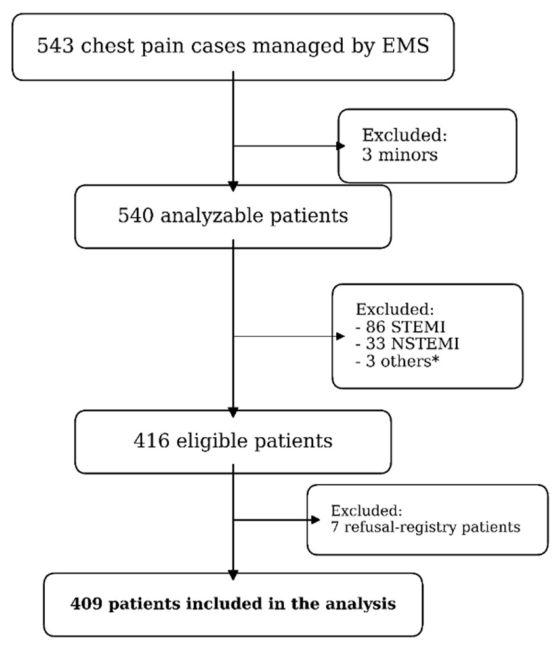
Figure 2.
Sankey diagram showing final diagnosis of chest pain managed by Orléans Mobil Intensive Care Unit without prehospital aetiologies (N=409).
Figure 2.
Sankey diagram showing final diagnosis of chest pain managed by Orléans Mobil Intensive Care Unit without prehospital aetiologies (N=409).
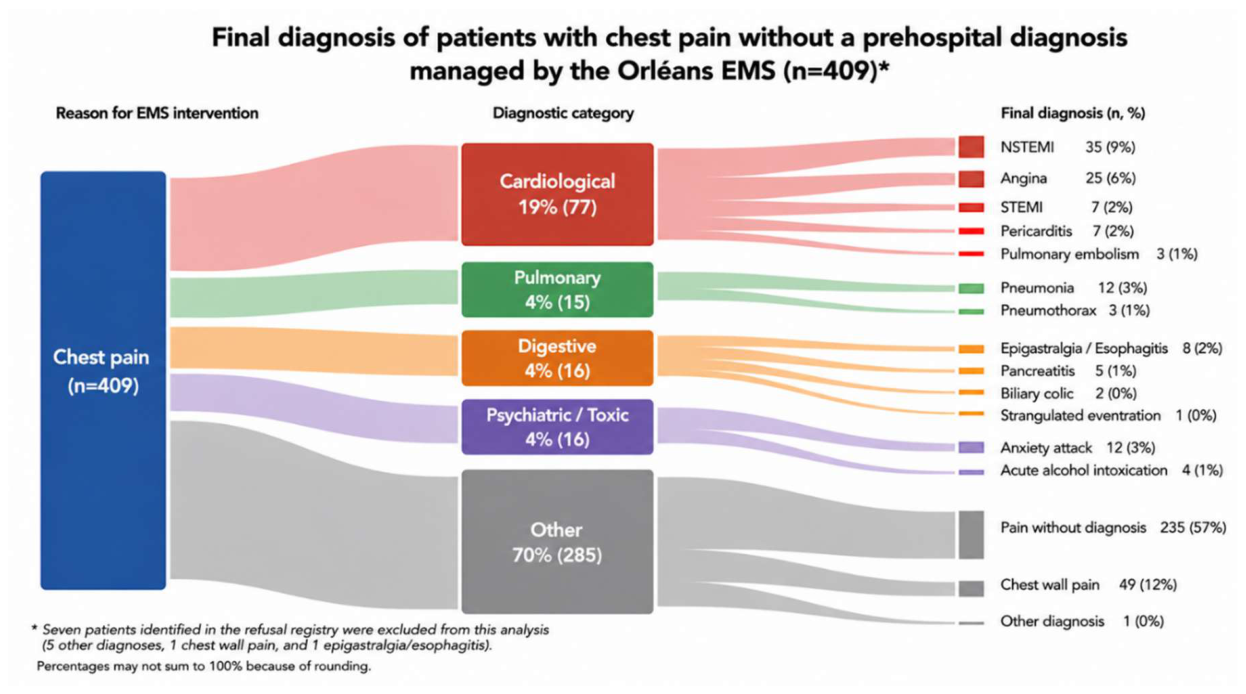
Figure 3.
Performance of the HATS score for predicting significant coronary lesions. (A) Receiver operating characteristic (ROC) curve showing the discrimination of the HATS score (AUC 0.81, 95% CI 0.76–0.87). (B) Calibration plot comparing predicted and observed probabilities of significant coronary lesions (Hosmer–Lemeshow P = 0.88; observed-to-expected ratio = 1.02). Abbreviations: AUC, area under the receiver operating characteristic curve; CI, confidence interval; E/O, observed-to-expected ratio.
Figure 3.
Performance of the HATS score for predicting significant coronary lesions. (A) Receiver operating characteristic (ROC) curve showing the discrimination of the HATS score (AUC 0.81, 95% CI 0.76–0.87). (B) Calibration plot comparing predicted and observed probabilities of significant coronary lesions (Hosmer–Lemeshow P = 0.88; observed-to-expected ratio = 1.02). Abbreviations: AUC, area under the receiver operating characteristic curve; CI, confidence interval; E/O, observed-to-expected ratio.
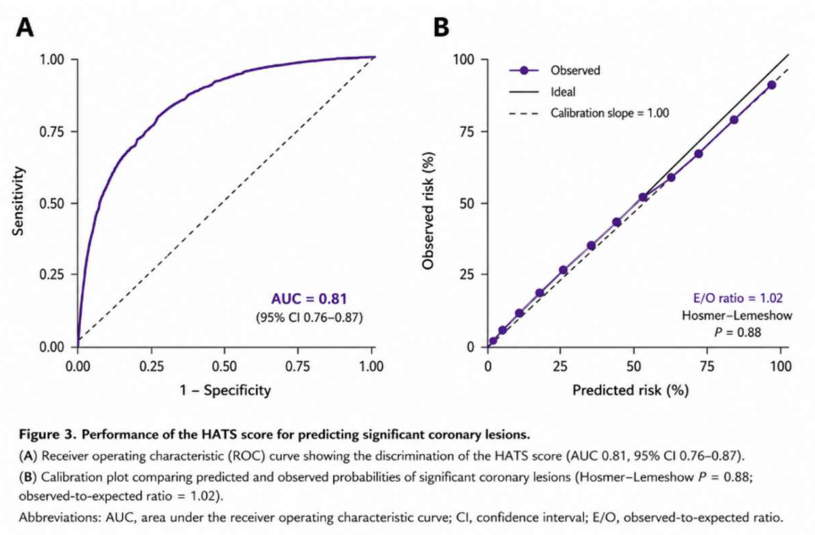

Table 1.
Baseline demographic, clinical and prehospital characteristics.
| Characteristics | Total population (n = 409) |
Significant coronary lesions (n = 53) | No significant coronary lesions (n = 356) | p |
|---|---|---|---|---|
| Demographics | ||||
| Age, years | 61 (49–74) | 69 (61–77) | 59 (48–72) | <0.001 |
| Sex | ||||
| Male | 259 (63.3%) | 41 (77.4%) | 218 (61.2%) | 0.034 |
| Female | 150 (36.7%) | 12 (22.6%) | 138 (38.8%) | |
| Age | ||||
| < 51 years | 115 (28.1%) | 3 (5.7%) | 112 (31.5%) | 0.001 |
| 52-63 years | 108 (26.4%) | 17 (32.1%) | 91 (25.6%) | |
| 64-74 years | 95 (23.2%) | 17 (32.1%) | 78 (21.9%) | |
| >=75 years | 91 (22.2%) | 16 (30.2%) | 75 (21.1%) | |
| BMI | ||||
| Normal <25 | 120 (30.8%) | 20 (37.7%) | 100 (29.7%) | 0.046 |
| Overweight 25-30 | 156 (40.0%) | 13 (24.5%) | 143 (42.4%) | |
| Obesity >=30 | 114 (29.2%) | 20 (37.7%) | 94 (27.9%) | |
| Past medical history | ||||
| Ischemic heart disease | 128 (31.3%) | 26 (49.1%) | 102 (28.7%) | 0.004 |
| Hypertension | 189 (46.2%) | 37 (69.8%) | 152 (42.7%) | <0.001 |
| Diabetes | 66 (16.1%) | 14 (26.4%) | 52 (14.6%) | 0.043 |
| Dyslipidaemia | 178 (43.5%) | 28 (52.8%) | 150 (42.1%) | 0.181 |
| Smoking | ||||
| Non-smoker | 207 (50.6%) | 22 (41.5%) | 185 (52.0%) | 0.175 |
| Current smoker | 110 (26.9%) | 14 (26.4%) | 96 (27.0%) | |
| Former smoker | 92 (22.5%) | 17 (32.1%) | 75 (21.1%) | |
| Family history of cardiovascular disease | 101 (24.7%) | 20 (37.7%) | 81 (22.8%) | 0.026 |
| Clinical and prehospital characteristics | ||||
| SBP >=150 mmHg | 213 (52.1%) | 35 (66.0%) | 178 (50.0%) | 0.038 |
| Typical chest pain | 110 (26.9%) | 35 (66.0%) | 75 (21.1%) | <0.001 |
| Sweating | 24 (5.9%) | 6 (11.3%) | 18 (5.1%) | 0.107 |
| Malaise | 39 (9.5%) | 4 (7.5%) | 35 (9.8%) | 0.803 |
| Heart failure | 13 (3.2%) | 3 (5.7%) | 10 (2.8%) | 0.23 |
| Dyspnea | 26 (6.4%) | 5 (9.4%) | 21 (5.9%) | 0.36 |
| Positive nitrate test (among tested) | 68 (37.0%) | 20 (55.6%) | 48 (32.4%) | 0.013 |
| Normal ECG | 229 (56.0%) | 26 (49.1%) | 203 (57.0%) | 0.301 |
| ECG with known repolarisation abnormalities | 34 (8.3%) | 6 (11.3%) | 28 (7.9%) | 0.421 |
| ECG with non-significant repolarisation abnormalities | 80 (19.6%) | 11 (20.8%) | 69 (19.4%) | 0.853 |
| Medicalised transport | 92 (22.5%) | 26 (49.1%) | 66 (18.5%) | <0.001 |
Values are n (%). Percentages are calculated on available data. BMI percentages use the non-missing BMI denominator (n=390). Positive nitrate test percentages use patients with a nitrate test documented (n=184). p values were recalculated from updated aggregated counts using Fisher exact tests for binary variables and chi-square tests for multi-category variables. Abbreviations: BMI, body mass index; SBP, systolic blood pressure; ECG, electrocardiogram; STEMI, ST-elevation myocardial infarction; NSTEMI, non-ST-elevation myocardial infarction.
Table 2.
Multivariate Analysis.
| Predictors | Coefficient β | OR | 95% CI | p | |
| Heritage | 1.24 | 3.44 | 1,61 – 6.60 | 0.001 | |
|
Age |
52 – 63 years | 1.9 | 6.67 | 1.77 – 25.07 | 0.005 |
| 64-74 years | 2.16 | 8.64 | 2.24 – 33.4 | 0.002 | |
| ≥ 75 years | 2.18 | 8.87 | 2. 25 – 35 | 0.002 | |
| Typical chest pain | 1.88 | 6.56 | 3.45 – 12.84 | < 104 | |
| Male Sex | 0.79 | 2.2 | 1.02 – 4.55 | 0.04 | |
OR = Odd Ratio – CI = confidence interval.
Table 3.
HATS Score.
| Predictors | Points | |
| Male Sex | 8 | |
| Age | 52 – 63 years | 19 |
| ≥ 64 years | 22 | |
| Heritage | 12 | |
| Typical chest pain | 19 | |
Table 4.
Internal validation of the HATS prediction model.
| Metric | Apparent model | Optimism-corrected model | Comment |
|---|---|---|---|
| Sample size | 409 | — | Adult patients after excluding refusal registry |
| Events | 53 (12.9%) | — | Significant coronary lesions / final ACS-related diagnosis |
| AUC | 0.826 | 0.810 | Optimism-corrected after bootstrap |
| AUC optimism | — | 0.016 | Mean bootstrap optimism from previous run |
| Brier score | 0.085 | 0.091 | Lower values indicate better overall accuracy |
| Calibration slope | 1.00 | 0.91 | Shrinkage factor |
| E/O ratio | 1.00 | 1.01 | Observed / expected events |
| Nagelkerke R² | 0.305 | 0.232 | Bootstrap optimism-corrected |
Internal validation was performed using bootstrap resampling (1000 iterations). Abbreviations: AUC, area under the receiver operating characteristic curve; E/O, observed-to-expected ratio; R², coefficient of determination.
Disclaimer/Publisher’s Note: The statements, opinions and data contained in all publications are solely those of the individual author(s) and contributor(s) and not of MDPI and/or the editor(s). MDPI and/or the editor(s) disclaim responsibility for any injury to people or property resulting from any ideas, methods, instructions or products referred to in the content. |
© 2026 by the authors. Licensee MDPI, Basel, Switzerland. This article is an open access article distributed under the terms and conditions of the Creative Commons Attribution (CC BY) license (http://creativecommons.org/licenses/by/4.0/).
Copyright: This open access article is published under a Creative Commons CC BY 4.0 license, which permit the free download, distribution, and reuse, provided that the author and preprint are cited in any reuse.