

Submitted:
27 July 2026
Posted:
28 July 2026
You are already at the latest version
Abstract
The electromagnetic spectrum grows increasingly crowded with the rapid expansion of mobile, satellite and Internet of Things communications, making intelligent spectrum sensing and efficient management an urgent priority. Automatic modulation classification (AMC) serves as the core of cognitive radio and intelligent communication. Existing deep models often suffer from a large number of parameters and high computational complexity. To overcome these limitations, we propose MDSCNet, a Multi-Scale Depthwise Separable Complex Network. Built upon complex depthwise separable convolution, the network makes full use of the phase information in IQ signals while naturally preserving the symmetric relationship between the in-phase and quadrature components. An asymmetric multi-scale structure with embedded channel attention further helps the model capture diverse distortion patterns under non-ideal channels at negligible extra cost. The overall parameter count is kept extremely low, at only 47.739k. Experiments on the RML2016.10a and RML2016.10b datasets show that MDSCNet delivers excellent recognition performance under low signal-to-noise ratios, reaching 63.37% and 67.07%respectively. More importantly, it significantly outperforms mainstream methods in both parameter count and computational load.
Keywords:
automatic modulation classification
; complex-valued neural networks
; symmetric IQ features
; asymmetric multi-scale structure
; lightweight model
1. Introduction
Automatic modulation classification(AMC), has become a key technology for cognitive radio, intelligent receivers, and electronic reconnaissance. It enables a receiving system to identify the modulation type of an incoming signal without any prior information. Many standard modulation formats exhibit clear symmetry in their constellation diagrams, and AMC can exploit this structural property. The technique is widely used in signal monitoring, interference identification, and electronic countermeasures [1,2,3,4]. It also plays an important role in radio management, spectrum sensing, and software-defined radio [5,6].
Traditional AMC methods follow two main paths. The first path is the likelihood-based approach [7,8], which requires explicit channel assumptions. This leads to exponentially growing computational costs and poor generalization. The second path relies on manually designed features [9]. Such features are difficult to scale to large and diverse modulation sets. More importantly, when a signal passes through a real-world channel, its original constellation symmetry is often distorted by asymmetric fading or hardware imperfections. Manually crafted features seldom capture these asymmetric effects, and the methods ultimately fail to deliver the full autonomy that cognitive radio demands.
In recent years, deep learning has achieved remarkable breakthroughs in signal classification. These advances span automatic modulation classification [10,11,12], specific emitter identification [13,14,15], and interference recognition [16,17]. Convolutional neural networks [18], recurrent networks, and Transformers [19] have all been applied with notable success. O’Shea and West [20] released the RML2016.10a dataset and introduced the VT-CNN2 model, which convincingly demonstrated the power of deep learning for AMC. Later models such as MCLDNN [21] and MCNet [22] further improved performance through multi-stream architectures and residual connections. By processing the in-phase and quadrature components through separate or shared pathways, these designs began to implicitly exploit the inherent symmetry between I and Q channels. Yet the demand for lighter and more symmetry-aware architectures remains strong, especially when the asymmetric distortions in practical channels are taken into account.
Figure 1.
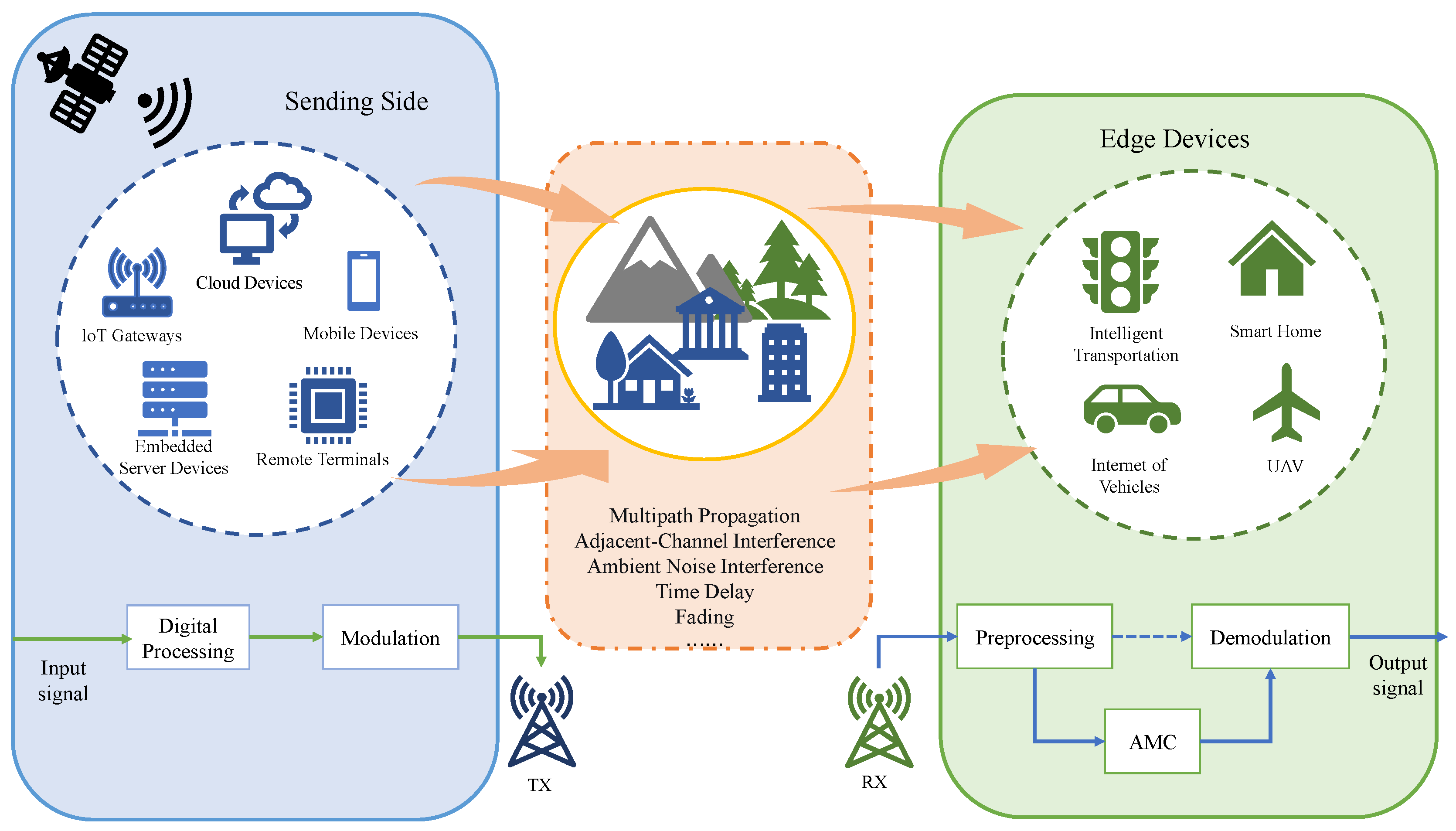
AMC in resource-constrained networks spans the entire chain from diverse sending devices, through harsh wireless channels, to receiver-side processing, and ultimately to edge applications.
Figure 1.
AMC in resource-constrained networks spans the entire chain from diverse sending devices, through harsh wireless channels, to receiver-side processing, and ultimately to edge applications.
- 1.
- We present MDSCNet, an end-to-end deep architecture that operates directly on raw IQ samples.Built around complex depthwise separable convolution, the network retains the natural symmetric coupling between in-phase and quadrature components throughout the feature pipeline, and at the same time cuts the parameter budget and computational load by a substantial margin compared with both real-valued baselines and conventional complex networks. Such a property makes it a sensible candidate for on-device inference where memory and computing resources are tightly constrained.
- 2.
- The proposed MDSCBlock arranges several parallel complex depthwise branches with distinct dilation rates, which effectively enlarges the temporal receptive field without inflating the parameter count.This deliberately asymmetric layout helps the network pick up temporal patterns of different lengths, a capability that matters most when clean constellation symmetry is degraded by realistic channel distortions. A lightweight squeeze-and-excitation unit is further inserted into deeper blocks to reweight channel features adaptively, which empirically brings noticeable gains under low-SNR conditions.
2. Related Work
2.1. AMC Methods Based on CNN
Wang and colleagues proposed a dual-branch CNN architecture for AMC [23]. The first branch operates directly on IQ time series and substitutes pooling layers with dropout regularization to improve separation between QAM and non-QAM modulation families. The second branch takes constellation images as input and specializes in distinguishing between 16QAM and 64QAM. A comparable two-CNN pipeline was adopted by Gu et al. for blind channel recognition tasks [24]. Their first network distinguishes line-of-sight from non-line-of-sight channels, while the second performs modulation classification across 2FSK, DQPSK, 16QAM, 4PAM, MSK, and GMSK. The reported results outperform classical cumulant-based approaches. Xu et al. developed MCLDNN [21], a multi-stream architecture that merges convolutional feature extraction with LSTM layers over IQ inputs. By jointly modeling spatial and temporal dependencies, the model reduces confusion among high-order modulation schemes and achieves stronger performance than conventional CNN baselines, especially at low and mid-range SNR levels.
2.2. Lightweight AMC Methods
On the lightweight design front, Lin et al. explored filter pruning based on activation maximization criteria [25,26]. Their method evaluates the contribution of each convolution kernel using gradient-based saliency metrics, and prunes filters with the lowest importance scores. The resulting compressed models occupy less storage, exhibit reduced overfitting, and run faster on edge-class hardware. Knowledge distillation offers another route to compactness: Wang et al. devised a teacher-student training scheme [27] in which a tiny student network, 0.37 MB in size, learns to mimic a larger, highly accurate teacher model. The distilled student achieves accuracy on par with or better than the teacher while maintaining a favorable accuracy-to-complexity ratio. More recently, Hamidi-Rad and Jain introduced MCformer [19], which brings Transformer-style self-attention to the AMC problem. The architecture achieves reduced parameter counts alongside improved classification accuracy, handles complex-valued inputs naturally, and delivers consistent gains across the full SNR range, most prominently under low-noise conditions.
2.3. AMC Methods Based on Complex Convolution
Complex-valued neural networks represent another active research direction for AMC. Tu et al. [28] investigated fully complex convolutional modules that explicitly model amplitude-phase relationships in IQ data. While these modules improve both classification accuracy and convergence speed under low-SNR conditions, they also introduce higher computational overhead. Building on this idea, Xiao et al. proposed CDSCNN [29], which decomposes standard complex convolution into depthwise and pointwise stages. The resulting architecture preserves phase-related structural information while substantially reducing both parameter count and floating-point operations. CDSCNN reports improvements over real-valued baselines in accuracy, inference speed, and noise robustness, with the largest gains appearing at low SNR. Most recently, Xin et al. presented CPPCNet [30], which employs partial pointwise convolution to better capture amplitude-phase interactions. The design strikes an appealing balance between recognition performance and computational cost, making it suitable for deployment on resource-limited platforms.
3. Signal Model and Problem Formulation
This section introduces the communication signal model and the problem formulation for automatic modulation classification in the complex domain.
3.1. Signal Model
We use a standard baseband equivalent communication link. This link includes symbol modulation, pulse shaping, multipath fading, additive white Gaussian noise, and sampling. The model is defined as follows.
Define the m-th complex baseband modulation symbol as
Here and are the amplitude and phase. Their values depend on the specific modulation scheme.
The continuous-time transmitted signal after pulse shaping is
In this equation, denotes the energy-normalized pulse shaping filter. We use a root raised cosine filter in this paper. T is the symbol period.
The multipath fading channel is represented by a linear time-invariant tap delay line. Its impulse response is
Here L is the number of resolvable multipath components. is the complex fading gain, and it follows . is the propagation delay of the l-th path.
The received continuous-time signal is the convolution of the transmitted signal with the channel impulse response, plus noise. That is
Here ∗ denotes convolution. is complex AWGN with zero mean and bilateral power spectral density .
After sampling at period (which satisfies the Nyquist criterion), we get the discrete-time sequence
By combining equations (2) to (4) with Equation (5), we obtain the final discrete-domain received signal
The noise sequence satisfies
with , where is the symbol energy. We apply global energy normalization. This ensures consistency between simulation and theoretical analysis.
3.2. Problem Formulation
Complex-valued convolutions preserve IQ quadrature relationships but introduce substantial parameter and computational overhead. To address this, we design MDSCNet that achieves high recognition performance with drastically reduced complexity.
4. Proposed Method
This section primarily introduces the current mainstream complex convolution theories, namely Complex Convolution (CC) [31] and Complex Depthwise Separable Convolution (CDSC) [29]. It also presents the MDSCBlock module designed in this paper and compares it with the CC and CDSC modules, focusing on parameter count and theoretical complexity. Additionally, this section introduces the MDSCNet network architecture. In the following, and represent the logical complex channel counts, k denotes the convolution kernel size, L is the output sequence length, N indicates the number of multi-scale parallel branches, stands for the parameter count, represents the floating-point operations (FLOPs = MACs), and g is the grouping count.
4.1. Theoretical Analysis of CC
CC is a basic complex network that does not use depthwise separable structures, as illustrated in Figure 2. It directly extends real-valued convolutions into the complex domain, treating the input as a channel real-valued tensor with real and imaginary parts concatenated. Two sets of real-valued convolution kernels are used internally to simulate complex multiplication, without introducing depthwise separable structures. Spatial filtering and channel mixing are fully coupled. If the complex input is and the complex convolution kernel is , then the convolution operation is defined as:
The interface convention specifies that the number of input channels is , which is internally halved to C logical complex channels. Since each module contains 2 real-valued Conv1d layers with a size of , forward propagation calls the real-valued Conv1d 4 times to complete the four cross terms. Thus:
When , and . The number of parameters increases with the square of the number of channels and is proportional to the kernel size k. Spatial filtering and channel mixing are coupled in the same tensor.
4.2. Theoretical Analysis of CDSC
CDSC decomposes standard complex convolution into DWC and pointwise convolution (PWC), where PWC is equivalent to , as depicted in Figure 3.
When the complex input is , let the complex convolution kernel be , , and let the real depthwise convolution kernel be , then:
According to the above, the total parameter count of the CDSC module is obtained by summing the parameters of DWC and PWC, where and . Therefore, the overall parameter count is:
The computational cost is split and counted using the same method, with and . After combining, we obtain:
When , the parameter count is , and the computational complexity is . Compared to CC’s , CDSC decreases to . When , the spatial filtering part saves a factor of k.
4.3. Design of MDSCBlock
Although CDSC uses fewer parameters than standard complex convolution, it suffers from two clear weaknesses. First, its real-valued depthwise convolution disrupts the natural symmetric coupling between the I and Q components. Second, a single-scale kernel severely limits the receptive field. The proposed MDSCBlock overcomes both problems. Its structure is shown in Figure 4. The block relies on complex depthwise convolution, which faithfully preserves the IQ phase structure, together with N parallel branches whose dilation rates are . An optional SE attention module can further enhance feature recalibration.
Let input . For the i-th branch with dilation :
where has kernel . For the c-th channel:
where denotes dilated convolution.
Multi-branch outputs are fused by element-wise addition:
followed by complex pointwise convolution:
When SE attention is turned on, channel recalibration and CReLU are applied. Parameter count and FLOPs are:
where and r is the compression ratio. When and , and .
Unlike CDSC, which relies on real-valued depthwise convolution and loses the inherent symmetry between I and Q, MDSCBlock uses complex depthwise convolution throughout. It applies phase rotation and amplitude scaling through the cross terms and . This preserves the symmetric IQ relationship while enabling richer signal modeling with exactly the same number of parameters. Moreover, the asymmetric dilation rates across parallel branches expand the receptive field, and the optional SE attention adds channel-wise adaptation. These capabilities are completely absent in CDSC.
4.4. Design of MDSCNet
To efficiently process IQ modulated signals, we propose a lightweight complex convolutional network named MDSCNet, as shown in Figure 5. It is built entirely on native complex operations, which naturally preserve the symmetric relationship between the in-phase and quadrature components. Multi-scale dilated convolutions and channel attention are jointly employed to capture time-frequency characteristics with an extremely low parameter count. The asymmetric dilation rates enable the network to cover multiple temporal receptive fields without extra cost.
IQ channels are combined into a single complex representation. All feature transformations, including convolution, batch normalization and ReLU activation, remain in the complex domain. Complex convolution simulates complex multiplication with two real convolutions, strictly following complex algebra. This design faithfully retains the coupling between phase and amplitude, which is essentially the symmetric structure of the IQ signal. The core MDSCBlock employs a depthwise separable design, which decouples channel-wise spatial filtering from pointwise fusion. Parallel branches with dilation rates of 1, 2, and 4 are introduced. This asymmetric arrangement of receptive fields aggregates multi-scale temporal contexts without increasing the parameter count, forming rich multi-scale representations. Lightweight Squeeze-and-Excitation attention is embedded in deeper MDSCBlock layers to perform channel recalibration, strengthening informative channels and suppressing redundancy with negligible extra computation.
The network begins with a complex convolution whose kernel length is 7, followed by four groups of MDSCBlocks. The channel count grows from 32 to 64 across these groups. Downsampling with a stride of 2 between groups enables hierarchical feature abstraction. Multi-scale dilation and SE attention are enabled only in the last two groups, where feature representations are richest. Repeated downsampling progressively compresses the temporal dimension. Global average pooling and Dropout are applied before the final fully connected classification layer. The whole model contains approximately 47k parameters, striking a balance between recognition accuracy and the low latency needed for real-time edge deployment. By preserving the symmetric IQ structure throughout the complex pipeline, MDSCNet achieves robust classification even under asymmetric channel distortions.
5. Experimental Results and Discussion
5.1. Experimental Setup
Experiments were carried out on two widely used benchmarks, RadioML2016.10a and RadioML2016.10b.Both datasets cover signal-to-noise ratios from -20 dB to 18 dB in steps of 2 dB.The 10a set contains 8 digital and 3 analog modulation types, providing 220,000 IQ signals of length 128.The 10b set offers 8 digital and 2 analog modulation types, with a larger volume of 1,200,000 signals.All modulation formats exhibit clear symmetry in their ideal constellations, a property that is easily corrupted by noise and channel imperfections.The data were split by modulation and SNR, using 80 percent of the samples for training and 20 percent for testing.This split prevents leakage while preserving the natural balance between clean symmetric patterns and distorted asymmetric ones.Training was performed on an NVIDIA RTX 4080 SUPER GPU with Python 3.8, PyTorch 1.12, and CUDA 11.6.The initial learning rate was set to 0.001.A decay factor of 0.5 was applied when validation accuracy plateaued for 10 epochs.Early stopping terminated training if no improvement was seen for 20 epochs.
5.2. Impact of MDSCBlock Variants
We analyze the ablation results in Table 1 to assess the contribution of each key design choice.
When compared against its real-valued counterpart MDSCNet-A, our proposed MDSCNet delivers superior accuracy, with 63.37% compared with 62.21% on RML2016.10a and 67.07% compared with 65.16% on RML2016.10b, while using roughly 38% fewer parameters, at 47.739k versus 76.987k. This finding suggests that complex convolution preserves competitive classification performance while encoding IQ orthogonality more efficiently through kernel sharing between the real and imaginary components. As a result, storage and computation are reduced without sacrificing expressive capacity, which is a clear advantage for parameter-sensitive AMC models intended for lightweight deployment.
In contrast, MDSCNet-B eliminates the multi-scale branches and relies solely on single-scale convolution.This simplification causes a modest accuracy decline on RML2016.10a, from 63.37% to 63.10%, but a more substantial drop on the larger and more modulation-diverse RML2016.10b, from 67.07% to 65.80%. Meanwhile, the parameter count shrinks by only about 9%, to 43.483k. These observations indicate that the multi-scale structure introduces negligible additional parameters, yet considerably improves the model’s ability to capture temporal patterns across varied time scales, which is especially beneficial under complex channel conditions and for high-order modulation recognition.
Taken together, the ablation study validates that both complex convolution and multi-scale branching play essential roles in achieving the favourable accuracy-efficiency trade-off exhibited by MDSCNet.
5.3. Classification Performance Analysis
This subsection evaluates MDSCNet comprehensively from two perspectives: recognition accuracy and computational efficiency. The comparison models include a complex-valued network CDSCNN [29], a real-valued hybrid network MCLDNN [21], and lightweight real-valued networks PET-CGDNN [32] and SCNN [33].
Figure 6 presents the accuracy curves of all evaluated methods over the entire SNR range. Table 2 summarises the recognition performance of MDSCNet alongside several mainstream approaches on both RML2016.10a and RML2016.10b. The competing baselines consist of CDSCNN, MCLDNN, PET-CGDNN, and SCNN.
Table 2 demonstrates that MDSCNet achieves the highest classification accuracy on both datasets. On the relatively easy RML2016.10a, it reaches 63.37%, outperforming all competing models. For the more difficult RML2016.10b, which covers a larger set of modulation types and suffers from more severe channel distortions, the performance advantage of MDSCNet becomes even clearer. It not only obtains the best result of 67.07% but also enlarges the accuracy gap over the second-ranked method, and this margin is wider than that observed on RML2016.10a. These outcomes strongly indicate that the multi-scale complex-valued depthwise separable convolution module employed in MDSCNet can capture more meaningful features and generalize better under complex conditions involving high-order modulations. The confusion matrix obtained by MDSCNet on RML2016.10b is shown in Figure 7.
The comparative results in Table 3 and Table 2 indicate that MDSCNet achieves the best classification accuracy among all evaluated methods, reaching 63.37% on RML2016.10a and 67.07% on RML2016.10b, while requiring only 47.739k trainable parameters, which is the smallest model size overall. Compared with parameter-heavy architectures such as MCLDNN and CDSCNN, the storage footprint of MDSCNet is reduced by over 85%. Even against purposely lightweight designs like SCNN and PET-CGDNN, the parameter count of MDSCNet is approximately 54% and 37% lower, respectively. In terms of computational cost, MDSCNet operates at 3.028M FLOPs, slightly above the most aggressively simplified model SCNN, yet it improves recognition accuracy by more than 12 percentage points. On inference latency, MDSCNet delivers a per-sample processing time of 7.70 ms on an RTX 4080 GPU. Its two variants, MDSCNet-A and MDSCNet-B, further reduce this latency to 2.37 ms and 4.81 ms, respectively, thus offering flexible trade-offs for different real-time constraints. Such attributes render MDSCNet especially well-suited for UAV-borne deployment, where onboard computing power and energy reserves are strictly constrained. Beyond substantially reducing storage and transmission overheads, the compactness of our model acts as an implicit regularizer via parameter sparsity, which helps to alleviate overfitting. In essence, MDSCNet provides a compelling synergy among accuracy, model footprint, and inference speed, positioning it as a credible solution for AMC tasks in environments where resources are scarce.
6. Conclusion
In summary, we have developed MDSCNet, a lightweight complex-valued network for automatic modulation classification. The core MDSCBlock builds on complex depthwise separable convolution, which preserves the inherent symmetric coupling between the I and Q components while drastically cutting the parameter count and computational operations. Its asymmetric multi-scale dilated branches expand the temporal receptive field at no extra cost, and the embedded squeeze-and- excitation module further sharpens channel-wise discrimination. The gain is especially evident at low SNR, where the original constellation symmetry is easily corrupted by asymmetric noise and interference. Evaluated on two public benchmarks, our model reaches overall accuracies of 63.37% on RadioML2016.10a and 67.07% on RadioML2016.10b. It outperforms several state-of-the-art competitors with a much smaller parameter budget. Ablation experiments confirm that both the complex-valued operations and the asymmetric multi-scale receptive fields contribute to these gains.Given its balanced accuracy, compact size and fast inference, MDSCNet is well suited for UAV-mounted and other edge deployment scenarios, where computational resources are scarce and asymmetric channel distortions are unavoidable.
Author Contributions
Shuxuan Ma: Conceptualization, Methodology, Software, Writing – original draft. Zhuoran Cai: Supervision, Writing – review & editing, Funding acquisition. Yue Yin: Writing – review & editing. All authors reviewed the manuscript.
Funding
This work was supported by the National Natural Science Foundation of China (Grant No. 62571472).
Institutional Review Board Statement
Not applicable.
Informed Consent Statement
Not applicable.
Data Availability Statement
The RadioML2016.10a and RadioML2016.10b datasets are publicly accessible benchmark resources adopted in this study.
Acknowledgments
The authors would like to thank the National Natural Science Foundation of China for their financial support.
Conflicts of Interest
The authors declare no conflicts of interest.
Abbreviations
The following abbreviations are used in this manuscript:
| AMC | Automatic modulation classification |
| AWGN | Additive White Gaussian Noise |
| CBN | Complex Batch Normalization |
| CDSCNN | Complex Depthwise Separable Convolutional Neural Network |
| CNN | Convolutional neural network |
| CC | Complex convolution |
| CDSC | Complex depthwise separable convolution |
| CReLU | Complex Rectified Linear Unit |
| DQPSK | Differential Quadrature Phase Shift Keying |
| DWC | Depthwise convolution |
| PWC | Pointwise convolution |
| FC | Fully Connected |
| FLOPs | Floating point operations |
| FSK | Frequency Shift Keying |
| GMSK | Gaussian Minimum Shift Keying |
| SE | Squeeze-and-excitation |
| IoT | Internet of Things |
| LOS | Line-of-Sight |
| NLOS | Non-Line-of-Sight |
| LSTM | Long Short-Term Memory |
| MACs | Multiply-Accumulate Operations |
| MDSCBlock | Multi-Scale Depthwise Separable Convolution Block |
| MDSCNet | Multi-Scale Depthwise Separable Complex Network |
| MSK | Minimum Shift Keying |
| PAM | Pulse Amplitude Modulation |
| QAM | Quadrature Amplitude Modulation |
| SNR | Signal-to-noise ratio |
| IQ | In-phase and quadrature |
| UAV | Unmanned Aerial Vehicle |
References
- Mao, Q.; Hu, F.; Hao, Q. Deep Learning for Intelligent Wireless Networks: A Comprehensive Survey. IEEE Commun. Surv. Tutorials 2018, 20, 2595–2621. [CrossRef]
- Eldemerdash, Y.A.; Dobre, O.A.; Oner, M. Signal Identification for Multiple-Antenna Wireless Systems: Achievements and Challenges. IEEE Commun. Surv. Tutorials 2016, 18, 1524–1551. [CrossRef]
- Zhao, Z.; Shang, P.; Chen, H.; Liu, Q.; Li, D.; Zhang, Z.; Cui, L. Interference identification and classification mechanism for wireless sensor network [in Chinese]. Journal on Communications 2013, 34, 28–36. [in Chinese].
- Dobre, O. Signal Identification for Emerging Intelligent Radios: Classical Problems and New Challenges. IEEE Instrum. Meas. Mag. 2015, 18, 11–18. [CrossRef]
- Zhang, C.; Patras, P.; Haddadi, H. Deep Learning in Mobile and Wireless Networking: A Survey. IEEE Commun. Surv. Tutorials 2019, 21, 2224–2287. [CrossRef]
- Gouldieff, V.; Palicot, J.; Daumont, S. Blind Modulation Classification for Cognitive Satellite in the Spectral Coexistence Context. IEEE Trans. Signal Process. 2017, 65, 3204–3217. [CrossRef]
- Haring, L.; Chen, Y.; Czylwik, A. Automatic Modulation Classification Methods for Wireless OFDM Systems in TDD Mode. IEEE Trans. Commun. 2010, 58, 2480–2485. [CrossRef]
- Xu, J.L.; Su, W.; Zhou, M. Likelihood-Ratio Approaches to Automatic Modulation Classification. IEEE Trans. Syst., Man, Cybern. C 2011, 41, 455–469. [CrossRef]
- Huang, S.; Lin, C.; Xu, W.; Gao, Y.; Feng, Z.; Zhu, F. Identification of Active Attacks in Internet of Things: Joint Model- and Data-Driven Automatic Modulation Classification Approach. IEEE Internet Things J. 2021-02-01, 8, 2051–2065. [CrossRef]
- Chen, Z.; Cui, H.; Xiang, J.; Qiu, K.; Huang, L.; Zheng, S.; Chen, S.; Xuan, Q.; Yang, X. SigNet: A Novel Deep Learning Framework for Radio Signal Classification. IEEE Trans. Cogn. Commun. Netw. 2022, 8, 529–541. [CrossRef]
- Meng, F.; Chen, P.; Wu, L.; Wang, X. Automatic Modulation Classification: A Deep Learning Enabled Approach. IEEE Trans. Veh. Technol. 2018-11, 67, 10760–10772. [CrossRef]
- Lin, Y.; Zhao, H.; Ma, X.; Tu, Y.; Wang, M. Adversarial Attacks in Modulation Recognition With Convolutional Neural Networks. IEEE Trans. Rel. 2021, 70, 389–401. [CrossRef]
- Zha, H.; Wang, H.; Feng, Z.; Xiang, Z.; Yan, W.; He, Y.; Lin, Y. LT-SEI: Long-Tailed Specific Emitter Identification Based on Decoupled Representation Learning in Low-Resource Scenarios. IEEE Trans. Intell. Transport. Syst. 2024, 25, 929–943. [CrossRef]
- Han, G.; Xu, Z.; Zhu, H.; Ge, Y.; Peng, J. A Two-Stage Model Based on a Complex-Valued Separate Residual Network for Cross-Domain IIoT Devices Identification. IEEE Trans. Ind. Inf. 2024, 20, 2589–2599. [CrossRef]
- Lin, Y.; Zha, H.; Zhang, S. GLR-SEI: Green and Low Resource Specific Emitter Identification Based on Complex Networks and Fisher Pruning. IEEE Transactions on Emerging Topics in Computational Intelligence 2024, 8, 3239–3250. [CrossRef]
- Wang, P.; Cheng, Y.; Dong, B.; Peng, Q.; Li, S. Multi-Domain Networks for Wireless Interference Recognition. IEEE Trans. Veh. Technol. 2022, 71, 6534–6547. [CrossRef]
- Wang, P.; Cheng, Y.; Dong, B.; Gui, G. Binary Neural Networks for Wireless Interference Identification. IEEE Wireless Commun. Lett. 2022, 11, 23–27. [CrossRef]
- Rajendran, S.; Meert, W.; Giustiniano, D.; Lenders, V.; Pollin, S. Deep Learning Models for Wireless Signal Classification With Distributed Low-Cost Spectrum Sensors. IEEE Trans. Cogn. Commun. Netw. 2018, 4, 433–445. [CrossRef]
- Hamidi-Rad, S.; Jain, S. MCformer: A Transformer Based Deep Neural Network for Automatic Modulation Classification. In Proceedings of the 2021 IEEE Global Communications Conference (GLOBECOM). IEEE, 2021, pp. 1–6. [CrossRef]
- O’Shea, T.J.; West, N.E. Radio Machine Learning Dataset Generation with GNU Radio. In Proceedings of the Proceedings of the GNU Radio Conference, 2016, Vol. 1, pp. 1–6.
- Xu, J.; Luo, C.; Parr, G.; Luo, Y. A Spatiotemporal Multi-Channel Learning Framework for Automatic Modulation Recognition. IEEE Wireless Commun. Lett. 2020, 9, 1629–1632. [CrossRef]
- Huynh-The, T.; Hua, C.H.; Pham, Q.V.; Kim, D.S. MCNet: An Efficient CNN Architecture for Robust Automatic Modulation Classification. IEEE Commun. Lett. 2020, 24, 811–815. [CrossRef]
- Wang, Y.; Liu, M.; Yang, J.; Gui, G. Data-Driven Deep Learning for Automatic Modulation Recognition in Cognitive Radios. IEEE Trans. Veh. Technol. 2019, 68, 4074–4077. [CrossRef]
- Gu, H.; Wang, Y.; Hong, S.; Gui, G. Blind Channel Identification Aided Generalized Automatic Modulation Recognition Based on Deep Learning. IEEE Access 2019, 7, 110722–110729. [CrossRef]
- Lin, Y.; Tu, Y.; Dou, Z. An Improved Neural Network Pruning Technology for Automatic Modulation Classification in Edge Devices. IEEE Trans. Veh. Technol. 2020, 69, 5703–5706. [CrossRef]
- Molchanov, P.; Tyree, S.; Karras, T.; Aila, T.; Kautz, J. Pruning Convolutional Neural Networks for Resource Efficient Inference. In Proceedings of the Proceedings of the International Conference on Learning Representations (ICLR), 2017, pp. 1–17, [1611.06440]. [CrossRef]
- Wang, S.; Liu, C.; Ba, J. Knowledge Distillation For Deep Learning Based Automatic Modulation Classification. In Proceedings of the Proceedings of the 4th International Conference on Electronic Engineering and Informatics (EEI), Guiyang, China, 2022; p. 5.
- Tu, Y.; Lin, Y.; Hou, C.; Mao, S. Complex-Valued Networks for Automatic Modulation Classification. IEEE Trans. Veh. Technol. 2020, 69, 10085–10089. [CrossRef]
- Xiao, C.; Yang, S.; Feng, Z. Complex-Valued Depthwise Separable Convolutional Neural Network for Automatic Modulation Classification. IEEE Trans. Instrum. Meas. 2023, 72, 1–10. [CrossRef]
- Xin, G.; Cai, Z.; Lou, Y.; Wang, C. CPPCNet: High-Performance and Low-Complexity Automatic Modulation Classification for Resource-Limited IoT Communication. IEEE Internet of Things Journal 2025, 12, 43842–43854. Published: 15 October 2025. [CrossRef]
- Xiu, Y.; Zhao, J.; Sun, W.; Renzo, M.D.; Gui, G.; Zhang, Z.; Wei, N. Reconfigurable Intelligent Surfaces Aided mmWave NOMA: Joint Power Allocation, Phase Shifts, and Hybrid Beamforming Optimization. IEEE Transactions on Wireless Communications 2021, 20, 8393–8409. [CrossRef]
- Zhang, F.; Luo, C.; Xu, J.; Luo, Y. An Efficient Deep Learning Model for Automatic Modulation Recognition Based on Parameter Estimation and Transformation. IEEE Communications Letters 2021, 25, 3287–3290. [CrossRef]
- Fu, X.; Gui, G.; Wang, Y.; Ohtsuki, T.; Adebisi, B.; Gacanin, H.; Adachi, F. Lightweight Automatic Modulation Classification Based on Decentralized Learning. IEEE Trans. Cogn. Commun. Netw. 2022, 8, 57–70. [CrossRef]
Figure 2.
Details of a CC
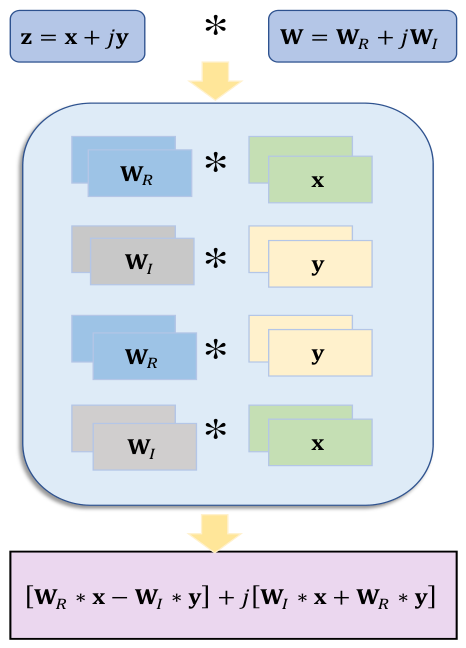
Figure 3.
Details of a CDSC
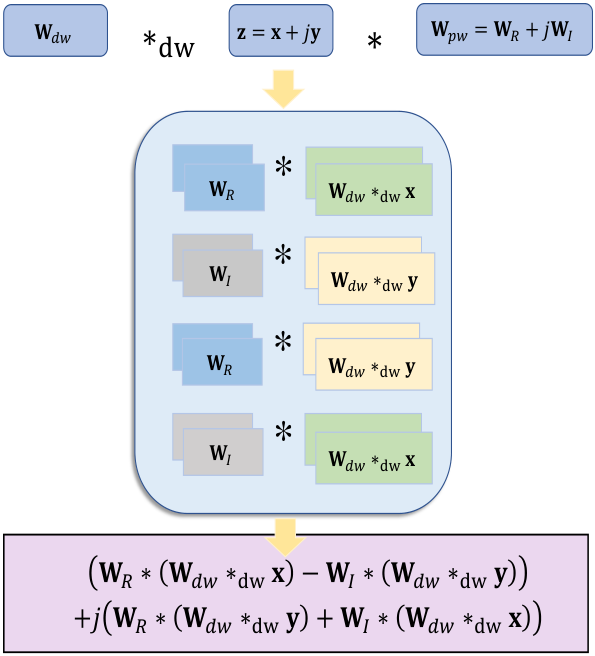
Figure 4.
Structure of MDSCBlock with N parallel complex depthwise branches and optional SE attention.
Figure 4.
Structure of MDSCBlock with N parallel complex depthwise branches and optional SE attention.
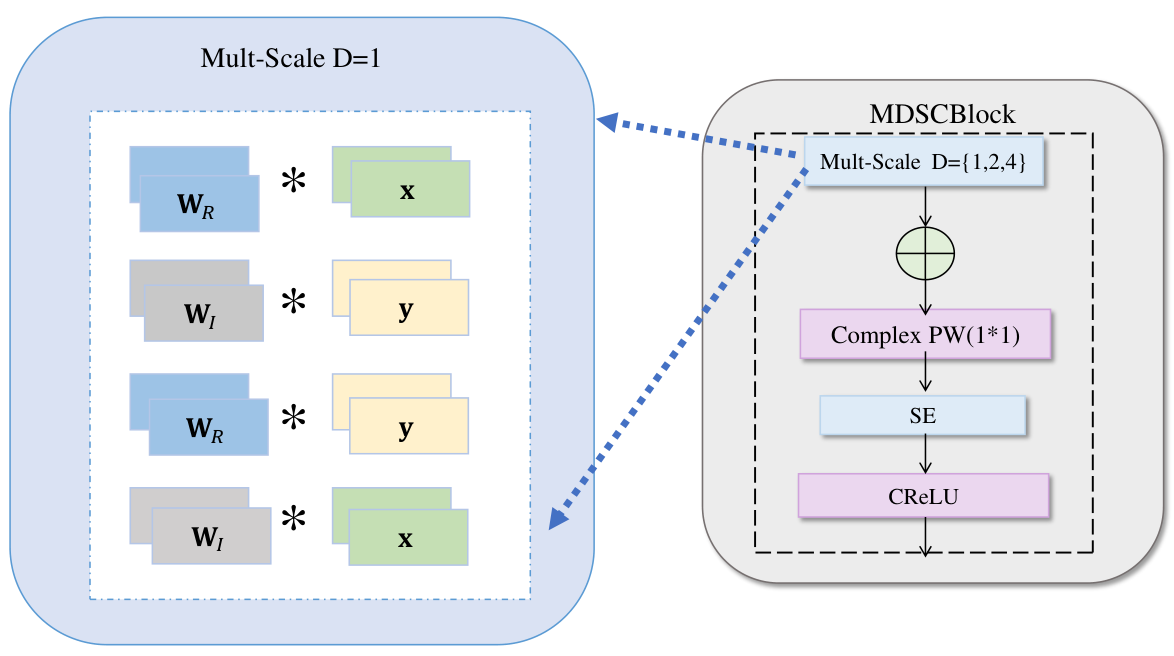
Figure 5.
The overall architecture of MDSCNet.
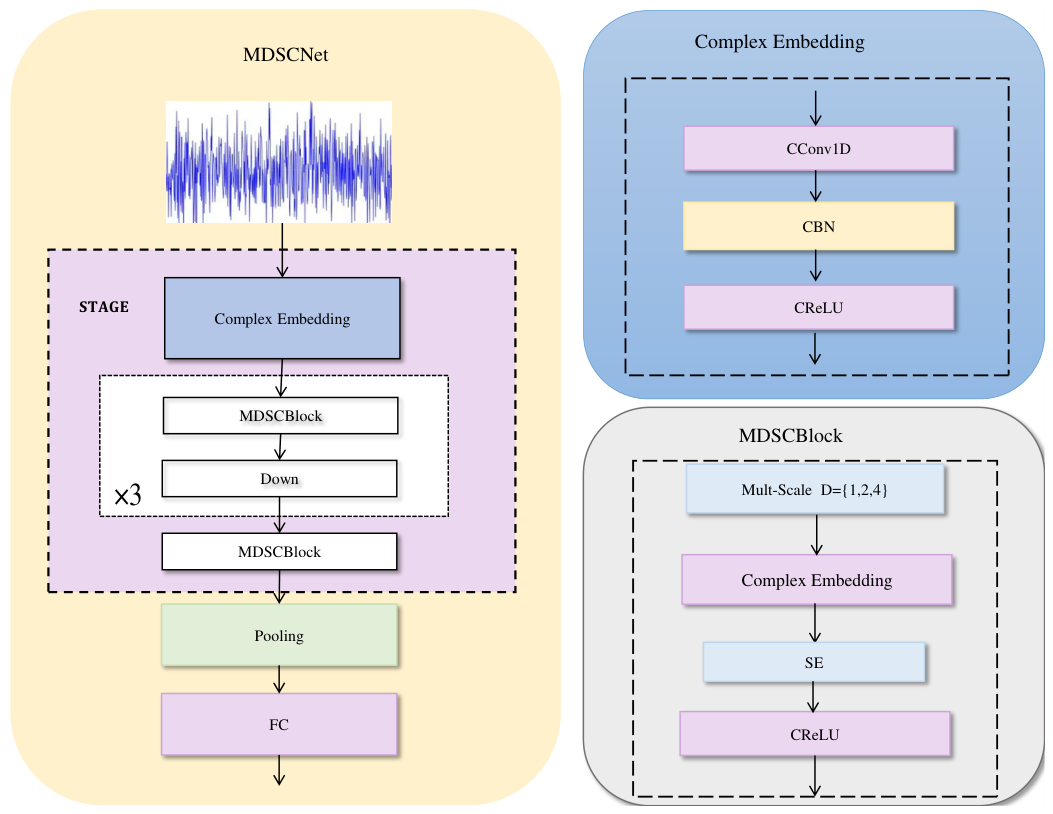
Figure 6.
Comparison of classification performance of different models on (a) RML2016.10a and (b) RML2016.10b.
Figure 6.
Comparison of classification performance of different models on (a) RML2016.10a and (b) RML2016.10b.
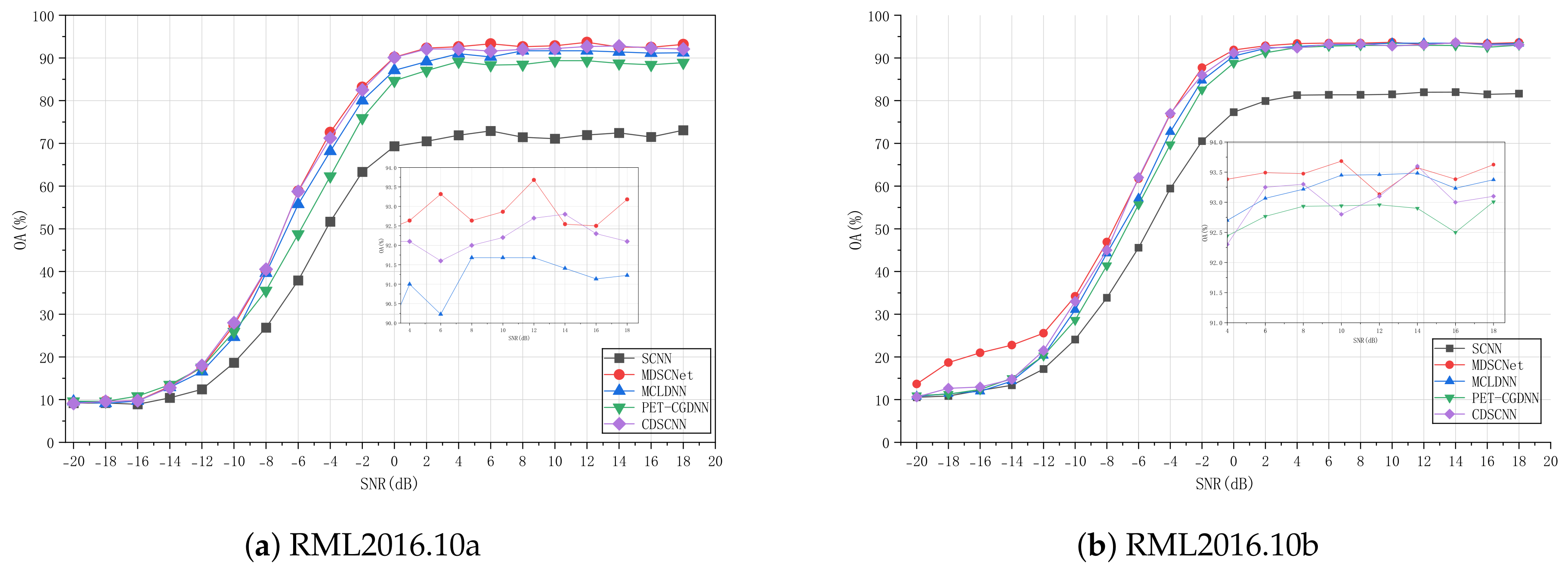
Figure 7.
Confusion matrices (SNR = 8 dB) on RML2016.10b.
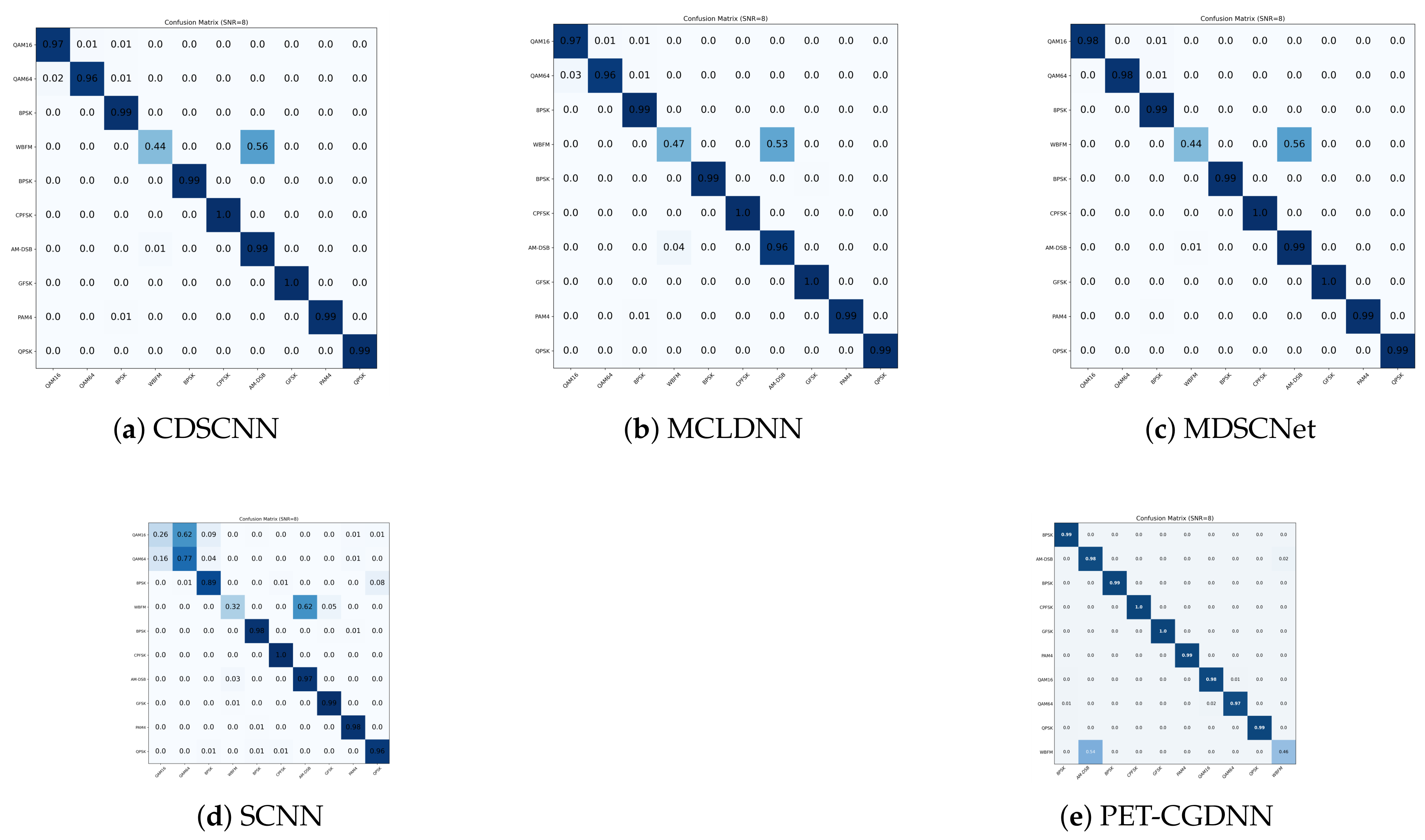

Table 1.
Impact of block operation modifications on overall accuracy and parameter count.
| Models | Ablation Part | RML2016.10a (%) | RML2016.10b (%) | Params |
|---|---|---|---|---|
| MDSCNet | – | 63.37 | 67.07 | 47.739k |
| MDSCNet-A | Real-valued version | 62.21 | 65.16 | 76.987k |
| MDSCNet-B | w/o Multi-Scale | 63.10 | 65.80 | 43.483k |
Table 2.
Performance comparison of different methods.
| Models | RML2016.10a (%) | RML2016.10b (%) |
|---|---|---|
| CDSCNN | 62.23 | 64.32 |
| MCLDNN | 61.27 | 64.26 |
| PET-CGDNN | 61.15 | 62.60 |
| SCNN | 51.10 | 55.36 |
| MDSCNet | 63.37 | 67.07 |
Table 3.
Performance and Efficiency Comparison of Different Methods on GPU (RTX 4080).
| Models | FLOPs | Params | Inference Time (s) |
|---|---|---|---|
| CDSCNN | 9.226M | 315.428k | 2.52E-02 |
| MCLDNN | 49.259M | 406.50k | 1.49E-03 |
| PET-CGDNN | 143.848M | 75.598k | 1.10E-03 |
| SCNN | 1.897M | 104.139k | 3.57E-04 |
| MDSCNet | 3.028M | 47.739k | 7.70E-03 |
| MDSCNet-B | 2.849M | 43.483k | 4.81E-03 |
| MDSCNet-A | 2.832M | 76.987k | 2.37E-03 |
Disclaimer/Publisher’s Note: The statements, opinions and data contained in all publications are solely those of the individual author(s) and contributor(s) and not of MDPI and/or the editor(s). MDPI and/or the editor(s) disclaim responsibility for any injury to people or property resulting from any ideas, methods, instructions or products referred to in the content. |
© 2026 by the authors. Licensee MDPI, Basel, Switzerland. This article is an open access article distributed under the terms and conditions of the Creative Commons Attribution (CC BY) license (http://creativecommons.org/licenses/by/4.0/).
Copyright: This open access article is published under a Creative Commons CC BY 4.0 license, which permit the free download, distribution, and reuse, provided that the author and preprint are cited in any reuse.