

Submitted:
27 July 2026
Posted:
28 July 2026
You are already at the latest version
Abstract
IMGT®, the international information system® (https://www.imgt.org) (IMGT) was created in 1989 by Marie-Paule Lefranc (Université de Montpellier and CNRS) at Montpellier, France, to deal with and to manage the huge diversity of the immuno-globulins (IG) or antibodies and T cell receptors (TR), which are the antigen receptors (AR) of the adaptive immune response (AIR) of the jawed vertebrates. The founding of IMGT® marked the advent of immunoinformatics, a new science which emerged at the interface between immunogenetics and bioinformatics. The biocuration of the IMGT data (IG and TR sequences, genes and structures) and the implementation of the IMGT system (7 databases, 17 tools, 25,000 Web resources pages) are based on the IMGT Sci-entific chart rules (keywords, labels, nomenclature, numbering…) generated from the IMGT-ONTOLOGY axioms and concepts. The IMGT nomenclature (IMGT-NC) and the IMGT unique numbering, the two pillars of immunoinformatics, have been used to de-fine 335 engineered variants for effector properties and formats of therapeutic antibodies (including chimerisotypes) and TR, fusion proteins for immune applications (FPIA) and composite proteins for clinical applications (CPCA). IMGT engineered var-iants names from the World Health Organization (WHO) International Nonproprietary Name (INN) programme descriptions contribute to the common language for immunoinformatics and artificial intelligence (AI).
Keywords:
antibody-dependent cellular cytotoxicity (ADCC)
; antibody-dependent cellular phagocytosis (ADCP)
; complement dependent cytotoxicity (CDC)
; composite proteins for clinicial applications (CPCA)
; engineered variants of therapeutic antibodies
; fusion proteins for immune applications (FPIA)
; half-life
; ImMunoGeneTics (IMGT)
; immunoglobulin (IG) or antibody
; T cell receptor (TR)
1. Introduction
Immunogenetics is the science that studies the genetics of the immune system and immune responses. Among them, the adaptive immune response (AIR), acquired by jawed vertebrates (or gnathostomata) about 450 millions years ago, is characterized by an extreme diversity of the specific antigen receptors (AR) that comprises the immunoglobulins (IG) or antibodies [1] and the T cell receptors (TR) [2]. The IG occur as membrane IG (mIG) monomers (two light chains, kappa (IGK) or lambda (IGL), and two heavy chains (IGH)), anchored by their heavy chains in the surface of the B cells, associated to the signalling CD79A and CD79 B coreceptors which together form the B cell receptor (BcR) [1], or as secreted IG (sIG) by the plasma cells [1]. The TR occur as membrane monomers (two chains, alpha (TRA) and beta (TRB), or gamma (TRG) and delta (TRD)), anchored by their two chains in the surface of the T cells, associated to the signalling dimeric CD3D_CD3E, CD3G_CD3E and CD247_CD247 coreceptors which together form the T cell receptor (TcR) [2]. The potential expressed AR repertoire of each individual is estimated to comprise about 2 x 10¹² different IG and TR, and the limiting factor is only the number of B and T cells that an organism is genetically programmed to produce [3]. This huge diversity results from the complex and unique molecular synthesis and genetics of the IG and TR chains [1,2] that include (i) DNA molecular rearrangements (combinatorial diversity) in multiple loci, three loci for IG (IGH at 14q32.33, IGK at 2p11.2, IGL at 22q11.2 [1,4]) and four loci for TR (TRA and TRD at 14q11.2, TRB at 7q34, TRG at 7p14 [2,5]) in humans, located on different chromosomes (four in humans, chr 2, 7, 14 and 22), (ii) nucleotide deletions and insertions at the rearrangements junctions (junctional diversity, mostly represented by the N-diversity) [1,2], and (iii) for the IG, somatic hypermutations (SHM) and class switch recombinations (CSR) [1,6,7,8].
Owing to the complexity and diversity of the IG and TR immune expressed repertoires and to their implications in fundamental and medical research, immunogenetics represents one of the greatest challenges for data interpretation : a large biological expertise, a considerable effort of standardization and the elaboration of an efficient system for the management of the related knowledge were required. To answer that challenge, IMGT®, the international ImMunoGeneTics information system® (IMGT) [1,2,3,9,10,11,12,13] was created in 1989 by Marie-Paule Lefranc (Laboratoire d’ImmunoGénétique Moléculaire (LIGM) cofounded with Gérard Lefranc, Université de Montpellier (UM) and Centre National de la Recherche Scientifique (CNRS), Montpellier, France).
The founding of IMGT® marked the advent of immunoinformatics [3], a novel science that emerged at the interface between immunogenetics and bioinformatics [9,10,11,12,13]. Immunoinformatics has been built on IMGT-ONTOLOGY [1,2,14,15,16,17,18,19,20,21,22,23] and its seven axioms: IDENTIFICATION [24], DESCRIPTION [25], CLASSIFICATION [26], NUMEROTATION [27,28,29,30,31,32,33,34], ORIENTATION [21], LOCALIZATION [21], OBTENTION [14,21], which postulate that any object and process and any relation has to be identified, described, classified, numbered, localized and orientated, and that the way it is obtained can be characterized.
Each IMGT-ONTOLOGY axiom has generated concepts, which themselves have generated the IMGT Scientific chart rules (examples are shown between parentheses): (i) concepts of identification (IMGT standardized keywords) [24], (ii) concepts of description (IMGT standardized labels in capital letters) [25], (iii) concepts of classification [26] (IMGT nomenclature or IMGT-NC [1,2,4,5,26,35,36,37,38,39], for IG and TR loci [1,2,40], for genes and alleles [1,2,39], for gene copy number variations (CNV) [39,40], for amino acids [41], for allotypes [42,43,44], for IGHG engineered variants involved in antibody effector properties, half-life, physicochemical properties and structure [45,46]), (iv) concepts of numerotation [27,28,29,30,31,32,33,34] (IMGT unique numbering for variable (V) domain of IG, TR and immunoglobulin superfamily (IgSF) members other than IG and TR [29], IMGT unique numbering for constant (C) domain of IG, TR and IgSF members other than IG and TR [30], IMGT unique numbering for groove (G) domain of major histocompatibility (MH) class I (MH1), class II (MH2) and MH superfamily (MhSF) members other than MH1 [31]; IMGT Collier de Perles ‘on one layer’ and ‘on two layers’ [47,48,49,50,51,52]; IMGT complementarity determining region (CDR-IMGT) and IMGT framework region (FR-IMGT) lengths [53,54,55,56,57,58,59]; paratope, pMH contacts sites, contact analysis [54,55,60,61,62]), (v) concepts of orientation (IMGT locus orientation forward ‘FWD’ or reverse ‘REV’ on chromosome [1,2,40], gene in direct or opposite orientation of transcription in locus [1,2,39,40]), (vi) concepts of localization (IMGT gene order from 5’ to 3’ in the locus, haplotypes [39,40]), and (vii) concepts of obtention (source, metadata) [24].
The IMGT nomenclature and the IMGT unique numbering, created for immunogenetics data, are the two pillars of immunoinformatics [3,38], on which the IMGT® databases, tools and Web resources pages have been built for 35 years [63,64,65,66,67,68,69,70,71]. These two breakthroughs are the foundations which have made IMGT®, the global reference in immunogenetics and immunoinformatics [1,2,38,39,40]. IMGT® data focused mainly on the genes, sequences and structures of the IG or antibodies and TR, from any species from fish to humans, and relations based on IMGT-ONTOLOGY, for basic and medical research, useful to scientists for the study of the IG and TR gene and locus evolution of the adaptive immune response, the analysis of the diversity and clonality of the IG and TR repertoires, and the development of antibody engineering for diagnostic and therapeutic applications. IMGT® biocurated data include, as examples (i) IG and TR genes and alleles in databases (nucleotide (nt-) sequences and translation in IMGT/LIGM-DB [72,73,74,75,76], IG and TR gene and allele names in IMGT/GENE-DB [77], amino acid (aa-) sequences in IMGT/2Dstructure-DB and IMGT/3Dstructure-DB [53,56,57]), (ii) sequence reference directories in analysis tools (nt-sequences in IMGT/V-QUEST and IMGT/HighV-QUEST [70], domain aa-sequences in IMGT/DomainGapAlign [56,58,59]), (iii) Chromosomal localisations, Locus representations, Gene tables, Alignments of alleles, Allotypes [43,44], Protein displays, IMGT Colliers de Perles, etc. in the IMGT Repertoire for IG and TR [71], for MH, and for related proteins of the immune system (RPI).
Created in 2010, IMGT/mAb-DB [71,78,79,80] provides an interface for therapeutic antibodies, TR, fusion proteins for immune applications (FPIA) and composite proteins for clinical applications (CPCA), with links to the aa-sequences, from the World Health Organisation (WHO) International Nonproprietary Name (INN) programme lists [81,82,83], biocurated in IMGT/2Dstructure-DB (INN number code) and used as two-dimensional (2D) reference aa- sequences (with a receptor description per chain and domains) for a given INN. If a three-dimensional (3D) structure is available in the Research Collaboratory for Structural Bioinformatics Protein Data Bank (RCSB PDB) [84], a link from IMGT/mAb-DB provides access to the biocurated aa-sequences in IMGT/3Dstructure-DB (PDB code) and to the specific data related to 3D structures (contact analysis, paratope, epitope, hydrogen bonds in IMGT Collier de Perles on two layers). In IMGT/2Dstructure-DB, the aa-sequences are diplayed assigned, per domain, to the closest gene(s) and allele(s), as the result of the biocuration performed by comparison with the IMGT reference directory using the internal IMGT/DomaingapAlign tool [56,58,59]. Experimental analysis of binding sites [85,86,87], effector properties [88,89,90,91,92,93,94] and half-life [95] have led to advances in the engineering of the antibody Fc with an increasing number of variants. Systematic analysis of the varied designs of therapeutic antibodies and FPIA assigned INN and systematic analysis of the Fc aa changes of therapeutic antibodies and FPIA designed to reduce or to enhance binding to Fc-gamma receptors have been performed [96,97,98,99]. In order to bridge the gap at the amino acid level, between aa-sequences and properties and functions types, the IMGT® nomenclature of IGHG engineered variants using the IMGT numbering has been implemented [45,46], with the Eu-IMGT positions aligned to the IMGT numbering (rather than the Eu aa sequence itself [100] for a more general use, creating additional positions not present in the Eu protein, if required, while avoiding the original sequence errors).
Here, we review firstly, in three sections, the IMGT nomenclature (IMGT-NC) and IMGT unique numbering breakthroughs, the two pillars of immunoinformatics; the IMGT IGHG and IGHA reference aa-sequences, IMGT/DomainGapAlign tool and IMGT/2Dstructure-DB, for variants aa data and sequence analysis; the IMGT-NC engineered IGHG variant classification in four categories and in 18 types, each defined by a ‘Property and Function Type’ [45,46]. In the core fourth section, we report, in IMGT formatted tables, the IMGT® nomenclature and description of 335 IMGT engineered variants, and among them, the 228 IMGT engineered variants names identified in the WHO INN sequences [81,82,83], up to recommended list R95 and proposed list L134, included. The twelve chimerisotypes variants (of which six are found in INN) are detailed in the fifth and last section. By bridging IMGT nomenclature, IMGT unique numbering, amino acids in topological motifs, Eu-IMGT positions, variants categories, properties and functions types, with humanly retrieved bibliographical references [45,46], the IMGT engineered variants names, and more particularly those assigned to the INN therapeutic antibodies descriptions [81,82,83], contribute to the common language of immunogenetics and immunoinformatics in antibody engineering for artificial intelligence (AI).
2. IMGT Nomenclature (IMGT-NC) and IMGT Unique Numbering Breakthroughs
2.1. IMGT Nomenclature (IMGT-NC) Breakthrough
The first breakthrough, in June 1989 at the Human Gene Mapping (HGM)10 Workshop at New Haven, was to make the variable (V), diversity (D), and joining (J) DNA , which participate in the synthesis of the IG or TR chain, officially recognized as ‘genes’, as well as were the conventional genes, allowing them to be entered for the first time in the HGM gene database [3]. This led to the standardized IMGT nomenclature (IMGT-NC) for IG and TR, based on locus, group, subgroup, gene and allele [1,2,35,36,37,38,39,40].
The nucleotide sequences of the IG and TR genes, identified in the publications and in the generalist sequence databases (European Molecular Biology Laboratory (EMBL) (now European Nucleotide Archive (ENA))/GenBank/DNA database of Japan (DDBJ)) biocurated by the IMGT team at LIGM [39] were entered in IMGT/LIGM-DB [72,73,74,75,76], the IMGT nucleotide sequence database created in 1994, using the same accession numbers ‘GEDI’ (for GenBank_EMBL_DDBJ_IMGT/LIGM-DB) for data interoperability, and LinkOut at NCBI. Following assignment of an IMGT reference sequence to each IG or TR gene or allele, the IMGT gene names were entered in HGNC in 1999 [1,2,4,5,39] and in IMGT/GENE-DB [77], the IMGT gene database created in 2003, which proposes an interface to query the IMGT/LIGM-DB sequences of the genes, per label (nucleotides and translation), bridging genes and sequences.
2.2. IMGT Numbering Breakthrough
The second breakthrough in 1997 was to consider the variable (V) and constant (C) domains of the IG and TR as evolutionary related structural units [27,28,29,30] (despite their fundamental differences in sequence (V-(D)-J region versus C-region exon, CDR-IMGT versus loops) and in number and type of strands (‘9 antiparallel strands’ for the V domain versus ‘7 antiparallel strands and a transverse CD strand’ for the C domain) [3]. This led to the standardized IMGT unique numbering for V domain [29] and for C domain [30] (with four common amino acids, cysteines C23 and C104 of the disulfide bridge, tryptophane W41, hydrophobic 89) and their IMGT Collier de Perles graphical representation (47,48,49,50,51,52). The IMGT unique numbering for V and C domains of IG and TR [29,30] has been extended to the V-like and C-like domains of the immunoglobulin superfamily (IgSF) other than IG and TR [32,33,34]. The IMGT unique numbering defined for the groove (G) domains of major histocompatibility MH1 and MH2 proteins [31] has been extended to the G-like domain of the MH superfamily (MhSF) other than MH1 (there is no known MH2-like) [32,33,34].
3. IMGT IGHG and IGHA Reference aa-Sequences, IMGT/DomainGapAlign Tool, IMGT/3Dstructure-DB and IMGT/2Dstructure-DB
3.1. IMGT IGHG and IGHA Reference aa-Sequences
The constant region of the IG and TR defines the isotype of the expressed IG and TR chains. In humans, there are nine classical isotypes for the IGH locus, H-mu, H-delta, H-gamma3, H-gamma1, H-alpha1, H-gamma2, H-gamma4, H-epsilon, and H-alpha2 chains, the constant region of the IGH chains being encoded by the IGHM, IGHD, IGHG3, IGHG1, IGHA1, IGHG2, IGHG4, IGHE and IGHA2 genes, respectively, whereas the variable domain VH is encoded by the rearranged V-D-J-region [1,8]. For the light chains, there are one isotype (L-kappa chain) for the IGK locus, the constant region being encoded by one IGKC gene, and several isotypes (L-lambda chains) for the IGL locus depending on the number of functional IGLC genes (e.g., C-lambda2 encoded by IGLC2), respectively, while the variable VL domain (either V-kappa or V-lambda) is encoded by the rearranged V-J-region [1,8].
The basic IMGT molecular immmunogenetics information necessary for the variants characterization [45,46] comprises (i) the IMGT classes of the 20 common amino acids for the ‘hydropathy’, ‘volume’, ‘chemical characteristics’ properties [41],
(ii) the IMGT Colliers de Perles (‘On one layer’ and ‘On two layers’) of the CH1, CH2 and CH3 domains encoded by the four Homo sapiens IGHG genes (IGHG1 [45,46], IGHG2, IGHG3 and IGHG4) [46],
(iii) the structural features of the C domain template and those of the CH1, CH2 and CH3 of the four Homo sapiens IGHG genes [46], based on the IMGT unique numbering for C domain [30],
(iv) the correspondence between the IMGT unique numbering of the CH1, CH2 and CH3 of Homo sapiens IGHG1*01 (J00228) [1,30] and the Eu-IMGT positions, shown in table [46] or in Protein display (Figure 1).
(v) the IMGT Protein display of the CH1, CH2 and CH3 domains of the IMGT reference aa-sequences which includes the translation of:
- Homo sapiens (Homsap) IGHG1*01 (J00228), IGHG2*01 (J00230), IGHG3*01 (X03604), IGHG4*01 (K01316) (G1, G2, G3 and G4) [1,45,46], IGHA1*01 (J00220), IGHA2*01 (J00221) [1],
- Mus musculus (Musmus) IGHG2A*01 (V00825) and IGHG2B*01 (V00763),
- Canis lupus familiaris (Canlupfam) IGHG2*01 (IMGT000001),
(vi) the hinge regions of the Homo sapiens IGHG1 (15 aa), IGHG2 (12 aa); IGHG3 (H1 17 aa, H2, H3 and H4 (15 aa), IGHG4 (12 aa) encoded by the hinge exons, and those of the Homo sapiens IGHA1 (19 aa) and IGHA2 (6 aa) fused in 5’ of the respective CH2. (Figure 1B),
(vii) the display of the Homsap IGKC, and IGLC2 with Eu-IMGT positions (IGKC 1.4 - 126, 108 - 214; IGLC2 1.5 - 128, 107 - 215) [45].
3.2. IMGT/DomainGapAlign Tool
IMGT/DomainGapAlign [56,58,59] is the tool for the analysis of amino acid sequences per domain, widely used for the analysis of the V domain and C domain aa-sequences of therapeutic antibodies. In the V domain analysis, IMGT/DomainGapAlign is used for the identification of the closest V and J gene(s) and allele(s), the N-and-D-region delimitation, CDR-IMGT and FR-IMGT delimitations and lengths (shown with the number of aa, separated by dots, between brackets, [e.g., [8.8.13]), the identification of aa-changes due to SHM or to engineered variants, and the evaluation of the V domain humanization. In the C domain analysis, IMGT/DomainGapAlign is used for the identification of the closest C domain(s) of C gene(s) and allele(s), the description of polymorphisms with aa-changes, allotypes and engineered variants (IMGT/DomainGapAlign Interface ‘Analyse your sequence using IMGT domains’ https://www.imgt.org/3Dstructure-DB/cgi/DomainGapAlign.cgi (accessed on 12 July 2026); IMGT/DomainGapAlign Documentation, https://www.imgt.org/3Dstructure-DB/doc/IMGTDomainGapAlign.shtml) (accessed on 12 July 2026)). IMGT/DomainGapAlign is the tool used in the assignment of the IMGT names to IGHG engineered variants [45,46], done by comparision to the allele *01 of the closest gene. For a given receptor, the assignment is done to each chain, individually (e.g., H, L, H”, L’” chains in INN descriptions or H, L, M, N chains in IMGT/2Dstructure-DB).
3.3. IMGT/3Dstructure-DB and IMGT/2Dstructure-DB
IMGT/3Dstructure-DB [53,56,57] has been implemented for the management of aa-sequences from the 3D structures from RCSB PDB (using the PDB code as ID). The aa-sequences of 3D structures (PDB code) are frequently used for the molecular identification of an antigen receptor, however these sequences may be partial and/or modified for the experimental structural analysis. For that reason, only the WHO INN aa-sequences, entered in IMGT/2Dstructure-DB with an INN code, are the references aa-sequences of therapeutic proteins. IMGT/2Dstructure-DB [53,56,57] was created as an archive for the Kabat amino acid sequences (336 ‘KAB’ entries) which do not have nucleotide sequences in IMGT/LIGM-DB and in the generalist nucleotide databases (GEDI) and uses the same computational framework and interface as IMGT/3Dstructure-DB. Since 2006, the aa-sequences published biannually in the proposed (P) and recommended (R) lists of the WHO INN programme have been entered in IMGT/2Dstructure-DB (using the INN number as ID, with WHO INN permission). IMGT/2Dstructure-DB has beccome the IMGT reference database for proteins without nucleotide sequences which include antigen receptors (IG or antibodies, TR), fusions proteins for immune applications (FPIA) and composite proteins for clinical applications (CPCA). For each receptor entry, IMGT/2Dstructure-DB displays, per chain and per domain, the aa-sequence analysed by the internal IMGT/DomainGapAlign tool. Amino acids differences, compared to the aa-sequence of the domain of the IMGT closest reference sequence, are highlighted in the IMGT/2Dstructure-DB sequences (in orange), in the IMGT Collier de Perles [48,49,50,51,52] and in the displayed results of IMGT/DomainGapAlign [56,58,59].
4. IMGT-NC Engineered IGHG Variant Classification in Four Categories and in 18 Types
The constant region of the IG or antibody heavy gamma (IGHG) chain is frequently engineered to modify the effector properties, the half-life, the physicochemical properties and/or the structure of the therapeutic monoclonal antibodies [45]. The standardized IMGT® nomenclature (IMGT-NC) of engineered IGHG variants [45] has been set up for an easier comparison between engineered antibody variants belonging to four categories involved in effector properties (antibody-dependent cellular cytotoxicity (ADCC), anti-dependent cellular cytotoxicity phagocytosis (ADCP) and complement-dependent cytotoxicity (CDC)), half-life, physicochemical properties and structure of therapeutical monoclonal antibodies [45,46]. The IMGT-NC of the IGHG variants is based on the classification in four categories of ‘effector’, ‘half-life’, ‘physicochemical’ and ‘structure’, and in 18 types (from 1 to 18) each type being defined by a ‘Property and Function Type‘ [45,46] (Table 1).
The ‘effector’ category comprises eight types (1 to 8): 1. ADCC reduction, 2. ADCC enhancement, 3. ADCC and ADCP enhancement, 4. CDC enhancement, 5. CDC reduction, 6. ADCC and CDC reduction, 7. FcγRIIB binding increase and B cell inhibition (coengagement of antigen and FcγR on the same cell), 8. knock out CH2 84.4 glycosylation (ADCC reduction).
Two categories comprises a single type: the ‘half-life’ category includes the type 9 (half-life increase or decrease), whereas the ‘physicochemical’ category’ includes the type 10 (abrogation of binding to Protein A, thermal stability, pI, reduced acid-induced aggregation).
The ‘structure’ category comprises eight types (11 to 18): 11. formation of additional bridge for domain stabilization, including scFv, 12. prevention of IgG4 half-IG exchange, amino acid changes or insertion at the elbow of crossovers (e.g., aa change at the elbow of VH-C-kappa, insertion upstream of G4 in VK-G4 CH1), 13. hexamerization, 14. enhancement of heteropairing H-H of bispecific antibodies (knobs-into-holes, charge steering, additional disulfide bridge), 15. suppression of inter H-L and/or inter H-H disulfide bridges, 16. site-specific drug attachment, e.g., additional cysteine, 17. enhancement of heteropairing H-L of bispecific antibodies, 18. control of H chain expression or of half-IG exchange of bispecific IgG by amino acid changes [45,46].
5. IMGT® Nomenclature (IMGT-NC) and Description of 335 Engineered Variants, with 228 of Them Identified in INN
The IMGT-NC of IGHG engineered variants involved in effector properties (ADCC, ADCP, CDC), half-life, physicochemical properties and structure of therapeutic monoclonal antibodies, FPIA and CPCA [45,46] and its standardized IMGT Scientific chart rules have previously been published [45,46]. Here we report the IMGT® nomenclature (IMGT-NC) and description of 335 engineered variants in Table 2, with 228 ot them identified in INN (Table 3).
The IMGT engineered variant characterization displayed in the ten columns of Table 2 comprises:
(1) the IMGT variant identifier (ID) (column 1),
(2) the IMGT engineered variant name : it includes the ‘Species’ (column 2) (genus and species in the 6- letter (Homsap for Homo sapiens, Musmus for Mus muscuslus) or 9-letter (Canlupfam for Canis lupus familiaris) abbreviation, and the ‘Variant name’ (column 3) made of the variant type(s) (number(s) from 1 to 18), the gene name abbreviation (e.g., G1 for IGHG1), the letter ‘v’ (for variant) with a number (e.g., Homsap 1-G1v1, Homsap 6-G1v14), followed if needed with a hyphen and a number (e.g., 6-G1v14-48) [45,46],
(3) the IMGT engineered variant definition (column 4) : it includes, for each engineered amino acid (aa) change, the domain (e.g., CH1, CH2 or CH3) or the region (hinge, CHS), the amino acid is in the one-letter abbreviation [41] with its position according to the IMGT unique numbering for C domain [30], e.g., Homsap 1-G1v1, CH2 P1.4, Homsap 6-G1v14, CH2 A1.3, A1.2, A114. In addition to the very common domains and regions mentioned above, the VH, CH1, V-KAPPA, C-KAPPA, C-LAMBDA2 domains are found in type 17 variants, the IMGT unique numbering for V domains [29] being used for VH and V-KAPPA. Type 10 variants have been described for C-KAPPA, C-LAMBDA2 and C-LAMBDA3, the variant (ID690) 9-chain-v1 has been described for JCHAIN and the variant (ID139) 10-G1v73-3 for a region ‘linker’.
(4) the list of the IMGT aa change(s) per domain (column 5) : it includes for each aa change, the aa before the change (in bold, red), the symbol ‘>’ and the aa after the change (in bold, green) followed by the Eu-IMGT position between parentheses (e.g., CH2 P114 >A (329)). Alias variant names found in the literature (e.g., LALA, YTE, etc) are written in blue.
(4) the Eu-IMGT positions of the aa changes (column 6) (e.g., P329A),
(5) the IMGT topological motifs [45,46] (column 7) identifiable in gene and domain with positions according to the IMGT unique numbering for C-domain [30], followed between parentheses, by the Eu-IMGT positions (the display of the motif shows the aa involved in the change highlighted in bold, red before the change and green after the change, respectively (e.g., IGHG1 CH2 1.6–3 APELLGGPS > APPLLGGPS; underlined amino acids in the motif correspond to additional positions in the IMGT unique numbering for the C-domain [30], e.g., APELLG and APPLLG correspond to 1.6, 1.5, 1.4, 1.3, 1.2 and 1.1 positions, respectively. The hinge numbering [45,46] or the IMGT unique numbering for V domain [29] is used whenever it is relevant. The JCHAIN coding aa translation (NCBI, CCDS 3545.1) is used for the 9-Jchain-v1.

Table 2.
IMGT® nomenclature of engineered variants involved in effector properties (ADCC, ADCP, CDC), half-life physicochemical properties and structure of therapeutic monoclonal antibodies, fusion proteins for immune applications (FPIA) and composite proteins for clinical applications (CPCA). In column 10 (the most right column), the bold number in red indicates the number of WHO INN entries, up to lists R95 and PL134, included. The first (one or two) INN name(s), INN number(s) and, between parentheses, proposed (PL) and recommended (RL) list numbers, are displayed in green italics. ‘0’ in black in the column means no INN. (Author and Editor Marie-Paule Lefranc 14/07/2026). (With permission from M-P. Lefranc and G. Lefranc, LIGM, Founders and Authors of IMGT®, the international ImMunoGeneTics information system®, https://www.imgt.org).
Table 2.
IMGT® nomenclature of engineered variants involved in effector properties (ADCC, ADCP, CDC), half-life physicochemical properties and structure of therapeutic monoclonal antibodies, fusion proteins for immune applications (FPIA) and composite proteins for clinical applications (CPCA). In column 10 (the most right column), the bold number in red indicates the number of WHO INN entries, up to lists R95 and PL134, included. The first (one or two) INN name(s), INN number(s) and, between parentheses, proposed (PL) and recommended (RL) list numbers, are displayed in green italics. ‘0’ in black in the column means no INN. (Author and Editor Marie-Paule Lefranc 14/07/2026). (With permission from M-P. Lefranc and G. Lefranc, LIGM, Founders and Authors of IMGT®, the international ImMunoGeneTics information system®, https://www.imgt.org).
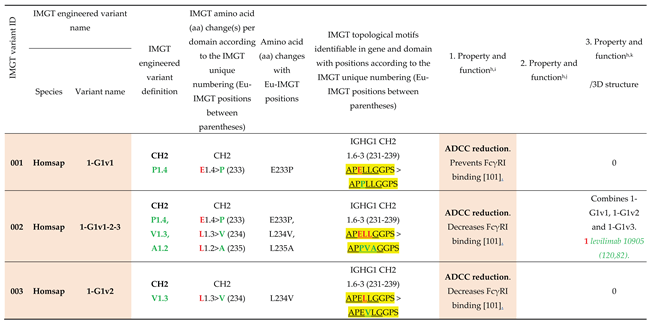
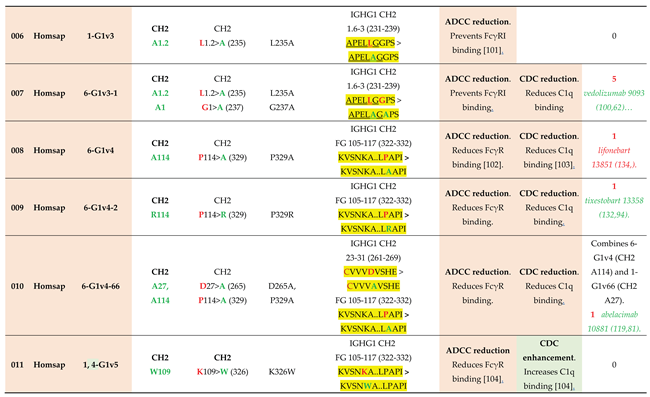
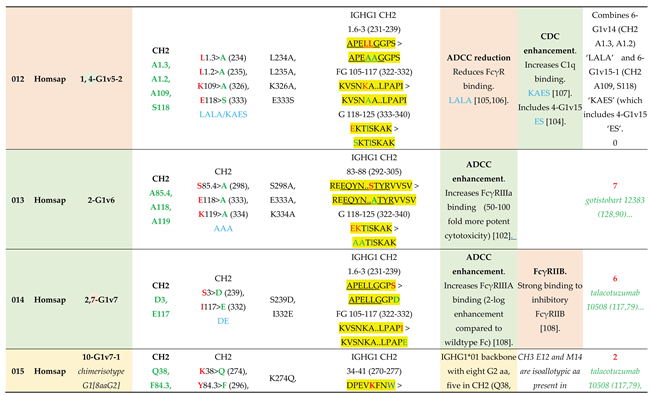
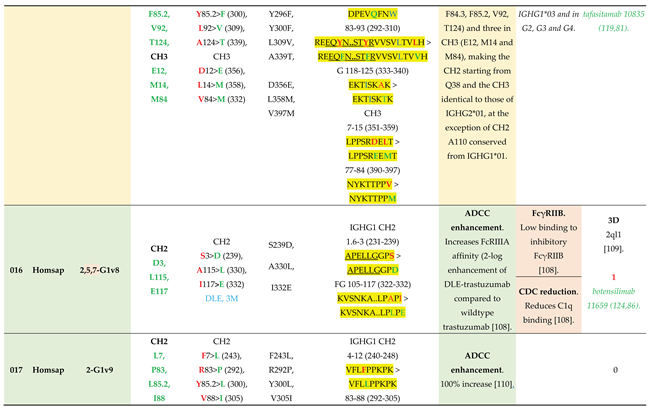
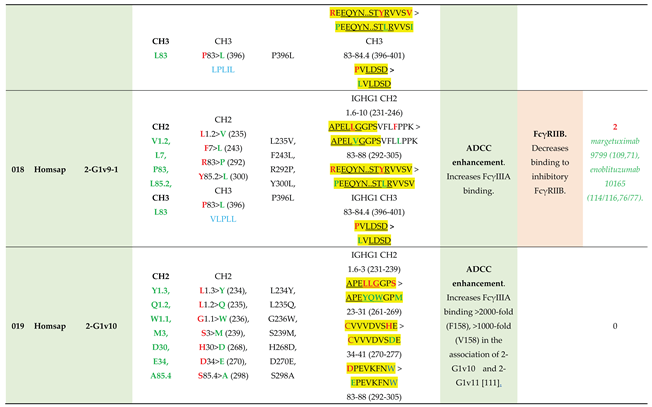
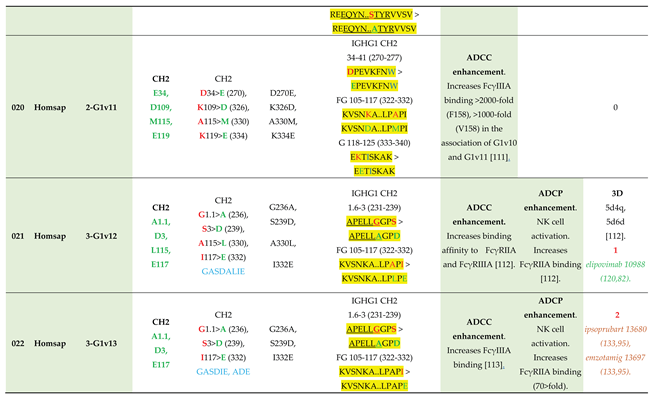
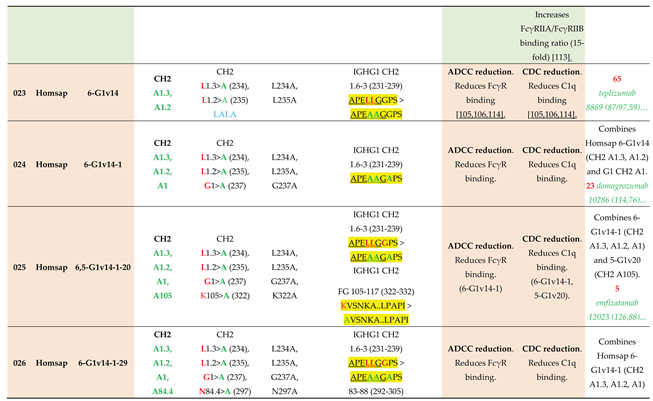
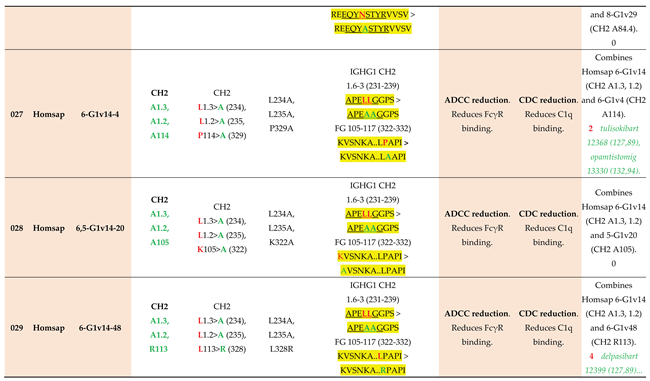
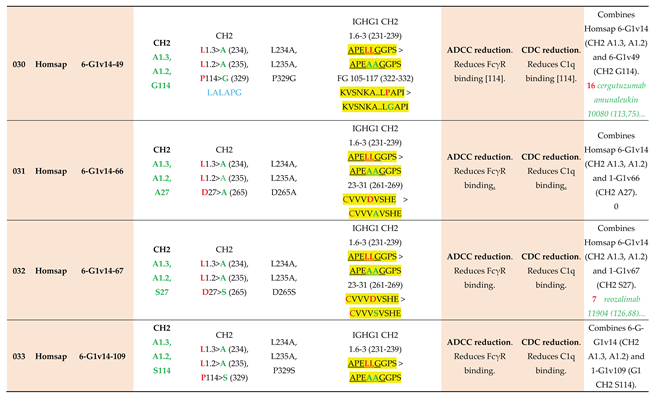
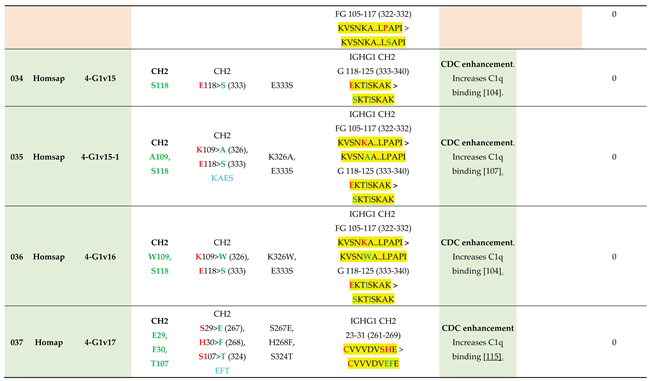
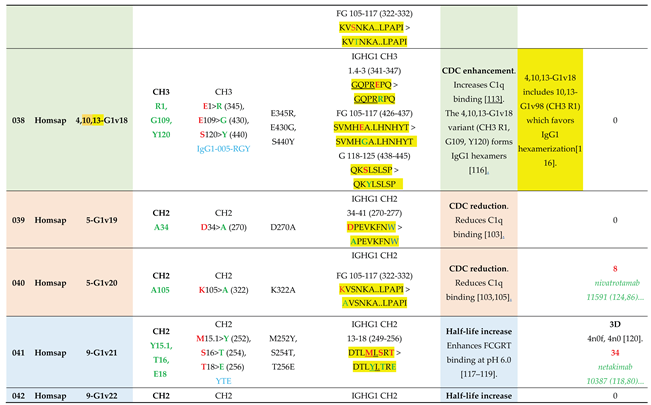
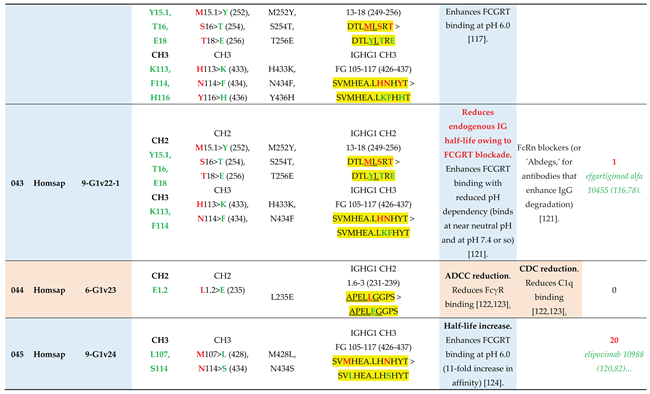
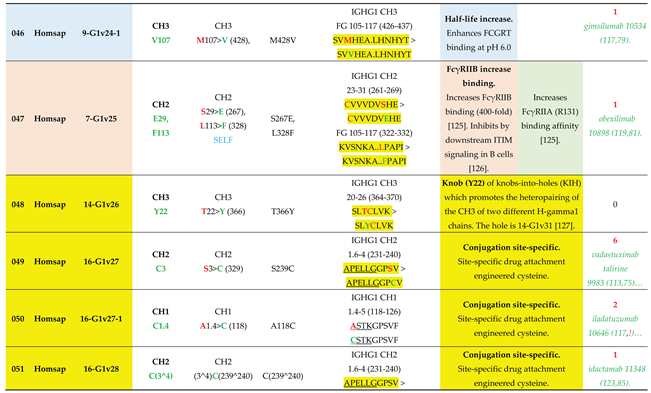
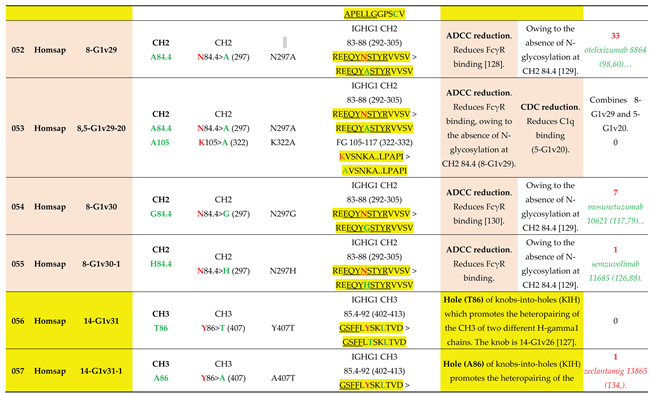
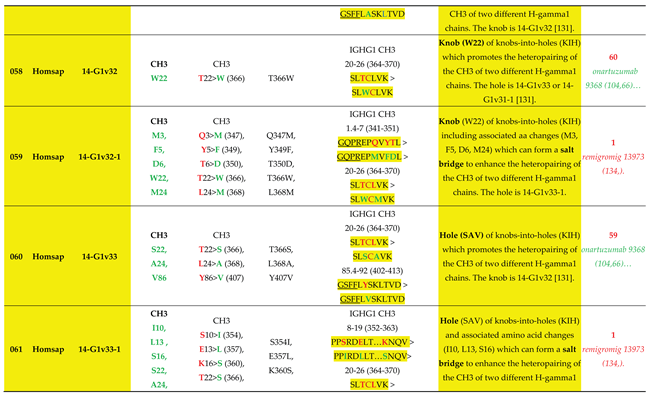
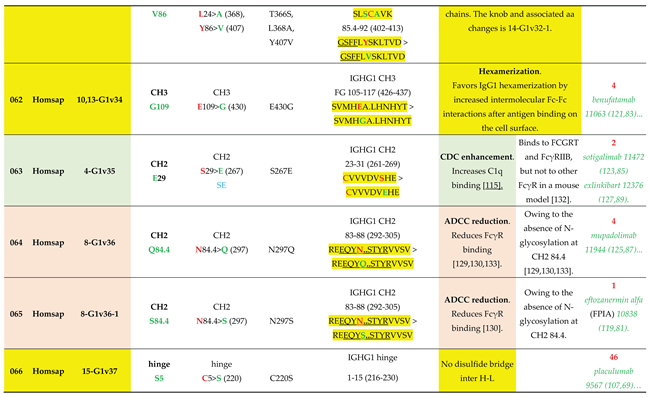
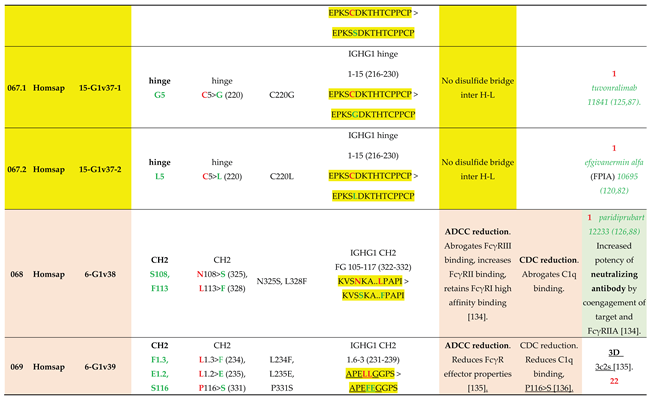
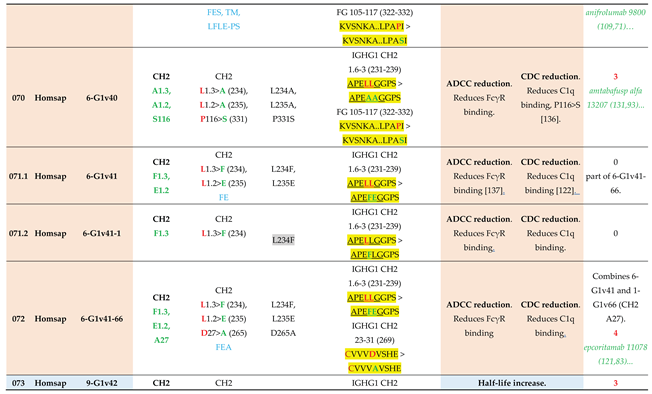
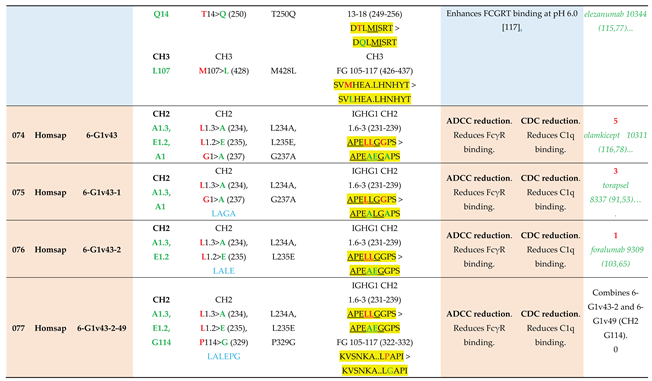
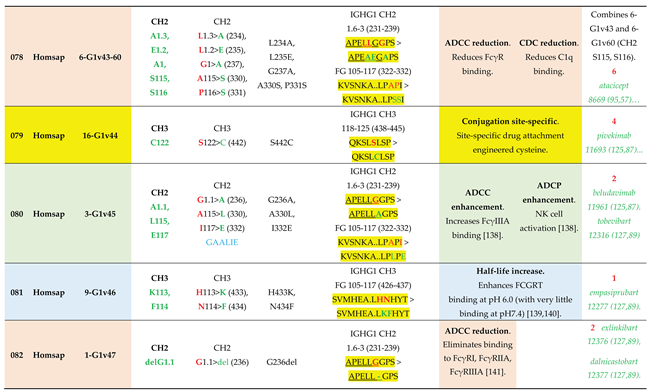
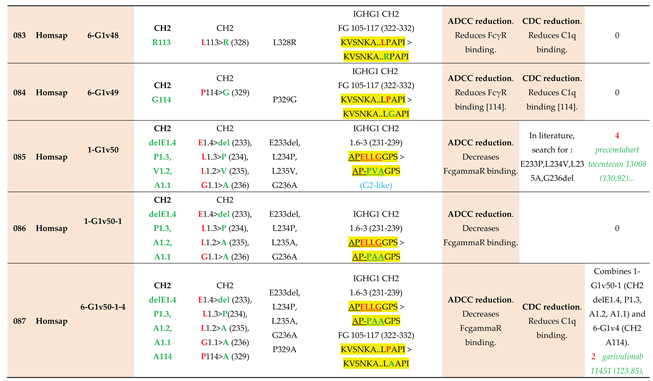
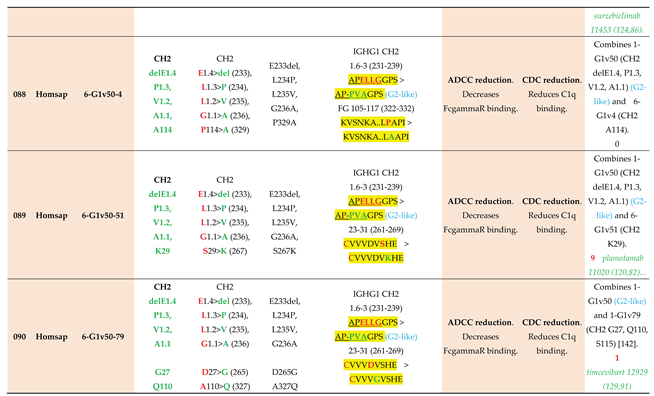
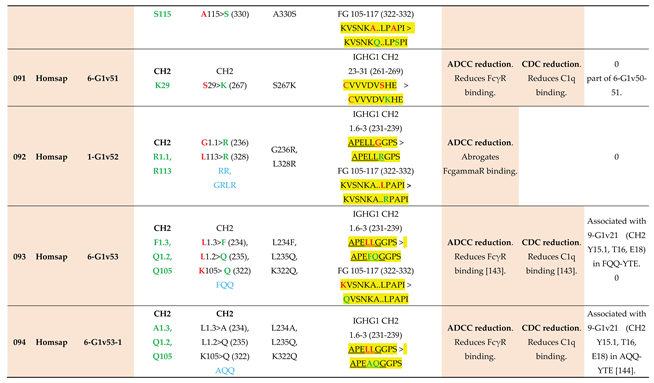
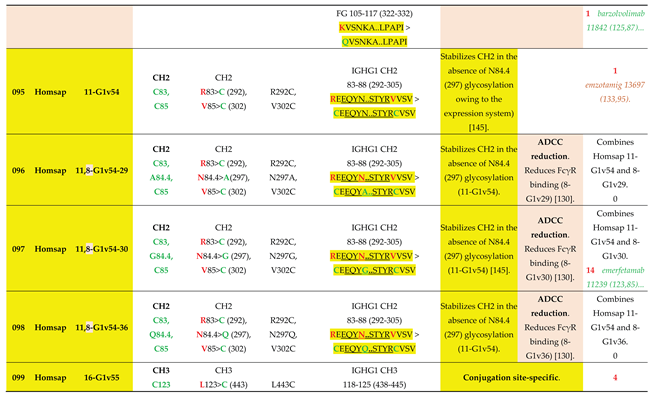
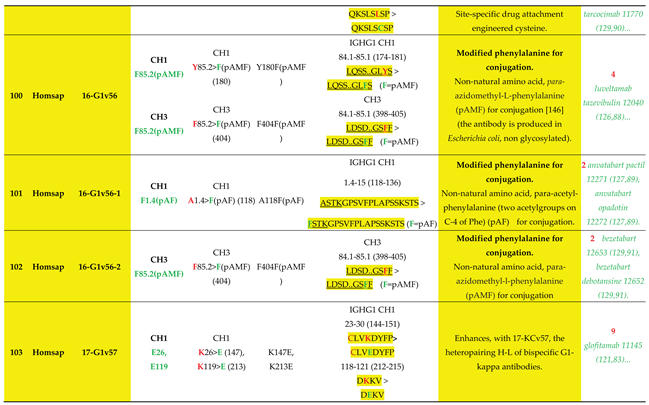
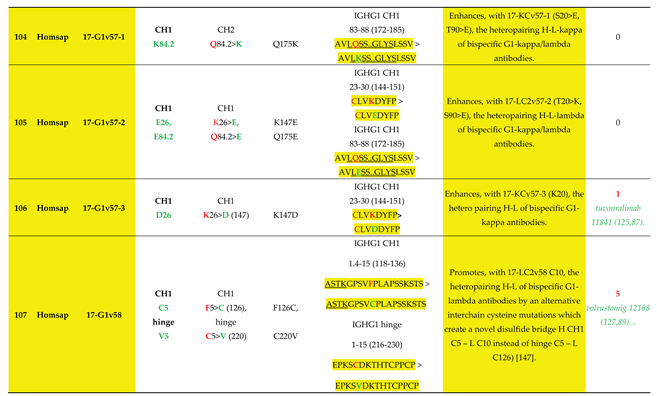
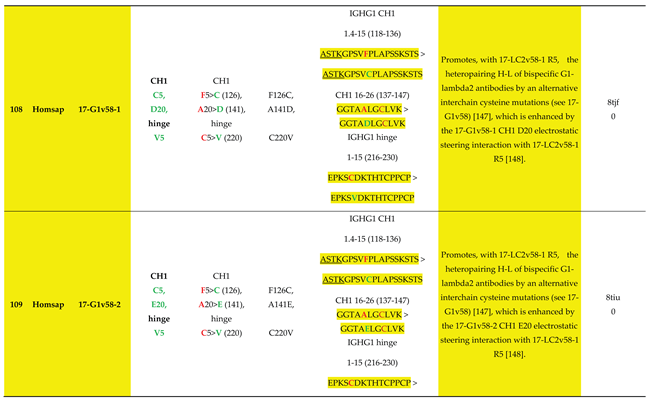
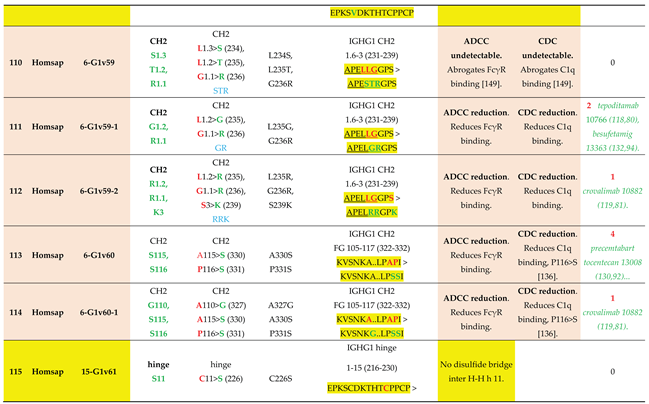
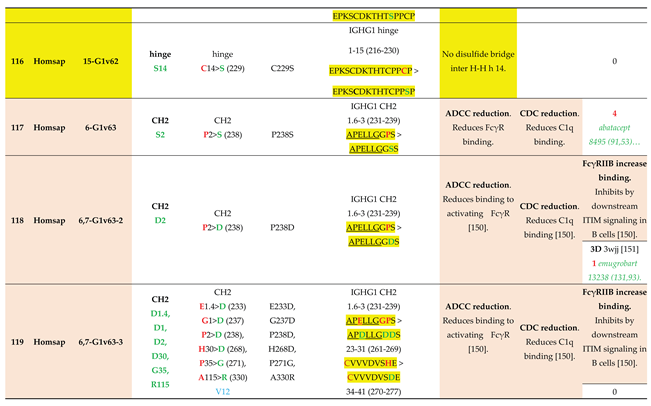
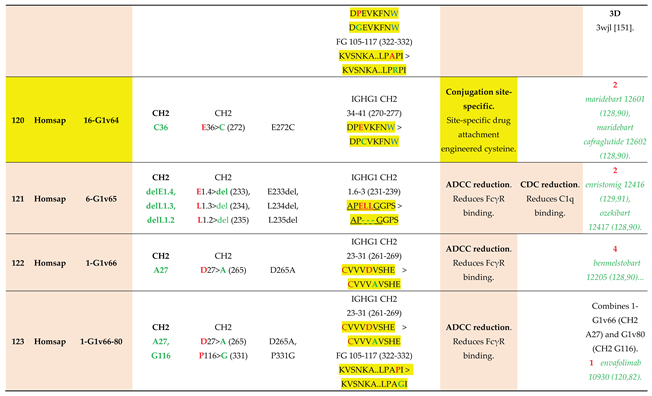
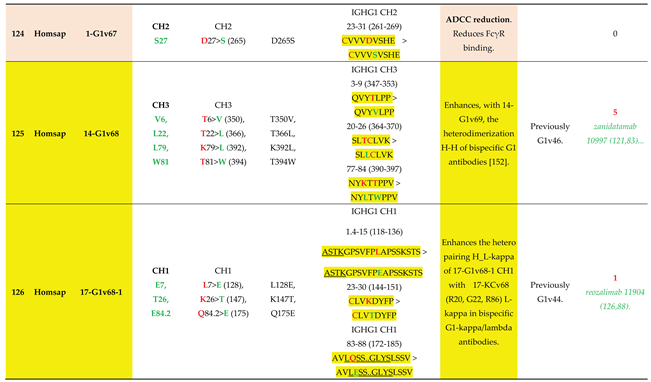
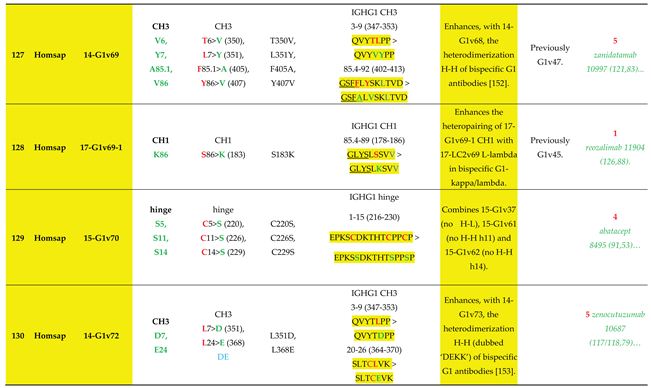
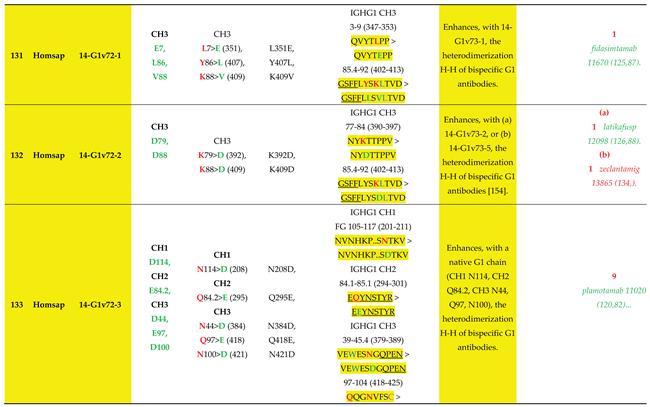
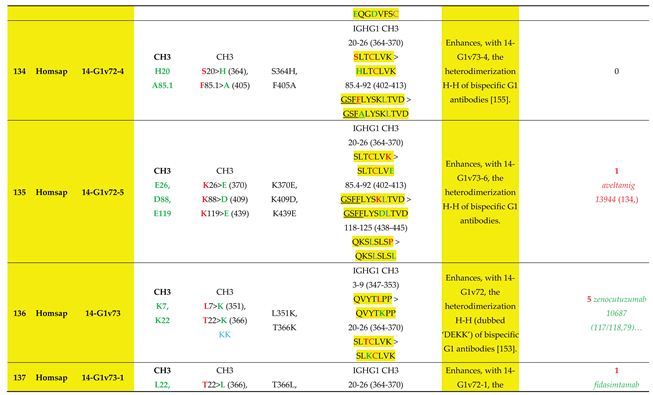
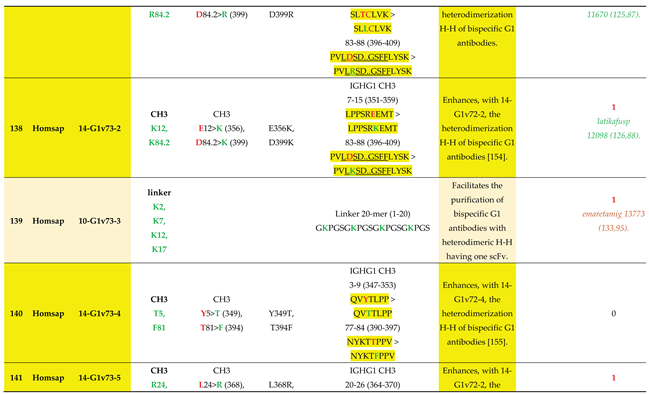
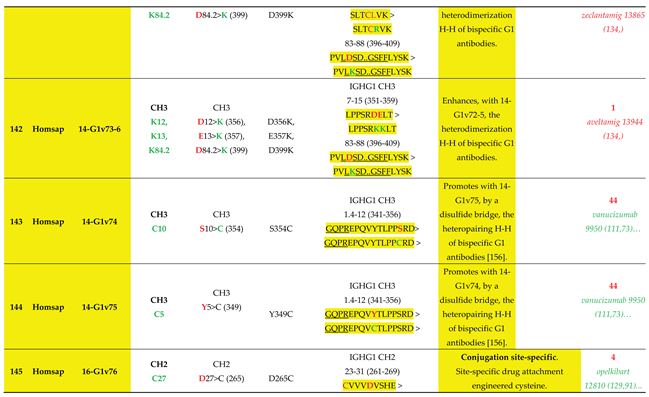
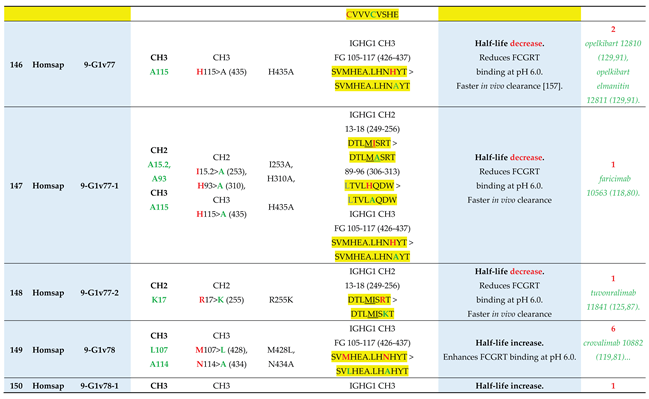
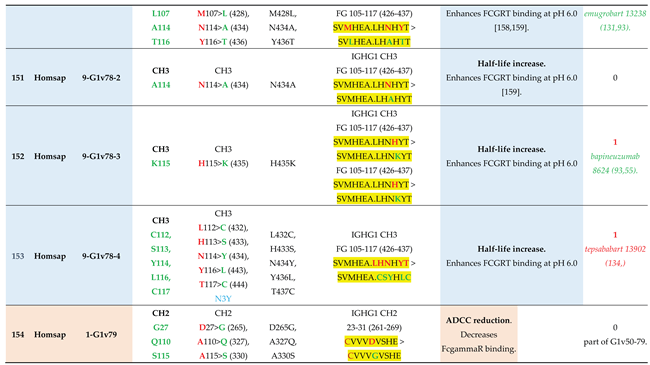
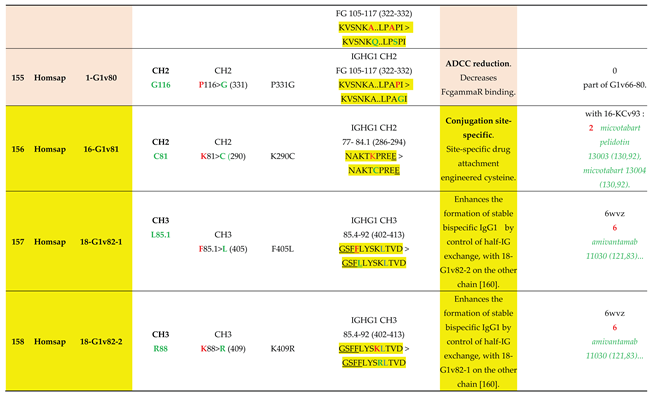
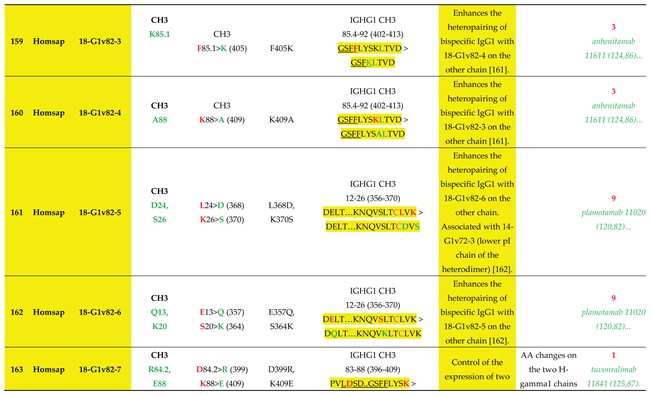
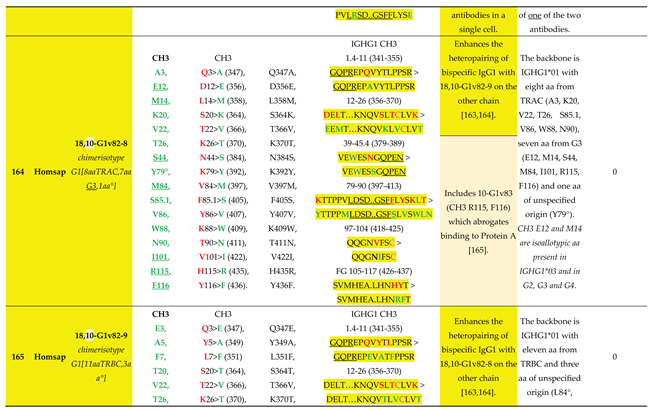
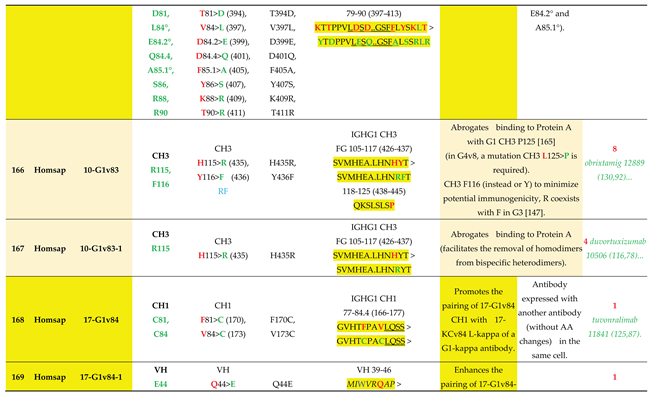
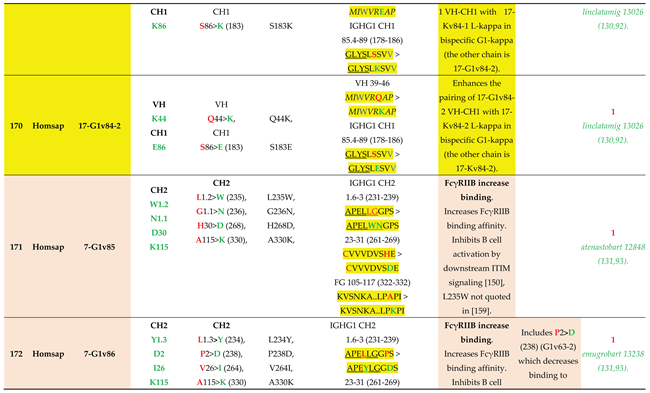
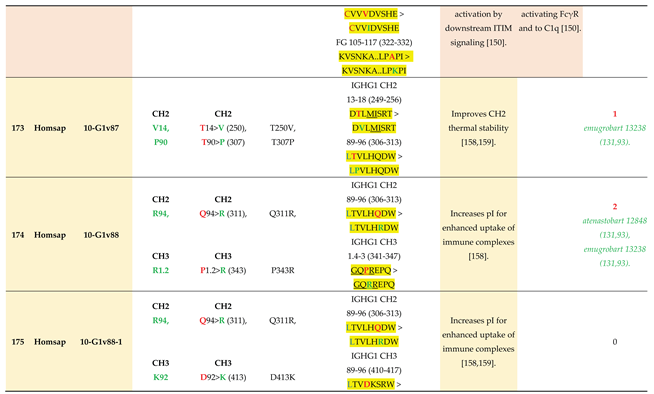
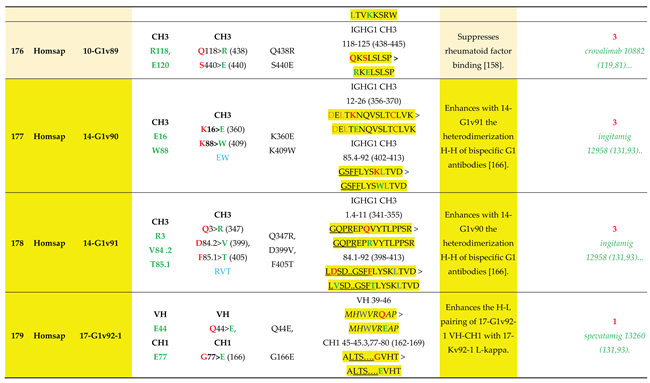
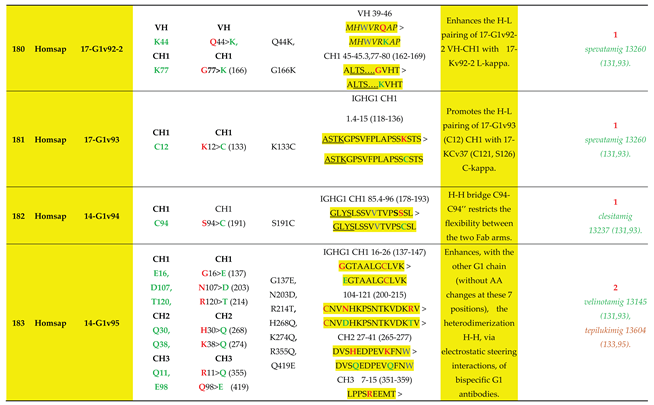
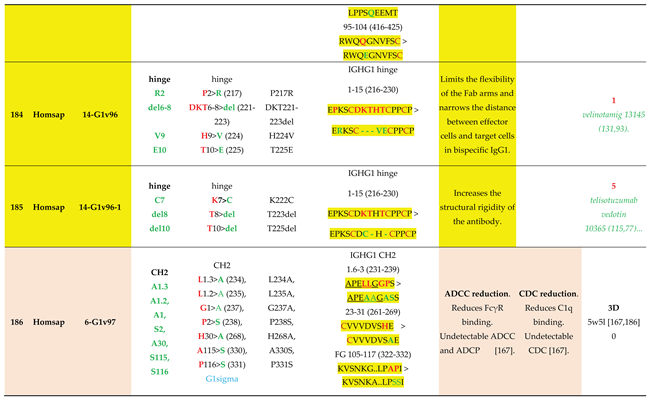
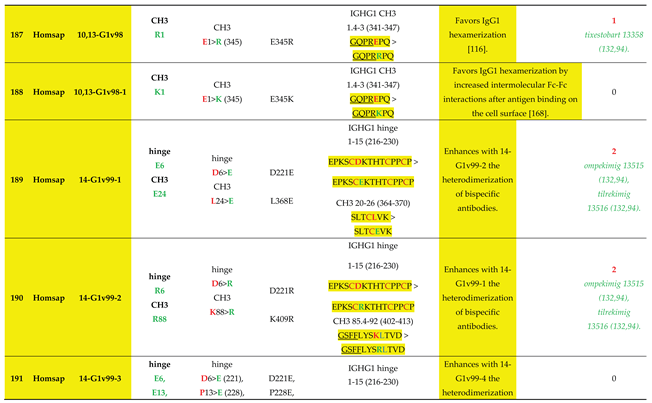
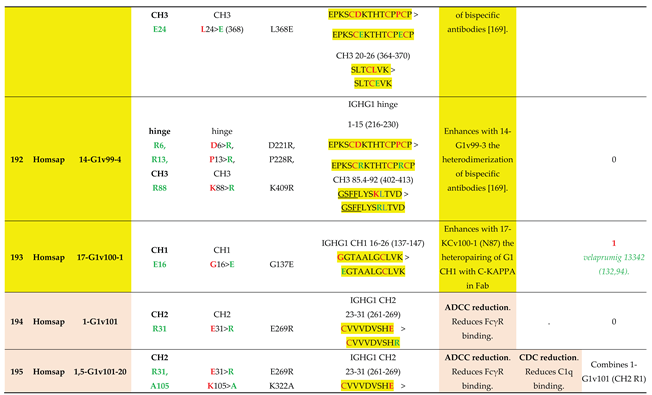
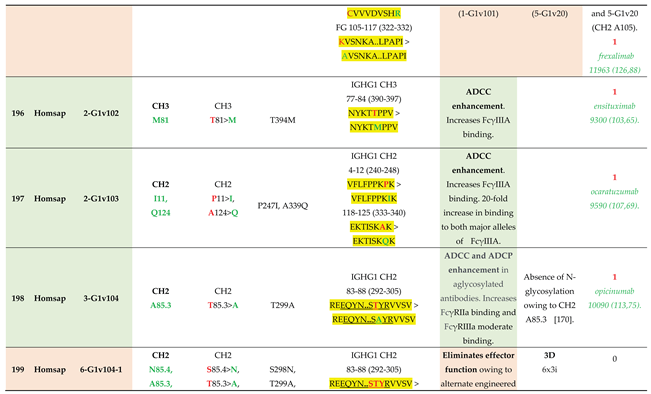
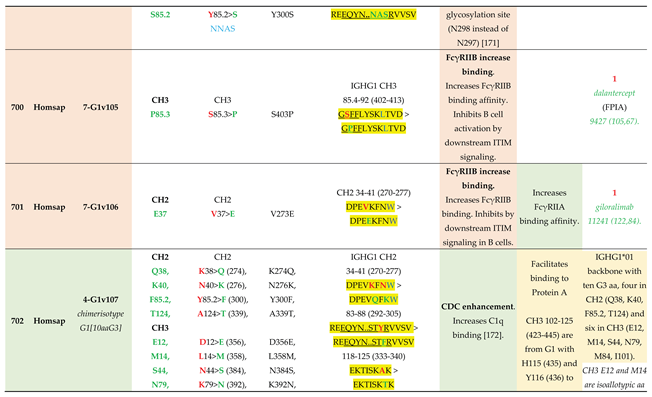
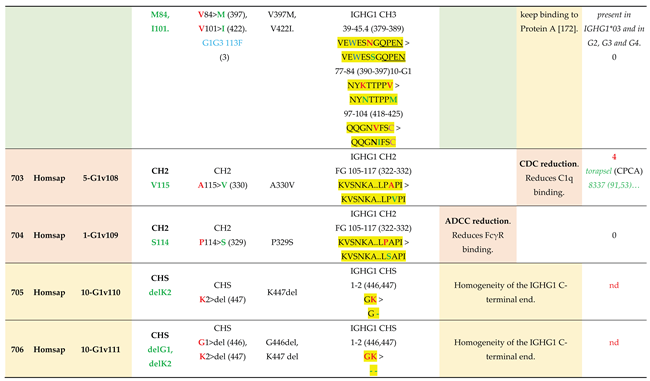
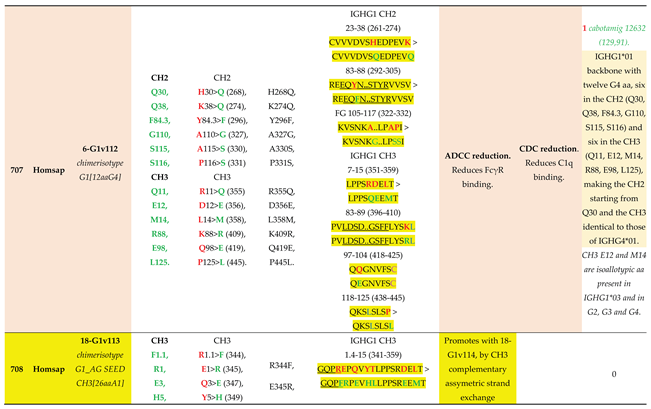
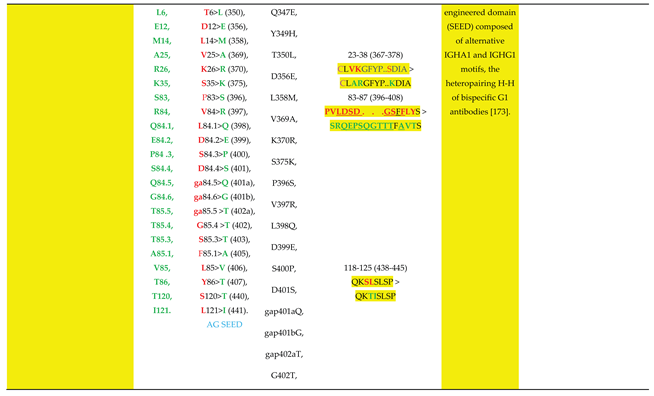
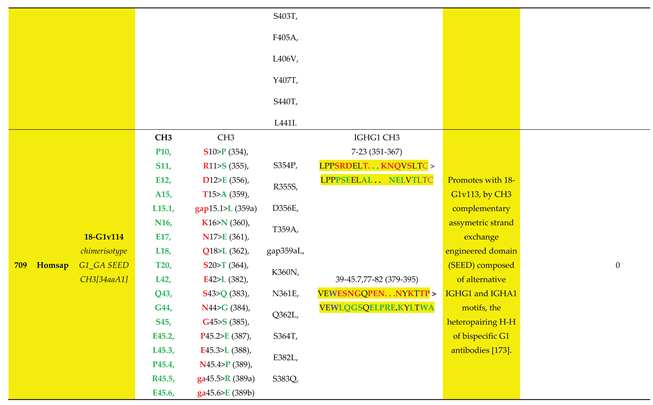
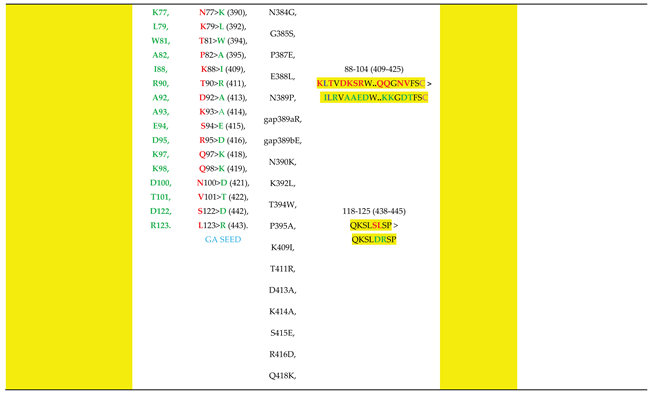
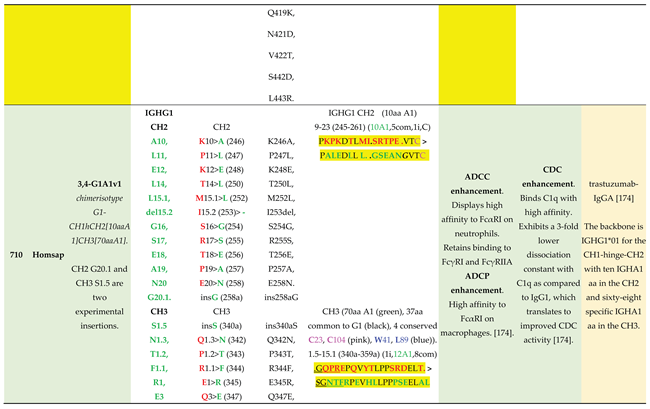
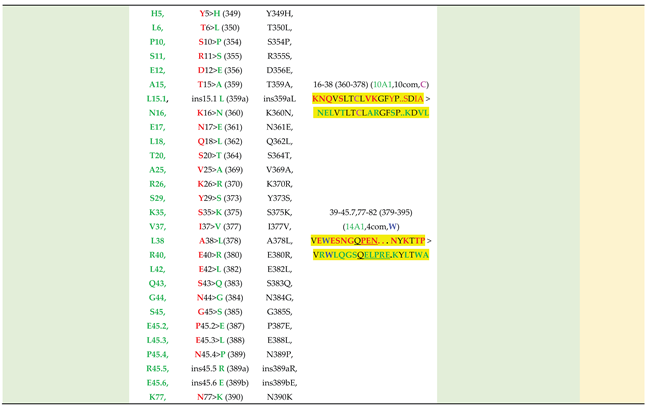
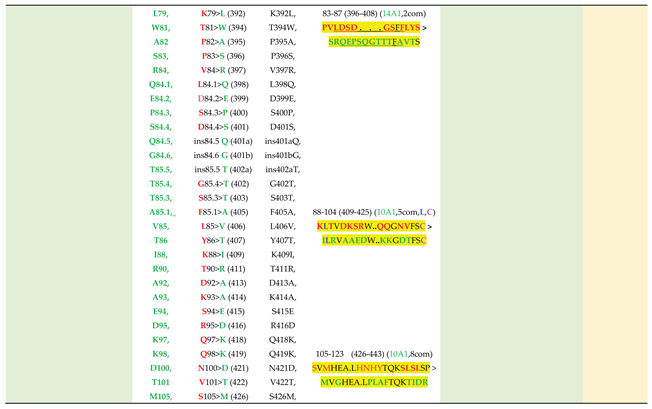
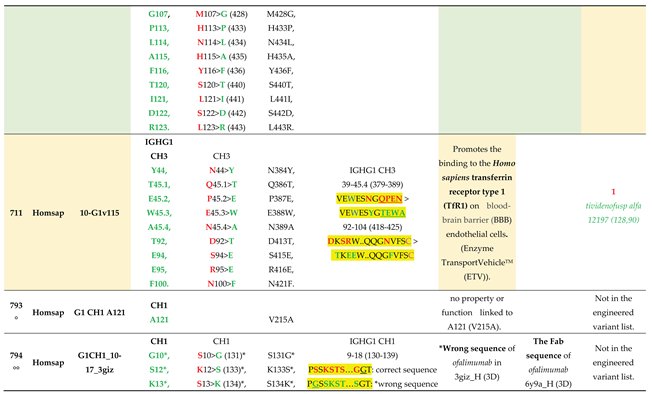
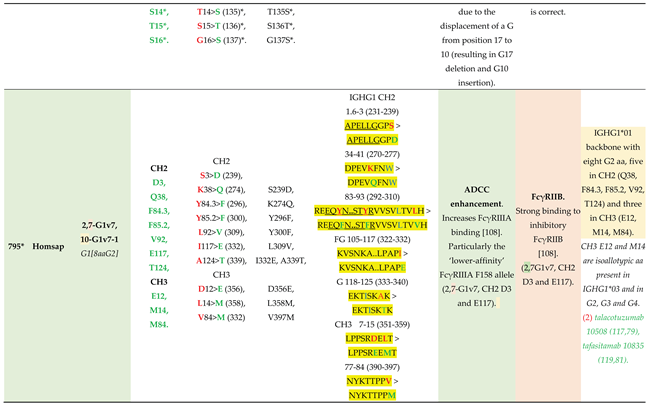
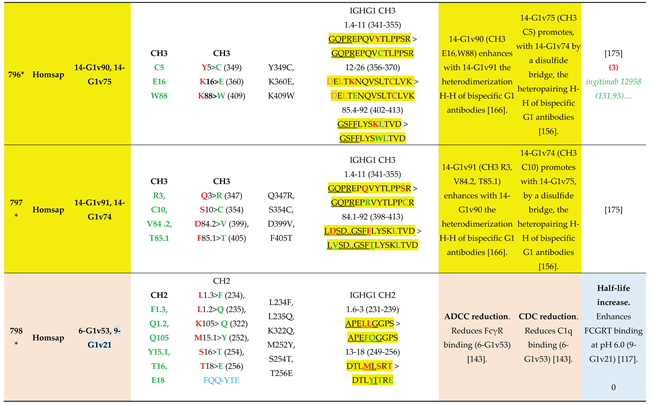
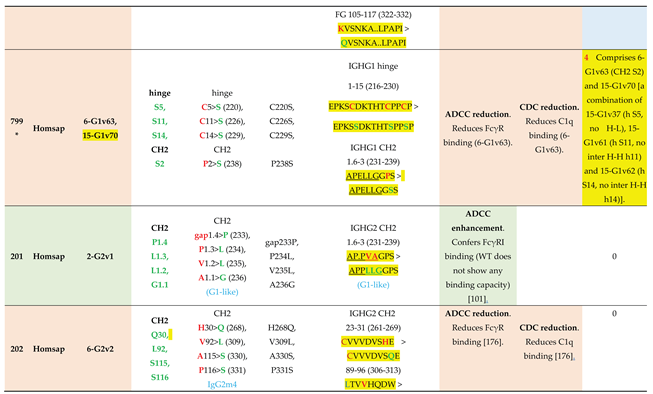
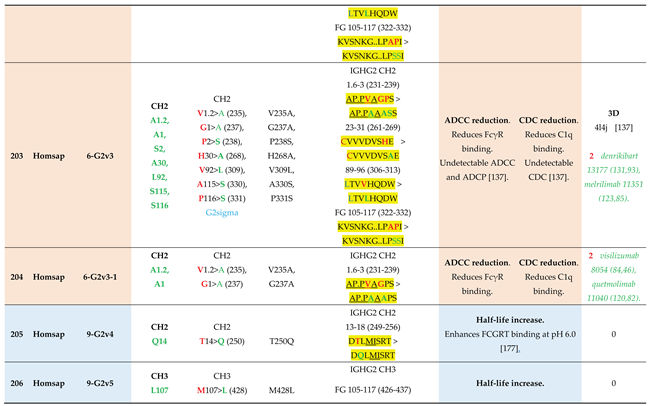
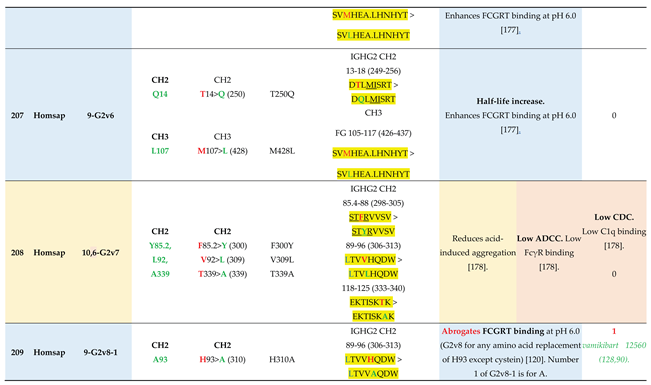
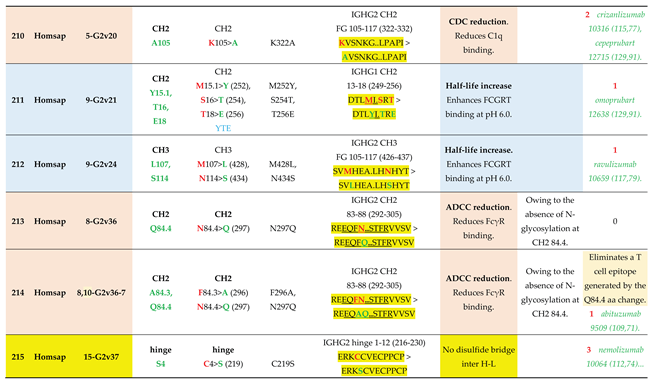
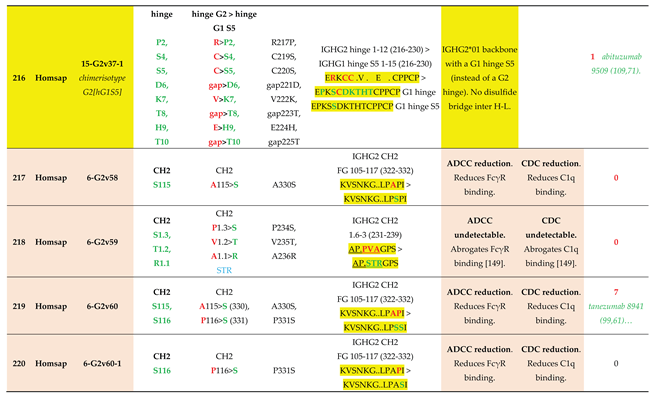
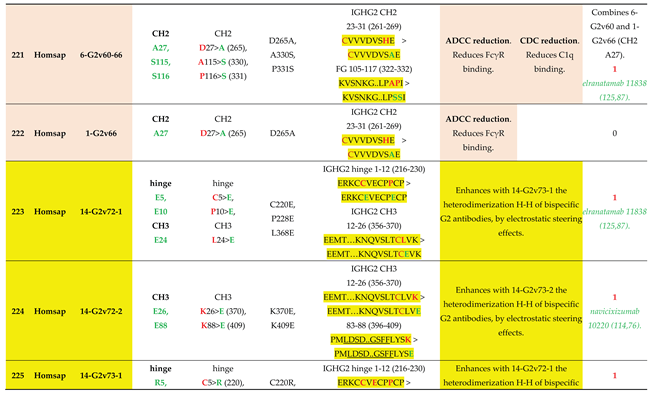
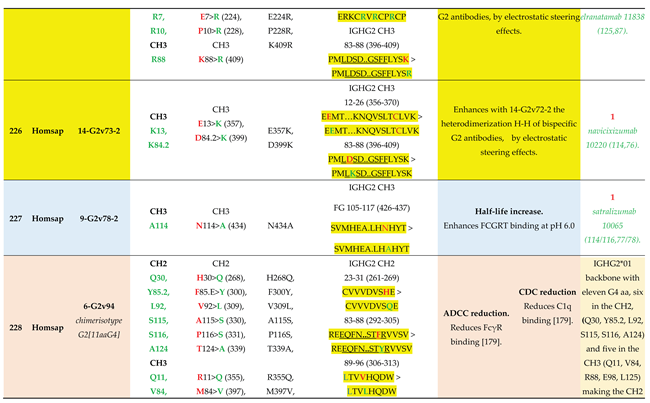
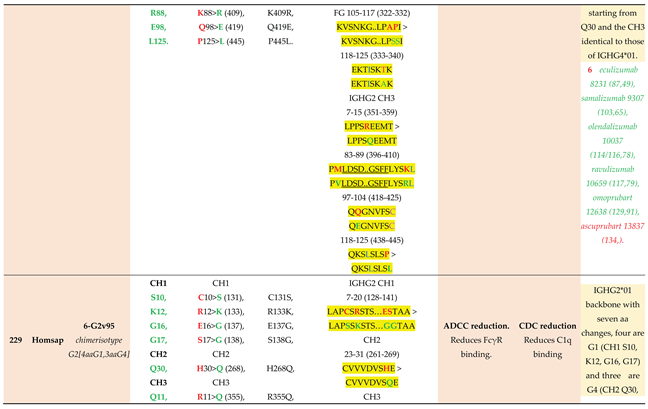
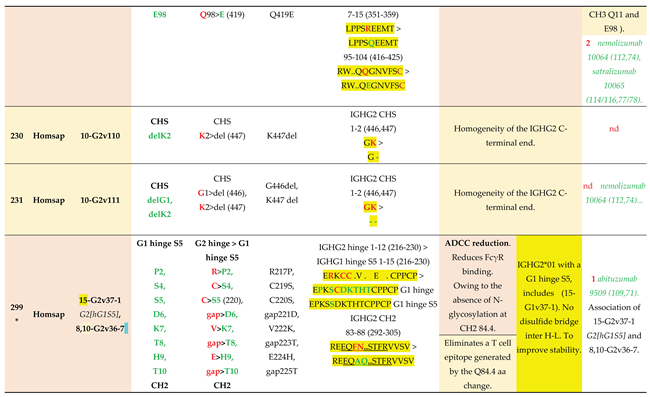
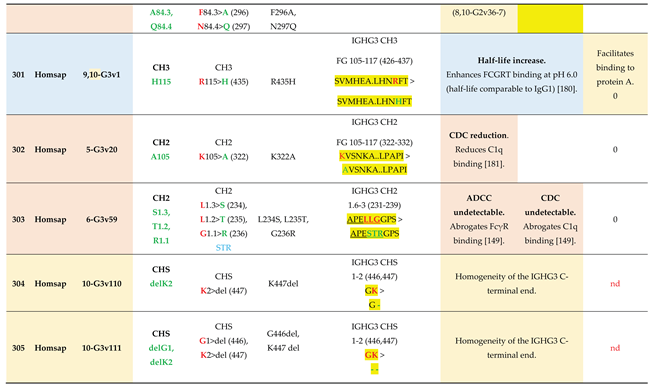
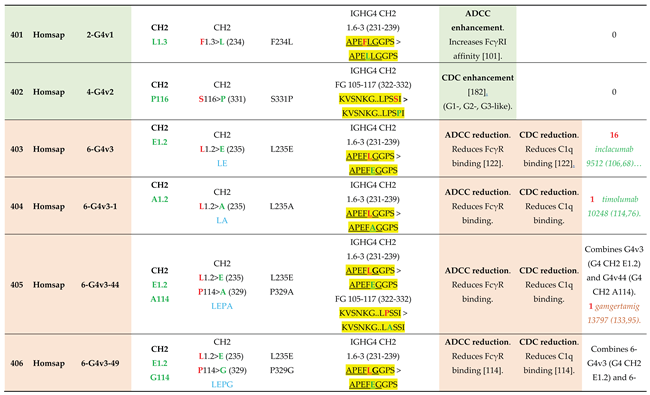
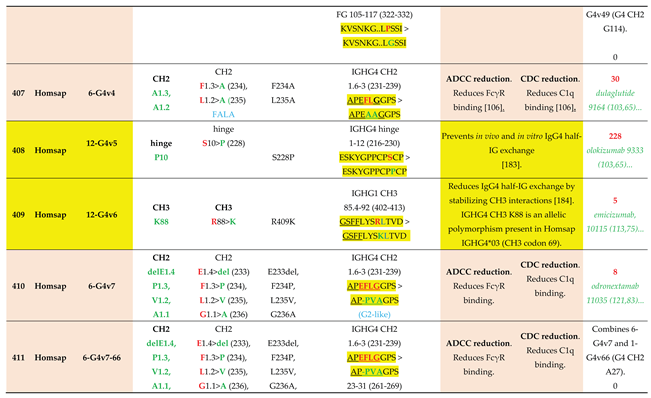
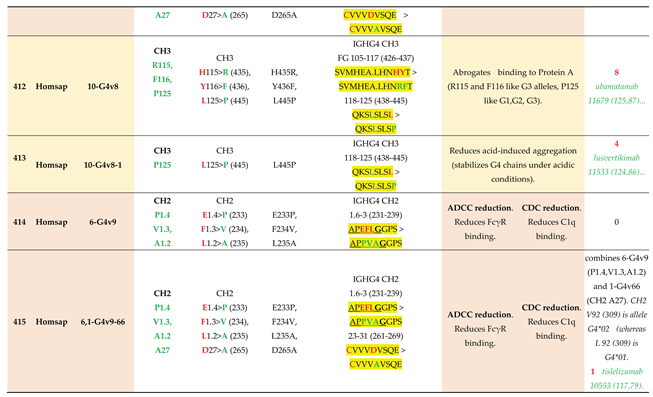
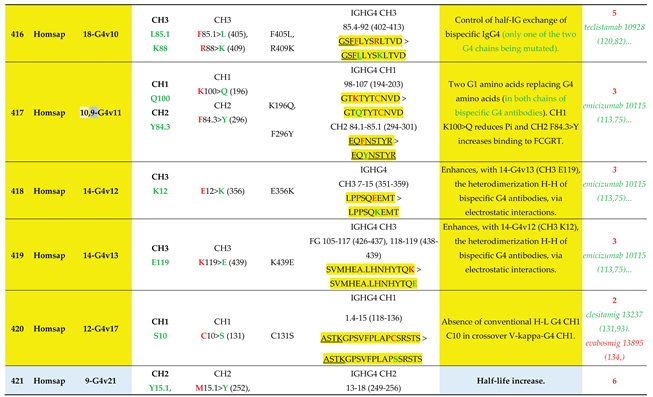
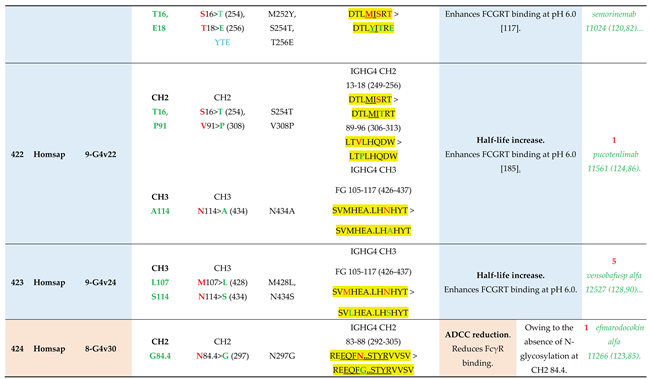
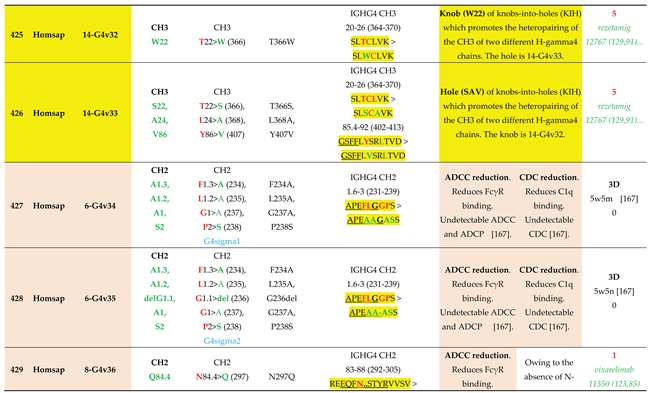
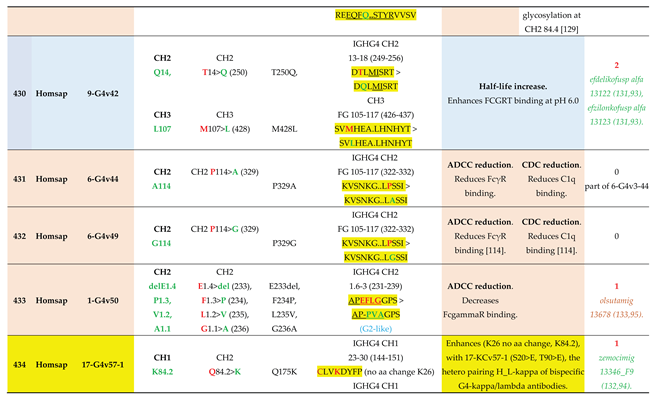
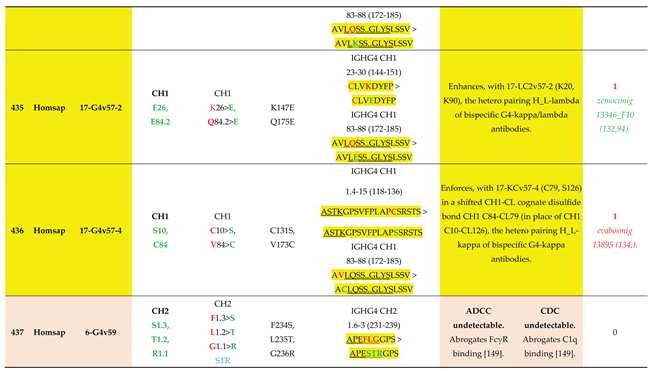
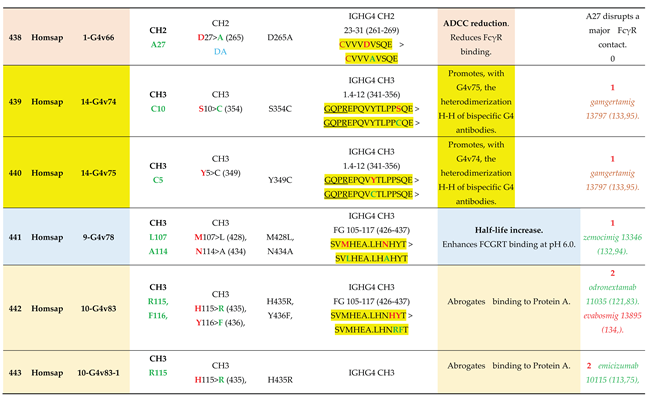
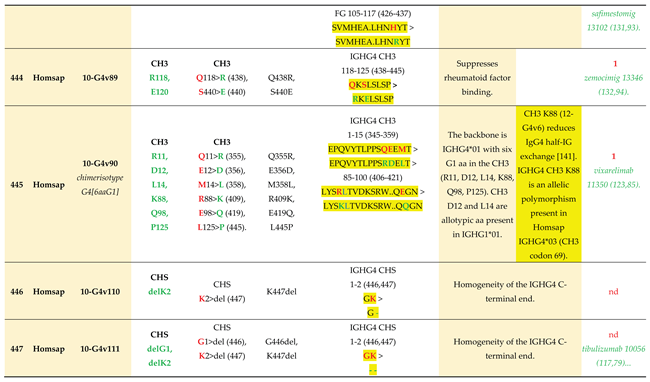
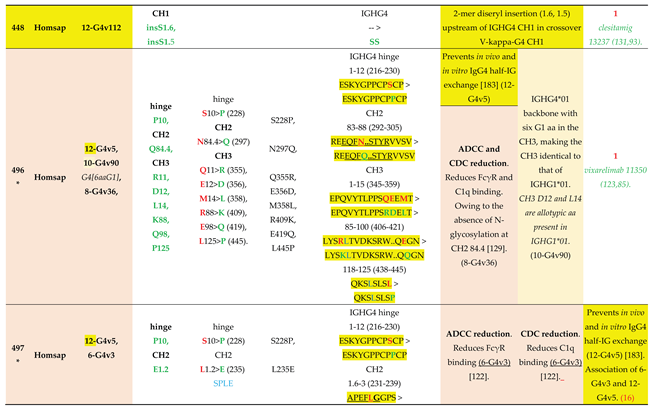
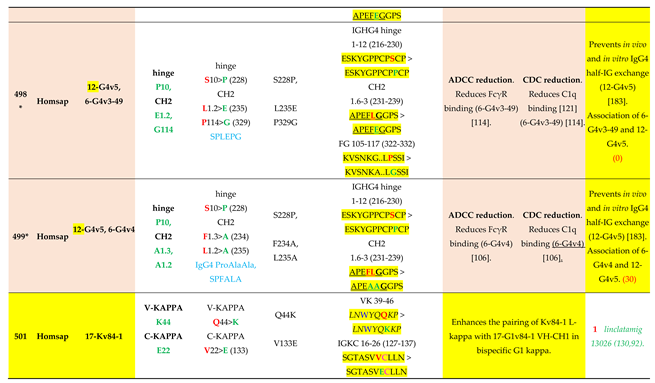
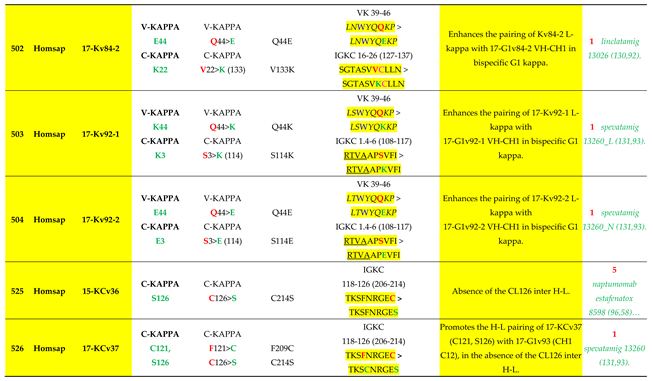
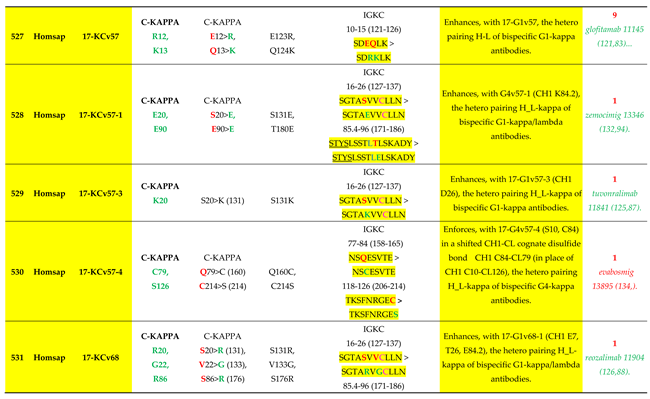
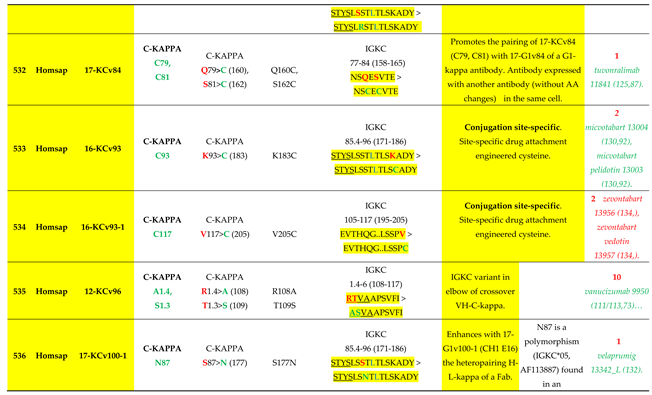
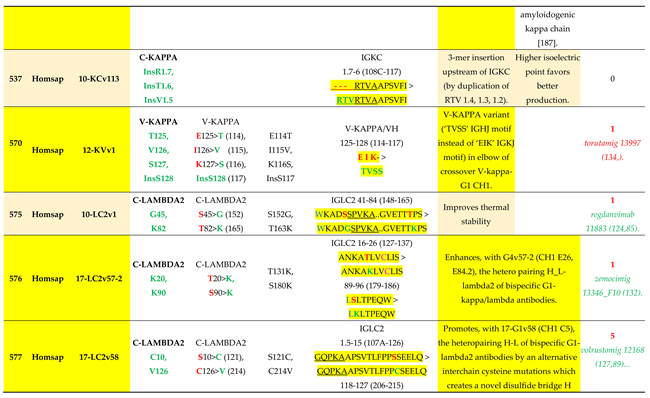
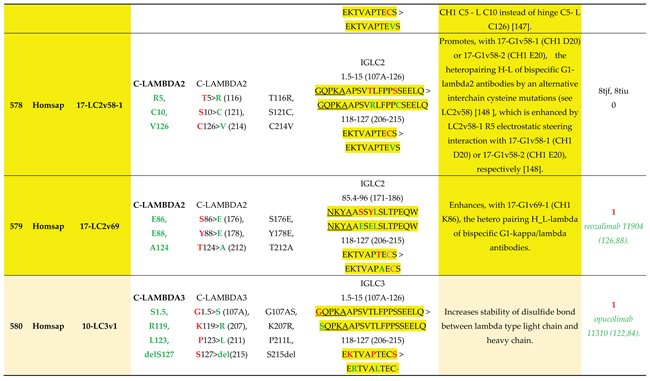
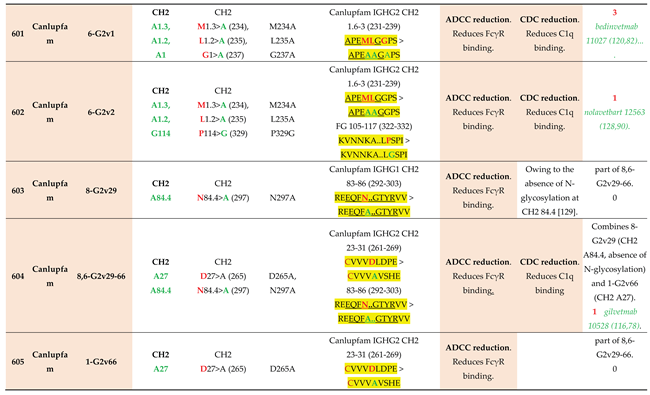
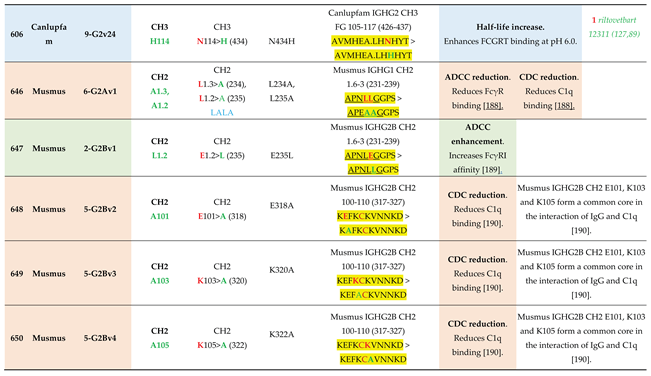
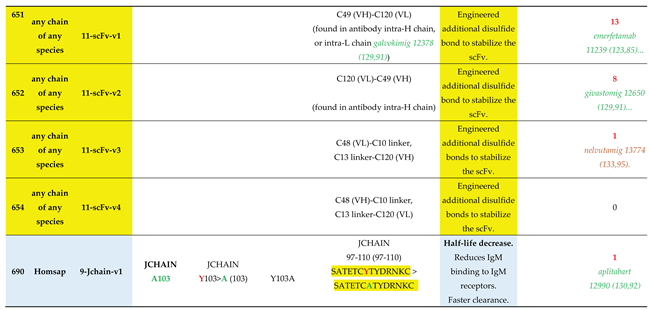
(6) ‘Property and function type’ (at least one, and up to three per variant) (columns 8, 9 and 10). In column 10 (the most right column), information on 3D structure with PDB codes are indicated (if available in IMGT/3Dstructure-DB and RCSB PDB) [45,46]. The number in red indicates the number of WHO INN, up to lists R95 and PL134, included. The first (one or two) INN (name, number and, between parentheses, PL and RL numbers) are displayed in green italics. If more than 2, only the first one (chronological order in the list) is displayed. ‘0’ in black means no INN. In the variant description of the sequences of therapeutic antibodies of the WHO INN lists [81,82,83], the Eu-IMGT position is replaced by the position of the aa change in the INN antibody chain sequence.
Table 2 includes a total of 335 engineered variants, of which 323 are Homo sapiens (Homsap) with 294 H-gamma (constant region encoded by a IGHG gene) chains. The isotypes repartition is the following: two hundred ten are ‘G1’ (ID 1-199, 700-711), thirty-one ‘G2’ (ID 201-231), five ‘G3’ (ID 301-305), forty-eight ‘G4’ (ID 401-448), eighteen are kappa (four ‘K’ with amino changes on C-kappa and V-kappa, thirteen ‘KC’ with aa changes on C-kappa, one ‘KV’ with aa changes on V-kappa), six lambda (five ‘LC2’ with aa changes on C-lambda2, one ‘LC3’ with aa change on C-lambda3), four ‘scFv-‘ (ID 651-654) and one ‘Jchain-‘ (ID 690). The other eleven variants comprise six Canlupfam ‘G2’(ID 601-606) and five Musmus of which one ‘G2A’ and four ‘G2B’(ID 646-650).
In addition to the 335 variants, the list includes ten codes with an asterisk highlighting a combination of variants, five are G1 (ID 795* to 799*), one G2 (ID 299*) and four G4 (ID 496* to 499*), and two codes G1 with ‘°’ or ‘°°’ indicating that the aa changes did not qualify as engineered variant, the first one is the result of a fortuitous experimental change without linked property or function (G1 CH1 A121, ID 793°), the second one is an error in the sequence of ofalimumab in 3giz_H (ID 794°°) by comparison with the Fab sequence of ofalimumab in 6y9 which is the correct one. These last two are added in the table for information.
Two hundred twenty-eight engineered variants assigned to INN are reported in Table 3.
Table 3.
Engineered variants assigned to INN.
| IDa | IMGT engineered variant name | Nbb |
INN name and INN number (proposed list, recommended list) |
|---|---|---|---|
| 002 | 1-G1v1-2-3 | 1 | levilimab 10905 (120,82). |
| 007 | 6-G1v3-1 | 5 |
vedolizumab 9093 (100,62), ozanezumab 9703 (108,70), plozalizumab 10124 (113,75), refanezumab 10174 (114,76), plozalizumab plevistinag 13431 (132,94). |
| 008 | 6-G1v4 | 1 | lifonebart 13851 (134,). |
| 009 | 6-G1v4-2 | 1 | tixestobart 13358 (132,94). |
| 010 | 6-G1v4-66 | 1 | abelacimab 10881 (119,81). |
| 013 | 2-G1v6 | 7 |
gotistobart 12383 (128,90), amulirafusp alfa (IG) 12963 (130/131,92), tazlestobart 12964 (130,92), vislarafusp alfa (IG) 12965 (130/131,92), palverafusp alfa (IG) 12967 (130,92), suvonstobart 13347 (132,94), moflerafusp alfa (IG) 13348 (132,94). |
| 014 | 2,7-G1v7 | 6 |
talacotuzumab 10508 (117,79), tafasitamab 10835 (119,81), lacutamab 10924 (120,82), porustobart 12381 (127,89), vilastobart 12761 (129,91), tecotabart 13031 (130,92). |
| 015 |
10-G1v7-1 chimerisotype G1[8aaG2] |
2 | talacotuzumab 10508 (117,79), tafasitamab 10835 (119,81). |
| 016 | 2,5,7-G1v8 | 1 | botensilimab 11659 (124,86). |
| 018 | 2-G1v9-1 | 2 | margetuximab 9799 (109,71), enoblituzumab 10165 (114/116, 76/77). |
| 021 | 3-G1v12 | 1 | elipovimab (120,82). |
| 022 | 3-G1v13 | 2 | ipsoprubart 13680 (133,95), emzotamig 13697 (133,95). |
| 023 | 6-G1v14 |
65 |
teplizumab 8869 (87/97,59) ’hOKT3’, perakizumab 9648 (107,69), bimagrumab 9711 (108/110,70), lodelcizumab 9733 (108,70), tesidolumab 10051 (112,74), risankizumab 10128 (113,75), elezanumab 10344 (115,77), lutikizumab 10347 (115,77), duvortuxizumab 10506 (116,78), ravagalimab 10750 (118,80), imaprelimab 10753 (118,80), spesolimab 10845 (119,81), dilpacimab 10863 (119,81), prolgolimab 10904 (119,81), budigalimab 10908 (119,81), cendakimab 10990 (120,82), batoclimab 11064 (121,83), manelimab 11133 (121,83), mirzotamab 11146 (121,83), mirzotamab clezutoclax 11147 (121,83), obrindatamab 11181 (123,85), domvanalimab 11559 (124,86), simridarlimab 11730 (125,87), ivonescimab 11809 (125,87), etesevimab 11873 (124,85), upanovimab 11966 (125,87), rimteravimab 12047 (125,87), dresbuxelimab 12115 (125,87), plutavimab 12159 (126,88), prafnosbart 12177 (127,89), tividenofusp alfa (CPCA) 12197 (128,90), empasiprubart 12277 (127,89/95), sotiburafusp alfa (IG) 12407 (128,90), eurestobart 12434 (128,90), fanastomig 12694 (129,91), luvagrobart 12725 (129,91), opelkibart 12810 (129,91), opelkibart elmanitin 12811 (129,91), obrixtamig 12889 (130,92), rinatabart 13029 (130,92), rinatabart sesutecan 13030 (130,92), efimosfermin alfa (CPCA) 13045 (130,92), larnefpendekin alfa (FPIA) 13051 (131,93), amostomig 13052 (130,92), greziprubart 13120 (131,93), cizutamig 13166 (131,93), imeroprubart 13167 (131,93), imneskibart 13202 (131,93), clesitamig 13237 (131,93), recibokibart 13255 (131,93), betinukibart 13289 (131,93), pumitamig 13367 (132,94), etuptamig 13402 (132,94), adimanebart 13433 (132,94), arumakimig 13493 (132,94), lumivatamig 13593 (133,95), zumilokibart 13638 (133,95) fetrastobart vedotin 13768 (133,95), fetrastobart 13769 (133,95), selcodebart 13796 (133,95), afivastobart 13876 (134,), elfetabart drozuntecan 13946 (134,), elfetabart 13947 (134,), corveldebart 13975 (134,), torutamig 13997 (134,). |
| 024 | 6-G1v14-1 | 23 |
domagrozumab 10286 (114,76), marstacimab 10789 (119,81), penpulimab 11497 (123,85), cadonilimab 11581 (124,86), ponsegromab 11605 (124,86), tarcocimab 11770 (125,87), tarcocimab tedromer 11774 (126/129/130,88/90), tagitanlimab 11843 (125,87), evorpacept (FPIA) 12029 (126,88), dazukibart 12518 (128,90), ledostomig 12726 (132,), sifarobocept (FPIA) 12787 (129,91), etakafusp alfa (IG) 12919 (130/131,92), cugrastomig 12924 (130,92), mozistobart zoratolimod 12947 (130,92) mozistobart 12946 (130,92), mipletamig 12998 (130,92), afimkibart 13205 (131,93), tabirafusp alfa tedromer (IG) 13242 (131/133,93/94), tabirafusp alfa (IG) 13243 (131/133,93/94), tixentamig 13477 (132,94), ompekimig 13515 (132,94), tilrekimig 13516 (132,94). |
| 025 | 6,5-G1v14-1-20 | 5 |
emfizatamab 12023 (126,88), danvilostomig 12198 (127,89), umizortamig 12292 (127,89), nebratamig 12499 (128,90), mipletamig 12998 (130,92). |
| 027 | 6-G1v14-4 | 2 | tulisokibart 12368 (127,89), opamtistomig 13330 (132,94). |
| 029 | 6-G1v14-48 | 4 |
delpasibart 12399 (127,89), delpasibart etedesiran 12400 (127,89), delpasibart zotadirsen 13250 (131,93), delpasibart braxlosiran 13251 (131,93). |
| 030 | 6-G1v14-49 | 16 |
cergutuzumab amunaleukin 10080 (113,75), faricimab 10563 (118,80), cibisatamab 10636 (118,80), simlukafusp alfa (IG) 11116 (121,83), glofitamab 11145 (121,83), alnuctamab 11457 (123,85), melredableukin alfa (IG) 11723 (125/126,87), englumafusp alfa (IG) 11793 (125/127,89), masavibart 12234 (126,88), nepuvibart 12235 (126,88), eciskafusp alfa (IG) 12317 (127,89), tobemstomig 12318 (127,89), lomvastomig 12319 (127,89), forimtamig 12346 (127,89), simaravibart 12423 (127,89), zareprumig 13958 (134,). |
| 032 | 6-G1v14-67 | 7 |
reozalimab 11904 (126,88), obertamig 12551 (128,90), pasritamig 13153 (131,93), ramantamig 13340 (132,94), anafiltamig 13438 (133,95), nelvutamig 13774 (133,95), remigromig 13973 (134,). |
| 040 | 5-G1v20 | 8 |
nivatrotamab 11591 (124,86), anzurstobart 12363 (127,89), mipletamig 12998 (130,92), donitabart 13053 (130,92), avitotamig 13055 (130,92), daretabart 13434 (132,94), gamsitabart 13908 (134,), gamsitabart tocentecan 13909 (134,). |
| 041 | 9-G1v21 |
34 |
netakimab 10387 (118,80), suvratoxumab 10441 (116,78), nirsevimab 10780 (119,81), levilimab 10905 (120,82), ziltivekimab 11143 (121,83), avizakimab 11148 (121,83), depemokimab 11449 (123,85), recaticimab 11502 (123,85), tixagevimab 11776 (124,85), cilgavimab 11777 (124,85), barzolvolimab 11842 (125,87), clesrovimab 11857 (126,88), amubarvimab 11988 (125,87), romlusevimab 11992 (125,87), izeltabart (12302 (127,89), izeltabart tapatansine 12303 (127,89), gotistobart 12383 (128,90), picankibart 12419 (128,90), sipavibart 12778 (129,91), ozureprubart 12977 (130,92), navenibart 12991 (130,92), donitabart 13053 (130,92), efitazanamivir alfa (CPCA) 13066 (132,), amtabafusp alfa (IG) 13207 (131,93), vebanvibart 13272 (130,92), trovostobart 13453 (132,94), lasrekibart 13500 (132,94), elegrobart 13528 (132,94), glarivibart 13605 (133,95), zumilokibart 13638 (133,95), felcorekibart 13642 (133,95), solaprubart 13933 (134,), ombetoxabart 13952 (134,), torutamig 13997 (134,). |
| 043 | 9-G1v22-1 | 1 | efgartigimod alfa (IG) 10455 (116,78). |
| 045 | 9-G1v24 | 21 |
elipovimab 10988 (120,82), vudalimab 11464 (123,85), bavunalimab 11465 (123/125,87), izuralimab 11466 (123,85), sotrovimab 11766 (124,85), teropavimab 11878 (125,87), zinlirvimab 11879 (126,88), beludavimab 11961 (125,87), masavibart 12234 (126,88), nepuvibart 12235 (126,88), tobevibart 12316 (127,89), ogalvibart 12361 (126,88), crexavibart 12362 (126,88), simaravibart 12423 (127,89), efbalropendekin alfa (FPIA) 12475 (128/130,90), sonavibart 13036 (130,92), lotivibart 13158 (131,93), ompekimig 13515 (132,94), tilrekimig 13516 (132,94), retavibart 13354 (132,94), lifonebart 13851 (134,). |
| 046 | 9-G1v24-1 | 1 | gimsilumab 10534 (117,79). |
| 047 | 7-G1v25 | 1 | obexilimab 10898 (119,81). |
| 049 | 16-G1v27 | 6 |
vadastuximab talirine (113,75), vadastuximab 10242 (114,76), rolinsatamab talirine (119,81), rolinsatamab 10874 (119,81), serclutamab talirine 10959 (120,82), serclutamab 10960 (120,82). |
| 050 | 16-G1v27-1 | 2 | iladatuzumab 10646 (117,!), iladatuzumab vedotin 10647 (117,!). |
| 051 | 16-G1v28 | 1 | idactamab 11348 (123,85). |
| 052 | 8-G1v29 |
33 |
otelixizumab 8864 (98,60), clazakizumab 9599 (107,69), atezolizumab 9814 (112,74), eptinezumab 10308 (115,77), iscalimab 10707 (118,90), nipocalimab 11215 (122,84), opucolimab 11310 (122,84), nivatrotamab 11591 (124,86), uliledlimab 11597 (124,86), sudubrilimab 11649 (124,86), rulonilimab 11710 (125,87), dalutrafusp alfa (IG) 11814 (125,87), betifisolimab 11926 (126,88), evorpacept (FPIA) 12029 (126,88), epacmarstobart 12164 (127,89), tuparstobart 12389 (127,89), verzistobart 12390 (128,90), givastomig 12650 (129,91), uprevstobart 12670 (129,91), ragistomig 12707 (129,91), xirestomig 12746 (129,91), efercoleukin alfa (FPIA) 12762 (129,91), rezorstobart 12766 (129,91), lumistobart 13012 (130,92), balekafusp alfa (IG) 13040 (132/133/134,95), avitotamig 13055 (130,92), invikafusp alfa (IG) 13065 (130/131,92), ruxoprubart 13213 (131,93), efarindodekin alfa (FPIA) 13222 (131,93), clesitamig 13237 (131,93), bocunebart 13356 (132,94), asedebart 13606 (133,95), olevaprubart 13949 (134,). |
| 054 | 8-G1v30 | 7 |
mosunetuzumab 10621 (117,79), efavaleukin alfa (FPIA) 10762 (118,80), zelminemab 11091 (121,83), cevostamab 11258 (122,84), runimotamab 11496 (124,86), fazpilodemab 12017 (126,88), linclatamig 13026 (130,92). |
| 055 | 8-G1v30-1 | 1 | semzuvolimab 11685 (126,88). |
| 057 | 14-G1v31-1 (hole) | 1 | zeclantamig 13865 (134,). |
|
058 |
14-G1v32 (knob) |
60 |
onartuzumab 9368 (104,66), vanucizumab 9950 (111,73), cergutuzumab amunaleukin 10080 (113,75), duvortuxizumab 10506 (116,78), faricimab 10563 (118,80), mosunetuzumab 10621 (117,79), cibisatamab 10636 (118,80), simlukafusp alfa (IG) 11116 (121,83), glofitamab 11145 (121,83), obrindatamab 11181 (123,85), cevostamab 11258 (122,84), alnuctamab 11457 (123,85), runimotamab 11496 (124,86), anbenitamab 11611 (124,86), simridarlimab 11730 (125,87), goflikicept (FPIA) 11764 (124,85), englumafusp alfa (IG) 11793 (125/127,89), fazpilodemab 12017 (126,88), trontinemab 12120 (126,88), volrustomig 12168 (127,89), tividenofusp alfa (CPCA) 12197 (128,90), eciskafusp alfa (IG) 12317 (127,89), tobemstomig 12318 (127,89), lomvastomig 12319 (127,89), forimtamig 12346 (127,89), rilvegostomig 12387(127,89), sabestomig 12457 (128,90), silevimig 12660 (129,91), efercoleukin alfa (FPIA) 12762 (129,91), obrixtamig 12889 (130,92), etakafusp alfa (IG) 12919 (130/131,92), opugotamig 12941 (130,92), opugotamig olatansine 12957 (130,92), tilatamig 13020 (130,92), tilatamig samrotecan 13021 (130,92), linclatamig 13026 (130,92), amostomig 13052 (130,92), invikafusp alfa (IG) 13065 (130/131,92), velinotamig 13145 (131,93), amtabafusp alfa (IG) 13207 (131,93), efarindodekin alfa (FPIA) 13222 (131,93), clesitamig 13237 (131,93), spevatamig 13260 (131,93), peluntamig 13261 (131,93), ramantamig 13340 (132,94), etuptamig 13402 (132,94), efranarelaxin alfa (CPCA) 13420 (132/133,94), anafiltamig 13438 (133,95), anbenitamab repodatecan 13457 (132,94), tixentamig 13477 (132,94), arumakimig 13493 (132,94), lumivatamig 13593 (133,95), tepilukimig 13604 (133,95), emzotamig 13697 (133,95), nelvutamig 13774 (133,95), zeclantamig 13865 (134,), rolditamig deuderuxtecan 13866 (134,), zareprumig 13958 (134,), torutamig 13997 (134,), rolditamig 14031 (134,). |
| 059 | 14-G1v32-1 (knob) | 1 | remigromig 13973 (134,). |
| 060 |
14-G1v33 (hole) |
59 |
onartuzumab 9368 (104,66), vanucizumab 9950 (111,73), cergutuzumab amunaleukin 10080 (113,75), duvortuxizumab 10506 (116,78), faricimab 10563 (118,80), mosunetuzumab 10621 (117,79), cibisatamab 10636 (118,80), simlukafusp alfa (IG) 11116 (121,83), glofitamab 11145 (121,83), obrindatamab 11181 (123,85), cevostamab 11258 (122,84), alnuctamab 11457 (123,85), runimotamab 11496 (124,86), anbenitamab 11611 (124,86), simridarlimab 11730 (125,87), goflikicept (FPIA) 11764 (124,85), englumafusp alfa (IG) 11793 (125/127,89), fazpilodemab 12017 (126,88), trontinemab 12120 (126,88), volrustomig 12168 (127,89), tividenofusp alfa (CPCA) 12197 (128,90), eciskafusp alfa (IG) 12317 (127,89), tobemstomig 12318 (127,89), lomvastomig 12319 (127,89), forimtamig 12346 (127,89), rilvegostomig 12387(127,89), sabestomig 12457 (128,90), silevimig 12660 (129,91), efercoleukin alfa (FPIA) 12762 (129,91), obrixtamig 12889 (130,92), etakafusp alfa (IG) 12919 (130/131,92), opugotamig 12941 (130,92), opugotamig olatansine 12957 (130,92), tilatamig 13020 (130,92), tilatamig samrotecan 13021 (130,92), linclatamig 13026 (130,92), amostomig 13052 (130,92), invikafusp alfa (IG) 13065 (130/131,92), velinotamig 13145 (131,93), amtabafusp alfa (IG) 13207 (131,93), efarindodekin alfa (FPIA) 13222 (131,93), clesitamig 13237 (131,93), spevatamig 13260 (131,93), peluntamig 13261 (131,93), ramantamig 13340 (132,94), etuptamig 13402 (132,94), efranarelaxin alfa (CPCA) 13420 (132/133,94), anafiltamig 13438 (133,95), anbenitamab repodatecan 13457 (132,94), tixentamig 13477 (132,94), arumakimig 13493 (132,94), lumivatamig 13593 (133,95), tepilukimig 13604 (133,95), emzotamig 13697 (133,95), nelvutamig 13774 (133,95), rolditamig deuderuxtecan 13866 (134,), zareprumig 13958 (134,), torutamig 13997 (134,), rolditamig 14031 (134). |
| 061 | 14-G1v33-1 (hole) | 1 | remigromig 13973 (134,). |
| 062 | 10,13-G1v34 | 4 |
benufatamab 11063 (121,83), tilogatamab 11267 (122,84), ivicentamab 11702 (125,87), erzotabart 12562 (128,90). |
| 063 | 4-G1v35 | 2 | sotigalimab 11472 (123,85), exlinkibart 12376 (127,89). |
| 064 | 8-G1v36 | 4 |
mupadolimab 11944 (125,87), briquilimab 12124 (126,88), temtokibart 12231 (128,90), trevotamig 13209 (131,93). |
| 065 | 8-G1v36-1 | 1 | eftozanermin alfa (FPIA) 10838 (119,81). |
| 066 | 15-G1v37 | 46 |
placulumab 9567(107,69), ipafricept (FPIA) 9810 (109,71), otlertuzumab 9832 (110,72), rivabazumab pegol (Fab) 10144 (113,75), rivabazumab (Fab) 10197 (114,76), ontorpacept (FPIA) 10927 (122,84), envafolimab 10930 (120,82), tamrintamab pamozirine 10961 (120,82), tamrintamab 10962 (120,82), zanidatamab 10997 (121,83), plamotamab 11020 (120,82), vibecotamab 11021 (120,82), tidutamab 11022 (120,82), acazicolcept (FPIA) 11385 (124,86), zanidatamab zovodotin 11433 (123,85), vudalimab 11464 (123,85), bavunalimab 11465 (123,87), izuralimab 11466 (123,85), erfonrilimab 11617 (124,86), crefmirlimab 11678 (126,88), davoceticept (FPIA) 11827 (125,87), tuvonralimab 11841 (125,87), zirconium (89Zr) crefmirlimab berdoxam 12138 (127,89), povetacicept (FPIA) 12264 (127,89), efbalropendekin alfa (FPIA) 12475 (128/130,90), obertamig 12551 (128,90), sifarobocept (FPIA) 12787 (129,91), canvircept (CPCA) 12882 (129,91), opugotamig 12941 (130,92), opugotamig olatansine 12957 (130,92), mipletamig 12998 (130,92), lofacimig 13117 (131,93), pasritamig 13153 (131,93), spevatamig 13260 (131,93), ramantamig 13340 (132,94), velaprumig 13342 (132,94), anafiltamig 13438 (133,95), tixentamig 13477 (132,94), turmetabart adizutecan 13671 (133,95), turmetabart 13672 (133,95), nelvutamig 13774 (133,95,), alveltamig 13944 (134,), remigromig 13973 (134,), rolditamig deuderuxtecan 13866 (134,), rolditamig 14031 (134,). Note: variant included in 15-G2v37-1 G2[hG1] abituzumab 9509 (109,71) |
| 067.1 | 15-G1v37-1 | 1 | tuvonralimab 11841 (125,87). |
| 067.2 | 15-G1v37-2 | 1 | efgivanermin alfa (FP1A) 10695 (120,82). |
| 068 | 6-G1v38 | 1 | paradiprubart 12233 (126,88) |
| 069 | 6-G1v39 | 22 |
anifrolumab 9800 (109,71), durvalumab 10010 (112,74), oleclumab 10545 (116,78), tixagevimab 11776 (124,85), cilgavimab 11777 (124,85), golocdacimab 12003 (126,88), camoteskimab 12062 (126,88), volrustomig 12168 (127,89), rilvegostomig 12387 (127,89), sabestomig 12457 (128,90), lixudebart 12552 (128,90), sipavibart 12778 (129,91), indenebart 13006 (130,92), ansipastobart 13011 (130,92), tilatamig 13020 (130,92), tilatamig samrotecan 13021 (130,92), telikibart 13144 (131,93), velinotamig 13145 (131,93), adezkibart 13365 (132,94), efranarelaxin alfa (CPCA) 13420 (132/133,), tepilukimig 13604 (133,95), alveltamig 13944 (134,). |
| 070 | 6-G1v40 | 3 |
amtabafusp alfa (IG) 13207 (131,93), latozinemab 11584 (124,86), nivisnebart 13157 (131,93). |
| 072 | 6-G1v41-66 | 4 |
epcoritamab 11078 (121,83), acasunlimab 11565 (124,86), tecaginlimab 11729 (125,87), zubotamig 13007 (130,92). |
| 073 | 9-G1v42 | 3 |
elezanumab 10344 (115,77), ravagalimab 10750 (118,80), rulonilimab 11710 (125,87). |
| 074 | 6-G1v43 | 5 |
olamkicept (FPIA) 10311 (116,78), acazicolcept (FPIA) 11385 (124,86), davoceticept (FPIA) 11287 (125,87), bempikibart 12242 (127,89), povetacicept (FPIA) 12264 (127,89). |
| 075 | 6-G1v43-1 | 3 |
torapsel (CPCA) 8337 (91,53), anrukinzumab 8942 (98,60), dalantercept (FPIA) 9427 (105,67). |
| 076 | 6-G1v43-2 | 1 | foralumab 9309 (103,65). |
| 078 | 6-G1v43-60 | 6 |
atacicept (FPIA) 8669 (95,57), telitacicept (FPIA) 10932 (120,82), avdoralimab 11081 (121,83), lodapolimab 11185 (121,83), renvistobart 12465 (128,90), izastobart 12721 (129,91). |
| 079 | 16-G1v44 | 4 |
pivekimab 11693 (125,87), pivekimab sunirine 11695 (125,87), izeltabart 12302 (127,89), izeltabart tapatansine 12303 (127,89). |
| 080 | 3-G1v45 | 2 | beludavimab 11961 (125,87), tobevibart12316 (127,89). |
| 081 | 9-G1v46 | 1 | empasiprubart 12277 (127,89). |
| 082 | 1-G1v47 | 2 | exlinkibart 12376 (127,89), dalnicastobart 13277 (127,89). |
| 085 | 1-G1v50 | 4 |
precemtabart tocentecan 13008 (130,92), precemtabart 13071 (130,92), gamsitabart 13908 (134,), gamsitabart tocentecan 13909 (134,). |
| 087 | 6-G1v50-1-4 | 2 | garivulimab 11451 (123,85), surzebiclimab 11453 (124,86). |
| 089 | 6-G1v50-51 | 9 |
plamotamab 11020 (120,82), vibecotamab 11021 (120,82), tidutamab 11022 (120,82), vudalimab 11464 (123,85), bavunalimab 11465 (123/125,87), izuralimab 11466 (123,85), xaluritamig 12082 (127,89), efbalropendekin alfa (FPIA) 12475 (128/130,90), emaretamig 13773 (133,95). |
| 090 | 6-G1v50-79 | 1 | timcevibart 12929 (129,91). |
| 094 | 6-G1v53-1 | 1 | barzolvolimab 11842 (125,87). |
| 095 | 11-G1v54 | 1 | emzotamig 13697 (133,95). |
| 097 | 11,8-G1v54-30 | 14 |
emerfetamab 11239 (123,85), pavurutamab 11290 (123,85), zeluvalimab 11417 (124,86), tarlatamab 11420 (123,85), acapatamab 11421 (123/124,85), gresonitamab 11798 (125,87), vepsitamab 11822 (125,87), emirodatamab 12028 (126,88), xaluritamig 12082 (127,89), inezetamab 12088 (126,88), latikafusp (IG) 12098 (126,88), iluzanebart 12479 (128,90), maridebart 12601 (128,90), maridebart cafraglutide (128,90). |
| 099 | 16-G1v55 | 4 |
tarcocimab 11770 (129,90), tarcocimab tedromer 11774 (126/129/130,88/90) tabirafusp alfa tedromer (IG) 13242 (131/133,93/94), tabirafusp alfa (IG) 13243 (131/133,93/94). |
| 100 | 16-G1v56 | 4 |
luveltamab tazevibulin 12040 (126,88), luveltamab tazide 12041 (126,88), ispectamab debotansine 12079 (126,88), ispectamab tazide 12139 (127,89). |
| 101 | 16-G1v56-1 | 2 | anvatabart pactil 12271 (127,89), anvatabart opadotin 12272 (127,89). |
| 102 | 16-G1v56-2 | 2 | bezetabart 12653 (129,91), bezetabart debotansine 12652 (129,91). |
| 103 | 17-G1v57 | 9 |
glofitamab 11145_H (121,83), alnuctamab 11457_H (123,85), englumafusp alfa (IG) 11793_N (125/127,89), trontinemab 12120_H,M (126/127,88), tobemstomig 12318_M (127/129,89/90), lomvastomig 12319_M (127,89), forimtamig 12346 (127,89), clesitamig 13237_ H,M (131,93), zareprumig 13958_M (134,). Idemd 17-KCv57 (9). |
| 106 | 17-G1v57-3 | 1 | tuvonralimab 11841 (125,87). |
| 107 | 17-G1v58 | 5 |
volrustomig 12168 (127,89), rilvegostomig 12837 (127,89), sabestomig 12457 (128,90), tilatamig 13020 (130,92), tilatamig samrotecan 13021 (130/132, 92/93). |
| 111 | 6-G1v59-1 | 2 | tepoditamab 10766 (118,80), besufetamig 13363 (132,94). |
| 112 | 6-G1v59-2 | 1 | crovalimab 10882 (119,81). |
| 113 | 6-G1v60 | 4 |
precemtabart 13071 (130,92), precemtabart tocentecan 13008 (130,92), gamsitabart 13908 (134,), gamsitabart tocentecan 13909 (134,). |
| 114 | 6-G1v60-1 | 1 | crovalimab 10882 (119,81). |
| 117 | 6-G1v63 | 4 |
abatacept (FPIA) 8495 (91,53), belatacept (FPIA) 8627 (9359), letolizumab 10436 (116,78), tegoprubart 12545 (128,90). |
| 118 | 6,7-G1v63-2 | 1 | emugrobart 13238 (131,93). |
| 120 | 6-G1v64 | 2 | maridebart 12601 (128,90), maridebart cafraglutide 12602 (128,90). |
| 121 | 6-G1v65 | 2 | enristomig 12416 (129,91), ozekibart 12417 (128,99). |
| 122 | 1-G1v66 | 4 |
benmelstobart 12205 (128,90), zubotamig 13007 (130,92), opamtistomig 13330 (132,), lifonebart 13851 (134,). |
| 123 | 1-G1v66-80 | 1 | envafolimab 10930 (120,82) |
| 125 | 14-G1v68 | 5 |
zanidatamab 10997 (121,83), zanidatamab zovodotin 11433 (123/125,85/86), reozalimab 11904 (126,88), obertamig 12551 (128,90), pasritamig 13153 (131,93). |
| 126 | 17-G1v68-1 | 1 | reozalimab 11904 (126,88). |
| 127 | 14-G1v69 | 5 |
zanidatamab 10997 (121,83), zanidatamab zovodotin 11433 (123/125,85/86), reozalimab 11904 (126,88), obertamig 12551 (128,90), pasritamig 13153 (131,93). |
| 128 | 17-G1v69-1 | 1 | reozalimab 11904 (126,88). |
| 129 | 15-G1v70 | 4 |
abatacept (FPIA) 8495 (91,53), belatacept (FPIA) 8627 (93,59), letolizumab 10436 (116,78), tegoprubart 12545 (128,90). |
| 130 | 14-G1v72 | 5 |
zenocutuzumab 10687_M (117/118,79), tepoditamab 10766_H (118,80), petosemtamab 11136_H (121,83), pamvatamig 12549_H (129,91), besufetamig 13363_H (132,94). |
| 131 | 14-G1v72-1 | 1 | fidasimtamab 11670_M (125,87). |
| 132 | 14-G1v72-2 | 2 | latikafusp (IG) 12098 (126,88), zeclantamig 13865 (134,). |
| 133 | 14-G1v72-3 | 9 |
plamotamab 11020 (120,82), vibecotamab 11021 (120,82), tidutamab 11022 (120,82), vudalimab 11464 (123,85), bavunalimab 11465 (123,87), izuralimab 11466 (123,85), xaluritamig 12082 (127,89), efbalropendekin (FPIA) 12475 (128/130,90), emaretamig 13773 (133,95). |
| 135 | 14-G1v72-5 | 1 | aveltamig 13944 (134,). |
| 136 | 14-G1v73 | 5 |
zenocutuzumab 10687_H (117/118,79), tepoditamab 10766_M (118,80), petosemtamab 11136_M (121,83), pamvatamig 12549_M (129,91), besufetamig 13363_M (132,94). |
| 137 | 14-G1v73-1 | 1 | fidasimtamab 11670_H (125,87). |
| 138 | 14-G1v73-2 | 1 | latikafusp (IG) 12098_H (126,88). |
| 139 | 10-G1v73-3 | 1 | emaretamig 13773 (133,95). |
| 141 | 14-G1v73-5 | 1 | zeclantamig 13865 (134,). |
| 142 | 14-G1v73-6 | 1 | aveltamig 13944 (134,). |
| 143 |
14-G1v74 |
44 |
faricimab 10563 (118,80), cibisatamab 10636 (118,80), simlukafusp alfa (IG) 11116 (121,83), glofitamab 11145 (121,83), alnuctamab 11457 (123,85), simridarlimab 11730 (125,87), goflikicept (FPIA) 11764 (124,85), englumafusp alfa (IG) 11793 (125/127,89), trontinemab 12120 (126,88), volrustomig 12168 (127,89), eciskafusp alfa (IG) 12317 (127,89), tobemstomig 12318 (127,89), lomvastomig 12319 (127,89), forimtamig 12346 (127,89), rilvegostomig 12387(127,89), sabestomig 12457 (128,90), silevimig 12660 (129,91), efercoleukin alfa (FPIA) 12762 (129,91), tilatamig 13020 (130,92), tilatamig samrotecan 13021 (130,92), amostomig 13052 (130,92), invikafusp alfa (IG) 13065 (130/131,92), velinotamig 13145 (131,93), efarindodekin alfa (FPIA) 13222 (131,93), clesitamig 13237 (131,93), spevatamig 13260 (131,93), peluntamig 13261 (131,93), efranarelaxin alfa (CPCA) 13420 (132,94), tixentamig 13477 (132,94), arumakimig 13493 (132,94), lumivatamig 13593 (133,95), tepilukimig 13604 (133,95), emzotamig13697 (133,95), rolditamig deuderuxtecan 13866 (134,), zareprumig 13958 (134,), torutamig 13997 (134,), rolditamig 14031 (134,),
vadalentamig 13892 (134,),
|
| 144 | 14-G1v75 | 44 |
faricimab 10563 (118,80), cibisatamab 10636 (118,80), simlukafusp alfa (IG) 11116 (121,83), glofitamab 11145 (121,83), alnuctamab 11457 (123,85), simridarlimab 11730 (125,87), goflikicept (FPIA) 11764 (124,85), englumafusp alfa (IG) 11793 (125/127,89), trontinemab 12120 (126,88), volrustomig 12168 (127,89), eciskafusp alfa (IG) 12317 (127,89), tobemstomig 12318 (127,89), lomvastomig 12319 (127,89), forimtamig 12346 (127,89), rilvegostomig 12387(127,89), sabestomig 12457 (128,90), silevimig 12660 (129,91), efercoleukin alfa (FPIA) 12762 (129,91), tilatamig 13020 (130,92), tilatamig samrotecan 13021 (130,92), amostomig 13052 (130,92), invikafusp alfa (IG) 13065 (130/131,92), velinotamig 13145 (131,93), efarindodekin alfa (FPIA) 13222 (131,93), clesitamig 13237 (131,93), spevatamig 13260 (131,93), peluntamig 13261 (131,93), efranarelaxin alfa (CPCA) 13420 (132,94), tixentamig 13477 (132,94), arumakimig 13493 (132,94), lumivatamig 13593 (133,95), tepilukimig 13604 (133,95), emzotamig13697 (133,95), rolditamig deuderuxtecan 13866 (134,), zareprumig 13958 (134,), torutamig 13997 (134,), rolditamig 14031 (134,),
vadalentamig 13892 (134,),
|
| 145 | 16-G1v76 | 4 |
opelkibart 12810 (129,91), opelkibart elmanitin 12811 (129,91), pamlectabart 13245 (131,93), pamlectabart tismanitin 13244 (131,93). |
| 146 | 9-G1v77 | 2 | opelkibart 12810 (129,91), opelkibart elmanitin 12811 (129,91). |
| 147 | 9-G1v77-1 | 1 | faricimab 10563 (118,80). |
| 148 | 9-G1v77-2 | 1 | tuvonralimab 11841 (125,87). |
| 149 | 9-G1v78 | 6 |
crovalimab 10882 (119,81), adintrevimab 12026 (125,87), turenkibart 12621 (131,93), pemivibart 13017 (129,91), clesitamig 13237 (131,93), ibramvibart 13806 (132,94). |
| 150 | 9-G1v78-1 | 1 | emugrobart 13238 (131,93). |
| 152 | 9-G1v78-3 | 1 | bapineuzumab 8624 (93,55). |
| 153 | 9-G1v78-4 | 1 | tepsababart 13902 (134,). |
| 156 | 16-G1v81 | 2 | micvotabart pelidotin 13003 (130,92), micvotabart 13004 (130,92). |
| 157 | 18-G1v82-1 | 6 |
amivantamab 11030 (121,83), epcoritamab 11078 (121/123/127,83/84/88), acasunlimab 11565 (124,86), ivicentamab 11702 (125,87), tecaginlimab 11729 (125,87), zubotamig 13007 (130,92). |
| 158 | 18-G1v82-2 | 6 |
amivantamab 11030 (121,83), epcoritamab 11078 (121/123/127,83/84/88), acasunlimab 11565 (124,86), ivicentamab 11702 (125,87), tecaginlimab 11729 (125,87), zubotamig 13007 (130,92). |
| 159 | 18-G1v82-3 | 3 |
anbenitamab 11611 (124,86), goflikicept (FPIA) 11764 (124,85), anbenitamab repodatecan 13457 (132,94) |
| 160 | 18-G1v82-4 | 3 |
anbenitamab 11611 (124,86), goflikicept (FPIA) 11764 (124,85), anbenitamab repodatecan 13457 (132,94) |
| 161 | 18-G1v82-5 | 9 |
plamotamab 11020 (120,82), vibecotamab 11021 (120,82), tidutamab 11022 (120,82), vudalimab 11464 (123,85), bavunalimab 11465 (123/125,87), izuralimab 11466 (123,85), xaluritamig 12082 (127,89), efbalropendekin alfa (FPIA) 12475 (128/130,90),emaretamig 13773 (133,95). |
| 162 | 18-G1v82-6 | 9 |
plamotamab 11020 (120,82), vibecotamab 11021 (120,82), tidutamab 11022 (120,82), vudalimab 11464 (123,85), bavunalimab 11465 (123/125,87), izuralimab 11466 (123,85), xaluritamig 12082 (127,89), efbalropendekin alfa (FPIA) 12475 (128/130,90),emaretamig 13773 (133,95). |
| 163 | 18-G1v82-7 | 1 | tuvonralimab 11841 (125,87). |
| 166 | 10-G1v83 | 8 |
obrixtamig 12889 (130,92), ramantamig 13340 (132,94), etuptamig 13402 (132,94), anafiltamig 13438 (133,95), emzotamig 13697 (133,95), nelvutamig 13774 (133,95), rolditamig deuderuxtecan 13866 (134,), rolditamig 14031 (134,). |
| 167 | 10-G1v83-1 | 4 |
duvortuxizumab 10506 (116,78), obrindatamab 11181 (123,85), amtabafusp alfa (IG) 13207 (131,93), lumivatamig (133,95). |
| 168 | 17-G1v84 | 1 | tuvonralimab 11841 (125,87). |
| 169 | 17-G1v84-1 | 1 | linclatamig 13026 (130,92). |
| 170 | 17-G1v84-2 | 1 | linclatamig 13026 (130,92). |
| 171 | 7-G1v85 | 1 | atenastobart 12848 (131,93). |
| 172 | 7-G1v86 | 1 | emugrobart 13238 (131,93). |
| 173 | 10-G1v87 | 1 | emugrobart 13238 (131,93). |
| 174 | 10-G1v88 | 2 | atenastobart 12848 (131,93), emugrobart 13238 (131,93). |
| 176 | 10-G1v89 | 3 |
crovalimab 10882 (119,81), clesitamig 13237 (131,93), emugrobart 13238 (131,93). |
| 177 | 14-G1v90 | 3 |
ingitamig 12958 (131,93), azerutamig 13130 (131,93), vadalentamig 13892 (134,). |
| 178 | 14-G1v91 | 3 |
ingitamig 12958 (131,93), azerutamig 13130 (131,93), vadalentamig 13892 (134,). |
| 179 | 17-G1v92-1 | 1 | spevatamig 13260_H (131,93). |
| 180 | 17-G1v92-2 | 1 | spevatamig 13260_M (131,93). |
| 181 | 17-G1v93 | 1 | spevatamig 13260_H (131,93). |
| 182 | 14-G1v94 | 1 | clesitamig 13237_H,_M (131,93). |
| 183 | 14-G1v95 | 2 | velinotamig 13145_M (131,93), tepilukimig 13604 (133,95). |
| 184 | 14-G1v96 | 1 | velinotamig 13145_H,M (131,93). |
| 185 | 14-G1v96-1 | 5 |
telisotuzumab vedotin 10365 (115,77), telisotuzumab 10366 (115,77), telisotuzumab adizutecan 13001 (130,92), zevontabart 13956 (134,), zevontabart vedotin 13957 (134,). |
| 187 | 10,13-G1v98 | 1 | tixestobart 13358 (132,94). |
| 189 | 14-G1v99-1 | 2 | ompekimig 13515_H (132,94), tilrekimig 13516_H (132,94). |
| 190 | 14-G1v99-2 | 2 | ompekimig 13515_M (132,94), tilrekimig 13516_M (132,94). |
| 193 | 17-G1v100-1 | 1 | velaprumig 13342_H (132,94). |
| 195 | 1,5-G1v101-20 | 1 | frexalimab 11963_H (126,88). |
| 196 | 2-G1v102 | 1 | ensituximab 9300_H (103,65). |
| 197 | 2-G1v103 | 1 | ocaratuzumab 9590_H (107,69). |
| 198 | 3-G1v104 | 1 | opicinumab 10090 (113,75). |
| 700 | 7-G1v105 | 1 | dalantercept (FPIA) 9427 (105,67). |
| 701 | 7-G1v106 | 1 | giloralimab 11241 (122,84). |
| 703 | 5-G1v108 | 4 |
torapsel (CPCA) 8337 (91,53), sotatercept (FPIA) 9188 (102/104,64/65), dalantercept (FPIA) 9427 (105,67), ramatercept (FPIA) 9606 (108,70). |
| 707 |
6-G1v112 chimerisotype G1[12aaG4] |
1 | cabotamig 12632 (129,91). |
| 711 | 10-G1v115 | 1 | tividenofusp alfa 12197 (128,90). |
| 795*e |
2,7-G1v7, 10-G1v7-1 chimerisotype G1[8aaG2] |
(2) |
talacotuzumab 10508 (117,79), tafasitamab 10835 (119,81), |
| 796* | 14-G1v90, 14-G1v75 | (3) | Idem 14-G1v90. |
| 797* | 14-G1v91, 14-G1v74 | (3) | Idem 14-G1v91. |
| 799* | 6-G1v63, 15-G1v70 | (4) | Idem 6-G1v63 (4), idem 6-G1v70 (4). |
| 203 | 6-G2v3 | 2 | denrikibart 13177 (131,93), melrilimab 11351 (123,85). |
| 204 | 6-G2v3-1 | 2 | visilizumab 8054 (84,46), quetmolimab 11040 (120,82). |
| 209 | 9-G2v8-1 | 1 | vamikibart 12560 (128,90). |
| 210 | 5-G2v20 | 2 | crizanlizumab 10316 (115,77), cepeprubart 12368 (129,91). |
| 211 | 9-G2v21 | 1 | omoprubart 12638 (129,91) with 6-G2v94 (chimerisotype G2[11aaG4]). |
| 212 | 9-G2v24 | 1 | ravulizumab 10659 (117,79) with 6-G2v94 (chimerisotype G2[11aaG4]). |
| 214 | 8,10-G2v36-7 | 1 | abituzumab 9509 (109,71) with 15-G2v37-1 (chimerisotype G2[hG1S5]). |
| 215 | 15-G2v37 | 3 |
nemolizumab 10064 (112,74), satralizumab 10065 (114/116,77/78), efsubaglutide alfa (CPCA) 12853. |
| 216 |
15-G2v37-1 chimerisotype G2[hG1S5] |
1 | abituzumab 9509 (109,71) with 8,10-G2v36-7. |
| 219 | 6-G2v60 | 7 |
tanezumab 8941 (99,61), ponezumab 9322 (104,66), bococizumab 9840 (110,72), ralpancizumab 9841 (110,72), fremanezumab 10299 (115,77), elranatamab 11838 (125,87), efsubaglutide alfa (CPCA) 12853 (131,93). |
| 221 | 6-G2v60-66 | 1 | elranatamab 11838 (125,87). |
| 223 | 14-G2v72-1 | 1 | elranatamab 11838 (125,87). |
| 224 | 14-G2v72-2 | 1 | navicixizumab 10220 (114,76). |
| 225 | 14-G2v73-1 | 1 | elranatamab 11838 (125,87). |
| 226 | 14-G2v73-2 | 1 | navicixizumab 10220 (114,76). |
| 227 | 9-G2v78-2 | 1 | satralizumab 10065 (114/116,77/78). |
| 228 |
6-G2v94 chimerisotype G2[11aaG4] |
6 |
eculizumab 8231 (87,49), samalizumab 9307 (103,65), olendalizumab 10037 (114/116,78), ravulizumab 10659 (117,79), omoprubart 12638 (129,91),ascuprubart 13837 (134,). |
| 229 |
6-G2v95 chimerisotype G2[4aaG1,3aaG4] |
2 | nemolizumab 10064 (112,74), satralizumab 10065 (114/116,77/78). |
| 231 | 10-G2v111 | ndc | nemolizumab 10064 (112,74), satralizumab 10065 (114/116,77/78). |
| 299* |
15-G2v37-1G2[hG1S5], 8,10-G2v36-7 |
(1) | abituzumab 9509 (109,71). |
| 403 | 6-G4v3 | 16 |
inclacumab 9512 (106,68), bleselumab 10114 (113,75) , romilkimab 10622 (118,80), sutimlimab 10737 (118,80), feladilimab 11311 (122,84), bexmarilimab, 11328 (122,84), amlitelimab 11545 (124,86), quisovalimab 12100 (125,87), ebrasodebart 12275 (130,92), riliprubart 12577 (128,90), umikibart 12925 (130,92), efdoralprin alpha (FPIA) 13115 (131,93), claseprubart 13138 (132,94) tanruprubart 13359 (132,94), latarcibart 13690 (133,95), zamristobart 13722 (133,95). |
| 404 | 6-G4v3-1 | 1 | timolumab 10248 (114,76). |
| 405 | 6-G4v3-44 | 1 | gamgertamig 13797_H (133,95). |
| 407 | 6-G4v4 |
30 |
dulaglutide (CPCA) 9164 (103,65), emibetuzumab 9932 (111,73), galcanezumab 10277 (114,76), mirikizumab 10657 (117,79), frovocimab 10859 (119,81), teclistamab 10928 (120,82), zagotenemab 11050 (121,83), cinrebafusp alfa (IG) 11094 (121,83), adebrelimab 11300 (122,84), letaplimab 11366 (123,85), torudokimab 11572 (124,86), retlirafusp alfa (IG) 11662 (124,86), tamgiblimab 11690 (125,87), voxalatamab 11734 (125,87), sirexatamab 11751 (125,87), zansecimab 11797 (124,85), ciduvectamig 12199 (127,89), patecibart 12333 (128,90), fepixnebart 12352 (127,89), etentamig 12522 (130,92), vipalanebart 12534 (129,91), negalstobart 12629 (129,91), lucorafusp alfa (IG) 12728 (130,92), rezetamig 12767 (129,91), venanprubart 12769 (129,91), efdelikofusp alfa (FPIA) 13122 (131,93), efzilonkofusp alfa (FPIA) 13123 (131,93), solabafusp alfa (IG) 13188 (131,93), surovatamig 13199 (131/132, 93), turigrobart 14005 (134,). |
| 408 | 12-G4v5 | 228 |
gemtuzumab 8024 (83,45), inotuzumab ozogamicin 8574 (92,54), dulaglutide (CPCA) 9164 (103,65), lebrikizumab 9165 (101,63), olokizumab 9333 (103,65), urelumab 9365 (104,66), lirilumab 9415 (107,69), tabalumab 9430 (105,67), blosozumab 9440 (105,67), ixekizumab 9467 (105,67), crenezumab 9482 (105,67), inclakumab 9512 (106,68), fasinumab 9589 (107,69), nivolumab 9623 (107,69), simtuzumab 9626 (107,69), concizumab 9636 (108,70) dupilumab 9669 (108,70), efpegsomatropin (CPCA) (114,75), pembrolizumab 9798 (109,72), ulocuplumab 9854 (110,72), fletikumab 9876 (110,72), emibetuzumab 9932 (111,73), evinacumab 10013 (112,74), andecaliximab 10035(115,77), trevogrumab 10087 (113,75), monalizumab 10113 (113,75), bleselumab 10114 (113,75), emicizumab 10115 (113,75), cabiralizumab 10121 (114,76), rinucumab 10175 (113,75), landogrozumab 10188 (113,75), crotedumab 10196 (114,76), rozanolixizumab 10213 (115,77), timolumab 10248 (114,76), galcanezumab 10277 (114,76), gemtuzumab ozogamicin 10315 (115,77), camrelizumab 10400 (115,77), efizonerimod alfa (FPIA) 10417 (117,79), tislelizumab 10553 (117,79), romilkimab 10622 (118,80), spartalizumab 10624 (117,79), tibulizumab 10656 (117,79), mirikizumab 10657 (117,79), gosuranemab 10663 (119,81), cemiplimab 10691 (119,81), relatlimab 10735 (119,81), sutimlimab 10737 (118,80), cetrelimab 10757 (118,80), dostarlimab 10787 (119,81), cobolimab 10788 (120,82), sintilimab 10801 (119,81), toripalimab 10820 (119,81), orilanolimab 10825 (119,81), temelimab 10830 (119,81) zampilimab 10843 (119,81), frovocimab 10859 (119,81), teclistamab 10928 (120,82), pacmilimab 10938 (121,83), pozelimab 10945 (120,82), axatilimab 10953 (121,83), tilavonemab 10957 (120,82), balstilimab10993 (120,82), garadacimab 10996 (120,82), magrolimab 10999 (120,82), ieramilimab 11005 (120,82), pepinemab 11011 (120,82), nimacimab 11023 (120,82), semorinemab 11024 (120,82), odronextamab 11035 (121,83), garetosmab 11041 (120,82), tomaralimab 11044 (120,82), zagotenemab 11050 (121,83), encelimab 11056 (121,83), cinrebafusp alfa (IG) 11094 (121,83), retifanlimab 11095 (121,83), sasanlimab 11161 (121,83), narsoplimab 11174 (121,83), serplulimab 11176 (121,83), favezelimab 11179 (121,85), fianlimab 11182 (121,83), ongericimab 11188 (122,84), tifcemalimab 11192 (122,86), bepranemab 11224 (122,84), tesnatilimab 11249 (122,84), sabatolimab 11256 (122,84), efmarodocokin alfa (FPIA) 11266 (122,84), adebrelimab 11300 (122,84), miptenalimab 11302 (122,84), ezabenlimab 11303 (122,84), modakafusp alfa (IG) 11306 (122,84), feladilimab 11311 (122,84), bexmarilimab 11328 (122,84), sugemalimab 11330 (122,84), itepekimab 11333 (122,84), tebotelimab 11338 (122,84), imsidolimab 11340 (124,86), vixarelimab 11350 (123,85), letaplimab 11366 (123,85), zimberelimab 11413 (123,85), geptanolimab 11436 (123,85), pimivalimab 11461 (123,85), apitegromab 11471 (123,85), finotonlimab 11492 (124,86), mibavademab 11510 (124,85), lusvertikimab 11533 (124,85), amlitelimab 11545 (124,86), pucotenlimab 11561 (124,86), nadecnemab 11567 (124,86), torudokimab 11572 (124,86), lemzoparlimab 11596 (124,86), ginisortamab 11604 (125,87), xeligekimab 11625 (125,87), retlirafusp alfa (IG) 11662 (124,86), ubamatamab 11679 (125,87), tamgiblimab 11690 (125,87), anumigilimab 11718 (125,87), voxalatamab 11734 (125,87), livmoniplimab 11741 (125,87), sirexatamab 11751 (125,87), lorigerlimab 11771 (125,87) exidavnemab 11775 (125,87), zansecimab 11797(124,85), ligufalimab 11810 (125,87), manfidokimab 11811 (125,87), iparomlimab 11840 (125,87), eblasakimab 11881 (125,87), nofazinlimab 11892 (125,87), acrixolimab 11969 (126,88), enuzovimab 12009 (125,87), visugromab 12044 (126,88), quisovalimab 12100 (125,87), linvoseltamab 12104 (126,88), denecimig 12155 (127,89), ciduvectamig 12199 (127,89), resugosbart 12244 (127,89), trabikibart 12247 (128,90), polzastobart 12249 (127,89), freneslerbart 12255 (127,89), mevonlerbart 12256 (127,89), bremzalerbart 12257 (127,89), umesolerbart 12258 (127,89), atisnolerbart 12259 (127,89), evunzekibart 12262 (127,89), perenostobart 12269 (127,89), ebrasodebart 12275 (130,92), linavonkibart 12283 (127,89), maplirpacept (FPIA) 12295 (127,89), zigakibart 12304 (127,89), varokibart 12309 (127,89), efrilacedase alfa (CPCA) 12312 (126,88), patecibart 12333 (128,90), narlumosbart 12344 (127,89), fepixnebart 12352 (127,89), eltrekibart 12372 (129,91), ucenprubart 12373 (129,91), pradusinstobart 12375 (127,89), lipustobart 12392 (127,89), rademikibart 12401 (128,90), enlonstobart 12413 (128,90), oloctinebart 12421 (128,90), stapokibart 12443 (128,90), davutamig 12481 (128,90), vonsetamig 12494 (128,90), etentamig 12522 (130,92) vensobafusp alfa (IG) 12527 (128,90), vipalanebart 12534 (129,91), rolistobart 12567 (128,90), riliprubart 12577 (128,90), gruticibart 12624 (129,91), negalstobart 12629 (129,91), abiprubart 12636 (129, 91), nelmastobart 12640 (129,91), lucorafusp alfa (IG) 12728 (130,92), roconkibart 12736 (129,91), rezetamig 12767 (129,91), venanprubart 12769 (129,91), reflocibart 12770 (129,91), nezastomig 12804 (129,91), brivestobart 12847 (131,93), zaltenibart 12858 (130,92), comekibart 12879 (130,92), vixticibart 12917 (130,92), imelciment (IG) 12918 (130,92), umikibart12925 (130,92), marlotamig 13010 (130,94), safimestomig 13102 (131,93), efdoralprin alfa (FPIA) 13115 (131,93), armocibart 13116 (131,93), birinkibart 13121 (131,93), efdelikofusp alfa (FPIA) 13122 (131,93), efzilonkofusp alfa (FPIA) 13123 (131,93), claseprubart 13138 (132,94), alcestobart 13148 (131,93), solabafusp alfa (IG) 13188 (131,93) surovatamig 13199 (131,93), inclocibart 13212 (133,95), drotokibart 13214 (131,93), mavrostobart 13259 (131,93), zadoprubart 13268 (131,93), eltivutabart 13273 (131,93), sutacimig 13275 (131,93), zemocimig 13346 (132,94), firsekibart 13353 (132,94), tanruprubart 13359(132,94), exerenibart 13405 (132,94), ubletamig 13410 (132,94), cenvacibart 13411 (132,94), amrecibart 13412 (132,94), abazistobart 13430 (132,94), baloncibart 13486 (132,94), oturkibart 13526 (132,94), licastobart 13585 (133,95), ticalicibart 13627 (133,95), ponumkibart 13641 (133,95), gimvekibart 13663 (133,95), olsutamig 13678 (133,95), latarcibart 13690 (133,95), camtarkibart 13699 (133,95), vasigrobart 13706 (133,95), abdakibart 13713 (133,95), zamristobart 13722 (133,95), nebaprubart 13788 (133,95), gamgertamig 13797 (133,95), furtisetabart 13860 (134,), nilvanstomig 13880 (134,), evabosmig 13895 (134,), turigrobart 14005 (134,), radanstobart 14006 (134,). |
| 409 | 12-G4v6 | 5 |
emicizumab, 10115 (113,75), tislelizumab 10553 (117,79), safimestomig 13102 (131,93), zemocimig 13346 (132,94), gamgertamig 13797 (133,95). |
| 410 | 6-G4v7 | 8 |
odronextamab 11035_M (121,83), fianlimab 11182 (121,83), ubamatamab 11679 (125,87), linvoseltamab 12104 (126,88), vonsetamig 12494 (128,90), nezastomig 12804 (129,91), marlotamig 13010 (130,94), ubletamig 13410 (132,94). |
| 412 | 10-G4v8 | 8 |
ubamatamab 11679 (125,87), linvoseltamab 12104 (126,88), davutamig 12481 (128,90), vonsetamig 12494 (128,90), nezastomig 12804 (129,91), imelciment (IG) 12918 (130,92), marlotamig 13010 (130,94), olsutamig 13678_H (133,95). |
| 413 | 10-G4v8-1 | 4 |
lusvertikimab 11533 (124,86), tibulizumab 10056 (117,79), emicizumab, 10115 (113,75), zemocimig 13346 (132). |
| 415 | 6,1-G4v9-66 | 1 | tislelizumab 10553 (117,79). |
| 416 | 18-G4v10 | 5 |
teclistamab 10928 (120,82), voxalatamab 11734 (125,87), denecimig 12155 (127,89), ciduvectamig 12199 (127,89), sutacimig 13275 (131,93), |
| 417 | 10,9-G4v11 | 3 |
emicizumab 10115 (113,75), safimestomig 13102 (131,93), zemocimig 13346 (132,94). |
| 418 | 14-G4v12 | 3 |
emicizumab 10115_H (113,75), safimestomig 13102_H (131,93), zemocimig 13346_F9 (132,94). |
| 419 | 14-G4v13 | 3 |
emicizumab 10115_O (113,75), safimestomig 13102_M (131,93), zemocimig 13346_F10 (132). |
| 420 | 12-G4v17 | 2 | clesitamig 13237_H (131,93), evabosmig 13895_M (134,). |
| 421 | 9-G4v21 | 6 |
semorinemab 11024 (120,82),
tebotelimab, 11338 (122,84),
lorigerlimab 11771 (125,87), enuzovimab 12009 (125,87), varokibart 12309 (127,89),claseprubart 13138 (132,94). |
| 422 | 9-G4v22 | 1 | pucotenlimab 11561 (124,86). |
| 423 | 9-G4v24 | 5 |
vensobafusp alfa (IG) 12527 (128,90), riliprubart 12577 (128,90), zaltenibart 12858 (130,92), comekibart 12879 (120,82), latarcibart 13690 (133,95). |
| 424 | 8-G4v30 | 1 | efmarodocokin alfa (FPIA) 11266 (123,85). |
| 425 |
14-G4v32 |
5 |
rezetamig 12767 (129,91), etentamig 12522 (130,92), surovatamig 13199 (131,93), gamgertamig 13797_M (133,95), evabosmig_M 13895 (134,). |
| 426 | 14-G4v33 | 5 |
rezetamig 12767 (129,91), etentamig 12522 (130,92), surovatamig 13199 (131,93), gamgertamig 13797_H (133,95), evabosmig_H 13895 (134,). |
| 429 | 8-G4v36 | 1 | vixarelimab 11350 (123,85). |
| 430 | 9-G4v42 | 2 |
efdelikofusp alfa (FPIA) 13122 (131,93), efzilonkofusp alfa (FPIA) 13123 (131,93). |
| 433 | 1-G4v50 | 1 | olsutamig 13678_H_M (133,95). |
| 434 | 17-G4v57-1 | 1 | zemocimig 13346_F9 (132,94). |
| 435 | 17-G4v57-2 | 1 | zemocimig 13346_F10 (132,94). |
| 436 | 17-G4v57-4 | 1 | evabosmig_M 13895 (134,). |
| 439 | 14-G4v74 | 1 | gamgertamig 13797_M (133,95). |
| 440 | 14-G4v75 | 1 | gamgertamig 13797_H (133,95). |
| 441 | 9-G4v78 | 1 | zemocimig 13346 (132,94). |
| 442 | 10-G4v83 | 2 | odronextamab 11035_M (121,83), evabosmig 13895_H (134,). |
| 443 | 10-G4v83-1 | 2 | emicizumab 10115_H (113,75), safimestomig 13102_H (131,93). |
| 444 | 10-G4v89 | 1 | zemocimig 13346 (132,94). |
| 445 |
10-G4v90 chimerisotype G4[6aaG1] |
1 | vixarelimab 11350 (123,85). |
| 447 | 10-G4v111 | ndc |
tibulizumab 10056 (117,79), emicizumab 10115 (113,75), zemocimig 13346 (132). |
| 448 | 12-G4v112 | 1 | clesitamig 13237 (131,93). |
| 496*e | 12-G4v5, 10-G4v90G4[6aaG1], 8-G4v36 | (1) | vixarelimab 11350 (123,85). |
| 501 | 17-Kv84-1 | 1 | linclatamig 13026 (130,92). |
| 502 | 17-Kv84-2 | 1 | linclatamig 13026 (130,92). |
| 503 | 17-Kv92-1 | 1 | spevatamig 13260_L (131,93). |
| 504 | 17-Kv92-2 | 1 | spevatamig 13260_N (131,93). |
| 525 | 15-KCv36 | 5 |
naptumomab estafenatox 8598 (96,58), rivabazumab pegol 10144 (113,75), rivabazumab 10197 (114,76), tuvonralimab 11841 (125,87), velaprumig 13342 (132,94). |
| 526 | 17-KCv37 | 1 | spevatamig 13260_L (131,93). |
| 527 | 17-KCv57 | 9 |
glofitamab 11145_N (121,83), alnuctamab 11457_N (123,85), englumafusp alfa (IG) 11793_M (125/127,89), trontinemab 12120_L (126,127,88), tobemstomig 12318_ N (127/129,89/90), lomvastomig 12319_N (127,89), forimtamig 12346 (127,89), clesitamig 13237_N (131,93), zareprumig 13958_L (134,). Idem 17-G1v57 (9). |
| 528 | 17-KCv57-1 | 1 | zemocimig 13346 (132). |
| 529 | 17-KCv57-3 | 1 | tuvonralimab 11841 (125,87). |
| 530 | 17-KCv57-4 | 1 | evabosmig 13895_N (134,). |
| 531 | 17-KCv68 | 1 | reozalimab 11904 (126,88). |
| 532 | 17-KCv84 | 1 | tuvonralimab 11841 (125,87). |
| 533 | 16-KCv93 | 2 | micvotabart pelidotin 13003 (130,92), micvotabart 13004 (130,92). |
| 534 | 16-KCv93-1 | 2 | zevontabart 13956 (134,), zevontabart vedotin 13957 (134,). |
| 535 | 12-KCv96 | 10 |
vanucizumab 9950 (111/113,73), faricimab 10563 (118,80), cibisatamab 10636 (118,80), glofitamab 11145 (121,83), alnuctamab 11457 (123,85), tobemstomig 12318 (127/129,89/90), lomvastomig 12319 (127,89), forimtamig 12346 (127,89) , clesitamig 13237_L (131,93), zareprumig 13958 (134,). |
| 536 | 17-KCv100-1 | 1 | velaprumig 13342_L (132). |
| 570 | 12-KVv1 | 1 | torutamig 13997 (134,). |
| 575 | 10-LC2v1 | 1 | regdanvimab 11883_L (124,85). |
| 576 | 17-LC2v57-2 | 1 | zemocimig 13346_F10 (132). |
| 577 | 17-LC2v58 | 5 |
volrustomig 12168 (127,89),sabestomig 12457 (128,90), rilvegostomig 12837 (127,89), tilatamig 13020 (130,92), tilatamig samrotecan 13021 (130,92). |
| 579 | 17-LC2v69 | 1 | reozalimab 11904 (126,88). |
| 580 | 10-LC3v1 | 1 | opucolimab 11310 (122,84) |
| 601 |
Canlupfam 6-G2v1 |
3 |
bedinvetmab 11027 (120,82), izenivetmab 11906 (126,88), cirevetmab 11970 (126,88). |
| 602 |
Canlupfam 6-G2v2 |
1 | nolavetbart 12563 (128,90). |
| 604 |
Canlupfam 8,6-G2v29-66 |
1 | gilvetmab 10528 (116,78). |
| 651 | 11-scFv-v1 | 13 |
emerfetamab 11239 (123,85), pavurutamab 11290 (123,85), etevritamab 11418 (123,85), tarlatamab 11420 (123,85), acapatamab 11421 (123/124,85), cadonilimab 11581 (124,86), gresonitamab 11798 (125,87), vepsitamab 11822 (125,87), emirodatamab 12028 (126,88), inezetamab 12088 (126,88), galvokimig 12378 (129,91) Fab-2scFv, donzakimig 12679 (129,91) Fab-2scFv, opamtistomig 13330 (132,). |
| 652 | 11-scFv-v2 | 8 |
givastomig 12650 (129,91), ragistomig 12707 (129,91), opugotamig 12941 (130,92), opugotamig olatansine 12957 (130,92), ingitamig 12958 (131,93), tovecimig 13128 (131,93), azerutamig 13130 (131,93), nesfrotamig 13381 (132,). |
| 653 | 11-scFv-v3 | 1 | nelvutamig 13774 (133,95). |
| 690 |
Homsap 9-Jchain-v1 |
1 | aplitabart 12990 (130,92). |
a ID: IMGT variant identifier. b Nb: number of INN (in July 2026 : up to R95 and PL134 included). c nd: not defined number of variants. d Idem: same number as. e *: an asterisk indicates a combination of variants (the number of INN not in bold between parentheses is not counted in the total).
Table 3 shows in four columns the variant ID, the IMGT engineered variant name, the number of INN for each variant, the INN name and INN number with, between parentheses, the proposed list and the recommended list. ‘IG’ in black highlights IG fused with other proteins (-fusp suffix), an IG isolated Fc with modulating property (-imod suffix) and an IG fragment (-ciment suffix), ‘CPCA’ and ‘FPIA’ are highlighed in black owing to the diversity of their suffixes [82]. A The highlighed Fab (-mab suffix) is counted among the IG. List numbers in black correspond to amendments published in the corresponding INN lists.
6. Chimerisotype
6.1. Definition and Characterization of the Chimerisotypes
A chimerisotype defines a chimeric antibody chain made of amino acids of two (or more) different isotypes. Among the 294 variants names defined for the G1 to G4 isotypes, twelve chimerisotypes variants have been identified and assigned to the isotype considered as the backbone of the chain, respectively eight G1, three G2 and one G4. In addition to the classical engineered variant name [45,46], they are defined by the backbone isotype in italics, followed between square brackets, by the number of aa changes of the other isotype(s) by comparison to the allele *01 of the backbone isotype. For example, the chimerisotype variant (ID 702) 4-G1v107, G1[10aaG3], which characterizes G1G3 113F [172] corresponds to an IGHG1*01 backbone with ten G3 aa, four in CH2 (Q38, K40, F85.2 and T124) and six in CH3 (E12, M14, S44, N79, M84, I101). It shows an increase of C1q binding and CDC enhancement [172]. CH3 E12 and M14 are isoallotypic aa present in IGHG1*03 and in G2, G3 and G4. CH3 102-125 (423-445) are from G1, with H115 (435) and Y116 (436) to keep binding to Protein A [172]. The other eleven chimerisotypes variants comprise six identified in the INN and five for novel isotype effector functions or for heterodimerizations, described in the next sections.
6.2. Description of Six Different Chimerisotypes Variants Found in Inn
Six different chimerisotypes (2 G1, 3 G2 and 1 G4 backbones, respectively) have been identified in a total of 13 INN and are described below, based on the IGHG backbone.
6.2.1. IGHG1 Backbone Chimerisotype
The chimerisotype variant (ID 015) 10-G1v7-1, G1[8aaG2] (Table 2) is present in two INN, talacotuzumab 10508 and tafasitamab 10835 (Table 3). It corresponds to an IGHG1*01 backbone with eight G2 aa, five in CH2 (Q38, F84.3, F85.2, V92, T124) and three in CH3 (E12, M14, M84). As a result, and at the exception of a single aa CH2 A110 (conserved from IGHG1*01), the 10-G1v7-1 sequence is, starting from CH2 Q38 and including the whole CH3, identical to that of IGHG2*01. 10-G1v7-1 is associated to (ID 014) 2,7-G1v7 CH2 D3, E117 (which confer the properties of ADCC enhancement by increase binding to FcγRIIIA , particularly the ‘lower-affinity’ FcγRIIIA F158 allele, and strong binding to inhibitory FcγRIIB [108]) to talacotuzumab and tafasitamab (ID 795*).
The chimerisotype variant (ID 707) 6-G1v112, G1[12aaG4] (Table 2) which characterizes one INN cabotamig 12632 (Table 3), corresponds to an IGHG1*01 backbone with twelve G4 aa, six in the CH2 (Q30, Q38, F84.3, G110, S115, S116) and six in the CH3 (Q11, E12, M14, R88, E98, L125), making the 6-G1v112 aa sequence starting from CH2 Q30 and including the whole CH3 identical to those of IGHG4*01. CH3 E12 and M14 are isoallotypic aa present in IGHG1*03 and in G2, G3 and G4. The CH2 G110, S115 and S116 corresponds to the (ID 114) 6-G1v60-1 variant and confers ADCC reduction and CDC reduction, P116>S).
6.2.2. IGHG2 Backbone Chimerisotype
The chimerisotype variant (ID 216) 15-G2v37-1, G2[hG1S5] (Table 2) of abituzumab 9509 (Table 3) corresponds to an IGHG2*01 backbone with a G1 hinge S5 (instead of a G2 hinge), leading to the absence of the disulfide bridge inter H-L. This variant is associated with (ID 214) 8,10-G2v36-7 (CH2 A84.3, Q84.4, with ADCC reduction owing to the absence of N-glycosylation at CH2 84.4 and elimination of a T cell epitope generated by the Q84.4 aa change (ID299*).
The chimerisotype variant (ID 229) 6-G2v95, G2[4aaG1,3aaG4] (Table 2), in two INN nemolizumab 10064 and satralizumab 10065 (Table 3), corresponds to an IGHG2*01 backbone with seven aa changes, four are G1 (CH1 S10, K12, G16, G17) and three are G4 (CH2 Q30, CH3 Q11, E98). 6-G2v95 confers ADCC reduction and CDC reduction. The variant 6-G2v95 is associated in both antibodies with a G2 hinge S4 (ID215) 15-G2v37 leading to the absence of the disulfide bridge inter H-L), and in satralizumab with (ID 227) 9-G2v78-2 CH3 A114.
The chimerisotype variant (ID 228) 6-G2v94, G2[11aaG4] [179] (Table 2) characterizes six INN, eculizumab 8231, samalizumab 9307, olendalizumab 10037, ravulizumab 10659, omoprubart 12638 and ascuprubart 13837 (Table 3). 6-G2v94 corresponds to an IGHG2*01 backbone with eleven G4 aa, six in the CH2 (Q30, Y85.2, L92, S115, S116, A124) and five in the CH3 (Q11, V84, R88, E98, L125), making the aa sequence starting from CH2 Q30 and including the whole CH3 identical to those of IGHG4*01. The CH2 Q30, L92, S115 and S116 correspond to the (ID 202) 6-G2v2 variant which confers ADCC reduction and CDC reduction [176]. 6-G2v94 is associated in ravulizumab to (ID 212) 9-G2v24 CH3 L107, S114 and in omoprubart to (ID 211) 9-G2v21 CH2 Y15.1, T16, E18.
6.2.3. Ighg4 Backbone Chimerisotype
The chimerisotype variant (ID 445) 10-G4v90 G4[6aaG1] (Table 2) of the INN vixarelimab 11350 (Table 3) corresponds to an IGHG4*01 backbone with six G1 aa in the CH3 (R11, D12, L14, K88, Q98, P125), making the CH3 identical to that of IGHG1*01. CH3 D12 and L14 are allotypic aa present in IGHG1*01. CH3 K88 (12-G4v6) reduces IgG4 half-IG exchange [141]. IGHG4 CH3 K88 is an allelic polymorphism present in Homsap IGHG4*03 (CH3 codon 69). The variant 10-G4v90 is associated in vixarelimab with (ID 408) 12-G4v5 G4 hinge P10 which prevents in vivo and in vitro IgG4 half-IG exchange [183], and with (ID 429) 8-G4v36 CH2 Q84.4 which confers ADCC reduction and CDC reduction owing to the absence of N-glycosylation at CH2 84.4 [129] (ID496*).
6.3. Chimerisotypes for Novel Isotype Effector Functions or for Heterodimerizations
Given the high percentage of identity between the H-gamma isotypes, a limited number of aa changes (up to 12 aa) characterize the chimerisotypes described, in the literature, as obtained by exchange of ‘exons’ (or ‘fragments of exons’). However the number of aa changes is much higher when the isotype is from a different IG class and intended to confer effector properties of a novel class isotype to the original G1 backbone or to enhance heterodimerization of bispecific antibodies, as described below.
6.3.1. Chimerisotypes with Different Class Isotypes for Novel Effector Properties
This is exemplified by the chimerisotype (ID 710) 3,4-G1A1v1, G1-CH1hCH2[10aaA1]CH3[68aaA1] [174] (Table 2), illustrated by the ‘cross-isotype’ trastuzumab-IgGA [174] in which the backbone is IGHG1*01 for the CH1-hinge-CH2 with ten IGHA1 aa in the CH2 and seventy IGHA1 aa in the CH3, conferring the effector properties of H-alpha1 of IgA1. The chimerisotype 3,4-G1A1v1 displays ADCC and ADCP enhancement, and a high affinity to FcαRI on neutrophils and on macrophages [174]. It retains binding to FcγRI and FcγRIIA. It binds C1q with high affinity and exhibits a 3-fold lower dissociation constant with C1q as compared to IgG1, which translates to improved CDC activity [174].
6.3.2. Chimerisotypes with Aa Domain Interface Exchange for the Generation of Fc Heterodimers and Bispecific Antibodies
Amino acid domain interface exchange is used for the generation of Fc heterodimers and bispecific antibodies. Thus the chimerisotype variant (ID 708) 18-G1v113, G1_AG SEED CH3[26aaA1] [173] promotes, with the chimerisotype variant (ID 709) 18-G1v114, G1_GA SEED CH3[34aaA1] [173], the heteropairing H-H of bispecific G1 antibodies, by complementary assymetric strand exchange engineered domain (SEED) composed of alternative IGHA1 and IGHG1 motifs. The SEED CH3 heterodimerization is created by the exchange of beta-strands and loops between IgA and IgG1 CH3 homodimers [173].
6.3.3. Chimerisotypes with Tr Constant Domain Amino Acids for Heterodimerizations
The heavy chain heterodimerization of this type of chimerisotype is obtained by exchange of aa from the IgG1 CH3 homodimer interface with aa from the TR alpha/beta constant domain interface BEAT (bispecific engagement by antibodies based on the T cell receptor) [163]. The chimerisotype (ID 164) 18,10-G1v82-8, G1[8aaTRAC,7aaG3,1aa°] enhances the heteropairing of bispecific IgG1 with the chimerisotype (ID 165) 18,10-G1v82-9 G1[11aaTRBC,3aa°] on the other chain [163,164]. The backbone of the chimerisotype 18,10-G1v82-8 is IGHG1*01 with eight aa from TRAC (A3, K20, V22, T26, S85.1, V86, W88, N90), seven aa from G3 (E12, M14, S44, M84, I101, R115, F116) and one aa of unspecified origin (Y79°). CH3 E12 and M14 are isoallotypic aa present in IGHG1*03 and in G2, G3 and G4. 18,10-G1v82-8 includes 10-G1v83 (CH3 R115, F116) which abrogates binding to Protein A [165]. The backbone of the chimerisotype 18,10-G1v82-9 is IGHG1*01 with eleven aa from TRBC and three aa of unspecified origin (L84°, E84.2° and A85.1°) [163,164].
7. Conclusions
The major challenge of immunogenetics, which supports antigen receptor repertoires analysis research, primary immunodeficiency diagnosis, minimal residual disease tracking, vaccine response studies, cancer immunogenetics, therapeutic antibody design, is to meet the highest standards to advance research, to provide accurate diagnostic information and to find the best and more appropriate therapeutics. The IMGT nomenclature and the standardized IMGT unique numbering provide a rigorous, universal and biologically meaningful framework to identify, describe, classify and number the IG and TR genes, sequences and structures, and have made IMGT, the international ImMunoGeneTics information system, the global reference for immunoinformatics. The IMGT nomenclature is used for any IG and TR genes from Homo sapiens [1,2,3] and from any other jawed vertebrate species [39], enabling comparative immunology, evolutionary immunogenetics, clinical, veterinary and zoonotic research, from fish to humans. The IMGT nomenclature for IG and TR loci [1,2,40], genes and alleles [1,2,39], CNV and haplotypes [39,40], amino acids [41], allotypes [43,44] and engineered variants involved in antibody effector properties, half-life, physicochemical properties and structure [45,46] and the IMGT unique numbering for the V, C and G domains [29,30,31] provide a foundational, unifying infrastructure to immunogenetics and immunoinformatics [1,2,3,39] and make the huge genetic diversity of the IG and TR antigen receptors standardized, computable and comparable worldwide. By disseminating the standardized IMGT Scientific chart rules, IMGT nomenclature used worldwide to name genes and IMGT unique numbering in antibody engineering, researchers participate to a global scientific research endeavor on antibody engineering such as complex bispecific formats and new engineered variants [191,192,193,194,195,196,197,198,199,200,201,202,203,204,205,206] for the development of immunogenetics and immunoformatics with the use of AI [207,208,209,210,211,212,213,214]. In this context speaking a common language which bridge genes, sequences, structures and functions ensures that we understand each other and communicate scientific findings effectively while also minimizing misunderstandings and confusion [37].
8. Availability and Citation
Online access to IMGT® databases, tools and web resources is freely available for academics. Authors are encouraged to cite the references quoted in this article. Access to IMGT® databases, tools and Web resources are under CNRS licenses and contracts for companies.
Supplementary Materials
The following supporting information can be downloaded at the website of this paper posted on Preprints.org, Table S1. IMGT® nomenclature of engineered variants involved in effector properties (ADCC, ADCP, CDC), half-life physicochemical properties and structure of therapeutic monoclonal antibodies, fusion proteins for immune applications (FPIA) and composite proteins for clinical applications (CPCA). Table S2. Engineered variants assigned to INN.
Author Contributions
Conceptualization, M.-P.L.; methodology, M.-P.L.; investigation, M.-P.L.; resources, M.-P.L.; data curation, M.-P.L.; writing—review and editing, M.-P.L.; visualization, M.-P.L. All authors have read and agreed to the published version of the manuscript.
Funding
This research received no external funding.
Data Availability Statement
No new data were created or analyzed in this study.
Acknowledgments
We are very grateful to Gérard Lefranc for his staunch life time support to ImMunoGeneTics (IMGT) starting with his seminal work on allotypes and rare genetic diseases in consanguineous families in Lebanon (1969-1976, Faculté de Médecine Beirut, Lebanon), then in Tunisia (1976-1981, Faculté de Pharmacie et Faculté de Médecine Dentaire Monastir, Tunisia), the co-founding of the Laboratoire d’ImmunoGénétique Moléculaire (LIGM) at Montpellier in 1982 (Université de Montpellier, Centre National de la Recheche Scientifique, Montpellier, France), and the creation and the implementation over 35 years of IMGT®, the international ImMunoGeneTics information system®. We thank Cold Spring Harbor Protocol Press for the pdf of the IMGT Booklet available in IMGT references. IMGT® is a registered trademark of CNRS. IMGT® was funded in part by the BIOMED1 (BIOCT930038), Biotechnology BIOTECH2 (BIO4CT960037), fifth PCRDT Quality of Life and Management of Living Resources (QLG2-2000-01287), and sixth PCRDT Information Science and Technology (ImmunoGrid, FP6 IST-028069) programmes of the European Union (EU). IMGT received financial support from the GIS IBiSA, BioCampus Montpellier, the Région Occitanie (Grand Plateau Technique pour la Recherche (GPTR)), the Agence Nationale de la Recherche (ANR) and the Labex MabImprove (ANR-10-LABX-53-01). IMGT is granted access to the HPC resources of CINES under the allocation [036029] (2010-2026) made by GENCI (Grand Equipement National de Calcul Intensif). IMGT® is currently supported by the Centre National de la Recherche Scientifique (CNRS), the Ministère de l’Enseignement Supérieur et de la Recherche (MESR) and the Université de Montpellier (UM).
Conflicts of Interest
The authors declare no conflicts of interest.
Abbreviations
The following abbreviations are used in this manuscript:
| 2D | Two-dimensional |
| 3D | Three-dimensional |
| ADCC | Antibody-dependent cellular cytotoxicity |
| ADCP | Antibody-dependent cellular phagocytosis |
| AI | Artificial intelligence |
| AIR | Adaptive immune response |
| AR | Antigen receptor (IG and/or TR) |
| BcR | B cell receptor (mIG with coreceptors CD79A and CD79B) |
| C | Constant (gene type, domain type) |
| CDC | Complement-dependent cytotoxicity |
| CDR | Complementarity determining region |
| CNRS | Centre National de la Recherche Scientifique |
| CNV | Copy number variation |
| CPCA | Composite protein for clinical applications |
| CSR | Class switch recombination |
| D | Diversity (gene type) |
| DDBJ | DNA Database of Japan |
| EMBL | European Molecular Biology Laboratory |
| ENA | European Nucleotide Archive |
| Fc | Fragment crystallizable |
| FcγR | Fc gamma receptor |
| FPIA | Fusion protein for immune applications |
| FR | Framework region |
| FWD | Forward (IG and TR locus orientation on chromosome) |
| G | groove (domain type) |
| GEDI | GenBank_EMBL(ENA)_DDBJ_IMGT/LIGM-DB |
| H | Heavy (chain) |
| HGM | Human Gene Mapping |
| HGNC | HUGO Gene Nomenclature Committee |
| IG | Immunoglobulin or antibody |
| IGH | IG heavy (locus) |
| IGK | IG kappa (locus) |
| IGL | IG lambda (locus) |
| IgSF | Immunoglobulin superfamily |
| IMGT | ImMunoGeneTics |
| IMGT-NC | IMGT nomenclature |
| INN | International Nonproprietary Name |
| J | Joining (gene type) |
| LIGM | Laboratoire d’ImmunoGénétique Moléculaire |
| mIG | Membrane IG |
| MH | Major histocompatibility |
| MH1 | MH class I |
| MH2 | MH class II |
| MhSF | MH superfamily |
| NCBI | National Center for Biotechnology Information |
| PDB | Protein Data Bank |
| RCSB | Research Collaboratory for Structural Bioinformatics |
| REV | Reverse (IG and TR locus orientation on chromosome) |
| RPI | Related protein of the immune system |
| SHM | Somatic hypermutation |
| sIG | Secreted IG |
| TcR | T cell receptor (TR with coreceptors CD3) |
| TR | T cell receptor |
| TRA | TR alpha (locus) |
| TRB | TR beta (locus) |
| TRD | TR delta (locus) |
| TRG | TR gamma (locus) |
| UM | Université de Montpellier |
| V | Variable (gene type, domain type) |
| VH | Variable domain of (IG) heavy chain |
| VL | Variable domain of (IG) light chain |
| WHO | World Health Organization |
References
- Lefranc, M.-P.; Lefranc, G. The Immunoglobulin FactsBook; Academic Press: London, UK, 2001; pp. 1–457.
- Lefranc, M.-P.; Lefranc, G. The T cell receptor FactsBook; Academic Press: London, UK, 2001; pp. 1–397.
- Lefranc, M.-P. Immunoglobulin and T cell receptor genes: IMGT® and the birth and rise of immunoinformatics. Front. Immunol. 2014, 5, 22. PMID: 24600447. [CrossRef]
- Lefranc, M.-P. Nomenclature of the human immunoglobulin genes. In Current Protocols in Immunology; Coligan, J.E.; Bierer, B.E.; Margulies, D.E.; Shevach, E.M.; Strober, W., Eds.; John Wiley and Sons: Hoboken, NJ, USA, 2000. p. A.1P.1–A.1P.37.
- Lefranc, M.-P. Nomenclature of the human T cell receptor genes. In Current Protocols in Immunology; Coligan, J.E., Bierer, B.E.; Margulies, D.E.; Shevach, E.M.; Strober, W., Eds.; John Wiley and Sons: Hoboken, NJ, USA, 2000. p. A.1O.1–A.1O.23.
- Lefranc, M.-P.; Lefranc, G. Immunoglobulins: 25 years of Immunoinformatics and IMGT-ONTOLOGY. Biomolecules. 2014, 4, 1102-1139. http://www.mdpi.com/2218-273X/4/4/1102. [CrossRef]
- Lefranc, M.-P.; Lefranc, G. IMGT® and 30 years of immunoinformatics insight in antibody V and C domain structure and function. Antibodies 2019, 8(2), 29. PMID:31544835. [CrossRef]
- Lefranc, M.-P.; Lefranc, G. Immunoglobulins or antibodies: IMGT bridging genes, structures and functions. Biomedicines 2020, 8, 319. PMID: 32878258. [CrossRef]
- Lefranc, M.-P. IMGT, the international ImMunoGeneTics information system®. In Immunoinformatics: Bioinformatic Strate gies for Better Understanding of Immune Function; Bock, G., Goode, J., Eds.; Novartis Foundation Symposium 254; John Wiley and sons: Chichester, UK, 2003; pp. 126-135, discussion pp. 136-142, 216-222, 250-252. PMID: 14712935.
- Lefranc, M.-P. IMGT-ONTOLOGY and IMGT databases, tools and web resources for immunogenetics and immunoinformatics. Mol. Immunol. 2004, 40, 647–660. PMID:14644091. [CrossRef]
- Lefranc, M.-P.; Giudicelli, V.; Regnier, L.; Duroux, P. IMGT, a system and an ontology that bridge biological and computational spheres in bioinformatics. Brief. Bioinform. 2008, 9, 263–275. Epub 2008 Apr 19. PMID: 18424816. [CrossRef]
- Lefranc, M.-P. IMGT-ONTOLOGY, IMGT® databases, tools and Web resources for Immunoinformatics. In Immunoinformatics; Schoenbach, C., Ranganathan, S., Brusic, V., Eds.; Immunomics Reviews, Series of Springer Science and Business Media LLC; Springer: New York, NY, USA, 2008, Chapter 1; pp. 1–18.
- Lefranc, M.-P. IMGT, the international ImMunoGeneTics information system for immunoinformatics. Methods for querying IMGT® databases, tools and Web resources in the context of immunoinformatics. Mol. Biotechnol. 2008, 40, 101-111. Epub 2008 May 8. PMID:18463990. [CrossRef]
- Giudicelli, V.; Lefranc, M.-P. Ontology for Immunogenetics: IMGT-ONTOLOGY. Bioinformatics 1999, 15, 1047–1054. PMID: 10745995. [CrossRef]
- Giudicelli, V.; Lefranc, M.-P. IMGT-ONTOLOGY: gestion et découverte de connaissances au sein d’IMGT. In Extraction et gestion des connaissances (EGC’2003); Hacid, M.-S.; Kodratoff, Y.; Boulanger, D., Eds.; Actes des troisièmes journées Extraction et Gestion des Connaissances, Lyon, France, 22-24 janvier 2003. Revue des Sciences et Technologies de l’Information, RSTI, série Revue d’Intelligence Artificielle-Extraction des Connaissances et Apprentissage (RIA-ECA), Hermès Science Publications Lavoisier, Cachan, Paris, ISBN 2-7462-0631-5, 17(1-2-3), 2003; pp.13-23.
- Lefranc, M.-P.; Giudicelli, V.; Ginestoux, C.; Bosc, N.; Folch, G.; Guiraudou, D.; Jabado-Michaloud, J.; Magris, S.; Scaviner, D.; Thouvenin, V.; Combres, K., Girod, D.; Jeanjean, S.; Protat, C.; Yousfi Monod, M.; Duprat, E.; Kaas, Q.; Pommié, C.; Chaume, D.; Lefranc, G. IMGT-ONTOLOGY for Immunogenetics and Immunoinformatics. In Silico Biol. 2004, 4, 17–29. Epub 2003 Nov 22. PMID: 15089751.
- Lefranc, M.-P.; Clément, O.; Kaas, Q.; Duprat, E.; Chastellan, P.; Coelho, I.; Combres, K.; Ginestoux, C.; Giudicelli, V.; Chaume, D.; Lefranc, G. IMGT-Choreography for Immunogenetics and Immunoinformatics. In Silico Biol. 2005, 5(1), 45-60. PMID: 15972004.
- Chaume, D.; Giudicelli, V.; Combres, K.; Ginestoux, C.; Lefranc, M.-P. IMGT-Choreography: Processing of complex immunogenetics knowledge. In computational Methods in Systems Biology CMSB 2004; Danos, V., Schachter, V., Eds.; Lecture Notes in Computer Science; Springer-Verlag GmbH: Berlin/Heidelberg, Germany, 2005, pp 73–84; ISBN 3-540-25375-0.
- Lefranc, M.-P. IMGT-ONTOLOGY and IMGT Databases, Tools and Web Resources for Immunoinformatics. From the IMGT Genomics, Genetics and Structural Approaches to IMGT-Choreography. Interdisciplinary Seminar Series; Computer Science and IT with/for, Biology; Keet, C.M., Franconi, E., Eds.; Free University of Bozen-Bolzano: Pozzano, Italy, 2005; pp. 26–38.
- Chaume, D.; Combres, K.; Giudicelli, V.; Lefranc, M.-P. Retrieving factual data and documents using IMGT-ML in the IMGT information system®. Technologies and technological platforms of interest to the field, with emphasis on: Ontologies, Databases and Applications of Semantics in Bioinformatics. In Proceedings of the NETTAB 2005 Workflows Management: New Abilities for the Biological Information Overflow, Naples, Italy, 5–7 October 2005; pp. 47–51.
- Duroux, P.; Kaas, Q.; Brochet, X.; Lane, J.; Ginestoux, C.; Lefranc, M.-P.; Giudicelli, V. IMGT-Kaleidoscope, the formal IMGT-ONTOLOGY paradigm. Biochimie 2008, 90, 570–583. Epub 2007 Sep 11. PMID: 17949886. [CrossRef]
- Giudicelli, V.; Lefranc, M.-P. (2012). IMGT-ONTOLOGY 2012. Frontiers in Bioinformatics and Computational Biology. Front. Genet. 2012, 3:79. eCollection 2012. [CrossRef]
- Giudicelli, V.; Lefranc, M.-P. IMGT-ONTOLOGY. In Encyclopedia of Systems Biology; Dubitzky, W.; Wolkenhauer, O.; Cho, K.-H.; Yokota, H., Eds.; Springer Science & Business Media, LLC: New York, NY, USA, 2013; pp. 964-972. [CrossRef]
- Lefranc, M.-P. From IMGT-ONTOLOGY IDENTIFICATION axiom to IMGT standardized keywords: For immunoglobulins (IG), T cell receptors (TR), and conventional genes. Cold Spring Harb. Protoc. 2011, 6, 604–613. [CrossRef]
- Lefranc, M.-P. From IMGT-ONTOLOGY DESCRIPTION axiom to IMGT standardized labels: For immunoglobulin (IG) and T cell receptor (TR) sequences and structures. Cold Spring Harbor Protoc. 2011, 6, 614–626. [CrossRef]
- Lefranc, M.-P. From IMGT-ONTOLOGY CLASSIFICATION axiom to IMGT standardized gene and allele nomenclature: For immunoglobulins (IG) and T cell receptors (TR). Cold Spring Harbor Protoc. 2011, 6, 627–632. [CrossRef]
- Lefranc, M.-P. Unique database numbering system for immunogenetic analysis. Immunol. Today 1997, 18, 509.
- Lefranc, M.-P. The IMGT unique numbering for Immunoglobulins, T cell receptors and Ig-like domains. Immunologist 1999, 7, 132–136.
- Lefranc, M.-P.; Pommié, C.; Ruiz, M.; Giudicelli, V.; Foulquier, E.; Truong, L.; Thouvenin-Contet, V.; Lefranc, G. IMGT unique numbering for immunoglobulin and T cell receptor variable domains and Ig superfamily V-like domains. Dev. Comp. Immunol. 2003, 27, 55–77.
- Lefranc, M.-P.; Pommié, C.; Kaas, Q.; Duprat, E.; Bosc, N.; Guiraudou, D.; Jean, C.; Ruiz, M.; Da Piédade, I.; Rouard, M.; Foulquier, E.; Thouvenin, V.; Lefranc, G. IMGT unique numbering for immunoglobulin and T cell receptor constant domains and Ig superfamily C-like domains. Dev. Comp. Immunol. 2005, 29, 185–203. [CrossRef]
- Lefranc, M.-P.; Duprat, E.; Kaas, Q.; Tranne, M.; Thiriot, A.; Lefranc, G. IMGT unique numbering for MHC groove G-DOMAIN and MHC superfamily (MhcSF) G-LIKE-DOMAIN. Dev. Comp. Immunol. 2005, 29, 917–938. [CrossRef]
- Lefranc, M-P. IMGT Unique Numbering for the Variable (V), Constant (C), and Groove (G) Domains of IG, TR, MH, IgSF, and MhSF. Cold Spring Harb Protoc. 2011, 6, 633-642. [CrossRef]
- Lefranc, M.-P. IMGT unique numbering. In Encyclopedia of Systems Biology; Dubitzky, W., Wolkenhauer, O., Cho, K.-H., Yokota, H., Eds.; Springer Science & Business Media, LLC: New York, NY, USA, 2013; pp. 952–959.
- Lefranc, M.-P. Immunoinformatics of the V, C, and G domains: IMGT® definitive system for IG, TR and IgSF, MH, and MhSF. In Immunoinformatics; De, R.K.; and N. Tomar, N., Eds.; 2nd edition; Humana Press; Springer: New York, NY, USA. Methods Mol Biol. 2014, 1184, 59–107. [CrossRef]
- Lefranc, M.-P. WHO-IUIS Nomenclature Subcommittee for immunoglobulins and T cell receptors report. Immunogenetics 2007, 59, 899–902. Epub 2007 Nov 29. [CrossRef]
- Lefranc, M.-P. WHO-IUIS Nomenclature Subcommittee for immunoglobulins and T cell receptors report: August 2007, 13th International Congress of Immunology, Rio de Janeiro, Brazil. Dev. Comp. Immunol. 2008, 32, 461–463. Epub 2007 Nov 6, PMID: 18036660. [CrossRef]
- Stamatopoulos,K.; Bruford,E.; Campo,E.; Lefranc, M.-P. Immunogenetics in hematopathology and hematology: Why a common language is important. Leukemia 2024, 38, 1474-1476.
- Lefranc, M.-P.; Lefranc, G. IMGT nomenclature and IMGT unique numbering: the two pillars of 35 years of immunoinformatics for immunoglobulins (IG) or antibodies and T cell receptors (TR). In: Antibody engineering, Nevoltris, D.; Ollier, R., Eds.; Springer Science and Business Media LLC; Springer Nature: New York, NY, USA; Methods Mol Biol. 2026; Volume 2998, Chapter 1, pp. 3-65.
- Lefranc, M.-P.; Lefranc, G. IMGT® nomenclature of immunoglobulins (IG) or antibodies and T cell receptors (TR): a common language for immunoinformatics and artificial intelligence (AI). Antibodies 2026, 15, 35. [CrossRef]
- Lefranc, M.-P.; Lefranc, G. IMGT® Homo sapiens IG and TR loci, gene order, CNV and haplotypes: New concepts as a paradigm for jawed vertebrates genome assemblies. Biomolecules 2022, 12, 381.
- Pommié, C.; Levadoux, S.; Sabatier, R.; Lefranc, G.; Lefranc, M.-P. IMGT standardized criteria for statistical analysis of immunoglobulin V-REGION amino acid properties. J. Mol. Recognit., 2004, 17(1),17-32. PMID: 14872534. [CrossRef]
- Lefranc, M.-P.; Lefranc, G. Molecular genetics of immunoglobin allotype expression. In: The Human IgG subclasses: Molecular Analysis of Structure, Function and Regulation, Shakib, F., Ed.; Pergamon: Oxford, UK,1990; Chapter 4; pp.43-78.
- Lefranc, M.-P.; Lefranc, G. Human Gm, Km and Am allotypes and their molecular characterization: A remarkable demonstration of polymorphism. In: Immunogenetics; Christiansen, F., Tait, B., Eds.; Humana Press: New York, NY, USA, 2012; Volume 882, Chapter 34; pp. 635–680.
- Lefranc, M.-P.; Lefranc, G. Human Gm, Km and Am allotypes: WHO/IMGT nomenclature and IMGT unique numbering for immunoinformatics and therapeutical antibodies. BioMedInformatics 2023, 3, 649-690.
- Lefranc, M.-P. IMGT® nomenclature of engineered IGHG variants involved in antibody effector properties and formats. Antibodies 2022, 11, 65.
- Lefranc, M.-P. Using IMGT unique numbering for IG allotypes and Fc-engineered variants of effector properties and half-life of therapeutic antibodies. Immunol. Rev. 2024, 328, 473-506.
- Ruiz, M.; Lefranc, M.-P. IMGT gene identification and Colliers de Perles of human immunoglobulins with known 3D structures. Immunogenetics 2002, 53, 857–883. [CrossRef]
- Kaas, Q.; Lefranc, M.-P. IMGT Colliers de Perles: Standardized sequence-structure representations of the IgSF and MhcSF superfamily domains. Curr. Bioinform. 2007, 2, 21–30.
- Kaas, Q.; Ehrenmann, F.; Lefranc, M.-P. IG, TR and IgSF, MHC and MhcSF: What do we learn from the IMGT Colliers de Perles? Brief. Funct. Genom. 2007, 6, 253–264. [CrossRef]
- Lefranc, M.-P. IMGT Collier de Perles for the variable (V), constant (C), and groove (G) domains of IG, TR, MH, IgSF, and MhSF. Cold Spring Harb. Protoc. 2011, 6, 643–651. [CrossRef]
- Ehrenmann, F.; Giudicelli,V.; Duroux, P.; Lefranc, M.-P. IMGT/Colliers de Perles: IMGT standardized representation of domains (IG, TR, and IsSF variable and constant domains, MH and MhSF groove domains). Cold Spring Harb. Protoc. 2011, 6, 726–736. [CrossRef]
- Lefranc, M.-P. IMGT Collier de Perles. In Encyclopedia of Systems Biology; Dubitzky,W.,Wolkenhauer, O., Cho, K.-H., Yokota, H., Eds.; Springer Science & Business Media, LLC: New York, NY, USA, 2013; pp. 944–952.
- Kaas, Q.; Ruiz, M.; Lefranc, M.-P. IMGT/3Dstructure-DB and IMGT/StructuralQuery, a database and a tool for immunoglobulin, T cell receptor and MHC structural data. Nucleic Acids Res. 2004, 32, D208–D210. [CrossRef]
- Kaas,Q.; Lefranc, M.-P. T cell receptor/peptide/MHC molecular characterization and standardized pMHC contact sites in IMGT/3Dstructure-DB. In Silico Biol. 2005, 5(5-6), 505-528. PMID: 16268793.
- Kaas Q, Duprat E, Tourneur G, Lefranc M-P. IMGT standardization for molecular characterization of the T cell receptor/peptide/MHC complexes. In: Schoenbach C, Ranganathan S, Brusic V (eds) Immunoinformatics. Springer, New York, 2008, 19–49.
- Ehrenmann, F.; Kaas, Q.; Lefranc, M.-P. IMGT/3Dstructure-DB and IMGT/DomainGapAlign: A database and a tool for immunoglobulins or antibodies, T cell receptors, MHC, IgSF and MhcSF. Nucleic Acids Res. 2010, 38, D301–D307. Epub 2009 Nov 9. [CrossRef]
- Ehrenmann, F.; Lefranc, M.-P. IMGT/3Dstructure-DB: Querying the IMGT database for 3D structures in immunology and immunoinformatics (IG or antibodies, TR, MH, RPI, and FPIA). Cold Spring Harb. Protoc. 2011, 6, 750–761. [CrossRef]
- Ehrenmann, F.; Lefranc, M.-P. IMGT/DomainGapAlign: IMGT standardized analysis of amino acid sequences of variable, constant and groove domains (IG, TR, MH, IgSF, MhSF). Cold Spring Harb. Protoc. 2011, 6, 737–749. [CrossRef]
- Ehrenmann, F.; Lefranc, M.-P. IMGT/DomainGapAlign: the IMGT® tool for the analysis of IG, TR, MHC, IgSF and MhcSF domain amino acid polymorphisms. In Christiansen, F., Tait, B., eds. Immunogenetics. Methods in Molecular Biology, 2012, Vol. 882, chap. 33, 605-633. [CrossRef]
- Marillet, S., , Lefranc, M.-P., Boudinot, P., Cazals, F. Novel Structural Parameters of Ig-Ag Complexes Yield a Quantitative Description of Interaction Specificity and Binding Affinity. Front Immunol. 2017 Feb 9;8:34. eCollection 2017. PMID: 28232828. [CrossRef]
- Lefranc M-P, Lefranc G. IMGT/ 3Dstructure-DB: T-cell receptor TR paratope and peptide/major histocompatibility pMH contact sites and epitope. Methods Mol Biol 2022, 2453, 533–570. PMID: 35622341. [CrossRef]
- Lefranc M-P, Lefranc G. Antibody sequence and structure analyses using IMGT®: 30 years of immunoinformatics. In: Tsumoto K, Kuroda D (eds) Computer-aided antibody design: methods and protocols. Springer Science+ Business Media, LLC. Methods in Molecular Biology, 2023, vol. 2552, pp 3–59. PMID: 36346584. [CrossRef]
- Lefranc, M.-P.; Giudicelli, V.; Kaas, Q.; Duprat, E.; Jabado-Michaloud, J.; Scaviner, D.; Ginestoux, C.; Clément, O.; Chaume, D.; Lefranc, G. IMGT, the international ImMunoGeneTics information system®. Nucl. Acids Res. 2005, 33, D593–D597. PMID:15608269. [CrossRef]
- Lefranc, M.-P. IMGT, the international ImMunoGenetics information system®. In Antibody Engineering Methods and Protocols, 2nd edn; Lo, B.K.C., Ed. Humana Press, Totowa, NJ, USA, 2004. Vol. 248, chap. 3, pp. 27-49.
- Lefranc, M.-P. IMGT®, the international ImMunoGeneTics information system® for immunoinformatics. Methods for querying IMGT databases, tools and Web resources in the context of immunoinformatics. In Methods in Molecular Biology. Immunoinformatics: Predicting Immunogenicity In Silico; Flower, D.R., Ed.; Humana Press Inc.: Totowa, NJ, Springer New York, NY, USA, Methods Mol Biol. 2007, 409, 19–42. [CrossRef]
- Lefranc, M.-P.; Giudicelli, V.; Ginestoux, C.; Jabado-Michaloud, J.; Folch, G.; Bellahcene, F.; Wu, Y.; Gemrot, E.; Brochet, X.; Lane, J.; Regnier, L.; Ehrenmann, F.; Lefranc, G.; Duroux, P. IMGT, the international ImMunoGeneTics information system. Nucl. Acids Res. 2009, 37, D1006–D1012. Epub 2008 Oct 31. [CrossRef]
- Lefranc, M.-P. IMGT, the international ImMunoGeneTics information system. Cold Spring Harb Protoc. 2011, 6, 595–603. PMID: 21632786. [CrossRef]
- Lefranc, M.-P. IMGT® information system. In Encyclopedia of Systems Biology; Dubitzky, W.; Wolkenhauer, O.; Cho, K.-H.; Yokota, H., Eds.; Springer Science & Business Media, LLC: New York, NY, USA, 2013, pp. 959–964. [CrossRef]
- Lefranc, M.-P. Antibody informatics: IMGT®, the international ImMunoGeneTics information system®, the international ImMunoGeneTics information system®. Microbiol. Spectr. 2014, 2, 2.
- Lefranc, M.-P. Antibody Informatics: IMGT, the International ImMunoGeneTics Information System. In Antibodies for Infectious Diseases; Crowe, J., Boraschi, D., Rappuoli, R., Eds.; ASM Press: Washington, DC, USA, 2015; pp. 363–379.
- Lefranc, M.-P.; Giudicelli, V.; Duroux, P.; Jabado-Michaloud, J.; Folch, G.; Aouinti, S.; Carillon, E.; Duvergey, H.; Houles, A.; Paysan-Lafosse, T.; Hadi-Saljoqi, S.; Sasorith, S.; Lefranc, G.; Kossida, S. IMGT®, the international ImMunoGeneTics information system® 25 years on. Nucleic Acids Res. 2015, 43, D413–D422. Epub 2014 Nov 5. PMID:25378316. [CrossRef]
- Lefranc, M.-P.; Giudicelli, V.; Busin, C.; Malik, A.; Déhais, P.; Chaume, D. Une base de données intégrée en Immunogénétique, LIGM-DB/IMGT. In L’Immuno-Intervention. De la Biothérapie à la Thérapie Génique; Chouaib, S., Mencia-Huerta, J.M., Eds.; Institut Henri Beaufour, Les Ulis, France, 1994; pp. 25–32.
- Lefranc, M.-P.; Giudicelli, V.; Busin, C.; Malik, A.; Mougenot, I.; Déhais, P.; Chaume, D. LIGM-DB/IMGT: An integrated database of Ig and TcR, part of the Immunogenetics database. Ann. New York Acad. Sci. 1995, 764, 47–49.
- Giudicelli, V.; Chaume, D.; Lefranc, M.-P. IMGT/LIGM-DB: a systematized approach for ImMunoGeneTics database coherence and data distribution improvement. ISMB 1998, 6, 59–68.
- Chaume, D.; Giudicelli, V.; Lefranc, M.-P. IMGT-ML a XML language for IMGT-ONTOLOGY and IMGT/LIGM-DB data. In CORBA and XML: Towards a Bioinformatics Integrated Network Environment, Proceedings of the NETTAB 2001; Network Tools and Applications in Biology: Genoa, Italy, 2001; pp. 71–75.
- Giudicelli, V.; Duroux, P.; Ginestoux, C.; Folch, G.; Jabado-Michaloud, J.; Chaume, D.; Lefranc, M.-P. IMGT/LIGM-DB, the IMGT comprehensive database of immunoglobulin and T cell receptor nucleotide sequences. Nucleic Acids Res. 2006, 34, D781–D784. [CrossRef]
- Giudicelli, V.; Chaume, D.; Lefranc, M.-P. IMGT/GENE-DB: A comprehensive database for human and mouse immunoglobulin and T cell receptor genes. Nucleic Acids Res. 2005, 33, D256–D261. [CrossRef]
- Poiron, C.; Wu, Y.; Ginestoux, C.; Ehrenmann, F.; Duroux, P.; Lefranc, M.-P. IMGT/mAb-DB: The IMGT® database for therapeutic monoclonal antibodies. In Proceedings of the 11èmes Journées Ouvertes de Biologie. Informatique et Mathématiques (JOBIM), Montpellier, France, 7–9 September 2010. Poster 13, Available from: http://www.jobim2010.fr/indexe662.html?q=en/node/56.
- Giudicelli C.; Alamyar, E.; Poiron, C.; Ginestoux, C.; Duroux, P.; Lefranc, M.-P. IMGT/HighV-QUEST, IMGT/DomainGapAlign and IMGT/mAb-DB: novel IMGT contribution for antibody engineering and humanization. Antibody Engineering, IBC 21st Annual International Conference, December 5-9, 2010, San Diego, USA.
- Cambon, M.; Cherouali, K.; Kushwaha, A.; Giudicelli, V. ; Duroux, P.; Kossida, S.; Lefranc, M.-P. IMGT/mAb-DB and IMGT/2Dstructure-DB for IMGT standard definition of an antibody: from receptor to amino acid changes Journées Ouvertes de Biologie Informatique et Mathématiques (JOBIM). July 3-6, 2018, Marseille, France.
- Lefranc M.-P. Antibody nomenclature: from IMGT-ONTOLOGY to INN definition. Mabs 2011, Jan-Feb;3(1):1–2. PMID: 21099347. [CrossRef]
- World Health Organization. International Nonproprietary Names (INN) for Biological and Biotechnological Substances (a Review). WHO/EMP/RHT/TSN/2019.1. Available online: http://www.nihs.go.jp/dbcb/INN/BioReview2019.pdf (accessed on 10 July 2026).
- Guimaraes Koch, S.S.; Thorpe,R.; Kawasaki, N.; Lefranc, M.-P.; Malan, S.; Martin, A.C.R.; Mignot, G.; Plückthun, A.; Rizzi, M.; Shubat, S.; Weisser, K.; Balocco, R. International nonproprietary names for monoclonal antibodies: an evolving nomenclature system. MAbs, 2022 14:1, 2075078. [CrossRef]
- Berman, H.M.; Westbrook, J.; Feng, Z.; Gilliland, G.; Bhat, T.N.; Weissig, H.; Shindyalov, I..N.; Bourne, P.E. The Protein Data Bank. Nucleic Acids Research 2000, 28, 235-242 . [CrossRef]
- Canfield SM , Morrison SL. The binding affinity of human IgG for its high affinity Fc receptor is determined by multiple amino acids in the CH2 domain and is modulated by the hinge region. J Exp Med. 1991 Jun 1;173(6):1483-91. PMID: 1827828. [CrossRef]
- Lund, J., Winter, G., Jones, P.T., Pound, J.D., Tanaka, T., Walker, M.R., Artymiuk, P.J., Arata, Y., Burton, D.R., Jefferis, R., et al. Human Fc gamma RI and Fc gamma RII interact with distinct but overlapping sites on human IgG. J Immunol. 1991 Oct 15;147(8):2657-62. PMID:1833457.
- Armour KL, Clark MR, Hadley AG, Williamson LM, Recombinant human IgG molecules lacking Fcgamma receptor I binding and monocyte triggering activities. Eur J Immunol 1999 Aug; 29(8):2613-24. PMID: 10458776. [CrossRef]
- Bournazos, S.; Ravetch, J.V. Anti-retroviral antibody FcgammaR-mediated effector functions. Immunol Rev. 2017 Jan;275(1):285-295. PMID: 28133801. [CrossRef]
- Lu, L.L.; Suscovich, T.J.; Fortune, S.M.; Alter, G. Beyond binding: antibody effector functions in infectious diseases. Nature Reviews Immunology 2018, 18, 46–61. [CrossRef]
- Chiu, M.L.; Goulet, D.R.; Teplyakov, A.; Gilliland, G.L. Antibody Structure and Function: The Basis for Engineering Therapeutics. Antibodies (Basel). 2019 Dec 3;8(4):55. PMID: 31816964. [CrossRef]
- Bournazos S. IgG Fc Receptors: Evolutionary Considerations. Curr Top Microbiol Immunol. 2019;423:1-11. PMID: 30739161. [CrossRef]
- Liu, R.; Oldham, R.J.; Teal, E.; Beers, S.A.; Cragg M.S. Fc-Engineering for Modulated effector functions-improving antibodies for cancer treatment. Antibodies (Basel). 2020 Nov 17;9(4):64. PMID: 33212886. [CrossRef]
- Oostindie, S.C.; Lazar, G.A.; Schuurman, J.; Parren, P.W.H.I. Avidity in antibody effector functions and biotherapeutic drug design. Nat Rev Drug Discov. 2022 Oct;21(10):715-735. Epub 2022 Jul 5.PMID: 35790857. [CrossRef]
- Pejchal, R.; Cooper, A.B.; Brown, M.E.; Vásquez, M.; Krauland, E.M.; Profiling the biophysical developability properties of common IgG1 Fc effector silencing variants. Antibodies (Basel). 2023 Aug 22;12(3):54. PMID: 37753968. [CrossRef]
- Menant, S.; Nevoltris, D.; Ollier, R. Characterizing pH-dependent interactions between Immunoglobulin and the neonatal Fc Receptor using surface plasmon resonance. Methods Mol Biol. 2026; 2998, 317-326. PMID: 42129097. [CrossRef]
- Wilkinson, I., Hale, G. Systematic analysis of the varied designs of 819 therapeutic antibodies and Fc fusion proteins assigned international nonproprietary names. MAbs. 2022, 14(1), 2123299. PMID: 36109838. [CrossRef]
- Hale, G., De Vos J., Davy, A.D., Sandra, K., Wilkinson, I. Systematic analysis of Fc mutations designed to reduce binding to Fc-gamma receptors. MAbs, 2024, 16(1), 2402701. [CrossRef]
- Hale, G., Davy, A.D., Wilkinson, I. Systematic analysis of Fc mutations designed to enhance binding to Fc-gamma receptors. MAbs. 2024, 16(1), 2406539. [CrossRef]
- Hale, G. Living in LALA land? Forty years of attenuating Fc effector functions. Immunol Rev. 2024 Nov;328(1):422-437. Epub 2024 Aug 19.PMID: 39158044. [CrossRef]
- Edelman, G.M.; Cunningham, B.A.; Gall, W.E.; Gottlieb, P.D.; Rutishauser, U.; Waxdal, M.J. The covalent structure of an entire gammaG immunoglobulin molecule. Proc. Natl. Acad. USA, 1969 63, 78-85. PMID: 5257969. [CrossRef]
- Chappel, M.S.; Isenman, D.E.; Everett, M.; Xu, Y.Y.; Dorrington, K.J.; Klein, M.H. Identification of the Fc gamma receptor class I binding site in human IgG through the use of recombinant IgG1/IgG2 hybrid and point-mutated antibodies. Proc. Natl. Acad. Sci. USA 1991, 88, 9036–9040.
- Shields, R.L.; Namenuk, A.K.; Hong, K.; Meng, Y.G.; Rae, J.; Briggs, J.; Xie, D.; Lai, J.; Stadlen, A.; Li, B.; et al. High resolution mapping of the binding site on human IgG1 for Fc gamma RI, Fc gamma RII, Fc gamma RIII, and FcRn and design of IgG1 variants with improved binding to the Fc gamma R. J. Biol. Chem.
- Idusogie, E.E.; Presta, L.G.; Gazzano-Santoro, H.; Totpal, K.; Wong, P.Y.; Ultsch, M.; Meng, Y.G.; Mulkerrin, M.G. Mapping of the C1q binding site on rituxan, a chimeric antibody with a human IgG1 Fc. J. Immunol. 2000, 164, 4178–4184. PMID : 10754313.
- Idusogie, E.E.; Wong, P.Y.; Presta, L.G.; Gazzano-Santoro, H.; Totpal, K.; Ultsch, M.; Mulkerrin, M.G. Engineered antibodies with increased activity to recruit complement. J. Immunol. 2001, 166, 2571–2575.
- Hezareh, M.; Hessell, A.J.; Jensen, R.C.; van deWinkel, J.G.; Parren, P.W. Effector function activities of a panel of mutants of a broadly neutralizing antibody against human immunodeficiency virus type 1. J. Virol. 2001, 75, 12161–12168.
- Xu, D.; Alegre, M.L.; Varga, S.S.; Rothermel, A.L.; Collins, A.M.; Pulito, V.L.; Hanna, L.S.; Dolan, K.P.; Parren, P.W.; Bluestone, J.A.; et al. In vitro characterization of five humanized OKT3 effector function variant antibodies. Cell Immunol. 2000, 200, 16–26.
- Sampei Z, Koo CX, Teo FJ, Toh YX, Fukuzawa T, Gan SW, Nambu T, Ho A, Honda K, Igawa T, Ahmed F, Wang CI, Fink K, Nezu J. Complement activation by an anti-dengue/Zika antibody with impaired Fcgamma receptor binding provides strong efficacy and abrogates risk of antibody-dependent enhancement. Antibodies (Basel) 2023;12(2):36. [CrossRef]
- Lazar, G.A.; Dang,W.; Karki, S.; Vafa, O.; Peng, J.S.; Hyun, L.; Chan, C.; Chung, H.S.; Eivazi, A.; Yoder, S.C.; et al. Engineered antibody Fc variants with enhanced effector function. Proc. Natl. Acad. Sci. USA 2006, 103, 4005–4010.
- Oganesyan, V.; Damschroder, M.M.; Leach, W.; Wu, H.; Dall’Acqua, W.F. Structural characterization of a mutated, ADCC enhanced human Fc fragment. Mol. Immunol. 2008, 45, 1872–1882.
- Stavenhagen, J.B.; Gorlatov, S.; Tuaillon, N.; Rankin, C.T.; Li, H.; Burke, S.; Huang, L.; Vijh, S.; Johnson, S.; Bonvini, E.; et al. Fc optimization of therapeutic antibodies enhances their ability to kill tumor cells in vitro and controls tumor expansion in vivo via low-affinity activating Fcgamma receptors. Cancer Res. 2007, 67, 8882–8890.
- Mimoto, F.; Igawa, T.; Kuramochi, T.; Katada, H.; Kadono, S.; Kamikawa, T.; Shida-Kawazoe, M.; Hattori, K. Novel asymmetrically engineered antibody Fc variant with superior FcR binding affinity and specificity compared with afucosylated Fc variant. mAbs 2013, 5, 229–236.
- Ahmed, A.A.; Keremane, S.R.; Vielmetter, J.; Bjorkman, P.J. Structural characterization of GASDALIE Fc bound to the activating Fc receptor FcRIIIa. J. Struct. Biol. 2016, 194, 78–89.
- Richards, J.O.; Karki, S.; Lazar, G.A.; Chen, H.; Dang, W.; Desjarlais, J.R. Optimization of antibody binding to FcgammaRIIa enhances macrophage phagocytosis of tumor cells. Mol. Cancer Ther. 2008, 7, 2517–2527.
- Schlothauer, T.; Herter, S.; Koller, C.F.; Grau-Richards, S.; Steinhart, V.; Spick, C.; Kubbies, M.; Klein, C.; Umaña, P.; Mössner, E. Novel human IgG1 and IgG4 Fc-engineered antibodies with completely abolished immune effector functions. Protein Eng. Des. Sel. 2016, 29, 457–466.
- Moore, G.L.; Chen, H.; Karki, S.; Lazar, G.A. Engineered Fc variant antibodies with enhanced ability to recruit complement and mediate effector functions. MAbs 2010, 2, 181–189.
- Diebolder, C.A.; Beurskens, F.J.; de Jong, R.N.; Koning, R.I.; Strumane, K.; Lindorfer, M.A.; Voorhorst, M.; Ugurlar, D.; Rosati, S.; Heck, A.J.; et al. Complement is activated by IgG hexamers assembled at the cell surface. Science 2014, 343, 1260–1263.
- Dall’Acqua, W.F.; Woods, R.M.; Ward, E.S.; Palaszynski, S.R.; Patel, N.K.; Brewah, Y.A.; Wu, H.; Kiener, P.A.; Langermann, S. Increasing the affinity of a human IgG1 for the neonatal Fc receptor: Biological consequences. J. Immunol. 2002, 169, 5171–5180.
- Dall’Acqua,W.F.; Kiener, P.A.;Wu, H. Properties of human IgG1s engineered for enhanced binding to the neonatal Fc receptor (FcRn). J. Biol. Chem. 2006, 281, 23514–23524.
- Robbie, G.J.; Criste, R.; Dall’acqua, W.F.; Jensen, K.; Patel, N.K.; Losonsky, G.A.; Griffin, M.P. A novel investigational Fc-modified humanized monoclonal antibody, motavizumab-YTE, has an extended half-life in healthy adults. Antimicrob. Agents Chemother. 2013, 57, 6147–6153.
- Oganesyan, V.; Damschroder, M.M.; Cook, K.E.; Li, Q.; Gao, C.; Wu, H.; Dall’Acqua, W.F. Structural insights into neonatal Fc receptor-based recycling mechanisms. J. Biol. Chem. 2014, 289, 7812–7824.
- Vaccaro C, Zhou J, Ober RJ, Ward ES. Engineering the Fc region of immunoglobulin G to modulate in vivo antibody levels. Nat Biotechnol. 2005 Oct;23(10):1283-8. [CrossRef]
- Alegre, M.L.; Collins, A.M.; Pulito, V.L.; Brosius, R.A.; Olson,W.C.; Zivin, R.A.; Knowles, R.; Thistlethwaite, J.R.; Jolliffe, L.K.; Bluestone, J.A. Effect of a single amino acid mutation on the activating and immunosuppressive properties of a “humanized” OKT3 monoclonal antibody. J. Immunol. 1992, 148, 3461–3468.
- Alegre, M.L.; Peterson, L.J.; Xu, D.; Sattar, H.A.; Jeyarajah, D.R.; Kowalkowski, K.; Thistlethwaite, J.R.; Zivin, R.A.; Jolliffe, L.; Bluestone, J.A. A non-activating “humanized” anti-CD3 monoclonal antibody retains immunosuppressive properties in vivo. Transplantation 1994, 57, 1537–1543.
- Zalevsky, J.; Chamberlain, A.K.; Horton, H.M.; Karki, S.; Leung, I.W.; Sproule, T.J.; Lazar, G.A.; Roopenian, D.C.; Desjarlais, J.R. Enhanced antibody half-life improves in vivo activity. Nat. Biotechnol. 2010, 28, 157–159.
- Chu, S.Y.; Vostiar, I.; Karki, S.; Moore, G.L.; Lazar, G.A.; Pong, E.; Joyce, P.F.; Szymkowski, D.E.; Desjarlais, J.R. Inhibition of B cell receptor-mediated activation of primary human B cells by coengagement of CD19 and FcgammaRIIb with Fc-engineered antibodies. Mol. Immunol. 2008, 45, 3926–3933.
- Szili, D.; Cserhalmi, M.; Bankó, Z.; Nagy, G.; Szymkowski, D.E.; Sármay, G. Suppression of innate and adaptive B cell activation pathways by antibody coengagement of FcRIIb and CD19. MAbs 2014, 6, 991–999.
- Ridgway J.B.; Presta, L.G.; Carter, P. ‘Knobs-into-holes’ engineering of antibody CH3 domains for heavy chain heterodimerization. Protein Eng. 1996, 9, 617–621. [CrossRef]
- Bolt, S.; Routledge, E.; Lloyd, I.; Chatenoud, L.; Pope, H.; Gorman, S.D.; Clark, M.; Waldmann, H. The generation of a humanized, non-mitogenic CD3 monoclonal antibody which retains in vitro immunosuppressive properties. Eur. J. Immunol. 1993, 23,403–411.
- Walker MR, Lund J, Thompson KM, Jefferis R. Aglycosylation of human IgG1 and IgG3 monoclonal antibodies can eliminate recognition by human cells expressing Fc gamma RI and/or Fc gamma RII receptors. Biochem J 1989 ;259(2):347-353. [CrossRef]
- Leabman, M.K.; Meng, Y.G.; Kelley, R.F.; DeForge, L.E.; Cowan, K.J.; Iyer, S. Effects of altered FcR binding on antibody pharmacokinetics in cynomolgus monkeys. MAbs 2013, 5, 896–903.
- Atwell S, Ridgway JB, Wells JA, Carter P. Stable heterodimers from remodeling the domain interface of a homodimer using a phage display library. J Mol Biol. 1997 Jul 4;270(1):26-35. PMID: 9231898. [CrossRef]
- Smith, P.; DiLillo, D.J.; Bournazos, S.; Li, F.; Ravetch, J.V. Mouse model recapitulating human Fc receptor structural and functional diversity. Proc. Natl. Acad. Sci. USA 2012, 109, 6181–6186.
- Tao MH, Morrison SL. Studies of aglycosylated chimeric mouse-human IgG. Role of carbohydrate in the structure and effector functions mediated by the human IgG constant region. J Immunol. 1989; 143(8) :2595-2601.
- Shang, L.; Daubeuf, B.; Triantafilou, M.; Olden, R.; Dépis, F.; Raby, A.C.; Herren, S.; Dos Santos, A.; Malinge, P.; Dunn-Siegrist, I.; et al. Selective antibody intervention of Toll-like receptor 4 activation through Fc receptor tethering. J. Biol. Chem. 2014, 289, 15309–15318.
- Oganesyan, V.; Gao, C.; Shirinian, L.; Wu, H.; Dall’Acqua, W.F. Structural characterization of a human Fc fragment engineered for lack of effector functions. Acta Crystallogr. D. Biol. Crystallogr. 2008, 64, 700-704.
- Xu, Y. ; OoMen, R. ; Klein, M.H. Residue at position 331 in the IgG1 and IgG4 CH2 domains contributes to their differential ability to bind and activate complement. J. Biol. Chem. 1994, 269, 3469-3474.
- Vafa, O.; Gilliland, G.L.; Brezski, R.J.; Strake, B.;Wilkinson, T.; Lacy, E.R.; Scallon, B.; Teplyakov, A.; Malia, T.J.; Strohl,W.R. An engineered Fc variant of an IgG eliminates all immune effector functions via structural perturbations. Methods 2014, 65, 114–126.
- Weitzenfeld P, Bournazos S, Ravetch JV. Antibodies targeting sialyl Lewis A mediate tumor clearance through distinct effector pathways. J Clin Invest 2019 Aug 19;129(9):3952–3962. [CrossRef]
- Vaccaro C, Bawdon R, Wanjie S, Ober RJ, Ward ES. Divergent activities of an engineered antibody in murine and human systems have implications for therapeutic antibodies. Proc Natl Acad Sci U S A. 2006 Dec 5;103(49):18709-14. Epub 2006 Nov 20. [CrossRef]
- Van de Walle I, Silence K, Budding K, van de Ven L, Dijkxhoorn K, de Zeeuw et al. ARGX-117, a therapeutic complement inhibiting antibody targeting C2. J Allergy Clin Immunol. 2021 Apr;147(4):1420-1429.e7. [CrossRef]
- Brinkhaus, M.; Douwes, R.G.J.; Bentlage, A.E.H.; Temming, A.R.; de Taeye, S.W.; Tammes Buirs, M.; Gerritsen, J.; Mok, J.Y.; Brasser, G.; Ligthart, P.C.; et al. . Glycine 236 in the lower hinge region of human IgG1 differentiates FcR from Complement effector function. J. Immunol. 2020, 205, 3456–3467.
- Bertoglio F, Fühner V, Ruschig M, Heine PA, Abassi L Klünemann et al. A SARS-CoV-2 neutralizing antibody selected from COVID-19 patients binds to the ACE2-RBD interface and is tolerant to most known RBD mutations. Cell reports 2021, 36, 109433.
- Borrok, M.J.; Mody, N.; Lu, X.; Kuhn, M.L.; Wu, H.; Dall’Acqua, W.F.; Tsui, P. An “Fc-Silenced” IgG1 format with extended half-life designed for improved stability. J. Pharm. Sci. 2017, 106, 1008–1017.
- Alvarado D,Maurer M, Gedrich R, Seibel SB, Murphy MB, Crew L et al. Anti-KIT monoclonal antibody CDX-0159 induces profound and durable mast cell suppression in a healthy volunteer study. Allergy. 2022 Mar 3;77(8):2393–2403. [CrossRef]
- Jacobsen, F.W.; Stevenson, R.; Li, C.; Salimi-Moosavi, H.; Liu, L.; Wen, J.; Luo, Q.; Daris, K.; Buck, L.; Miller, S.; et al. Engineering an IgG Scaffold Lacking Effector Function with Optimized Developability. J. Biol. Chem. 2017, 292, 1865–1875.
- Zimmerman, E.S.; Heibeck, T.H.; Gill, A.; Li, X.; Murray, C.J.; Madlansacay, M.R.; Tran, C.; Uter, N.T.; Yin, G .; Rivers, P.J. ; et al. Production of site-specific antibody-drug conjugates using optimized non-natural amino acids in a cell-free expression system. Bioconjug. Chem. 2014, 25(2), 351-61.
- Mazor, Y.; Oganesyan, V.; Yang, C.; Hansen, A.; Wang, J.; Liu, H.; Sachsenmeier, K.; Carlson, M.; Dhanesh, V.; Gadre, D.V.; Borrok, M.J.; Yu, X.Q. ; Dall’Acqua, W.; Wu, H.; Chowdhury, P.S. Improving target cell specificity using a novel monovalent bispecific IgG design. MAbs 2015, 7(2), 377-389.
- Bagert, J.D.; Oganesyan, V.; Chiang, C.I.; Iannotti, M.; Lin, J.; Yang, C.; Payne, S.; McMahon, W.; Edwards, S.; Dippel, A.; Hutchinson, M.; Huang, F.; Aleti, V.; Niu, C.; Qian, C.; Denham, J.; Ferreira, S.; Pradhan, P.; Penney, M.; Wang, C.; Liu, W.; Walseng, E.; Mazor, Y. Robust production of monovalent bispecific IgG antibodies through novel electrostatic steering mutations at the CH1-Cλ interface. MAbs. 2023, 15(1), 2273449.
- Wilkinson, I.; Anderson, S.; Fry, J.; Julien, L.A.; Neville, D.; Qureshi, O.;Watts, G.; Hale, G. Fc-engineered antibodies with immune effector functions completely abolished. PLoS ONE 2021, 16, e0260954.
- Mimoto, F.; Katada, H.; Kadono, S.; Igawa, T.; Kuramochi T.; Muraoka, M.; Wada, Y.; Haraya, K.; Miyazaki, T.; Hattori, K. Engineered antibody Fc variant with selectively enhanced FcγRIIb binding over both FcγRIIa(R131) and FcγRIIa(H131). Protein Eng. Des. Sel. 2013, 26(10), 589-598.
- Kadono, S.; Mimoto, F.; Katada, H.; Igawa, T.; Kuramochi, T.; Muraoka, M.; Wada, Y.; Haraya, K.; Miyazaki, T.; Hattori, K. 3wjl. Crystal structure of IIb selective Fc variant, Fc(V12), in complex with FcgRIIb. [CrossRef]
- Von Kreudenstein TS, Escobar-Carbrera E, Lario PI, D’Angelo I, Brault K, Kelly J, Durocher Y, Baardsnes J, Woods RJ, Xie MH, et al. Improving biophysical properties of a bispecific antibody scaffold to aid developability: quality by molecular design. MAbs. 2013 Sep-Oct;5(5):646-54. Epub 2013 Jul 8. PMID: 23924797. [CrossRef]
- De Nardis C., Hendriks LJA, Poirier E , Arvinte T, Gros P , Bakker ABH , de Kruif J. A new approach for generating bispecific antibodies based on a common light chain format and the stable architecture of human immunoglobulin G1. J Biol Chem. 2017 Sep 1;292(35):14706-14717. Epub 2017 Jun 27. doi: 10.1074/jbc.M117.793497. [CrossRef]
- Gunasekaran K, Pentony M, Shen M, Garrett L, Forte C, Woodward A, Ng SB, Born T, Retter M, Manchulenko K, Sweet H, Foltz IN, Wittekind M, Yan W. Enhancing antibody Fc heterodimer formation through electrostatic steering effects: applications to bispecific molecules and monovalent IgG. J Biol Chem. 2010 Jun 18;285(25):19637-46. Epub 2010 Apr 16. PMID: 20400508. [CrossRef]
- Moore GL.; Bautista C.; Pong E.;, Nguyen D-H.; Jacinto J.; Eivazi A.; Muchhal US.; Karki S.; Chu SY.; Lazar GA. A novel bispecific antibody format enables simultaneous bivalent and monovalent co-engagement of distinct target antigens. MAbs. 2011 Nov-Dec;3(6):546-57. Epub 2011 Nov 1. PMID: 22123055. [CrossRef]
- Merchant AM , Zhu Z, Yuan JQ, Goddard A, Adams CW, Presta LG, Carter P. An efficient route to human bispecific IgG. Nat Biotechnol. 1998 Jul;16(7):677-81. PMID: 9661204. [CrossRef]
- Firan, M.; Bawdon, R.; Radu, C.; Ober, R.J.; Eaken, D.; Antohe, F.; Ghetie, V.; Ward, E.S. The MHC class I-related receptor, FcRn, plays an essential role in the maternofetal transfer of -globulin in humans. Int. Immunol. 2001, 13, 993–1002.
- Kuramochi, T.; Igawa, T.; Katada, H.; Hori, Y. Anti-myostatin antibodies, polypeptides containing variant Fc regions, and methods of use. WO2017/104783.
- Hori, Y.; Ohmine, K.; Katada, H.; Noguchi, Y.; Sato, K.; Nambu, T.; Adeline, L.R.; Wan, G.S.; Haraya, K.; Ozeki, K.; Nanami, M.; Tachibana, T.; Sampei, Z.; Kuramochi, T.; Nezu, J.; Hattori, K.; Igawa, T. Elimination of plasma soluble antigen in cynomolgus monkeys by combining pH-dependent antigen binding and novel Fc engineering. MAbs 2022, 14(1), e2068213.
- Labrijn, A.F.; Meesters, J.; de Goeij, B.E.C.G.; van den Bremer, E.T.J.; Neijssen, J.; van Kampen M.D.; Strumane, K.; Verploegen, S.; Kundu, A.; Gramer, M.J.; van Berkel, P.H.C.; van de Winkel, J.G.J.; Schuurman, J.; Parren, P.W.H.I. Efficient generation of stable bispecific IgG1 by controlled Fab-arm exchange. Proc. Natl. Acad. Sci. U S A. 2013, 110(13), 5145–5150.
- Wei H.; Cai H.; Jin Y.; Wang P.; Zhang Q.; Lin Y.; Wang W.; Cheng J.; Zeng N.; Xu T.; Zhou A. Structural basis of a novel heterodimeric Fc for bispecific antibody production. Oncotarget. 2017 May 2;8(31):51037-51049. eCollection 2017 Aug 1. PMID: 28881627. [CrossRef]
- Moore GL.; Bernett MJ.; Rashid R.; Pong EW.; Nguyen D-HT.; Jacinto J.; Eivazi A.; Nisthal A.; Diaz JE.; Chu SY.; Muchhal US.; Desjarlais JR. A robust heterodimeric Fc platform engineered for efficient development of bispecific antibodies of multiple formats. Methods 2019 Feb 1; 154 :38-50. PMID: 30366098. [CrossRef]
- Skegro, D., Stutz, C., Ollier, R., Svensson, E., Wassmann, P., Bourquin, F., Monney, T., Gn S., Blein, S. Immunoglobulin domain interface exchange as a platform technology for the generation of Fc heterodimers and bispecific antibodies. J Biol Chem 2017 Jun 9;292(23) 9745-9759. PMID: 28450393. [CrossRef]
- Stutz C.; .; Blein S. A single mutation increases heavy-chain heterodimer assembly of bispecific antibodies by inducing structural disorderin one homodimer species. J Biol Chem 2020 Jul 10;295(28):9392-9408. PMID: 32404368. [CrossRef]
- Jendeberg, L.; Nilsson, P.; Larsson, A.; Denker, P.; Uhlén, M.; Nilsson, B.; Nygren, P.A. Engineering of Fc(1) and Fc(3) from human immunoglobulin G to analyse subclass specificity for staphylococcal protein A. J. Immunol. Methods 1997; 201:25-34.
- Choi HJ.; Kim YJ.; Lee S.; Kim YS. A heterodimeric Fc-based bispecific antibody simultaneously targeting VEGFR-2 and Met exhibits potent antitumor activity. Mol Cancer Ther. 2013 Dec;12(12):2748-59. Epub 2013 Oct 16. PMID: 24132142. [CrossRef]
- Tam, S.H.; McCarthy, S.G.; Armstrong, A.A.; Somani, S.; Wu, S.-J.; Liu, X.; Gervais, A.; Ernst, R.; Saro, D.; Decker, R.; Luo, J.; Gilliland, G.L.; Chiu, M.L.; Scallon, B.J. Functional, biophysical, and structural characterization of human IgG1 and IgG4 Fc variants with ablated immune functionality. Antibodies 2017, 6, 12. PMID: 31548527. [CrossRef]
- van der Horst HJ, Mutis T. Enhancing Fc-mediated effector functions of monoclonal antibodies : the example of HexaBodies. Immunological Reviews 2024;328:456-465. [CrossRef]
- Strop P.; Ho WH.; Boustany LM.; Abdiche YN.; Lindquist KC.; Farias SE.; Rickert M.; Appah CT.; Pascua E.; Radcliffe T.; Sutton J.; Chaparro-Riggers J.; Chen W.; Casas MG.; Chin SM.; Wong OK.; Liu SH.; Vergara G.; Shelton D.; Rajpal A.; Pons J. Generating bispecific human IgG1 and IgG2 antibodies from any antibody pair. J Mol Biol. 2012 Jul 13;420(3):204-19. Epub 2012 Apr 25. PMID: 22543237. [CrossRef]
- Sazinsky SL.; Ott RG.; Silver NW.; Tidor B.; Ravetch JV.; Wittrup KD. Aglycosylated immunoglobulin G1 variants productively engage activating Fc receptors. Proc Natl Acad Sci U S A. 2008 Dec 23;105(51):20167-72. Epub 2008 Dec 12. PMID: 19074274. [CrossRef]
- Zhou, Q.; Jaworski, J.; Zhou, Y.; Valente, D.; Cotton, J.; Honey, D.; Boudanova, E.; Beninga, J.; Rao, E.; Wei, R.; Mauriac, C.; Pan, C.; Park, A.; Qiu, H. Engineered Fc-glycosylation switch to eliminate antibody effector function. MAbs. 2020 Jan-Dec;12(1):1814583. PMID: 32892677. [CrossRef]
- Natsume, A.; In, M.; Takamura, H.; Nakagawa, T.; Shiz, Y.; Kitajima, K.; Wakitani, M.; Ohta, S.; Satoh, M.; Shitara, K.; et al. Engineered antibodies of IgG1/IgG3 mixed isotype with enhanced cytotoxic activities. Cancer Res. 2008, 68, 3863–3872.
- Davis JH, Aperlo C, Li Y, Kurosawa E, Lan Y, Lo K-M, Huston JS. SEEDbodies: fusion proteins based on strand-exchange engineered domain (SEED) CH3 heterodimers in an Fc analogue platform for asymmetric binders or immunofusions and bispecific antibodies. Protein Engineering, Design & Selection, 2010; 23(4):195-202. [CrossRef]
- Kelton W, Mehta N, Charab W, Lee J, Lee C-H, Kojima T, Kang TH , Georgiou G. IgGA: A ‘’cross-isotype’’ engineered human Fc antibody domain that displays both IgG-like and IgA-like effector functions. Chemistry & Biology 2014 Dec 18;2 :1603-1609. [CrossRef]
- Choi HJ , Seok SH , Kim YJ, Seo MD , Kim YS. Crystal structures of immunoglobulin Fc heterodimers reveal the molecular basis for heterodimer formation. Mol Immunol. 2015 Jun;65(2):377-83. Epub 2015 Mar 2. PMID: 25743157. [CrossRef]
- An, Z.; Forrest, G.; Moore, R.; Cukan, M.; Haytko, P.; Huang, L.; Vitelli, S.; Zhao, J.Z.; Lu, P.; Hua, J.; et al. IgG2m4, an engineered antibody isotype with reduced Fc function. MAbs 2009, 1, 572–579.
- Hinton, P.R.; Johlfs, M.G.; Xiong, J.M.; Hanestad, K.; Ong, K.C.; Bullock, C.; Keller, S.; Tang, M.T.; Tso, J.Y.; Vásquez, M.; et al. Engineered human IgG antibodies with longer serum half-lives in primates. J. Biol. Chem. 2004, 279, 6213–6216.
- Saito, S.; Namisaki, H.; Hiraishi, K.; Takahashi, N.; Iida, S. Engineering a human IgG2 antibody stable at low pH. Protein Sci. 2020, 29, 1186–1195.
- Rother, R.P.; Rollins, S.A.; Mojcik, C.F.; Brodsky, R.A.; Bell, L. Discovery and development of the complement inhibitor eculizumab for the treatment of paroxysmal nocturnal hemoglobinuria. Nat. Biotechnol. 2007, 25, 1256–1264.
- Stapleton, N.M.; Andersen, J.T.; Stemerding, A.M.; Bjarnarson, S.P.; Verheul, R.C.; Gerritsen, J.; Zhao, Y.; Kleijer, M.; Sandlie, I.; de Haas, M.; et al. Competition for FcRn-mediated transport gives rise to short half-life of human IgG3 and offers therapeutic potential. Nat. Commun. 2011, 2, 599.
- Thommesen JE, Michaelsen TE, Løset GÅ, Sandlie I, Brekke OH. Lysine 322 in the human IgG3 C(H)2 domain is crucial for antibody dependent complement activation. Mol Immunol. 2000 Nov;37(16):995-1004. PMID: 11395138. [CrossRef]
- Tao, M.H.; Smith, R.I.; Morrison, S.L. Structural features of human immunoglobulin G that determine isotype-specific differences in complement activation. J. Exp. Med. 1993, 178, 661–667.
- Labrijn, A.F.; Buijsse, A.O.; van den Bremer, E.T.; Verwilligen, A.Y.; Bleeker, W.K.; Thorpe, S.J.; Killestein, J.; Polman, C.H.; Aalberse, R.C.; Schuurman, J.; et al. Therapeutic IgG4 antibodies engage in Fab-arm exchange with endogenous human IgG4 in vivo. Nat. Biotechnol. 2009, 27, 767–771.
- Labrijn, A.F.; Rispens, T.; Meesters, J.; Rose, R.J.; den Bleker, T.H.; Loverix, S.; van den Bremer, E.T.; Neijssen, J.; Vink, T.; Lasters, I.; et al. Species-specific determinants in the IgG CH3 domain enable Fab-arm exchange by affecting the noncovalent CH3-CH3 interaction strength. J. Immunol. 2011, 187, 3238–3246.
- Zhang, J.; Huang, Y.; Xi, G.; Zhang, F. HX008: A humanized PD-1 blocking antibody with potent antitumor activity and superior pharmacologic properties. MAbs 2020, 12, 1724751.
- Armstrong, A.A.; Gilliland, G.L. Crystal structure of human IgG1-Sigma Fc fragment. RCSB PDB 2017. [CrossRef]
- Wally, J.; Kica G.; Zhang, Y.; Ericsson,T.; Connors, L.H. ; Benson, M.D; Liepnieks, J.J.; Murray, J.; Skinner, M.; Comenzo, R.L. Identification of a novel substitution in the constant region of a gene coding for amyloidogenic kappa1 light chain. Biochem Biophys Acta. 1999 May 31;1454(1):49-56. PMID: 10354514. [CrossRef]
- Smith, S.L. Ten years of orthoclone OKT3 (muromonab-CD3): A review. J. Transpl. Coord. Off. Publ. N. Am. Transpl. Coord. Organ. 1996, 6, 109–119, quiz 120–121. [CrossRef]
- Duncan, A.R.; Woof, J.M.; Partridge, L.J.; Burton, D.R.;Winter, G. Localization of the binding site for the human high-affinity Fc receptor on IgG. Nature 1988, 332, 563–564.
- Duncan, A.R.;Winter, G. The binding site for C1q on IgG. Nature 1988, 332, 738–740.
- Schaefer, W., Regula, J.T., Bähner, M., Schanzer, J., Croasdale, R., Dürr, H., Gassner, C., Georges, G., Kettenberger, H., Imhof-Jung, S., Schwaiger, M., Stubenrauch, K.G., Sustmann, C., Thomas, M., Scheuer, W. and Klein C. Immunoglobulin domain crossover as a generic approach for the production of bispecific IgG antibodies. Proc Natl Acad Sci U.S.A., 2011, 108, 11187-11192.
- Von Kreudenstein, T.S.; Escobar-Carbrera, E.; Lario, P.I.; D’Angelo, I.; Brault, K.; Kelly, J.; Durocher, Y.; Baardsnes, J.; Woods R.J.; Xie, M.H. ; et al. Improving biophysical properties of a bispecific antibody scaffold to aid developability: quality by molecular design. MAbs. 2013, 5(5), 646-654. Epub 2013 Jul 8. PMID: 23924797. [CrossRef]
- Klein, C.; Schaefer, W.; Regula, J.T. The use of CrossMAb technology for the generation of bi- and multispecific antibodies. MAbs. 2016 Aug-Sep;8(6):1010-20. Epub 2016 Jun 10.PMID: 27285945. [CrossRef]
- Verdino, P.; Atwell, S.; Demarest, S.J. Emerging trends in bispecific antibody and scaffold protein therapeutics. Curr. Opin. Chem. Eng. 2018, 19, 107-123.
- Spiess, C.; Zhai, Q.; Carter, P.J. Alternative molecular formats and therapeutic applications for bispecific antibodies. Mol. Immunol. 2015, 67(2 Pt A), 95-106. [CrossRef]
- Brinkmann, U.; R.E. Kontermann, R.E. The making of bispecific antibodies. MAbs, 2017 9 (2), 182-212.
- Verdino, P.; Atwell, S.; Demarest, S.J. Emerging trends in bispecific antibody and scaffold protein therapeutics. Curr. Opin. Chem. Eng. 2018, 19, 107-123.
- Regula, J.T.; Imhof-Jung, S.; Mølhøj, M.; Benz, J.; Ehler, A.; Bujotzek, A.; Schaefer, W.; Klein, C. Variable heavy-variable light domain and Fab-arm CrossMabs with charged residue exchanges to enforce correct light chain assembly. Protein Eng Des Sel. 2018 Jul 1;31(7-8):289-299. PMID: 30169707. [CrossRef]
- Wu, X.; Demarest, S.J. Building blocks for bispecific and trispecific antibodies. Methods. 2019, 154, 3-9. Epub 2018 Aug 30. PMID: 30172007. [CrossRef]
- Klein, C.; Schaefer, W.; Regula, J.T.; Dumontet, C.; Brinkmann, U.; Bacac, M.; Umaña, P. Engineering therapeutic bispecific antibodies using CrossMab technology. Methods. 2019, 154, 21-31. Epub 2018 Nov 16.PMID: 30453028. [CrossRef]
- Sustmann, C.; Dickopf, S.; Regula, JT.; Kettenberger, H.; Mølhøj, M.; Gassner, C.; Weininger, D.; Fenn S.; Manigold, T.; Kling L., et al. DuoMab: a novel CrossMab-based IgG-derived antibody format for enhanced antibody-dependent cell-mediated cytotoxicity. MAbs. 2019, 11(8), 1402-1414. Epub 2019 Sep 17.PMID: 31526159. [CrossRef]
- Ellerman, D. Bispecific T-cell engagers: Towards understanding variables influencing the in vitro potency and tumor selectivity and their modulation to enhance their efficacy and safety. Methods. 2019 Feb 1;154:102-117. Epub 2018 Nov 3.PMID: 30395966. [CrossRef]
- Klein, C.; Brinkmann, U.; Reichert, J.M.; Kontermann, R.E. The present and future of bispecific antibodies for cancer therapy. Nat Rev Drug Discov 2024 Apr;23(4):301-319. Epub 2024 Mar 6. PMID: 38448606. [CrossRef]
- Surowka, M.; Klein, C. A pivotal decade for bispecific antibodies? MAbs. 2024, 16(1), 2321635. Epub 2024 Mar 11.PMID: 38465614. [CrossRef]
- Natale, V.; Heves, G.; Stadlbauer, K.; Rüker, F.; Siegmund, V.; Pekar, L.; Zielonka, S.; Toleikis, L.; Becker, S.; Wozniak-Knopp, G. Trispecific SEED antibodies engineered for neutrophil-mediated cell killing. MAbs. 2025 Dec;17(1):2532851. Epub 2025 Jul 15.PMID: 40662295 . [CrossRef]
- Brinkmann, U.; Kontermann, R.E. The making of multispecific immunoglobulins - a clinical perspective. MAbs. 2026 Dec;18(1):2613548. Epub 2026 Jan 15.PMID: 41542910. [CrossRef]
- Raybould, M.I.J.; Marks, C.; Krawczyk, K.; Taddese, B.; Nowak, J.; Lewis, A.P.; Bujotzek, A.; Shi, J.; Deane, C.M. Five computational developability guidelines for therapeutic antibody profiling. Proc. Natl. Acad. Sci. USA 2019, 116, 4025–4030. Epub 14 February 2019. PMID: 30765520. [CrossRef]
- Hummer, A.M.; Abanades, B.; Deane, C.M. Advances in computational structure-based antibody design. Curr. Opin. Struct. Biol. 2022, 74, 102379. Epub 28 April 2022. PMID: 35490649. [CrossRef]
- Olsen, T.H.; Boyles, F.; Deane, C.M. Observed Antibody Space: A diverse database of cleaned, annotated, and translated unpaired and paired antibody sequences. Protein Sci. 2022, 31, 141–146. PMID: 34655133. https:// doi.org/10.1002/pro.4205.
- Erasmus, M.F.; Spector, L.; Ferrara, F.; DiNiro, R.; Pohl, T.J.; Perea-Schmittle, K.; Wang, W.; Tessier, P.M.; Richardson, C.; Turner, L.; et al. AIntibody: An experimentally validated in silico antibody discovery design challenge. Nat. Biotechnol. 2024, 42, 1637–1642. PMID: 39496931. [CrossRef]
- Hummer, A.M.; Deane, C.M. Designing stable humanized antibodies. Nat. Biomed. Eng. 2024, 8, 3–4. PMID: 38151639. [CrossRef]
- Kenlay, H.; A Dreyer, F.; Kovaltsuk, A.; Miketa, D.; Pires, D.; Deane, C.M. Large scale paired antibody language models. PLoS Comput. Biol. 2024, 20, e1012646. [CrossRef]
- Outeiral, C.; Deane, C.M. Perfecting antibodies with language models. Nat. Biotechnol. 2024, 42, 185–186. PMID: 37845572. [CrossRef]
- Dreyer, F.A.; Schneider, C.; Kovaltsuk, A.; Cutting, D.; Byrne, M.J.; Nissley, D.A.; Kenlay, H.; Marks, C.; Errington, D.; Gildea, R.J.; et al. Computational design of therapeutic antibodies with improved developability: Efficient traversal of binder landscapes and rescue of escape mutations. MAbs 2025, 17, 2511220. Epub 3 June 2025. PMID: 40458889. [CrossRef]
- Vogt, Y.; Roßberg,R.; Habermann, J.; Kluge, P.; Xu, W.; Naouar, M.; Hirschberg, S.; Miething, C.; Bödecker, J.; Kalweit, M.; Ullrich, E.; Kalweit, G. Analysing open-source protein folding models for nanobody binding prediction. Front. Bioinform. 6:1858891. [CrossRef]
Figure 1.
Protein display of the Homo sapiens IGHG1, IGHG2, IGHG3 , IGHG4, IGHA1 and IGHA2 [1,45,46]. A. Protein display of the CH1, CH2, CH3 and CHS of the Homo sapiens IGHG1, IGHG2, IGHG3 and IGHG4, IGHA1 and IGHA2. The IMGT reference aa-sequences displayed are Homo sapiens (Homsap) IGHG1*01 (J00228), IGHG2*01 (J00230), IGHG3*01 (X03604), IGHG4*01 (K01316) [1,45,46] (G1, G2, G3 and G4 in Figure), IGHA1*01 (J00220), IGHA2*01 (J00221) [1] (A1 and A2 in Figure), Mus musculus (Musmus) IGHG2A*01 (V00825) and IGHG2B*01 (V00763) (mG2A, mG2B in Figure), Canis lupus familiaris (Canlupfam) IGHG2*01 (IMGT000001) (cG2 in Figure). The Eu-IMGT positions are read vertically in the three lines below the aa-sequences alignments. The delimitation of the domains (aa start-end) are IGHG1 CH1 1.4 - 121 which correspond to Eu-positions ‘118’ (read vertically ‘1’ (top line), ‘1’ (middle line)’ and ‘8’ (bottom line)) and ‘215’ (read vertically ‘2’, ‘1’ and ‘5’), CH2 1.6 - 125 which correspond to Eu-positions 231 - 340 and CH3 1.4 - 125 which correspond to the Eu-positions 341- 445 [45,46]. B. Protein display of the hinge exons of the IGHG1, IGHG2, IGHG3 (_H1, _H2,_H3 and _H4) and IGHG4 (each aligned to Eu-IMGT positions 216-230) and of the hinge region of IGHA1 (19 aa) and IGHA2 (6 aa) fused in 5’ of the CH2. Proline (P) are highlighted in yellow and cysteine (C ) are in pink. (With permission from M-P. Lefranc and G. Lefranc, LIGM, Founders and Authors of IMGT®, the international ImMunoGeneTics information system®, https://www.imgt.org).
Figure 1.
Protein display of the Homo sapiens IGHG1, IGHG2, IGHG3 , IGHG4, IGHA1 and IGHA2 [1,45,46]. A. Protein display of the CH1, CH2, CH3 and CHS of the Homo sapiens IGHG1, IGHG2, IGHG3 and IGHG4, IGHA1 and IGHA2. The IMGT reference aa-sequences displayed are Homo sapiens (Homsap) IGHG1*01 (J00228), IGHG2*01 (J00230), IGHG3*01 (X03604), IGHG4*01 (K01316) [1,45,46] (G1, G2, G3 and G4 in Figure), IGHA1*01 (J00220), IGHA2*01 (J00221) [1] (A1 and A2 in Figure), Mus musculus (Musmus) IGHG2A*01 (V00825) and IGHG2B*01 (V00763) (mG2A, mG2B in Figure), Canis lupus familiaris (Canlupfam) IGHG2*01 (IMGT000001) (cG2 in Figure). The Eu-IMGT positions are read vertically in the three lines below the aa-sequences alignments. The delimitation of the domains (aa start-end) are IGHG1 CH1 1.4 - 121 which correspond to Eu-positions ‘118’ (read vertically ‘1’ (top line), ‘1’ (middle line)’ and ‘8’ (bottom line)) and ‘215’ (read vertically ‘2’, ‘1’ and ‘5’), CH2 1.6 - 125 which correspond to Eu-positions 231 - 340 and CH3 1.4 - 125 which correspond to the Eu-positions 341- 445 [45,46]. B. Protein display of the hinge exons of the IGHG1, IGHG2, IGHG3 (_H1, _H2,_H3 and _H4) and IGHG4 (each aligned to Eu-IMGT positions 216-230) and of the hinge region of IGHA1 (19 aa) and IGHA2 (6 aa) fused in 5’ of the CH2. Proline (P) are highlighted in yellow and cysteine (C ) are in pink. (With permission from M-P. Lefranc and G. Lefranc, LIGM, Founders and Authors of IMGT®, the international ImMunoGeneTics information system®, https://www.imgt.org).
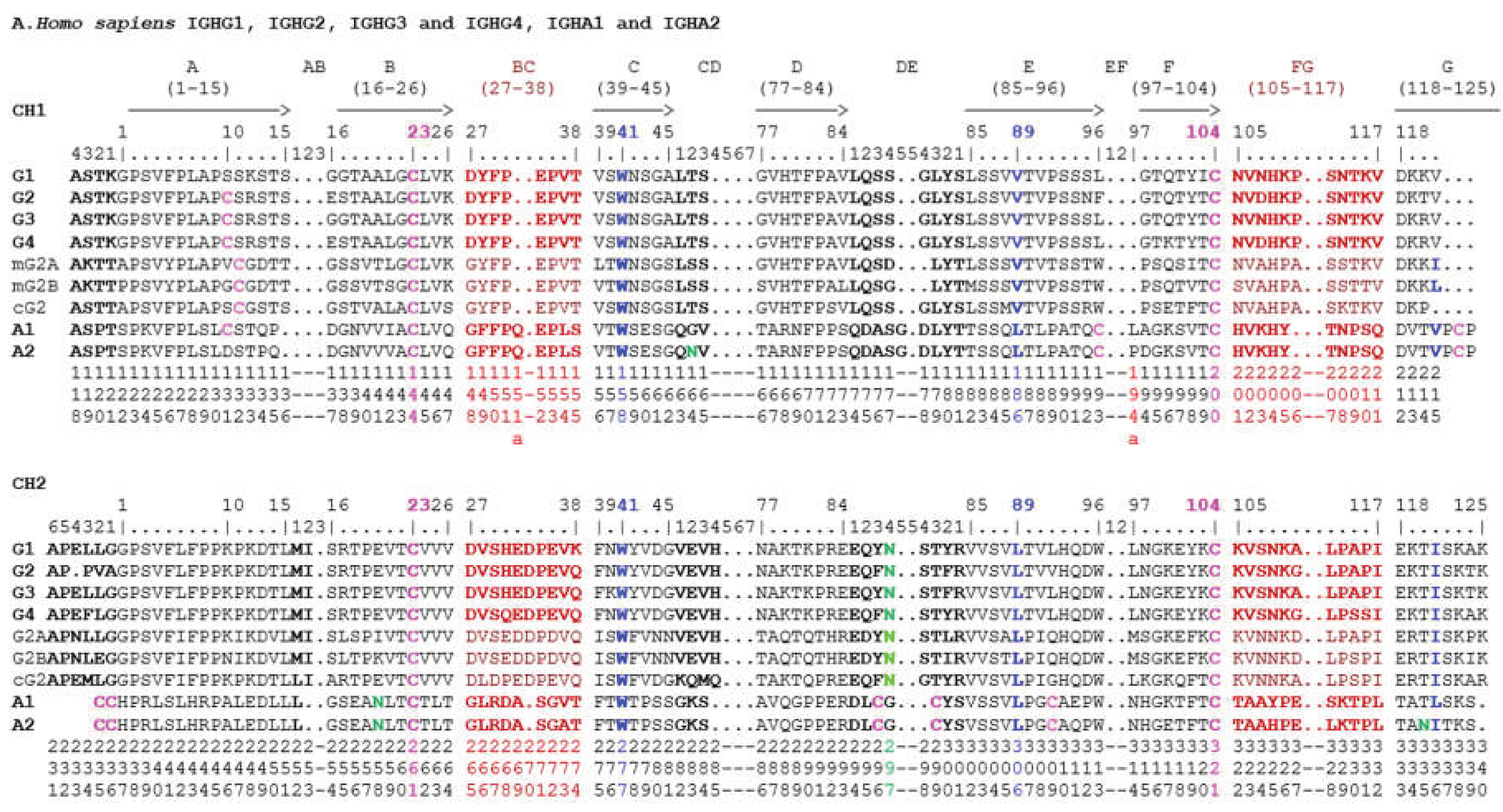
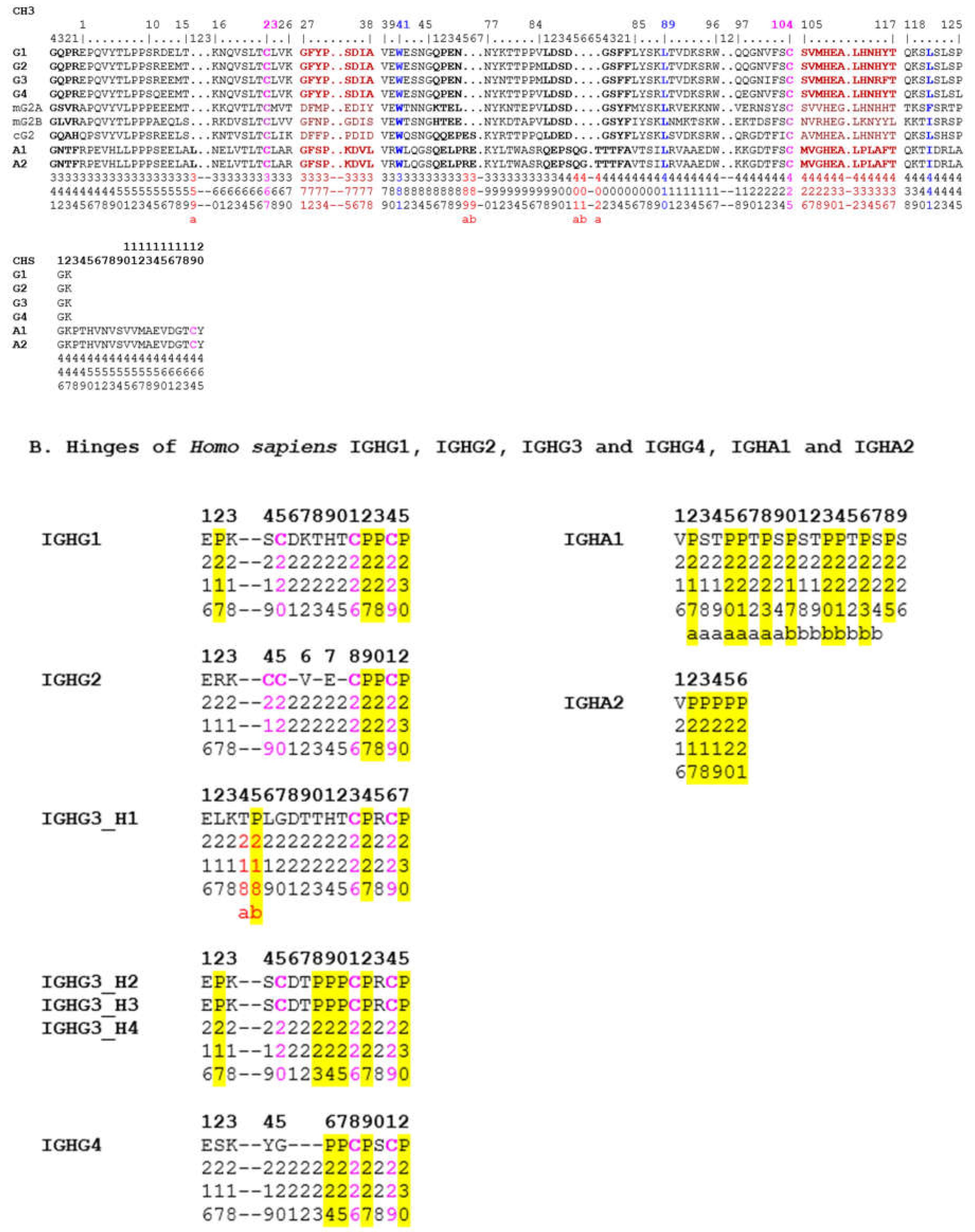
Table 1.
IMGT-NC engineered IGHG variant classification in four categories and 18 types, each type being defined by a ‘Property and Function Type’ [45,46]. (With permission from M-P. Lefranc and G. Lefranc, LIGM, Founders and Authors of IMGT®, the international ImMunoGeneTics information system®, https://www.imgt.org).
Table 1.
IMGT-NC engineered IGHG variant classification in four categories and 18 types, each type being defined by a ‘Property and Function Type’ [45,46]. (With permission from M-P. Lefranc and G. Lefranc, LIGM, Founders and Authors of IMGT®, the international ImMunoGeneTics information system®, https://www.imgt.org).
| Variant Categories |
Variant Types | Property and Function Type |
| Effector | 1 | antibody-dependent cellular cytotoxicity (ADCC) reduction. |
| 2 | antibody-dependent cellular cytotoxicity (ADCC) enhancement. | |
| 3 | antibody-dependent cellular cytotoxicity (ADCC) and antibody-dependent cellular phagocytosis (ADCP) enhancement. | |
| 4 | complement-dependent cytotoxicity (CDC) enhancement. | |
| 5 | complement-dependent cytotoxicity (CDC) reduction. | |
| 6 | antibody-dependent cellular cytotoxicity (ADCC) and complement-dependent cytotoxicity (CDC) reduction. | |
| 7 | FcγRIIB binding increase and B cell inhibition (coengagement of antigen and FcγR on the same cell). | |
| 8 | knock out of the CH2 84.4 glycosylation (ADCC reduction). | |
| Half-life | 9 | half-life increase or decrease. |
| Physicochemical properties | 10 | abrogation of binding to Protein A, thermal stability, pI, reduced acid-induced aggregation.a |
| Structure | 11 | additional intrachain disulfide bridge for domain or scFv stabilization. |
| 12 | prevention of IgG4 half-IG exchange, amino acid changes or insertion at the elbow of crossovers. | |
| 13 | hexamerization. | |
| 14 | enhancement of heteropairing H-H of bispecific antibodies (knobs-into-holes, charge steering, additional disulfide bridge). | |
| 15 | suppression of inter H-L and/or inter H-H disulfide bridges. | |
| 16 | site-specific drug attachment, e.g., additional cysteine. | |
| 17 | enhancement of heteropairing H-L of bispecific antibodies. | |
| 18 | control of H chain expression or of half-IG exchange of bispecific IgG by amino acid changes. |
Disclaimer/Publisher’s Note: The statements, opinions and data contained in all publications are solely those of the individual author(s) and contributor(s) and not of MDPI and/or the editor(s). MDPI and/or the editor(s) disclaim responsibility for any injury to people or property resulting from any ideas, methods, instructions or products referred to in the content. |
© 2026 by the author. Licensee MDPI, Basel, Switzerland. This article is an open access article distributed under the terms and conditions of the Creative Commons Attribution (CC BY) license.
Copyright: This open access article is published under a Creative Commons CC BY 4.0 license, which permit the free download, distribution, and reuse, provided that the author and preprint are cited in any reuse.


