
Submitted:
26 July 2026
Posted:
28 July 2026
You are already at the latest version
Abstract
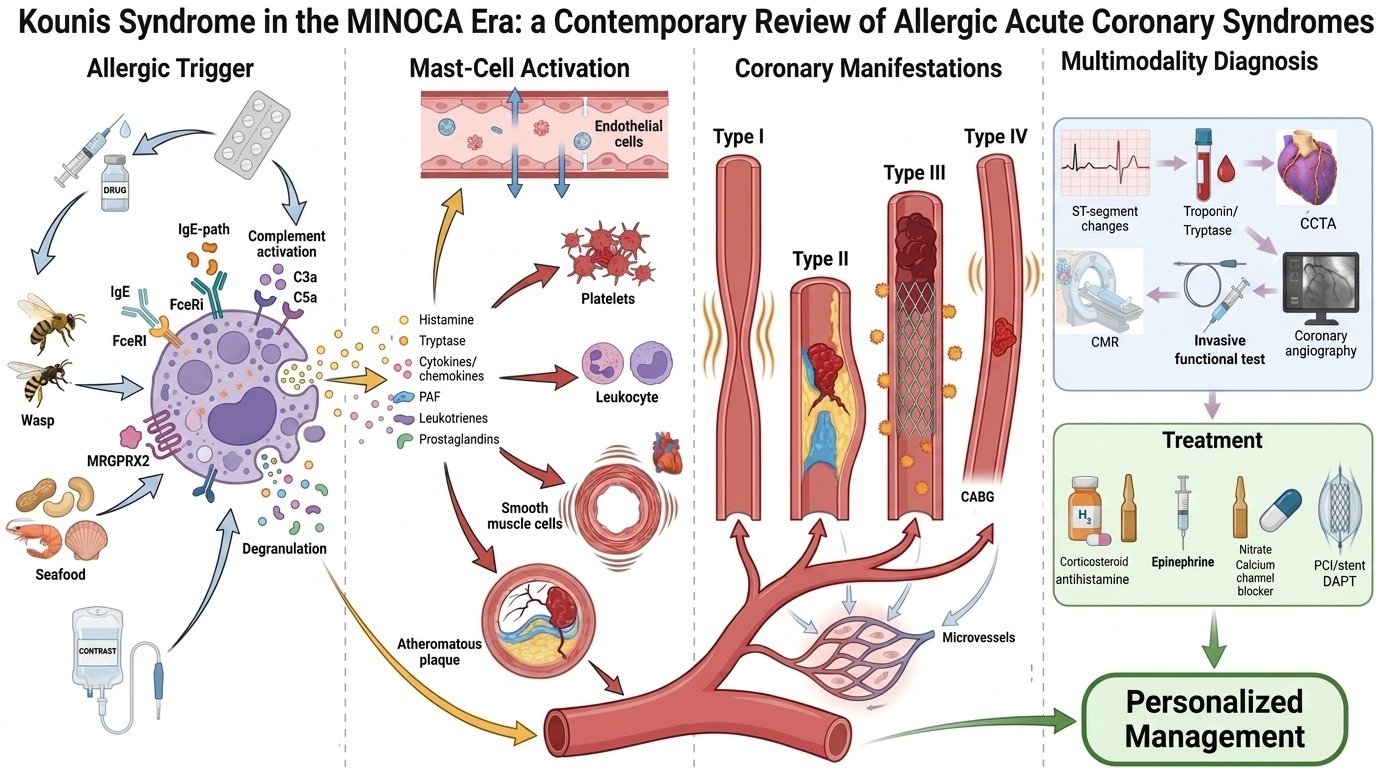
Kounis syndrome (KS) is an increasingly recognized cause of acute coronary syndromes triggered by allergic or hypersensitivity reactions. The syndrome results from a complex interplay between mast-cell degranulation and platelet activation during allergic reactions, leading to the release of vasoactive, pro-inflammatory and prothrombotic mediators. These mechanisms may induce coronary vasospasm (type I KS) or thrombosis of plaque (type II KS), stent (type III KS) or coronary artery bypass graft (type IV KS). KS remains largely underdiagnosed in routine clinical practice, with significant gaps in epidemiology, diagnosis and management. This narrative review critically appraises current evidence, integrating historical perspectives with contemporary insights into classification, pathophysiology, triggers, diagnostic strategies and thera-peutic approaches, focusing on the most frequent manifestation represented by vasospastic variant. Despite increasing recognition over the past three decades, its true pathophysiological mechanisms, diagnostic boundaries, and therapeutic implications remain incompletely understood. Available data indicate that angiographically documented epicardial coronary spasm is observed in only a minority of patients, while normal or non-obstructive coronary arteries are frequently encountered. Emerging evidence from provocative testing, coronary physiology assessment, cardiac magnetic resonance and nuclear imaging suggests that coronary microvascular dysfunction may contribute substantially to the clinical phenotype, expanding the traditional concept of allergic epicardial vasospasm. A comprehensive diagnostic approach, including signs, symptoms, biochemical findings, electrocardiography, echocardiography, coronary angiography, and multimodality imaging including invasive assessment in selected cased, can be recommended, although its implementation in routine practice remains limited. Current evidence supports the recognition of type I KS as a distinct allergic vasomotor acute coronary syndrome within the myocardial infarction non-obstructive cor-onary artery (MINOCA) spectrum, deserving greater recognition in future diagnostic classifications and clinical practice guidelines.
Keywords:
kounis syndrome
; allergic myocardial infarction
; acute coronary syndrome
; MINOCA
; coronary vasospasm
; coronary microvascular dysfunction
; stent thrombosis mast cells
; anaphylaxis
; cardiac magnetic resonance
Copyright: This open access article is published under a Creative Commons CC BY 4.0 license, which permit the free download, distribution, and reuse, provided that the author and preprint are cited in any reuse.


