

Submitted:
27 July 2026
Posted:
28 July 2026
You are already at the latest version
Abstract
This article examines when a gender-responsive public procurement obligation becomes institutionally verifiable. It analyzes Brazil’s federal policy reserving jobs for women experiencing domestic and family violence, established by Law No. 14,133/2021 and regulated by Decrees No. 11,430/2023 and No. 12,516/2025. The study uses the empirical legal design documented in the underlying doctoral thesis and preserves four non-interchangeable evidentiary layers: an audit of 163 records; a retained corpus of 74 documentary units; a comparative matrix of 67 cases and 335 evidence records; and aggregate official and administrative information. The expanded matrix identified 16 cases with high density across all four dimensions, five with partial intersectoral integration, and 51 that were not verifiable through the documentary proxy. These figures describe the expanded corpus and are not used as a federal compliance denominator. Official aggregate data documented localized implementation involving 20 women; a later administrative update reported 143 women hired across five federative units, without contract-level granularity. The findings indicate that contractual enforceability, intersectoral connectivity, and protected verifiability are necessary institutional conditions—although not sufficient evidence of social impact—for converting the mandate into a monitorable practice. The article distinguishes direct federal evidence, normative diffusion, documentary absence, and non-verifiability without inferring a national effectiveness rate.
Keywords:
gender-responsive public procurement
; legal implementation
; affirmative action
; domestic violence
; documentary traceability
; accountability
; data protection
1. Introduction
Public procurement is no longer understood solely as a set of procedures for the efficient acquisition of goods, services, and works. In recent decades, its economic scale, institutional reach, and capacity to shape markets have increased interest in its strategic use to advance environmental, social, labor, and innovation objectives. From this perspective, the state acts not only as a purchaser: by defining participation requirements, performance clauses, evaluation criteria, and oversight mechanisms, it also signals standards of conduct and creates incentives that can affect suppliers, workers, and supply chains. The literature describes this development as a shift from transactional procurement toward strategic procurement or procurement oriented to the creation of public value (McCrudden 2004; Grandia and Meehan 2017; OECD 2021).
Among the social objectives incorporated into this field, gender equality has gained increasing prominence. Gender-responsive public procurement encompasses distinct strategies: expanding the participation of women-owned businesses, requiring equal pay, combating discrimination in supply chains, including equity criteria in supplier selection, and creating employment opportunities for groups of women facing specific barriers. International organizations have argued that mainstreaming gender throughout the procurement cycle depends not only on legal authorization but also on institutions, partnerships, evidence, administrative capacity, and monitoring mechanisms (UN Women and ILO 2021; OECD 2021; UN Women 2023; EIB 2026).
Most international scholarship, however, focuses on women-owned enterprises’ access to public markets. Studies of Canada, the United States, African countries, and European experiences show that quotas, preferences, and supplier-diversity programs may coexist with low effective participation, institutional fragmentation, and a persistent gap between policy and practice (Medina-Arnáiz 2010; Orser et al. 2021; Williams-Elegbe 2024). Less attention has been paid to a different form of gender-responsive procurement: the use of contract-performance clauses to reserve jobs for women facing defined vulnerabilities. This model redistributes not only business opportunities; it seeks to transform outsourced public contracts into an infrastructure for labor inclusion.
Brazil provides a particularly relevant case. Article 25, paragraph 9, item I, of Law No. 14,133/2021 authorized tender documents to require that a minimum percentage of the workforce assigned to contract performance consist of women who are victims of domestic violence. Decree No. 11,430/2023 regulated the measure within the direct federal administration, federal agencies, and public foundations. Decree No. 12,516/2025 subsequently revised operational aspects by establishing a minimum reservation of 8% of positions in continuous-service contracts involving the exclusive allocation of labor and by simplifying federative coordination through accession agreements (Brazil 2021, 2023, 2025a). The design connects public procurement, policies addressing violence against women, support-service networks, outsourced companies, and contract oversight.
The measure responds to a complex public problem. Domestic and family violence is not limited to physical assault and cannot be addressed exclusively through criminal law. It intersects with inequalities of gender, race, income, employment, care responsibilities, and access to services. Economic dependence may restrict exit options, hinder the reorganization of daily life, and prolong vulnerability. Employment, in turn, does not automatically produce safety or autonomy, but it can form part of the material conditions that expand choices and reduce dependence (Vyas and Watts 2009; Peled and Krigel 2016; Soares and Teixeira 2022). The Brazilian policy should therefore be assessed without resorting to two opposing simplifications: employment alone cannot be presumed to break cycles of violence, but the potential value of a protected opportunity for work and income should not be dismissed.
The central legal problem arises in the transition from normative validity to institutional operation. A rule may be constitutionally justified, formally in force, and incorporated into tender documents, yet still fail to generate a stable process of referral, hiring, retention, and monitoring. Between the norm and the outcome lie interdependent stages: procurement planning, drafting the tender instrument, calculating eligible positions, formulating the clause, coordinating with women’s policy bodies, confidentially identifying candidates, selection by the contractor, monitoring performance, replacing vacancies, and producing administrative information. Weakness at any link can turn legal innovation into a merely declaratory obligation.
This issue is especially important at the intersection of law and public policy because the success of a social clause cannot be inferred from its textual presence alone. A clause may make the policy enforceable without making it operational; an institutional agreement may allocate responsibilities without ensuring that the referral pathway is used; and aggregate data may indicate expansion without linking each outcome to the relevant contract. Effectiveness therefore requires an architecture that simultaneously preserves oversight capacity and protects beneficiaries. Transparency in this context does not mean unrestricted disclosure of personal information. The challenge is to produce sufficient data for oversight and evaluation without compromising confidentiality, dignity, or safety.
Brazilian scholarship has begun to examine gender-responsive procurement following Law No. 14,133/2021. In a historical and normative analysis, Marques and Santos (2026) discuss the policy’s development, foundations, and possible pathologies in its access criteria. The present study occupies a distinct and complementary space: it empirically investigates how the obligation appears in procurement documents and under what conditions it becomes institutionally verifiable. Rather than reconstructing only the legal meaning of the measure, it follows the documentary trail of implementation and distinguishes direct application of the federal decree, analogous experiences, and cases in which no specific clause was located.
The research question is: under what legal and institutional conditions can a gender-responsive public procurement policy move from a formal mandate to institutionally verifiable implementation of employment opportunities for women experiencing domestic and family violence? The objective is to analyze the institutional and operational effectiveness of Brazil’s federal policy through its normative design, incorporation into procurement instruments, referral processes, and publicly available evidence of implementation. Effectiveness is used in a deliberately limited sense: the study does not measure causal effects on individual trajectories, but rather the existence of legal, documentary, administrative, and organizational conditions capable of converting the obligation into a protected, monitorable, and results-oriented practice.
The article makes five contributions. First, it is empirical: it preserves the thesis’s distinct evidentiary layers and restricts federal conclusions to evidence legally compatible with the decree, avoiding a heterogeneous denominator. Second, it is methodological: it presents an evidentiary architecture and auditable decision rules for studying sensitive policies without exposing beneficiaries. Third, it is legal: it connects the binding force of procurement instruments, the allocation of institutional competences, and data protection to implementation assessment. Fourth, it is conceptual: it proposes that verifiable institutional implementation depends on the combination of contractual enforceability, intersectoral connectivity, and protected verifiability. Fifth, it is comparative: it uses the Brazilian case to formulate hypotheses that may be tested in studies of other social clauses.
The article is organized into six sections. Following this introduction, Section 2 presents the legal and theoretical framework and the Brazilian regulatory architecture. Section 3 describes the materials, methods, scope criteria, and coding procedures. Section 4 reports the results. Section 5 discusses the findings and develops the three-dimensional implementation model. Section 6 summarizes the conclusions, limitations, and regulatory implications.
2. Legal and Theoretical Framework
2.1. Strategic and Gender-Responsive Public Procurement
The use of public procurement to pursue social objectives is not new. McCrudden (2004) historically traces the relationship between purchasing power and social regulation, showing how public contracts have been used to influence labor standards, equality, and inclusion. The contemporary development of this rationale is associated with strategic procurement: purchasing decisions remain subject to efficiency, competition, and integrity, but may also incorporate additional public purposes when legally authorized, proportionate, and verifiable (Grandia and Meehan 2017).
This expansion does not eliminate tensions. The inclusion of social objectives may increase complexity, transaction costs, and administrative-capacity requirements. It may also produce generic clauses disconnected from the subject matter of the contract or weakly monitored in practice. The question is therefore not only whether procurement may pursue social aims, but how those aims can be translated into intelligible and controllable obligations. Strategic procurement requires coherence among the public need, clause design, allocation of responsibilities, implementation indicators, and consequences of non-performance.
Gender-responsive public procurement is a specific application of this rationale. The OECD (2021) defines the field as the use of procurement opportunities to advance gender equality and improve suppliers’ performance regarding women’s empowerment. UN Women and the ILO (2021) propose a broader understanding that is not limited to purchasing from women-owned firms, but also encompasses working conditions, value chains, and equality outcomes. UN Women’s comparative review (2023) further emphasizes that gender must be embedded in the legal, regulatory, and policy frameworks governing the procurement cycle.
International experience reveals multiple techniques. These include set-asides or targets for women-owned businesses, supplier certification, tie-breaking criteria, equal-pay requirements, non-discrimination clauses, employment and training targets, and reporting duties. Medina-Arnáiz (2010) showed how equality clauses may appear at different stages of Spanish procurement procedures. Examining Canadian firms, Orser et al. (2021) identified sectoral underrepresentation and a gap between announced policies and effective access. Williams-Elegbe (2024) demonstrates that preferential frameworks in Africa coexist with legal, institutional, cultural, and integrity-related barriers. Across these contexts, the existence of a preferential rule does not, by itself, change patterns of participation.
The Brazilian model examined in this article differs from the more common configuration. The benefit is not tied to company ownership, but to the composition of the workforce employed in outsourced contract performance. The company is selected under ordinary procurement rules and, during performance, must reserve positions for women referred through the public policy. This choice shifts the focus from supplier diversity to diversity and inclusion in publicly financed employment. In regulatory terms, it is a social contract-performance clause linked to gender-based affirmative action.
This distinctive design has consequences. Programs targeting women-owned businesses can be monitored through data on ownership, participation in tenders, awarded contracts, and contract values. Reserving positions for women experiencing violence requires a different information infrastructure: the number of eligible positions, the reserved percentage, occupational profiles, referred candidates, completed hires, vacancies, replacements, retention, and reasons for non-filling. Moreover, the condition underlying eligibility is sensitive and must not be disclosed in the workplace. The policy therefore combines a greater need for information with a heightened duty of protection.
2.2. Substantive Equality, Affirmative Action, and Economic Autonomy
The legitimacy of the reservation must be situated within the distinction between formal and substantive equality. Formal equality prohibits arbitrary discrimination and requires impartial treatment; substantive equality recognizes that apparently neutral rules may perpetuate historical barriers and that differentiated measures may be necessary to achieve genuinely equal access. In Brazilian constitutional law, affirmative action has been recognized as compatible with equality when it addresses an identifiable inequality, rests on a legal basis, pursues a legitimate purpose, and is proportionately designed (Gomes 2001; Piovesan 2005; Brazil 2014).
The policy targets women experiencing domestic and family violence, a group whose vulnerability is not homogeneous. Gender intersects with race, class, territory, disability, age, gender identity, education, and care responsibilities. Intersectionality prevents the category “women” from being treated as an abstract and uniform subject (Crenshaw 1991; Akotirene 2019). The most recent Brazilian regulation partly reflects this concern by including transgender women and travestis (a Latin American transfeminine identity) and by prioritizing Black and Brown women according to local demographic composition (Brazil 2025a).
Affirmative action must also avoid revictimization. Requiring candidates to prove violence directly to the company or co-workers would create risks of exposure and stigma. The federal design instead relies on referrals by public-policy units, thereby preserving institutional mediation. This arrangement assigns verification of eligibility to the support network and limits the company’s access to strictly necessary information. Protection is not external to the policy; it forms part of its legal substance and operational feasibility.
Economic autonomy is important, but it is not the sole consideration. Research on intimate partner violence identifies complex relationships among economic resources, bargaining power, risk of violence, and capacity to leave. Increased income may expand options, but its effects vary with context, the perpetrator’s control, support networks, and institutional safety (Vyas and Watts 2009). Reviews of survivors’ economic independence emphasize the need to combine employment, training, assistance, protection, and long-term support (Peled and Krigel 2016). In Brazil, economic dependence is associated with intimate partner violence, although it is neither the sole cause nor a uniform mechanism (Soares and Teixeira 2022).
Accordingly, job reservation should not be presented as a complete solution to domestic violence. Its justification is more precise: it seeks to remove a significant material barrier and expand access to protected employment opportunities for women supported by the service network. Substantive effectiveness will depend on job quality, workplace support, retention, and coordination with other policies. For the purposes of this study, however, the observable outcome is narrower: whether the legal-administrative arrangement creates conditions for positions to be accessed and monitored in practice.
2.3. Implementation, Intersectorality, Accountability, and Data Protection
Public policies do not end with legislative adoption. Implementation scholarship has shown that approved objectives may be transformed, delayed, or neutralized by long chains of decisions, multiple actors, ambiguities, and unequal capacities (Pressman and Wildavsky 1973; Sabatier and Mazmanian 1980; Matland 1995). In the case of social clauses, the gap between norm and outcome is widened because implementation occurs through private contractors, under public oversight, and—in this case—in coordination with a protection network that does not necessarily form part of the contracting authority’s organizational structure.
Intersectorality addresses problems that cannot be contained within a single administrative unit. Cunill-Grau (2014) distinguishes episodic coordination from integration capable of sharing objectives, processes, and responsibilities. The Brazilian policy requires interaction among federal bodies, state or municipal women’s policy bodies, support-network services, and companies. This architecture creates reciprocal dependencies: without a contractual provision, the company has no enforceable duty; without a partner institution, the contracting authority may receive no candidates; without information about profiles and vacancies, referrals may be unsuitable; and without oversight, there is neither correction nor accountability.
Accountability adds another dimension. A legal obligation must become the object of records, monitoring, and, where appropriate, sanctions. Publicity, however, must be calibrated. Personal data concerning women experiencing violence are sensitive, and disclosure may cause harm. The solution is not to eliminate records, but to build a protected information layer: individualized data accessible only to authorized actors and aggregate data sufficient for public oversight. This distinction reconciles administrative transparency, data protection, and evaluation.
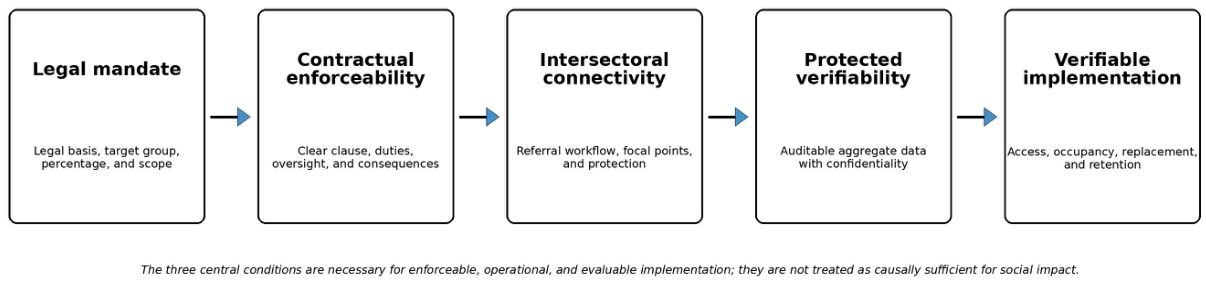
On this basis, the article proposes three analytical conditions. The first is contractual enforceability: the obligation must clearly define its scope, percentage, responsibilities, maintenance, and consequences. The second is intersectoral connectivity: an agreement or functional workflow must connect vacancies, the support network, referral, and selection, with focal points and safeguards. The third is protected verifiability: the system must produce auditable implementation records without disclosing workers’ identities or protected status. Joint operation of the three conditions makes implementation legally enforceable, operational, and evaluable, but does not by itself establish social impact or employment retention.
The legal theory of public policy reinforces the proposition that the validity of a legal command does not exhaust the legal phenomenon. Policy materializes through competences, procedures, instruments, organizations, and implementation decisions (Bucci 2013). The policy-cycle framework is useful for identifying points of translation and failure, but it should not be treated as a linear sequence: agenda setting, formulation, procurement, implementation, monitoring, and evaluation feed back into one another and depend on distributed capacities (Howlett, Ramesh, and Perl 2013; Winter 2003).
In the present case, accountability cannot be reduced to unrestricted publicity. Experience of violence is sensitive information, and governance must reconcile oversight with purpose limitation, necessity, data minimization, security, and access control, principles consistent with Brazil’s General Data Protection Law (Lei Geral de Proteção de Dados Pessoais—LGPD). The information required to verify that a position has been filled does not include a reproduction of the survivor’s history; it requires only confirmation through an authorized channel, aggregate counts, and protected contractual records (Brazil 2018).
The proposed framework is therefore a model of necessary conditions for verifiable implementation, not a theory of causal sufficiency. The simultaneous presence of the three conditions increases the capacity to convert a legal norm into an institutional routine and to produce evidence; it does not by itself guarantee retention, job quality, economic autonomy, or reduced violence, all of which would require longitudinal data and research involving participants.
Figure 1.
Analytical model of the transition from legal mandate to verifiable implementation. Source: Authors’ own elaboration.
Figure 1.
Analytical model of the transition from legal mandate to verifiable implementation. Source: Authors’ own elaboration.
2.4. Legal and Institutional Architecture of the Brazilian Policy
The Brazilian Constitution establishes equality between women and men, the reduction of inequalities, and the state’s duty to address violence. Law No. 11,340/2006, known as the Maria da Penha Law, recognizes domestic and family violence as a human rights violation and establishes integrated measures of prevention, protection, and accountability (Brazil 1988, 2006). Law No. 14,133/2021, which reorganized the general framework for public procurement and contracts, expressly authorized workforce reservations for women who are victims of domestic violence and the use of gender-equity measures as tie-breaking criteria (Brazil 2021).
Decree No. 11,430/2023 regulated the policy within the direct federal administration, federal agencies, and public foundations. Its scope focuses on continuous-service contracts involving the exclusive allocation of labor. Decree No. 12,516/2025 established a reservation of at least 8% of positions and improved the mechanism of federative coordination by replacing more complex arrangements with accession agreements. The 2025 amendment also permitted reservations in contracts with fewer than 25 workers, required maintenance of the percentage throughout performance, included transgender women and travestis, prioritized Black and Brown women, and prohibited contractors and contracting authorities from requiring additional proof of violence (Brazil 2025a).
The prescribed workflow can be summarized in four movements. The federal body plans the procurement and includes the obligation in the tender notice, terms of reference, and contract. The women’s policy body confidentially identifies women supported by the service network who are interested in the positions. The contractor receives candidates whose profiles match the occupational requirements, conducts its selection process, and hires them. The contracting authority monitors compliance during performance. The employment relationship is established with the service provider, not with the public administration.
The design allocates responsibilities but also creates risk points. The contracting authority may insert a generic clause without properly calculating positions or providing for replacement. The partner institution may not receive advance information about occupational profiles and deadlines. The company may treat the reservation as an initial obligation without maintaining it during substitutions. Oversight may record only the total number of employees, without a specific indicator. Finally, data may remain fragmented across the contract, contracting authority, company, and support network.
The Logistics Handbook prepared by the Ministry of Management and Innovation in Public Services details procedures, roles, and safeguards (MGI 2024). The existence of this guidance shows that the legal command requires administrative translation. Nevertheless, manuals and model clauses do not replace incorporation into specific procurement instruments or guarantee uniform use. The empirical question remains: to what extent does the regulatory architecture appear in the documents actually produced, and which components prove most fragile?

Table 1.
Legal architecture of the federal policy and implementation risks.
| Component | Legal-operational content | Implementation risk |
|---|---|---|
| Scope | Direct federal administration, federal agencies, and public foundations; continuous services involving the exclusive allocation of labor. | Confusion with state-owned enterprises, other branches of government, or subnational entities; use of out-of-scope cases as the federal denominator. |
| Reservation | At least 8%; regulated possibility in smaller contracts; maintenance during performance and proportional distribution across services. | Unspecified calculation; generic rule; loss of the reservation through vacancies and substitutions. |
| Referral | Exclusive referral by public-policy units that are parties to the accession agreement. | Agreement without an active workflow; late communication; absence of suitable candidates when contract mobilization begins. |
| Protection | Confidentiality, prohibition of additional proof, inclusion of transgender women and travestis, and intersectional priority. | Disclosure of protected status, discrimination, excessive data collection, and revictimization. |
| Oversight | Duty to maintain the percentage, monitoring by the contracting authority, records, and response to non-compliance. | Generic oversight without a specific indicator; sanctioning the contractor for failure attributable to the public referral workflow. |
| Information | Minimum contract-level data and aggregate consolidation consistent with the LGPD and beneficiary safety. | Absolute secrecy or excessive publicity; aggregate data without links to contracts and periods. |
Source: Authors’ own elaboration based on Law No. 14,133/2021, Decrees No. 11,430/2023 and No. 12,516/2025, and Law No. 13,709/2018.
3. Materials and Methods
3.1. Research Design, Object, and Scope of Inference
The study adopts a qualitative, applied, exploratory, and evaluative empirical legal design. Its central object is the institutional and operational implementation of Decree No. 11,430/2023. Within the strict federal scope, the unit of analysis is the arrangement formed by the contracting authority or entity, the procurement instrument, the contractor, the reservation clause, the accession agreement or referral workflow, and the oversight mechanisms. The unit of observation is the auditable documentary dossier associated with a procurement procedure or contract.
Effectiveness is understood in an institutionally and operationally limited legal sense. The study does not measure causal effects on economic autonomy, safety, income, or exit from cycles of violence. Nor does it treat every located contract as a case of federal compliance or non-compliance. Within the strict core, the analysis assesses whether verifiable operating conditions exist; within the expanded corpus, analogous experiences are examined only to compare design, trace normative diffusion, and identify mechanisms.
The design was refined after a pilot stage. The object, the four analytical dimensions, and the use of public sources were retained, while the unit of analysis, documentary sufficiency, and separation between direct federal application and the expanded corpus were sharpened. This subsequent audit prevented state, municipal, judicial, prosecutorial, state-owned enterprise, or otherwise separately regulated contracts from being attributed to Decree No. 11,430/2023.
3.2. Scope, Sources, and Documentary Search Protocol
The temporal scope covered procurement procedures and contracts concluded between 2021 and 2025, encompassing the statutory introduction of the reservation, federal regulation, and the initial years of implementation. The search was nationwide, but legal interpretation was differentiated according to level of government, branch, institutional nature, legal basis, subject matter, period, and the existence of a referral workflow.
The material scope prioritized labor-intensive services, especially continuous services involving the exclusive allocation of labor. Goods, works, leases, individualized social-service accreditation, one-off technical services, and objects without outsourced positions were excluded. Dossiers supported only by summary item lists were retained as insufficient documentation, without inferring absence.
The primary source was Brazil’s National Public Procurement Portal (Portal Nacional de Contratações Públicas—PNCP), supplemented by institutional portals, procurement documents, freedom-of-information responses, and administrative information. Searches combined direct and functionally equivalent expressions concerning domestic and family violence, job reservations, relevant federal and institution-specific rules, percentages of the workforce, women’s policy bodies, accession or referral arrangements, confidentiality, replacement, and labor-intensive outsourced services. This wording reproduces the search logic documented in the thesis and does not add unrecorded consultation parameters.
Documents examined included tender notices, terms of reference, preliminary technical studies, contracts, draft contracts, amendments, price-registration minutes, management or inspection orders, spreadsheets, measurement documents, institutional responses, and equivalent records. The underlying doctoral thesis documents the screening pathway, DAD decisions, coding rules, and traceability appendix; this article reports only procedures and parameters recorded in that source.
3.3. Document Mining, Audit, and Analytical Pipeline
Data collection combined automated scanning of public databases, metadata extraction, file downloading, dossier organization, optical character recognition where necessary, lexical and semantic screening, and human audit. Language models were used only to locate candidate documents and organize preliminary information; no inclusion, exclusion, classification, or scoring decision was automated.
Every item of evidence used in the analysis was verified in the original document and recorded by code, source, page, excerpt, and interpretation. Duplicates and supporting documents remained in the audit trail but were not counted as new units. This combination expanded coverage without replacing legal-documentary judgment.
Table 2.
Document-mining and audit pipeline.
| Stage | Procedure | Purpose | Error control |
|---|---|---|---|
| 1. Parameterization | Definition of period, subject matter, institutions, and search vocabulary. | Locate potentially relevant procurements. | Registration of parameters and controlled protocol updates. |
| 2. Scanning and collection | Consultation of metadata, portals, and documents; file downloads. | Expand coverage and assemble the documentary cycle. | PNCP identifier, institution, year, subject matter, and source address. |
| 3. Processing | OCR, text conversion, and organization by dossier. | Make documents searchable and comparable. | Manual verification of relevant passages. |
| 4. Screening | Lexical and semantic searches for clauses, workflows, protection, oversight, and implementation. | Select candidate excerpts and cases. | Automated screening without final decisions. |
| 5. Human audit | Direct reading, legal and documentary classification, inclusion/exclusion, and scoring. | Define the analytical database. | Explicit justification linked to evidence. |
| 6. Traceability | DAD register and evidence matrix. | Enable external audit. | Correspondence among case, document, page, excerpt, and decision. |
Source: Authors’ own elaboration based on the doctoral thesis protocol.
3.4. Evidentiary Layers and Denominators
The study used four non-interchangeable evidentiary layers established in the doctoral thesis. The audit base records the full search process; the retained DAD corpus contains documentarily relevant units and preserves legal-scope classifications; the comparative matrix codes cases across analytical dimensions and links them to 335 evidence records; and aggregate official and administrative information contextualizes implementation and the state’s monitoring capacity. The thesis did not create a separate numerical federal denominator. Federal conclusions were therefore formulated case by case only when institutional, temporal, material, and operational scope requirements were satisfied. This architecture prevents normative diffusion from being treated as federal compliance, documentary insufficiency from being treated as absence, and aggregate information from being treated as a contract-specific outcome.
The audit began with 163 public records. After separation by documentary unit, 74 were retained, 44 were excluded because their subject matter was incompatible, 44 were classified as duplicates or supporting records, and one was treated as hybrid. The 74 retained units comprised 36 CP-DIR, four CP-ANA, 26 CN-SEM, and eight DOC-INSUF units. The matrix was closed with 67 cases and 335 coding records; seven later units remained only in the traceability database as DOC-INSUF.
The DAD classes do not automatically establish incidence or effectiveness under the federal decree. CP-DIR identifies a clause directly applicable under the documentary unit’s own legal basis; the federal inference additionally requires control of the institution, period, subject matter, and relevant referral arrangement. CP-ANA and out-of-scope CN-SEM units serve comparative and diffusion purposes only, while DOC-INSUF and ND preclude an inference of absence. Consistent with the thesis, this article does not calculate a federal compliance, non-compliance, prevalence, or effectiveness rate.
Table 3.
Evidentiary layers, denominators, and permissible scope of inference.
| Layer | Quantity | Function | Permissible inference |
|---|---|---|---|
| Audit base | 163 records | Document the search pathway, exclusions, duplicates, and the hybrid unit. | Process transparency; does not measure implementation. |
| Retained DAD corpus | 74 units: 36 CP-DIR, 4 CP-ANA, 26 CN-SEM, and 8 DOC-INSUF | Preserve legal bases, documentary sufficiency, diffusion, exclusions, and cautions. | Normative diffusion, documentary scope, and institutional variation; classes require legal-scope control before federal inference. |
| Comparative matrix and evidence records | 67 cases; 335 records (four dimensions and one proxy per case) | Identify co-occurrence patterns and document every score. | Descriptive patterns in the expanded corpus; not a federal denominator, and the 335 records are not independent cases or contracts. |
| Aggregate official and administrative information | 82, 77, 16, 20, and a later update of 143 | Contextualize localized implementation and state monitoring capacity. | Reported implementation and a contextual indication of expansion; not contract-level audit, retention, national coverage, or an effectiveness rate. |
Note: The quantities refer to different units and analytical functions; they should neither be added together nor converted into a single rate.
3.5. DAD Classification, Coding Instrument, and Decision Rules
The DAD register classified units as CP-DIR (a directly applicable clause under the contract’s own legal basis), CP-ANA (a positive analogous case), CN-SEM (sufficient documentation without a specific clause), DOC-INSUF (a compatible object but a source incapable of establishing presence or absence), EXC-OBJ, EXC-DUP, or MIX. CP-DIR did not automatically mean application of the federal decree; equivalence was recognized only after reclassifying the entity, legal basis, period, and subject matter.
The four dimensions were normative adherence, intersectoral integration, justice and support, and governance and accountability. A score of 0 was assigned only when an adequate source was examined and the component was absent; a score of 1 indicated a partial, generic, or weakly operational provision; a score of 2 indicated a clear, specific provision linked to responsibilities, a workflow, or a consequence; and ND was used when documentation did not permit the component to be tested. A zero score and insufficient documentation were therefore mutually exclusive categories.
The documentary proxy classified convergence among the clause, institutional arrangement, and implementation as ED-B, ED-M, ED-A, or ND. ED-A required concordant evidence across all three dimensions; ED-M indicated partial convergence; ED-B indicated limited evidence; and ND indicated the absence of an adequate evidentiary basis. None of these categories represents a percentage of positions, individual occupancy, or impact.
Table 4.
Classification rules and interpretation.
| Element | Decision rule | Interpretation |
|---|---|---|
| CP-DIR | Clause directly applicable under the contract’s legal basis. | Supports direct federal inference only after legal control of institutional, temporal, material, and operational scope. |
| CP-ANA | Equivalent clause based on a related legal rule. | Comparison and diffusion, without inference regarding the federal decree. |
| CN-SEM | Sufficient document and absence of a specific clause. | Documentary absence under the relevant regime; constitutes non-compliance only if legal coverage is demonstrated. |
| DOC-INSUF / ND | Source incapable of testing presence, workflow, or implementation. | Does not support an inference of absence or non-compliance. |
| Score 0 | Adequate source; component not located. | Verifiable absence of the component in the analyzed case. |
| Score 1 | Partial or generic provision. | Incomplete institutionalization. |
| Score 2 | Clear, specific, and operational provision. | High documentary density of the component. |
| ED-A / ED-M / ED-B | High, intermediate, or limited convergence among clause, arrangement, and implementation. | Ordinal verifiability proxy, not an outcome rate. |
Source: Coding protocol developed for the doctoral thesis.
3.6. Analytical Procedures, Reliability, Ethics, and Use of Artificial Intelligence
Analysis proceeded in six stages: dossier organization; DAD classification; dimension-guided reading; score registration; linkage of each decision to the document, page, excerpt, and justification; and synthesis through simple frequencies and qualitative analysis. For scores of 0, 1, and 2, the valid denominator was 66, excluding the single ND case; combined patterns and the proxy used the structural total of 67. No inferential tests were performed because selection was purposive and traceability-oriented.
Reliability was supported by explicit criteria, duplicate control, separation of data from interpretation, human validation of OCR and automated screening, audit of the legal basis, the DAD register, and a matrix containing 335 evidence records. The principal safeguard against arbitrariness was the ability to reconstruct every decision from the original document, page, excerpt, and recorded justification. The thesis does not report independent double coding or an intercoder-reliability coefficient; this limitation is therefore acknowledged rather than retrospectively supplemented.
The study involved no interviews, medical records, confidential databases, or identification of beneficiaries. Data minimization was applied: the object of inquiry was the institutional existence of clauses, workflows, and safeguards, not the identities or personal histories of the women concerned.
Generative artificial intelligence was used only as an auxiliary, supervised, and non-decisional tool. ChatGPT (OpenAI; accessed July 2026) assisted with textual organization, academic-language revision, terminological standardization, coherence checking, preliminary organization of documentary evidence, and English-language editing. It was not used to determine inclusion or exclusion, assign DAD classifications or scores, generate empirical data, fill documentary gaps, or make methodological, legal, or interpretive decisions. All tool-assisted outputs were reviewed and verified by the authors against the original public documents, evidence matrices, and institutional responses. No sensitive personal data or information capable of identifying women experiencing domestic and family violence were entered into the tool.
4. Results
4.1. Results of the Documentary Audit
The audit showed that the principal difficulty was not merely locating documents, but correctly delimiting units, subject matters, and legal regimes. Of the 163 initial records, 74 units were retained; 44 were excluded because of material incompatibility; 44 were duplicates or supporting documents; and one was treated as hybrid. Preserving these decisions prevents corpus inflation and makes it possible to trace how raw records were converted into analytical cases.
Among the retained units, 40 contained some form of positive clause under their own legal basis—36 CP-DIR and four CP-ANA—26 were materially compatible contracts in which no specific clause was located, and eight were documentarily insufficient. These classes describe the documentary pathway; they do not automatically correspond to matrix scores or to the scope of the federal decree.
Table 5.
Conversion of raw records into the analytical database.
| Audit result | Quantity | Treatment |
|---|---|---|
| Retained units | 74 | Included in the DAD corpus, preserving the legal basis and documentary sufficiency. |
| Subject-matter exclusions | 44 | Goods, works, leases, one-off services, or objects without compatible positions. |
| Duplicates/supporting documents | 44 | Linked to the corresponding dossier without being counted again. |
| Hybrid unit | 1 | Separated and treated cautiously to prevent contamination. |
| Closed matrix | 67 cases / 335 records | Basis for comparative patterns; seven later DOC-INSUF units remained only in the DAD register. |
Source: DAD audit register.
4.2. Federal-Scope Evidence: Localized Incorporation and Measurement Limits
The DAD register and traceability appendix contain federal procurement documents in which directly applicable reservation clauses were located. They also record important documentary and operational caveats. In some entries, the complete contract file required confirmation; in others, the number of workers stated in the contract could affect whether the operational threshold was reached. Other federal documentary units remained DOC-INSUF because the available records did not permit adequate testing of the clause or implementation cycle. These cases demonstrate both normative incorporation and the limits of the public documentary infrastructure, but they are not aggregated into a separate federal denominator.
Federal-scope inference was therefore made only from evidence compatible with the decree and its implementation arrangements. The seven units DAD-064 to DAD-070, added after matrix closure, remained exclusively in the traceability database as DOC-INSUF and did not alter the matrix. No absence of a clause was treated as federal non-compliance unless the documentation and legal scope were adequate, and no national compliance estimate was produced. The evidence supports the existence of federal normative incorporation while preserving uncertainty regarding prevalence and contract-level outcomes.
Inference concerning the federal policy therefore does not depend on the 45 zero-scoring cases in the expanded corpus. It rests on three converging sets of evidence: federal contracts containing directly applicable clauses; official agreements, guidance, and workflows; and administrative implementation data. This triangulation supports the conclusion that the policy exists and has been implemented, but does not authorize a national effectiveness rate.
Table 6.
Criteria governing federal-scope inference.
| Criterion | Scope question | Consequence for inference | Evidence required | Inference prohibited |
|---|---|---|---|---|
| Institutional scope | Is the contracting body within the direct federal administration, a federal agency, or a public foundation covered by the decree? | Out-of-scope entities may inform comparison or diffusion only. | Institutional status and contracting instrument. | Treating an out-of-scope case as federal compliance or non-compliance. |
| Temporal and legal basis | Was the instrument concluded under the relevant statutory and regulatory framework? | A clause based on another rule is not automatically attributed to Decree No. 11,430/2023. | Date, governing rule, and documentary legal basis. | Attributing another regime’s result to the federal decree. |
| Material scope | Does the procurement concern continuous services with exclusive allocation of labor and compatible positions? | Incompatible objects are excluded from strict federal inference. | Subject matter, staffing model, and eligible positions. | Using goods, works, leases, or incompatible services as federal cases. |
| Documentary sufficiency | Are the relevant notice, terms, contract, amendments, or execution records adequate to test the component? | DOC-INSUF or ND precludes an inference of absence or non-compliance. | Auditable documents capable of testing the component. | Converting missing documentation into evidence of absence. |
| Operational arrangement | Was an accession agreement or equivalent referral workflow relevant and identifiable for the period and setting? | Formal incorporation is distinguished from operational implementation. | Agreement, referral channel, responsibilities, or execution records. | Inferring operational results from the clause alone. |
Source: Authors’ own elaboration based on the DAD register, methodological rules, and traceability appendix of the doctoral thesis.
4.3. Comparative Matrix: Structural Patterns, Not a Federal Rate
The comparative matrix contains 67 cases and 335 analytical records, five per case. Sixty-six cases had documentation sufficient for scoring; one remained ND across all four dimensions. The 335 records are not independent contracts, but coding units linked to the 67 cases. In 253 records, the principal evidentiary source was a contract; the remaining records relied on tender notices, terms of reference, draft instruments, or documentary combinations.
Patterns were highly concentrated: 45 cases presented the 0-0-0-0 pattern, 16 the 2-2-2-2 pattern, five the 2-1-2-2 pattern, and one remained ND-ND-ND-ND. The value of these numbers lies in comparing documentary architectures across different legal regimes. The 45 zero-scoring cases show that, where documentation was sufficient, the four components were absent. When these cases concerned entities outside the decree’s scope, they indicated absence or limited diffusion within the relevant legal regime, not federal non-compliance.
The 21 cases with high normative adherence also received maximum scores for justice and support and for governance. Intersectoral integration distinguished 16 complete cases from five partial cases. This co-occurrence supports the analytical model: a dense clause tends to incorporate protection and oversight, while connection with the service network may remain incomplete even when the other elements are formally established.
Table 7.
Combined scoring patterns and interpretive scope.
| Pattern | Cases | Analytical function | Inference that must not be made |
|---|---|---|---|
| 0-0-0-0 | 45 | Identify verifiable absence of the components in the expanded corpus. | Do not convert into 45 instances of non-compliance with the federal decree. |
| 2-2-2-2 | 16 | Identify dense and convergent documentary architectures. | Do not presume social impact or worker retention. |
| 2-1-2-2 | 5 | Isolate intersectoral integration as a bottleneck even in strong instruments. | Do not attribute the failure exclusively to the contractor. |
| ND-ND-ND-ND | 1 | Record documentary insufficiency without filling the gap by inference. | Do not interpret as absence of the policy. |
Source: Comparative matrix of 67 cases.
4.4. Enforceability, Connectivity, Protection, and Governance
Normative adherence, justice and support, and governance displayed identical distributions: 21 cases scored 2, 45 scored 0, and one was ND. In the high-density cases, the reservation appeared as a specific obligation defining the target group, percentage or applicability criterion, maintenance, confidentiality, and monitoring mechanisms. Where no clause was present, the policy did not become an individually identifiable object of documentary oversight.
Intersectoral integration was the only dimension with an intermediate score: 16 cases scored 2, five scored 1, 45 scored 0, and one was ND. In the five partial cases, the clause, protection, and governance provisions were dense, but the document did not sufficiently specify the responsible body, focal point, agreement, channel, deadline, or referral procedure. This finding shows that legal density does not automatically eliminate operational disconnection.
The results also show that protection is not ancillary. Confidentiality, non-disclosure, non-stigmatizing language, replacement mechanisms, and intersectional priorities appeared mainly in instruments with high normative density. When the policy was not translated into a specific obligation, safeguards likewise disappeared from the contractual documentary trail.
Table 8.
Distribution of scores by analytical dimension.
| Dimension | Score 0 | Score 1 | Score 2 | ND | Interpretation |
|---|---|---|---|---|---|
| Normative adherence | 45 | 0 | 21 | 1 | Division between documentary absence and a dense clause. |
| Intersectoral integration | 45 | 5 | 16 | 1 | Principal partial weakness in the architecture. |
| Justice and support | 45 | 0 | 21 | 1 | Safeguards accompany normative density. |
| Governance and accountability | 45 | 0 | 21 | 1 | Specific oversight depends on an individualized obligation. |
Percentages for scores 0, 1, and 2 were calculated using the valid n = 66; the ND case was retained outside that denominator.
4.5. Documentary Verifiability and Federal Administrative Data
The documentary proxy classified 51 cases as ND, ten as ED-A, and six as ED-M; there were no ED-B cases. The 16 classifiable cases belonged to the 2-2-2-2 pattern. This association partly reflects the availability of documentation itself and does not constitute causal validation. ND means only that public sources did not permit the clause, institutional arrangement, and implementation to be connected; its recurrence nevertheless indicates low informational maturity.
Responses obtained through Brazil’s freedom-of-information system (e-SIC/Fala.BR) provided federal aggregate evidence outside the comparative matrix. The Ministry of Management and Innovation in Public Services (MGI) reported 82 labor-related tenders and direct procurements during the consulted period, 77 successful procurements of continuous services involving exclusive labor allocation, 16 contracts managed by DAL/SSC in Brasília, and 20 women hired who met the contractual and decree requirements in that administrative scope. For decentralized units, the response reported no consolidated records of occupied positions and stated that no contracted company had fulfilled the quota in the reported scope, attributing the operational difficulty to the absence of effective referrals by women’s policy bodies. These figures are presented as reported administrative data, not as independently audited contract-level outcomes.
A subsequent administrative update received during the research reported 143 women hired across five federative units; the partial list identified 111 occupied positions in the Federal District and one IPEA entry without a numerical total. This update is consistent with an interpretation of administrative expansion, but it is not treated as an audited contract-level result because the consolidation criteria, contract links, dates, replacements, and retention could not be independently verified. It was not incorporated into the matrix scores or documentary proxy.
Taken together, the official aggregate information supports localized implementation and a cautious interpretation of subsequent expansion. It does not support a national effectiveness, coverage, compliance, or retention rate. Territorial asymmetry and insufficient contract-level data continue to limit continuous evaluation.
Table 9.
Evidence matrix and authorized inferences.
| Evidence | Result | Authorized conclusion | Limit |
|---|---|---|---|
| Federal-scope documents in the DAD register and traceability appendix | Directly applicable clauses were located; other federal units remained documentarily insufficient or carried recorded caveats. | The federal policy was normatively incorporated in located documents, while documentary limitations remained. | No national frequency, compliance, operational-incidence, or effectiveness estimate. |
| e-SIC/Fala.BR | 82 tenders/direct procurements; 77 successful procurements; 16 contracts; 20 women in the reported scope | Official aggregate evidence of localized implementation and a reported bottleneck in decentralized units. | Specific administrative scope; figures were not independently reconstructed contract by contract. |
| Later administrative update | 143 women hired across five federative units; the partial list recorded 111 occupied positions in the Federal District and one IPEA entry without a numerical total. | The update is consistent with a contextual interpretation of expansion. | Not an audited contract-level result; no complete contract linkage, consolidation criteria, dates, replacement records, or retention indicators. |
| Comparative matrix | 16 complete patterns; 5 with partial integration; 51 ND in the proxy | Identification of documentary architectures, mechanisms, and non-verifiability. | Not a denominator for federal effectiveness or social impact. |
Source: Triangulation of the DAD register, comparative matrix, and institutional responses.
5. Discussion
5.1. What the Evidence Supports Concerning the Federal Policy
The results support a conclusion that goes beyond normative analysis without exceeding the evidence. Federal procurement documents in the retained corpus include directly applicable reservation clauses, official accession and referral arrangements exist, and aggregate administrative figures report women hired under the measure. At the same time, the evidence does not support a national compliance or effectiveness rate because the thesis did not establish a numerical federal denominator, some documentary units are insufficient or operationally qualified, and outcome data lack contract-level granularity.
The layered architecture resolves the apparent tension between a heterogeneous comparative matrix and a federal research question. Federal-scope documents address the existence and design of implementation arrangements; the expanded matrix identifies structural patterns among clause, workflow, protection, and governance; and official aggregate data contextualize implementation and monitoring capacity. Each source answers a distinct question, and none is used beyond its inferential reach.
The empirically supported characterization is one of ongoing but uneven institutionalization. Normative density and localized implementation are documented, while operation depends on interorganizational and informational capacities that vary across territories. This interpretation is consistent with implementation scholarship, according to which multi-actor and interorganizational policies accumulate points of translation, veto, and failure (Pressman and Wildavsky 1973; Matland 1995; Winter 2003).
5.2. Contractual Enforceability as a Necessary Legal Condition
The first condition is contractual enforceability. The statute and decree provide authorization, purpose, and scope; the tender notice, terms of reference, and contract individualize performance, make the duty intelligible to the contractor, and provide benchmarks for managers and inspectors. The located CP-DIR units show that this translation is documentarily possible, subject to the caveats recorded for particular entries, while the comparative matrix indicates that, when a specific clause is absent, protection and governance also cease to be documentarily observable.
An effective clause should establish the calculation basis, applicability, maintenance, proportional distribution, communication of vacancies, replacement, minimum evidentiary requirements, confidentiality, and consequences. Density does not mean length; it means reducing relevant ambiguity. The obligation should also distinguish justified impossibility—for example, the absence of referred candidates—from inactivity by the contractor or contracting authority.
The finding has a legal consequence: the contractor should not automatically be held responsible for failure in the public referral channel, just as a claim that no candidates were available should not be accepted without records of communication, occupational profile, deadline, and response. Before corrective measures are imposed, responsibility should be allocated according to the documented stage at which the implementation chain failed.
5.3. Intersectoral Connectivity and Implementation Capacity
The second condition is intersectoral connectivity. The five 2-1-2-2 cases show that an obligation may be legally strong yet still lack sufficient operational connection. In the institutional response concerning decentralized units, the ministry attributed non-fulfilment in the reported scope to the absence of effective referrals by women’s policy bodies. This evidence supports—but does not causally prove—the interpretation that intersectoral connectivity was an operational bottleneck in that administrative setting.
Connectivity is not exhausted by signing an agreement. It requires demand forecasting, advance communication of occupational profiles and schedules, designated focal points, a secure channel, deadlines, feedback on selection, reasons for non-filling, and replacement procedures. The policy operates through two simultaneous chains—contractual and protective—and fails when they do not meet at the time required for contractor mobilization.
This conclusion aligns the Brazilian case with governance and intersectorality approaches that emphasize the distribution of resources, responsibilities, and information among organizations (Pierre and Peters 2000; Kooiman 2003; Cunill-Grau 2014). In policies directed toward protected groups, coordination forms part of the substantive content of the policy rather than being a peripheral administrative concern.
5.4. Protected Verifiability, the LGPD, and Accountability
The third condition is protected verifiability. The reported figures of 20 and 143 women show that some aggregate monitoring exists, but the absence of standardized links to individual contracts prevents assessment of coverage, referral time, replacement, and retention. The finding does not support individual publicity; it supports layered data governance.
At the individual layer, access should be limited to actors who need to refer candidates or validate the authorized channel. At the contract layer, the contracting authority can record eligible positions, the applicable percentage, vacancies communicated, referrals, admissions, vacancies arising during performance, replacements, reasons, and corrective measures. At the public layer, indicators aggregated by period, sector, and territory should prevent re-identification. This architecture gives practical effect to purpose limitation, minimization, security, and accountability in accordance with the LGPD.
Protected verifiability resolves a false opposition. Accountability does not require disclosing names or histories of violence, while confidentiality does not justify a complete absence of records. Sufficient evidence can be produced for oversight, institutional learning, and evaluation while preserving beneficiaries’ dignity and safety.
5.5. Non-Verifiability as an Institutional Outcome
The predominance of ND in the documentary proxy requires separate interpretation. Methodologically, ND precludes inference about the presence or absence of implementation. Institutionally, its recurrence shows that the policy does not yet generate an evidentiary trail proportionate to the complexity of its obligations. Implementation may occur, but it remains difficult to demonstrate through public sources.
The distinction between zero and ND is decisive. A zero score requires an adequate source and a verifiable absence of the component; ND results from an inadequate source. Preserving this distinction prevents the study from penalizing the policy for documentary incompleteness. At the same time, it shows that incompleteness has costs: it impedes oversight, learning, territorial comparison, and evidence-based defense of policy continuity.
International organizations likewise identify evidence, indicators, and monitoring as conditions of gender-responsive procurement (OECD 2021; UN Women 2023; EIB 2026). The Brazilian case adds that, in sensitive policies, the information system must be designed from the outset to combine auditability and protection.
5.6. Original Contribution and Transferability
The original contribution lies in combining a conceptual model with an evidentiary architecture. The three-dimensional model identifies the legal and institutional conditions of verifiable implementation; the layered architecture prevents sources of different kinds from being merged into a single denominator. This combination addresses both the substantive problem and the methodological problem.
The model may be tested and adapted in future studies of employment reservations for persons with disabilities, formerly incarcerated people, refugees, young people, or other groups, provided that their legal bases, referral arrangements, and safeguards are examined independently. The transferable questions are: has the duty been individualized in the contract? Is there an institution capable of connecting the target population to the opportunities? Are sufficient data produced to monitor implementation without exposing beneficiaries?
Generalization is analytical. The percentages in the matrix cannot be transferred to other jurisdictions, and the proposed mechanisms should be treated as hypotheses for comparative testing. Within this study, enforceability, connectivity, and verifiability are identified as necessary institutional conditions for verifiable implementation; causal sufficiency and social impact were not demonstrated and remain questions for longitudinal studies and field research.
5.7. Regulatory and Administrative Implications
The findings directly support four grouped measures. First, federal model instruments and procurement planning should standardize the essential clause elements—calculation, maintenance, replacement, communication, protection, oversight, and consequences—and verify the existence and operational capacity of the accession or referral arrangement before contract mobilization. Second, the contracting authority, women’s policy body, and contractor should have clearly defined responsibilities, focal points, secure channels, and advance communication of vacancies and occupational profiles.
Third, contract oversight and public monitoring should use protected minimum records on eligible contracts, reserved and occupied positions, reasons for non-filling, referrals, replacements, and, when lawfully and safely available, retention and follow-up; no history of violence should be recorded in routine contract files. Fourth, responses to non-filling should distinguish failures attributable to the contracting authority, the referral network, or the contractor, while monitoring should incorporate confidentiality, non-stigmatization, and beneficiary protection as substantive policy requirements.
Expansion to other levels and branches of government should preserve the distinction between normative diffusion and demonstrated implementation. Replicating a percentage without building a referral workflow, safeguards, data, and oversight may multiply legal rules without producing verifiable opportunities. Any adaptation should remain compatible with the competences and legal bases of the relevant institution.
6. Conclusions
This article examined the conditions under which a gender-responsive public procurement obligation moves from a formal mandate to institutionally verifiable implementation. The thesis-based evidentiary architecture supports a substantive yet methodologically bounded answer: federal procurement documents show incorporation of the policy in located cases, official aggregate data report hires in specific administrative scopes, and a later update is consistent with expansion. The study does not establish national coverage, compliance, retention, or social impact, and it identifies a continuing lack of contract-linked public information.
The conclusion does not rest on a heterogeneous federal denominator. The 67-case matrix is comparative and identifies architectural patterns, particularly the co-occurrence of clause, protection, and governance and the role of intersectoral integration as a bottleneck. Federal conclusions are limited to documents and administrative evidence compatible with the decree’s institutional, temporal, material, and operational scope. Administrative data concerning 20 women support localized implementation, while the later figure of 143 is treated as a contextual indication of expansion rather than an audited contract-level result.
The answer to the research question is that contractual enforceability, intersectoral connectivity, and protected verifiability constitute necessary institutional conditions for making the policy operational and evaluable. They are not presented as sufficient conditions for guaranteeing social impact, retention, or economic autonomy. This distinction preserves the strength of the argument without attributing causality that the documentary design cannot establish.
The principal legal contribution is to show that a social clause becomes verifiably implementable through a chain of instruments, competences, safeguards, and data. The methodological contribution is the strict separation of the audit base, retained DAD corpus, comparative matrix and evidence records, federal-scope inference, and aggregate administrative information. The practical contribution lies in identifying standardized clause elements, operational referral arrangements, protected minimum records, and responsibility allocated according to the documented point of failure.
The remaining limitations are inherent in the design: reliance on public sources, purposive and traceability-oriented selection, absence of individual-level data, lack of independent double coding, and absence of research involving workers, managers, and contractors. Future studies should longitudinally follow federal contracts, test intercoder reliability, examine retention and workplace conditions, and assess women’s experiences under rigorous ethical protocols. The evidence is consistent with ongoing but uneven institutionalization; consolidation will depend on stronger coordination among contracts, protection networks, and information systems.
Supplementary Materials
No separate supplementary materials accompany this article. The underlying doctoral thesis contains the methodological rules and the DAD-001 to DAD-070 traceability appendix on which the article is based. Public third-party documents remain available through their original portals. Non-sensitive coding matrices may be provided by the corresponding author on reasonable request, subject to institutional authorization and preservation of beneficiary protection.
Author Contributions
Conceptualization, Silvana Weinhardt de Oliveira; Methodology, Silvana Weinhardt de Oliveira; Formal analysis, Silvana Weinhardt de Oliveira; Investigation, Silvana Weinhardt de Oliveira; Data curation, Silvana Weinhardt de Oliveira; Writing – original draft, Silvana Weinhardt de Oliveira; Writing – review & editing, Luiz Alberto Pilatti; Supervision, Luiz Alberto Pilatti and Silvana Souza Netto Mandalozzo. All authors have read and agreed to the published version of the manuscript.
Funding
This research received no external funding.
Institutional Review Board Statement
Not applicable. The study used exclusively public documents and aggregate public information, involved no interaction with human participants, and did not access identifiable private data.
Informed Consent Statement
Not applicable.
Data Availability Statement
The public documents analyzed in this study remain available through their original government and institutional portals. The DAD-001 to DAD-070 traceability appendix and detailed methodological rules are contained in the underlying doctoral thesis. Non-sensitive coding matrices may be provided by the corresponding author on reasonable request. Complementary administrative information lacking contract-level granularity is reported only in aggregate and was not used to calculate matrix scores or the documentary proxy.
Acknowledgments
During the preparation of this manuscript, the authors used ChatGPT (OpenAI; accessed July 2026) for textual organization, academic-language revision, terminological standardization, coherence checking, preliminary organization of documentary evidence, and English-language editing. The authors reviewed and edited the output and take full responsibility for the content of this publication.
Conflicts of Interest
The authors declare no conflict of interest.
References
- Akotirene, Carla. Interseccionalidade [Intersectionality]; Pólen: São Paulo, 2019. [Google Scholar]
- Biroli, Flávia. Gênero e desigualdades: Limites da democracia no Brasil [Gender and Inequalities: The Limits of Democracy in Brazil]; Boitempo: São Paulo, 2018. [Google Scholar]
- Brazil. Constitution of the Federative Republic of Brazil of 1988. 1988.
- Brazil. Decree No. 4,377 of 13 September 2002. Promulgates the Convention on the Elimination of All Forms of Discrimination against Women. Decree No. 4,377 of2002.
- Brazil. Law No. 11,340 of 7 August 2006. Establishes mechanisms to prevent and address domestic and family violence against women. Law No. 11,340 of2006.
- Brazil. Federal Supreme Court. Claim of Non-Compliance with a Fundamental Precept (ADPF) No. 186. Full Court, judgment of 26 April 2012. 2014.
- Brazil. Law No. 13,709 of 14 August 2018. General Data Protection Law. Law No. 13,709 of2018.
- Brazil. Law No. 14,133 of 1 April 2021. Establishes general rules on procurement and contracting for public administrations. Law No. 14,133 of2021.
- Brazil. Decree No. 11,430 of 8 March 2023. Regulates the reservation of workforce positions for women who are victims of domestic violence in federal public procurement. Decree No. 11,430 of2023.
- Brazil. Decree No. 12,516 of 17 June 2025. Amends Decree No. 11,430 of 8 March 2023. Amends Decree No. 11,430 of, 2025a.
- Bucci, Maria Paula Dallari. Fundamentos para uma teoria jurídica das políticas públicas [Foundations for a Legal Theory of Public Policy]; Saraiva: São Paulo, 2013. [Google Scholar]
- Cairney, Paul. Understanding Public Policy: Theories and Issues, 2nd ed.; Bloomsbury Academic: London, 2019. [Google Scholar]
- Crenshaw, Kimberlé. Mapping the Margins: Intersectionality, Identity Politics, and Violence against Women of Color. Stanf. Law. Rev. 1991, 43, 1241–1299. [Google Scholar] [CrossRef]
- Cunill-Grau, Nuria. La intersectorialidad en las nuevas políticas sociales: Una aproximación analítico-conceptual [Intersectorality in New Social Policies: An Analytical-Conceptual Approach]. Gest. Y Política Pública 2014, 23 (special issue), 5–46. [Google Scholar]
- European Investment Bank (EIB). Gender-Responsive Public Procurement: EIB Guidance Note; EIB: Luxembourg, 2026. [Google Scholar] [CrossRef]
- Farah; Santos, Marta Ferreira. Gênero e políticas públicas [Gender and Public Policies]. Rev. Estud. Fem. 2004, 12, 47–71. [Google Scholar] [CrossRef]
- de Faria, Carlos Aurélio Pimenta. A política da avaliação de políticas públicas [The Politics of Public Policy Evaluation]. Rev. Bras. De Ciências Sociais 2005, 20, 97–110. [Google Scholar] [CrossRef]
- Fraser, Nancy; Honneth, Axel. Redistribution or Recognition? A Political-Philosophical Exchange; Verso: London, 2003. [Google Scholar]
- Gomes, Joaquim B. Barbosa. Ação afirmativa e princípio constitucional da igualdade: O direito como instrumento de transformação social [Affirmative Action and the Constitutional Principle of Equality: Law as an Instrument of Social Transformation]; Renovar: Rio de Janeiro, 2001. [Google Scholar]
- Grandia, Jolien; Meehan, Joanne. Public Procurement as a Policy Tool: Using Procurement to Reach Desired Outcomes in Society. Int. J. Public Sect. Manag. 2017, 30, 302–309. [Google Scholar] [CrossRef]
- Howlett, Michael; Ramesh, M.; Perl, Anthony. Política pública: Seus ciclos e subsistemas [Public Policy: Its Cycles and Subsystems]; Elsevier: Rio de Janeiro, 2013. [Google Scholar]
- Kooiman, Jan. Governing as Governance; Sage: London, 2003. [Google Scholar]
- Mahoney, James; Thelen, Kathleen (Eds.) Explaining Institutional Change: Ambiguity, Agency, and Power; Cambridge University Press: Cambridge, 2010. [Google Scholar]
- Marques, Ayeska Morandini Dolabella; Santos, Luísa. Gender-Responsive Public Procurement in Brazil: History, Critical Analysis and Normative Possibilities after Article 25, § 9 of Law 14.133/21. Rev. Digit. De Direito Adm. 2026, 13, 1–29. [Google Scholar] [CrossRef]
- Matland, Richard E. Synthesizing the Implementation Literature: The Ambiguity-Conflict Model of Policy Implementation. J. Public Adm. Res. Theory 1995, 5, 145–174. [Google Scholar]
- McCrudden, Christopher. Using Public Procurement to Achieve Social Outcomes. Nat. Resour. Forum 2004, 28, 257–267. [Google Scholar] [CrossRef]
- Medina-Arnáiz, Teresa. Integrating Gender Equality in Public Procurement: The Spanish Case. J. Public Procure. 2010, 10, 541–563. [Google Scholar] [CrossRef]
- Ministry of Management and Innovation in Public Services (MGI). Caderno de Logística: Implementação do Decreto nº 11.430/2023—Reserva de Vagas para Mulheres em Situação de Violência Doméstica e Familiar [Logistics Handbook: Implementation of Decree No. 11,430/2023—Job Reservations for Women Experiencing Domestic and Family Violence]; SEGES/MGI: Brasília, 2024. [Google Scholar]
- Ministry of Management and Innovation in Public Services (MGI). Contratação de mulheres em situação de violência [Hiring Women Experiencing Violence]. Brasília, 2026. Available online: https://www.gov.br/gestao/pt-br/assuntos/contratacao-de-mulheres-em-situacao-de-violencia (accessed on 26 July 2026).
- Organisation for Economic Co-operation and Development (OECD). Promoting Gender Equality through Public Procurement: Challenges and Good Practices. In OECD Public Governance Policy Papers; OECD Publishing: Paris, 2021; p. 9. [Google Scholar] [CrossRef]
- Orser, Barbara; Liao, Xiaolu; Riding, Allan L.; Duong, Quang; Catimel, Jerome. Gender-Responsive Public Procurement: Strategies to Support Women-Owned Enterprises. J. Public Procure. 2021, 21, 260–284. [Google Scholar] [CrossRef]
- Peled, Einat; Krigel, Karni. The Path to Economic Independence among Survivors of Intimate Partner Violence: A Critical Review of the Literature and Courses for Action. Aggress. Violent Behav. 2016, 31, 127–135. [Google Scholar] [CrossRef]
- Pierre, Jon; Peters, B. Guy. Governance, Politics and the State; Macmillan: London, 2000. [Google Scholar]
- Piovesan, Flávia. Ações afirmativas da perspectiva dos direitos humanos [Affirmative Action from a Human Rights Perspective]. Cad. De Pesqui. 2005, 35, 43–55. [Google Scholar]
- Pressman, Jeffrey L.; Wildavsky, Aaron. Implementation; University of California Press: Berkeley, 1973. [Google Scholar]
- Sabatier, Paul A.; Mazmanian, Daniel A. The Implementation of Public Policy: A Framework of Analysis. Policy Stud. J. 1980, 8, 538–560. [Google Scholar] [CrossRef]
- Saffioti, Heleieth. Gênero, patriarcado, violência [Gender, Patriarchy, Violence]; Expressão Popular: São Paulo, 2015. [Google Scholar]
- Soares, Laís de Sousa Abreu; Teixeira, Evandro Camargos. Dependência econômica e violência doméstica conjugal no Brasil [Economic Dependence and Intimate Partner Violence in Brazil]. Planej. E Políticas Públicas 2022, 61, 263–283. [Google Scholar]
- United Nations Entity for Gender Equality and the Empowerment of Women (UN Women). Legal Frameworks for Gender-Responsive Procurement: A Comparative Review of Regulatory and Policy Measures and International and National Legal Norms; UN Women: New York, 2023. [Google Scholar]
- United Nations Entity for Gender Equality and the Empowerment of Women (UN Women); and International Labour Organization (ILO). Rethinking Gender-Responsive Procurement: Enabling an Ecosystem for Women’s Economic Empowerment; UN Women and ILO: New York and Geneva, 2021. [Google Scholar]
- Vedung, Evert; Pedone, Luiz. Avaliação de políticas públicas e programas governamentais: Fundamentos e modelos [Evaluation of Public Policies and Government Programs: Foundations and Models]; Luzes: Rio de Janeiro, 2021. [Google Scholar]
- Vyas, Seema; Watts, Charlotte. How Does Economic Empowerment Affect Women’s Risk of Intimate Partner Violence in Low and Middle Income Countries? A Systematic Review of Published Evidence. J. Int. Dev. 2009, 21, 577–602. [Google Scholar] [CrossRef]
- Williams-Elegbe, Sope. Gender-Responsive Public Procurement in Africa: Barriers and Challenges. J. Afr. Law. 2024, 68, 157–179. [Google Scholar] [CrossRef]
- Winter, Søren C. Implementation Perspectives: Status and Reconsideration. In The Handbook of Public Administration; Peters, B. Guy, Pierre, Jon, Eds.; Sage: London, 2003; pp. 212–221. [Google Scholar]
Disclaimer/Publisher’s Note: The statements, opinions and data contained in all publications are solely those of the individual author(s) and contributor(s) and not of MDPI and/or the editor(s). MDPI and/or the editor(s) disclaim responsibility for any injury to people or property resulting from any ideas, methods, instructions or products referred to in the content. |
© 2026 by the authors. Licensee MDPI, Basel, Switzerland. This article is an open access article distributed under the terms and conditions of the Creative Commons Attribution (CC BY) license (http://creativecommons.org/licenses/by/4.0/).
Copyright: This open access article is published under a Creative Commons CC BY 4.0 license, which permit the free download, distribution, and reuse, provided that the author and preprint are cited in any reuse.