

Submitted:
25 July 2026
Posted:
28 July 2026
You are already at the latest version
Abstract
Purpose: The anaerobic speed reserve (ASR), defined as the difference between maximal sprint speed (MSS) and maximal aerobic speed (MAS), has been used in track and field to establish locomotor profiles and individualize training. In cross-country (XC) skiing, training encompasses varied activities that involve lower and upper body engagement and present distinct biomechanical and cardiometabolic characteristics. This study aimed to determine whether the locomotor profile of youth XC skiers depends on the locomotion mode. Methods: Twelve regional-level female skiers completed two field performance assessments in running (RUN) and roller skiing (SKI): a half-Cooper 6-minute test to determine MAS and a 40-m sprint to establish MSS. Three profiles (endurance, hybrid, or sprint) were determined from the ASR. Results: MAS was higher in SKI than RUN (17.2 ± 1.24 km·h⁻¹ vs 13.9 ± 1.0 km·h⁻¹; t (11) = 10.19, p < 0.001). MSS was also higher in SKI than RUN (23.0 ± 1.35 km·h⁻¹ vs 20.0 ± 1.3 km·h⁻¹; t (11) = 8.15; p < 0.001). However, the ASR did not significantly differ between modalities (p = 0.606). Most athletes were classified as hybrids in RUN (n = 7) and SKI (n = 6). Conclusion: Our findings indicate that most athletes retain a hybrid profile regardless of the modality, which is probably due to modern XC ski racing requirements. The stability of ASR across modalities suggests that this parameter reflects athlete’s intrinsic characteristics rather than modality-specific demands. The ASR may therefore represent a useful indicator for comparing athletes across different testing modalities.
Keywords:
anaerobic speed reserve
; locomotor profile
; youth athletes
; cross-country skiing
; roller skiing
; female athetes
1. Introduction
Cross-country (XC) skiing is an endurance sport that includes both long-distance and sprint race formats performed on a hilly terrain, placing substantial demands on both aerobic and anaerobic energy systems [1,2]. Although maximal oxygen uptake (VO2max) is a key determinant of endurance performance, aerobic capacity alone does not fully explain performance variability [3], and factors such as anaerobic capacity, movement efficiency and technique also contribute to success [4]. Despite the diversity of competition requirements, XC skiing training programs remain essentially based on uniform intensity benchmarks such as the maximum aerobic speed (MAS) representing the maximum speed sustained by the aerobic system [2], which fails to capture the entire continuum of speeds that athletes must improve. In fact, athletes with comparable overall performance levels may differ substantially in their underlying physiological and locomotor profiles: some are more endurance-oriented, while others possess greater sprinting potential [5]. In recent profiling work conducted in runners, endurance-leaning athletes scored higher on MAS, while sprint-leaning athletes exhibited a higher maximal sprinting speed (MSS) and maximal lactate accumulation rate [6]. Analogous distinctions exist in XC skiing: while elite sprint and distance skiers exhibit similar absolute VO2max values, sprinter demonstrate higher anaerobic capacity and upper-body power output, reflecting a physiological specialization that goes beyond aerobic capacity alone [2].
At the muscular level, sprinters are characterized by a predominance of Type II (fast-twitch) muscle fibers and higher motor-unit conduction velocities [7], whereas endurance athletes display greater oxidative metabolic machinery and enhanced mitochondrial biogenesis [7,8,9]. Biomechanically, superior running economy in endurance athletes has been associated with shorter ground contact times and leg stiffness, consistent with efficient elastic energy storage and return [10,11], while sprinter possess greater muscle thickness and more compliant tendons, favoring elastic energy storage and rapid force production [12]. Taken together, these converging lines of evidence delineate two broad physiological phenotypes: an endurance profile, defined by elevated aerobic capacity, an oxidative muscle phenotype and high locomotor economy; and a sprint profile, characterized by a greater anaerobic speed reserve, fast motor-unit recruitment, higher anaerobic capacity and structural musculotendinous adaptations favoring rapid force production. This interindividual heterogeneity constitutes a major challenge for the individualization of training: applying uniform training content to athletes with divergent profiles risks limiting adaptative responses or generating no response at all [13].
The anaerobic speed reserve (ASR) concept has been proposed as an integrative indicator for characterizing athletes’ locomotor profiles. The ASR represents the difference between the MSS and the MAS [5,14,15]. Athletes may then be classified on a continuum ranging from an endurance-oriented profile to a sprint-oriented one, with a hybrid profile between these two extremes. The ASR has shown utility in differentiating athletes of similar aerobic capacity but distinct speed profiles, making it a more discriminant indicator than MAS alone [14]. By anchoring intensity to the full locomotor capability of each athlete, ASR-based prescription allows a more individualized training content thereby reducing the inter-individual variability in physiological responses [15,16]. Importantly, the tests used to measure MAS and MSS must be specific to the modality used in the sport to fully express an athlete’s locomotor potential. Sport-specific protocols have been developed in several disciplines, ranging from running to team and combat sports [14,15,17]. In XC skiing, athletes train in varied styles engaging lower- and upper-body muscles (classic, skating, double-poling and roller-skiing), but also incorporate substantial amounts of running [18]. To our best knowledge, the ASR has not been described in XC skiers across varied locomotion modes, and it is not known whether this parameter remains stable across modalities for a given athlete. Before the ASR can be widely implemented in this sport to better prescribe training intensity, it is necessary to determine whether this indicator allows characterizing athletes independently of the mode of locomotion.
Therefore, the aim of this study was to assess the MAS, MSS and ASR of youth XC skiers in running and roller skiing to characterise the locomotor profile (endurance, hybrid or sprint) of this adolescent cohort, and to determine whether athletes retain a given profile across modalities.
2. Methods
2.1. Participants
Ethical approval was granted from the ethics review committee of Université Laval (#2025-172/18-07-2025), and the experiment was conducted in accordance with the principles established in the Declaration of Helsinki.
Twelve Tier 2–3 female cross-country (XC) skiers (age: 14 ± 1 years; height: 1.67 ± 0.07 m; body mass: 56 ± 6 kg), with a minimum of two years of structured training and competitive experience at a regional level, were recruited during one summer training camp. All athletes were healthy, non-smokers, and did not use any medication. They were instructed to avoid vigorous exercise, alcohol, and caffeine for 24 hours prior to the testing session. Prior to participation, athletes attended an online information session during which we explained the study objectives, procedures, potential risks, and rights related to confidentiality and voluntary withdrawal. Written informed consent was obtained from the voluntary participant and their legal guardians.
2.2. Experimental Design
The study took place during the general preparation period in July and was integrated into the summer training camp. At the time of the study, their training volume consisted of approximately six sessions per week, totaling around 15 hours (Zone 1: 51%; Zone 2: 17%; Zone 3: 13%; Zone 4: 13%; Zone 5: 4%). All testing procedures were embedded within a single day to ensure ecological validity and minimize disruption to the athletes’ regular training routine. Body mass, height, resting heart rate and resting blood pressure were measured at 9:00 am before testing. Physical performances and physiological measurements were assessed through field-based tests performed in two locomotion modalities: running (RUN) and roller skiing using the double-poling technique (SKI). The two 6-minute half-Cooper tests were performed first. After 2 hours of rest, four 40-meter maximal sprints were performed, two in running and two in roller skiing using the double-poling technique.
2.3. Testing Procedures
The 6-minute half-Cooper tests were performed outdoors on a flat asphalt road. All athletes performed the running test first, followed by the roller ski test, with 1 hour of recovery in between. All tests were initiated from a stationary standing start. Athletes were instructed to cover the greatest possible distance within 6 minutes, maintaining a self-paced maximal effort throughout the duration of the test. The total distance covered was recorded using a GPS-enabled sports watch, which has been shown to provide acceptable validity for distance measurement in field-based endurance performance [19]. MAS was estimated from the total distance covered during the test using the following equation: MAS (km.h-1) = distance (m)/6*60. Athletes were verbally encouraged throughout the test to ensure maximal effort. Maximal heart rate (HRmax) was recorded during the test with the sport watch of each athlete. One minute after each test, blood lactate concentration ([Lac-]) was measured from a finger prick using a small lancet and the LactatePlus device (Nova Biomedical Canada Ltd., Mississauga, ON, Canada). Rating of perceived exertion (RPE) was obtained immediately after the 6-minute effort ceased for both the running and roller skiing tests using a 10-point Borg scale.
The 40-meter maximal sprint tests were performed on the same outdoor flat road. The sprint distance was precisely measured with a measuring tape (decameter) and clearly marked at the start and finish lines. Athletes completed each sprint from a standardized standing start position and were instructed to produce a maximal effort throughout the 40-meter distance. Athletes performed two maximal sprints in each modality, separated by 5 minutes of passive recovery to limit the effects of fatigue. A recovery period of 10 minutes was provided between the running and roller skiing tests. Sprint time was recorded using a chronometer (ONSTART 110, Decathlon, Lille, France) operated by the same investigator to minimize inter-variability between athletes and the two modalities. The fastest sprint time recorded in each modality was retained for analysis. MSS was calculated using the following equation: sprint speed (km.h-1) = distance (km)/ (fastest time (s)/3600).
2.4. ASR Analysis
The ASR was calculated as the difference between MSS and MAS for each modality [20]. Athletes were classified into three locomotor profiles (endurance, hybrid, or sprint) using an unsupervised k-means clustering approach based on their speed reserve ratio (SSR) values defining by the MSS/MAS using RStudio (version 4.4.1).
The k-means algorithm groups athletes by minimizing the distance between individual values and the central value of each group, referred to as the cluster centroid. In the present study, the number of clusters was set a priori to three (k = 3) to reflect the expected distribution of endurance-, hybrid-, and sprint-oriented profiles based on previous literature [15]. The centroid of each cluster was computed as the mean SSR values of all athletes assigned to that cluster and represented the typical locomotor characteristic of that profile. Athletes were assigned to the cluster whose centroid was the closest to their individual SSR value, and centroid values were recalculated until the cluster stabilized. The resulting clusters were labeled as endurance, hybrid, or sprint according to the centroid value, with lower values indicating a predominance of aerobic characteristics and higher values reflecting greater sprint-related capacity. Cluster-derived SSR cutoffs differed slightly between modalities, with endurance-, hybrid-, and sprint-oriented profiles separated by thresholds of 1.39 and 1.61 in RUN, compared with 1.29 and 1.43 in SKI, respectively.
2.5. Statistical Analysis
All data are reported as mean ± standard deviation (SD) and were analyzed using RStudio (version 4.4.1). The normality of data distribution was assessed using the Shapiro-Wilk test, and homogeneity of variances was evaluated with Levene’s test. Paired t-tests were used to compare MAS and MSS between the two modalities (running vs roller skiing). A McNemar-Bowker test of symmetry was conducted in the paired categorical data to assess the distribution of the locomotor profiles between modalities. This test was used to evaluate potential changes in profile classification between running and roller skiing within the same athlete. Statistical significance was set at p < 0.05 for all analyses.
3. Results
All twelve athletes completed the testing session and were included in the analyses. Mean resting heart rate measured prior to testing was 81 ± 17 bpm. Testing sessions occurred at an average of 15 ± 10 days of the menstrual cycle. Among the participants, three had not yet reached menarche and therefore did not present an active menstrual cycle at the time of testing.
MSS was significantly higher in roller skiing compared with running (paired t-test, t(11) = 8.15, p < 0.001), indicating a greater speed achieved during double-poling vs running (23.0 ± 1.35 km·h−1 vs 20.0 ± 1.3 km·h−1; mean difference = 3.03 ± 1.29 km·h−1, Figure 1).
MAS was also significantly higher in roller skiing than in running (paired t-test, t(11)= 10.19, p < 0.001), indicating a greater speed achieved during double-poling than running in the half-Copper test (17.2 ± 1.24 km·h−1 vs 13.9 ± 1.0 km·h−1; respectively; mean difference = 3.33 ± 1.13 km·h−1 , Figure 2).
ASR values did not differ significantly between running and roller skiing (6.05 ± 1.59 vs 5.75 ± 1.69 km·h−1, respectively; mean difference = −0.29 ± 0.82 km·h−1; paired t-test, t(11) = −1.23, p = 0.243, dz = −0.36, Figure 3). Locomotor profile transitions between running and roller skiing were symmetrical, with no significant modality-related shift in profile distribution (McNemar–Bowker test, χ2 (2) = 1, p = 0.606). Although 10 of 12 athletes maintained the same profile across modalities, 2 athletes changed classification, with transitions balanced across directions. In both modalities, the hybrid profile was the most prevalent with 7 in running (58%) and 6 in roller skiing (50%). Endurance and sprint profiles were less represented in the sample, with 4 athletes classified as endurance in both running and roller skiing, and 1 athlete classified as sprint in running versus 2 in roller skiing.
Blood lactate concentration was significantly lower during roller skiing compared with running (p = 0.006). Ratings of perceived exertion were also significantly lower in roller skiing (p = 0.001). Maximal heart rate did not differ significantly between modalities (p = 0.092) (Table 1).
4. Discussion
The present study aimed to determine whether the ASR and the associated locomotor profiles of youth cross-country skiers are consistent across different locomotion modalities. Despite significant differences in physiological responses and locomotor performances between running and roller skiing, ASR values and locomotor profile classifications remained stable across modalities in this cohort.
Significant differences were observed in absolute MAS and MSS between the two modalities, both being higher in roller skiing than in running. These differences would be explained by the specific mechanical characteristics of each modality. Compared with running, roller skiing is similar but includes a gliding phase that prolongs forward movement after propulsion; this gliding phase may contribute to higher velocities in skiing techniques [21]. Furthermore, the double poling technique mechanics rely in lower body strength [22] and upper body strength, which is a performance determinant in XC skiing [23]. This dual use would also be beneficial for achieving higher speeds on roller skis compared to running.
Athletes were classified into three locomotor profiles (endurance, hybrid, sprint) using a k-means cluster analysis performed separately for running and skiing modalities, following the approach described by Sandford et al. (2019) for international and world-class male 800-m runners. The Speed Reserve Ratio (SRR = MSS/MAS) emerged as the primary discriminating variable between cluster, yielding cutoffs of 1.39 and 1.61 in running (mean SRR: 1.44 ± 0.14) and 1.29 and 1.43 in roller skiing (mean SRR: 1.34 ± 0.11) in the present study. These cutoffs are lower than the SRR ranges previously reported for speed types (SRR ≥1.58), specialists (SRR ≤1.57 to ≥1.48), and endurance types (SRR ≤1.47 to ≥1.36), using a k-means cluster analysis on multiple physiological and performance variables, of which the SRR accounted for the greatest variation (R2 = 0.87) between subgroups [15]. This discrepancy is most likely attributable to differences in competition level and sex between the two cohorts. At lower competition levels, the MAS/MSS balance may differ substantially from that of world class athletes, who have developed both aerobic and neuromuscular capacities to a high degree through multiple years of systematic training. As no sport-specific or sex-specific SSR reference values currently exist for regional-level female XC skiers, the cutoffs derived from the present cluster analysis should be interpreted as internal thresholds reflecting the locomotor profile distribution of this specific youth cohort.
A methodologically distinct approach was adopted by Deguire and coworkers (2023) in short-track speed skaters, by appying a fuzzy clustering analysis directly on raw MAS and MSS values without computing an intermediate ratio, thereby preserving the two-dimensional structure of the ASR construct and allowing probabilistic profile. Despites these methodological differences, all three approaches converge on the same three-profile framework, confirming that sprint, hybrid, and endurance profiles represent a classification of locomotor characteristics across middle distance and endurance sports. In the present study, mean ASR values were 6.05 ± 1.59 km·h−1 in RUN and 5.75 ± 1.69 km·h−1 in SKI. These values were substantially lower than those reported by Sandford and coworkers (2019) in elite male 800-m runners, where ASR ranged from 10.1 km·h−1 in endurance-type athletes to 14.5 km·h−1 in speed-type athletes. This difference was expected given the differences in sex, competition level, and sprint assessment methodology (see methodological considerations).
In this study, the absence of change in ASR between modalities suggests that the locomotor profile may primarily reflect intrinsic neuromuscular and metabolic capacities rather than the modality biomechanical constraints. Previous work described the locomotor profile as a relatively stable individual characteristic across different sporting contexts [20], likely reflecting underlying neuromuscular and muscular properties that maintain consistent locomotor patterns across tasks [24]. The stability of the locomotor profiles across running and roller skiing modalities suggests that running-based assessments may serve as a valid and practical proxy for estimating the locomotor profile of cross-country skiers. This has important implications for applied sport science, as running tests are considerably easier to administer than sport-specific assessments, requiring no specialized equipment or technical proficiency that could confound physiological measurements or alter performances. Field-based assessments of running MAS and MSS are well-established, time efficient, and can be conducted year-round, making them especially appropriate for winter sports and for regional-level programs with limited access to sport specific testing infrastructure.
While locomotor profiles appear stable across modalities, it is important to acknowledge that several key determinants of XC skiing performance remain modality-specific and cannot be captured through running assessments alone. Among these is movement economy, defined as the metabolic cost of locomotion at a given speed, which differs between running and skiing due to fundamental difference in propulsion mechanics, muscle recruitments patterns, and energy transfer strategies [25]. XC skiing involves complex upper-body contributions to propulsion that are smaller in running, and the relative contribution of the upper and lower limbs varies across skiing sub-techniques (double poling, skating), each imposing distinct neuromuscular and metabolic demands [22]. Consequently, two athletes presenting identical locomotor profiles in running may demonstrate markedly different skiing performance outcomes on snow depending on their technical proficiency and skiing specific movement economy. These modality specific determinants underscore the complementary role of running-based assessments in the monitoring of XC skiers and highlight the continued importance of sport-specific evaluations for comprehensive understanding of skiing performance.
Most of the athletes included in this study presented a hybrid-oriented profile. From a physiological maturation perspective, adolescent athletes are often in an intermediate stage of long-term athletic development, during which both aerobic and anaerobic capacities are still developing and have not yet reached the degree of specialization in elite performers [26]. This developmental intermediacy produces a clustering around hybrid profiles, reflecting a balanced but not yet specialized physiological profile. From a training perspective, the hybrid distribution may also reflect the broad competitive demands imposed by the cross-country skiing sport with a wide range of competition distances and durations, from sprint events lasting approximately 2 to 4 minutes to mass-start and interval start races extending from 10 km to 50 km, that can go to several hours of duration [1,2]. This diversity requires athletes to develop both a high maximal aerobic capacity and anaerobic capacity to produce high speed during acceleration phases, steep climbs, and sprint finishes [4]. From an applied perspective, the identification of locomotor profiles may contribute to a more individualized approach to training prescription. Indeed, despite belonging to the same competitive group and similar training programs, athletes demonstrated variability in locomotor profiles across both modalities. In running, 58% of athletes were classified as hybrid, 22% as endurance-oriented, and 8% as sprint-oriented, while in roller skiing, the distribution was 50% hybrid, 33% endurance-oriented, and 1% sprint-oriented. This within-group heterogeneity suggests that a uniform training prescription may be suboptimal for a substantial proportion of the cohort. This observation is supported by Buchheit and Laursen (2013), who highlighted that athlete profile and sport specialty should be considered when individualizing HIT prescription, as two athletes with similar MAS but different MSS will work at markedly different proportions of their ASR during the same session, resulting in distinct physiological demands and training stimuli. Future research should aim to better link locomotor profiles with underlying physiological and metabolic characteristics, determine whether they predict training responsiveness, and examine whether similar profile patterns are observed during on-snow skiing and across different skiing techniques.
The present study has limitations. The small sample size limits the generalizability of the finding and reduces the ability to clearly distinguish locomotor profiles within the sample. It should be noted that the sprint speed used in the present study is a mean sprint velocity over a fixed distance rather than a true instantaneous maximal sprint speed as measured in previous studies [15,27]. As such, absolute ASR and SRR values are likely underestimated relative to the literature, and direct numerical comparisons should be interpreted with caution. Nevertheless, the within-cohort comparison of locomotor profiles across running and skiing modalities remains valid, as the same methodology was applied consistently across all athletes and both conditions. We did not assess each athlete training experience in skiing. Technical proficiency may influence performance outcomes of measures like MAS or MSS. Experienced skiers have been shown to exhibit approximately 21% lower oxygen cost than novices during double poling, reflecting greater movement economy [28]. Given that movement economy and physiological responses differ across performance levels, future research should investigate ASR and locomotor profiles in athletes from different competitive tiers and levels of expertise.
5. Conclusions
In conclusion, the present findings suggest that adolescent female XC skiers exhibit a hybrid locomotor profile regardless of the modality used for testing. The relative stability of ASR between modalities suggests that this parameter reflects intrinsic characteristics of the athlete, less affected by the modality. The ASR appears to be a reliable and relevant indicator for comparing athletes across different testing modalities.
Author Contributions
Conceptualization: FB; Data curation: JG; Formal analysis: JG, FB; Funding acquisition: FB; Investigation: JG, DC, FB; Methodology: JG, FB; Project administration: JG, FB; Resources: JG, FB; Supervision: FB; Validation: JG, DC, FB; Visualization: JG, FB; Writing– original draft: JG; Writing– review & editing: JG, DC, FB.
Funding
This research was supported by the Ministère de l’Éducation du Québec (programme PSDE) and a MITACS Accelerate Grant (#45121).
Institutional Review Board Statement
This study was performed in line with the principles of the Declaration of Helsinki. Approval was granted by the Ethics Committee of Université Laval (#2025-172/18-07-2025).
Informed Consent Statement
Data Availability Statement
Data generated or analyzed during this study are not publicly available due to confidentiality agreement with research collaborators but are available from the corresponding author on reasonable request.
Conflicts of Interest
The authors declare there are no competing interests.
Acknowledgments
This research was supported by the Ministère de l’Éducation du Québec (programme PSDE) and a MITACS Accelerate Grant (#45121). The authors wish to thank Ski de Fond Québec and the Feminaction initiative for their support and for allowing data collection during their summer training camp.
References
- Losnegard, T. Energy System Contribution during Competitive Cross-Country Skiing. Eur. J. Appl. Physiol. 2019, 119, 1675–1690. [Google Scholar] [CrossRef]
- Sandbakk, Ø.; Holmberg, H.-C. A Reappraisal of Success Factors for Olympic Cross-Country Skiing. Int. J. Sports Physiol. Perform. 2014, 9, 117–121. [Google Scholar] [CrossRef]
- Kjøsen Talsnes, R.; Torvik, P.-Ø.; Skovereng, K.; Sandbakk, Ø. Comparison of Acute Physiological Responses between One Long and Two Short Sessions of Moderate-Intensity Training in Endurance Athletes. Front. Physiol. 2024, 15, 1428536. [Google Scholar] [CrossRef] [PubMed]
- Hébert-Losier, K.; Zinner, C.; Platt, S.; Stöggl, T.; Holmberg, H.-C. Factors That Influence the Performance of Elite Sprint Cross-Country Skiers. Sports Med. 2017, 47, 319–342. [Google Scholar] [CrossRef] [PubMed]
- Thron, M.; Düking, P.; Ruf, L.; Härtel, S.; Woll, A.; Altmann, S. Assessing Anaerobic Speed Reserve: A Systematic Review on the Validity and Reliability of Methods to Determine Maximal Aerobic Speed and Maximal Sprinting Speed in Running-Based Sports. PLoS ONE 2024, 19, e0296866. [Google Scholar] [CrossRef] [PubMed]
- Thron, M.; Sondermann, Y.; Ruf, L.; Van Hooren, B.; Düking, P.; Wehdemeier, L.; Buday, L.; Woll, A.; Altmann, S. Locomotor Profile Influences Physiological and Locomotor Adaptations After 6 Weeks of High-Intensity or Sprint Interval Training in Male and Female Runners. Int. J. Sports Physiol. Perform. 2026, 21, 472–481. [Google Scholar] [CrossRef] [PubMed]
- Klaver-Król, E.G.; Henriquez, N.R.; Oosterloo, S.J.; Klaver, P.; Kuipers, H.; Zwarts, M.J. Distribution of Motor Unit Potential Velocities in the Biceps Brachii Muscle of Sprinters and Endurance Athletes during Short Static Contractions at Low Force Levels. J. Electromyogr. Kinesiol. 2010, 20, 1107–1114. [Google Scholar] [CrossRef] [PubMed]
- Booth, F.W.; Ruegsegger, G.N.; Toedebusch, R.G.; Yan, Z. Endurance Exercise and the Regulation of Skeletal Muscle Metabolism. In Progress in Molecular Biology and Translational Science; Elsevier, 2015; Vol. 135, pp. 129–151. ISBN 978-0-12-803991-5. [Google Scholar]
- Irrcher, I.; Adhihetty, P.J.; Joseph, A.-M.; Ljubicic, V.; Hood, D.A. Regulation of Mitochondrial Biogenesis in Muscle by Endurance Exercise. 2003, 33, 783–793. [Google Scholar] [CrossRef] [PubMed]
- Liu, B.; Wu, J.; Shi, Q.; Hao, F.; Xiao, W.; Yu, J.; Yu, F.; Ren, Z. Running Economy and Lower Extremity Stiffness in Endurance Runners: A Systematic Review and Meta-Analysis. Front. Physiol. 2022, 13, 1059221. [Google Scholar] [CrossRef] [PubMed]
- Tam, N.; Tucker, R.; Santos-Concejero, J.; Prins, D.; Lamberts, R.P. Running Economy: Neuromuscular and Joint-Stiffness Contributions in Trained Runners. Int. J. Sports Physiol. Perform. 2019, 14, 16–22. [Google Scholar] [CrossRef] [PubMed]
- Kubo, K.; Ikebukuro, T.; Yata, H.; Tomita, M.; Okada, M. Morphological and Mechanical Properties of Muscle and Tendon in Highly Trained Sprinters. J. Appl. Biomech. 2011, 27, 336–344. [Google Scholar] [CrossRef] [PubMed]
- Bouchard, C.; Rankinen, T. Individual Differences in Response to Regular Physical Activity. Med. Sci. Sports Exerc. 2001, 33, S446–S451. [Google Scholar] [CrossRef] [PubMed]
- Julio, U.F.; Panissa, V.L.G.; Paludo, A.C.; Alves, E.D.; Campos, F.A.D.; Franchini, E. Use of the Anaerobic Speed Reserve to Normalize the Prescription of High-intensity Interval Exercise Intensity. Eur. J. Sport Sci. 2020, 20, 166–173. [Google Scholar] [CrossRef] [PubMed]
- Sandford, G.N.; Allen, S.V.; Kilding, A.E.; Ross, A.; Laursen, P.B. Anaerobic Speed Reserve: A Key Component of Elite Male 800-m Running. Int. J. Sports Physiol. Perform. 2019, 14, 501–508. [Google Scholar] [CrossRef] [PubMed]
- Buchheit, M.; Laursen, P.B. High-Intensity Interval Training, Solutions to the Programming Puzzle: Part I: Cardiopulmonary Emphasis. Sports Med. 2013, 43, 313–338. [Google Scholar] [CrossRef] [PubMed]
- Franchini, E.; Kons, R.L.; Panissa, V.L.G.; Detanico, D. Assessment of the Anaerobic Speed Reserve during Specific High-Intensity Exercise in Judo Athletes. J. Sci. Sport Exerc. 2022, 4, 266–274. [Google Scholar] [CrossRef]
- Mahood, N.V.; Kenefick, R.W.; Kertzer, R.; Quinn, T.J. Physiological Determinants of Cross-Country Ski Racing Performance: Med. Sci. Sports Exerc. 2001, 33, 1379–1384. [Google Scholar] [CrossRef] [PubMed]
- Johansson, R.E.; Adolph, S.T.; Swart, J.; Lambert, M.I. Accuracy of GPS Sport Watches in Measuring Distance in an Ultramarathon Running Race. Int. J. Sports Sci. Coach. 2020, 15, 212–219. [Google Scholar] [CrossRef]
- Sandford, G.N.; Laursen, P.B.; Buchheit, M. Anaerobic Speed/Power Reserve and Sport Performance: Scientific Basis, Current Applications and Future Directions. Sports Med. 2021, 51, 2017–2028. [Google Scholar] [CrossRef] [PubMed]
- Kehler, A.L.; Hajkova, E.; Holmberg, H.-C.; Kram, R. Forces and Mechanical Energy Fluctuations during Diagonal Stride Roller Skiing; Running on Wheels? J. Exp. Biol. 2014, 217, 3779–3785. [Google Scholar] [CrossRef] [PubMed]
- Holmberg, H.-C.; Lindinger, S.; Stöggl, T.; Eitzlmair, E.; Müller, E. Biomechanical Analysis of Double Poling in Elite Cross-Country Skiers. Med. Sci. Sports Exerc. 2005, 37, 807–818. [Google Scholar] [CrossRef] [PubMed]
- Mikkola, J.; Laaksonen, M.; Holmberg, H.-C.; Vesterinen, V.; Nummela, A. Determinants of a Simulated Cross-Country Skiing Sprint Competition Using V2 Skating Technique on Roller Skis. J. Strength Cond. Res. 2010, 24, 920–928. [Google Scholar] [CrossRef] [PubMed]
- Sartori, M.; Gizzi, L.; Lloyd, D.G.; Farina, D. A Musculoskeletal Model of Human Locomotion Driven by a Low Dimensional Set of Impulsive Excitation Primitives. Front. Comput. Neurosci. 2013, 7. [Google Scholar] [CrossRef] [PubMed]
- Losnegard, T.; Schäfer, D.; Hallén, J. Exercise Economy in Skiing and Running. Front. Physiol. 2014, 5. [Google Scholar] [CrossRef] [PubMed]
- Armstrong, N.; Welsman, J. The Development of Aerobic and Anaerobic Fitness with Reference to Youth Athletes. J. Sci. Sport Exerc. 2020, 2, 275–286. [Google Scholar] [CrossRef]
- Deguire, S.; Sandford, G.N.; Bieuzen, F. Anaerobic Speed Reserve and Performance Relationships Between International and World-Class Short-Track Speed Skating. Int. J. Sports Physiol. Perform. 2023, 18, 1196–1205. [Google Scholar] [CrossRef] [PubMed]
- Zhu, Y.; Wang, Z.; Li, R.; Li, Y.; Bai, P.; Gao, W.; Zhong, Y. Skiing Economy and Kinematic during a Field Double Poling Roller Skiing among Novice and Experienced Cross-Country Skiers. Sci. Rep. 2024, 14, 7073. [Google Scholar] [CrossRef] [PubMed]
Figure 1.
Maximal sprint speed (MSS) during running (RUN) and roller skiing (SKI) modalities. Black dots indicate individual values and red squares indicate group means. * Indicate a significant difference between running and roller skiing.
Figure 1.
Maximal sprint speed (MSS) during running (RUN) and roller skiing (SKI) modalities. Black dots indicate individual values and red squares indicate group means. * Indicate a significant difference between running and roller skiing.
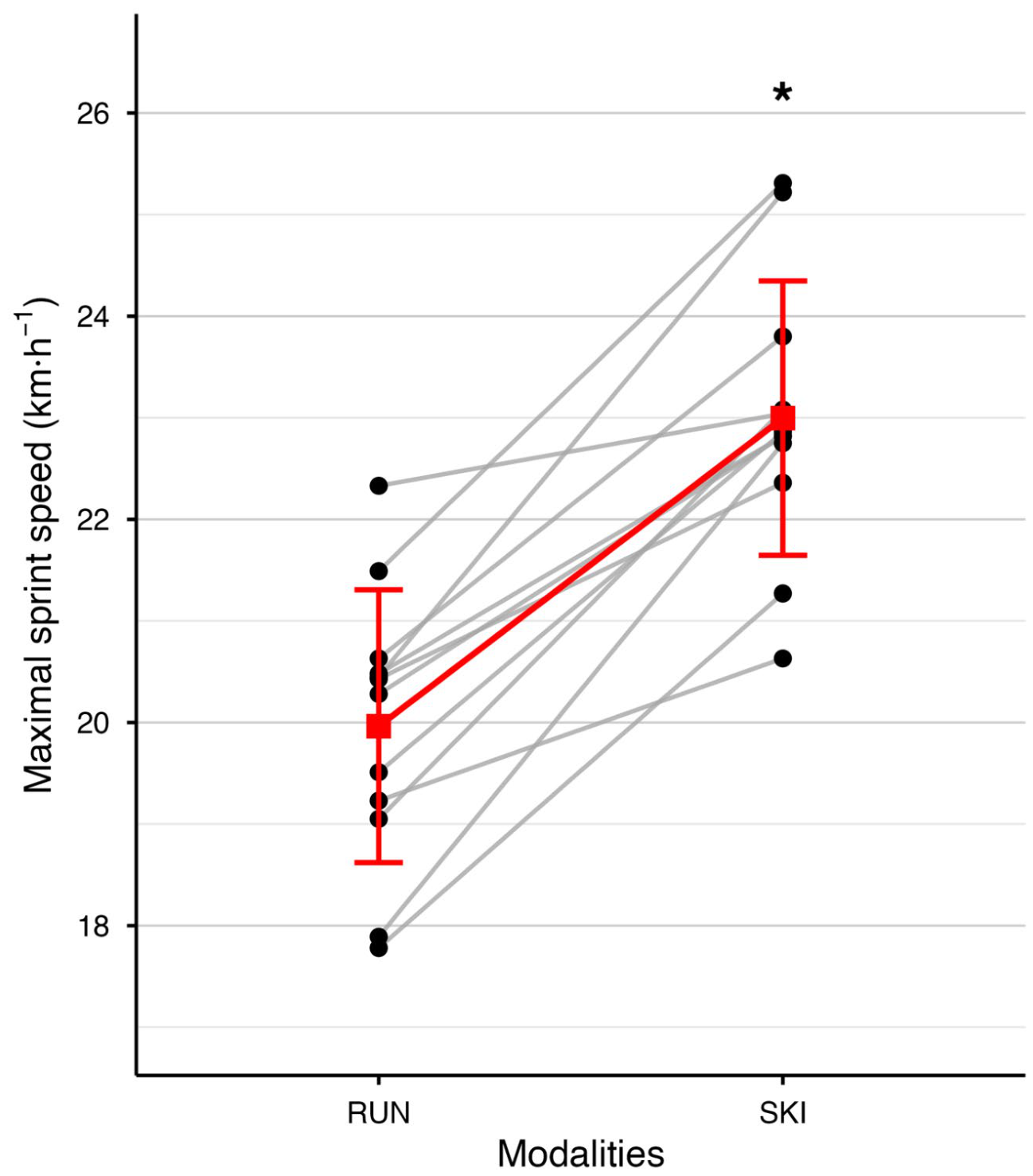
Figure 2.
Maximal aerobic speed (MAS) during running (RUN) and roller skiing (SKI) modalities. Individual values are represented by black dots, red squares indicate the group mean and red error bars indicate the standard deviation (± SD). * Indicate a significant difference between running and roller skiing.
Figure 2.
Maximal aerobic speed (MAS) during running (RUN) and roller skiing (SKI) modalities. Individual values are represented by black dots, red squares indicate the group mean and red error bars indicate the standard deviation (± SD). * Indicate a significant difference between running and roller skiing.
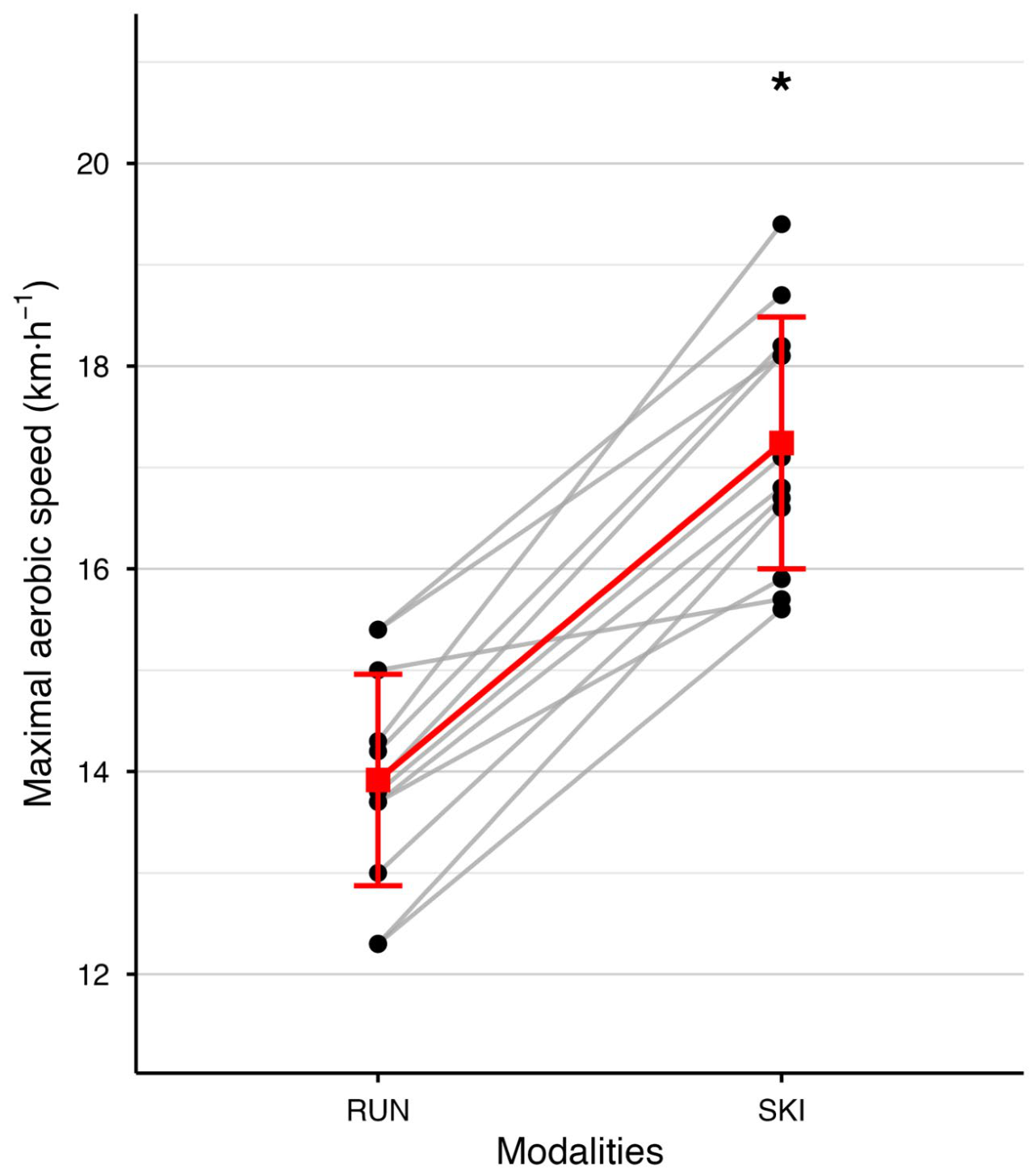
Figure 3.
Distribution of locomotor profiles (endurance, hybrid and sprint) identified by the speed reserve ratio (SRR) clustering, represented by individual anaerobic speed reserve (ASR) values in running (RUN) and roller skiing (SKI). Each circle, square and triangle represents an individual ASR value.
Figure 3.
Distribution of locomotor profiles (endurance, hybrid and sprint) identified by the speed reserve ratio (SRR) clustering, represented by individual anaerobic speed reserve (ASR) values in running (RUN) and roller skiing (SKI). Each circle, square and triangle represents an individual ASR value.
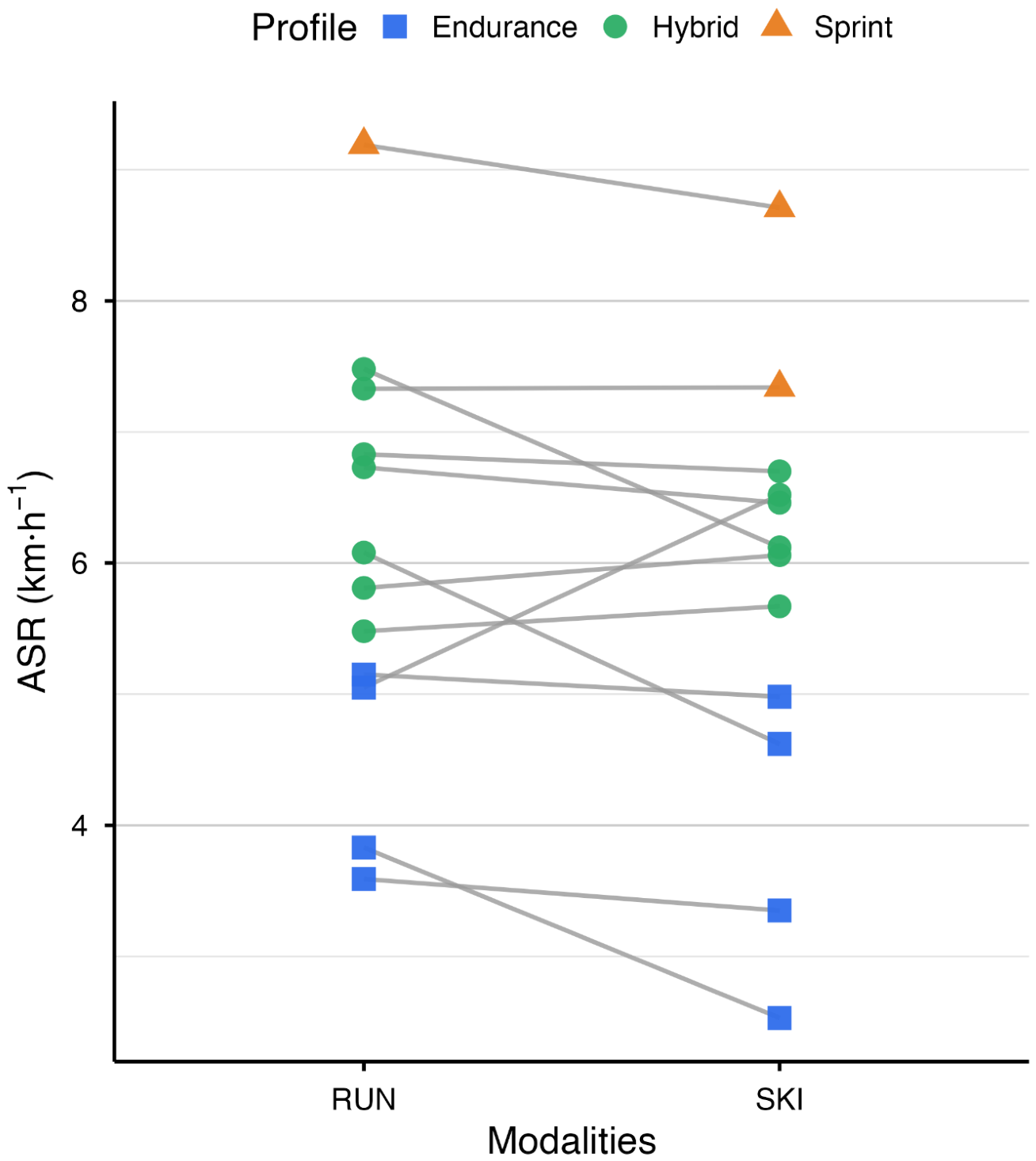

Table 1.
Physiological and perceptual responses during the half-Cooper test in running (RUN) and roller skiing (SKI) (n = 12).
Table 1.
Physiological and perceptual responses during the half-Cooper test in running (RUN) and roller skiing (SKI) (n = 12).
| Variables | RUN | SKI | Δ (SKI-RUN) | Paired comparison |
|---|---|---|---|---|
| Lactate (mmol·L−1) | 7.74 ± 1.50 | 6.03 ± 1.12 | -1.72 ± 1.77 | p = 0.006 |
| HRmax (bpm) | 192.2 ± 12.8 | 184.8 ± 13.5 | -7.42 ± 14.1 | p = 0.092 |
| RPE | 7.19 ± 0.52 | 5.88 ± 1.12 | -1.32 ± 1.09 | p = 0.001 |
Disclaimer/Publisher’s Note: The statements, opinions and data contained in all publications are solely those of the individual author(s) and contributor(s) and not of MDPI and/or the editor(s). MDPI and/or the editor(s) disclaim responsibility for any injury to people or property resulting from any ideas, methods, instructions or products referred to in the content. |
© 2026 by the authors. Licensee MDPI, Basel, Switzerland. This article is an open access article distributed under the terms and conditions of the Creative Commons Attribution (CC BY) license (http://creativecommons.org/licenses/by/4.0/).
Copyright: This open access article is published under a Creative Commons CC BY 4.0 license, which permit the free download, distribution, and reuse, provided that the author and preprint are cited in any reuse.