
Submitted:
26 July 2026
Posted:
28 July 2026
You are already at the latest version
Abstract
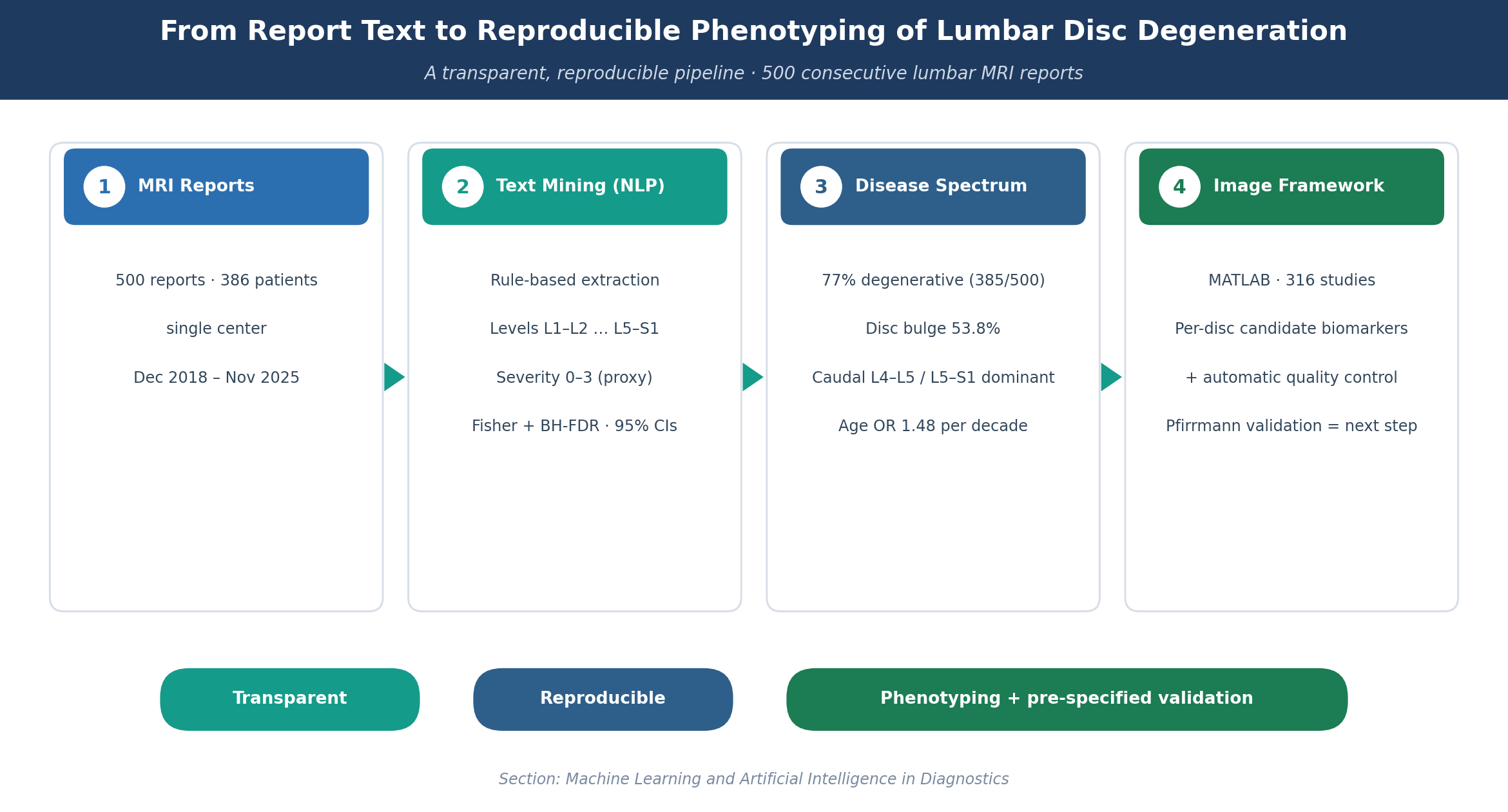
Background/Purpose: To characterize the degenerative vocabulary of 500 consecutive lumbar MRI reports using a transparent, reproducible text-extraction pipeline; to quantify which descriptors distinguish included from excluded reports and which factors predict text-derived severity; and to specify a reproducible image-analysis pipeline whose formal validation against radiologist Pfirrmann grading is defined as the next step. Methods: We analyzed 500 lumbar MRI reports (386 patients; December 2018–November 2025), extracting morphological and severity keywords, segmental levels (L1–L2 to L5–S1), Modic mentions, and a custom text-derived ordinal severity (0–3). Keyword-prevalence differences were tested with the Fisher exact test under Benjamini–Hochberg false-discovery-rate control, with 95% confidence intervals (CIs) for all odds ratios (ORs) and risk differences; predictors of severity were examined by ordinal logistic regression. A MATLAB pipeline derived per-disc candidate imaging features (predicted Pfirrmann grade, normalized disc height, T2 signal index, quality control) across 316 studies. Results: 385/500 reports (77.0%) met inclusion criteria. The structured morphological-keyword field was missing in 49.4% of records, declining across years (58.6% in 2020 to 33.5% in 2025), indicating systematic reporting drift. Bulge was the dominant descriptor (53.8%); L4–L5 and L5–S1 dominated level mentions. After correction, bulge (OR 6.70, 95% CI 3.86–11.65), mild (5.08, 2.39–10.78), dehydration (9.82, 2.36–40.87) and central (8.63, 2.07–36.01) were enriched among included reports. Older age independently predicted higher severity (OR 1.48 per 10 years, 95% CI 1.29–1.70). The image pipeline produced per-disc candidate biomarkers across 316 studies. Conclusions: Free-text lumbar MRI reports encode a recognizable but heterogeneous degenerative vocabulary, sufficient for cohort construction yet inconsistent for quantitative grading; the text-derived severity is a noisy proxy. The reproducible image-analysis pipeline yields candidate biomarkers whose formal validation against an adjudicated radiologist Pfirrmann reference standard is the explicit, pre-specified next step.
Keywords:
lumbar spine
; intervertebral disc degeneration
; radiology reports
; natural language processing
; Pfirrmann grading
; imaging biomarkers
; radiomics
; reproducibility
; Modic changes
; validation
Copyright: This open access article is published under a Creative Commons CC BY 4.0 license, which permit the free download, distribution, and reuse, provided that the author and preprint are cited in any reuse.


