

Submitted:
24 July 2026
Posted:
27 July 2026
You are already at the latest version
Abstract
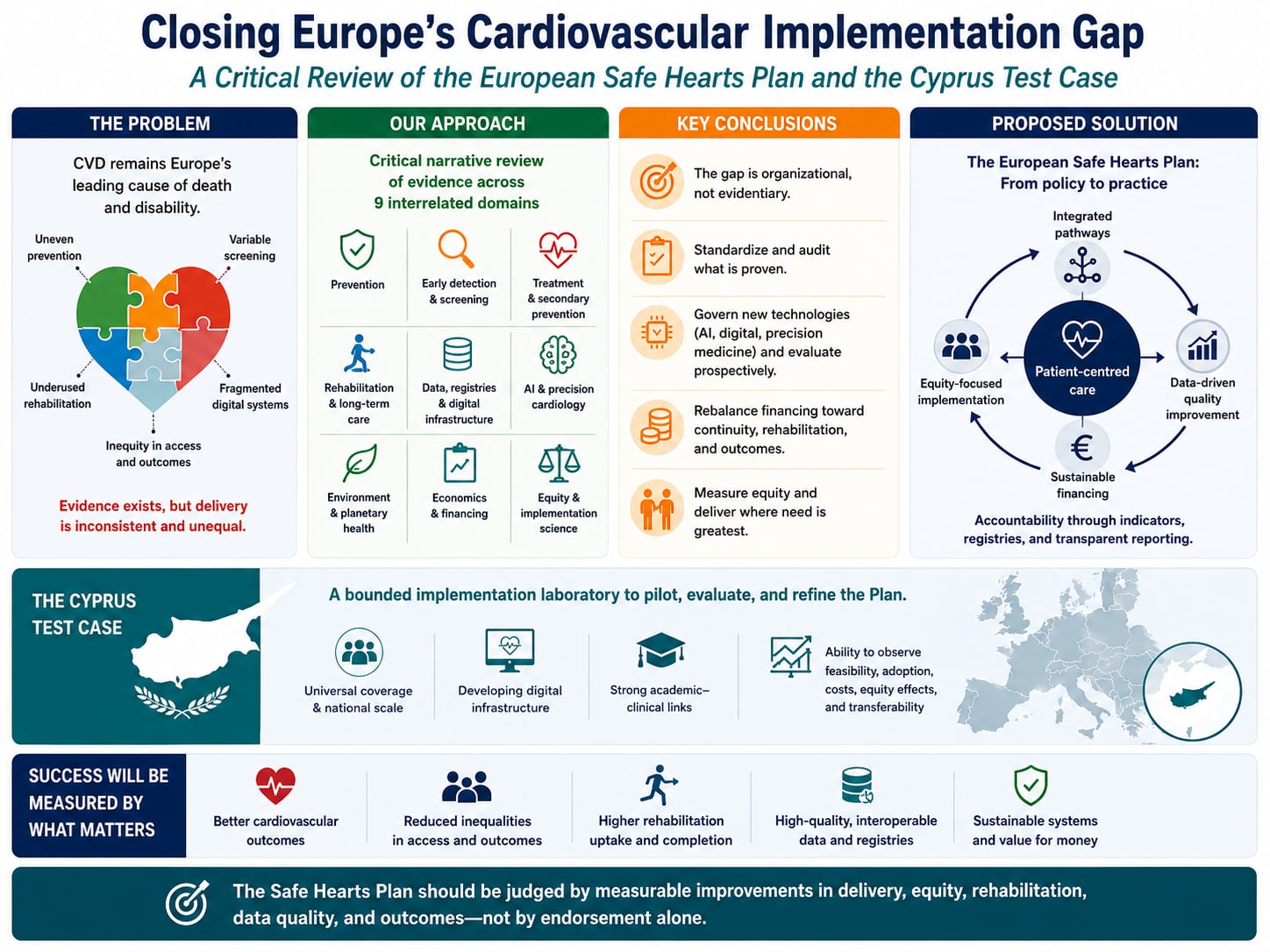
Cardiovascular disease remains Europe’s leading cause of death and disability despite strong evidence for prevention, risk-factor treatment, early detection, rehabilitation, and secondary prevention. This critical narrative review evaluates the European Safe Hearts Plan as a proposed framework for organising cardiovascular care and policy. Its value will depend on whether European priorities can be converted into national plans, dedicated financing, primary-care risk assessment, specialist pathways, rehabilitation, interoper-able registries, digital governance, and equity monitoring. We synthesise evidence from clinical guidelines, epidemiological and economic studies, screening trials, rehabilitation research, digital-health and artificial intelligence literature, registry initiatives, envi-ronmental cardiovascular evidence, and implementation-science frameworks. The central challenge is not a lack of effective interventions but their uneven organisation across health systems. Established interventions should be standardised and audited, whereas screening technologies, artificial intelligence, precision medicine, and digital follow-up require governed implementation and prospective evaluation. Cyprus is discussed as a bounded test setting because its universal coverage, national scale, developing digital infrastructure, and academic-clinical links could make feasibility, adoption, costs, equity effects, and transferability observable before wider European adaptation. The Plan should ultimately be judged by measurable improvements in cardiovascular delivery, equity, rehabilitation, data quality, and outcomes, rather than by endorsement alone.
Keywords:
cardiovascular disease
; European Safe Hearts Plan
; critical review
; cardiovascular prevention
; health systems
; implementation science
; digital health
; equity
1. Introduction
Cardiovascular disease (CVD) remains Europe’s largest cause of mortality and one of its greatest sources of disability, hospital use, productivity loss, and informal care dependency. Recent European and global estimates put cardiovascular mortality at roughly 1.7 million deaths each year in the European Union and close to 3.9 million across the wider European region. This burden persists despite decades of progress in acute coronary care, stroke care, lipid lowering, antihypertensive treatment, and smoking reduction. Demographic ageing and the rising prevalence of obesity, diabetes mellitus, chronic kidney disease, atrial fibrillation, and multimorbidity mean that the absolute number of people living with CVD is likely to remain high, even where age-standardised mortality continues to decline [1,2,3,4,5,6].
The burden is distributed unevenly across Europe, with worse outcomes in settings where prevention infrastructure is weaker, socioeconomic resources are lower, specialist access is poorer, and guideline-directed therapy is implemented less consistently. This pattern exposes a delivery problem in which avoidable cardiovascular harm increasingly depends on whether effective care can be organised, financed, measured, and sustained across the life course [1,2,7,8,9].
The economic consequences are equally important because cardiovascular disease remains one of Europe’s most expensive disease groupings. The annual burden in the European Union was estimated at €282 billion in 2021 after direct medical costs, lost productivity, and informal care were included. Prevention therefore functions as a health-system sustainability strategy as well as a public-health priority, since inadequate early detection, rehabilitation, and long-term follow-up continue to convert preventable risk into acute events and chronic disability [4,6,10,11].
Europe’s problem is not a shortage of cardiovascular evidence, but the uneven way this evidence is organised and delivered. The continent has strong guidelines, mature scientific evidence, and several national initiatives, yet many patient pathways still pass through inconsistent prevention, heterogeneous screening, underused rehabilitation, fragmented digital systems, and unequal access to specialist care. This fragmentation creates preventable delay and recurrence while reinforcing inequalities between and within countries [12,13,14,15,16].
The central translational question is whether Europe can turn established cardiovascular knowledge into a joined-up model of care that clinicians can use, health systems can measure, and patients can hold accountable. The European Safe Hearts Plan is important because it provides a framework through which Europe’s prevention-delivery gap can be examined across prevention, detection, treatment, rehabilitation, data, digital infrastructure, research, financing, and equity [17,18]. Its value would depend on whether it can move cardiovascular prevention from a collection of guidance documents and local initiatives into a coordinated programme with defined responsibilities, common indicators, sustainable funding, and transparent accountability. Cyprus and its General Healthcare System are considered here as one bounded environment in which this model could be designed, measured, and refined through implementation.
The implementation framework for operationalising the European Safe Hearts Plan developed in this review is an original conceptual framework proposed by the authors. It is not intended to replace existing European cardiovascular guidelines, strategies, or policy initiatives. Instead, it seeks to integrate current evidence-based recommendations into a coordinated implementation model that combines prevention, early detection, guideline-directed treatment, cardiac rehabilitation, digital health, implementation science, governance, quality improvement, and continuous outcome evaluation. The objective is to facilitate the translation of established scientific evidence into sustainable clinical practice and healthcare policy while remaining sufficiently flexible to accommodate the diverse organisational and healthcare environments across Europe.
Recent European guidance has sharpened standards for prevention, hypertension, chronic coronary syndromes, and atrial fibrillation [12,13,14,15,16]. In parallel, European registry, rehabilitation, genomics, precision-medicine, vaccination, environmental-risk, and research-funding initiatives have strengthened the mechanisms for benchmarking, implementation research, and data-enabled governance [17,18,19,20,21,22,23,24,25,26,27,28,29,30,31,32,33,34]. The contemporary relevance of the Safe Hearts Plan is that these parallel developments can now be assembled into an accountable cardiovascular delivery model. Figure 1 summarises the proposed integrated cardiovascular policy framework.
2. Core Argument of the Review
This review advances a clinical and policy argument about cardiovascular delivery: Europe has matured cardiovascular evidence, but its impact is weakened when prevention, detection, treatment, rehabilitation, financing, data systems, and equity monitoring remain separated by institutional boundaries. The Safe Hearts Plan should therefore be judged by its capacity to turn clinical evidence into measurable services, with national cardiovascular plans, registry-enabled accountability, prevention-oriented funding, and explicit safeguards for equity. Mature interventions require standardisation and audit, while conditional technologies require governance and prospective evaluation before scale-up. Cyprus is relevant because it offers a tractable setting in which the full pathway, from governance and financing to clinical delivery, stakeholder adoption, registry measurement, equity effects, and transferability, can be observed. For clinicians, the practical consequence is that prevention, screening, treatment, rehabilitation, digital follow-up, and registry reporting should no longer be evaluated as separate domains, because patients experience them as one cardiovascular pathway.
3. Review Approach and Scope
This manuscript is a structured critical narrative synthesis of evidence relevant to European cardiovascular prevention, delivery, and implementation. Priority was given to official and primary sources, including European Society of Cardiology guidelines and scientific statements, World Health Organization and European Commission policy documents, European epidemiological and economic datasets, major prevention and screening studies, Cyprus-specific sources, peer-reviewed environmental and vaccination evidence, and implementation science frameworks. Evidence was interpreted by maturity, implementability, and relevance to cardiovascular pathway design, with institutional items retained where they remained the most appropriate source for the policy or programme being cited.
The aim is to separate evidence maturity from implementation readiness, and the review identifies where evidence is already mature enough for standardisation, where clinical technologies require governed deployment, and where implementation studies are needed before wider scale-up.
Evidence was weighted qualitatively through a set of linked appraisal questions that preserve the critical review character of the manuscript. We considered whether the source base had reached guideline-level maturity; whether outcomes were patient-centred or limited to detection, process, or surrogate measures; whether major limitations such as selection bias, false-positive burden, implementation cost, and external validity were explicit; whether delivery required new digital or workforce capacity; and whether transferability had been tested outside selected settings. This weighting is not a formal grading system, since the review is neither a guideline nor a systematic review, but its purpose is to separate established clinical evidence from implementation-dependent propositions.
4. Evidence Weighting and Critical Interpretation
The hierarchy of evidence is central to this critical review because mature clinical therapies, targeted screening tools, digital infrastructure, and implementation strategies cannot be interpreted with the same level of certainty. In the Safe Hearts framework, risk-factor treatment, risk estimation, secondary prevention, and rehabilitation are supported by established evidence, while screening technologies, artificial intelligence, precision medicine, digital follow-up, and registry-enabled governance require careful separation between technical performance, clinical value, equity, and scalability. Table 1 serves as the evidence map of the review.
Mature interventions such as risk estimation, lipid lowering, blood-pressure control, diabetes care, obesity management, and cardiac rehabilitation carry the greatest evidentiary weight, while risk-based screening and wearable detection remain more pathway-dependent. Digital health, artificial intelligence, precision medicine, and registries are interpreted as enabling infrastructure, and Cyprus is treated as an implementation hypothesis whose value depends on prospective evaluation rather than assumed generalisability.
Taken together, this evidence hierarchy supports interpreting the Safe Hearts Plan as a delivery framework rather than as a simple policy statement. Components with mature evidence should be standardised and measured through routine indicators; conditional technologies should enter governed pathways with validation, workflow testing, and equity audit; and system-level models should be tested in bounded settings before broader transferability claims are made.
For clinicians, payers, policymakers, registry leaders, and implementation researchers, the practical test is consistent across domains including which components are already evidence-based, which require governance before scale-up, who is accountable, which metric demonstrates delivery, and which contextual conditions limit external validity. Applying this template gives the review its policy relevance, because it converts a broad European cardiovascular proposal into testable functions rather than disconnected recommendations.
5. Europe’s Cardiovascular Implementation Gap and the Safe Hearts Plan
Europe already has several strong cardiovascular policy components across clinical guidance, public health, and European policy. The European Society of Cardiology (ESC) provides detailed guidance for prevention, dyslipidaemia, hypertension, chronic coronary syndromes, and atrial fibrillation [12,13,14,15,16]. The World Health Organization has long promoted non-communicable disease control through population health measures, primary care strengthening, and essential package approaches [35,36]. The European Commission’s Healthier Together initiative provides a cross-disease framework for non-communicable disease action [37], while Europe’s Beating Cancer Plan demonstrates the effect of giving a disease area visible, funded, transnational political priority [38].
These frameworks are scientifically strong, although their combined effect across the cardiovascular continuum remains incomplete. Guidelines define clinical standards once a patient is identified [12,13,14,15,16], public-health frameworks describe broad prevention goals [35,36], and European Union initiatives support coordination [37,38]. The missing element is an operational model that specifies how prevention, screening, diagnosis, treatment, rehabilitation, follow-up, data capture, financing, and accountability should interact at continental scale [17,18].
The added value of the Safe Hearts Plan, if realised, would be to connect ESC guidelines and existing public-health frameworks into one cardiovascular pathway. Such a pathway would need clearer responsibility for inequalities, interoperability, financing, implementation, and accountability. Its relevance therefore depends on whether it can organise mature evidence into a measurable programme with national ownership, common indicators, and credible mechanisms for funding and audit.
The comparison with cancer policy is useful when framed with appropriate caution, because cancer and cardiovascular disease differ in biology, public perception, screening paradigms, treatment pathways, and survivorship models. Europe’s Beating Cancer Plan nevertheless shows that a disease area can gain political traction when prevention, early detection, treatment quality, research, data, funding, and equity are organised within one visible framework. Cardiovascular disease requires comparable political visibility, adapted to chronic risk-factor control, acute-event prevention, rehabilitation, and lifelong follow-up [17,18,38].
6. Life-Course Prevention
A credible European cardiovascular strategy should begin before clinical disease appears. The INTERHEART paradigm, later prevention frameworks, and life-course constructs converge on the same central lesson: many cardiovascular events arise from modifiable risk exposures that begin early, accumulate over decades, and interact with social context. Prevention therefore requires organised action across the life course and across sectors, since opportunistic advice during specialist encounters cannot carry the burden of population-level risk reduction [39,40,41,42,43].
This has practical consequences for how the first pillar should be interpreted. A narrow health-education model would be insufficient because the plan requires layered prevention across population policy, primary care, and intensified management for people with established risk [12,17,18]. Population-level action should address tobacco, food environments, physical activity, and cardiometabolic risk [39,40,41], while primary-care pathways should detect and treat hypertension, dyslipidaemia, diabetes mellitus, and obesity in a systematic way [13,14,44,45,46,47,48,49,50,51,52,53,54,55]. Prevention also needs escalation for people affected by social disadvantage, chronic kidney disease, or early vascular disease, because uniform advice does not correct unequal risk exposure [7,8,9,12,15].
Hypertension and dyslipidaemia show why implementation matters as much as evidence [13,14,44,45,46,47,48,49]. Both conditions are common, measurable, treatable, and strongly linked to subsequent cardiovascular events. Persistent gaps in control usually arise from incomplete identification, therapeutic inertia, poor adherence, and insufficient follow-up. A European cardiovascular strategy should therefore specify minimum standards for measurement, treatment intensification, follow-up intervals, and performance reporting.
Diabetes and obesity require the same integrated treatment logic across cardiovascular care. Diabetes care increasingly overlaps with cardiology, nephrology, primary care, and weight-management services, while obesity is now understood as a chronic disease shaped by metabolic, vascular, and societal determinants. Effective cardiovascular prevention needs shared pathways for weight reduction, glucose control, blood-pressure control, lipid optimisation, renal protection, and long-term behavioural support [50,51,52,53,54,55].
Life-course prevention also needs to extend beyond the first clinical event. In real health systems, prevention begins with primordial and primary prevention, continues through secondary prevention, and then becomes long-term risk control after established disease. The Safe Hearts framework should therefore connect prevention and rehabilitation structurally, because separating them into different silos undermines continuity [40,41,42,43,56,57,58].
7. Risk-Based Screening and Early Detection
Early detection forms the second policy pillar, although the case for screening must remain disciplined and outcome-facing. Earlier diagnosis creates value only when the target population is appropriate, the method is reliable, the downstream pathway can deliver treatment or follow-up, and the health system can monitor unintended consequences such as false positives, anxiety, and inequitable uptake [59,60,61]. The defensible position is therefore risk-based and evidence-based screening, with safeguards against indiscriminate testing [62,63,64,65].
For overall cardiovascular risk estimation, Europe now has well-validated tools in SCORE2 and SCORE2-Older Persons, which improve risk stratification and give a rational basis for targeted intervention. These tools can support structured primary-care pathways for blood pressure, lipid, diabetes, and kidney disease assessment, while reducing under-treatment in high-risk groups and unnecessary testing in low-risk populations [12,59,60,61].
Atrial fibrillation illustrates the promise and the caution required in screening policy. Opportunistic and technology-enabled detection can identify previously unrecognised atrial fibrillation, although trial results differ according to age, device, and strategy, and higher detection does not always translate directly into improved hard outcomes. Screening should therefore focus on older or higher-risk populations, with confirmatory pathways and anticoagulation decision-making in place before technology is scaled [16,62,63,64,65].
Wearable technologies extend atrial fibrillation detection beyond conventional clinical settings, while also illustrating why detection alone cannot be treated as prevention. Wearable-derived signals need to enter a governed pathway that includes verification, risk assessment, shared decision-making, treatment where indicated, and audit of false-positive burden, anxiety, inequity, and clinical yield [64,65].
The major screening studies illustrate why evidence weighting is necessary as systematic atrial fibrillation screening can identify previously undiagnosed disease and may produce modest net clinical benefit in selected older populations. However, implantable-loop-recorder strategies increased atrial fibrillation detection and anticoagulation without showing a clear proportional reduction in stroke outcomes. Large-scale smartwatch and photoplethysmography studies show feasibility and patient reach, although they also highlight selection, confirmatory-testing, false-positive, and downstream management limitations [62,63,64,65].
The same principle applies to coronary artery calcium scoring, wearable-enabled rhythm assessment, biomarker strategies, and other emerging detection tools. The review therefore emphasises careful pathway design. The plan favours a stepped model in which primary care provides universal basic risk assessment, higher-risk groups receive intensified evaluation, imaging or digital tools are used selectively when they change management, and registries evaluate yield, uptake, false-positive burden, equity, and clinical outcomes [12,19,20,59,60,61,62,63,64,65].
8. Treatment, Rehabilitation, and Long-Term Follow-Up
A European cardiovascular strategy should extend beyond prevention and diagnosis. Treatment quality still varies across Europe, and rehabilitation remains underused despite its contribution to functional recovery, risk-factor control, recurrent-event reduction, and quality of life. When rehabilitation is treated as an optional post-discharge service, cardiovascular care becomes episodic and incomplete [15,16,56,57,58].
The Safe Hearts Plan is strongest when it treats rehabilitation as co-equal with prevention and screening, because this reflects the real pathway of cardiovascular disease. Guideline-directed therapy, cardiology team decision-making, rapid specialist access, and effective acute interventions reduce short-term risk, while structured rehabilitation and long-term follow-up reduce recurrent risk and preserve function [15,16,56,57,58].
Cardiac rehabilitation should be positioned as an essential cardiovascular service, with an evidence base supporting exercise-based, home-based, and structured secondary-prevention models, and with telerehabilitation extending access where geography, workforce capacity, or patient preference limits participation in centre-based programmes [21,56,57,58].
Value-based thinking is central to this pillar because health systems that invest heavily in procedures while underinvesting in rehabilitation, adherence, and long-term review will continue to finance avoidable recurrence. A serious Safe Hearts programme should rebalance reimbursement towards continuity and outcomes, with procedural throughput no longer dominating delivery incentives [10,11,56,57,58].
9. Digital Health, Artificial Intelligence, Precision Medicine, and Governance
Digital health and artificial intelligence are relevant to the Safe Hearts Plan when they support continuity, access, and measurement rather than add another layer of complexity. Digital health earns its place by closing gaps in follow-up, interoperability, and patient engagement [66,67,68,69]. Artificial intelligence should be judged by whether validated tools improve decisions, reduce inequity, fit clinical workflow, and operate within acceptable standards of governance, explainability, privacy, and interoperability [70,71,72,73].
For artificial intelligence specifically, the relevant distinction is between technical accuracy and clinical value. AI-enabled electrocardiography and machine learning cardiology applications demonstrate diagnostic and risk-stratification potential. The evidence base still needs broader external validation, calibration monitoring, bias assessment, data-provenance transparency, prospective workflow testing, and proof that use changes management or outcomes beyond model performance alone [70,71,72,73].
Remote monitoring, telemedicine, wearable technologies, interoperable electronic health records, registry-linked analytics, and digital rehabilitation can strengthen the cardiovascular continuum when they are designed around clinical pathways. These tools are especially valuable where geography, workforce shortages, or follow-up attrition undermine continuity. The priority should be interoperable digital infrastructure that follows the patient across prevention, primary care, acute care, rehabilitation, and long-term management [19,20,21,66,67,68,69].
Artificial intelligence adds potential in risk prediction, imaging interpretation, rhythm classification, clinical decision support, and detection of hidden phenotypes. Implementation needs governance from the outset, with validation in relevant populations, transparent model updating, audit of bias, integration with guideline-based care, clinician oversight, and clear accountability. Algorithmic novelty should not be allowed to substitute for careful health-system design [70,71,72,73].
Precision cardiovascular medicine should be treated as promising where it is clinically actionable and implementable at scale. Genomics, biomarkers, polygenic risk scores [22], advanced phenotyping [23,24,25], vaccination strategies in selected cardiovascular populations, and emerging preventive cardiology models [26,27] may sharpen risk stratification or individualise treatment in selected contexts. These approaches should refine public health by building on risk-factor control, access, and data quality.
Registries are the practical link between policy ambition and accountability. Without interoperable registries, European cardiovascular policy remains dependent on episodic audits, local enthusiasm, and incomplete data. The EuroHeart and ESC Atlas models show how structured data systems can support benchmarking, quality improvement, and cross-country learning. An implementation programme would need a minimum dataset, common definitions, and routine public reporting of process, outcome, and equity indicators [19,20].
10. Equity and Environmental Determinants
A European cardiovascular strategy cannot treat inequality as an afterthought, because socioeconomic deprivation, education, geography, social exclusion, and environmental exposure shape risk-factor prevalence, diagnostic delay, treatment access, rehabilitation participation, and long-term outcomes, influencing both how risk is generated and how care is received [7,8,9].
Air pollution and climate-related exposure extend the cardiovascular agenda beyond the clinic, affecting cardiovascular events and vulnerability directly, so that prevention cannot be framed only as individual behaviour change but must connect cardiovascular health with public-health regulation, urban design, air-quality policy, climate adaptation, and heat-risk planning [28,29,30,31,32].
Equity also needs to be operationalised across every major implementation domain in the Safe Hearts Plan, including screening, digital access, rehabilitation uptake, specialist referral, and data completeness. These domains should be evaluated by socioeconomic status, sex, age, geography, and other relevant demographic stratifies where available, because the plan could otherwise improve averages while leaving disparities intact [7,8,9,19,20].
This issue is particularly important for digital health, as technologies that depend on smartphones, continuous connectivity, health literacy, and active patient engagement can widen disparities if safeguards are absent [7,8,9]. Digital inclusion, language access, clinician support, community outreach, and alternative non-digital pathways should be built into implementation design from the start [66,67,68,69].
11. Cyprus as a Bounded Implementation Laboratory
Cyprus is examined in this review as the setting best positioned to become the first European health system to demonstrate the complete Safe Hearts pathway – from governance and financing through to clinical delivery, registry measurement, and equity monitoring – end-to-end under real delivery conditions. It is presented as a bounded implementation laboratory not because it is representative of Europe, but because its scale, geography, and national health-system structure make it a tractable setting in which the full policy chain can be implemented, observed, evaluated, and refined. Its relevance comes from feasibility, observability, and evaluability, while its limitations are acknowledged explicitly. Universal coverage through the General Healthcare System, manageable population scale, bounded geography, developing digital infrastructure, identifiable academic-clinical networks, and scope for national pathway design make Cyprus suitable for testing implementation with less institutional fragmentation than larger systems [74,75,76]. The features that limit Cyprus’s statistical scale are precisely those that maximise its evidentiary value: a bounded population and single national system make the entire policy-to-outcome chain observable within one governance structure, and make a full pilot inexpensive to run, instrument, and evaluate. Few European settings can offer that combination of completeness and tractability.
Beyond its national value, Cyprus is structurally positioned to act as a coordinating node between European and Eastern Mediterranean cardiovascular systems. Four features underpin this: (1) EU membership provides regulatory and guideline alignment; (2) universal coverage through the General Healthcare System offers a replicable delivery template that neighbouring systems largely lack; (3) geographic proximity lowers the barrier to shared implementation learning; and (4) established academic-clinical networks provide convening capacity. This regional role is stated as a testable proposition rather than an assumption: Cyprus would qualify as a regional reference model if a national pilot met predefined reach, adoption, and fidelity thresholds and if at least one neighbouring health system adopted one or more pathway components within a defined period.
Cyprus is included for methodological as well as policy reasons. Implementation science often needs bounded settings in which the full pathway can be observed from policy decision to primary care identification, specialist referral, rehabilitation, digital follow-up, registry reporting, financing, stakeholder response, and equity monitoring. Cyprus offers that tractability, and its value would lie in identifying which functions of an integrated cardiovascular strategy are essential, measurable, affordable, and transferable across more complex European systems.
The selection of Cyprus as a pilot implementation setting should therefore be understood as a strategic proof-of-concept rather than as an attempt to propose a universally applicable model for all European healthcare systems. Its universal healthcare system, relatively small population, bounded geography, centralised governance, developing digital infrastructure, and established academic–clinical networks provide favourable conditions for implementing, monitoring, and refining integrated cardiovascular pathways within a comparatively short timeframe. These characteristics could facilitate systematic data collection, continuous quality assessment, and timely evaluation of clinical, economic, equity, and health-system outcomes before broader European adaptation [74,75,76].
Nevertheless, caution is required when extrapolating findings from Cyprus to larger and more heterogeneous European healthcare systems. European countries differ substantially in population demographics, cardiovascular burden, healthcare financing, workforce capacity, governance structures, digital maturity, rehabilitation infrastructure, and resource availability. Implementation strategies that prove feasible in Cyprus may therefore require substantial contextual adaptation before being transferred elsewhere. The Cyprus model should be regarded as an implementation laboratory capable of generating real-world evidence on feasibility, acceptability, fidelity, clinical effectiveness, cost-effectiveness, equity, sustainability, and operational barriers, rather than as a directly generalisable template [74,75,76,77,78,79].
Accordingly, Cyprus should be considered a scalable implementation platform rather than a definitive European model. Its principal value would be to identify which components of the Safe Hearts framework are essential and transferable, which depend on local context, and which require modification before adoption by larger, more decentralised, or differently financed healthcare systems. Lessons from such a pilot could thereby support progressive European adaptation while preserving the flexibility needed to accommodate national priorities, available resources, and organisational structures [77,78,79].
These features make Cyprus a practical place to test whether an integrated cardiovascular strategy can be delivered under real health system conditions. A national Safe Hearts pilot could link structured primary care risk assessment with referral into multidisciplinary Cardiovascular Prevention Centres, integrated digital follow-up, national rehabilitation standards, registries aligned with EuroHeart principles, and mandatory indicators reported at fixed intervals [19,20,74,75,76]. Academic institutions could then evaluate implementation through established frameworks that examine adoption, reach, fidelity, feasibility, sustainability, cost, and equity [77,78,79]. Figure 2 illustrates how Cyprus could function as a bounded implementation laboratory for evaluating governance, prevention pathways, digital infrastructure, academic-clinical collaboration, equity, cost, adoption, and transferability before broader European adaptation.
If implemented, Cardiovascular Prevention Centres should be treated as testable system nodes. Their role would be to connect high-risk primary prevention, post-event secondary prevention, rehabilitation, digital follow-up, weight management, blood-pressure and lipid optimisation, diabetes-cardiology coordination, smoking cessation, psychosocial support, and referral escalation when disease is detected. Their purpose would be continuity. Their value would need to be demonstrated through uptake, outcomes, equity, cost, and sustainability [12,13,14,15,21,39,40,41,44,45,46,47,48,49,50,51,52,56,57,58,74,75,76].
A Cyprus pilot could generate the class of implementation evidence that is currently scarce across Europe: not whether integrated cardiovascular care works in principle, which is established, but under which financing, workforce, and governance conditions it becomes deliverable in practice. That distinction, from efficacy to deliverability, is where European cardiovascular policy is most evidence-starved, and it is precisely what a bounded national pilot is designed to supply. A pilot could examine prevention-oriented reimbursement, digital follow-up, structured atrial fibrillation detection, risk-based screening, rehabilitation participation, and registry-supported governance within a single national programme. The transferable value would depend on transparent reporting of mechanisms, context, costs, fidelity, equity, and negative findings [10,11,19,20,21,33,34,56,57,58,59,60,61,62,63,64,65,66,67,68,69,77,78,79].
A credible Cyprus roadmap would need staged implementation with predefined decision points. The design phase would establish governance, define the minimum dataset, agree referral criteria, specify outcome measures, and secure financing [74,75,76,77,78,79]. Deployment would introduce screening, prevention-centre referral, rehabilitation standards, and digital follow-up across selected districts or provider networks. Scale-up would extend successful components nationally only if transparent dashboards show acceptable uptake, quality, outcomes, cost, and equity [33,34,77,78,79].
This section advances the authors’ earlier strategic framework for cardiovascular prevention [80] from proposition to operational blueprint, and positions Cyprus as the first testable national platform on which the Safe Hearts Plan could be delivered, instrumented, and falsified rather than in fragments. Its contribution is to present the Safe Hearts Plan as a deliverable strategy and Cyprus as one testable national implementation platform, while explicitly separating transferable implementation principles from direct generalisability claims.
The external validity of a Cyprus pilot would therefore need to be judged through prespecified boundary conditions. These should include the financing model, primary-care capacity, digital maturity, workforce availability, registry completeness, rehabilitation infrastructure, public engagement, and baseline inequalities. Larger or more decentralised European systems would not be expected to reproduce the same delivery model exactly, although they could adapt its measurable pathway components if the pilot identifies which functions are essential and which are context-dependent.
Transferability should also be tested through implementation evidence rather than inferred from national scale alone. A Cyprus pilot should therefore report which stakeholders adopted each component, which financing lines supported delivery, which workforce roles were required, what opposition or implementation friction emerged, and whether observed gains persisted after the initial pilot phase. These data would allow Cyprus to contribute European policy learning without claiming to represent every European health system [74,75,76,77,78,79].
12. From Evidence Domains to a Cardiovascular Care Model
The principal innovation of the implementation framework developed in this review lies not in proposing new clinical recommendations but in providing an integrated model designed to support the systematic adoption of existing evidence-based cardiovascular strategies. By combining clinical guidance with implementation science, health system governance, multidisciplinary collaboration, digital technologies, quality indicators, registry-based evaluation, and continuous performance monitoring, the framework addresses the persistent gap between scientific evidence and routine clinical practice. Its primary objective is to facilitate coordinated implementation while allowing sufficient flexibility for adaptation to national healthcare priorities and available resources.
The next step in European cardiovascular policy is not only to produce more evidence, but to organise existing evidence into reliable care. Guidelines, risk tools, rehabilitation models, digital systems, artificial intelligence methods, registries, and implementation science already exist, yet they remain insufficiently connected in routine practice. The Safe Hearts Plan is valuable because it can connect these domains through shared definitions, measurable outputs, transparent accountability, and a stronger policy mandate for prevention [12,13,14,15,16,17,18,19,20,21,33,34,77,78,79].
A mature European model should distinguish mature interventions that require standardisation from conditional interventions that require prospective evaluation. Universal prevention, guideline-directed treatment, and rehabilitation should be treated as core services. Screening technologies, wearables, artificial intelligence, genomics, and precision tools should enter practice through governed pathways that measure downstream action, false-positive burden, equity, clinical outcomes, and cost [12,13,14,15,16,19,20,21,22,23,24,25,26,27,56,57,58,59,60,61,62,63,64,65,66,67,68,69,70,71,72,73].
For practicing cardiovascular teams, the clinical implication is that prevention, detection, treatment, and rehabilitation should be audited as one pathway. A patient with uncontrolled blood pressure, untreated dyslipidaemia, newly detected atrial fibrillation, recent acute coronary syndrome, or low rehabilitation access should not disappear between institutional boundaries. The same logic applies to digital and artificial-intelligence tools: their value depends on whether they improve pathway continuity and clinical decisions, not on whether they add another isolated data stream.
Before broader European scale-up, integrated pathways need to be tested under real delivery conditions. Cyprus offers one such setting because national pathways, prevention-centre delivery, digital follow-up, registry-enabled evaluation, financing decisions, stakeholder adoption, and equity monitoring can be examined within a bounded health system. The aim is to identify transferable functions, non-transferable contextual dependencies, costs, stakeholder friction, and equity effects before larger systems attempt adaptation [33,34,74,75,76,77,78,79].
This synthesis is intended to be useful to clinicians and decision-makers as well as to researchers. It defines the minimum evidence domains, implementation conditions, stakeholder responsibilities, and measurement logic that a European cardiovascular plan would need before it can be considered more than a policy aspiration.
13. Future Directions and Unresolved Controversies
The unresolved questions are practical, comparative, and evaluative, and they are closely linked to policy design. Europe needs to know which interventions are ready for immediate standardisation, which screening pathways produce net clinical value, which digital tools improve adherence without widening inequality, which rehabilitation models are scalable, which indicators best capture quality, which financing mechanisms change professional behaviour, and which implementation features are transferable across health systems. A credible European cardiovascular strategy should make these questions measurable and weight them according to evidence maturity.
14. Limitations of This Critical Review
This review is interpretative and policy-oriented and should not be read as a clinical guideline or a systematic review. The evidence base spans guidelines, trials, registries, policy documents, implementation frameworks, environmental and digital-health evidence, and Cyprus-specific sources; therefore, the level of certainty differs across sections. Some programme-level sources are necessarily institutional because peer-reviewed evaluations are not yet available. The Cyprus discussion is deliberately hypothesis-generating: it is intended to define measurable implementation conditions and transferability limits, not to infer European generalisability from a single health system. Accordingly, each claim made for Cyprus in this review is offered with an explicit success or failure condition, so that the proposal can be confirmed or refuted by pilot data rather than defended by assertion.
15. Practical Implications and Measurable Indicators
European cardiovascular strategy now needs concrete deliverables that can be measured, compared, and improved. Each member state should produce a National Cardiovascular Plan aligned with a common European framework and adapted to local epidemiology, financing, and infrastructure [17,18,35,36,37,38]. Dedicated financing streams are needed so that prevention, rehabilitation, and follow-up do not compete informally within fragmented budgets [10,11,33,34]. Registry-enabled performance reporting should become standard because improvement depends on reliable measurement [19,20].
The practical implications below should be read through this evidence-weighting lens, because mature clinical interventions require standardisation, conditional technologies require governance, and implementation hypotheses require prospective evaluation before wider scale-up.
For implementation readiness, proposed actions also need assigned domains, measurable endpoints, and resource awareness; Table 2 summarises the main strategic domains, core implementation actions, and expected implementation value of the European Safe Hearts Plan.
Europe should standardise a minimum cardiovascular prevention and detection package in primary care that covers blood pressure, lipids, diabetes risk, kidney risk, smoking status, anthropometric measurement, and validated risk estimation [12,13,14,59,60,61]. Rehabilitation should be classified as an essential component of cardiovascular care [21,56,57,58]. Digital health policy should prioritise interoperability, accessibility, cybersecurity, and outcome evaluation [34,66,67,68,69], while artificial intelligence adoption should require validation, fairness assessment, transparency, and accountability before scale-up [70,71,72,73].
A minimum European indicator set should include process, outcome, and equity measures. Process indicators could assess screening uptake, risk-score documentation, blood-pressure control, lipid target attainment, diabetes assessment, rehabilitation referral, rehabilitation completion, digital follow-up enrolment, registry completeness, and time to specialist review. Outcome indicators should capture major cardiovascular events, recurrent events, hospitalisation, premature mortality, quality of life, and health-system costs [10,11,19,20]. Equity indicators should compare these measures across age, sex, geography, socioeconomic status, and digital access [7,8,9,77,78,79].
The plan should also connect to European research and innovation funding. Horizon Europe and the Digital Europe Programme can support implementation research, data infrastructure, digital tools, registry development, and cross-border collaboration. Funding should be linked to deliverables, with support directed towards countries and regions that test pathways, report indicators, and scale interventions demonstrating feasibility and value [33,34,77,78,79].
16. Conclusions
Further population-level gains in European cardiovascular medicine will depend on how well discovery relates to delivery. New evidence remains important, yet proven interventions also need to be delivered reliably, equitably, and continuously across real health systems. The European Safe Hearts Plan deserves attention because it creates an opportunity to organise prevention, early detection, treatment, rehabilitation, digital systems, research, financing, and equity within one cardiovascular programme [17,18].
The main implication is disciplined implementation across policy and clinical delivery. Mature interventions should be standardised and measured; conditional technologies should be introduced through governed pathways; and bounded implementation studies should test feasibility, fidelity, costs, equity, and external validity before wider adaptation. Cyprus and its General Healthcare System provide one credible setting for such evaluation, provided that any European learning is based on transparent reporting of boundary conditions and transferability mechanisms [74,75,76,77,78,79].
Taken together, this review proposes a reference framework for European cardiovascular health. It links clinical evidence with common data standards, prevention-oriented incentives, accountable services, stakeholder engagement, policy funding, and equity monitoring. The success of the Safe Hearts Plan should therefore be judged by measurable improvements in cardiovascular delivery and outcomes, supported by credible implementation rather than policy endorsement alone [17,18,33,34,77,78,79].
Author Contributions
Conceptualization, S.K., P.G. and G.P.G.; methodology, S.K. and G.P.G.; investigation, S.K., P.G., A.G., N.I., K.T. and A.K.; resources, F.T., A.X., K.L., K.T. and G.P.G.; data curation, S.K. and P.G.; writing—original draft preparation, S.K. and G.P.G.; writing—review and editing, P.G., A.G., N.I., F.T., A.X., K.L., A.K., K.T. and G.P.G.; visualization, S.K. and A.K.; supervision, F.T., A.X., K.L. and G.P.G.; project administration, S.K. and G.P.G. All authors have read and agreed to the published version of the manuscript.
Funding
This research received no external funding.
Institutional Review Board Statement
Not applicable.
Informed Consent Statement
Not applicable.
Data Availability Statement
No new data were created or analysed in this study. Data sharing is not applicable to this article.
Acknowledgments
During the preparation of this manuscript, the authors used OpenAI ChatGPT only to assist with the preparation and refinement of Figure 1 and the graphical abstract. The manuscript text, scientific interpretation, reference selection and final editorial decisions were prepared and verified by the authors. The authors reviewed and edited all AI-assisted outputs and take full responsibility for the content of this publication.
Conflicts of Interest
The authors declare no conflicts of interest.
Abbreviations
The following abbreviations are used in this manuscript:
| AF | Atrial fibrillation |
| AI | Artificial intelligence |
| CAC | Coronary artery calcium |
| CKD | Chronic kidney disease |
| CVD | Cardiovascular disease |
| EHR | Electronic health record |
| ESC | European Society of Cardiology |
| EU | European Union |
| GESY | General Healthcare System |
| GDMT | Guideline-directed medical therapy |
| SCORE2 | Systematic Coronary Risk Evaluation 2 |
| SCORE2-OP | Systematic Coronary Risk Evaluation 2-Older Persons |
References
- Timmis, A.; Vardas, P.; Townsend, N.; Torbica, A.; Katus, H.; De Smedt, D.; Gale, C.P.; Maggioni, A.P.; Petersen, S.E.; Huculeci, R.; et al. European Society of Cardiology: cardiovascular disease statistics 2021. Eur. Heart J. 2022, 43, 716–799. [Google Scholar] [CrossRef] [PubMed]
- Townsend, N.; Kazakiewicz, D.; Wright, F.L.; Timmis, A.; Huculeci, R.; Torbica, A.; Gale, C.P.; Achenbach, S.; Weidinger, F.; Vardas, P. Epidemiology of cardiovascular disease in Europe. Nat. Rev. Cardiol. 2022, 19, 133–143. [Google Scholar] [CrossRef] [PubMed]
- Roth, G.A.; Mensah, G.A.; Johnson, C.O.; Addolorato, G.; Ammirati, E.; Baddour, L.M.; Barengo, N.C.; Beaton, A.Z.; Benjamin, E.J.; Benziger, C.P.; et al. Global burden of cardiovascular diseases and risk factors, 1990–2019. J. Am. Coll. Cardiol. 2020, 76, 2982–3021. [Google Scholar] [CrossRef] [PubMed]
- Vaduganathan, M.; Mensah, G.A.; Turco, J.V.; Fuster, V.; Roth, G.A. The global burden of cardiovascular diseases and risk: a compass for future health. J. Am. Coll. Cardiol. 2022, 80, 2361–2371. [Google Scholar] [CrossRef] [PubMed]
- World Health Organization. Cardiovascular Diseases (CVDs): Fact Sheet. Available online: https://www.who.int/news-room/fact-sheets/detail/cardiovascular-diseases-(cvds).
- OECD. The State of Cardiovascular Health in the European Union; OECD Publishing: Paris, France, 2025. [Google Scholar] [CrossRef]
- Mannoh, I.; Hussien, M.; Commodore-Mensah, Y.; Michos, E.D. Impact of social determinants of health on cardiovascular disease prevention. Curr. Opin. Cardiol. 2021, 36, 572–579. [Google Scholar] [CrossRef] [PubMed]
- Marmot, M. Social determinants of health inequalities. Lancet 2005, 365, 1099–1104. [Google Scholar] [CrossRef] [PubMed]
- WHO Commission on Social Determinants of Health. Closing the Gap in a Generation: Health Equity Through Action on the Social Determinants of Health; World Health Organization: Geneva, Switzerland, 2008. [Google Scholar]
- Luengo-Fernandez, R.; Walli-Attaei, M.; Gray, A.; Torbica, A.; Maggioni, A.P.; Huculeci, R.; Bairami, F.; Aboyans, V.; Timmis, A.D.; Vardas, P.; et al. Economic burden of cardiovascular diseases in the European Union: a population-based cost study. Eur. Heart J. 2023, 44, 4752–4767. [Google Scholar] [CrossRef] [PubMed]
- Wilkins, E.; Wilson, L.; Wickramasinghe, K.; Bhatnagar, P.; Leal, J.; Luengo-Fernandez, R.; Burns, R.; Rayner, M.; Townsend, N. European Cardiovascular Disease Statistics 2017; European Heart Network: Brussels, Belgium, 2017. [Google Scholar]
- Visseren, F.L.J.; Mach, F.; Smulders, Y.M.; Carballo, D.; Koskinas, K.C.; Bäck, M.; Benetos, A.; Biffi, A.; Boavida, J.M.; Capodanno, D.; et al. 2021 ESC Guidelines on cardiovascular disease prevention in clinical practice. Eur. Heart J. 2021, 42, 3227–3337. [Google Scholar] [CrossRef] [PubMed]
- Mach, F.; Baigent, C.; Catapano, A.L.; Koskinas, K.C.; Casula, M.; Badimon, L.; Chapman, M.J.; De Backer, G.G.; Delgado, V.; Ference, B.A.; et al. 2019 ESC/EAS Guidelines for the management of dyslipidaemias. Eur. Heart J. 2020, 41, 111–188. [Google Scholar] [CrossRef] [PubMed]
- McEvoy, J.W.; McCarthy, C.P.; Bruno, R.M.; Brouwers, S.; Canavan, M.D.; Ceconi, C.; Christodorescu, R.M.; Clinthorne, J.; Cosentino, F.; Crousillat, D.R.; et al. 2024 ESC Guidelines for the management of elevated blood pressure and hypertension. Eur. Heart J. 2024, 45, 3912–4018. [Google Scholar] [CrossRef] [PubMed]
- Vrints, C.; Andreotti, F.; Koskinas, K.C.; Rossello, X.; Adamo, M.; Ainslie, J.; Banning, A.P.; Budaj, A.; Buechel, R.R.; Chiariello, G.A.; et al. 2024 ESC Guidelines for the management of chronic coronary syndromes. Eur. Heart J. 2024, 45, 3415–3537. [Google Scholar] [CrossRef] [PubMed]
- Van Gelder, I.C.; Rienstra, M.; Bunting, K.V.; Casado-Arroyo, R.; Caso, V.; Crijns, H.J.G.M.; De Potter, T.J.R.; Dwight, J.; Guasti, L.; Hanke, T.; et al. 2024 ESC Guidelines for the management of atrial fibrillation. Eur. Heart J. 2024, 45, 3314–3414. [Google Scholar] [CrossRef] [PubMed]
- European Commission. Communication from the Commission to the European Parliament, the Council, the European Economic and Social Committee and the Committee of the Regions on an EU Cardiovascular Health Plan: The Safe Hearts Plan; COM(2025) 1024 final; European Commission: Strasbourg, France, 2025. Available online: https://eur-lex.europa.eu/legal-content/EN/TXT/?uri=CELEX:52025DC1024.
- European Alliance for Cardiovascular Health. The European Safe Hearts Plan. Available online: https://www.cardiovascular-alliance.eu/.
- Batra, G.; Aktaa, S.; Wallentin, L.; Maggioni, A.P.; Wilkinson, C.; Casadei, B.; Gale, C.P.; Norrving, B.; Gouveia, E.; Huber, K.; et al. Methodology for the development of international clinical data standards for common cardiovascular conditions: European Unified Registries for Heart Care Evaluation and Randomised Trials (EuroHeart). Eur. Heart J. Qual. Care Clin. Outcomes 2023, 9, 161–168. [Google Scholar] [CrossRef] [PubMed]
- European Society of Cardiology. ESC Atlas of Cardiology. Available online: https://www.escardio.org/Research/ESC-Atlas-of-cardiology.
- Scherrenberg, M.; Falter, M.; Abreu, A.; Aktaa, S.; Busnatu, S.; Casado-Arroyo, R.; Hansen, D.; Frederix, I.; De Sutter, J.; Kemps, H.; et al. Standards for cardiac telerehabilitation. Eur. Heart J. 2025, 46, 3714–3737. [Google Scholar] [CrossRef] [PubMed]
- Schunkert, H.; Di Angelantonio, E.; Inouye, M.; Patel, R.S.; Ripatti, S.; Widén, E.; Asselbergs, F.W.; Davies, R.W.; Kathiresan, S.; Hingorani, A.D.; et al. Clinical utility and implementation of polygenic risk scores for predicting cardiovascular disease. Eur. Heart J. 2025, 46, 1372–1383. [Google Scholar] [CrossRef] [PubMed]
- Ashley, E.A. Towards precision medicine. Nat. Rev. Genet. 2016, 17, 507–522. [Google Scholar] [CrossRef] [PubMed]
- Leopold, J.A.; Loscalzo, J. Emerging role of precision medicine in cardiovascular disease. Circ. Res. 2018, 122, 1302–1315. [Google Scholar] [CrossRef] [PubMed]
- Elliott, P.; Schunkert, H.; Bondue, A.; Behr, E.R.; Carrier, L.; van Duijn, C.M.; Basso, C.; Bauce, B.; Charron, P.; De Backer, J.; et al. Integration of genetic testing into diagnostic pathways for cardiomyopathies: a clinical consensus statement by the ESC Council on Cardiovascular Genomics. Eur. Heart J. 2025, 46, 1114–1123. [Google Scholar] [CrossRef] [PubMed]
- Modin, D.; Lassen, M.C.H.; Claggett, B.; Johansen, N.D.; Keshtkar-Jahromi, M.; Skaarup, K.G.; Solomon, S.D.; Køber, L.; Schou, M.; Torp-Pedersen, C.; et al. Influenza vaccination and cardiovascular events in patients with ischaemic heart disease and heart failure: a meta-analysis. Eur. J. Heart Fail. 2023, 25, 1685–1692. [Google Scholar] [CrossRef] [PubMed]
- Koskinas, K.C.; Wilhelm, M.; Halle, M.; Biffi, A.; Cavarretta, E.; Davos, C.H.; Hansen, D.; Iliou, M.C.; Lapetra, J.; Niebauer, J.; et al. The future of education in preventive cardiology: a statement of the European Association of Preventive Cardiology (EAPC) of the ESC. Eur. J. Prev. Cardiol. 2024, 31, 1904–1911. [Google Scholar] [CrossRef] [PubMed]
- Rajagopalan, S.; Al-Kindi, S.G.; Brook, R.D. Air pollution and cardiovascular disease: JACC State-of-the-Art Review. J. Am. Coll. Cardiol. 2018, 72, 2054–2070. [Google Scholar] [CrossRef] [PubMed]
- Newby, D.E.; Mannucci, P.M.; Tell, G.S.; Baccarelli, A.A.; Brook, R.D.; Donaldson, K.; Forastiere, F.; Franchini, M.; Franco, O.H.; Graham, I.; et al. Expert position paper on air pollution and cardiovascular disease. Eur. Heart J. 2015, 36, 83–93b. [Google Scholar] [CrossRef] [PubMed]
- Romanello, M.; Di Napoli, C.; Drummond, P.; Green, C.; Kennard, H.; Lampard, P.; Scamman, D.; Arnell, N.; Ayeb-Karlsson, S.; Ford, L.B.; et al. The 2023 report of the Lancet Countdown on health and climate change: the imperative for a health-centred response in a world facing irreversible harms. Lancet 2023, 402, 2346–2394. [Google Scholar] [CrossRef] [PubMed]
- Aitken, W.W.; Brown, S.C.; Comellas, A.P. Climate change and cardiovascular health. J. Am. Heart Assoc. 2022, 11, e027847. [Google Scholar] [CrossRef] [PubMed]
- Chaseling, G.K.; Uchmanowicz, I.; Bäck, M.; Miró, Ò.; Tokmakova, M.; Ljungman, P.; Thiele, H.; Aboyans, V.; Boriani, G.; Casadei, B.; et al. Heat extremes and cardiovascular diseases: a scientific statement of the Association of Cardiovascular Nursing & Allied Professions, Association for Acute Cardiovascular Care, European Association of Preventive Cardiology, Heart Failure Association, European Heart Rhythm Association of the ESC, the ESC Council on Hypertension, the ESC Council on Stroke, and the ESC Working Group on Cardiovascular Pharmacotherapy. Eur. Heart J. 2025, 46, 2950–2958. [Google Scholar] [CrossRef] [PubMed]
- European Commission. Horizon Europe: The EU Research and Innovation Programme, Health Cluster. Available online: https://research-and-innovation.ec.europa.eu/funding/funding-opportunities/funding-programmes-and-open-calls/horizon-europe_en.
- European Commission. Digital Europe Programme. Available online: https://digital-strategy.ec.europa.eu/en/activities/digital-programme.
- WHO Regional Office for Europe. European Programme of Work, 2020–2025: United Action for Better Health; WHO Regional Office for Europe: Copenhagen, Denmark, 2021. [Google Scholar]
- WHO Regional Office for Europe. Action Plan for the Prevention and Control of Noncommunicable Diseases in the WHO European Region; WHO Regional Office for Europe: Copenhagen, Denmark, 2016. [Google Scholar]
- European Commission. Healthier Together—EU Non-Communicable Diseases Initiative; Publications Office of the European Union: Luxembourg, 2022. [Google Scholar]
- European Commission. Europe’s Beating Cancer Plan; European Commission: Brussels, Belgium, 2021. [Google Scholar]
- Yusuf, S.; Hawken, S.; Ounpuu, S.; Dans, T.; Avezum, A.; Lanas, F.; McQueen, M.; Budaj, A.; Pais, P.; Varigos, J.; et al. Effect of potentially modifiable risk factors associated with myocardial infarction in 52 countries (the INTERHEART study): case-control study. Lancet 2004, 364, 937–952. [Google Scholar] [CrossRef] [PubMed]
- Lloyd-Jones, D.M.; Allen, N.B.; Anderson, C.A.M.; Black, T.; Brewer, L.C.; Foraker, R.E.; Grandner, M.A.; Lavretsky, H.; Perak, A.M.; Sharma, G.; et al. Life’s Essential 8: updating and enhancing the American Heart Association’s construct of cardiovascular health. Circulation 2022, 146, e18–e43. [Google Scholar] [CrossRef] [PubMed]
- Arnett, D.K.; Blumenthal, R.S.; Albert, M.A.; Buroker, A.B.; Goldberger, Z.D.; Hahn, E.J.; Himmelfarb, C.D.; Khera, A.; Lloyd-Jones, D.; McEvoy, J.W.; et al. 2019 ACC/AHA Guideline on the Primary Prevention of Cardiovascular Disease. Circulation 2019, 140, e596–e646. [Google Scholar] [CrossRef] [PubMed]
- Stone, N.J.; Smith, S.C., Jr.; Orringer, C.E.; Rigotti, N.A.; Navar, A.M.; Khan, S.S.; Jones, D.W.; Goldberg, R.; Mora, S.; Blaha, M.J.; et al. Managing atherosclerotic cardiovascular risk in young adults: JACC State-of-the-Art Review. J. Am. Coll. Cardiol. 2022, 79, 819–836. [Google Scholar] [CrossRef] [PubMed]
- Genovesi, S.; Giussani, M.; Orlando, A.; Battaglino, M.G.; Nava, E.; Parati, G. Prevention of cardiovascular diseases in children and adolescents. High Blood Press. Cardiovasc. Prev. 2019, 26, 191–199. [Google Scholar] [CrossRef] [PubMed]
- NCD Risk Factor Collaboration. Worldwide trends in hypertension prevalence and progress in treatment and control from 1990 to 2019. Lancet 2021, 398, 957–980. [Google Scholar] [CrossRef] [PubMed]
- Mills, K.T.; Stefanescu, A.; He, J. The global epidemiology of hypertension. Nat. Rev. Nephrol. 2020, 16, 223–237. [Google Scholar] [CrossRef] [PubMed]
- Whelton, P.K.; Carey, R.M.; Aronow, W.S.; Casey, D.E., Jr.; Collins, K.J.; Dennison Himmelfarb, C.; DePalma, S.M.; Gidding, S.; Jamerson, K.A.; Jones, D.W.; et al. 2017 ACC/AHA Guideline for the Prevention, Detection, Evaluation, and Management of High Blood Pressure in Adults. Hypertension 2018, 71, e13–e115. [Google Scholar] [CrossRef] [PubMed]
- Ference, B.A.; Ginsberg, H.N.; Graham, I.; Ray, K.K.; Packard, C.J.; Bruckert, E.; Hegele, R.A.; Krauss, R.M.; Raal, F.J.; Schunkert, H.; et al. Low-density lipoproteins cause atherosclerotic cardiovascular disease. 1. Evidence from genetic, epidemiologic, and clinical studies. A consensus statement from the European Atherosclerosis Society Consensus Panel. Eur. Heart J. 2017, 38, 2459–2472. [Google Scholar] [CrossRef] [PubMed]
- Sabatine, M.S.; Giugliano, R.P.; Keech, A.C.; Honarpour, N.; Wiviott, S.D.; Murphy, S.A.; Kuder, J.F.; Wang, H.; Liu, T.; Wasserman, S.M.; et al. Evolocumab and clinical outcomes in patients with cardiovascular disease. N. Engl. J. Med. 2017, 376, 1713–1722. [Google Scholar] [CrossRef] [PubMed]
- Silverman, M.G.; Ference, B.A.; Im, K.; Wiviott, S.D.; Giugliano, R.P.; Grundy, S.M.; Braunwald, E.; Sabatine, M.S. Association between lowering LDL-C and cardiovascular risk reduction among different therapeutic interventions: a systematic review and meta-analysis. JAMA 2016, 316, 1289–1297. [Google Scholar] [CrossRef] [PubMed]
- American Diabetes Association Professional Practice Committee. Standards of Care in Diabetes—2025. Diabetes Care 2025, 48, S1–S350. [Google Scholar] [CrossRef] [PubMed]
- GBD 2021 Diabetes Collaborators. Global, regional, and national burden of diabetes from 1990 to 2021. Lancet 2023, 402, 203–234. [Google Scholar] [CrossRef] [PubMed]
- Cosentino, F.; Grant, P.J.; Aboyans, V.; Bailey, C.J.; Ceriello, A.; Delgado, V.; Federici, M.; Filippatos, G.; Grobbee, D.E.; Hansen, T.B.; et al. 2019 ESC Guidelines on diabetes, pre-diabetes, and cardiovascular diseases developed in collaboration with the EASD. Eur. Heart J. 2020, 41, 255–323. [Google Scholar] [CrossRef] [PubMed]
- González-Muniesa, P.; Martínez-González, M.A.; Hu, F.B.; Després, J.P.; Matsuzawa, Y.; Loos, R.J.F.; Moreno, L.A.; Bray, G.A.; Martinez, J.A. Obesity. Nat. Rev. Dis. Prim. 2017, 3, 17034. [Google Scholar] [CrossRef] [PubMed]
- Bray, G.A.; Kim, K.K.; Wilding, J.P.H.; World Obesity Federation. Obesity: a chronic relapsing progressive disease process. A position statement of the World Obesity Federation. Obes. Rev. 2017, 18, 715–723. [Google Scholar] [CrossRef] [PubMed]
- Wilding, J.P.H.; Batterham, R.L.; Calanna, S.; Davies, M.; Van Gaal, L.F.; Lingvay, I.; McGowan, B.M.; Rosenstock, J.; Tran, M.T.D.; Wadden, T.A.; et al. Once-weekly semaglutide in adults with overweight or obesity. N. Engl. J. Med. 2021, 384, 989–1002. [Google Scholar] [CrossRef] [PubMed]
- Anderson, L.; Thompson, D.R.; Oldridge, N.; Zwisler, A.D.; Rees, K.; Martin, N.; Taylor, R.S. Exercise-based cardiac rehabilitation for coronary heart disease. Cochrane Database Syst. Rev. 2016, 2016, CD001800. [Google Scholar] [CrossRef] [PubMed]
- Taylor, R.S.; Dalal, H.M.; McDonagh, S.T.J. The role of cardiac rehabilitation in improving cardiovascular outcomes. Nat. Rev. Cardiol. 2022, 19, 180–194. [Google Scholar] [CrossRef] [PubMed]
- Ambrosetti, M.; Abreu, A.; Corrà, U.; Davos, C.H.; Hansen, D.; Frederix, I.; Iliou, M.C.; Pedretti, R.F.E.; Schmid, J.P.; Vigorito, C.; et al. Secondary prevention through comprehensive cardiovascular rehabilitation: from knowledge to implementation. 2020 update. A position paper from the Secondary Prevention and Rehabilitation Section of the European Association of Preventive Cardiology. Eur. J. Prev. Cardiol. 2021, 28, 460–495. [Google Scholar] [CrossRef] [PubMed]
- SCORE2 Working Group and ESC Cardiovascular Risk Collaboration. SCORE2 risk prediction algorithms: new models to estimate 10-year risk of cardiovascular disease in Europe. Eur. Heart J. 2021, 42, 2439–2454. [Google Scholar] [CrossRef] [PubMed]
- SCORE2-OP Working Group and ESC Cardiovascular Risk Collaboration. SCORE2-OP risk prediction algorithms: estimating incident cardiovascular event risk in older persons. Eur. Heart J. 2021, 42, 2455–2467. [Google Scholar] [CrossRef] [PubMed]
- European Society of Cardiology. SCORE2 and SCORE2-OP Cardiovascular Risk Estimation Charts. Available online: https://www.escardio.org/Guidelines/Clinical-Practice-Guidelines/CVD-Prevention-Guidelines.
- Svennberg, E.; Friberg, L.; Frykman, V.; Al-Khalili, F.; Engdahl, J.; Rosenqvist, M. Clinical outcomes in systematic screening for atrial fibrillation (STROKESTOP): a multicentre, parallel group, unmasked, randomised controlled trial. Lancet 2021, 398, 1498–1506. [Google Scholar] [CrossRef] [PubMed]
- Svendsen, J.H.; Diederichsen, S.Z.; Højberg, S.; Krieger, D.W.; Graff, C.; Kronborg, C.; Olesen, M.S.; Nielsen, J.B.; Holst, A.G.; Brandes, A.; et al. Implantable loop recorder detection of atrial fibrillation to prevent stroke (The LOOP Study): a randomised controlled trial. Lancet 2021, 398, 1507–1516. [Google Scholar] [CrossRef] [PubMed]
- Perez, M.V.; Mahaffey, K.W.; Hedlin, H.; Rumsfeld, J.S.; Garcia, A.; Ferris, T.; Balasubramanian, V.; Russo, A.M.; Rajmane, A.; Cheung, L.; et al. Large-scale assessment of a smartwatch to identify atrial fibrillation. N. Engl. J. Med. 2019, 381, 1909–1917. [Google Scholar] [CrossRef] [PubMed]
- Guo, Y.; Wang, H.; Zhang, H.; Liu, T.; Liang, Z.; Xia, Y.; Yan, L.; Xing, Y.; Shi, H.; Li, S.; et al. Mobile photoplethysmographic technology to detect atrial fibrillation. J. Am. Coll. Cardiol. 2019, 74, 2365–2375. [Google Scholar] [CrossRef] [PubMed]
- Topol, E.J. Deep Medicine: How Artificial Intelligence Can Make Healthcare Human Again; Basic Books: New York, NY, USA, 2019. [Google Scholar]
- Cowie, M.R.; Bax, J.; Bruining, N.; Cleland, J.G.F.; Koehler, F.; Malik, M.; Pinto, F.; van der Velde, E. e-Health: a position statement of the European Society of Cardiology. Eur. Heart J. 2016, 37, 63–66. [Google Scholar] [CrossRef] [PubMed]
- World Health Organization. Global Strategy on Digital Health 2020–2025; World Health Organization: Geneva, Switzerland, 2021. [Google Scholar]
- European Society of Cardiology. ESC Digital Health Strategy; European Society of Cardiology: Sophia Antipolis, France, 2024; Available online: https://www.escardio.org/The-ESC/What-we-do/ESC-Digital-Health-Strategy.
- Topol, E.J. High-performance medicine: the convergence of human and artificial intelligence. Nat. Med. 2019, 25, 44–56. [Google Scholar] [CrossRef] [PubMed]
- Rajpurkar, P.; Chen, E.; Banerjee, O.; Topol, E.J. AI in health and medicine. Nat. Med. 2022, 28, 31–38. [Google Scholar] [CrossRef] [PubMed]
- Johnson, K.W.; Torres Soto, J.; Glicksberg, B.S.; Shameer, K.; Miotto, R.; Ali, M.; Ashley, E.; Dudley, J.T. Artificial intelligence in cardiology. J. Am. Coll. Cardiol. 2018, 71, 2668–2679. [Google Scholar] [CrossRef] [PubMed]
- Attia, Z.I.; Kapa, S.; Lopez-Jimenez, F.; McKie, P.M.; Ladewig, D.J.; Satam, G.; Pellikka, P.A.; Enriquez-Sarano, M.; Noseworthy, P.A.; Munger, T.M.; et al. Screening for cardiac contractile dysfunction using an artificial intelligence-enabled electrocardiogram. Nat. Med. 2019, 25, 70–74. [Google Scholar] [CrossRef] [PubMed]
- Charalampous, P.; Gorasso, V.; Plass, D.; Pires, S.M.; von der Lippe, E.; Naghavi, M.; Eikemo, T.A.; Cyprus, G.B.D. 2017 (Eds.) Burden of non-communicable diseases in Cyprus, 1990–2017: findings from the Global Burden of Disease 2017 study. In Arch. Public Health; 2021; Volume 79, p. 138. [Google Scholar]
- Kyprianidou, M.; Panagiotakos, D.B.; Makris, K.C.; Kambanaros, M.; Christophi, C.A.; Giannakou, K. The lifestyle profile of individuals with cardiovascular and endocrine diseases in Cyprus: a hierarchical, classification analysis. Nutrients 2022, 14, 1559. [Google Scholar] [CrossRef] [PubMed]
- OECD/European Observatory on Health Systems and Policies. Cyprus: Country Health Profile 2023; OECD Publishing: Paris, France, 2023. [Google Scholar]
- Glasgow, R.E.; Harden, S.M.; Gaglio, B.; Rabin, B.; Smith, M.L.; Porter, G.C.; Ory, M.G.; Estabrooks, P.A. RE-AIM planning and evaluation framework: adapting to new science and practice with a 20-year review. Front. Public Health 2019, 7, 64. [Google Scholar] [CrossRef] [PubMed]
- Proctor, E.K.; Silmere, H.; Raghavan, R.; Hovmand, P.; Aarons, G.; Bunger, A.; Griffey, R.; Hensley, M. Outcomes for implementation research: conceptual distinctions, measurement challenges, and research agenda. Adm. Policy Ment. Health 2011, 38, 65–76. [Google Scholar] [CrossRef] [PubMed]
- Greenhalgh, T.; Robert, G.; Macfarlane, F.; Bate, P.; Kyriakidou, O. Diffusion of innovations in service organizations: systematic review and recommendations. Milbank Q. 2004, 82, 581–629. [Google Scholar] [CrossRef] [PubMed]
- Georghiou, G.P.; Georghiou, P.; Georgiou, A.; Xanthopoulos, A.; Lambropoulos, K.; Triposkiadis, F. The European Union Must Act Effectively for a New Plan of Action to Improve the Cardiovascular Health Burden of European citizens: A Narrative Review. J. Biomed. Res. Environ. Sci. 2025, 6, 545–555. [Google Scholar] [CrossRef]
Figure 1.
The European Safe Hearts Plan as an integrated cardiovascular care continuum. The figure presents the Safe Hearts Plan as a life-course cardiovascular pathway linking prevention, early detection, treatment, rehabilitation, and long-term care. Prevention includes lifestyle, physical activity, tobacco cessation, cardiometabolic risk-factor control, and environmental and social risk reduction. Early detection includes risk assessment, blood-pressure and lipid testing, diabetes screening, atrial-fibrillation detection, and selective imaging or biomarker use. Treatment includes guideline-directed therapy, risk-factor control, interventional and surgical care, antithrombotic therapy, and multidisciplinary management. Rehabilitation and long-term care include cardiac rehabilitation, secondary prevention, medication adherence, remote monitoring, and regular follow-up. Cross-cutting principles include patient-centred care, shared decision-making, continuity across the lifespan, digital health, artificial intelligence, research, equity, and governance. Abbreviations: AI, artificial intelligence.
Figure 1.
The European Safe Hearts Plan as an integrated cardiovascular care continuum. The figure presents the Safe Hearts Plan as a life-course cardiovascular pathway linking prevention, early detection, treatment, rehabilitation, and long-term care. Prevention includes lifestyle, physical activity, tobacco cessation, cardiometabolic risk-factor control, and environmental and social risk reduction. Early detection includes risk assessment, blood-pressure and lipid testing, diabetes screening, atrial-fibrillation detection, and selective imaging or biomarker use. Treatment includes guideline-directed therapy, risk-factor control, interventional and surgical care, antithrombotic therapy, and multidisciplinary management. Rehabilitation and long-term care include cardiac rehabilitation, secondary prevention, medication adherence, remote monitoring, and regular follow-up. Cross-cutting principles include patient-centred care, shared decision-making, continuity across the lifespan, digital health, artificial intelligence, research, equity, and governance. Abbreviations: AI, artificial intelligence.
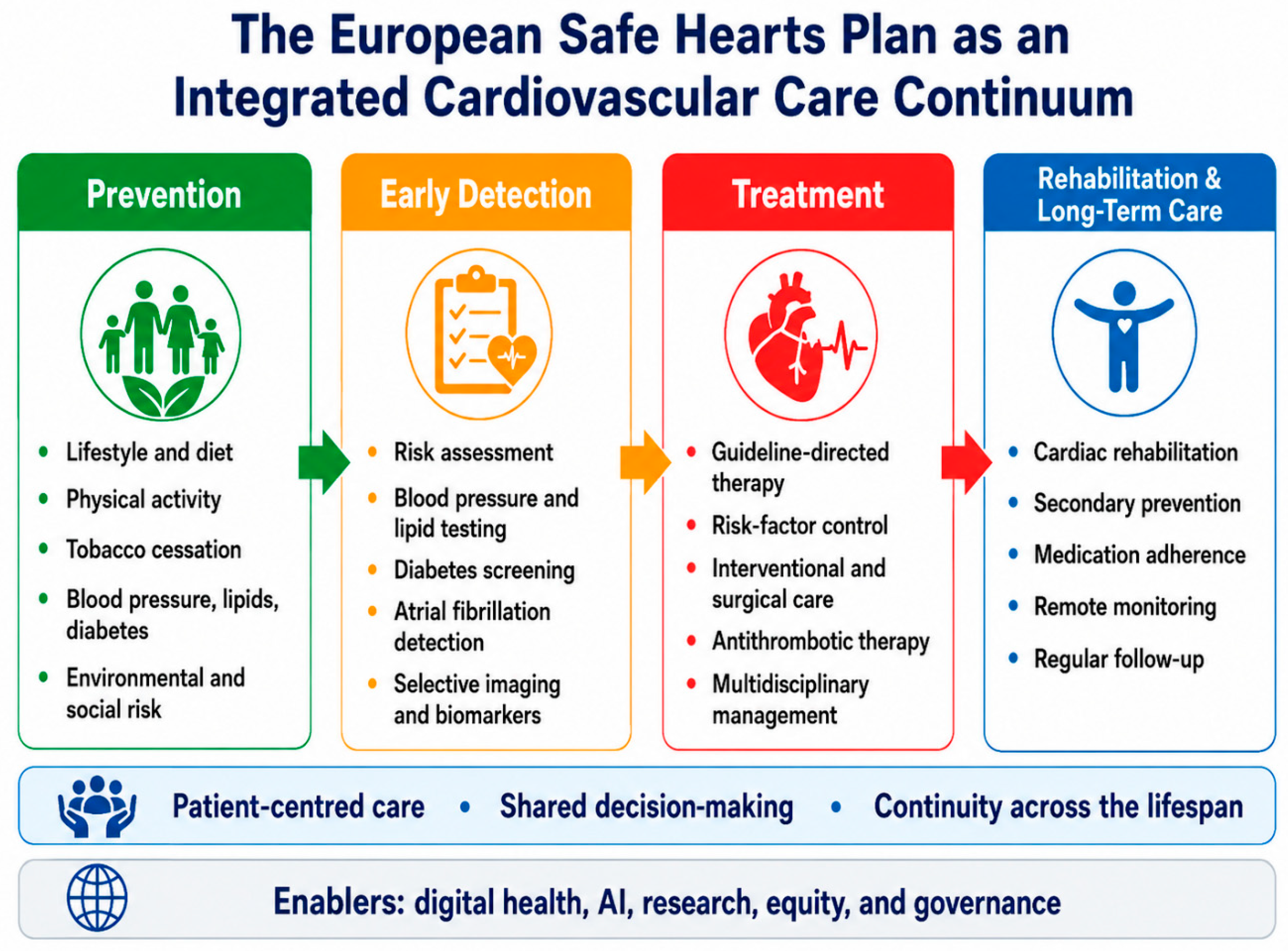
Figure 2.
Cyprus as a bounded implementation laboratory for the European Safe Hearts Plan. Cyprus is presented as a testable national platform rather than as a directly generalisable European model. Universal coverage through the General Healthcare System, manageable population scale, bounded geography, developing digital infrastructure, and academic-clinical links could allow pathway feasibility, stakeholder adoption, costs, equity effects, and transferability conditions to be evaluated before wider European adaptation. Abbreviations: AF, atrial fibrillation; AI, artificial intelligence; CAC, coronary artery calcium; EHR, electronic health record; ESC, European Society of Cardiology; GESY, General Healthcare System.
Figure 2.
Cyprus as a bounded implementation laboratory for the European Safe Hearts Plan. Cyprus is presented as a testable national platform rather than as a directly generalisable European model. Universal coverage through the General Healthcare System, manageable population scale, bounded geography, developing digital infrastructure, and academic-clinical links could allow pathway feasibility, stakeholder adoption, costs, equity effects, and transferability conditions to be evaluated before wider European adaptation. Abbreviations: AF, atrial fibrillation; AI, artificial intelligence; CAC, coronary artery calcium; EHR, electronic health record; ESC, European Society of Cardiology; GESY, General Healthcare System.
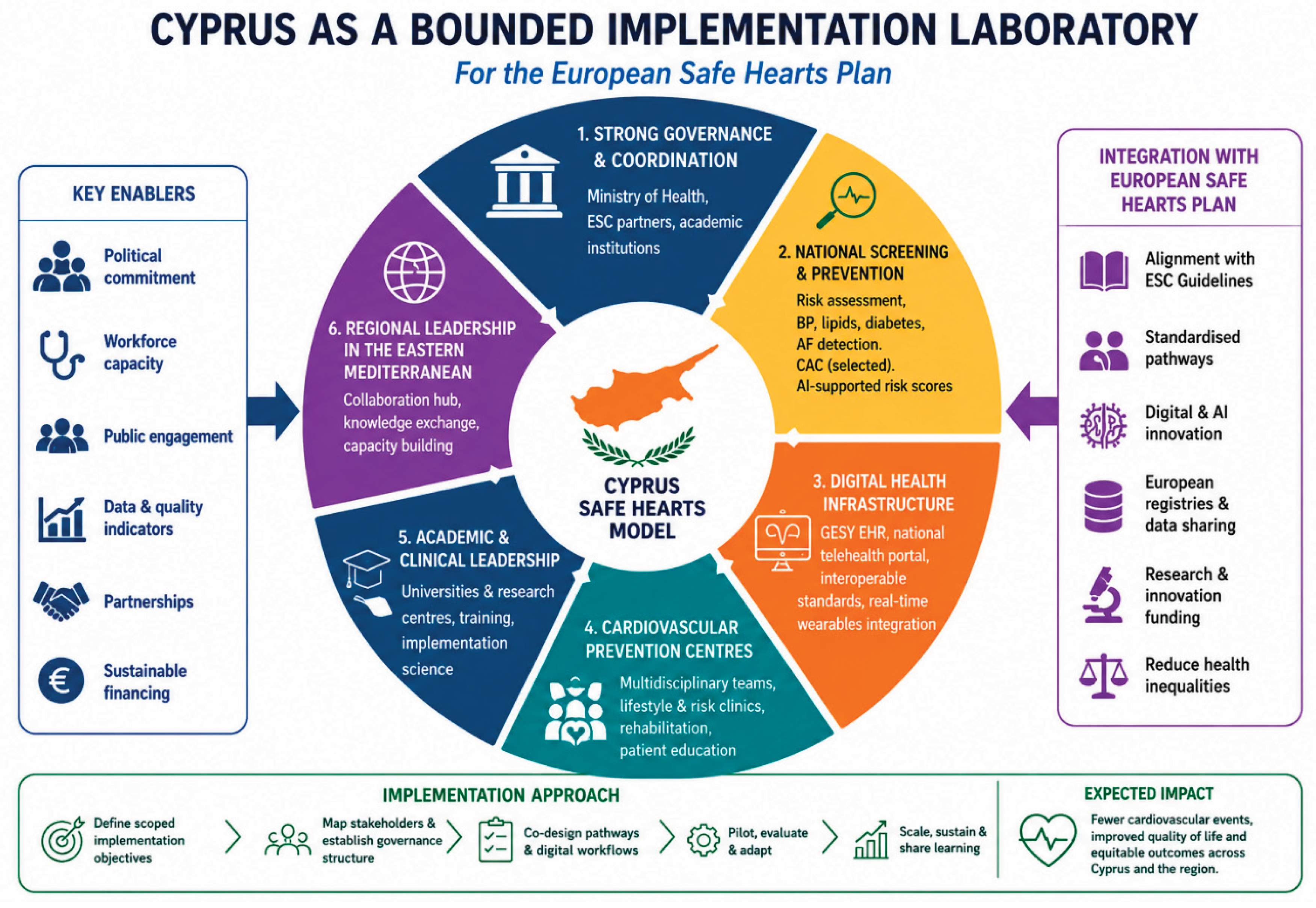

Table 1.
Evidence maturity and implementation readiness for the European Safe Hearts Plan.
| Evidence domain | Evidence status | Critical implementation interpretation |
| Mature prevention, treatment, and rehabilitation | High evidence weight; risk estimation, risk-factor treatment, secondary prevention, and rehabilitation are guideline-supported and outcome-oriented. | Standardise these pathways first, audit delivery, and monitor access, adherence, and outcomes. |
| Targeted screening and early detection | Moderate, pathway-dependent evidence; tools such as SCORE2/SCORE2-OP, atrial-fibrillation detection, wearables, imaging, and biomarkers can improve identification in selected groups. | Use targeted screening only where confirmatory pathways and treatment capacity exist; evaluate net benefit, false positives, equity, and cost. |
| Digital health, artificial intelligence, precision medicine, and registries | Conditional evidence; technical promise is strong, but clinical value depends on validation, workflow integration, governance, and outcome impact. | Treat technology as governed infrastructure, requiring external validation, bias audit, interoperability, clinical accountability, and prospective evaluation. |
| Equity, environment, and implementation science | Contextual evidence; social determinants, environmental exposure, digital inclusion, and delivery models shape cardiovascular outcomes. | Measure reach, adoption, fidelity, sustainability, equity, and outcomes rather than policy adoption alone. |
| Bounded implementation laboratories and external validity | Hypothesis-generating implementation evidence; national pilots can test whether integrated pathways are deliverable in real systems. | Report mechanisms, costs, stakeholder adoption, negative findings, and boundary conditions before claiming wider transferability. |
Note: Evidence levels are interpreted narratively and are not formally graded. Abbreviations: AI, artificial intelligence; SCORE2, Systematic Coronary Risk Evaluation 2; SCORE2-OP, SCORE2-Older Persons.
Table 2.
Strategic implementation domains for the European Safe Hearts Plan. The table summarises the main domains through which the Safe Hearts Plan could be translated from policy ambition into measurable health-system delivery.
Table 2.
Strategic implementation domains for the European Safe Hearts Plan. The table summarises the main domains through which the Safe Hearts Plan could be translated from policy ambition into measurable health-system delivery.
| Strategic domain | Core implementation action | Expected implementation value |
| Prevention & risk-factor control | Standardise population prevention and primary-care management of hypertension, dyslipidaemia, diabetes, obesity, smoking, and inactivity. | Fewer incident CVD events and lower premature mortality. |
| Early detection | Use targeted, risk-based screening: SCORE2/SCORE2-OP, AF detection, CKD assessment, and selective CAC or biomarker testing. | Earlier identification and timely intervention in high-risk groups. |
| Treatment & long-term care | Strengthen GDMT, specialist referral, multidisciplinary care, rehabilitation, adherence support, and follow-up. | Better survival, fewer recurrent events, and improved quality of life. |
| Digital, data & innovation | Build interoperable EHRs, registries, telemedicine, remote monitoring, validated AI, and precision-medicine tools. | Better continuity, decision support, accountability, and quality improvement. |
| Equity, policy & financing | Align national CVD plans, prevention-focused reimbursement, dedicated funding, and targeted access for underserved groups. | Reduced inequalities, sustainable financing, and more harmonised European implementation. |
| Cyprus bounded model | Test screening, prevention centres, digital infrastructure, registry measurement, academic leadership, and regional collaboration within GESY. | Feasibility, adoption, cost, equity, and transferability tested before wider European adaptation. |
Note: The table is intended as a compact implementation matrix for the main manuscript. Domains are grouped to avoid duplication between prevention, treatment, digital infrastructure, equity, financing, and the Cyprus bounded implementation model. Abbreviations: AF, atrial fibrillation; AI, artificial intelligence; CAC, coronary artery calcium; CKD, chronic kidney disease; CVD, cardiovascular disease; EHR, electronic health record; GESY, General Healthcare System; GDMT, guideline-directed medical therapy; SCORE2, Systematic Coronary Risk Evaluation 2; SCORE2-OP, SCORE2-Older Persons.
Disclaimer/Publisher’s Note: The statements, opinions and data contained in all publications are solely those of the individual author(s) and contributor(s) and not of MDPI and/or the editor(s). MDPI and/or the editor(s) disclaim responsibility for any injury to people or property resulting from any ideas, methods, instructions or products referred to in the content. |
© 2026 by the authors. Licensee MDPI, Basel, Switzerland. This article is an open access article distributed under the terms and conditions of the Creative Commons Attribution (CC BY) license.
Copyright: This open access article is published under a Creative Commons CC BY 4.0 license, which permit the free download, distribution, and reuse, provided that the author and preprint are cited in any reuse.


