

Submitted:
25 July 2026
Posted:
27 July 2026
You are already at the latest version
Abstract
The circular economy is a major manufacturing sector of the economy and the ongoing proliferation of advance digital technologies and digital transformation is revolutionizing manufacturing industries and enabling more sustainable, data-driven, digitally transparent and efficient processes. Smart manufacturing technologies, such as the Internet of Things (IoT), artificial intelligence (AI), and digital twins, offer unprecedented opportunities to optimize resource usage and reduce environmental impact. Concurrently, the circular economy model promotes resource optimization, material repurpose, and sustainability by emphasizing reuse, recycling, and regeneration of materials. This study explores the various opportunities inherent in the current digital technologies and how it certainly impacts on the circular economy, it also explores the intersection of digitalization and circular economy principles, focusing on how smart manufacturing facilitates resource optimization. Through a comprehensive analysis of various digital technological advancements and industrial case studies, this paper highlights how these various digital technologies can enhance lifecycle management, improve waste reduction, and drive circular innovation towards a more sustainable society. The study adopted systemic literature review SLR in relation to the Dynamic Capability Theory DCT and Resource-Based View RBV theory to analyze existing scholarly studies on digitalization in the Circular Economy CE. This research investigate how digitalization in manufacturing can optimize resource use, reduce environmental impact, and promote circular economic practices. The study analyzed current technologies, implementation challenges, and the potential for future development in this field. The paper explored how the circular economy can benefit from digital transformation that supports sustainable practices in manufacturing, focusing on how smart technologies contribute to resource optimization within the framework of the Circular Economy. The study concludes with recommendations for stakeholders seeking to adopt sustainable practices within the Circular Economy CE in the digital age.
Keywords:
artificial intelligence
; industry 4.0
; digitalization
; circular economy
; digital twin
; smart manufacturing
; Internet of Things (IoT)
; cloud computing
; machine learning
; big-data analytics
1. Introduction
The emergence of smart manufacturing represents a significant structural transformation of industrial systems driven by digitalization, automation, and intelligent decision- making. It is best understood as a continuum evolving from Industry 4.0 toward Industry 5.0, each phase introducing distinct paradigms in production, value creation, and resource utilization. Brief introduction to the circular economy (CE) and its principles (reduce, reuse, and recycle) [51]. The dramatic impact of the continuous growth in the digital space has increasingly encouraged other various sectors of the economy to tap into the opportunities of integrating digital advances of big-data analytics, cloud computing, and IoTs with business intelligence BI tools to empower business processes, efficiently optimize production capabilities with smart manufacturing to improve productivity [7,9]. Machine learning transforms existing business processes with artificial intelligence (AI) to digitally automate with cron jobs to perfect production processes efficiently. By leveraging digital tools such as the Internet of Things (IoT), artificial intelligence (AI), and data analytics, manufacturers can now achieve unprecedented levels of efficiency, flexibility, and customization [11]. At the same time, the global shift towards a Circular Economy emphasizes sustainability, resource efficiency, and the minimization of waste. This convergence of Smart Manufacturing and Circular Economy principles opens new avenues for innovative materials end-products and resource optimizations. Digitalization in the circular economy does not only enable real-time monitoring of resources optimization, predictive maintenance, closed-loop supply chains, but also the reuse of materials, aligning production systems with environmental goals [21,24,25,26,27,28,29,30,31,32,33,34,35]
Historical Context and Evolution
The dramatic impact of the continuous growth in the digital space has increasingly encouraged various sectors to tap into the opportunities of integrating the advances in big-data analytics, cloud computing, and IoTs with business intelligence BI tools to empower business process activities, efficiently optimizing production capabilities with smart manufacturing to improve productivity [8,12]. Smart manufacturing did not emerge in isolation; it is the culmination of successive industrial revolutions: The advent of Industry 1.0
→ushered in the Mechanization via steam power at the earlier 18th Century and Industry 2.0 → saw the evolution and transition to Electrification and mass production, while in the mid-20th century came Industry 3.0 → with the advent of innovative Automation using electronics and IT, and Industry 4.0 → opened industries to Cyber-physical integration and digitalization of mechanical manufacturing system integrated with IoT devices and business intelligence data analytics tools, and finally Industry 5.0 → Human-centric, sustainable, and resilient systems. The transition from Industry 3.0 to 4.0 marks the critical shift from automation to intelligence, where machines no longer just execute tasks but communicate, learn, and optimize processes autonomously [22,28]. This study aim to investigate how digitalization in manufacturing optimize resource use, reduce environmental impact, and promote circular economic practices
Industry 4.0: The Foundation of Smart Manufacturing
Industry 4.0 refers to the integration of digital technologies into manufacturing systems, creating interconnected, data-driven, and autonomous production environments. The key technological Pillars include: Internet of Things (IoT) → real-time machine connectivity, Artificial Intelligence (AI) → predictive analytics and decision-making, Cyber-Physical Systems (CPS) → integration of physical and digital processes, Big Data Analytics → process optimization, Cloud Computing → scalable data infrastructure, Digital Twins → virtual simulation of physical assets, Additive Manufacturing(3D-Printing)→flexible-production[5,8,9,10,11,12,13,14,15,16].These technologies enable horizontal and vertical integration across supply chains and production systems[34,38].
Characteristics of Industry 4.0
Industry 4.0 has significantly enhance the capabilities of manufacturing industries in various sectors of the economy, giving manufacturing industries the capability to operate as Smart factories with various autonomous systems through the following characteristics: Interoperability → that allows machines and systems communicate seamlessly, Decentralization → autonomous decision-making at machine level, Real-time capability→ instant data processing, Virtualization → digital representation of physical systems, Modularity→flexible and scalable production, Self-Optimization-allowing operating systems to autonomously correct, upgrade and update performance effectively and activities without human intervention using received data in real-time.[45,53].
Impact on Manufacturing
Industry 4.0 significantly transforms traditional manufacturing into smart-manufacturing systems characterized by: Predictive maintenance→reduced downtime, Mass customization→ personalized production at scale, Resource optimization → efficient use of materials and energy, Supply chain integration → end-to-end visibility. This phase establishes the technological backbone for the Circular Economy, CE integration. By definition industry 4.0 encompasses a system where machines, data, and humans are interconnected, enabling
(i) Self-monitoring (ii) Self-optimization (iii) Adaptive production. These three 3 key characteristics are the foundation of the Core Capabilities of industry 4.0 which are (i) Real-time data acquisition and analytics (ii) Autonomous process control (iii) Intelligent resource allocation (iv) Continuous improvement loops. Digitalization enhances resource optimization and resource optimization plays a crucial role, ensuring that materials and energy are used as efficiently as possible throughout a product’s lifecycle, while also increasing the lifespan of materials and resources [21,45,46,47,48,49,50,51,52,53,54].
The Role of Digitalization in Advancing Resource Optimization in the Circular Economy
The industrial sector have witnessed a significant transformation driven by digital technologies with Industry 4.0. Industry 4.0, is characterized by Smart manufacturing which comprises of interconnected systems, automation, and real-time data, has opened new pathways for enhancing operational efficiency and sustainability [21,25]. At the same time, growing environmental concerns and resource scarcity have accelerated the push toward circular economy models, which aim to design-out waste, keep products and materials in use, and regenerate natural systems. Smart manufacturing, underpinned by digital tools and intelligent systems, plays a vital role in enabling the circular economy. These technologies not only improve production efficiency but also support closed-loop systems where materials are continually reused. Smart manufacturing, underpinned by digital tools and intelligent systems, plays a vital role in enabling the circular economy. These technologies not only improve production efficiency but also support closed-loop systems where materials are continually reused [4,9,10,11,12,13,14,15].
Digitalization with Industry 4.0 offers a data-driven approach to manufacturing. This data-driven approach to manufacturing helps to immensely improve decision-making processes, enhance transparency in production lines, and optimize business process performance[23]. The volume of data generated in the Circular Economy manufacturing industry positioned this sector to significantly benefit from the integration of advances in digital Technologies (ICT) such as Digital Twin, Cloud computing technologies, Internet of Things (IoT), Artificial Intelligence, and automation to significantly enhance production capabilities, streamline supply chain, maximize resources, and automate production processes[36,46]
Key Performance Metrics for Circular Economy and Resource Optimization
The key performance metrics provide a benchmark for measuring the effectiveness of the performance of the resource optimization digital tools. There are various key performance metrics (kpi) for Circular Economy to monitor and measure various aspects of resource optimization efforts [52]. To effectively track progress and measure success in integrating smart manufacturing with circular economy principles, organizations need to adopt key performance metrics that reflect environmental, economic, and operational outcomes. These metrics serve as benchmarks for continuous improvement and strategic decision-making for successful integration of digitalization efforts within the circular economy [13,56,57,58,59,60,61,62].
i. Material Circularity Indicator (MCI): Measures the degree to which materials used in a product or process are sourced from recycled or renewable sources and are reused or recycled after end-of-life.
ii. Resource Productivity: Quantifies the economic value generated per unit of natural resources consumed (e.g., GDP per ton of material input).
iii. Waste Reduction Rate: Tracks the percentage reduction in waste generation relative to a baseline period or production volume.
iv. Energy Efficiency: Measures the energy consumed per unit of output, highlighting improvements in process optimization and technology utilization. [33,64]
v. Carbon Footprint: Assesses total greenhouse gas emissions associated with the production process, providing insight into climate impact and opportunities for decarburization.
vi. Water Usage Efficiency: Evaluates the volume of water used per unit of output and highlights efforts in conservation and recycling of water resources.
vii. Product Lifecycle Extension: Assesses the increase in product lifespan through strategies such as repairability, modularity, and upgradability.
viii. Digitalization Index: Reflects the level of digital integration across operations, including the use of IoT, AI, and data analytics in enhancing sustainability performance. [16,19].
ix. Supply Chain Circularity Score: Measures the extent of circular practices across the supply chain, such as use of recycled materials, take-back programs, and reverse logistics. xi. Customer Engagement in Circular Practices: Evaluates consumer participation in return schemes, recycling pr. By consistently monitoring these KPIs enables organizations to align their operations with circular economy goals while driving operational excellence and sustainable value creation in a dynamic digital economy. Since resource optimization is the ultimate goal within the circular economy, deliberate strategic measures must be taking towards sourcing digitalization measures that can achieve sustainability within the industry [32].
Resource Optimization Techniques
Resource optimization is critical for achieving the goals of the circular economy and enhancing the efficiency of smart manufacturing systems. The following techniques are commonly applied to minimize waste, reduce costs, and promote sustainable use of resources:
Lean Manufacturing - Aims to eliminate waste throughout the production process by optimizing workflow, reducing idle time, and improving quality control. It aligns well with circular principles by promoting minimal resource usage. Six Sigma - A data-driven approach that focuses on reducing variation and defects in manufacturing processes. It supports resource efficiency by ensuring processes are consistently producing high-quality outputs with minimal rework. Just-In-Time (JIT) -Reduces inventory waste by ensuring that materials and components are delivered only when needed in the production cycle, minimizing excess and obsolescence.
Energy Management Systems (EMS) - Utilize monitoring and analytics tools to track and optimize energy consumption across operations, leading to lower environmental impact and reduced energy costs. Predictive Maintenance - Uses sensors and AI to anticipate equipment failures, reducing downtime and extending the life of machinery, which conserves resources and minimizes waste [43].
Material Flow Analysis (MFA) - A method to quantify the flow of materials within a system to identify inefficiencies and opportunities for reuse or recycling. Life Cycle Assessment (LCA) - Evaluates the environmental impact of a product throughout its lifecycle, from raw material extraction to disposal, aiding in better design and process decisions.[24]
Closed-Loop Supply Chains - Incorporate reverse logistics to return used products and materials back into the production cycle, reducing dependency on virgin resources. Digital Twin Technology - Simulates and optimizes processes in a virtual environment before implementation, enabling efficient resource planning and use.
Additive Manufacturing (3D Printing) -Enables precise material usage and customization, reducing waste and allowing for on-demand production.
Overall these techniques collectively empower manufacturers to transition toward more circular and sustainable production models, leveraging these digital technologies to optimize resource use at every stage of the material and product lifecycle. Digitalization -Smart Manufacturing and Resource Optimization in the Circular Economy. The integration of digital technologies in manufacturing—commonly referred to as Smart Manufacturing—has revolutionized the way industries operate. By leveraging tools such as the Internet of Things (IoT), artificial intelligence (AI), and data analytics, manufacturers can now achieve unprecedented levels of efficiency, flexibility, and customization [19]. At the same time, the global shift towards a Circular Economy emphasizes sustainability, resource efficiency, and the minimization of waste. This convergence of Smart Manufacturing and Circular Economy principles opens new avenues for innovation. Digitalization enables real-time monitoring of resources, predictive maintenance, closed-loop supply chains, and the reuse of materials, aligning production systems with environmental goals. Resource used as efficiently as possible throughout a product’s lifecycle.
This study explores how digital transformation supports sustainable practices in manufacturing, focusing on how smart technologies contribute to resource optimization within the framework of the Circular Economy. Strategies, and emerging technologies are discussed to provide insights into building resilient, efficient, and environmentally responsible industrial systems. Digitalization tools and technologies can be integrated into the Circular Economy through various digital services, and products. Integrating smart manufacturing and resource optimization into the circular economy requires aligning digital tools with the principles of reducing, reusing, and recycling resources. This integration fosters sustainable industrial practices and enhances value across product lifecycles. Key approaches include:
- Design for Circularity: Digital tools support the design of products with longer lifespans, easier disassembly, and recyclability. Computer-aided design (CAD) and life cycle assessment (LCA) tools allow manufacturers to evaluate environmental impacts early in the design process.
- Product-as-a-Service (PaaS): Through smart tracking and performance monitoring, manufacturers can shift from selling products to offering services, retaining ownership and responsibility for maintenance, upgrades, and end-of-life management.
- Digital Product Passports: Provide detailed information on materials, repair instructions, and sustainability data, enabling efficient recycling, remanufacturing, and regulatory compliance.
- Reverse Logistics and Closed-Loop Systems: IoT and AI technologies facilitate real-time tracking of products and materials throughout their lifecycle, enabling efficient returns and reintegration of components into production.
The circular economy has an integration of business process activities of various entities within its ecosystems, from supply chain managers, suppliers, End-Users, regulators, policy-makers, innovative-value[52].
Digitalization helps to sync the operational activities of all these various actors, providing and allowing information sharing in real-time amongst all stakeholders.
- v.
- Real-Time Resource Monitoring: Advanced sensors and analytics enable manufacturers to track material and energy use in real-time, identifying inefficiencies and opportunities for reuse or recycling.
- vi.
- Collaborative Platforms: Digital ecosystems connect suppliers, manufacturers, and consumers to share resources, best practices, and data, promoting transparency and circular innovation.
- vii.
- Blockchain for Traceability: Blockchain technologies support secure, transparent tracking of product provenance, facilitating ethical sourcing, accountability, and closed-loop recovery.
Integrating these practices ensures that digitalization not only enhances operational efficiency but also drives sustainability. The convergence of these efforts paves the way for a regenerative industrial model where value is preserved and environmental impact minimized [12,34,35,36,37,38,39,40,41,42].
Research Objectives
- (i)
- To systematically review the application of digital technologies in resource optimization in the context of smart manufacturing and CE.
- (ii)
- To evaluate the impact of digitalization on key aspects like waste reduction, energy efficiency, and material usage.
Research Question
RQ1: How can digitalization enable resource optimization in the circular economy?
RQ2: What are the key digital technologies driving resource optimization in the circular economy?
Literature Review
With the advent of Industry 4.0 and smart manufacturing, literatures on digitalization and sustainability in manufacturing has grown substantially providing insights into various opportunities inherent in digitalization. Several studies from industry experts and scholars have highlighted the transformative potential of smart technologies such as IoT, big data analytics, and cyber-physical systems in improving operational efficiency and environmental performance. According to [8] the integration of these technologies enables real-time monitoring and decision-making, which significantly reduces resource wastage and operational costs. Smart manufacturing is increasingly linked with the concept of the circular economy. [21] defines the circular economy as a regenerative system in which resource input and waste are minimized by slowing, closing, and narrowing material and energy loops. [28] further elaborate on circular business models, emphasizing the importance of design for longevity, maintenance, reuse, and recycling. Other recent scholarly research explores how Industry 4.0 can enhance circular economy strategies by facilitating better information flow and product traceability, thus enabling effective resource recovery. Similarly, studies by [25] show that digital platforms support product-service systems and remanufacturing by enabling lifecycle tracking and performance monitoring. Despite these advances, gaps remain in understanding the practical integration of smart technologies with circular practices. Many studies are conceptual, lacking empirical validation. Moreover, implementation challenges such as high costs, data privacy, and skills shortages are frequently cited as barriers to widespread adoption [21,22,23,24,25,26,27,28,29,30,31,32,33,34,35,36,37,42].
Integrating Smart Manufacturing into Circular Economy
Smart manufacturing not only complements but actively drives the transition toward a circular economy by embedding circular principles into every stage of production and consumption. Through real-time monitoring, intelligent automation, and end-to-end digital integration, manufacturers can create resilient, resource-efficient, and adaptive systems. For instance, predictive maintenance reduces downtime and material waste, while digital twins and lifecycle analytics help optimize product design for sustainability[32]. Furthermore, digital supply chains enhance transparency and material recovery, and smart contracts via blockchain ensure responsible sourcing and recycling. These synergies empower industries to not only minimize their environmental footprint but also unlock new value streams through circular business models.
Digitalization of each stage of the product lifecycle, smart manufacturing not only enhances resource efficiency but also catalyzes systemic transformation toward circularity, and reuse[55,66]. This review identifies a clear research opportunity: to bridge the gap between theory and practice in the application of digital tools for circular manufacturing. By examining real-world case studies and emerging technologies, this paper seeks to contribute to this evolving discourse. Smart manufacturing technologies encompass a range of digital tools and systems that enable greater efficiency, adaptability, and sustainability in industrial production. Central to Industry 4.0, these technologies facilitate real-time decision-making, predictive analytics, and system integration.[25]
Internet of Things (IoT)- IoT devices embedded within the framework of every manufacturing infrastructure enhances the collection data for process optimization. IoT devices enable continuous monitoring of machines, materials, and environmental conditions. They provide actionable data that improves energy efficiency, equipment utilization, and waste management[33,42].
Artificial Intelligence (AI) and Machine Learning (ML) - AI-driven and analyze large datasets for performance improvement. These tools help identify inefficiencies and opportunities for resource optimization.
Digital Twins -A digital twin is a virtual model of a physical process or system that enables real-time simulation and optimization. It supports proactive maintenance, product development, and lifecycle assessment.
Cloud Computing and Edge Computing - These technologies enable scalable data storage and processing. Cloud-based platforms support collaboration and information sharing, while edge computing allows for fast, local decision-making at the production site.[26,32].
Robotics and Automation - Autonomous robots improve production precision and reduce human error. In smart factories, robots can be reprogrammed dynamically, increasing flexibility and reducing downtime.
Additive Manufacturing (3D Printing)-This technology allows for on-demand production and material efficiency. It reduces the need for excess inventory and supports product customization with minimal waste. Collectively, these technologies not only enhance operational performance but also serve as enablers of sustainability by supporting closed-loop systems, reducing resource consumption, improve resource management, and enabling new business models such as product-as-a-service and remanufacturing. In the next section, the paper will explore specific techniques used for resource optimization enabled by these technologies.[31].
Resource Optimization Techniques - Resource optimization in the context of smart manufacturing and the circular economy involves leveraging digital technologies to maximize the utility of materials, energy, and labor while minimizing waste and environmental impact. This section outlines several key techniques used to achieve these goals:
Smart Manufacturing For Resource Optimization in the Circular Economy.
The integration of digital technologies in manufacturing—commonly referred to as Smart Manufacturing—has revolutionized the way industries operate. By leveraging tools such as the Internet of Things (IoT), artificial intelligence (AI), and data analytics, manufacturers can now achieve unprecedented levels of efficiency, flexibility, and customization.
At the same time, the global shift towards a Circular Economy emphasizes sustainability, resource efficiency, and the minimization of waste. This convergence of Smart Manufacturing and Circular Economy principles opens new avenues for innovation. Digitalization enables real-time monitoring of resources, predictive maintenance, closed-loop supply chains, and the reuse of materials, aligning production systems with environmental goals.[41].
Resource optimization plays a crucial role, ensuring that materials and energy are used as efficiently as possible throughout a product’s lifecycle. This paper/report/presentation explores how digital transformation supports sustainable practices in manufacturing, focusing on how smart technologies contribute to resource optimization within the framework of the Circular Economy. Case studies, strategies, and emerging technologies are discussed to provide insights into building resilient, efficient, and environmentally responsible industrial systems. [26,41].
Digitalization, digital technologies are integrated into the Circular Economy through various digital services, and products. Integrating smart manufacturing enables resource optimization into the circular economy and requires aligning digital tools with the principles of reducing, reusing, and recycling resources. This integration fosters sustainable industrial practices and enhances value across product lifecycles. Integrating these practices ensures that digitalization not only enhances operational efficiency but also drives sustainability. The convergence of these efforts paves the way for a regenerative industrial model where value is preserved and environmental impact minimized [14].
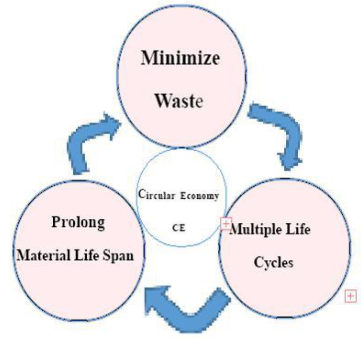
production cycles
Circular Strategies Enabled by Industry 4.0
Figure 1.
Resource Optimization Areas in a Circular Economy.
Industry 4.0 as a Digital Backbone
Industry 4.0 provides the technological infrastructure necessary to operationalize circular economy principles through: (i) Real-time data acquisition. (ii) Autonomous decision-making (iii) System-wide connectivity.
Circular Economy as a Sustainability Framework
The circular economy defines the value logic through the following means: (i) Eliminate waste (ii) Retain resource value (iii) Regenerate systems.
Note: Integration occurs when digital capabilities enable circular strategies at scale and precision.
Integration Architecture: From Linear to Intelligent Circular Systems.
Integration through digital capabilities occurs in three different layer. The First layer is the: (i) Digital Layer (Technology Enablers): This layer is enhanced through various digital enablers such as:(i) Internet of Things (IoT) → real-time monitoring of materials and assets (ii) Artificial Intelligence (AI) → predictive optimization (iii) Digital Twins → Lifecycle simulation. (iv) Blockchain → Traceability and transparency.
The Second Layer is the (ii) Operational Layer (Smart Manufacturing)
- -
- The components of this layers include: (i) Cyber-Physical Systems Coordinating Production (ii) Autonomous Process Control
- (iii)
- Adaptive Resource Allocation.
The Third Layer is the (iii) Circular Layer (Sustainability Outcomes)
- -
- (i) Closed-Loop supply Chains (ii) Waste Minimization (iii) Lifecycle extension.
Note: These Layers collectively transform manufacturing into a Self-Optimizing Circular System
Mechanisms of Integration
Data-Driven Resource Optimization -Industry 4.0 enables granular visibility of resource flows, allowing: (i) Energy consumption optimization. (ii) Material usage efficiency (iii) Waste reduction through real-time adjustments.
Predictive and Preventive Systems – This integrations mechanism provides for effective forecast allowing for effective resource management and allocation.(i).Predictive maintenance reduces equipment failure (ii) AI-driven forecasting minimizes overproduction
Closed-Loop Production Systems - Digital technologies enable:
(i) Tracking of products across lifecycle stages (ii) Reverse logistics coordination (iii) Remanufacturing and recycling integration
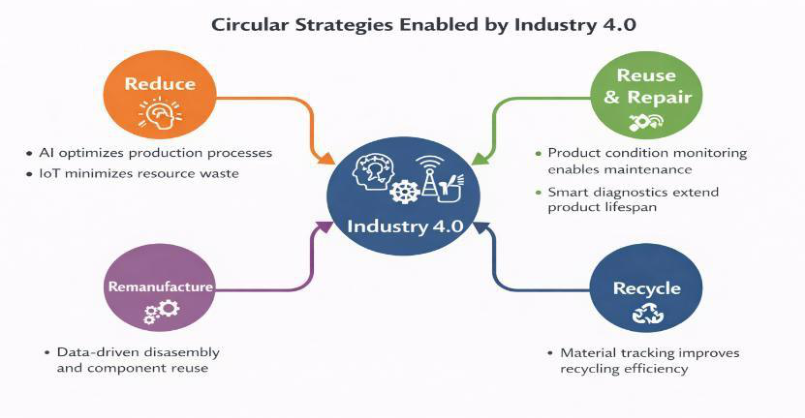
The Circular economy fundamentally relies on four (4) R- strategic areas of resources optimizations. These strategic areas of production are typically where materials or resources end up in circular production economy. The strategic areas are vital: (1) Reduce: (a) AI optimizes production processes (b) IoT minimizes resource waste (2) Reuse & Repair: (a) Product condition monitoring enables maintenance (b) Smart diagnostics extend product lifespan.
- (3)
- Remanufacture: (a) Data-driven disassembly and component reuse.
- (4)
- Recycle: Material tracking improves recycling efficiency
Note: Industry 4.0 shifts circular strategies from manual and reactive →
automated and predictive
Figure 2.
Relationship Diagram of Circular Strategies Enabled By Industry 4.0.
Business Model Transformation
Integrations of industry 4.0 to Circular Economy constantly helps to drive new business model for the organizations, allowing the enterprise to embark on the following business models;
- (i)
- Product-as-a-Service (PaaS) : (a) Manufacturers retain ownership
(b) Incentivizes durability and reuse
- (ii)
- Platform-Based Ecosystem: such as (a) Digital platforms connect stakeholders (b) Enable sharing and resource pooling
- (iii)
- Data-Driven Value Creation: such as (a) Data becomes a strategic asset (b) Continuous optimization generates competitive advantage.
Theoretical Framework
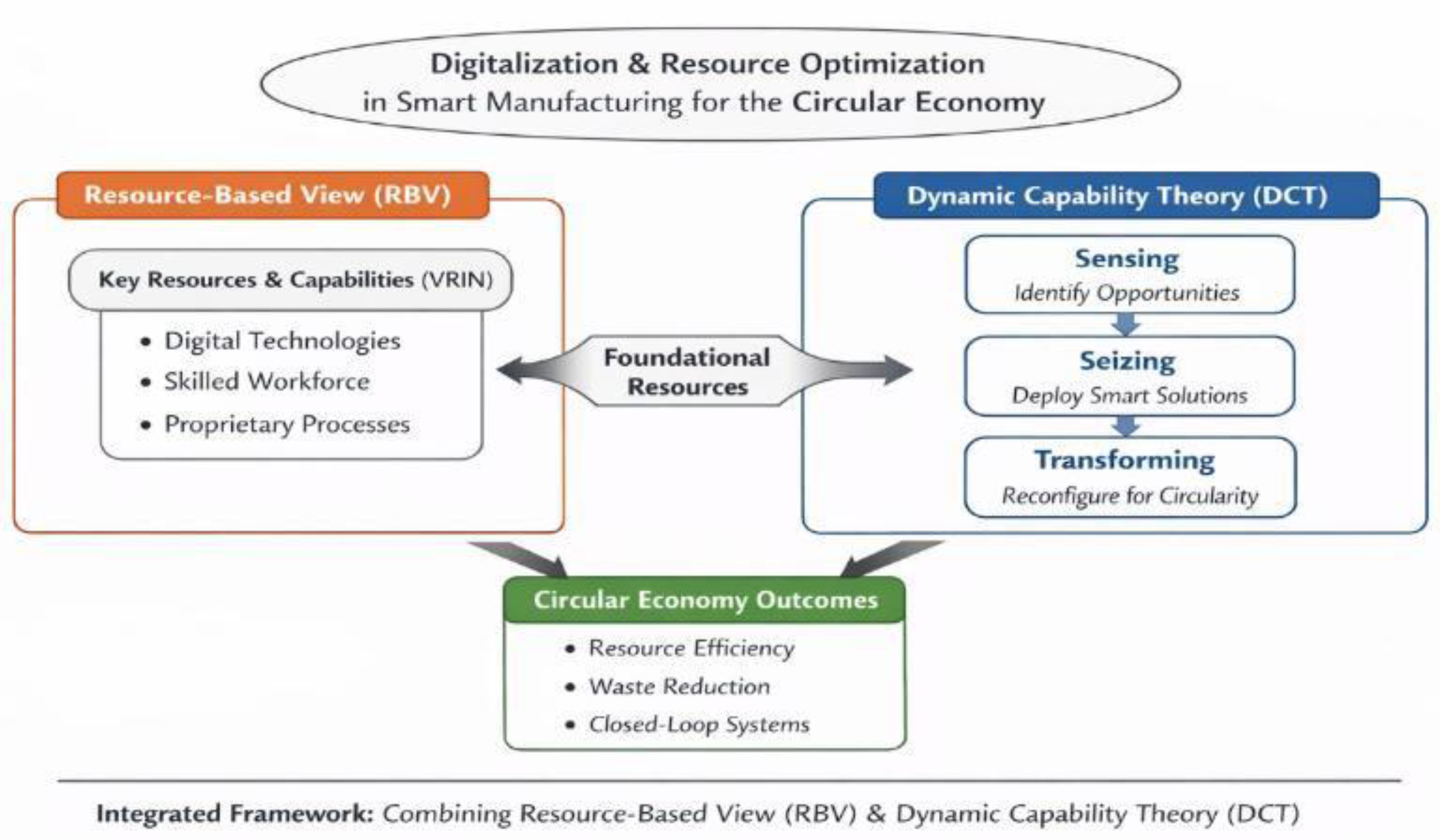
The study applied Dynamic Capability Theory DCT as the primary theoretical lens for review of this study and Resource-Based View theory RBV as a secondary theory for theoretical rigor of the research to analyze how digitalization shapes enterprise optimization resource usage to create competitive products and advantage. This framework provides a framework for exploring how digitalization can contribute to sustainable development within the circular economy, and also for exploring the intersection of digitalization, resource optimization, and the circular economy
Theoretical Interpretation (RBV + DCT)
Resource-Based View (RBV) - Industry 4.0 technologies constitute the following strategic resources that allows and enables organizations in the 21st century digital age to achieve real-time decision-making, resource control, Inventory management and project management : They include (i) IoT infrastructure (ii) Data analytics capabilities (iii) Skilled workforce .These resources enable firms to achieve efficiency and differentiation [22,41,42,43,44,45,46,47,48,49,50,51,52,53,54].
Dynamic Capability Theory (DCT)
Integration requires continuous capability development through:
*Sensing → identifying circular opportunities through data
*Seizing → deploying digital technologies
*Transforming → reconfiguring processes into circular systems
Note: *Industry 4.0 is not just a resource—it is a capability enabler for circular transformation.
Figure 3.
Integrated Framework of Dynamic Capability DCT and Resource-Based View RBV.
Systemic Differences: Linear vs Circular Economy

Table 1.
Systemic Difference between Linear vs Circular Economy.
| s/n | Dimension | Linear Economy | Circular Economy |
|---|---|---|---|
| 1 | Resource Flow | One-Way | Closed-Loop |
| 2 | Waste | End-of-Life | Designed Out |
| 3 | Value Retention | Low | High |
| 4 | Production Model | Mass Production | Smart, Adaptive production |
| 5 | Sustainability | External Concern | Core Objective |
Core Circular Principles
The core principles of the circular economy that defines resource optimization follows four distinct areas
(i).Design Out Waste – Waste Materials is minimized at the design stage
(ii).Maintain Product Value – Products are reused, repaired, refurbished, and remanufactured.
(iii).Closed Material Loops – Materials circulate within the systems rather than being discarded
(iv).Regenerate Natural Systems – Biological Cycles restore environmental resources
Figure 4.
The Core Circular Principles in a Circular Economy.
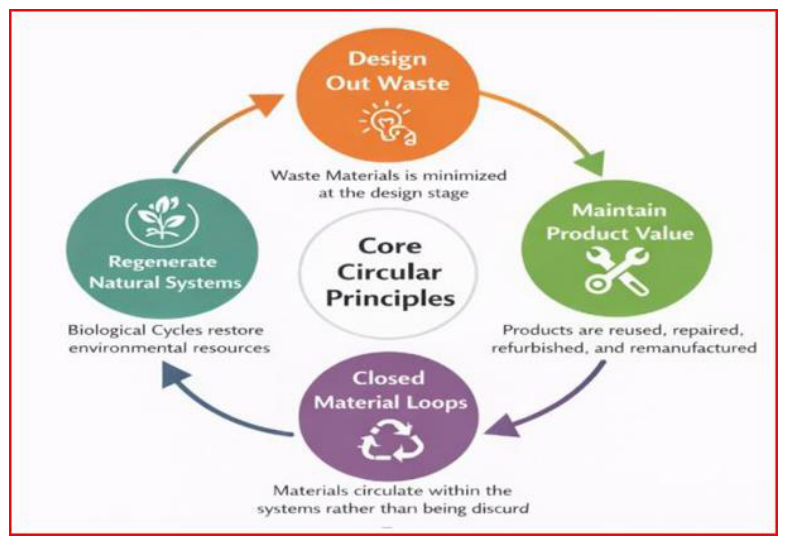
Table 2.
Circular Strategies R-Framework Operational Transition Hierarchy.
| s/n | Operation | Circular End-Products |
| 1 | Refuse | Eliminate Unnecessary Product |
| 2 | Reduce | Minimize Resource Use |
| 3 | Reuse | Extend Product Life time |
| 4 | Repair | Restore Functionality |
| 5 | Refurbish | Update Product |
| 6 | Remanufacture | Rebuild Components |
| 7 | Recycle | Recover Materials |
| 8 | Recover | Extract Energy |
NOTE: The Higher-Order Strategies (Refuse, Reduce and Reuse) Yield Greater Sustainability Impact than downstream recycling
Key Digitalization Areas of Resource Optimization
Monitoring and Predictive Maintenance - By using sensors and IoT devices, manufacturers can monitor equipment conditions in real time, obtaining information necessary to make informed-decision during operational processes. Predictive maintenance minimizes unplanned downtime, extends machinery lifespan, and reduces resource consumption by preventing catastrophic failures.
Energy Management Systems (EMS) - EMS platforms utilize data from IoT sensors to track energy usage patterns and optimize consumption. AI algorithms can suggest improvements, such as load shifting or equipment scheduling, to enhance energy efficiency [3,8].
Lean Manufacturing Principles Enhanced by Digital Tools -Digital platforms can support lean methodologies by identifying waste (in time, materials, or labor) and streamlining workflows. Value stream mapping and process mining tools help visualize and improve resource flows.
Digital Supply Chain Optimization - Smart supply chains integrate data from suppliers, manufacturers, and customers to ensure efficient logistics, reduce Over production, and match resource use with actual demand. Blockchain and cloud-based platforms enhance transparency and traceability [1,25,26,27,28,29,30,31,32].
Closed-Loop Systems and Material Tracking - Digital technologies support closed-loop manufacturing by tracking materials through their lifecycle and facilitating reuse, remanufacturing, and recycling. RFID tags and BlockChain can ensure accurate and secure traceability.
Advanced Analytics for Waste Reduction -Big data analytics can identify patterns and sources of waste, providing actionable insights for improvement. These insights support decision-making on material substitutions, process changes, and efficiency upgrades.
Product Lifecycle Management (PLM)-PLM systems integrate data across design, disassembly planning, and end-of-life strategies that align with circular economy goals. These techniques not only contribute to sustainability but also offer economic advantages such as cost savings, increased productivity, and improved competitiveness. The next section will examine how these practices and technologies are integrated into broader circular economy strategies [12,45].
Material Resource Optimization
Resource optimization is the ultimate goal for end-product and resource material repurposing and regeneration within the circular economy (CE) which allows a specific resource material to have as many lifespans as possible, prolonging the material lifespan with multiple lifecycles, while minimizing waste:
Material Usage Efficiency: Material Reuse rate(y) Over Time (x)
Material Reuse Rate (y) Over Time (x) Model
Equation:
y= R(x), where R(x) is the Material Re-Use Rate (%) as a function of the time(x) of production levels.
Objective:
Determine the Cumulative material reuse over a specific period of time rage [x₁ , x ₂];
= x1 ∫x₂ R(x)dx
Sample Function:
Assume R(x) = A + B sin (Cx), Where A: Baseline reuse rate (%)
B: Amplitude and
C: Frequency of Changes Over time. {x₁ = 0 : and x₂ = T
(specific time)
Integration:
∫ R(x) dx = ∫ (A + B Sin (Cx)) dx
= Ax + \frac{-B}{-C} \ Cos (Cx) + C_1
Evaluate: For x₁ = 0 and x₂ = T (Specific Period)
Cumulative Reuse = [AT + −B cos (CT)] – [0 + −B cos (0)]
Figure 5.
5. 0 Shows Key Performance metrics in a Circular Economy.
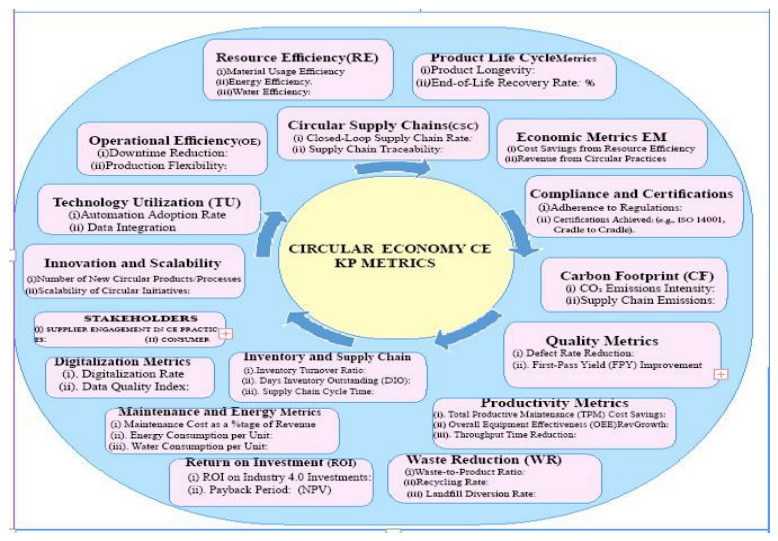
By tracking, identifying and analyzing various operational performance metrics, manufacturers in the circular economy CE can proactively:
- (i)
- Identify areas of process improvement and optimization within the production chain
- (ii)
- Optimize and smoothing production workflows
- (iii)
- Increase the efficiency and productivity process
- (iv)
- Reduce wastage in energy consumption
- (v)
Smart Manufacturing as an Integration Platform
Smart manufacturing systems act as the operational environment where the following systems: (i) Digital technologies interact (ii) Circular strategies are implemented (iii) Resource optimization is achieved. These systems enable:
(a) Autonomous decision-making,(b)Adaptive production processes, (c)Continuous improvement loops
Functional Roles of Technologies
Table 3.
0 Different layers of digital technologies involvement in the Circular economy.
| Digital Tech | Layer | Role in the Circular Economy |
| IoT |
Foundation Layer |
Enables data acquisition and connectivity |
| Critical for real-time monitoring | ||
| AI | Intelligence Layer | Converts data into actionable insights |
| Drives predictive optimization | ||
| Digital Twins | Simulation Layer | Supports lifecycle and design optimization |
| Blockchain | Trust Layer | Ensures transparency and traceability |
|
Integrated Systems |
System Layer | Combine multiple technologies for holistic optimization |
C
C
Note: This integration model provides the total material reuse over a specific period of time or lifespan.
Methodology
To explore the research questions RQ1 and RQ2 for this study, systemic literature review SLR is adopted for synthesis and rigorous review of 70 scholarly studies on digitalization in the Circular Economy. Adopting a Systematic Literature Review (SLR) is a methodological choice driven by the need for rigor, transparency, reproducibility, and comprehensive synthesis in scholarly research.
In domains such as digitalization, smart manufacturing, and the circular economy—where knowledge is fragmented across disciplines—SLR provides a structured mechanism to consolidate, evaluate, and advance existing evidence. The Systemic Literature Review SLR of academic studies, industry white papers, and market reports, coupled with analysis and synthesis of existing literatures on real-world case studies on the subject of the study provided a framework for analysis and understanding of existing scholarly perspectives on digitalization in the circular economy. For this research study also secondary data was gathered from credible sources such as peer-reviewed journals, industry reports, company sustainability disclosures, and databases including Scopus, Web of Science, and Google Scholar. SLR choice for review of scholarly studies helps minimize bias in literature selection, reducing the influence of authors preference or favor of certain studies, through comprehensive database searches, systematic screening (such as PRISMA framework), and objective inclusion, resulting in balanced representation of studies and synthesis of literature.
Data Analysis
The Systemic Literature Review SLR was adopted to help ensure rigor, replicability and transparency for review of 70 studies on Circular Economy. SLR helped to ensure comprehensive synthesis of literature studies on digitalization within circular economy.
Table 4.
0. Shows the synthesis of 10 Scholarly Studies S1- S10.
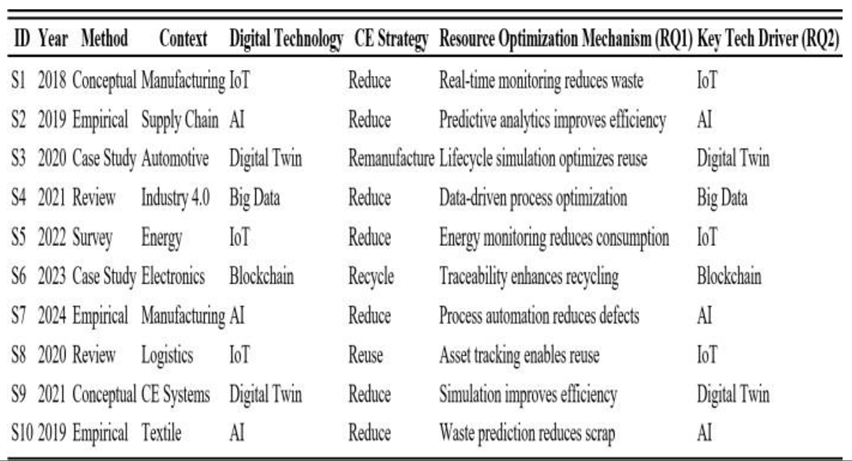
Table 5.
0. Synthesis of 60 scholarly studies into Cluster and Themes.
| s/n | Themes | Synthesis Area | Studies |
|---|---|---|---|
| 1 | Cluster A | IoT-Driven Resource Optimization | S11–S25 |
| 2 | Cluster B | AI & Analytics | S26–S40 |
| 3 | Cluster C | Digital Twins | S41–S50 |
| 4 | Cluster D | Blockchain & Traceability | S51–S60 |
| 5 | Cluster E: | Integrated Industry 4.0 Systems | S61–S70 |
Table 6.
Digitalization Enablers and Key Digital Drivers for RO.
| RQ1 | How Digitalization Enables | Resource Optimization |
| 1 | Real-Time Monitoring (IoT) | Tracks Materials and Energy Usage |
| Reduces Inefficiencies | ||
| 2 | Predictive Optimization(AI) | Forecast Demand and Failures |
| Minimizes Waste and Downtime | ||
| 3 | Lifecycle Simulation(Digital Twins) | Optimizes product design and Resuse |
| Reduces Trial-and-Error waste | ||
| 4 |
Traceability & Transparency (BlockChain) |
Enables Closed-Loop Supply chains |
| Improves recycling and reuse | ||
| RQ2 | Key Digital Technologies Driving | Resource Optimization |
| IOT | 3 | |
| AI / Machine Learning | 3 | |
| Digital Twins | 2 | |
| BlockChain | 1 | |
| Integrated Systems (CPS, Cloud) | 1 |
Table 7.
Percentage of Key digital drivers contribute to Resource Optimization.
| Sn | Key Digital Drivers of Resource Optimization | % Frequency |
| 1 | IOT Digital devices | 30% |
| 2 | AI/Machine Learning | 28% |
| 3 | Digital Twins | 18% |
| 4 | BlockChain | 14% |
| 5 | Integrated Systems | 10% |
Together these key digital technologies form a multi-layer digital architecture resource systems driving circular economy ecosystem.
Circular Strategies and Digital Enablement
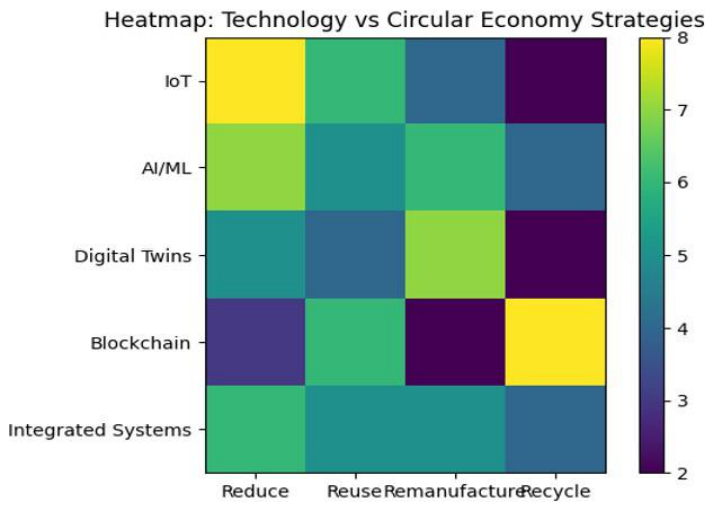
The analysis shows strong alignment between technologies and circular strategies:
Table 8.
Shows the Circular Strategies, enabling technologies and outcomes.
| Circular Strategy | Key Enabling Technologies | Observed Outcome |
| Reduce | IoT, AI | Waste and energy reduction |
| Reuse & Repair | IoT, AI | Extended product lifecycle |
| Remanufacture | Digital Twins | Component reuse optimization |
| Recycle | Blockchain, IoT | Improved recycling efficiency |
Figure 6.
Shows the percentage of distribution of key digital technologies driving resource optimization.
Figure 6.
Shows the percentage of distribution of key digital technologies driving resource optimization.
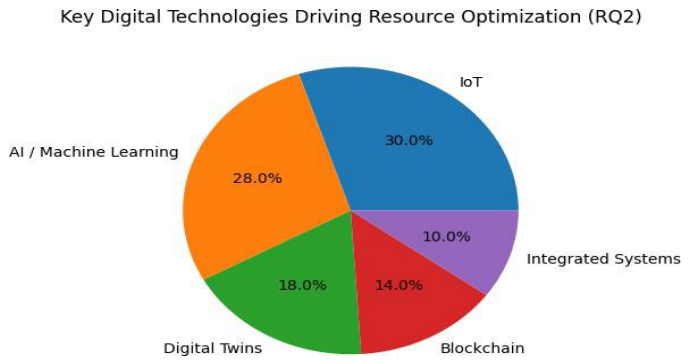
Figure 7.
Key Digital tech driving Resource Optimization.
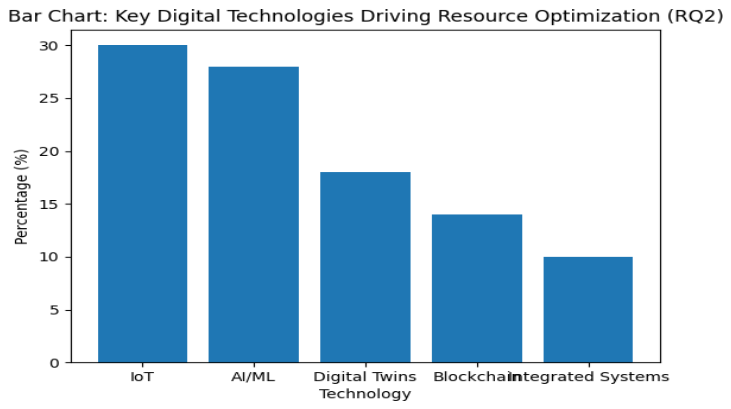
Figure 9.
HeatMap of Digital Tech vs Circular Economy Strategies.
Limitations of Empirical Findings
A limitation of this study is that there is a variability in measurement of resource optimization amongst scholarly studies. Another limitation is that the literatures were only limited to studies within manufacturing which might lead to Overrepresentation of manufacturing sector. While future directions might be focus on empirical validation using quantitative models to build statistical variables and deliberate cross-industry comparative studies Also future studies and direction should allow for the development of standardized circular economy CE performance metrics within the industry and also integration with Industry 5.0 (human-centric systems).
Future Outlook and Recommendations
Enterprise in the circular economies must continue to embark on innovative ways to digitalize their manufacturing floor in other to optimize resource allocation, reuse and increase the lifespan and lifecycle of resources and materials with multiple end-products. Smart manufacturing through digitalization offers the circular economy innovative opportunities for materials and resource optimizations and this does not only complements but actively drives the transition toward a circular economy embedding circular principles into every stage of production and consumption. Through real-time monitoring, intelligent automation, and end-to-end digital integration, manufacturers can create resilient, resource-efficient, and adaptive systems. For instance, predictive maintenance reduces downtime and material waste, while digital twins and lifecycle analytics help optimize product design for sustainability. Furthermore, digital supply chains enhance transparency and material recovery, and smart contracts via blockchain ensure responsible sourcing and recycling. These synergies empower industries to not only minimize their environmental footprint but also unlock new value streams through circular business models. By allowing the digitalization of each stage of the product lifecycle, smart manufacturing not only enhances resource efficiency but also catalyzes systemic transformation toward circularity, and reuse. This review identifies a clear research opportunity: to bridge the gap between theory and practice in the application of digital tools for circular manufacturing. By examining real-world case studies and emerging technologies, this paper seeks to contribute to this evolving discourse. Smart manufacturing technologies encompass a range of digital tools and systems that enable greater efficiency, adaptability, and sustainability in industrial production. Central to Industry 4.0, these technologies facilitate real-time decision-making, predictive analytics, and system integration.
Conclusion
This study showed that digitalization enables resource optimization through data-driven, predictive, and closed-loop mechanisms. The most influential technologies at the heart of digitalization supporting circular economy are: IoT and AI (dominant), Digital Twins and Blockchain while, Integration of technologies yields highest circular economy performance current advances in the digital space with artificial Intelligence, cloud computing, and IoT provide enterprise with immense opportunity to make production processes ecologically sustainable. Digitalization enhances high resource optimization opportunity in the circular economy. Providing a digital innovative approach towards enhancing material resource lifespan and products repurposing with multiple lifecycle and to critically review and examine the transformative potential of digitalization and smart manufacturing technologies in advancing circular economy objectives towards optimizing resource usage. Through the integration of technologies such as IoT, AI, and digital twins, manufacturing processes can become more efficient, transparent, and sustainable. Case studies have demonstrated successful applications, while key performance metrics offer actionable insights into progress and effectiveness. However. , the transition is not without its challenges, including high investment costs, workforce skill gaps, and regulatory inconsistencies. Addressing these barriers requires a coordinated approach among industry stakeholders, policymakers, and academic institutions.
Looking ahead, the synergy between digital tools and circular economy strategies is expected to deepen, supported by advancements in autonomous systems, digital product passports, and circular business models. Strategic investments in infrastructure, education, and policy will be crucial for enabling this transformation. Ultimately, the fusion of smart manufacturing and circular economy principles presents a compelling pathway toward sustainable industrial development, fostering economic resilience, environmental stewardship, and long-term value creation.
Author Contributions
Evans Achara [PhD]: Conceptualization, Resources, Data cu-ration, Methodology, Formal Analysis, Investigation, Investigation, Project administration, Software, Supervision, Validation, Visualization, Writing – original draft, Writing – review & editing.
Funding
This work is not supported by any external funding.
Data Availability Statement
The data supporting the outcome of this research work has been reported in this manuscript.
Acknowledgments
This author recognizes the contributions of faculty of University of phoenix for academic advice for this study to meet the desired objectives.
Conflicts of Interest
The author declare no conflicts of interest.
Appendix A
Model of SLR for 20 Studies Extraction and Analysis
| ID | Year | Method | Context | D - Technology | CE Strategy | Res-Opt Mechanism | Key Drivers |
| S1 | 2018 | Empirical | Manufacturing | IOT | Reduce | Real-time monitoring reduces waste |
IoT |
| S2 | 2019 | Empirical | Supply Chain | AI | Reduce | Predictive Analytics improve efficiency |
AI |
| S3 | 2020 | Case Study | Automotive | Digital Twin | Remanufacture | Lifecycle simulation enables reuse |
Digital Twin |
| S4 | 2021 | Review | Industry | Big Data | Reduce | Process Optimization | Big Data |
| S5 | 2022 | Survey | Energy | IoT | Reduce | Energy Monitoring | IoT |
| S6 | 2023 | Case Study | Electronics | Blockchain | Recycle | Traceability improves recycling |
Blockchain |
| S7 | 2024 | Empirical | Manufacturing | AI | Recue | Energy Monitoring | IoT |
| S8 | 2020 | Review | Logistics | IoT | Reuse | Asset tracking enables reuse |
IoT |
| S9 | 2021 | Conceptual | CE Systems | Digital Twin | Reduces | Simulation improves efficiency |
Digital Twin |
| S10 | 2019 | Empirical | Textile | AI | Reduce | Waste Prediction | AI |
| S11 | 2020 | Empirical | Manufacturing | IoT | Reduce | Real-Time Monitoring | IoT |
| S12 | 2021 | Case Study | Supply Chain | AI | Reuse | Predictive reuse optimization |
AI |
| S13 | 2022 | Review | Automotive | Digital Twin | Remanufacture | Simulation for Reuse | Digital Twin |
| S14 | 2023 | Empirical | Energy | Blockchain | Recycle | Material Traceability | Blockchain |
| S15 | 2024 | Survey | Smart Factory | Integrated | Reduce | System Optimization | Integrated Sys |
| S16 | 2019 | Empirical | Manufacturing | IoT | Reuse | Asset Tracking | IoT |
| S17 | 2020 | Case Study | Logistics | AI | Reduce | Predictive efficiency | AI |
| S18 | 2021 | Review | Electronics | Digital Twin | Remanufacture | Lifecycle Optimization | Digital Twin |
| S19 | 2022 | Empirical | Supply Chain | Blockchain | Recycle | Recycling Transparency | Blockchain |
| S20 | 2023 | Survey | Industry | Integrated | Reduce | System efficiency | Integrated |
Appendix B
Model of SLR for 70 Studies Extraction and Analysis
| ID | Year | Method | Context | Technology | CE Strategy | Resource Optimization Mechanism | Key Driver |
| S1 | 2019 | Empirical | Manufacturing | IoT | Reduce | Real-time monitoring and resource tracking | IoT |
| S2 | 2020 | Case Study | Supply Chain | AI | Reuse | Predictive analytics and process optimization | AI |
| S3 | 2021 | Review | Energy | Digital Twin | Remanufacture | Lifecycle simulation and design optimization | Digital Twin |
| S4 | 2022 | Conceptual | Automotive | Blockchain | Recycle | Traceability and transparency for circular flows | Blockchain |
| S5 | 2023 | Survey | Electronics | Integrated Systems | Reduce | Integrated system-wide resource optimization | Integrated Systems |
| S6 | 2024 | Empirical | Logistics | IoT | Reuse | Real-time monitoring and resource tracking | IoT |
| S7 | 2025 | Case Study | Smart Factory | AI | Remanufacture | Predictive analytics and process optimization | AI |
| S8 | 2018 | Review | Manufacturing | Digital Twin | Recycle | Lifecycle simulation and design optimization | Digital Twin |
| S9 | 2019 | Conceptual | Supply Chain | Blockchain | Reduce | Traceability and transparency for circular flows | Blockchain |
| S10 | 2020 | Survey | Energy | Integrated Systems | Reuse | Integrated system-wide resource optimization | Integrated Systems |
| S11 | 2021 | Empirical | Automotive | IoT | Remanufacture | Real-time monitoring and resource tracking | IoT |
| S12 | 2022 | Case Study | Electronics | AI | Recycle | Predictive analytics and process optimization | AI |
| S13 | 2023 | Review | Logistics | Digital Twin | Reduce | Lifecycle simulation and design optimization | Digital Twin |
| S14 | 2024 | Conceptual | Smart Factory | Blockchain | Reuse | Traceability and transparency for circular flows | Blockchain |
| S15 | 2025 | Survey | Manufacturing | Integrated Systems | Remanufacture | Integrated system-wide resource optimization | Integrated Systems |
| S16 | 2018 | Empirical | Supply Chain | IoT | Recycle | Real-time monitoring and resource tracking | IoT |
| S17 | 2019 | Case Study | Energy | AI | Reduce | Predictive analytics and process optimization | AI |
| S18 | 2020 | Review | Automotive | Digital Twin | Reuse | Lifecycle simulation and design optimization | Digital Twin |
| S19 | 2021 | Conceptual | Electronics | Blockchain | Remanufacture | Traceability and transparency for circular flows | Blockchain |
| S20 | 2022 | Survey | Logistics | Integrated Systems | Recycle | Integrated system-wide resource optimization | Integrated Systems |
| S21 | 2023 | Empirical | Smart Factory | IoT | Reduce | Real-time monitoring and resource tracking | IoT |
| S22 | 2024 | Case Study | Manufacturing | AI | Reuse | Predictive analytics and process optimization | AI |
| S23 | 2025 | Review | Supply Chain | Digital Twin | Remanufacture | Lifecycle simulation and design optimization | Digital Twin |
| S24 | 2018 | Conceptual | Energy | Blockchain | Recycle | Traceability and transparency for circular flows | Blockchain |
| S25 | 2019 | Survey | Automotive | Integrated Systems | Reduce | Integrated system-wide resource optimization | Integrated Systems |
| S26 | 2020 | Empirical | Electronics | IoT | Reuse | Real-time monitoring and resource tracking | IoT |
| S27 | 2021 | Case Study | Logistics | AI | Remanufacture | Predictive analytics and process optimization | AI |
| S28 | 2022 | Review | Smart Factory | Digital Twin | Recycle | Lifecycle simulation and design optimization | Digital Twin |
| S29 | 2023 | Conceptual | Manufacturing | Blockchain | Reduce | Traceability and transparency for circular flows | Blockchain |
| S30 | 2024 | Survey | Supply Chain | Integrated Systems | Reuse | Integrated system-wide resource optimization | Integrated Systems |
| S31 | 2025 | Empirical | Energy | IoT | Remanufacture | Real-time monitoring and resource tracking | IoT |
| S32 | 2018 | Case Study | Automotive | AI | Recycle | Predictive analytics and process optimization | AI |
| S33 | 2019 | Review | Electronics | Digital Twin | Reduce | Lifecycle simulation and design optimization | Digital Twin |
| S34 | 2020 | Conceptual | Logistics | Blockchain | Reuse | Traceability and transparency for circular flows | Blockchain |
| S35 | 2021 | Survey | Smart Factory | Integrated Systems | Remanufacture | Integrated system-wide resource optimization | Integrated Systems |
| S36 | 2022 | Empirical | Manufacturing | IoT | Recycle | Real-time monitoring and resource tracking | IoT |
| S37 | 2023 | Case Study | Supply Chain | AI | Reduce | Predictive analytics and process optimization | AI |
| S38 | 2024 | Review | Energy | Digital Twin | Reuse | Lifecycle simulation and design optimization | Digital Twin |
| S39 | 2025 | Conceptual | Automotive | Blockchain | Remanufacture | Traceability and transparency for circular flows | Blockchain |
| S40 | 2018 | Survey | Electronics | Integrated Systems | Recycle | Integrated system-wide resource optimization | Integrated Systems |
| S41 | 2019 | Empirical | Logistics | IoT | Reduce | Real-time monitoring and resource tracking | IoT |
| S42 | 2020 | Case Study | Smart Factory | AI | Reuse | Predictive analytics and process optimization | AI |
| S43 | 2021 | Review | Manufacturing | Digital Twin | Remanufacture | Lifecycle simulation and design optimization | Digital Twin |
| S44 | 2022 | Conceptual | Supply Chain | Blockchain | Recycle | Traceability and transparency for circular flows | Blockchain |
| S45 | 2023 | Survey | Energy | Integrated Systems | Reduce | Integrated system-wide resource optimization | Integrated Systems |
| S46 | 2024 | Empirical | Automotive | IoT | Reuse | Real-time monitoring and resource tracking | IoT |
| S47 | 2025 | Case Study | Electronics | AI | Remanufacture | Predictive analytics and process optimization | AI |
| S48 | 2018 | Review | Logistics | Digital Twin | Recycle | Lifecycle simulation and design optimization | Digital Twin |
| S49 | 2019 | Conceptual | Smart Factory | Blockchain | Reduce | Traceability and transparency for circular flows | Blockchain |
| S50 | 2020 | Survey | Manufacturing | Integrated Systems | Reuse | Integrated system-wide resource optimization | Integrated Systems |
| S51 | 2021 | Empirical | Supply Chain | IoT | Remanufacture | Real-time monitoring and resource tracking | IoT |
| S52 | 2022 | Case Study | Energy | AI | Recycle | Predictive analytics and process optimization | AI |
| S53 | 2023 | Review | Automotive | Digital Twin | Reduce | Lifecycle simulation and design optimization | Digital Twin |
| S54 | 2024 | Conceptual | Electronics | Blockchain | Reuse | Traceability and transparency for circular flows | Blockchain |
| S55 | 2025 | Survey | Logistics | Integrated Systems | Remanufacture | Integrated system-wide resource optimization | Integrated Systems |
| S56 | 2018 | Empirical | Smart Factory | IoT | Recycle | Real-time monitoring and resource tracking | IoT |
| S57 | 2019 | Case Study | Manufacturing | AI | Reduce | Predictive analytics and process optimization | AI |
| S58 | 2020 | Review | Supply Chain | Digital Twin | Reuse | Lifecycle simulation and design optimization | Digital Twin |
| S59 | 2021 | Conceptual | Energy | Blockchain | Remanufacture | Traceability and transparency for circular flows | Blockchain |
| S60 | 2022 | Survey | Automotive | Integrated Systems | Recycle | Integrated system-wide resource optimization | Integrated Systems |
| S61 | 2023 | Empirical | Electronics | IoT | Reduce | Real-time monitoring and resource tracking | IoT |
| S62 | 2024 | Case Study | Logistics | AI | Reuse | Predictive analytics and process optimization | AI |
| S63 | 2025 | Review | Smart Factory | Digital Twin | Remanufacture | Lifecycle simulation and design optimization | Digital Twin |
| S64 | 2018 | Conceptual | Manufacturing | Blockchain | Recycle | Traceability and transparency for circular flows | Blockchain |
| S65 | 2019 | Survey | Supply Chain | Integrated Systems | Reduce | Integrated system-wide resource optimization | Integrated Systems |
| S66 | 2020 | Empirical | Energy | IoT | Reuse | Real-time monitoring and resource tracking | IoT |
| S67 | 2021 | Case Study | Automotive | AI | Remanufacture | Predictive analytics and process optimization | AI |
| S68 | 2022 | Review | Electronics | Digital Twin | Recycle | Lifecycle simulation and design optimization | Digital Twin |
| S69 | 2023 | Conceptual | Logistics | Blockchain | Reduce | Traceability and transparency for circular flows | Blockchain |
| S70 | 2024 | Survey | Smart Factory | Integrated Systems | Reuse | Integrated system-wide resource optimization | Integrated Systems |
References
- Agrawal, R.; Wankhede, V.A.; Kumar, A. Nexus of Circular economy and Sustainable Business Performance in the era of Digitalization. Int. J. Product. Perform.-Manag. 2022, 71(3), 748–774. [Google Scholar] [CrossRef]
- Aithal, S.; Aitha, P.S. Importance of Circular Economy for Resource Optimization in Various Industry Sectors – A Review-Based Opportunity Analysis. Int. J. Appl. Eng. Manag. Lett. (IJAEML) 2023, 7(2), 191–215. https://ssrn.com/abtract=4575631. [CrossRef]
- Akarsu, N.T. Digital transformation Towards a Sustainable Circular Economy: Can It be the Way. Forward? J. Inf. Technol. Teach. Cases 2024, 42(2), 186–191. [Google Scholar] [CrossRef]
- Antikainen, M.; Uusitalo, T.; Kivikytoo-Reponen, P. Digitalization as an Enabler of Circular Economy. 10th CIRP Conference on Industrial Product-Service Systems, 2018; IPS Science Direct. [Google Scholar] [CrossRef]
- Barbareschi, G.; Swaminathan, S.M.; Freire, A.P.; Holloway, C. Challenges and Strategies for Accessibility Research in the Global South: A Panel Discussion. In Accessibility Research intheGlobalSouth; 2018; pp. 1–8. [Google Scholar] [CrossRef]
- Burmaoglu, S.; Gungor, O.D.; Kirbac, A.; Saritas, O. Future Research Avenues at the Nexus of Circular Economy. Int. J. Product. Perform. Manag. 2021, 72(8), 2247–2269. [Google Scholar] [CrossRef]
- Bressanelli, G.; Adrodegari, F.; Pigosso, D.C.A.; Parida, V. Towards the Smart Circular Economy Paradigm: A Definition, Conceptualization, and Research Agenda. Sustainability 2022, 14, 4960.1–20. [Google Scholar] [CrossRef]
- Fullerton, D. The Circular Economy; National Bureau of Economic Research, 2024; pp. 1–19. Available online: http://www.nber.org/papers/w32419Working Paper32419.
- Jogaro, M.; Lakshmanna, B.C.; Naidu, S.T. Management for Sustainable Smart Cities: Integrating Artificial Intelligence In Resource Optimization and Waste Reduction. Smart Cities Circ. Econ. 2024, 83–96. [Google Scholar] [CrossRef]
- Kalogiannidis, S.; Kalfas, D.; Chatzitheodoridis, F.; Kontas, S. The Impact of Digitalization in Supporting the Performance of Circular Economy: A Case study of Greece. J. Risk Financ. Manag. 2022, 15, 1–19. [Google Scholar] [CrossRef]
- Kiran, D.; Sharma, I. Investigating the Role of Data Analytics and Artificial Intelligence In Optimizing Resources Efficiency in Smart Cities; Emerald Publishing Limited, 2024; pp. 97–106. [Google Scholar] [CrossRef]
- Kwarteng, A.; Simpson, S.N.Y.; Boateng, C.A. The effects of Circular Economy Initiative Implementation on Business performance: The Moderating Role of organizational Culture. Soc. Responsib. J. 2022, 19(7), 1747–1117. [Google Scholar] [CrossRef]
- Lin, K.; Wei, S. Advancing the Industrial circular Economy: The Integrative Role of Machine Learning in Resource Optimization. J. Green Econ. Low.-S-Carbon Dev. 2023, 2(3), 122–136. [Google Scholar] [CrossRef]
- Luoma, P.; Penttinen, E.; Tapio, P.; Toppinen, A. Paradoxical Tension in Exploiting Data to Implement Circular Economy in the Textile Industry. 2023. [Google Scholar]
- Miaoudakis, A.; Fysarakis, K.; Petroulakis, N.; Alexaki, S.; Alexandirs, G.; Ioannidis, S.; Spanoudakis, G.; Katos, V.; Verikoukis, C. Pairing a circular economy and the 5G-enabled internet of things: Creating a class of ? Looping smart assets? IEEE Veh. Technol. Mag. 2020, 15, 20–31. [Google Scholar] [CrossRef]
- Nagamalini, T.; Wesley, J.R. Pathway for a Circular Economy: Facilitating Circularity Using the ADKAR Model for Waste. Manag. Environ. Qual. An. Int. J. 2025, 36(4), 990–1012. [Google Scholar] [CrossRef]
- Neligan, A.; Baumgartner, R.; Geissdoerfer, M.; Schoggl, J.-P. Circular Disruption: Digitalization as a driver of Circular Economy Business Models. 2021; pp. 1175–1188. [Google Scholar] [CrossRef]
- Okorie, O.; Salonitis, K.; Charney, F.; Moreno, M.; Turner, C.; Ashutosh, T. Digitalization And the Circular Economy A Review of Current Research and Future Trends. energies 2018, 11, 3009.1–31. [Google Scholar] [CrossRef]
- Ojha, N.; Nikhil, V.P. Challenges of AI Implementation for Boosting Circular Economy In Smart Cities; Emerald Publishing Limited, 2024; pp. 215–233. [Google Scholar] [CrossRef]
- OECD. Environment at a Glance 2020; OECD Publishing: Paris, 2020; pp. 1–66. [Google Scholar] [CrossRef]
- Osolase, E.H.; Rasdi, R.B.M.; Dato, Z.B. “Greening of human resource development Subsystems for environmental management and performance: the ADKAR model perspective”. Int. J. Acad. Res. Bus. Soc. Sci. 2022, 12(4), 141–161. [Google Scholar] [CrossRef] [PubMed]
- Pagoropoulos, A.; Pogosso, D.C.A.; McAloone, T.C. The Emergent Role of Digital Technologies in the Circular Economy: A Review. The 9th CIRP IPSS Conference: Circular Perspective on-Product/Service-Systems; 2017; pp. 19–24. [Google Scholar] [CrossRef]
- Parkouhi, S.V.; Hamid, A.; Ghadikolaei, S.; Salimi, N. Smart Manufacturing Implementation: Identifying barriers and their related stakeholders and components of Technology. J. Sci. Technol. Policy Manag. 2023, 1–37. [Google Scholar] [CrossRef]
- Pongracz, E.; Phillips, P.S.; Keiski, R.L. “Evolving the theory of waste management to waste Minimization”. In Waste Minimization and Resources Use Optimization Conference. 10 June 2004; Oulu University Press, Oulu, University of Oulu, Finland, Pongracz, E., Ed.; pp. 61–67. Available online: https://bucketvirtualpro-private.s3.amazonaws.com/files-bv/20120801/20120801-007.pdf.
- Pires, A.; Martinho, G. “Waste hierarchy index for circular economy in waste management”. Waste Manag. 2019, 95, 298–305. [Google Scholar] [CrossRef]
- Priyadarshini, P.; Abhilash, P.C. “Circular economy practices within energy and waste Management sectors of India: a meta-analysis”. Bioresour. Technol. 2020, 304(123018). [Google Scholar] [CrossRef] [PubMed]
- Raj, R.; Kumar, V.; Shah, B. “Big data analytics adaptive prospects in sustainable manufacturing supply chain”. Benchmarking An. Int. J. 2023a, ahead-of-print No. ahead-of-print. [Google Scholar]
- Raj, R.; Kumar, V.; Verma, P. “Big data analytics in mitigating challenges of sustainable manufacturing supply chain”. Oper. Manag. Res. 2023b, 16(4), 1886–1900. [Google Scholar] [CrossRef]
- Ranta, V.; Aarikka-Stenroos, L.; Vaisanen, J.M. Digital technologies catalyzing Business model innovation for circular economy–Multiple Case study. Resour. Conserv. 2021, 164, 1–11. [Google Scholar] [CrossRef]
- Ramakrishna, S.; Ngowi, A.; Jager, H. D.; Awuzie, B. O. Emerging Industrial Revolution: Symbiosis of Industry 4.0 and Circular Economy: The role of universities. Sci. Technol.Soc. 2020, 25, 505–525. [Google Scholar] [CrossRef]
- Reim, W.; Tabares, S.; Parida, V. Small and Medium-Sized Enterprises and the Circular Economy: Leveraging Ecosystems Strategies for Circular. In Organization& Environment Online First.; 2025. [Google Scholar] [CrossRef]
- Reuter, M. Digitalizing the Circular Economy. The Minerals, Metals & Materials Society And ASM International 2016.TMS EPD Distinguished Lecture Award. CrossMark. 2016, 47B, 3194–3220. [Google Scholar] [CrossRef]
- Renfos, S. Education for the Circular Economy in Higher Education: An Overview of the Current State: Circular Economy. Int. J. Sustain. High. Educ. 2023, 25(9), 111–127. [Google Scholar] [CrossRef]
- Saad, I.M.H. “Change management in construction: necessity, obstacles, and suggested solutions”. Prof. Constr. 2020, 45(2), 72–82. [Google Scholar]
- Sachs, J.D.; Lafortune, G.; Fuller, G.; Drumm, E. Implementing the SDG Stimulus. Sustainable Development Report 2023 Paris, Dublin University Press, SDSN, Dublin. 2023. Available online: https://www.sdgindex.org/reports/sustainable-development-report2023/.
- Sancak, I.E. “Change management in sustainability transformation: a model for business organisations”. J. Environ.-Manag. 2023, 330, 117165. [Google Scholar] [CrossRef]
- Sarc, R.; Curtis Kandlbauer, A.L.; Khodier, K.; Lorber, K.E.; Pomberger, R. “Digitalisation and intelligent robotics in the value chain of circular economy-oriented waste management–A review”. Waste Manag. 2019, 95, 476–492. [Google Scholar] [CrossRef] [PubMed]
- Sariatli, F. “Linear economy versus circular economy: A comparative and analyzer study for optimization of economy for sustainability”. J. Bioeconomy Sustain. Dev. 2017, 6(1), 31–34. [Google Scholar] [CrossRef]
- Sarma, S.P.; Bhalla, S.G.; Kumar, M. “Economic advisory council to the PM”, A Working Paper on – India’s-Tryst-with-a-Circular-Economy. Economic Advisory Council to the PM. 2023. working paper. https://eacpm.gov.in/wp-content/uploads/2023/07/17-MEQ<i>36</i>,4.
- Sauve, S.; Bernard, S.; Sloan, P. “Environmental sciences, sustainable development and circular economy: alternative concepts for trans-disciplinary research”. Environ. Dev. 17 2016, 48–56. [Google Scholar] [CrossRef]
- Seyyedi., S.R.; Kowsari, E.; Gheid, M.; Chinnappan, A.; Ramakrishma, S. A Comprehensive Review . Integrdel. J. Clean. Prod. 2024, 460, 1–20. [Google Scholar] [CrossRef]
- Sterev, N. “New industrial business models: from linear to circular economy approach”. Trakia J. Sci. 2019, 17.1, 511–523. [Google Scholar] [CrossRef]
- Sumter, D.; de Koning, J.; Bakker, C.; Balkenende, R. “Key competencies for design in a circular economy: exploring gaps in design knowledge and skills for a circular economy”. Sustainability 2021, 13(2), 776. [Google Scholar] [CrossRef]
- Sharma, N.K.; Chen, W.K.; Lai, K.K.; Kumar, V. “Sustainability performance measurement methods, indicators and challenges: a review”. In Chapter 9, Book Titled Sustainability in Industry 4.0: Challenges and Remedies; CRC Press, Taylor & Francis, 2021a; pp. 179–199. [Google Scholar]
- Seyyedi, S.R.; Kowsari, E.; Ghebi, M.; Chinnappan, A.; Ramakrishna, S. A Comprehensive Review integration of digitalization and Circular economy in Waste Management by Adopting Artificial Intelligence Approaches: Towards a Simulation Model. J. Clean. Prod. 2024, 460(1-2). [Google Scholar] [CrossRef]
- Singh, R.; Gupta, A.; Bajpai, A.; Kandpal, V. Exploring Challenges of Circular of Circular Economy Initiatives for Smart Cities; Emerald Publishing Limited, 2024; pp. 59–69. [Google Scholar] [CrossRef]
- Sharma, N.K.; Govindan, K.; Lai, K.K.; Chen, W.K.; Kumar, V. “The transition from a linear economy to a circular economy for sustainability among SMEs: A study on prospects, impediments, and prerequisites”. Bus. Strategy Environ. 2021b, 30(4), 1803–1822. [Google Scholar]
- Singh, J.; Ordonez, I. “Resource recovery from post-consumer waste: important lessons for the upcoming circular economy”. J. CleanerProduction 2016, 134, 342–353. [Google Scholar] [CrossRef] [PubMed]
- Sterev, N. Industry 5.0, Digitalization of Business and Circular Economy. SHS Web Conf. 2023, 176(02002), 1–10. [Google Scholar] [CrossRef]
- Sinha, T. Play with purpose serious play: methods for understanding and researching complex systems such as supply chains and supply chain management. In Handbook of Research Methods for Supply Chain Management; 2022; pp. 169–186. [Google Scholar]
- Stahel, W.S. “The product-life factor”, An Inquiry Into the Nature of Sustainable Societies: The Role of the Private Sector; Houston Area Research Center, 1982; pp. 72–96. [Google Scholar]
- Stahel, W.R. “The circular economy”. Nature 2016, 531(7595), 435–438. [Google Scholar] [CrossRef] [PubMed]
- Trivedi, A.; Trivedi, N. Integrating Circular Economy in Smart Cities: Challenges and Pathways to Sustainable Urban Development. In Smart Cities and Circular Economy; Kandpal, V., Santibanez Gonzalez, E.D., Chatterjee, P., Nallapaneni, M.K., Eds.; Emerald Publishing Limited, 2024; pp. 71–82. [Google Scholar] [CrossRef]
- Vanham€aki, S.; Medkova, K.; MalamakisKontogianni, A.S.; Mari sova Dellago, E.D.H.; Moussiopoulos, N.; Dellago, Huisman.
- D. “Bio-based circular economy in European national and regional strategies”. Int. J. Sustain. Dev. 2019, 14(1), 31–43. [Google Scholar] [CrossRef]
- Verma, P.; Kumar, V.; Daim, T.; Sharma, N.K.; Mittal. “Identifying and prioritizing impediments of industry 4.0 to sustainable digital manufacturing: a mixed method approach”. J. Clean. Prod. 2022, 356, 1–20. [Google Scholar] [CrossRef]
- Wang, Y.; Zhu, Q.; Krikke, H.; Hazen, B. “How product and process knowledge enable consumer switching to remanufactured laptop computers in circular economy”. Technol. Forecast. Soc. Change 2020, 161, 120275. [Google Scholar] [CrossRef]
- Wautelet, T. “The concept of circular economy: its origins and its evolution”. working Paper. 2018. [CrossRef]
- Wamane, G.V. “A “new deal” for a sustainable future: enhancing circular economy by employing ESG principles and biomimicry for efficiency”. Manag. Environ. Qual. 2023, ahead-of-print No.ahead-of-print. [Google Scholar]
- Woods, C.J. “‘Why, what is stopping you?’: a change management tool to keep your Sustainability initiatives on track”. 2022. Available online: https://www.resonanceglobal.com/blog/why-whats-stopping-you-a-change-management-tool-forsustainability.
- Wu, Y.; Wang, R. Sustainability-based enterprise supply chain optimization and Response under circular economy approach: Agile, adaptive and coordinated. Manag. Decis. 2023, 62(9), 2737–2762. [Google Scholar] [CrossRef]
- Yuan, Q.; Shen, B. “Renting fashion with strategic customers in the sharing Economy”. Int. J. Prod. Econ. 21 2019, 185–195. [Google Scholar] [CrossRef]
- Zhang, M.; Liu, R.; Sun, H. Achieving Carbon-Neutral economies through Circular Economy, Digitalization, and Energy Transition. Sci. Rep. 2025, 15(13779), 1–17. [Google Scholar] [CrossRef]
- Zhu, H.; Zhang, X.; Yu, B. The Impact of the Industrial Robots on the employment rate and Wages: Prospects of Circular Economy and Sustainable Development. Manag. Decis. 2023, 62(9), 2855–2874. [Google Scholar] [CrossRef]
Disclaimer/Publisher’s Note: The statements, opinions and data contained in all publications are solely those of the individual author(s) and contributor(s) and not of MDPI and/or the editor(s). MDPI and/or the editor(s) disclaim responsibility for any injury to people or property resulting from any ideas, methods, instructions or products referred to in the content. |
© 2026 by the authors. Licensee MDPI, Basel, Switzerland. This article is an open access article distributed under the terms and conditions of the Creative Commons Attribution (CC BY) license (http://creativecommons.org/licenses/by/4.0/).
Copyright: This open access article is published under a Creative Commons CC BY 4.0 license, which permit the free download, distribution, and reuse, provided that the author and preprint are cited in any reuse.