
Submitted:
24 July 2026
Posted:
27 July 2026
You are already at the latest version
Abstract
Synthetic aperture radar (SAR) ship recognition faces great challenges in few-shot scenarios, including insufficient global context modeling, underutilization of physical scattering topological characteristics, and poor generalization capability under limited labeled samples. To address these bottlenecks, this paper proposes a novel few-shot SAR ship recognition method integrating Vision Mamba and scattering topology fusion. A dual-branch complementary architecture is innovatively constructed to learn discriminative features from two heterogeneous perspectives. The visual semantic branch combines residual convolution and state space model in a parallel manner, which empowers simultaneous capture of local fine-grained scattering traits and long-range global structural dependencies, breaking the inherent local receptive-field constraint of conventional CNN-based schemes. The scattering topological branch innovatively introduces graph modeling on extracted strong scattering points, and leverages graph convolutional networks to excavate implicit physical structural priors inherent in SAR ship targets, which are neglected by existing visual-only learning methods. A cross-branch feature fusion strategy is further developed to adaptively aggregate semantic and topological representations, yielding robust feature embedding with strong intra-class compactness and inter-class separability under data scarcity. Experiments on the FUSARShip dataset validate that our method achieves superior performance compared with state-of-the-art competitors in both 1-shot and 5-shot tasks.
Keywords:
synthetic aperture radar (SAR)
; few-shot ship recognition
; Vision Mamba
; scattering topology
1. Introduction
Synthetic aperture radar (SAR) has become a key tool for maritime traffic supervision, marine environmental monitoring, and emergency rescue, thanks to its all-day, all-weather operation, long-range imaging, and strong penetration capabilities [1]. As a core task in SAR image interpretation, automatic ship target recognition has long been a research hotspot in this field [2,3]. In recent years, with the rapid advancement of deep learning, data-driven convolutional neural networks (CNNs) and transformer-based models have been widely applied to SAR ship recognition, achieving remarkable performance with sufficient labeled training samples [4,5,6]. However, the unique imaging mechanism of SAR and the constraints of practical applications pose three inherent challenges to high-precision ship recognition, which greatly limit the engineering deployment of existing algorithms.
First, the inherent imaging properties of SAR images hinder effective feature representation. Unlike optical images with rich texture and color cues, SAR images reflect the electromagnetic scattering responses of target structures [7], which are severely degraded by coherent speckle noise, complex imaging attitudes, and drastic scale variations [8,9]. Traditional CNN-based methods extract features via fixed local receptive fields [10,11,12], only capturing local edge and contour information of ships. Unable to model long-range dependencies, these methods fail to characterize the global spatial structure and topological layout of ships, resulting in low feature discriminability under complex imaging conditions. Although vision transformers enhance global context modeling via self-attention [13,14], their quadratic computational complexity leads to high overhead and limited inference efficiency. They also suffer from severe performance degradation with limited training samples, restricting their applicability to practical SAR interpretation tasks. Recently, state space models (SSMs) such as Vision Mamba (ViM) [15] and its variants [16,17] have enabled advanced global modeling in computer vision, achieving promising efficiency and performance in high-resolution image analysis. Nevertheless, directly transferring these models to few-shot SAR recognition yields poor generalization, primarily due to their failure to adapt to the unique scattering characteristics of SAR [18].
Second, most existing approaches overlook the inherent physical scattering properties of SAR imagery [19,20]. Strong scattering points from ship metal components (e.g., masts, decks, corner reflectors, and superstructures) provide critical discriminative structural cues, and their spatial distribution and topological connections form the core physical basis for ship classification [21,22]. Most deep learning methods only extract intensity-related visual semantics and lack explicit modeling of these topological properties. Relying solely on scattering intensity and geometric features fails to capture high-order structural correlations among scattering nodes, underutilizing inherent SAR physical priors and weakening feature representation stability and robustness. Recent computer vision studies use graph neural networks (GNNs) [23,24] and contrastive learning [25,26] to model irregular topological patterns and enhance feature discriminability. While some efforts have transferred these paradigms to SAR target recognition [27,28,29], most rely on supervised learning and rarely integrate advanced global modeling backbones like ViM.
Third, few-shot learning under extremely scarce labeled samples is highly demanded in practical scenarios, yet existing methods lack targeted optimization. Constructing high-quality SAR ship datasets requires long-term satellite observation, and manual annotation demands professional expertise and substantial labor costs [30]. Consequently, most rare ship categories in maritime monitoring suffer from chronic labeled sample scarcity [31]. Current SAR ship recognition methods, designed primarily for sufficient training data, experience sharp performance degradation under few-shot conditions. Although classic few-shot paradigms based on metric learning [32] and meta-learning [33] have been introduced into SAR-related tasks, they adopt generic backbones originally designed for optical images. These backbones fail to account for the inherent scattering characteristics of SAR data, making it impossible to effectively suppress speckle noise and attitude interference. This results in unsatisfactory accuracy and generalization in real-world few-shot ship recognition. Recent advances have explored strategies to enhance generalization under limited samples, including feature disentanglement [34], style quantization [35], vision-language fusion [36], task-aware saliency modeling [37], and self-supervised pretraining based on synthetic data [38,39]. However, these methods still fail to integrate SAR-specific physical scattering priors, leading to suboptimal performance in practical scenarios [40].
Notably, while ViM excels at global SAR feature extraction and GNNs are superior in modeling scattering topology, few works have unified these two paradigms for few-shot ship recognition. For example, the VSFA method [41] and dual-stream physical feature fusion method [28] both combine visual and scattering topological features. Yet, they rely on conventional CNNs (not ViM) and are designed for domain adaptation or standard supervised recognition, not few-shot learning. A unified, fused approach is therefore urgently needed to address these three key challenges simultaneously.
To fill this gap, this paper proposes a novel few-shot SAR ship recognition method fusing ViM and scattering topology features. Specifically, existing CNN-based methods are limited by local receptive fields and cannot capture global structural dependencies of SAR ship targets. Although ViM and other SSMs achieve efficient global feature modeling, they lack adaptability to the unique scattering characteristics of SAR imagery. Furthermore, most existing methods either ignore the physical scattering topology of SAR ships or fail to integrate such topological priors with advanced global backbones under few-shot learning settings. To tackle these challenges, a dual-branch complementary framework is constructed to integrate global-aware visual semantic modeling and physical scattering topology learning. In the visual semantic branch, ViM is adopted to capture long-range spatial dependencies, and residual convolution is embedded to preserve fine-grained local scattering details and suppress speckle noise, thereby breaking the local receptive-field limitation of conventional CNNs. In the scattering topology branch, graph convolutional networks (GCNs) are utilized to explicitly model topological relationships among strong scattering points of SAR ships, mining inherent physical structural priors that are neglected by generic visual feature learning schemes. The fusion of the two complementary feature streams effectively reduces the dependence on massive labeled samples, and achieves accurate and robust SAR ship classification under few-shot scenarios.
The main contributions of this work are summarized as follows:
1) A visual semantic branch is designed by paralleling residual convolution and ViM-based SSM, which is applied in a novel way for few-shot SAR ship recognition. This design breaks the limitation of the local receptive fields of traditional CNNs and obtains discriminative visual semantic features with both local details and global context, addressing the shortcomings of single CNN or ViM-based methods in SAR imagery analysis.
2) A scattering topological branch is constructed to model the topological relationships of the strong scattering points of SAR ships via GCN, which innovatively incorporates the physical scattering priors of SAR into the few-shot recognition framework. This effectively supplements the structural information neglected by existing generic visual feature learning schemes.
3) A novel cross-modal feature fusion strategy is proposed to aggregate the outputs of the two branches, enabling the fused features to inherit both image-level semantic discriminability and physical scattering-level structural uniqueness. Experiments on the FUSARShip dataset [30] verify that the proposed method outperforms the state-of-the-art (SOTA) approaches under 1-shot and 5-shot settings.
The rest of this paper is organized as follows. Section 2 elaborates the overall architecture of the proposed method, including the detailed design of the visual semantic branch, scattering topology branch, and feature fusion module. Section 3 introduces the experimental dataset, implementation details, comparison results with mainstream methods, ablation experiments, and corresponding analysis. Finally, Section 4 presents the conclusions of this paper.
2. Proposed Method
To address the drawbacks of limited global modeling capability, insufficient exploitation of physical scattering properties, and poor generalization in few-shot scenarios, this work proposes a novel SAR ship recognition framework that fuses ViM and scattering topological features. As illustrated in Figure 1, the proposed framework adopts a dual-branch architecture. The visual semantic branch excavates high-level semantic representations and global context from SAR visual appearances, while the scattering topological branch explicitly captures structural priors by modeling strong scattering keypoints and their spatial correlation. The two complementary feature streams are further integrated to realize robust and comprehensive ship classification under few-shot conditions.
2.1. Visual Semantic Branch
To address the characteristics of SAR ship images, including distinct local scattering details and complex global structural dependencies, we propose a visual semantic branch that integrates convolutions and SSMs.
Given an input SAR ship image , we first utilize a convolutional patch embedding layer to map it into a dense feature map , where C denotes the dimension of feature channels. Subsequently, the obtained feature map is fed into the designed visual semantic branch. This branch adopts a four-stage cascaded architecture. Each stage consists of stacked RC-SSM modules, and a patch merging layer is deployed between adjacent stages to implement progressive feature downsampling and channel refinement, generating high-level semantic features with enhanced representation capability. Specifically, for the RC-SSM module, the input feature map is uniformly split into two groups along the channel dimension. These two groups are fed into parallel submodules to collaboratively extract local and global features.
2.1.1. RC-SSM Module
As illustrated in Figure 2, each RC-SSM module consists of a residual convolution (RC) submodule and a SSM submodule, which operate in parallel.
The RC submodule is dedicated to capturing local textures, edge contours, and fine-grained target details. In this submodule, the input feature is transformed into the intermediate feature by two successive convolutional layers integrated with batch normalization (BN) and ReLU activation functions as follows:
The intermediate feature is then fused with the original input via a residual connection, and the final local feature is generated after ReLU activation:
The residual connection enhances local feature representation and effectively alleviates the gradient vanishing problem in deep network training.
The SSM submodule is dedicated to global context modeling. In this submodule, the input feature first undergoes layer normalization (LN) to yield :
Subsequently, is processed by linear projection, depthwise separable convolution (DWConv) [42] and SiLU activation, and then fed into the two-dimensional Selective Scan (SS2D) [43] unit, followed by layer normalization, to generate:
As the core component of ViM, the SS2D unit captures long-range dependencies within two-dimensional image features. It expands the feature interaction range with low computational overhead and enhances the capability of the network in modeling global structural relationships. Meanwhile, is processed by linear projection and SiLU activation to produce:
Finally, element-wise multiplication ⊙ is performed on and , followed by a linear projection layer to produce the final global feature:
2.1.2. Cross-Submodule Feature Fusion
After completing local and global feature extraction, the local feature and global feature are concatenated along the channel dimension. A channel shuffle operation is further adopted to reorganize cross-channel information and yield the fused feature:
2.1.3. Patch Merging Layer
Between successive stages, the patch merging layer splits the input feature along the spatial dimension with a stride of 2, generating four sub-images each with a size of . These sub-images are then concatenated along the channel dimension to form the aggregated feature:
Subsequently, layer normalization and a bias-free linear projection are employed to compress the channel dimension from to , outputting the stage feature:
This process reduces the spatial resolution of the feature map, integrates neighborhood information, and adjusts the channel number simultaneously. As a result, it yields a more compact feature representation, which facilitates the extraction of high-level semantic information in subsequent stages.
2.1.4. Multi-Scale Feature Output
Based on the above cascaded stages, our visual semantic branch progressively constructs multi-level visual representations from low-level details to high-level semantics, and ultimately outputs the comprehensive visual semantic feature . The dimension variations of features at each stage are clearly listed in Table 1. Benefiting from the parallel extraction of local and global information, integrates fine-grained scattering characteristics and global structural relationships, providing discriminative features for the subsequent multi-modal fusion and target recognition stages.
2.2. Scattering Topological Branch
The scattering topological branch explicitly models the intrinsic structure of SAR ship targets governed by sparse scattering properties. Different from the visual semantic branch for texture and high-level semantics, this branch focuses on spatial relevance among scattering components. It describes key scattering nodes and employs graph convolution to capture structural features. Such topological cues offer complementary representations for cross-branch fusion and ship recognition.
2.2.1. Scattering Point Extraction
Scattering point extraction aims to locate critical scattering positions in SAR images. Since SAR ship targets exhibit intense scattering responses and ordered spatial arrangement, we employ the Harris corner detector for local feature searching. This algorithm quantifies local gray-scale changes to mine areas with sharp intensity variation and stable geometric boundaries. In our implementation, a local window calculates pixel neighborhood gradients, and non-maximum suppression eliminates adjacent redundant samples, stabilizing the overall spatial distribution of extracted scattering points.
Nevertheless, raw detection results often contain clustered, low-informative points, causing interference to subsequent graph construction. To alleviate this issue, we adopt K-means clustering [44] to aggregate initial scattering points. This strategy filters out trivial nodes while preserving the global spatial layout of target scattering features. Finally, we reserve a fixed number of key points to construct the scattering set . The unified node scale across samples facilitates stable model training and batch processing.
Due to the unique SAR imaging mechanism, different ship components yield distinct geometric structures and scattering signatures. Accordingly, the extracted scattering points differ in number, density and spatial layout. These natural variations effectively reveal target structural traits and provide discriminative prior cues for ship classification.
2.2.2. Topological Graph Construction
With the scattering point set obtained, we model spatial interactions among these points to construct a topological graph for ship structural representation. For SAR ship targets, a single scattering point only reflects local strong scattering responses, while the relative position and overall layout of multiple points convey rich structural information. Therefore, we construct the graph according to the spatial proximity between scattering nodes, and adopt the shortest path distance on the graph to capture long-range topological dependencies.
First, the Euclidean distance between any two scattering points and is calculated. For each point , we select its nearest neighbors according to the Euclidean distance and establish node connections. Unlike the binary adjacency matrix in [45], this work adopts a distance weighting strategy to assign adaptive weights to graph edges. The weight of the edge connecting and is defined as:
Here, denotes the weighted adjacency matrix, which acts as the mathematical representation of the constructed scattering topological graph. is a scale parameter that controls the decay rate of edge weights. Under this distance-decay rule, spatially adjacent nodes are assigned higher connection weights, while distant nodes yield weaker responses. This weighting scheme improves the modeling capability of local geometric patterns and suppresses redundant edge interference during graph feature propagation.
With the initial graph established, the Dijkstra algorithm is utilized to compute the shortest path distance between all node pairs, yielding a global distance matrix . Euclidean distance only reflects isolated local spatial relations, while shortest path distance describes graph-level connectivity and captures global structural correlations. The fusion of local Euclidean distance and global shortest path distance enables the topological representation to preserve fine-grained spatial distribution and holistic structural constraints, providing discriminative structural priors for topological feature learning. Figure 3 illustrates the results of scattering point extraction, K-means clustering, and topological graph construction.
2.2.3. Topological Feature Learning
After constructing the scattering topological graph, we assign initial features to graph nodes to facilitate topological feature learning. Pure visual semantic features can reflect local scattering responses but are insufficient to capture the overall spatial layout of scattering points. To address this limitation, we introduce a structural position encoding mechanism to explicitly characterize the relative spatial relationships among scattering points. We take the target center as the reference origin, normalize the coordinates of each scattering point, and calculate the center offset to form a compact spatial position representation. This encoding mechanism enables the model to integrate local semantic information and global spatial layout during feature learning.
On this basis, fused visual feature from the visual semantic branch is combined with structural position encodings to form initial node features:
where denotes the node feature of scattering point with pixel coordinates , and represents the fused visual feature extracted at the same position. denotes the structural position encoding of , which is defined as:
where denotes the coordinates of the target center. Such hybrid node features provide comprehensive structural cues and strengthen the ability to capture fine-grained geometric patterns of ship scattering layouts. All the individual node features are concatenated row by row to construct the node feature matrix .
Finally, the topological graph and node feature matrix are fed into a GCN to achieve deep structural feature learning. Graph convolutional layers aggregate features from neighboring nodes in a weighted manner, so as to model local connection relations and structural dependencies among scattering points. To extract hierarchical structural features, initial node features are processed by the first GCN layer with ReLU activation for hidden representation extraction:
The obtained hidden representations are then delivered to the second GCN layer to generate intermediate output feature:
Layer normalization is subsequently applied to . The normalized features are imported into a multi-layer perceptron (MLP) to strengthen feature representation and cross-node information interaction, and ultimately produce the final scattering topological feature:
These extracted scattering topological features provide discriminative structural cues for SAR ship recognition.
2.3. Cross-Branch Feature Fusion
After acquiring visual semantic features and scattering topological features, joint learning is conducted on these two distinct feature modalities to fully exploit their cross-domain complementary advantages, thereby supporting high-performance few-shot ship classification.
For the visual semantic feature , global average pooling (GAP) is adopted to compress spatial dimensions and aggregate global responses across the entire feature map. The GAP operation for each independent channel index t is defined as:
The aggregated output is then flattened into a one-dimensional visual feature vector . This operation reduces feature dimensionality while retaining high-level semantic information, and yields a compact visual representation for subsequent cross-feature fusion.
For the scattering topological feature , it is flattened into a one-dimensional topological feature vector . It contains structural representations learned by the GCN, and can reflect geometric organization characteristics of ship targets from the topological perspective.
The two feature vectors and are then concatenated to obtain the joint feature representation:
This concatenation strategy effectively enhances the representation capacity of the model while preserving the discriminative power of each feature type. is finally fed into a fully connected layer for classification, with Softmax normalization to determine the final recognition result based on category probabilities.
3. Experiment and Discussion
3.1. Data Set
We conduct experiments on the FUSARShip dataset [30], a public benchmark for SAR ship recognition with abundant multi-category marine vessel samples and complex imaging scenarios. All ship categories are divided into mutually exclusive base classes and novel classes to form conventional recognition and few-shot recognition tasks. Detailed statistics of sample distribution are presented in Table 2. This design supports the evaluation of the transfer and generalization capabilities of the model on both known and unseen classes. The data of base classes is randomly split into a training set and a test set at a ratio of 7:3. Random rotation and flipping are employed for data augmentation during training to alleviate class imbalance and enhance robustness to variations of target poses. For few-shot evaluation, we follow the classical 5-way 1-shot and 5-way 5-shot settings. In each episode, a small number of samples are randomly selected from each novel class to form the support set. Meanwhile, 15 images per class are selected as the query set for quantitative performance validation.
3.2. Experimental Setup
All experiments are conducted under a unified environment to ensure the comparability and reproducibility of results. The hardware platform consists of an Intel Core i9-10920X CPU and an NVIDIA GeForce GTX 3090 GPU. The operating system is Ubuntu 20.04, with CUDA 11.8, Python 3.9, and PyTorch 2.2.
All SAR ship images are resized to for unified input. Fixed hyperparameters are adopted for model training for base-class recognition. For the scattering topological feature branch, the number of scattering points and nearest neighbors are properly configured. These settings preserve the structural information of ship targets and ensure computational efficiency in graph construction. Detailed configurations of all key hyperparameters are listed in Table 3.
3.3. Evaluation Metrics
For base-class recognition, accuracy, precision, recall, and F1-score are adopted as the main evaluation metrics. These metrics follow standard definitions in image classification tasks.
For few-shot recognition, overall accuracy is used as the primary evaluation metric. In each test episode, accuracy is defined as the proportion of correctly classified query samples, formulated as:
where is the total number of query samples per episode. and denote the predicted and ground-truth labels of the i-th query sample, respectively. is an indicator function that equals 1 for correct predictions and 0 otherwise.
To reduce the randomness of task sampling, E independent test episodes are conducted. The final recognition result is defined as the average accuracy over all episodes:
This averaging scheme produces stable evaluation results for the few-shot recognition model.
3.4. Base-Class Recognition Comparison
To evaluate the performance of the proposed framework in base-class recognition tasks, comprehensive comparisons are conducted against several representative deep learning models, including DenseNet121 [46], ConvNeXt [47], ViM [15], SE-T2T-ViT [48], and HOG-ShipCLSNet [49]. All competing approaches are trained and evaluated under identical experimental configurations to guarantee a fair and credible comparison, with quantitative results summarized in Table 4.
The quantitative results reveal obvious performance gaps across different models, which are closely related to their feature modeling mechanisms. Traditional CNN-based methods such as DenseNet121 and ConvNeXt produce relatively inferior results due to the limitation of local receptive fields. They cannot adequately capture long-range spatial dependencies and global structural traits of SAR ship targets. ViM and transformer-based SE-T2T-ViT gain moderate accuracy improvements by strengthening global modeling capacity, but they ignore the inherent physical scattering properties of SAR imagery. HOG-ShipCLSNet combines handcrafted and deep features yet only achieves limited performance promotion, since it fails to mine topological relationships among strong scattering points.
The proposed method outperforms all competing schemes in overall recognition accuracy. Such performance superiority stems from effective cross-modal complementary learning. Different from existing models that rely merely on single visual feature extraction or shallow feature fusion, our framework organically incorporates semantic visual representation and scattering topological priors. This design enables the learned features to better adapt to speckle noise, attitude variation and complex imaging conditions of SAR scenes, and further enhances feature discrimination and generalization for ship classification.
The confusion matrix of the proposed method for base-class recognition is illustrated in Figure 4. The model yields high recognition accuracy for bulk carriers and other ship types. Minor misclassification mainly occurs between cargo ships and fishing vessels. This phenomenon stems from their similar scattering signatures and comparable target scales under SAR imaging. In general, the proposed method achieves stable and reliable recognition across most ship categories.
For intuitive qualitative analysis, t-SNE visualization [50] is adopted to compare the feature distribution learned by different methods. As shown in Figure 5, DenseNet121 suffers from severe inter-class overlap, which reflects weak feature discrimination. ConvNeXt alleviates such overlap to a certain extent but still retains obvious inter-class aliasing. In contrast, our method yields more compact and well-separated feature clusters for all ship categories. This visual comparison verifies that the designed feature fusion strategy can effectively boost discriminative capability and learn more representative features for SAR ship recognition.
3.5. Few-Shot Recognition Comparisons
This section evaluates the performance of the proposed method in few-shot scenarios with limited annotated samples. Experiments are conducted on the novel classes of the FUSARShip dataset. We compare our method with several classical few-shot learning models, including metric-based ProtoNet [32] and RelationNet [51], meta-learning-based MAML [33], as well as Baseline++ [52], MetaBaseline [53] and NegMargin [54]. For a fair comparison, all competing methods adopt ResNet [55] as the shared backbone.
Table 5 reports the few-shot comparison results. The proposed method achieves clear performance superiority over all competitors under both settings. Most existing few-shot models employ generic backbones originally designed for optical scenarios, without considering SAR imaging characteristics and speckle noise. These methods are susceptible to confusing inter-class scattering similarities and fail to form stable decision boundaries with limited support samples. In addition, conventional metric and meta-learning methods depend merely on global feature matching while ignoring fine-grained structural differences among ship targets, leading to poor generalization to unseen SAR classes. By contrast, our method incorporates SAR domain structural priors into few-shot feature embedding, effectively reducing the dependence on sufficient labeled data. It regularizes feature distributions from global semantic and local topological perspectives, narrowing intra-class dispersion and broadening inter-class margins. Such characteristics facilitate robust prototype estimation under sparse samples, and further improve generalization ability for novel ship categories.
Figure 6 illustrates the confusion matrices under settings of 1-shot and 5-shot. Severe misclassification occurs in the case of 1-shot owing to inadequate feature constraints from extremely sparse support samples. By contrast, the setting of 5-shot yields more stable and reliable classification across all categories of ships. The noticeable performance gain with the increase of support samples demonstrates that more labeled prototypes can suppress ambiguity of recognition and strengthen the capacity of feature discrimination for SAR ship targets.
3.6. Ablation Study
To further analyze the influence of each component of the model on recognition performance, ablation experiments are conducted on the base classes of the FUSARShip dataset. To ensure fairness of comparison, all other training parameters, data divisions and test settings remain unchanged except for the researched variables. The ablation analysis is carried out from the following aspects.
3.6.1. Ablation Analysis of Core Modules
To verify the effectiveness of the SSM submodule and the scattering topological branch for ship recognition, four network structures are established for controlled comparison. The first structure retains only the RC submodule as the baseline model, responsible for extracting local visual features for classification. The second structure combines the RC submodule with the SSM submodule to form a complete visual semantic branch, enhancing global feature modeling capability. The third structure integrates the RC submodule with the scattering topological branch, focusing on exploring the contribution of topological features. The fourth structure adopts the complete model proposed in this paper. Experimental results are illustrated in Table 6.
From the results in Table 6, Structure 1 yields limited recognition accuracy. Convolution is good at extracting local texture and edge features but cannot capture long-range spatial dependencies. Under speckle noise and complex scattering distributions in SAR images, it fails to adequately characterize the overall structure of ship targets, resulting in inferior performance. For Structure 2, the selective scan mechanism of SSM overcomes the local receptive-field limitation of convolution, effectively modeling long-range spatial correlations and global structural information while suppressing speckle interference, thus achieving a noticeable performance gain over the baseline. For Structure 3, the topological description of key scattering points supplements the inherent structural characteristics of ship targets, further boosting recognition accuracy. For Structure 4, our full dual-branch framework, visual semantic features and scattering topological features are mutually complementary. Their synergistic fusion constructs a multidimensional target representation, enabling finer inter-class distinction and stronger robustness to complex SAR imaging scenarios. The superior results fully validate the rationality and efficacy of the proposed dual-branch design.
3.6.2. Ablation Analysis of Scattering Point Number
The number of scattering points is a key parameter in constructing scattering topological features, as its value directly affects the ability of the topological structure to express the spatial structural relationships of ship targets. Comparative experiments with varying values are conducted under unchanged experimental settings, and results in the left panel of Table 7 indicate the recognition performance of the model first improves and then declines with increasing . Within a reasonable range, more scattering points preserve richer target structural information, enhancing the ability of the model to characterize the distributions of key scattering centers and improving performance. Excessive scattering points are counterproductive. Insufficient points lead to incomplete topological graphs failing to reflect the morphology of ships, while excessive points introduce redundancy and noise, complicating the structure of the graph, obscuring key information, and increasing the learning difficulty of the model. Thus, needs to balance the adequacy of structural representation and the control of feature redundancy.
To intuitively illustrate the changes of topological structures with , the scattering topological graphs under different values are visualized in Figure 7. The sparse topological structures become more complete with increasing , better describing the contours of ships and the local structural relationships, while excessive significantly increases the complexity of graph connections. Combining the results of performance and visualization, the optimal value of is determined to balance the capability of feature representation and the computational overhead, so this paper finally sets the number of scattering points to 25.
3.6.3. Ablation Analysis of Nearest-Neighbor Counts
The nearest-neighbor number dominates the connectivity density of the constructed scattering topological graph, and profoundly determines the capacity of capturing local geometric correlations and global structural dependencies among scattering keypoints. We conduct controlled experiments with different values while keeping all other experimental settings fixed. As reported in the right panel of Table 7, model performance presents an initial rising trend followed by marginal saturation as increases. A moderate enables adequate edge connections between keypoints, which facilitates message propagation over the topological graph and fully mines the inherent structural layout of SAR ship targets. When is too small, the graph remains overly sparse, resulting in insufficient information interaction among nodes and incomplete modeling of ship geometric structures. By contrast, an overlarge introduces numerous redundant edges and irrelevant spatial connections, which brings extra noise, degrades feature discrimination, and increases computational burden for graph convolution learning.
Figure 8 visually demonstrates the evolution of scattering topological layouts under different nearest-neighbor settings. With the growth of , node connections become more abundant and the overall topological skeleton of ships is better characterized; nevertheless, further increase of causes over-complex graph topology without obvious performance gain. Combining quantitative results and visual observation, we select as the optimal configuration to achieve a favorable trade-off between structural modeling capability, feature robustness and computational efficiency.
4. Conclusions
This paper presents a novel few-shot SAR ship recognition approach integrating ViM and scattering topology fusion to address key challenges of insufficient global feature modeling, underutilized physical scattering properties of SAR, and poor generalization with limited labeled samples. A dual-branch framework is proposed, where the visual semantic branch adopts a parallel RC-SSM structure to capture local scattering details and global spatial dependencies, overcoming the local receptive field limitation of conventional CNNs. The scattering topology branch leverages GCNs to model topological relationships among strong scattering points of SAR ships, incorporating domain-specific physical priors to enhance feature discriminability. A cross-modal fusion strategy aggregates complementary outputs of the two branches to yield a robust joint feature representation. Extensive experiments demonstrate that the proposed method outperforms SOTA few-shot learning methods under 1-shot and 5-shot configurations, verifying its effectiveness and practical applicability for real-world SAR ship recognition with scarce labeled data.
Author Contributions
Conceptualization, Y.Z.; Methodology, Y.Z.; Software, Y.Z.; Validation, Y.Z. and S.W.; Formal analysis, S.W.; Investigation, Y.Z.; Resources, J.W.; Writing-original draft, Y.Z.; Writing-review & editing, J.W. and S.W.; Supervision, J.W.; Project administration, J.W.; Funding acquisition, J.W. All authors have read and agreed to the published version of the manuscript.
Funding
This research was partially supported by the National Natural Science Foundation of China (Grant No. 62271226).
Data Availability Statement
The original contributions presented in the study are included in the article, further inquiries can be directed to the corresponding author.
Acknowledgments
The authors thank all the editors and anonymous reviewers for their helpful comments and suggestions to improve the manuscript.
Conflicts of Interest
The authors declare no conflict of interest.
References
- Bodnar, C.; Bruinsma, W. P.; Lucic, A.; Stanley, M.; Allen, A.; Brandstetter, J.; Garvan, P.; Riechert, M.; Weyn, J. A.; Dong, H.; Gupta, J. K.; Thambiratnam, K.; Archibald, A. T.; Wu, C.-C.; Heider, E.; Welling, M.; Turner, R. E.; Perdikaris, P. A foundation model for the earth system. Nature 2025, vol. 641, 1180–1187. [Google Scholar] [CrossRef]
- El-Darymli, K.; McGuire, P.; Power, D.; Moloney, C. Target detection in synthetic aperture radar imagery: A state-of-the-art survey. IEEE J. Sel. Top. Appl. Earth Obs. Remote Sens. 2013, vol. 7(no. 1), 071598. [Google Scholar] [CrossRef]
- Zhou, J.; Liu, Y.; Liu, L.; Li, W.; Peng, B.; Song, Y.; Kuang, G.; Li, X. Fifty years of object detection and recognition from synthetic aperture radar remote sensing imagery: The road forward. arXiv 2026, arXiv:2509.22159. [Google Scholar]
- Huang, Z.; Pan, Z.; Lei, B. What, where, and how to transfer in SAR target recognition based on deep CNNs. IEEE Trans. Geosci. Remote Sens. 2019, vol. 58(no. 4), 2324–2336. [Google Scholar] [CrossRef]
- Qiao, S.; Zhang, Q.; Wang, Z. A review of deep-learning-based SAR image ship interpretation technology: The latest advances. IEEE J. Sel. Top. Appl. Earth Obs. Remote Sens. 2025, vol. 18, 26152–26185. [Google Scholar] [CrossRef]
- Wang, L.; Liu, Z.; Zhang, Z. Scattering and optical cross-modal attention distillation framework for SAR target recognition. IEEE Sens. J. 2025, vol. 25(no. 2), 3126–3137. [Google Scholar] [CrossRef]
- Zhang, Z.; Zhang, L.; Wu, J.; Guo, W. Optical and synthetic aperture radar image fusion for ship detection and recognition: Current state, challenges, and future prospects. IEEE Geosci. Remote Sens. Mag. 2024, vol. 12(no. 4), 132–168. [Google Scholar] [CrossRef]
- Zhao, C.; Fu, X.; Dong, J.; Cao, S.; Zhang, C. MLC-Net: A robust SAR ship detector with speckle noise and multiscale targets. IEEE J. Sel. Top. Appl. Earth Obs. Remote Sens. 2024, vol. 17, 19260–19273. [Google Scholar] [CrossRef]
- Chen, Y.; Shen, Y.; Duan, C.; Wang, Z.; Mo, Z.; Liang, Y.; Zhang, Q. Robust and efficient SAR ship detection: An integrated despecking and detection framework. Remote Sens. 2025, vol. 17(no. 4), art. no. 580. [Google Scholar]
- Zhang, J.; Xing, M.; Xie, Y. FEC: A feature fusion framework for SAR target recognition based on electromagnetic scattering features and deep CNN features. IEEE Trans. Geosci. Remote Sens. 2020, vol. 59(no. 3), 2174–2187. [Google Scholar] [CrossRef]
- Li, Y.; Du, L.; Wei, D. Multiscale CNN based on component analysis for SAR ATR. IEEE Trans. Geosci. Remote Sens. 2021, vol. 60, art. no. 5211212. [Google Scholar]
- Kamirul, K.; Pappas, O. A.; Achim, A. M. R-Sparse R-CNN: SAR ship detection based on background-aware sparse learnable proposals. IEEE J. Sel. Top. Appl. Earth Obs. Remote Sens. 2025, vol. 18, 14955–14973. [Google Scholar] [CrossRef]
- Xia, R.; Chen, J.; Huang, Z.; Wan, H.; Wu, B.; Sun, L.; Yao, B.; Xiang, H.; Xing, M. CRTransSar: A visual transformer based on contextual joint representation learning for SAR ship detection. Remote Sens. 2022, vol. 14(no. 6), art. no. 1488. [Google Scholar]
- Qin, C.; Zhang, L.; Wang, X.; Li, G.; He, Y.; Liu, Y. RDB-DINO: An improved end-to-end transformer with refined de-noising and boxes for small-scale ship detection in SAR images. IEEE Trans. Geosci. Remote Sens. 2024, vol. 63, art. no. 5200517. [Google Scholar]
- Zhu, L.; Liao, B.; Zhang, Q.; Wang, X.; Liu, W.; Wang, X. Vision mamba: Efficient visual representation learning with bidirectional state space model. Proc. Int. Conf. Mach. Learn. 2024, 62429–62442. [Google Scholar]
- Xie, F.; Nie, J.; Tang, Y.; Zhang, W.; Zhao, H. Mamba-Adapter: State Space Model Adaptor for Visual Recognition. Proc. IEEE/CVF Conf. Comput. Vis. Pattern Recognit., 2025; pp. 34117–34126. [Google Scholar]
- Zhou, J.; Liu, Y.; Peng, B.; Liu, L.; Li, X. MaDiNet: Mamba diffusion network for SAR target detection. IEEE Trans. Circuits Syst. Video Technol. 2025, vol. 35(no. 11), 10787–10800. [Google Scholar] [CrossRef]
- Yu, H.; Yu, X.; Ren, H.; Zhou, Y. Few-shot SAR target recognition via enhanced prototypical network with multiscale region-aware convolution. Proc. IEEE Int. Geosci. Remote Sens. Symp., 2024; pp. 4567–4572. [Google Scholar]
- Yao, B.; Gao, G.; Zhang, X.; Yao, L.; Li, G.; Chen, Z. A dual-driven deep learning model with local-structure physical scattering characteristics and fine-grained image features for SAR ship recognition. IEEE J. Sel. Top. Appl. Earth Obs. Remote Sens. 2026, vol. 19, 2953–2972. [Google Scholar] [CrossRef]
- Li, X.; Liu, L.; Wan, G.; Zheng, F.; Guo, S.; Sun, G.; Wang, Z.; Liu, X. Physics-driven SAR target detection: A review and perspective. Remote Sens. 2026, vol. 18(no. 2), art. no. 200. [Google Scholar]
- Zhang, Y.; Lu, D.; Qiu, X.; Li, F. Scattering-point topology for few-shot ship classification in SAR images. IEEE J. Sel. Top. Appl. Earth Obs. Remote Sens. 2023, vol. 16, 10326–10343. [Google Scholar] [CrossRef]
- Pan, D.; Gao, X.; Dai, W.; Fu, J.; Wang, Z.; Sun, X. SRT-Net: Scattering region topology network for oriented ship detection in large-scale SAR images. IEEE Trans. Geosci. Remote Sens. 2024, vol. 62, art. no. 5202318. [Google Scholar]
- Kipf, T. N.; Welling, M. Semi-supervised classification with graph convolutional networks. Proc. Int. Conf. Learn. Represent. 2017. [Google Scholar] [CrossRef]
- Chen, L.; Hu, P.; Liu, Q.; Liu, Z. GAF-MLGNN: An efficient meta-learning framework for few-shot HRRP RATR with GNN. IEEE Trans. Signal Inf. Process. Netw. 2026, vol. 12, 341–356. [Google Scholar] [CrossRef]
- Chen, Y.; Frías, J.; Gel, Y. R. TopoGCL: Topological graph contrastive learning. AAAI Conf. Artif. Intell.. 2024. [Google Scholar] [CrossRef]
- Liang, Z.; Bai, L.; Yang, X.; Liang, J. Graph contrastive learning for fusion of graph structure and attribute information. IEEE Trans. Multimed. 2025, vol. 27, 5521–5532. [Google Scholar] [CrossRef]
- Hou, J.; Bian, Z.; Yao, G.; Lin, H.; Zhang, Y.; He, S. Attribute scattering center-assisted SAR ATR based on GNN-FiLM. IEEE Geosci. Remote Sens. Lett. 2024, vol. 21, art. no. 4009205. [Google Scholar]
- Xiong, X.; Zhang, X.; Jiang, W.; Liu, T.; Liu, Y.; Liu, L. Lightweight dual-stream SAR–ATR framework based on an attention mechanism-guided heterogeneous graph network. IEEE J. Sel. Top. Appl. Earth Obs. Remote Sens. 2025, vol. 18, 537–556. [Google Scholar] [CrossRef]
- Zhou, X.; Zhang, J.; Su, X.; Gao, X. Position embedding achieves better: A GNN-based lightweight SAR image target recognition method. IEEE J. Sel. Top. Appl. Earth Obs. Remote Sens. 2026, vol. 19, 10124–10139. [Google Scholar] [CrossRef]
- Hou, X.; Ao, W.; Song, Q.; Lai, J.; Wang, H.; Xu, F. FUSARShip: Building a high-resolution SAR-AIS matchup dataset of Gaofen-3 for ship detection and recognition. Sci. China Inf. Sci. 2020, vol. 63, art. no. 140303. [Google Scholar]
- Liao, W.; Ma, Q.; Wang, H.; Li, H. Improving small object detection in open water maritime monitoring under low-shot learning. Ocean Eng. 2026, vol. 343(pt. 3), art. no. 123307. [Google Scholar]
- Snell, J.; Swersky, K.; Zemel, R. Prototypical networks for few-shot learning. Adv. Neural Inf. Process. Syst. 2017, vol. 30, 4077–4087. [Google Scholar]
- Finn, C.; Abbeel, P.; Levine, S. Model-agnostic meta-learning for fast adaptation of deep networks. Proc. Int. Conf. Mach. Learn. 2017, vol. 70, 1126–1135. [Google Scholar]
- Tong, J.; Zou, Y.; Chen, G.; Li, Y.; Li, R. Self-disentanglement and re-composition for cross-domain few-shot segmentation. Proc. Int. Conf. Mach. Learn. 2025, 59867–59882. [Google Scholar]
- Wang, J.; Lan, X.; Lv, J. Style quantization for data-efficient GAN training. Proc. IEEE/CVF Conf. Comput. Vis. Pattern Recognit., 2025; pp. 11898–11907. [Google Scholar]
- Xue, Z.; Kan, M.; Shan, S.; Chen, X. Feature decomposition-recomposition in large vision-language model for few-shot class-incremental learning. Proc. IEEE/CVF Int. Conf. Comput. Vis. 2025, 3153–3162. [Google Scholar] [CrossRef]
- Zhou, Z.; Luo, L.; Zhou, S.; Li, W.; Yang, X.; Liu, X.; Zhu, E. Task-related saliency for few-shot image classification. IEEE Trans. Neural Netw. Learn. Syst. 2024, vol. 35(no. 8), 10751–10763. [Google Scholar] [CrossRef]
- Nguyen, L.-C.; Nguyen-Tri, Q.; Khanh, B. T.; Le, D. D.; Tran-Thanh, L.; Than, K. Provably improving generalization of few-shot models with synthetic data. Proc. Int. Conf. Mach. Learn. 2025, 17238–17257. [Google Scholar]
- Yang, H.; Li, X.; Lv, J.; Cheng, X.; Wang, Q.; Li, P. ImagineFSL: Self-supervised pretraining matters on imagined base set for VLM-based few-shot learning. Proc. IEEE/CVF Conf. Comput. Vis. Pattern Recognit., 2025; pp. 30020–30031. [Google Scholar]
- Gao, G.; Liu, W.; Zhang, X. Enhancing few-shot SAR ship recognition: Pseudospectrum information generation and fusion. IEEE J. Sel. Top. Appl. Earth Obs. Remote Sens. 2025, vol. 18, 13825–13843. [Google Scholar] [CrossRef]
- Zhang, C.; Wang, Y.; Liu, H.; Sun, Y.; Wang, S. VSFA: Visual and scattering topological feature fusion and alignment network for unsupervised domain adaptation in SAR target recognition. IEEE Trans. Geosci. Remote Sens. 2023, vol. 61, art. no. 5216920. [Google Scholar]
- Chollet, F. Xception: Deep learning with depthwise separable convolutions. Proc. IEEE Conf. Comput. Vis. Pattern Recognit., 2017; pp. 1800–1807. [Google Scholar]
- Liu, Y.; Tian, Y.; Zhao, Y.; Yu, H.; Xie, L.; Wang, Y.; Ye, Q.; Jiao, J.; Liu, Y. VMamba: Visual state space model. Adv. Neural Inf. Process. Syst. 2024, vol. 37, 103031–103063. [Google Scholar] [CrossRef]
- Abiodun, M. I.; Absalom, E. E.; Laith, A.; Belal, A.; Jia, H. K-means clustering algorithms: A comprehensive review, variants analysis, and advances in the era of big data. Inf. Sci. 2023, vol. 622, 178–210. [Google Scholar] [CrossRef]
- Zhang, Y.; Lu, D.; Qiu, X.; Li, F. Few-shot ship classification of SAR images via scattering point topology and dual-branch convolutional neural network. J. Radars 2024, vol. 13(no. 2), 411–427. [Google Scholar]
- Huang, G.; Liu, Z.; Van Der Maaten, L.; Weinberger, K. Q. Densely connected convolutional networks. Proc. IEEE Conf. Comput. Vis. Pattern Recognit., 2017; pp. 2261–2269. [Google Scholar]
- Liu, Z.; Mao, H.; Wu, C. Y.; Feichtenhofer, C.; Darrell, T.; Xie, S. A convnet for the 2020s. Proc. IEEE/CVF Conf. Comput. Vis. Pattern Recognit., 2022; pp. 11966–11976. [Google Scholar]
- Wang, L.; Qi, Y.; Mathiopoulos, P. T.; Zhao, C.; Mazhar, S. An improved SAR ship classification method using text-to-image generation-based data augmentation and squeeze and excitation. Remote Sens. 2024, vol. 16(no. 7), art. no. 1299. [Google Scholar]
- Zhang, T.; Zhang, X.; Ke, X.; Liu, C.; Xu, X.; Zhan, X. HOG-ShipCLSNet: A novel deep learning network with hog feature fusion for SAR ship classification. IEEE Trans. Geosci. Remote Sens. 2021, vol. 60, art. no. 5210322. [Google Scholar]
- Maaten, L. V. D.; Hinton, G. Visualizing data using t-SNE. J. Mach. Learn. Res. 2008, vol. 9(no. 86), 2579–2605. [Google Scholar]
- Sung, F.; Yang, Y.; Zhang, L.; Xiang, T.; Torr, P. H. S.; Hospedales, T. M. Learning to compare: Relation network for few-shot learning. Proc. IEEE Conf. Comput. Vis. Pattern Recognit., 2018; pp. 1199–1208. [Google Scholar]
- Chen, W. Y.; Liu, Y. C.; Kira, Z.; Wang, Y. C. F.; Huang, J.-B. A closer look at few-shot classification. Int. Conf. Learn. Represent. 2019. [Google Scholar] [CrossRef]
- Chen, Y.; Liu, Z.; Xu, H.; Darrell, T.; Wang, X. Meta-baseline: Exploring simple meta-learning for few-shot learning. Proc. IEEE/CVF Int. Conf. Comput. Vis. 2021, 9062–9071. [Google Scholar]
- Liu, B.; Cao, Y.; Lin, Y.; Li, Q.; Zhang, Z.; Long, M.; Hu, H. Negative margin matters: Understanding margin in few-shot classification. Proc. Eur. Conf. Comput. Vis. 2020, 438–455. [Google Scholar] [CrossRef]
- He, K.; Zhang, X.; Ren, S.; Sun, J. Deep residual learning for image recognition. Proc. IEEE Conf. Comput. Vis. Pattern Recognit., 2016; pp. 770–778. [Google Scholar]
Figure 1.
Overall architecture of the proposed method.
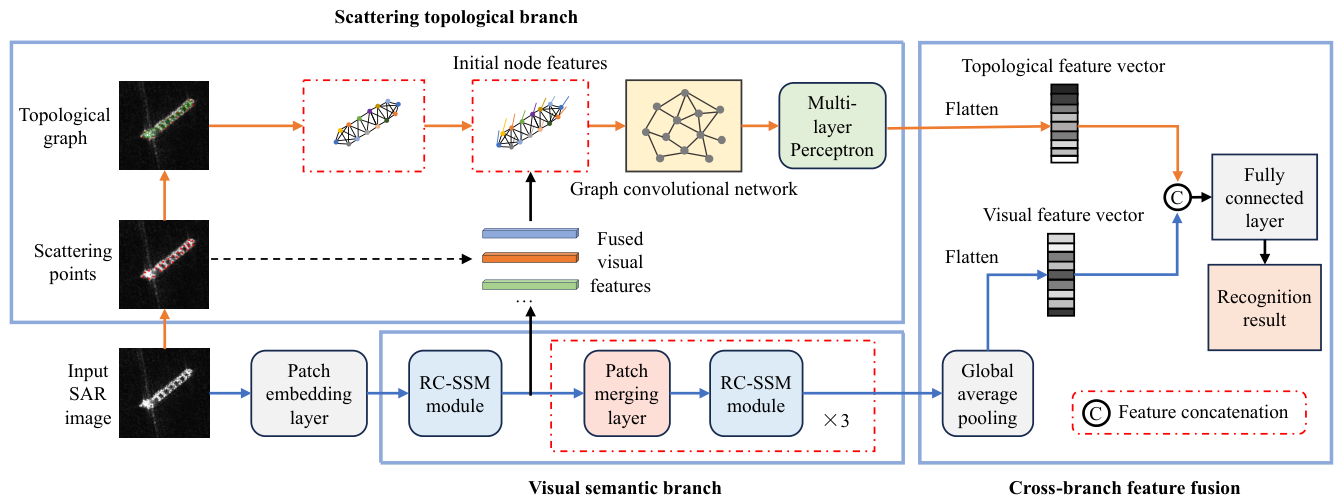
Figure 2.
Structure of the RC-SSM module.
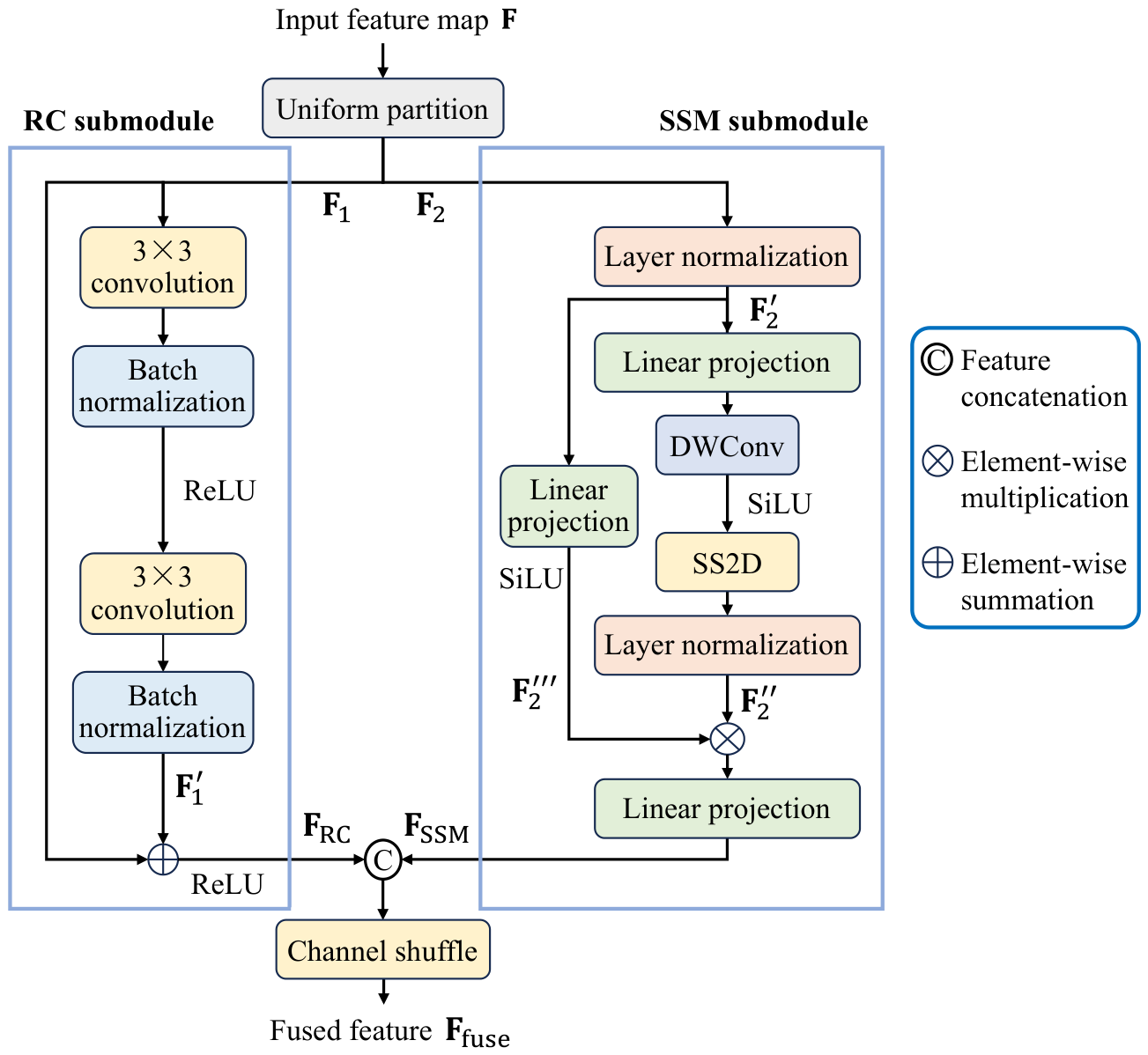
Figure 3.
Visualization of scattering point extraction, clustering and topological graph construction for SAR ship targets.
Figure 3.
Visualization of scattering point extraction, clustering and topological graph construction for SAR ship targets.
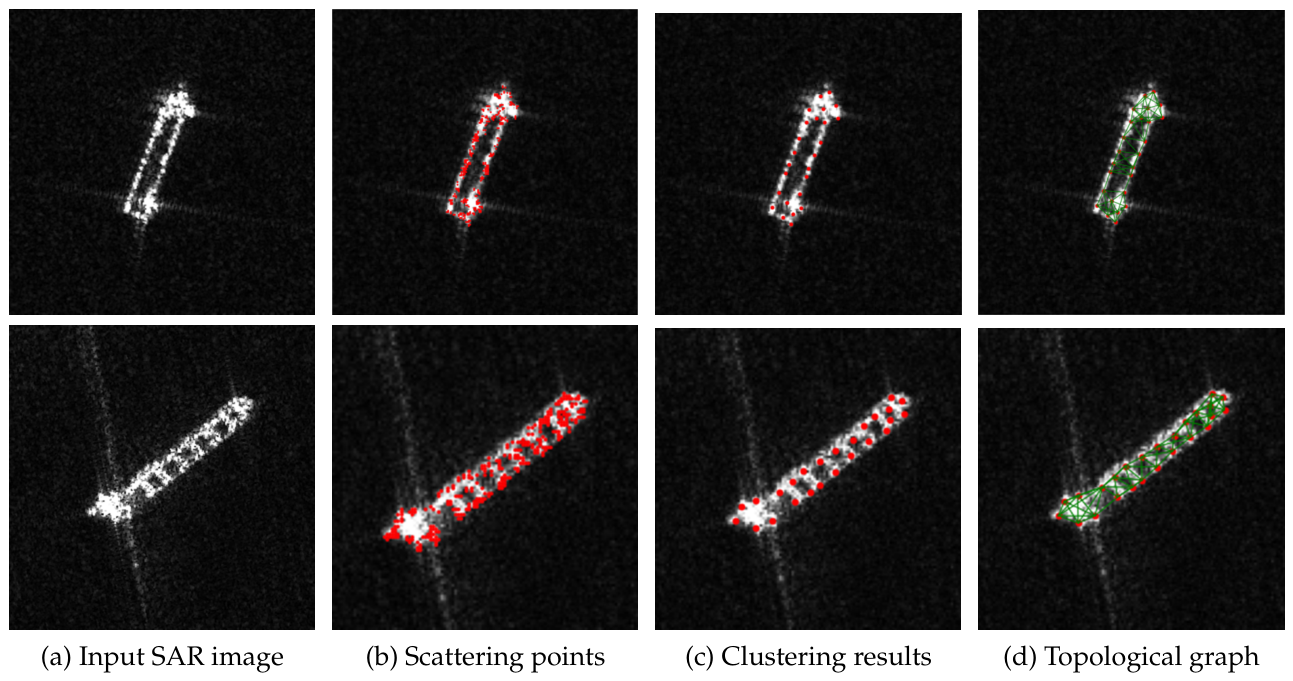
Figure 4.
Confusion matrix of base-class recognition.
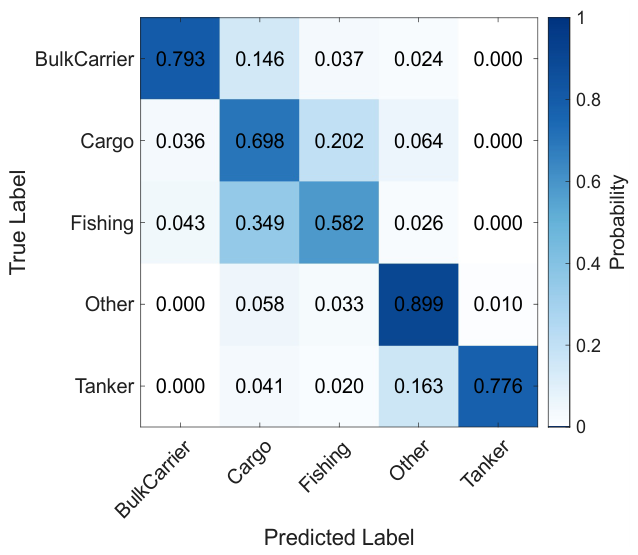
Figure 5.
t-SNE feature visualization for different methods.
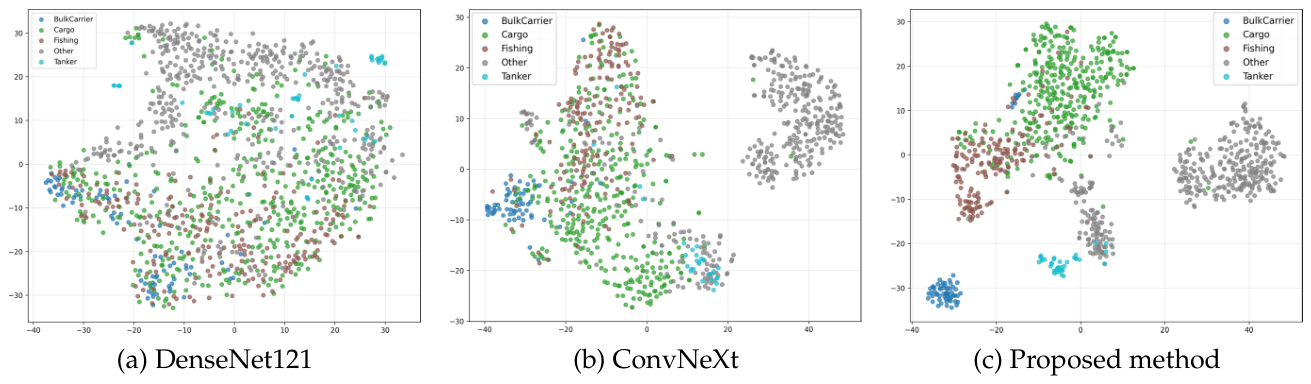
Figure 6.
Confusion matrix of few-shot recognition.
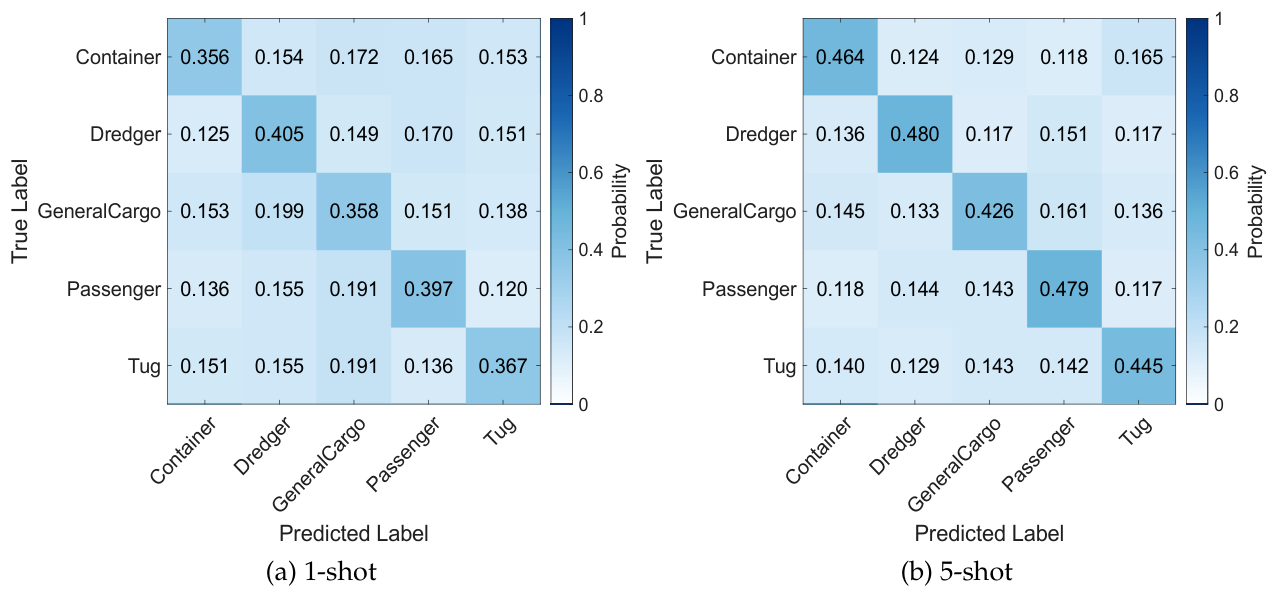
Figure 7.
Visualization of scattering topological structures with different numbers of scattering points .
Figure 7.
Visualization of scattering topological structures with different numbers of scattering points .
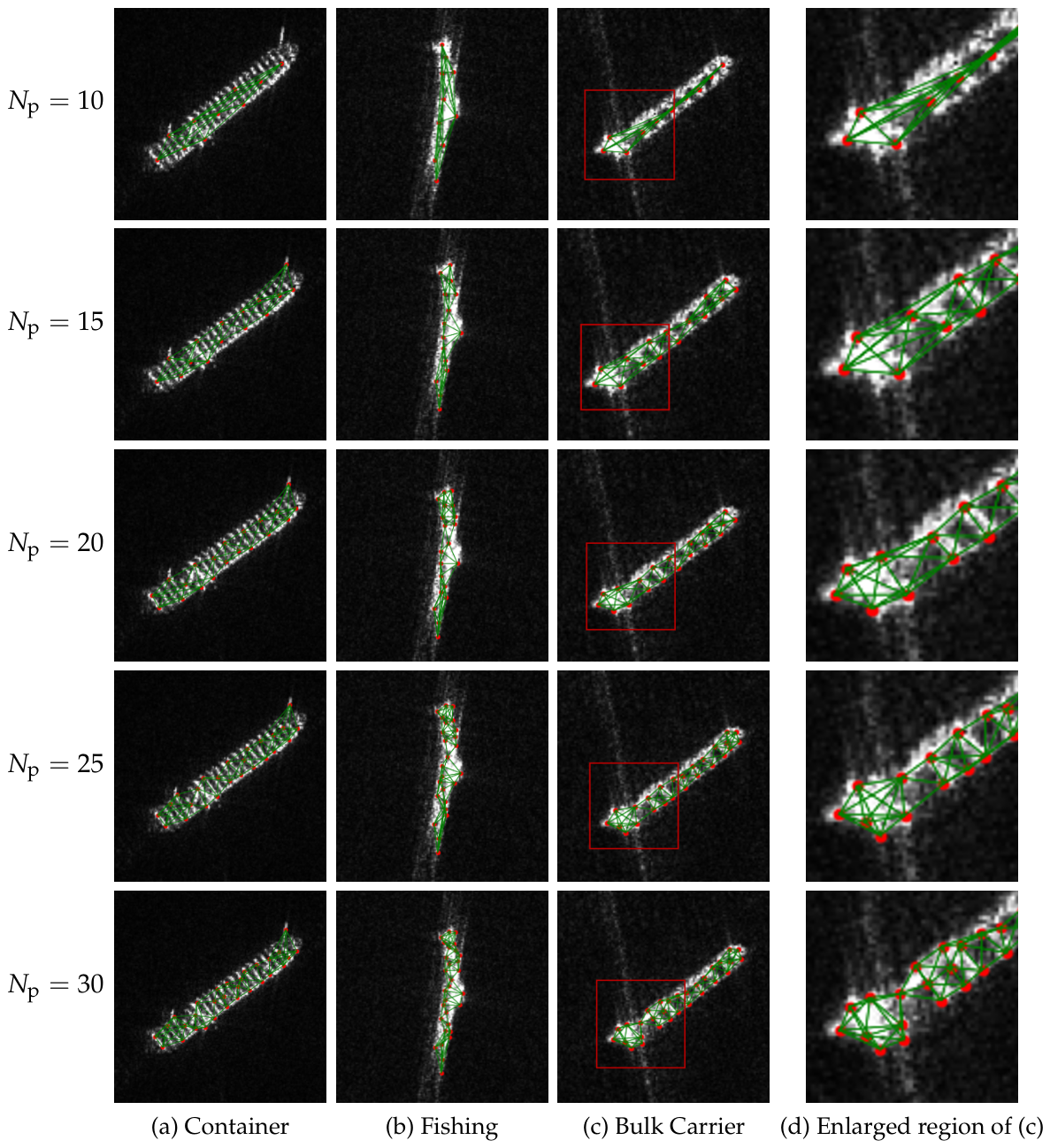
Figure 8.
Visualization of scattering topological structures with different nearest-neighbor counts .
Figure 8.
Visualization of scattering topological structures with different nearest-neighbor counts .
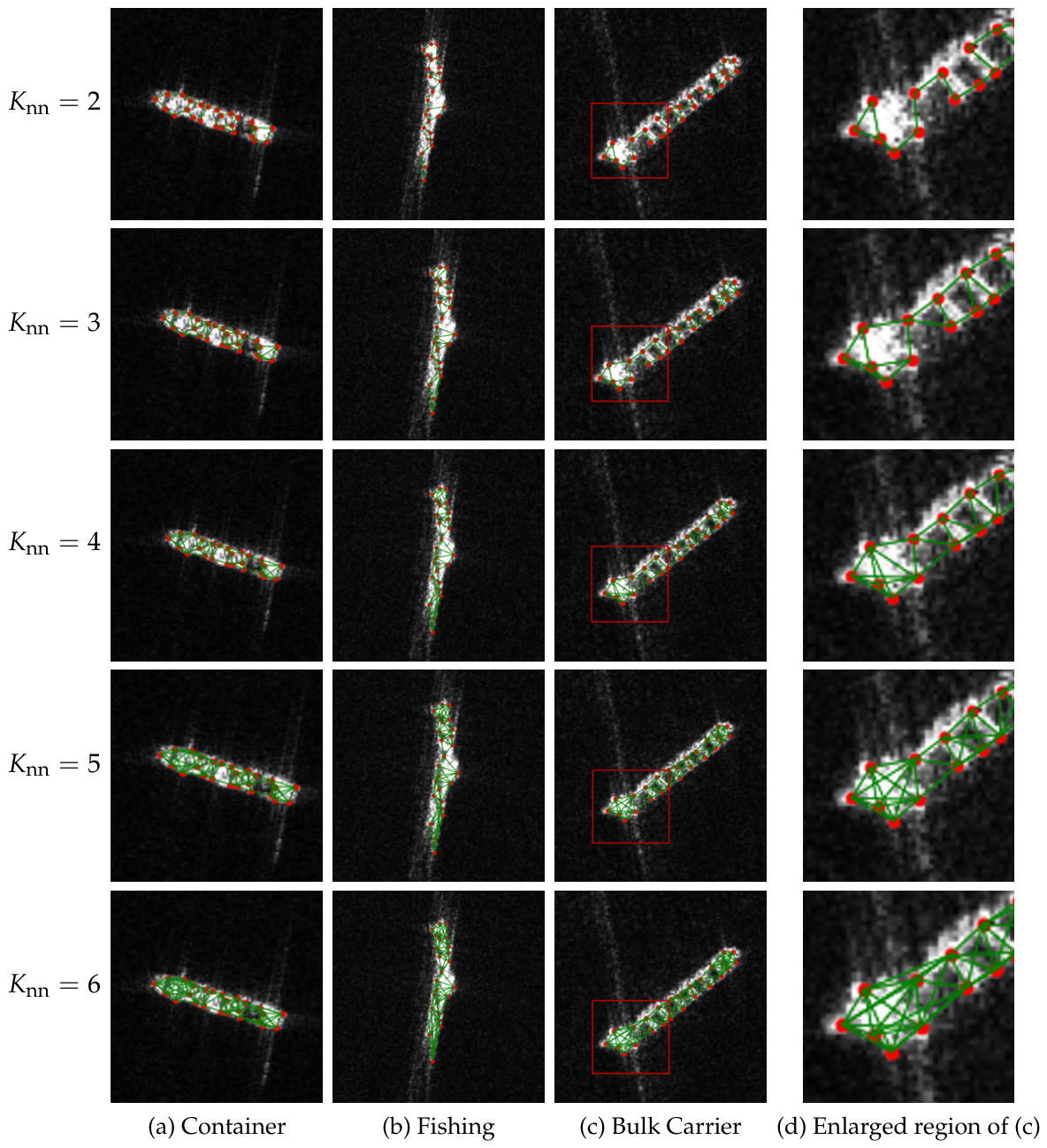

Table 1.
Feature dimension changes in the visual semantic branch.
| Stage ID | Structure | Spatial Size | Channel Number |
| Input | SAR image | 3 | |
| 1 | Patch embedding layer | 96 | |
| RC-SSM module | 96 | ||
| 2 | Patch merging layer | 192 | |
| RC-SSM module | 192 | ||
| 3 | Patch merging layer | 384 | |
| RC-SSM module | 384 | ||
| 4 | Patch merging layer | 768 | |
| RC-SSM module | 768 |
Table 2.
Sample distribution of the FUSARShip dataset.
| Base classes | Novel classes | |||
| Class | Count | Class | Count | |
| Training set | Test set | |||
| Bulk carrier | 1000 | 82 | General cargo | 34 |
| Cargo | 1053 | 470 | Dredger | 56 |
| Fishing | 1000 | 232 | Container | 53 |
| Tanker | 1000 | 50 | Tug | 49 |
| Other ship | 1115 | 496 | Passenger | 36 |
| Total | 5168 | 1330 | Total | 228 |
Table 3.
Hyperparameter settings.
| Category | Stage | Parameter | Value |
| Base-class | Training | Batch size | 16 |
| Epoch | 100 | ||
| Learning rate | 0.001 | ||
| Optimizer | Adam | ||
| Test | Batch size | 4 | |
| Few-shot | Training | Epoch (1-shot) | 80 |
| Epoch (5-shot) | 80 | ||
| Test | Batch size | 4 | |
| Episode | 100 | ||
| Other parameters |
- | Number of scattering points | 25 |
| Number of nearest neighbors | 5 |
Table 4.
Recognition results on base classes. The best values on each metric are highlighted in bold.
Table 4.
Recognition results on base classes. The best values on each metric are highlighted in bold.
| Method | Accuracy (%,↑) |
Precision (%,↑) |
Recall (%,↑) |
F1-score (%,↑) |
| DenseNet121 | 69.22 | 67.81 | 68.96 | 68.05 |
| ConvNeXt | 72.63 | 71.42 | 70.88 | 71.57 |
| ViM | 72.76 | 72.18 | 70.94 | 71.70 |
| SE-T2T-ViT | 73.19 | 72.74 | 72.91 | 72.82 |
| HOG-ShipCLSNet | 73.81 | 74.27 | 72.84 | 73.55 |
| Proposed method | 75.99 | 75.23 | 74.39 | 74.94 |
Table 5.
Few-shot recognition accuracy. The best values on each few-shot setting are highlighted in bold.
Table 5.
Few-shot recognition accuracy. The best values on each few-shot setting are highlighted in bold.
| Method | Accuracy(%,↑)± error(%,↓) | |
| 1-shot | 5-shot | |
| ProtoNet | ||
| RelationNet | ||
| MAML | ||
| Baseline++ | ||
| NegMargin | ||
| MetaBaseline | ||
| Proposed method | ||
Table 6.
Ablation results of core network modules. The best values on each few-shot setting are highlighted in bold.
Table 6.
Ablation results of core network modules. The best values on each few-shot setting are highlighted in bold.
| Structure ID |
RC submodule |
SSM submodule |
Scattering topological branch |
Accuracy (%,↑) | |
| 1-shot | 5-shot | ||||
| 1 | × | × | 31.82 | 38.63 | |
| 2 | × | 50.47 | 64.18 | ||
| 3 | × | 52.91 | 64.54 | ||
| 4 | |||||
Table 7.
Impact of scattering point number and nearest-neighbor count on few-shot recognition performance. The best values on each few-shot setting are highlighted in bold, and the second-best values are underlined.
Table 7.
Impact of scattering point number and nearest-neighbor count on few-shot recognition performance. The best values on each few-shot setting are highlighted in bold, and the second-best values are underlined.
| Param. | Value | Accuracy (%,↑) | Param. | Value | Accuracy (%,↑) | ||
| 1-shot | 5-shot | 1-shot | 5-shot | ||||
| 10 | 52.12 | 64.08 | 1 | 51.10 | 62.08 | ||
| 15 | 53.12 | 68.72 | 2 | 53.12 | 66.72 | ||
| 20 | 57.24 | 70.44 | 3 | 57.24 | 70.44 | ||
| 25 | 51.08 | 67.80 | 4 | 55.08 | 69.80 | ||
| 30 | 50.68 | 70.04 | 5 | 54.68 | 71.04 | ||
Disclaimer/Publisher’s Note: The statements, opinions and data contained in all publications are solely those of the individual author(s) and contributor(s) and not of MDPI and/or the editor(s). MDPI and/or the editor(s) disclaim responsibility for any injury to people or property resulting from any ideas, methods, instructions or products referred to in the content. |
© 2026 by the authors. Licensee MDPI, Basel, Switzerland. This article is an open access article distributed under the terms and conditions of the Creative Commons Attribution (CC BY) license (http://creativecommons.org/licenses/by/4.0/).
Copyright: This open access article is published under a Creative Commons CC BY 4.0 license, which permit the free download, distribution, and reuse, provided that the author and preprint are cited in any reuse.


