

Submitted:
24 July 2026
Posted:
27 July 2026
You are already at the latest version
Abstract
Background: Functional fitness has evolved from a niche training methodology into an influential movement in contemporary exercise science, sports performance, and the fitness industry. Among the competitive formats that have recently emerged, Hyrox® has become a prominent standardized model of hybrid fitness competition. This review aimed to critically synthesize the available evidence on the development of Hyrox® and its physiological demands, psychological characteristics, and performance determinants. Methods: Given the limited evidence available, a narrative review was conducted. PubMed, Scopus, and Web of Science were searched for original and review articles investigating Hyrox® athletes or participants. The evidence was synthesized across three major domains: physiology, psychology, and performance determinants. Results: Eleven studies were included, comprising eight original articles and three review articles. The available evidence indicates that Hyrox® imposes sustained high metabolic and per-ceptual demands, with functional stations eliciting particularly elevated blood lactate concentrations. Running capacity consistently emerged as the strongest determinant of overall performance. Psychological, recovery, sleep, and injury-related aspects remain insufficiently investigated. Conclusions: Hyrox® represents a promising research model for hybrid fitness because of its standardized competition format and rapidly growing international participation. However, the evidence base remains limited and is pre-dominantly derived from observational studies and analyses of publicly available competition data. Controlled interventions, longitudinal monitoring, and physiological, biomechanical, and psychosocial investigations are required to support evidence-based recommendations for athlete preparation and competition.
Keywords:
hybrid fitness
; functional fitness
; fitness racing
; physiological demands
; performance
1. Introduction
Over the past two decades, functional fitness has evolved from a niche training methodology into one of the most influential approaches in contemporary exercise science, sports performance, and the fitness industry [1,2]. Functional fitness training integrates resistance exercise, weightlifting, gymnastics, running, rowing, and other cyclical activities into high-intensity training sessions designed to develop multiple components of physical fitness simultaneously [3]. Originally popularized through CrossFit® and related training systems, functional fitness rapidly expanded beyond recreational exercise, becoming one of the fastest-growing sectors of the global fitness industry and generating substantial scientific interest in its physiological responses, chronic adaptations, injury epidemiology, and health-related outcomes [4].
This rapid expansion has transformed the landscape of fitness competition. Unlike traditional endurance- or strength-based sports, competitive functional fitness requires athletes to integrate aerobic capacity, muscular strength and power, movement efficiency, and fatigue resistance across multiple exercise modalities [1,5,6]. Consequently, competitions have proliferated worldwide, attracting participants ranging from recreational exercisers to elite athletes and contributing to the emergence of a distinct sporting ecosystem.
Despite this growth, a defining characteristic of traditional functional fitness competitions has constrained scientific investigation and longitudinal athlete evaluation: the continuous variation in competitive workouts [7]. Exercise selection, volume, intensity, movement standards, and event sequencing may vary substantially across competitions, limiting direct comparisons between athletes, events, and competitive seasons. Although this variability is central to the identity of functional fitness, it complicates longitudinal performance monitoring, the establishment of normative data, and the identification of physiological and performance-related determinants of competitive success.
The pursuit of greater competitive standardization contributed to the emergence of hybrid fitness racing. Among the formats introduced in recent years, Hyrox® has become one of the most prominent and scientifically relevant examples of this competitive model [2,8]. Established in Hamburg, Germany, in 2017 by sports-event organizer Christian Toetzke, Olympic field hockey champion Moritz Fürste, and marketing entrepreneur Michael Trautmann, Hyrox® was conceived as a standardized fitness race. Its format combines endurance running with functional exercise stations performed in a fixed sequence under consistent competition rules across official events worldwide [8].
From a scientific perspective, Hyrox® represents a valuable research model because its standardized competition format provides relatively consistent external demands across events [8,9]. This standardization facilitates the investigation of pacing strategies, physiological responses, performance determinants, biomechanical demands, and training adaptations, particularly when compared with sports characterized by continually varying competitive tasks [1]. Consequently, Hyrox® has emerged as a growing research topic within exercise physiology, strength and conditioning, and hybrid sports performance.
Despite its rapid global expansion, the scientific evidence on Hyrox® remains limited and fragmented. As the sport continues to evolve, an integrated synthesis is needed to consolidate current knowledge and guide both research and practice. Therefore, the purpose of this review is to critically analyze the current scientific evidence regarding the emergence and global development of Hyrox®, characterize the physiological demands of competition, summarize the principal determinants of performance, and discuss the psychological determinants, as well as the practical applications for athlete assessment, training prescription, and future research directions.
2. Methods
Given the emerging, heterogeneous, and multidimensional nature of the available evidence, a narrative review was conducted to provide an integrated overview of research on Hyrox®. The literature was synthesized across three domains: physiological demands, psychological factors, and performance determinants. A conceptual comparison between Hyrox® and other competitive functional fitness disciplines was also undertaken.
2.1. Search Strategy
A literature search was conducted in PubMed, Scopus, and the Web of Science Core Collection from database inception to 8 July 2026. Because Hyrox® is a specific and distinctive term, “HYROX” was searched across all available fields without additional keywords or language filters. Google Scholar was also searched to identify potentially eligible studies not indexed in the selected databases. The reference lists of the included articles were screened to identify additional relevant publications.
2.2. Eligibility Criteria
Studies were eligible if they: (1) were original quantitative or qualitative studies or review articles; (2) investigated Hyrox® athletes, participants, competitions, training, or performance; and (3) were published in English, Portuguese, or Spanish by 8 July 2026. No restriction was applied regarding the initial publication date. Conference abstracts, editorials, commentaries, non-scholarly publications, and studies that mentioned Hyrox® without directly examining the sport or its participants were excluded.
2.3. Study Selection and Synthesis
After duplicate records were removed, titles and abstracts were screened for relevance, followed by full-text assessment of potentially eligible studies. Study selection and data extraction were performed independently by two authors. If two authors participated, disagreements regarding eligibility or data extraction were resolved through discussion and consensus. Data were extracted on publication year, study design, participant characteristics, research domain, assessed outcomes, and principal findings.
Given the narrative design and the heterogeneity of the included studies, the evidence was synthesized qualitatively across three domains: physiology, psychology, and performance determinants. Attention was given to the consistency of findings, methodological limitations, and practical implications. A conceptual comparison between Hyrox® and other competitive functional fitness disciplines was also undertaken. No quantitative pooling or meta-analysis was performed.
3. Results
The database search identified 28 records, of which 13 were removed as duplicates. Following title and abstract screening, six of the remaining 15 records were excluded for not meeting the eligibility criteria. Two additional studies were identified through Google Scholar, resulting in 11 studies included in the narrative synthesis. These comprised eight original studies and three review articles, with four published in 2025 and seven in 2026. Table 1 summarizes their characteristics and principal findings.
3.1. Hyrox® Competition Format and Global Development
A Hyrox® race comprises eight 1-km running segments, each followed by one of eight functional exercise stations: SkiErg, sled push, sled pull, burpee broad jumps, rowing, farmer’s carry, sandbag lunges, and wall balls [9]. The sequence and distances of these components are illustrated in Figure 1. Although loads and task distribution vary across competitive divisions, the sequence and fundamental structure of the race remain standardized across official events. This consistency facilitates comparisons between athletes, competitions, and seasons and provides a reproducible framework for physiological and performance research.
Hyrox® has also experienced substantial international growth [10]. Within a relatively short period, it expanded from a European event into a global hybrid fitness competition, attracting participants across multiple countries and competitive divisions. Its accessible movement repertoire and standardized format may appeal to individuals from diverse sporting backgrounds, including endurance running, CrossFit®, weightlifting, powerlifting, obstacle-course racing, and team sports, while reducing some of the technical barriers associated with other functional fitness competitions.
Hyrox® combines a standardized race format with substantial endurance and strength demands, facilitating longitudinal athlete monitoring and direct performance comparisons across events and seasons. In contrast, CrossFit® is characterized by substantial variation in workout structure, exercise selection, and task sequencing. These differences influence their physiological demands, technical requirements, performance comparability, and suitability for longitudinal research, as summarized in Table 2.
Villarroel López et al. [11] conducted a descriptive cross-sectional study examining the demographic, training, recovery, physical, and motivational characteristics of Hyrox® athletes. The sample comprised 80 athletes (22 females and 58 males; mean age: 37.5 ± 8.3 years) with an average of 22.4 months of Hyrox® experience and 5.5 completed competitions. More than half (56%) had previously participated in related disciplines, including CrossFit®, obstacle-course racing, and other functional fitness competitions. Participants trained an average of 5.5 days per week, and 55% performed at least one double-session training day per week. Athletes reported predominantly positive competition-related emotions, although performance pressure and anxiety were also common. Their motivations included competitive achievement, personal enjoyment, and social connection, illustrating the multidimensional nature of Hyrox® participation.
Recovery practices were less consistently structured. More than 40% of participants reported no formal post-training recovery protocol, although most performed active recovery on rest days and slept an average of 7.1 ± 0.8 h per night. While 56.3% reported no injuries, the most frequently reported problems among injured athletes were overuse injuries, tendinopathies, and joint discomfort. These findings highlight the need for further investigation of training-load management, recovery practices, and injury risk in Hyrox® athletes.
Considering recovery, Buoite Stella et al. [12] examined the influence of training modality on sleep quantity, quality, and architecture in hybrid athletes. Using a validated medical-grade wearable device, eight experienced male Hyrox® athletes aged 23–32 years completed two resistance-training and two endurance-training sessions over two weeks under ecologically valid conditions. Resistance training resulted in longer sleep-onset latency than endurance training (29 vs. 10 min), whereas endurance training was associated with greater wake after sleep onset (48 vs. 31 min). These findings suggest that the resistance and endurance components of hybrid training may influence distinct aspects of post-exercise sleep.
3.2. Physiology Demands
Brandt et al. [9] provided the first characterization of the acute physiological responses to a simulated Hyrox® competition. Eleven recreational athletes completed a race following the Individual Open Division standards, with a mean completion time of 86.5 ± 14.5 min. Both the running segments and functional stations were performed at high perceived intensities, indicating sustained physiological and perceptual strain throughout the event. Blood lactate concentrations were highest during the functional stations (8.5 ± 5.4 mmol·L−1), suggesting a substantial contribution of glycolytic metabolism during tasks such as the sled push, sled pull, wall balls, and burpee broad jumps. Ratings of perceived exertion were also high during both the functional stations (18 ± 2) and running segments (16 ± 2), indicating limited perceptual recovery between successive race components. Collectively, these findings characterize Hyrox® as a prolonged hybrid endurance–strength event involving sustained metabolic and perceptual demands, with particularly high glycolytic stress during the functional stations.
Complementing this acute physiological characterization, Rios and Pyne [1] proposed an integrative framework combining oxygen uptake kinetics, metabolic profiling, heart rate and heart rate variability, and neuromuscular fatigue assessment to monitor the internal demands of hybrid fitness. The framework emphasizes that no single physiological marker can adequately capture the multidimensional demands of competitions such as Hyrox®. However, an important methodological gap remains although acute race-related responses have begun to be characterized, chronic adaptations to Hyrox®-specific training and their association with longitudinal changes in competitive performance remain largely unexplored.
3.3. Psychology Factors
From an exercise psychology perspective, Tibana and Dominski [2] conceptualized Hyrox® as an emerging development within functional fitness. Its relatively straightforward movement repertoire, which excludes highly technical elements such as Olympic weightlifting and gymnastics, may reduce barriers to participation among individuals with different levels of experience and physical fitness.
The standardized race format also allows participants to evaluate their progress through repeated self-comparison across events. Moreover, the absence of qualification requirements and completion-time limits may increase perceived accessibility. As observed in other functional fitness settings, social interaction and a sense of community may contribute to enjoyment and motivation, while the novelty and structured challenge of the competition may support initial engagement. However, these proposed psychological benefits require further empirical investigation, particularly regarding their influence on adherence and long-term participation.
We highlighted that the rise of hybrid fitness may also represent a broader trend within the fitness industry, whereby established training approaches are reframed and marketed under new terminology to better match evolving consumer preferences and commercial demands [2].
In this context, Caumeran and Jesus [13] examined whether participation loyalty in Hyrox® was more strongly associated with the sport experience or with marketing-related factors. Using a cross-sectional design, they surveyed 320 first-time and repeat participants (168 women and 152 men) in Cebu, Philippines. The findings showed that participation loyalty was predominantly explained by sport experience variables, with community and belongingness emerging as the strongest predictor, followed by training readiness, event challenge satisfaction, operations and safety quality, and coaching/program support. In contrast, marketing-related variables had a comparatively minor influence. Among the marketing factors, only product experience quality and place accessibility were significant predictors, whereas price fairness and promotion effectiveness were not independently associated with loyalty [13].
Based on their findings, Caumeran and Jesus [13] recommended prioritizing community-building initiatives to strengthen participation loyalty in Hyrox®. This recommendation is consistent with Self-Determination Theory, which identifies relatedness—the experience of feeling connected to, cared for, and valued by others—as a basic psychological need that supports autonomous motivation and sustained engagement [14].
It also aligns with Sense of Community Theory, which comprises four interconnected dimensions: membership, influence, integration and fulfillment of needs, and shared emotional connection [15]. Together, these perspectives provide a theoretical explanation for how the sense of community associated with Hyrox® may support motivation, commitment, and long-term participation. However, these psychological mechanisms require direct empirical examination in Hyrox® participants.
The opportunity to self-regulate pacing during Hyrox® may contribute to a more positive affective experience and, consequently, support continued participation, as affective responses during exercise can predict future physical activity behavior [16]. However, the competitive environment may encourage participants to exercise above the ventilatory threshold (VT). According to the Dual-Mode Theory, affective responses are generally positive below the VT, become increasingly variable around this threshold, and tend to decline as exercise intensity increases beyond it and interoceptive cues become more dominant [17]. Given the high physiological demands of Hyrox®, further research should examine how pacing, exercise intensity, and competitive level influence affective responses and subsequent participation.
Psychological factors were the least explored of the three domains examined in this narrative review. Only one study directly investigated the motivational profile of Hyrox® athletes, identifying goals ranging from competitive performance and personal achievement to enjoyment and social interaction [11].
3.4. Performance-Related Determinants
The standardized structure of Hyrox® enables direct comparisons of performance across athletes, competitions, and competitive seasons. This consistency has supported large-scale analyses of race results, allowing researchers to identify the race components most strongly associated with overall performance and to examine changes in elite performance over time.
Rappelt et al. [18] analyzed more than 39,000 performances from PRO and ELITE competitions across the first seven competitive seasons. Running time showed the strongest association with total race time in both sexes, while the functional stations provided additional, but comparatively smaller, contributions to overall performance. These results indicate that running performance represents a central component of competitive success. However, because running time is included in total race time, these associations should not be interpreted as direct evidence that physiological running capacity is the sole causal determinant of performance.
Running accounts for a substantial proportion of total race duration, meaning that relatively small improvements across the eight running segments may produce meaningful reductions in overall time. Nevertheless, performance at strength-oriented stations, particularly the Sled Push, Sled Pull, Farmer’s Carry, and Wall Balls, also differentiated faster from slower athletes. Efficient performance at these stations likely depends on force production, muscular endurance, movement proficiency, and the ability to limit fatigue before subsequent running segments [18].
Longitudinal evidence indicates that elite performance has improved considerably since the introduction of Hyrox®. Gutiérrez-Hellín et al. [19] analyzed the annual Top 50 PRO Men performances across seven competitive seasons and reported a 20.8% reduction in total race time between 2018 and 2024. Improvements occurred in running, functional-station, and transition times, with the largest station-specific changes observed in the Wall Balls, Sled Pull, and Farmer’s Carry. These trends may reflect improvements in sport-specific preparation, technical execution, pacing, and the competitive depth of the athlete population.
Running performance and pacing strategies also evolved across seasons. The largest running improvement occurred during the eighth segment, indicating an enhanced ability among contemporary elite competitors to maintain running speed under accumulated fatigue. Running pace also became progressively more even, suggesting more effective distribution of effort throughout the race [19].
Fernández-Navarrete et al. [20] complemented these findings by analyzing more than 186,000 results from Individual, Doubles, and Relay divisions. The study established percentile-based benchmarks for overall race time and individual segments, providing reference values for athlete assessment and performance monitoring. These benchmarks allow coaches and athletes to identify relative strengths and weaknesses and compare performance within the relevant sex and competitive division.
Collectively, the evidence indicates that Hyrox® performance reflects the interaction of running ability, station-specific performance, fatigue resistance, movement efficiency, pacing, and transition execution. Although aerobic fitness, maximal strength, and muscular endurance are theoretically important, their independent contributions require confirmation through studies involving direct physiological and neuromuscular assessment.
Figure 2 illustrates the conceptual positioning of two major fitness functional competitions based on two key dimensions: technical skill requirement (low to high) and degree of competition standardization (low to high). CrossFit® is characterized by high technical demand combined with low standardization and high variability. Hyrox® occupies a unique position with low-to-moderate technical demand and a very high degree of standardization, which enhances reproducibility and enables direct performance comparisons across events and seasons.
4. Discussion
The available evidence indicates that Hyrox® remains at an early stage of scientific development. Although the sport was introduced in 2017, only 11 eligible studies were identified, all published from 2025 onward. This recent concentration of research contrasts with the rapid international expansion of participation and competition documented across multiple countries and competitive divisions [2,20].
Three main patterns emerged from this synthesis. First, the depth of evidence differs substantially across research domains. Participation trends, normative benchmarks, pacing, and performance development have been examined using large competition databases containing tens or hundreds of thousands of results [18,19,20]. In contrast, physiological responses, athlete characteristics, motivation, and recovery have been investigated in considerably smaller samples [9,11]. Consequently, current evidence provides a detailed description of participation and performance trends but offers limited insight into the physiological and psychological mechanisms underlying these patterns.
Second, the standardized competition format represents a major methodological advantage of Hyrox®, enabling direct comparisons across athletes, events, and seasons. However, this advantage has thus far been used primarily in descriptive and correlational research examining participation growth, performance benchmarks, and pacing trends [18,20]. No randomized or controlled trials evaluating Hyrox®-specific training interventions were identified. Therefore, causal relationships between training strategies, physiological adaptations, and competitive performance remain unknown.
Third, psychological and recovery-related factors remain underexplored. Only two original studies directly examined psychosocial dimensions: one characterized athlete motivation and competition-related experiences [11], while the other investigated participation loyalty, community, and marketing-related factors [13]. Sleep and recovery physiology were examined in only one small-sample study involving eight male athletes [12]. Moreover, more than 40% of surveyed athletes reported not following a structured post-training recovery protocol [11], while resistance and endurance training were associated with different post-exercise sleep responses [12]. These findings identify recovery management, affective responses, competitive anxiety, motivation, and long-term adherence as important priorities for future research.
4.1. Practical Applications for Athlete Assessment and Training Prescription
Based on the current evidence, several practical implications can be drawn for coaches, clinicians, and athletes:
Since overall Hyrox® performance is most strongly associated with running capacity, particularly at PRO/ELITE levels [18], training programs should ensure that aerobic and running-specific development is not subordinated to station-specific strength work, even though the latter remains an important secondary contributor.
Functional stations should be trained under fatigue rather than exclusively in isolation. Blood lactate concentration and perceived exertion are particularly elevated during the functional stations [9], while substantial historical performance improvements have been observed in the Wall Balls, Sled Pull, and Farmer’s Carry [19]. Therefore, station-specific exercises should also be practiced under conditions of accumulated fatigue, including running-to-station transitions.
Training should also develop late-race pacing and fatigue resistance. The disproportionate improvement observed in the final running segment across competitive seasons suggests that specific attention to pacing strategy and end-race fatigue resistance may provide meaningful performance benefits [19].
4.2. Future Research Directions
Future research should prioritize six areas. First, randomized controlled and quasi-experimental trials should evaluate the effects of Hyrox®-specific interventions, including concurrent strength–endurance periodization, station-specific technical training, and pacing strategies, on competitive performance. Second, longitudinal within-athlete studies should integrate physiological monitoring with competition outcomes to identify markers associated with performance changes over time, building on the framework proposed by Rios and Pyne [1]. Third, psychological research should examine motivation, affective responses across exercise-intensity domains, competitive anxiety, mental preparation, and long-term adherence [21].
Fourth, physiological demands and performance determinants should be investigated across sexes, age groups, and competitive divisions, as current physiological evidence is based predominantly on small male samples [9,12]. Fifth, prospective injury-surveillance studies are needed to establish injury incidence, severity, mechanisms, and training-related risk factors, extending the preliminary self-reported findings of Villarroel López et al. [11]. Finally, biomechanical studies should examine station-specific movement efficiency, particularly during the Sled Push, Sled Pull, Farmer’s Carry, Wall Balls, and Burpee Broad Jumps. Such analyses may help explain the substantial performance improvements observed in several of these stations across competitive seasons [19].
5. Conclusions
This narrative review synthesized the emerging evidence on Hyrox® across three domains: physiological demands, psychological factors, and performance-related determinants. Its standardized competition format provides a valuable model for direct performance comparisons and longitudinal analyses across athletes, events, and seasons. However, the evidence base remains limited and fragmented, comprising only 11 studies published since 2025 and relying predominantly on observational analyses of competition databases. Current findings indicate that running performance is most strongly associated with total race time, while the functional stations impose substantial metabolic and perceptual demands. Psychological factors, recovery, injury risk, and chronic training adaptations remain insufficiently investigated. As Hyrox® continues to expand internationally, controlled interventions, longitudinal monitoring, and integrated physiological, biomechanical, and psychosocial research will be essential to support evidence-based recommendations for athlete preparation, performance, recovery, and long-term participation.
Author Contributions
R.A.T., M.J.R. and F.H.D.: Writing—original draft; R.A.T., M.J.R., F.H.D. and J.P.: Writing—review and editing. All authors have read and agreed to the published version of the manuscript.
Funding
F.H.D. is supported by a Postdoctoral Fellowship from the Graduate Program in Human Movement Sciences (PPGCMH), Center for Health and Sport Sciences (CEFID), Santa Catarina State University (UDESC), Brazil (Public Call No. 03/2025).
Institutional Review Board Statement
Not applicable.
Informed Consent Statement
Not applicable.
Data Availability Statement
No new data were created or analyzed in this study.
Conflicts of Interest
The authors declare no conflicts of interest.
References
- Rios, M.; Pyne, D.B. Integrative Physiological Strategies for Monitoring Demands in Functional Fitness. Sports 2025, 13. [Google Scholar] [CrossRef] [PubMed]
- Tibana, R.A.; Dominski, F.H. From functional fitness to hybrid fitness: Is a new training paradigm emerging? Sport Sci. Health 2026, 22, 246. [Google Scholar] [CrossRef]
- Dominski, F.H.; Tibana, R.A.; Andrade, A. “Functional Fitness Training”, CrossFit, HIMT, or HIFT: What Is the Preferable Terminology? Front Sports Act. Living 2022, 4, 882195. [Google Scholar] [CrossRef] [PubMed]
- Rios, M.; Pyne, D.B.; Fernandes, R.J. The Effects of CrossFit(®) Practice on Physical Fitness and Overall Quality of Life. Int. J. Env. Res. Public Health 2024, 22. [Google Scholar] [CrossRef] [PubMed]
- Martinho, D.V.; Rebelo, A.; Gouveia É, R.; Field, A.; Costa, R.; Ribeiro, A.S.; Casonatto, J.; Amorim, C.; Sarmento, H. The physical demands and physiological responses to CrossFit®: a scoping review with evidence gap map and meta-correlation. BMC Sports Sci. Med. Rehabil. 2024, 16, 196. [Google Scholar] [CrossRef] [PubMed]
- Rios, M.; Zacca, R.; Azevedo, R.; Fonseca, P.; Pyne, D.B.; Reis, V.M.; Moreira-Gonçalves, D.; Fernandes, R.J. Bioenergetic Analysis and Fatigue Assessment During the Fran Workout in Experienced Crossfitters. Int. J. Sports Physiol. Perform. 2023, 18, 786–792. [Google Scholar] [CrossRef] [PubMed]
- Strunk-Pomar, R.; Santos-Concejero, J. Breaking down the CrossFit Games: A 10-year analysis of the competition and top athletes. Are they the fittest on Earth? Sci. Sports 2026. [Google Scholar] [CrossRef]
- Davids, C.J. A performance analysis of hyrox: A review of the physiologic, mechanical, and technical demands. Strength Cond. J. 2022, 10, 1519. [Google Scholar]
- Brandt, T.; Ebel, C.; Lebahn, C.; Schmidt, A. Acute physiological responses and performance determinants in Hyrox©–a new running-focused high intensity functional fitness trend. Front. Physiol. 2025, 16, 1519240. [Google Scholar] [CrossRef] [PubMed]
- Fernández-Navarrete, I.; Ruiz-Alias, S.A.; Gómez-García, M.; Riquelme-Sebastián, L.; García-Pinillos, F. Hyrox©: A descriptive analysis of participation trends among over 275,000 athletes in the new fitness modality. Res. Q. Exerc. Sport 2026, 97, 266–272. [Google Scholar] [PubMed]
- Villarroel López, P.; Agudo-Ortega, A.; Juárez Santos-García, D. Characterization of the Profile of Hyrox© Athletes. Appl. Sci. 2025, 15, 11693. [Google Scholar] [CrossRef]
- Buoite Stella, A.; D’Andrea, F.; Deodato, M.; Murena, L.; Sabot, R.; Martini, M.; Morrison, S.A.; Ajčević, M. Strengthening recovery, enduring sleep. An ecologically valid assessment of sleep quantity and quality in hybrid athletes: does training mode matter? Eur. J. Appl. Physiol. 2026, 126, 3473–3480. [Google Scholar] [CrossRef] [PubMed]
- Caumeran, R.R.; Jiomarie, B.J. Participation Loyalty in Hyrox: The Primacy of Sport Experience and the Effects of Marketing Support. Int. Rev. Manag. Mark. 2026, 16, 73. [Google Scholar] [CrossRef]
- Deci, E.L.; Ryan, R.M. Intrinsic motivation and self-determination in human behavior; Springer Science & Business Media, 2013. [Google Scholar]
- McMillan, D.W.; Chavis, D.M. Sense of community: A definition and theory. J. Community Psychol. 1986, 14, 6–23. [Google Scholar] [CrossRef]
- Rhodes, R.E.; Kates, A. Can the Affective Response to Exercise Predict Future Motives and Physical Activity Behavior? A Systematic Review of Published Evidence. Ann. Behav. Med. 2015, 49, 715–731. [Google Scholar] [CrossRef] [PubMed]
- Ekkekakis, P.; Parfitt, G.; Petruzzello, S.J. The pleasure and displeasure people feel when they exercise at different intensities: decennial update and progress towards a tripartite rationale for exercise intensity prescription. Sports Med. 2011, 41, 641–671. [Google Scholar] [PubMed]
- Rappelt, L.; Wiedenmann, T.; Held, S.; Heinke, L.; Micke, F.; Wicker, P.; Donath, L. Longitudinal performance development in PRO and ELITE HYROX competitions across the first seven competitive seasons. Front. Physiol. 2026, 17, 1847569. [Google Scholar] [CrossRef] [PubMed]
- Gutiérrez-Hellín, J.; Alonso-Domínguez, S.; Martín-Gómez, F.J.; Muñoz, A.; Franco-Andrés, A.; Yustres-Amores, I.; del Cerro, J.S.; Del Coso, J. Performance Trends and Pacing Evolution in Elite HYROX©: A Seven-Season Analysis of Top 50 PRO Men (2018–2024). Appl. Sci. 2026, 16, 6674. [Google Scholar] [CrossRef]
- Fernández-Navarrete, I.; Ruiz-Alias, S.A.; García-Pinillos, F. Where am I struggling? Detailed benchmarks for every workout and category in Hyrox© competition. J. Sports Med. Phys. Fit. 2026. [Google Scholar] [CrossRef] [PubMed]
- Villarroel López, P.; Juárez Santos-García, D. High Intensity Functional Training in Hybrid Competitions: A Scoping Review of Performance Models and Physiological Adaptations. J. Funct. Morphol. Kinesiol. 2025, 10, 365. [Google Scholar] [CrossRef] [PubMed]
Figure 1.
Standard sequence and distances of the running segments and functional exercise stations in a Hyrox® race.
Figure 1.
Standard sequence and distances of the running segments and functional exercise stations in a Hyrox® race.
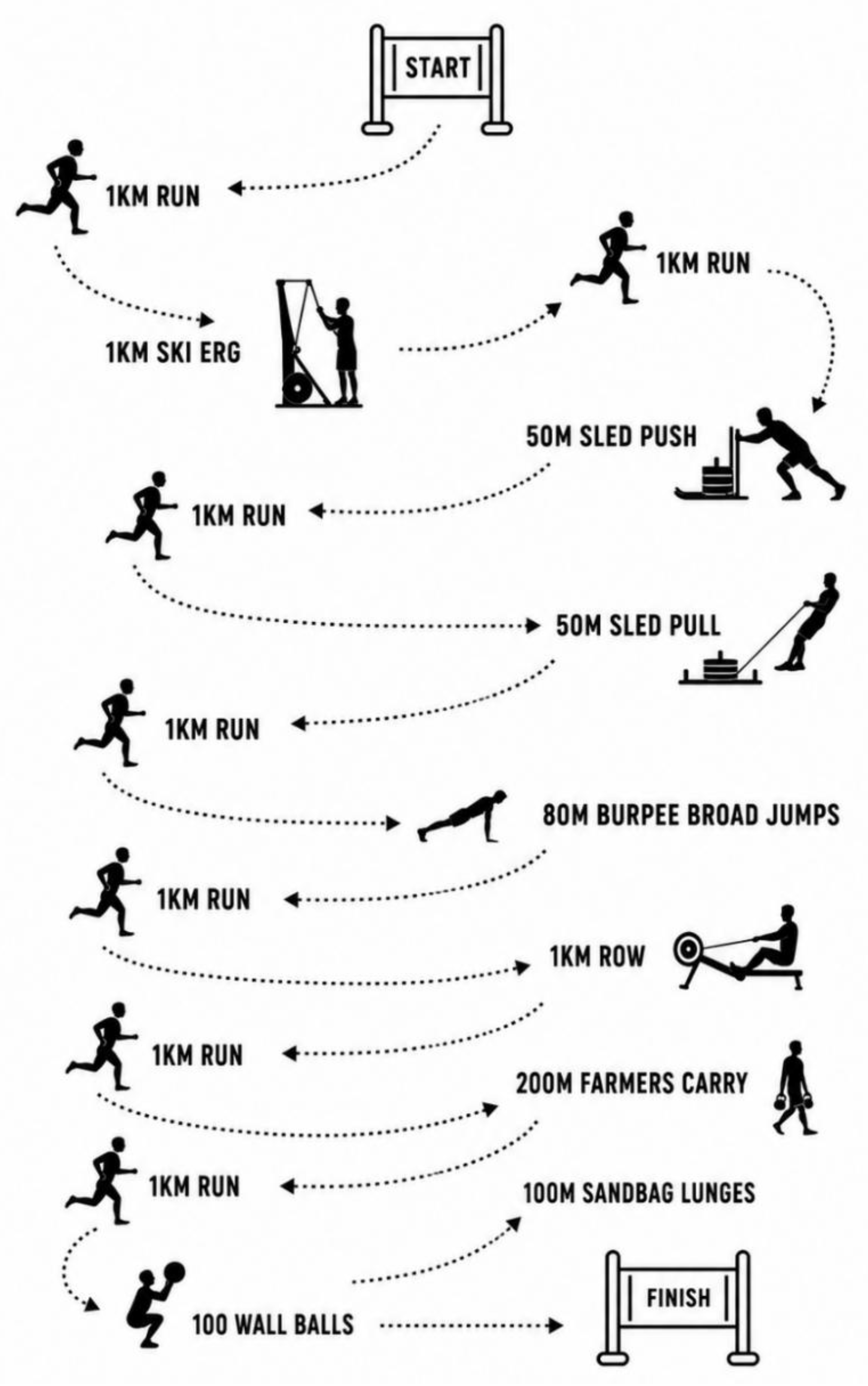
Figure 2.
Conceptual positioning of Hyrox® and CrossFit® based on two key dimensions: technical skill requirement (low to high) and degree of competition standardization (low to high).
Figure 2.
Conceptual positioning of Hyrox® and CrossFit® based on two key dimensions: technical skill requirement (low to high) and degree of competition standardization (low to high).
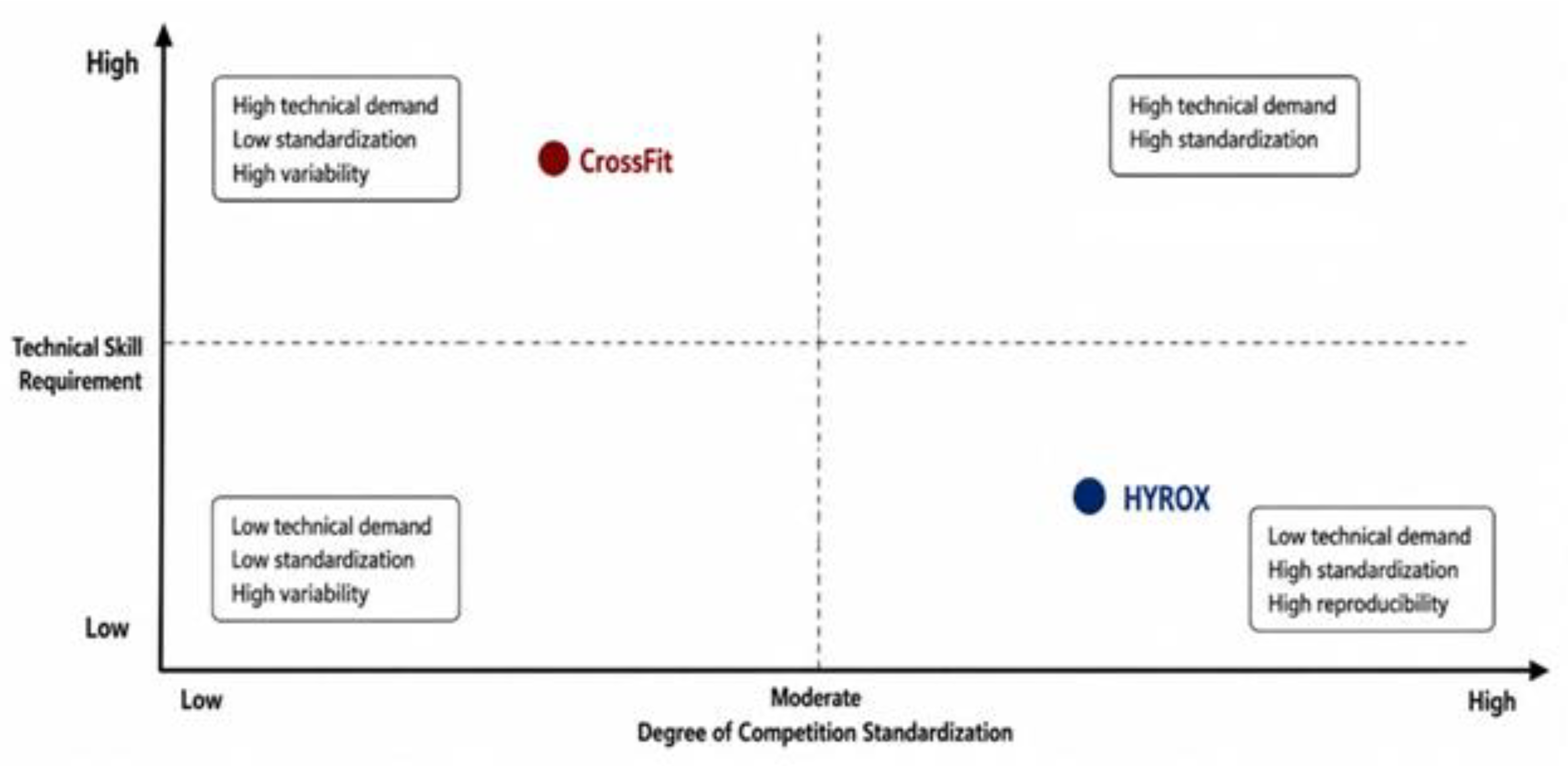

Table 1.
Characteristics, research domains, and principal findings of the included studies on Hyrox®.
Table 1.
Characteristics, research domains, and principal findings of the included studies on Hyrox®.
| Authors and year |
Study design | Research domain |
Principal findings |
|---|---|---|---|
| Brandt et al. (2025) | Original | Physiological responses and performance | Eleven recreational Hyrox® athletes performed a simulated competition (standards of the “Individual Open Division”) with a completion time of 86.5 (14.5) minutes, performed at very hard and hard intensities. Blood lactate concentrations peaked during the exercise stations [8.5 (5.4) mmol/L], exceeding those observed during the running segments. Regarding RPE, similar results were found for exercise stations 18 (2) and runs: 16 (2). |
| López, Agudo-Ortega, and Santos-García (2025) | Original | Profile of Hyrox® athletes | A predominantly male athlete profile with high physical demands and prior experience in functional or endurance-based sports. They generally exhibited well-developed strength and endurance capacities. Recovery strategies were often unstructured or insufficient. |
| López and Santos-García (2025) | Scoping Review | Performance in Hyrox® | HIFT has been associated with improvements in aerobic fitness, muscular strength, power, and fatigue resistance. In addition to these physiological adaptations, several studies have reported favorable psychobiological responses, including lower perceived exertion, greater cognitive control, and enhanced motivation, particularly among more experienced participants. |
| Rios and Pyne (2025) | Review | Integrative Physiological Strategies for Monitoring Demands in Functional Fitness | This review proposed an integrated physiological monitoring framework for functional fitness, combining oxygen uptake kinetics, metabolic profiling, heart rate and heart rate variability, and neuromuscular fatigue assessment to quantify internal training load. The authors highlighted the complementary use of laboratory-based and field-based tools to support individualized training prescription, optimize recovery, and improve performance in modalities such as CrossFit® and Hyrox®. |
| Caumeran and Jesus (2026) | Original | Participation Loyalty in Hyrox® | In a sample of 320 Hyrox® participants (168 women and 152 men), sport experience was the primary determinant of participation loyalty. Community and belongingness emerged as the strongest predictor, while product experience quality and place accessibility were the only marketing-related factors associated with loyalty. Additionally, repeat participants reported greater loyalty than first-time competitors. |
| Davids (2026) | Review | Performance in Hyrox® | This review identified aerobic capacity, anaerobic power, muscular endurance, and maximal strength as the primary determinants of Hyrox® performance. It also highlighted the importance of technical proficiency and proposed evidence-based training strategies to optimize preparation for the sport, while emphasizing the need for further Hyrox®-specific research. |
| Fernández-Navarrete et al. (2026) | Original | Hyrox® participation | Analyzing 278,063 participants across 145 Hyrox® races over five competitive seasons, the study demonstrated a substantial global expansion of the sport. Participation increased consistently across most divisions and host countries, reaching 22 nations by the 2023/2024 season, supporting Hyrox®’s emergence as a rapidly growing international fitness competition. |
| Fernández-Navarrete, Ruiz-Alias, García-Pinillos (2026) | Original | Performance in Hyrox® | Using 186,411 Hyrox® race results across individual, doubles, and relay categories, the study established normative performance values and percentile-based benchmarks for overall and segment-specific performance. |
| Gutiérrez-Hellín et al. (2026) | Original | Performance in Hyrox® | Using the annual Top 50 PRO MEN performances across seven Hyrox® competitive seasons (2018–2024; n = 350 season-level observations from 138 unique athletes), the study demonstrated a 20.8% reduction in total race time. Improvements were observed across all race components, including running, workout, and transition times. The largest gains occurred in the Wall Balls, Sled Pull, and Farmer’s Carry stations, while the final running segment (Run 8) showed the greatest improvement among the running splits. Additionally, running pacing became more even across seasons, indicating an evolution in elite race execution. |
| Rappelt et al. (2026) | Original | Performance in Hyrox® | With an analysis on publicly available data about race results (females: 11,842; males: 27,854) from individual PRO and ELITE Hyrox® competitions from the first seven seasons (2018/19-2024/25), they found that overall performance is most strongly associated with running performance, alongside meaningful contributions from the strength-based stations. |
| Buoite Stella et al. (2026) | Original | Recovery and sleep in Hyrox® athletes | In a sample of eight experienced male Hyrox® athletes, resistance and endurance training elicited distinct sleep responses. Although overall sleep quality was considered good, resistance training resulted in longer sleep onset latency, whereas endurance training increased wake after sleep onset. These differences were accompanied by training mode-specific patterns of cardiac autonomic activity, suggesting that exercise modality influences post-exercise sleep characteristics. |
| Note: HIFT, high-intensity functional training; RPE, rating of perceived exertion; SD, standard deviation. PRO and ELITE refer to Hyrox® competitive divisions. Data are presented as mean ± SD where applicable. | |||
Table 2.
Conceptual comparison of the competition characteristics of Hyrox® and CrossFit®.
| Characteristic | Hyrox® | CrossFit® |
|---|---|---|
| Competition format | Predetermined and standardized | Varied across events |
| Running volume | Fixed at 8 km | Variable |
| Exercise sequence | Fixed | Variable |
| Functional exercise component | Eight predetermined stations | Broad and variable exercise repertoire |
| Technical complexity | Low to moderate | Moderate to high |
| Strength demands | Moderate | High but event-dependent |
| Endurance demands | High | Moderate to high and event-dependent |
| Skill requirements | Low to moderate | Moderate to high and event-dependent |
| Longitudinal performance comparison | Highly feasible | Limited by workout variation |
| Research reproducibility | Relatively high | Relatively limited |
| Predominant performance profile | Endurance-dominant hybrid | Multidimensional strength-power-endurance and event-dependent |
| Note: The classifications are conceptual and reflect the typical competition formats of each discipline. CrossFit® demands vary according to exercise selection, duration, loading, and event structure. Hyrox® loads and task distribution may also differ across competitive divisions. | ||
Disclaimer/Publisher’s Note: The statements, opinions and data contained in all publications are solely those of the individual author(s) and contributor(s) and not of MDPI and/or the editor(s). MDPI and/or the editor(s) disclaim responsibility for any injury to people or property resulting from any ideas, methods, instructions or products referred to in the content. |
© 2026 by the authors. Licensee MDPI, Basel, Switzerland. This article is an open access article distributed under the terms and conditions of the Creative Commons Attribution (CC BY) license (http://creativecommons.org/licenses/by/4.0/).
Copyright: This open access article is published under a Creative Commons CC BY 4.0 license, which permit the free download, distribution, and reuse, provided that the author and preprint are cited in any reuse.