
Submitted:
24 July 2026
Posted:
27 July 2026
You are already at the latest version
Abstract
Response inhibition is often summarized as a single individual score, although performance may change within a session as temporal demand and repeated exposure vary. We examined whether within-session improvement in cognitive-motor inhibition depended on stimulus rate and affective temperament in 53 physically active adolescents and young adults. Participants completed three blocks of an elbow-based Go/No-Go task; four 50-stimulus series were administered at 40, 50, 60, and 70 bpm in randomized order. The analysis included 636 series-level observations and 6,360 No-Go trials, including 3,185 commission errors (50.1%). Outcomes were commission-error probability, conditional error duration, and an integrated error index. Error burden increased with stimulus rate, and rate-by-block interactions emerged for commission-error probability (Wald chi-square(6) = 24.17, p = .0005), conditional error duration (Wald chi-square(6) = 14.96, p = .021), and the integrated index (Wald chi-square(6) = 30.40, p < .001). Direct contrasts confirmed larger Block 1-to-Block 3 reductions at 50-70 bpm than at 40 bpm. A secondary exploratory participant-level analysis suggested that higher irritable temperament was associated with greater improvement (beta = 0.82, 95% CI 0.26 to 1.39, adjusted p = .020), although the corresponding moderation did not survive global correction across all temperament tests. Motor-inhibitory performance therefore adapted to repeated exposure in a rate-dependent manner, whereas temperament-related findings should be considered exploratory.
Keywords:
cognitive-motor inhibition
; response inhibition
; motor control
; affective temperament
; temporal demand
1. Introduction
Response inhibition refers to the ability to suppress actions that are inappropriate, premature, or no longer aligned with current goals, and it is a core component of executive control [1,2,3]. This ability is essential in everyday and sport-related motor behavior, where individuals must continuously decide whether to initiate, withhold, or adjust an action in response to changing environmental demands. In fast cognitive-motor contexts, inhibitory control is therefore not only a matter of avoiding an incorrect response, but also of regulating movement output under time pressure.
Response inhibition should not be considered a unitary process. Different forms of inhibitory control may be involved depending on whether an action must be withheld before execution, interrupted after initiation, or corrected while it is unfolding. Experimental paradigms differ in the inhibitory processes they emphasize. Go/No-Go tasks mainly assess action restraint, namely the ability to withhold a response before it is executed, whereas stop-signal paradigms emphasize action cancellation, namely the interruption of an already initiated response [4]. Recent neuroimaging evidence further indicates that the neural architecture supporting inhibitory control varies according to task complexity and contextual demands [5]. This distinction is relevant for cognitive-motor tasks in which stimuli are presented rapidly, and participants must continuously update action selection.
Inhibitory performance is unlikely to operate as a fixed trait-like capacity. Evidence from the sport-cognition literature suggests that inhibitory control varies with expertise, task constraints, and environmental demands, although findings remain heterogeneous because of differences in experimental design, task structure, and outcome definition [6,7,8,9]. Temporal urgency may alter evidence accumulation, response thresholds, and speed-accuracy policy during ongoing decisions [10,11]. At the same time, repeated exposure to a task can reduce false alarms and modify neural indices of inhibitory control within a single experimental session [12,13], and response-inhibition training may influence GABA-mediated motor-cortical inhibition [14]. These observations suggest that stimulus rate and within-session repetition may interact: practice-related improvements may be limited when the task is relatively slow or performance is already stable but become more evident when faster stimulus presentation increases temporal demand and creates greater room for calibration.
A further issue concerns the behavioral interpretation of commission errors. In standard Go/No-Go paradigms, commission-error rate is commonly treated as the main indicator of failed action restraint. However, in a cognitive-motor task involving measurable movement output, an error can be decomposed into at least two complementary components. A participant may frequently release an inappropriate movement but suppress it rapidly, whereas another participant may make fewer errors but allow each erroneous movement to persist for longer. These profiles are not equivalent. Commission-error probability primarily reflects the likelihood that restraint fails, whereas the duration of the erroneous movement after onset may reflect the efficiency of online correction or motor suppression once an inappropriate response has escaped. This distinction is consistent with broader models of stopping, which separate whether an inhibitory process is triggered from how efficiently it suppresses an action [15,16]. Therefore, composite measures of total error burden can be useful, but they should be interpreted together with their components because similar composite values may arise from different combinations of error frequency and error persistence.
Individual differences in affective temperament may also influence adaptation to demanding cognitive-motor tasks. Affective temperament refers to relatively stable patterns of emotional reactivity, energy, and self-regulation, commonly described across depressive, cyclothymic, hyperthymic, irritable, and anxious profiles. Related work has linked anxiety, emotional regulation, and attentional control to inhibitory efficiency, particularly under demanding or stressful conditions [17,18,19,20,21]. These temperament profiles may therefore shape how individuals adjust to changes in temporal demand across repeated task blocks. However, temperament dimensions are often intercorrelated, and trait-based analyses are vulnerable to multiple testing. Associations between affective temperament and inhibitory performance should therefore be examined using simultaneous adjustment and interpreted cautiously.
The present study examined inhibitory performance during a modified cognitive-motor Go/No-Go protocol in physically active adolescents and young adults. The primary objective was to determine whether within-session improvement differed across randomized stimulus-rate conditions. Rather than treating inhibitory performance as a single static score, we tested whether repeated task exposure produced different performance trajectories depending on temporal demand. We expected faster stimulus rates to produce greater error burden, but also to provide greater opportunity for within-session calibration. The secondary objective was to determine whether any rate-dependent improvement reflected changes in commission-error probability, conditional error duration, or both. Finally, we explored whether affective temperament moderated rate- or block-related change when temperament dimensions were entered simultaneously in the same model.
2. Materials and Methods
2.1. Participants
Eligibility required structured training at least three times per week during the preceding six months, an age range of 15–35 years, and the ability to understand task instructions. Exclusion criteria were any medical condition or medication likely to affect cognitive or motor function.
The study protocol was approved by the local Ethics Committee of the University of Genoa, Genoa, Italy (protocol no. 2024.36, April 12, 2024). Written informed consent was obtained before study procedures in accordance with the Declaration of Helsinki [22]. Where applicable, consent procedures for participants younger than 18 years followed the approved ethics protocol.
2.2. Affective Temperament
Affective temperament was assessed one day before the motor task using the Brief Temperament Evaluation of Memphis, Pisa, Paris and San Diego—Modified version (Brief TEMPS-M). The instrument yields depressive, cyclothymic, hyperthymic, irritable, and anxious scores and has been validated in an Italian sample [23]. Raw subscale scores were retained to preserve their clinical and conceptual interpretation. For multivariable analyses, each score was standardized across participants, and all five temperament dimensions were entered simultaneously to reduce confounding by their intercorrelations.
2.3. Cognitive-Motor Go/No-Go Task
Participants sat in front of a screen with the dominant upper limb free to perform elbow flexion and extension. An upward arrow required elbow flexion, a downward arrow required elbow extension, and a circle required complete response inhibition. Go stimuli alternated continuously, whereas 10 No-Go stimuli replaced Go stimuli in a pseudorandom arrangement within each 50-stimulus series.
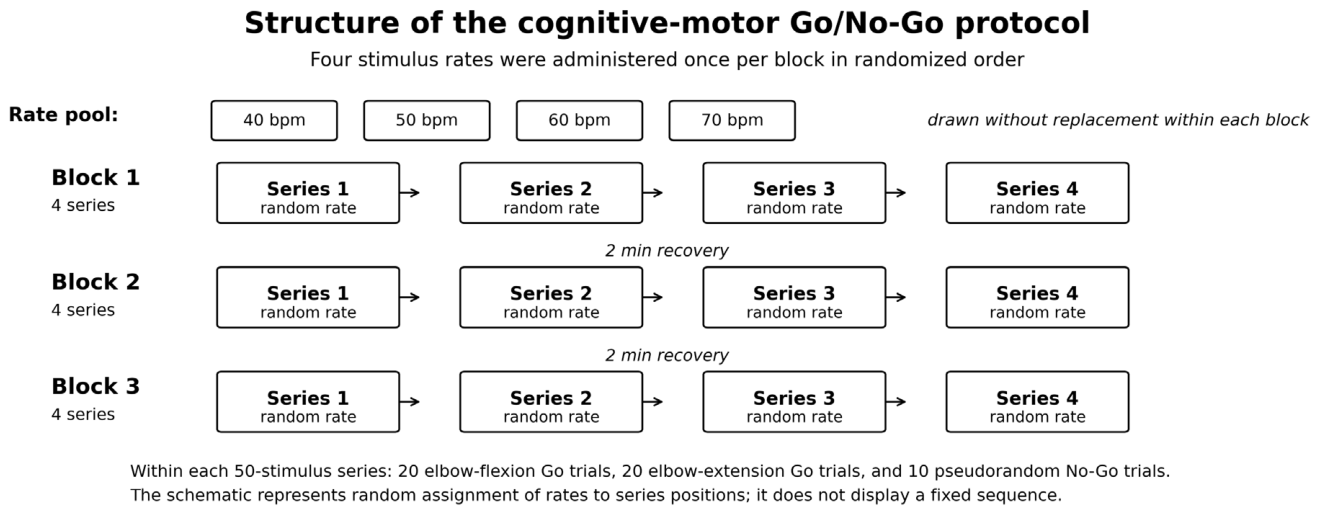
The protocol comprised three consecutive blocks separated by two minutes of recovery. Each block contained four 50-stimulus series administered at 40, 50, 60, and 70 bpm, with 30 seconds of rest between series. The order of the four stimulus rates was randomized within each block, with each rate appearing once per block. Each series contained 20 flexion trials, 20 extension trials, and 10 No-Go trials.
Figure 1.
Structure of the cognitive-motor Go/No-Go protocol. Each block included four 50-stimulus series administered at 40, 50, 60, and 70 bpm in randomized order. The schematic shows the four rate conditions included in each block and does not imply a fixed presentation sequence.
Figure 1.
Structure of the cognitive-motor Go/No-Go protocol. Each block included four 50-stimulus series administered at 40, 50, 60, and 70 bpm in randomized order. The schematic shows the four rate conditions included in each block and does not imply a fixed presentation sequence.
2.4. Kinematic Acquisition, IMU Processing, Error Detection, and Outcome Calculation
Movement kinematics were acquired at 500 Hz using four inertial measurement units (Mini Wave X sensors; Cometa, Italy) placed on the dorsum of the hand, forearm, upper arm, and sternum. Acquisition was synchronized with the cognitive-motor task through a trigger generated at each stimulus onset.
Raw inertial data were processed to identify task-relevant elbow flexion–extension movements during No-Go trials. Sensor-to-segment alignment was established using a standardized static posture and functional elbow flexion–extension movements performed before the experimental task. Upper-arm and forearm angular velocities were transformed into a common reference frame. Relative elbow angular velocity was calculated by subtracting upper-arm angular velocity from forearm angular velocity and projecting the resulting vector onto the calibrated flexion–extension axis. Elbow flexion–extension angle was obtained from the relative orientation of the forearm and upper-arm sensors. The resulting kinematic signals were low-pass filtered using a fourth-order, zero-phase Butterworth filter with a cutoff frequency of 10 Hz.
For each No-Go trial, movement detection was performed within the response interval extending from stimulus onset to immediately before the subsequent stimulus. A commission error was identified when the absolute task-relevant relative elbow angular velocity exceeded a participant-specific threshold for at least 50 ms and was accompanied by an absolute elbow flexion–extension excursion of at least 3°. The participant-specific threshold was defined as the mean absolute relative elbow angular velocity recorded during the resting period plus three standard deviations. The combined velocity and angular-displacement criteria were used to distinguish genuine task-related responses from sensor noise, minor postural adjustments, and isolated movements of the hand, wrist, shoulder, or trunk.
Movement onset was defined as the first sample of a sustained threshold crossing satisfying both the velocity and angular-excursion criteria. Movement suppression was defined as the first subsequent time point at which the absolute relative elbow angular velocity returned below the participant-specific threshold and remained below it for at least 100 ms. Error duration was calculated as the interval, in seconds, between movement onset and movement suppression. Error onset was searched within the No-Go response interval, but duration estimation was not mechanically set to zero or capped solely because the next stimulus occurred. Movements involving the trunk, shoulder, wrist, or hand without a corresponding task-relevant change in relative elbow flexion-extension kinematics were not classified as commission errors.
The error-detection procedure was validated on a stratified subset of No-Go trials selected across participants, stimulus rates, experimental blocks, and both error and no-error events. Two independent assessors, blinded to the automated classification, reviewed the synchronized kinematic traces and stimulus markers and independently classified each trial as containing or not containing a commission error. Disagreements were resolved by consensus, and the consensus classification was used as the reference standard. Agreement between the automated procedure and the reference classification was evaluated using overall agreement, sensitivity, specificity, and Cohen’s κ.
Following error detection, the trial-level dataset contained the classification of each No-Go trial and, when a commission error occurred, the corresponding erroneous-movement duration. For each 50-stimulus series, the dataset contained either an error-duration value or a blank entry for each of the 10 No-Go trials. Blank entries indicated the absence of a commission error rather than missing data.
Three outcomes were calculated from the trial-level data. Commission-error probability was calculated as the number of commission errors divided by the 10 No-Go trials included in each series. Conditional error duration was calculated as the mean duration of erroneous movements within a series and was therefore defined only for series containing at least one commission error. This outcome described the persistence of an erroneous movement after action restraint had failed.
The integrated error index combined error frequency and erroneous-movement duration. The exponent of 1.5 was used as a pragmatic weighting to assign progressively greater influence to series characterized by a high number of commission errors while retaining information on erroneous-movement duration. The index was calculated as follows:
Integrated error index = (number of commission errors)^1.5 × mean error duration
For series containing no commission errors, the integrated error index was set to 0. Higher values indicated poorer inhibitory performance. Application of these calculations yielded 636 series-level observations corresponding to 53 participants, four stimulus rates, and three experimental blocks, for a total of 6,360 No-Go trials. The integrated error index was interpreted as a measure of total error burden rather than as a process-pure estimate of a single inhibitory mechanism.
2.5. Statistical Analysis
Descriptive analyses used participant-level means. Integrated-error-index analyses were initially performed using Friedman tests and Holm-adjusted Wilcoxon signed-rank comparisons. The main analysis used participant fixed-effects regression with standard errors clustered by participant. This approach used all repeated series-level observations, controlled for all stable participant characteristics, and permitted direct estimation of stimulus-rate-by-block effects within individuals.
Commission-error probability was analyzed on its original 0-1 scale as a linear probability outcome with clustered robust standard errors. Conditional error duration was analyzed only in series with at least one commission error and was log-transformed before modeling. The integrated error index was transformed as log(1 + index). Stimulus rate and block were treated as categorical predictors in the omnibus models. When a stimulus-rate-by-block interaction was detected, follow-up tests used model-based Block 1-to-Block 3 contrasts and direct difference-in-differences relative to 40 bpm, estimated from participant fixed-effects models with participant-clustered standard errors. Holm correction was applied across the three direct contrasts comparing 50, 60, and 70 bpm with 40 bpm.
For temperament moderation analyses, stimulus rate was expressed in 10-bpm units and centered at the sample mean, while block was centered at Block 2. A quadratic stimulus-rate term and the stimulus-rate-by-block interaction were retained in the model. Cross-level stimulus-rate-by-temperament and block-by-temperament interaction terms were then entered simultaneously for the five standardized temperament dimensions. Benjamini-Hochberg false-discovery-rate correction [24] was applied across the 10 speed- and block-by-temperament interaction tests within each outcome. Correction across all 30 temperament interaction tests was also examined as a global sensitivity analysis.
A participant-level sensitivity analysis regressed Block 1-to-Block 3 improvement on all five standardized temperament scores using heteroskedasticity-robust standard errors (HC3). A parallel model examined the total integrated error score. Integrated-index robustness was examined by recalculating the composite as total erroneous-movement time (exponent 1.0) and with a stronger frequency weighting (exponent 2.0). All tests were two-sided, and statistical significance was set at p < .05. Analyses were conducted in Python 3.12.13 using pandas 3.0.1 and NumPy 2.3.5. The moderation analyses were not preregistered and were therefore treated as exploratory.
3. Results
3.1. Sample Characteristics and Outcome Data
The study included 53 physically active participants (27 males and 26 females), with a mean age of 24.27 ± 3.48 years (range: 15.66–30.54 years). Mean body mass and height were 65.69 ± 11.15 kg and 170.72 ± 8.39 cm, respectively. Descriptive affective-temperament scores are reported in Table 1.
Across the 636 series-level observations, 3,185 commission errors were identified among 6,360 No-Go trials, corresponding to an overall commission-error rate of 50.1%. Twenty-three series contained no commission errors (3.6%); therefore, conditional error duration was available for 613 series. Duration-window checks showed that no error duration exceeded the nominal inter-stimulus interval at 40, 50, or 60 bpm. At 70 bpm, 5 of 870 error trials (0.6%) exceeded the nominal 0.86-s interval, indicating that duration was not simply capped at the next stimulus, although overlap with the following stimulus was possible in a very small number of fastest-rate errors.
3.2. Validation of the IMU-Based Error-Detection Procedure
The validation subset included 320 No-Go trials sampled across participants, stimulus rates, and experimental blocks. Compared with the assessors’ consensus classification, the automated IMU-based procedure correctly classified 301 trials, corresponding to an overall agreement of 94.1%. Sensitivity was 93.8%, specificity was 94.4%, and Cohen’s κ was 0.88, indicating excellent agreement beyond chance.
3.3. Temporal Demand, Repetition, and Their Interaction
The participant-averaged integrated error index increased with stimulus rate, from 2.35 ± 1.80 at 40 bpm to 3.07 ± 2.09 at 50 bpm and 5.39 ± 3.06 at 60 bpm, remaining elevated at 70 bpm (5.08 ± 3.01). The Friedman test showed a significant effect of stimulus rate, χ2(3) = 73.42, p < .001, Kendall’s W = .46. Across blocks, the integrated error index decreased from 4.51 ± 2.29 in Block 1 to 3.93 ± 2.33 in Block 2 and 3.49 ± 2.20 in Block 3, χ2(2) = 15.21, p < .001, Kendall’s W = .14.
The participant fixed-effects models showed that the effects of stimulus rate and block were not independent. Significant stimulus-rate-by-block interactions were observed for commission-error probability, conditional error duration, and the integrated error index (Table 2; Figure 2). Direct model-based contrasts confirmed that Block 1-to-Block 3 change in the integrated index differed from the 40-bpm reference at each faster rate. Estimated B3-B1 change was +0.32 points at 40 bpm, compared with -1.19 points at 50 bpm, -1.66 points at 60 bpm, and -1.55 points at 70 bpm. The corresponding difference-in-differences relative to 40 bpm were -1.51, -1.98, and -1.87 points, respectively (all Holm-adjusted p < .002; Table 3). The same interaction remained significant when the integrated index was recalculated as total erroneous-movement time (exponent 1.0; Wald chi-square(6) = 33.04, p < .001) or with stronger frequency weighting (exponent 2.0; Wald chi-square(6) = 28.29, p < .001). Because stimulus-rate order was randomized within each block, this pattern is unlikely to reflect systematic serial-position bias.
3.4. Affective Temperament and Performance Dynamics
No temperament-by-stimulus-rate interaction survived FDR correction for any outcome; the full set of cross-level temperament interaction tests is reported in Supplementary Table S1. In the integrated-error-index model, higher irritable temperament was associated with a steeper decline in the integrated error index across blocks, indicating greater within-session improvement (interaction estimate = −0.073 log-index units per block per SD, p = .0049; FDR p = .0489 across the 10 integrated-index interaction tests). The corresponding association was directionally similar for commission-error probability, with a reduction of 2.1 percentage points per block per SD increase in irritable temperament (p = .014), but it did not survive FDR correction. The association with conditional error duration was weaker and not statistically significant (p = .082). When FDR correction was applied globally across all 30 temperament interaction tests, the irritable-temperament-by-block association did not remain significant (FDR p = .147).
The secondary participant-level sensitivity analysis showed a similar exploratory pattern, with complete adjusted models reported in Supplementary Table S2. After adjustment for depressive, cyclothymic, hyperthymic, and anxious temperament scores, each 1-SD increase in irritable temperament was associated with 0.82 points greater Block 1-to-Block 3 improvement in the integrated error index (95% CI 0.26 to 1.39, p = .004; FDR p = .020 across the five traits; Figure 3). This analysis used the same sample and should be interpreted as a participant-level sensitivity analysis rather than as independent confirmation of the moderation result. Hyperthymic temperament showed a suggestive association with a lower total integrated error score (beta = -8.58 points per SD, 95% CI -15.40 to -1.76, p = .014), but this association did not survive FDR correction (FDR p = .068). Other adjusted temperament associations were not statistically significant.
Selected findings from these models are summarized in Table 4.
4. Discussion
This study examined two related questions. The primary objective was to determine whether inhibitory performance in a cognitive-motor Go/No-Go task changes within a single session as a function of temporal demand. The secondary objective was to explore whether affective temperament contributes to these within-session performance dynamics. Physically active adolescents and young adults completed repeated blocks of an elbow-based Go/No-Go task at four randomized stimulus rates. The main finding was that improvement was rate-dependent: performance did not improve at 40 bpm, whereas clear gains emerged at 50, 60, and 70 bpm. These gains reflected both a lower probability of commission errors and shorter erroneous movements when errors occurred. In contrast, temperament explained comparatively little of the overall pattern, although irritable temperament showed an exploratory association with greater Block 1-to-Block 3 improvement.
The central contribution of the study is therefore not simply that faster stimulus rates increased error burden. This finding was expected, because higher temporal demand should make action restraint more difficult. More importantly, temporal demand also shaped how performance changed with repeated exposure. Participants did not show a uniform practice effect across all rates. Instead, improvement became evident mainly when the task imposed greater temporal pressure. Because stimulus-rate order was randomized within each block, this pattern is unlikely to reflect a fixed serial-position effect.
These findings support a dynamic account of cognitive-motor inhibition. Response inhibition is often treated as a relatively stable individual ability, but inhibitory performance may also depend on the interaction between task demands and short-term adaptation. This is consistent with evidence that inhibitory-control performance varies according to task structure, context, and the specific inhibitory process required [4,16]. At slower rates, participants may have had sufficient time to identify the stimulus, select the appropriate response, and suppress the No-Go response, leaving little room for measurable improvement. At faster rates, the task likely increased the need for rapid stimulus classification, response-threshold adjustment, and online correction of inappropriate movements. Under these conditions, within-session adaptation became more visible.
The decomposed outcomes clarify the behavioral meaning of this adaptation. Improvement was not limited to fewer commission errors. Participants also shortened the duration of erroneous movements when errors occurred. Commission-error probability can be interpreted as an index of failed action restraint, whereas conditional error duration reflects the persistence of an erroneous movement after restraint has failed. This second measure should not be considered a process-pure measure of action cancellation [4,16]. However, it provides useful information about how quickly an inappropriate movement is corrected once it has escaped initial restraint. Reporting the integrated error index together with its components therefore gives a more complete description of cognitive-motor inhibitory performance.
The present findings are compatible with rapid task-set calibration under temporal pressure. Repeated exposure may have improved stimulus classification, anticipation of No-Go events, response-threshold setting, or correction of escaped actions. Previous Go/No-Go studies have reported reductions in false alarms and changes in neural responses after short practice [12,13]. Moreover, response-inhibition training has been linked to changes in motor-cortical inhibitory physiology, even when average behavioral changes are modest [14]. Although the present study did not measure neural activity, its behavioral pattern is consistent with the idea that motor inhibition is not fixed during task performance. Instead, inhibitory control may be recalibrated over a short time scale, especially when temporal demand is sufficiently high.
The temperament results address the second objective of the study and require a cautious interpretation. Affective temperament may plausibly influence cognitive-motor inhibition because emotional reactivity, arousal, attentional control, and self-regulation are all relevant when individuals must suppress or correct actions under time pressure [17,18,19,20,21]. In the present study, irritable temperament was associated with greater Block 1-to-Block 3 improvement in the participant-level model and with a steeper block-related decline in the integrated error index. One possible interpretation is that individuals with higher irritable temperament adapted more strongly once task contingencies became familiar. However, alternative explanations are also plausible, including greater initial room for improvement, regression toward the mean, residual overlap among temperament dimensions, and sampling variability. Therefore, this result should be considered exploratory and hypothesis-generating rather than evidence that irritable temperament enhances inhibitory learning.
Hyperthymic temperament showed a suggestive association with better overall performance, broadly consistent with the idea that hyperthymic traits may relate to energy, activation, or resilience [25]. However, this association did not remain significant after correction across temperament dimensions. More generally, neither hyperthymic temperament nor the other temperament dimensions robustly moderated sensitivity to increasing stimulus rate. The evidence is therefore stronger for task-driven performance dynamics than for stable affective moderation. In practical terms, stimulus rate and repeated task exposure explained the main performance pattern more clearly than affective temperament did.
Several limitations should be acknowledged, although they do not undermine the main behavioral finding. First, the study used a within-session design; therefore, the observed changes across blocks should be interpreted as short-term performance adaptation rather than as stable learning. Second, although stimulus-rate order was randomized within each block, other time-dependent factors such as fatigue, arousal, motivation, or strategic adjustment may have contributed to the observed pattern. Third, Go-trial performance measures were not part of the present analysis, so the findings should be interpreted as changes in No-Go motor-inhibitory performance rather than as a process-pure estimate of inhibition isolated from broader response strategy. Fourth, duration-based outcomes are partly linked to the temporal structure of the task; however, only five error trials exceeded the nominal inter-stimulus interval, and the main interaction remained evident for commission-error probability as well as duration-based outcomes. Fifth, the integrated error index combines error frequency and error duration according to a pragmatic weighting; sensitivity analyses using total erroneous-movement time and stronger frequency weighting led to the same conclusion. Finally, the sample was modest and included physically active adolescents and young adults with heterogeneous sport backgrounds, and the temperament analyses were exploratory and should be confirmed in larger preregistered studies.
Despite these limitations, the study has several strengths. It included all available No-Go trials, verified the accuracy and internal consistency of the outcome calculations, and applied within-participant models rather than relying only on aggregated totals. Future studies should retain randomized stimulus-rate sequences and examine whether the present rate-dependent improvement replicates across different cognitive-motor inhibition tasks, sport profiles, and levels of physical activity. Larger samples would also allow more precise testing of affective temperament as a moderator of short-term motor-inhibitory adaptation.
Overall, the findings suggest that cognitive-motor inhibitory performance is better understood as a dynamic, context-sensitive process than as a single static individual score. Faster stimulus rates increased error burden, but they also revealed the conditions under which within-session improvement became most evident. Affective temperament was relevant as an exploratory individual-difference factor, particularly for irritable temperament, but it did not explain the main behavioral pattern. The central message of the study is therefore that motor inhibition adapts to repeated task exposure in a rate-dependent manner, while temperament-related modulation remains a promising but preliminary finding.
5. Conclusions
In this cognitive-motor Go/No-Go task, temporal demand did not simply impair inhibitory performance; it shaped how performance changed within the session. Improvement was absent at 40 bpm and emerged at 50 to 70 bpm, where gains reflected both fewer commission errors and shorter erroneous movements. These findings suggest that motor inhibition should be interpreted as a dynamic, context-sensitive performance rather than a static individual score. Affective temperament explained comparatively little of these dynamics, although irritable temperament showed an exploratory association with greater improvement. Future preregistered studies should test whether this rate-dependent improvement replicates across different cognitive-motor inhibition tasks, sport profiles, and levels of physical activity.
Supplementary Materials
The following supporting information can be downloaded at the website of this paper posted on Preprints.org, Table S1: Cross-level temperament interactions in the joint fixed-effects models; Table S2: Participant-level adjusted temperament models.
Author Contributions
Conceptualization, L.P; methodology, L.P., and G.P.; software, G.P.; validation, L.P., G.P. and C.T.; formal analysis, L.P.; investigation, L.P. and G.P.; resources, L.P. and C.T.; data curation, G.P. and L.P.; writing—original draft preparation, L.P.; writing—review and editing, G.P. and C.T.; visualization, G.P.; supervision, C.T.; project administration, L.P. All authors have read and agreed to the published version of the manuscript.
Funding
This research received no external funding.
Institutional Review Board Statement
The study was conducted in accordance with the Declaration of Helsinki and approved by the local Ethics Committee of the University of Genoa, Genoa, Italy (protocol no. 2024.36, April 12, 2024).
Informed Consent Statement
Written informed consent was obtained from all adult participants. For participants younger than 18 years, written informed consent was obtained from a parent or legal guardian.
Data Availability Statement
The data supporting the findings of this study are available from the corresponding author upon reasonable request.
Conflicts of Interest
The authors declare no conflicts of interest.
References
- Diamond, A. Executive functions. Annu. Rev. Psychol. 2013, 64, 135–168. [Google Scholar] [CrossRef] [PubMed]
- Verbruggen, F.; Logan, G.D. Response inhibition in the stop-signal paradigm. Trends Cogn. Sci. 2008, 12, 418–424. [Google Scholar] [CrossRef] [PubMed]
- Bari, A.; Robbins, T.W. Inhibition and impulsivity: Behavioral and neural basis of response control. Prog. Neurobiol. 2013, 108, 44–79. [Google Scholar] [CrossRef] [PubMed]
- Raud, L.; Westerhausen, R.; Dooley, N.; Huster, R.J. Differences in unity: The Go/No-Go and stop signal tasks rely on different mechanisms. NeuroImage 2020, 210, 116582. [Google Scholar] [CrossRef] [PubMed]
- Aziz-Safaie, T.; Müller, V.I.; Langner, R.; Eickhoff, S.B.; Cieslik, E.C. The effect of task complexity on the neural network for response inhibition: An ALE meta-analysis. Neurosci. Biobehav. Rev. 2024, 158, 105544. [Google Scholar] [CrossRef] [PubMed]
- Nakamoto, H.; Mori, S. Sport-specific decision-making in a Go/NoGo reaction task: Difference among nonathletes and baseball and basketball players. Percept. Mot. Ski. 2008, 106, 163–170. [Google Scholar] [CrossRef] [PubMed]
- Wang, C.-H.; Chang, C.-C.; Liang, Y.-M.; Shih, C.-M.; Chiu, W.-S.; Tseng, P.; Hung, D.L.; Tzeng, O.J.L.; Muggleton, N.G.; Juan, C.-H. Open vs. closed skill sports and the modulation of inhibitory control. PLoS ONE 2013, 8, e55773. [Google Scholar] [CrossRef] [PubMed]
- Albaladejo-García, C.; García-Aguilar, F.; Moreno, F.J. The role of inhibitory control in sport performance: Systematic review and meta-analysis in stop-signal paradigm. Neurosci. Biobehav. Rev. 2023, 152, 105108. [Google Scholar] [CrossRef] [PubMed]
- Furley, P.; Schütz, L.-M.; Wood, G. A critical review of research on executive functions in sport and exercise. Int. Rev. Sport Exerc. Psychol. 2023, 1–29. [Google Scholar] [CrossRef]
- Standage, D.; Blohm, G.; Dorris, M.C. On the neural implementation of the speed-accuracy trade-off. Front. Neurosci. 2014, 8, 236. [Google Scholar] [CrossRef] [PubMed]
- Derosiere, G.; Thura, D.; Cisek, P.; Duque, J. Trading accuracy for speed over the course of a decision. J. Neurophysiol. 2021, 126, 361–372. [Google Scholar] [CrossRef] [PubMed]
- Schapkin, S.A.; Falkenstein, M.; Marks, A.; Griefahn, B. Practice-related effects in a Go-Nogo task. Percept. Mot. Ski. 2007, 105, 1275–1288. [Google Scholar] [CrossRef] [PubMed]
- Benikos, N.; Johnstone, S.J.; Roodenrys, S.J. Short-term training in the Go/Nogo task: Behavioural and neural changes depend on task demands. Int. J. Psychophysiol. 2013, 87, 301–312. [Google Scholar] [CrossRef] [PubMed]
- Chowdhury, N.S.; Livesey, E.J.; Harris, J.A. Stop signal task training strengthens GABA-mediated neurotransmission within the primary motor cortex. J. Cogn. Neurosci. 2020, 32, 1984–2000. [Google Scholar] [CrossRef] [PubMed]
- Jana, S.; Aron, A.R. Mind wandering impedes response inhibition by affecting the triggering of the inhibitory process. Psychol. Sci. 2022, 33, 1068–1085. [Google Scholar] [CrossRef] [PubMed]
- Verbruggen, F.; Aron, A.R.; Band, G.P.H.; Beste, C.; Bissett, P.G.; Brockett, A.T.; Brown, J.W.; Chamberlain, S.R.; Chambers, C.D.; Colonius, H.; et al. A consensus guide to capturing the ability to inhibit actions and impulsive behaviors in the stop-signal task. eLife 2019, 8, e46323. [Google Scholar] [CrossRef] [PubMed]
- Posner, M.I.; Rothbart, M.K. Developing mechanisms of self-regulation. Dev. Psychopathol. 2000, 12, 427–441. [Google Scholar] [CrossRef] [PubMed]
- Rothbart, M.K.; Sheese, B.E.; Posner, M.I. Developing mechanisms of self-regulation in early life. Emot. Rev. 2011, 3, 207–213. [Google Scholar] [CrossRef] [PubMed]
- Huang, Y.-X.; Zhang, W.; Luo, Y.-J.; Li, H. Influence of trait-anxiety on inhibition function: Evidence from ERPs study. Neurosci. Lett. 2009, 456, 1–5. [Google Scholar] [CrossRef] [PubMed]
- Wagstaff, C.R.D. Emotion regulation and sport performance. J. Sport Exerc. Psychol. 2014, 36, 401–412. [Google Scholar] [CrossRef] [PubMed]
- Xia, L.; Mo, L.; Wang, J.; Zhang, W.; Zhang, D. Trait anxiety attenuates response inhibition: Evidence from an ERP study using the Go/NoGo task. Front. Behav. Neurosci. 2020, 14, 28. [Google Scholar] [CrossRef] [PubMed]
- World Medical Association. World Medical Association Declaration of Helsinki: Ethical principles for medical research involving human subjects. JAMA 2013, 310, 2191–2194. [Google Scholar] [CrossRef] [PubMed]
- Fico, G.; Luciano, M.; Sampogna, G.; Zinno, F.; Steardo, L., Jr.; Perugi, G.; Pompili, M.; Tortorella, A.; Volpe, U.; Fiorillo, A.; Maj, M. Validation of the brief TEMPS-M temperament questionnaire in a clinical Italian sample of bipolar and cyclothymic patients. J. Affect. Disord. 2020, 260, 458–462. [Google Scholar] [CrossRef] [PubMed]
- Benjamini, Y.; Hochberg, Y. Controlling the false discovery rate: A practical and powerful approach to multiple testing. J. R. Stat. Soc. Ser. B 1995, 57, 289–300. [Google Scholar] [CrossRef]
- Kesebir, S.; Gündoğar, D.; Küçüksubaşı, Y.; Tatlıdil Yaylacı, E. The relation between affective temperament and resilience in depression: A controlled study. J. Affect. Disord. 2013, 148, 352–356. [Google Scholar] [CrossRef] [PubMed]
Figure 2.
Stimulus-rate-by-block dynamics of inhibitory performance. Panels show the integrated error index (A), commission-error probability (B), and conditional error duration (C). Points represent condition means and error bars represent 95% confidence intervals across participants. Lower values indicate better inhibitory performance.
Figure 2.
Stimulus-rate-by-block dynamics of inhibitory performance. Panels show the integrated error index (A), commission-error probability (B), and conditional error duration (C). Points represent condition means and error bars represent 95% confidence intervals across participants. Lower values indicate better inhibitory performance.
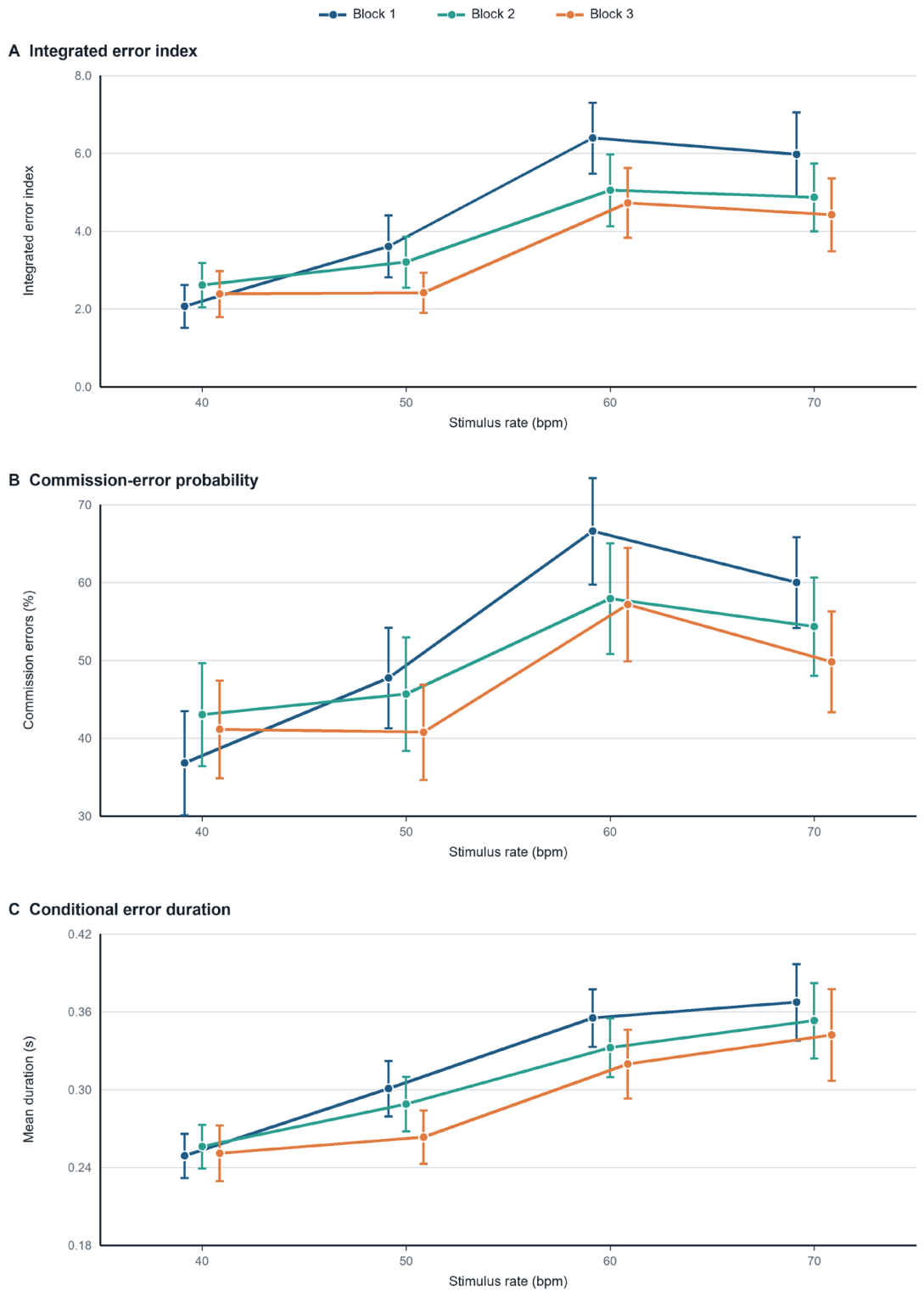
Figure 3.
Partial association between irritable temperament and Block 1-to-Block 3 improvement in the integrated error index. Both variables are residualized for depressive, cyclothymic, hyperthymic, and anxious temperament scores. Positive values indicate a larger reduction in the integrated error index from Block 1 to Block 3.
Figure 3.
Partial association between irritable temperament and Block 1-to-Block 3 improvement in the integrated error index. Both variables are residualized for depressive, cyclothymic, hyperthymic, and anxious temperament scores. Positive values indicate a larger reduction in the integrated error index from Block 1 to Block 3.
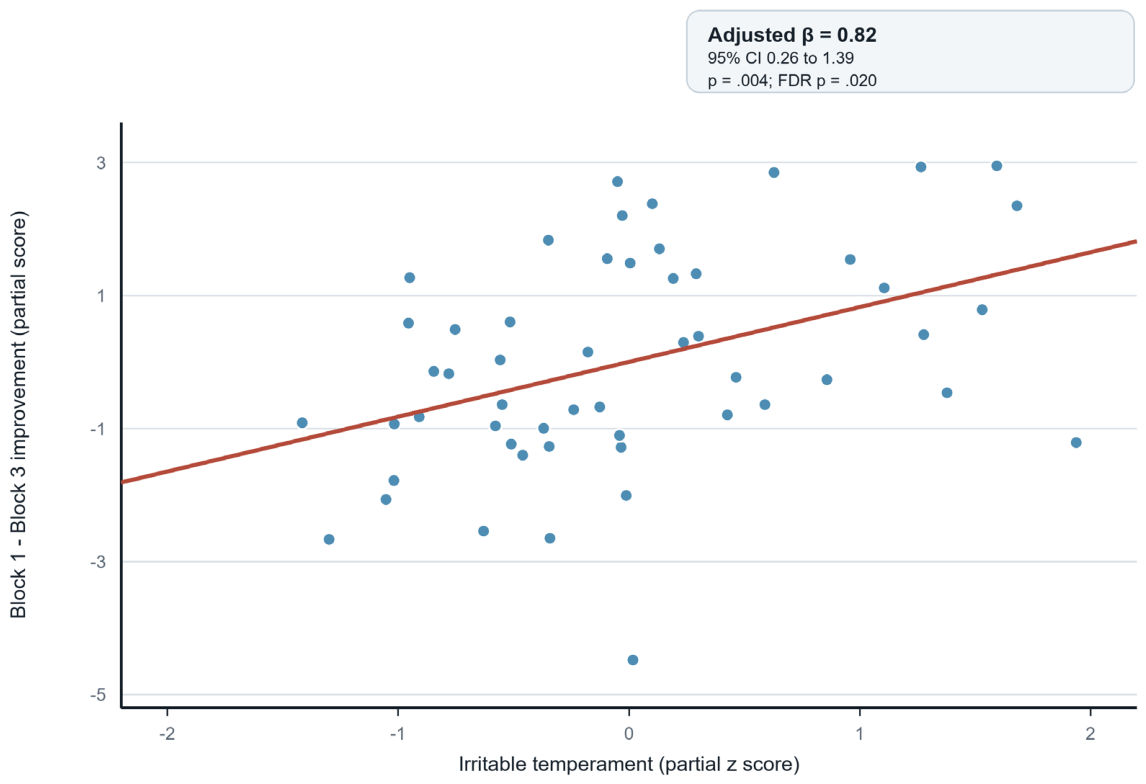

Table 1.
Sample characteristics and affective-temperament scores.
| Characteristic | Value |
| Participants | 53 |
| Sex | 27 males; 26 females |
| Age, years | 24.27 ± 3.48 |
| Body mass, kg | 65.69 ± 11.15 |
| Height, cm | 170.72 ± 8.39 |
| Depressive temperament | 17.26 ± 4.98 |
| Cyclothymic temperament | 17.04 ± 6.13 |
| Hyperthymic temperament | 22.68 ± 3.69 |
| Irritable temperament | 14.42 ± 6.46 |
| Anxious temperament | 15.55 ± 5.32 |
Note. Values are reported as mean ± standard deviation unless otherwise indicated.
Table 2.
Participant fixed-effects models with participant-clustered robust standard errors.
| Outcome | Speed χ2 (df), p | Block χ2 (df), p | Speed × block χ2 (df), p |
| Commission-error probability | 77.10 (3), < .001 | 10.19 (2), .006 | 24.17 (6), < .001 |
| Conditional error duration1 | 77.03 (3), < .001 | 12.45 (2), .002 | 14.96 (6), .021 |
| Integrated error index2 | 115.48 (3), < .001 | 15.12 (2), < .001 | 30.40 (6), < .001 |
Note. 1Model fitted to log duration among series containing at least one error. 2Model fitted to log(1 + index).
Table 3.
Model-based Block 3 minus Block 1 change in the integrated error index and direct contrasts against 40 bpm.
Table 3.
Model-based Block 3 minus Block 1 change in the integrated error index and direct contrasts against 40 bpm.
| Rate | B3-B1 change | DiD vs 40 bpm | DiD 95% CI | Holm p |
| 40 bpm | 0.32 (-0.31 to 0.95) | Reference | -- | -- |
| 50 bpm | -1.19 (-1.95 to -0.44) | -1.51 | -2.29 to -0.74 | < .001 |
| 60 bpm | -1.66 (-2.37 to -0.96) | -1.98 | -2.90 to -1.07 | < .001 |
| 70 bpm | -1.55 (-2.63 to -0.48) | -1.87 | -3.02 to -0.72 | .001 |
Note. B3-B1 change and difference-in-differences are estimated from participant fixed-effects models on the raw integrated-index scale with participant-clustered standard errors. Negative values indicate a reduction in error burden from Block 1 to Block 3. Difference-in-differences = (B3-B1)rate − (B3-B1)40 bpm; Holm p values are adjusted across the three direct contrasts.
Table 4.
Main exploratory temperament findings from adjusted moderation and participant-level sensitivity analyses.
Table 4.
Main exploratory temperament findings from adjusted moderation and participant-level sensitivity analyses.
| Predictor | Outcome | Estimate | Robust SE | p | FDR p |
| Irritable × block | Integrated index | -0.073 | 0.026 | .0049 | .04891 |
| Irritable × block | Commission probability | -0.0209 | 0.0085 | .014 | .1452 |
| Irritable × block | Conditional duration | -0.031 | 0.018 | .082 | .4292 |
| Irritable temperament | Block 1-3 improvement | 0.82 | 0.29 | .004 | .020³ |
| Hyperthymic temperament | Total integrated score | -8.58 | 3.48 | .014 | .068³ |
Note. 1FDR across the 10 speed- and block-moderation terms for the integrated index. 2FDR across the 10 interactions for the corresponding decomposed outcome. ³FDR across five traits in the participant-level model.
Disclaimer/Publisher’s Note: The statements, opinions and data contained in all publications are solely those of the individual author(s) and contributor(s) and not of MDPI and/or the editor(s). MDPI and/or the editor(s) disclaim responsibility for any injury to people or property resulting from any ideas, methods, instructions or products referred to in the content. |
© 2026 by the authors. Licensee MDPI, Basel, Switzerland. This article is an open access article distributed under the terms and conditions of the Creative Commons Attribution (CC BY) license.
Copyright: This open access article is published under a Creative Commons CC BY 4.0 license, which permit the free download, distribution, and reuse, provided that the author and preprint are cited in any reuse.


