
Submitted:
24 July 2026
Posted:
27 July 2026
You are already at the latest version
Abstract
overty-alleviation relocation has been a key policy for breaking spatial poverty traps, but post-relocation sustainability depends on livelihood reconstruction. This study investigates the association between women’s non-agricultural employment and the economic resilience of relocated households, with attention to intra-household resource allocation. Drawing on four-wave household survey data from southern Shaanxi (2016, 2018, 2020, 2022), we develop an analytical framework linking female employment, household capabilities, and resilience, and apply Tobit regression, propensity-score matching, and pathway analysis. Results show a robust positive association, controlling for household characteristics and sample-composition differences. Pathway evidence reveals that women’s employment enhances buffering capacity (higher income and savings, lower debt), learning capacity (greater development-oriented spending and children’s cultural participation), and self-organization capacity (expanded internet use, social networks, policy awareness, and access to support). These findings suggest that women’s non-agricultural employment restructures household resource allocation and developmental investment, rather than merely shifting labor from farm to market. Policies supporting women’s employment, skills training, public services, digital access, and care systems are thus essential for consolidating poverty-alleviation gains and fostering resilient communities.
Keywords:
female non-agricultural employment
; household economic resilience
; relocated households
; poverty-alleviation relocation
1. Introduction
In China, poverty-alleviation relocation is a large-scale, state-led development intervention targeting rural poor households living in areas where ecological, geographical, and economic conditions cannot sustain viable livelihoods. It is commonly framed as a policy response to situations in which one region is unable to support its own inhabitants, particularly in mountainous, remote, disaster-prone, or ecologically fragile areas. Between 2016 and 2020, China relocated more than 9.6 million people under this program, established approximately 35,000 centralized resettlement sites, and invested about RMB 600 billion through multiple funding channels. The program also supported the construction and expansion of schools, health-care facilities, elderly-care institutions, and public activity spaces, indicating that relocation was embedded in a broader package of social and developmental support.
This policy can be understood as a form of spatial poverty governance. For relocated households, the most important change is not merely the improvement of housing conditions but the transformation of the livelihood environment. Before relocation, many households depended heavily on small-scale farming, fuelwood collection, informal labor, and kinship-based village networks. After relocation, they are situated closer to towns, roads, schools, clinics, labor markets, and public services. This shift creates new opportunities but also new adaptation pressures: households must reconstruct income sources, reorganize gendered divisions of labor, rebuild social networks, and learn to access policy and market information. In this respect, China's relocation policy shares certain features with planned community relocation programs implemented in other national contexts [1,2,3,4].
Access to non-agricultural employment opportunities outside the household has the potential to transform resettled communities and migrant households in multiple and far-reaching ways. As men and women leave their households to participate in the labor market and generate income, studies on household development and women’s economic participation suggest that employment reshapes intra-household resource allocation and strengthens household development capabilities. Income not only provides households with additional economic resources but also enhances family members’ capacity to control, mobilize, and make effective use of existing household assets [5,6]. This issue is particularly salient in China’s migrant resettlement communities, where relocated households are often moved from ecologically fragile and economically constrained areas into new living environments. In these settings, livelihoods, social relations, and family roles must be reorganized within the destination community.
Development interventions such as relocation, infrastructure construction, public-service improvement, and employment support can influence intra-household economic decision-making and resource allocation, with effects that may extend to the broader community. Although such policies often target households or individuals, the sustainable development of relocation communities depends on the creation of conditions that support long-term household transformation, including improved infrastructure, more accessible public services, and expanded employment opportunities [7]. This is particularly important for resettlement communities where infrastructure and market opportunities remain relatively limited [8].China's relocation programs and related employment-support policies therefore provide a valuable policy setting for examining how household livelihood structures, gendered labor divisions, and community development interact. Analyzing women's non-agricultural employment and household economic resilience is essential for understanding whether relocated households can achieve sustainable development [9].
The specific provisions of relocation policy include housing allocation, road and public-infrastructure construction, improvements in education and health-care services, community-governance support, vocational training, and job placement. These measures may influence relocated households through multiple channels. On the one hand, they improve access to labor markets and public-service systems. On the other hand, they alter household arrangements concerning labor allocation, caregiving, and resource distribution. Existing studies have primarily evaluated policy effectiveness in terms of income growth, consumption improvement, and short-term welfare gains. However, these indicators do not fully capture whether relocated households can withstand shocks, maintain stability, and pursue long-term development in their new environments. Because poverty-alleviation relocation provides potential livelihood opportunities through spatial restructuring, it is expected to rebuild livelihood capacity, reshape livelihood practices, and enhance resilience to future risks and challenges, thereby contributing to more sustainable livelihoods [10]. Government support policies, as external interventions, play a critical role in this process. At the same time, relocation is a top-down policy that entails inherent risks. Changes in access to external resources and opportunities may alter production structures and household arrangements [11], reshape livelihood-capital portfolios, and disrupt existing livelihood processes. Economic burdens and integration costs may even produce secondary poverty, offsetting some benefits of relocation [12]. Existing research has extensively discussed the links between relocation and income [13], livelihood capital, livelihood strategy, risk vulnerability, and livelihood resilience [14]. Adaptation is therefore crucial for reducing human vulnerability to environmental change [15]. As the basic socioeconomic units of relocated community development, households must re-establish connections with the local environment and undergo multidimensional adaptation processes after moving to centralized resettlement sites [16]. Although studies of livelihood adaptation under rapid environmental change provide a useful theoretical foundation, several limitations remain. First, prior research often treats livelihood adaptation as isolated interactions rather than as an integrated systemic process. Second, relocation is a double-edged sword, yet most studies assess its livelihood effects either from the perspective of risk or support, without fully explaining how constraints and opportunities jointly shape adaptation. Third, relocation outcomes are often evaluated from a single perspective, such as income or life satisfaction, whereas livelihood adaptation involves both economic and social objectives [17].
Household economic resilience offers a more appropriate perspective for understanding this process. Household economic resilience typically refers to a household’s ability to adapt to changing environments and sustain long-term development following economic shocks. In the context of resettlement, this concept holds particular significance because relocated households must not only meet their immediate living needs upon arrival but also establish new foundations for development in areas such as employment, education, health, and social relationships.
This study contributes to the literature on relocation, gendered labor allocation, and household development by examining the relationship between women's non-agricultural employment and the economic resilience of relocated households in China. Using household survey data from 2016, 2018, 2020, and 2022, the study constructs a multidimensional measure of household economic resilience and investigates whether women's participation in non-agricultural employment is associated with stronger long-term development capacity among relocated households. It further examines three theoretically grounded channels: financial buffering, human-capital learning, and self-organization through social networks and information access. The remainder of the paper is organized as follows. Section 2 reviews the literature and develops the analytical framework. Section 3 introduces the data, variables, and empirical strategy. Section 4 presents the main results and robustness checks. Section 5 reports pathway evidence, and the final section summarizes the findings and discusses policy implications.
2. Theoretical Background and Analytical Framework
2.1. Poverty Alleviation Relocation
The effects of poverty-alleviation relocation on rural households have attracted considerable scholarly attention. Several studies show that participation in relocation programs can promote non-agricultural employment by reducing dependence on local ecosystems and improving household capital endowments [18,19], participation in relocation programs has effectively promoted non-agricultural employment among farmers [20]. Non-agricultural employment can improve livelihood capabilities and income levels, narrow income gaps among farmers, and reduce relative poverty. However, scholars also note that relocated farmers face distinctive barriers to labor-market entry, including language obstacles, limited work experience, and weak social networks, all of which may undermine the stability of non-agricultural employment [21].
Nevertheless, studies of non-agricultural employment among relocated farmers have paid insufficient attention to gender-specific dynamics. The mechanism through which relocation affects employment is not limited to expanding access to new jobs; it also involves the reallocation of labor within the household, in which women play a central role. Compared with male labor, female labor supply may be more responsive to changes in the livelihood environment [22], creating substantial potential for improving living standards and labor productivity. Bandiera et al. [23]. show that policy support aimed at asset transfers and skill upgrading for poor women can encourage participation in higher-paying non-agricultural activities, extend employment duration, and increase the value of household durable assets. The positive effects of promoting women's non-agricultural employment may also emerge gradually as programs are implemented, implying a possible time lag.
2.2. Women's Non-Agricultural Employment
Existing research has examined how women's participation in non-agricultural employment affects rights, occupational choices, and household development. Women's non-agricultural employment can promote economic independence and social value realization through changes in household labor allocation, improvements in children's educational resources, and increases in household resource endowments [24]. Female non-agricultural employment is also associated with improvements in literacy and may interact with trade openness over both the short and long term [25], thereby indirectly supporting agricultural production and expanding household resources [26]. Increasing the proportion of women engaged in non-agricultural employment can effectively balance decision-making power within families [27], A higher share of women in non-agricultural employment can improve intra-household decision-making, enhance the allocation of household resources, and strengthen women's pursuit of equality within the family and society [28]. Molina and Usui [31] further show that regions with higher female employment rates tend to have narrower gender gaps in labor-market aspirations and employment outcomes [29].
At the same time, women often bear a disproportionate share of family caregiving responsibilities, especially for children and older adults. Such responsibilities can reduce income, constrain career progression, limit autonomy, and reduce time for self-development [30]. Even when women obtain stable employment, labor-market policies may not provide adequate incentives or institutional support for their continued participation in non-agricultural work [31].Evidence from China shows that women spend substantial time on domestic tasks, with average daily housework time of 3.75 hours in urban areas and 5.18 hours in rural areas; moreover, 56.1 percent of working women report a heavy domestic-work burden. These constraints can reinforce traditional gender roles and weaken household resilience by limiting the full contribution of women's labor and capabilities [32].
2.3. Constituent of Household Economic Resilience
The concept of resilience was introduced in 1973 as a measure of a system's persistence and its capacity to absorb changes and disturbances while maintaining core relationships among population or state variables. [33] Since then, resilience has evolved from a relatively narrow ecological concept into a broader analytical and normative concept applied to socioeconomic systems. This expansion has provided theoretical foundations for disaster response, regional planning, and household development. Existing studies have increasingly emphasized the sustainability of interactions among household members and between households and their external environments, which together inform the conceptualization of household resilience [34].
Unlike the equilibrium perspective in early ecosystem research, social-science approaches emphasize that social systems are characterized by continuous variability. Although variability may generate instability during the consolidation of social systems, it can also stimulate social innovation and progress. Against this background, household economic resilience has emerged as a useful concept for assessing a family's ability to cope with external disturbances. Operationally, the concept depends on measurable household-level factors. Existing studies have proposed a resilience-assessment framework known as BRIC, which identifies three core household capabilities: buffering capacity, self-organization capacity, and learning capacity. These capabilities can be further divided into dimensions such as social resources, infrastructure, environment, and social networks [35]. The analytical framework for household economic resilience is shown in Figure 1.
Household assets constitute the foundation of buffering capacity, but asset accumulation is often constrained by limited income and weak savings [36]. After relocation, households in resettlement areas may not necessarily remain poor, yet many still lack sufficient asset reserves, which weakens their capacity to buffer shocks [37]. For typical rural households, limited assets and human capital make it difficult to maintain stable non-agricultural employment and build reserves for risk mitigation [38]. In resettlement areas, relocated families may show a lower propensity to engage in non-agricultural employment because of limited assets and human-capital endowments [39]. At the same time, expanding non-agricultural employment opportunities in these areas is essential. The entrenched urban-rural divide intensifies job competition, making it difficult to rely solely on market forces to secure employment [40]. Relocated households also face skill constraints and therefore require assistance in entering non-agricultural labor markets [41]. In short, insufficient asset accumulation remains a major challenge to successful post-relocation transition.
Employment is also closely linked to household learning capacity through human-capital formation. First, age is an important factor. Rural labor forces are aging, and older workers often face discrimination in the labor market [42]. In resettlement areas, due to age constraints, older workers in relocated families face difficulties in transitioning from agricultural to non-agricultural employment, further reducing employment stability [43] and limits labor-market transformation [44]. Second, education matters. Because many relocated households faced economic and natural constraints before relocation, compulsory-education policies may have had uneven effects, resulting in limited non-agricultural employment capacity among some workers [45]. Policies should therefore address educational constraints and expand employment opportunities [46]. Third, family size affects the division of responsibilities among household members, including childrearing and domestic labor. These responsibilities influence the ability of relocated household members to search for and participate in non-agricultural employment [47].
In addition, the social networks formed by household members enable families to participate more actively in both family and community life. Such networks can foster cooperation and communication among family members and strengthen the household's self-organization capacity [48]. When households face adversity or transition, members with stronger social networks are better able to coordinate action and mobilize support, thereby improving their capacity for collective problem solving.
2.4. Analytical Framework and Research Hypotheses
For relocated households, non-agricultural employment is not merely a change in occupational category; it is a critical step in reconstructing livelihoods after relocation. In resettlement communities, households' original production conditions, income sources, and social environments often change substantially. Compared with agricultural livelihoods, non-agricultural employment is less dependent on land, less vulnerable to natural shocks, and more closely linked to market opportunities. Access to such employment enables relocated households to diversify livelihood strategies, reduce dependence on traditional agriculture, and adapt more effectively to new socioeconomic conditions [49].This substitution is especially evident in studies of relatively impoverished regions. Subsequent research shows that rural residents' non-agricultural income in China has increased over time, and its substitution for agricultural income has become increasingly pronounced [50]. Scholars have examined multiple factors shaping this trend, including land transfer, educational attainment, and gender differences [51,52,53]. Although non-agricultural income increasingly substitutes for agricultural income, rural households' non-agricultural employment historically remained dependent on agricultural production. The abolition of China's agricultural tax and the restructuring of the agricultural sector altered this subordinate relationship. Thereafter, surplus rural labor shifted more rapidly into non-agricultural industries, while local cities relaxed employment policies and provided skills training to improve employment quality. Non-agricultural employment has since become a major source of income for many rural households.
Furthermore, the importance of non-agricultural employment extends beyond income growth. From the perspective of household economic resilience, participation in non-agricultural work may enhance a household's capacity to buffer risks, adjust to shocks, and sustain long-term development through several interrelated channels. First, non-agricultural employment can improve financial conditions by generating more stable cash income, diversifying earnings sources, and reducing vulnerability to agricultural production shocks. These improvements strengthen the household's ability to withstand unexpected expenses, employment instability, and other livelihood shocks. Second, non-agricultural employment can facilitate social-network expansion and access to external resources, thereby supporting human-capital accumulation. Participation in non-agricultural work helps individuals build connections beyond kinship and locality, improving access to employment opportunities, policy information, mutual aid, and community support. For relocated families, such network expansion is particularly important because relocation may disrupt existing social ties and require households to rebuild external relationships in new environments. Strong social networks are therefore a key component of household economic resilience [54], [55].
Taken together, the literature suggests that poverty-alleviation relocation, women's non-agricultural employment, and household economic resilience are connected through a complex and multidimensional process. Relocation changes the spatial conditions under which households access labor markets, public services, and community networks. Within this process, women's non-agricultural employment may become a key channel through which households reorganize labor allocation, diversify income sources, adjust consumption and investment decisions, and rebuild social ties.
Based on this framework, the study proposes the following hypotheses from the perspective of women in relocated households.
H1: Women's non-agricultural employment is positively associated with the economic resilience of relocated households.
H2: Female non-agricultural employment enhances household economic resilience by improving learning capacity, specifically manifested as increasing the share of development-oriented household expenditure and raising the frequency of children’s participation in cultural activities.
H3: Female non-agricultural employment enhances household economic resilience by strengthening self-organization capacity, specifically manifested as improving household access to internet information, expanding social networks during festival periods, increasing participation in community social activities, and raising the level of awareness of post-relocation support policies.
3. Data and Methods
3.1. Data Collection
The data used in this study are drawn from a household survey conducted by the research team among participants in the poverty-alleviation relocation program in southern Shaanxi Province. Southern Shaanxi comprises the cities of Hanzhong, Ankang, and Shangluo. Located in the Qinba Mountains, the region has a fragile ecological environment, high exposure to flooding and geological disasters, and an important water-conservation function in the upper reaches of the Yangtze River. Because of natural constraints and a relatively weak development foundation, the region has long been a priority area for ecological conservation, disaster prevention and mitigation, and poverty-alleviation policies in Shaanxi Province. Since 2011, the province has advanced resettlement projects tailored to local conditions in southern Shaanxi, including ecological conservation relocation, disaster-risk avoidance relocation, and poverty-alleviation relocation. Southern Shaanxi therefore provides a representative empirical setting for examining the relationship between women's non-agricultural employment and household economic resilience among relocated households [58].
As illustrated in Figure 2, the surveyed households are predominantly located in four key counties within Southern Shaanxi: Baihe County and Hanbin District (under Ankang City), as well as Danfeng County and Shangnan County (under Shangluo City). These areas represent the core zones of poverty-alleviation relocation implementation in the region, with township-level sample sizes ranging from 43 to 89 households. The spatial distribution map highlights the geographic concentration of the relocation sites and provides a visual basis for understanding the regional context of this study.
The survey data were collected in four waves: 2016, 2018, 2020, and 2022, mainly covering townships and villages in southern Shaanxi where relocation policies were intensively implemented. Based on the original questionnaire data, this study obtained 523 valid household samples. Among them, 316 households were included in the baseline survey, accounting for 60.4 percent of the total sample, and 207 households were newly surveyed, accounting for 39.6 percent. In terms of resettlement status, all sampled households were associated with relocation plans. The relocation-status variable indicates that 520 households had a clear history of relocation, accounting for 99.4 percent of the total sample, whereas three households were marked as not relocated or contained inconsistent information. Overall, the sample effectively captures the post-relocation employment transition, household resource allocation, and livelihood reconstruction of relocated households in southern Shaanxi.
Spatially, the sample covers 26 townships and 38 township-village combinations, providing a degree of regional coverage. Townships with larger sample sizes include Yanbu Town (89 households), Tanba Town (71 households), Zhulinguan Town (66 households), Changsheng Town (52 households), and Jihe Town (43 households). These areas are among the locations where the southern Shaanxi relocation policy has been implemented most intensively. Differences across sites in resettlement arrangements, employment opportunities, public-service access, and community integration provide a rich empirical basis for analyzing the formation mechanisms of household economic resilience.
3.2. Empirical Strategy
Because women's labor-allocation decisions are not randomly assigned, estimates of the relationship between women's non-agricultural employment and household economic resilience may be affected by observable selection bias and unobserved household characteristics. The empirical analysis therefore combines a baseline limited-dependent-variable regression with a propensity-score-matching robustness check. The survey contains repeated household-year observations from 2016, 2018, 2020, and 2022; the baseline specification is estimated on pooled household-year data, and the interpretation focuses on conditional associations rather than strict causal effects. The benchmark specification is expressed as follows:
In Equation (1),resilience represents household resilience. To eliminate heteroscedasticity and facilitate interpretation of the results, the natural logarithm form is adopted in this paper. denotes Female Non-agricultural Ratio; represents other control variables, including individual characteristic variables and household characteristic variables.,, andare the corresponding regression coefficients, and is the random error term. (Female participation in non-farm employment is used as the core explanatory variable.)
Next, a control group with propensity scores similar to those of relocated households is identified among non-relocated households. This study employs a Logit model to estimate the propensity scores as follows(2):
The left side of Equation (3) represents the fitted value of the conditional probability of household relocation, while the right side is the cumulative distribution function. X denotes a set of matching variables, and β represents the coefficients of the matching variables.
3.3. Variable Selection
3.3.1. Dependent Variable: Household Economic Resilience
According to the research,our study conceptualizes household economic resilience as a forward-looking probability—specifically, the likelihood that a household’s future economic welfare will remain above a basic level and avoid falling into poverty when exposed to external shocks [56].
According to the resilience measurement approach proposed by Cissé and Barrett [57,58], First, indicators are selected across three dimensions: shock buffering, income recovery, and risk prevention, as detailed in Table 1. Each indicator is winsorized at the 1st and 99th percentiles to mitigate the influence of extreme values, and then transformed using the natural logarithm to alleviate skewness. To preserve as much information variation as possible contained in the original indicators while circumventing biases arising from subjective weighting, principal component analysis (PCA) is employed to construct the economic welfare index Wi,t for each household in each period.
Second, the distributional characteristics of economic welfare are estimated. To facilitate the computation of the probability that future economic welfare will remain above the basic level, it is necessary to estimate its distribution. Following Cissé and Barrett, we assume that the dynamics of economic welfare follow a first-order Markov process and estimate the conditional expectation and conditional variance of future welfare via a nonlinear regression model, which capture the expected level and volatility risk of economic welfare, respectively, as shown in (4) and (5):
Third, the resilience probability is calculated. Assuming that the economic welfare index follows a normal distribution (after standardization) and setting the welfare threshold W* at the sample median, household economic resilience is defined as (6):
In the (6),ϕ() denotes the cumulative distribution function of the standard normal distribution. This indicator ranges between 0 and 1. A value closer to 1 implies a higher probability that the household’s future welfare will persist above the basic standard, indicating stronger economic resilience; a value closer to 0 suggests a greater susceptibility to poverty or falling back into poverty, signifying weaker economic resilience.
3.3.2. Core Explanatory Variable
The core explanatory variable is the proportion of female non-agricultural employment, which measures the extent to which adult women in relocated households participate in non-agricultural work. Specifically, the variable is calculated as the number of adult women engaged in non-agricultural employment divided by the total number of employed household members, with values ranging from 0 to 1. Compared with a binary indicator of whether women participate in non-agricultural employment, this proportion more accurately captures the intensity of female labor participation in non-agricultural activities within the household. For relocated households, women's participation in non-agricultural employment reflects not only a shift from traditional agriculture or domestic labor toward market-based work but also potential changes in income sources, resource allocation, and social-network formation.
3.3.3. Control Variables and Mechanism Variables
As shown in Table 2, the main control variables include gender, employment status, disability status of the household head, age, educational attainment, health status, productive assets, network infrastructure, number of village cadres, per capita cultivated land, distance to the nearest town, and loan amount. The mechanism analysis examines three sets of variables corresponding to buffering capacity, learning capacity, and self-organization capacity. Buffering capacity includes labor income, debt, and savings rate. Learning capacity includes nutrition expenditure, medical expenditure, health status, education expenditure, children's participation in cultural activities, the share of development-oriented expenditure, and the share of internet-related expenditure. Self-organization capacity includes the number of people contacted during festivals, frequency of participation in social activities, level of policy understanding, and ability to obtain support during hardship. These variables are used to examine the potential pathways through which women's non-agricultural employment affects household economic resilience.
4. Results
4.1. Measurement Results for Household Economic Resilience
Figure 3 consists of two side-by-side panels that collectively illustrate the temporal dynamics of women’s non-agricultural employment participation and household economic resilience. (a) presents a line chart showing the trend of women’s off-farm employment participation rate from 2016 to 2022. The data indicate a steady increase from 21.2% in 2016 to 26.5% in 2022, with a notable rise between 2016 and 2018, followed by a slightly slower but still positive growth. This suggests a continuous shift of rural female labor toward non-agricultural sectors, implying that industrial restructuring and relevant support policies may have positively influenced women’s employment structure. (b) displays a boxplot depicting the annual distribution of household economic resilience scores over the same period. The median resilience score rises from approximately 0.054 in 2016 to about 0.062 in 2022, and the mean trend line also shows a consistent upward movement, indicating a significant improvement in households’ overall capacity to withstand economic risks over time.
4.2. Benchmark Regression Results
Table 3 reports the Tobit estimation results for the relationship between women's non-agricultural employment and the economic resilience of relocated households. A stepwise regression strategy is adopted: Model 1 includes only the core explanatory variable, while Model 2 adds individual- and household-level controls. Given the limited variation in the resilience index, the estimated coefficients are interpreted as evidence of conditional association rather than as direct marginal changes in the descriptive index shown in Figure 2.
The coefficient of female non-agricultural employment is positive in both specifications. In Model 1, the coefficient is 0.0578 and is statistically significant at the 5 percent level. After control variables are added in Model 2, the coefficient decreases slightly to 0.0543 and remains significant at the 10 percent level. These results suggest that women's non-agricultural employment is positively associated with household economic resilience and that the estimated relationship is not substantially altered by the inclusion of observed household and household-head characteristics.
4.3. Robustness Checks
Propensity-score matching is used here to assess observable sample-composition bias rather than to estimate the causal effect of women's non-agricultural employment. Because the sample includes both continuously tracked baseline households and newly added households, these two groups may differ systematically in household endowments, location, household-head characteristics, and social capital. Direct comparison of economic resilience across the two groups may therefore be affected by sample-composition differences. The matching procedure estimates propensity scores based on observable household and individual characteristics and then matches households with similar scores to construct comparable groups.
Figure 4 reports standardized differences in covariates before and after propensity-score matching. Circles indicate standardized differences between continuously tracked and newly added households before matching, whereas crosses indicate standardized differences after matching. Before matching, the two groups differ substantially across several covariates, particularly per capita cultivated land, employment status, loan amount, gender, and productive assets. These differences indicate the need to account for observable sample-composition differences before assessing whether the pooled sample affects the main results.
Figure 5 presents the standardized percentage bias for 12 covariates before and after matching. The bias statistic measures the difference in group means standardized by the pooled standard deviation, with values below 10 percent generally considered acceptable. The figure indicates that matching improves balance for most covariates, although some variables may still require further diagnostic assessment.
As show in Table 4 ,the matching process improves balance between continuously tracked and newly added households. The pseudo-R2 declines from 0.057 before matching to 0.004 after matching, the average bias decreases from 10.9 percent to 3.2 percent, and Rubin's B statistic falls below the recommended threshold of 25 percent. The estimated average treatment effect on the treated is 0.00182, with a standard error of 0.00117 and a t-statistic of 1.55, indicating that the matched comparison does not show a statistically significant difference in household economic resilience at conventional levels. This result suggests that observable sample-composition differences are unlikely to overturn the baseline association between women's non-agricultural employment and household economic resilience.
4.4. Heterogeneity Analyses
Table 5 presents the robustness checks and heterogeneity analyses based on the propensity-score matching (PSM) model. Column (1) examines the moderating role of household head's educational attainment. The interaction term between female non-agricultural employment and low education is positive and statistically significant at the 5% level, with a coefficient of 0.0877, indicating that the positive association between women's non-agricultural employment and household economic resilience is significantly more pronounced among households with lower-educated heads. This finding is consistent with Ding et al. (2025), suggesting that the off-farm employment opportunities generated by relocation policies yield greater marginal improvements for disadvantaged groups with lower human capital endowments—populations that often lacked access to stable non-agricultural work prior to relocation. The post-relocation employment support policies appear to effectively bridge this gap.
Column (2) investigates the heterogeneous effects by resettlement location, using the distance to the nearest town (≤ 2 km) as a proxy for urban resettlement. The interaction term between female employment and urban resettlement is positive and statistically significant at the 5% level, with a coefficient of 0.0189, indicating that urban resettlement significantly reinforces the positive association between women's non-agricultural employment and household resilience. A plausible explanation is that urban resettlement sites typically feature denser labor markets, more comprehensive public service systems, and richer information channels, all of which facilitate the fuller realization of income-enhancing effects, social capital accumulation, and human capital investment associated with women's non-agricultural employment. Moreover, urban resettlement may reduce commuting distances and lower job information search costs, further strengthening employment stability.
4.5. Mechanism Analysis
4.5.1. Learning Capacity
Table 5 examines whether women's non-agricultural employment is associated with stronger household learning capacity through human-capital investment. This improvement may occur in two ways. First, women's employment may change current household expenditure patterns. In many households, women are primarily responsible for everyday consumption decisions. When women increase their income through non-agricultural employment, they may gain greater decision-making power over household consumption [59].
Moreover, women's non-agricultural employment may enhance future development opportunities by increasing investment in the human capital of the next generation. Prior research suggests that increases in women's income may be more effective than increases in men's income in promoting investment in children's education.
In order to assess the relationship between women's non-agricultural employment and children's cultural capital, the study uses the frequency with which unmarried children participate in cultural activities, such as museum visits and theater performances, as a proxy variable. Column (1) of Table 6 indicates that a higher proportion of women in non-agricultural employment is associated with more frequent participation in such activities. This suggests that women's employment may enrich children's cultural life, increase investment in family cultural capital, and contribute to children's future development, thereby strengthening household developmental resilience.
In summary, the results suggest that women's non-agricultural employment has positive implications for both current and future household human capital. Column (2), which uses the share of development-oriented expenditure as the dependent variable, further shows that women's non-agricultural employment is associated with higher household development expenditure. Such expenditure may improve nutrition, health care, health status, and children's education, thereby enhancing overall household human capital. It may also enrich spiritual and cultural life and satisfy needs for self-development and self-realization [60]. In the long run, these investments may expand development pathways and strengthen household resilience.
4.5.2. Self-Organizing Capacity
Table 7 examines whether women's non-agricultural employment is associated with stronger household self-organization capacity through expanded social networks and information access. Non-agricultural employment often requires communication with colleagues, clients, and other labor-market participants. With the widespread adoption of mobile internet, such communication increasingly occurs online [61]. Compared with agricultural work, non-agricultural employment may therefore increase household demand for online communication. Using the share of internet expenditure in total household expenditure as the dependent variable, Column (1) shows that a higher proportion of female non-agricultural employment is associated with greater internet expenditure. Internet use may facilitate participation in non-agricultural employment and expand household social networks. Prior research shows that internet use can broaden individuals' social circles and help non-agricultural workers accumulate social capital [62].Columns (2) and (3), which use the number of people contacted during the Spring Festival and the frequency of participation in social activities outside the household as dependent variables, indicate that women's non-agricultural employment is positively associated with the scope of household social interaction. This may reflect the fact that shared work experiences create new channels of communication and mutual assistance, encouraging households to participate more actively in social activities.
Frequent social interaction can expand and consolidate household social capital, which may help workers obtain new employment opportunities and promote personal development [63,64]. For women in relocated households who have recently moved beyond traditional agricultural work, information sources often depend on familiar networks such as fellow villagers, relatives, or clan ties. When families encounter difficulties, acquaintance networks may also serve as important channels of problem solving. For example, borrowing from acquaintances can ease financing constraints, expand investment opportunities, and diversify income sources. To test whether women's non-agricultural employment is related to information access and problem-solving capacity, this study uses policy-understanding level and the ability to obtain assistance during hardship as dependent variables. Columns (4) shows that women's non-agricultural employment is associated with higher policy awareness and stronger capacity to obtain support. These findings suggest that women's non-agricultural employment may enhance household self-organization capacity by expanding network-based trust and resource mobilization.
5. Conclusions
This study utilizes four waves of household panel data (2016–2022) collected from relocated households in southern Shaanxi to examine the relationship between women's non-agricultural employment and household economic resilience. The empirical results reveal a statistically significant and positive association between female off-farm employment and the economic resilience of relocated households. This finding remains robust after controlling for a comprehensive set of household and household-head characteristics, and after mitigating potential observable selection bias through propensity score matching.
The analysis further probes the underlying mechanisms through which women's non-agricultural employment may bolster household economic resilience. The evidence points to two interrelated pathways. First, women's non-agricultural employment is positively associated with enhanced learning capacity, as manifested in higher shares of development-oriented household expenditures and increased frequency of children's participation in cultural activities. Second, it is linked to strengthened self-organization capacity, reflected in greater internet-related expenditures, expanded social networks during festive periods, more active engagement in community social activities, and improved awareness of post-relocation support policies.
Heterogeneity analyses indicate that the positive association between women's non-agricultural employment and household economic resilience is particularly pronounced among households whose heads have lower educational attainment, suggesting that relocation-induced off-farm employment opportunities may confer greater benefits to socioeconomically disadvantaged groups. In contrast, no statistically significant heterogeneity is detected with respect to resettlement location, a finding that may reflect a trade-off between improved employment access and higher living costs in urban resettlement sites. Across relocation typologies, poverty-alleviation-driven resettlement exhibits the strongest positive association, whereas disaster-driven resettlement consistently yields negative coefficients, although these estimates do not reach conventional significance levels—likely due to limited subsample sizes.
These findings make several contributions to the existing literature on resettlement, gendered labor allocation, and household development. First, they extend the scholarly discourse on China's poverty-alleviation relocation program by shifting analytical attention from income and consumption metrics toward household economic resilience—a multidimensional construct that encompasses households' capacity to absorb shocks, maintain stability, and pursue sustainable development trajectories. Second, the results demonstrate that women's non-agricultural employment is not merely a sectoral reallocation of labor, but also a significant driver of changes in household resource allocation, consumption patterns, and long-term developmental investment. Third, the identification of concrete mediating pathways offers actionable leverage points for policy design.
The policy implications are threefold. To strengthen learning capacity, policy interventions should prioritize the expansion of vocational training programs, child education subsidies, health service provisions, and incentives for development-oriented household investment, alongside initiatives that enrich children's cultural participation. To reinforce self-organization capacity, relocated communities should invest in digital infrastructure, improve the dissemination of policy information, bolster community organizations and mutual aid networks, and foster broader social engagement. Given the persistent gendered division of caregiving responsibilities, employment policies must be systematically coordinated with accessible childcare, elderly care services, flexible work arrangements, and community-based care support systems.
Supplementary Materials
The following supporting information can be downloaded at the website of this paper posted on Preprints.org.
Author Contributions
Conceptualization, Z.W. and Q.G.; methodology, Q.G.; software, D.C.; validation, D.C. and Q.G.; formal analysis, Q.G.; investigation, D.C.; resources, Z.W.; data curation, D.C.; writing—original draft preparation, Q.G.; writing—review and editing, Z.W.; visualization, D.C.; supervision, Z.W.; project administration, Z.W.; funding acquisition, Z.W. All authors have read and agreed to the published version of the manuscript.
Funding
Major Project of the National Social Science Fund of China (No. 22&ZD143); Innovation Project of the Chinese Academy of Social Sciences, "Research on the Fields and Countermeasures for Unleashing the Dividends of Urbanization Reform".
Institutional Review Board Statement
Not applicable.
Data Availability Statement
The original contributions presented in this study are included in the article; further inquiries can be directed to the corresponding authors.
Conflicts of Interest
The authors declare no conflicts of interest.
Acknowledgments
We gratefully acknowledge the anonymous reviewers and editors for their helpful reviews and critical comments.
References
- Albert, S.; Bronen, R.; Tooler, N.; Leon, J.; Yee, D.; Ash, J.; Boseto, D.; Grinham, A. Heading for the hills: climate-driven community relocations in the Solomon Islands and Alaska provide insight for a 1.5 °C future. Reg. Environ. Change 2017. [Google Scholar] [CrossRef]
- Roberts, C.K. The greater good: media, family removal, and TVA dam construction in North Alabama. J. South. Hist. 2020, *86*, 216–217. [Google Scholar] [CrossRef]
- Piggott-Mckellar, A.; Vella, K. Lessons learned and policy implications from climate-related planned relocation in Fiji and Australia. Front. Clim. 2023, *5*, 1032547. [Google Scholar]
- Schewel, K. Understanding immobility: moving beyond the mobility bias in migration studies. Int. Migr. Rev. 2019, *54*, 328–355. [Google Scholar] [CrossRef]
- Rostow, W.W. The Stages of Economic Growth; Cambridge Books: Cambridge, UK, 1991. [Google Scholar]
- Praag, M.V.; van Stel, A. The more business owners, the merrier? The role of tertiary education. In Small Bus. Econ.; 2013. [Google Scholar]
- Rodriguez, Z. The power of employment: effects of India's employment guarantee on women empowerment. World Dev. 2022, *152*. [Google Scholar]
- Nguyen, D. Trade and employment in Vietnam: how firms' trade matters. In Asian-Pac Econ. Lit.; 2023. [Google Scholar]
- Molina, T.M.T.; Usui, E.U.E. Female labor market conditions and gender gaps in aspirations. J. Econ. Behav. Organ. 2023. [Google Scholar] [CrossRef]
- Liu, W.; Li, J.; Ren, L.; Xu, J.; Li, C.; Li, S. Exploring livelihood resilience and its impact on livelihood strategy in rural China. Soc. Indic. Res. 2020, *150*, 977–998. [Google Scholar] [CrossRef]
- Zhou, S.; Chen, S. The impact of the anti-poverty relocation and settlement program on farmers' livelihood: perspective of livelihood space. Sustainability 2023, *15*. [Google Scholar] [CrossRef]
- Zhu, Y.; Shibasaki, S.; Guan, R.; Yu, J. Poverty alleviation relocation, fuelwood consumption and gender differences in human capital improvement. Int. J. Environ. Res. Public Health 2023, *20*. [Google Scholar]
- Leng, G.X.; Feng, X.L.; Qiu, H.G. Income effects of poverty alleviation relocation program on rural farmers in China. J. Integr. Agric. 2021, *20*, 891–904. [Google Scholar] [CrossRef]
- Li, C.; Li, S.; Feldman, M.W.; Li, J.; Zheng, H.; Daily, G.C. The impact on rural livelihoods and ecosystem services of a major relocation and settlement program: a case in Shaanxi, China. Ambio 2018, *47*, 245–259. [Google Scholar] [PubMed]
- Chen, J.; Yin, S.; Gebhardt, H.; Yang, X. Farmers' livelihood adaptation to environmental change in an arid region: a case study of the Minqin oasis, northwestern China. Ecol. Indic. 2018, *93*, 411–423. [Google Scholar] [CrossRef]
- Rogers, S.; Li, J.; Lo, K.; Guo, H.; Li, C. China's rapidly evolving practice of poverty resettlement: moving millions to eliminate poverty. Dev. Policy Rev. 2020, *38*, 541–554. [Google Scholar] [CrossRef]
- Zhu, D.; Jia, Z.; Zhou, Z. Place attachment in the ex-situ poverty alleviation relocation: evidence from different poverty alleviation migrant communities in Guizhou province, China. Sust. Cities Soc. 2021, *75*. [Google Scholar]
- Liu, W.; Li, J.; Xu, J. Impact of the ecological resettlement program in southern Shaanxi province, China on households' livelihood strategies. For. Policy Econ. 2020, *120*. [Google Scholar]
- Kura, Y.; Joffre, O.; Laplante, B.; Sengvilaykham, B. Coping with resettlement: a livelihood adaptation analysis in the Mekong river basin. Land Use Policy 2017, *60*, 139–149. [Google Scholar] [CrossRef]
- Li, C.; Guo, M.; Li, S.; Feldman, M. The impact of the anti-poverty relocation and settlement program on rural households' well-being and ecosystem dependence: evidence from western China. Soc. Nat. Resour. 2021, *34*, 40–59. [Google Scholar]
- Lai, H.; Due, C.; Ziersch, A. The relationship between employment and health for people from refugee and asylum-seeking backgrounds: a systematic review of quantitative studies. SSM-Popul. Health 2022, *18*. [Google Scholar]
- Zhou, Z. The effects of state-led relocation on labor market participation: evidence from China. China Econ. Rev. 2022, *73*. [Google Scholar]
- Bandiera, O.; Burgess, R.; Das, N.; Gulesci, S.; Rasul, I.; Sulaiman, M. Labor markets and poverty in village economies. Q. J. Econ. 2017, *132*, 811–870. [Google Scholar] [CrossRef]
- Elliott, L.; Bachman, H.J. Mothers' strategies to support children's early learning in low-income homes: a qualitative investigation. J. Child Fam. Stud. 2023. [Google Scholar] [CrossRef]
- Voumik, L.C.; Rahman, M.H.; Islam, M.A.; Chowdhury, M.A.; Zimon, G. The impact of female education, trade openness, per capita GDP, and urbanization on women's employment in South Asia: application of CS-ARDL model. Systems-Basel 2023, *11*. [Google Scholar]
- Nguyen, D.X. Trade and employment in Vietnam: how firms' trade matters. Asian-Pac. Econ. Lit. 2023, *37*, 20–38. [Google Scholar] [CrossRef]
- Rodriguez, Z. The power of employment: effects of India's employment guarantee on women empowerment. World Dev. 2022, *152*. [Google Scholar]
- Zverová, M. Frequency of some psychosomatic symptoms in informal caregivers of Alzheimer's disease individuals. Prague's experience. Neuro Endocrinol. Lett. 2012, *33*, 565–567. [Google Scholar] [PubMed]
- Molina, T.; Usui, E. Female labor market conditions and gender gaps in aspirations. J. Econ. Behav. Organ. 2023, *211*, 165–187. [Google Scholar] [CrossRef]
- Shen, X.; Yang, Q.Y.; Qiu, T.; Ao, R.J. Off-farm employment, outsourced machinery services, and farmers' ratoon rice production behavior: evidence from rice farmers in central China. Agriculture-Basel 2023, *13*. [Google Scholar]
- Xu, X.G.; Peng, S. Research on sustainable livelihoods of relocate migrants based on poverty alleviation——investigation and analysis on the migrants of Guizhou province. J. Guizhou Univ. Financ. Econ. 2018. [Google Scholar] [CrossRef]
- MacPhail, F.; Dong, X.Y. Women's market work and household status in rural China: evidence from Jiangsu and Shandong in the late 1990s. Fem. Econ. 2007, *13*, 93–124. [Google Scholar] [CrossRef]
- Brand, F.; Simon, J.; Jax, K. Focusing the meaning(s) of resilience: resilience as a descriptive concept and a boundary object. Ecol. Soc. 2007. [Google Scholar] [CrossRef]
- Bryant, R.L. Political ecology - an emerging research agenda in third-world studies. Polit. Geogr. 1992, *11*, 12–36. [Google Scholar]
- Barrett, C.B.; Ghezzi-Kopel, K.; Hoddinott, J.; Homami, N.; Tennant, E.; Upton, J.; Wu, T. A scoping review of the development resilience literature: theory, methods and evidence. In Applied Economics and Policy Working Paper Series; 2021. [Google Scholar]
- Carter, M.R.; Lybbert, T.J. Consumption versus asset smoothing: testing the implications of poverty trap theory in Burkina Faso. J. Dev. Econ. 2012. [Google Scholar] [CrossRef]
- Hoddinott, J. Shocks and their consequences across and within households in rural Zimbabwe. J. Dev. Stud. 2006, *42*, 301–321. [Google Scholar] [CrossRef]
- Ao, Y.B.; Tan, L.; Feng, Q.Q.; Tan, L.Y.; Li, H.F.; Wang, Y.; Wang, T.; Chen, Y.F. Livelihood capital effects on famers' strategy choices in flood-prone areas-a study in rural China. Int. J. Environ. Res. Public Health 2022, *19*. [Google Scholar]
- Ning, J.; Yang, H.D.; Wang, S.G.; Wang, Q. Does poverty alleviation relocation reduce poverty vulnerability: PSM-DID analysis based on the quasi-experimental study of the poverty alleviation relocation from 16 counties in 8 provinces. China Popul. Resour. Environ. 2018. [Google Scholar]
- Bird, K.; Chabé-Ferret, B.; Simons, A. Linking human capabilities with livelihood strategies to speed poverty reduction: evidence from Rwanda. World Dev. 2022, *151*. [Google Scholar] [CrossRef]
- Zhang, T.L.; Zhang, M.N.; Zhang, L.X. Self-employment of Chinese rural labor force: subsistence or opportunity? - An empirical study based on nationally representative micro-survey data. J. Asian Econ. 2021, *77*. [Google Scholar] [CrossRef]
- Jiang, J.Q.; Huang, W.Z.; Wang, Z.H.; Zhang, G.S. The effect of health on labour supply of rural elderly people in China: an empirical analysis using CHARLS data. Int. J. Environ. Res. Public Health 2019, *16*. [Google Scholar]
- Shu, X.L.; Chen, J.J.; Zhu, Y.F. Changing times and subjective well-being in urban China 2003-2013: an age-period-cohort approach. Chin. J. Sociol. 2023, *9*, 321–354. [Google Scholar] [CrossRef]
- Latulippe, D.; Fontaine, F. Effective retirement age from employment and full-time employment, and the impact of the 2008 crisis. Int. Soc. Secur. Rev. 2019, *72*, 23–47. [Google Scholar] [CrossRef]
- Nkurunziza, J.; Broekhuis, A.; Hooimeijer, P. Do poverty reduction programmes foster education expenditure? New evidence from Rwanda. J. Asian Afr. Stud. 2017, *52*, 425–443. [Google Scholar] [CrossRef]
- Rahman, H.T.; Hickey, G.M. An analytical framework for assessing context-specific rural livelihood vulnerability. Sustainability 2020, *12*, 5654. [Google Scholar]
- Donni, O.; Badaoui, E.E. Labor supply in the extended household: economies of scale, self-selection, and the intrahousehold distribution of resources in South Africa. Int. Econ. Rev. 2024, *65*, 191–215. [Google Scholar] [CrossRef]
- Wilkin, J.; Biggs, E.; Tatem, A.J. Measurement of social networks for innovation within community disaster resilience. Sustainability 2019, *11*. [Google Scholar] [CrossRef]
- Ferreira, F.; Lanjouw, P. Rural nonfarm activities and poverty in the Brazilian northeast. World Dev. 2001, *29*, 509–528. [Google Scholar] [CrossRef]
- Zhang, F.; Zhou, L.; Huang, J. First kilometer" to realize common prosperity: impact of public bus expansion into villages on farmers' income mobility. Appl. Econ. 2023. [Google Scholar] [CrossRef]
- Djurfeldt, A.A.; Djurfeldt, G.; Lodin, J.B. Geography of gender gaps: regional patterns of income and farm-nonfarm interaction among male- and female-headed households in eight African countries. World Dev. 2013, *48*, 32–47. [Google Scholar] [CrossRef]
- Kelly, P.; Huo, X. Land retirement and nonfarm labor market participation: an analysis of China's sloping land conversion program. World Dev. 2013, *48*, 156–169. [Google Scholar] [CrossRef]
- Su, B.; Li, Y.; Li, L.; Wang, Y. How does nonfarm employment stability influence farmers' farmland transfer decisions? Implications for China's land use policy. Land Use Policy 2018, *74*, 66–72. [Google Scholar] [CrossRef]
- Knight, J.; Deng, Q.; Li, S. The puzzle of migrant labour shortage and rural labour surplus in China. China Econ. Rev. 2011, *22*, 585–600. [Google Scholar] [CrossRef]
- Bloom, D.E.; Canning, D.; Fink, G.; Finlay, J.E. Fertility, female labor force participation, and the demographic dividend. J. Econ. Growth 2009, *14*, 79–101. [Google Scholar] [CrossRef]
- Fakhari, N.; McIsaac, J.L.E.D.; Spencer, R. Child immigrant post-migration mental health: a qualitative inquiry into caregivers' perspectives. Int. J. Child. Youth Fam. Stud. 2023, *14*, 68–85. [Google Scholar] [CrossRef]
- Cannon, T.; Müller-Mahn, D. Vulnerability, resilience and development discourses in context of climate change. Nat. Hazards 2010, *55*, 621–635. [Google Scholar] [CrossRef]
- Davoudi, S.; Shaw, K.; Haider, L.J.; Quinlan, A.E.; Peterson, G.D.; Wilkinson, C.; Fünfgeld, H.; McEvoy, D.; Porter, L.; Davoudi, S. Resilience: a bridging concept or a dead end? "Reframing" resilience: challenges for planning theory and practice Interacting traps: resilience assessment of a pasture management system in northern Afghanistan Urban resilience: what does it mean in planning practice? Resilience as a useful concept for climate change adaptation? The politics of resilience for planning: a cautionary note: Edited by Simin Davoudi and Libby Porter. Plan. Theory Pract. 2012, *13*, 299–333. [Google Scholar] [CrossRef]
- Ding, H.; Yang, D.; Liu, Z.M.; Ding, C.M. Clever women cook with new fuel: rural women's non-farm employment and household energy poverty. J. Financ. Econ. 2025, *51*, 94–109. [Google Scholar]
- Liu, G.G.; Zhou, Y.X.; Ge, Y.X. The impact of diversified ecological compensation methods on farmers' family development resilience. China Popul. Resour. Environ. 2024, *34*, 180–192. [Google Scholar]
- Tian, G.; Zhang, X. Digital economy, non-agricultural employment and social division of labor. Manag. World 2022, *38*, 72–84. [Google Scholar]
- Ma, J.L.; Ning, G.J. Internet and non-agricultural employment of rural labor force in China. Financ. Econ. 2017, 50–63. [Google Scholar]
- Liu, C.J.; Zhou, L. Social capital and urban integration of migrant workers. Popul. Res. 2004, 12–18. [Google Scholar]
- Ye, J.Y.; Zhou, Y.X. Social capital transformation and migrant workers' income: evidence from a survey of migrant workers in Beijing. Manag. World 2010, 34–46. [Google Scholar]
Figure 1.
Household economic resilience Framework.
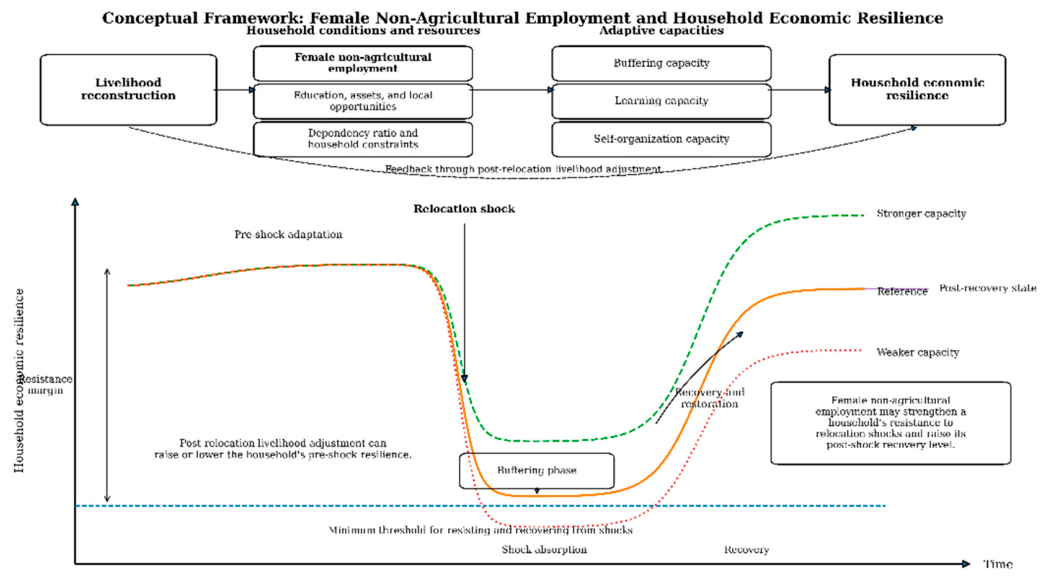
Figure 2.
Spatial Distribution of Surveyed Relocated Households in Southern Shaanxi.
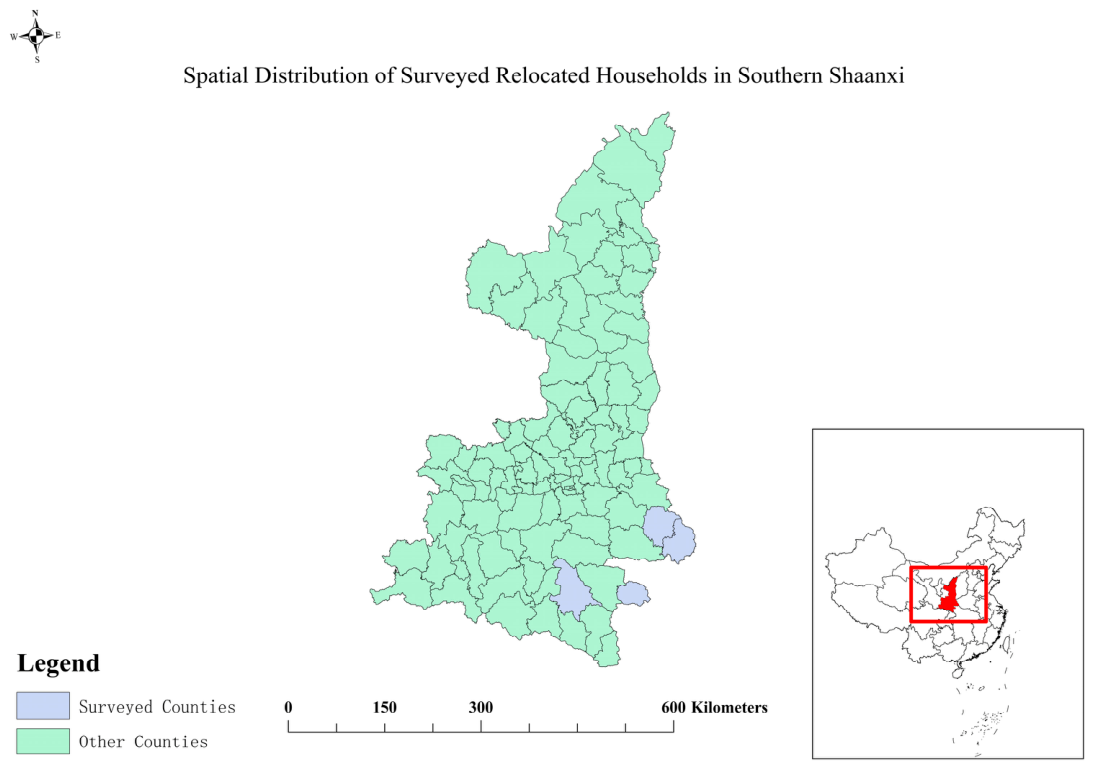
Figure 3.
Figure3. Distribution of Household economic resilience Families and off-Farm Employment, 2016–2022.
Figure 3.
Figure3. Distribution of Household economic resilience Families and off-Farm Employment, 2016–2022.
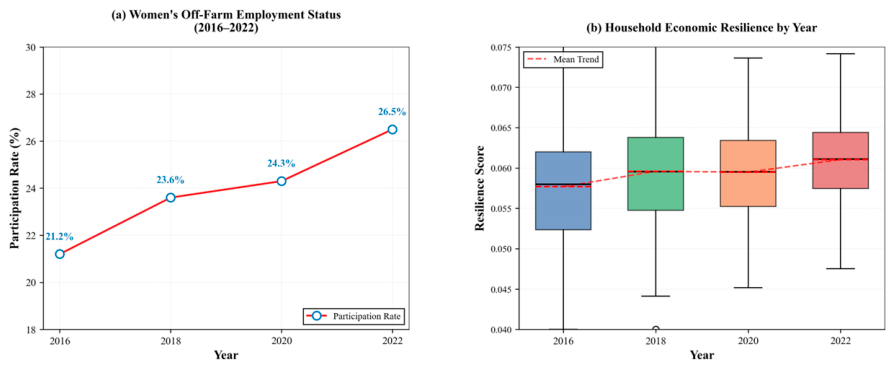
Figure 4.
Figure4. Common Support Region.
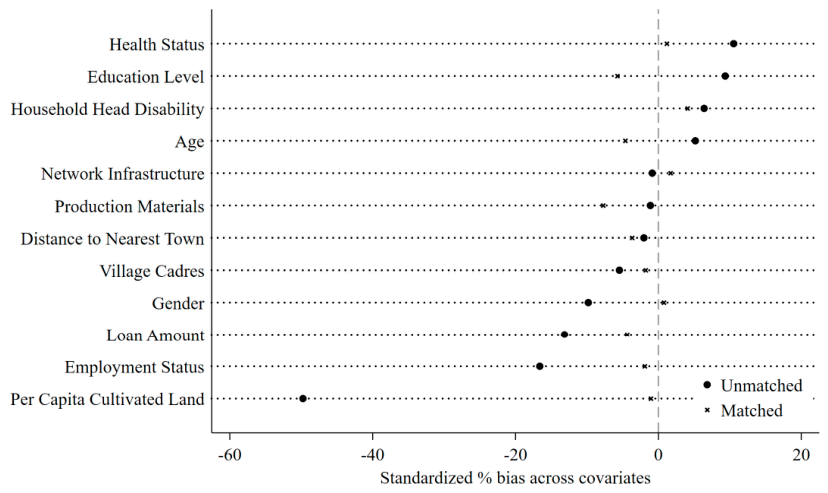
Figure 5.
Figure5. Covariate Balance Plot.
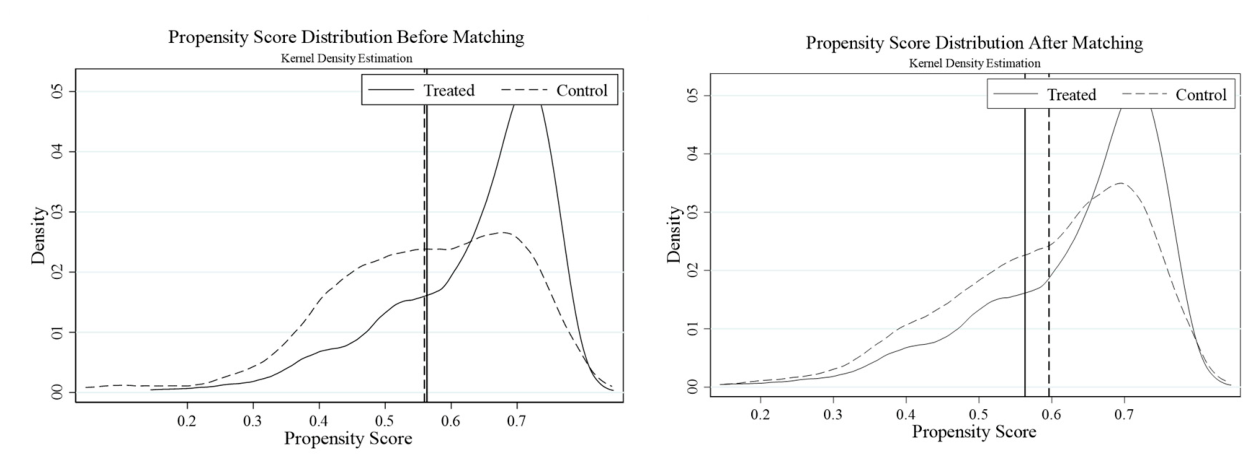

Table 1.
Household Economic Resilience Indicator.
| Measurement indicator |
Obs | Mean | Std. dev. |
|---|---|---|---|
| Work Income1 | 2089 | 7.175 | 5.008 |
| Savings2 | 2089 | 1.454 | 0.846 |
| Developmental Expenditure Share3 | 2089 | 0.043 | 0.167 |
Note: 1After 99% winsorization, add 1 and take logarithm;2 Categorical variable (1=<10k; 2=10k-30k; 3=30k-50k; 4=50k-100k; 5=>100k);3Using previously calculated results;.
Table 2.
Definition and Descriptive Statistical Analysis of Variables.
| Measurement indicator |
Obs | Mean | Std. dev. | |
|---|---|---|---|---|
| Control Variables | Gender | 2089 | 1.0479 | 0.4669 |
| Household Head Disability | 2089 | 0.0704 | 0.2558 | |
| Employment Status | 2089 | 0.0423 | 0.2013 | |
| Production Materials | 2089 | 0.9087 | 0.5798 | |
| Age | 2089 | 3.8504 | 0.2216 | |
| Education Level | 2089 | 1.1977 | 0.2595 | |
| Health Status | 2089 | 1.2498 | 0.3078 | |
| Network Infrastructure | 2089 | 1.2973 | 0.2267 | |
| Number of Village Cadres | 2089 | 0.0319 | 0.1514 | |
| Per Capita Cultivated Land | 2089 | 0.4136 | 0.5082 | |
| Distance to Nearest Town | 2089 | 0.9403 | 0.8486 | |
| Loan Amount | 2089 | 1.4991 | 3.7707 | |
| Mechanism Variables | Children's Cultural Activity Frequency1 | 2089 | 1.281 | 0.641 |
| Developmental Expenditure Share2 | 2089 | 0.043 | 0.167 | |
| Internet Expenditure Ratio3 | 2089 | 0.064 | 0.205 | |
| Number of Contacts During Festivals | 2089 | 2.348 | 1.005 | |
| Social Activity Participation Frequency | 2089 | 1.886 | 0.968 | |
| Policy Understanding Leve | 2089 | 2.638 | 0.887 |
Notes: 1 Frequency of unmarried children's participation in museums, theater, etc.; 2 Using previously calculated results; 3 Logarithm of internet expenditure/logarithm of total expenditure (99% winsorization).
Table 3.
Table3. Tobit Regression: Determinants of Household Economic Resilience.
| Variable | Model 1 | Model 2 |
|---|---|---|
| Female Non-agriculture employment | 0.0578** (0.0286) |
0.0543* (0.0285) |
| Control Variable | No | Yes |
| Observations | 2089 | 2089 |
| Log pseudolikelihood | -394.4899 | -392.4276 |
| F | 4.10 | 0.75 |
| Prob > F | 0.0430 | 0.6920 |
| Pseudo R2 | 0.0050 | 0.0102 |
*Note: Standard errors in parentheses. * p<0.1, ** p<0.05, *** p<0.01.
Table 4.
Table4. Robustness test by PSM model.
| Matching Method | |||
|---|---|---|---|
| ATT | S.E | T-stat | |
| Before Match | 0.00079 | (0.00119) | 0.67 |
| NNM | 0.00182 | (0.00117) | 1.55 |
Note: NNM refers to one-to-one nearest neighbor matching. The treatment variable is “whether the household is a registered poor household” (1 = yes, 0 = no). Covariate balance after matching is satisfactory (MeanBias = 3.2%, Pseudo R2 = 0.004).
Table 5.
Table5. Robustness test by PSM model.
| (1) | (2) | ||
|---|---|---|---|
| Female non-agricultural employment | 0.0061 (0.0272) |
0.0587* (0.0307) |
|
| Female emp. × Low education | 0.0877** (0.0358) |
||
| Female emp. × Urban resettlement | 0.0189** (0.0147) |
||
| Control Variables | Yes | Yes | |
| R2 | 0.632 | 0.639 | |
| Observations | 2089 | 2089 |
*Notes: ***, **, and * indicate significance at the 1%, 5%, and 10% levels, respectively. Standard errors clustered at the household level are reported in parentheses. The same applies below.
Table 6.
Table6. Household Development Mechanism.
| (1) | (2) | |
|---|---|---|
| Female Non-agricultural Employment | 0.1131* (0.0617) |
0.1032*** (0.0371) |
| Household-head Controls | Yes | Yes |
| Household Controls | Yes | Yes |
| Observations | 1825 | 2029 |
| R2 | 0.0169 | 0.0874 |
Notes: ***, **, and * indicate significance at the 1%, 5%, and 10% levels, respectively. Standard errors clustered at the household level are reported in parentheses. The same applies below.
Table 7.
Table7. Household Network Mechanism.
| (1) | (2) | (3) | (4) | |
|---|---|---|---|---|
| Female Non-agricultural Employment | 0.5501* (0.3304) |
0.3163* (0.1794) |
0.2598* (0.1492) |
0.3181** (0.1525) |
| Household-head Controls | Yes | Yes | Yes | Yes |
| Household Controls | Yes | Yes | Yes | Yes |
| Observations | 1425 | 1435 | 1997 | 1439 |
| R2 | 0.0251 | 0.0470 | 0.0637 | 0.0152 |
Notes: ***, **, and * indicate significance at the 1%, 5%, and 10% levels, respectively. Standard errors clustered at the household level are reported in parentheses. The same applies below.
Disclaimer/Publisher’s Note: The statements, opinions and data contained in all publications are solely those of the individual author(s) and contributor(s) and not of MDPI and/or the editor(s). MDPI and/or the editor(s) disclaim responsibility for any injury to people or property resulting from any ideas, methods, instructions or products referred to in the content. |
© 2026 by the authors. Licensee MDPI, Basel, Switzerland. This article is an open access article distributed under the terms and conditions of the Creative Commons Attribution (CC BY) license (http://creativecommons.org/licenses/by/4.0/).
Copyright: This open access article is published under a Creative Commons CC BY 4.0 license, which permit the free download, distribution, and reuse, provided that the author and preprint are cited in any reuse.


