
Submitted:
18 July 2026
Posted:
27 July 2026
You are already at the latest version
Abstract
During indoor navigation, a mobile robot often needs to cross doors while relying on multiple sensors that may be faulty or temporarily unreliable. This paper presents a fault-tolerant framework for mobile-robot door-crossing behaviour based on a dynamic Bayesian network (DBN). The framework combines behaviour learning, sensor-fault detection, fault isolation, structural adaptation of the Bayesian network, and corrective control. Faults are detected by evaluating sensor probabilities and modifying the DBN structure when abnormal sensor readings are identified. Five fault types are considered: constant, drift, shock, crosstalk, and spike faults. Experiments in static and dynamic environments show that the proposed DBN-based structures substantially reduce behavioural failure compared with a conventional Bayesian-network controller. The best configuration, combining fault detection with the third manoeuvre strategy, achieves a failure rate of 7.2% in the tested dynamic environment.
Keywords:
dynamic Bayesian network
; behaviour
; fault detection
; mobile robot
; sensor fault
1. Introduction
A fault is defined here as a deviation from expected behaviour. In robotics, faults may arise from mechanical failures, environmental interactions, or sensor failures. Robots operating in real environments often work without direct human interaction; therefore, they must monitor their own behaviour because faults can lead to catastrophic consequences. Even well-designed and thoroughly tested robots may encounter unexpected faults [1,2,3].
Fault diagnosis has become an important issue in robotics. The complexity of modern industrial processes and the increasing demand for autonomous robots create a need for robust online monitoring and diagnosis of complex hybrid systems. Fault detection and identification (FDI) are difficult because the space of possible faults is large, robot sensors and actuators are uncertain, environmental models are imperfect, and computational resources are limited [4,5].
The Dante II robot provides a well-known example. During a 1994 expedition in an Alaskan volcano, the robot encountered a steep slope and a changed system condition that it could not predict, and it had to be rescued by helicopter [6]. Other examples include the Mars Polar Lander, which crashed after its landing thrusters shut down prematurely, and the Mars Exploration Rover Spirit, whose controller was modified after a wheel fault.
Autonomous robots must therefore detect and isolate faults promptly. Effective FDI can substantially improve robot performance. Recent machine-learning studies across robotics, biomedical signal analysis, and multimodal decision systems also demonstrate the value of robust, interpretable, and data-driven models when observations are noisy, incomplete, or heterogeneous [7,8,9,10]. A robot collects data from sensors that may themselves be defective, so it must identify anomalous sensor readings while continuing to act safely. Traditional diagnosis and control approaches can suffer from computational intractability and numerical convergence problems. The method introduced in this paper detects and isolates faults using Bayesian probabilities and applies corrective remedies by changing the network structure. This emphasis on structural adaptation is consistent with broader work on predictive modelling, optimisation, and model-based control, where performance depends strongly on selecting representations that remain reliable under changing operating conditions [11,12]. Bayesian reasoning has been widely recognised as an effective framework for reasoning under uncertainty and incomplete observations, making it particularly suitable for robotic fault diagnosis and decision making [13,14].
2. Previous Work
Recent advances in machine learning have produced a broad range of predictive and recognition systems, including multimodal biomedical models, retinal-image transformers, cardiac-signal networks, and optimised deep classifiers [8,9,12,15]. Although these applications differ from mobile-robot diagnosis, they reinforce three principles relevant to the present study: robust feature representation, interpretable decision making, and adaptation to heterogeneous data sources.
Hardware redundancy is a common FDI technique based on duplicating components. Redundant hardware elements are often spatially distributed so that local damage does not disable the whole system. Triple modular redundancy is widely used in highly critical systems [16,17]. A fault can be detected by comparing the outputs of three equivalent components. The main disadvantages are extra hardware, maintenance cost, power consumption, and physical space. The Boeing 777 primary flight computers are a well-known example of triple redundancy [18].
Rule-based diagnosis depends strongly on expert knowledge, and adding a new fault may require the complete rule base to be rechecked. Venkatasubramanian et al. classify fault-diagnosis methods into quantitative model-based, process-history-based, and qualitative approaches [19].
Model-based methods compare observed robot behaviour with nominal behaviour generated by a system model [20]. History-based methods infer faults from previous sensor streams [21]. Related data-driven systems have used deep and hybrid architectures for temporal prediction, classification, and decision support in complex domains [15,22,23]. Analytical redundancy methods use state estimation, parameter identification, and statistical decision theory. Qualitative reasoning can reduce modelling requirements, but imprecise representations may lead to poor performance in complicated and dynamic systems [24].
Kalman filters are frequently used to monitor innovations and prediction errors [25]. One or more filters predict sensor values and compare predictions with observations. Cork and Walker combined a nonlinear dynamic model with an interacting multiple-model unscented Kalman filter to compensate for malfunctioning UAV sensors [26]. Kalman filters can also fuse noisy measurements from redundant positioning systems [27,28].
In this work, a complex hybrid system is modelled as a Bayesian network (BN). More generally, graph-based and structured machine-learning models are increasingly used because they can encode relationships among variables while supporting interpretability and multimodal integration [9,10]. A BN can represent nonlinear and non-Gaussian dependencies, handle incomplete information, and expose variable relationships in a form that is easier for humans to understand. It is modular, allowing local tests and structural modification after a faulty sensor is identified. Small model changes do not necessarily cause large performance changes, and nodes can be removed more naturally than in many fixed-structure models. Similar concerns regarding scalability, robustness, and adaptive computation arise in distributed data-processing systems, where load-balancing strategies must cope with skewed or changing workloads.
A probabilistic model maintains a belief distribution over possible system states given the evidence observed so far. This supports ranking possible failures and handling multiple simultaneous failures. The proposed method analyses dependencies among robot sensors and is designed to operate under constant, drift, shock, crosstalk, and spike faults.
3. Fault Types
Five fault types are considered.
3.1. Spike Fault
A spike is a large error that occurs in a single observation:
3.2. Drift Fault
A drift fault increases gradually:
3.3. Constant Fault
A constant fault keeps the sensor output at a fixed value over a time interval:
3.4. Shock Fault
A shock fault adds a constant offset to the actual value:
3.5. Crosstalk Fault
Crosstalk occurs when reflected information is received in addition to the true signal. For example, an ultrasonic sensor may receive both the direct echo and a weaker reflection from a wall. The simulations use this fault type, although the framework is not limited to these five faults.
4. Problem Description
The objective is to detect anomalies in the behaviour of a mobile robot using multistream data measured by the robot or simulator. The data may include pose, altitude, odometry, motor temperature, mass, and other telemetry. Let denote the finite set of values for sensor i. The joint state space is
Let the discrete time set be
where is the final period. A robot data stream is an ordered sequence of state vectors.
An abnormal reading is defined as a deviation from a nominal state greater than a threshold :
The distance may be a multivariate measure such as the Mahalanobis distance [29]. Euclidean distance is adequate for comparing two vectors, but comparison with a set of nominal vectors requires a probabilistic distance. The probabilistic distance measures how far the input stream lies from the centre of the nominal multidimensional distribution [30]. Comparable representation-learning approaches have also been applied to image, signal, and shape data, where informative feature structures are essential for reliable discrimination [31,32,33].
5. Proposed Method
Two approaches are considered. The first executes the learned behaviour without fault detection, whereas the second performs fault detection and isolation. The Bayesian-network structure may be learned automatically, specified by an expert, or constructed by a hybrid method. In this paper, an expert-defined structure is used.
Door crossing is used as the target behaviour. The choice of a navigation task also reflects the wider use of learning-based methods for collision avoidance and autonomous movement [7]. Ultrasonic sensor readings determine one of three actions: turn left, turn right, or move straight ahead. These actions correspond to negative, positive, and zero rotational velocity. The robot is driven from multiple positions and directions to collect training data. At each state, a supervisor selects the action that directs the robot toward the centre of the door.
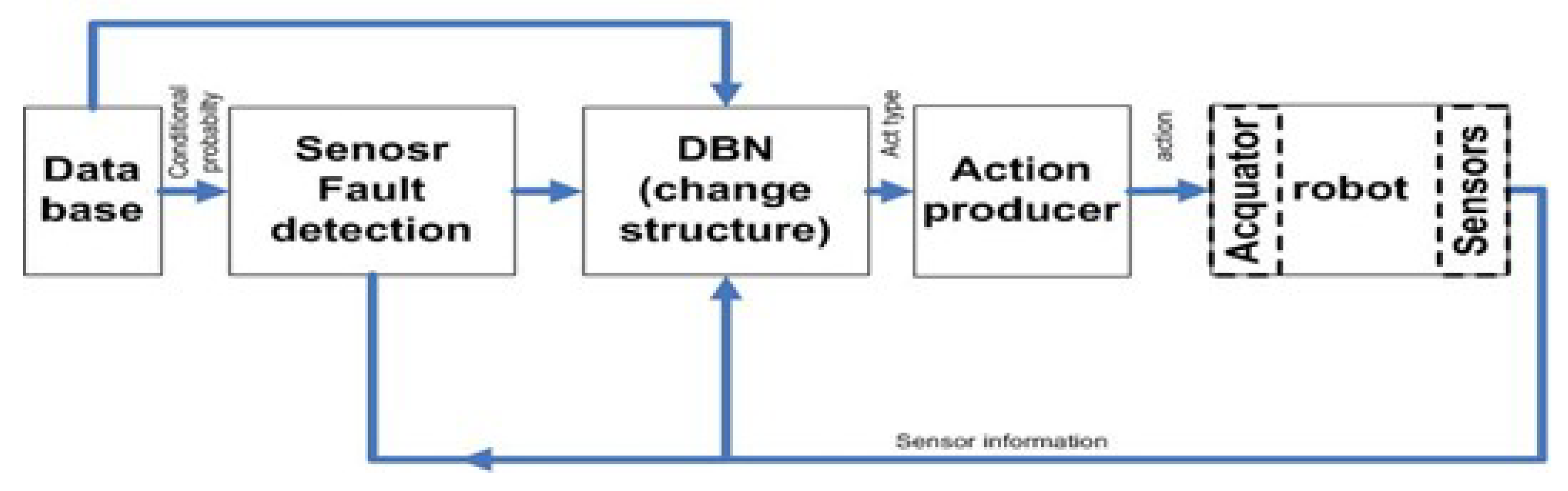
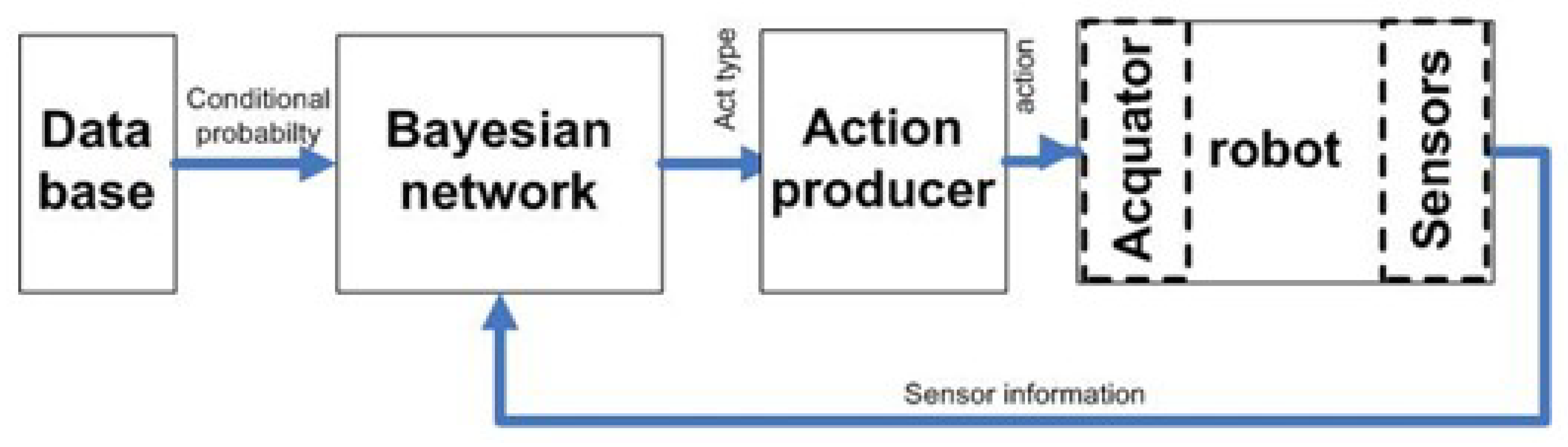
Figure 1 shows the learning framework. Conditional probability distributions (CPDs) are calculated from the database. The action producer uses the inferred action to generate wheel commands.
The framework contains the following components:
- Robot: a differential-drive robot with 13 sonar sensors distributed around its chassis.
- Bayesian network: the probabilistic model used to infer actions from sensor readings.
- Database: raw sensor and action data represented as conditional probability tables.
- Action producer: the module that generates wheel commands from the selected action.
5.1. Fault-Detection Structure for Robot Behaviour
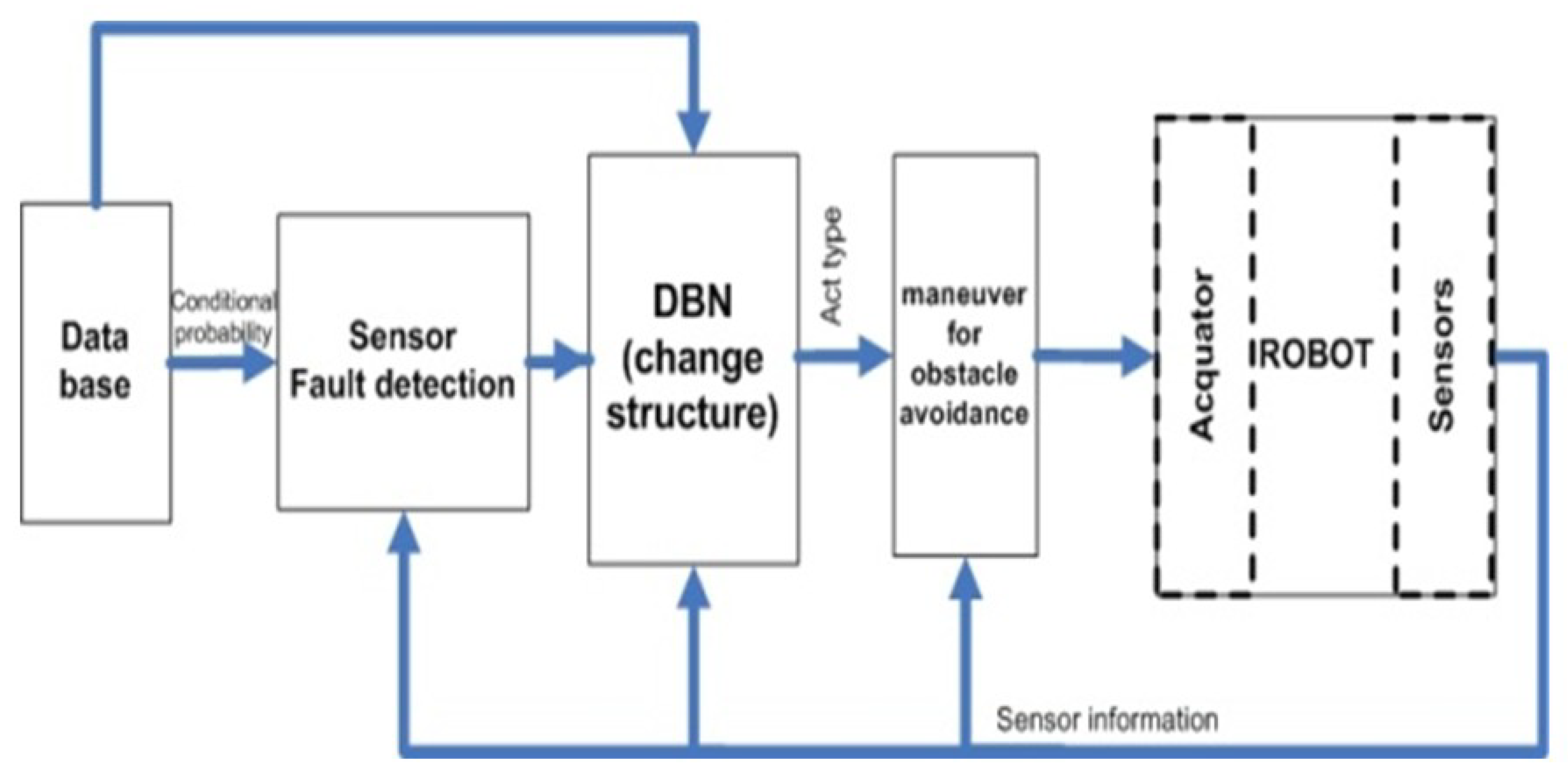
The network in Figure 2 combines a DBN with a fault-detection module. When an abnormal reading is detected, the faulty sensor is reported to the DBN and the network structure is modified.
If sensor is faulty, for example, the conditional probabilities
become small relative to the corresponding values of healthy sensors.
Figure 2.
Proposed framework with sensor-fault detection and DBN structural adaptation.
Two fault-detection algorithms are used.
FD1.
FD1 identifies a faulty sensor by comparing the sum of its conditional probabilities with a threshold :
FD2.
When the number of faulty sensors is known, FD2 removes the sensor with the minimum probability score:
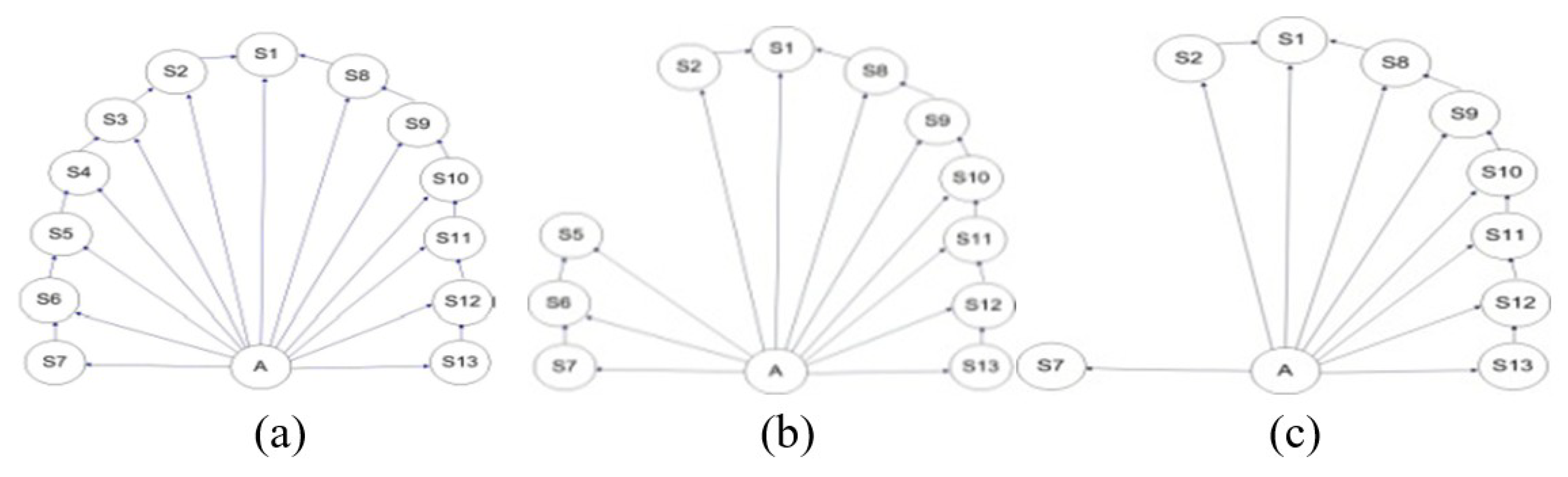
After a sensor is diagnosed as faulty, the DBN structure is changed and the CPD of the action node is updated. Four alternative structures, DBN1–DBN4, are evaluated.
Figure 3.
DBN1 structure: (a) no fault, (b) sensor faulty, and (c) sensors and faulty.
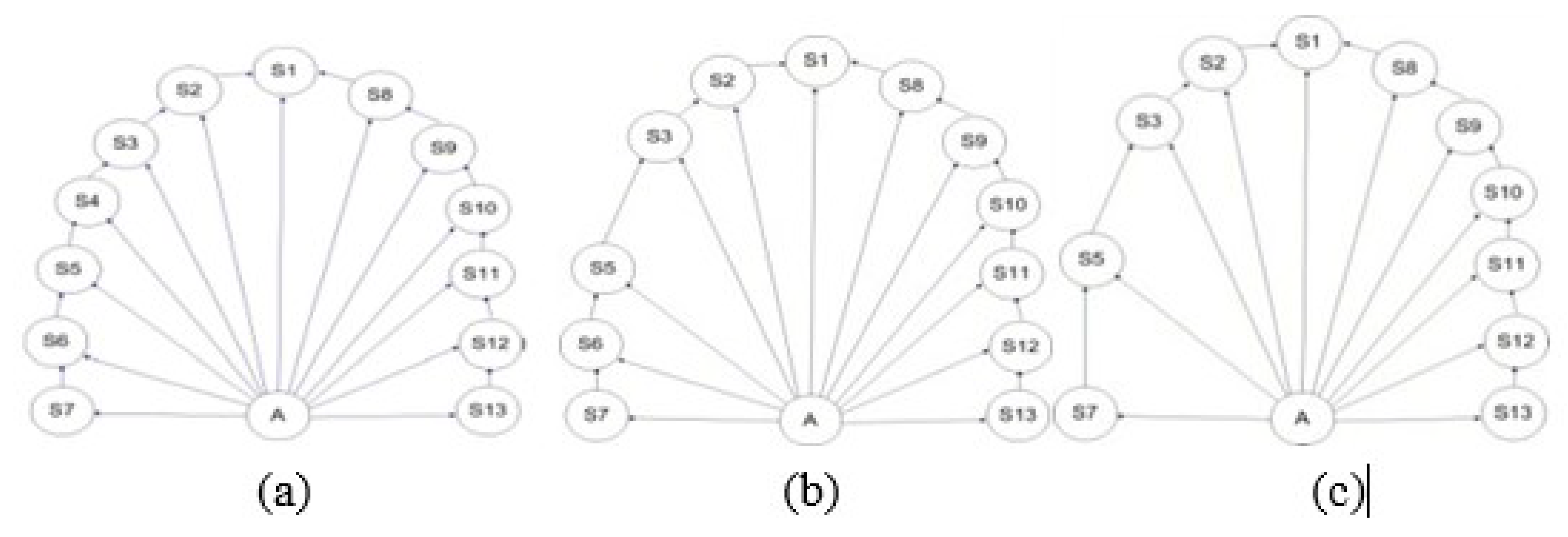
Figure 4.
DBN2 structure: (a) no fault, (b) sensor faulty, and (c) sensors and faulty.
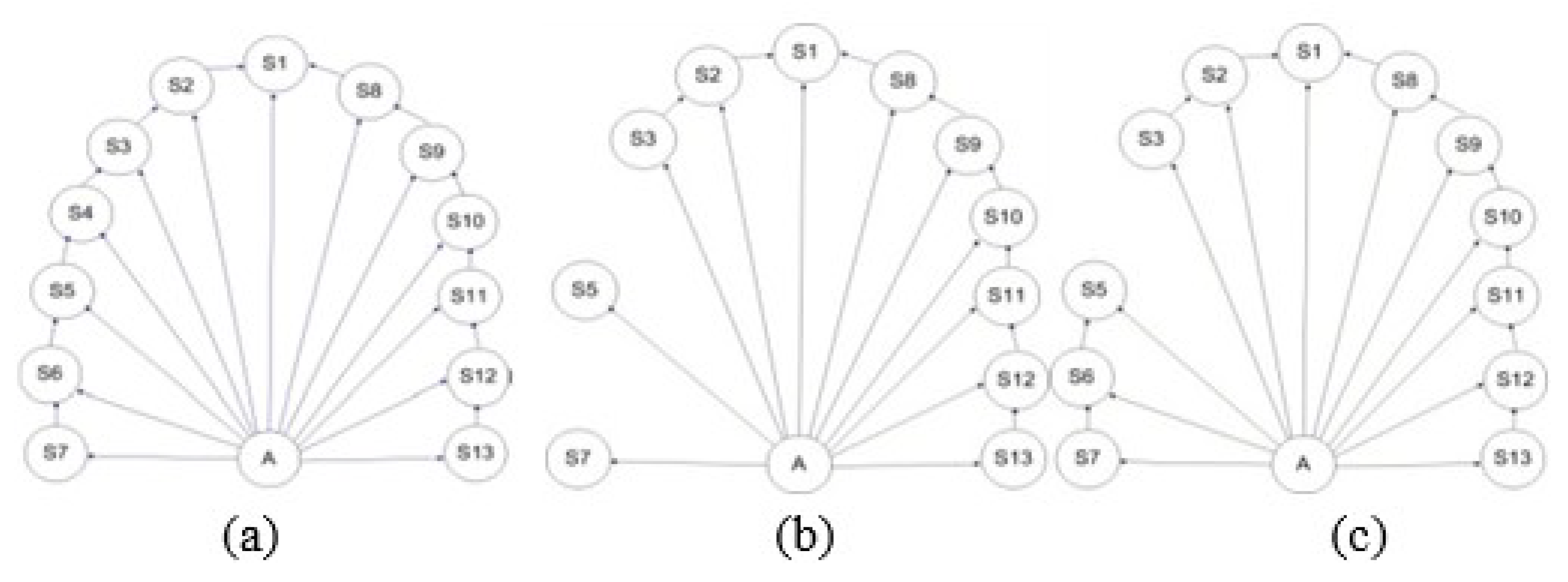
Figure 5.
DBN3 structure: (a) no fault, (b) sensor faulty, and (c) sensors and faulty.
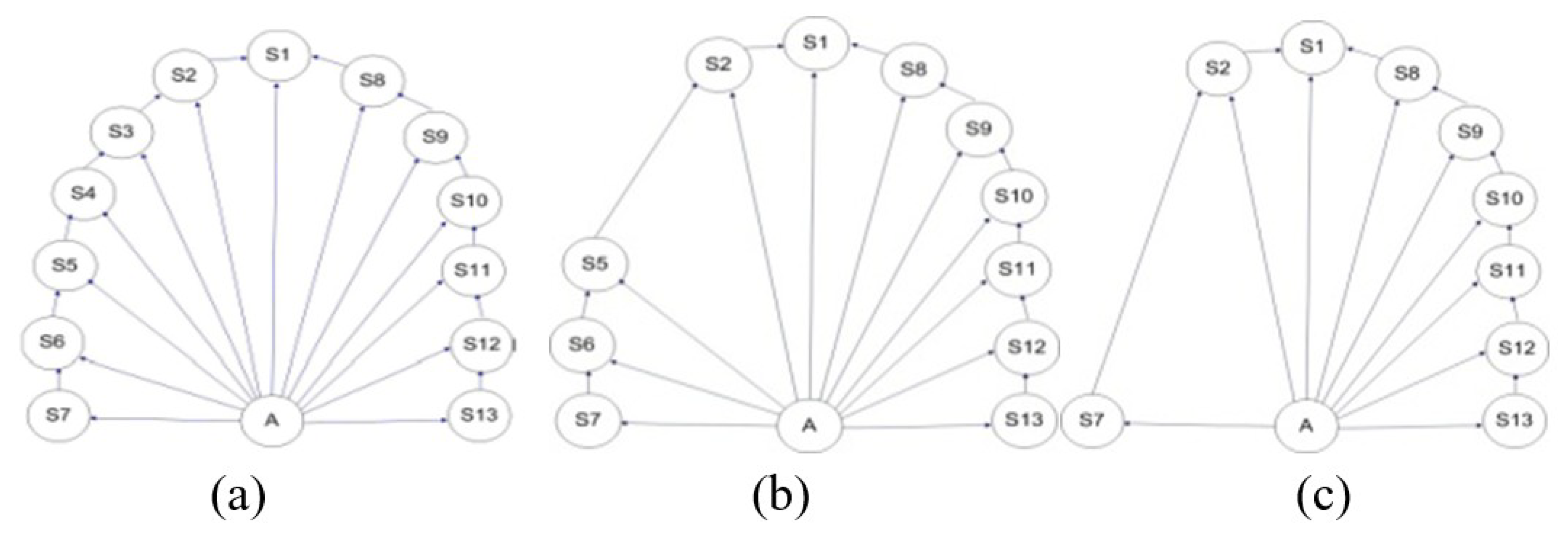
Figure 6.
DBN4 structure: (a) no fault, (b) sensor faulty, and (c) sensors and faulty.
5.2. Dynamic Environment and Manoeuvres
In a dynamic environment, sensor information may be temporarily incorrect. A second robot is added as a moving obstacle. The manoeuvre component changes robot speed according to the distance from nearby objects.
Figure 7.
Fault-tolerant framework for a dynamic environment.
Three manoeuvres are considered:
- MAN1
- Robot 1 reduces its speed according to its distance from Robot 2.
- MAN2
- Both robots reduce their speed according to their mutual distance.
- MAN3
- Both robots reduce their speed, and Robot 2 is commanded to move backward when the separation becomes very small.
5.3. Simulation Environment
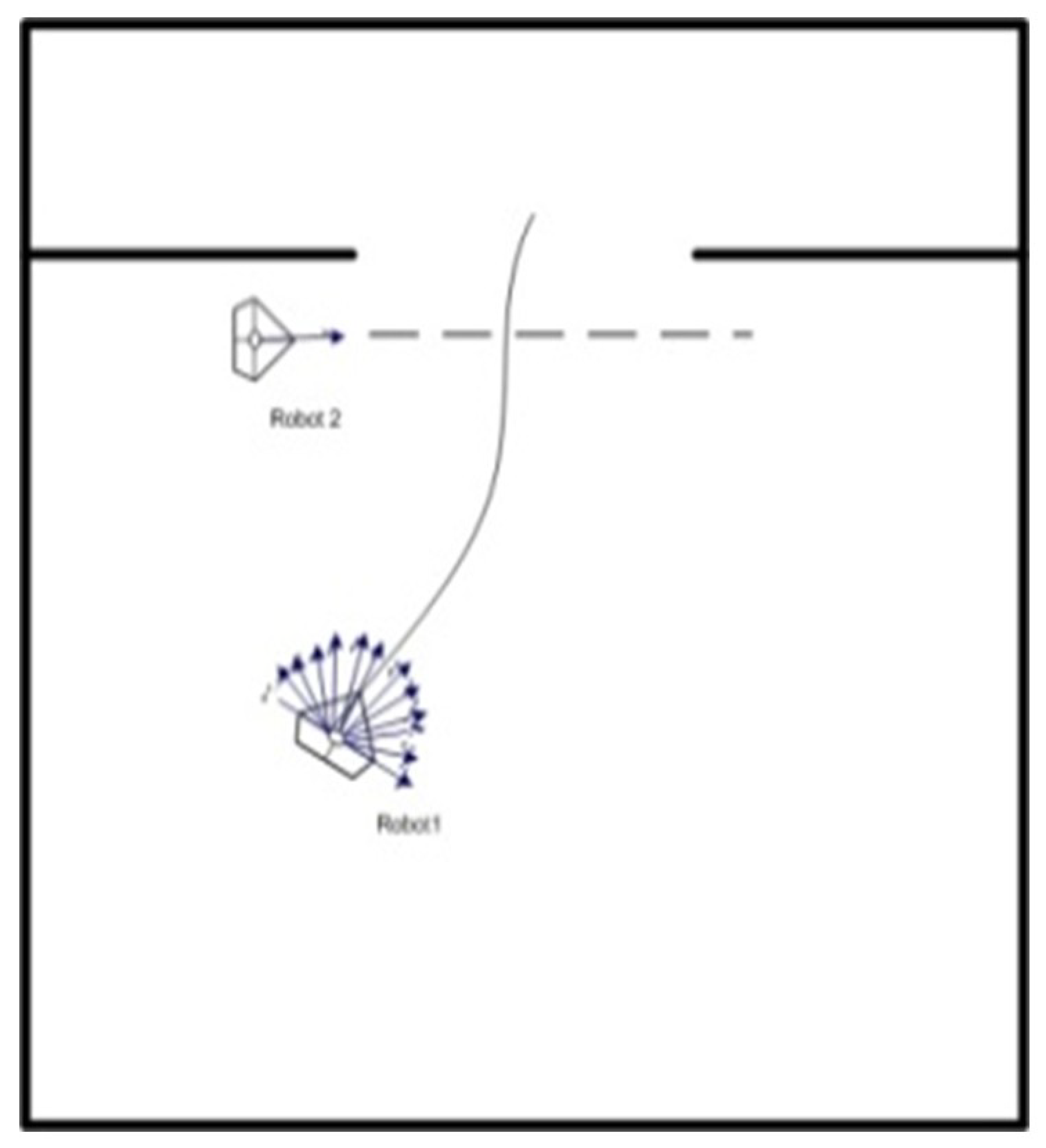
SIMROBOT in MATLAB is used to collect the required data and construct the database. Robot 1 traverses the doorway, whereas Robot 2 moves forward and backward.
Figure 8.
Dynamic simulation environment containing Robot 1, Robot 2, and the doorway.
6. Experimental Results
Initially, the fault-detection block is assumed to identify faulty sensors exactly. Failure is measured as the percentage of unsuccessful trials, including loss of the intended path and collisions with walls.

Table 1.
Failure percentage for constant, drift, and shock faults with exact fault elimination.
| No. faults | BN without elimination | DBN with exact elimination | ||||||
| Constant | Drift | Shock | DBN1 | DBN2 | DBN3 | DBN4 | ||
| 0 | 0 | 0 | 0 | 0 | 0 | 0 | 0 | |
| 1 | 14.6 | 3.8 | 11.1 | 0.2 | 1.8 | 2.6 | 4.0 | |
| 2 | 34.2 | 8.8 | 23.0 | 0.4 | 5.4 | 5.4 | 7.6 | |
| 3 | 44.2 | 30.0 | 38.0 | 1.6 | 6.2 | 9.0 | 10.4 | |
| 4 | 58.4 | 45.0 | 52.0 | 5.2 | 10.8 | 14.8 | 14.8 | |
| 5 | 67.4 | 56.0 | 63.0 | 7.0 | 13.4 | 19.6 | 18.6 | |
Table 2.
Failure percentage for crosstalk and spike faults with exact fault elimination.
| No. faults | BN without elimination | DBN with exact elimination | |||||
| Crosstalk | Spike | DBN1 | DBN2 | DBN3 | DBN4 | ||
| 0 | 0 | 0 | 0 | 0 | 0 | 0 | |
| 1 | 1.8 | 1.0 | 0 | 1.8 | 0.2 | 2.0 | |
| 2 | 15.4 | 10.0 | 0 | 2.8 | 1.4 | 4.0 | |
| 3 | 29.4 | 25.0 | 0 | 4.4 | 3.6 | 8.2 | |
| 4 | 34.0 | 29.0 | 0.2 | 10.6 | 9.2 | 15.6 | |
| 5 | 42.0 | 35.0 | 1.4 | 15.2 | 14.6 | 19.6 | |
These results indicate that changing the DBN structure can substantially reduce failures. DBN1 produces only 7% failure with five simultaneous constant, drift, or shock faults and is particularly robust to crosstalk.
Because exact fault identification is not always possible, FD1 and FD2 are evaluated next. For FD1, .
Table 3.
Failure percentage for constant, drift, and shock faults using FD1 and FD2.
| Constant | Drift | Shock | ||||||||||
| No. | BN | Exact | FD1 | FD2 | BN | Exact | FD1 | FD2 | BN | Exact | FD1 | FD2 |
| 0 | 0 | 0 | 0 | 4.2 | 0 | 0 | 0 | 4.2 | 0 | 0 | 0 | 4.2 |
| 1 | 14.6 | 0.2 | 2.4 | 3.4 | 3.8 | 0.2 | 2.6 | 3.0 | 11.1 | 0.2 | 6.7 | 8.1 |
| 2 | 34.2 | 0.4 | 10.4 | 8.8 | 8.8 | 0.4 | 5.0 | 6.0 | 23.0 | 0.4 | 14.3 | 16.8 |
| 3 | 44.2 | 1.6 | 21.6 | 17.6 | 30.0 | 1.6 | 7.6 | 10.2 | 38.0 | 1.6 | 22.4 | 23.6 |
| 4 | 58.4 | 5.2 | 33.0 | 29.4 | 45.0 | 5.2 | 12.0 | 21.0 | 52.0 | 5.2 | 35.0 | 31.0 |
| 5 | 67.4 | 7.0 | 49.4 | 35.4 | 56.0 | 7.0 | 25.4 | 30.0 | 63.0 | 7.0 | 50.0 | 36.0 |
Table 4.
Failure percentage for crosstalk and spike faults using FD1 and FD2.
| Crosstalk | Spike | |||||||
| No. | BN | Exact | FD1 | FD2 | BN | Exact | FD1 | FD2 |
| 0 | 0 | 0 | 0 | 4.2 | 0 | 0 | 0 | 4.2 |
| 1 | 1.8 | 0 | 0.8 | 0.6 | 1.0 | 0 | 0.5 | 0.54 |
| 2 | 15.4 | 0 | 0.8 | 2.0 | 10.0 | 0 | 0.6 | 1.5 |
| 3 | 29.4 | 0 | 5.6 | 3.2 | 25.0 | 0 | 3.0 | 3.0 |
| 4 | 34.0 | 0.2 | 12.0 | 11.0 | 29.0 | 0.2 | 6.8 | 8.0 |
| 5 | 42.0 | 1.4 | 36.6 | 27.0 | 35.0 | 1.4 | 23.0 | 24.0 |
Both FD1 and FD2 improve performance relative to the baseline BN. FD1 is sensitive to the threshold but is generally preferable in the reported experiments.
Table 5.
Failure percentage in the dynamic environment.
| Method | DBN1 | DBN4 | BN |
| FD1–Typical | 30.0 | 26.8 | 39.0 |
| FD1–MAN1 | 21.3 | 18.2 | 37.0 |
| FD1–MAN2 | 14.3 | 11.4 | 30.0 |
| FD1–MAN3 | 10.0 | 7.2 | 22.0 |
The manoeuvre component is effective for all networks. DBN4 outperforms DBN1 in the dynamic environment, and MAN3 produces the best results.
Table 6.
Evaluation in static and dynamic environments.
| Model | No fault | Constant | Drift | Shock | Crosstalk | Spike | Dynamic |
| BN | 0 | 14.6 | 3.8 | 11.1 | 1.8 | 1.0 | 39.0 |
| BN–MAN3 | 0 | 14.0 | 3.6 | 11.0 | 1.6 | 1.0 | 22.0 |
| DBN1–FD1 | 0 | 2.4 | 2.6 | 6.7 | 0.8 | 0.5 | 30.0 |
| DBN1–FD1–MAN3 | 0 | 2.2 | 2.4 | 6.5 | 0.6 | 0.4 | 10.0 |
| DBN4–FD1 | 0 | 6.8 | 3.3 | 7.3 | 3.0 | 2.8 | 26.8 |
| DBN4–FD1–MAN3 | 0 | 3.0 | 2.8 | 7.0 | 0.8 | 0.5 | 7.2 |
| Exact elimination | 0 | 0.6 | 0.6 | 0.6 | 0 | 0 | – |
The combined results show that DBN1–FD1–MAN3 performs well in both static and dynamic conditions. DBN4–FD1–MAN3 gives the lowest reported dynamic-environment failure rate, 7.2%.
7. Conclusions
This paper proposed a fault-tolerant method for improving mobile-robot behaviour. Bayesian networks were used to learn door-crossing behaviour and to support operation with malfunctioning sensors. Sensor faults were detected using probability-based criteria, after which the dynamic Bayesian network structure was modified to remove or reduce the influence of faulty sensors.
Experiments with constant, drift, shock, crosstalk, and spike faults show that structural adaptation substantially reduces failure compared with a conventional BN controller. In dynamic environments, manoeuvre strategies further improve performance. The best tested configuration, DBN4–FD1–MAN3, achieved a 7.2% failure rate. Future work should evaluate the method on larger datasets, more complex environments, and physical robotic platforms.
Funding
This research received no external funding.
Institutional Review Board Statement
Not applicable.
Informed Consent Statement
Not applicable.
Data Availability Statement
The data supporting the findings of this study are available from the corresponding author upon reasonable request.
Acknowledgments
The author acknowledges the technical and institutional support provided during the preparation of this study.
Conflicts of Interest
The author declares no conflicts of interest.
Abbreviations
The following abbreviations are used in this manuscript:
| BN | Bayesian network |
| DBN | Dynamic Bayesian network |
| FDI | Fault detection and identification |
| FD1 | Fault-detection algorithm 1 |
| FD2 | Fault-detection algorithm 2 |
| CPD | Conditional probability distribution |
| UAV | Unmanned aerial vehicle |
References
- Carlson, J.; Murphy, R.R. Reliability Analysis of Mobile Robots. In Proceedings of the Proceedings of the IEEE International Conference on Robotics and Automation, 2003.
- Blanke, M.; Kinnaert, M.; Lunze, J.; Staroswiecki, M. Diagnosis and Fault-Tolerant Control, 3rd ed.; Springer, 2016.
- Isermann, R. Fault-Diagnosis Systems: An Introduction from Fault Detection to Fault Tolerance; Springer, 2006.
- Chen, J.; Patton, R.J. Robust Model-Based Fault Diagnosis for Dynamic Systems; Kluwer Academic Publishers, 1999.
- Ding, S.X. Model-Based Fault Diagnosis Techniques: Design Schemes, Algorithms, and Tools, 2nd ed.; Springer, 2013.
- Bares, J.; Wettergreen, D. Dante II: Technical Description, Results, and Lessons Learned. The International Journal of Robotics Research 1999, 18, 621–624. [CrossRef]
- Rafiei, A.; Fasakhodi, A.O.; Hajati, F. Pedestrian Collision Avoidance Using Deep Reinforcement Learning. International Journal of Automotive Technology 2022, 23, 613–622. [CrossRef]
- Sadeghi, A.; Hajati, F.; Rezaee, A.; Sadeghi, M.; Argha, A.; Alinejad-Rokny, H. 3DECG-Net: ECG Fusion Network for Multi-Label Cardiac Arrhythmia Detection. Computers in Biology and Medicine 2024, 182, 109126. [CrossRef]
- Jamshidiha, S.; Rezaee, A.; Hajati, F.; Golzan, M.; Chiong, R. An Explainable Transformer Model for Alzheimer’s Disease Detection Using Retinal Imaging. Scientific Reports 2025, 15, 26773. [CrossRef]
- Sadeghi, A.; Hajati, F.; Argha, A.; Lovell, N.H.; Yang, M.; Alinejad-Rokny, H. Interpretable Graph-Based Models on Multimodal Biomedical Data Integration: A Technical Review and Benchmarking. Nature Communications 2026. [CrossRef]
- Tavakolian, A.; Rezaee, A.; Hajati, F.; Uddin, S. Hospital Readmission and Length-of-Stay Prediction Using an Optimized Hybrid Deep Model. Future Internet 2023, 15, 304. [CrossRef]
- Zobeiri, A.; Rezaee, A.; Hajati, F.; Argha, A.; Alinejad-Rokny, H. Post-Cardiac Arrest Outcome Prediction Using Machine Learning: A Systematic Review and Meta-Analysis. International Journal of Medical Informatics 2025, 193, 105659. [CrossRef]
- Pearl, J. Probabilistic Reasoning in Intelligent Systems: Networks of Plausible Inference; Morgan Kaufmann, 1988.
- Jensen, F.V.; Nielsen, T.D. Bayesian Networks and Decision Graphs, 2nd ed.; Springer, 2007. [CrossRef]
- Tavakolian, A.; Hajati, F.; Rezaee, A.; Fasakhodi, A.O.; Uddin, S. Fast COVID-19 Versus H1N1 Screening Using Optimized Parallel Inception. Expert Systems with Applications 2022, 204, 117551. [CrossRef]
- Bererton, C.; Khosla, P. An analysis of cooperative repair capabilities in a team of robots. In Proceedings of the Proceedings of the IEEE International Conference on Robotics and Automation, 2002.
- Sheaffer, J.W.; Luebke, D.; Skadron, K. A hardware redundancy and recovery mechanism for reliable scientific computation on graphics processors. In Proceedings of the Proceedings of the SIGGRAPH/Eurographics Conference, 2007, pp. 55–64.
- Yeh, Y. Triple-triple redundant 777 primary flight computers. In Proceedings of the Proceedings of the IEEE Aerospace Applications Conference, 1996, Vol. 1, pp. 293–307.
- Venkatasubramanian, V.; Rengaswamy, R.; Yin, K.; Kavuri, S.N. A review of process fault detection and diagnosis. Part I: Quantitative model-based methods. Computers & Chemical Engineering 2003, 27, 293–311. [CrossRef]
- Hofbaur, M.; Steinbauer, G.; Wotawa, F. Improving robustness of mobile robots using model-based reasoning. Journal of Intelligent and Robotic Systems 2007, 48, 37–54. [CrossRef]
- Steinbauer, G.; Orth, M.; Wotawa, F. Real-time diagnosis and repair of faults of robot control software. In RoboCup 2005: Robot Soccer World Cup IX; 2006; pp. 13–23.
- Fiorini, S.; Hajati, F.; Barla, A.; Girosi, F. Predicting Diabetes Second-Line Therapy Initiation in the Australian Population via Timespan-Guided Neural Attention Network. PLOS ONE 2019, 14, e0211844. [CrossRef]
- Wang, S.; Lu, H.; Khan, A.; Hajati, F.; Khushi, M.; Uddin, S. A Machine Learning Software Tool for Multiclass Classification. Software Impacts 2022, 13, 100383. [CrossRef]
- Hodge, V.; Austin, J. A survey of outlier detection methodologies. Artificial Intelligence Review 2004, 22, 85–126.
- Daigle, M.; Koutsoukos, X.; Biswas, G. A qualitative event-based approach to continuous systems diagnosis. IEEE Transactions on Control Systems Technology 2009, 17, 780–793. [CrossRef]
- Cork, L.; Walker, R. Sensor fault detection for UAVs using a nonlinear dynamic model and the IMM-UKF algorithm. In Proceedings of the Information, Decision and Control, 2007, pp. 230–235.
- Sundvall, P.; Jensfelt, P. Fault detection for mobile robots using redundant positioning systems. In Proceedings of the Proceedings of the IEEE International Conference on Robotics and Automation, 2006.
- Basseville, M. Detecting changes in signals and systems: A survey. Automatica 1988, 24, 309–326. [CrossRef]
- He, W.; et al. State of charge estimation for Li-ion batteries using neural network modeling and unscented Kalman filter-based error cancellation. International Journal of Electrical Power & Energy Systems 2014, 62, 783–791. [CrossRef]
- Lazkano, E.; Sierra, B.; Astigarraga, A.; Martinez-Otzeta, J.M. On the use of Bayesian networks to develop behaviors for mobile robots. Robotics and Autonomous Systems 2007, 55, 253–265. [CrossRef]
- Hajati, F.; Cheraghian, A.; Gheisari, S.; Gao, Y.; Mian, A.S. Surface Geodesic Pattern for 3D Deformable Texture Matching. Pattern Recognition 2017, 62, 21–32. [CrossRef]
- Ayatollahi, F.; Raie, A.A.; Hajati, F. Expression-Invariant Face Recognition Using Depth and Intensity Dual-Tree Complex Wavelet Transform Features. Journal of Electronic Imaging 2015, 24, 023031. [CrossRef]
- Hajati, F.; Raie, A.A.; Gao, Y. Pose-Invariant 2.5D Face Recognition Using Geodesic Texture Warping. In Proceedings of the 2010 11th International Conference on Control, Automation, Robotics and Vision. IEEE, 2010, pp. 1837–1841.
Figure 1.
Framework structure for learning robot behaviour.
Disclaimer/Publisher’s Note: The statements, opinions and data contained in all publications are solely those of the individual author(s) and contributor(s) and not of MDPI and/or the editor(s). MDPI and/or the editor(s) disclaim responsibility for any injury to people or property resulting from any ideas, methods, instructions or products referred to in the content. |
© 2026 by the authors. Licensee MDPI, Basel, Switzerland. This article is an open access article distributed under the terms and conditions of the Creative Commons Attribution (CC BY) license (http://creativecommons.org/licenses/by/4.0/).
Copyright: This open access article is published under a Creative Commons CC BY 4.0 license, which permit the free download, distribution, and reuse, provided that the author and preprint are cited in any reuse.