
Submitted:
24 July 2026
Posted:
24 July 2026
You are already at the latest version
Abstract
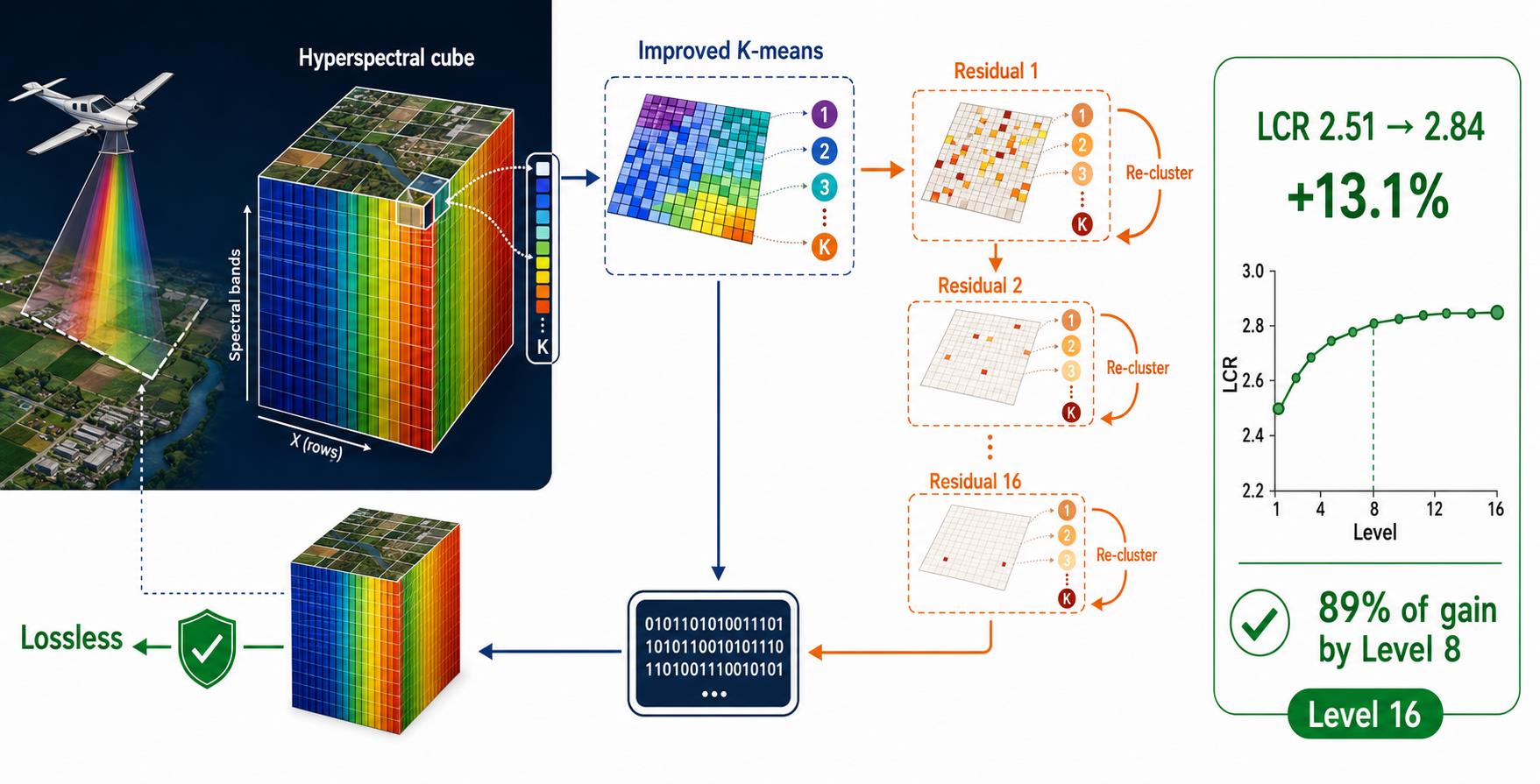
Hyperspectral remote sensing instruments record hundreds of narrow, contiguous spectral bands, and the resulting data volumes make compression essential for storage and transmission. Lossless compression preserves this data exactly, which matters for archival and reanalysis, but existing methods largely target redundancy in the original image, leaving the redundancy in residual data after an initial compression pass largely unexploited. The proposed Multi-level Clustering Lossless Compression Algorithm (MLCLCA) is built on an Improved K-means Algorithm (IKA) that exploits the spatial geometry of remotely sensed pixels to prune distance comparisons among distant or already-stable classes, accelerating convergence relative to standard K-means. MLCLCA re-clusters the residue produced at each level and searches, at every level, for the class count that maximizes the lossless compression ratio (LCR). On 220-band AVIRIS hyperspectral data, rounding class centers to the nearest integer outperforms nearest-pixel selection, and differencing class centers across bands and classes reduces inter-band redundancy by roughly two orders of magnitude. Extending clustering from one level to nineteen raises the LCR from 2.51 to 2.84, a 13.1% relative gain, though about 89% of it is already realized within the first eight levels, showing that residue redundancy, while substantial, is finite. These results indicate MLCLCA is best suited to archival and reprocessing scenarios that prioritize compression ratio over real-time throughput.
Keywords:
hyperspectral images
; lossless compression
; multi-level clustering
; K-means
; residue redundancy
Copyright: This open access article is published under a Creative Commons CC BY 4.0 license, which permit the free download, distribution, and reuse, provided that the author and preprint are cited in any reuse.


