

Submitted:
23 July 2026
Posted:
24 July 2026
You are already at the latest version
Abstract
Background and Objectives: The COVID-19 pandemic highlighted persistent limitations of personal protective equipment (PPE), particularly the difficulty of maintaining rapid and repeated hand hygiene during uninterrupted patient care. To address this challenge, we developed and performed a preliminary benchtop validation of a lightweight proof-of-concept face shield integrating an on-demand disinfectant reservoir for immediate point-of-care hand sanitisation. Materials and Methods: A multidisciplinary clinical–engineering team designed a dual-function wearable system consisting of a polyethylene terephthalate glycol-modified (PETG) visor (23 × 23 cm; 0.20 mm) and a modular disinfectant reservoir with capacities of 25, 50, 75, and 100 mL. The prototype was developed using computer-aided design, fused deposition modelling three-dimensional printing, and PETG thermoforming. A touch-activated self-sealing valve delivered approximately 3 mL of disinfectant per activation. No human participants were involved. Benchtop testing evaluated dispensing consistency, valve resealing, leak-tightness, attachment stability, chemical compatibility with alcohol-based disinfectants, and mechanical durability under repeated fill–drain cycles. Ergonomic assessment was limited to biomechanical modelling of mass distribution and estimated cervical torque. Results: The visor weighed 13.4 g, while the complete system weighed 103.4 g when empty and 203.4 g when loaded with 100 mL of disinfectant. Estimated cervical torque increased from 0.084 N·m to 0.282 N·m under maximum-load conditions. The prototype demonstrated reproducible disinfectant dispensing within predefined acceptance criteria, reliable valve resealing, absence of continuous leakage, secure reservoir attachment, and preserved PETG stability following exposure to alcohol-based disinfectants. Minor early dispensing variability and superficial contact wear were observed but did not impair device functionality. The estimated prototype material cost was approximately €10–20 (US$11–22). Conclusions: This proof-of-concept study demonstrates the technical feasibility of integrating facial protection with immediate on-demand hand sanitisation within a single reusable wearable device. The prototype achieved predefined engineering and performance endpoints during benchtop testing while maintaining low estimated material costs and a modular design. Further studies involving human participants, microbiological evaluation, ergonomic validation, and clinical usability testing are required before clinical implementation can be considered.
Keywords:
hand hygiene
; personal protective equipment
; face shield
; infection prevention and control
; wearable medical device
; disinfectant reservoir
; proof-of-concept
; benchtop validation
1. Introduction
The COVID-19 pandemic emerged suddenly and followed patterns previously observed during other large infectious outbreaks. Several analyses described the early appearance of SARS-CoV-2, the rapid growth of initial clusters, and the transition from a local epidemic to a global emergency [1]. Comparative studies showed that widespread infectious events produce major medical, social, and economic disruption and can quickly overwhelm public behaviour and healthcare capacity [2]. Additional reports indicated that the worldwide impact of COVID-19 reflected both the biological properties of the virus and structural weaknesses in preparedness systems [3].
As case numbers increased, protecting healthcare workers became a central priority. Research on occupational safety revealed that institutional protocols frequently left gaps in routine workflows, creating vulnerabilities during patient care [4]. Evidence confirmed that infected individuals generate respirable aerosol particles capable of sustaining close-contact and household transmission [5]. Further findings suggested that the conjunctiva may represent a secondary portal of entry for the virus [6]. These observations aligned with established aerosol principles showing that particle size strongly influences airborne transport and infection risk. Because many medical and dental procedures create heavy aerosol loads, strict facial and ocular protection became essential in preventing exposure [7].
Hand hygiene remains a central component of infection prevention, but compliance can be affected by workflow interruption, time pressure, limited access to fixed dispensers, and repeated surface contact during patient care [8,9,10]. Conventional face shields provide passive facial and ocular barrier protection, yet they do not directly improve access to hand disinfection during procedure-intensive activity. Prolonged use of personal protective equipment may also contribute to discomfort, fatigue, communication difficulties, and cognitive load, which can influence usability and infection-control behaviour during demanding clinical workflows [11]. These factors create a design opportunity for wearable protective systems that combine barrier function with immediate point-of-care access to disinfectant while preserving visibility, comfort, stability, and low production cost.
Wearable and modular protective technologies are increasingly relevant in healthcare because they allow additional safety functions to be integrated into clinical protective equipment [12,13,14]. In the present device, incorporation of a disinfectant reservoir into a face shield required preservation of optical clarity, facial coverage, stable head fixation, modular attachment, controlled manual dispensing, leak-tightness, repeated attachment–detachment resistance, and compatibility with alcohol-based disinfectants.
Material selection was central to the development of a reusable protective device for infection-control workflows, where equipment may be exposed to aerosols, splatter, surface contamination, handling, and repeated cleaning procedures [7]. Polyethylene terephthalate glycol-modified material was selected for the visor and reservoir because of its optical clarity, dimensional stability, impact resistance, thermoformability, and documented chemical resistance profile [15]. Mikrozid AF Liquid was selected as the test disinfectant because it is an aldehyde-free alcohol-based formulation containing ethanol and propan-1-ol, according to the manufacturer’s product data sheet [16].
Because the reservoir adds mass to a head-mounted device, basic load distribution was also considered during design. However, ergonomic assessment in this preliminary phase was limited to mass, centre-of-mass position, and estimated cervical torque, while clinical comfort and user tolerance require future human-factor validation [17,18,19,20].
Because of these combined pressures, protective solutions must reduce aerosol, droplet, and ocular exposure and must also ensure immediate and effortless hand disinfection at the point of care. The systematic search of the PubMed, Scopus, Web of Science, and Google Scholar databases, as well as the international patent registries (WIPO PATENTSCOPE, EPO Espacenet, and USPTO), conducted up to March 1, 2026, did not identify any scientific publication or patent document describing a face shield with an integrated hand disinfectant reservoir. Although portable disinfectant dispensers mounted on belts or wrists exist, they are not structurally integrated into a facial protection system and do not provide the combined functionality of ocular barrier protection and point-of-care dispensing. Therefore, the concept of integrating a disinfectant reservoir into a reusable face shield with mechanically controlled dispensing has not previously been reported in scientific literature or in publicly accessible patent documents. We emphasize that this statement is based on the systematic search described above and does not exclude the existence of unpublished industrial developments.
To explore a potential solution to this identified gap, we designed and developed a face shield incorporating a modular disinfectant reservoir intended to combine facial protection with immediate access to hand sanitisation within a single wearable platform.
2. Materials and Methods
2.1. Study Design and Development Workflow
This study was designed as a preclinical prototype development and bench validation study of a dual-function polymer face shield incorporating an on-demand disinfectant reservoir for use in infection control workflows in medical practice. The methodological flow included: digital design, material selection, prototype fabrication, dimensional and gravimetric evaluation, bench functional testing, chemical and mechanical durability testing, ergonomic modeling and cost analysis.
No human participants, patients, biological samples, personal data, or clinical interventions were involved. Therefore, institutional ethical approval was not required for this preclinical technical phase. Future testing involving physicians or patients will only be conducted after approval by an institutional ethics committee and after obtaining written informed consent.
The main technical parameters were: consistency of the disinfectant dose, valve resealing, tightness, stability of tank attachment, chemical compatibility with alcohol-based disinfectant, mechanical durability, mass distribution and estimated cervical torque. Secondary parameters included the production cost of the prototype and the feasibility of modular tank use.
2.2. Device Design and Materials
The device has been designed as a reusable polymer face shield system that integrates facial and eye barrier protection with on-demand hand disinfection capability. The final assembly consisted of a transparent sight, a double-spring cranial frame, a removable side tank for disinfectant, a touch-activated self-sealing dispensing valve, a flexible sealing gasket and an adjustable rear elastic fixing band.
The visor was made of glycol-modified polyethylene terephthalate (PETG) polymer material, with final dimensions of 230 × 230 mm and a nominal thickness of 0.20 mm. PETG was selected due to its optical clarity, low weight, impact resistance, thermoformability and tolerance to alcohol-based cleaning agents and disinfectants [15]. The cranial frame and tank components were designed for molten deposition modeling using PETG filament, while the gasket was designed from thermoplastic polyurethane (TPU 95A) to support cap sealing and leakage prevention.
The disinfectant tank was designed as a modular component with four interchangeable nominal capacities: 25 mL, 50 mL, 75 mL and 100 mL. The 100 mL tank was selected as the maximum load configuration for subsequent functional, durability and ergonomic testing. The tank has been designed for ambidextrous lateral mounting via a reversible male-female click-lock interface, allowing attachment on both sides of the cranial frame.
Mikrozid AF Liquid (Schülke & Mayr GmbH, Norderstedt, Germany) was used for compatibility and distribution tests. According to the manufacturer’s technical documentation, Mikrozid AF Liquid is an alcohol-based, aldehyde-free disinfectant containing ethanol and propan-1-ol [16]. Prior to dispensing tests, the density of the disinfectant was experimentally determined and used to convert the dispensed mass into the delivered volume. The materials and components used for the development of the prototype are summarised in Table 1.
Detailed Dispensing Valve Specifications: The valve is a commercial self-sealing, spring-loaded ball-type distributor (model V 100 SS, local supplier, Galati, Romania). The main body is made of stainless steel (AISI 304), with a sealing seat made of polytetrafluoroethylene (PTFE) and a stainless steel spring (wire diameter 0.3 mm, spring constant 2.5 N/mm). The valve opens when a force of approximately 8 12 N is applied to the actuator knob, moving the ball out of the seat, allowing fluid to flow. The internal volume of the chamber is designed to deliver a dose of ~3 mL per full stroke; The flow rate is limited by an internal hole of 1.5 mm. The valve is integrated into the tank outlet via a threaded connection (M10×1) with a rubber O-ring (NBR 70 Shore A) to prevent leaks. The outlet port of the valve is positioned outside the central optical field of the sight.
2.3. Prototype Fabrication
The prototype was digitally designed using Fusion 360, version 2.0.18961 (Autodesk Inc., San Francisco, CA, USA). Three-dimensional models of the cranial frame, reservoir body, reservoir cap, locking interface, valve housing, and gasket seat were generated as separate components to allow independent optimisation and replacement. All models were exported as STL files with high-resolution mesh settings before additive manufacturing. Slicing was performed using Ultimaker Cura, version 5.6.0 (UltiMaker, Utrecht, The Netherlands), and the generated toolpaths were inspected before printing to verify wall continuity, support distribution, and preservation of sealing surfaces.
Fused deposition modelling was performed using an Original Prusa i3 MK3S+ 3D printer (Prusa Research a.s., Prague, Czech Republic). PETG filament with a nominal diameter of 1.75 mm was used for the rigid components, including the cranial frame, reservoir body, reservoir cap, valve housing, and male–female locking interface. TPU 95A filament was used for the flexible sealing gasket. Before fabrication, the printer was calibrated for bed levelling, extrusion flow, and first-layer adhesion. Filament was stored in dry conditions and visually inspected before use.
The main printing parameters for PETG components were as follows: 0.4 mm nozzle diameter, 0.20 mm layer height, three outer perimeters, 35% cubic infill, 245 °C nozzle temperature, 80 °C build-plate temperature, 45 mm/s printing speed, and 30% cooling fan speed after the initial layers. The reservoir body was printed in an orientation selected to maximise wall continuity and reduce the need for supports on fluid-contacting and sealing surfaces. The cap, valve housing, and locking interface were printed with the functional surfaces oriented to minimise post-processing in areas involved in sealing or mechanical retention. TPU 95A gaskets were printed using a 0.4 mm nozzle, 0.20 mm layer height, 100% infill, 225 °C nozzle temperature, and 50 °C build-plate temperature.
After printing, support structures were removed manually. Printed components were cleaned of residual filament strings and inspected visually for incomplete extrusion, layer separation, warping, surface irregularities, and defects affecting the locking or sealing interfaces. Particular attention was given to the reservoir wall, cap–reservoir contact area, gasket seat, valve housing, and male–female click-lock attachment interface. Components with visible structural defects, incomplete sealing surfaces, or deformation of functional interfaces were excluded from assembly.
The visor was fabricated from a transparent PETG sheet with a nominal thickness of 0.20 mm. The sheet was cut to final dimensions of 230 × 230 mm using a calibrated template and was laterally thermoformed over a curved mould to improve facial side coverage. After forming, the visor was inspected for surface distortion, edge irregularities, cracks, and optical-field obstruction. The visor was then attached to the double-arch cranial frame using press-fit fixation points, avoiding adhesive use on areas exposed to disinfectant or repeated cleaning.
Final assembly included the PETG cranial frame, transparent PETG visor, detachable PETG reservoir, TPU 95A sealing gasket, posterior elastic fixation band, and ball-type self-sealing dispensing valve. The reservoir was attached laterally through the male–female click-lock interface and checked for complete seating, absence of wobbling, and ease of detachment. The valve was mounted with its outlet positioned outside the central optical field of the visor to minimise interference with visibility during use.
Before functional and mechanical testing, assembled prototypes were conditioned for 24 h at 23 ± 2 °C and 45–55% relative humidity. After conditioning, each prototype underwent a final pre-test inspection to confirm correct assembly, reservoir seating, gasket placement, valve mobility, and absence of visible leakage or structural defects.
2.4. Dimensional, Mass, and Capacity Measurements
Dimensional measurements were performed using a digital calliper with 0.01 mm resolution (Mitutoyo Corporation, Kawasaki, Japan). The following parameters were measured: visor width, visor height, visor thickness, frame arch thickness, reservoir wall thickness, locking-interface width, cap diameter, valve-outlet diameter, and reservoir external dimensions. Measurements were performed at predefined locations selected according to the geometry and functional role of each component. Each measurement was performed three times at predefined points, and results were expressed as mean ± standard deviation.
Visor width and height were measured after cutting and thermoforming to verify preservation of the intended 230 × 230 mm geometry. Visor thickness was measured at three regions: central, superior, and lateral. Reservoir wall thickness was measured at the anterior, posterior, medial, and lateral walls, avoiding the cap thread, valve seat, and locking interface. The male–female click-lock interface was measured at the principal retention surfaces to confirm dimensional consistency before functional testing.
Mass measurements were performed using an analytical balance with 0.001 g resolution (Sartorius Lab Instruments GmbH & Co. KG, Göttingen, Germany). Before each measurement sequence, the balance was levelled and tared according to the manufacturer’s instructions. The following configurations were weighed in triplicate: visor alone, frame alone, empty reservoir, complete device without disinfectant, and complete device with 25 mL, 50 mL, 75 mL, and 100 mL disinfectant.
Reservoir capacity was verified gravimetrically. Each reservoir was filled to its functional fill line with distilled water at room temperature, avoiding overfilling and external surface wetting. Empty and filled masses were recorded, and the net mass was converted to volume using water density at the measured room temperature. Capacity verification was performed in triplicate for each reservoir size. A deviation within ±5% of nominal capacity was considered acceptable (Table 2).
For disinfectant-filled configurations, the density of Mikrozid AF Liquid was determined experimentally before use by weighing 10 mL of disinfectant measured with a calibrated volumetric pipette. This density value was used for subsequent conversion of disinfectant mass into volume during dispensing-dose testing.
All dimensional, mass, and capacity data were recorded in a structured database and reported descriptively. No inferential statistical testing was applied to these measurements, as they represented repeated technical measurements against predefined acceptance criteria.
2.5. Functional Bench Testing
Functional bench testing evaluated dispensing consistency, valve resealing, leak-tightness, pressure resistance, and reservoir attachment stability. All tests were performed at 23 ± 2 °C and 45–55% relative humidity. The 100 mL reservoir was selected for functional testing because it represented the maximum-capacity and maximum-load configuration of the modular system. All acceptance criteria were predefined before testing.
Dispensing-dose consistency was tested using the 100 mL reservoir filled with Mikrozid AF Liquid. Before testing, disinfectant density was determined by weighing 10 mL of disinfectant measured with a calibrated volumetric pipette. The reservoir was mounted on the face-shield frame in the standard operating position. For each activation, the dispensed fluid was collected in a pre-weighed container and weighed using the analytical balance. The valve was activated manually using the same operating direction and full-stroke movement for each test activation. A total of 100 consecutive activations were performed. Dispensed mass was converted to volume using the measured disinfectant density. Mean dose, standard deviation, 95% confidence interval, range, coefficient of variation, failed activations, and post-activation dripping were recorded. As secondary practical observations, early priming behaviour, perceived changes in activation resistance, and visible superficial wear at the valve or attachment interface were also noted qualitatively.
Manual actuation force was measured during the first 10 valve activations using a digital force gauge. The force required to fully depress the dispensing valve was recorded and compared with the 8–12 N operating range specified for the valve mechanism. Qualitative handling with gloved hands was also noted by two testers as a preliminary practical observation.
Valve resealing was assessed after each activation by observing the outlet for 30 s. Any delayed dripping, incomplete closure, or spontaneous leakage was recorded. Leak-tightness was further evaluated by filling the reservoir with 100 mL disinfectant and maintaining it for 30 min in six orientations: upright, inverted, right lateral, left lateral, 45° anterior tilt, and 45° posterior tilt. The reservoir was weighed before and after each positional test to detect fluid loss. Mass loss <0.1 g and absence of visible leakage were considered acceptable.
Static pressure resistance was assessed by connecting the filled 100 mL reservoir to a low-pressure testing system and gradually increasing the internal pressure to 0.2 bar. Pressure was maintained for 10 min and monitored using a digital manometer. After pressure loading, the reservoir was inspected for leakage at the cap, valve, gasket, reservoir wall, and locking interface. Wall deformation was measured with a digital calliper before and after testing. The pressure-resistance test was considered successful if no leakage occurred and post-test deformation remained ≤0.2 mm.
Attachment stability was evaluated using 100 attachment–detachment cycles of the reservoir click-lock interface. After every 20 cycles, the interface was inspected for wear, cracks, wobbling, incomplete locking, and loss of retention, with distinction between superficial cosmetic wear and functionally relevant loosening or structural damage. Retention force was measured using a digital force gauge in three directions: vertical, lateral, and anterior-posterior. The interface was considered mechanically acceptable if it resisted ≥10 N of traction in all directions without detachment or structural damage (Table 3).
2.6. Chemical Compatibility and Mechanical Durability
Chemical compatibility was evaluated using both complete reservoirs and flat PETG specimens. This assessment was performed because PETG was selected for its reported chemical tolerance and suitability for use with cleaning agents and alcohol-based disinfectants [15]. Flat PETG specimens measuring 20 × 20 × 1.2 mm were immersed in Mikrozid AF Liquid for 14 days at 25 ± 2 °C using an immersion protocol for plastics exposed to liquid chemical agents. Mikrozid AF Liquid was selected as the test disinfectant according to the manufacturer’s technical documentation and its alcohol-based composition, containing ethanol and propan-1-ol [16]. Specimens were evaluated at baseline, 24 h, 7 days, and 14 days.
In addition to immersion testing, repeated wiping resistance was evaluated on flat PETG visor specimens. Each specimen underwent 50 manual wiping cycles using Mikrozid AF Liquid applied with a disposable non-woven wipe. After wiping, specimens were inspected visually and under 20× magnification for scratching, clouding, surface roughening, or loss of optical clarity. Optical transparency at 550 nm and mass change were measured after completion of the wiping cycles.
Mass change was measured using the analytical balance. Dimensional changes were measured using the digital calliper. Optical transparency was measured at 550 nm using a UV–Vis spectrophotometer (Shimadzu Corporation, Kyoto, Japan). Surface integrity was assessed under 20× magnification using a stereomicroscope (Leica Microsystems GmbH, Wetzlar, Germany). The following material changes were recorded: swelling, clouding, cracking, surface roughening, colour alteration, stress-crazing, and delamination.
Complete 100 mL reservoirs were filled with Mikrozid AF Liquid and stored under two exposure conditions: 7 days at 25 ± 2 °C and 48 h at 60 ± 2 °C. After exposure, the reservoirs were inspected for leakage, deformation, transparency changes, valve function, and cap sealing integrity.
Mechanical durability was assessed through 50 fill–drain cycles, followed by static leakage inspection and valve-function testing. In addition, a 1 m drop test was performed on the filled reservoir in three orientations: lateral impact, cap-side impact, and valve-side impact. Five consecutive drops were performed for each orientation, resulting in a total of 15 impact events. After each impact, the reservoir was inspected for visible cracks, cap displacement, valve damage, leakage, loss of attachment stability, superficial impact marks, and dimensional deformation at the impact area. Valve function was reassessed after drop testing by performing five additional dispensing activations.
Acceptance criteria for chemical and mechanical testing were predefined before analysis. The reservoir and PETG specimens were considered acceptable if mass change was ≤1%, optical-transparency loss was ≤5%, dimensional deformation was ≤0.2 mm, no visible cracks were detected, no stress-crazing was observed at 20× magnification, valve function was preserved, and no leakage occurred.
2.7. Ergonomic Modelling, Cost Analysis, and Data Handling
Ergonomic assessment was based on measured device mass, estimated centre-of-mass position, and cervical torque calculation. The atlanto-occipital region was considered the reference rotational axis for modelling the anterior load generated by the face-shield system, in accordance with anatomical and biomechanical descriptions of atlanto-occipital motion [17]. Three device configurations were analysed: the basic shield without reservoir, the shield with an empty reservoir, and the shield with the 100 mL reservoir filled with disinfectant.
The centre of mass was estimated experimentally by balancing each configuration on a horizontal edge and measuring the distance from the headband reference point. The effective lever arm was calculated as the distance between the estimated centre of mass and the assumed atlanto-occipital rotational axis. Cervical torque was calculated according to the following formula:
where τ represents torque in N·m, W represents gravitational force in newtons, and r represents the effective lever arm in metres. Gravitational force was calculated as:
where m represents mass in kilograms. Torque values were reported in both N·m and N·cm.
τ = W × r
W = m × 9.81
Cost analysis was performed using a bottom-up approach based on direct material consumption. The estimated prototype cost included the PETG visor sheet, PETG filament, TPU gasket material, valve component, elastic fixation band, fastening elements, and estimated material loss during fabrication. Labour costs, equipment depreciation, packaging, sterilisation validation, regulatory approval, quality-control certification, and industrial-scale production costs were not included in the prototype-level estimate.
All quantitative data were entered into a structured electronic database. Statistical analysis was performed using GraphPad Prism, version 10.2.0 (GraphPad Software, Boston, MA, USA). Because this was a preclinical prototype-development and benchtop validation study without human participants, biological samples, or clinical comparison groups, the statistical analysis was primarily descriptive.
Continuous variables obtained from repeated technical measurements were expressed as mean ± standard deviation. When relevant, 95% confidence intervals for means were calculated using the t distribution according to the number of repeated measurements. Minimum values, maximum values, ranges, coefficients of variation, and percentage changes from baseline or nominal values were also calculated when appropriate. Dispensing-dose consistency was assessed using the mean dispensed volume, standard deviation, 95% confidence interval, range, and coefficient of variation across repeated valve activations.
For reservoir-capacity verification, dimensional measurements, mass measurements, and material-compatibility testing, results were expressed as absolute values and percentage deviations from baseline or nominal values. Chemical compatibility was assessed by comparing post-exposure mass change, dimensional deformation, and optical-transparency loss with predefined technical acceptance criteria. These criteria included mass change ≤1%, dimensional deformation ≤0.2 mm, optical-transparency loss ≤5%, absence of visible cracking, absence of stress-crazing under 20× magnification, preserved valve function, and absence of leakage.
No inferential statistical tests were applied because the study did not include independent biological, clinical, or experimental comparison groups designed for hypothesis testing. Accordingly, no sample-size calculation was performed. The objective of the statistical analysis was to verify whether the prototype met predefined technical performance criteria rather than to assess clinical efficacy or between-group differences.
3. Results
The prototype was evaluated according to the predefined technical endpoints described in the Materials and Methods section. The results are presented sequentially according to prototype fabrication, dimensional and mass assessment, reservoir-capacity verification, functional bench testing, chemical compatibility, mechanical durability, ergonomic modelling, and prototype-level cost analysis.
3.1. Prototype Fabrication and Final Assembly
The integrated face-shield prototype was successfully fabricated and assembled as a complete dual-function protective system. The final device consisted of a transparent PETG visor, a double-arch cranial support frame, a posterior adjustable fixation band, a detachable modular disinfectant reservoir, and a touch-activated self-sealing dispensing valve. The complete assembled prototype is shown in Figure 1.
The transparent visor was integrated into the double-arch frame to provide frontal and lateral facial coverage while maintaining a lightweight configuration. The cranial frame allowed stable head fixation and provided the structural interface required for reservoir attachment. The modular reservoir was designed as a detachable component and could be mounted laterally through a male–female click-lock mechanism. The detached reservoir and the corresponding locking interface are presented in Figure 2.
The reservoir module was compatible with multiple nominal capacities, including 25 mL, 50 mL, 75 mL, and 100 mL. The 100 mL reservoir was selected as the baseline maximum-capacity configuration for subsequent functional, mechanical, and ergonomic evaluations. The dispensing system incorporated a compact ball-type self-sealing valve positioned outside the optical field of the visor, allowing on-demand disinfectant delivery while minimizing interference with visibility.
The final prototype specifications are summarized in Table 4. Overall, the fabricated assembly confirmed the technical feasibility of integrating a reusable facial protective barrier with a modular, mechanically operated disinfectant-delivery system within a single wearable device.
3.2. Dimensional, Mass, and Reservoir-Capacity Outcomes
Dimensional and gravimetric assessment confirmed that the fabricated prototype remained within the predefined technical tolerances established for the visor, reservoir, and complete assembled system. The PETG visor showed minimal deviation from the nominal 230 × 230 mm geometry, while the measured thickness remained consistent with the intended lightweight configuration. The reservoir wall thickness was maintained within the target range required for mechanical rigidity and low mass. The empty reservoir mass was 20.94 ± 0.03 g (95% CI: 20.87–21.01 g), while the complete system weighed 103.4 ± 0.4 g without disinfectant (95% CI: 102.4–104.4 g) and 203.4 ± 0.5 g when filled with 100 mL of disinfectant (95% CI: 202.2–204.6 g). The dimensional and mass-related outcomes, including 95% CIs, are summarized in Table 5. Commercial face shields typically weigh between 120 and 350 g, depending on visor dimensions, frame geometry, and accessory components. Therefore, despite incorporating an integrated disinfectant reservoir, the proposed system remained within the lower range of masses reported for commercially available reusable facial protective devices.
Reservoir-capacity verification demonstrated that all four modular reservoirs were within the predefined ±5% tolerance relative to their nominal volumes. The measured deviations ranged from −0.8% to +1.2%, confirming acceptable volumetric accuracy across the complete reservoir set. The 100 mL reservoir, which was used as the maximum-load configuration for subsequent functional and ergonomic assessments, showed a measured capacity of 99.4 ± 0.8 mL, corresponding to a −0.6% deviation from the nominal value. Reservoir-capacity outcomes are presented in Table 6.
3.3. Functional Bench-Testing Outcomes
Functional bench testing confirmed that the disinfectant-delivery module achieved controlled manual activation, automatic valve resealing, positional leak-tightness, pressure resistance, and stable reservoir attachment under repeated handling conditions. The 100 mL reservoir was used for functional testing because it represented the maximum-load configuration of the modular system.
Dispensing assessment showed a mean delivered volume of 3.08 ± 0.21 mL per activation across 100 consecutive valve activations (95% CI: 3.04–3.12 mL). The measured dose range was 2.71–3.46 mL, with a coefficient of variation of 6.8%. Minor variability was observed during the first 10 activations, most likely related to initial fluid-column stabilisation and reservoir pressure equilibration. After this priming phase, dose delivery became more consistent. No failed activations were recorded, and no continuous post-activation leakage was observed. The obtained values remained within the predefined acceptance interval of 3.0 ± 0.5 mL per activation and below the maximum accepted coefficient of variation of 15%.
The manual actuation force required to fully depress the dispensing valve was 9.8 ± 0.7 N during the first 10 activations (95% CI: 9.3–10.3 N), with a measured range of 8.9–10.6 N. These values remained within the 8–12 N operating range specified for the valve mechanism. During qualitative handling assessment, two testers considered this force level compatible with gloved hand operation.
Valve resealing was maintained after each activation. During positional leak testing, no continuous visible leakage was observed in upright, inverted, lateral, or tilted positions, and recorded mass loss remained below the predefined threshold of 0.1 g. In the first activations, a small residual droplet was occasionally visible at the outlet, but it did not progress to dripping or measurable fluid loss. Static pressure testing at 0.2 bar showed no leakage at the cap, valve, gasket, reservoir wall, or locking interface. Post-pressure dimensional deformation remained limited to 0.05 mm, below the predefined 0.2 mm acceptance limit.
The reservoir attachment system maintained functional stability after 100 attachment–detachment cycles. Mild superficial wear was visible on the contact surfaces of the click-lock mechanism after repeated cycling, but no cracks, incomplete locking, functional loosening, or loss of retention were detected. Retention-force testing demonstrated resistance above the predefined 10 N threshold in vertical, lateral, and anterior–posterior loading directions; corresponding 95% CIs are provided in Table 7. Functional bench-testing outcomes are summarized in Table 7.
3.4. Chemical Compatibility and Mechanical Durability Outcomes
Chemical-compatibility testing showed that PETG maintained dimensional stability, optical transparency, and surface integrity after exposure to the alcohol-based disinfectant, although small measurable changes were recorded. After 14 days of immersion in Mikrozid AF Liquid, flat PETG specimens showed a mean mass increase of 0.33 ± 0.05% (95% CI: 0.21–0.45%), remaining below the predefined acceptance threshold of 1%. Optical transmission at 550 nm decreased from 91.2 ± 0.8% before exposure to 89.6 ± 0.9% after immersion, corresponding to an overall transparency reduction of approximately 1.7 ± 0.4%, which remained well below the predefined acceptance threshold of 5%.
After 50 repeated wiping cycles with Mikrozid AF Liquid, PETG visor specimens showed no visible surface alteration, scratching, or loss of optical clarity. Optical transparency at 550 nm remained at 98.3 ± 0.5% of baseline values, while mass change was 0.12 ± 0.03%, well below the predefined acceptance threshold of 1%. These findings indicate that repeated alcohol-based wiping did not impair the optical or structural integrity of the PETG visor material under the tested conditions.
Visual inspection showed no relevant clouding, swelling, discoloration, or surface roughening. Under 20× magnification, isolated superficial handling marks were observed on some specimens, but no stress-crazing, microcracks, delamination, or layer separation was identified after disinfectant exposure. The complete 100 mL reservoir also maintained sealing integrity after storage with disinfectant for 7 days at 25 °C and 48 h at 60 °C.
Mechanical durability testing confirmed preserved reservoir function after repeated use and mechanical stress, while also identifying minor non-critical surface changes. The 100 mL reservoir completed 50 fill–drain cycles without measurable leakage, cap displacement, or valve malfunction. A slight increase in perceived activation resistance was noted after repeated use, but valve opening, resealing, and dose delivery remained functional. Static pressure testing at 0.2 bar for 10 min showed no leakage and produced only minimal wall deformation. The reservoir withstood five consecutive drops from 1 m in each of the three tested orientations, resulting in 15 impact events. Minor superficial impact marks were visible after drop testing, but no visible cracks, cap displacement, valve damage, leakage, or loss of attachment stability were observed. Post-drop dimensional inspection showed no measurable deformation greater than 0.05 mm at the impact points. Valve function remained preserved, with all five post-drop activations delivering volumes within 3.0 ± 0.3 mL.
Overall, the PETG reservoir and TPU sealing interface met all predefined chemical-compatibility and mechanical-durability acceptance criteria. The observed deviations were limited to minor dose variability during early activation, small measurable material changes after disinfectant exposure, superficial contact wear, and cosmetic impact marks, none of which caused functional failure under the tested conditions. The quantitative outcomes are summarized in Table 8.
3.5. Ergonomic Modelling and Cost Outcomes
Ergonomic modelling showed that the addition of the disinfectant reservoir increased the anterior mass and the estimated cervical torque of the face-shield system in a capacity-dependent manner. The basic shield configuration, without reservoir, had a total mass of 83.4 g and an estimated anterior torque of 0.084 N·m. After attachment of the empty reservoir, the total mass increased to 103.4 g, with an estimated torque of 0.130 N·m. The maximum-load configuration, consisting of the complete device filled with 100 mL of disinfectant, reached 203.4 g and generated the highest estimated torque, 0.282 N·m.
Even under maximum-load conditions, the estimated cervical torque remained substantially below the 0.5–1.0 N·m range commonly associated with clinically relevant neck discomfort during short-term use of head-mounted equipment. Nevertheless, the progressive increase in torque observed with increasing reservoir volume suggests that lower-capacity reservoirs may provide a more favourable balance between disinfectant availability and ergonomic comfort.
The effective lever arm increased from 102.6 mm in the basic shield configuration to 134.5 mm in the full-reservoir configuration. Compared with the head-only baseline model, the estimated torque increase ranged from 3.8% for the basic configuration to 12.8% for the full 100 mL configuration. These results indicate that the filled reservoir represents the most relevant ergonomic load condition and should be prioritised in future human comfort and usability testing. The mass-distribution and torque-modelling outcomes are summarized in Table 9.
Bottom-up cost analysis showed that the estimated direct material cost of the basic shield was approximately 20 RON, corresponding to approximately EUR 4. The estimated complete prototype cost, including the PETG visor, FDM-printed frame and reservoir, TPU gasket, valve component, elastic fixation band, and fastening elements, ranged from 50 to 100 RON, corresponding to approximately EUR 10–20. These values refer only to prototype-level direct costs and do not include labour, equipment depreciation, sterilisation validation, packaging, regulatory approval, quality-control certification, or industrial-scale manufacturing costs. The estimated cost structure is presented in Table 10.
Overall, the ergonomic model identified the full 100 mL reservoir as the maximum-load configuration, while the cost analysis indicated that integration of the reservoir and dispensing module remained within a low prototype-level material-cost range. These findings support further functional optimisation and human-factor validation of the device before clinical implementation.
3.6. Study Boundaries
The present results should be interpreted within the limits of preliminary benchtop testing. No clinical usability assessment was performed, and no microbiological efficacy endpoints were evaluated. Long-term durability beyond 50 fill–drain cycles and prolonged valve performance were not assessed. Furthermore, ergonomic outcomes were derived from biomechanical modelling rather than direct physiological measurements such as electromyography, pressure mapping, or user-reported comfort scores.
4. Discussion
This study describes the design, fabrication, and preliminary technical validation of a dual-function polymeric face-shield prototype integrating a modular on-demand disinfectant reservoir intended for healthcare, emergency-response, and infection-control applications. The principal finding of this investigation is that the integration of a liquid disinfectant storage and dispensing system into a wearable facial protective platform was technically feasible without compromising mechanical stability, attachment security, leak-tightness, valve functionality, or preliminary ergonomic acceptability.
Unlike conventional face shields, which function primarily as passive protective barriers, the proposed system combines facial and ocular protection with local disinfectant storage and controlled point-of-care dispensing. This multifunctional approach was conceived to address a practical challenge encountered across a broad range of healthcare and operational environments, namely the need for rapid hand sanitisation while maintaining continuous workflow and uninterrupted patient contact.
The rationale for developing such a system originates from lessons learned during the COVID-19 pandemic and other situations involving elevated infectious risk. The pandemic highlighted vulnerabilities in infection-prevention workflows, healthcare preparedness, and access to protective resources across hospitals, intensive care units, emergency departments, ambulance services, field hospitals, military medical units, and humanitarian-response operations [1,2,3,4]. At the same time, studies have repeatedly demonstrated that hand-hygiene compliance remains a persistent challenge despite its recognised importance in reducing healthcare-associated infections [8,10]. In many clinical environments, healthcare workers move repeatedly between contaminated and clean zones while maintaining patient-care activities, creating circumstances in which immediate access to sanitisation resources may be beneficial.
The benchtop evaluation demonstrated successful assembly, secure reservoir attachment, positional leak-tightness within the predefined threshold, automatic valve resealing, and reproducible dispensing performance after an initial priming phase. These findings support the engineering feasibility of the proposed concept and indicate that liquid-storage functionality can be incorporated into a wearable face-shield platform without immediate compromise of operational stability. From an engineering perspective, fluid containment is particularly important because leakage represents one of the principal challenges associated with wearable liquid reservoirs. The combination of PETG structural components, TPU sealing elements, and a self-sealing valve mechanism maintained containment under the conditions tested, although longer and more aggressive use cycles remain necessary before clinical durability can be inferred.
The dispensing mechanism demonstrated reproducible performance within the predefined acceptance interval, rather than perfectly uniform delivery. The small early variability in delivered volume is compatible with priming and fluid-column stabilisation, which are expected practical phenomena in mechanically actuated liquid reservoirs. Reliable dosing and automatic valve resealing remain essential requirements for wearable dispensing systems. Unlike electronically controlled solutions, the present prototype relies entirely on mechanical components and therefore avoids the complexity associated with batteries, sensors, electronic controllers, charging requirements, and software maintenance. Such simplicity may facilitate manufacturing, maintenance, deployment, and use in environments where technical-support infrastructure is limited.
Additive manufacturing played a central role in prototype development. Previous investigations have demonstrated the value of three-dimensional printing for the rapid production and iterative optimisation of personal protective equipment, particularly during periods of supply-chain disruption [21,22,23,24,25]. Most published designs have focused primarily on barrier protection. In contrast, the present prototype extends the functional scope of additive manufacturing by integrating disinfectant storage, controlled dispensing, and modular attachment mechanisms into a single wearable platform. The ability to rapidly modify reservoir dimensions, attachment geometry, valve housing design, and ergonomic configuration may represent a significant advantage during early-stage medical-device development.
Material compatibility represents another critical consideration for reusable protective equipment. PETG was selected because of its favourable combination of transparency, impact resistance, dimensional stability, and documented resistance to alcohol-based formulations [15]. Exposure testing with Mikrozid AF Liquid demonstrated only minimal changes in mass, transparency, and surface integrity while maintaining sealing performance [16]. These findings are consistent with the known chemical-resistance profile of PETG and suggest that the PETG–TPU combination may be suitable for repeated exposure to alcohol-based disinfectants. Nevertheless, the present results should be interpreted as evidence of short-term compatibility rather than proof of long-term clinical durability. Additional investigations involving prolonged exposure, repeated cleaning cycles, ultraviolet radiation, thermal stress, and environmental ageing remain necessary.
Ergonomics represented a major design consideration because the incorporation of a liquid reservoir inevitably increases total device mass and anterior load distribution. Previous investigations have demonstrated that head-supported loads may increase cervical muscle demand, discomfort, and fatigue during prolonged use [18,19]. Similarly, extended use of personal protective equipment has been associated with headaches, discomfort, communication difficulties, and reduced user tolerance [11,26]. Ergonomic considerations are particularly important because even relatively small increases in head-supported mass may influence long-term user acceptance and compliance. Although the torque values estimated in the present study remained within a technically acceptable range for preliminary prototype development, these findings should be interpreted cautiously because they were derived from biomechanical modelling rather than direct physiological measurements. Future investigations incorporating electromyography, motion analysis, user-comfort scales, fatigue assessment, and workplace ergonomics evaluation would provide a more comprehensive understanding of real-world performance [18,19,20].
Comparison with existing protective technologies further highlights the novelty of the proposed design. Face shields have been widely investigated as components of infection-prevention strategies and are recognised as important elements of facial and ocular protection in healthcare environments [21]. Following the COVID-19 pandemic, numerous face-shield systems were developed using both conventional and additive-manufacturing approaches, demonstrating the value of rapid prototyping and distributed production during periods of supply-chain disruption [22,23,24,25]. The association between prolonged PPE use and headache reported by Oliveira et al. further supports the importance of minimizing ergonomic burden in newly developed protective devices{26}. However, these devices generally function as passive protective barriers and do not incorporate integrated hand-hygiene support mechanisms. Based on the literature and patent searches performed during this study, the integration of facial protection, disinfectant storage, and controlled point-of-care dispensing within a single wearable platform appears to have received limited formal scientific attention [21,22,23,24,25]. Consequently, the principal innovation of the present prototype lies not in the visor itself but in the functional integration of infection-control resources into a unified wearable system.
The potential clinical value of this concept should nevertheless be interpreted conservatively. Although the device was designed to facilitate access to disinfectant during clinical activity, the present investigation did not evaluate hand-hygiene compliance, workflow efficiency, contamination reduction, healthcare-associated infection rates, or user behaviour. Therefore, no conclusions can currently be drawn regarding clinical effectiveness. Demonstration of clinical benefit will require controlled human-factor studies, workflow simulations, usability assessments, and microbiological investigations comparing the device with conventional infection-control strategies.
The modular architecture of the prototype may also provide a foundation for future technological expansion. Recent developments have explored the use of wearable sensors, proximity-monitoring systems, workflow-tracking technologies, artificial-intelligence-assisted PPE training platforms, automated hand-hygiene monitoring systems, and intelligent infection-control environments [12,13,14,24,27,28,29,30,31]. Although the present prototype intentionally employs a simple mechanical architecture, future development could investigate the integration of selected digital technologies, including usage monitoring, sanitisation-event tracking, environmental sensing, wireless communication, and AI-assisted workflow analysis. Such possibilities remain speculative and require independent validation.
An additional advantage of the proposed concept is its potential adaptability to diverse operational environments. Although originally conceived as a healthcare-associated infection-control device, the platform may have broader relevance in prehospital medicine, disaster-response operations, military medicine, humanitarian missions, long-term care facilities, outpatient healthcare settings, and other environments where access to fixed hand-hygiene infrastructure may be limited or intermittent. However, these potential applications remain hypothetical and require dedicated validation studies.
The results demonstrate that a modular disinfectant reservoir can be incorporated into a wearable face-shield platform while maintaining mechanical stability, leak-tightness within predefined thresholds, controlled dispensing performance, material compatibility, and acceptable preliminary ergonomic characteristics. Importantly, minor non-critical variations were observed, including early dosing variability, superficial wear at the attachment interface, and cosmetic impact marks, which should guide subsequent design optimisation. Future investigations should focus on human-factor validation, user-comfort assessment, workflow analysis, microbiological evaluation, long-term durability testing, and regulatory-oriented safety studies before clinical implementation can be considered.
Limits of the Study
Several limitations must be acknowledged. First, the prototype was evaluated exclusively under controlled benchtop conditions, and no human participants were involved. Consequently, the present investigation demonstrates the technical feasibility of the proposed device rather than its clinical usability or effectiveness. Future studies should therefore include physicians, nurses, dentists, paramedics, medical students, and other healthcare professionals to evaluate real-world usability, user acceptance, comfort, practicality, and overall satisfaction during routine clinical activities. Standardized human-factor instruments, such as the System Usability Scale (SUS), NASA Task Load Index (NASA-TLX), Borg Rating of Perceived Exertion Scale, and visual analogue scales for comfort should be incorporated to obtain objective user-centered outcomes [32,33,34,35].
Second, although the prototype demonstrated favorable engineering characteristics, no direct comparison with commercially available reusable face shields was performed. Future investigations should include head-to-head comparisons with conventional face shields, evaluating parameters such as total weight, field of vision, wearing comfort, donning and doffing time, balance, stability, ease of use, and production costs.
Third, the present work did not evaluate microbiological performance or infection-control outcomes. Therefore, no conclusions can be drawn regarding reductions in microbial contamination, improvements in hand hygiene compliance, or decreases in healthcare-associated infection rates. Future clinical investigations should incorporate microbiological sampling, contamination mapping, direct observation of hand hygiene behaviour according to the WHO Five Moments for Hand Hygiene, and controlled comparisons with standard personal protective equipment [36].
Fourth, the statistical analysis was intentionally limited to descriptive methods because this study focused on prototype development and technical validation rather than hypothesis testing. Future engineering validation should include repeatability and reproducibility analyses, intraclass correlation coefficients, Bland–Altman agreement analysis, and Gage Repeatability and Reproducibility (Gage R&R) studies to further strengthen measurement reliability [37,38].
Fifth, ergonomic evaluation was based exclusively on biomechanical modelling of mass distribution and estimated cervical torque. Although this approach provides useful preliminary information, it cannot fully predict user comfort or physiological workload during prolonged use. Future human-factor studies should incorporate electromyography of cervical muscles, pressure mapping, motion analysis, fatigue assessment, discomfort scores, and standardized ergonomic questionnaires [33,34,35].
Sixth, although extensive literature and patent search did not identify an identical device concept, the originality of the proposed system would be further strengthened by systematic comparative analyses of currently available face shields and related technologies.
Seventh, the present investigation focused on engineering feasibility and therefore did not address regulatory aspects required for medical-device commercialization. Future development should include compliance with the European Medical Device Regulation (MDR 2017/745), ISO 13485, ISO 14971, IEC 62366-1, EN 166, and ISO 10993 before clinical implementation [39,40,41,42,43].
Eighth, the reported production costs represent only prototype-level direct material expenses. They do not include labour, industrial manufacturing, quality assurance, sterilization validation, regulatory certification, packaging, distribution, or post-market surveillance costs. Future economic evaluations should therefore include complete industrial cost analyses.
Finally, durability testing was limited to relatively short-term laboratory evaluation, including 50 fill–drain cycles. Future investigations should evaluate substantially longer service life, including 200, 500, and 1000 filling cycles, prolonged disinfectant exposure, ultraviolet ageing, repeated cleaning procedures, mechanical fatigue, and extended functional performance under routine healthcare conditions.
5. Conclusions
This study describes the design, fabrication, and preliminary technical evaluation of a dual-function protective face shield integrating a modular disinfectant reservoir and a mechanically actuated dispensing system. The results demonstrated the technical feasibility of combining facial and ocular protection with on-demand disinfectant storage and delivery within a single wearable platform.
The prototype met the predefined engineering and performance endpoints established for this proof-of-concept investigation within the limits of benchtop testing. The integrated system demonstrated secure reservoir attachment, reproducible disinfectant dispensing within the accepted range, automatic valve resealing, positional leak-tightness below the predefined mass-loss threshold, resistance to moderate pressure loading, and preserved functionality following repeated handling and durability testing. Minor early dose variability, slight perceived increase in activation resistance, superficial contact wear, and cosmetic impact marks were observed, but these did not result in functional failure under the tested conditions. In addition, PETG and TPU components maintained acceptable dimensional stability, transparency, and structural integrity following exposure to an alcohol-based disinfectant formulation.
Ergonomic modelling indicated that increasing reservoir capacity was associated with progressively greater anterior load and cervical torque. However, even under maximum-load conditions, the estimated biomechanical values remained within a range considered acceptable for preliminary prototype development. Nevertheless, these findings should be interpreted cautiously because ergonomic performance was assessed through biomechanical modelling rather than direct human-subject testing.
The modular architecture of the system allows the use of reservoirs with different capacities (25, 50, 75, and 100 mL), providing flexibility for future adaptation to a variety of clinical and non-clinical operational environments. Furthermore, the prototype was produced using widely available additive-manufacturing technologies and low-cost materials, suggesting potential affordability and scalability for future development.
Several limitations should be acknowledged. The present investigation was limited to benchtop technical testing and did not include clinical usability assessment, human-factor evaluation, microbiological efficacy testing, hand-hygiene compliance measurements, or infection-prevention outcomes. Consequently, no conclusions can currently be drawn regarding the clinical effectiveness of the device or its impact on healthcare-associated infection control.
Overall, the findings support the feasibility of the proposed engineering concept and provide a foundation for future development of integrated infection-control technologies. Further studies should focus on human-factor validation, user comfort assessment, workflow analysis, microbiological evaluation, long-term durability testing, and regulatory-oriented safety investigations before clinical implementation can be considered.
Author Contributions
Conceptualization, P.N., A.N. and M.A. .; methodology, P.N., A.S., A.C., M.-N.M, MA. and M.F.M.; software, M.F.M., C.-A.D, and G.V.P.; validation, P.N., A.S., A.C., A.N., M.-N.M., G.V.P. and M.F.M.; formal analysis, P.N., A.S., A.C., M.A., C.-A.D and M.-N.M.; investigation, P.N., M.-N.M., G.V.P. and M.F.M.; resources, P.N., A.N. and M.-N.M.; data curation, P.N. A.S., M.N A.C., G.V.P., C.-A.D and M.F.M.; writing—original draft preparation, P.N., A.S. and A.C.; writing—review and editing, P.N., A.N., M.-N.M., G.V.P , M.A., C.-A.D. and M.F.M.; visualization, G.V.P., M.F.M. and M.-N.M.; supervision, A.N. and M.-N.M.; project administration, P.N. and A.N.; funding acquisition, not applicable. All authors have read and agreed to the published version of the manuscript.
Funding
This research received no external funding.
Institutional Review Board Statement
Ethical review and approval were not required for this study because it involved only technical prototype development, bench testing, and engineering evaluation. No human participants, patients, biological samples, personal data, clinical procedures, or interventions were included.
Informed Consent Statement
Not applicable. Written informed consent for publication must be obtained from participating patients who can be identified (including by the patients themselves). Please state “Written informed consent has been obtained from the patient(s) to publish this paper.” if applicable.
Data Availability Statement
All data supporting the findings of this study are included in the article. Additional prototype-related materials, including CAD models, STL files, technical drawings, and detailed specifications, are available from the corresponding author upon reasonable request.
Acknowledgments
During the preparation of this manuscript, the authors used ChatGPT (OpenAI, GPT-5.1, 2025) exclusively to improve the linguistic clarity, readability, consistency, and academic wording of the text, including verification of English translations of sentences originally drafted in Romanian. The AI tool was not used to generate scientific content, develop the study design, collect or analyze data, interpret the results, or formulate scientific conclusions. The authors have reviewed and edited all AI-assisted output and take full responsibility for the content of this publication. The authors acknowledge the institutional support provided by “Dunărea de Jos” University of Galați during the development of this prototype.
Conflicts of Interest
The authors declare no conflicts of interest.
Abbreviations
The following abbreviations are used in this manuscript:
| CAD | computer-aided design |
| COM | centre of mass |
| CV | coefficient of variation |
| FDM | fused deposition modelling |
| IPC | infection prevention and control |
| mL | millilitre |
| N-m | newton-metre |
| N-cm | newton-centimetre |
| PPE | personal protective equipment |
| PETG | polyethylene terephthalate glycol-modified material |
| TPU | thermoplastic polyurethane |
| SD | standard deviation |
References
- Platto, S.; Wang, Y.; Zhou, J.; Carafoli, E. History of the COVID-19 pandemic: Origin, explosion, worldwide spreading. Biochem. Biophys. Res. Commun. 2021, 538, 14–23. [Google Scholar] [CrossRef] [PubMed]
- Patterson, G.E.; McIntyre, K.M.; Clough, H.E.; Rushton, J. Societal impact of pandemics: a comparison of COVID-19 with history’s deadliest pandemics. Front. Vet. Sci. 2021, 8, 650497. [Google Scholar] [CrossRef]
- Khan, M.; Adil, S.F.; Alkhathlan, H.Z.; Tahir, S.; Khan, S.T. COVID-19: A global challenge with old history, epidemiology and progress so far. Molecules 2020, 26, 39. [Google Scholar] [CrossRef] [PubMed]
- Alah, M.T.A.; Alah, M.R.; Alah, S.A.; Alah, S.A.S.; Alah, G.S.A.; Alah, A.S.A.; et al. Prevention of COVID-19 in the workplace among medical personnel. J. Occup. Health 2022, 64, e12345. [Google Scholar] [CrossRef]
- Alsved, M.; Nygren, D.; Thuresson, S.; Fraenkel, C.J.; Medstrand, P.; Löndahl, J. SARS-CoV-2 in exhaled aerosol particles and its association with household transmission. Clin. Infect. Dis. 2022, 75, e50–e58. [Google Scholar] [CrossRef] [PubMed]
- Peng, Y.; Zhou, Y.H. Is SARS-CoV-2 transmitted by conjunctiva? J. Med. Virol. 2020, 92, 2429–2430. [Google Scholar] [CrossRef] [PubMed]
- Amato, A.; Caggiano, M.; Amato, M.; Moccia, G.; Capunzo, M.; De Caro, F. Infection control in dental offices during the COVID-19 pandemic. Int. J. Environ. Res. Public Health 2020, 17, 4769. [Google Scholar] [CrossRef] [PubMed]
- Gaur, U.; Majeed, S.; Gavali, K.; Bansal, R.; Kumar, S.; Zhao, M.; et al. Knowledge, attitudes, and practices regarding hand hygiene among healthcare workers during the COVID-19 pandemic. Int. J. Environ. Res. Public Health 2024, 21, 89. [Google Scholar] [CrossRef] [PubMed]
- van Doremalen, N.; Bushmaker, T.; Morris, D.H.; Holbrook, M.G.; Gamble, A.; Williamson, B.N.; et al. Aerosol and surface stability of SARS-CoV-2 as compared with SARS-CoV-1. N. Engl. J. Med. 2020, 382, 1564–1567. [Google Scholar] [CrossRef] [PubMed]
- Ahmadipour, M.; Dehghan, M.; Jabarpour, M.; Shamsaei, A. Barriers to hand hygiene compliance in intensive care units during the COVID-19 pandemic: a qualitative study. Antimicrob. Resist. Infect. Control 2022, 11, 86. [Google Scholar] [CrossRef] [PubMed]
- Ruskin, K.J.; Ruskin, A.C.; Musselman, B.T.; Harvey, J.R.; Soltys, S.M.; Kincaid, M.S.; et al. COVID-19, personal protective equipment, and human performance. Anesthesiology 2021, 134, 701–715. [Google Scholar] [CrossRef] [PubMed]
- Välimäki, M.; Hipp, K.; Chen, J.; Huang, X.; Guo, J.; Wong, M.S. Sensor technology for monitoring the health, wellbeing and movement of staff in the workplace: a scoping review protocol. BMJ Open 2021, 11, e054408. [Google Scholar] [CrossRef] [PubMed]
- Obuseh, M.; Lillrank, P.; Fasanghari, H.; Kallio, T.; Linna, P.; Lehtonen, L.; et al. Sensor-based framework for workflow and ergonomics assessment in operating rooms: a scope review. Int. J. Environ. Res. Public Health 2023, 20, 4121. [Google Scholar] [CrossRef] [PubMed]
- Keller, S.C.; Bailey, E.C.; Pryor, R.; Cosgrove, S.E.; Gibson, L.; Pineles, L.; et al. Feasibility of wearable proximity sensors for quantifying interactions in hospital units. JAMIA Open 2021, 4, ooab056. [Google Scholar] [CrossRef] [PubMed]
- Plaskolite, Inc. Chemical resistance PETG – Technical data sheet TEC 409 [Internet]. 2025. Available online: https://plaskolite.com.
- Schülke; Mayr GmbH. Mikrozid AF liquid – Product data sheet [Internet]. 2025. Available online: https://www.schuelke.com.
- Como, C.J.; Shafi, B.; Hansen, N.M.; et al. In vivo dynamic 3D atlanto-occipital kinematics during multiplanar physiological movements. J. Biomech. 2024, 173, 112236. [Google Scholar] [CrossRef] [PubMed]
- Harrison, M.F.; Neary, J.P.; Albert, W.J.; Veillette, M.D.; McKenzie, N.P.; Croll, J.C. Physiological effects of night vision goggle counterweights on neck musculature of military helicopter pilots. Mil. Med. 2007, 172, 864–870. [Google Scholar] [CrossRef] [PubMed]
- Barrett, J.M.; Perry, B.; Ekerold, N.; et al. Effects of head-supported mass on neck nociception during high-performance flight maneuvers: An F-16 pilot study. Hum. Factors 2024, 66, 363–376. [Google Scholar] [CrossRef] [PubMed]
- Hallbeck, M.S.; Lowndes, B.R.; Bingener, J.; et al. The impact of intraoperative microbreaks with exercises on surgeons: a multi-center cohort study. Appl. Ergon. 2017, 60, 334–341. [Google Scholar] [CrossRef] [PubMed]
- Chu, D.K.; Akl, E.A.; Duda, S.; et al. Physical distancing, face masks, and eye protection to prevent person-to-person transmission of SARS-CoV-2 and COVID-19: a systematic review and meta-analysis. Lancet 2020, 395, 1973–1987. [Google Scholar] [CrossRef] [PubMed]
- Novak, J.I.; Loy, J. A quantitative analysis of 3D printed face shields and masks during COVID-19. Emerald Open Res. 2020, 2, 42. [Google Scholar] [CrossRef]
- Manero, A.; Smith, P.; Koontz, A.; et al. Leveraging 3D printing capacity in times of crisis: The COVID-19 experience. Int. J. Environ. Res. Public Health 2020, 17, 4634. [Google Scholar] [CrossRef] [PubMed]
- Syed, S.A.; Mushtaq, T.; Umar, N.; Baig, W.; Shakeel, C.S.; Zahid, H. Smart face shield for monitoring COVID-19 physiological parameters. Proc. Inst. Mech. Eng. H. 2022, 236, 1685–1691. [Google Scholar] [CrossRef]
- Celik, H.K.; Kose, O.; Ulmeanu, M.E.; Rennie, A.E.W.; Abram, T.N.; Akinci, I. Design and additive manufacturing of medical face shield for healthcare workers battling coronavirus. Int. J. Bioprint. 2020, 6, 286. [Google Scholar] [CrossRef] [PubMed]
- Oliveira, R.; Gomes, L.; Gonçalves, N.; et al. Headaches and the use of personal protective equipment in the general population during COVID-19: a cross-sectional study. Cephalalgia 2022, 42, 648–655. [Google Scholar] [CrossRef]
- Sickbert-Bennett, E.E.; DiBiase, L.M.; Willis, T.M.; Wolak, E.S.; Weber, D.J.; Rutala, W.A. Reducing healthcare-associated infections by implementing a novel all-hands-on-deck approach for hand hygiene compliance. Am. J. Infect. Control 2016, 44, e13–e16. [Google Scholar] [CrossRef] [PubMed]
- Preda, V.; Ong, Z.; Wijeweera, C.; et al. Artificial intelligence use for personal protective equipment training, remediation, and education in healthcare. Am. J. Infect. Control 2025, 53, 678–684. [Google Scholar] [CrossRef] [PubMed]
- Kim, M.; Choi, J.; Jo, J.-Y.; Kim, W.-J.; Kim, S.-H.; Kim, N. Video-based automatic hand hygiene detection for operating rooms using 3D convolutional neural networks. J. Clin. Monit. Comput. 2024, 38, 1187–1197. [Google Scholar] [CrossRef] [PubMed]
- Hu, D.; Zhong, H.; Li, S.; Tan, J.; He, Q. Segmenting areas of potential contamination for adaptive robotic disinfection in built environments. Build. Environ. 2020, 184, 107226. [Google Scholar] [CrossRef] [PubMed]
- Lee, J.H.; Shim, J.W.; Lim, M.H.; et al. Towards optimal design of patient isolation units in emergency rooms to prevent airborne virus transmission: from computational fluid dynamics to data-driven modeling. Comput. Biol. Med. 2024, 173, 108309. [Google Scholar] [CrossRef] [PubMed]
- Brooke, J. SUS: a “quick and dirty” usability scale. In Usability Evaluation in Industry; Jordan, P.W., Thomas, B., Weerdmeester, B.A., McClelland, I.L., Eds.; Taylor & Francis, 1996; pp. 189–194. [Google Scholar]
- Hart, S.G.; Staveland, L.E. Development of NASA-TLX (Task Load Index): results of empirical and theoretical research. In Human Mental Workload; Hancock, P.A., Meshkati, N., Eds.; North-Holland, 1988; pp. 139–183. [Google Scholar]
- Borg, G. Borg’s Perceived Exertion and Pain Scales. In Human Kinetics; 1998. [Google Scholar]
- Lewis, J.R. The System Usability Scale: past, present, and future. Int. J. Hum. Comput Interact. 2018, 34(7), 577–590. [Google Scholar] [CrossRef]
- World Health Organization. WHO Guidelines on Hand Hygiene in Health Care; World Health Organization, 2009. [Google Scholar]
- Bland, J.M.; Altman, D.G. Statistical methods for assessing agreement between two methods of clinical measurement. Lancet 1986, 1(8476), 307–310. [Google Scholar] [CrossRef]
- Automotive Industry Action Group. Measurement Systems Analysis (MSA), 4th ed.; Automotive Industry Action Group, 2010. [Google Scholar]
- Regulation (EU) 2017/745 of the European Parliament and of the Council of 5 April 2017 on medical devices, amending Directive 2001/83/EC, Regulation (EC) No 178/2002 and Regulation (EC) No 1223/2009 and repealing Council Directives 90/385/EEC and 93/42/EEC. Off. J. Eur. Union. 2017, 60(L117), 1–175. [CrossRef]
- International Organization for Standardization. ISO 13485:2016Medical devices—Quality management systems—Requirements for regulatory purposes, 3rd ed.; 2016. [Google Scholar]
- International Organization for Standardization. ISO 14971:2019Medical devices—Application of risk management to medical devices, 3rd ed.; 2019. [Google Scholar]
- International Electrotechnical Commission. IEC 62366-1:2015; Medical devices—Part 1: Application of usability engineering to medical devices. 2015.
- International Organization for Standardization. ISO 10993-1:2018Biological evaluation of medical devices—Part 1: Evaluation and testing within a risk management process, 5th ed.; 2018. [Google Scholar]
Figure 1.
Complete assembled prototype of the integrated polymeric face shield with lateral disinfectant reservoir.
Figure 1.
Complete assembled prototype of the integrated polymeric face shield with lateral disinfectant reservoir.
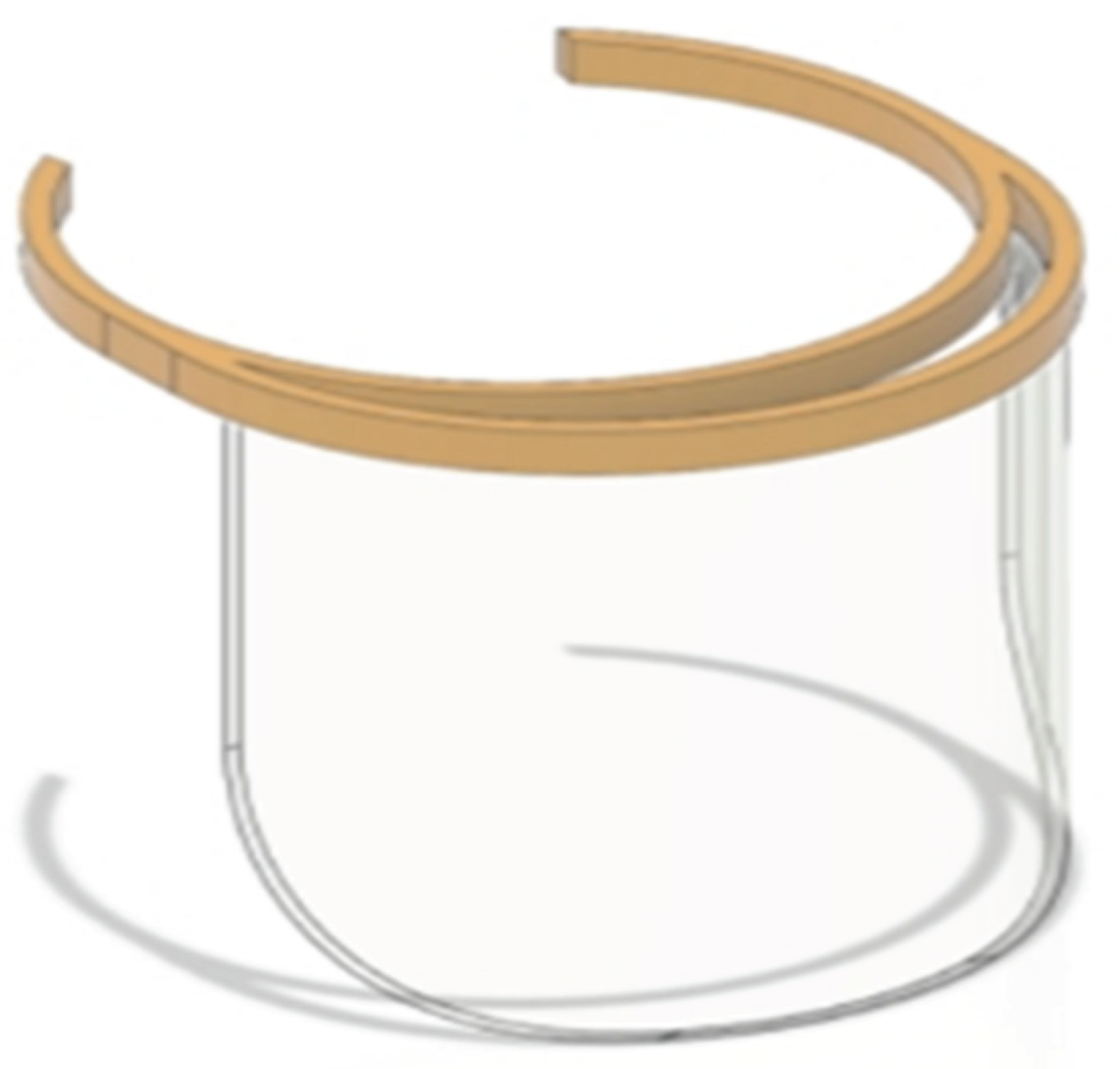
Figure 2.
Detached modular disinfectant reservoir and male–female click-lock attachment interface.
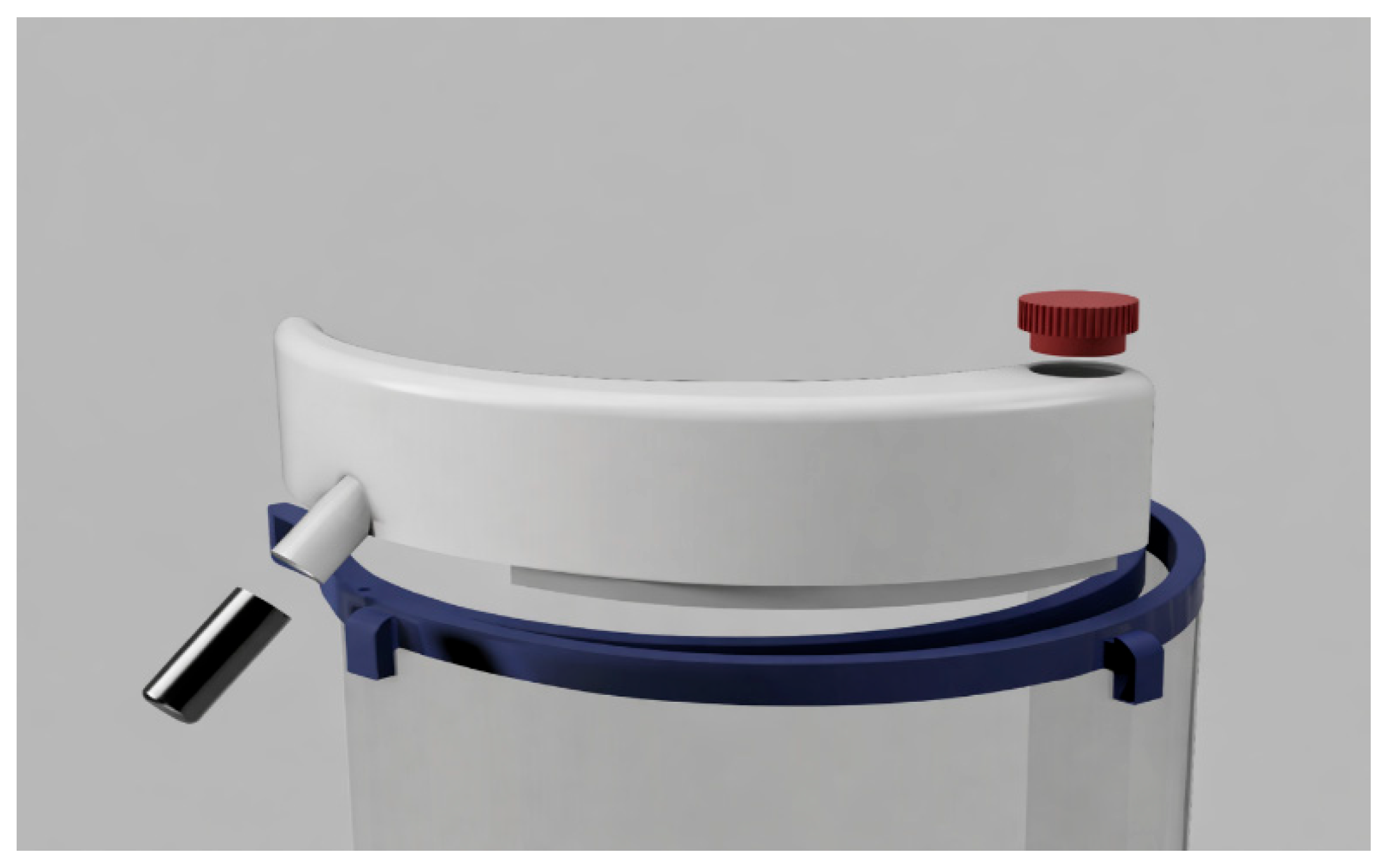

Table 1.
Materials and components used for prototype development.
| Component | Material / Product | Manufacturer / Origin |
| Visor | Transparent PETG sheet, 0.20 mm thickness | Plaskolite LLC, Columbus, OH, USA |
| Cranial frame | PETG filament, 1.75 mm | Prusament PETG, Prusa Polymers a.s., Prague, Czech Republic |
| Reservoir module | PETG filament, 1.75 mm | Prusament PETG, Prusa Polymers a.s., Prague, Czech Republic |
| Reservoir cap | PETG filament, 1.75 mm | Prusament PETG, Prusa Polymers a.s., Prague, Czech Republic |
| Sealing gasket | TPU 95A flexible filament, 1.75 mm | Commercially available TPU 95A filament, local supplier, Galati, Romania |
| Disinfectant | Mikrozid AF Liquid | Schülke & Mayr GmbH, Norderstedt, Germany |
| Head fixation | Adjustable medical/technical elastic textile band | Prym Consumer Europe GmbH, Stolberg, Germany |
| Fastening elements | Stainless-steel miniature screws and press-fit connectors | Würth Group, Künzelsau, Germany |
| Dispensing valve | Ball-type self-sealing dispensing valve | Commercially available self-sealing valve, local supplier, Galati, Romania |
Table 2.
Measurement plan for dimensional, mass, and capacity assessment.
| Parameter | Instrument | Repetitions | Reporting |
| Linear dimensions | Digital calliper | 3 per site | Mean ± SD |
| Component mass | Analytical balance | 3 per configuration | Mean ± SD |
| Reservoir capacity | Gravimetric method | 3 per reservoir | Mean ± SD |
| Wall thickness | Digital calliper | 3 per site | Mean ± SD |
Table 3.
Functional bench-testing endpoints and acceptance criteria.
| Test | Endpoint | Acceptance criterion |
| Dispensing consistency | Mean dose and CV | 3.0 ± 0.5 mL; CV <15% |
| Valve resealing | Dripping after activation | No continuous leakage |
| Positional leak test | Visible leakage and mass loss | No leakage; mass loss <0.1 g |
| Pressure resistance | Leakage/deformation at 0.2 bar | No leakage; deformation <0.2 mm |
| Attachment cycles | Interface stability after 100 cycles | No cracks; no functional loosening |
| Retention force | Force before detachment | ≥10 N in all tested directions |
| Actuation force | Force required for full valve depression | 8–12 N operating range |
Table 4.
Final technical specifications of the integrated face-shield prototype.
| Component | Material | Final specification | Interface / mounting | Functional role |
| Visor | PETG sheet | 230 x 230 mm; 0.20 mm thickness; laterally curved | Attached to the double-arch frame | Frontal and lateral facial protection |
| Cranial frame | FDM-printed PETG | Double-arch geometry | Supports visor and reservoir module | Load distribution and structural support |
| Head fixation | Adjustable elastic band | Posterior fixation system | Connected to cranial frame | Head retention and fitting adjustment |
| Reservoir module | FDM-printed PETG | Modular capacities: 25, 50, 75, and 100 mL | Detachable male-female click-lock interface | Disinfectant storage and lateral mounting |
| Sealing element | TPU 95A gasket | Flexible sealing interface | Integrated between reservoir and cap | Leakage prevention |
| Dispensing valve | Ball-type self-sealing valve | Approximately 3 mL per activation | Touch-activated; positioned outside optical field | On-demand disinfectant delivery |
Abbreviations: PETG, polyethylene terephthalate glycol-modified; FDM, fused deposition modelling; TPU, thermoplastic polyurethane.
Table 5.
Dimensional and mass outcomes of the integrated face-shield prototype.
| Parameter | Nominal value | Measured value, mean ± SD (95% CI) | Deviation | Acceptance |
| Visor width | 230 mm | 230.4 ± 0.6 mm (95% CI: 228.9–231.9) | +0.17% | Passed |
| Visor height | 230 mm | 229.8 ± 0.5 mm (95% CI: 228.6–231.0) | −0.09% | Passed |
| Visor thickness | 0.20 mm | 0.21 ± 0.01 mm (95% CI: 0.19–0.23) | +5.0% | Passed |
| Reservoir wall thickness | 1.2–1.4 mm | 1.31 ± 0.06 mm (95% CI: 1.16–1.46) | — | Passed |
| Empty reservoir mass | — | 20.94 ± 0.03 g (95% CI: 20.87–21.01) | — | Recorded |
| Complete empty system mass | — | 103.4 ± 0.4 g (95% CI: 102.4–104.4) | — | Recorded |
| Complete full system mass | — | 203.4 ± 0.5 g (95% CI: 202.2–204.6) | — | Recorded |
Table 6.
Capacity verification of the modular disinfectant reservoirs.
| Reservoir | Nominal capacity | Measured capacity, mean ± SD (95% CI) | Deviation | Acceptance |
| 25 mL | 25 mL | 25.3 ± 0.4 mL (95% CI: 24.3–26.3) | +1.2% | Passed |
| 50 mL | 50 mL | 49.6 ± 0.5 mL (95% CI: 48.4–50.8) | −0.8% | Passed |
| 75 mL | 75 mL | 74.8 ± 0.7 mL (95% CI: 73.1–76.5) | −0.3% | Passed |
| 100 mL | 100 mL | 99.4 ± 0.8 mL (95% CI: 97.4–101.4) | −0.6% | Passed |
Table 7.
Functional bench-testing outcomes of the disinfectant-delivery module.
| Functional endpoint | Result | Acceptance criterion | Outcome |
| Valve activations | 100 | Completed without interruption | Passed |
| Mean dispensed volume | 3.08 ± 0.21 mL (95% CI: 3.04–3.12) | 3.0 ± 0.5 mL | Passed |
| Manual actuation force | 9.8 ± 0.7 N (95% CI: 9.3–10.3; range: 8.9–10.6) | 8–12 N operating range | Passed |
| Dose range | 2.71–3.46 mL | Within accepted interval | Passed |
| Coefficient of variation | 6.8% | <15% | Passed |
| Failed activations | 0/100; transient early priming variability noted | No failed activations; early variability recorded | Passed |
| Continuous post-activation leakage | 0/100 continuous leakage; occasional small residual outlet droplet early in testing | No continuous leakage | Passed |
| Positional leak test | No visible leakage; mass loss <0.1 g | No leakage; mass loss <0.1 g | Passed |
| Static pressure test | 0.2 bar; no leakage | No leakage at 0.2 bar | Passed |
| Post-pressure deformation | 0.05 mm | ≤0.2 mm | Passed |
| Attachment–detachment cycles | 100 cycles; mild superficial contact wear, no functional loosening | No cracks or functional loosening | Passed |
| Vertical retention force | 18.4 ± 1.6 N (95% CI: 14.4–22.4) | ≥10 N | Passed |
| Lateral retention force | 15.7 ± 1.2 N (95% CI: 12.7–18.7) | ≥10 N | Passed |
| Anterior–posterior retention force | 21.1 ± 1.8 N (95% CI: 16.6–25.6) | ≥10 N | Passed |
Table 8.
Chemical compatibility and mechanical durability outcomes of the PETG reservoir.
| Test | Quantitative outcome | Acceptance criterion | Outcome |
| PETG mass change after 14 days | +0.33 ± 0.05% (95% CI: 0.21–0.45) | ≤1% | Passed |
| Dimensional deformation after immersion | 0.04 ± 0.02 mm (95% CI: −0.01–0.09) | ≤0.2 mm | Passed |
| Optical-transparency loss at 550 nm | 1.7 ± 0.4% (95% CI: 0.7–2.7) | ≤5% | Passed |
| Repeated wiping resistance | 50 cycles; optical transparency 98.3 ± 0.5% of baseline; mass change 0.12 ± 0.03% | No visible optical or structural deterioration; mass change ≤1% | Passed |
| Visual surface inspection | No relevant clouding, swelling, or discoloration; minor handling marks only | No visible functional material alteration | Passed |
| Reservoir storage at 25 °C | 7 days; no leakage or deformation | Preserved sealing integrity | Passed |
| Reservoir storage at 60 °C | 48 h; no leakage or deformation | Preserved sealing integrity | Passed |
| Fill–drain cycling | 50 cycles; no measurable leakage; slight increase in perceived activation resistance | No leakage or valve failure | Passed |
| Static pressure resistance | 0.2 bar for 10 min; no leakage | No leakage at 0.2 bar | Passed |
| Post-pressure deformation | 0.05 mm | ≤0.2 mm | Passed |
| Drop test | 15 impact events from 1 m; superficial impact marks only; no cracks, leakage, cap displacement, valve damage, or deformation >0.05 mm; post-drop activations within 3.0 ± 0.3 mL | No structural or functional failure | Passed |
| Microscopy | No stress-crazing at 20× | No microcracks or stress-crazing | Passed |
Table 9.
Mass-distribution and cervical-torque modelling outcomes by device configuration.
| Configuration | Total mass (g) | COM from band, mm (+ anterior) | Axis-band offset (mm) | Effective lever arm (mm) | Estimated torque, τ (N·m) | Increase vs head-only baseline |
| Basic shield without reservoir | 83.4 | +17.6 | 85 | 102.6 | 0.084 | +3.8% |
| Shield with empty reservoir | 103.4 | +31.5 | 85 | 116.5 | 0.130 | +5.9% |
| Shield with 100 mL filled reservoir | 203.4 | +49.5 | 85 | 134.5 | 0.282 | +12.8% |
Table 10.
Prototype-level direct cost estimate for the integrated face-shield system.
| Cost component | Estimated cost | Notes |
| PETG visor sheet | Included in basic shield estimate | Transparent protective screen |
| PETG filament for frame | Included in basic shield estimate | FDM-printed cranial frame |
| PETG filament for reservoir | Included in complete prototype estimate | Modular 25-100 mL reservoir |
| TPU 95A gasket | Included in complete prototype estimate | Sealing interface |
| Self-sealing valve component | Included in complete prototype estimate | Touch-activated dispensing system |
| Elastic band and fastening elements | Included in complete prototype estimate | Posterior fixation and assembly |
| Basic shield material cost | ~20 RON / ~EUR 4 | Prototype-level estimate |
| Complete integrated system | 50-100 RON / ~EUR 10-20 | Prototype-level estimate |
Disclaimer/Publisher’s Note: The statements, opinions and data contained in all publications are solely those of the individual author(s) and contributor(s) and not of MDPI and/or the editor(s). MDPI and/or the editor(s) disclaim responsibility for any injury to people or property resulting from any ideas, methods, instructions or products referred to in the content. |
© 2026 by the authors. Licensee MDPI, Basel, Switzerland. This article is an open access article distributed under the terms and conditions of the Creative Commons Attribution (CC BY) license (http://creativecommons.org/licenses/by/4.0/).
Copyright: This open access article is published under a Creative Commons CC BY 4.0 license, which permit the free download, distribution, and reuse, provided that the author and preprint are cited in any reuse.


