

Submitted:
23 July 2026
Posted:
24 July 2026
You are already at the latest version
Abstract
This conceptual paper re-imagines the application scenario of immersive technologies not merely as promotional add-ons or experiential devices, but as integral components of a hotel’s service communication and distribution architecture. Drawing upon information richness theory, signaling theory, information asymmetry, and transaction cost economics—with expectation-confirmation logic providing the link to during- and post-purchase outcomes—the paper conceptualizes hospitality digital twins as data-connected interfaces that illustrate heterogeneous offers, reduce pre-purchase uncertainty, support direct bookings, and align marketing communication with service-quality management through expectation calibration. An illustrative review of current immersive-technology providers reveals that commercial offerings predominantly remain limited to basic visualization or promotional gimmicks with minimal connections to booking engines, CRM systems, analytics, or quality-management processes. In contrast, the theoretical analysis demonstrates that the true value of a hospitality digital twin extends far beyond visual realism toward a combination of richer information, verifiability, and deep system integration. By distinguishing visualization-only virtual tours from data-enriched interfaces and fully integrated digital twins, this paper highlights expectation calibration as the core mechanism through which pre-purchase transparency enhances trust, channel choice, booking quality, and post-purchase service outcomes. Consequently, hotel managers should approach digital twins as next-generation customer journey infrastructure rather than isolated promotional novelties, while future empirical studies across laboratory and field settings are encouraged to test how varying levels of interface integration affect guest satisfaction, complaint reduction, and direct distribution performance.
Keywords:
digital twin
; virtual reality
; immersive technologies
; information transparency
; expectation calibration
; tourism distribution
1. Introduction
The “heterogeneity and intangibility problems” have long hindered the development of tourism and hospitality industry (Kotler & Armstrong, 2010). As offerings can largely vary from room to room and from season to season, buying a hospitality service requires a customer to commit financially without being able to “trying-on” a hotel room, a cruise cabin, or a guided tour. Decisions, therefore, must be made from partial representations, photographs, short videos, reviews, ratings, and written descriptions, while the provider holds much more detailed knowledge of the property and its day-to-day conditions. This imbalance shapes both the promotion and distribution for tourism and hospitality services. It raises unilateral risk for consumers to absorb expectation-performance gaps, which is expected to lead to oppressed demands and possibilities for post-purchase dissatisfaction.
Immersive technologies have emerged as one potential solution to this long-lasting problem. Virtual reality (VR), three-dimensional environments, and interactive tours give prospective visitors a stronger sense of presence and spatial context than conventional webpages. Most of the prior work on VR has understandably focused on whether immersion makes a destination or property more appealing. For instance, research has associated these formats with telepresence, enjoyment, destination image, perceived value, and booking intention (Guttentag, 2010; Leung et al., 2020; Tussyadiah et al., 2018; Yung & Khoo-Lattimore, 2019; Yung et al., 2021). However, conceptualization of immersive technologies’ broader application beyond promotion and tech gimmick has been largely underdeveloped.
The commercial use of immersion technologies in the industry has grown even more narrowly than academic endeavors. In many hotel settings, the experience is still a 360-degree tour or a virtual showroom attached to an otherwise conventional website, or a rentable VR headset in-room (Atzeni et al., 2022; Elmashhara et al., 2024; Wang et al., 2024). On the promotion side, we observed that service providers typically only show partial of the reality, selectively showcasing only the best-view rooms and upper-deck cabins, making only a small portion of the benefits that immersive technologies could promise the tourism hospitality industry. On the booking side, customers may be able to look around a room in VR, but must then leave the tour to identify the room category, check availability, compare rates, and complete a reservation. In this process, customer data, service records, and post-stay feedback are generally handled in separate traditional systems. The resulting application is visually richer than a photograph, yet it does very little to change the underlying booking or quality-management process.
This gap is not explained by technical maturity alone. It also reflects the current limited perspective how immersive technologies has been framed and communicated. It is thus essential to extend the imagination, incorporating works on the metaverse and digital twins to start considering broader changes to the travel value chain (Buhalis et al., 2023a, 2023b; Verma et al., 2022; Wong et al., 2024). It leaves a different question largely open: what happens when an immersive representation becomes connected to inventory, prices, booking, customer profiles, and organizational learning?
We address that question by proposing hospitality digital twin as service infrastructure rather than simply as promotional or tech gimmick. The critical test is not whether a representation looks impressive, but whether it gives a prospective guest useful evidence about the offering and connects that evaluation to subsequent actions, tackling the “heterogeneity and intangibility problems”. This perspective brings marketing communication, distribution, and service-quality management into the same analysis beyond promotion. It also places expectation calibration at the center: richer and more transparent information may help customers choose an offering that fits their needs and enter the transaction with a more realistic understanding of what will be delivered.
The paper makes three related contributions.
- First, it develops a three-level distinction among visualization-oriented virtual tours, data-enriched immersive interfaces, and hospitality digital twins.
- Second, it combines information richness, signaling, information asymmetry, transaction cost economics, and expectation-confirmation logic to explain how pre-purchase inspection may influence trust, direct booking, and post-purchase outcomes.
- Third, it uses case studies and an illustrative provider review to show the current industrial landscape of immersive tech applications on this continuum, and the reasons why the links to booking, customer relationship management (CRM), analytics, and quality management remain the principal implementation gaps.
The study follows a conceptual research design (Lee & Kim, 2026). Multiple business theories are used to support a sequence of mechanisms and to derive propositions that can be later examined empirically. The case studies and the provider review anchors the raised issues in observable market offerings, and identifies recurring differences in adoption depth between visualization and comprehensive integration.
In the following, Section 2 defines the three levels of immersive representation and develops the theoretical foundations, Section 3 examines the industry trajectory and current provider landscape, Section 4 presents the framework and propositions, Section 5 applies the framework to illustrative cases and the fragmented customer journey, and Section 6 discusses contributions, managerial implications, limitations, and research priorities for future studies.
2. Conceptual and Theoretical Foundations
2.1. Distinguishing Virtual Tours from Digital Twins
Virtual tours and digital twins describe different forms of digital representation. A virtual tour provides remote users visual accesses to a physical setting and may allow spatial sensation, but it is usually a relatively static presentation with limited interactivity and information richness (Elmashhara et al., 2024). A digital twin is a persistent representation that proffers immersive visualization but also can be linked to data, updated, and integrated with processes outside the visual model (Toubia et al., 2025). In a hotel context, a 360-degree view may reveal what a room looks like. While a more integrated digital twin could create a “replica” of the reality and connect the representation to room location in the building, room type, availability, price, booking options, customer preferences, service history, and feedbacks. In the vein, we define a hospitality digital twin as a persistent, interactive, and data-enriched representation of a hospitality environment that supports customer evaluation, transactions, and organizational learning. This definition excludes stand-alone tours while allowing for service-oriented applications that do not reproduce every feature of an engineering twin. Related work has begun to consider digital twins as a source of tourism competitiveness (Litavniece et al., 2023).
Table 1 organizes these immersive technology applications into three levels according to media richness and system sophistication. At the first level, a visualization-oriented virtual tour provides static or semi-interactive access to a room, facility, or destination. At the second, a data-enriched interface adds information that helps the user interpret what is shown, such as amenities, room attributes, prices, availability, maps, or booking links. The third level connects the immersive representation to organizational systems, including booking engines, CRM, analytics, operational databases, and quality-management processes. The difference is not merely one of visual quality. It concerns what data are connected, what actions the user can complete, and whether the organization can learn from the interaction.
These service-oriented use of the terms is worthy of careful examination. Engineering definitions commonly emphasize real-time, bidirectional synchronization between a physical asset and its digital replica (Barricelli et al., 2019; Fuller et al., 2020; Jones et al., 2020; Tao & Qi, 2019), with few consumer-facing hospitality applications meeting the threshold. Rather than labeling every 3D tour as a digital twin, we place applications on a continuum of integration. The lower end supports inspection; the upper end connects inspection with search, comparison, booking, personalization, feedback, and service improvement. The conceptual argument in this paper concerns movement along that continuum, especially the transition from a visual representation to an interface that participates in service delivery and organizational learning.
2.2. Hospitality Distribution Under Information Asymmetry
Hospitality offerings are difficult to evaluate in advance because they are experiential, variable, and consumed in the setting in which they are delivered (Kotler & Armstrong, 2010). Photographs and descriptions can communicate selected attributes, but they cannot fully convey room proportions, views, noise exposure, access to facilities, or the condition of a property at a particular time. Travelers usually must infer service quality from indirect evidence such as brand reputation, word-of-mouth (WOM), and online reviews on platforms like TripAdvisor and Yelp.
Hospitality consumers enter transactions with information disadvantages. While a hotel has near-perfect information about the differences among different room layouts, maintenance conditions, views, operating constraints, and service routines; a customer sees only what the supplier and other users made visible and easy to access. When the available evidence is incomplete, selective or too costly to process, unilateral risk rises, and consumers may misjudge the fit between their preferences and the eventual service experience. While extensive past efforts have been spent on improving service “quality” by providers, little was allocated in increasing the “fit” between guests’ expectations and the information they had access to.
Information asymmetry has consequently influenced the organization of hospitality distribution (Manes & Tchetchik, 2018). Travel agencies and online travel agencies (OTAs) aggregate alternatives, standardize some information, and lower search costs. It is observed from industry that some traditional travel agencies intentionally advertise on the prevalent information asymmetry, persuading consumers to buy via agencies to be “assigned a better room”. Hotels, however, also have reasons to strengthen direct channels, including lower commissions and greater control over the customer relationship. A supplier-owned channel becomes more competitive when it provides credible information that a customer cannot obtain as easily from an intermediary, and when traditional heterogeneity and intangibility problems are communicated with higher transparency and trustworthiness.
An immersive representation can contribute to this goal by bridging the information gap and revealing attributes that matter to the purchase decisions. A prospective guest may use a digital twin to inspect the relationship among rooms and facilities, compare layouts, or understand the surrounding area before booking. Though such inspection does not remove all information asymmetry and a selective or outdated twin could create new problems, its potential remains largely unrealized, and its contribution and depends on whether the representation is sufficiently complete, current, and connected to the actual offering.
2.3. Information Richness Theory
Information richness theory explains why some communication media are better suited to uncertain or ambiguous tasks. A richer medium carries multiple cues, allows feedback, and helps users interpret complex information (Daft and Lengel, 1986). Hospitality evaluation is a suitable setting for this context because a traveler is trying to understand a multi-sensory experience that cannot yet be consumed.
Text and 2D photographs are media formats with limited information richness. They can convey some information about price, style, and selected features, but they require audience to infer spatial, temporal, and multisensory information through imagination or guessing. The incomplete information problem cannot be solved by only adding more texts and photos. Due to the low efficiency in these media formats in carrying information, the costs of time and effort will proportionally increase when a consumer try to gather larger amount of information before purchase.
Immersive and interactive media formats, on the other hand, can communicate richer information in faster and more interesting ways. Attributes can be made directly observable and combined with contextual information such as amenities, availability, and booking options. Evidence from metaverse-mediated hospitality linked media richness with perceived realism and engagement (Cheung et al., 2024). Besides immersion, the other advantage is diagnosticity when it helps consumers select between alternatives.
2.4. Signaling Theory
Signaling theory focuses on how observable cues are used to infer qualities that cannot be verified before a transaction (Spence, 1973). In hospitality, the customer pays before experiencing most of the service, so claims about quality, authenticity, and fit must be assessed through signals.
Brands, star ratings, awards, certifications, price, reviews, and professional photography all perform this role of signaling, and their credibility varies. A carefully framed image may be attractive while omitting a limited view, an awkward room shape, or the distance between facilities. So, the concern is not that promotional communication is necessarily deceptive, but that it gives the provider considerable control over which aspects of the experience are visible, and leaves the perceiver little control over what to see and what to trust, especially in an era of ubiquitous generative AI (gen-AI) and deepfake videos.
A navigable digital and immersive representation is promising in changing the form of the signal by giving users more control over inspection. Customers can follow their own path through a space and focus on attributes that matter to them rather than relying only on a supplier’s selected images to present. It has the potential to make quality claims easier to evaluate by consumers, and may enhance perceived transparency, trust, and confidence in purchase, on condition of mindful maintenance where critical weaknesses are not intentionally excluded, and data continues to be updated. The signal becomes credible when the representation is sufficiently comprehensive and costly to misrepresent.
2.5. Transaction Cost Economics
Transaction cost economics studies the hidden costs required to complete an exchange besides monetary price (Williamson, 1985). In a hospitality search, these costs include time, effort, psychological stress, and opportunity costs when locating comparable information, reconciling inconsistent room descriptions, checking reviews, assessing uncertainty, and moving among different websites or applications.
A traveller’s online journey often distributes these tasks across several providers’ interfaces. A traveler may inspect photographs on a hotel website, read reviews on TripAdvisor, consult Google maps for the location, compare rates on an OTA, and then return to a booking platform. Fragmented information and distributed responsibility increase cognitive effort and perceived risks, thus can make many intermediaries such as travel agencies to be even more attractive than the supplier’s direct channel. Tourism intermediaries often advertise on the private information, experience, connection, and quick responses within transactions.
A data-connected digital twin could plausibly reduce some of these transaction frictions by bringing spatial inspection, room comparison, contextual information, and booking into one environment from trusted sources, often the direct service providers. AI-supported search or recommendation may further reduce effort when it helps users interpret the available options. Integration, however, is essential. A virtual tour that ends with an external link merely adds another step to the journey; it does not materially lower the transaction costs associated with booking.
2.6. Toward a Unified Conceptual Framework
These theoretical perspectives above have usually been applied separately in hospitality and tourism research. Studies of virtual reality have emphasized outcomes such as telepresence, destination image, brand experience, enjoyment, booking intention, and visit intention (Bogicevic et al., 2019; Hyun & O’Keefe, 2012; Israel et al., 2019; Ying et al., 2022). These works explained important psychological responses but invested less attention to the organizational consequences of connecting an immersive representation to distribution and service systems, beyond what are already applied in the industry (Yung & Khoo-Lattimore, 2019).
The perspectives thus become more useful when they are treated as parts of an integrated process. A richer representation can improve diagnosticity; diagnostic information can make a supplier’s claims more transparent; transparency can reduce uncertainty and help a customer form a more accurate expectation; and integration with booking can lower the effort required to act on that evaluation. Expectation calibration is the bridge to the post-purchase stage because it concerns whether the customer’s understanding before booking corresponds to the service later delivered. Section 4 develops this sequence formally after the next section examines how industry applications have evolved.
3. From Virtual Tours to Digital Twins: Evolution of Immersive Technologies in Hospitality
3.1. The Evolution of Immersive Technologies in Hospitality
Hospitality communication has shifted from textual descriptions to digital photography, video, and interactive tours. Each format has expanded what a prospective guest can inspect before purchase, although not every advance has changed the way the transaction itself is organized (Buhalis & Law, 2008). This trajectory is also part of the broader development of smart tourism, in which data and connected technologies influence how destinations and firms create value for consumers (Gretzel et al., 2015).
VR extended this progression by allowing users to navigate guestrooms, public spaces, attractions, and surrounding environments with autonomy. Compared to video-viewing must be in a fixed sequence from start to finish, certain types of VR or 3D models present an overview of the entire property allowing users to freely click and explore their interested parts and skip the rest. Tourism research has examined VR as a tool for destination marketing, hotel presentation, heritage interpretation, and customer engagement (Guttentag, 2010; Tussyadiah et al., 2018).
Commercial adoption of VR and immersive technologies has nevertheless remained concentrated in the promotion side. Most hospitality applications are stand-alone tours, or 360-degree videos embedded in a website or hosted on an external platform such as YouTube. They may improve a visitor’s understanding of a space, but they rarely change how availability is checked, how a room is selected, how payment is completed, or how information from the interaction reaches operational staff beyond the promotional side.
Digital twins extend the technical possibilities which representation can persist, receive updated data, and connect with operational systems, customer records, reservation platforms, geographic information systems, and AI applications (Fuller et al., 2020; Jones et al., 2020). These capabilities create the possibility of a different role for immersion.
3.2. From Promotion to Strategic Infrastructure
The shift proposed here is from an isolated viewing experience to a connected decision environment. In our conceptualization, in the future customers should be able to navigate total floor plans in 3D, inspect rooms, identify exact categories, compare relevant alternatives, view price and availability, and proceed to bookings without reconstructing the same information on another page. For the organization, the same interface should be able to record data along customer journey, so that Big Data analytics should be able to reveal which attributes attract attention or create uncertainty and can connect those observations to CRM and quality-management processes. Figure 1 presents this progression from conventional online media to an AI-enabled, system-integrated infrastructure.
3.3. Current Industry Ecosystem
To compare the conceptual argument with current industrial practices, we reviewed a purposive set of immersive-technology and digital twin providers. The selection was designed to cover different points on the integration continuum rather than to produce an exhaustive directory. And we believe the present digital twins remain in very early stage without fully demonstrating their true potential.
Providers were included when their technologies were relevant to hospitality, tourism, real estate, destination marketing, or facility management; when they represented a distinct position between visualization and enterprise-level digital twins; and when enough public material was available to assess their capabilities. Official websites, product documentation, platform descriptions, and published cases were examined using five dimensions: hospitality relevance, digital twin capability, booking integration, analytics, and organizational application. Booking integration and analytics are reported on a four-level ordinal scale (None, Basic, Moderate, Advanced). AI features are described qualitatively because the disclosures are not sufficiently consistent for direct comparison. The resulting assessment should be read as an illustrative market map based on public claims, not as an independent technical audit. Table 2 summarizes the providers, and Section 5 examines four examples in greater details.
3.4. Industry Gaps
The provider review points to three gaps between the available technology and its use in hospitality.
The first is an outcome gap. Immersive applications are commonly justified through traffic, viewing time, engagement, or promotional reach. Those measures are highly relevant, but they inform little about whether a virtual tour improves room selection, increases direct booking ratio, lowers distribution costs, enhances disintermediation, or prevents avoidable service failures. Practitioner accounts of metaverse adoption show a similar emphasis on near-term experiential and promotional uses, while deeper integration remains less certain (Ashton et al., 2025).
The second is an interface gap. Many products placed a link to a reservation page inside or beside the experience, such as the hotel website links in the Google Maps. Yet customers still must leave the immersive environment and enters a conventional booking flow. Room names, prices, and availability may not be accurate or updated on the interface and must be located again in other traditional websites. With TikTok recently started to develop a TikTok GO function to allow users to book hotels and experiences through the app (TikTok USDS Joint Venture LLC., 2026), the break interface gap is expected to last in a foreseeable future, which weakens continuity and limits the amount of decision data that can be carried into the transaction.
The third is an organizational learning gap. Current applications seldom connect what customers inspect before purchase with complaint patterns, service recovery, facility decisions, or post-stay feedback. To our best knowledge, no prior research has linked the prediction of post-purchase complaints from recorded customer expectations from systems, because such data has not been effectively collected through booking systems. Should our proposed framework to be adopted, hospitality service providers may be able to expand new ways to collect behavioral logs about the users time-spent examining a pool, a meeting room, or a particular room view. Such information has tremendous unrealized value until it is systematically documented, interpreted, and fed into operational decisions.
These gaps suggest that the main constraint is not the absence of immersive visualization. It is the weak connection among representation, transaction, and organizational learning. The framework in the next section explains why those connections are crucial.
4. A Conceptual Framework for Digital Twins in Hospitality
The distinction developed above fundamental challenges and re-imagines the long-term blueprint of immersive technologies development in hospitality. When immersion is treated as a media format like text and videos, the main outcomes are attention, presence, attitude, and intention. However, when we reconceptualize it as service infrastructure and interface, the analysis must also include information quality, channel design, booking continuity, and organizational feedback. A hospitality digital twin can then be evaluated by what it allows customers and firms to do, not simply by how much attention it attracts.
Figure 2 illustrates our propositions with relevant theoretical supports. The digital twin first affects the richness and diagnosticity of the information available to the customer. With credible and inspectable information about products, it can increase perceived transparency and reduce information asymmetry. Transparency supports expectation calibration, which in turn influences trust, the quality of demand, dissatisfaction, and reduction of complaints. System integration and data analytics determines whether these consumer-level effects translate into direct booking and organizational learning.
4.1. Information Richness
Some media formats inherently can carry richer information that others, for example VR can embed spatial information, and audio can embed auditory cues (Daft and Lengel, 1986). Information richness is a key concept because an immersive environment can communicate spatial and contextual details that are difficult to convey through photographs and videos. In tourism and hospitality, a guest can examine the relationship among rooms and facilities, compare layouts, and view the property from perspectives chosen during the search in VR. These affordances are expected to improve both the amount of relevant information and its diagnostic value (Jiang and Benbasat, 2004; Leung et al., 2022).
The benefits will be more prominent when contextual data are placed inside the immersive representation. Room categories, amenities, accessibility features, price, and availability allow the user to interpret the space as a purchasable service rather than a promotional material. A highly realistic tour with no connection to the actual inventory may be engaging, but its usefulness for evaluation remains limited.
Proposition 1.
Relative to photographs, conventional video, and visualization-only virtual tours, a data-integrated hospitality digital twin will increase perceived information richness and diagnosticity during pre-purchase evaluation.
4.2. Information Transparency
More information does not necessarily produce higher trust nor a favorable decision. With given information, customers must also believe the representation is relevant, current, and reasonably complete to support decision-making. With increasing uses of AI-generated or AI-enhanced videos, video as a media format is expected to shrink in credibility as a traditionally believed evidence of recorded events (Gao et al., 2026). A digital twin can increase transparency when it allows users to inspect service attributes with autonomy rather than infer them from a handful of suppliers’ selected promotional materials.
This distinction separates richness from transparency, as richness concerns how much and what kind of information the medium can carry, and transparency is related to whether the information gives the user a credible view of conditions and foster trust in the provided information. A detailed model can be rich but not transparent if it omits important spaces or is disconnected from the room being advertised.
When relevant attributes become easier to observe and compare, the informational advantage held by the provider is reduced and the customer can evaluate the offering with greater confidence (Akerlof, 1970), pointing to the concept of diagnosticity, or the extent to which information provided by a medium helps consumers evaluate a product or service and make informed purchase decisions (Jiang & Benbasat, 2004). Diagnosticity is expected to provide the mechanism through which richness is expected to influence transparency.
Proposition 2.
Perceived diagnosticity will mediate the relationship between Digital twin richness and perceived transparency; a representation will be judged more transparent when it enables independent inspection of service attributes that are relevant to the booking decision.
4.3. Expectation Calibration
Expectation calibration describes the extent to which a customer’s pre-purchase understanding corresponds to the service that is likely to be delivered (McLean and Barhorst, 2022). Dissatisfaction can follow poor performance, but it can also arise when the experience differs from what the customer believed was being purchased. Selective photographs, heterogeneous room categories, and omitted contextual details can inflate or distort consumer expectations, creating a gap that becomes visible only after arrival. Expectation-confirmation theory locates satisfaction in the comparison between prior expectations and perceived performance (Oliver, 1980). The present framework adopts this theory to support the expected enhancement of quality by bringing consumer expectation closer to the real products (Jiang and Benbasat, 2004).
A digital twin can contribute to such calibration by clearly revealing previously hidden differences among rooms, views, layouts, facilities, and surroundings and enable early online inspection. It grants potential guests enough clues to decide whether a particular offering suits their preferences. Some users may decide not to book after seeing a limitation; that response may still be valuable if it prevents a poor match and a predictable complaint. But those users who examined and booked are more likely to be satisfied with their informed choices.
Proposition 3.
Perceived transparency improves expectation calibration by enabling accurate service expectations before purchase.
Proposition 4.
Calibrated expectations increase consumer trust by reducing uncertainty about the supplier claims and consumption.
Proposition 5.
Calibrated expectations reduce post-purchase dissatisfaction and complaint likelihood.
4.4. Consumer Trust and Direct Booking
Consumer trust is crucial in all industries, particularly in hospitality where payment and commitment precede most of the service delivery. Earning consumer trust is essential amongst the process of overcoming skepticism and reducing transactional uncertainty, as identified in metaverse-related hospitality research (Chakraborty et al., 2025).
The trust and confidence on the service providers strongly affect consumer channel choice. In hospitality, hotels have long sought to strengthen direct relationships and reduce dependence on OTAs, known as the disintermediation trend (Law, 2009; Law et al., 2015). A digital twin can support direct distribution channels when the information and transaction remain connected on the supplier’s platform. This has a vast potential in challenging current distribution status quo if it can keeps direct booking within suppliers’ own portals.
Transparency, however, is not expected to increase every conversion. An accurate representation will make both strengths and limitations more visible. Customers whose preferences do not fit the property may leave, while well-matched customers may book with greater confidence. The relevant outcome is not only booking volume but the composition and quality of demand, including subsequent satisfaction and loyalty.
Proposition 6.
Consumer trust increases direct-booking intention, stronger when the digital twin is embedded in a supplier-owned booking flow.
Proposition 7.
Product-consumer fit moderates the effect of digital twin transparency on booking outcomes.
4.5. Quality Management
Most studies of hospitality immersion end at pre-purchase outcomes such as destination image, attitude, telepresence, or booking intention (Bogicevic et al., 2019; Hyun & O’Keefe, 2012; Israel et al., 2019; Ying et al., 2022). These outcomes capture whether a customer responds favorably to the technology, but not whether the information improves the eventual service relationship. With limited real data of conversion rate, transaction size, and booking timing, Big Data analytics have been relatively rare to inform more nuanced data-driven decisions.
With click stream log data and purchase records, integrated digital twin systems extends the possibilities of data analysis beyond the self-reported purchase intentions in customer surveys. When customers understand what a room or facility offers and only make informed purchases, fewer complaints are expected to arise from avoidable mismatches between marketing communication and delivery. This does not eliminate dissatisfaction caused by service failures, but it separates failures of execution from failures of mis-representation. The distinction is crucial for quality management and service failure recoveries.
The integrated data offers a second route to quality improvement when optimizing “moments of truth” along customer journey. Search paths, room comparisons, repeated questions, abandoned selections, booking choices, and post-stay feedback can reveal where customers are uncertain or where particular attributes influence decisions. If fully used, these data can inform interface design, room descriptions, facility investment, personalization, and operational priorities. However, clickstream data only becomes learnt organizational knowledge through deliberate analytics, integration, and governance.
Proposition 8.
Digital twins will contribute to quality management when collected data are combined in organizational learning and improvements.
4.6. Boundary Conditions and Potential Trade-Offs
As of boundary conditions, the above proposed hospitality digital twins’ effects on 1) information richness, 2) information transparency, 3) expectation calibration, 4) consumer trust and direct booking, and 5) quality management should be strongest where customers face substantial uncertainty or risks. Resorts, boutique hotels, cruise cabins, vacation rentals, and conference venues often contain meaningful variation in layout, access, surroundings, and facilities. In those settings, additional inspection can change the evaluation. The incremental value may be smaller for a standardized economy property or a familiar chain where repeat customers already know what to expect, and more prominent for luxury, customizable or high unique hotels. It is also expected to be stronger for risky offers, including financially risky purchases like fixed-date Antarctica cruise holidays, physical risky activities such as skydiving, and psychological risky experience such as ghost hunting tours (Kotler & Armstrong, 2010).
Customer experience is also expected to be boundary conditions, with first-time and international customers perceive digital twins more favorably. Transparency is also expected to have a nonlinear effect: it may reduce total conversion by revealing limitations even as it improves the fit and quality of the bookings that remain. Finally, information richness can become information overload. Excessive visual detail, poor navigation, inaccessible design, or fragmented data layers may increase effort instead of reducing it. The value of the twin depends on information organization, credibility, usability, accessibility, and system integration as much as on visual sophistication.
Proposition 9.
Digital twins’ effects on 1) information richness, 2) information transparency, 3) expectation calibration, 4) consumer trust and direct booking, and 5) quality management are stronger where customers face substantial uncertainty or risks.
Proposition 10.
Digital twins’ effects on 1) information richness, 2) information transparency, 3) expectation calibration, 4) consumer trust and direct booking, and 5) quality management are stronger for first-time and international customers.
Table 3 brings the 10 propositions together and identifies their theoretical basis and possible empirical measures.
5. Applying the Framework: Illustrative Industry Cases
This section applies our theoretical framework into analyzing industry cases for illustration about the logics. We selected multiple tourism and hospitality service providers from 1) hotels, 2) VR/3D tour makers, and 3) digital map providers to examine the current state of immersive technology application in the marketplace. The provider landscape offers a practical way to examine what our framework adds to the understanding and reimagination of existing tech applications in hospitality. Representing different positions on the continuum: a hotel, a platform that produces detailed spatial models, a hospitality-oriented tour provider, and geographic platforms used during destination search, they show which mechanisms are already supported and where the customer journey still breaks apart.
This use of cases follows the logic of illustration described by Eisenhardt (1989) and Siggelkow (2007) to make the conceptual distinctions concrete and to identify questions that lead to what later comparative studies could examine.
5.1. Expectation Calibration Problem Among Hotel Rooms and Cruise Cabins
Hospitality products are inherently heterogeneous. For hotels and cruises, even within the same room category, there exist substantial differences in floor/deck level, room size and shape, orientation, surrounding buildings, views, or landscape from room to room. Static promotional photographs inevitably only represent a hand-picked subset of these variations. Figure 3 illustrate this challenge using photographs from an 807-room Marriot hotel with substantially varying room size, and Figure 4 shows a 5-star luxury hotel has varying window view under the same price and room type. This problem is particularly salient for location-centric properties nearby local landmarks such as a pyramid, while promotional materials must emphasize an unobstructed view from the hotel, actual rooms that consumers receive may only have partial or blocked views. Though some hotels provide more divided room types like street view or garden view for customers to choose from, the heterogeneity problem is only attenuated than solved, and consumers are still left to be “assigned” a room subject to availability and service providers’ subjective anticipation of consumer preferences. Similarly, Figure 5 shows a traditional cruise floor plan where all decks and cabins are presented as equal, without showing how the customer experience differ among all the options.
From the perspective of information asymmetry, prospective guests cannot easily distinguish all these differences before purchase. The resulting expectation-performance gap may contribute to avoidable dissatisfaction and post-purchase complaints. We propose that a hospitality digital twin could reduce this asymmetry by enabling room-specific inspection before booking, thereby improving expectation calibration.
5.2. Matterport: Digital Documentation as Immersive Communication
Matterport is an immersive tech solution provider that captures and models physical spaces for use in real estate, construction, facilities management, retail, museums, and hospitality. In a hotel, the platform can present guestrooms, meeting areas, restaurants, and shared facilities in a navigable three-dimensional environment. The result is more detailed than a conventional gallery and can preserve spatial relationships that are difficult to infer from separate photographs.
These details can be diagnostic for prospective guests. Room dimensions, furniture placement, routes between facilities, and the relationship between public and private spaces become easier to assess with Matterport. The value is particularly clear for meeting venues in which layout affects the purchase decisions.
The limitation of Matterport’s current solution is that the spatial model and the transaction are often separate, with limited possibility for continuous updates and information addition. Availability, pricing, room-category logic, CRM, and quality-management functions usually sit outside the Matterport tour. Matterport illustrates both sides of our proposed continuum: technically sophisticated representation and only limited integration with distribution and service processes in many hospitality deployments.
5.3. Mass Interact 3D Tour: Immersive Marketing for Hospitality
Mass Interact 3D Tour is a tech solution provider more directly oriented toward hotels, resorts, visitor attractions, universities, and destination organizations. Its services emphasize presentation and engagement, allowing an organization to guide users through rooms, meeting venues, recreational facilities, and other points of interest.
This service focus makes the platform useful for communicating configurations where static media communicates poorly. With Mass Interact 3D Tour, a prospective visitor can move among facilities and develop a clearer sense of how the property is organized. The application can support branding and pre-visit understanding at the same time.
Its current strategic role nevertheless remains close to marketing. Booking, dynamic pricing, customer analytics, and quality-management systems are not usually experienced as one continuous environment. The case shows that sector-specific presentation does not by itself produce an integrated digital twin.
5.4. Google Street View and Baidu Maps: Immersion Within Geographic Platforms
Google Street View and Baidu Maps occupy a different position. As independent travellers frequently utilize digital maps for travel planning and booking, immersive imageries have been added to these map tools to connect user to hospitality offers while users are searching for a destination, route, neighborhood, or nearby attraction. The combination of imagery and geographic context helps travelers evaluate access, surroundings, transportation, and proximity to other services.
These platforms’ strengths are discovery and context. They reduce uncertainty at the destination level and are particularly in communicating the location information of a hospitality offering, but they are commonly not directly connected to a property’s room inventory, customer profile, service customization, or quality-management process. Users must click to outside links for more information and for bookings. Their limitation is the absence of a supplier-controlled path from inspection to booking and learning.
5.5. Comparative Analysis
Taken together, the cases show that information richness is already achievable, while organizational integration is largely absent. Hotels and cruises have paused at communicating rooms and cabins as standardized despite largely observed heterogeneity. Matterport offers detailed spatial inspection, Mass Interact provides hospitality-specific presentation, and the mapping platforms add geographic context. None routinely combines those strengths with advanced booking, CRM, personalization, and post-purchase learning in a single customer journey. Table 4 summarizes the comparison and uses the proposed framework as a benchmark.
5.6. Journey Fragmentation and Transaction Costs
The comparison reveals a structural problem that is easy to miss when individual technologies are assessed in isolation and widely adopted at the surface level. Hospitality purchasing is a sequence: customers discover a property, compare alternatives, inspect room categories, check availability, book, pay, and later evaluate the stay. It is observed that current immersive tools usually improve only the inspection stage, so the later stages must be directed and fragmented in other systems, increasing transaction costs for consumers.
Consumers must spend substantial mental resources in consolidating information from different sources and platforms, continuously making decisions what to search, see, and believe. Each interface break requires the customer to reconstruct context. After leaving a tour, a guest may need to remember the room category name, confirm that the displayed space corresponds to the available product, intentionally excluding the upsold options, compare a new set of prices, and re-enter dates and preferences. These steps increase search effort and create opportunities for abandonment or error. They also prevent the supplier from linking what the customer inspected with what was booked and how the stay was later evaluated.
Figure 6 contrasts this fragmented workflow with an integrated one. In the proposed model, search, inspection, room comparison, direct booking, and payment remain connected through the same digital twin interface. CRM, behavioral analytics, and quality management sit beneath that customer-facing flow and receive data from it. The figure is proposed as an organizational design proposition.
AI may make this integration easier, without removing the underlying data and governance requirements. A conversational assistant could augment the digital twin by answering live questions, explain invisible features, or recommend optional services while the user remains inside the representation. Such uses are strategically meaningful when the assistant was well trained with reliable data.
6. Discussion
The industry evidence suggest that immersive technologies and digital twins are not yet fully adopted to their full potential. Hospitality organizations have mainly adopted the part that is easiest to separate from existing systems: visualization. And we advocate for the next step in organizational integration. Historically, global distribution systems (such as Galileo and Abacus) and later OTAs have fundamentally reshaped hospitality distribution when they reorganized the transaction channels, and it is not because they displayed information more attractively. Digital twins are likely to have a comparable strategic effect only when they participate in evaluation, booking, and learning rather than pausing at promotion.
6.1. Theoretical Contributions
This conceptual work first contributes to hospitality technology theories in shifting the discussion about immersive technologies and digital twins from media promotional effects to infrastructural functions. Prior research has established that VR, AR, and virtual tours can influence telepresence, enjoyment, destination image, attitude, and booking intention (Guttentag, 2010; Tussyadiah et al., 2018). And the present framework asks what follows when the immersive representation is connected to distribution, customer data, analytics, and service operations. This shift expands the dependent variables from perceptions and intentions to channel choice, booking fit, complaint patterns, and organizational learning.
The second contribution is the three-level typology in Table 1. The distinction prevents a visually impressive tour from being treated as equivalent to a system-integrated digital twin. It paved conceptual clarity for future studies to further compare applications according to data connectivity, transaction support, and organizational use rather than relying on vendor labels.
The third contribution is expectation calibration. While prior immersion literature is more focused about persuasion effect, this study raises another research direction on calibration about the accuracy of the customer’s pre-purchase understanding. It explains why a transparent representation may be valuable even when it discourages some bookings, and it connects pre-purchase information to trust, demand quality, dissatisfaction, complaints, and quality improvement. In this sense, the framework links marketing communication with service quality research through a mechanism that can be measured and tested.
6.2. Managerial Implications
This study findings suggest hospitality managers to expand the imagination and look forward to how Tech 3.0 and 4.0 may alter the industrial landscape in the coming decade. Immersive technologies, digital twins, and Big Data should be actively integrated into existing platforms and business models. In a virtual tour, page views, dwell time, and tour completion has more unrealized values to predict customer journey experiences and decision makings. Leveraging technologies can bridge information asymmetry and help consumers to choose appropriate room, reducing distribution and service costs. A more informative evaluation would include direct-booking share, movement from inspection to reservation, room-category changes, abandonment points, complaint reasons, review sentiment, and service-recovery outcomes.
Implementation should be organized around the customer journey and existing intangibility and heterogeneity struggles. The strongest business case is expected when the representation is connected to inventory, pricing, booking, loyalty data, customer profiles, and post-stay feedback. A guest who is inspecting a room should be able to see whether that room type is available, understand why it differs in price, and continue to checkout without losing context. Near-real-time information is more important than visual perfection if the two cannot be achieved together.
Technology providers, in turn, need hospitality-specific functions rather than selling a stand-alone 3D tour model as a product. Embedded booking, accessible descriptions, room comparison, preference capture, conversational support, and behavior analytics are useful only when they are aligned with the property’s data definitions and operating processes. The strategic product is a service interface, not a digital brochure.
The possibility of reducing OTA dependence should be treated cautiously. A richer supplier-owned environment can give customers a reason to book directly, especially when it provides details or personalization that an intermediary cannot match. But visualization alone is unlikely to alter channel choice. The direct channel must also be credible, easy to use, price-matched, and connected to the same inventory that the customer has just inspected.
6.3. Limitations
Several limitations bound the argument. The propositions are conceptual and do not establish causal effects. The provider review is illustrative rather than exhaustive and relies on publicly available descriptions that may lag product changes or overstate integration. The analysis is centered on accommodation, particularly hotels and resorts; cruise tourism, theme parks, museums, destination organizations, and vacation rentals may involve different forms of uncertainty and different system architectures. The framework also gives more attention to potential value than to implementation burdens. Development and maintenance costs, interoperability, data quality, privacy, accessibility, cybersecurity, and organizational ownership may all limit adoption. Finally, a more transparent representation can expose weaknesses or overwhelm users as readily as it can build confidence. These limitations reinforce the need to identify the contexts in which integration creates value rather than assuming a uniform effect.
6.4. Future Research Agenda
The first empirical priority is to test the proposed mechanisms rather than only compare media formats. Field experiments could vary the level of data and booking integration while measuring diagnosticity, expectation accuracy, trust, channel choice, and post-stay outcomes. Longitudinal studies could link exploration behavior to actual reservations, complaints, reviews, and customer lifetime value. A second priority concerns conversational AI. Researchers should examine when an assistant improves interpretation and when it introduces hallucination, bias, privacy, or overreliance risks inside an immersive environment. Comparative work across property types, price levels, and customer segments would clarify the boundary conditions identified here. Organizational studies are also needed to understand who maintains the twin, how data are governed, and whether insights from customer interaction are actually used in service and investment decisions.
7. Conclusions
The distinction between a virtual tour and a hospitality digital twin is ultimately organizational. A virtual tour presents a place. A digital twin begins to change the service system when the representation is connected to current information, customer decisions, transactions, and feedback.
Expectation calibration explains why that connection matters. The aim is not simply to make a property more persuasive. It is to help prospective guests understand the offering well enough to select an appropriate product and enter the stay with expectations that the organization can reasonably meet. When this occurs, transparency can support trust and direct booking while reducing a class of complaints caused by mismatched expectations.
Current industry applications show that the visual component is already well developed, but the links to booking, CRM, analytics, and quality management remain uneven. The next stage of research should compare levels of integration and examine both benefits and trade-offs in real transactions. The future contribution of hospitality digital twins will depend less on another increase in visual realism than on whether firms can make them reliable, connected, usable, and capable of supporting organizational learning.
Declaration of AI Use
During the preparation of this manuscript, the authors used Claude Fable 5 and ChatGPT-5.5 to improve the language and readability of author-created draft text. The authors reviewed and edited the output as necessary and take full responsibility for the content of the publication.
References
- Akerlof, G.A. “The market for “lemons”: quality uncertainty and the market mechanism”. Q. J. Econ. 1970, Vol. 84(No. 3), 488–500. [Google Scholar] [CrossRef]
- Ashton, M.; Filimonau, V.; Tuomi, A. “How the metaverse can add new layers of hospitality services: a perspective of senior industry practitioners”. Int. J. Contemp. Hosp. Manag. 2025, Vol. 37(No. 4), 1231–1256. [Google Scholar] [CrossRef]
- Atzeni, M.; Del Chiappa, G.; Mei Pung, J. Enhancing visit intention in heritage tourism: The role of object-based and existential authenticity in non-immersive virtual reality heritage experiences. Int. J. Tour. Res. 2022, 24(2), 240–255. [Google Scholar]
- Barricelli, B.R.; Casiraghi, E.; Fogli, D. “A survey on digital twin: definitions, characteristics, applications, and design implications”. IEEE Access 2019, Vol. 7, 167653–167671. [Google Scholar] [CrossRef]
- Bogicevic, V.; Seo, S.; Kandampully, J. A.; Liu, S. Q.; Rudd, N. A. Virtual reality presence as a preamble of tourism experience: The role of mental imagery. Tour. Manag. 2019, 74, 55–64. [Google Scholar] [CrossRef]
- Buhalis, D.; Law, R. “Progress in information technology and tourism management: 20 years on and 10 years after the internet—the state of eTourism research”. Tour. Manag. 2008, Vol. 29(No. 4), 609–623. [Google Scholar] [CrossRef]
- Buhalis, D.; Leung, D.; Lin, M. “Metaverse as a disruptive technology revolutionising tourism management and marketing”. Tour. Manag. 2023a, Vol. 97, 104724. [Google Scholar] [CrossRef]
- Buhalis, D.; Lin, M.S.; Leung, D. “Metaverse as a driver for customer experience and value co-creation: implications for hospitality and tourism management and marketing”. Int. J. Contemp. Hosp. Manag. 2023b, Vol. 35(No. 2), 701–716. [Google Scholar] [CrossRef]
- Chakraborty, D.; Mehta, P.; Khorana, S. “Metaverse technologies in hospitality: using the theory of consumption values to reveal consumer attitudes and trust factors”. Int. J. Contemp. Hosp. Manag. 2025, Vol. 37(No. 4), 1276–1308. [Google Scholar] [CrossRef]
- Cheung, M.L.; Leung, W.K.; Chang, L.M.K.; Aw, E.C.; Wong, R.Y. “Immersive time in the metaverse and visits to the physical world: why not both? A holistic customer engagement framework”. Int. J. Contemp. Hosp. Manag. 2024, Vol. 36(No. 11), 3674–3703. [Google Scholar] [CrossRef]
- Daft, R.L.; Lengel, R.H. “Organizational information requirements, media richness and structural design”. Manag. Sci. 1986, Vol. 32(No. 5), 554–571. [Google Scholar] [CrossRef]
- Eisenhardt, K.M. “Building theories from case study research”. Acad. Manag. Rev. 1989, Vol. 14(No. 4), 532–550. [Google Scholar] [CrossRef]
- Elmashhara, M. G.; Blazquez, M.; Julião, J. “Stylish virtual tour: exploring fashion’s influence on attitude and satisfaction in VR tourism”. Int. J. Contemp. Hosp. Manag. 2024, 36(11), 3774–3793. [Google Scholar] [CrossRef]
- Fuller, A.; Fan, Z.; Day, C.; Barlow, C. “Digital twin: enabling technologies, challenges and open research”. IEEE Access 2020, Vol. 8, 108952–108971. [Google Scholar] [CrossRef]
- Gao, Y.; Wang, Y.; Liu, Fengming. “Behavioral signals of echo chamber risk around misleading AI-generated videos”. working paper. 2026. [Google Scholar] [CrossRef]
- Gretzel, U.; Sigala, M.; Xiang, Z.; Koo, C. “Smart tourism: foundations and developments”. Electron. Mark. 2015, Vol. 25(No. 3), 179–188. [Google Scholar] [CrossRef]
- Guttentag, D.A. “Virtual reality: applications and implications for tourism”. Tour. Manag. 2010, Vol. 31(No. 5), 637–651. [Google Scholar] [CrossRef]
- Hyun, M. Y.; O’Keefe, R. M. Virtual destination image: Testing a telepresence model. J. Bus. Res. 2012, 65(1), 29–35. [Google Scholar] [CrossRef]
- Israel, K.; Zerres, C.; Tscheulin, D. K. Presenting hotels in virtual reality: Does it influence the booking intention? J. Hosp. Tour. Technol. 2019, 10(3), 443–463. [Google Scholar] [CrossRef]
- Jiang, Z.; Benbasat, I. “Virtual product experience: effects of visual and functional control of products on perceived diagnosticity and flow in electronic shopping”. J. Manag. Inf. Syst. 2004, Vol. 21(No. 3), 111–147. [Google Scholar] [CrossRef]
- Jones, D.; Snider, C.; Nassehi, A.; Yon, J.; Hicks, B. “Characterising the digital twin: a systematic literature review”. CIRP J. Manuf. Sci. Technol. 2020, Vol. 29, 36–52. [Google Scholar] [CrossRef]
- Kotler, P.; Armstrong, G. Principles of Marketing; Pearson education, 2010. [Google Scholar]
- Law, R. “Disintermediation of hotel reservations: the perception of different groups of online buyers in Hong Kong”. Int. J. Contemp. Hosp. Manag. 2009, Vol. 21(No. 6), 766–772. [Google Scholar] [CrossRef]
- Law, R.; Leung, R.; Lo, A.; Leung, D.; Fong, L.H.N. “Distribution channel in hospitality and tourism: revisiting disintermediation from the perspectives of hotels and travel agencies”. Int. J. Contemp. Hosp. Manag. 2015, Vol. 27(No. 3), 431–452. [Google Scholar] [CrossRef]
- Lee, J. J.; Kim, H. Measuring the disruptiveness of conceptual papers in the field of marketing. J. Mark. Anal. 2026, 1–11. [Google Scholar] [CrossRef]
- Leung, W.K.; Cheung, M.L.; Chang, M.K.; Shi, S.; Tse, S.Y.; Yusrini, L. “The role of virtual reality interactivity in building tourists’ memorable experiences and post-adoption intentions in the COVID-19 era”. J. Hosp. Tour. Technol. 2022, Vol. 13(No. 3), 481–499. [Google Scholar] [CrossRef]
- Leung, X.Y.; Lyu, J.; Bai, B. “A fad or the future? Examining the effectiveness of virtual reality advertising in the hotel industry”. Int. J. Hosp. Manag. 2020, Vol. 88, 102391. [Google Scholar] [CrossRef]
- Litavniece, L.; Kodors, S.; Adamoniene, R.; Kijasko, J. “Digital twin: an approach to enhancing tourism competitiveness”. Worldw. Hosp. Tour. Themes 2023, Vol. 15(No. 5), 538–548. [Google Scholar] [CrossRef]
- Manes, E.; Tchetchik, A. The role of electronic word of mouth in reducing information asymmetry: An empirical investigation of online hotel booking. J. Bus. Res. 2018, 85, 185–196. [Google Scholar] [CrossRef]
- McLean, G.; Barhorst, J.B. “Living the experience before you go … but did it meet expectations? The role of virtual reality during hotel bookings”. J. Travel Res. 2022, Vol. 61(No. 6), 1233–1251. [Google Scholar] [CrossRef]
- Oliver, R.L. “A cognitive model of the antecedents and consequences of satisfaction decisions”. J. Mark. Res. 1980, Vol. 17(No. 4), 460–469. [Google Scholar] [CrossRef]
- Siggelkow, N. “Persuasion with case studies”. Acad. Manag. J. 2007, Vol. 50(No. 1), 20–24. [Google Scholar] [CrossRef]
- Spence, M. “Job market signaling”. Q. J. Econ. 1973, Vol. 87(No. 3), 355–374. [Google Scholar] [CrossRef]
- Tao, F.; Qi, Q. “Make more digital twins”. Nature 2019, Vol. 573(No. 7775), 490–491. [Google Scholar] [CrossRef] [PubMed]
- TikTok USDS Joint Venture LLC. Introducing TikTok GO: A new way to discover and book experiences on TikTok. TikTok Newsroom. 2026. Available online: https://newsroom.tiktok.com/introducing-tiktok-go?lang=en.
- Toubia, O.; Gui, G. Z.; Peng, T.; Merlau, D. J.; Li, A.; Chen, H. Database report: Twin-2k-500: A data set for building digital twins of over 2,000 people based on their answers to over 500 questions. Mark. Sci. 2025, 44(6), 1446–1455. [Google Scholar] [CrossRef]
- Tussyadiah, I.P.; Wang, D.; Jung, T.H.; Tom Dieck, M.C. “Virtual reality, presence, and attitude change: empirical evidence from tourism”. Tour. Manag. 2018, Vol. 66, 140–154. [Google Scholar] [CrossRef]
- Verma, S.; Warrier, L.; Bolia, B.; Mehta, S. “Past, present, and future of virtual tourism-a literature review”. Int. J. Inf. Manag. Data Insights 2022, Vol. 2(No. 2), 100085. [Google Scholar] [CrossRef]
- Wang, J.; Sun, Y.; Zhang, L.; Zhang, S.; Feng, L.; Morrison, A. M. Effect of display methods on intentions to use virtual reality in museum tourism. J. Travel Res. 2024, 63(2), 314–334. [Google Scholar] [CrossRef]
- Williamson, O.E. The Economic Institutions of Capitalism; Free Press, New York, 1985. [Google Scholar]
- Wong, L.W.; Tan, G.W.H.; Ooi, K.B.; Dwivedi, Y.K. “Metaverse in hospitality and tourism: a critical reflection”. Int. J. Contemp. Hosp. Manag. 2024, Vol. 36(No. 7), 2273–2289. [Google Scholar] [CrossRef]
- Ying, T.; Tang, J.; Ye, S.; Tan, X.; Wei, W. Virtual reality in destination marketing: Telepresence, social presence, and tourists’ visit intentions. J. Travel Res. 2022, 61(8), 1738–1756. [Google Scholar] [CrossRef]
- Yung, R.; Khoo-Lattimore, C. “New realities: a systematic literature review on virtual reality and augmented reality in tourism research”. Curr. Issues Tour. 2019, Vol. 22(No. 17), 2056–2081. [Google Scholar] [CrossRef]
- Yung, R.; Khoo-Lattimore, C.; Potter, L.E. “Virtual reality and tourism marketing: conceptualizing a framework on presence, emotion, and intention”. Curr. Issues Tour. 2021, Vol. 24(No. 11), 1505–1525. [Google Scholar] [CrossRef]
Figure 1.
Evolution of immersive technologies in hospitality.
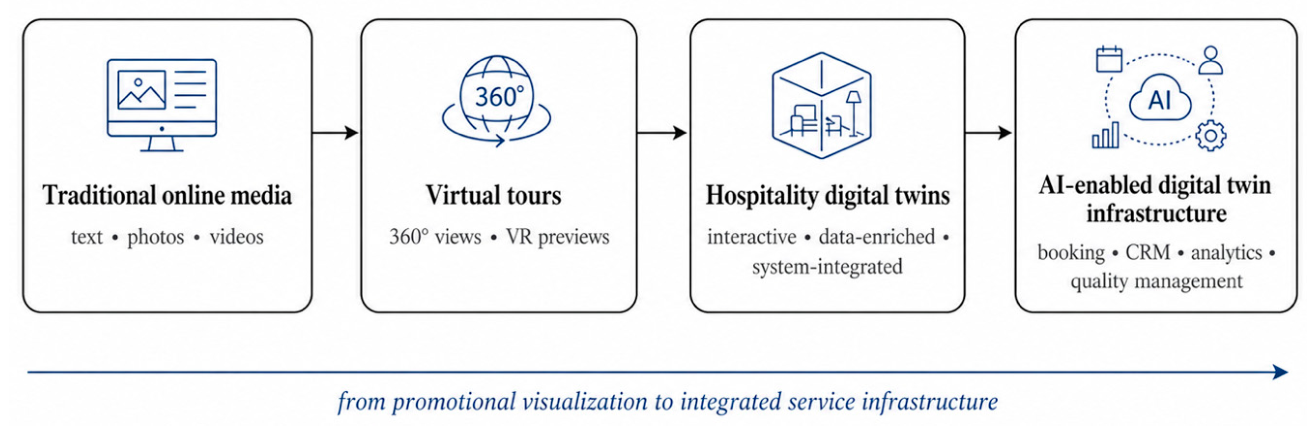
Figure 2.
Conceptual framework of hospitality digital twins as communication-distribution-quality infrastructure.
Figure 2.
Conceptual framework of hospitality digital twins as communication-distribution-quality infrastructure.
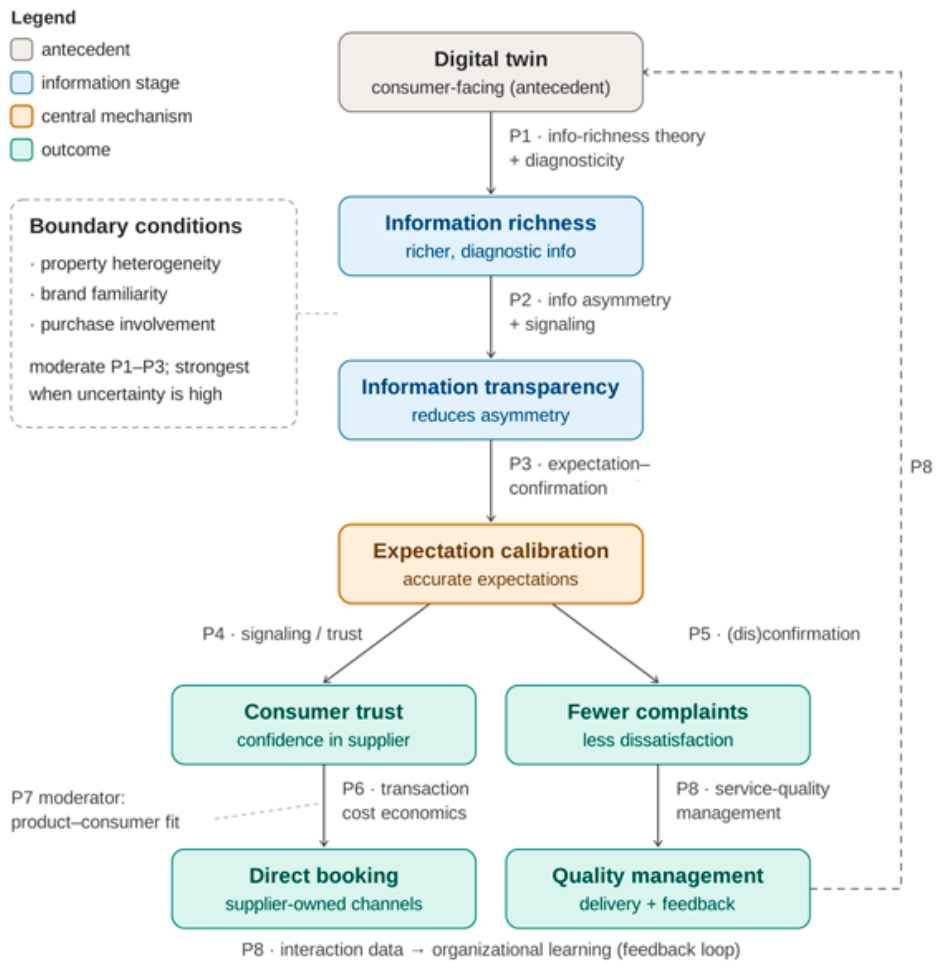
Figure 3.
Room size variations at identical hotel, room type, and price. Source: Author’s own photographs from The Westin DC Downtown Hotel.
Figure 3.
Room size variations at identical hotel, room type, and price. Source: Author’s own photographs from The Westin DC Downtown Hotel.
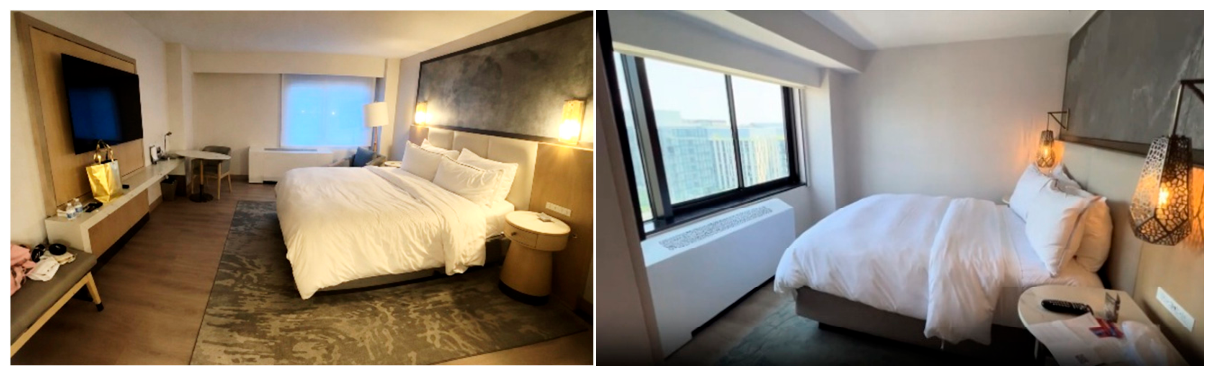
Figure 4.
Room view variations at identical hotel, room type, and price. Left: Promotional image from the Marriot Mena House, Cairo website: www.marriott.com/hotels/hotel-photos/caimn-marriott-mena-house-cairo/. Right: Traveler photograph on TripAdvisor: www.tripadvisor.ie/Hotel_Feature-g294202-d302723-zft1-Marriott_Mena_House_Cairo.html. Images retrieved on April 25, 2020.
Figure 4.
Room view variations at identical hotel, room type, and price. Left: Promotional image from the Marriot Mena House, Cairo website: www.marriott.com/hotels/hotel-photos/caimn-marriott-mena-house-cairo/. Right: Traveler photograph on TripAdvisor: www.tripadvisor.ie/Hotel_Feature-g294202-d302723-zft1-Marriott_Mena_House_Cairo.html. Images retrieved on April 25, 2020.
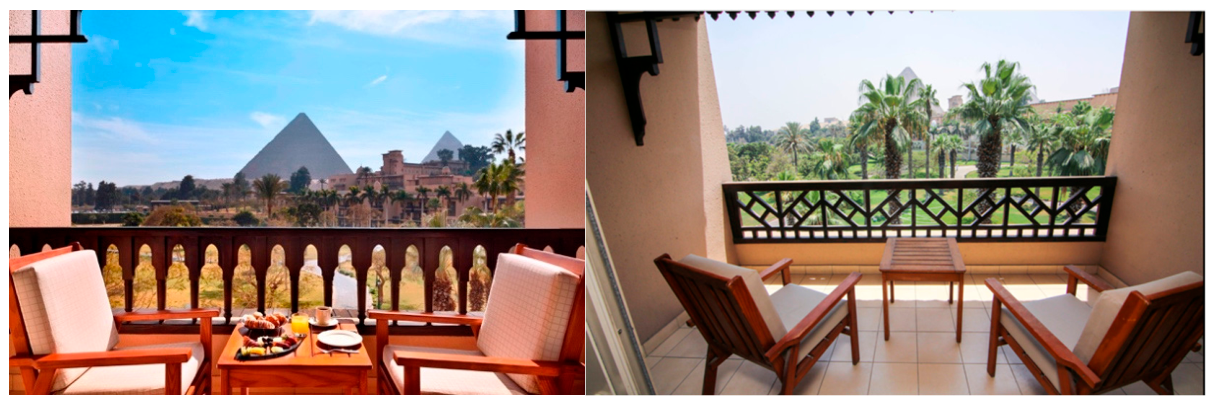
Figure 5.
Cruise floor plan displaying identical visual representation for all decks and cabins. Source: Yangzi Explorer Cruise website www.yangziexplorer.com, retrieved on July 20, 2026, with cruise authorization.
Figure 5.
Cruise floor plan displaying identical visual representation for all decks and cabins. Source: Yangzi Explorer Cruise website www.yangziexplorer.com, retrieved on July 20, 2026, with cruise authorization.
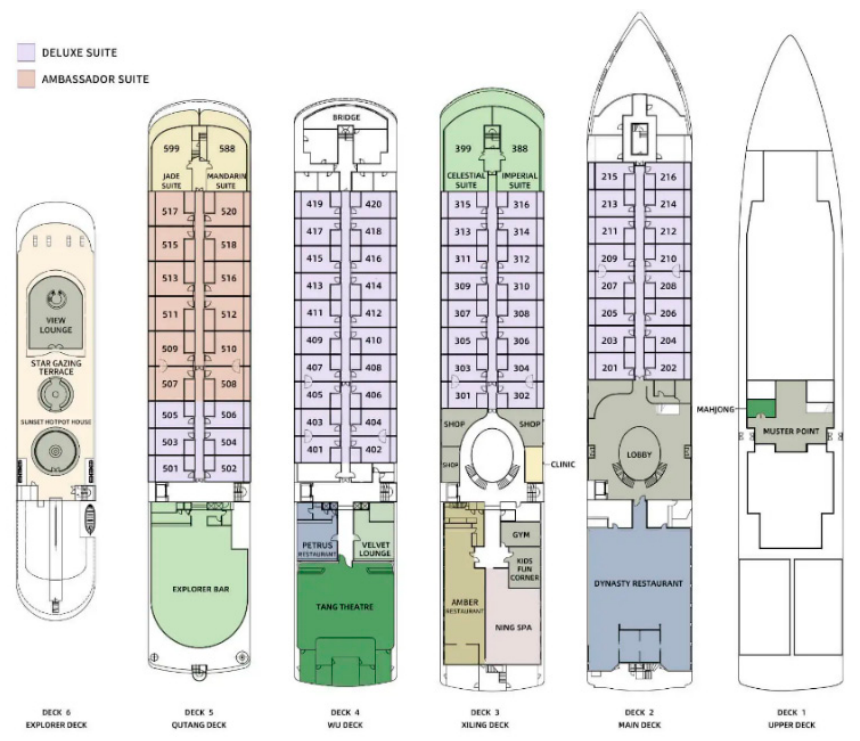
Figure 6.
Current and proposed workflows for immersive technologies in hospitality.
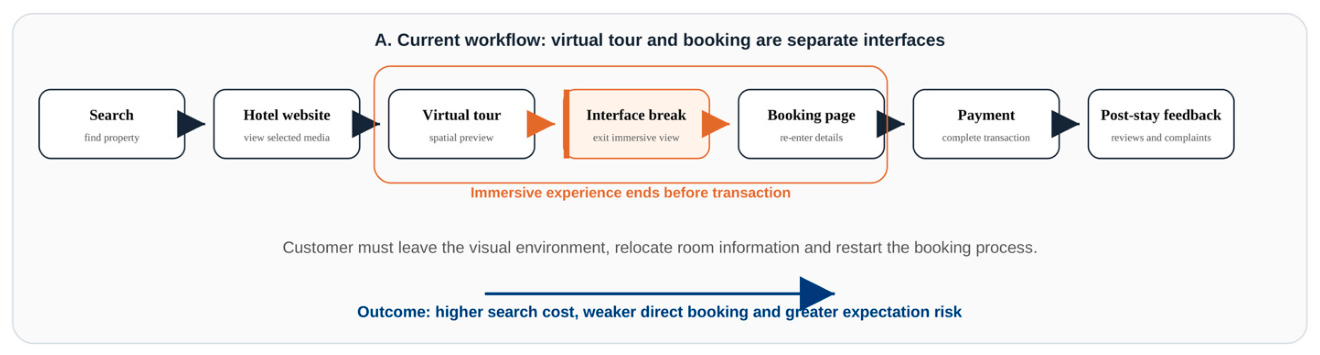
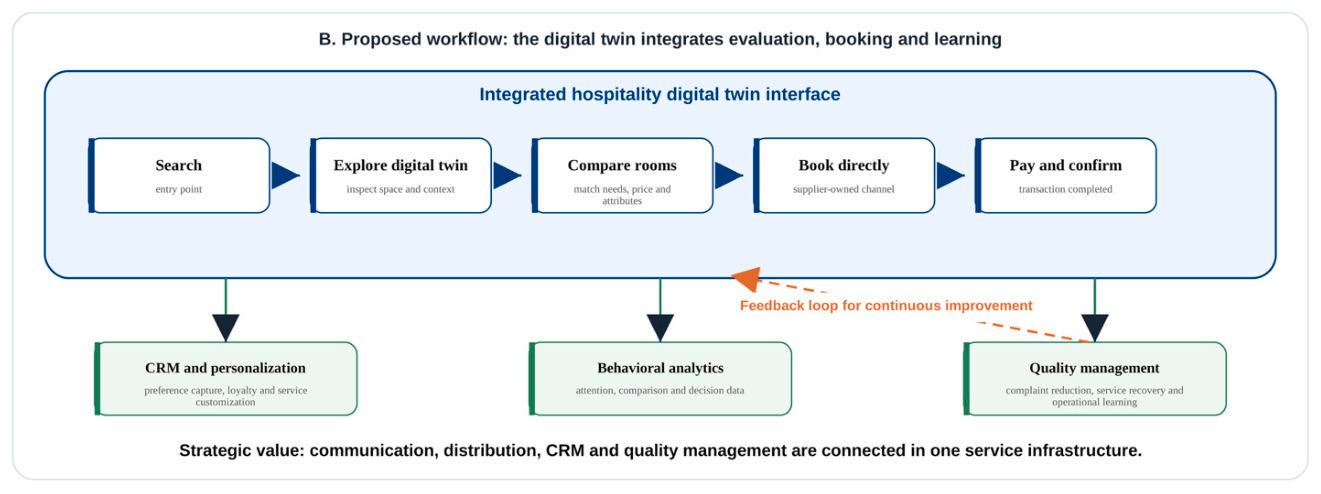

Table 1.
Levels of immersive representation in hospitality.
| Level | Description | Main function | Typical system connection | Strategic role |
|---|---|---|---|---|
| Virtual tour | Static or semi-interactive visual representation of a hotel, room, facility, or destination | Promotion and visualization | Usually standalone or embedded on a website | Digital brochure |
| Data-enriched immersive interface | Interactive environment with additional information such as room attributes, amenities, prices, availability, or location context | Product evaluation and decision support | Partial connection to website content, maps, or booking links | Enhanced evaluation interface |
| Hospitality digital twin | Persistent, interactive, and data-enriched representation connected to booking, CRM, analytics, operational data, or quality-management systems | Search, comparison, booking, personalization, feedback, and organizational learning | Integrated with reservation systems, customer data, analytics, and service operations | Strategic service infrastructure |
Table 2.
Representative immersive technologies and digital twin ecosystem in hospitality.
| Company | Country | Core Technology | Hospitality Applications | Booking Integration | Analytics | AI Features | Main Strategic Position |
|---|---|---|---|---|---|---|---|
| Matterport | USA | 3D Digital Twin | Hotels, resorts, museums | Basic | Advanced | Emerging | Digital documentation |
| Mass Interact 3D Tour | USA | Interactive 3D Tour | Hotels, destinations | Basic | Basic | Limited | Hospitality marketing |
| 3DVista | Spain | Virtual Tour Platform | Hotels, museums | Basic | Basic | No | Interactive storytelling |
| CloudPano | USA | Cloud 360 Tours | Hotels, vacation rentals | Basic | Basic | No | Easy deployment |
| EyeSpy360 | UK | Cloud Digital Tours | Hotels, real estate |
Basic | Advanced | AI chatbot | Sales & marketing |
| Cupix | USA | Digital Twin Platform | Hotels, facilities | Basic | Advanced | Emerging | Operations |
| Kuula | Estonia | Panorama Platform | Tourism, attractions | Basic | None | No | Content publishing |
| Google Street View | USA | Street-level imagery | Destinations | Basic | Advanced | AI-supported | Destination discovery |
| Baidu Maps VR | China | VR Maps | Hotels, attractions | Basic | Advanced | AI-supported | Geographic search |
| Apple Maps | USA | Immersive Maps | Destinations | Basic | Basic | AI-supported | Geographic navigation |
| NavVis | Germany | Enterprise Digital Twin | Large hospitality facilities | None | Advanced | Emerging | Facility management |
| Autodesk Tandem | USA | BIM Digital Twin | Hotels under construction | None | Advanced | AI-supported | Building lifecycle |
Table 3.
Summary of propositions, mechanisms, theoretical grounding, and illustrative testable variables.
Table 3.
Summary of propositions, mechanisms, theoretical grounding, and illustrative testable variables.
| Proposition | Core mechanism | Theoretical grounding | Illustrative testable variables (IV → DV) |
|---|---|---|---|
| P1 | Immersive, interactive representation raises the completeness and diagnosticity of pre-purchase information. | Information richness theory (Daft and Lengel, 1986); perceived diagnosticity (Jiang and Benbasat, 2004) | Media type (digital twin vs. photos/video) → perceived information richness/diagnosticity |
| P2 | Perceived diagnosticity mediates the effect of Digital twin richness on perceived transparency; richer, verifiable information narrows the supplier–consumer information gap. | Information asymmetry (Akerlof, 1970); Signaling theory (Spence, 1973) | Information richness → perceived diagnosticity → perceived transparency (mediation) |
| P3 | Transparent pre-purchase inspection helps consumers form accurate expectations. | Expectation–confirmation theory (Oliver, 1980) | Perceived transparency → expectation accuracy/calibration |
| P4 | Accurate expectations reduce uncertainty and raise confidence in the supplier. | Signaling theory (Spence, 1973); trust literature | Expectation calibration → consumer trust |
| P5 | A smaller expectation-performance gap lowers dissatisfaction and complaints. | Expectation–(dis)confirmation (Oliver, 1980) | Expectation calibration → post-purchase (dis)satisfaction, complaint likelihood, review valence |
| P6 | Trust and credible supplier-owned information shift demand to direct channels, conditional on product-consumer fit. | Transaction cost economics (Williamson, 1985); disintermediation (Law, 2009; Law et al., 2015) | Trust → direct-booking intention/share (moderator: product–consumer fit) |
| P7 | Greater transparency changes the composition of demand by discouraging poorly matched consumers and increasing better-matched bookings. | Signaling theory (Spence, 1973); expectation-confirmation theory (Oliver, 1980) | Digital twin transparency × product–consumer fit → direct-booking intention, booking quality, satisfaction, loyalty |
| P8 | Customer interaction data, booking behavior, post-stay feedback, and service-performance indicators feed organizational learning and continuous improvement. | Organizational learning; service-quality management; transaction cost economics | Digital twin analytics integration → service improvement, complaint reduction, review sentiment, operational improvement |
| P9 | Product types (heterogeneity/uncertainty/risk) positively moderate the effects above. | Information asymmetry (Akerlof, 1970) | Digital twin × product heterogeneity/uncertainty/risk → information richness, transparency, expectation calibration, trust, direct booking, complaint reduction |
| P10 | Customer characteristics (less prior knowledge) benefit more from immersive information. | Consumer expertise/prior knowledge literature | Digital twin × customer experience (first-time, international, unfamiliar) → information richness, transparency, expectation calibration, trust, direct booking, complaint reduction |
Table 4.
Comparative analysis of representative Digital twin providers.
| Capability | Selected Hotels | Matterport | Mass Interact | Google/Baidu Maps | Proposed Framework |
|---|---|---|---|---|---|
| Immersive visualization | Moderate | Advanced | Advanced | Moderate | Advanced |
| Interactive navigation | Basic | Advanced | Advanced | Basic | Advanced |
| Information richness | Basic | Advanced | Advanced | Advanced | Advanced |
| Booking integration | None | Basic | Basic | Basic | Advanced |
| Customer personalization | None | Basic | Basic | None | Advanced |
| CRM integration | None | Basic | Basic | None | Advanced |
| Quality management | None | Basic | Basic | None | Advanced |
| Behavioral analytics | Basic | Basic | Basic | Basic | Advanced |
| Strategic role | Marketing | Marketing | Marketing | Information | Integrated infrastructure |
Disclaimer/Publisher’s Note: The statements, opinions and data contained in all publications are solely those of the individual author(s) and contributor(s) and not of MDPI and/or the editor(s). MDPI and/or the editor(s) disclaim responsibility for any injury to people or property resulting from any ideas, methods, instructions or products referred to in the content. |
© 2026 by the authors. Licensee MDPI, Basel, Switzerland. This article is an open access article distributed under the terms and conditions of the Creative Commons Attribution (CC BY) license (http://creativecommons.org/licenses/by/4.0/).
Copyright: This open access article is published under a Creative Commons CC BY 4.0 license, which permit the free download, distribution, and reuse, provided that the author and preprint are cited in any reuse.