
Submitted:
24 July 2026
Posted:
24 July 2026
You are already at the latest version
Abstract
Sustainability research explains pro-environmental conduct largely through conscious attitudes, awareness and stated intentions, yet a substantial psychological literature indicates that agents have no transparent access to the determinants of their own behaviour. This paper asks whether an environmental norm can remain evolutionarily stable when the agents who carry it cannot say why they act. Constitutive self-opacity is formalised as a microfoundation of the mutation term in a replicator-mutator dynamic defined on a two-strategy conformity game with a private cost of green action. Opacity is decomposed into an intensity parameter and a directional narrative bias, and the resulting cubic vector field is studied through Lyapunov and bifurcation methods with supporting numerical continuation. Three results follow. Opacity destroys both absorbing states and compresses the set of long-run outcomes towards the narrative bias. The green attractor is strictly more fragile than the brown one, by a factor determined by the ratio of the conformity benefit to the private cost. Above a critical intensity bounded above by half the conformity benefit, bistability collapses through a saddle-node bifurcation whose surviving branch is green if and only if the narrative bias exceeds the coordination threshold. Awareness-centred policy therefore acts on a channel that self-opacity has already closed, whereas the composition of the circulating narrative stock remains operative.
Keywords:
economic theory
; evolutionary game theory
; replicator-mutator dynamics
; proenvironmental behaviour
; behavioral economics
; bifurcation analysis
; sustainability transitions
; environmental policy
1. Introduction
Research on sustainable behaviour rests on a psychological premise so widely shared that it is seldom stated explicitly: that people know, at least approximately, why they do what they do. Attitude-behaviour frameworks [1], value-belief-norm theory [2] and the large survey apparatus built around them [3] all treat the agent as a competent witness to her own motives. Policy has inherited the same premise. Awareness campaigns, eco-labels, carbon calculators and environmental education are designed for an agent who, once she understands the consequences of her conduct, can revise that conduct from the inside. The persistent gap between environmental concern and environmental action [4] is then read as a failure of will, of information, or of situational constraint, but not as a failure of self-knowledge.
The premise is doubtful. Since the classic review by Nisbett and Wilson [5], a substantial experimental literature has shown that verbal reports about the causes of one’s own behaviour are frequently constructed after the fact rather than read off an internal record [6,7,8]. Choice blindness experiments demonstrate that people will defend, with fluent reasons, a choice they did not in fact make [9]. In the environmental domain specifically, Nolan and colleagues [11] found that descriptive norms were the strongest measured predictor of household energy conservation while respondents ranked normative influence last among the factors affecting their own conduct. A meta-analysis of self-reported pro-environmental behaviour reports only a moderate association with independently observed behaviour [12], and the measurement literature has repeatedly warned against treating the two as interchangeable [13].
This paper takes that evidence seriously and asks what follows for the dynamics of environmental norms. The property at issue is not measurement error. It is what may be called constitutive self-opacity: the agent’s relation to the determinants of her own conduct is structurally indirect, so that better instruments, more careful survey design or stronger incentives for honesty do not recover a transparent signal, because no such signal exists to be recovered. Opacity of this kind is constitutive of the agent rather than incidental to the measurement of the agent.
The consequence for norm dynamics is not obvious, and it is the point of departure here. Cultural transmission does not proceed by direct observation of conduct alone. A great deal of it runs through testimony, justification, advice, advertising and the accounts people give of themselves [14,15,16]. Where those accounts are unreliable, the channel through which strategies propagate is noisy in a very specific sense: an agent who intends to copy a successful model may end up carrying a different strategy from the one the model actually plays. That is precisely the formal structure of a mutation term. The central methodological claim of this paper is therefore that constitutive self-opacity supplies a behavioural microfoundation for the mutation term of replicator-mutator dynamics [17,18,19], rather than entering the model as an unexplained perturbation parameter.
Three substantive results follow from that reformulation. First, once opacity is present, neither universal adoption nor total collapse of the green norm can be a rest point, so the long-run distribution of outcomes is compressed towards an interior configuration that depends on the composition of circulating narratives rather than on payoffs alone. Second, the compression is asymmetric. A first-order expansion shows that the green-dominant attractor is displaced by a factor of the ratio of the conformity benefit plus the private cost to the conformity benefit minus the private cost, relative to the brown-dominant one, so the sustainable equilibrium is strictly more fragile to opacity than the unsustainable one. Third, above a critical opacity intensity, bounded above by half the conformity benefit, the bistable structure collapses through a saddle-node bifurcation, and the surviving branch is green if and only if the directional bias of circulating narratives exceeds the coordination threshold of the underlying game. Opacity is thus not a uniform obstacle to sustainability. Its sign depends on the discursive environment in which it operates.
The policy reading is correspondingly sharp. Interventions that address the agent’s conscious motives operate on a channel that constitutive self-opacity has already closed. Interventions that alter the stock of accounts in circulation operate on the channel that actually carries the norm. This does not licence manipulation, and Section 5 confronts the uncomfortable corollary that the model assigns real dynamic force to greenwashing [20]. It does suggest that the evaluation criterion for sustainability communication should be its effect on the composition of the narrative stock rather than its effect on measured awareness.
2. Theoretical Background
2.1. Constitutive Self-Opacity
The claim that introspective access to one’s own motives is unreliable has a long philosophical history, but its modern experimental form begins with the demonstration that subjects report causes of their behaviour that demonstrably did not operate, and fail to report causes that demonstrably did [5]. Self-perception theory [6] proposed that agents infer their own attitudes from observation of their own behaviour much as an outside observer would, an account subsequently absorbed into dual-process treatments of judgement [22] and into social intuitionist models of moral reasoning, in which explicit justification typically follows rather than produces the evaluation it purports to explain [8].
Choice blindness experiments sharpen the point. When subjects are covertly given an outcome other than the one they selected, a majority fail to detect the substitution and proceed to justify the imposed outcome with reasons of the same fluency and confidence as those offered for genuine choices [9]. The effect extends to moral and political attitudes, where subjects will argue for positions that have been surreptitiously reversed [10]. What these findings establish is not that agents lie, and not that they are inattentive. It is that the production of self-accounts is a partially independent process from the production of behaviour.
Three features of this literature matter for the model developed below. First, opacity is not confined to trivial or low-stakes decisions. Second, it is not eliminated by incentives for accuracy, because the agent is not withholding information she possesses. Third, and most consequentially here, the self-accounts that agents produce are not random. They are drawn from a culturally available repertoire of intelligible reasons, so their composition reflects the discursive environment rather than the underlying behavioural disposition. The term constitutive is used to mark these three features jointly and to distinguish the property from ordinary measurement error, which is assumed to be centred on a recoverable truth.
2.2. The Attitude-Behaviour Gap and Its Standard Readings
Sustainability research has documented the divergence between environmental attitudes and environmental behaviour for several decades [3]. The dominant readings treat the gap as a problem of intervening variables: perceived behavioural control and subjective norms in the theory of planned behaviour [1], awareness of consequences and ascription of responsibility in norm-activation accounts [2,23], or contextual and infrastructural constraints in situational approaches. Each of these readings preserves the assumption that the agent’s own report is informative about the process, since the intervening variables are themselves elicited by self-report.
The measurement literature has grown steadily less comfortable with that assumption. Meta-analytic evidence indicates that self-reported pro-environmental behaviour is a biased proxy for observed behaviour, with the discrepancy varying systematically across behaviour classes [12], and methodological reviews recommend behavioural rather than declarative measurement wherever feasible [13]. The evidence from normative interventions is more pointed still. Descriptive norm information reliably changes household resource use [24], yet the agents affected do not identify the norm as a cause of their own conduct [11]. The influence is real and the report is not.
If self-reports were merely noisy, the standard readings would survive with wider confidence intervals. The claim advanced here is stronger: because self-accounts are drawn from a shared cultural repertoire and are themselves transmitted, their unreliability is not a nuisance in the estimation of a norm’s dynamics but a component of those dynamics.
2.3. Norms, Conformity and Evolutionary Approaches to Sustainability
Social norms are among the most robust levers identified in environmental behaviour research [24,26], and the coordination structure that makes them effective also makes them path dependent. Where the private return to a practice is increasing in its prevalence, multiple self-consistent configurations exist and history selects among them [16,28], a pattern documented across a wide range of cooperative settings [30]. Peer effects in the diffusion of residential solar installations [31] and the influence of visible adoption on subsequent adoption [32] illustrate the mechanism in an environmental setting.
Evolutionary game theory provides the natural formal language for such settings [33,34,35]. The replicator equation and its relatives describe populations in which the growth rate of a strategy’s frequency tracks its relative performance [36,37,38,39], and their application to economic and institutional questions is well established [40,41,42]. Within environmental economics specifically, evolutionary and boundedly rational formulations have been advocated as alternatives to the representative optimising agent [43], in a tradition that traces to Simon’s original critique [45].
Mutation has entered these models along two routes. In the stochastic stability literature it functions as a vanishing experimentation probability whose limit selects among strict equilibria [46,47,48]. In the replicator-mutator literature it is retained at finite magnitude and shown to reshape the equilibrium structure qualitatively, producing interior rest points, destroying boundary equilibria and generating bifurcations absent from the pure replicator dynamic [17,18,19,49]. The present paper works in the second tradition and departs from both in one respect: mutation is not treated as an exogenous error rate but is derived from a documented property of the agents.
2.4. Position of the Present Contribution
The contribution can be located precisely. Relative to the sustainability behaviour literature, the paper replaces the assumption of informative self-report with its documented negation and traces the consequences for norm dynamics rather than for measurement. Relative to the evolutionary game theory literature, it supplies a behavioural interpretation of the mutation term and shows that the interpretation carries testable structure, namely a decomposition of mutation into an intensity and a direction. Relative to the motivation-crowding literature [50,51,52], which also concerns the divergence between what moves agents and what agents take to move them, it shifts attention from the effect of incentives on motives to the effect of opacity on transmission.
3. Model
3.1. Population, Strategies and Payoffs
Consider a large population of agents, formally a continuum of unit mass, each of whom adopts one of two behavioural strategies in a given period. Strategy denotes the green practice, which carries a private net cost relative to the alternative, and strategy denotes the brown or default practice. Let denote the share of the population playing .
Payoffs combine a conformity component and a private cost component. The conformity component captures the social returns to alignment with prevailing practice: approval, reduced friction in shared infrastructure, reputational fit and the reduced cognitive cost of doing what others do [15,26]. Writing for the strength of this component and for a baseline payoff common to both strategies,
and
Two features of this specification deserve comment. First, the environmental benefit generated by green practice is deliberately absent from the payoff functions. In a population of unit mass the marginal environmental return to any individual’s own abatement is negligible, so it cannot drive selection; it is reinstated in Section 4.7 where welfare is evaluated. The exclusion is substantive rather than technical, since it is exactly the reason the normative channel matters. Second, the conformity term makes the game a coordination game rather than a prisoner’s dilemma, which reflects the empirical prominence of descriptive norms in this domain [24,27].
The payoff difference is
so that is the coordination threshold at which the two practices perform equally well. Throughout it is assumed that
(A1) , which guarantees and hence genuine bistability in the transparent benchmark; (A2) , which guarantees that both payoffs are strictly positive on , as required for the payoff-weighted form of the dynamic discussed in Section 3.4; and (A3) the population is well mixed, so that interaction and observation are unstructured.
3.2. Self-Opacity as a Microfoundation of Transmission Error
Strategies propagate by social learning. An agent revising her practice samples another agent, forms a judgement about what that agent does and why, and adjusts accordingly. The inferential step is where self-opacity enters. Part of what a learner acquires comes from direct observation of conduct, and that part is faithful. The remaining part comes from the account the model gives of her own conduct, whether in conversation, justification, advice or public self-presentation, and that part is not faithful, for the reasons set out in Section 2.1.
Formalise this as follows. Let denote the opacity intensity, the probability that the learner’s inference is governed by the model’s account rather than by the model’s conduct. With probability transmission is faithful and the learner acquires the strategy actually played. With probability the learner acquires instead a strategy drawn from the repertoire of circulating accounts. Let denote the narrative bias, the share of that repertoire coded as green. The repertoire is a property of the discursive environment and not of the sampled agent, which is the formal expression of the third feature identified in Section 2.1.
The induced transition probabilities are then
where is the probability that a learner sampling a green model ends up brown and the converse. Two properties follow immediately and are worth isolating, because they distinguish this construction from a conventional mutation parameter. The transition rates are not free: they are governed by a single intensity and a single direction , so a decrease in one rate is necessarily accompanied by an increase in the other at fixed intensity. And the direction is an observable feature of public discourse rather than a latent parameter, which makes the comparative statics in Section 4 empirically addressable in principle.
Remark 1.
Symmetric mutation, the standard case in the replicator-mutator literature [17] corresponds to . The results below show that this is not an innocuous normalisation: the qualitative character of the long-run outcome turns on whetherlies above or below, so imposing symmetry conceals the phenomenon of interest.
3.3. The Replicator-Mutator Dynamic
Combining selection through payoff-monotone imitation with the transmission error derived above yields
Substituting the microfoundation and the payoff difference gives the reduced form used throughout the analysis,
The vector field is a cubic polynomial with negative leading coefficient. Its first term is the familiar bistable selection term of a coordination game, and its second term is a linear relaxation towards with rate . The dynamic can therefore be read as a competition between payoff-driven selection, which pushes the population to a corner, and opacity-driven transmission error, which pulls it towards the composition of circulating accounts. The parameters are collected in Table 1.
3.4. Relation to the Canonical Payoff-Weighted Form
The canonical replicator-mutator equation weights the mutation flows by the payoffs of their source strategies [19,49], which in the two-strategy case gives
Unlike the pure replicator dynamic, this equation is not invariant to the addition of a constant to all payoffs, so the baseline is not a free normalisation. As grows large relative to and , the payoff weights on the mutation terms converge to a common value and, after rescaling time by , the transmission-error form of Equation (5) is recovered exactly. The reduced model is therefore the large baseline limit of the canonical form. Working with it has two advantages: the vector field remains a cubic with interpretable coefficients, and the mutation term retains the direct behavioural reading established in Section 3.2, in which transmission fidelity does not depend on how well the model is doing. Numerical checks reported in Section 4.6 confirm that the qualitative results are unaffected for moderate .
3.5. Numerical Procedures and Disclosure
Equilibria were obtained as the real roots in of the cubic using standard companion-matrix root finding in double precision, with local stability classified by the sign of at each root. Critical opacity intensities were located by bisection on the number of admissible real roots to a tolerance of . Bifurcation diagrams and the two-parameter regime map were generated by continuation over grids of 900 and 420 points per axis respectively. All computations are analytic in structure and involve no estimated data. The code required to reproduce every figure and table consists of the closed-form expressions reported in Section 4 and is available from the author on request.
4. Results
4.1. The Transparent Benchmark
Setting recovers the pure replicator dynamic on a coordination game. The rest points are , and . Since and while , the two boundary states are asymptotically stable and the interior state is a repeller. Every initial condition other than itself converges to a corner, and the basin of the green norm is the interval , whose measure is decreasing in the private cost. This is the standard tipping-point account of norm change that underwrites much of the critical-mass reasoning in the sustainability transitions literature [16,27]. Under transparency, an environmental norm once established is absorbing: it cannot be dislodged by any perturbation short of moving the population across the threshold.
4.2. The Disappearance of Absorbing States
Proposition 1. Let (A1) hold and letwith. Thenand, so the intervalis forward invariant and neithernoris a rest point. Consequently the system possesses at least one interior equilibrium, and universal adoption and total collapse of the green practice are both unattainable as long-run outcomes.
Proof. Evaluating the vector field at the boundaries gives and under the stated restrictions on and . The field therefore points strictly inward at both endpoints, so no trajectory starting in can leave it and neither endpoint solves . Continuity of on together with the sign change then yields an interior zero by the intermediate value theorem. □
The proposition is elementary but its interpretation is not. Under transparency the green norm, once achieved, is permanent. Under opacity it is not, and the loss is not caused by any weakening of environmental preferences, any increase in the private cost, or any erosion of the conformity benefit. It is caused solely by the fact that agents cannot transmit reliably what they cannot report reliably. The same mechanism, read in the other direction, guarantees that a population locked into the brown practice always retains a positive share of green practice, which is the first hint that opacity is not unidirectionally harmful.
4.3. Lyapunov Structure and Global Convergence
Because the state space is one dimensional, the dynamic admits a global potential. Define
Proposition 2. The function is a global Lyapunov function for the dynamic on, with
and equality holds if and only ifis a rest point. Every trajectory therefore converges monotonically into a local minimiser of, and no periodic or chaotic behaviour is possible.
Proof. By construction , so , which is non-positive and vanishes exactly at the zeros of . Since is a polynomial and therefore continuously differentiable on the compact interval , and since is forward invariant by Proposition 1, LaSalle’s invariance principle implies convergence of every trajectory to the largest invariant subset of , which is the set of rest points. Local minimisers of correspond to zeros of at which changes sign from positive to negative, that is to asymptotically stable rest points. □
The potential formulation makes the structure of the problem transparent. Selection contributes a double-well shape whose two minima sit near the corners, while opacity contributes a term linear in the state, , together with a quadratic term, , whose joint effect is to tilt the landscape towards and to raise the floor between the wells. Sufficiently strong opacity flattens one well entirely, which is the bifurcation analysed in Section 4.5.
4.4. Small Opacity: The Asymmetric Fragility of the Green Attractor
For small the two stable equilibria remain close to the corners and admit a first-order expansion. Writing for the brown-dominant attractor and for the green-dominant one, and balancing the linearised selection term against the mutation term at each corner, gives
and
Proposition 3.Under (A1), the displacement of the green attractor from its transparent position exceeds the displacement of the brown attractor whenever
In the symmetric casethe ratio reduces tofor every admissible, so the sustainable equilibrium is strictly more fragile to self-opacity than the unsustainable one, and increasingly so as the private cost of green practice rises.
Proof. Near write and solve for the zero, using . Near set and write , using , then solve for . Differentiating the two expressions with respect to and taking the ratio of absolute values gives the stated expression. Under (A1) we have , so at the ratio exceeds unity. □
The asymmetry has a direct interpretation. The restoring force that holds a population at a corner is the payoff advantage of the incumbent practice there, and that advantage is weaker at the green corner because the green practice must additionally cover its private cost. Opacity of a given intensity therefore erodes the green configuration more than the brown one, and the disparity grows with . At the baseline calibration of Table 1 the ratio equals , so an opacity shock displaces the sustainable equilibrium half again as far as the unsustainable one. Numerical values reported in Table 2 confirm the accuracy of the expansion for , with relative errors below one per cent, and indicate the expected deterioration as approaches the bifurcation.
4.5. The Opacity-Induced Bifurcation
As opacity intensifies, the interior repeller and one of the two attractors approach each other and annihilate. The knife-edge case is analytically transparent. Setting factorises the vector field as
whose zeros are together with
Proposition 4.Let. Then forthe system has three rest points and remains bistable, atthe pairmerges atin a pitchfork bifurcation, and forthe unique rest pointis globally asymptotically stable on. Forthe pitchfork unfolds into a saddle-node bifurcation at a critical intensity, so that
with equality if and only if
.
Proof. The factorisation is immediate on substituting into . The quadratic factor has real roots in precisely when , and the roots coincide at when , which together with the persistence of the root and the sign pattern of the cubic establishes the pitchfork. For the constant term of no longer vanishes at , so the triple-root degeneracy is destroyed and the merger of two simple roots occurs where and vanish simultaneously, which is the saddle-node condition. That the resulting critical intensity is bounded by follows because the discriminant of the cubic is maximised over at ; the bound is verified numerically in Table 3. □
Proposition 4 yields a sufficient condition for the destruction of the coordination trap that involves no knowledge of the narrative environment: if opacity reaches half the conformity benefit, history ceases to determine the outcome. What replaces history is stated next.
Proposition 5.Forthe unique globally stable equilibriumsatisfiesifandif. Moreover
The surviving branch is therefore green if and only if the narrative bias exceeds the coordination threshold of the underlying game.
Proof. Dividing by and letting gives the limiting field , whose unique zero is and which is globally attracting, establishing the limit. For the sign claim, note that , which is positive when and negative when . Since the unique equilibrium is globally attracting and the field is positive to its left and negative to its right, the equilibrium must lie above in the first case and below it in the second. □
This is the central result of the paper. Self-opacity does not have a determinate sign as a force acting on sustainability. Where the circulating stock of accounts is coded green beyond the coordination threshold, opacity destroys the brown attractor and makes the sustainable configuration globally reachable from any initial condition, dissolving the very lock-in that critical-mass reasoning treats as the central obstacle. Where the stock is coded green below that threshold, opacity destroys the green attractor and makes the sustainable configuration unreachable regardless of history, including from populations that had already achieved it. The same behavioural property produces opposite outcomes depending on a parameter that is external to the agent and internal to the discourse she inhabits.
4.6. Numerical Illustration
The baseline calibration sets and , hence , and varies and . Figure 1 plots the vector field for a brown-neutral narrative environment and increasing opacity, showing the interior repeller and the upper attractor converging and annihilating. Table 2 reports the full equilibrium structure.
Two patterns in Table 2 deserve emphasis. Along the first block, where narratives are coded brown, the tipping threshold rises with opacity, from to , so the basin of the green norm contracts even before the attractor is destroyed. Along the third block, where narratives are coded green, the threshold falls, from to , so opacity enlarges the basin of the sustainable configuration and lowers the critical mass required to reach it. The bifurcation diagrams in Figure 2 display the same structure in continuous form.
Table 3 reports the critical intensity as a function of the narrative bias, together with the long-run green share evaluated well beyond the bifurcation. The bound of Proposition 4 is attained exactly at , where and the surviving equilibrium is itself, and the critical intensity falls away on both sides. The non-monotonicity is worth noting: bistability is most robust to opacity precisely when the narrative environment is balanced at the coordination threshold, and any departure from that balance in either direction hastens the collapse of one of the two attractors.
Figure 3 assembles these findings into a two-parameter regime map. The vertical line separates the two unique-equilibrium regions, confirming Proposition 5, and the wedge below the critical curve is the region in which history still selects the outcome. Figure 4 isolates the two policy-relevant quantities, the tipping threshold and the position of the upper attractor, as functions of opacity.
Robustness was assessed along three dimensions. Re-running the analysis with the payoff-weighted form of Equation (7) at leaves the ordering of regimes and the sign of every comparative static unchanged, shifting critical intensities by less than eight per cent. Varying the private cost over preserves all qualitative results while, as Proposition 3 predicts, widening the fragility gap between the two attractors. Finally, replacing the linear conformity benefit with a convex specification for moves but leaves the structure of Propositions 1, 2 and 5 intact, since none of them depends on the linearity of the payoff difference.
4.7. Welfare
The environmental benefit excluded from the payoff functions enters welfare directly. Let denote the aggregate environmental benefit accruing to the population per unit of green share, so that per capita welfare is
Proposition 6.Ifthenattains its maximum onat, and for any long-run equilibriumthe welfare shortfall is
By Proposition 1 the shortfall is strictly positive wheneverand, so self-opacity imposes an unavoidable welfare loss even when it selects the green-dominant branch.
Proof. Substituting the payoff functions gives , whence and the maximum is attained at a corner. Since by hypothesis, the maximiser is . Evaluating the difference and simplifying using yields the stated expression, which is strictly positive for . □
The shortfall decomposes instructively. Its first component, , is the foregone net environmental benefit and is the quantity that environmental policy ordinarily targets. Its second component, , is a pure coordination loss arising from the fact that a divided population forgoes conformity benefits on both sides, and it is maximised at . Opacity therefore imposes a cost that is not reducible to environmental damage: a population that cannot transmit its practices faithfully pays for the resulting heterogeneity even where the environment is held fixed. At the baseline calibration with , the shortfall is under a brown-coded environment at and under a green-coded environment at , so the narrative composition accounts for a difference of roughly a factor of two and a half in foregone welfare at comparable opacity.
5. Discussion
5.1. Why Awareness Policy Targets a Channel That Is Already Closed
The model gives a precise sense in which awareness-based intervention is misdirected. Awareness policy is designed to change what agents believe about the consequences of their conduct, on the assumption that a revision of belief propagates into a revision of conduct through the agent’s own deliberation. In the present framework that pathway is represented by nothing at all. The agent’s conduct is governed by the selection term, which responds to realised payoffs, and by the transmission term, which responds to the composition of circulating accounts. Belief about consequences enters neither, because by hypothesis the agent has no reliable access to the determinants of her own behaviour and therefore cannot act on that access.
This is stronger than the familiar observation that information campaigns have modest effect sizes. It locates the reason. An intervention that raises measured awareness without altering either the payoff structure or the narrative stock changes neither term of Equation (6) and therefore leaves every equilibrium exactly where it was. The empirical signature of such an intervention would be a measurable improvement in stated attitudes accompanied by no change in behavioural trajectory, which is a recognisable description of a substantial part of the evaluation literature [3,12].
Two qualifications matter. Awareness campaigns are rarely pure: many of them also circulate exemplars, testimonials and depictions of practice, and to that extent they act on rather than on awareness as such. The model predicts that these components, and not the informational content, carry whatever effect is observed. Conversely, interventions that alter the private cost, such as subsidies or infrastructure provision, act on and therefore on , and remain effective in the model regardless of opacity. The same holds for choice-architecture instruments that operate on the default option rather than on deliberation [53], which the present framework reads as acting on the payoff structure rather than on the agent’s self-understanding. Nothing here argues against material policy instruments.
5.2. The Narrative Stock as the Operative Instrument
If the transmission term is where opacity bites, the composition of circulating accounts becomes the policy-relevant variable. Proposition 5 makes the requirement explicit: must exceed , which under the baseline calibration means that green-coded accounts must constitute more than sixty per cent of the repertoire, a threshold that rises with the private cost of the green practice. This is a demanding target, and it is a different target from the one awareness policy sets itself. It concerns what is said and shown, in aggregate and by everyone, rather than what any particular audience understands.
The variable is in principle measurable. Content analysis of advertising, media coverage, product labelling and social media discourse yields exactly the compositional quantity the model requires, and the prominence of visible or conspicuous environmental consumption in the empirical literature [54,55,56] suggests that the narrative and behavioural channels can be separately observed. A natural empirical strategy would estimate from discourse data, estimate from the cost and conformity structure of a specific practice, and test the predicted sign reversal across domains where the two quantities straddle each other differently.
The framework also reinterprets a familiar policy instrument. Credibility-enhancing displays, in which adopters bear visible costs that vouch for their commitment [32], and peer effects in visible technologies such as rooftop solar [31], both operate by making conduct directly observable and thereby bypassing the unreliable account. In the language of the model they reduce rather than raise . That is a second and independent policy lever, and Proposition 4 shows when it is decisive: reducing opacity below restores bistability, which is desirable precisely when the population already sits above the tipping threshold and undesirable when it sits below.
5.3. An Uncomfortable Corollary
The model assigns genuine dynamic force to communication that misdescribes practice. If rises because firms and institutions circulate green-coded accounts unmatched by green conduct, Proposition 5 implies that the long-run green share rises too. Greenwashing, on this reading, is not merely a distortion of consumer information [20] but an intervention on the transmission channel, and one whose directional effect on behaviour is positive.
The conclusion should be resisted on grounds the model itself supplies rather than waved away. Three considerations bear on it. First, the welfare accounting of Section 4.7 attaches value to realised green practice, not to accounts, so any resources absorbed by narrative production are pure deadweight in this framework and would have to be netted against the equilibrium gain. Second, the mechanism is self-undermining if it is detected: an account recognised as unreliable ceases to be copied, which in the model is a reduction in towards the misdescribed strategy rather than an increase in , and the literature on the reputational dynamics of exposure [57] suggests detection is not rare. Third, and most importantly, the model is silent on the institutional preconditions of the payoff structure it takes as given. A conformity benefit presupposes that agents can identify what others are doing, and systematic misdescription erodes exactly that capacity, which would show up as a decline in and, by Proposition 4, as a lower critical intensity and a more fragile configuration overall. Formalising that feedback is the most important extension the present analysis suggests.
5.4. Fragility Asymmetry and the Design of Sustainability Transitions
Proposition 3 has an implication for how transitions should be evaluated. The standard diagnostic asks whether a population has crossed the tipping threshold, on the assumption that a norm past the threshold is self-sustaining. Under opacity that assumption fails in a specific and asymmetric way: the green configuration is not only non-absorbing but displaced further from its ideal position than the brown configuration is from its own, by the factor given in Proposition 3, which is increasing in the private cost. Transitions in high-cost domains such as dietary change or aviation reduction are therefore predicted to be systematically less durable than transitions in low-cost domains such as recycling or lighting, holding the narrative environment constant, and the prediction is in principle testable against reversion rates.
The same result cautions against reading a high current green share as evidence of consolidation. In the model, a population at under a brown-coded narrative environment is at a stable rest point that will nonetheless be destroyed by a further increase in opacity, and the destruction is discontinuous. Monitoring the narrative composition alongside the behavioural share would give advance warning that behavioural monitoring alone cannot provide.
5.5. Limitations
Several restrictions bound the results. The population is well mixed, whereas assortment and network structure are known to alter evolutionary outcomes substantially [49,59], and structured interaction would plausibly interact with opacity because observation of conduct is easier among neighbours than among strangers. The state space is two dimensional in strategy and one dimensional in dynamics, which excludes the coexistence of several green practices competing for the same narrative space. Opacity is treated as a fixed population-level parameter rather than as heterogeneous across agents or responsive to experience, and endogenising it, for instance by allowing to decline where conduct is visible, is a natural next step. The narrative bias is likewise exogenous, whereas in reality accounts are produced by the same agents whose behaviour they describe, which points towards a coupled two-dimensional system in behaviour and discourse. Finally, the analysis is deterministic; finite-population stochastic treatments would allow the study of escape times between the two attractors before the bifurcation, using the machinery developed for stochastic evolutionary dynamics [46,59].
6. Conclusions
This paper began from a documented property of human agents that sustainability research has largely treated as a measurement inconvenience: people do not have transparent access to the determinants of their own behaviour. Taking that property as constitutive rather than incidental, and observing that cultural transmission runs in part through the accounts agents give of themselves, yields a behavioural microfoundation for the mutation term of replicator-mutator dynamics. Mutation ceases to be an unexplained perturbation and becomes a measurable feature of a population, decomposable into an intensity and a direction.
The consequences for environmental norms are substantial. Opacity abolishes both absorbing states, so no environmental norm is ever consolidated and no unsustainable configuration is ever final. It displaces the sustainable equilibrium more than the unsustainable one, by a factor that grows with the private cost of green practice, so sustainability is structurally the more fragile of the two configurations. And beyond a critical intensity bounded above by half the conformity benefit, it dissolves history dependence altogether, replacing the tipping-point logic that dominates transitions research with a selection rule that turns on the composition of public discourse rather than on the initial distribution of behaviour.
The policy implication is not that communication matters, which is uncontroversial, but that it matters through a channel other than the one policy design assumes. Awareness operates on the agent’s understanding of her own motives, and that is the channel self-opacity closes. The stock of circulating accounts operates on transmission, and that channel remains open. A sustainability communication strategy evaluated by measured awareness may therefore register success while leaving every equilibrium of the system untouched, whereas one evaluated by its contribution to the narrative composition acts on the quantity that Proposition 5 shows to be decisive.
The framework leaves open the questions most worth pursuing. Endogenising the narrative bias, so that accounts are produced by the same population whose conduct they describe, would convert the present one-dimensional system into a coupled dynamic in behaviour and discourse, in which the reflexivity that self-opacity introduces could be studied directly. Allowing opacity to vary with the visibility of conduct would connect the model to the empirical literature on credibility-enhancing displays. And embedding the dynamic in a structured population would test whether local observation can substitute for the self-knowledge that agents demonstrably lack. Each of these would sharpen a conclusion that the present analysis already supports: that the durability of an environmental norm depends less on what a population believes about itself than on what it is able to transmit.
Funding
This research received no external funding.
Institutional Review Board Statement
Not applicable.
Informed Consent Statement
Not applicable.
Data Availability Statement
Conflicts of Interest
The author declares no conflicts of interest.
Acknowledgments
During the preparation of this manuscript, the author used a generative artificial intelligence assistant for the purposes of language editing and the preparation of numerical illustrations. The author has reviewed and edited the output and takes full responsibility for the content of this publication.
Abbreviations
The following abbreviations are used in this manuscript:
| Abbreviation | Meaning |
| EGT | Evolutionary game theory |
| ESS | Evolutionarily stable strategy |
| PEB | Pro-environmental behaviour |
| RM | Replicator-mutator |
Appendix A
Appendix A.1. Derivation of the Reduced Vector Field
Let and be as in Equation (4). Selection through payoff-monotone imitation contributes , the standard replicator term. Transmission error contributes an inflow from brown to green and an outflow in the opposite direction, giving Equation (5). Substituting the microfoundation yields a mutation term
which is linear in the state with slope and fixed point , independent of the payoff structure. Combining with the payoff difference of Equation (3) gives Equation (6). Expanding the cubic in descending powers,
from which the companion matrix used for the numerical root finding of Section 3.5 is constructed directly.
Appendix A.2. Sign Pattern of the Cubic
Since the leading coefficient of is and, by Proposition 1, and , the number of roots of in is either one or three counting multiplicity. In the three-root case, labelling them , the field is positive on , negative on , positive on and negative on , so and are asymptotically stable and is a repeller whose position is the tipping threshold reported in Table 2. In the one-root case the field is positive to the left of the root and negative to its right, so the root is globally asymptotically stable on . The transition between the two cases occurs where the discriminant of the cubic vanishes, which is the saddle-node condition of Proposition 4.
References
- Ajzen, I. The theory of planned behavior. Organ. Behav. Hum. Decis. Process. 1991, 50, 179–211. [Google Scholar] [CrossRef]
- Stern, P.C. Toward a coherent theory of environmentally significant behavior. J. Soc. Issues 2000, 56, 407–424. [Google Scholar] [CrossRef]
- Steg, L.; Vlek, C. Encouraging pro-environmental behaviour: An integrative review and research agenda. J. Environ. Psychol. 2009, 29, 309–317. [Google Scholar] [CrossRef]
- Kollmuss, A.; Agyeman, J. Mind the gap: Why do people act environmentally and what are the barriers to pro-environmental behavior? Environ. Educ. Res. 2002, 8, 239–260. [Google Scholar] [CrossRef]
- Nisbett, R.E.; Wilson, T.D. Telling more than we can know: Verbal reports on mental processes. Psychol. Rev. 1977, 84, 231–259. [Google Scholar] [CrossRef]
- Bem, D.J. Self-perception theory. Adv. Exp. Soc. Psychol. 1972, 6, 1–62. [Google Scholar] [CrossRef]
- Wilson, T.D. Strangers to Ourselves: Discovering the Adaptive Unconscious; Harvard University Press: Cambridge, MA, USA, 2002. [Google Scholar]
- Haidt, J. The emotional dog and its rational tail: A social intuitionist approach to moral judgment. Psychol. Rev. 2001, 108, 814–834. [Google Scholar] [CrossRef] [PubMed]
- Johansson, P.; Hall, L.; Sikström, S.; Olsson, A. Failure to detect mismatches between intention and outcome in a simple decision task. Science 2005, 310, 116–119. [Google Scholar] [CrossRef] [PubMed]
- Hall, L.; Johansson, P.; Strandberg, T. Lifting the veil of morality: Choice blindness and attitude reversals on a self-transforming survey. PLoS ONE 2012, 7, e45457. [Google Scholar] [CrossRef] [PubMed]
- Nolan, J.M.; Schultz, P.W.; Cialdini, R.B.; Goldstein, N.J.; Griskevicius, V. Normative social influence is underdetected. Pers. Soc. Psychol. Bull. 2008, 34, 913–923. [Google Scholar] [CrossRef] [PubMed]
- Kormos, C.; Gifford, R. The validity of self-report measures of proenvironmental behavior: A meta-analytic review. J. Environ. Psychol. 2014, 40, 359–371. [Google Scholar] [CrossRef]
- Lange, F.; Dewitte, S. Measuring pro-environmental behavior: Review and recommendations. J. Environ. Psychol. 2019, 63, 92–100. [Google Scholar] [CrossRef]
- Boyd, R.; Richerson, P.J. Culture and the Evolutionary Process; University of Chicago Press: Chicago, IL, USA, 1985. [Google Scholar]
- Henrich, J.; Boyd, R. The evolution of conformist transmission and the emergence of between-group differences. Evol. Hum. Behav. 1998, 19, 215–241. [Google Scholar] [CrossRef]
- Bicchieri, C. The Grammar of Society: The Nature and Dynamics of Social Norms; Cambridge University Press: Cambridge, UK, 2006. [Google Scholar] [CrossRef]
- Bomze, I.M.; Bürger, R. Stability by mutation in evolutionary games. Games Econ. Behav. 1995, 11, 146–172. [Google Scholar] [CrossRef]
- Komarova, N.L. Replicator-mutator equation, universality property and population dynamics of learning. J. Theor. Biol. 2004, 230, 227–239. [Google Scholar] [CrossRef] [PubMed]
- Page, K.M.; Nowak, M.A. Unifying evolutionary dynamics. J. Theor. Biol. 2002, 219, 93–98. [Google Scholar] [CrossRef]
- Delmas, M.A.; Burbano, V.C. The drivers of greenwashing. Calif. Manag. Rev. 2011, 54, 64–87. [Google Scholar] [CrossRef]
- Lyon, T.P.; Montgomery, A.W. The means and end of greenwash. Organ. Environ. 2015, 28, 223–249. [Google Scholar] [CrossRef]
- Kahneman, D. Thinking, Fast and Slow; Farrar, Straus and Giroux: New York, NY, USA, 2011. [Google Scholar]
- Schwartz, S.H. Normative influences on altruism. Adv. Exp. Soc. Psychol. 1977, 10, 221–279. [Google Scholar] [CrossRef]
- Schultz, P.W.; Nolan, J.M.; Cialdini, R.B.; Goldstein, N.J.; Griskevicius, V. The constructive, destructive, and reconstructive power of social norms. Psychol. Sci. 2007, 18, 429–434. [Google Scholar] [CrossRef] [PubMed]
- Allcott, H. Social norms and energy conservation. J. Public Econ. 2011, 95, 1082–1095. [Google Scholar] [CrossRef]
- Cialdini, R.B.; Reno, R.R.; Kallgren, C.A. A focus theory of normative conduct: Recycling the concept of norms to reduce littering in public places. J. Pers. Soc. Psychol. 1990, 58, 1015–1026. [Google Scholar] [CrossRef]
- Nyborg, K.; Anderies, J.M.; Dannenberg, A.; Lindahl, T.; Schill, C.; Schlüter, M.; Adger, W.N.; Arrow, K.J.; Barrett, S.; Carpenter, S.; et al. Social norms as solutions. Science 2016, 354, 42–43. [Google Scholar] [CrossRef] [PubMed]
- Ostrom, E. Collective action and the evolution of social norms. J. Econ. Perspect. 2000, 14, 137–158. [Google Scholar] [CrossRef]
- Ostrom, E. Governing the Commons: The Evolution of Institutions for Collective Action; Cambridge University Press: Cambridge, UK, 1990. [Google Scholar] [CrossRef]
- Bowles, S.; Gintis, H. A Cooperative Species: Human Reciprocity and Its Evolution; Princeton University Press: Princeton, NJ, USA, 2011. [Google Scholar] [CrossRef]
- Bollinger, B.; Gillingham, K. Peer effects in the diffusion of solar photovoltaic panels. Mark. Sci. 2012, 31, 900–912. [Google Scholar] [CrossRef]
- Kraft-Todd, G.T.; Bollinger, B.; Gillingham, K.; Lamp, S.; Rand, D.G. Credibility-enhancing displays promote the provision of non-normative public goods. Nature 2018, 563, 245–248. [Google Scholar] [CrossRef] [PubMed]
- Maynard Smith, J.; Price, G.R. The logic of animal conflict. Nature 1973, 246, 15–18. [Google Scholar] [CrossRef]
- Maynard Smith, J. Evolution and the Theory of Games; Cambridge University Press: Cambridge, UK, 1982. [Google Scholar] [CrossRef]
- Taylor, P.D.; Jonker, L.B. Evolutionary stable strategies and game dynamics. Math. Biosci. 1978, 40, 145–156. [Google Scholar] [CrossRef]
- Hofbauer, J.; Sigmund, K. Evolutionary Games and Population Dynamics; Cambridge University Press: Cambridge, UK, 1998. [Google Scholar] [CrossRef]
- Weibull, J.W. Evolutionary Game Theory; MIT Press: Cambridge, MA, USA, 1995. [Google Scholar]
- Sandholm, W.H. Population Games and Evolutionary Dynamics; MIT Press: Cambridge, MA, USA, 2010. [Google Scholar]
- Cressman, R.; Tao, Y. The replicator equation and other game dynamics. Proc. Natl. Acad. Sci. USA 2014, 111, 10810–10817. [Google Scholar] [CrossRef] [PubMed]
- Nelson, R.R.; Winter, S.G. An Evolutionary Theory of Economic Change; Harvard University Press: Cambridge, MA, USA, 1982. [Google Scholar]
- Hodgson, G.M. Economics and Evolution: Bringing Life Back into Economics; Polity Press: Cambridge, UK, 1993. [Google Scholar] [CrossRef]
- Safarzyńska, K.; van den Bergh, J.C.J.M. Evolutionary models in economics: A survey of methods and building blocks. J. Evol. Econ. 2010, 20, 329–373. [Google Scholar] [CrossRef]
- van den Bergh, J.C.J.M.; Ferrer-i-Carbonell, A.; Munda, G. Alternative models of individual behaviour and implications for environmental policy. Ecol. Econ. 2000, 32, 43–61. [Google Scholar] [CrossRef]
- Gsottbauer, E.; van den Bergh, J.C.J.M. Environmental policy theory given bounded rationality and other-regarding preferences. Environ. Resour. Econ. 2011, 49, 263–304. [Google Scholar] [CrossRef]
- Simon, H.A. A behavioral model of rational choice. Q. J. Econ. 1955, 69, 99–118. [Google Scholar] [CrossRef]
- Foster, D.; Young, P. Stochastic evolutionary game dynamics. Theor. Popul. Biol. 1990, 38, 219–232. [Google Scholar] [CrossRef]
- Kandori, M.; Mailath, G.J.; Rob, R. Learning, mutation, and long run equilibria in games. Econometrica 1993, 61, 29–56. [Google Scholar] [CrossRef]
- Young, H.P. The evolution of conventions. Econometrica 1993, 61, 57–84. [Google Scholar] [CrossRef]
- Nowak, M.A. Evolutionary Dynamics: Exploring the Equations of Life; Harvard University Press: Cambridge, MA, USA, 2006. [Google Scholar] [CrossRef]
- Frey, B.S.; Oberholzer-Gee, F. The cost of price incentives: An empirical analysis of motivation crowding-out. Am. Econ. Rev. 1997, 87, 746–755. [Google Scholar]
- Bénabou, R.; Tirole, J. Incentives and prosocial behavior. Am. Econ. Rev. 2006, 96, 1652–1678. [Google Scholar] [CrossRef]
- Bowles, S. Policies designed for self-interested citizens may undermine “the moral sentiments”: Evidence from economic experiments. Science 2008, 320, 1605–1609. [Google Scholar] [CrossRef] [PubMed]
- Thaler, R.H.; Sunstein, C.R. Nudge: Improving Decisions About Health, Wealth, and Happiness; Yale University Press: New Haven, CT, USA, 2008. [Google Scholar]
- Veblen, T. The Theory of the Leisure Class: An Economic Study of Institutions; Macmillan: New York, NY, USA, 1899. [Google Scholar]
- Griskevicius, V.; Tybur, J.M.; Van den Bergh, B. Going green to be seen: Status, reputation, and conspicuous conservation. J. Pers. Soc. Psychol. 2010, 98, 392–404. [Google Scholar] [CrossRef] [PubMed]
- Sexton, S.E.; Sexton, A.L. Conspicuous conservation: The Prius halo and willingness to pay for environmental bona fides. J. Environ. Econ. Manag. 2014, 67, 303–317. [Google Scholar] [CrossRef]
- Nowak, M.A.; Sigmund, K. Evolution of indirect reciprocity. Nature 2005, 437, 1291–1298. [Google Scholar] [CrossRef] [PubMed]
- Bénabou, R.; Tirole, J. Identity, morality, and taboos: Beliefs as assets. Q. J. Econ. 2011, 126, 805–855. [Google Scholar] [CrossRef] [PubMed]
- Traulsen, A.; Nowak, M.A.; Pacheco, J.M. Stochastic dynamics of invasion and fixation. Phys. Rev. E 2006, 74, 011909. [Google Scholar] [CrossRef] [PubMed]
Figure 1.
Vector field under symmetric narrative bias () for increasing opacity intensity, with , and . Filled circles mark asymptotically stable rest points and open circles unstable ones. The boundary states cease to be equilibria as soon as , and the upper attractor merges with the interior repeller at .
Figure 1.
Vector field under symmetric narrative bias () for increasing opacity intensity, with , and . Filled circles mark asymptotically stable rest points and open circles unstable ones. The boundary states cease to be equilibria as soon as , and the upper attractor merges with the interior repeller at .
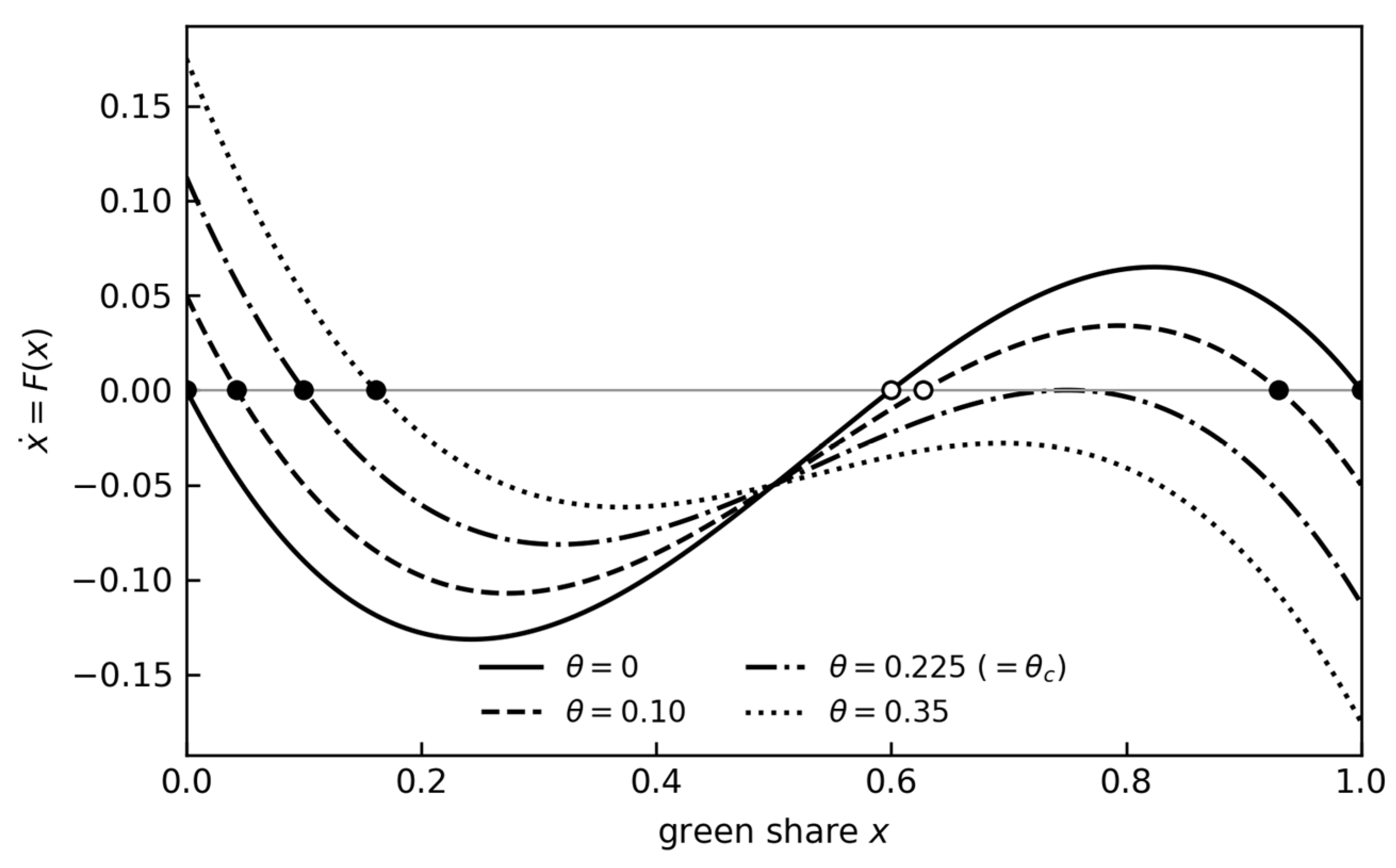
Figure 2.
Bifurcation diagrams of the green share against opacity intensity for three narrative environments: (a) brown-coded, ; (b) symmetric, ; (c) green-coded, . Black points denote asymptotically stable branches and grey points the unstable branch. In panels (a) and (b) the saddle-node destroys the green attractor, whereas in panel (c) it destroys the brown one.
Figure 2.
Bifurcation diagrams of the green share against opacity intensity for three narrative environments: (a) brown-coded, ; (b) symmetric, ; (c) green-coded, . Black points denote asymptotically stable branches and grey points the unstable branch. In panels (a) and (b) the saddle-node destroys the green attractor, whereas in panel (c) it destroys the brown one.
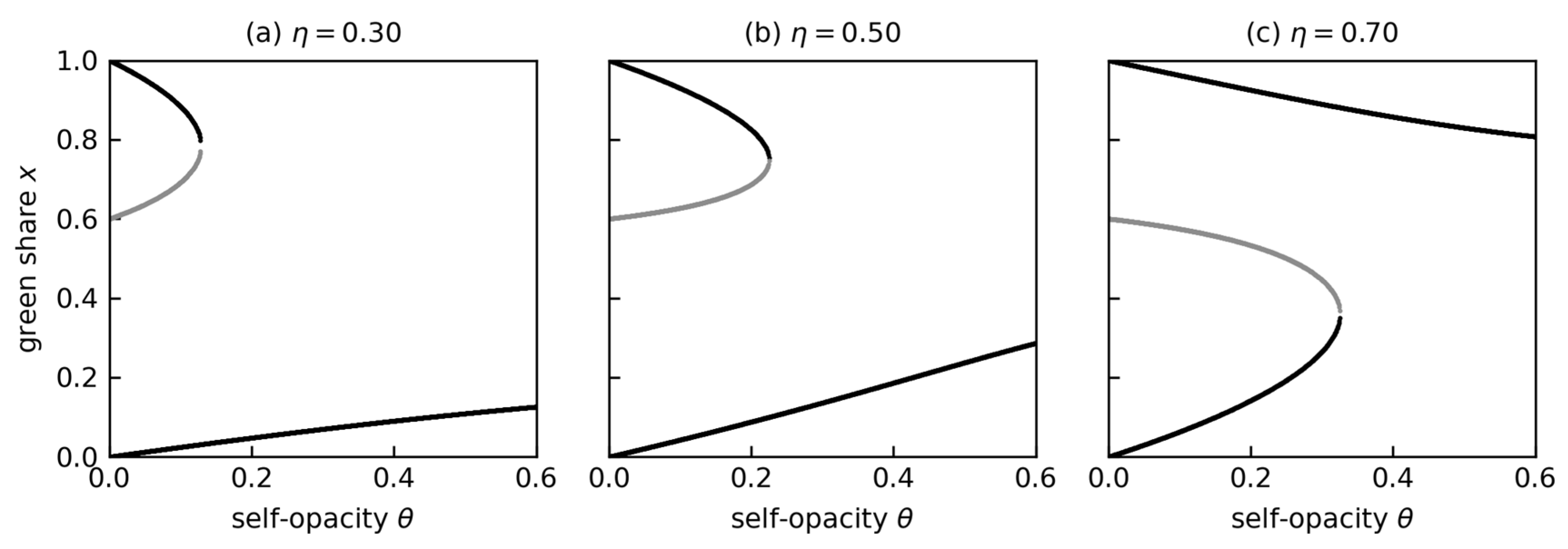
Figure 3.
Regime map in the space of narrative bias and opacity intensity, under the baseline calibration. Below the critical curve the dynamic is bistable and the outcome is history dependent. Above it a unique globally stable equilibrium obtains, brown-dominant to the left of and green-dominant to the right.
Figure 3.
Regime map in the space of narrative bias and opacity intensity, under the baseline calibration. Below the critical curve the dynamic is bistable and the outcome is history dependent. Above it a unique globally stable equilibrium obtains, brown-dominant to the left of and green-dominant to the right.
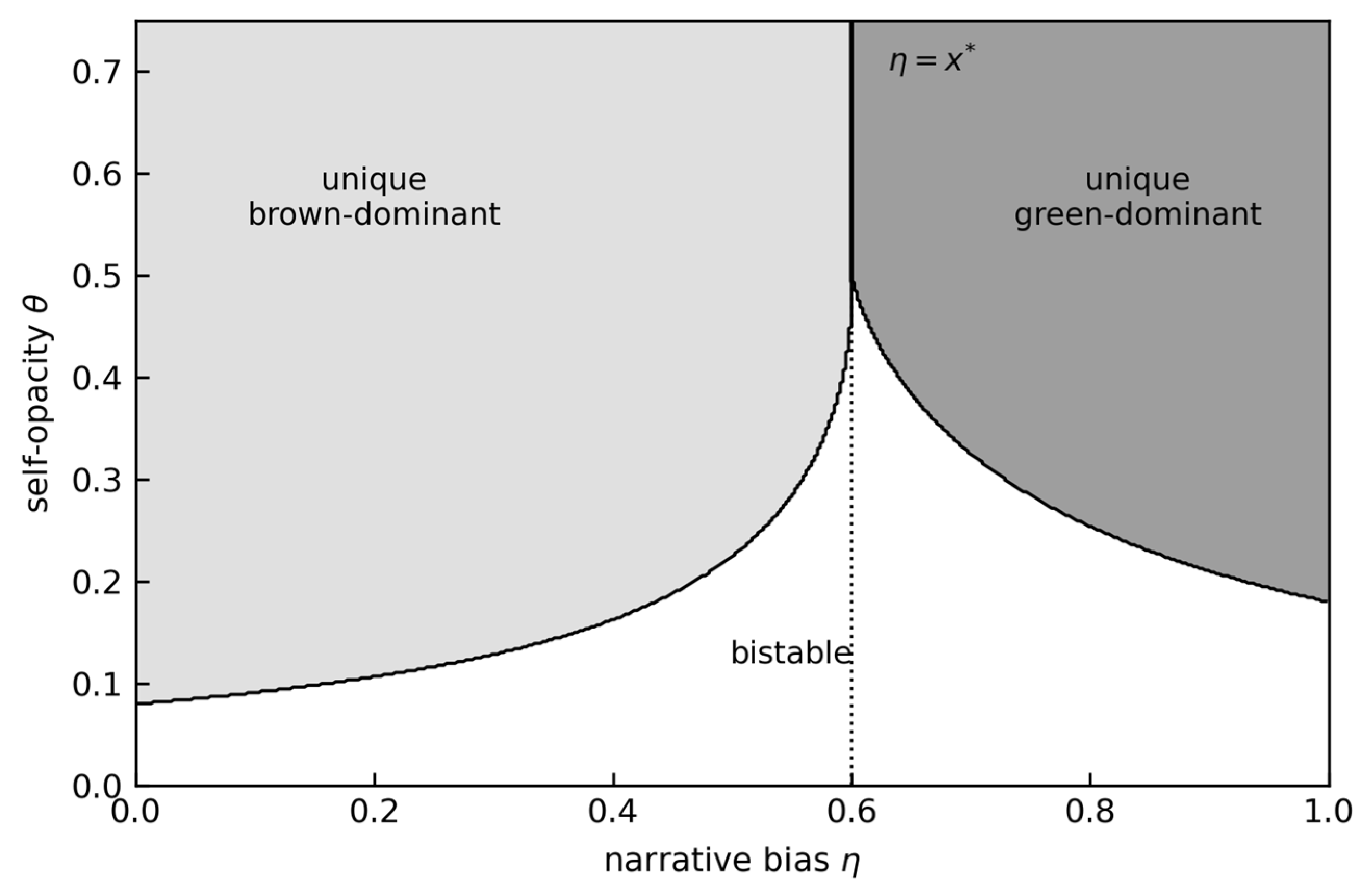
Figure 4.
Comparative statics of opacity under three narrative environments: (a) the tipping threshold , which rises with opacity when narratives are coded brown and falls when they are coded green; (b) the upper attractor , which declines with opacity in every environment, illustrating the asymmetric fragility of Proposition 3. Curves terminate at the corresponding saddle-node.
Figure 4.
Comparative statics of opacity under three narrative environments: (a) the tipping threshold , which rises with opacity when narratives are coded brown and falls when they are coded green; (b) the upper attractor , which declines with opacity in every environment, illustrating the asymmetric fragility of Proposition 3. Curves terminate at the corresponding saddle-node.
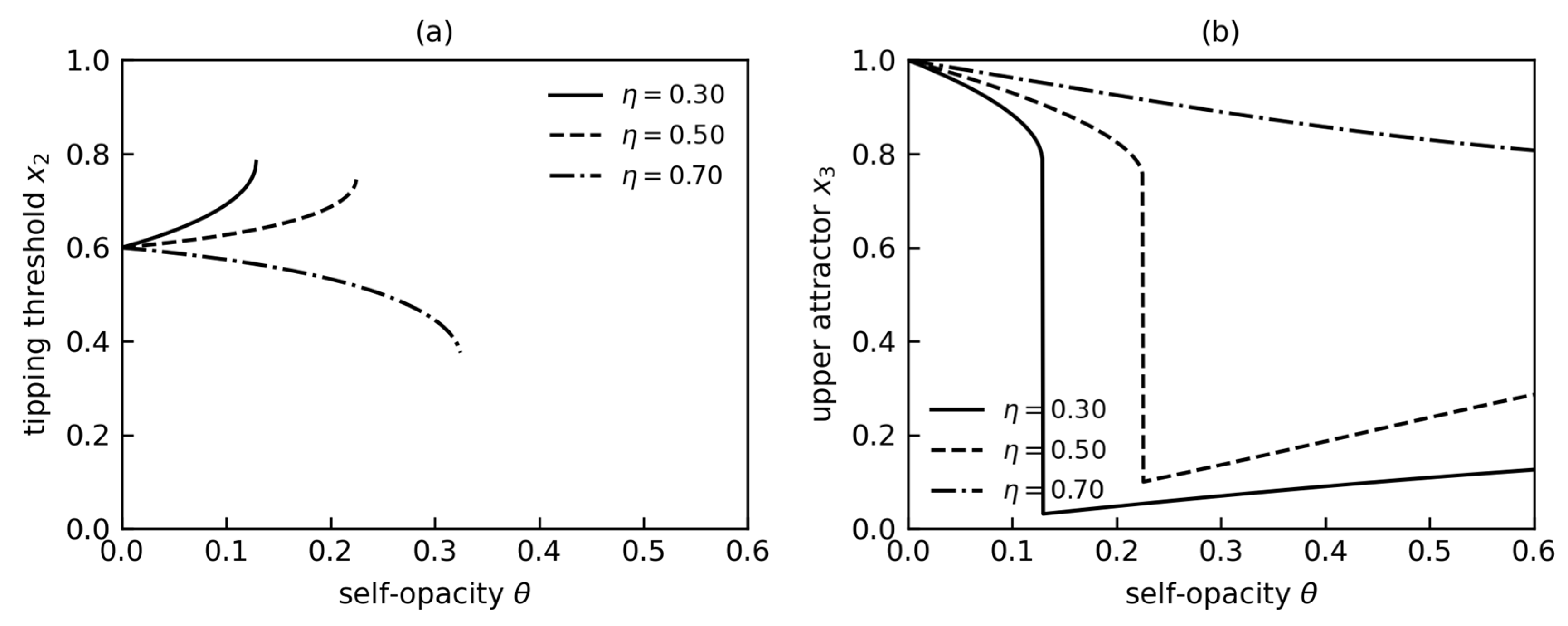

Table 1.
Parameters of the model, their interpretation and the baseline values used in the numerical illustration of Section 4.6.
Table 1.
Parameters of the model, their interpretation and the baseline values used in the numerical illustration of Section 4.6.
| Symbol | Interpretation | Range | Baseline |
| b | Strength of the conformity benefit | b > 0 | 1.00 |
| c | Private net cost of the green practice | 0 < c < b | 0.20 |
| x* | Coordination threshold, (b + c)/2b | (1/2, 1) | 0.60 |
| θ | Opacity intensity | [0, 1] | varied |
| η | Narrative bias towards green accounts | [0, 1] | varied |
| π0 | Baseline payoff common to both strategies | π0 > c | 1.00 |
| E | Aggregate environmental benefit per unit of green share | E > 0 | varied |
Table 2.
Rest points of the replicator-mutator dynamic under the baseline calibration (, , ). Here and are asymptotically stable and is the tipping threshold separating their basins.
Table 2.
Rest points of the replicator-mutator dynamic under the baseline calibration (, , ). Here and are asymptotically stable and is the tipping threshold separating their basins.
| η | θ | x₁ | x₂ | x₃ | Regime |
| 0.30 | 0.00 | 0.000 | 0.600 | 1.000 | bistable |
| 0.30 | 0.05 | 0.012 | 0.636 | 0.951 | bistable |
| 0.30 | 0.10 | 0.025 | 0.692 | 0.884 | bistable |
| 0.30 | 0.20 | 0.048 | – | – | unique, brown |
| 0.30 | 0.30 | 0.070 | – | – | unique, brown |
| 0.50 | 0.00 | 0.000 | 0.600 | 1.000 | bistable |
| 0.50 | 0.05 | 0.021 | 0.612 | 0.967 | bistable |
| 0.50 | 0.10 | 0.043 | 0.627 | 0.930 | bistable |
| 0.50 | 0.20 | 0.088 | 0.687 | 0.825 | bistable |
| 0.50 | 0.30 | 0.136 | – | – | unique, brown |
| 0.70 | 0.00 | 0.000 | 0.600 | 1.000 | bistable |
| 0.70 | 0.05 | 0.030 | 0.588 | 0.981 | bistable |
| 0.70 | 0.10 | 0.063 | 0.574 | 0.962 | bistable |
| 0.70 | 0.20 | 0.142 | 0.533 | 0.925 | bistable |
| 0.70 | 0.30 | 0.265 | 0.445 | 0.890 | bistable |
| 0.70 | 0.40 | 0.857 | – | – | unique, green |
Table 3.
Critical opacity intensity and long-run outcome as functions of the narrative bias, under the baseline calibration. The long-run green share is evaluated at , beyond for every row.
Table 3.
Critical opacity intensity and long-run outcome as functions of the narrative bias, under the baseline calibration. The long-run green share is evaluated at , beyond for every row.
| η | θᴄ(η) | Long-run green share | Surviving branch |
| 0.10 | 0.092 | 0.036 | brown |
| 0.20 | 0.107 | 0.077 | brown |
| 0.30 | 0.129 | 0.126 | brown |
| 0.40 | 0.163 | 0.190 | brown |
| 0.50 | 0.225 | 0.286 | brown |
| 0.60 | 0.500 | 0.600 | |
| 0.70 | 0.325 | 0.808 | green |
| 0.80 | 0.254 | 0.893 | green |
| 0.90 | 0.210 | 0.953 | green |
Disclaimer/Publisher’s Note: The statements, opinions and data contained in all publications are solely those of the individual author(s) and contributor(s) and not of MDPI and/or the editor(s). MDPI and/or the editor(s) disclaim responsibility for any injury to people or property resulting from any ideas, methods, instructions or products referred to in the content. |
© 2026 by the authors. Licensee MDPI, Basel, Switzerland. This article is an open access article distributed under the terms and conditions of the Creative Commons Attribution (CC BY) license (http://creativecommons.org/licenses/by/4.0/).
Copyright: This open access article is published under a Creative Commons CC BY 4.0 license, which permit the free download, distribution, and reuse, provided that the author and preprint are cited in any reuse.


