

Submitted:
22 July 2026
Posted:
23 July 2026
You are already at the latest version
Abstract
Fairness in recommendation systems has drawn growing attention due to rising societal and regulatory concerns over algorithmic bias. Existing fairness-aware approaches typically mitigate bias by either removing sensitive attributes via representation learning or leveraging causal-path interventions (e.g., counterfactual or specific-path debiasing) to distinguish genuine causal effects from confounder-induced correlations between sensitive attributes and users perference. However, when it comes to evaluation, most prior work adopts both Demographic Parity (DP) and Equal Opportunity (EO) as simultaneous criteria, yet overlooks their inherent tension and the causal nature of the sensitive attribute. Specifically, if a sensitive attribute genuinely drives preference variation, enforcing DP forces equal exposure across groups, contradicting natural interest diversity and severely hurting accuracy; conversely, for spurious correlations, relying solely on EO fails to remove confounder-introduced bias. More importantly, these metrics are typically computed in a static, one-shot manner, ignoring that recommendation is an iterative process where even minor initial disparities can be amplified over time through feedback loops, eventually leading to substantial long-term unfairness. Nevertheless, existing studies rarely address such dynamic, long‑term fairness implications, leaving a critical gap in both evaluation and optimization. To resolve this, we propose Long-term Fairness-aware Recommendation via Adaptive Fairness Metric Selection. Our framework first learns the causal structure to identify whether the sensitive attribute has a genuine causal effect or merely a spurious association with user preferences. Based on this diagnosis, it adaptively selects the most appropriate fairness criterion: Equal Opportunity for true causality, which allows legitimate group differences in preference, and Demographic Parity for spurious correlations, which eliminates unjustified disparities entirely. The adaptively chosen metric is then integrated into an actor-critic reinforcement learning reward to optimize long-term fairness without sacrificing accuracy. Extensive experiments on Alibaba and MovieLens datasets demonstrate that proposed method achieves a superior fairness-accuracy trade-off compared to state-of-the-art baselines, and the adaptive metric selection proves indispensable for maintaining both equity and recommendation quality.
Keywords:
Fairness-aware Recommendation
; causal inference
; Disentangled Representation Learning
; reinforcement learning
; Adaptive Fairness Metric
; long-term fairness
1. Introduction
Recommender systems have become indispensable in modern online platforms, shaping user experiences across e-commerce, social media, and content streaming [1]. However, mounting evidence shows that these systems can inadvertently reinforce or amplify societal biases, leading to unfair treatment of certain demographic groups [2,3]. For instance, job recommendation systems might favor male candidates for technical roles, while product recommenders may under-expose fashion items to male users. Such biases erode user trust and raise serious ethical and legal concerns.
To mitigate these issues, a large body of fairness-aware recommendation methods has been developed. The majority focus on removing or obfuscating information related to sensitive attributes (e.g., gender, age) from user representations [4,5,6,7]. More recent approaches employ causal reasoning to separate fair from unfair information paths [13,14,15,16,17,73]. Nevertheless, a critical and often overlooked limitation persists: these methods almost uniformly adopt a fixed fairness metric, most commonly Demographic Parity (DP), for both evaluation and optimization. DP demands that the probability of receiving a positive recommendation be identical across groups. While seemingly impartial, this requirement becomes problematic when a sensitive attribute genuinely influences user preferences—for example, when gender causally affects interest in certain product categories. In such cases, enforcing DP forces the system to ignore legitimate taste differences, inevitably hurting recommendation accuracy. Conversely, if the observed correlation is purely spurious (e.g., driven by historical exposure bias), DP is indeed appropriate, whereas Equal Opportunity (EO), which only equalizes true positive rates, may fail to rectify the underlying injustice.
This observation reveals a fundamental tension: a single fairness metric cannot serve all scenarios well. We argue that the choice of fairness criterion should be guided by the causal role of the sensitive attribute. When the attribute has a genuine causal effect on user preferences, it is reasonable to tolerate outcome disparities as long as qualified users from different groups enjoy equal access to relevant items; hence, Equal Opportunity is the more suitable metric. When the association is spurious, the system must pursue complete statistical independence from the attribute, i.e., Demographic Parity. This adaptive principle avoids the unnecessary accuracy degradation caused by blindly applying DP where it is not needed, while also providing stronger fairness guarantees than EO when bias is purely artifactual.
Figure 1 illustrates the contradictions inherent in existing approaches and how our adaptive strategy resolves them. Existing work typically tries to simultaneously satisfy both DP and EO, but this joint pursuit ignores three critical aspects: (1) the intrinsic tension between the two metrics, (2) the causal nature of the sensitive attribute, and (3) the dynamic amplification of bias over time. Depending on whether the attribute is truly causal or spurious, enforcing the wrong metric leads to either accuracy collapse (when DP is forced on a causal attribute) or residual bias (when EO is applied to a spurious association). Moreover, static one-shot evaluations miss the gradual accumulation of unfairness through feedback loops. Our LFR-via-AFMS framework addresses all three issues by first diagnosing the causal status, then adaptively selecting EO (for causal) or DP (for spurious), and finally embedding this choice into a reinforcement learning agent that optimizes long-term fairness.
Guided by this principle, we propose LFR-via-AFMS (Long-term Fairness-aware Recommendation via Adaptive Fairness Metric Selection). LFR-via-AFMS consists of three integrated stages: (1) Causal Structure Identification to determine whether the sensitive attribute operates through a genuine causal pathway or a spurious back-door path; (2) Disentangled Representation Learning that preserves legitimate causal information or removes bias factors accordingly; and (3) Actor-Critic Reinforcement Learning with Adaptive Fairness Penalty, where the reward function dynamically selects EO or DP penalty based on the causal diagnosis, thereby optimizing long-term fairness without compromising accuracy.
Our main contributions are:
- Principle of Adaptive Fairness Metric Selection: We formally analyze why simultaneously satisfying DP and EO is contradictory under genuine causality, and propose a causal diagnosis-based strategy that applies EO for true causal attributes and DP for spurious ones, fundamentally avoiding the accuracy-fairness dilemma.
- Integrated LFR-via-AFMS Framework: We combine causal discovery, path-specific/VAE debiasing, and an actor-critic RL agent with an adaptive fairness reward, achieving long-term group fairness with minimal accuracy loss.
- Empirical Validation: Extensive experiments on MovieLens and Alibaba datasets show that LFR-via-AFMS outperforms fixed-metric and non-causal baselines in both fairness and recommendation quality, and confirm the indispensability of adaptive metric selection.
2. Related Work
2.1. Fairness in Recommendation
Research on fairness in recommender systems has flourished, covering pre-processing, in-processing, and post-processing techniques. Ekstrand et al. [70] provided a comprehensive survey categorizing fairness approaches along dimensions including consumer versus provider fairness [2,18,22,23], individual versus group fairness [19,20], and static versus dynamic settings. Most existing approaches follow one of three intervention strategies: pre-processing, in-processing, or post-processing.
Pre-processing methods modify the training data before model learning to remove or mitigate bias [29,30]. Common techniques include reweighting samples from underrepresented groups [62], obfuscating sensitive attributes through feature transformation [63], and generating counterfactual data augmentations [64]. While straightforward, pre-processing approaches often fail to eliminate bias that emerges through complex interactions during model training.
In-processing methods incorporate fairness constraints directly into the optimization objective or learning algorithm [18,31]. Regularization-based approaches add penalty terms that encourage prediction parity across groups [32,33,65,76], while adversarial methods learn representations invariant to sensitive attributes [69]. More recent approaches integrate fairness constraints into graph neural network architectures [66,67]. However, these methods typically treat all variation related to sensitive attributes as undesirable, failing to distinguish between legitimate preference differences and discriminatory bias.
Post-processing methods adjust model outputs after training to satisfy fairness constraints [34,35,68]. These approaches are model-agnostic and computationally efficient but may substantially degrade recommendation quality when the underlying model is severely biased.
Most existing methods optimize fairness constraint by Demographic Parity, regardless of the data generation process. While some works have incorporated Equal Opportunity, they treat fairness metrics as fixed and universally desirable, ignoring the fact that their appropriateness depends on the causal nature of the sensitive attribute. Our work departs from this static view by making the fairness metric itself adaptive.
2.2. Causal Inference for Fairness
Causal inference provides a powerful language for reasoning about fairness [36]. Counterfactual fairness [37] requires that a model’s prediction remain unchanged under counterfactual interventions on the sensitive attribute. Path-specific fairness allows certain causal pathways while blocking others. Wang et al. [28,38] used a causal graph to debias click data. PSF-RS preserves the fair influence of sensitive features by identifying fair and unfair latent mediators [73], but it only focuses on the immediate fairness of a single model’s prediction. Nevertheless, most existing causal fair recommenders do not consider long-term fairness under the loop effect of the recommender system over time, nor do they employ a predetermined fairness evaluation metric without considering that the definition of fairness should adapt according to the causal status of the attribute. LFR-via-AFMS fills this gap by using causal discovery to also decide which metric to optimize.
2.3. Disentangled Representation Learning and RL
Disentangled representation learning aims to separate independent generative factors in data. Variational autoencoders (VAEs) with modified loss functions (e.g., -VAE [39], FactorVAE [40]) have been widely used. In recommendation, disentanglement can separate user preferences from confounding factors like popularity bias [41,42,60,61,71]. In fairness applications, disentanglement has been employed to separate variation related to sensitive attributes from task-relevant information. The CAD-VAE framework [59] introduces correlation-aware regularization to separate sensitive attributes from other factors. Existing fairness-aware RL methods add a static fairness penalty to the reward. In contrast, we design an adaptive penalty that switches between EO and DP based on causal identification, leading to a more intelligent long-term policy.
2.4. Reinforcement Learning for Recommendation
Reinforcement learning (RL) is well-suited for recommendation as a sequential interaction process [43,44]. Actor-Critic methods have been applied to optimize long-term user engagement [45]. Recently, fairness-aware RL approaches incorporate fairness metrics into the reward function [46,47,61]. However, existing RL-based fairness methods do not consider causal structure, and causal-based reinforcement learning recommendation algorithms typically consider only features with causal effects while neglecting features without causal influence [48,49]. Our work builds upon these RL foundations but differs in the state representation: rather than using raw user histories or biased embeddings, our RL agent operates on the debiased representations produced by our causal disentanglement module, providing a cleaner signal for fairness-accuracy trade-off optimization.
3. Preliminaries
In this section, we first recall standard fairness definitions and causal graph notations. Then, we present a detailed analysis of the dilemmas that arise when simultaneously applying DP and EO in recommendation, which directly motivates our adaptive fairness metric selection strategy.
3.1. Fairness Definitions
We consider a binary sensitive attribute . Let be the true user preference (e.g., click) and be the recommendation decision. Two widely used group fairness metrics are:
- Demographic Parity (DP): . It requires equal positive prediction rates across groups.
- Equal Opportunity (EO): . It requires equal true positive rates across groups.
DP focuses on outcome distribution, while EO focuses on equitable access for those truly interested.
3.2. Causal Graphs and Path-Specific Fairness
We model the recommendation environment with variables: sensitive attribute A, user intrinsic preference U, item features X, exposure E, and interaction Y. The causal role of A determines not only how bias arises but also which fairness intervention is appropriate. In this work we distinguish two fundamental structures, as illustrated in Figure 2.
Genuine causal effect.
Figure 2(a) depicts the case where the sensitive attribute has a genuine causal influence on user preference. The path captures how inherent group characteristics (e.g., gender differences in movie genre affinity) legitimately shape interests. At the same time, may represent an unfair exposure mechanism (e.g., historical under-representation of certain groups in recommendations), which introduces bias. In this scenario, it would be incorrect to remove all influence of A on Y—doing so would discard the authentic preference signal carried by and degrade recommendation accuracy. Path-specific fairness [73] provides the right tool: we should preserve the fair causal path while blocking the unfair mediation through E. Consequently, enforcing Demographic Parity (which forces total independence between A and ) is too restrictive: it eliminates even the legitimate variation, leading to unnecessary accuracy loss. Instead, Equal Opportunity is the natural metric, as it allows group-level differences in base rates while requiring equal true positive rates for those truly interested. This aligns with the idea that we only constrain the unfair pathway, not the causal one.
Spurious association.
Figure 2(b) illustrates the spurious case, where A and Y share a common confounder C (e.g., societal stereotypes that affect both group identity and perceived preferences). There is no causal path from A to Y; the statistical association is entirely artificial. In this setting, any dependence between and A arises purely from bias. The system should therefore aim for complete independence, making Demographic Parity the appropriate fairness criterion. Removing the sensitive attribute’s influence is both safe and necessary, as it does not sacrifice any genuine preference signal. Using only Equal Opportunity would be insufficient because it could still leave the spurious correlation untouched.
Based on this causal diagnosis, we learn the causal graph and perform conditional independence tests to distinguish between the two cases, yielding a flag ( for genuine causal, for spurious).
3.3. The Dilemma of Simultaneous DP-EO Evaluation and Our Adaptive Principle
Most prior studies simultaneously report DP and EO, and often try to improve both. However, this joint pursuit is fundamentally problematic when the sensitive attribute has a genuine causal effect on user preferences, which is the primary motivation behind our work. We elaborate the issues below.
1. Mathematical impossibility under true causality. Suppose gender (A) causally influences movie genre preference (Y). Then the base rate may naturally differ from . DP requires . Since the optimal prediction should approximate the true preference Y, achieving DP forces the system to over-recommend to the group with lower true interest or under-recommend to the group with higher interest, thereby introducing systematic distortion. EO only requires , which can be satisfied without altering the overall recommendation rates; it respects genuine base rate differences. Thus, when A is causal, strict DP and EO cannot be simultaneously satisfied unless base rates are equal—a condition rarely met in reality.
2. Conflicting optimization objectives. Many fairness-aware models add penalty terms for both DP violation and EO violation to the loss function. Under genuine causality, these two penalties push the model in opposite directions: DP penalty discourages any dependence on A, while EO penalty only discourages unequal error rates. The model is forced to reach a suboptimal compromise that satisfies neither perfectly and degrades recommendation accuracy. This “waterbed effect” leads to unstable training and unpredictable fairness-accuracy trade-offs.
3. Masking the true nature of unfairness. Reporting both metrics without causal context can obscure the source of bias. A low DP gap might be achieved by sacrificing EO (e.g., recommending fewer relevant items to a disadvantaged group to equalize exposure), while a low EO gap might coexist with a large DP gap that reflects legitimate preference variation. Without causal diagnosis, we cannot interpret whether a disparity is discriminatory or simply a reflection of diverse interests. The field lacks a principled guideline on when each metric is appropriate.
4. Our adaptive solution. To resolve these dilemmas, we propose a simple yet effective rule: the choice of fairness metric should align with the causal role of the sensitive attribute. Specifically:
- If the attribute has a genuine causal effect on preference (), we adopt Equal Opportunity. This allows natural base rate differences while ensuring that truly interested users from all groups receive fair access. DP is not enforced.
- If the attribute has only a spurious correlation (), we adopt Demographic Parity. Since the observed association is entirely due to bias, the system should aim for complete independence from the attribute, eradicating the illegitimate signal.
This adaptive strategy eliminates the contradictory objectives inherent in previous approaches and provides a causally grounded definition of fairness. It forms the foundation of the LFR-via-AFMS framework.
3.4. Actor-Critic Reinforcement Learning
We formulate sequential recommendation as a Markov Decision Process (MDP). At step t, the state includes user representation and history; action is a set of recommended items; reward combines accuracy and fairness. The goal is to learn a policy that maximizes expected cumulative reward . We adopt an Actor-Critic architecture, where the Critic estimates and the Actor updates the policy via PPO [52]. The fairness penalty in will be defined adaptively based on the causal flag, as detailed in Section 4.
4. Proposed Method: LFR-via-AFMS
In this section we detail the three core components of LFR-via-AFMS: causal structure identification, conditional representation learning, and actor-critic training with adaptive fairness penalties. An overview of the pipeline is shown in Figure 3.
4.1. Causal Structure Identification
The first stage diagnoses whether the sensitive attribute A has a genuine causal effect on user preference Y or merely exhibits a spurious correlation. We treat the observed variables and aim to recover the underlying causal graph. A proxy for the latent intrinsic preference U is obtained from a pre-trained matrix factorization model, which provides low-dimensional user embeddings that capture genuine taste factors independent of exposure.
We apply the PC algorithm [50] with Fisher’s z-test for conditional independence. Starting from a fully connected graph, edges are iteratively removed when a conditional independence is detected. After orienting edges via collider detection and propagation rules, we obtain a partial ancestral graph. The critical question is whether A has any directed path to Y that does not go through U—that is, whether there exists a direct effect or a back-door path remaining after conditioning on U and E. If A and Y are independent given U and E, i.e. , then the entire association is mediated by the fair path and possibly the unfair path (which we will later block). In this case the effect of A on Y is genuine and operates through known mediators; we set the spurious flag .
If, however, the conditional independence does not hold, the remaining dependence indicates an unblocked back-door path (e.g., a hidden confounder C affecting both A and Y, as in Figure 2(b)), or a direct causal link not captured by U or E. Such a residual association has no legitimate grounding in user preference and is therefore deemed spurious; we set . In practice, to be robust to finite-sample noise, we additionally train a simple classifier to predict Y from A given ; if the AUC exceeds , we also decide . The outcome of this stage is a binary flag that determines both the representation learning strategy and the fairness metric to be used in the RL reward.
4.2. Conditional Representation Learning
Given the causal diagnosis, we adopt one of two debiasing approaches to learn a user representation that only retains fair information.
4.2.1. Path-Specific Fair Representation (Genuine Causality)
When , the attribute A is a genuine cause of Y through the preference U. To avoid unfair bias introduced by differential exposure E, we learn a representation that satisfies path-specific fairness: it preserves the causal pathway while blocking the unfair mediation . Concretely, we define an encoder and optimize the following objective:
The first term is the standard Bayesian Personalized Ranking loss that encourages the representation to be effective for preference prediction:
where is the predicted score for user u and item i computed from .
The second term penalizes any direct dependence between and exposure E that is not mediated by U. We implement this using an adversarial discriminator D that tries to recover E from and U, while the encoder is trained to fool it. With a gradient reversal layer [74], the adversarial loss becomes
which is minimized by the encoder to make E unpredictable. This encourages the representation to be conditionally independent of E given U, thereby removing the influence of the unfair exposure path while keeping the legitimate signal from A through U intact.
4.2.2. Disentangled VAE (Spurious Correlation)
When , the correlation between A and Y is entirely non-causal. In this case we must remove any influence of A from the user representation. We employ a variational autoencoder that factorizes each user interaction vector (e.g., a multi-hot encoding of items clicked) into two independent latent variables: a preference component and a bias component . The generative model is defined as
The encoder outputs the parameters of the approximate posterior.
To ensure that contains no information about the sensitive attribute, we add an independence regularization between and the attribute vector (one-hot encoding of A). We employ the Hilbert-Schmidt Independence Criterion (HSIC) [75], which measures the dependence between two random variables in reproducing kernel Hilbert spaces:
The overall VAE loss becomes
The HSIC penalty drives towards statistical independence from the sensitive attribute, effectively discarding the spurious signal. After training, we discard and use only as the debiased representation for downstream recommendation.
The final debiased representation, denoted , is set to when and to when .
4.3. Actor-Critic with Adaptive Fairness Penalty
The debiased representation is fed into a reinforcement learning agent that interacts with users over time. We model the sequential recommendation process as an MDP with state , where is the aggregated history of recent interactions. The action is a slate of K items chosen from the candidate pool; the agent receives an immediate reward defined below.
The reward is composed of an accuracy term and an adaptive fairness penalty:
is the standard feedback (e.g., 1 for a click, 0 otherwise). The penalty dynamically selects the appropriate fairness metric based on the causal flag:
Here and , both computed over a sliding window of the most recent W interactions. and are small tolerance thresholds to prevent over-penalisation of minor fluctuations. This formulation directly enforces the adaptive principle: when causality is genuine, the agent is penalized only for unequal true positive rates; when the association is spurious, it must equalize overall recommendation rates.
We implement the policy using Proximal Policy Optimization (PPO) [52], with an actor network and a critic network . In addition to the intrinsic reward penalty, we adopt a Lagrangian approach to enforce a long-term fairness budget. Let be the cumulative fairness penalty over the whole trajectory. We introduce a Lagrange multiplier and augment the PPO objective with a constraint:
where is the maximum allowable long-term unfairness. During training, is updated by dual gradient ascent: . The actor and critic are updated via the standard PPO clipped objective:
where and is the generalized advantage estimate using the value function . The value loss is the squared error
An entropy bonus is added to encourage exploration.
This design allows the agent to learn a recommendation policy that simultaneously maximizes user satisfaction and maintains long-term fairness, with the definition of fairness adaptively chosen according to the causal nature of each sensitive attribute.
4.4. Training Procedure
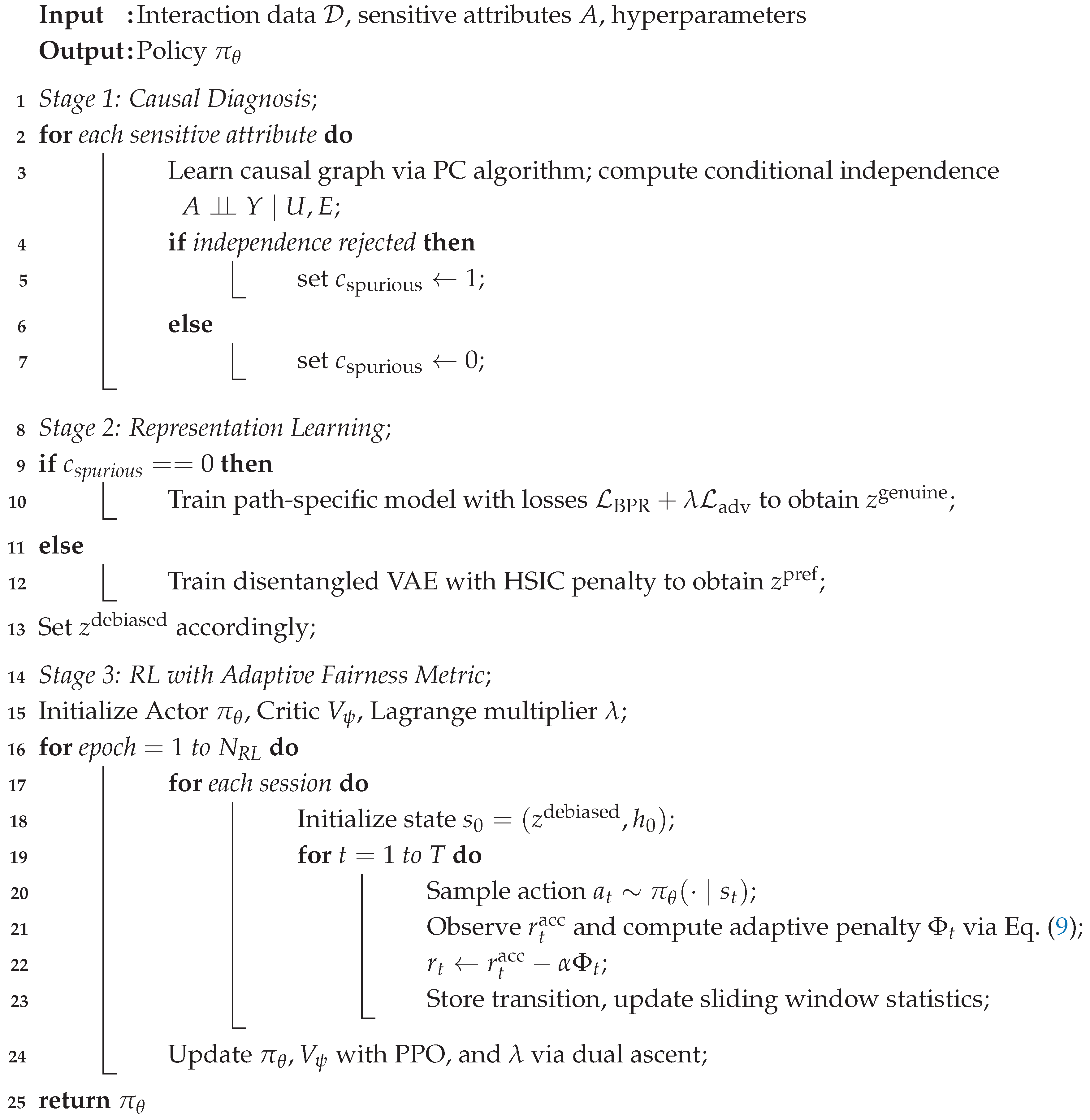
The full training algorithm is summarized in Algorithm 1. Stage 1 determines offline. Stage 2 pre-trains the appropriate debiasing model to obtain . Stage 3 then trains the RL agent using the adaptive reward. All components are trained jointly in an end-to-end manner after pre-training.
| Algorithm 1: LFR-via-AFMS Training Procedure |
 |
5. Experiments
In this section we conduct extensive experiments to evaluate LFR-via-AFMS from multiple perspectives. We first describe the datasets and experimental setup, then present overall performance, followed by detailed ablation studies and parameter analyses.
5.1. Datasets and Settings
We adopt two widely used public recommendation datasets with distinct causal properties.
- MovieLens-1M1: This dataset contains 1,000,209 ratings from 6,040 users on 3,952 movies. User gender is used as the sensitive attribute. Prior studies and preliminary causal analysis show that gender has a genuine causal effect on movie genre preferences (e.g., males tend to prefer action, females romance), making it a representative case of .
- Alibaba display advertising dataset2: This dataset contains 1,140,000 interactions from 10,000 users on 800,000 items. Gender serves as the sensitive attribute. Due to heavy exposure bias (certain ads are historically shown disproportionately to one gender), the correlation between gender and clicks is largely spurious, i.e., .
For both datasets, we filter out users with fewer than 20 interactions to ensure sufficient history. Data is split chronologically: the earliest 80% interactions form the training set, the next 10% validation, and the most recent 10% testing. We report recommendation accuracy via NDCG@K and Recall@K for . Fairness is measured by the absolute difference in demographic parity () and equal opportunity () across the two gender groups, with lower values indicating better fairness. Long-term fairness drift is measured as the increase in the target fairness metric after 10,000 interaction steps compared to the initial state.
5.1.1. Implementation Details
All models are implemented in PyTorch. The user preference proxy U is obtained from a matrix factorization model with 64 latent dimensions. For the PC algorithm, we use a significance level of 0.01 for conditional independence tests. The path-specific model uses a two-layer MLP encoder with hidden sizes [128, 64] and a discriminator with a single hidden layer of 32 units. The VAE employs symmetric 128-64-32 encoder and decoder architectures with 32-dim and 16-dim . The HSIC penalty coefficient is set to 0.1.
In the RL stage, we use a PPO agent with a learning rate of , discount factor , clipping parameter , and entropy coefficient 0.01. The sliding window size W for online fairness estimation is 500. The fairness penalty weight is 0.1, and tolerance thresholds , . The Lagrangian multiplier starts at 0.1 with a learning rate of 0.05. All hyperparameters were tuned on the validation set.
5.2. Baselines
We compare LFR-via-AFMS against the following methods:
- BPR-MF [55]: Bayesian Personalized Ranking with matrix factorization, a classic non-fair baseline.
- RLFair: A fairness-aware RL recommender that adds a fixed DP penalty to the reward.
- FairDgcl: A graph contrastive learning method for fairness that uses adversarial debiasing.
- CausalDF [38]: A causal click-bias removal method that uses a causal graph to infer true preference.
- PSFRS [73]: Path-Specific Fair Recommender System that blocks unfair pathways using counterfactual reasoning.
- LFR-via-AFMS-FixedDP: A variant of LFR-via-AFMS that always enforces DP regardless of causal diagnosis.
- LFR-via-AFMS-FixedEO: A variant of LFR-via-AFMS that always enforces EO.
- LFR-via-AFMS-NoCausal: A variant that skips causal identification and always applies the disentangled VAE (spurious branch).
5.3. Overall Performance
On MovieLens, LFR-via-AFMS correctly identifies genuine causality and selects EO as the optimization target. It achieves the highest NDCG and Recall, demonstrating that preserving the legitimate pathway is crucial for accuracy. Most importantly, it attains the lowest EO (0.0723 at K=10), meaning that truly interested users receive equally accurate recommendations irrespective of gender. The fixed-DP variant, while reducing DP significantly, severely damages recommendation quality (NDCG drops from 0.2356 to 0.2052) and even worsens EO compared to LFR-via-AFMS-FixedEO, confirming that forcing DP under genuine causality leads to contradictory objectives.
For the Alibaba dataset, LFR-via-AFMS correctly switches to DP as the fairness metric. It obtains the best DP (0.0651) while preserving competitive accuracy, closely matching the fixed-EO variant in NDCG but with far superior DP control. The fixed-EO variant, designed for genuine causality, fails to mitigate the spurious DP gap (0.2210). These results strongly support our adaptive metric selection principle.
5.4. Ablation Studies
We conduct ablation experiments to isolate the contribution of each component. Results are summarized in Table 3.
We start from the vanilla BPR-MF (no fairness components). Adding causal diagnosis alone (using the correct metric but without debiased representation) already improves fairness, confirming the value of metric selection. Incorporating the conditional representation learning module further reduces the target unfairness metric significantly while boosting accuracy, as the RL agent operates on cleaner signals. Finally, the full model with adaptive penalty achieves the best trade-off on both datasets. These results verify that all three components are essential and complementary.
5.5. Parameter Sensitivity
We analyze the sensitivity of the fairness penalty weight and the tolerance thresholds on both datasets. Figure 4 and Figure 5 illustrates the Pareto frontier between recommendation accuracy and the respective target fairness metric as varies from 0.01 to 1.0.
On MovieLens (Figure 4), increasing strengthens EO enforcement, steadily reducing EO at a modest cost in NDCG. The curve stays relatively flat for , demonstrating robust behavior. On Alibaba (Figure 5), a similar trend is observed for DP: larger consistently shrinks DP without drastic accuracy degradation until . The recommended value lies in the stable region for both datasets, achieving a favorable balance. Sensitivity analyses for and yield analogous conclusions, with and providing sufficient noise tolerance without compromising fairness goals.
5.6. Long-Term Fairness Evolution
To assess long-term dynamics, we simulate 10,000 recommendation steps and record the fairness drift. As shown in Figure 6 and Figure 7, LFR-via-AFMS maintains the target fairness metric (EO difference on MovieLens, DP difference on Alibaba) consistently below the tolerance threshold, while fixed-metric variants gradually drift upward due to feedback loops. The Lagrangian multiplier effectively adjusts the penalty strength, preventing fairness violation accumulation.
Table 4 quantifies the fairness drift after the long interaction sequence. LFR-via-AFMS exhibits the smallest increase in unfairness, demonstrating superior stability.
Overall, the empirical evidence confirms that LFR-via-AFMS effectively balances accuracy and fairness across different causal regimes, and that its adaptive design is vital for achieving robust long-term performance.
6. Conclusions and Future Work
We introduced LFR-via-AFMS, a causal-driven fairness-aware recommendation framework that adaptively selects between Equal Opportunity and Demographic Parity based on whether the sensitive attribute’s effect is genuine or spurious. By embedding this adaptive metric into an RL-based long-term optimization, LFR-via-AFMS resolves the contradictions of fixed-metric approaches and achieves state-of-the-art fairness-accuracy balance. Future work will extend the adaptive principle to multiple intersecting sensitive attributes and online causal discovery from dynamic interactions.
Acknowledgments
This work was supported by the Project of Educational Commission of Guangdong Province of China (No.2021WTSCX243), and the Research Launch Fund of Shanwei Institute of Technology (SKQD2021b-014).
Conflicts of Interest
The authors declare that they have no known competing financial interests.
References
- Ko, H.; Lee, S.; Park, Y.; Choi, A. A survey of recommendation systems: recommendation models, techniques, and application fields. Electronics 2022, 11, 141. [CrossRef]
- Mehrabi, N.; Morstatter, F.; Saxena, N.; Lerman, K.; Galstyan, A. A survey on bias and fairness in machine learning. ACM Comput. Surv. 2021, 54, 1–35. [CrossRef]
- Chen, J.; Dong, H.; Wang, X.; Feng, F.; Wang, M.; He, X. Bias and debias in recommender system: a survey and future directions. ACM Trans. Inf. Syst. 2023, 41, 67:1–67:39. [CrossRef]
- Zhang, B.H.; Lemoine, B.; Mitchell, M. Mitigating unwanted biases with adversarial learning. In Proceedings of the AAAI/ACM Conference on AI, Ethics, and Society (AIES), 2018; pp. 335–340. [CrossRef]
- Beutel, A.; Chen, J.; Zhao, Z.; Chi, E.H. Fairness in recommendation ranking through pairwise comparisons. In Proceedings of the 25th ACM SIGKDD International Conference on Knowledge Discovery & Data Mining (KDD), 2019; pp. 2212–2220. [CrossRef]
- Bin, C.; Liu, W.; Zhang, F.; Chang, L.; Gu, T. FairCoRe: fairness-aware recommendation through counterfactual representation learning. IEEE Trans. Knowl. Data Eng. 2025, 37, 4049–4062. [CrossRef]
- Zeng, H.; He, Z.; Yue, Z.; et al. Fair sequential recommendation without user demographics. In Proceedings of the 47th International ACM SIGIR Conference on Research and Development in Information Retrieval, 2024; pp. 395–404.
- Chen, X.; Fan, W.; Chen, J.; Liu, H.; Liu, Z.; Zhang, Z.; Li, Q. Fairly adaptive negative sampling for recommendations. In Proceedings of the ACM Web Conference 2023, 2023; pp. 3723–3733. [CrossRef]
- Chen, J.; Tam, D.; Raffel, C.; Bansal, M.; Yang, D. An empirical survey of data augmentation for limited data learning in NLP. Trans. Assoc. Comput. Linguist. 2023, 11, 191–211. [CrossRef]
- Chen, L.; Wu, L.; Zhang, K.; Hong, R.; Lian, D.; Zhang, Z.; Zhou, J.; Wang, M. Improving recommendation fairness via data augmentation. In Proceedings of the ACM Web Conference 2023, 2023; pp. 1012–1020. [CrossRef]
- Boratto, L.; Fabbri, F.; Fenu, G.; Marras, M.; Medda, G. Counterfactual graph augmentation for consumer unfairness mitigation in recommender systems. In Proceedings of the 32nd ACM International Conference on Information and Knowledge Management (CIKM), 2023; pp. 3753–3757. [CrossRef]
- Xu, S.; Ji, J.; Li, Y.; et al. Causal inference for recommendation: foundations, methods and applications. ACM Trans. Intell. Syst. Technol. 2025. [CrossRef]
- Klimashevskaia, A.; Jannach, D.; Elahi, M.; Trattner, C. A survey on popularity bias in recommender systems. User Model. User-Adapt. Interact. 2024, 34, 1777–1834. [CrossRef]
- Li, Y.; Zhu, X.; Wu, Y.; Zhao, W.; Xia, X. A survey on causal inference-driven data bias optimization in recommendation systems: principles, opportunities and challenges. WIREs Data Min. Knowl. Discov. 2025, 15, e70020. [CrossRef]
- Kusner, M.J.; Loftus, J.; Russell, C.; Silva, R. Counterfactual fairness. In Advances in Neural Information Processing Systems (NeurIPS), 2017; pp. 4066–4076. [CrossRef]
- Chen, W.; Yuan, M.; Zhang, Z.; et al. FairDgcl: fairness-aware recommendation with dynamic graph contrastive learning. IEEE Trans. Knowl. Data Eng. 2025, 37, 5230–5242. [CrossRef]
- Gholinejad, N.; Chehreghani, M.H. Heterophily-aware fair recommendation using graph convolutional networks. Neurocomputing 2025, 661, 131956. [CrossRef]
- Liu, S.; Zhang, Y.; Yi, L.; et al. Dual-side adversarial learning based fair recommendation for sensitive attribute filtering. ACM Trans. Knowl. Discov. Data 2024, 18, 20.
- Chakraborty, A.; Gummadi, K.P. Fairness in algorithmic decision making. In Proceedings of the 7th ACM IKDD CoDS and 25th COMAD, 2020. [CrossRef]
- Yao, S.; Huang, B. Beyond parity: fairness objectives for collaborative filtering. In Advances in Neural Information Processing Systems 30 (NIPS 2017), 2017; pp. 2921–2930. [CrossRef]
- Kusner, M.J.; Loftus, J.; Russell, C.; Silva, R. Counterfactual fairness. In Advances in Neural Information Processing Systems 30 (NIPS 2017), 2017; pp. 4066–4076. [CrossRef]
- Zhu, Y.; et al. Fair graph representation learning via sensitive attribute disentanglement. In Proceedings of the ACM Web Conference 2024, 2024; pp. 1182–1192. [CrossRef]
- Madras, D.; Creager, E.; Pitassi, T.; Zemel, R. Fairness through causal awareness: learning causal latent-variable models for biased data. In Proceedings of the Conference on Fairness, Accountability, and Transparency (FAT*), 2019; pp. 349–358. [CrossRef]
- Feldman, M.; Friedler, S.A.; Moeller, J.; Scheidegger, C.; Venkatasubramanian, S. Certifying and removing disparate impact. In Proceedings of the 21th ACM SIGKDD International Conference on Knowledge Discovery and Data Mining (KDD), 2015; pp. 259–268. [CrossRef]
- Hardt, M.; Price, E.; Srebro, N. Equality of opportunity in supervised learning. In Advances in Neural Information Processing Systems 29 (NIPS 2016), 2016; pp. 3315–3323. [CrossRef]
- Zliobaite, I. On the relation between accuracy and fairness in binary classification. In 2nd Workshop on Fairness, Accountability, and Transparency in Machine Learning, Lille, France, July 2015.
- Wang, X.; Wang, W.; Feng, F.; et al. Causal intervention for fairness in multibehavior recommendation. IEEE Trans. Comput. Soc. Syst. 2024, 11, 6320–6332. [CrossRef]
- Wang, X.; Li, Q.; Yu, D.; et al. Counterfactual explanation for fairness in recommendation. ACM Trans. Inf. Syst. 2024, 42. [CrossRef]
- Shi, J.; Liu, Y.; Liu, H.; et al. Inter-group knowledge transfer and representation distillation for fair recommendation. Knowl.-Based Syst. 2026, 336, 115279. [CrossRef]
- Gulsoy, M.; Yalcin, E.; Bilge, A. EquiRate: balanced rating injection approach for popularity bias mitigation in recommender systems. PeerJ Comput. Sci. 2025, 11, e3055. [CrossRef]
- Heidarpour-Shahrezaei, M.; Loughran, R.; McDaid, K. Mitigating algorithmic bias through sampling: the role of group size and sample selection. In 6th International Workshop, BIAS 2025, and 2nd International Workshop, IR4U2 2025, Padua, Italy, July 2026. [CrossRef]
- Escobedo, G.; Penz, D.; Schedl, M. Debiasing implicit feedback recommenders via sliced Wasserstein distance-based regularization. In Proceedings of the Nineteenth ACM Conference on Recommender Systems (RecSys ’25), 2025; pp. 1153–1158. [CrossRef]
- Yang, R.; Zhang, Y.; Li, K.; He, Q.; Li, X.; Zhou, W. Adversarial regularized diffusion model for fair recommendations. Neural Netw. 2025, 190, 107695. [CrossRef]
- Singh, A.; Joachims, T. Fairness of exposure in rankings. In Proceedings of the 26th ACM SIGKDD International Conference on Knowledge Discovery & Data Mining (KDD), 2020; pp. 2219–2229. [CrossRef]
- Ye, X.; et al. Regret-aware re-ranking for guaranteeing two-sided fairness and accuracy in recommender systems. arXiv preprint 2025. [CrossRef]
- Nabi, R.; Shpitser, I. Fair inference on outcomes. In Proceedings of the AAAI Conference on Artificial Intelligence, 2018; pp. 1931–1940. [CrossRef]
- Wu, P.; Chen, L.; Wang, W. Counterfactual fairness for recommendation. IEEE Trans. Big Data 2022. [CrossRef]
- Wang, W.; Lin, X.; Feng, F.; He, X.; Chua, T.S. Causal representation learning for recommendation. In Proceedings of the 45th International ACM SIGIR Conference on Research and Development in Information Retrieval, 2022; pp. 1123–1133. [CrossRef]
- Higgins, I.; Matthey, L.; Pal, A.; Burgess, C.; Glorot, X.; Botvinick, M.; Mohamed, S.; Lerchner, A. beta-VAE: learning basic visual concepts with a constrained variational framework. In International Conference on Learning Representations (ICLR), 2017. [CrossRef]
- Kim, H.; Mnih, A. Disentangling by factorising. In International Conference on Machine Learning (ICML), 2018; pp. 2649–2658. [CrossRef]
- Ma, J.; Zhou, C.; Cui, P.; Yang, H.; Zhu, W. Disentangled representation learning for recommendation. IEEE Trans. Knowl. Data Eng. 2020, 34, 865–878. [CrossRef]
- Shi, J.; Liu, H.; Zhao, N.; Zhou, J. Disentangling confounders via counterfactual interventions for fair recommendations. Expert Syst. Appl. 2026, 289, 130023. [CrossRef]
- Afsar, M.M.; Crump, T.; Far, B. Reinforcement learning based recommender systems: a survey. ACM Comput. Surv. 2022, 55, 1–38. [CrossRef]
- Anonymous. A comprehensive review of recommender systems: transitioning from theory to practice. Comput. Sci. Rev. 2026, 59, 100849. [CrossRef]
- Zhao, X.; Zhang, L.; Ding, Z.; Yin, D.; Tang, J. Recommendations with negative feedback via reinforcement learning. In Proceedings of the Web Conference (WWW), 2018; pp. 1011–1020. [CrossRef]
- Ge, Y.; Zhao, X.; Yu, L.; Paul, S.; Yin, D.; Zhang, C. Fairness-aware reinforcement learning for recommendation. In Proceedings of the 14th ACM International Conference on Web Search and Data Mining (WSDM), 2021; pp. 381–389. [CrossRef]
- Wang, J.; Zhang, Y.; McAuley, J. Achieving fairness in recommendation with reinforcement learning. In Proceedings of the 15th ACM Conference on Recommender Systems (RecSys), 2021; pp. 456–461. [CrossRef]
- Anonymous. Balancing accuracy and fairness for interactive recommendation with reinforcement learning. In Proceedings of the 2022 Pacific-Asia Conference on Knowledge Discovery and Data Mining (PAKDD), 2022. [CrossRef]
- Xia, C.; Shi, X.; Xie, H. Hierarchical reinforcement learning for long-term fairness in interactive recommendation. In Proceedings of the 2024 International Conference on Information and Knowledge Management (CIKM), 2024; pp. 300–309. [CrossRef]
- Spirtes, P.; Glymour, C.N.; Scheines, R. Causation, Prediction, and Search; MIT Press, 2000. [CrossRef]
- Arjovsky, M.; Bottou, L.; Gulrajani, I.; Lopez-Paz, D. Invariant risk minimization. arXiv preprint 2019. [CrossRef]
- Schulman, J.; Wolski, F.; Dhariwal, P.; Radford, A.; Klimov, O. Proximal policy optimization algorithms. arXiv preprint 2017. [CrossRef]
- Li, D.; Chen, C.; Lv, Q.; Shang, L.; Chu, S. GANM: a generative adversarial network for multi-task learning in recommendation. In Proceedings of the 27th ACM International Conference on Information and Knowledge Management (CIKM), 2018; pp. 1675–1678. [CrossRef]
- Harper, F.M.; Konstan, J.A. The MovieLens datasets: history and context. ACM Trans. Interact. Intell. Syst. 2015, 5, 1–19. [CrossRef]
- Rendle, S.; Freudenthaler, C.; Gantner, Z.; Schmidt-Thieme, L. BPR: Bayesian personalized ranking from implicit feedback. In Proceedings of the 28th Conference on Uncertainty in Artificial Intelligence (UAI), 2012; pp. 452–461. [CrossRef]
- Klimashevskaia, A.; Jannach, D.; Elahi, M.; Trattner, C. Fairness in recommender systems: research landscape and future directions. User Model. User-Adapt. Interact. 2024, 34, 1777–1834. [CrossRef]
- Wu, L.; Chen, L.; Shao, P.; Hong, R.; Wang, M. FairGo: a fair recommendation framework via causal reasoning and adversarial learning. In Proceedings of the 30th ACM International Conference on Multimedia (ACM MM), 2022; pp. 4751–4760. [CrossRef]
- La Malfa, G.; Zhang, J.M.; Luck, M.; Black, E. Fairness aware reinforcement learning via proximal policy optimization. In Proceedings of the AAAI Conference on Artificial Intelligence, 2026, 40, 22725–22733. [CrossRef]
- Lin, C.; Yang, X.; Wang, X.; Chua, T.-S. Causal inference for recommendation: foundations, methods and applications. In Proceedings of the 46th International ACM SIGIR Conference, 2023; pp. 3456–3459.
- Ma, J.; Zhou, C.; Cui, P.; Yang, H.; Zhu, W. Learning disentangled representations for recommendation. In Advances in Neural Information Processing Systems, 2019; pp. 5711–5722.
- Zhou, Y.; Liu, S.; Zhang, Y. Contrastive disentangled variational autoencoder for collaborative filtering. In Proceedings of the ACM Web Conference, 2025.
- Zhang, B.H.; Lemoine, B.; Mitchell, M. Mitigating unwanted biases with adversarial learning. In AAAI/ACM Conference on AI, Ethics, and Society, 2018; pp. 335–340. [CrossRef]
- Hajian, S.; Domingo-Ferrer, J. A methodology for direct and indirect discrimination prevention in data mining. IEEE Trans. Knowl. Data Eng. 2012, 25, 1445–1459. [CrossRef]
- Wang, Y.; Zhang, X.; Chen, L. FairGap: fairness-aware recommendation via generating counterfactual graph. ACM Trans. Inf. Syst. 2024, 42, 1–25.
- Bin, C.; Liu, W.; Zhang, F.; Chang, L.; Gu, T. FairCoRe: fairness-aware recommendation through counterfactual representation learning. IEEE Trans. Knowl. Data Eng. 2025. [CrossRef]
- Chen, W.; Chen, L.; Ni, Y.; Zhao, Y. Causality-inspired fair representation learning for multimodal recommendation. In Proceedings of the ACM Web Conference 2025, 2025; pp. 1–12.
- Dong, Y.; Ma, J.; Chen, C.; Li, J. Fairness in graph mining: a survey. arXiv preprint 2022. [CrossRef]
- Pleiss, G.; Raghavan, M.; Wu, F.; Kleinberg, J.; Weinberger, K.Q. On fairness and calibration. In Advances in Neural Information Processing Systems, 2017; pp. 5680–5689.
- Kamiran, F.; Calders, T. Classifying without discriminating. In International Conference on Computer, Control and Communication, 2009; pp. 1–6.
- Ekstrand, M.D.; Das, A.; Burke, R.; Diaz, F. Fairness in recommender systems. In Recommender Systems Handbook; Springer, 2022; pp. 679–712. [CrossRef]
- Yang, X.; Li, X.; Liu, Z.; Wang, Y.; Lu, S.; Liu, F. Disentangled causal representation learning for debiasing recommendation with uniform data. Appl. Intell. 2024, 54, 6760–6775.
- Chiappa, S. Path-specific counterfactual fairness. In Proceedings of the AAAI Conference on Artificial Intelligence, 2019, 33, 7801–7808. [CrossRef]
- Zhu, Y.; Ma, J.; Wu, L.; Guo, Q.; Hong, L.; Li, J. Path-specific counterfactual fairness for recommender systems. In Proceedings of the 29th ACM SIGKDD Conference on Knowledge Discovery and Data Mining (KDD), 2023; pp. 3638–3649.
- Ganin, Y.; Lempitsky, V. Unsupervised domain adaptation by backpropagation. In Proceedings of the 32nd International Conference on Machine Learning, 2015; pp. 1180–1189.
- Gretton, A.; Bousquet, O.; Smola, A.; Schölkopf, B. Measuring statistical dependence with Hilbert-Schmidt norms. In Algorithmic Learning Theory, 2005; pp. 63–77.
- Kamishima, T.; Akaho, S.; Asoh, H.; Sakuma, J. Fairness-aware classifier with prejudice remover regularizer. In Machine Learning and Knowledge Discovery in Databases, 2012; pp. 35–50.
Figure 1.
Conceptual illustration of the dilemma in existing fairness evaluation and our adaptive resolution. Existing work jointly optimizes DP and EO while neglecting the tension between them, the causal nature of the sensitive attribute, and the long-term dynamics of recommendation. Enforcing the wrong metric based on the causal role leads to either accuracy loss or persistent bias. Our LFRAF framework diagnoses the causal status and adaptively selects EO (for genuine causality) or DP (for spurious association), integrated with reinforcement learning for long-term fairness.
Figure 1.
Conceptual illustration of the dilemma in existing fairness evaluation and our adaptive resolution. Existing work jointly optimizes DP and EO while neglecting the tension between them, the causal nature of the sensitive attribute, and the long-term dynamics of recommendation. Enforcing the wrong metric based on the causal role leads to either accuracy loss or persistent bias. Our LFRAF framework diagnoses the causal status and adaptively selects EO (for genuine causality) or DP (for spurious association), integrated with reinforcement learning for long-term fairness.
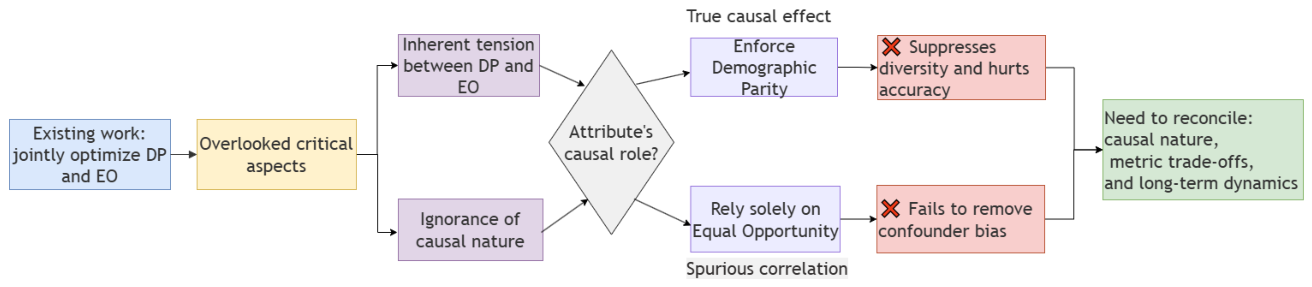
Figure 2.
Two causal structures between sensitive attribute A and preference Y. (a) Genuine causal effect: A influences Y through the intrinsic preference U (fair path) and through exposure E (potentially unfair path). (b) Spurious correlation: a hidden confounder C creates a non-causal statistical association between A and Y.
Figure 2.
Two causal structures between sensitive attribute A and preference Y. (a) Genuine causal effect: A influences Y through the intrinsic preference U (fair path) and through exposure E (potentially unfair path). (b) Spurious correlation: a hidden confounder C creates a non-causal statistical association between A and Y.
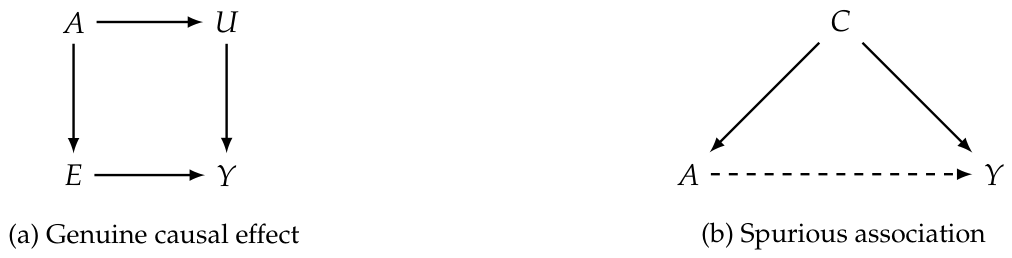
Figure 3.
Overview of LFR-via-AFMS. Causal diagnosis determines the fairness metric: EO for genuine causal, DP for spurious. The debiased representation and adaptive reward are used in actor-critic RL for long-term fairness.
Figure 3.
Overview of LFR-via-AFMS. Causal diagnosis determines the fairness metric: EO for genuine causal, DP for spurious. The debiased representation and adaptive reward are used in actor-critic RL for long-term fairness.
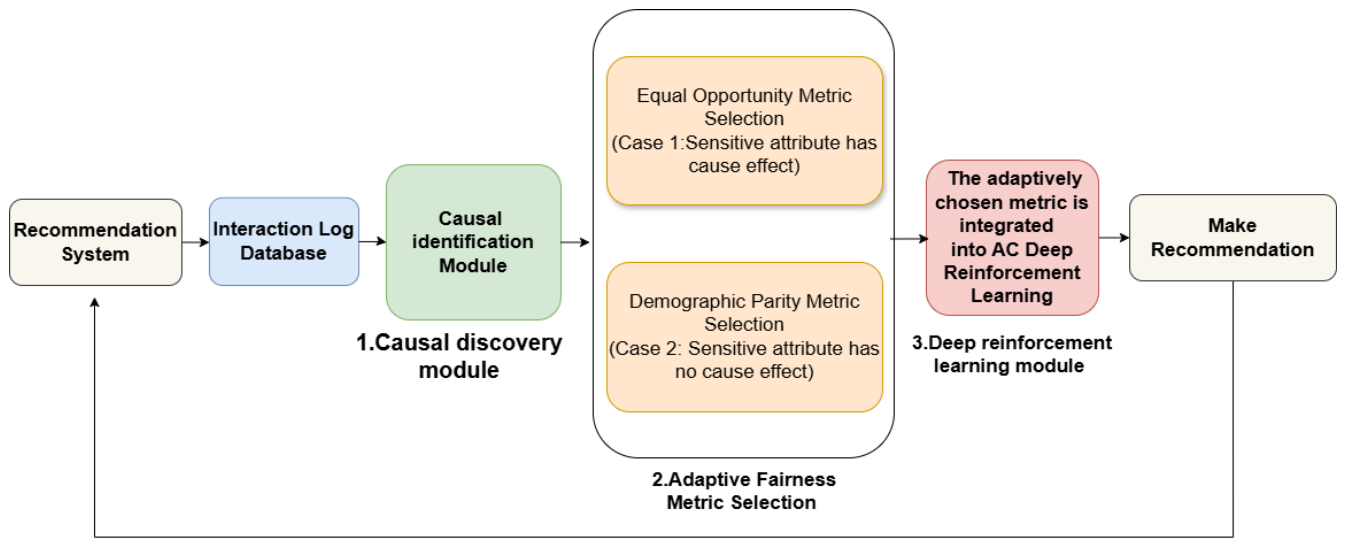
Figure 4.
MovieLens (NDCG@10 vs. EO@10) under varying penalty coefficient .
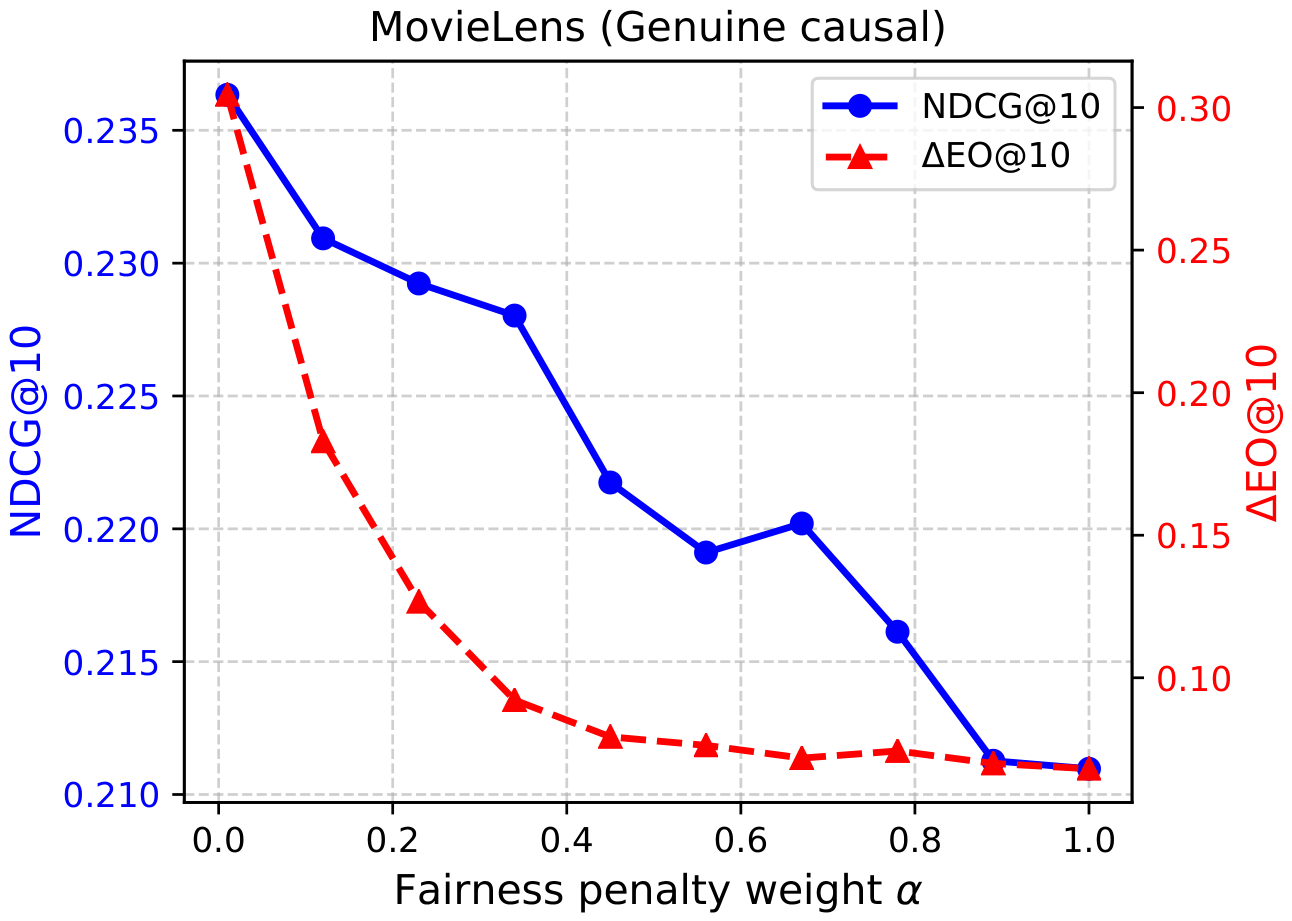
Figure 5.
Alibaba (NDCG@10 vs. DP@10) under varying penalty coefficient .
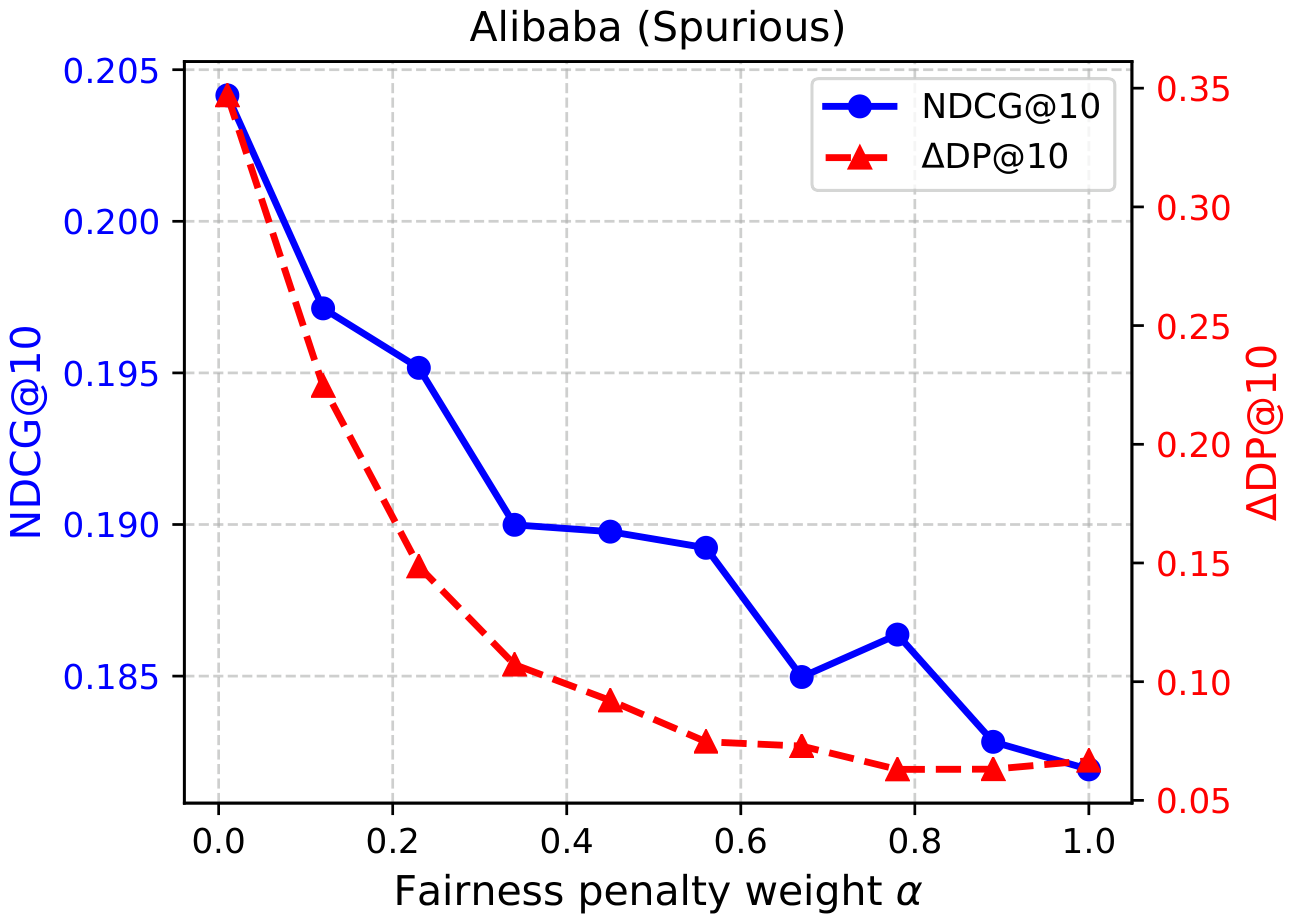
Figure 6.
MovieLens: EO evolution over 10k interaction steps.
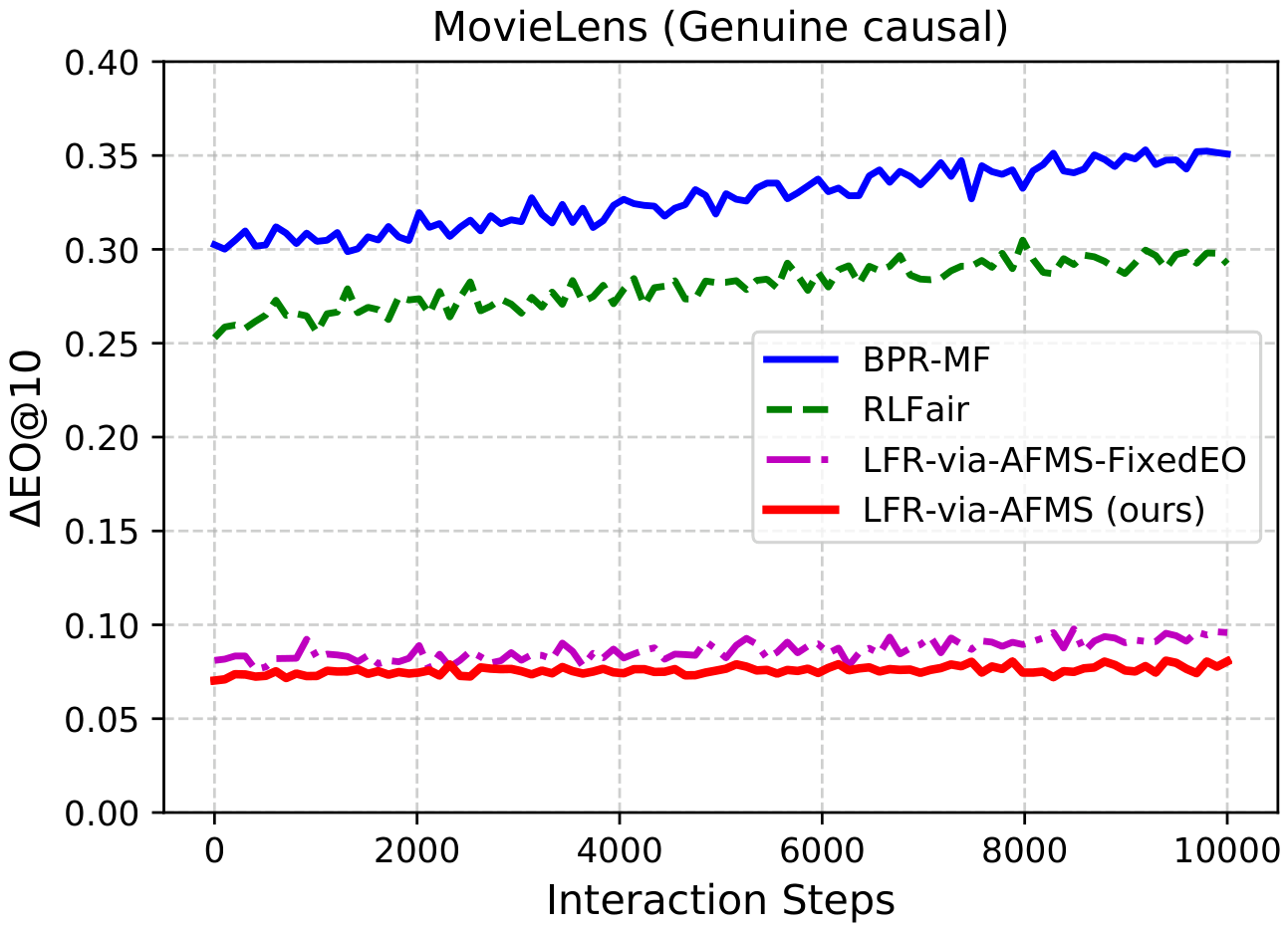
Figure 7.
Alibaba: DP evolution over 10k interaction steps.
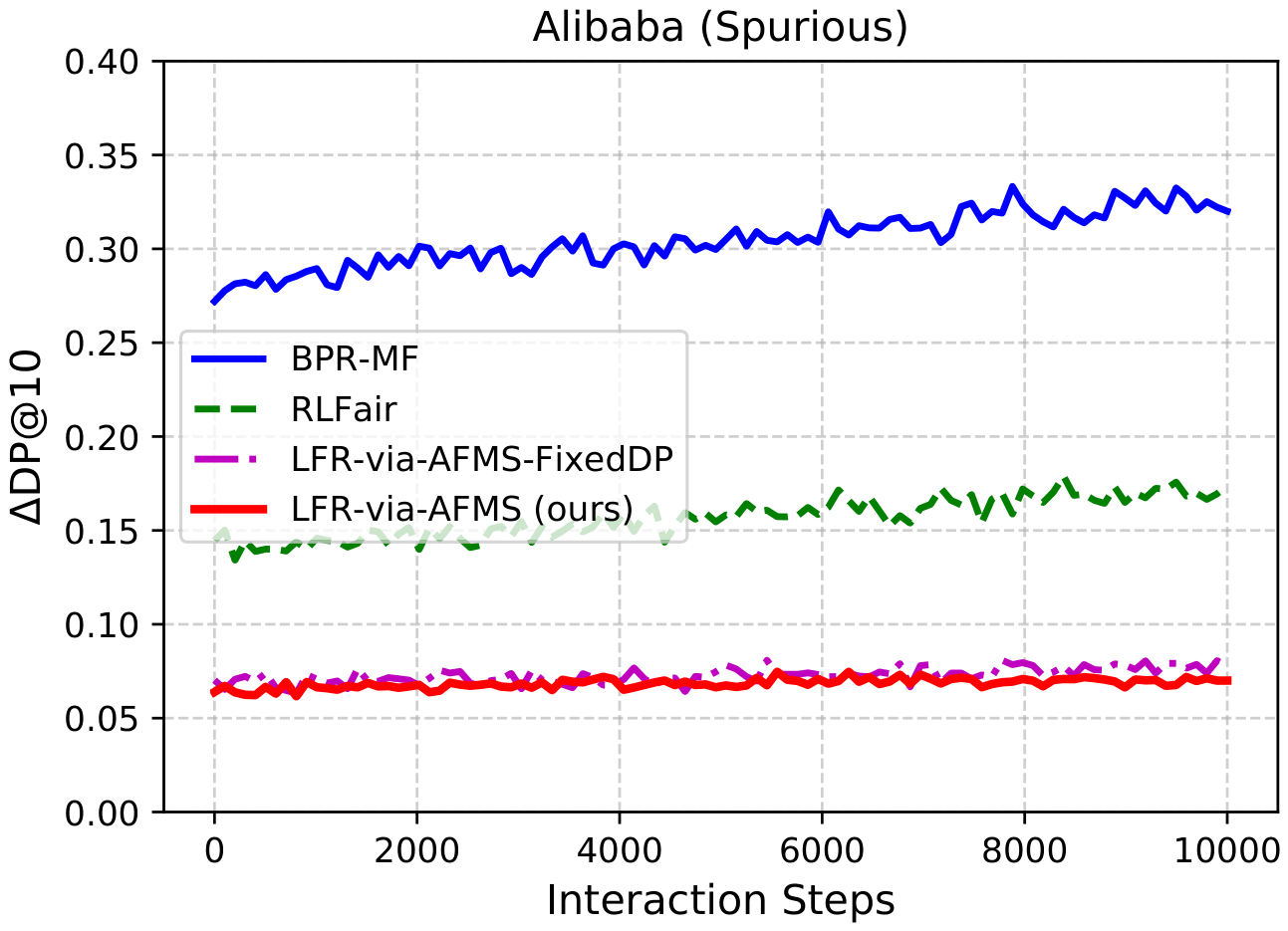

Table 1.
Performance on MovieLens-1M (genuine causal, gender). Best results in bold, second best underlined.
Table 1.
Performance on MovieLens-1M (genuine causal, gender). Best results in bold, second best underlined.
| Method | NDCG@10 | NDCG@20 | Rec@10 | Rec@20 | DP@10 | DP@20 | EO@10 | EO@20 |
|---|---|---|---|---|---|---|---|---|
| BPR-MF | 0.2018 | 0.2655 | 0.1442 | 0.2341 | 0.2780 | 0.2552 | 0.3010 | 0.3312 |
| RLFair | 0.1880 | 0.2435 | 0.1362 | 0.2158 | 0.1620 | 0.1410 | 0.2675 | 0.2538 |
| FairDgcl | 0.1888 | 0.2482 | 0.1402 | 0.2230 | 0.1642 | 0.1304 | 0.2700 | 0.2438 |
| CausalDF | 0.1965 | 0.2585 | 0.1465 | 0.2332 | 0.1450 | 0.1158 | 0.2605 | 0.2325 |
| PSFRS | 0.2035 | 0.2620 | 0.1502 | 0.2335 | 0.1365 | 0.1162 | 0.2215 | 0.2020 |
| LFR-via-AFMS-FixedDP | 0.2052 | 0.2640 | 0.1518 | 0.2340 | 0.1065 | 0.0858 | 0.1870 | 0.1735 |
| LFR-via-AFMS-FixedEO | 0.2320 | 0.2745 | 0.1601 | 0.2438 | 0.1320 | 0.1125 | 0.0805 | 0.0712 |
| LFR-via-AFMS (ours) | 0.2356 | 0.2772 | 0.1625 | 0.2465 | 0.1208 | 0.1075 | 0.0723 | 0.0680 |
Table 2.
Performance on Alibaba (spurious, gender). Best results in bold, second best underlined.
| Method | NDCG@10 | NDCG@20 | Rec@10 | Rec@20 | DP@10 | DP@20 | EO@10 | EO@20 |
|---|---|---|---|---|---|---|---|---|
| BPR-MF | 0.1965 | 0.2458 | 0.1568 | 0.2376 | 0.2852 | 0.2665 | 0.3500 | 0.3325 |
| RLFair | 0.1893 | 0.2370 | 0.1510 | 0.2298 | 0.1376 | 0.1268 | 0.2675 | 0.2592 |
| FairDgcl | 0.1887 | 0.2369 | 0.1500 | 0.2271 | 0.1391 | 0.1290 | 0.2693 | 0.2600 |
| PSFRS | 0.1971 | 0.2458 | 0.1571 | 0.2368 | 0.1306 | 0.1194 | 0.2396 | 0.2393 |
| LFR-via-AFMS-FixedDP | 0.2003 | 0.2475 | 0.1579 | 0.2381 | 0.0680 | 0.0612 | 0.1785 | 0.1620 |
| LFR-via-AFMS-FixedEO | 0.2051 | 0.2508 | 0.1592 | 0.2395 | 0.2210 | 0.2074 | 0.0923 | 0.0865 |
| LFR-via-AFMS (ours) | 0.2012 | 0.2483 | 0.1582 | 0.2385 | 0.0651 | 0.0578 | 0.1654 | 0.1489 |
Table 3.
Ablation study on MovieLens-1M (top) and Alibaba (bottom). “CausalDiag” = causal diagnosis module, “CondRep” = conditional representation learning, “AdaptPen” = adaptive fairness penalty. Checkmarks indicate the component is present.
Table 3.
Ablation study on MovieLens-1M (top) and Alibaba (bottom). “CausalDiag” = causal diagnosis module, “CondRep” = conditional representation learning, “AdaptPen” = adaptive fairness penalty. Checkmarks indicate the component is present.
| MovieLens-1M (genuine causal) | |||||
| CausalDiag | CondRep | AdaptPen | NDCG@10 | EO@10 | DP@10 |
| 0.2018 | 0.3010 | 0.2780 | |||
| ✓ | 0.2105 | 0.2603 | 0.1820 | ||
| ✓ | ✓ | 0.2287 | 0.1120 | 0.1425 | |
| ✓ | ✓ | ✓ | 0.2356 | 0.0723 | 0.1208 |
| Alibaba (spurious) | |||||
| CausalDiag | CondRep | AdaptPen | NDCG@10 | DP@10 | EO@10 |
| 0.1965 | 0.2852 | 0.3500 | |||
| ✓ | 0.1982 | 0.1780 | 0.3105 | ||
| ✓ | ✓ | 0.2008 | 0.1045 | 0.2200 | |
| ✓ | ✓ | ✓ | 0.2012 | 0.0651 | 0.1654 |
Table 4.
Fairness Drift after 10k steps.
| Method | MovieLens (EO) | Alibaba (DP) |
|---|---|---|
| BPR-MF | +0.0523 | +0.0471 |
| RLFair | +0.0382 | +0.0324 |
| LFR-via-AFMS-FixedDP | +0.0301 | +0.0098 |
| LFR-via-AFMS-FixedEO | +0.0145 | +0.0412 |
| LFR-via-AFMS (ours) | +0.0078 | +0.0065 |
Disclaimer/Publisher’s Note: The statements, opinions and data contained in all publications are solely those of the individual author(s) and contributor(s) and not of MDPI and/or the editor(s). MDPI and/or the editor(s) disclaim responsibility for any injury to people or property resulting from any ideas, methods, instructions or products referred to in the content. |
© 2026 by the authors. Licensee MDPI, Basel, Switzerland. This article is an open access article distributed under the terms and conditions of the Creative Commons Attribution (CC BY) license (http://creativecommons.org/licenses/by/4.0/).
Copyright: This open access article is published under a Creative Commons CC BY 4.0 license, which permit the free download, distribution, and reuse, provided that the author and preprint are cited in any reuse.