

Submitted:
22 July 2026
Posted:
23 July 2026
You are already at the latest version
Abstract
Immunopharmacology spans immunostimulation, immunosuppression, and immunomodulation across oncology, transplantation, autoimmunity, allergy, and infection, yet it lacks a unifying organising framework comparable to the hallmarks of cancer in oncology; the immunological hallmark schemes that exist are disease- or therapy-specific rather than general. We present the Immunity Hallmarks Matrix, a two-axis conceptual framework constructed by structured expert synthesis. The first axis is a biological spine of fifteen hallmarks of the immune response, each a discrete and mechanistically defined capability, grouped into three functional clusters — Recognition and Activation, Effector and Memory, and Regulation, Tolerance and Context. The second axis classifies every therapeutic strategy by its intent toward a hallmark: to Enhance, Diminish, or Alter that capability. The organising principle is therapeutic intent rather than molecular identity: the same biological hallmark may be acted upon in opposite directions in different clinical settings, illustrated by the dual-coding of checkpoint control and by the enhance-early, diminish-late course of a viral illness. The crossing of the two axes yields a grid whose intersections are either coherent therapeutic targets, structurally empty (not a coherent goal), or as-yet-unaddressed white space that the framework exposes as hypothesised opportunity. The matrix is offered as a navigable, generative conceptual grammar for immunopharmacology with educational and research applications, and it subsumes existing descriptive frameworks as special cases. It is a conceptual synthesis, not a clinical instrument or a prescribing tool.
Keywords:
immunopharmacology
; immune response
; therapeutic framework
; hallmarks of immunity
; conceptual framework
; precision immunology
; translational immunology
1. Introduction
Immunopharmacology has become one of the most rapidly expanding areas of therapeutics. A wave of targeted biologic, small-molecule, and cellular strategies has transformed the management of autoimmune, allergic, transplant-related, malignant, and infectious disease — the checkpoint-blockade revolution in oncology being only the most visible example (Ribas and Wolchok, 2018). Yet this armamentarium is taught and organised in silos — by disease, or by molecular class — and the field lacks a single conceptual map that links the immune capability being targeted to the direction of the intervention.
Oncology faced an analogous problem and solved it conceptually. The hallmarks of cancer (Hanahan and Weinberg, 2000, 2011; Hanahan, 2022) distilled a fragmented field into a compact set of acquired capabilities and, in doing so, supplied a shared vocabulary that now organises both the biology and the therapeutics of the discipline. Immunology has no equivalent, field-wide consensus framework.
The immunological frameworks that do exist are context-specific. Descriptions of immune dysregulation in COVID-19 (Mazzoni et al., 2021), the “three Cs” of tumour immune evasion (Galassi et al., 2024), and the hallmarks of response and resistance to checkpoint blockade (Morad et al., 2021) are each valuable, but each characterises what the immune system or a disease does in a particular setting. None provides a general account of the directions in which the clinician may act upon the immune response.
The classical organisation of immunopharmacology textbooks — grouping strategies as immunostimulation, immunosuppression, and immunomodulation — does capture the direction of an intervention, but it is not tied to an explicit account of the immune capabilities being targeted.
We propose the Immunity Hallmarks Matrix, which crosses a biological-hallmark spine with a therapeutic-intent axis. We describe its construction (Section 2), present the framework and its two visual representations (Section 3, Figure 1 and Figure 2), illustrate its logic conceptually (Section 4), position it against prior frameworks and state its limitations (Section 5). The aim is a navigable, generative conceptual grammar for immunopharmacology suitable for teaching and research.
2. Methods: Framework Construction
2.1. Study Design
This work is a structured expert synthesis presented as a conceptual framework, not a systematic review or a clinical practice guideline. The construction proceeded in four stages: (i) derivation and clustering of the biological hallmarks; (ii) definition of the therapeutic-intent axis and its operational rules; (iii) characterisation of each hallmark–intent intersection as a coherent therapeutic direction, a structurally empty intersection, or hypothesised white space; and (iv) reflection on the resulting structure. Sources comprised standard immunology and immunopharmacology texts and primary and review literature current to mid-2026.
2.2. Axis 1 — The Biological Hallmark Spine
Candidate biological processes were drawn from the canonical arc of an immune response (sensing, recognition, activation, effector deployment, memory, and regulation) and from the contextual determinants of immune behaviour (tolerance, resolution, and the barrier–microbiome interface). A candidate was admitted as a hallmark only if it satisfied all four of the following inclusion criteria:
- Discreteness. It represents a mechanistically distinct capability of the immune response that can be described independently of any intervention.
- Actionability. It is, in principle, susceptible to at least one direction of therapeutic intent.
- Observability. Its state can in principle be characterised by empirical readouts of immune function.
- Non-redundancy. It is conceptually separable from the other hallmarks rather than a subdivision of one already included.
Applying these criteria yielded fifteen hallmarks, grouped into three clusters by their position in the immune response: Recognition & Activation (R1–R4), Effector & Memory (F1–F6), and Regulation, Tolerance & Context (G1–G5). The clustering is functional (afferent / efferent / governance) rather than anatomical, and is intended to make the matrix readable both by row (one capability acted upon three ways) and by column (one therapeutic intent applied across the whole response).
2.3. Axis 2 — Therapeutic Intent
Each therapeutic strategy was classified by the direction of its effect on the relevant hallmark:
- Enhance — augments or supplements the capability.
- Diminish — suppresses or removes the capability.
- Alter — re-channels or re-specifies the capability without simply increasing or decreasing it.
Of the three intents, Alter requires the most careful definition, because it is the one most easily treated as a residual category. We define it as a change in the qualitative state of a capability rather than its quantitative magnitude: where Enhance and Diminish answer ‘more or less?’, Alter answers ‘redirected to what?’. It subsumes several distinct sub-modes — re-channelling (shifting a response from one effector programme to another, as in type-2-to-type-1 repolarisation), re-specification (changing the target of a response, as in antigen redirection), and re-localisation (changing where a response occurs). Because re-channelling moves a capability between states rather than along a single axis of intensity, Alter is intrinsically the least cell-localisable intent, and its assignments are the most approximate.
Two further features are made explicit in the matrix. First, dual coding: a single strategy may legitimately occupy two intent columns of one hallmark, as when an inhibitory node is diminished in order to enhance a downstream capability. This does not compromise the orthogonality of the axes — the two effects act on the same hallmark through different mechanistic levels, so ‘which capability’ and ‘which direction’ remain independent; what dual-coding shows is that one agent can occupy more than one cell, not that the axes collapse. Dual coding is also distinct from Alter: a dual-coded strategy has opposite-signed effects at two levels of the same capability, whereas an Alter strategy changes the kind of response rather than its sign.
Second, structural emptiness: some hallmark–intent intersections may appear not to be coherent therapeutic goals, and are in principle distinguished from genuine white space. This category must be applied with care, because a direction that looks incoherent in one context may be actively pursued in another. Deliberately diminishing self-tolerance, for instance, might seem to describe a disease state rather than a treatment — yet breaking tolerance to tumour antigens, for example by regulatory-cell depletion, is a genuine oncological goal. We therefore treat such intersections as coherent, if double-edged, targets rather than as structurally empty, and reserve structural emptiness for intersections that are incoherent in principle — a category the present roster instantiates, at most, weakly.
2.4. Characterisation of the Cells
Each hallmark–intent intersection was assigned to one of three kinds by explicit criteria. A coherent therapeutic target is a pairing that is a defensible clinical goal — acting on the capability in that direction is mechanistically sensible and clinically desirable in at least one setting — whether or not a mature therapy exists. Open (hypothesised) white space is a pairing that is mechanistically coherent and desirable but for which no established therapeutic strategy yet exists. A structurally empty intersection is one that is not a coherent goal in principle. We stress that these boundaries are provisional: they reflect current therapeutic norms rather than fixed constraints, and a direction that is empty or open today may become a coherent target as clinical goals evolve. The framework does not enumerate specific agents; it is deliberately positioned one level of abstraction above particular therapeutics, in the manner of the cancer-hallmarks precedent.
2.5. White-Space Identification
Intersections that are coherent but unaddressed were retained and labelled hypothesised, on the principle that a framework’s value lies partly in exposing where a therapeutic direction is conceptually available but not yet realised; examples include selective re-channelling of innate pattern sensing, antigen-specific clonal silencing, and the pharmacological promotion of inflammation resolution. These white-space cells are distinguished from the structurally empty intersections described in Section 2.3.
3. The Framework
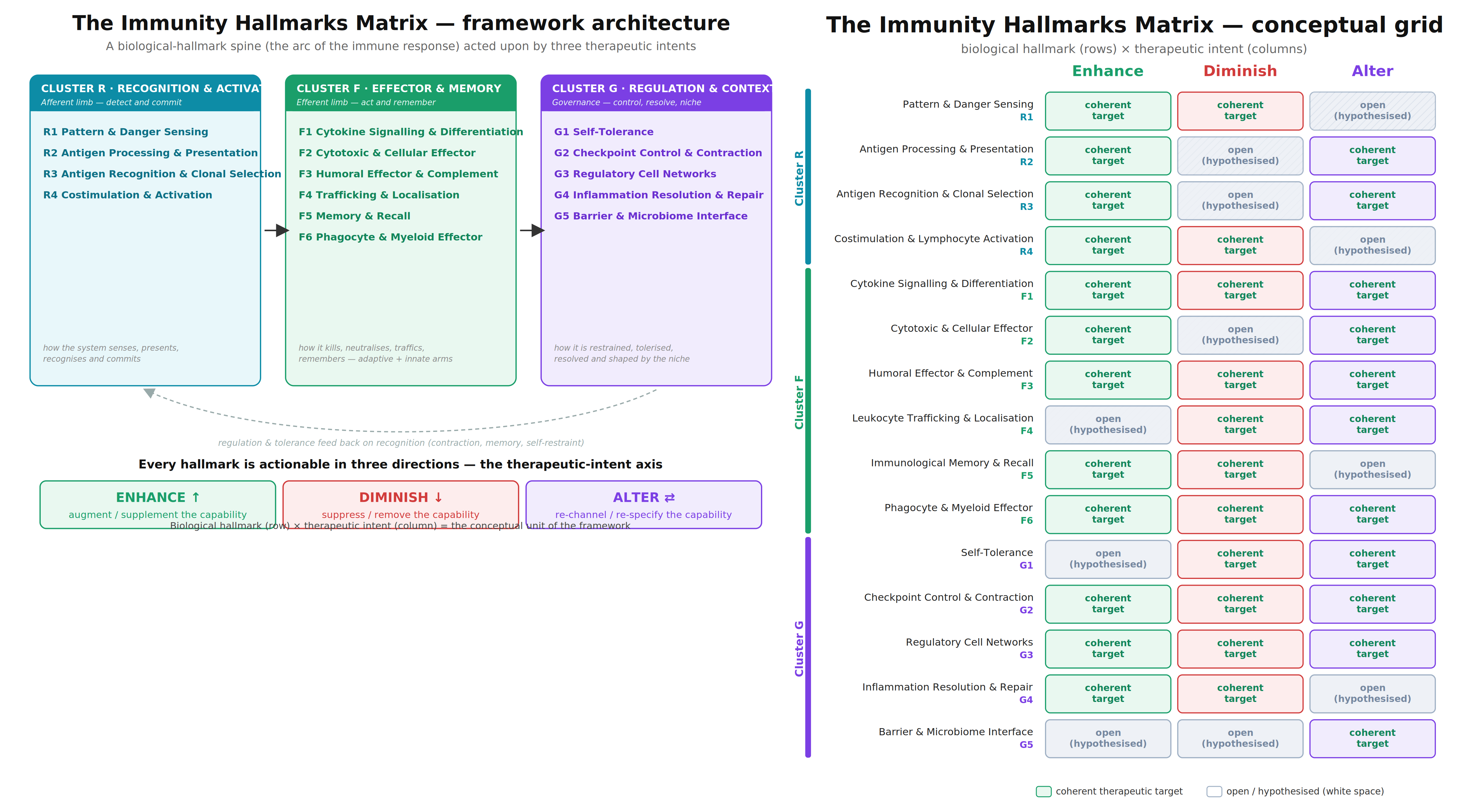
The framework organises immunopharmacology along two orthogonal axes. The first is a biological spine of fifteen hallmarks of the immune response, each a discrete and mechanistically defined capability, grouped into three functional clusters — Recognition & Activation (the afferent limb), Effector & Memory (the efferent limb), and Regulation, Tolerance & Context (governance) (Figure 1). The second axis is therapeutic intent: every strategy is classified by the direction in which it acts on a hallmark — to Enhance, Diminish, or Alter that capability. The intersection of the two axes is a grid whose cells are characterised as coherent targets, structurally empty intersections, or hypothesised white space (Figure 2).
The central conceptual claim is that therapeutic intent, not molecular identity, is the organising principle: the same biological hallmark may be acted upon in opposite directions in different diseases. The matrix is intended as an educational and research scaffold that renders a fragmented conceptual area into a single navigable structure.
Each hallmark denotes an established domain of immunobiology; the framework’s aim is not to re-describe these domains but to arrange them on a common spine and cross them with therapeutic intent. Representative anchors include innate pattern and danger sensing (R1; Takeuchi and Akira, 2010), costimulation and lymphocyte activation (R4; Chen and Flies, 2013), cytokine signalling and lineage differentiation via the JAK–STAT axis (F1; O’Shea and Plenge, 2012), humoral effector function and complement (F3; Ricklin et al., 2010; Weiner, 2015), immunological memory and recall (F5; Farber et al., 2014), ‘trained’ innate memory in the myeloid compartment (F6; Netea et al., 2016), self-tolerance and regulatory networks (G1, G3; Sakaguchi et al., 2008), checkpoint control and contraction (G2; Ribas and Wolchok, 2018; Chen and Flies, 2013), the resolution of inflammation (G4; Serhan, 2014), and the barrier–microbiome interface (G5; Belkaid and Hand, 2014).
The fifteen hallmarks and their three-cluster grouping are defined in Table 1; the same fifteen form the rows of the conceptual grid in Figure 2.
To show that the framework is generative rather than merely descriptive, consider one open cell: antigen-specific clonal silencing (R3, Diminish). Almost all established immunosuppression is antigen-non-specific; the matrix marks the selective silencing of a single pathogenic clone — diminishing recognition for one specificity while leaving the rest of the repertoire intact — as a coherent yet largely unrealised direction. Placing this gap on the same grid as established directions turns it into a concrete question (which recognition nodes admit antigen-specific silencing, and in which diseases) rather than supplying its answer. That is the sense in which a white-space cell is generative: it does not invent a therapy, but it locates a missing one precisely.
4. Illustrative Logic of the Framework
Four brief illustrations, chosen at deliberately different scales, show how the two axes accommodate the diversity of immunological situations. They are conceptual demonstrations of the framework’s grammar, not clinical guidance, and they name no agents.
One capability, opposite intents. A viral illness may implicate the same hallmark cluster in opposite directions across its course — recognition and humoral capabilities Enhanced early, when the goal is to build or supplement immunity, and cytokine and effector capabilities Diminished late, when the goal is to restrain a maladaptive response (Mazzoni et al., 2021). The framework represents this phase-flip without contradiction, because intent, not the underlying biology, is the organising variable.
Dual-coding. Checkpoint control (G2) is the paradigmatic dual-coded hallmark: an inhibitory node is Diminished precisely in order to Enhance downstream effector immunity, so the strategy legitimately occupies two intent columns of a single hallmark (Ribas and Wolchok, 2018; Morad et al., 2021).
A single intent, layered across hallmarks. Transplant governance illustrates one intent — Diminish — applied simultaneously across several hallmarks (costimulation and activation, clonal expansion, humoral effector and complement), showing how the matrix reads coherently down a column.
A single hallmark in focus. An antibody-mediated disease illustrates the opposite reading: attention concentrated on one hallmark (humoral effector and complement; Ricklin et al., 2010) acted upon with a single intent (Diminish), showing how the matrix reads coherently along a row. Across the four illustrations the framework accommodates opposite intents over time, a dual-coded strategy, a single intent layered across hallmarks, and a single hallmark in focus — demonstrating that it functions not only as a taxonomy but as a navigable conceptual grammar for immunopharmacology.
5. Discussion
The framework’s contribution is best understood in relation to the organising schemes that precede it in oncology and immunology, and against its own limitations.
5.1. Relationship to Existing Frameworks
The Hanahan Analogy and Its Limits
The framework is explicitly modelled on the Hallmarks of Cancer (Hanahan and Weinberg, 2000, 2011; Hanahan, 2022), which consolidated a fragmented field into a compact set of organising capabilities and gave oncology a shared conceptual vocabulary. The structural debt is acknowledged: a small set of capabilities, a taxonomic grouping, and a mapping onto therapeutic strategy. The analogy is, however, deliberately incomplete in two respects. First, the cancer hallmarks are acquired capabilities of a malignant cell, whereas the immune hallmarks here are physiological capabilities of an intact system. Second, and more importantly, the present framework adds a second, orthogonal axis absent from the cancer hallmarks: therapeutic intent. Where the cancer hallmarks map each capability broadly to a direction of inhibition, the immune response can be therapeutically pushed in three directions, and it is the crossing of the biological and intent axes that constitutes the novel structure proposed here.
No Canonical Equivalent Exists in Immunology
Unlike oncology, immunology has no single, field-wide consensus set of hallmarks. The frameworks that do exist are context-specific, and the present work is positioned as a synthesis that subsumes them rather than as a competitor. A described set of hallmarks of immune dysregulation in COVID-19 (Mazzoni et al., 2021) is a disease-state descriptive framework that maps onto the rows of the present matrix and exemplifies its central claim — the same system Enhanced early and Diminished late. The “three Cs” of cancer immune evasion (Galassi et al., 2024) describe tumour defensive behaviours that map onto the Recognition, checkpoint/regulatory, and effector hallmarks, with the corresponding counter-strategies being the Enhance and Alter intents. The described hallmarks of response and resistance to immune-checkpoint blockade (Morad et al., 2021) constitute a therapy-prediction framework that sits as the predictive and resistance layer beneath the checkpoint-control hallmark (G2).
The Distinguishing Contribution
The three frameworks above are descriptive — they characterise what the immune system or a disease does. The present framework is prescriptive and integrative — it characterises the directions in which the clinician may act, organised so that any descriptive dysregulation state maps onto a corrective therapeutic intent. In this sense the matrix functions as a grammar that resolves descriptive immune states into directions of pharmacological action, and the prior frameworks become instances that populate specific rows rather than competing schemes. The framework also relates to the classical tripartite organisation of immunopharmacology (immunostimulation, immunosuppression, immunomodulation), which is the acknowledged origin of the Enhance/Diminish/Alter axis. The contribution claimed here is not the tripartite classification itself, but its use as an axis orthogonal to an explicit biological-hallmark spine, and the framework’s generativity — its capacity to expose unaddressed hallmark–intent intersections as candidate directions for inquiry.
5.2. Limitations
The hallmark roster is author-constructed. Because immunology has no consensus set of hallmarks to inherit, the fifteen hallmarks and their grouping into three clusters represent the author’s synthesis and could reasonably be partitioned differently. The roster comprises fifteen rather than the fourteen that would mirror the cancer hallmarks exactly; the fifteenth (phagocyte and myeloid effector function) was included because omitting the innate effector arm would have left the framework adaptive-immunity-centric.
The roster is version 1.0, not a canon. The fifteen hallmarks should be read as an initial ontology rather than a closed canonical set; alternative decompositions — a different count, or the explicit separation of immunometabolism, neuro-immune communication, stromal and lymphoid architecture, or innate lymphoid populations — are legitimate and to be expected. The hallmarks also deliberately span biological scales, from molecular signalling (checkpoint control) through cellular programmes (pattern sensing) to tissue ecology (the barrier–microbiome interface), because therapeutic interventions themselves span these scales; the price of that choice is that the rows are not ontologically uniform.
The synthesis is not systematic. The hallmark roster and the characterisation of the cells are illustrative expert judgement rather than the product of a pre-registered search protocol.
The axes are simplifications. The Alter intent is intrinsically the least cell-localisable, because re-channelling moves a capability between states; assignment of such strategies to a single cell is approximate, and dual-coded strategies occupy more than one cell by design.
The rows under-represent network behaviour. Treating hallmarks as discrete rows understates the connectedness of immunity, in which acting on one capability propagates to others; dual-coding captures only the simplest such coupling. Relatedly, the classification of cells is normative — it reflects current assumptions about which therapeutic directions are desirable, assumptions that are historically contingent and vary across settings.
The framework is a snapshot. Immunopharmacology is moving rapidly, and the conceptual landscape will require periodic revision.
It is a conceptual synthesis, not a clinical instrument. The framework is educational and generative. It has not been prospectively evaluated, it makes no treatment recommendation, and any clinical inference requires validated criteria and clinician judgement.
5.3. Conclusions and Outlook
The Immunity Hallmarks Matrix reorganises immunopharmacology around two orthogonal axes — the biological capabilities of the immune response and the direction of therapeutic intent. By making therapeutic intent the organising variable, it accommodates capabilities that are acted upon in opposite directions in different settings, exposes unaddressed directions as white space, and subsumes existing descriptive frameworks as special cases. It is offered as an educational and research scaffold for immunopharmacology, and as a reusable conceptual foundation for translational and pharmacological inquiry.
Two lines of development follow naturally. First, the roster and the cell assignments invite community validation — for example a structured expert-consensus (Delphi) process — to move the ontology from a single-author synthesis toward a shared reference. Second, the same structure could organise disease-specific hallmark–intent profiles, projecting individual conditions onto the map to make their therapeutic logic explicit.
Author Contributions
RP conceived the framework, led its design and construction, drafted and revised the manuscript, approved the final version, and is accountable for the work. BL contributed to the conceptual analysis and intellectual revision of the framework, approved the final version, and is accountable for the work. PT contributed to the validation of the illustrative cases and intellectual revision of the manuscript, approved the final version, and is accountable for the work. All authors have read and agreed to the submitted version.
Funding
The author declares that no financial support was received for the research, authorship, and/or publication of this article.
Data Availability Statement
All information supporting the framework is contained within the article and its figures. No datasets were generated or analysed.
Ethics Statement: Ethical review and approval were not required for this study, which involved no human participants, human data, or animals.
Conflicts of Interest
The author declares no competing financial or non-financial interests.
References
- Belkaid, Y.; Hand, T. W. Role of the microbiota in immunity and inflammation. Cell 2014, 157(1), 121–141. [Google Scholar] [CrossRef]
- Chen, L.; Flies, D. B. Molecular mechanisms of T cell co-stimulation and co-inhibition. Nat. Rev. Immunol. 2013, 13(4), 227–242. [Google Scholar] [CrossRef]
- Farber, D. L.; Yudanin, N. A.; Restifo, N. P. Human memory T cells: generation, compartmentalization and homeostasis. Nat. Rev. Immunol. 2014, 14(1), 24–35. [Google Scholar] [CrossRef] [PubMed]
- Galassi, C.; Chan, T. A.; Vitale, I.; Galluzzi, L. The hallmarks of cancer immune evasion. Cancer Cell 2024, 42(11), 1825–1863. [Google Scholar] [CrossRef] [PubMed]
- Hanahan, D. Hallmarks of cancer: new dimensions. Cancer Discov. 2022, 12(1), 31–46. [Google Scholar] [CrossRef] [PubMed]
- Hanahan, D.; Weinberg, R. A. The hallmarks of cancer. Cell 2000, 100(1), 57–70. [Google Scholar] [CrossRef] [PubMed]
- Hanahan, D.; Weinberg, R. A. Hallmarks of cancer: the next generation. Cell 2011, 144(5), 646–674. [Google Scholar] [CrossRef] [PubMed]
- Mazzoni, A.; Salvati, L.; Maggi, L.; Annunziato, F.; Cosmi, L. Hallmarks of immune response in COVID-19: exploring dysregulation and exhaustion. Semin. Immunol. 2021, 55, 101508. [Google Scholar] [CrossRef] [PubMed]
- Morad, G.; Helmink, B. A.; Sharma, P.; Wargo, J. A. Hallmarks of response, resistance, and toxicity to immune checkpoint blockade. Cell 2021, 184(21), 5309–5337. [Google Scholar] [CrossRef] [PubMed]
- Netea, M. G.; Joosten, L. A. B.; Latz, E.; Mills, K. H. G.; Natoli, G.; Stunnenberg, H. G.; et al. Trained immunity: a program of innate immune memory in health and disease. Science 2016, 352(6284), aaf1098. [Google Scholar] [CrossRef] [PubMed]
- O’Shea, J. J.; Plenge, R. JAK and STAT signaling molecules in immunoregulation and immune-mediated disease. Immunity 2012, 36(4), 542–550. [Google Scholar] [CrossRef] [PubMed]
- Ribas, A.; Wolchok, J. D. Cancer immunotherapy using checkpoint blockade. Science 2018, 359(6382), 1350–1355. [Google Scholar] [CrossRef] [PubMed]
- Ricklin, D.; Hajishengallis, G.; Yang, K.; Lambris, J. D. Complement: a key system for immune surveillance and homeostasis. Nat. Immunol. 2010, 11(9), 785–797. [Google Scholar] [CrossRef] [PubMed]
- Sakaguchi, S.; Yamaguchi, T.; Nomura, T.; Ono, M. Regulatory T cells and immune tolerance. Cell 2008, 133(5), 775–787. [Google Scholar] [CrossRef] [PubMed]
- Serhan, C. N. Pro-resolving lipid mediators are leads for resolution physiology. Nature 2014, 510(7503), 92–101. [Google Scholar] [CrossRef] [PubMed]
- Takeuchi, O.; Akira, S. Pattern recognition receptors and inflammation. Cell 2010, 140(6), 805–820. [Google Scholar] [CrossRef] [PubMed]
- Weiner, G. J. Building better monoclonal antibody-based therapeutics. Nat. Rev. Cancer 2015, 15(6), 361–370. [Google Scholar] [CrossRef] [PubMed]
Figure 1.
Framework architecture. The biological-hallmark spine arranged as the arc of the immune response — Recognition & Activation (afferent), Effector & Memory (efferent), and Regulation, Tolerance & Context (governance), with regulation feeding back on recognition — acted upon by the three therapeutic intents (Enhance, Diminish, Alter).
Figure 1.
Framework architecture. The biological-hallmark spine arranged as the arc of the immune response — Recognition & Activation (afferent), Effector & Memory (efferent), and Regulation, Tolerance & Context (governance), with regulation feeding back on recognition — acted upon by the three therapeutic intents (Enhance, Diminish, Alter).
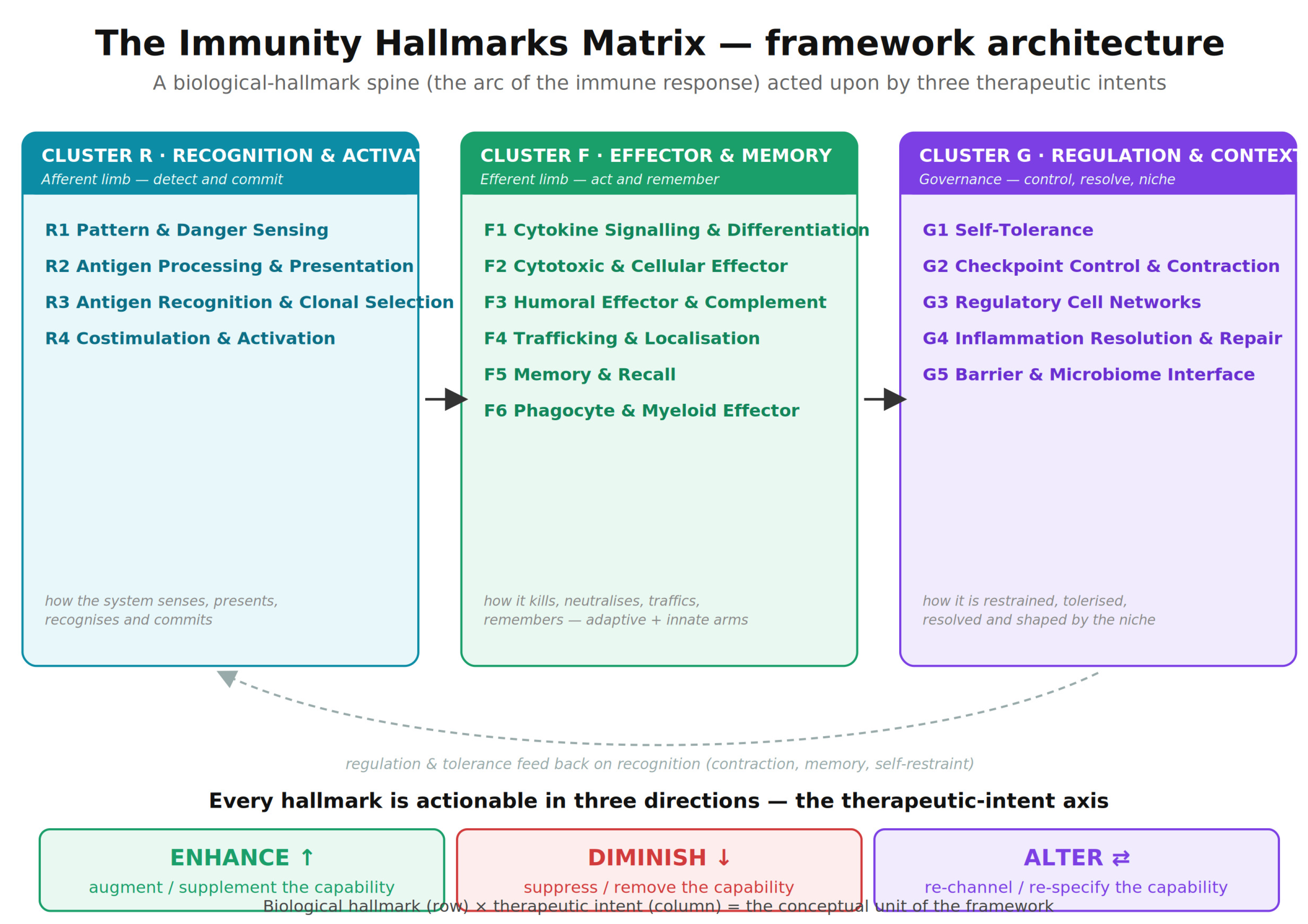
Figure 2.
The Immunity Hallmarks Matrix — conceptual grid. Fifteen biological hallmarks (rows, in clusters R, F, G) crossed with three therapeutic intents (columns). Each cell is characterised as a coherent therapeutic target or as open (hypothesised) white space; on the present roster no intersection is structurally empty in principle (Section 2.4). The grid records the conceptual structure of the field, not the presence of particular therapeutics.
Figure 2.
The Immunity Hallmarks Matrix — conceptual grid. Fifteen biological hallmarks (rows, in clusters R, F, G) crossed with three therapeutic intents (columns). Each cell is characterised as a coherent therapeutic target or as open (hypothesised) white space; on the present roster no intersection is structurally empty in principle (Section 2.4). The grid records the conceptual structure of the field, not the presence of particular therapeutics.
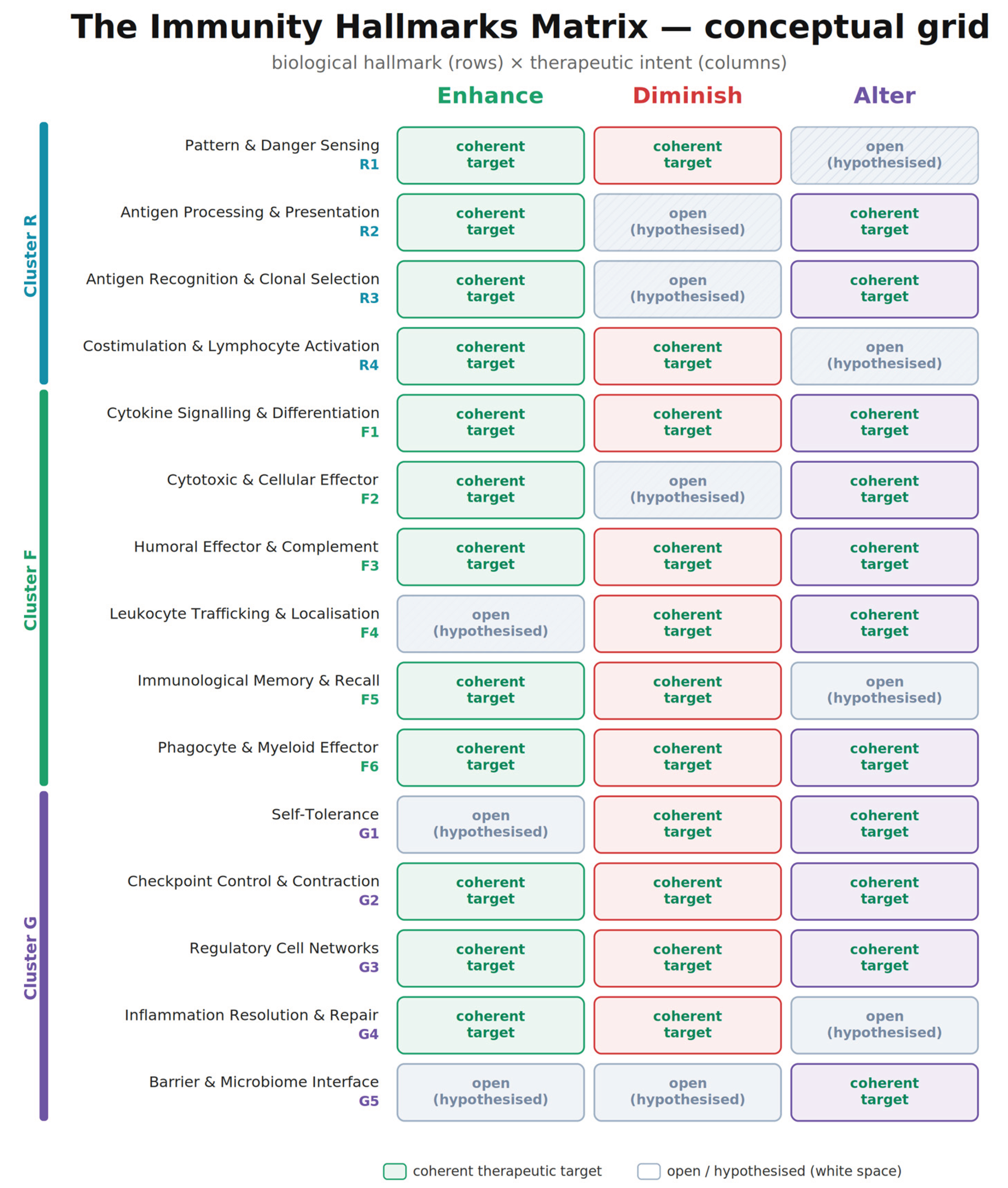

Table 1.
The fifteen hallmarks of the immune response, grouped into three functional clusters.
| ID | Hallmark | Definition |
| Cluster R — Recognition & Activation (afferent limb) | ||
| R1 | Pattern & Danger Sensing | Innate detection of pathogen- and damage-associated molecular patterns. |
| R2 | Antigen Processing & Presentation | Generation and display of peptide–MHC complexes to lymphocytes. |
| R3 | Antigen Recognition & Clonal Selection | Antigen-specific recognition and clonal expansion of lymphocytes. |
| R4 | Costimulation & Lymphocyte Activation | The second signals and thresholds that license full activation. |
| Cluster F — Effector & Memory (efferent limb) | ||
| F1 | Cytokine Signalling & Differentiation | Soluble mediators directing lineage commitment and effector programmes. |
| F2 | Cytotoxic & Cellular Effector | Direct killing of infected or transformed cells by cytotoxic lymphocytes. |
| F3 | Humoral Effector & Complement | Antibody- and complement-mediated neutralisation and clearance. |
| F4 | Leukocyte Trafficking & Localisation | Recruitment and positioning of immune cells within tissue. |
| F5 | Immunological Memory & Recall | Durable antigen-specific memory enabling accelerated recall. |
| F6 | Phagocyte & Myeloid Effector | Ingestion, clearance and myeloid effector functions, including innate (‘trained’) memory. |
| Cluster G — Regulation, Tolerance & Context (governance) | ||
| G1 | Self-Tolerance | Mechanisms that prevent reactivity against self. |
| G2 | Checkpoint Control & Contraction | Inhibitory checkpoints and the contraction of an active response. |
| G3 | Regulatory Cell Networks | Regulatory T and other suppressive populations that restrain immunity. |
| G4 | Inflammation Resolution & Repair | Active termination of inflammation and restoration of tissue. |
| G5 | Barrier & Microbiome Interface | Epithelial barriers and host–microbiota interactions that shape immunity. |
Disclaimer/Publisher’s Note: The statements, opinions and data contained in all publications are solely those of the individual author(s) and contributor(s) and not of MDPI and/or the editor(s). MDPI and/or the editor(s) disclaim responsibility for any injury to people or property resulting from any ideas, methods, instructions or products referred to in the content. |
© 2026 by the authors. Licensee MDPI, Basel, Switzerland. This article is an open access article distributed under the terms and conditions of the Creative Commons Attribution (CC BY) license.
Copyright: This open access article is published under a Creative Commons CC BY 4.0 license, which permit the free download, distribution, and reuse, provided that the author and preprint are cited in any reuse.


