

Submitted:
21 July 2026
Posted:
23 July 2026
You are already at the latest version
Abstract
Climate emotions are associated with sustainable and unsustainable consumption, but the processes underlying these associations remain unclear. This study examines how climate-change anxiety and eco-grief relate to self-reported consumer outcomes through moral disengagement and moral obligation, and whether these associations vary with solastalgia. A mixed-methods design was used. Quantitative data were collected from 582 adult consumers in Türkiye via a two-wave survey administered 2 weeks apart; measures included climate-change anxiety, eco-grief, moral disengagement, moral obligation, affective impulsive buying, eco-conscious behavior, and solastalgia. The hypotheses were tested using PLS-SEM with bootstrapping and predictive assessment. Semi-structured interviews with 26 participants were analyzed through codebook thematic analysis to explain the modeled paths. Climate-change anxiety was positively associated with moral disengagement and weaklier, with moral obligation. Eco-grief was positively associated with moral obligation and negatively associated with moral disengagement. Moral disengagement was positively associated with self-reported affective impulsive-buying tendency, whereas moral obligation was positively associated with self-reported eco-conscious consumption. The solastalgia interaction terms were small but significant: the CCA–MD association was stronger and the EG–MO association was weaker at higher levels of place-based distress. The findings support an outcome-specific moral-regulatory conflict model while positioning solastalgia as an incremental contextual influence. The findings indicate that climate emotions are associated with concurrent variation in moral disengagement and moral obligation, each of which is differently associated with self-reported consumer outcomes. These findings suggest that interventions could strengthen agency, reduce moral-disengagement cues, and make repair-oriented actions more visible in affected places.
Keywords:
climate change anxiety
; eco grief
; moral disengagement
; moral obligation
; solastalgia
; affective impulsive buying
; eco conscious behavior
; sustainable consumption
1. Introduction
Climate change is experienced through altered seasons, damaged landscapes, disrupted livelihoods, and increasingly visible ecological loss [1,2]. These conditions generate emotions that can support environmental action or prompt efforts to regulate distress through consumption [3,4]. Climate-related affect therefore has no fixed behavioral meaning. A consumer may acknowledge environmental responsibility while using justificatory reasoning to permit an inconsistent purchase. The theoretical problem concerns how responsibility-oriented and self-exonerating forms of moral regulation remain psychologically available within the same individual and how their relative activation shapes consumption. Resolving this problem is important for environmental psychology, consumer research, and public policy because interventions directed at emotional intensity alone may leave the decisive moral-regulatory process unchanged. Recent research distinguishes climate-change anxiety (CCA), which is oriented toward anticipated ecological threat, from eco-grief (EG), which arises from ecological damage that is experienced as actual or irreversible [3,5,6]. Each emotion can alter perceived responsibility, control, and moral self-evaluation. CCA may encourage defensive reasoning when the threat exceeds perceived coping capacity, yet it may also heighten personal responsibility when agency remains available [7,8]. EG may strengthen a duty to repair, while severe or uncontrollable loss may promote resignation [9,10]. The relevant distinction is therefore probabilistic rather than categorical. Climate emotions change the likelihood and relative strength of competing moral appraisals; they do not assign consumers to stable defensive or responsible types.
However, emotions alone do not dictate behavior; context matters profoundly. A key contextual factor is solastalgia, a profound emotional distress that stems from witnessing the deterioration of cherished local environments [11]. As places become degraded beyond recognition, individuals experience not only anxiety and grief but a profound sense of helplessness and loss of identity [12]. This localized loss might amplify defensive responses, intensifying moral disengagement (MD) and undermining individuals’ sense of MO. Clarifying the moderating role of solastalgia is essential for understanding when climate emotions foster collective environmental engagement and when they merely trigger consumer escapism.
This study develops a moral-regulatory conflict framework that connects differentiated climate emotions with concurrent processes of moral obligation (MO) and MD. The framework does not define these processes as separate channels assigned to different consumers. It specifies how each process predicts environmentally adverse and environmentally responsible consumption, then tests whether the behavioral influence of one process depends on the simultaneous strength of the other. Solastalgia is examined as a place-based condition that alters the formation of disengagement and obligation. The empirical design combines a two-wave survey analyzed through partial least squares structural equation modeling with interviews that identify the reasoning sequences underlying modeled associations. The study contributes by specifying an interdependent moral mechanism, distinguishing this mechanism from the mere co-estimation of parallel mediators, and identifying how place-based distress alters the activation of the moral-regulatory system.
2. Theoretical Framework
Climate change is a material crisis and an emotional condition that alters how consumers interpret responsibility, agency, and ecological loss. CCA reflects anticipation of environmental threat, whereas EG concerns losses perceived as occurring or irreversible [1,3]. These emotional states may activate competing moral appraisals within the same consumer. Concern may heighten a sense of duty, while perceived uncontrollability may encourage the suspension of self-sanctions. The central theoretical problem is therefore not why one consumer follows a defensive route and another follows a responsible route. It is how obligation and disengagement can coexist, constrain one another, and produce different behavioral expressions within a common moral-regulatory system. The framework treats climate emotions as inputs to moral appraisal rather than direct causes of consumption. Appraisal and coping theories suggest that perceived controllability may influence whether distress prompts problem-directed action or affect regulation [13,14,15]. Perceived controllability was not measured in this study, and solastalgia was not used as its proxy. Norm Activation Theory explains how awareness of consequences and ascribed responsibility activate personal norms [16]. MD theory explains how individuals selectively suspend self-sanctions without abandoning the underlying moral standard [7,17]. These perspectives imply that obligation and disengagement are distinct but co-activatable. A consumer may believe that environmentally responsible conduct is morally required and still invoke limited personal impact, delegated responsibility, or prior green conduct to justify a conflicting purchase. Table 1 positions the present framework within these theoretical traditions.
Research on CCA reports associations with climate action, information seeking, information avoidance, reciprocal behavioral change, and attentional engagement [4,8,20,21]. EG research has concentrated on ecological loss, well-being, place, activism, and stewardship [3,10,22,23,24,25]. Norm-activation and moral-disengagement studies explain responsibility and self-exoneration, while Wu et al. [18] incorporated MO and MD into one model of pro-environmental intentions. Three gaps remain. First, climate-emotion research does not explain how anticipatory anxiety and loss-based grief activate concurrent moral processes. Second, existing moral-regulation models do not test whether MO and MD condition one another or connect them with affective overconsumption. Third, place-based distress has received limited attention as an incremental condition of emotion-to-moral associations. The present framework addresses these gaps without treating climate emotions as uniform behavioral causes.
2.1. Moral-Regulatory Conflict as the İntegrative Mechanism
MO and MD should not be represented as opposite endpoints of a single continuum. MO reflects an active personal norm through which environmentally responsible conduct is experienced as morally required. MD refers to cognitive mechanisms that suspend or weaken the self-sanctions associated with violating such a norm [7,17]. Selective disengagement does not require the disappearance of the underlying moral standard. A consumer may therefore recognize an environmental duty while invoking situational justifications that permit an inconsistent purchase. This concurrent activation constitutes moral-regulatory conflict. Affective impulsive buying (AIB) and eco-conscious behavior (ECB) are not symmetric endpoints. AIB is immediate, affect-driven, and weakly deliberative [26,27,28,29], whereas ECB requires sustained attention to environmental consequences, acceptance of inconvenience, and goal-consistent control [30,31,32]. The focal paths therefore remain behavior-specific: MD is expected to facilitate AIB, while MO is expected to support ECB. Cross-outcome paths are assessed only as robustness checks.
The integrative mechanism concerns conditional behavioral expression. A strong obligation should restrict the extent to which disengagement authorizes impulsive escape. A strong level of disengagement should weaken the translation of obligation into sustained eco-conscious conduct. The model therefore specifies latent interactions between MD and MO for AIB and ECB. This specification treats moral regulation as an interdependent system and permits a direct empirical test of whether the effect of one moral process changes with the activation of the other.
At the same time, emotions never unfold in a vacuum. They are filtered through place-based experiences of environmental change. Solastalgia, the distress of witnessing one’s home environment deteriorate, intensifies helplessness and erodes efficacy [11,12,17]. It is therefore theorized here as a contextual moderator: when solastalgia is high, anxiety is more likely to feed disengagement, while grief is less likely to translate into obligation. This place-based dimension explains variation in the strength of the CCA–MD and EG–MO associations without assigning consumers to discrete response types.
The framework makes three theoretical advances. First, it conceptualizes climate emotions as probabilistic antecedents of competing moral appraisals rather than markers of fixed consumer types. Second, it specifies MO and MD as distinct, concurrent, and behaviorally interdependent processes. Integration is established through cross-outcome effects and latent interactions, rather than through the placement of separate mediators in one diagram. Third, it positions solastalgia as a place-based condition that alters the formation of these moral appraisals. This formulation explains how climate-related distress can generate responsibility, self-exoneration, or conflict between them before consumption occurs.
2.2. Construct Boundaries
EG, place attachment, and solastalgia are related but non-equivalent. EG denotes grief concerning actual or anticipated ecological loss and need not involve one’s home environment [3,10]. Place attachment refers to a bond with a place rather than distress arising from its degradation [17]. Solastalgia requires perceived deterioration of a valued home environment and disruption to identity, continuity, or control [11,33]. AIB also differs from adjacent consumption constructs. It captures an affect-laden tendency toward urgent and weakly deliberative purchasing [26,27,28,29]. General impulsive consumption is broader and need not contain the same affective component. Compensatory repair is not modeled as a quantitative outcome in this study. It is a qualitative sequence in which an indulgent choice is followed by resale, repair, donation, or another restorative act.
3. Literature Review and Hypothesis Development
3.1. Climate-Based Stressors: Anxiety vs. Grief
CCA reflects a persistent, future-oriented distress rooted in perceived threats to environmental stability [34,35]. Such heightened anxiety can overwhelm coping resources, prompting individuals to distance themselves from moral self-sanctions in order to alleviate discomfort. MD provides a cognitive escape, enabling the justification or minimisation of behaviours that conflict with pro-environmental norms [8,36]. By reframing harmful actions as acceptable, individuals reduce the tension between their environmental concerns and daily consumption patterns. Additionally, in contexts that prioritize economic benefits over environmental consequences, individuals with strong concerns about climate change may exhibit MD as a defensive response [37]. Therefore, greater CCA is expected to be accompanied by higher MD.
Hypothesis
1a. CCA is positively associated with MD.
CCA may heighten awareness of environmental consequences and personal responsibility. Norm Activation Theory suggests that these appraisals can strengthen personal moral norms [16]. Climate worry has been associated with action when individuals perceive personal responsibility and feasible opportunities to respond [24,35]. Social and institutional norms may further influence whether anxiety acquires this responsibility-oriented meaning [25]. H1b therefore specifies a context-sensitive association between CCA and MO rather than a universal anxiety-to-obligation mechanism. Cultural contingency and perceived controllability were not tested in the present study.
Hypothesis
1b. CCA is positively associated with MO.
Unlike CCA, which appraises anticipated threat, EG evaluates ecological loss and the individual’s relation to that loss. This loss-based moral self-audit can intensify responsibility and repair motives [3,9]. Ecological grief has been associated with pro-environmental behavior [5], stewardship, and advocacy [22]. H2a therefore concerns obligation arising from perceived loss rather than from anticipatory threat.
Hypothesis
2a. EG is positively associated with MO.
EG arises when ecological loss ceases to be abstract and becomes personally experienced, for example through charred forests, absent birdcalls, or summers without shade. This bereavement evokes sadness while sharpening moral awareness. As a self-evaluative emotion, grief heightens recognition of personal complicity and increases the motivation to make amends [38]. In this context, common rationalizations such as “one flight won’t matter” or “everyone else consumes” lose their persuasiveness, reducing the ability of MD to provide comfort [39]. As EG intensifies, individuals become less able and willing to justify environmentally harmful behaviors, leading to a systematic decline in MD [10,40,41].
Hypothesis
2b. EG is negatively associated with MD.
3.2. Moral-Regulatory Conflict and Its Behavioral Expression
MD permits consumers to reinterpret environmental harm, diffuse personal responsibility, or minimize the consequences of a purchase [7,17,42]. These mechanisms reduce the self-sanction that would otherwise interrupt a hedonic decision. AIB is rapid, affect-driven, and weakly deliberative [26,27,28]. Its enactment is therefore especially sensitive to justificatory cognitions that lower the immediate moral cost of purchasing. Consumers who disengage moral self-regulation should be more willing to use consumption as a short-term response to distress.
Hypothesis
3. MD is positively associated with AIB.
MO converts environmental concern into a personally binding standard. Consumers act to preserve consistency between conduct and an internalized duty, even when the relevant choice requires time, effort, or material sacrifice [16]. Personal moral norms predict several forms of pro-environmental conduct and can retain explanatory relevance after attitudes, perceived social pressure, and efficacy are considered [18,36]. ECB is deliberate and effortful, which makes an active obligation particularly relevant to its initiation and maintenance [43,44,45,46,47].
Hypothesis
4. MO is positively associated with ECB.
3.2.1. Conditional Operation of MO and Moral Disengagement
The independent effects of MD and MO do not establish whether they form an interdependent regulatory system. Such a system requires the behavioral effect of one process to vary with the activation of the other. In the context of AIB, MO should preserve moral scrutiny that MD would otherwise suspend. The positive association between MD and AIB should consequently decline as MO increases.
Hypothesis 5a.
MO negatively moderates the positive association between MD and AIB, such that the association is weaker at higher levels of MO.
ECB requires an internalized duty to be translated into repeated, effortful conduct. MD can interrupt this translation by minimizing personal impact, diffusing responsibility, or legitimizing noncompliance. The positive association between MO and ECB should consequently decline as MD increases.
Hypothesis 5b.
MD negatively moderates the positive association between MO and ECB, such that the association is weaker at higher levels of MD.
Climate emotions are associated with environmental action, impairment, avoidance, and affect regulation [4,20]. The present model therefore avoids assigning each emotion to an exclusive behavioral route. CCA and EG are modeled as antecedents of MD and MO, while the behavioral effects of these moral processes are estimated within a common outcome system [21,48]. The indirect associations specified below represent theoretically focal paths within this wider structure. Their interpretation is conditional on the competing moral process included in each behavioral equation. Along the constructive route, CCA framed as “this is partly my doing” converts ecological harm into a personal moral mandate [16,49]. In this state, MO overrides hedonic cost–benefit calculations and installs a self-defining “green norm”: rejecting the sustainable option feels like a betrayal not only of the planet but of one’s own moral identity [50,51]. Accordingly, climate anxiety should elevate eco-conscious behaviour via heightened MO.
Hypothesis 6.
CCA has a positive indirect association with ECB through MO at the mean level of MD.
EG combines sorrow with remorse for the damage to ecosystems [52]. Within the self-conscious moral-emotions framework, loss-based feelings intensify self-evaluation and heighten sensitivity to moral standards [9]. This state mutes responsibility-avoiding rationalisations (“it isn’t my fault”) and thus lowers MD [53,54,55]. When disengagement recedes, the gate to hedonic escape closes: guilt resurfaces and dampens affect-driven impulse purchases [7]. EG should therefore exert a weakening, or negative, indirect effect on impulsive spending via reduced MD.
Hypothesis 7.
EG has a negative indirect association with AIB through MD at the mean level of MO.
3.3. Solastalgia as Place-Based Distress
CCA concerns anticipated environmental threat, whereas solastalgia locates that threat within the perceived deterioration of a valued home environment [11,56]. Such deterioration can disrupt place continuity and identity, making ecological harm more immediate and personally consequential [56,57]. When the damage is experienced as difficult to reverse, perceived efficacy may weaken and helplessness may intensify [58,59]. These appraisals can increase reliance on responsibility diffusion and consequence minimization as means of regulating distress [7,60]. H8a therefore proposes that solastalgia strengthens the CCA–MD association by intensifying perceived irreversibility and diminished agency, rather than by merely increasing the emotional intensity of anxiety.
Hypothesis 8a.
Solastalgia positively moderates the relationship between CCA and MD; the association is stronger at higher levels of solastalgia.
EG and solastalgia overlap in their orientation toward ecological loss, but they involve different regulatory processes. EG can heighten moral self-evaluation and motivate reparative action [3,9,22,23,24,25]. Solastalgia, by contrast, refers to distress arising from the degradation of a valued home environment and may disrupt place continuity, identity, and perceived control [11,12,17,33]. When local restoration remains visible and feasible, place-based loss may reinforce stewardship [17,61]. When environmental deterioration is perceived as irreversible, however, helplessness and diminished efficacy may weaken the translation of grief into MO [12,62]. H8b therefore predicts that higher solastalgia attenuates the EG–MO association on average. This prediction reflects a change in the relative likelihood of obligation rather than a uniform response across individuals or settings.
Hypothesis
8b. Solastalgia negatively moderates the relationship between EG and MO; the positive effect of EG on MO becomes weaker as solastalgia increases.
3.4. Conditional Indirect Effects
Building on dual-process self-regulation models, we view CCA as an affective cue that diverges depending on perceived controllability. Under high control, CCA enters a problem-focused coping track and strengthens MO [15,16]. Under low control, the same emotion shifts into emotion-focused coping and fosters MD [1,7]. Solastalgia, a form of place-anchored grief marked by helplessness, amplifies this low-control appraisal by casting loss as personal and irreversible [63]. Studies show that localized grief erodes place identity, heightens defensive rationalizations, and depletes self-regulatory resources [12,61,65]. Reduced self-control and loosened moral filters then steer mood regulation toward short-lived hedonic rewards, fueling AIB [28,66]. Accordingly, solastalgia should intensify the anxiety-to-disengagement pathway and thereby strengthen CCA’s downstream effect on AIB.
Hypothesis 9.
Solastalgia positively moderates the indirect association between CCA and AIB through MD.
Environmental degradation can evoke EG, a loss-based emotion marked by sadness, empathy, and moral regret, which has been associated with prosocial and low-impact consumption [67,68]. Cognitive-moral models suggest that EG strengthens MO by making discrepancies between current practices and internalized ethical standards more salient [16]. Prior research also associates ecological emotions with sustainable-diet and fair-trade intentions [69,70].
Solastalgia introduces a distinct place-based dimension by linking ecological loss to the perceived deterioration of a valued home environment and reduced confidence in local recovery [33]. When such loss is experienced as irreversible, help-lessness and diminished environmental self-efficacy may weaken the moral response ot-herwise associated with EG [3,7,71]. Research on place disruption and stewardship furt-her suggests that stronger solastalgic distress may reduce the translation of climate con-cern into reparative action [56]. We therefore expect solastalgia to attenuate the EG–MO association and the indirect association between EG and ECB through MO.
Hypothesis 10.
Solastalgia negatively moderates the indirect association between EG and ECB through MO.
Figure 1 presents a moral-regulatory conflict framework in which CCA and EG predict concurrent obligation and disengagement, MD and MO retain behavior-specific focal links to AIB and ECB, respectively, and latent interactions test their conditional operation.
4. Results
4.1. Quantitative Research Methodology
4.1.1. Sampling and Data Collection Procedure
A two-wave survey design was used to test the structural model shown in Figure 1. Wave 1 measured CCA, EG, and demographic characteristics. The same panel completed measures of MD, MO, AIB, ECB, and solastalgia two weeks later. This separation reduces immediate consistency cues between the emotional antecedents and the remaining constructs [72]. It does not establish temporal ordering among MD, MO, AIB, and ECB because these variables were measured in the same wave. Structural paths involving the Wave 2 variables are consequently interpreted as theory-guided conditional associations rather than demonstrated temporal sequences. The quantitative sample was recruited through consumer mailing lists and social-media invitations. Eligibility required residence in Türkiye, age 18 years or older, and at least one discretionary purchase in the preceding month. Participation was voluntary and anonymous. Invitations were sent to 1,450 prospective participants, and eligibility was confirmed at survey entry. Of these, 608 opened the survey and 596 completed Wave 1. Cases failing attention, completeness, or straight-lining checks were excluded. The final panel comprised 582 participants who completed Wave 2, yielding a 97.7% wave-to-wave retention rate and a 40.1% overall completion rate. The final sample exceeded the minimum size required for the most complex regression equation at 80% statistical power [73]. Early and late respondents did not differ significantly in age, gender, or education (Hotelling’s T², p > .10), suggesting limited evidence of nonresponse bias [74]. The sampling design was not intended to produce nationally representative estimates. Table 2 reports the sample profile.
All constructs were assessed with validated multi-item scales. Items were presented in random order and rated on seven-point Likert scales. Full item wording and source information are reported in Supplementary Table S1. ECB was measured with seven items capturing reported eco-conscious consumption practices and values [31,32,75]. AIB was measured with ten items capturing affective impulsive-buying tendency rather than observed purchases [26,29,76,77]. Solastalgia, MO, MD, EG, and CCA were assessed using the cited scales [12,43,63,78,79,80,81,82]. The outcome constructs therefore represent self-reported tendencies and practices, not verified transaction behavior. All measures were administered in Turkish. Where no established Turkish version was available, the items were translated by the research team with close reference to the source wording and construct definitions. The draft questionnaire was pilot-tested with 62 adults to assess clarity, naturalness, and contextual appropriateness. Minor wording revisions were made in response to participant feedback without altering the intended construct meaning. Full item wording and source references are reported in Supplementary Table S1.
4.1.2. Measurement Model Assessment
Indicator loadings ranged from .685 to .915. All but two indicators met the .70 guideline; MD4 (.685) and CCA9 (.695) were retained because the reliability and AVE of their respective constructs remained satisfactory [73]. Cronbach’s α ranged from .888 to .952, composite reliability from .900 to .966, and AVE from .594 to .754. The square roots of AVE ranged from .771 to .868 and exceeded all corresponding inter-construct correlations, supporting the Fornell–Larcker criterion [83].

Table 3.
Measurement model assessment.
| Construct | Mean | VIF | α | CR | AVE | CCA | AIB | BS | ECB | EG | MD | MO |
| CCA | 3.591 | 2.075 | 0.952 | 0.966 | 0.707 | 0.841 | ||||||
| AIB | 3.741 | 1.131 | 0.949 | 0.963 | 0.720 | 0.216 | 0.849 | |||||
| BS | 3.543 | 1.123 | 0.908 | 0.909 | 0.666 | 0.250 | 0.050 | 0.816 | ||||
| ECB | 3.218 | 1.331 | 0.922 | 0.934 | 0.670 | 0.096 | −0.031 | 0.095 | 0.819 | |||
| EG | 3.742 | 1.693 | 0.923 | 0.955 | 0.754 | −0.100 | −0.137 | 0.151 | 0.279 | 0.868 | ||
| MD | 3.393 | 2.260 | 0.894 | 0.910 | 0.594 | 0.671 | 0.338 | 0.192 | −0.042 | −0.336 | 0.771 | |
| MO | 3.833 | 1.949 | 0.888 | 0.900 | 0.693 | 0.279 | −0.028 | 0.220 | 0.494 | 0.518 | 0.044 | 0.833 |
Notes. α= Cronbach’s alpha; CR= composite reliability; AVE= average variance extracted. Bold diagonal values are the square roots of AVE; off-diagonal values are construct correlations. VIF values represent full-collinearity VIFs.
HTMT values ranged from .067 to .782, remaining below the .850 threshold [84]. Indicator-level VIFs ranged from 1.018 to 3.472, while inner-model VIFs ranged from 1.074 to 2.936. Interaction-term VIFs ranged from 1.074 to 1.109. Full diagnostics are reported in Supplementary Tables S2 and S5.
Table 4.
HTMT ratios of correlations.
| Construct | CCA | AIB | BS | ECB | EG | MD | MO |
| CCA | — | ||||||
| AIB | 0.245 | — | |||||
| BS | 0.288 | 0.091 | — | ||||
| ECB | 0.121 | 0.067 | 0.126 | — | |||
| EG | 0.118 | 0.162 | 0.184 | 0.326 | — | ||
| MD | 0.782 | 0.401 | 0.234 | 0.081 | 0.392 | — | |
| MO | 0.332 | 0.073 | 0.266 | 0.589 | 0.612 | 0.086 | — |
4.1.3. Structural Specification and Model Comparison
Three theory-guided structural specifications were estimated to determine whether the proposed contribution exceeded the co-estimation of parallel mediators. Model 1 reproduced the original additive structure. Model 2 added MO→AIB and MD→ECB as cross-outcome robustness paths rather than focal hypotheses. Model 3 retained these paths and introduced latent MD × MO interactions as predictors of AIB and ECB. The interaction terms were estimated through the two-stage procedure in SmartPLS 4 [73,85]. The constituent main effects of MD and MO were included in each behavioral equation.
Statistical inference was based on 10,000 bias-corrected and accelerated bootstrap samples, two-tailed tests, and 95% confidence intervals. Interaction interpretation relied on the sign and confidence interval of each interaction coefficient, simple slopes at one standard deviation below the mean, the mean, and one standard deviation above the mean, and interaction-specific f² values. Inner-model variance inflation factors were examined after the interaction terms were introduced.
The specifications were compared using changes in R², out-of-sample Q²_predict, PLSpredict errors, the cross-validated predictive ability test, Bayesian information criteria, and Akaike weights [86,87,88]. Identical folds, repetitions, and random seeds were used across the candidate models. Model complexity was considered justified when the extended specification improved predictive performance or produced theoretically meaningful interaction estimates without material deterioration in model parsimony.
A supplementary robustness model added age, gender, education, and household income as direct predictors of MD, MO, AIB, and ECB. The controls were included to assess the stability of the focal structural estimates rather than to eliminate endogeneity or establish causal identification. Environmental self-efficacy, green-product accessibility, and media exposure were not measured and could not be incorporated retrospectively. Baseline and control-adjusted estimates are compared in Supplementary Table S14. SEM is variable-centered and estimates between-person associations among continuous latent constructs. It does not identify consumer types or capture intraindividual transitions over time.
Exploratory heterogeneity analyses compared gender groups and respondents aged 18–34 versus 35 years or older. Measurement invariance was examined before path comparison. Group differences were evaluated only when compositional invariance was established. olastalgia was retained as a continuous moderator; conditional estimates were calculated at low (−1 SD), mean, and high (+1 SD) levels rather than using a median split. The results appear in Supplementary Tables S15 and S16.
The diagnostic assessment included indicator loadings, α, composite reliability, AVE, HTMT, outer and inner VIFs, R², f², Q²_predict, SRMR, NFI, PLSpredict, CVPAT, and information criteria. Interaction-term collinearity is reported separately in Supplementary Table S5. Complete model-comparison and robustness results appear in Supplementary Tables S11 and S14–S16.
4.2. Qualitative Research Methodology
The qualitative strand adopted a critical realist stance to examine the processes represented in the quantitative model while remaining open to contradictory, boundary, and unmodeled accounts. This approach allowed us to treat climate emotions and consumption practices as socially embedded yet materially grounded phenomena, combining sensitivity to lived experience with attention to structural constraints. Semi-structured interviews focused on the core constructs of climate anxiety, MD, MO, and impulsive buying while remaining open to emergent themes.
4.2.1. Sampling and Data Collection Procedures
Participants were recruited through university mailing lists, environmental NGOs, and snowball referrals; no paid advertising was used. Snowball referrals supplemented the two independent recruitment pools, and all 108 volunteers were screened using the same eligibility criteria. Twenty-six participants were selected to maximize demographic and attitudinal variation (Table 5). Eligibility required at least one online purchase per week and a climate-concern score of 4 or higher on a seven-point scale. Interviews were conducted in Turkish through encrypted video calls or face-to-face meetings and lasted 45–75 minutes. All interviews were recorded with consent and transcribed verbatim, producing approximately 218,000 words. Translation followed a forward–back procedure. Ethical safeguards covered informed consent, anonymity, and secure data storage. The complete interview guide is provided in Supplementary Table S4. Sampling sought analytic variation rather than representativeness. Twenty-three participants held at least a bachelor’s degree, and 13 reported monthly household income of at least ₺90,001; transferability to less educated or lower-income groups is therefore limited.
4.2.2. Data Analysis
Data were analysed using Braun and Clarke’s [89] codebook thematic analysis in MAXQDA 24.1.3. The primary author conducted the analysis; to enhance reliability, a second coder independently coded 20% of the transcripts (κ = .82). The codebook was subsequently refined and applied iteratively. Trustworthiness was supported through member checks, thick description, an audit trail, and reflexive journaling [90]. Reflexive memos recorded analytic assumptions and emotional reactions, which were revisited to maintain grounding in participant accounts. Code saturation was reached by Interview 23 and confirmed through the final three interviews [91]. Following the structural extension, the interview data underwent a focused second-cycle matrix analysis. The analysis examined whether MD and MO codes occurred within the same interview and whether participants described an ordered movement from environmentally responsible conduct to justificatory indulgence or from indulgence to reparative conduct. The first pattern was coded as licensing. The second was coded as compensatory repair. Co-activation was coded when obligation and disengagement appeared in the same participant account without sufficient evidence of temporal sequence. Two coders reviewed all candidate passages against explicit sequence criteria and resolved disagreements through discussion. Participant-level co-occurrences, sequence classifications, and representative excerpts are reported in Supplementary Table S12. The same review catalogued cases that contradicted or qualified the focal paths. Negative cases were retained rather than absorbed into the dominant themes and are summarized in Supplementary Table S13.
4.3. Mixed-Methods Integration
Integration was specified across analysis and interpretation. Quantitative paths defined sensitizing domains for the codebook, while inductive codes and contradictory accounts remained eligible for retention. Joint displays classified evidence as convergent, complementary, divergent, or silent. Qualitative material was used to clarify process and boundary conditions rather than to confirm statistical significance. Supplementary Table S8 provides path-level joint display, and Supplementary Table S13 reports negative and qualifying cases.
5. Results
5.1. Quantitative Results
Inner-model multicollinearity remained within conservative thresholds after the cross-outcome and interaction terms were introduced; the maximum inner VIF was 2.94. Structural estimates were obtained using 10,000 bias-corrected and accelerated bootstrap samples and two-tailed 95% confidence intervals [73,85]. Table 6 reports direct and interaction estimates, Table 7 reports indirect associations, and Table 8 reports conditional associations. Alternative-model comparisons appear in Supplementary Table S11, while VIF diagnostics are reported in Supplementary Table S5. Figure 2 presents the standardized coefficients and R² values; Table 6 and Table 9 report the structural and predictive results, respectively.
Table 6 reports the estimates for the moral-regulatory conflict model. CCA was positively associated with MD (H1a: β = .622, 95% BCa CI [.536, .701], p < .001) and MO (H1b: β = .318, 95% BCa CI [.246, .390], p < .001). EG was positively associated with MO (H2a: β = .541, 95% BCa CI [.477, .603], p < .001) and negatively associated with MD (H2b: β = −.286, 95% BCa CI [−.367, −.203], p < .001). MD was positively associated with AIB (H3: β = .346, 95% BCa CI [.280, .411], p < .001), whereas MO was positively associated with ECB (H4: β = .497, 95% BCa CI [.427, .563], p < .001). The cross-outcome association between MD and ECB was negative but nonsignificant (β = −.061, 95% BCa CI [−.126, .004], p = .066). The association between MO and AIB was also nonsignificant (β = −.043, 95% BCa CI [−.101, .016], p = .151). These results support a behavior-specific interpretation of the focal paths. MD was primarily associated with AIB, whereas MO was primarily associated with eco-conscious consumption.
The MD × MO interaction predicting AIB was negative and significant (H5a: β = −.103, 95% BCa CI [−.166, −.043], p = .001, f² = .016). The association between MD and AIB declined from β = .450 at low MO to β = .346 at the mean and β = .242 at high MO. Each conditional association remained significant at p < .001. MO therefore attenuated, but did not eliminate, the positive association between MD and AIB. This pattern supports H5a.
The MD × MO interaction predicting ECB was negative but nonsignificant (H5b: β = −.041, 95% BCa CI [−.098, .015], p = .149, f² = .003). The conditional association between MO and ECB was β = .538 at low MD, β = .497 at the mean, and β = .456 at high MD. Although each conditional estimate was positive and significant, their differences were not statistically reliable. H5b was therefore not supported. The evidence for moral-regulatory interdependence was specific to AIB rather than uniform across the two behavioral outcomes.
Statistical significance did not imply equal substantive importance. Under conventional f² benchmarks [92], the CCA–MD association was large (f² = .382). The CCA–MO, EG–MO, and MO–ECB associations were medium in magnitude (f² = .191, .301, and .196). The EG–MD and MD–AIB associations fell below the medium threshold (f² = .132 and .141). The MD × MO interaction predicting AIB was smaller than the conventional small-effect benchmark (f² = .016), while the interaction predicting ECB was negligible (f² = .003). The solastalgia interactions were small (f² = .021 and .037). The explanatory contribution therefore rests primarily on the emotion-to-moral and MO-to-ECB associations; the interaction terms refine rather than dominate the model. Direct comparison with prior coefficients remains limited because earlier studies commonly examine intentions or single environmental outcomes [4,8,18].
Partial measurement invariance was established across gender and age groups. No gender differences emerged. The MD→AIB path was stronger among respondents aged 18–34 than among those aged 35 or older (, permutation ; PLS-MGA ); all other age-group differences were nonsignificant. Given the exploratory, non-preregistered analysis, this finding should be interpreted cautiously and replicated.
Supplementary Table S15 reports the conditional indirect associations at low, mean, and high levels of solastalgia. These estimates retain the continuous information in the moderator and should not be interpreted as evidence of discrete high- and low-solastalgia consumer groups.
As shown in Table 8, the positive association between MD and AIB declined from β = .450 at low MO to β = .242 at high MO. The association remained significant at each level, indicating attenuation rather than elimination. This pattern supports H5a and suggests that environmental obligation constrains the extent to which disengagement is expressed through AIB. The association between MO and ECB ranged from β = .538 at low MD to β = .456 at high MD. Although each conditional estimate was positive and significant, the MD × MO interaction predicting ECB was nonsignificant. The observed differences should therefore be interpreted as descriptive rather than as evidence supporting H5b.
The latent correlation between MD and MO was small (r = .044), and their HTMT ratio was .086. These results confirm strong empirical distinctiveness but do not indicate between-person co-elevation. The qualitative evidence of concurrent MD and MO concerns episode-specific coactivation within participant accounts and should not be inferred from the near-zero latent correlation.
Adding the demographic controls did not materially change the focal estimates; absolute coefficient changes ranged from .002 to .008. All previously supported paths remained significant, whereas the MD × MO interaction for ECB and the cross-outcome paths remained nonsignificant. Age and education showed several associations with the endogenous constructs, while household income was nonsignificant. The controls produced only modest gains in explained variance. Full estimates are reported in Supplementary Table S14. These analyses do not address confounding from unmeasured efficacy, accessibility, or media exposure.
All endogenous constructs showed positive Q²_predict values, supporting out-of-sample predictive relevance. The PLS-SEM model produced lower RMSE and MAE values than the linear-model benchmark for MD, MO, AIB, and ECB. The reductions in prediction error were small, ranging from .008 to .015, and therefore indicate a modest rather than substantial predictive advantage. Predictive performance was stronger for the moral-process constructs than for the two behavioral outcomes, consistent with their respective R² values [86].
5.2. Qualitative Results
The qualitative analysis yielded six selective themes. Supplementary Table S6 reports the theme-level coding statistics, and Table 10 previews each theme with sub-themes and an illustrative quotation. The full code log is provided in Supplementary Table S7.
5.2.1. Theme T1: Cognitive Dissonance Catalysts
Across interviews, climate-change anxiety appeared as sensory “micro-alarms” embedded in daily routines rather than as abstract fear. Twenty-four of twenty-six participants described subtle but unsettling shifts—longer heatwaves, flattening flavours, delayed spring rains—that made the crisis immediate: “This year the ground stayed cracked until June; every dust cloud felt like a warning bell” (P05). Familiar foods were a frequent barometer: “My grandfather swears tomatoes used to smell like tomatoes. When even he can’t taste summer, I know something big is wrong” (P11).
These shocks typically triggered coping efforts that blunted discomfort. Some used downward comparison—“Yes, our figs dried on the branch, but at least we’re not living next to a burning forest in Canada” (P18). Others invoked delegated responsibility to larger actors, pointing to major infrastructure decisions (e.g., airport expansions or other industrial projects) as overshadowing personal choices (P02), and concluding that individual consumption would not make a significant difference. A quieter response was resignation: “You can’t taste strawberries anymore, but you still have to make breakfast, right? I just don’t think about it” (P09). These narratives normalised disruption and channelled anxiety into MD.
A small subset reacted in the opposite direction. Two participants reported immediate behavioral changes triggered by these alarms, including deleting a fast-fashion app after breathing “metallic” wildfire air and switching to a fully second-hand wardrobe following record heat (P04, P16). These cases suggest that anxiety can coexist with obligation when participants perceive a credible role for personal action. Their limited frequency indicates that this was a boundary pattern rather than the dominant qualitative response to CCA.
5.2.2. Theme 2: Mourning İnto Mandate
For nineteen of the twenty-six participants, climate emotion was expressed as grief over experienced ecological loss rather than fear of future risk. Participants referred to burned orchards, disappearing wildlife, and degraded rivers. As P14 explained, “When the orchard burned, I realised the olives on our table were borrowed from history. I co-uldn’t sit with that thought and do nothing.” P05 similarly described a sense of responsi-bility toward a damaged childhood river: “Every time I drive past, I feel I owe something back.”
Grief prompted moral self-evaluation and a perceived duty to repair. Participants re-ported joining reforestation projects (P14), replacing short-haul flights with rail travel (P17), and investing in a community solar project (P03). They framed these choices as re-paration rather than cost-benefit calculation, consistent with the proposed EG→MO as-sociation.
This pattern was not uniform. Two participants described grief as overwhelming and felt “too small for the scale of loss,” which resulted in paralysis or token action (P09, P20). These accounts suggest that severe place-based distress may weaken the movement from grief to obligation.
5.2.3. Theme 3: Last-Chance Hedonism
In ten interviews, participants described pursuing carbon-intensive experiences before climate change made them less accessible. This pattern was most common among participants in their late twenties and early thirties and reflected urgency rather than indifference. As P02 stated, “If coral reefs are dying, I want to see them while they’re still there. I’ll buy the ticket and plant trees later.” Offsets and donations often served as post-purchase justifications.
Other participants interpreted climate urgency as a reason for restraint. P04 rejected last-chance tourism, while P09 deleted a fast-fashion app after a heat record. Some also described compensatory repair, such as purchasing a household solar-roof share after a long-haul trip (P17). These accounts suggest that climate urgency may be associated with indulgence, restraint, or later repair, depending on how the decision is morally interpreted.
5.2.4. Theme 4: Algorithmic Absolution
Eight interviewees shifted moral scrutiny to digital tools, allowing apps, browser plug-ins, and platform badges to adjudicate purchase decisions. One participant relied on a plug-in “that flashes a green leaf if a product’s footprint is okay. The leaf shows up, I click buy. No leaf, I close the tab” (P21). Others used curated filters or automated offsets to settle ambiguity: “My grocery app has a ‘Low-Carbon Picks’ filter. If the list is pre-vetted, the responsibility isn’t on me, right?” (P19); “I tell the airline’s offset calculator to add whatever trees it takes… once the fee is on the ticket, I feel clean—like someone signed the permission slip” (P22).
The relief was tangible, but it came with trade-offs. Some reported buying more once a badge appeared, effectively licensing higher volumes: “If the site says the shoes are climate neutral, I add a second pair. It’s like a two-for-one on virtue” (P13). Others admitted they rarely interrogated how the icons were calculated (P21). The pattern reframes MD not as a denial of harm, but as a delegation of agency to simplified signals that convert a complex moral calculus into a binary cue. In practice, this delegation can loosen self-sanctions and increase the basket size, illuminating the route from weakened moral control to AIB, even as it creates opportunities for well-designed decision aids to guide lower-impact choices.
5.2.5. Theme 5: Circular Comfort
Where Algorithmic Absolution outsources conscience to code, Circular Comfort roots it in bodily effort and community exchange (tool libraries, swap nights). For eleven interviewees, the most convincing relief from climate-related guilt was a return to practices of repair, resale, and sharing. These practices were described as tangible and restorative: “When I resole my shoes instead of binning them, I get this spark of hope, like the story isn’t over yet” (P10). Others relied on neighbourhood exchange groups to keep items in circulation, treating the flow of goods as an everyday proof of impact (P06). While few participants attempted to quantify the effects, the appeal rested on conserving resources such as materials, energy, and water by extending lifespans and avoiding new production; the impact was felt immediately because it occurred in the home and within peer networks.
Several accounts framed circular acts as post-hoc repairs after high-carbon choices. One participant described clearing a wardrobe on a resale app the week after booking a long-haul flight, “rewinding the emissions, at least in my head” (P13). Psychologically, circular practices transformed diffuse guilt into visible restitution. They also stood in contrast to “algorithmic absolution”: rather than outsourcing conscience to badges and filters, participants grounded responsibility in manual effort and community exchange.
5.2.6. Theme 6: Homebound Stewardship
Nine participants who spontaneously described place-based distress also reported a shift toward hyperlocal goods and community services. P20 linked coastal change to buying produce from nearby villages: “It’s my way of keeping the place on the map.” Other participants described joining a neighbourhood seed swap (P11) or purchasing from a local dairy cooperative after wildfire damage (P05).
Participants framed these choices as stewardship and as a way to restore agency through everyday spending. Local purchasing kept resources and attention within the affected area, making environmental action more feasible and personally relevant.
Homebound Stewardship indicates that place-based distress does not uniformly weaken obligation. When local repair opportunities remain visible, participants may translate ecological loss into local purchasing and community participation. This pattern qualifies the average negative moderation of the EG–MO association and suggests that perceived agency may preserve obligation under solastalgic distress.
5.2.7. Cross-Theme Pattern: Moral Balancing Across Consumption Episodes
The focused matrix analysis identified concurrent MD and MO in 15 of the 26 interviews. These participants acknowledged an environmental duty while using contextual justifications for selected purchases. Their accounts did not reflect stable defensive or responsible orientations. They revealed the coexistence of obligation and disengagement within the same participant. Licensing sequences appeared in seven interviews. Participants referred to prior environmental actions, offsets, or sustainability credentials when justifying later consumption. Three participants described licensing and compensatory repair at different points in their accounts. Platform labels were especially salient. As P13 explained, “If the site says the shoes are climate neutral, I add a second pair. It’s like a two-for-one on virtue.” Environmental concern remained present, but perceived moral credit reduced scrutiny of the subsequent purchase.
Compensatory repair appeared in six interviews. Participants described guilt following an impulsive or carbon-intensive choice and then reported resale, repair, donation, or local purchasing. P13 cleared a wardrobe through a resale platform after booking a long-haul flight, describing the act as “rewinding the emissions, at least in my head.” These accounts positioned restorative conduct as an attempt to recover moral consistency after consumption.
Five additional participants expressed MD and MO without a sufficiently clear temporal sequence for classification as licensing or compensatory repair. The interview evidence cannot establish causal ordering or population prevalence. It shows that obligation and disengagement can coexist within participant accounts and can acquire different behavioral relevance across consumption episodes. This pattern supports the proposed interaction between the two moral processes.
Nine participants spontaneously described salient place-based distress. Their accounts did not form a uniform high-solastalgia pattern. P09 and P20 described paralysis or token action, whereas P05, P11, and P20 described local procurement and stewardship. P20’s account contained each response under different consumption conditions. The contrast suggests that visible repair opportunities and perceived agency may determine whether place loss weakens or preserves obligation. Interview participants were not assigned to quantitative solastalgia groups, so this analysis represents a narrative boundary comparison rather than a formal high–low subgroup test.
5.3. Integrated Mixed-Methods Findings
The mixed-methods integration examined convergence, complementarity, divergence, and boundary cases across the antecedents and behavioral expressions of MD and MO. Table 11 links the focal structural associations to the relevant qualitative themes, while Supplementary Table S8 reports the corresponding standardized estimates, confidence intervals, effect sizes, representative excerpts, and integration judgments. The survey estimates quantify between-person associations and latent interactions, whereas the interview analysis clarifies co-activation, licensing, compensatory repair, and accounts that qualify the dominant patterns. Qualitative evidence is used to assess mechanism plausibility and boundary conditions rather than to confirm statistical significance or establish temporal order. Participant-level sequence coding appears in Supplementary Table S12, and negative or qualifying cases are reported in Supplementary Table S13.
Negative cases qualified the focal patterns. Two participants responded to climate alarms with immediate restraint rather than disengagement. Two described ecological grief as paralysis rather than obligation. P04 and P09 treated climate urgency as a reason to avoid indulgence, while nine participants described local stewardship despite solastalgic distress. These cases indicate that perceived agency, efficacy, and access to visible repair channels may bound the proposed associations. They do not invalidate the framework, but they show that its qualitative support is conditional rather than uniform.
6. Discussion
The findings support a mechanism-based account in which climate emotions are associated with consumption through a contested system of moral self-regulation. This framework treats disengagement and obligation as concurrent moral processes. It estimates their outcome-specific associations, cross-outcome robustness paths, and latent interaction. Solastalgia is examined as a contextual correlate of variation in the CCA–MD and EG–MO associations. The quantitative and qualitative evidence indicates that climate-related consumption cannot be explained by two independent mediation chains. CCA and EG were associated with MD and MO, while MD and MO remained empirically distinct (r = .044; HTMT = .086). Their near-zero between-person correlation does not contradict the qualitative evidence that obligation and disengagement can become salient within the same participant across different consumption episodes. The two strands address different levels of evidence.
The interaction evidence was outcome-specific. MO attenuated the association between MD and AIB (β = −.103, p = .001), whereas MD did not significantly alter the association between MO and ECB (β = −.041, p = .149). This asymmetry is consistent with the different regulatory demands of AIB and eco-conscious consumption.
The interview findings clarify how this conflict appeared across consumption episodes. Concurrent MD and MO were identified in 15 interviews. Seven participants described prior environmental actions or sustainability credentials that licensed later indulgence, while six described reparative conduct after an impulsive or carbon-intensive choice. These accounts do not establish a universal sequence or causal order. They show that responsibility-oriented and self-exonerating reasoning can coexist within the same participant and become salient under different decision conditions.
The mixed-methods evidence indicates that CCA and EG are associated with concurrent but empirically distinct moral processes. Table 11 summarizes the links between the structural estimates and qualitative mechanisms, while Supplementary Table S8 reports convergence, complementarity, and divergence across the two strands. Negative and qualifying cases are reported in Supplementary Table S13.
The interviews provide process-level accounts relevant to the modeled associations. Participants described sensory “micro-alarms,” the delegation of responsibility to institutions, and short-term mood repair practices that loosen self-sanctions and smooth the way to quick purchases. Conversely, narratives of loss often crystallized into a felt duty to repair, anchoring everyday choices in local, restorative practices [61]. The first pattern is consistent with evidence that low-agency communication undermines functional coping among youth, while the second aligns with findings that duty-based motives can sustain costly pro-environmental action when loss is personally salient [93,94,95].
The CCA–MD association was stronger than the CCA–MO association. Theme T1 showed a similar imbalance: only two participants described immediate action-oriented responses, whereas most accounts emphasized rationalization or resignation. The CCA–MO association should therefore be interpreted as context-dependent and potentially stronger when responsibility and feasible action are salient. The present design cannot determine whether this pattern reflects cultural norms specific to Türkiye.
In the model, anxiety was associated with higher disengagement, which was associated with stronger self-reported impulsive-buying tendency. Qualitatively, participants narrated downward comparisons, diffusion of responsibility, and reliance on “green badges” or one-click offsets as moral shortcuts that reframed questionable purchases as acceptable. These mechanisms align with clinical and applied reports that therapists increasingly encounter climate-related concerns in practice, as well as survey evidence linking media exposure and stronger nature connectedness to higher eco-anxiety in community samples [6,96]. Experimental work further shows that low-agency cues suppress problem- and meaning-focused coping after anxiety induction, clarifying why anxiety, when paired with low controllability, is more likely to be managed affectively than resolved behaviorally [93].
The EG–MO–ECB association rests on the observation that EG functions as a self-evaluative, loss-based emotion that often activates personal norms. EG organizes attention around the loss experienced rather than the risk anticipated, shifting the person from third-person observation to first-person appraisal. In this process, personal norms rather than external obligations are activated, and pro-environmental action is chosen to preserve self-consistency rather than to optimize utility. Quantitatively, EG is associated with a higher MO, which was associated with self-reported eco-conscious consumption. Qualitative themes describe grief as “turning into mandate,” with participants moving toward repair, reuse, and hyper-local purchasing, which is framed as stewardship. Consistent with this reading, qualitative syntheses indicate that EG frequently co-occurs with “hope and the capacity to act,” motivating observers to deepen pro-environmental engagement [52]. When the felt loss shifts the question to “what can I do,” behavior becomes more durable and context-anchored. The coexistence and behavioral differentiation of the two moral processes are visible in the hypothesis-centered triangulation matrix, which links each modeled path to its corresponding qualitative mechanism, and in the theme-centered crosswalk, which maps themes back to their structural links. This pattern aligns with the qualitative meta-synthesis on adults, which documents grief, anticipatory concern for others, and adaptive responses in the wake of climate stressors [52,95], as well as with bushfire research that records both distress and trajectories of personal and ecological recovery [61].
Solastalgia modestly changed the strength of the CCA–MD and EG–MO associations. The interaction effect sizes were small (f² = .021 and .037), and the moderated indirect associations were modest. Solastalgia should therefore be interpreted as a supporting contextual influence rather than a switch that determines moral response. Its practical relevance may become greater under severe place disruption, but this possibility requires direct testing.
Agency and self-efficacy may help explain variation in these associations, although neither construct was measured directly. These patterns are consistent with evidence that perceived agency shapes whether anxiety is managed through disengagement or obligation [93]. Experimental studies show that high-agency framing reduces state anxiety and promotes meaning-focused coping, whereas low-agency framing fails to reduce arousal and suppresses functional coping [94,96,97]. The findings suggest that agency-focused interventions merit experimental evaluation, particularly where place-based distress is salient.
7. Theoretical and Practical Implications
The theoretical contribution of the framework lies in recasting climate emotions as differentiated antecedents of a shared moral-regulatory system rather than as direct or mutually exclusive drivers of consumption. Anticipatory anxiety and loss-based grief are associated with distinct configurations of obligation and disengagement, extending climate-emotion research beyond undifferentiated affect-to-behavior accounts [4,8,20,21].
Within this system, MD can remain active even when an environmental obligation is acknowledged, consistent with Bandura’s account of selective moral control [7,17]. The significant MD × MO interaction for AIB indicates that obligation constrains the behavioral expression of disengagement. The nonsignificant interaction for ECB, however, identifies an outcome-specific boundary and cautions against treating moral-regulatory interdependence as uniform across consumption outcomes.
The framework also extends norm-activation theory by locating MO within a context of concurrent justificatory processes and place-based distress, rather than assuming that personal norms translate uniformly into eco-conscious conduct [16,18]. Solastalgia contributes incremental explanatory power to this account, but its small interaction effects support its interpretation as a modest contextual condition rather than a determinant of moral response.
Because AIB and ECB represent self-reported tendencies and practices, the practical implications should be treated as theoretically grounded propositions that require validation through observed purchasing decisions, transaction records, or experimental behavior.
Interventions directed at the disengagement pathway should reduce opportunities for self-exoneration at the point of choice. Platforms can replace binary green badges with graded impact information, present repair or rental alternatives before checkout, and introduce transparent cooling-off periods for high-impulse categories [99,100]. Climate communication should connect concern with feasible and clearly specified actions [101,102]. This recommendation is theoretically grounded because perceived controllability was not measured directly.
Interventions directed at responsibility-oriented consumption should convert loss-based obligation into visible and attainable forms of action. Repair cafés, swap systems, local procurement networks, and community restoration projects can provide such opportunities. Educational and clinical applications should connect ecological loss with specific actions whose consequences remain observable [61,95,98].
Interventions addressing place-based distress should prioritize local efficacy and visible opportunities for environmental repair. Solastalgia was associated with a stronger CCA–MD relationship and a weaker EG–MO relationship, although the interaction effects were small. It should therefore inform intervention design cautiously rather than serve as a validated basis for consumer segmentation. These recommendations require field testing before implementation at scale.
8. Limitations and Future Directions
Several limitations qualify the interpretation of the moral-regulatory conflict model. The study was conducted in a single national context, and the quantitative sampling design was not intended to produce nationally representative estimates. Cultural, institutional, and socio-political conditions may alter the relative activation of obligation and disengagement. Cultural orientation and responsibility norms were not measured, so the CCA–MO association should not be interpreted as a culture-free mechanism. CCA and EG were measured before the moral and behavioral constructs, but MD, MO, AIB, and ECB were measured in Wave 2. The interaction estimates therefore identify conditional associations rather than temporal influence between the moral processes or behavioral outcomes. The qualitative accounts contain perceived licensing and compensatory sequences, yet retrospective narration cannot establish causal order. ECB reflects reported eco-conscious practices, while AIB reflects an impulsive-buying tendency rather than verified transactions. Social desirability, recall, and consistency biases may therefore affect the observed associations. The purposive interview sample supports process interpretation rather than statistical generalization. Transferability of the themes depends on similarity to the present cultural and consumption context. Perceived controllability, environmental self-efficacy, green-product accessibility, and media exposure were not measured. Their omission may contribute to residual confounding, and solastalgia should not be interpreted as a proxy for these constructs.
The solastalgia measure also does not distinguish acute disaster loss, chronic environmental degradation, and symbolic or cultural place loss. These boundaries preclude claims that MD causes subsequent MO, that MO causes subsequent MD, or that AIB directly produces later ECB. Future research should examine moral-regulatory conflict through designs that establish sequence within individuals. Experience-sampling studies could measure obligation, disengagement, and purchasing decisions across successive consumption episodes. Longitudinal designs could test whether indulgence predicts later compensatory conduct and whether prior environmental conduct licenses subsequent consumption. Preregistered experiments could manipulate moral credit, responsibility attribution, perceived efficacy, and exposure to environmental loss. Behavioral traces from e-commerce platforms, loyalty systems, repair services, or payment records would permit stronger tests of whether stated obligation restrains purchasing and whether disengagement weakens sustained ecological conduct. Multi-site research should test measurement invariance across cultural and socio-political settings. Disaster-recovery studies should examine whether acute loss, resource scarcity, institutional trust, and collective efficacy alter the proposed moral-regulatory relationships. Cross-lagged panels should test reciprocal associations between climate emotions, moral processing, and consumption tendencies. Randomized platform experiments can manipulate agency cues, product accessibility, and sustainability information. Transaction records can compare reported tendencies with observed purchases. Post-disaster cohorts should distinguish acute, chronic, material, and culturally symbolic forms of ecological loss.
9. Conclusion
This study shows that climate-related emotions are associated with self-reported consumption outcomes through a contested system of moral self-regulation. CCA and EG were related to MO and MD, indicating that climate affect does not assign consumers to an exclusively responsible or defensive route. The behavioral significance of each moral process depends on the outcome under consideration and, where supported, on the concurrent activation of the competing process. Solastalgia showed small moderating associations, strengthening the CCA–MD relationship and weakening the EG–MO relationship.
The theoretical contribution is therefore more specific than the inclusion of two mediators within one structural model. The study conceptualizes obligation and disengagement as distinct but co-activatable regulators, assesses cross-outcome associations as robustness checks, and tests their latent interaction. Interview evidence identifies licensing and compensatory repair as plausible consumption sequences through which moral inconsistency is negotiated. These findings support an interdependent moral-regulatory account within the inferential limits of the two-wave design.
For policy and practice, raising climate concern is insufficient when consumers can neutralize its moral implications. Interventions should preserve personal accountability, make environmental consequences legible, and create accessible opportunities for repair. Platform badges, offsets, and simplified sustainability claims require particular scrutiny because they may reduce moral attention while preserving a favorable self-perception. Place-based interventions should connect environmental loss with visible and achievable forms of stewardship.
Supplementary Materials
Supplementary Materials: The following supporting information can be downloaded at [link]: Table S1, Measurement scales and items; Table S2, Measurement-model evaluation results; Table S3, Cross-loadings and loadings; Table S4, Semi-structured interview guide; Table S5, Inner-model collinearity assessment; Figure S1, Final structural model with factor loadings and path coefficients; Table S6, Theme-level coding summary; Table S7, Qualitative codebook; Table S8, Quantitative–qualitative triangulation matrix; Table S9, Theme-centered crosswalk; Figure S2, Conditional association between moral disengagement and affective impulsive buying; Table S10, Conditional associations within the moral-regulatory conflict model; Table S11, Comparison of alternative structural specifications; Table S12, Focused matrix analysis of moral balancing; Table S13, Negative cases and qualitative boundary conditions; Table S14, Demographic-control robustness assessment; Table S15, Conditional indirect associations at different levels of solastalgia; Table S16, Measurement invariance and exploratory multigroup comparisons.
Author Contributions
Conceptualization, M.H.S. and O.A.; methodology, M.H.S. and O.A.; software, M.H.S. and O.A.; validation, M.H.S. and O.A.; formal analysis, M.H.S. and O.A.; investigation, M.H.S. and O.A.; resources, M.H.S. and O.A.; data curation, M.H.S. and O.A.; writing—original draft preparation, M.H.S. and O.A.; writing—review and editing, M.H.S. and O.A.; visualization, M.H.S. and O.A.; supervision, M.H.S. and O.A.; project administration, M.H.S. and O.A. All authors have read and agreed to the published version of the manuscript.
Funding
This research received no external funding.
Institutional Review Board Statement
The study was conducted in accordance with the Declaration of Helsinki and approved by the Social and Human Sciences Research Ethics Committee of Yıldız Technical University (meeting no. 2025.09; approval/report no. 20250905784; date of approval: 3 September 2025).
Informed Consent Statement
Informed consent was obtained from all subjects involved in the study.
Data Availability Statement
The data presented in this study are available on request from the corresponding author due to privacy and ethical restrictions.
Acknowledgments
Not applicable.
Conflicts of Interest
The authors declare no conflicts of interest.
Abbreviations
The following abbreviations are used in this manuscript:
| AIB | Affective Impulsive Buying |
| BCa | Bias-Corrected and Accelerated (bootstrap CI) |
| CCA | Climate-Change Anxiety |
| CI | Confidence Interval |
| ECB | Eco-Conscious Behavior |
| EG | Eco-Grief |
| MD | Moral Disengagement |
| MO | Moral Obligation |
| PLS-SEM | Partial Least Squares Structural Equation Modeling |
| κ (kappa) | Cohen’s Kappa (inter-rater reliability) |
| BS | Brief Solastalgia |
References
- Clayton, S.; Karazsia, B.T. Development and validation of a measure of climate change anxiety. J. Environ. Psychol. 2020, 69, 101434. [Google Scholar] [CrossRef]
- Hickman, C.; Marks, E.; Pihkala, P.; Clayton, S.; Lewandowski, R.E.; Mayall, E.E.; Wray, B.; Mellor, C.; van Susteren, L. Climate anxiety in children and young people and their beliefs about government responses to climate change: A global survey. Lancet Planet. Health 2021, 5, e863–e873. [Google Scholar] [CrossRef] [PubMed]
- Cunsolo, A.; Ellis, N.R. Ecological grief as a mental health response to climate-related loss. Nat. Clim. Chang. 2018, 8, 275–281. [Google Scholar] [CrossRef]
- Whitmarsh, L.; Player, L.; Jiongco, A.; James, M.; Williams, M.; Marks, E.; Kennedy-Williams, P. Climate anxiety: What predicts it and how is it related to climate action? J. Environ. Psychol. 2022, 83, 101866. [Google Scholar] [CrossRef]
- Ágoston, C.; Buvár, Á.; Dúll, A.; Szabó, Z.Á.; Varga, A. Complex pathways from nature relatedness and knowledge to pro-environmental behavior through eco-emotions. J. Clean. Prod. 2024, 468, 143037. [Google Scholar] [CrossRef]
- Trost, K.; Ertl, V.; König, J.; Rosner, R.; Comtesse, H. Climate change-related concerns in psychotherapy: Therapists’ experiences and views on addressing this topic in therapy. BMC Psychol. 2024, 12, 192. [Google Scholar] [CrossRef] [PubMed]
- Bandura, A. Moral disengagement in the perpetration of inhumanities. Pers. Soc. Psychol. Rev. 1999, 3, 193–209. [Google Scholar] [CrossRef] [PubMed]
- Chapman, D.A.; Peters, E. Examining the non-linear relationships between climate change anxiety, information seeking, and pro-environmental behavioral intentions. J. Environ. Psychol. 2024, 99, 102440. [Google Scholar] [CrossRef]
- Tangney, J.P.; Stuewig, J.; Mashek, D.J. Moral emotions and moral behavior. Annu. Rev. Psychol. 2007, 58, 345–372. [Google Scholar] [CrossRef] [PubMed]
- Benham, C.; Hoerst, D. What role do social-ecological factors play in ecological grief? Insights from a global scoping review. J. Environ. Psychol. 2024, 93, 102184. [Google Scholar] [CrossRef]
- Albrecht, G. Solastalgia: A new concept in health and identity. PAN Philos. Act. Nat. 2005, 3, 44–59. [Google Scholar]
- Leviston, Z.; Stanley, S.K.; Rodney, R.M.; Walker, I.; Reynolds, J.; Christensen, B.K.; et al. Solastalgia mediates between bushfire impact and mental-health outcomes: A study of Australia’s 2019–2020 bushfire season. J. Environ. Psychol. 2023, 90, 102071. [Google Scholar] [CrossRef]
- Lazarus, R.S.; Folkman, S. Stress, Appraisal, and Coping; Springer: New York, NY, USA, 1984. [Google Scholar]
- Carver, C.S.; Scheier, M.F. On the Self-Regulation of Behavior; Cambridge University Press: New York, NY, USA, 1998. [Google Scholar] [CrossRef]
- Frijda, N.H. The Laws of Emotion; Lawrence Erlbaum Associates: Mahwah, NJ, USA, 2007. [Google Scholar]
- Schwartz, S.H. Normative influences on altruism. In Advances in Experimental Social Psychology; Berkowitz, L., Ed.; Academic Press: New York, NY, USA, 1977; Volume 10, pp. 221–279. [Google Scholar] [CrossRef]
- Bandura, A. Selective activation and disengagement of moral control. J. Soc. Issues 1990, 46, 27–46. [Google Scholar] [CrossRef]
- Wu, J.; Font, X.; Liu, J. Tourists’ pro-environmental behaviors: Moral obligation or disengagement? J. Travel Res. 2021, 60, 735–748. [Google Scholar] [CrossRef]
- Gholamzadehmir, M.; Sparks, P.; Farsides, T. Moral licensing, moral cleansing and pro-environmental behaviour: The moderating role of pro-environmental attitudes. J. Environ. Psychol. 2019, 65, 101334. [Google Scholar] [CrossRef]
- Kühner, C.; Rudolph, C.W.; Zacher, H. Reciprocal relations between climate change anxiety and pro-environmental behavior. Environ. Behav. 2024, 56, 408–439. [Google Scholar] [CrossRef]
- Mathers-Jones, J.; Todd, J. Ecological anxiety and pro-environmental behaviour: The role of attention. J. Anxiety Disord. 2023, 98, 102745. [Google Scholar] [CrossRef] [PubMed]
- Holthaus, L. Feelings of (eco-) grief and sorrow: Climate activists as emotion entrepreneurs. Eur. J. Int. Relat. 2023, 29, 352–373. [Google Scholar] [CrossRef]
- Vig, S.; Dwivedi, S. Climate change and mental health: Impact on people with disabilities. Ment. Health Soc. Incl. 2024, 28, 941–949. [Google Scholar] [CrossRef]
- Hurst Loo, A.M.; Walker, B.R. Climate change knowledge influences attitude to mitigation via efficacy beliefs. Risk Anal. 2023, 43, 1162–1173. [Google Scholar] [CrossRef] [PubMed]
- Boafo, J.; Yeboah, T. Understanding ecological grief as a response to climate change-induced loss in Ghana. Clim. Dev. 2024, 17, 532–542. [Google Scholar] [CrossRef]
- Rook, D.W.; Fisher, R.J. Normative influences on impulsive buying behavior. J. Consum. Res. 1995, 22, 305–313. [Google Scholar] [CrossRef] [PubMed]
- Iyer, G.R.; Blut, M.; Xiao, S.H.; et al. Impulse buying: A meta-analytic review. J. Acad. Mark. Sci. 2020, 48, 384–404. [Google Scholar] [CrossRef]
- Vohs, K.D.; Faber, R.J. Spent resources: Self-regulatory resource availability affects impulse buying. J. Consum. Res. 2007, 33, 537–547. [Google Scholar] [CrossRef] [PubMed]
- Verplanken, B.; Herabadi, A. Individual differences in impulse buying tendency: Feeling and no thinking. Eur. J. Pers. 2001, 15, S71–S83. [Google Scholar] [CrossRef]
- Bamberg, S.; Möser, G. Twenty years after Hines, Hungerford, and Tomera: A new meta-analysis of psycho-social determinants of pro-environmental behaviour. J. Environ. Psychol. 2007, 27, 14–25. [Google Scholar] [CrossRef]
- Haws, K.L.; Winterich, K.P.; Naylor, R.W. Seeing the world through green-tinted glasses: Green consumption values and responses to environmentally friendly products. J. Consum. Psychol. 2014, 24, 336–354. [Google Scholar] [CrossRef]
- Hameed, I.; Waris, I.; Haq, M.A.U. Predicting eco-conscious consumer behavior using theory of planned behavior in Pakistan. Environ. Sci. Pollut. Res. 2019, 26, 15535–15547. [Google Scholar] [CrossRef] [PubMed]
- Albrecht, G.; Sartore, G.-M.; Connor, L.; Higginbotham, N.; Freeman, S.; Kelly, B.; et al. Solastalgia: The distress caused by environmental change. Australas. Psychiatry 2007, 15 (Suppl. 1), S95–S98. [Google Scholar] [CrossRef] [PubMed]
- Ge, J.; Pan, W.; Liang, X.; et al. Complex psychological responses to climate change: A longitudinal study exploring the interplay between climate change awareness and climate change anxiety among Chinese adolescents. BMC Public Health 2025, 25, 2139. [Google Scholar] [CrossRef]
- Rikner Martinsson, A.; Ojala, M. Patterns of climate-change coping among late adolescents: Differences in emotions concerning the future, moral responsibility, and climate-change engagement. Clim. Change 2024, 177, 125. [Google Scholar] [CrossRef]
- Parsons, M.; Bhor, G.; Crease, R.P. Everyday youth climate politics and performances of climate citizenship in Aotearoa New Zealand. Environ. Plan. E Nat. Space 2023, 7, 1436–1460. [Google Scholar] [CrossRef]
- Stubenvoll, M.; Neureiter, A. Fight or flight: How advertising for air travel triggers moral disengagement. Environ. Commun. 2021, 15, 765–782. [Google Scholar] [CrossRef]
- Awad, E.; Malaeb, D.; Sakr, F.; Dabbous, M.; Iskandar, K.; El Khatib, S.; et al. Psychometric properties of the Arabic version of the Eco guilt and Eco grief scales. Sci. Rep. 2025, 15, 11735. [Google Scholar] [CrossRef] [PubMed]
- Stoll-Kleemann, S.; Franikowski, P.; Nicolai, S. Development and validation of a scale to assess moral disengagement in high-carbon behavior (MDHCB). Sustainability 2025, 15, 2054. [Google Scholar] [CrossRef]
- Velasco, P.F. Ecological grief as a crisis in dwelling. Eur. J. Philos. 2025, 33, 233–248. [Google Scholar] [CrossRef]
- Varutti, M. Claiming ecological grief: Why are we not mourning (more and more publicly) for ecological destruction? Ambio 2024, 53, 552–564. [Google Scholar] [CrossRef] [PubMed]
- Leviston, Z.; Walker, I. The influence of moral disengagement on responses to climate change. Asian J. Soc. Psychol. 2021, 24, 144–155. [Google Scholar] [CrossRef]
- Onwezen, M.C.; Antonides, G.; Bartels, J. The norm activation model: An exploration of the role of anticipated pride and guilt in pro-environmental behaviour. J. Econ. Psychol. 2013, 39, 141–153. [Google Scholar] [CrossRef]
- Li, W.Q.; Qiao, D.; Hao, Q.C.; Ji, Y.F.; Chen, D.H.; Xu, T. Gap between knowledge and action: Understanding the consistency of farmers’ ecological cognition and green production behavior in Hainan Province, China. Environ. Dev. Sustain. 2024, 26, 31251–31275. [Google Scholar] [CrossRef]
- Marchetti, V.; Scopelliti, M.; Angelini, G.; Boezeman, E.J.; van Doesum, N.J.; Staats, H.; et al. Understanding proenvironmental behavior: A model based on moral identity and connection to nature. J. Appl. Soc. Psychol. 2025. [Google Scholar] [CrossRef]
- Zhang, Y.X.; Zhao, H.; Zaman, U. Eco-consciousness in tourism: A psychological perspective on green marketing and consumer behavior. Acta Psychol. (Amst.) 2025, 255, 104951. [Google Scholar] [CrossRef] [PubMed]
- Raj, S.; Singh, A.; Lascu, D.N. Green smartphone purchase intentions: A conceptual framework and empirical investigation of Indian consumers. J. Clean. Prod. 2023, 403, 136658. [Google Scholar] [CrossRef]
- Lutz, P.K.; Zelenski, J.M.; Newman, D.B. Eco-anxiety in daily life: Relationships with well-being and pro-environmental behavior. Curr. Res. Ecol. Soc. Psychol. 2023, 4, 100110. [Google Scholar] [CrossRef]
- Bouman, T.; Verschoor, M.; Albers, C.J.; Böhm, G.; Fisher, S.D.; Poortinga, W.; et al. When worry about climate change leads to climate action: How values, worry and personal responsibility relate to various climate actions. Glob. Environ. Change 2020, 62, 102061. [Google Scholar] [CrossRef]
- Flörchinger, D.; Frondel, M.; Sommer, S.; Andor, M.A. Pro-environmental behavior and environmentalist movements: Evidence from the identification with Fridays for Future. Ecol. Econ. 2025, 235, 108609. [Google Scholar] [CrossRef]
- Hoffmann-Kolss, V.; Rolffs, M. Graded causation and moral responsibility. Erkenntnis 2025, 90, 2219–2237. [Google Scholar] [CrossRef]
- Zurba, M.; Baum-Talmor, P.; Park, A.; et al. Exploring eco-grief, transformative learning, and action in environmental observers. Hum. Ecol. 2025. [Google Scholar] [CrossRef]
- Radomska, M. Mourning the more-than-human: Somatechnics of environmental violence, ethical imaginaries, and arts of eco-grief. Somatechnics 2024, 14, 199–223. [Google Scholar] [CrossRef]
- Qiu, S.C.; Qiu, J.C. From individual resilience to collective response: Reframing ecological emotions as catalysts for holistic environmental engagement. Front. Psychol. 2024, 15, 1363418. [Google Scholar] [CrossRef] [PubMed]
- Cooke, A.; Benham, C.; Butt, N.; Dean, J. Ecological grief literacy: Approaches for responding to environmental loss. Conserv. Lett. 2024, 17, e13018. [Google Scholar] [CrossRef]
- Devine-Wright, P. Think global, act local? The relevance of place attachments and place identities in a climate changed world. Glob. Environ. Change 2013, 23, 61–69. [Google Scholar] [CrossRef]
- Clayton, S. Climate change and mental health. Curr. Environ. Health Rep. 2021, 8, 1–6. [Google Scholar] [CrossRef] [PubMed]
- Betró, S. From eco-anxiety to eco-hope: Surviving the climate change threat. Front. Psychiatry 2024, 15, 1429571. [Google Scholar] [CrossRef] [PubMed]
- Venhof, V.S.M.; Jeronimus, B.F.; Martens, P. Environmental distress among Dutch young adults: Worried minds or indifferent hearts? EcoHealth 2025, 22, 279–295. [Google Scholar] [CrossRef] [PubMed]
- Pihkala, P. Ecological sorrow: Types of grief and loss in ecological grief. Sustainability 2024, 16, 849. [Google Scholar] [CrossRef]
- Stanley, S.K.; Heffernan, T.; Macleod, E.; Lane, J.; Walker, I.; Evans, O.; et al. Solastalgia following the Australian summer of bushfires: Qualitative and quantitative insights about environmental distress and recovery. J. Environ. Psychol. 2024, 95, 102273. [Google Scholar] [CrossRef]
- Verlie, B. Feeling climate injustice: Affective climate violence, greenhouse gaslighting and the whiteness of climate anxiety. Environ. Plan. E Nat. Space 2024, 7, 1601–1619. [Google Scholar] [CrossRef]
- Christensen, B.K.; Monaghan, C.; Stanley, S.K.; Kneebone, N.; Albrecht, G. The Brief Solastalgia Scale: A psychometric evaluation and revision. EcoHealth 2024, 21, 83–93. [Google Scholar] [CrossRef] [PubMed]
- Cho, H.; Wang, J.C.K.; Kim, S.; Chiu, W. Increasing exercise participation during the COVID-19 pandemic: The buffering role of nostalgia. Front. Psychol. 2023, 14, 1285204. [Google Scholar] [CrossRef] [PubMed]
- Phillips, C.; Murphy, C. Solastalgia, place attachment and disruption: Insights from a coastal community on the front line. Reg. Environ. Change 2021, 21, 46. [Google Scholar] [CrossRef]
- Billieux, J.; Rochat, L.; Rebetez, M.M.L.; Van der Linden, M. Are all facets of impulsivity related to self-reported compulsive buying behaviour? Pers. Individ. Dif. 2008, 44, 1432–1442. [Google Scholar] [CrossRef]
- Vining, J.; Ebreo, A. Emerging theoretical and methodological perspectives on conservation behavior. In Handbook of Environmental Psychology; Bechtel, R.B., Churchman, A., Eds.; John Wiley & Sons: New York, NY, USA, 2002; pp. 541–558. [Google Scholar]
- Pihkala, P. Anxiety and the ecological crisis: An analysis of eco-anxiety and climate anxiety. Sustainability 2020, 12, 7836. [Google Scholar] [CrossRef]
- Kabasakal-Cetin, A. Association between eco-anxiety, sustainable eating and consumption behaviors and the EAT-Lancet diet score among university students. Food Qual. Prefer. 2023, 111, 104972. [Google Scholar] [CrossRef]
- Brick, C.; Lai, C.K. Explicit (but not implicit) environmentalist identity predicts pro-environmental behavior and policy preferences. J. Environ. Psychol. 2018, 58, 8–17. [Google Scholar] [CrossRef]
- Norgaard, K.M. Living in Denial: Climate Change, Emotions, and Everyday Life; MIT Press: Cambridge, MA, USA, 2011. [Google Scholar]
- Podsakoff, P.M.; MacKenzie, S.B.; Lee, J.Y.; Podsakoff, N.P. Common method biases in behavioral research: A critical review of the literature and recommended remedies. J. Appl. Psychol. 2003, 88, 879–903. [Google Scholar] [CrossRef] [PubMed]
- Hair, J.F.; Hult, G.T.M.; Ringle, C.M.; Sarstedt, M. A Primer on Partial Least Squares Structural Equation Modeling (PLS-SEM), 3rd ed.; Sage: Thousand Oaks, CA, USA, 2022. [Google Scholar]
- Hair, J.F.; Black, W.C.; Babin, B.J.; Anderson, R.E. Multivariate Data Analysis, 8th ed.; Cengage: Andover, UK, 2019. [Google Scholar]
- Gilal, F.G.; Ashraf, Z.; Gilal, N.G.; Gilal, R.G.; Channa, N.A. Promoting environmental performance through green human resource management practices in higher education institutions: A moderated mediation model. Corp. Soc. Responsib. Environ. Manag. 2019, 26, 1579–1590. [Google Scholar] [CrossRef]
- Beatty, S.E.; Ferrell, M.E. Impulse buying: Modeling its precursors. J. Retail. 1998, 74, 169–191. [Google Scholar] [CrossRef]
- Sun, B.; Zhang, Y.; Zheng, L. Relationship between time pressure and consumers’ impulsive buying: Role of perceived value and emotions. Heliyon 2023, 9, e23185. [Google Scholar] [CrossRef] [PubMed]
- Wu, B.; Yang, Z.Y. The impact of moral identity on consumers’ green consumption tendency: The role of perceived responsibility for environmental damage. J. Environ. Psychol. 2018, 59, 74–84. [Google Scholar] [CrossRef]
- Bandura, A.; Barbaranelli, C.; Caprara, G.V.; Pastorelli, C. Mechanisms of moral disengagement in the exercise of moral agency. J. Pers. Soc. Psychol. 1996, 71, 364–374. [Google Scholar] [CrossRef]
- Moore, C.; Detert, J.R.; Treviño, L.K.; Baker, V.L.; Mayer, D.M. Why employees do bad things: Moral disengagement and unethical organizational behavior. Pers. Psychol. 2012, 65, 1–48. [Google Scholar] [CrossRef]
- Ágoston, C.; Urbán, R.; Nagy, B.; Csaba, B.; Kőváry, Z.; Kovács, K.; Varga, A.; et al. The psychological consequences of the ecological crisis: Three new questionnaires to assess eco-anxiety, eco-guilt, and ecological grief. Clim. Risk Manag. 2022, 37, 100441. [Google Scholar] [CrossRef]
- Chan, H.W.; Tam, K.P.; Clayton, S. Testing an integrated model of climate change anxiety. J. Environ. Psychol. 2024, 97, 102368. [Google Scholar] [CrossRef]
- Fornell, C.; Larcker, D.F. Evaluating structural equation models with unobservable variables and measurement error. J. Mark. Res. 1981, 18, 39–50. [Google Scholar] [CrossRef]
- Henseler, J.; Hubona, G.; Ray, P.A. Using PLS path modeling in new technology research: Updated guidelines. Ind. Manag. Data Syst. 2016, 116, 2–20. [Google Scholar] [CrossRef]
- Becker, J.-M.; Ringle, C.M.; Sarstedt, M. Estimating moderating effects in PLS-SEM and PLSc-SEM: Interaction term generation and data treatment. J. Appl. Struct. Equ. Model. 2018, 2, 1–21. [Google Scholar] [CrossRef] [PubMed]
- Shmueli, G.; Sarstedt, M.; Hair, J.F.; Cheah, J.H.; Ting, H.; Vaithilingam, S.; et al. Predictive model assessment in PLS-SEM using PLSpredict. Eur. J. Mark. 2019, 53, 2322–2347. [Google Scholar] [CrossRef]
- Danks, N.P.; Sharma, P.N.; Sarstedt, M. Model selection uncertainty and multimodel inference in partial least squares structural equation modeling. J. Bus. Res. 2020, 113, 13–24. [Google Scholar] [CrossRef]
- Sharma, P.N.; Liengaard, B.D.; Hair, J.F.; Sarstedt, M.; Ringle, C.M. Predictive model assessment and selection in composite-based modeling using PLS-SEM: Extensions and guidelines for using CVPAT. Eur. J. Mark. 2023, 57, 1662–1677. [Google Scholar] [CrossRef]
- Braun, V.; Clarke, V. Using thematic analysis in psychology. Qual. Res. Psychol. 2006, 3, 77–101. [Google Scholar] [CrossRef]
- Lincoln, Y.S.; Guba, E.G. Naturalistic Inquiry; Sage: Newbury Park, CA, USA, 1985. [Google Scholar]
- Guest, G.; Namey, E.E.; Chen, M. A simple method to assess and report thematic saturation in qualitative research. PLoS ONE 2020, 15, e0232076. [Google Scholar] [CrossRef] [PubMed]
- Cohen, J. Statistical Power Analysis for the Behavioral Sciences, 2nd ed.; Lawrence Erlbaum Associates: Hillsdale, NJ, USA, 1988. [Google Scholar]
- Asbrand, J.; Spirkl, N.; Reese, G.; Spangenberg, L.; Shibata, N.; Dippel, N. Understanding coping with the climate crisis: An experimental study with young people on agency and mental health. Anxiety Stress Coping 2025, 38, 1–16. [Google Scholar] [CrossRef] [PubMed]
- Wullenkord, M.C.; Schulz, J.; Geiger, S.M. Climate anxiety – impairment and/or activation? Exploring the roles of mindfulness and emotion regulation. J. Environ. Psychol. 2025, 105, 102664. [Google Scholar] [CrossRef]
- Marinova, N.; Calabria, L.; Marks, E. A meta-ethnography of global research on the mental health and emotional impacts of climate change on older adults. J. Environ. Psychol. 2025, 102, 102511. [Google Scholar] [CrossRef]
- Jalin, H.; Sapin, A.; Macherey, A.; Boudoukha, A.H.; Congard, A. Understanding eco-anxiety: Exploring relationships with environmental trait affects, connectedness to nature, depression, anxiety, and media exposure. Curr. Psychol. 2024, 43, 23455–23468. [Google Scholar] [CrossRef]
- Turcotte-Tremblay, A.M.; Fortier, G.; Bélanger, R.E.; Dion, C.B.; Gansaonré, R.J.; Leatherdale, S.T.; et al. Adolescents’ impairment due to climate anxiety is associated with self-efficacy and behavioral engagement: A cross-sectional analysis in Quebec (Canada). BMC Public Health 2024, 24, 3009. [Google Scholar] [CrossRef] [PubMed]
- Ilaslan, N.; Orak, N.S. Relationship between nursing students’ global climate change awareness, climate change anxiety and sustainability attitudes in nursing: A descriptive and cross-sectional study. BMC Nurs. 2024, 23, 573. [Google Scholar] [CrossRef] [PubMed]
- Mazar, N.; Zhong, C.B. Do green products make us better people? Psychol. Sci. 2010, 21, 494–498. [Google Scholar] [CrossRef] [PubMed]
- Wu, J.; Font, X.; Liu, J. Failure to morally self-regulate: Deindividuation and moral disengagement from pro-environmental behavioural intentions across tourism and home contexts. Curr. Issues Tour. 2024, 28, 1220–1239. [Google Scholar] [CrossRef]
- Doan, L.T.M.; Rahman, M.; Vo, X.V. Mitigating overconsumption through mindfulness: The role of cashless payments in impulsive buying and sustainable consumer behaviour. J. Chin. Econ. Bus. Stud. 2025, 23, 209–232. [Google Scholar] [CrossRef]
- Zafar, A.U.; Shen, J.; Shahzad, M.; Islam, T. Relation of impulsive urges and sustainable purchase decisions in the personalized environment of social media. Sustain. Prod. Consum. 2021, 25, 591–603. [Google Scholar] [CrossRef]
Figure 1.
Moral-regulatory conflict model with solastalgia as a place-based moderator. Solid black arrows indicate the focal main effects specified in H1–H4, red dashed arrows indicate the MD × MO interaction effects in H5a and H5b, and dotted arrows indicate moderation by solastalgia in H8a and H8b. The indirect effects in H6 and H7, the moderated indirect effects in H9 and H10, and the cross-outcome robustness paths are omitted for visual clarity.
Figure 1.
Moral-regulatory conflict model with solastalgia as a place-based moderator. Solid black arrows indicate the focal main effects specified in H1–H4, red dashed arrows indicate the MD × MO interaction effects in H5a and H5b, and dotted arrows indicate moderation by solastalgia in H8a and H8b. The indirect effects in H6 and H7, the moderated indirect effects in H9 and H10, and the cross-outcome robustness paths are omitted for visual clarity.
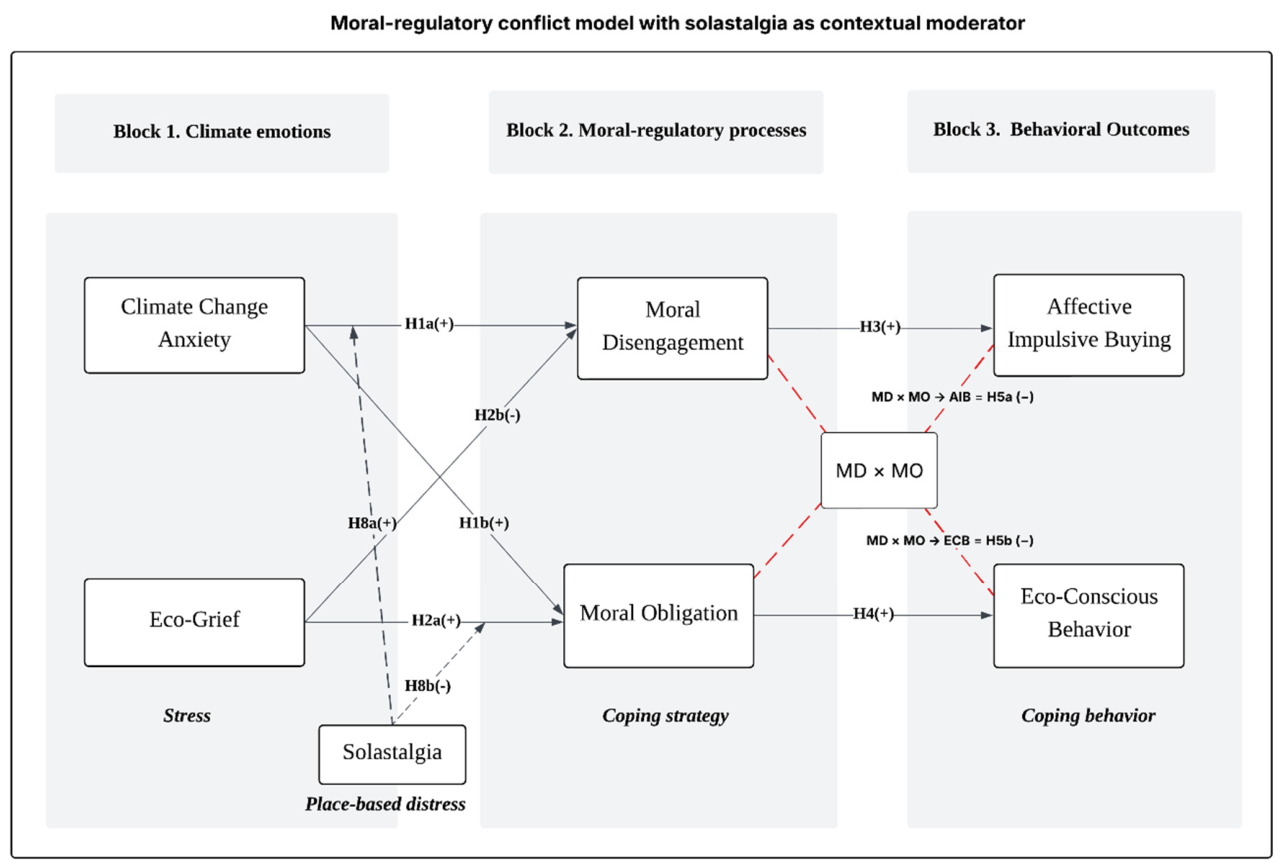
Figure 2.
Structural results for the focal moral-regulatory conflict model.
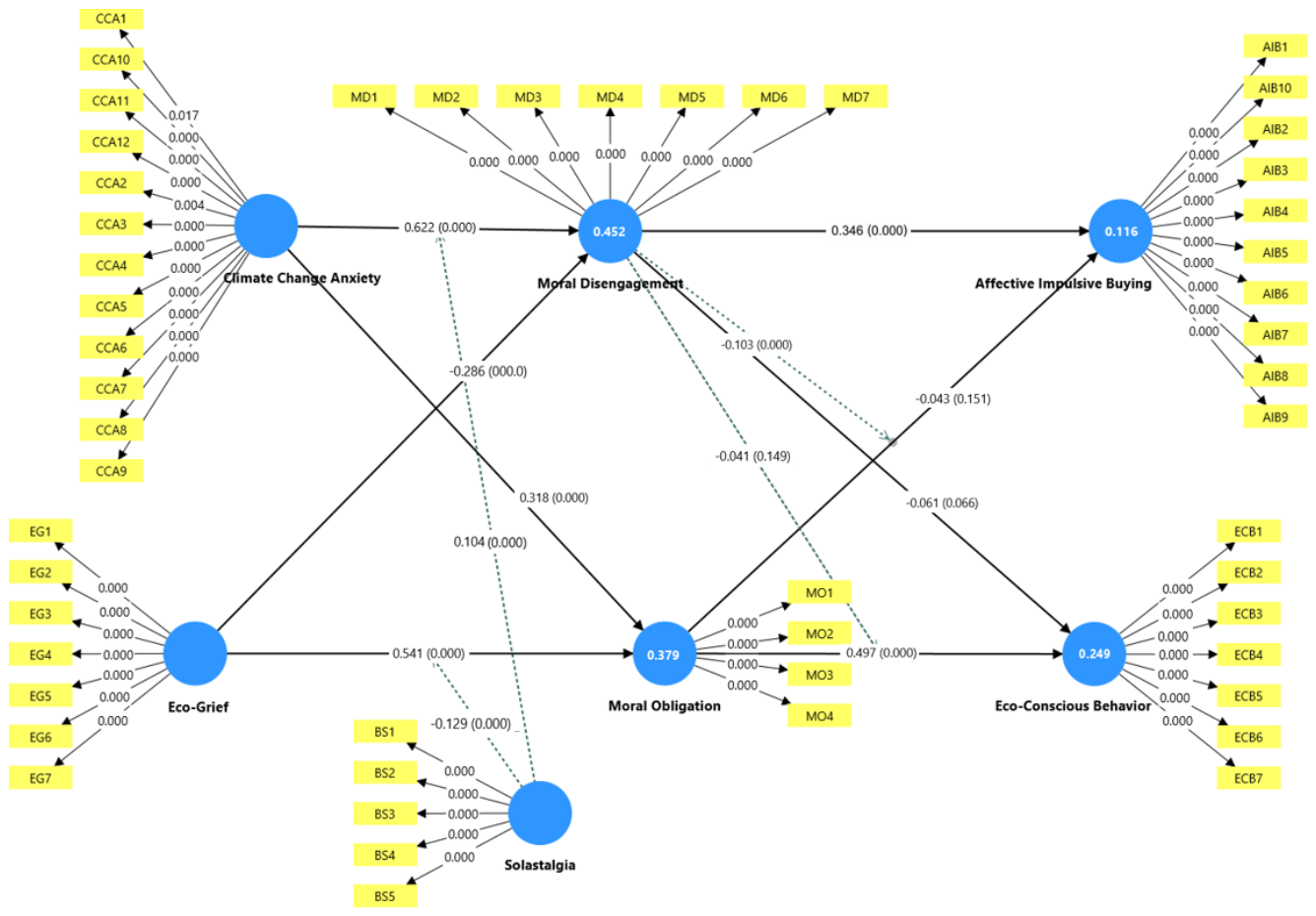
Table 1.
Theoretical foundations of the moral-regulatory conflict model.
| Theoretical perspective | Core proposition | Role in the present framework | Unresolved issue addressed |
| Appraisal and coping theory | Perceived controllability influences whether distress prompts problem-directed coping or affect regulation [13,14,15]. | Provides an appraisal-based account of divergent moral responses; perceived controllability is not tested in the structural model. | Climate-emotion research rarely specifies how opposing moral appraisals remain available within one consumer. |
| Norm Activation Theory | Awareness of consequences and ascribed responsibility activate personal moral norms [16]. | Explains the formation and behavioral force of MO. | Personal norms are often modeled without the justificatory processes that can inhibit their behavioral expression. |
| Selective moral self-regulation | Moral standards influence conduct when self-sanctions are activated; justificatory mechanisms can selectively suspend those sanctions [7,17]. | Explains why MD can operate in a person who continues to acknowledge an environmental obligation. | MD and MO are frequently treated as separate predictors rather than concurrent regulators. |
| Moral licensing and compensatory repair | Prior moral conduct can reduce restraint in a later decision, whereas perceived moral failure can prompt reparative conduct [18,19]. | Supplies process logic for movement between indulgent and reparative consumption episodes. | Sequential moral balancing has rarely been connected to differentiated climate emotions and concurrent moral regulation. |
| Place identity and solastalgia | Environmental deterioration can erode control, efficacy, and continuity of place identity [11,12,17]. | Explains why place-based distress alters the formation of MD and MO. | Place-based distress has received limited attention as a condition of moral self-regulation in consumption. |
Table 2.
Respondent socio-demographic characteristics.
| Variable | Category | n | % |
| Gender | |||
| Female | 302 | 51.9 | |
| Male | 280 | 48.1 | |
| Age | |||
| 18 – 24 | 128 | 22.0 | |
| 25 – 34 | 214 | 36.8 | |
| 35 – 44 | 140 | 24.1 | |
| 45 + | 100 | 17.2 | |
| Education | |||
| ≤ High-school | 156 | 26.8 | |
| Bachelor’s | 304 | 52.2 | |
| Master’s / PhD | 122 | 21.0 | |
| Monthly household income (₺) | |||
| < 26.500 | 80 | 13.7 | |
| 26.5001 – 50.000 | 110 | 18.9 | |
| 50. 001 – 70.000 | 140 | 24.1 | |
| 70.000 – 90.001 | 108 | 18.6 | |
| 90.001 – 120.000 | 85 | 14.6 | |
| ≥ 120.001 | 59 | 10.1 | |
| Employment status | |||
| Self-employed | 52 | 8.9 | |
| Full-time employee | 320 | 55.0 | |
| Part-time / contract | 38 | 6.5 | |
| Student | 92 | 15.8 | |
| Homemaker | 34 | 5.8 | |
| Unemployed / job-seeking | 24 | 4.1 | |
| Retired | 22 | 3.8 | |
₺: Turkish lira, the official currency of Türkiye.
Table 5.
Participant profile.
| ID | Age | Education | Occupation | Income ₺* |
| P01 | 18–24 | Bachelor’s | University student (Psychology) | ≥120.001 |
| P02 | 25–34 | Bachelor’s | Digital-marketing specialist | 26.5001–50.000 |
| P03 | 25–34 | Master’s | Bank inspector | 50.001–70.000 |
| P04 | 25–34 | Bachelor’s | Logistics analyst | 26.5001–50.000 |
| P05 | 25–34 | PhD | Academic (Environmental Science) | 90.001–120.000 |
| P06 | 18–24 | Associate | Freelance graphic designer | 50. 001–70.000 |
| P07 | 45–54 | Bachelor’s | Public-relations manager | 26.5001–50.000 |
| P08 | 35–44 | Bachelor’s | Software engineer | 90.001–120.000 |
| P09 | 35–44 | High school | Homemaker / volunteer activist | 90.001–120.000 |
| P10 | 35–44 | Bachelor’s | Sales manager (FMCG) | 50.001–70.000 |
| P11 | 25–34 | Master’s | Clinical psychologist | ≥120.001 |
| P12 | 25–34 | Bachelor’s | Industrial engineer | ≥120.001 |
| P13 | 25–34 | Bachelor’s | Fashion designer | 26.500 –50.000 |
| P14 | 45–54 | Bachelor’s | Public administrator (Municipality) | 90.001–120.000 |
| P15 | 45–54 | Master’s | Retired teacher | 50.001–70.000 |
| P16 | 25–34 | Bachelor’s | Start-up co-founder | 50.001–70.000 |
| P17 | 35–44 | PhD | Medical doctor (Family physician) | ≤ 26.500 |
| P18 | 35–44 | Bachelor’s | Tourism entrepreneur | 90.001–120.000 |
| P19 | 35–44 | Master’s | Finance consultant | 90.00–120.000 |
| P20 | 35–44 | High school | Driver / Freight transport | 26.5001–50.000 |
| P21 | 18–24 | Bachelor’s | Recent graduate – Data analyst | ≥120.001 |
| P22 | 45–54 | Bachelor’s | HR manager | ≥120.001 |
| P23 | 25–34 | Master’s | Advertising copywriter | 50. 001–70.000 |
| P24 | 25–34 | Bachelor’s | E-commerce entrepreneur | 50. 001–70.000 |
| P25 | 35–44 | PhD | Sustainability consultant | 90.001–120.000 |
| P26 | 35–44 | Bachelor’s | Electrical engineer (Energy) | ≥120.001 |
₺: Turkish lira, the official currency of Türkiye. Gender distribution (N = 26): Female = 14 (53.8%); Male = 12 (46.2%).
Table 6.
Direct, interaction, and robustness effects.
| Hypothesis | Relationship | β | 95% BCa CI | p | f² | Decision |
| H1a | CCA→MD | .622 | [.536, .701] | < .001 | .382 | Supported |
| H1b | CCA→MO | .318 | [.246, .390] | < .001 | .191 | Supported |
| H2a | EG→MO | .541 | [.477, .603] | < .001 | .301 | Supported |
| H2b | EG→MD | −.286 | [−.367, −.203] | < .001 | .132 | Supported |
| H3 | MD→AIB | .346 | [.280, .411] | < .001 | .141 | Supported |
| H4 | MO→ECB | .497 | [.427, .563] | < .001 | .196 | Supported |
| H5a | MD × MO→AIB | −.103 | [−.166, −.043] | .001 | .016 | Supported |
| H5b | MD × MO→ECB | −.041 | [−.098, .015] | .149 | .003 | Not supported |
| H8a | BS × CCA→MD | .104 | [.051, .157] | < .001 | .021 | Supported |
| H8b | BS × EG→MO | −.129 | [−.191, −.067] | < .001 | .037 | Supported |
| Robustness | MD→ECB | −.061 | [−.126, .004] | .066 | .006 | Nonsignificant |
| Robustness | MO→AIB | −.043 | [−.101, .016] | .151 | .003 | Nonsignificant |
Note. BCa CI= bias-corrected and accelerated confidence interval; BS= Brief Solastalgia. The MD→ECB and MO→AIB paths were examined as cross-outcome robustness tests and were not specified as focal hypotheses. The interaction effect was supported for AIB but not for ECB, indicating outcome-specific moral-regulatory interdependence. ***p < .001; **p < .01, Effect size classification: f² ≈ .02 = small, .15 = medium, .35 = large [92].
Table 7.
Indirect and moderated indirect effects.
| Hypothesis | Indirect relationship | Effect | 95% BCa CI | p | Decision |
| H6 | CCA→MO→ECB | .158 | [.112, .210] | < .001 | Supported |
| H7 | EG→MD→AIB | −.099 | [−.138, −.064] | < .001 | Supported |
| H9 | Index of moderated mediation: BS X CCA→MD→AIB | .036 | [.015, .061] | .001 | Supported |
| H10 | Index of moderated mediation: BS X EG→MO→ECB | −.064 | [−.097, −.034] | < .001 | Supported |
Note. Conditional indirect effects are evaluated at the mean of the competing moral process. H9 and H10 are indices of moderated mediation. Statistical support requires a 95% BCa confidence interval that excludes zero. p-values.
Table 8.
Conditional associations within the moral-regulatory conflict model.
| Outcome | Focal association | Level of competing moral process | Conditional β | 95% BCa CI | p |
| AIB | MD→AIB | Low MO, −1 SD | .450 | [.369, .529] | < .001 |
| AIB | MD→AIB | Mean MO | .346 | [.280, .411] | < .001 |
| AIB | MD→AIB | High MO, +1 SD | .242 | [.155, .329] | < .001 |
| ECB | MO→ECB | Low MD, −1 SD | .538 | [.456, .615] | < .001 |
| ECB | MO→ECB | Mean MD | .497 | [.427, .563] | < .001 |
| ECB | MO→ECB | High MD, +1 SD | .456 | [.367, .539] | < .001 |
Note. Conditional associations are reported at −1 SD, the mean, and +1 SD of the competing moral process. Moderation was supported only for AIB; the MO–ECB estimates are descriptive because the corresponding interaction was nonsignificant.
Table 9.
Out-of-sample predictive performance.
| Construct | R² | Q²_predict | RMSE PLS | RMSE LM (Δ) | MAE PLS | MAE LM (Δ) | Assessment |
| MD | .452 | .446 | .761 | .776 (−.015) | .615 | .628 (−.013) | Modest PLS advantage |
| MO | .379 | .361 | .734 | .746 (−.012) | .588 | .597 (−.009) | Modest PLS advantage |
| AIB | .116 | .121 | .942 | .951 (−.009) | .756 | .764 (−.008) | Modest PLS advantage |
| ECB | .249 | .245 | .878 | .889 (−.011) | .702 | .711 (−.009) | Modest PLS advantage |
Table 10.
Qualitative themes, sub-themes, and illustrative excerpts.
| ID | Theme Title | Conceptual Focus | Sub-Theme A | Sub-Theme B | Illustrative Excerpt |
| T1 | Cognitive-Dissonance Catalysts | Bodily and sensory “micro-alarms” that make climate change feel personal and spur instant self-justifications | Alarm Moment (heat, taste, missing rain) | Protective Stories (downward comparison, delegated responsibility, resignation) | “Tomatoes used to smell like tomatoes … now even my grand-dad can’t taste summer.” (P11) |
| T2 | Mourning Into Mandate | Eco-grief that converts felt loss into a moral duty to act | Visceral Loss (burned orchards, silent birds) | Moral Summons (replanting, lifestyle shifts) | “When the orchard burned, the olives on our table felt borrowed from history.” (P14) |
| T3 | Last-Chance Hedonism | Time-compressed indulgence driven by sense of a shrinking climate window | Now-or-Never Experiences (bucket-list travel, luxury produce) | Guilt Rebound (offsets, charitable penance) | “If coral reefs are dying, I want to see them while they’re still there.” (P02) |
| T4 | Algorithmic Absolution | Delegating moral scrutiny to apps, badges, and one-click offsets | Badge Faith (trusting green icons) | Delegated Conscience (buying more once ‘approved’) | “A green leaf pops up—I click buy. No leaf, I close the tab.” (P21) |
| T5 | Circular Comfort | Repair, resale, and sharing as hands-on antidotes to guilt | Repair as Relief (DIY fixes, resoling shoes) | Share–Swap–Sell (second-hand, gift circles) | “Buying a blouse pre-loved feels like erasing a line of emissions from my account.” (P01) |
| T6 | Homebound Stewardship | Hyper-local purchasing as place-anchored caregiving after ecological loss | Buy-Local Anchor (10-km food circles, local crafts) | Place-Repair Spend (community rewilding, coastal clean-ups) | “Shopping local feels like stacking sandbags against the flood of loss.” (P20) |
Table 11.
Mechanism–Lever–Outcome Matrix.
| Mechanism or candidate intervention implication | Qualitative anchors | Linked hypotheses | Role of solastalgia | Key empirical evidence | Candidate evaluation indicators |
| MD | T1, T3, T4 | H1a, H2b, H3, H7, H8a, H9 | Strengthens CCA→MD and the conditional indirect effect of CCA on AIB through MD | CCA→MD: β = .622, f² = .382; EG→MD: β = −.286, f² = .132; MD→AIB: β = .346, f² = .141; H9 index = .036 | Impulsive-buying tendency; checkout latency; basket revisions |
| MO | T2, T5, T6 | H1b, H2a, H4, H6, H8b, H10 | Weakens EG→MO and the conditional indirect effect of EG on ECB through MO | CCA→MO: β = .318, f² = .191; EG→MO: β = .541, f² = .301; MO→ECB: β = .497, f² = .196; H10 index = −.064 | Repair and reuse; second-hand purchasing; local expenditure |
| Moral-regulatory conflict | Cross-theme matrix; T3–T5 | H5a, H5b; robustness paths | Solastalgia was not modeled as a moderator of the MD × MO interaction | MD × MO → AIB: β = −.103, f² = .016; MD × MO→ECB: β = −.041, f² = .003; concurrent MD and MO appeared in 15 interviews | Within-person MD–MO variation; licensing and repair sequences |
| Agency and accountability cues | T1, T6; negative cases | H1b, H8a, H8b, H9, H10 | May be relevant under place-based distress, but agency was not tested quantitatively | Two action-oriented anxiety cases and nine stewardship accounts | Perceived efficacy; responsibility attribution; action uptake |
| Choice architecture and cooling-off measures | T3, T4, T5 | H3, H5a, H9 | May be relevant when the CCA→MD pathway is stronger; interventions were not directly tested | T3: 10 participants; T4: 8; T5: 11 | Repair or rental selection; reliance on sustainability badges; deliberation time |
| Place-anchored repair infrastructure | T2, T6 | H2a, H4, H8b, H10 | May be relevant where solastalgia weakens EG→MO, but this mechanism requires direct testing | BS × EG →MO: β = −.129, f² = .037; nine stewardship accounts | Local expenditure; repair participation; perceived local efficacy |
Note. H9 and H10 represent conditional moderated-mediation estimates evaluated at the mean level of MO and MD, respectively. Candidate intervention implications were not tested experimentally and should not be interpreted as evidence of causal effectiveness. H = hypothesis code/ID, T = qualitative theme ID; BS = solastalgia.
Disclaimer/Publisher’s Note: The statements, opinions and data contained in all publications are solely those of the individual author(s) and contributor(s) and not of MDPI and/or the editor(s). MDPI and/or the editor(s) disclaim responsibility for any injury to people or property resulting from any ideas, methods, instructions or products referred to in the content. |
© 2026 by the authors. Licensee MDPI, Basel, Switzerland. This article is an open access article distributed under the terms and conditions of the Creative Commons Attribution (CC BY) license.
Copyright: This open access article is published under a Creative Commons CC BY 4.0 license, which permit the free download, distribution, and reuse, provided that the author and preprint are cited in any reuse.