

Submitted:
16 July 2026
Posted:
22 July 2026
You are already at the latest version
Abstract
Background/Objectives: Drug repurposing is one of the possible sources of new anthelmintics. Afoxolaner is a insecticide/acaricide that acts on the insect GABA receptor and regulates uptake of chloride ions. We examined the interaction of afoxolaner with GABA receptors of nematodes. Methods: We tested the effects of afoxolaner on the motility of the free-living nematode C. elegans and its effect on the contractions/relaxation of the parasitic nematode A. suum. By means of structural bioinformatics, we analyzed the potential binding sites of afoxolaner on the nematode synaptic/exrasynaptic GABA receptor. Results: Afoxolaner inhibited the development of adult C. elegans, significantly reduced the distance traveled, movement speed, and motility score. Afoxolaner significantly inhibited the contractions of the A. suum neuromuscular preparation by increasing the EC50 value of ACh but not changed the Emax. However, afoxolaner neutralized the inhibitory effect of GABA, significantly reduced the EC50 of ACh and increased Emax. In the relaxation study, afoxolaner potentiates GABA-evoked relaxation but inhibited piperazine-induced relaxation. Conclusions: Pharmacological effect of afoxolaner on GABA receptors in nematodes can be defined in two ways: when contractions were induced by ACh, afoxolaner behaves as a partial agonist/antagonist, which would involve binding to an orthosteric site on the receptor. Probably this effect is realized on synaptic GABA receptors between inhibitory interneurons and motoneurons. However, when relaxation is induced by activation of an extrasynaptic GABA receptor, afoxolaner exhibits the characteristics of positive allosteric modulator, it does not cause relaxation by itself, but enhances the effect of GABA and antagonizes the action of piperazine.
Keywords:
afoxolaner
; GABA receptor
; Ascaris suum
; Caenorhabditis elegans
1. Introduction
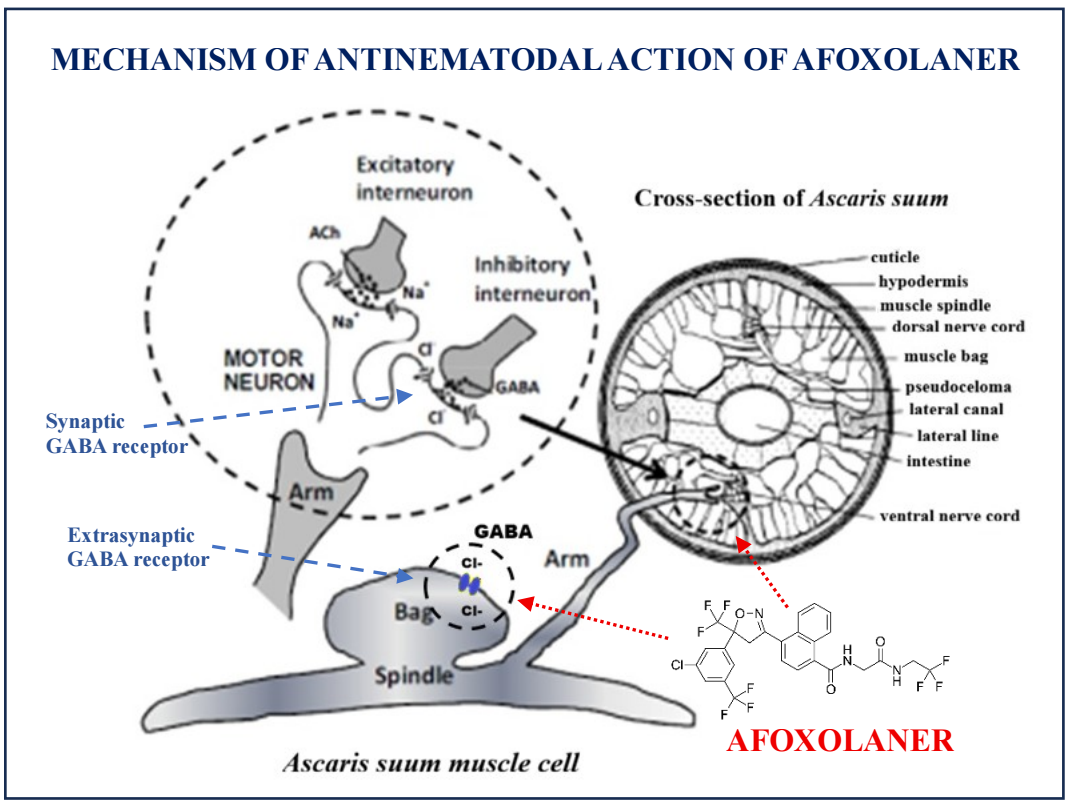
The discovery of new anthelmintic drugs is a constant need in veterinary and human medicine. In the past 25 years, only three new classes of anthelmintics have come onto the market: derquantel (spiroindole class), emodepside (cyclooctadepsipeptide class) and monepantel (amino-acetonitrile derivative (AAD) class). However, their effectiveness is variable, and the continued development of parasite resistance generally seriously threatens the success of anthelmintic pharmacotherapy. One of the possibilities for improving the effectiveness of therapy is the repurposing of existing drugs of other pharmacodynamic groups or their use as a platform for the synthesis and development of new drugs. Most existing modern anthelmintics act at the level of the neuromuscular system of nematodes. They mainly target nicotinic acetylcholine receptors (nAChRs) and gamma-aminobutyric acid (GABA) receptors. nAChRs in Ascaris suum are ligand-gated ion channels primarily located at the neuromuscular synapse serving as critical targets for cholinergic anthelmintic drugs (imidazothiazoles, tetrahydropyrimidines, and paraherquamide). These receptors mediate excitatory neurotransmission and cause spastic paralysis in the worms when activated. On the other side are GABA receptors. GABA-dependent chloride channels function as inhibitory, chloride-coupled receptors that cause muscle relaxation and flaccid paralysis when activated (piperazine and avermectins). Both types of receptors are localized synaptically (in synapses of motor neurons and interneurons) and extrasynaptically in the bag region of nematode muscle cells.
Even though the basic pharmacological characteristics of anthelmintic molecules are well known, many intracellular mechanisms that are activated after binding to the receptors are still not fully understood [1]. This fact further complicates the development of new drugs and indicates the need for a more fundamental understanding of the pharmacodynamics of existing agents. Of particular interest is the GABA-ergic system of nematodes, one of the evolutionarily oldest inhibitory neurotransmitter systems, present in various living organisms, including plants and bacteria [2]. In nematodes, GABA receptors form chloride channels, and their activation leads to muscle relaxation and induction of atonic paralysis, which is the primary mechanism of action of some anthelmintics, including piperazine [3].
Although nematode GABA receptors show structural similarity to vertebrate GABA-A receptors, numerous studies indicate the existence of specific differences that are important for drug selectivity. The classical GABA-A receptor antagonist bicuculline has extremely low potency at Caenorhabditis elegans GABA receptor [4]. This difference indicates a modified agonist binding site in nematodes, which is a key basis for the selective toxicity of GABA-ergic anthelmintics.
The genetic basis of the GABA receptor in nematodes has also been the subject of numerous studies. Historically, the model organism C. elegans has played a central role in understanding the function of this receptor. Its muscle GABA receptor is encoded by the UNC-49 gene, whose subunits and their roles in the formation of a functional receptor have been clearly defined [3]. The latest findings indicate that UNC-49, LGC-37/38 and GAB-1 subunits are essential components of a functional GABA-ergic chloride channel in the nematode C. elegans [5,6].
The question arises of the differences between the GABA receptors of nematodes and other invertebrates, primarily insects and acarinae. This difference/similarity could be significant for the development of new endectocide drugs. This is supported by the fact that the receptor subunit from the parasitic nematode Haemonchus contortus was identified and named Hco-LGC-38. This subunit is present in parasitic and free-living nematodes and is similar to the UNC-49 group of nematode GABA receptor subunits as well to insect resistant dieldrin (RDL) GABA receptors. RDL is a target for a variety of noncompetitive antagonists, including isoxazolines [7]. Afoxolaner is a insecticide/acaricide molecule from the isoxazoline family that acts on the insect gamma-aminobutyric acid receptor (GABA) and regulates uptake of chloride ions. At insect RDL receptors, afoxolaner acts as a non-competitive antagonist of ligand-gated chloride channels, blocking the channel pore, preventing chloride influx and thereby disrupting normal nerve function, leading to hyperexcitation and paralysis of the arthropod. Retention of nanomolar potency at the A302S dieldrin-resistance mutant indicates that its binding site is distinct from the classical cyclodiene/picrotoxin pore site. Whether this mechanism translates to phylogenetically distinct nematode GABA receptors remains to be established. At insect RDL receptors, afoxolaner acts as a non-competitive antagonist of ligand-gated chloride channels, blocking the channel pore, preventing chloride influx and thereby disrupting normal nerve function, leading to hyperexcitation and paralysis of the arthropod. Retention of nanomolar potency at the A302S dieldrin-resistance mutant indicates that its binding site is distinct from the classical cyclodiene/picrotoxin pore site. Whether this mechanism translates to phylogenetically distinct nematode GABA receptors remains to be established. At insect RDL receptors, afoxolaner acts as a non-competitive antagonist of ligand-gated chloride channels, blocking the channel pore, preventing chloride influx and thereby disrupting normal nerve function, leading to hyperexcitation and paralysis of the arthropod. Retention of nanomolar potency at the A302S dieldrin-resistance mutant indicates that its binding site is distinct from the classical cyclodiene/picrotoxin pore site. Whether this mechanism translates to phylogenetically distinct nematode GABA receptors remains to be established. As we mentioned, this blockade leads to hyperexcitation, paralysis, and ultimately the death of the arthropod. Notably, afoxolaner demonstrates high selectivity for insect receptors over their mammalian counterparts [8]. Invertebrate GABA-gated chloride (GABA-Cl⁻) receptors are well-established targets of anthelmintic and ectoparasiticide compounds. At this time the accessible co-crystallized ivermectin (IVM) with a Cys-loop receptor from RCSB PDB [9], is used as the structural. As a template, the crystalographic structure is routinely used to model IVM docking into other family receptors [10,11]. IVM potentiates GABA-A currents allosterically in vertebrates [12], by wedging horizontally between the M3 and M1 helices of adjacent subunits in the transmembrane region, the transmembrane (TM) cleft. The isoxazoline class occupies this same cleft in insect RDL, with key contact residues and selectivity determinants defined by mutagenesis [13,14]. Notably, isoxazolines such as afoxolaner show markedly higher potency at nematode GABA-Cl⁻ receptors than at insect RDL, a pharmacological selectivity attributed to divergent TM cleft residues across phyla [8,15].
Considering the above, we examined the interaction of afoxolaner with GABA receptors of nematodes. We tested the effects of afoxolaner on the motility of the free-living nematode C. elegans as well as its effect on the contractions/relaxation of the neuromuscular preparation of the parasitic nematode Ascaris suum. By means of structural bioinformatics, we analyzed the potential binding sites of afoxolaner on the nematode synaptic/exrasynaptic GABA receptor and compared it with the effects of the anthelmintic piperazine, an agonist of the nematode GABA receptor.
2. Results
2.1. Investigation of the Influence of Afoxolaner on the Number and Motility of Adult C. elegans
The effects of afoxolaner on the development and motility of C. elegans were tested. Nematodes were exposed for 48 hours to increasing concentrations of this isoxazoline of 1, 3 and 10μM, and the changes were monitored after 24 and 48 hours, by measuring for 5 minutes using the Microtracer 10 device. At the beginning of the test (1. day), the number of adult C. elegans did not differ statistically significantly in control and treated worms and ranged from 15.67±=0.67 to 30.00±0.57 (n=3) (Figure 1A). The number of adult C. elegans recorded by Microtracer 10 did not decrease either in the control group or in worms treated with afoxolaner, which would indicate that this isoxazoline does not exhibit lethal effects in the applied concentrations. However, in control worms, there was a significant increase in the number of adults until the third day of observation (p<0.0001), while this increase was not statistically significant in the presence of afoxolaner. On the other hand, on the third day of observation, the number of adults was significantly lower in all groups of worms treated with afoxolaner (p<0.0001) in comparison with control (Figure 1A).
The average distance traveled during 5 minutes of measurement increased insignificantly in control worms during the three days of observation. Furthermore, in the worms exposed to afoxolaner, on the third day of observation, the average value of the distance traveled significantly decreased (p=0.0174; p=0.0085; p=0.0081) compared to the control finding (Figure 1B). The average worm speed results follow the previously described changes in distance traveled. In control worms, the speed of movement measured during 5 minutes of observation increased insignificantly from the 1st to the 3rd day. On the other hand, such a finding was not observed in worms exposed to increasing concentrations of afoxolaner. However, on the third day of observation, the average speed of all treated C. elegans was significantly lower than the control (p=0.0020; p=0.0090; p=0.0002) (Figure 1C) and was in decline compared to the 1st day. The motility score was reduced in all worms treated with afoxolaner already after 24 hours of exposure and remained at that level until the end of the observation. However, this reduction compared to the control did not reach statistical significance (Figure 1D). During the three days of observation the rotational index did not differ between control groups and worms exposed to afoxolaner.
2.2. Investigation of the Influence of Afoxolaner on the Contraction/Relaxation of Neuromuscular Preparation Ascaris suum.
In the study of isometric contractions of the neuromuscular preparation of A. suum, afoxolaner significantly increased the EC50 value of acetylcholine (p<0.0007) from the control 8.419±2.679μM to 20.980±2.158μM. Even after washing, the EC50 value increased and reached 28.070±2.052μM. However, this increase in the EC50 value of ACh was not accompanied by a change in the maximal effect (Emax) and it did not differ in the presence of afoxolaner (1.148±0.189g, 1.124±0.215g and 1.266±0.247g) (Figure 2A and 2B).
In the following part of study, we compared the effect of GABA and the combination of GABA and afoxolaner on the contractions of A. suum induced by ACh (Figure 3A). Incubation of Ascaris neuromuscular preparation with 30μM GABA significantly increased (p<0.0001) the EC50 value of acetylcholine from 6.168±1.327μM to 25.240±1.483μM and insignificantly reduced Emax from 0.851±0.038g to 0.693±0.081g.
However, afoxolaner reduced the inhibitory effect of GABA, so the EC50 of ACh in the presence of GABA 30μM and afoxolaner 100μM was significantly lower (p<0.0001) compared to the effect recorded in the presence of only GABA, 10.760±1.442μM. It is interesting that after washing GABA and afoxolaner, the value of EC50 of ACh was lower than the control result (5.444±1.641μM). GABA insignificantly reduced Emax, however, this effect was almost neutralized by afoxolaner, so Emax in the presence of GABA and afoxolaner was 0.760±0.057g. It is interesting that after washing Emax was significantly higher than the value recorded in the presence of GABA (p=0.0029) and the combination of GABA and afoxolaner (p=0.0273) (Figure 3B).
Furthermore, it was tested the relaxant effect of GABA, afoxolaner and piperazine on the neuromuscular preparation of Ascaris suum (Figure 4A). GABA 30μM caused relaxation in two consecutive applications: 0.331±0.063g and 0.330±0.062g. Furthermore, afoxolaner 100μM significantly (p=0.0171) increased the effect of GABA and relaxation ranged from 0.408±0.059g to 0.445±0.073g. Obviously, the potentiating effect of afoxolaner on GABA-induced relaxation is reversible, because after washing the relaxation was almost the same as the control value (0.345±0.066 and 0.350±0.062g) (Figure 4B).
We also examined the effect of piperazine, a known GABA agonist, on GABA-induced relaxation and its interaction with afoxolaner (Figure 5A). In contrast to afoxolaner, piperazine 300μM significantly inhibited GABA-induced relaxation. Control relaxation was 0.642±0.024g and 0.670±0.037g, while piperazine significantly reduced this value (p=0.0017) to 0.532±0.014 and 0.520±0.019g.
However, when afoxolaner 100μM was added to piperazine 300μM, the relaxant effect of GABA was even more strongly inhibited and the relaxation was significantly reduced (p<0.0001) after application of GABA to only 0.362±0.026g and 0.373±0.042g. This inhibition of the relaxant effect of GABA was significantly higher (p=0.0008) than the inhibition caused by piperazine alone. After washing out piperazine and afoxolaner from the incubation solution, the relaxation caused by GABA was almost equal to the control relaxation (0.647±0.027g and 0.633g±0.024g) (Figure 5B). However, we emphasize that piperazine itself led to a slow relaxation after 4 minutes of incubation (Figure 5).
2.3. Docking of GABAergic Set and Binding Pocket Elucidation
Cross-species receptor models were constructed and superimposed into a common coordinate frame using PyMOL (v3.1.0). Each model was docked against six pharmacologically defined binding sites: AG, ECD-AN, BZ-PAM, BZ-NAM, TM-NCA, and TM-PAM (model composition, sequence alignments, and pocket definitions are provided in Supp. Tables 1A–1C). In addition, ivermectin (IVM) was coordinate-matched to the crystallographic pocket of the C. elegans GluCl ion channel (RCSB PDB: 3RIF) to be used as a structural reference for the transmembrane allosteric site.
2.4. Afoxolaner Binding Across Receptor Models
Afoxolaner (MW 610.75, CHEMBL2219412, HAC=42) was docked across distinctive model classes. The best pockets and the PAM-relevant transmembrane sites are summarised in Table 1. Given conserved TM binding locus across phyla, the lowest IVM score is taken as baseline (CAEELextra LE₁₀ 1.85). In addition, synaptic vs extrasynaptic model comparison supports receptor preference in ECD region (Table 2).
2.5. Piperazine Binding Across Receptor Models
Piperazine (MW 86.14, CHEMBL1412, HAC=5) scores highest at the extracellular orthosteric cleft across all models, consistent with orthosteric site of action and the reduction of GABA-evoked relaxation (Table 3).
2.6. Convergence of In Silico and Contraction/Relaxation Evidence
Experimental and computational data converge on a dual-site mechanistic picture. Afoxolaner potentiated GABA-evoked relaxation (p=0.0171, reversible), identifying it as a PAM at the transmembrane allosteric cleft somewhat more effective in nematodes (×1.14–1.32 vs IVM-site baseline), consistent with the known phylum-selective potency of isoxazolines. In co-application, afoxolaner allosterically amplifies the low-efficacy state established by piperazine's orthosteric engagement, producing additive effects at non-competing sites (Figure 6).
3. Discussion
Applied concentrations of afoxolaner (1, 3 and 10μM) did not have a lethal effect on adult C. elegans, but inhibits the development of adults. The Microtracer 10 device detects only adult worms. Given that the development of C. elegans from fertilized egg to reproductive adult takes approximately 3 days (65 hours at 20°C) [16], an increase in the number of adults over time is expected. In our study, all tested concentrations of afoxolaner reduced the number of adults compared to control worms, already on the second and especially on the third day of exposure. This can be a very important effect that should be checked in parasitic nematodes as well, because after oral administration of a therapeutic dose of afoxolaner in dogs (2.5mg/kg), its maximum plasma concentration is around 3μM [17]. Furthermore, all tested concentrations of afoxolaner significantly reduced the distance traveled and the speed of movement of adult C. elegans, which resulted in a reduced motility score. On the other hand, the rotational index did not differ in control and treated worms.
In the presented contractions study, afoxolaner significantly inhibited the contractions of the A. suum neuromuscular preparation by increasing the EC50 value of ACh but not changing the Emax, which corresponds to competitive antagonism. We have already described such an effect with GABA [18,19] and hypothesized that this phenomenon occurs as a consequence of the binding of GABA to the GABA receptor in the synapses between inhibitory interneurons and motoneurons (synaptic effect). This process immediately activates the competitive antagonistic excitatory mechanism through excitatory interneurons, which apparently also happens with afoxolaner. Exactly as in earlier studies [20], GABA 30μM in the present investigation caused inhibition of ACh induced contractions, by increasing the value of EC50 of ACh but not significantly reducing Emax. However, when we added afoxolaner to GABA, it neutralized the inhibitory effect of GABA, significantly reducing the EC50 of ACh and increasing Emax.
To facilitate functional interpretation of the modeled receptor systems, the two C. elegans GABA-A receptor assemblies were designated according to their proposed physiological roles. CAEELsyn was constructed as a heteropentameric UNC-49 receptor complex composed of UNC-49B, UNC-49C, and UNC-49Cshort subunits and is considered representative of the canonical synaptic GABA-gated chloride channel mediating fast phasic inhibition at the neuromuscular junction. In contrast, CAEELextra was designed as a heteropentameric assembly containing GAB-1 together with LGC-family chloride channel subunits, representing a proposed extrasynaptic GABA-responsive receptor architecture potentially involved in tonic inhibitory signaling mediated by ambient or spillover GABA. This nomenclature is used throughout the study to distinguish the putative synaptic and extrasynaptic receptor populations and to facilitate comparative structural and pharmacological analyses. Apparently, afoxolaner in ACh-induced contractions behaves as a partial agonist/antagonist of synaptic GABA receptor, depending on whether it is alone on the receptors or the exogenous GABA is also present there. Comparison of afoxolaner binding efficiency between the proposed synaptic (CAEELsyn) and extrasynaptic (CAEELextra) receptor models revealed a modest but consistent preference for the synaptic receptor architecture. Relative LE10 values were approximately 16–18% higher for CAEELsyn than for CAEELextra when normalized against both diazepam and GABA reference ligands. This preferential interaction with the UNC-49-containing receptor is consistent with pharmacological observations indicating that afoxolaner may act as a partial agonist at synaptic GABA receptors. Under conditions of low endogenous GABA, receptor occupancy by afoxolaner may produce receptor activation, whereas in the presence of exogenous GABA, competition for binding sites could reduce maximal receptor activation, resulting in an apparent antagonistic effect.
In the relaxation study, afoxolaner (100µM) potentiates GABA-evoked relaxation of the A. suum neuromuscular preparation (p=0.0171, fully reversible on washout). The effect is strictly GABA-dependent and no effect is observed in the absence of exogenous GABA, ruling out direct agonism. This GABA-dependence combined with full reversibility is the defining signature of a positive allosteric modulator (PAM). Docking places afoxolaner at BZ/allosteric inter-subunit interfaces in CAEELextra, CAEELsyn, and DROME, and at the ECD outer surface in ASUCU. This is consistent with the proposed PAM mechanism of structurally related isoxazolines at insect GABA-Cl receptors [8]. We note that afoxolaner is frequently characterised as a transmembrane channel blocker (non-competitive antagonist) in insect RDL receptors; the simplest hypothesis reconciling this with our nematode data is that the TM-pore site is pharmacologically accessible in the Drosophila/insect receptor but structurally occluded or less favoured in Ascaris suum and C. elegans GABA-Cl, redirecting the compound towards allosteric inter-subunit pockets and producing net potentiation rather than block.
In our previous study, it was shown that removal of the nerve cord from A. suum preparations resulted in the absence of contractions after ACh application. Contractions were stable only after Electrical Fild Stimulation (EFS) but were completely insensitive to GABA. These results indicate that the effect of ACh and GABA on the contraction/relaxation of Ascaris somatic muscles requires functional synaptic and extrasynaptic receptors [20].
4. Materials and Methods
4.1. C. elegans
C. elegans, wild type (N2 Bristol) was obtained from the Caenorhabditis Genetics Center [21]. Worms were cultivated and adults were separated for testing as we previously explained in Stojković et al. 2024, 2025 [22,23]. The effect of afoxolaner on the motility of adult C. elegans was investigated by using the Microtracker SMART 8 device (PHYLUMTECH S.A., Argentina). In the Petri dishes (diameter 3cm) filled with 2.5 ml of NGM substrate and increasing concentrations of afoxolaner 1, 3 and 10 μM the suspension (20 μL) of adult C. elegans was added. Data collection was performed once a day, after 24, 48 and 72 hours of exposure during a five-minute interval. The plates were subjected to “tapping” stimulation before each measurement. The following C. elegans parameters were monitored and analyzed: number of adults, movement speed, distance traveled, rotation index and motility score.
4.2. Ascaris suum Contractions/Relaxations Assay
Ascaris muscle strip for contraction studies was prepared, as previously described in Stojković et al. [22,23]. After 15 min of equilibration under a 500 mg load, contractions induced by increasing concentrations of acetylcholine (ACh) (1, 3, 10, 30 and 100 μM) were measured, as well as after incubation with GABA, afoxolaner or their combination. Monitoring, recording and expression of contractions intensity are described in Stojković et al. [22,23]. A similar protocol was used to measure the relaxation response to the tested substances. However, the neuromuscular preparation was equilibrated for 15 min under a tension of 2g, and only preparations that stabilized the tension between 1.5 and 2g were used. After each application of GABA, afoxolaner and piperazine, i.e. the combination, the preparation was washed out and after returning to the initial tension, tested again.
4.3. In Silico Isoxazoline Pharmacology at Invertebrate GABA Receptor Models
4.3.1. Sequence Retrieval and Subunit Selection
Amino acid sequences of GABA type A receptor subunits are retrieved from UniProt [24]. Subunits are selected to capture diversity among pentameric ligand-gated ion channels, including D. melanogaster RDL [15], A. suum F1LCR9, and C. elegans subunits UNC-49, LGC, and GAB, based on their experimental relevance and well-characterized pharmacological profiles. Multiple sequence alignment is performed using Clustal Omega v1.2.4 [25] against subunit chains derived from available target receptor co-crystal structures to identify conserved structural scaffolds for pentamer assembly, see Supplementary Table 1A.
4.3.2. Structural Modeling
Subunits are built using homology modeling [26] and assembled in a functional pentamer by superimposition onto co-crystal reference in PyMOL. Subunit identity and stoichiometry for each model follow established pharmacological characterisation of native receptors [27]. Final assembled models are energy-minimized in OpenMM v8.5, with AMBER force field [28]. Receptor pockets are annotated through binding-pocket transfer from co-crystallized ligands, see Supplementary tables S1B, 1C.
4.3.3. Molecular Docking and MOA Annotation Strategy
Receptor and ligand structures were prepared following standard protocols [29,30]. Docking follows a two-step protocol: first, an unbiased whole-receptor scan using a large search box centred at the receptor centre-of-mass to capture global binding preferences; second, pose sampling is refined at preferred sites using constrained local search volumes matched to crystallographically defined binding pockets. Ligand Efficiency (LE), defined as predicted binding free energy normalised by heavy-atom count (HAC), is the primary docking metric [31]. Each pocket is assigned to a mechanistic class based on its crystallographic reference ligand. For example, GABA/ABU as AG - orthosteric agonist; diazepam/DZP as BZ-PAM; bicuculline as the canonical ECD-AN antagonist (Johnston, 2013), full abbreviation list in Supplementary Table 1C. Final LE values are computed from the best docking mode across three independent seeds, and each pocket's Mechanism of Action (MOA) class is assigned by RMSD-based proximity to its crystallographic reference ligand position. For better readability - LE10 is used, defined as (mean −ΔG / HAC) × 10; averaged over seeds 100/200/300.
4.4. Drugs and Substances
Acetylcholine, GABA, piperazine and afoxolaner were obtained from Sigma-Aldrich Co. (St Louis, MO, USA). Acetylcholine and piperazine were dissolved in the APF-Ringer solution, while afoxolaner was dissolved in DMSO, with a final concentration of DMSO in the APF-Ringer Solution of 0.1%v/v.
4.5. Statistical Analyses
All values are expressed as mean ± standard error of the mean (mean ± SE). The results of muscle contraction/relaxation assay are expressed as means ± S.E. in grams (g) of contraction/relaxation. The dose-response relationship was analyzed via nonlinear regression, and the values of the median effective concentration (EC50) of the agonist (ACh), without and in the presence of GABA and afoxolaner, were determined. One-way analysis of variance (ANOVA) was applied for the comparison of the differences between the EC50 value and the maximal effect (Emax). Also, one-way ANOVA test was used to determine the difference between average relaxations induced by GABA, afoxolaner and piperazine, followed by Tukey’s multiple comparisons test with 95% CI. Differences were considered significant when the p value was < 0.05. The statistical analysis was conducted using GraphPad Prism® software, Version 6.01 (San Diego, CA, USA), while all values are expressed as mean ± standard error (S.E.).
5. Conclusions
Afoxoilaner showed promising antinematodal properties based on the results shown, affecting the development and motility of C. elegans, antagonizing the contractile effects of ACh and stimulating the relaxant action of GABA in A. suum. On the other hand, its pharmacological effect on GABA receptors can be defined in two ways: when contractions were induced by ACh, afoxolaner behaves as a partial agonist/antagonist of GABA receptor, which would involve binding to an orthosteric site on the receptor. We reasonably hypothesize that this effect is on synaptic GABA receptors between inhibitory interneurons and motoneurons, which immediately involves action of excitatory interneurons and a reaction resembling competitive antagonism. On the other hand, when it comes to relaxation caused by activation of an extrasynaptic GABA receptor, afoxolaner exhibits the characteristics of PAM, it does not cause relaxation by itself, but enhances the effect of GABA and antagonizes the action of piperazine. The described effects of afoxolaner on GABA receptors of nematodes can be used for further studies of its antinematodal properties, especially due to synaptic and extrasynaptic effects. However, the potential antagonism with some GABAergic anthelmintics, with which it is often combined in pharmaceutical formulations (nematode GABA receptor agonists) requires special interest.
Supplementary Materials
The following supporting information can be downloaded at the website of this paper posted on Preprints.org.
Author Contributions
Conceptualization, D.M. and S.M.T.; methodology, S.M.T., Dj.S.M.; software, S.S.; validation, S.M.T. and D.M.; formal analysis, Dj.S.M. and S.M.T.; investigation, D.M., S.S.; resources, S.M.T., T.M., S.G. and S.R.; data curation, S.M.T., T.M., V.M.; writing—original draft preparation, D.M. and S.M.T.; writing—review and editing, S.M.T., J.N.T. and S.G.; visualization, S.M.T., J.N.T., V.M. and S.R.; supervision, S.M.T.; project administration, D.M.; funding acquisition, S.M.T. All authors have read and agreed to the published version of the manuscript.
Funding
The study was supported by the Ministry of Science, Technological Development and Innovation of the Republic of Serbia (Contract number 451-03-136/2025-03/200143), Science Fund of the Republic of Serbia, #GRANT No. 7355, Project title-FARMASCA (https://farmasca.vet.bg.ac.rs, accessed on 1 January 2024).
Institutional Review Board Statement
Not applicable.
Informed Consent Statement
Not applicable.
Data Availability Statement
The data that support the findings of this study are incorporated into the article and supplementary material.
Acknowledgments
Special thanks and great memories of Prof. Dr. Alan P. Robertson, our long-time friend and colleague, who left us suddenly.
Conflicts of Interest
The authors declare no conflicts of interest.
References
- Choudhary, S.; Kashyap, S.S.; Martin, R.J.; Robertson, A.P. Advances in our understanding of nematode ion channels as potential anthelmintic targets. Int. J. Parasitol. Drugs Drug Resist. 2022,18, 52-86. [CrossRef]
- Bouché, N.; Fromm, H. GABA in plants: just a metabolite? Trends Plant Sci. 2004, 9(3),110-115. [CrossRef]
- Robertson, A.P.; Martin, R.J. Ion-channels on parasite muscle: pharmacology and physiology. Invert. Neurosci. 2007, 7(4), 209-217. [CrossRef]
- Kaji, M.D.; Kwaka, A; Callanan, M.K.; Nusrat, H., Desaulniers, J.P.; Forrester, S.G. A molecular characterization of the agonist binding site of a nematode cys-loop GABA receptor. Br. J. Pharmacol. 2015, 172(15), 3737-47. [CrossRef]
- Yuan, F.; Zhou, J.; Xu, L.; Jia, W.; Chun, L.; Xu, X.Z.S.; Liu, J. GABA receptors differentially regulate life span and health span in C. elegans through distinct downstream mechanisms. Am. J. Physiol. Cell. Physiol. 2019, 317(5), C953-C963.
- Awe, T.; Akinosho, A.; Niha, S.; Kelly, L.; Adams, J.; Stein, W.; Vidal-Gadea, A. The AMsh glia of C. elegans modulates the duration of touch-induced escape responses. bioRxiv. 2023. [CrossRef]
- Taylor-Wells, J.; Hawkins, J.; Colombo, C.; Bermudez, I.; Jones, A.K. Cloning and functional expression of intracellular loop variants of the honey bee (Apis mellifera) RDL GABA receptor. Neurotoxicology. 2017, 60, 207-213. [CrossRef]
- Shoop, W. L., Hartline, E. J., Gould, B. R., Waddell, M. E., McDowell, R. G., Kinney, J. B., Lahm, G. P., et al. 2014. Discovery and Mode of Action of Afoxolaner, a New Isoxazoline Parasiticide for Dogs. Veterinary Parasitology, 2014, 201, (3-4), 179-189. [CrossRef]
- Hibbs, R.E.; Gouaux, E. Principles of activation and permeation in an anion-selective Cys-loop receptor. Nature. 2011, 474, 7349, 54-60. [CrossRef]
- Estrada-Mondragon, A., and Lynch, J. W. Functional Characterization of Ivermectin Binding Sites in α1β2γ2L GABA(A) Receptors. Frontiers in Molecular Neuroscience, 2015, 8, 55. [CrossRef]
- Martin, R., Robertson, A., Choudhary, S. Ivermectin: An Anthelmintic, an Insecticide, and Much More. Trends in Parasitology, 2020, 37, 48-64. [CrossRef]
- Krůsek, J., and Zemková, H. 1994. Effect of Ivermectin on Gamma-Aminobutyric Acid-Induced Chloride Currents in Mouse Hippocampal Embryonic Neurones. European Journal of Pharmacology, 1994, 259 (2), 121-128. [CrossRef]
- Ozoe, Y., and Asahi, M. 2025. Mechanisms of Fluralaner Antagonism of GABA Receptors: A Review. Pesticide Biochemistry and Physiology, 2025, 213, 106535. [CrossRef]
- Zhang, Y., Huang, Q., Sheng, C., Liu, G., et al. G3′MTMD3 in the Insect GABA Receptor Subunit RDL Confers Resistance to Broflanilide and Fluralaner. PLOS Genetics, 2023, 19, 6, e1010814. [CrossRef]
- Casida, J. E., and Durkin, K. A. 2015. Antiparasitic Isoxazolines and GABA-Gated Chloride Channels. Molecular Pharmacology. 2015, 86, (4), 352-356.
- Corsi A.K.; Wightman, B.; Chalfie, M. A. Transparent Window into Biology: A Primer on Caenorhabditis elegans. Genetics. 2015, 200, (2) 387-407. [CrossRef]
- Letendre, L.; Huang, R.; Kvaternick, V.; Harriman, J.; Drag, M.; Soll, M. The intravenous and oral pharmacokinetics of afoxolaner used as a monthly chewable antiparasitic for dogs. Vet. Parasitol. 2014, 201, 3-4,190-197. [CrossRef]
- Trailović, S.M.; Marjanović, D.S.; Nedeljković Trailović, J.; Robertson, A.P.; Martin, R.J. Interaction of carvacrol with the Ascaris suum nicotinic acetylcholine receptors and gamma-aminobutyric acid receptors, potential mechanism of antinematodal action. Parasitol. Res. 2015, 114, 8, 3059-68. [CrossRef]
- Marjanović, D.S.; Trailović, S.M.; Milovanović, M. Interaction of agonists of a different subtype of the nAChR and carvacrol with GABA in Ascaris suum somatic muscle contractions. J. Nematol. 2021, 53:e2021-22. [CrossRef]
- Trailović, S.M.; Zurovac, Z.; Gruborović, S.; Marjanović, D.S.; Nedeljković-Trailović, J. Presynaptic and postsynaptic regulation of muscle contractions in the ascarid nematode Ascaris suum: a target for drug action. J. Helminthol. 2016, 90, 6, 698-705. [CrossRef]
- Charvet, C.L.; Guégnard, F.; Courtot, E.; Cortet, J.; Neveu, C. Nicotine-sensitive acetylcholine receptors are relevant pharmacological targets for the control of multidrug resistant parasitic nematodes. Int. J. Parasitol. Drugs Drug Resist. 2018, 8, 540–549.
- Stojković, M.; Todorović, Z.; Protic, D.; Stevanovic, S.; Medić, D.; Charvet, L.C.; Courtot, E.; Marjanović, D.S.; Trailović, J.N.; Trailović, S.M. Neuromuscular System of Nematodes Is a Target of Synergistic Pharmacological Effects of Carvacrol and Geraniol. Pharmaceuticals. 2025, 18, 1232.
- Stojković, M.; Todorović, Z.; Protic, D.; Stevanovic, S.; Medić, D.; Charvet, C.L., Marjanović, D.S.; Nedeljković Trailović, J.; Trailović, S.M. Pharmacological effects of monoterpene carveol on the neuromuscular system of nematodes and mammals. Front Pharmacol. 2024, 15, 1326779. [CrossRef]
- Ahmad, S., da Costa Gonzales, L. J., Bowler-Barnett, E. H., Rice, D. L., Kim, M., Wijerathne, S., et al. 2025. The UniProt Website API: Facilitating Programmatic Access to Protein Knowledge. Nucleic Acids Research. 2025. [CrossRef]
- Sievers, F.; Higgins, D. G. 2018. Clustal Omega for Making Accurate Alignments of Many Protein Sequences. Methods in Molecular Biology. 2018, 1807, 105–116. [CrossRef]
- Powell, H. R., et al. Phyre2.2: A Community Resource for Template-Based Protein Structure Prediction. Journal of Molecular Biology. 2025, 437, 15, 168960 . [CrossRef]
- Bamber, B. A., Richmond, J. E., Otto, J. F., and Jorgensen, E. M. 2005. The Composition of the GABA Receptor at the *Caenorhabditis elegans* Neuromuscular Junction. *British Journal of Pharmacology, 2025, 144, 4, 502–509. [CrossRef]
- Eastman, P., Galvelis, R., Peláez, R. P., Abreu, C. R. A., Farr, S. E., Gallicchio, E., Gorenko, A., et al. 2023. OpenMM 8: Molecular Dynamics Simulation with Machine Learning Potentials. *Journal of Physical Chemistry B* 128(1): 109–116. [CrossRef]
- Forli, S., Huey, R., Pique, M. E., Sanner, M. F., Goodsell, D. S., and Olson, A. J. 2016. Computational Protein–Ligand Docking and Virtual Drug Screening with the AutoDock Suite. *Nature Protocols* 11(5): 905–919. [CrossRef]
- O'Boyle, N. M., Banck, M., James, C. A., Morley, C., Vandermeersch, T., and Hutchison, G. R. 2011. Open Babel: An Open Chemical Toolbox. *Journal of Cheminformatics* 3: 33. [CrossRef]
- Kenny, P. W. 2019. The Nature of Ligand Efficiency. *Journal of Cheminformatics* 11: 8. [CrossRef]
Figure 1.
The influence of increasing concentrations of afoxolaner on motility parameters of adult C. elegans: A) Number of adult C. elegans; B) Distance traveled; C) Movement speed; D) Motility score.
Figure 1.
The influence of increasing concentrations of afoxolaner on motility parameters of adult C. elegans: A) Number of adult C. elegans; B) Distance traveled; C) Movement speed; D) Motility score.
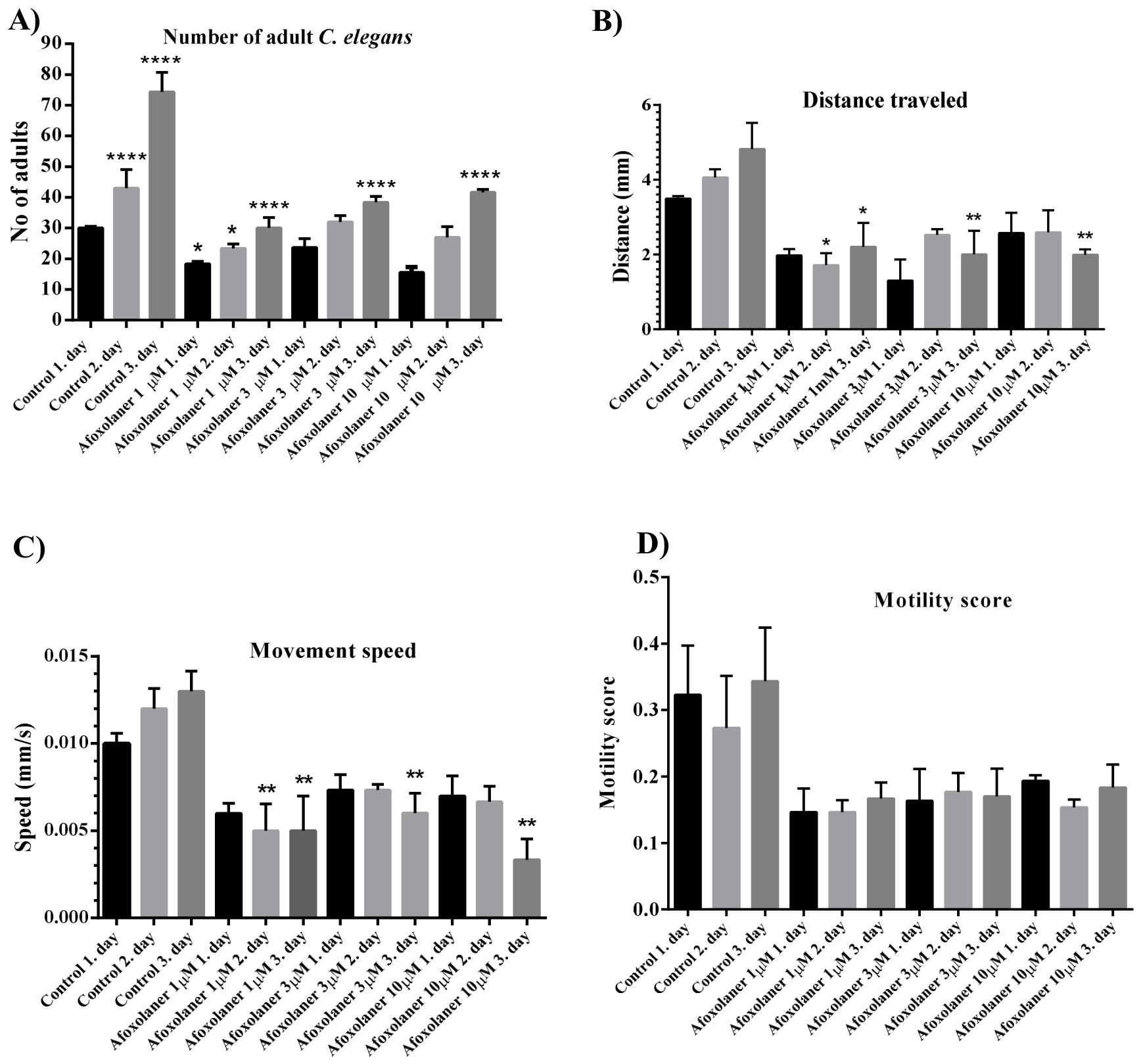
Figure 2.
Effect of afoxolaner on acetylcholine-induced isometric contractions of Ascaris suum neuromuscular preparation: A) Original record of contractions; B) Concentration-dependent sigmoid curves of the contractile effect of ACh without and in the presence of afoxolaner 100μM.
Figure 2.
Effect of afoxolaner on acetylcholine-induced isometric contractions of Ascaris suum neuromuscular preparation: A) Original record of contractions; B) Concentration-dependent sigmoid curves of the contractile effect of ACh without and in the presence of afoxolaner 100μM.
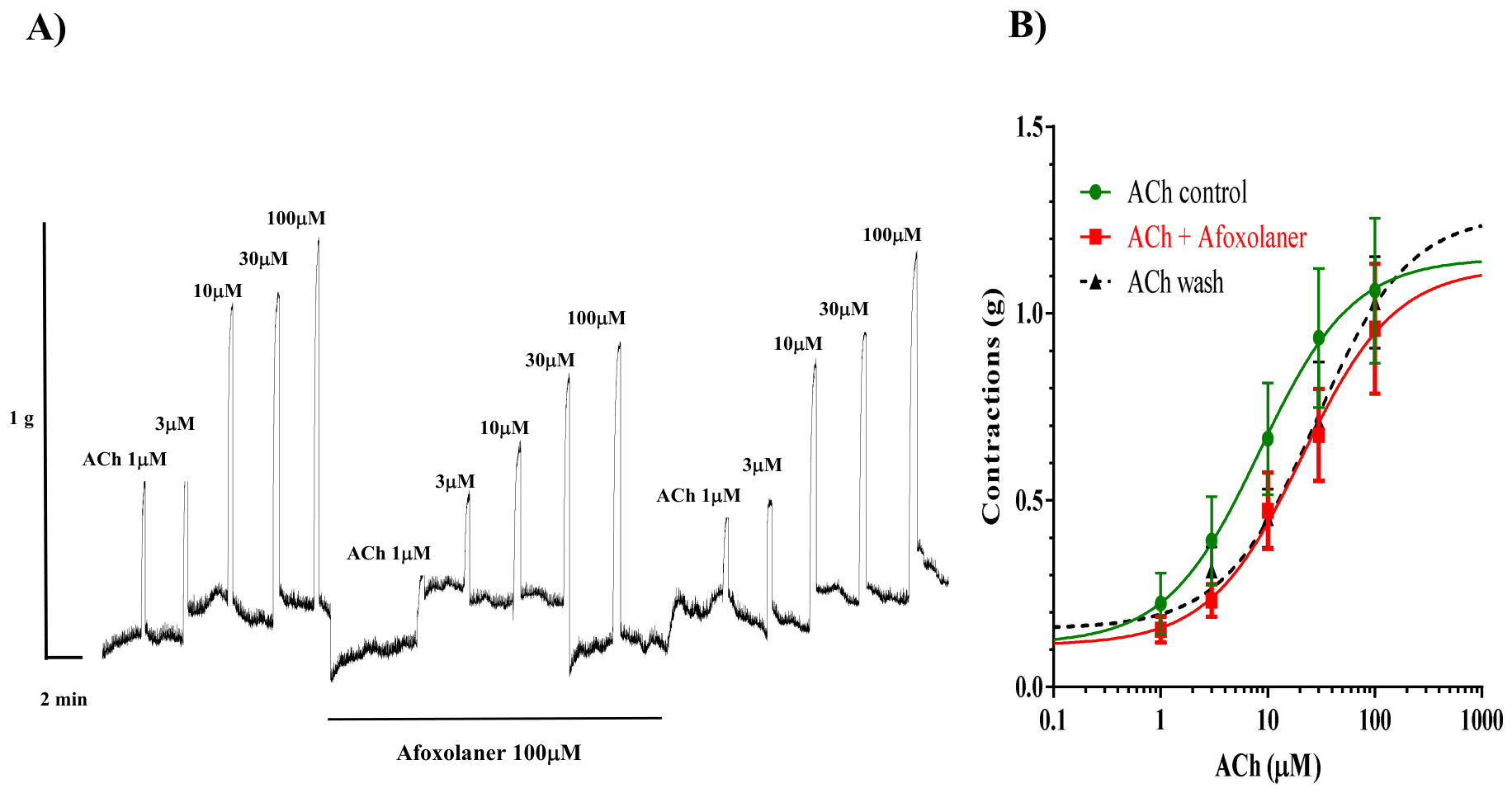
Figure 3.
Effect of GABA and afoxolaner on ACh-induced isometric contractions of Ascaris suum neuromuscular preparation: A) Original record of contractions; B) Concentration-dependent sigmoid curves of the contractile effect of ACh in the presence of GABA 30μM and afoxolaner 100μM (n=6).
Figure 3.
Effect of GABA and afoxolaner on ACh-induced isometric contractions of Ascaris suum neuromuscular preparation: A) Original record of contractions; B) Concentration-dependent sigmoid curves of the contractile effect of ACh in the presence of GABA 30μM and afoxolaner 100μM (n=6).
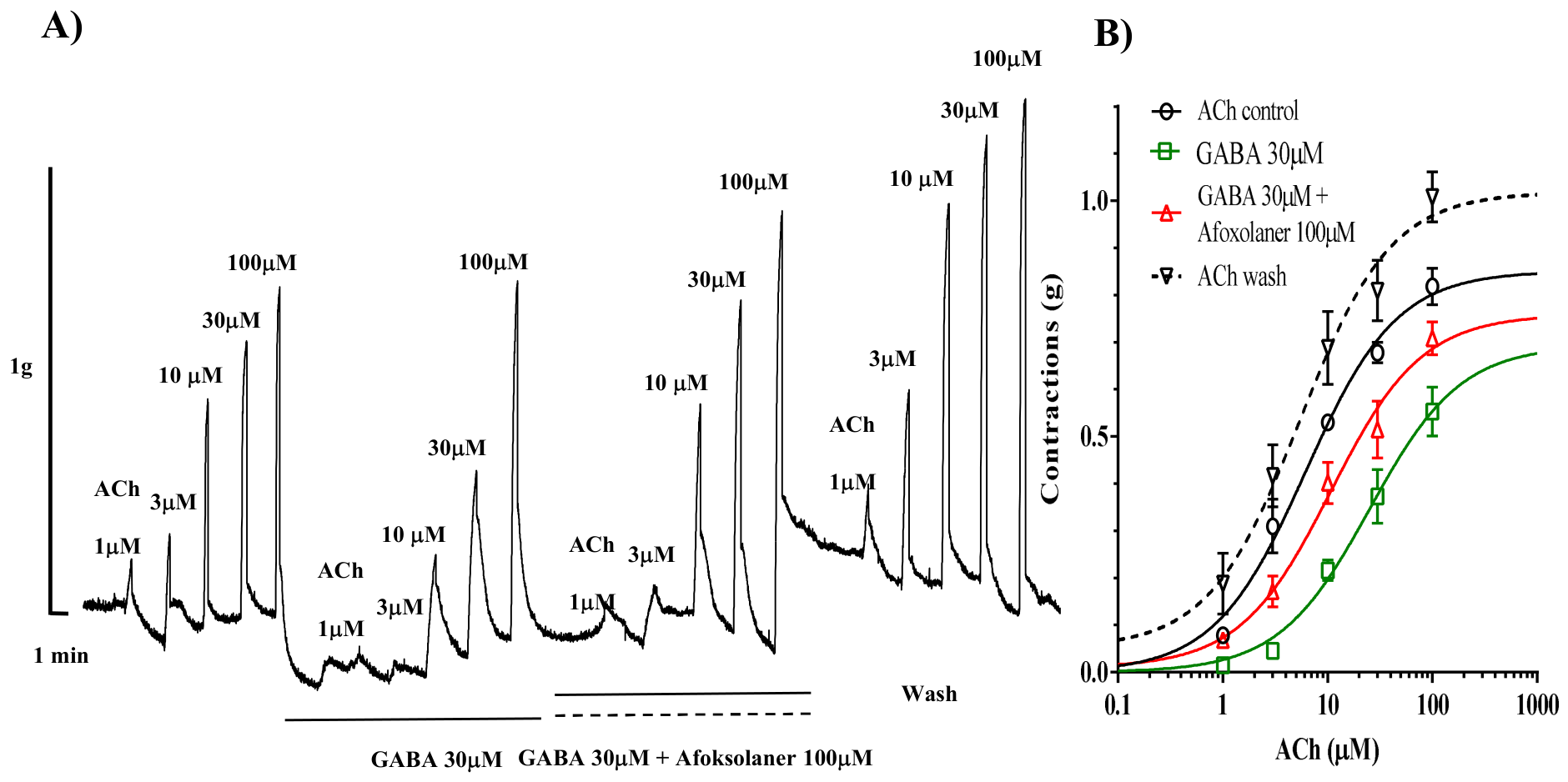
Figure 4.
A) Original record of the relaxation effect of GABA on the neuromuscular preparation of A. suum and the potentiating effect of afoxolaner 100mM on relaxation; B) Graph of the average relaxation of the neuromuscular preparation of A. suum induced by GABA 30μM and the effect of afoxolaner 100μM on relaxation (n=6).
Figure 4.
A) Original record of the relaxation effect of GABA on the neuromuscular preparation of A. suum and the potentiating effect of afoxolaner 100mM on relaxation; B) Graph of the average relaxation of the neuromuscular preparation of A. suum induced by GABA 30μM and the effect of afoxolaner 100μM on relaxation (n=6).
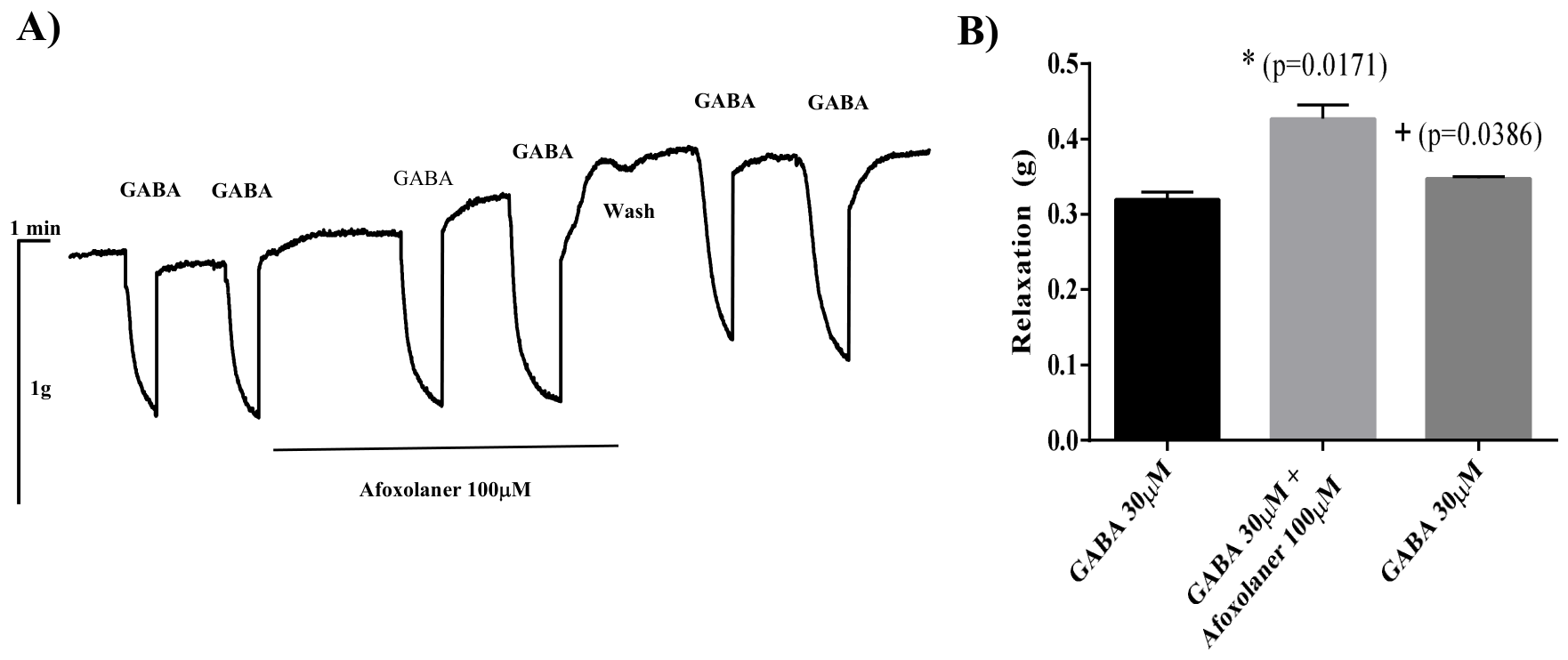
Figure 5.
A) Original record of the relaxation effect of GABA on the neuromuscular preparation of A. suum and the effect of piperazine 300μM and afoxolaner 100μM on relaxation; B) Graph of the average relaxation of the neuromuscular preparation of A. suum induced by GABA 30μM and the effect of piperazine 300μM and afoxolaner 100μM on relaxation (n=6).
Figure 5.
A) Original record of the relaxation effect of GABA on the neuromuscular preparation of A. suum and the effect of piperazine 300μM and afoxolaner 100μM on relaxation; B) Graph of the average relaxation of the neuromuscular preparation of A. suum induced by GABA 30μM and the effect of piperazine 300μM and afoxolaner 100μM on relaxation (n=6).
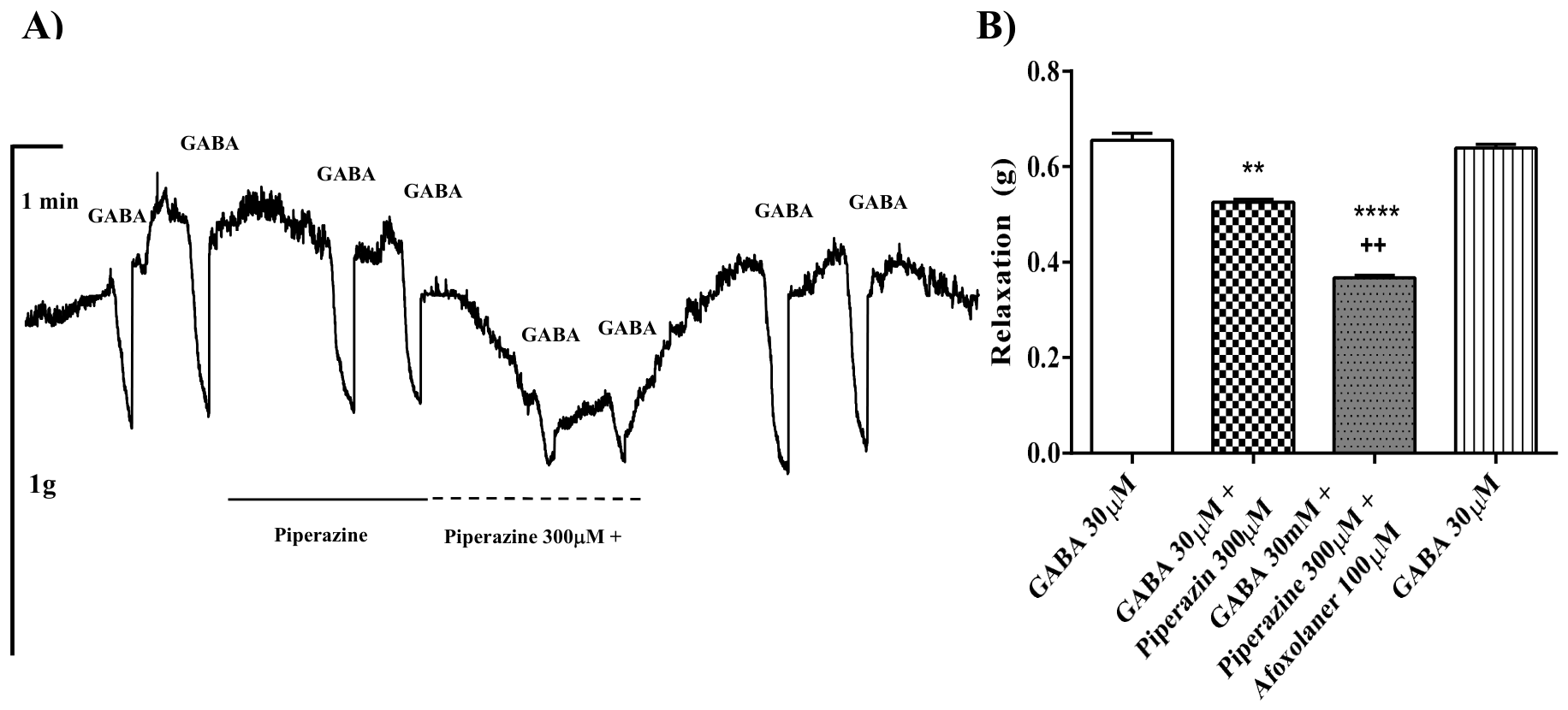
Figure 6.
A) Combined normalised electrogram of GABA-evoked relaxation of the *A. suum* neuromuscular preparation showing additive pharmacological effects of afoxolaner and piperazine at non-competing sites (GABA relaxation = 1.0). Dual-action phase: GABA alone (baseline = 1.0); Piperazine 300 µM + Afoxolaner 100 µM co-application deepened inhibition (−44%, p<0.0001); full washout recovery. Normalized relaxation values were calculated from the ratio of treatment-induced to control GABA-evoked relaxation responses (Supp. Material 2A) B) Top-down view of the ASUCU pentameric model; open-channel pore diameter 14.4 Å; Pore cross-section at the transmembrane domain showing the Cl⁻ permeation pathway; inter-subunit distances to the channel axis (7.6–7.9 Å) define the M2 lining of the TM cleft. C) Side-on cartoon of the full receptor model ASUCU; Within ECD AG site is an orthosteric GABA-A pocket occupied with piperazine; two afoxolaner poses at the TM-PAM inter-subunit cleft and the IVM reference site are shown; M1–M4 helix assignment and ECD/TMD domain boundaries indicated. Structural composition and residue-level annotations in Supp. Table 2B.
Figure 6.
A) Combined normalised electrogram of GABA-evoked relaxation of the *A. suum* neuromuscular preparation showing additive pharmacological effects of afoxolaner and piperazine at non-competing sites (GABA relaxation = 1.0). Dual-action phase: GABA alone (baseline = 1.0); Piperazine 300 µM + Afoxolaner 100 µM co-application deepened inhibition (−44%, p<0.0001); full washout recovery. Normalized relaxation values were calculated from the ratio of treatment-induced to control GABA-evoked relaxation responses (Supp. Material 2A) B) Top-down view of the ASUCU pentameric model; open-channel pore diameter 14.4 Å; Pore cross-section at the transmembrane domain showing the Cl⁻ permeation pathway; inter-subunit distances to the channel axis (7.6–7.9 Å) define the M2 lining of the TM cleft. C) Side-on cartoon of the full receptor model ASUCU; Within ECD AG site is an orthosteric GABA-A pocket occupied with piperazine; two afoxolaner poses at the TM-PAM inter-subunit cleft and the IVM reference site are shown; M1–M4 helix assignment and ECD/TMD domain boundaries indicated. Structural composition and residue-level annotations in Supp. Table 2B.
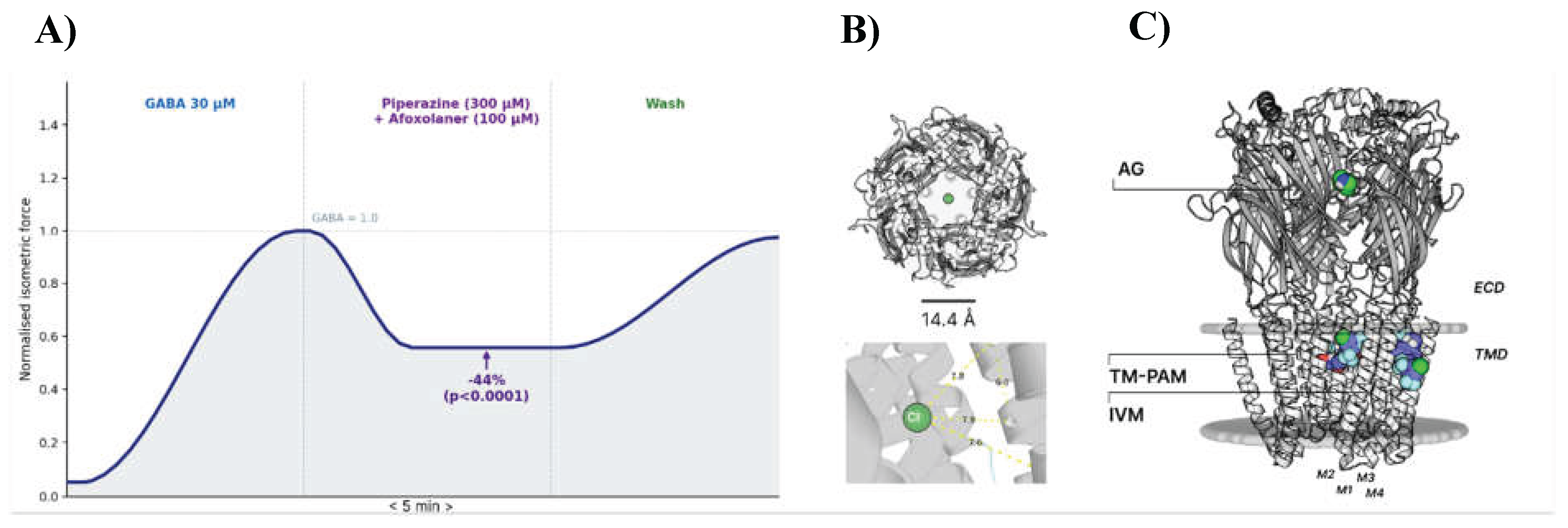

Table 1.
Afoxolaner (HAC=42) TM-pockets LE₁₀ per receptor model. LE₁₀ = −ΔG / HAC × 10. Smallest LE₁₀ (CAEELextra 1.85 against all IVMs) is taken as the baseline.
Table 1.
Afoxolaner (HAC=42) TM-pockets LE₁₀ per receptor model. LE₁₀ = −ΔG / HAC × 10. Smallest LE₁₀ (CAEELextra 1.85 against all IVMs) is taken as the baseline.
| Receptor | LE10 | Ref LE10 (co-cryst.) | ×baseline | MOA label |
|---|---|---|---|---|
| ASUCU | 2.44 | 2.88 (phenobarbital) | 1.32× | TM-PAM / IVM |
| CAEELsyn | 2.13 | 4.19 (etomidate) | 1.15× | TM-NCA |
| CAEELextra | 2.11 | 3.22 (etomidate) | 1.14× | TM-NCA |
| CAEELextra | 2.10 | 3.74 (phenobarbital) | 1.14× | TM-PAM |
| DROME | 2.21 | - | 1.19× | IVM |
| CAEELextra | 1.85 | - | 1.00× | IVM (baseline) |
Table 2.
Afoxolaner (HAC=42) extracellular-pockets LE₁₀ per CAEEL receptor model. LE₁₀ = −ΔG / HAC × 10. Smallest LE₁₀ (CAEELextra) is taken as the baseline.
Table 2.
Afoxolaner (HAC=42) extracellular-pockets LE₁₀ per CAEEL receptor model. LE₁₀ = −ΔG / HAC × 10. Smallest LE₁₀ (CAEELextra) is taken as the baseline.
| Receptor | LE10 | Ref LE10 (co-cryst.) | ×baseline | MOA label |
|---|---|---|---|---|
| CAEELsyn | 2.29 | 2.99 (diazepam) | 1.18 | BZ-PAM |
| CAEELsyn | 2.25 | 5.69 (GABA) | 1.16 | GABA |
| CAEELextra | 1.94 | 3.28 (diazepam) | 1.0 | BZ-PAM |
| CAEELextra | 1.94 | 6.98 (GABA) | 1.0 | GABA |
Table 3.
Piperazine docking profile per receptor.
| Receptor | LE10 | Ref LE10 (co-cryst.) | x baseline | MOA label |
|---|---|---|---|---|
| ASUCU | 8.23 | 6.82 (GABA) | 1.14 | AG |
| CAEELsyn | 7.30 | 5.69 (GABA) | 1.01 | AG |
| DROME | 7.27 | 6.02 (GABA) | 1.01 | AG |
| CAEELextra | 7.20 | 6.98 (GABA) | 1.00 | AG (baseline) |
Disclaimer/Publisher’s Note: The statements, opinions and data contained in all publications are solely those of the individual author(s) and contributor(s) and not of MDPI and/or the editor(s). MDPI and/or the editor(s) disclaim responsibility for any injury to people or property resulting from any ideas, methods, instructions or products referred to in the content. |
© 2026 by the authors. Licensee MDPI, Basel, Switzerland. This article is an open access article distributed under the terms and conditions of the Creative Commons Attribution (CC BY) license (http://creativecommons.org/licenses/by/4.0/).
Copyright: This open access article is published under a Creative Commons CC BY 4.0 license, which permit the free download, distribution, and reuse, provided that the author and preprint are cited in any reuse.


