
Submitted:
21 July 2026
Posted:
22 July 2026
You are already at the latest version
Abstract
Cellulose crystallinity is frequently associated with lignocellulosic biomass digestibility, yet its development during multistep biorefinery processing and its relationship with enzymatic hydrolysis remain difficult to isolate. This study investigated the evolution of cellulose crystallinity in wheat straw (Triticum aestivum) during Hot-Water Pretreatment (HWP), Water Pretreatment (WP), Organosolv extraction, sequential washing, and drying, and related these changes to enzymatic glucose yield. Crystallinity was determined using X-ray diffraction and an ATR-FTIR-based PLS model, while enzymatic hydrolysis was evaluated by HPLC-based glucose quantification. HWP caused a temperature-dependent decrease in crystallinity from 47.5 ± 1.3% in untreated straw to 27.0 ± 2.2% at 120 °C, whereas WP at room temperature caused no significant change. However, without subsequent Organosolv extraction, both pretreatments alone resulted in low glucose yields of approximately 10%, indicating that cellulose crystallinity is only one of several factors governing enzymatic hydrolysis efficiency. During washing after Organosolv extraction, crystallinity increased from 40.6 ± 2.1% to 54.2 ± 1.3%, while glucose yield was more closely associated with residual ethanol under the tested conditions rather than by crystallinity changes. Drying had the strongest effect, increasing crystallinity by up to 53,6% relative to the wet state. Overall, cellulose crystallinity should be considered as one of several interacting factors governing enzymatic digestibility, and sample moisture history must be carefully controlled when comparing crystallinity data.
Keywords:
wheat straw
; Triticum aestivum
; Organosolv
; enzymatic hydrolysis
; cellulose
; crystallinity
1. Introduction
The increasing demand for sustainable alternatives to fossil-based resources has intensified interest in lignocellulosic biomass as a renewable feedstock for biorefineries due to its potential for high sugar yields following efficient fractionation and enzymatic hydrolysis [1]. Among agricultural residues, wheat straw is one of the most abundant and economically attractive resources worldwide [2,3]. Due to its high cellulose content (34-40%), wheat straw represents a promising raw material for the production of biofuels and bio-based chemicals [4,5,6]. However, the efficient conversion of cellulose is hindered by the recalcitrant lignocellulosic structure, in which lignin and hemicellulose restrict enzyme accessibility and limit sugar yields during enzymatic hydrolysis [7,8,9].
To overcome these limitations, effective pretreatment and fractionation strategies are required. In previous studies conducted by our research group, Organosolv extraction combined with Hot-Water Pretreatment (HWP) or Water Pretreatment (WP) significantly improved the hydrolysability of wheat straw, achieving cellulose conversion efficiencies of up to approximately 95% under the reported conditions [10]. While these studies demonstrated the effectiveness of the pretreatment-Organosolv approach, the structural mechanisms responsible for the improved hydrolysis performance have not yet been fully clarified.
Cellulose crystallinity is one of the structural characteristics commonly associated with biomass recalcitrance and enzymatic hydrolysability. Highly ordered crystalline regions are generally considered less accessible to cellulolytic enzymes than amorphous cellulose. As a result, enzyme adsorption may be reduced and hydrolysis efficiency may be limited [11]. However, enzymatic digestibility is governed by multiple interacting factors, including lignin content, hemicellulose distribution, pore structure, surface accessibility, and particle size [12,13,14,15]. Consequently, the influence of crystallinity on enzymatic hydrolysis is often difficult to isolate and remains a subject of ongoing discussion. In lignocellulosic biorefinery processes, crystallinity may change throughout multiple processing stages. During pretreatment and Organosolv extraction, structural modifications of the cell wall occur together with lignin removal and compositional changes. These alterations can significantly affect the measured crystallinity [14]. Furthermore, subsequent processing steps may also affect cellulose structure. Washing removes residual lignin, catalyst, and organic solvent from the biomass and may therefore influence both crystallinity and enzymatic hydrolysis performance [16,17,18]. Drying can induce hornification, reduce pore volume, promote the reformation of hydrogen-bond networks, and alter cellulose accessibility, thereby affecting both the measured crystallinity and the hydrolysis behavior of the biomass [15].
Although numerous studies have investigated the effects of pretreatment and Organosolv extraction on biomass structure, systematic investigations of crystallinity development throughout the complete HWP/WP-assisted Organosolv processing chain remain limited. In particular, little information is available regarding the combined effects of pretreatment, Organosolv extraction, sequential washing, and drying on cellulose crystallinity and their relationship with enzymatic hydrolysis performance. Therefore, the present study investigates the evolution of cellulose crystallinity during HWP, WP, Organosolv extraction, sequential washing, and drying. By combining crystallinity measurements with enzymatic hydrolysis data, the study aims to identify the processing steps that most strongly influence crystallinity and to evaluate the extent to which crystallinity changes are reflected in the enzymatic conversion efficiency of wheat straw.
2. Materials and Methods
2.1. Experimental Workflow
The overall experimental workflow of this study (see Figure 1) comprised seven main steps: straw comminution, pretreatment, Organosolv extraction, sample washing, hydrolysis, HPLC analysis and crystallinity analysis. In addition to the hydrolysis-focused investigations, the study examined changes in the crystallinity of straw samples throughout the processing chain. Crystallinity measurements were performed on samples after comminution, after pretreatment, after Organosolv extraction, and after the individual washing steps. Furthermore, the crystallinity of selected samples was correlated with their corresponding enzymatic hydrolysis performance. This allowed the relationship between cellulose crystallinity and hydrolysis efficiency to be evaluated. This approach enabled a comprehensive assessment of how the different processing stages affected both the structural properties of the biomass and its subsequent enzymatic digestibility.
2.2. Raw Material and Comminution
In this study, wheat straw (Triticum aestivum) was used as the lignocellulosic raw material. The material was harvested from agricultural fields in the Rhineland region of Germany between June and August. After harvest, the straw was baled and transported to the laboratory facilities. Upon arrival, the material was stored in sealed plastic containers to ensure stable storage conditions and minimize environmental influences.
Straw comminution was performed using a laboratory cutting mill (SM300, Retsch, Haan, Germany). The mill was operated at 1000 rpm and equipped with a 6.0 mm sieve to control particle size during grinding. After comminution, the samples were transferred to airtight containers and stored until further use [10].
2.3. Pretreatment
Prior to Organosolv extraction, the biomass was subjected to one of two pretreatment strategies that had previously been shown to improve the performance of the overall Organosolv process. The pretreatment methods investigated in this study were Hot-Water Pretreatment (HWP) and Water Pretreatment (WP) (Figure 2).
For both pretreatment methods, 1.5 kg (dry mass basis) of comminuted wheat straw was loaded into a 50 L reactor (Model 8500, Parr Instrument Company, Moline, IL, USA). Deionized water was added at a liquor ratio of 1:19 (solid-to-liquid mass ratio). In the case of In the case of Hot-Water Pretreatment (HWP), the suspension was heated to the desired pretreatment temperature between 75 and 120 °C under continuous stirring at 50 rpm and maintained under these conditions for 90 min. For Water Pretreatment (WP), the suspension was stored at room temperature for eight days and stirred once daily for one minute at 50 rpm to ensure uniform wetting of the biomass. After completion of the respective pretreatment, the reactor contents were allowed to cool or equilibrate to room temperature, after which the biomass was removed and subjected to mechanical liquid removal prior to further processing [10].
2.4. Organosolv Extraction
Organosolv extraction experiments were carried out in a 7.5 L high-pressure reactor (Model 4550, Parr Instrument Company, Moline, IL, USA). For each experiment, 100 g of biomass (dry mass basis) was loaded into the reactor and mixed with a 60 wt% ethanol–water solution at a liquor ratio of 1:19 (solid-to-liquid mass ratio). Sulfuric acid was used as the catalyst, with the catalyst loading varied according to the experimental design and expressed as a percentage of the sample dry mass.
The reactor was heated to the target extraction temperature of between 135 and 170 °C. Both the catalyst loading and the residence time at the target temperature were adjusted according to the respective experimental conditions. Following the extraction, the reactor was allowed to cool naturally to room temperature. The solid fraction was subsequently recovered and subjected to hydraulic press and liquid removal prior to further processing and analysis.
2.5. Sample Washing
Following Organosolv extraction, the samples were subjected to a washing procedure to remove residual lignin, ethanol, and catalyst from the biomass. The washing process was carried out at 60 °C to maintain a high lignin solubility and thereby facilitate the removal of lignin residues. To ensure consistent washing conditions and stable temperature control, all washing experiments were performed in a double-jacket reactor (DWK Life Sciences, Wertheim, Germany) equipped with a mechanical stirrer (HS-100D, witeg Labortechnik GmbH, Wertheim, Germany) operating at 150 rpm.
The washing procedure consisted of three sequential steps (see Table 1). Samples were collected after each washing step for subsequent crystallinity analysis, allowing structural changes in the biomass during lignin removal to be monitored throughout the process. After completion of the washing procedure, the samples were mechanically dewatered prior to further characterization.
2.6. Sample Drying
To evaluate the influence of drying conditions on cellulose crystallinity, approximately 10 g (wet mass basis) of each sample was subjected to one of three drying methods prior to crystallinity analysis. The first method consisted of vacuum desiccation at room temperature. Samples were placed in a desiccator containing phosphorus pentoxide (P2O5) as a desiccant and maintained under a vacuum of approximately 100 mbar for seven days. In addition, convective drying was performed in a laboratory drying oven (UNE 500, Memmert, Schwabach, Germany) at either 50 °C or 105 °C until a constant sample mass was reached.
2.7. Crystallinity Analysis
In this study, the crystallinity of cellulose-containing samples was determined using two complementary analytical approaches: X-ray diffraction (XRD) and an attenuated total reflectance Fourier-transform infrared spectroscopy (ATR-FTIR)-based partial least squares (PLS) model.
XRD measurements were performed using an X-ray diffractometer (D2 Phaser, Bruker Corporation, Billerica, MA, USA) equipped with a Cu Kα radiation source (λ = 1.54184 Å). For analysis, the samples were evenly distributed on a flat sample holder and measured in continuous PSD scan mode using a LYNXEYE detector (Bruker Corporation, Billerica, MA, USA) operated in 1D mode. Diffraction patterns were recorded over a 2θ range of 5-40° with a step size of 0.1°. A total of 346 measurement points were collected with a counting time of 4 s per step. The detector slit width was set to 30 mm. A divergence slit of 0.2 mm, a scatter slit of 1.0 mm, and a 2.5° Soller module were used throughout the measurements. The resulting diffraction patterns were used to calculate the crystallinity of the samples [19].
Crystallinity was also estimated using a previously developed ATR-FTIR-based PLS model. For model calibration, a dataset comprising 230 cellulose-containing samples collected between 2021 and 2023 was used. Reference crystallinity values were obtained from XRD analysis, while the corresponding infrared spectra were recorded using an ATR-FTIR spectrometer (Spectrum 3, PerkinElmer, Waltham, MA, USA) over the spectral range of 4000-550 cm-1. The XRD-derived crystallinity values and the corresponding ATR-FTIR spectra were combined to calibrate the PLS model. The calibrated model was subsequently applied to estimate the crystallinity of cellulose-containing samples based on their ATR-FTIR spectra.
2.8. Hydrolysis
Enzymatic hydrolysis was performed to evaluate the effect of pretreatment and sample processing conditions on glucose release from wheat straw. For each experiment, 1 g of sample (dry mass basis) was suspended in 25 mL of 0.1 M sodium acetate buffer (pH 5.0), corresponding to a solids concentration of 40 g/L. Prior to enzyme addition, the suspension was pasteurized in an incubator (KS 4000 i control, IKA-Werke GmbH & Co. KG, Staufen im Breisgau, Germany) at 77 °C for 2 h to suppress microbial contamination. After cooling to approximately 55 °C, a commercial cellulase solution (C2610-10, US Biological, Salem, MA, USA) was added under sterile conditions at a loading of 12 wt% based on the dry mass of the sample. The enzyme solution had a specified activity of 6200-7580 U/g, where one unit (U) is defined as the amount of enzyme required to release 1 µmol of reducing sugars (expressed as glucose equivalents) per minute under standard assay conditions [10].
The sealed reaction vessels were incubated at 55 °C for 48 h. To maintain homogeneous reaction conditions and prevent sedimentation of the biomass particles, continuous shaking was applied at 130 rpm with an amplitude of 20 mm (KS 4000 i control, IKA-Werke GmbH & Co. KG, Staufen im Breisgau, Germany). All hydrolysis experiments were performed in triplicate. The glucose yield was calculated from the glucose concentration determined by HPLC and the initial total solids concentration of the hydrolysis slurry, corresponding to 40 g of dry biomass per liter, according to Equation 1 [10].
2.9. HPLC Analysis
Prior to high-performance liquid chromatography (HPLC) analysis, samples were first centrifuged at 16,100 rcf for 15 min using a centrifuge (5415 D, Eppendorf AG, Hamburg, Germany). The resulting supernatant was then diluted to fall within the respective calibration range and subsequently filtered through a 0.22 µm polyethersulfone membrane (Wicom, Heppenheim, Germany).
Sugar analysis in the hydrolysate was performed using HPLC with a system (1100 Series, Agilent Technologies, Santa Clara, CA, USA) equipped with a Repromer H+ column (300 × 8 mm, Dr. Maisch, Ammerbuch, Germany). The column temperature was maintained at 30 °C, and detection was carried out using a refractive index detector (1260 Infinity II, Agilent Technologies, Santa Clara, CA, USA) set to 35 °C. The mobile phase consisted of 5 mM sulfuric acid at a flow rate of 0.6 mL/min [10,20].
2.10. UV-Vis Analysis
The presence of dissolved lignin in the pretreatment liquor was evaluated by UV-Vis spectrophotometry using a UV-Vis spectrophotometer (Ultrospec 2100 Pro, Amersham BioScience, UK). Prior to analysis, 1 mL of each sample was diluted with deionized water to obtain an absorbance within the linear range of the instrument. The absorbance was subsequently measured at 240 nm [21].
3. Results and Discussion
3.1. Evaluation of the Impact of Pretreatment on Sample Crystallinity and Enzymatic Hydrolysis
The effects of Hot-Water Pretreatment (HWP) and Water Pretreatment (WP) on cellulose crystallinity and enzymatic hydrolysis performance were investigated. HWP was investigated at pretreatment temperatures ranging from 75 to 120 °C. In contrast, WP was evaluated over pretreatment durations of 0-8 days. By correlating crystallinity measurements with enzymatic hydrolysis results, the influence of pretreatment-induced structural changes on biomass digestibility could be assessed.
In terms of crystallinity (Figure 3A), the untreated straw exhibited a crystallinity index of 47.5 ± 1.3%. A pronounced temperature-dependent decrease in crystallinity was observed following Hot-Water Pretreatment (HWP), reaching a minimum value of 27.0 ± 2.2% at 120 °C, corresponding to a statistically significant reduction of 43.2% relative to the untreated sample (p < 0.05). In contrast, Water Pretreatment (WP) performed at room temperature caused no significant changes in crystallinity over the investigated period of eight days (p > 0.05), with values remaining close to those of the untreated straw.
The decrease in crystallinity after HWP may reflect temperature-induced structural modifications within the lignocellulosic matrix [22,23,24]. Elevated temperatures promote partial hemicellulose solubilization and weaken the structural constraints surrounding cellulose microfibrils [22,23]. In addition, hot water facilitates cellulose swelling and partial disruption of intermolecular hydrogen bonds, resulting in a reduction of molecular ordering and an increase in amorphous regions. Similar observations have been reported for hydrothermal pretreatment of wheat straw [25,26,27,28]. In contrast, the absence of thermal energy during WP limits hemicellulose hydrolysis and structural rearrangements, thereby preserving the crystalline structure of cellulose [29,30,31].
Despite these structural changes, both pretreatment methods alone resulted in relatively low glucose yields of approximately 10% (Figure 3B), which is substantially lower than the values of around 95% obtained after subsequent Organosolv extraction [10,32]. Although partial lignin dissolution was evidenced by the brown coloration of the pretreatment liquor and the corresponding UV absorbance at 240 nm, the mild pretreatment conditions were insufficient to remove substantial amounts of lignin and hemicellulose [33,34,35]. Total hydrolysis results confirmed that approximately 60% of these components remained in the biomass after pretreatment. Their persistence, together with the largely unchanged particle size and compact biomass structure, likely restricted enzyme accessibility and limited hydrolysis efficiency [36,37]. Nevertheless, HWP samples showed a statistically significant increase (p < 0.05) in glucose yield with increasing pretreatment temperature, reaching an overall improvement of approximately 68%. This trend suggests that increasing the HWP temperature progressively improved biomass accessibility prior to Organosolv extraction. Although pretreatment alone remained insufficient to achieve high glucose yields, the higher hydrolysis performance at elevated temperatures indicates that increasing disruption of the lignocellulosic matrix facilitated subsequent enzymatic attack.
3.2. Evaluation of the Impact of Washing on Sample Crystallinity
The washing procedure represents a critical step following Organosolv extraction, as it facilitates the removal of residual lignin, catalyst, and organic solvent retained within the biomass. Efficient removal of these components is considered essential for achieving high enzymatic hydrolysis performance and overall conversion efficiency in subsequent processing steps. Accordingly, the present study also investigated changes in cellulose crystallinity throughout the washing procedure. Multiple experiments were conducted to determine the average crystallinity following each washing step. Furthermore, the obtained crystallinity data were compared with the enzymatic hydrolysis results of selected Organosolv-treated samples to evaluate the relationship between cellulose crystallinity and hydrolysis performance.
Crystallinity analysis (Figure 4A) revealed a significant increase in cellulose crystallinity during the washing procedure (p < 0.05). The Organosolv-treated samples exhibited an initial crystallinity of 40.6 ± 2.1%, which increased to 46.1 ± 2.2% after the first washing step with a 60% (w/w) ethanol–water solution. A further increase to 51.5 ± 6.6% was observed after the second washing step with water, while the third washing step resulted in only a minor increase to 54.2 ± 1.3%. Overall, crystallinity increased by 13.6%, corresponding to a relative increase of approximately 33.5% compared with the unwashed material. Most of the crystallinity development therefore occurred during the first two washing steps.
The increase in crystallinity is likely associated with the progressive removal of residual lignin, hemicellulose, and other low-molecular-weight compounds remaining in the biomass after Organosolv extraction (Figure 5). These components may occupy spaces between cellulose chains and hinder the formation of intra- and intermolecular hydrogen bonds. Their removal during washing likely facilitated cellulose chain rearrangement and the development of more ordered structures. The limited increase in crystallinity during the third washing step is attributed to the removal of most residual lignin, hemicellulose, and other readily removable impurities during the first two washing steps. Furthermore, most cellulose crystallites had already formed, leaving only a limited fraction of amorphous cellulose available for further structural ordering. Consequently, only a minor increase in crystallinity was observed after the third washing step.
The enzymatic hydrolysis results (Figure 4B) followed a similar trend. The lowest glucose yield was obtained after the first washing step, most likely due to residual ethanol in the biomass. At this stage, the ethanol concentration in the hydrolysis slurry was approximately 10% (w/w), a level reported to negatively affect cellulase activity and stability [39,40]. Consequently, the inhibitory effect of ethanol likely outweighed any potential benefit associated with the relatively low cellulose crystallinity.
After the second and third washing steps, the residual ethanol concentration decreased to approximately 1.6% and 0.26%, respectively. According to the findings of Chen and Jin (2006), the inhibitory effect of ethanol on cellulase activity is expected to be only minor at these concentrations [41]. Despite the continued increase in crystallinity, no statistically significant differences in glucose yield were observed between these washing steps. This finding suggests that the additional crystallinity increase from 51.5% to 54.2% was insufficient to produce a measurable effect on enzymatic hydrolysis. Overall, the results indicate that residual ethanol was the primary factor influencing hydrolysis performance after the first washing step, whereas the relatively small crystallinity changes observed thereafter had only a minor impact on glucose yield under the investigated conditions.
3.3. Evaluation of the Impact of Drying Method and Temperature on Sample Crystallinity
In addition to investigating the effects of pretreatment and Organosolv extraction on cellulose crystallinity, the influence of sample drying on the measured crystallinity was also evaluated.
The results of the experiment showed (Figure 6A) that the Organosolv-extracted samples exhibited the lowest crystallinity in the wet state, reaching 42.0 ± 1.1%. However, all drying methods resulted in a significant increase in crystallinity. Drying in a vacuum desiccator increased crystallinity by 24.7% compared to the wet sample, whereas oven drying produced an average increase of around 53,6%, with the highest value observed at 50 °C (64.5 ± 4.5%). A similar trend was observed for samples subjected to Organosolv extraction without pretreatment. While increasing the extraction time reduced the crystallinity by an average of 18.5% compared to untreated straw (Figure 6B), subsequent drying increased the measured crystallinity by an average of 20.7%.
These findings demonstrate that the measured crystallinity of lignocellulosic biomass is strongly affected not only by pretreatment and extraction conditions but also by the drying procedure applied prior to analysis. The increase in crystallinity after drying is likely related to the removal of bound water, which promotes the reformation of intra- and intermolecular hydrogen bonds and facilitates a rearrangement of cellulose chains into more ordered structures, as schematically illustrated in Figure 7 [19,42,43,44]. The extent of this effect depended on the drying conditions. While desiccator drying resulted in a moderate increase, drying at 50 °C produced the highest crystallinity values. Interestingly, samples dried at 105 °C exhibited slightly lower crystallinity than those dried at 50 °C, suggesting that excessive drying temperatures may partially counteract dehydration-induced ordering through thermally induced structural disturbances [45,46].
From a practical perspective, these observations are highly relevant to the evaluation of biomass conversion processes. This relevance was further confirmed by the enzymatic hydrolysis results: the glucose yield decreased dramatically from 79.0% for the never-dried sample to only 6.4% after drying at 50 °C and 2.6% after drying at 105 °C. Thus, even though the sample dried at 105 °C exhibited slightly lower crystallinity than that dried at 50 °C, it produced a substantially lower glucose yield. This discrepancy indicates that the loss of enzymatic digestibility cannot be attributed solely to changes in crystallinity. Although higher cellulose crystallinity is generally associated with lower cellulose accessibility and greater resistance to enzymatic hydrolysis [11,15,47,48], drying may simultaneously induce hornification, pore collapse, microfibril aggregation, and particle agglomeration, resulting in a denser biomass structure with severely restricted enzyme accessibility [15].
Therefore, biomass samples should ideally be maintained in the wet state after Organosolv extraction and subsequent washing whenever enzymatic digestibility is to be evaluated. Avoiding drying minimizes irreversible structural changes that may reduce cellulose accessibility and artificially underestimate the effectiveness of the pretreatment or extraction process. Consequently, both the moisture state and drying history of biomass samples should be carefully controlled and reported when comparing crystallinity measurements and enzymatic hydrolysis results across different studies.
4. Conclusions
The results of this study demonstrate that cellulose crystallinity in wheat straw changes substantially throughout the entire biomass processing chain and is influenced not only by pretreatment and Organosolv extraction, but also by subsequent washing and drying procedures. Hot-Water Pretreatment (HWP) significantly reduced cellulose crystallinity from 47.5 ± 1.3% in untreated straw to 27.0 ± 2.2% at 120 °C, corresponding to a reduction of 43.2%. In contrast, Water Pretreatment (WP) performed at room temperature caused no significant changes in crystallinity. Despite this pronounced structural modification, both pretreatment methods alone produced relatively low glucose yields of approximately 10%, indicating that crystallinity reduction alone was insufficient to achieve efficient enzymatic hydrolysis.
The washing experiments further revealed that cellulose crystallinity increased continuously during the removal of residual lignin, catalyst, and solvent. Crystallinity increased from 40.6 ± 2.1% after Organosolv extraction to 54.2 ± 1.3% after the final washing step, corresponding to a relative increase of approximately 33.5%. However, this increase was not accompanied by a corresponding decrease in glucose yield. Once residual ethanol concentrations had been reduced from approximately 10% to below 2%, no statistically significant differences in hydrolysis performance were observed between the second and third washing steps. These findings indicate that residual solvent concentrations exerted a greater influence on enzymatic hydrolysis than the relatively small crystallinity differences generated during washing.
The most pronounced crystallinity changes were observed during sample drying. While the wet Organosolv-treated samples exhibited a crystallinity of only 42.0 ± 1.1%, vacuum-desiccator drying increased this value by 24.7%. The strongest effect was observed after oven drying at 50 °C, where crystallinity increased from 42.0 ± 1.1% to 64.5 ± 4.5%, corresponding to a relative increase of approximately 53,6%. Similar trends were observed for Organosolv-treated samples extracted for different residence times. These results demonstrate that drying can substantially alter the measured crystallinity of lignocellulosic biomass and may therefore influence the interpretation of structure–property relationships. In addition to increasing crystallinity, drying may induce hornification and particle agglomeration, further reducing cellulose accessibility [45,46].
Overall, the results show that cellulose crystallinity alone cannot adequately explain enzymatic hydrolysis performance. Although crystallinity changed significantly during pretreatment, washing, and drying, the hydrolysis results were more strongly influenced by factors such as lignin removal, residual solvent content, biomass accessibility, and sample moisture state. Consequently, crystallinity should be considered as one of several interacting parameters governing biomass digestibility rather than as an isolated predictor of hydrolysis efficiency. Furthermore, because sample preparation procedures can alter crystallinity by more than 20-50%, crystallinity data reported in different studies should be compared with caution unless identical washing, drying, and storage conditions are applied.
Author Contributions
Conceptualization, T.G. and N.T.; methodology, T.G., L.A., T.N., C.D. and N.T.; validation, T.G., L.A., T.N., C.D. and N.T.; formal analysis, T.G.; investigation, T.G. and N.T.; data curation, T.G.; writing-original draft preparation, T.G.; writing-review and editing, T.G. and N.T.; visualization, T.G.; supervision, N.T.; project administration, N.T.; funding acquisition, N.T. All authors have read and agreed to the published version of the manuscript.
Funding
This work was funded by the German Federal Ministry of Research, Technology and Space (BMFTR) under the funding code 13FH115KX1, administered by the project management agency VDI-Technologiezentrum GmbH.
Institutional Review Board Statement
Not applicable.
Informed Consent Statement
Not applicable.
Data Availability Statement
The original contributions presented in this study are included in the article, and further inquiries can be directed to the corresponding author.
Acknowledgments
This article was prepared with the support of AI-based software for translation and language enhancement in English.
Conflicts of Interest
The authors declare no conflicts of interest.
References
- Baral, N.R.; Sundstrom, E.R.; Das, L.; Gladden, J.; Eudes, A.; Mortimer, J.C.; Singer, S.W.; Mukhopadhyay, A.; Scown, C.D. Approaches for More Efficient Biological Conversion of Lignocellulosic Feedstocks to Biofuels and Bioproducts. ACS Sustainable Chem. Eng. 2019, 7, 9062–9079. [CrossRef]
- Tufail, T.; Saeed, F.; Afzaal, M.; Ain, H.B.U.; Gilani, S.A.; Hussain, M.; Anjum, F.M. Wheat Straw: A Natural Remedy against Different Maladies. Food Science & Nutrition 2021, 9, 2335–2344. [CrossRef]
- Ćilerdžić, J.; Galić, M.; Vukojević, J.; Brčeski, I.; Stajić, M. Potential of Selected Fungal Species to Degrade Wheat Straw, the Most Abundant Plant Raw Material in Europe. BMC Plant Biol 2017, 17, 249. [CrossRef]
- Carvalheiro, F.; Silva-Fernandes, T.; Duarte, L.C.; Gírio, F.M. Wheat Straw Autohydrolysis: Process Optimization and Products Characterization. Appl Biochem Biotechnol 2009, 153, 84–93. [CrossRef]
- Liu, R.; Yu, H.; Huang, Y. Structure and Morphology of Cellulose in Wheat Straw. Cellulose 2005, 12, 25–34. [CrossRef]
- Hernández, C.; Escamilla-Alvarado, C.; Sánchez, A.; Alarcón, E.; Ziarelli, F.; Musule, R.; Valdez-Vazquez, I. Wheat Straw, Corn Stover, Sugarcane, and Agave Biomasses: Chemical Properties, Availability, and Cellulosic-bioethanol Production Potential in Mexico. Biofuels Bioprod Bioref 2019, 13, 1143–1159. [CrossRef]
- Himmel, M.E.; Ding, S.-Y.; Johnson, D.K.; Adney, W.S.; Nimlos, M.R.; Brady, J.W.; Foust, T.D. Biomass Recalcitrance: Engineering Plants and Enzymes for Biofuels Production. Science 2007, 315, 804–807. [CrossRef]
- Deng, Z.; Xia, A.; Liao, Q.; Zhu, X.; Huang, Y.; Fu, Q. Laccase Pretreatment of Wheat Straw: Effects of the Physicochemical Characteristics and the Kinetics of Enzymatic Hydrolysis. Biotechnol Biofuels 2019, 12, 159. [CrossRef]
- Lynd, L.R.; Weimer, P.J.; Van Zyl, W.H.; Pretorius, I.S. Microbial Cellulose Utilization: Fundamentals and Biotechnology. Microbiol Mol Biol Rev 2002, 66, 506–577. [CrossRef]
- Guo, T.; Thielen, D.; Aydin, M.; Tippkötter, N. Water-Based Pretreatment Combined with Severity-Optimized Organosolv Enables Near-Complete Enzymatic Hydrolysis of Wheat Straw at Reduced Energy Demand. Sustainable Chemistry 2026, 7, 17. [CrossRef]
- Bansal, P.; Vowell, B.J.; Hall, M.; Realff, M.J.; Lee, J.H.; Bommarius, A.S. Elucidation of Cellulose Accessibility, Hydrolysability and Reactivity as the Major Limitations in the Enzymatic Hydrolysis of Cellulose. Bioresource Technology 2012, 107, 243–250. [CrossRef]
- Pihlajaniemi, V.; Sipponen, M.H.; Liimatainen, H.; Sirviö, J.A.; Nyyssölä, A.; Laakso, S. Weighing the Factors behind Enzymatic Hydrolyzability of Pretreated Lignocellulose. Green Chem. 2016, 18, 1295–1305. [CrossRef]
- Meng, X.; Ragauskas, A.J. Recent Advances in Understanding the Role of Cellulose Accessibility in Enzymatic Hydrolysis of Lignocellulosic Substrates. Current Opinion in Biotechnology 2014, 27, 150–158. [CrossRef]
- Zhao, X.; Zhang, L.; Liu, D. Biomass Recalcitrance. Part I: The Chemical Compositions and Physical Structures Affecting the Enzymatic Hydrolysis of Lignocellulose. Biofuels Bioprod Bioref 2012, 6, 465–482. [CrossRef]
- Koo, B.; Jo, J.; Cho, S.-M. Drying Effect on Enzymatic Hydrolysis of Cellulose Associated with Porosity and Crystallinity. Applied Sciences 2020, 10, 5545. [CrossRef]
- Kłosowski, G.; Mikulski, D. Changes in Various Lignocellulose Biomasses Structure after Microwave-Assisted Hydrotropic Pretreatment. Renewable Energy 2023, 219, 119387. [CrossRef]
- Margellou, A.G.; Psochia, E.A.; Torofias, S.A.; Pappa, C.P.; Triantafyllidis, K.S. Isolation of Highly Crystalline Cellulose via Combined Pretreatment/Fractionation and Extraction Procedures within a Biorefinery Concept. ACS Sustainable Resour. Manage. 2024, 1, 1432–1443. [CrossRef]
- Sun, Q.; Foston, M.; Meng, X.; Sawada, D.; Pingali, S.V.; O’Neill, H.M.; Li, H.; Wyman, C.E.; Langan, P.; Ragauskas, A.J.; et al. Effect of Lignin Content on Changes Occurring in Poplar Cellulose Ultrastructure during Dilute Acid Pretreatment. Biotechnol Biofuels 2014, 7, 150. [CrossRef]
- Toba, K.; Yamamoto, H.; Yoshida, M. Crystallization of Cellulose Microfibrils in Wood Cell Wall by Repeated Dry-and-Wet Treatment, Using X-Ray Diffraction Technique. Cellulose 2013, 20, 633–643. [CrossRef]
- Tix, J.; Moll, F.; Krafft, S.; Betsch, M.; Tippkötter, N. Hydrogen Production from Enzymatic Pretreated Organic Waste with Thermotoga Neapolitana. Energies 2024, 17, 2938. [CrossRef]
- Sluiter, A.; Hames, B.; Ruiz, R.; Scarlata, C.; Sluiter, J.; Templeton, D.; Crocker, D. Determination of Structural Carbohydrates and Lignin in Biomass. Laboratory analytical procedure 2008, 1617, 1–16.
- Li, M.; Cao, S.; Meng, X.; Studer, M.; Wyman, C.E.; Ragauskas, A.J.; Pu, Y. The Effect of Liquid Hot Water Pretreatment on the Chemical–Structural Alteration and the Reduced Recalcitrance in Poplar. Biotechnol Biofuels 2017, 10, 237. [CrossRef]
- Sun, Q.; Chen, W.-J.; Pang, B.; Sun, Z.; Lam, S.S.; Sonne, C.; Yuan, T.-Q. Ultrastructural Change in Lignocellulosic Biomass during Hydrothermal Pretreatment. Bioresource Technology 2021, 341, 125807. [CrossRef]
- Sun, D.; Lv, Z.-W.; Rao, J.; Tian, R.; Sun, S.-N.; Peng, F. Effects of Hydrothermal Pretreatment on the Dissolution and Structural Evolution of Hemicelluloses and Lignin: A Review. Carbohydrate Polymers 2022, 281, 119050. [CrossRef]
- Serna-Loaiza, S.; Dias, M.; Daza-Serna, L.; De Carvalho, C.C.C.R.; Friedl, A. Integral Analysis of Liquid-Hot-Water Pretreatment of Wheat Straw: Evaluation of the Production of Sugars, Degradation Products, and Lignin. Sustainability 2021, 14, 362. [CrossRef]
- Ilanidis, D.; Stagge, S.; Jönsson, L.J.; Martín, C. Hydrothermal Pretreatment of Wheat Straw: Effects of Temperature and Acidity on Byproduct Formation and Inhibition of Enzymatic Hydrolysis and Ethanolic Fermentation. Agronomy 2021, 11, 487. [CrossRef]
- Wang, R.; Yue, J.; Jiang, J.; Li, J.; Zhao, J.; Xia, H.; Wang, K.; Xu, J. Hydrothermal CO2-Assisted Pretreatment of Wheat Straw for Hemicellulose Degradation Followed with Enzymatic Hydrolysis for Glucose Production. Waste Biomass Valor 2021, 12, 1483–1492. [CrossRef]
- Kristensen, J.B.; Thygesen, L.G.; Felby, C.; Jorgensen, H.; Elder, T. Cell Wall Structural Changes in Wheat Straw Pretreated for Bioethanol Production. Biotechnol Biofuels 2008, 1, 5. [CrossRef]
- Shukla, A.; Kumar, D.; Girdhar, M.; Kumar, A.; Goyal, A.; Malik, T.; Mohan, A. Strategies of Pretreatment of Feedstocks for Optimized Bioethanol Production: Distinct and Integrated Approaches. Biotechnol Biofuels 2023, 16, 44. [CrossRef]
- Chen, W.-H.; Nižetić, S.; Sirohi, R.; Huang, Z.; Luque, R.; M.Papadopoulos, A.; Sakthivel, R.; Phuong Nguyen, X.; Tuan Hoang, A. Liquid Hot Water as Sustainable Biomass Pretreatment Technique for Bioenergy Production: A Review. Bioresource Technology 2022, 344, 126207. [CrossRef]
- Hendriks, A.T.W.M.; Zeeman, G. Pretreatments to Enhance the Digestibility of Lignocellulosic Biomass. Bioresource Technology 2009, 100, 10–18. [CrossRef]
- Borand, M.N.; Karaosmanoğlu, F. Effects of Organosolv Pretreatment Conditions for Lignocellulosic Biomass in Biorefinery Applications: A Review. Journal of Renewable and Sustainable Energy 2018, 10, 033104. [CrossRef]
- Michelin, M.; Teixeira, J.A. Liquid Hot Water Pretreatment of Multi Feedstocks and Enzymatic Hydrolysis of Solids Obtained Thereof. Bioresource Technology 2016, 216, 862–869. [CrossRef]
- Zheng, Q.; Zhou, T.; Wang, Y.; Cao, X.; Wu, S.; Zhao, M.; Wang, H.; Xu, M.; Zheng, B.; Zheng, J.; et al. Pretreatment of Wheat Straw Leads to Structural Changes and Improved Enzymatic Hydrolysis. Sci Rep 2018, 8, 1321. [CrossRef]
- Song, G.; Azad, S.A.; Hu, W.; Madadi, M.; Rahman, A.; Sun, C.; Sun, F. Comparison Study and Mechanisms Insight of AlCl3-Catalyzed Different Organosolv Pretreatment of Lignocellulose: Enhancing Enzymatic Hydrolysis, Lignin Fractionation, and Furfural Production. Bioresource Technology 2026, 439, 133308. [CrossRef]
- Gu, H.; An, R.; Bao, J. Pretreatment Refining Leads to Constant Particle Size Distribution of Lignocellulose Biomass in Enzymatic Hydrolysis. Chemical Engineering Journal 2018, 352, 198–205. [CrossRef]
- Yang, Q.; Tang, W.; Li, L.; Huang, M.; Ma, C.; He, Y.-C. Enhancing Enzymatic Hydrolysis of Waste Sunflower Straw by Clean Hydrothermal Pretreatment. Bioresource Technology 2023, 383, 129236. [CrossRef]
- Chen, J.; Wang, X.; Zhang, B.; Yang, Y.; Song, Y.; Zhang, F.; Liu, B.; Zhou, Y.; Yi, Y.; Shan, Y.; et al. Integrating Enzymatic Hydrolysis into Subcritical Water Pretreatment Optimization for Bioethanol Production from Wheat Straw. Science of The Total Environment 2021, 770, 145321. [CrossRef]
- Li, K.; Zhang, J.-W.; Liu, C.-G.; Bai, F.-W. Impact of Inhibitors on Commercial Cellulases in Lignocellulosic Ethanol Production. PPL 2018, 25. [CrossRef]
- P. Nghiem, N.; W. Ellis, Jr., C.; Montanti, J.; 1 Eastern Regional Research Center, Agricultural Research Service, U.S. Department of Agriculture, Wyndmoor, Pennsylvania, 19038, USA The Effects of Ethanol on Hydrolysis of Cellulose and Pretreated Barley Straw by Some Commercial Cellulolytic Enzyme Products. AIMS Bioengineering 2016, 3, 441–453. [CrossRef]
- Chen, H.; Jin, S. Effect of Ethanol and Yeast on Cellulase Activity and Hydrolysis of Crystalline Cellulose. Enzyme and Microbial Technology 2006, 39, 1430–1432. [CrossRef]
- Shao, B.; Han, Z.; Pang, R.; Wu, D.; Xie, B.; Su, Y. The Crystalline Structure Transition and Hydrogen Bonds Shift Determining Enhanced Enzymatic Digestibility of Cellulose Treated by Ultrasonication. Science of The Total Environment 2023, 876, 162631. [CrossRef]
- Wu, J.; Ao, T.; Yuan, Y.; Wan, Z.; Chandra, R.; Saddler, J. The Key Role That Cellulose Accessibility Plays in Restricting Enzyme-Mediated Hydrolysis of Cellulose. Biotechnology Advances 2026, 87, 108780. [CrossRef]
- Hill, S.J.; Kirby, N.M.; Mudie, S.T.; Hawley, A.M.; Ingham, B.; Franich, R.A.; Newman, R.H. Effect of Drying and Rewetting of Wood on Cellulose Molecular Packing. Holzforschung 2010, 64. [CrossRef]
- Barrios, N.; Parra, J.G.; Venditti, R.A.; Pal, L. Elucidation of Temperature-Induced Water Structuring on Cellulose Surfaces for Environmental and Energy Sustainability. Carbohydrate Polymers 2024, 329, 121799. [CrossRef]
- Wang, S.; Guo, X.; Zhang, X.; Lu, H.; Liu, H. Experimental Study on Biomass Reactive Drying Based on Three Major Components: Cellulose, Hemicellulose, and Lignin. Chemical Engineering Journal 2025, 504, 158675. [CrossRef]
- Hall, M.; Bansal, P.; Lee, J.H.; Realff, M.J.; Bommarius, A.S. Cellulose Crystallinity – a Key Predictor of the Enzymatic Hydrolysis Rate. The FEBS Journal 2010, 277, 1571–1582. [CrossRef]
- Sathitsuksanoh, N.; Zhu, Z.; Wi, S.; Percival Zhang, Y. -H. Cellulose Solvent-based Biomass Pretreatment Breaks Highly Ordered Hydrogen Bonds in Cellulose Fibers of Switchgrass. Biotech & Bioengineering 2011, 108, 521–529. [CrossRef]
Figure 1.
Schematic overview of the experimental workflow. Created in BioRender.com.
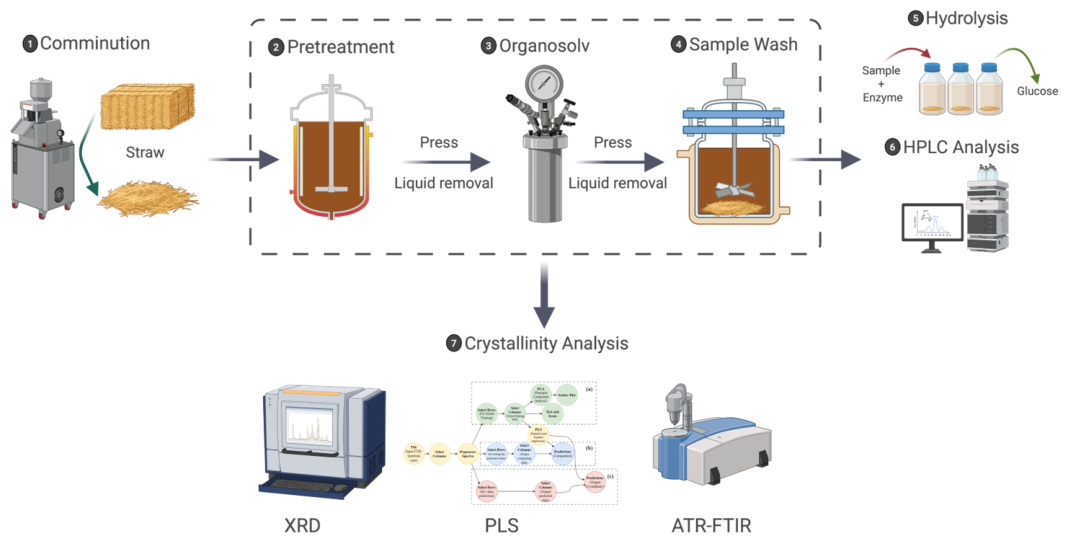
Figure 2.
Schematic overview of the HWP and WP pretreatment procedures. Created with BioRender.com [10].
Figure 2.
Schematic overview of the HWP and WP pretreatment procedures. Created with BioRender.com [10].
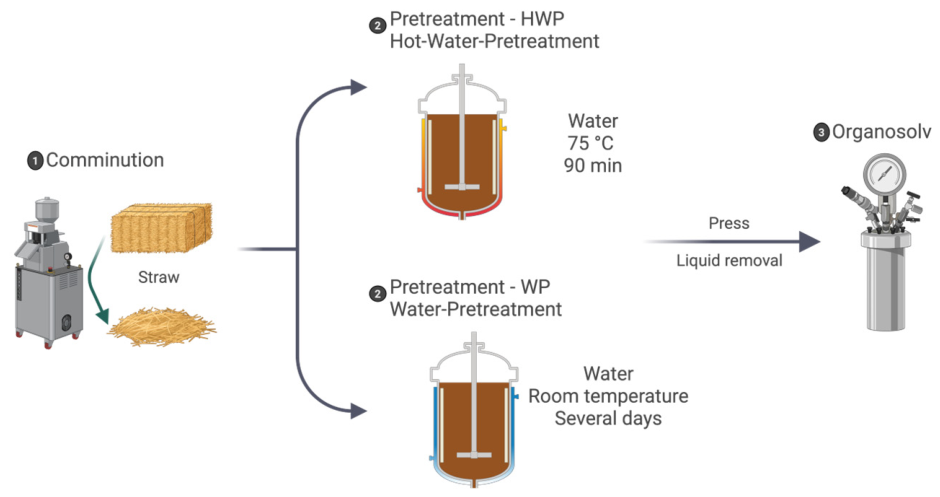
Figure 3.
Effect of HWP temperature (A) and WP duration (B) on cellulose crystallinity and enzymatic glucose yield of wheat straw. Error bars indicate standard deviations of the mean (n = 3).
Figure 3.
Effect of HWP temperature (A) and WP duration (B) on cellulose crystallinity and enzymatic glucose yield of wheat straw. Error bars indicate standard deviations of the mean (n = 3).
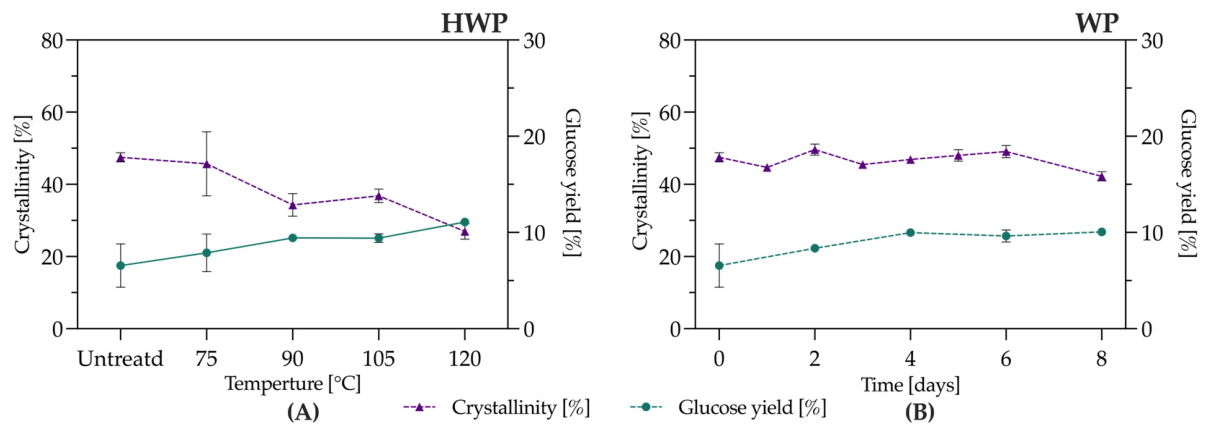
Figure 4.
Effect of washing on cellulose crystallinity and glucose yield after Organosolv pretreatment of wheat straw. (A) Average cellulose crystallinity of all investigated samples after different washing steps (n = 15). (B) Glucose yields obtained after enzymatic hydrolysis of samples subjected to different washing steps following Organosolv pretreatment under various extraction conditions Error bars indicate standard deviations. Error bars indicate standard deviations of the mean (n = 3).
Figure 4.
Effect of washing on cellulose crystallinity and glucose yield after Organosolv pretreatment of wheat straw. (A) Average cellulose crystallinity of all investigated samples after different washing steps (n = 15). (B) Glucose yields obtained after enzymatic hydrolysis of samples subjected to different washing steps following Organosolv pretreatment under various extraction conditions Error bars indicate standard deviations. Error bars indicate standard deviations of the mean (n = 3).
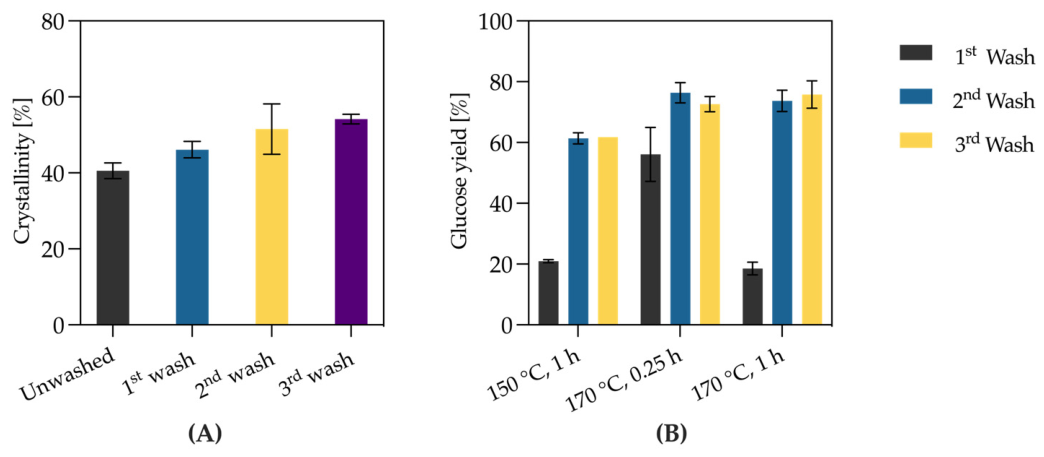
Figure 5.
Proposed mechanism of crystallinity increase during sequential washing of Organosolv-treated wheat straw. Created with BioRender.com.
Figure 5.
Proposed mechanism of crystallinity increase during sequential washing of Organosolv-treated wheat straw. Created with BioRender.com.
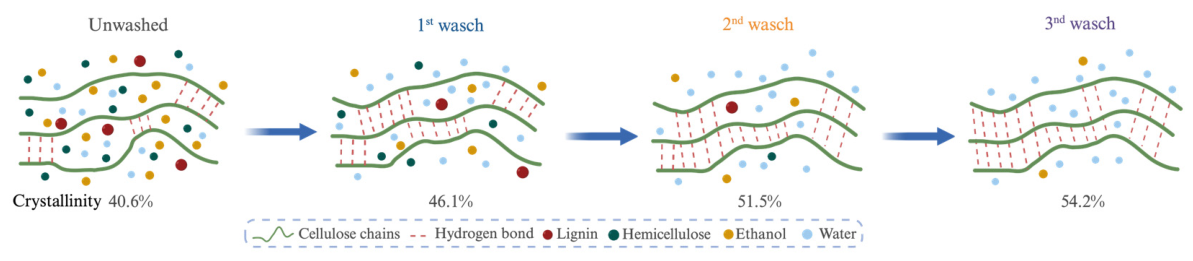
Figure 6.
Effect of drying conditions on the crystallinity of Organosolv-treated wheat straw. (A) Crystallinity of HWP-pretreated and subsequently Organosolv-extracted (2 h) samples measured in the wet state and after drying under different conditions. (B) Changes in crystallinity of non-pretreated wheat straw subjected to Organosolv extraction at 135 °C for different residence times (1-8 h) and subsequently dried in a vacuum desiccator. Error bars indicate standard deviations of the mean (n = 3).
Figure 6.
Effect of drying conditions on the crystallinity of Organosolv-treated wheat straw. (A) Crystallinity of HWP-pretreated and subsequently Organosolv-extracted (2 h) samples measured in the wet state and after drying under different conditions. (B) Changes in crystallinity of non-pretreated wheat straw subjected to Organosolv extraction at 135 °C for different residence times (1-8 h) and subsequently dried in a vacuum desiccator. Error bars indicate standard deviations of the mean (n = 3).
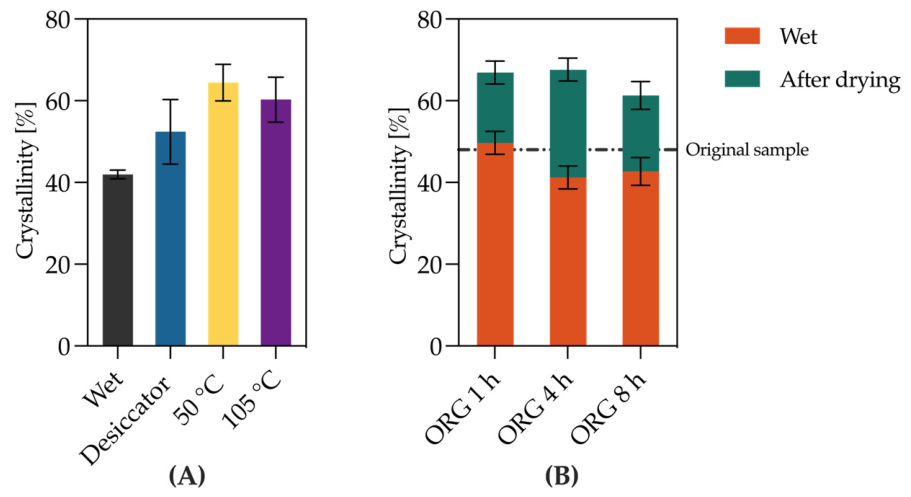
Figure 7.
Proposed mechanism of drying-induced cellulose ordering through bound-water removal and hydrogen-bond reformation. Created with BioRender.com.
Figure 7.
Proposed mechanism of drying-induced cellulose ordering through bound-water removal and hydrogen-bond reformation. Created with BioRender.com.
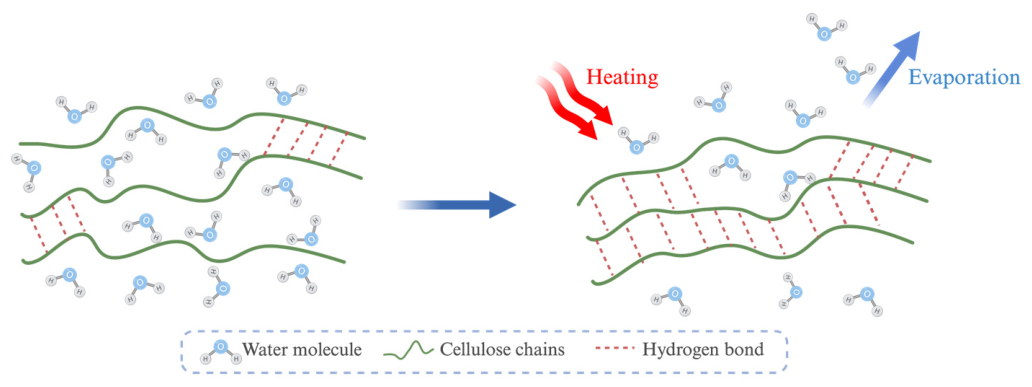

Table 1.
Overview of the sequential washing steps following organosolv extraction.
| Wash Steps | Wash solution | Liquor ratio* |
| 1 | 60% (w/w) ethanol–water solution | 1:5 |
| 2 | Water | 1:20 |
| 3 | Water | 1:10 |
* Liquor ratio is based on the dry mass of the sample.
Disclaimer/Publisher’s Note: The statements, opinions and data contained in all publications are solely those of the individual author(s) and contributor(s) and not of MDPI and/or the editor(s). MDPI and/or the editor(s) disclaim responsibility for any injury to people or property resulting from any ideas, methods, instructions or products referred to in the content. |
© 2026 by the authors. Licensee MDPI, Basel, Switzerland. This article is an open access article distributed under the terms and conditions of the Creative Commons Attribution (CC BY) license (http://creativecommons.org/licenses/by/4.0/).
Copyright: This open access article is published under a Creative Commons CC BY 4.0 license, which permit the free download, distribution, and reuse, provided that the author and preprint are cited in any reuse.