

Submitted:
21 July 2026
Posted:
22 July 2026
You are already at the latest version
Abstract
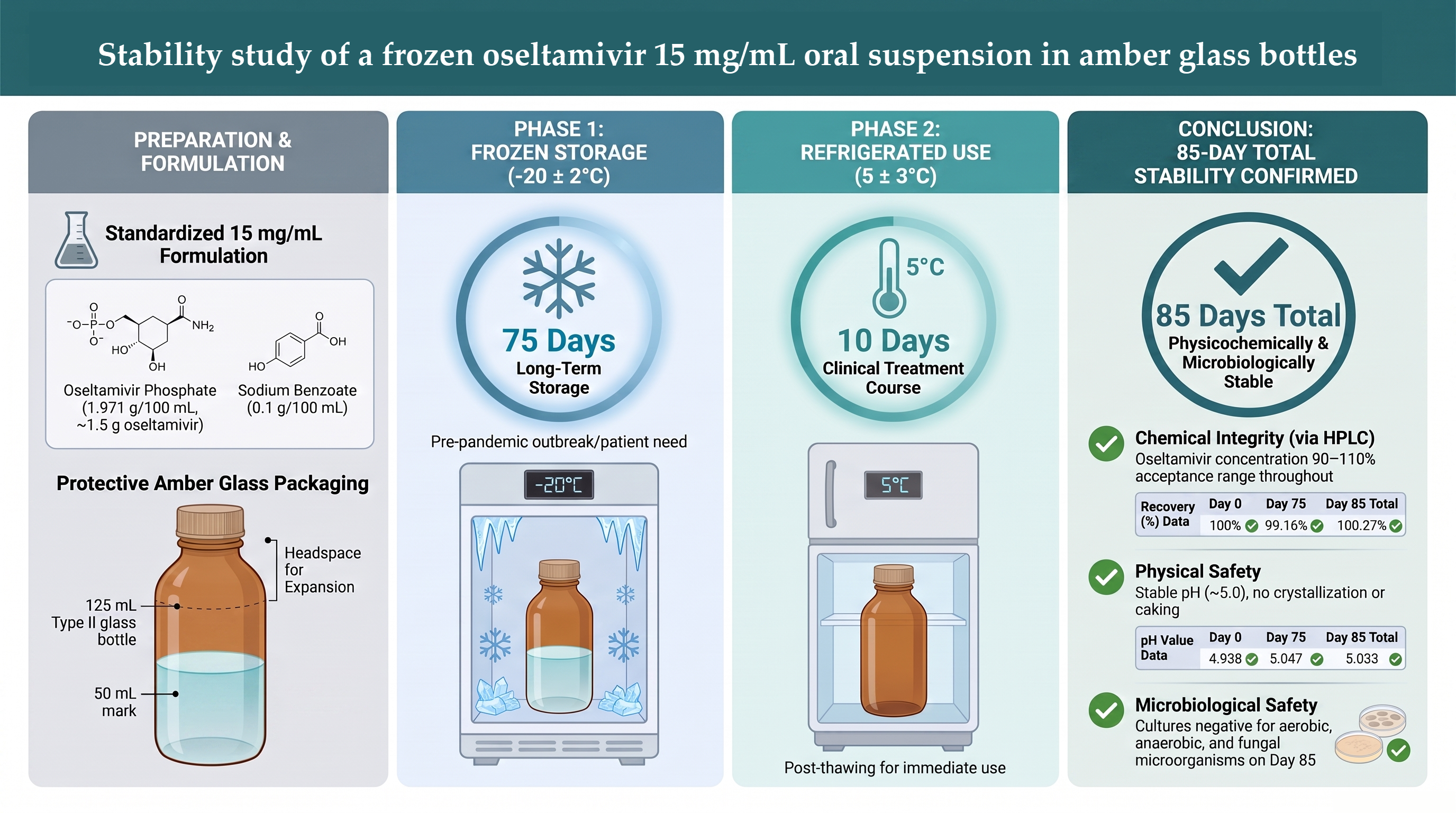
Background/ Objectives: Oseltamivir is a widely used antiviral agent indicated for the treatment of influenza and plays a central role in pandemic preparedness strategies. Although an extemporaneously prepared 15 mg/mL oral suspension is recognized in formularies, preparing large volumes during a pandemic requires extended storage options. However, no stability studies are currently available for an oseltamivir 15 mg/mL oral suspension stored under freezing and subsequent refrigerated conditions for the duration of a standard treatment. The aim of this study was to evaluate the physicochemical and microbiological stability of a 15 mg/mL oseltamivir oral suspension prepared from the active pharmaceutical ingredient (API) and packaged in amber glass containers. Methods: The oral suspension was formulated using oseltamivir phosphate API, sodium benzoate as a preservative, and purified water, and then packaged in 125 mL Type II amber glass bottles allowing for thermal expansion. The samples were stored at −20 ± 2 °C for up to 75 days, followed by refrigerated storage (5 ± 3 °C) after thawing for up to 10 days. Chemical stability was assessed using a validated HPLC method in accordance with ICH guidelines and was defined as 90–110% recovery of the initial concentration. Physical stability (color, pH, particulate matter, crystallization, and homogeneity) and microbiological stability were also evaluated. Results: The HPLC method demonstrated excellent linearity, precision, and accuracy. Oseltamivir concentrations remained within the predefined acceptance limits throughout the 75-day study period under freezing conditions, with no significant changes in pH, color, or particulate formation. After thawing, the drug concentration continued to remain fully stable and within the required limits for up to 10 days under refrigerated conditions. Despite the prolonged storage and phase changes, no significant changes in physical parameters were observed, and microbiological testing confirmed the absence of aerobic, anaerobic, and fungal microorganisms on the final day of the study. Conclusions: Oseltamivir 15 mg/mL oral suspension in amber glass bottles is physicochemically and microbiologically stable for up to 85 days (75 days under frozen conditions plus 10 days under refrigeration after thawing).
Keywords:
oseltamivir
; oral suspension
; stability
; freezing
; amber glass
; HPLC
1. Introduction
Oseltamivir is an antiviral agent indicated in adults and children, including term newborns, presenting with the characteristic symptoms of influenza when influenza virus is circulating in the human population. Efficacy has been demonstrated when treatment is initiated within two days of the onset of the first symptoms. Developed in the 1990s, it is an oral prodrug that is transformed into its active metabolite (oseltamivir carboxylate) mainly by hepatic esterases. Oseltamivir carboxylate inhibits influenza neuraminidase, a target that limits the release of newly formed viral particles. Introduced into clinical practice at the end of the 1990s and the beginning of the 2000s, it became one of the most widely used oral antivirals against influenza A and B viruses [1].
During the 2000s, oseltamivir gained importance in pandemic preparedness strategies because it could be administered orally and could be used both treatment and as prophylaxis. During the 2009 A(H1N1) pandemic, it played a central role in the initial health-care response and in the management of high-risk patients while specific vaccines were being developed. From 2010 to 2020, its use remained established, although discussions persisted regarding the magnitude of its clinical benefit, the need for early administration, and the surveillance of antiviral resistance [1].
At present, oseltamivir remains part of the therapeutic armamentarium for seasonal influenza and potential pandemic waves, especially in patients with a higher risk of complications or when treatment is initiated early. Its main value lies in reducing the duration and severity of some clinical manifestations when administered promptly, as well as in supporting clinical management in settings with a high health care demand. It is not a definitive solution to influenza pandemics, but rather a strategic tool within health preparedness and response frameworks [2].
Spain has an Influenza Pandemic Preparedness and Response Plan, aligned with the European Union, and aimed at assessing whether it would be appropriate to open negotiations with the pharmaceutical industry on the production and distribution of vaccines and antivirals. In this plan, the scenario considered in the event of an influenza pandemic is one of insufficient vaccine supplies, so antiviral drugs, which can be used from the outset, should be available, with the main objective being the minimizing of disease severity, the number of deaths, and the degree of social disruption that the pandemic could cause. The plan even raises the possibility, if necessary, of mandatory administration of antivirals to patients and their contacts [3]. In anticipation of the influenza pandemic, the General State Administration and the Autonomous Communities acquired batches of oseltamivir phosphate, active pharmaceutical ingredient (API), to prepare when the time came, a simple emergency formulation, endorsed by Roche GmbH, consisting of oseltamivir phosphate dissolved with sodium benzoate in water [4].
Oseltamivir is presented as ethyl (3R,4R,5S)-4-acetamido-5-amino-3-(1-ethylpropoxy)-1-cyclohex-1-ene-1-carboxylate phosphate (Figure 1). It is a white or almost white powder, freely soluble in water and methanol, and practically insoluble in methylene chloride [5].
The German National Formulary (GNF) includes a monograph entitled “Oseltamivir Oral Solution 15 mg/mL for Adults or for Children (NRF 31.2)” [6]. Although it refers to it as an oral solution, from a strictly pharmaceutical point of view it would be more accurate to call it an “oseltamivir oral suspension 15 mg/mL,” but the formulary retains the term “oral solution” for consistency with the product information and for practical classification reasons. Its appearance is that of a homogeneous whitish liquid suspension, that turn slightly opalescent once it has been properly shaken. If it has been prepared correctly, under normal conditions no visible particles and crystals should be observed in the suspension. The technical instruction is precisely to “shake gently for 2 minutes to obtain a homogeneous suspension,” which implies a uniform appearance with no lumps or visible aggregates in the liquid [7,8].
From a physicochemical standpoint, the stability of oseltamivir phosphate depends mainly on factors such as the temperature, relative humidity, light exposure, storage and packaging conditions and pH [1,8,9]. In practice, it has been reported that the API of oseltamivir can remain within the pharmaceutical specifications after a prolonged storage at 25 °C and 60% relative humidity when kept in its original packaging. In 2019, the Spanish Agency of Medicines and Medical Devices issued an information notice in which, after evaluating the content of three bulk lots of API over 13 years, purchased to prepare an oseltamivir phosphate solution as an emergency formulation, it was concluded that complied with the specifications of the Spanish Pharmacopoeia monograph [4,5].
As shown in Figure 2, there are two chemical transformation pathways of oseltamivir that have been identified: intramolecular N,N-acyl migration of the acetyl moiety of oseltamivir, which produces isomer I, and hydrolysis of the ethyl ester which generates oseltamivir carboxylate (active metabolite). The degradation kinetics of oseltamivir across the pH range 2.0–7.0, and the pH-rate profiles indicate that the compound is relatively stable between pH 2.0 and 8.0, with maximum stability at pH 4.0. Extrapolated rate constants at 25 ºC for N,N-acyl migration and ester hydrolysis suggest that the development of solutions or solid dosage forms of oseltamivir with adequate room-temperature shelf-life stability is feasible [10]. The most likely degradation pathways of oseltamivir phosphate are hydrolysis, oxidation, photodegradation, and acid-base catalyzed degradation. Hydrolysis of the phosphate ester (prodrug of oseltamivir carboxylate) is the principal pathway to be consider, especially in an aqueous medium and across different pH changes, because the compound is designed to undergo chemical or enzymatic cleavage of the phosphate group; oxidation may appear as a secondary pathway under stress conditions; photodegradation may also contribute upon light exposure; and, in solution, the pH can accelerate decomposition or alter the degradation profile by forced acid/base hydrolysis [1,8,9].
Another important issue is the type of container used to hold the medicine ready for administration. In pharmaceutical terms, glass containers intended to hold medicinal solutions and suspensions are usually characterized by the following: high chemical inertness, which minimizes interactions between the medicine and the container; high hydrolytic resistance, especially in Type I glass, making them suitable for solutions, suspensions and parenteral preparations; low permeability to gases and water vapor, which helps protect the formulation against oxidation and hydrolysis; transparency or amber/topaz coloration, depending on the need for visual inspection or light protection, particularly in light-sensitive formulations; the ability to undergo sterilization and, when required, depyrogenation, which is essential for containers intended for sterile solutions; good mechanical and dimensional resistance, allowing for safe filling, sealing, and transport; and compatibility with different closure systems, such as elastomeric stoppers and aluminum caps for vials or polypropylene caps for bottles, which help maintain container closure integrity [11,12].
The stability of an extemporaneously prepared aqueous oseltamivir phosphate suspension, containing 15 mg/mL of oseltamivir, has been studied both under refrigeration conditions and at room temperature [13]. However, there are no stability studies of a frozen aqueous suspension maintained for 10 days (the recommended treatment duration), under refrigeration after thawing. This storage method could be useful in the event of an influenza pandemic, when large volumes of this solution would need to be prepared.
2. Materials and Methods
2.1. Preparation of Oseltamivir 15 mg/mL Oral Suspension
The compounding process was performed using oseltamivir phosphate API (Roche Farma, Madrid, Spain) and sodium benzoate API (Acofarma Distribución, S.A., Madrid, Spain) which were reconstituted with purified water obtained from a Milli-Q® Integral 3/5/10/15 system (Merck KGaA, Darmstadt, Germany). Type II of 125 mL umber glass bottles, designed to allow for expansion upon freezing, were used to store the preparation (José Mestre, S.A., Barcelona, Spain).
Three batches of the oral suspension bottles containing 50 mL of the formulation were prepared and frozen (frozen stability group –FSG-) according to the GNF (Table 1) [6], containing 50 mL of this preparation. Bottles assigned to the FSG were thawed on the day of analysis and then transferred to the refrigerated stability group (RSG), where they were analyzed on the days specified in the analytical protocol. The freezing conditions were maintained at -20 ± 2 ºC in the FSG, and the refrigeration conditions at 5 ± 3 ºC in the RSG. The preparation process was carried out in accordance with the specific recommendations included in the Guide for Good Preparation Practices of Medicines in Hospital Pharmacy Services (GPPMHPS) [14].
2.2. Chromatographic Method
A Waters Breeze HPLC system equipped with an XBridge 5 µm C18 reversed-phase column was used. Chromatographic separation was performed under isocratic conditions using a mobile phase composed of acetonitrile/methanol/6.8 g/L potassium dihydrogen phosphate in water for chromatography (13.5/24.5/62, v/v), with the pH adjusted to 6 using 1 M potassium hydroxide. The flow rate was set at 1.2 mL/min, detection was carried out at 207 nm, the column temperature was maintained at 50 °C, the injection volume was 15 µL, and the total run time was 34 min [5]. HPLC-grade acetonitrile, methanol, and phosphoric acid were purchased from Panreac Química S.L.U. (Barcelona, Spain), and ultrapure water was obtained using the Milli-Q® Integral 3/5/10/15 system (Merck KGaA, Darmstadt, Germany). The oseltamivir phosphate (impurity B-free) reference standard product was obtained from Merck Life Science, S.L. (Madrid, Spain).
Method validation: The assay method described in the monograph for oseltamivir phosphate in the European Pharmacopoeia [15], was used as incorporated into the Spanish Royal Pharmacopoeia [5], and validated for linearity, precision, and accuracy in accordance with ICH Q2(R1) guidelines [16]. The European Pharmacopoeia assay for oseltamivir phosphate is considered specific within the pharmacopoeial framework to ensure selectivity [15].
Linearity between peak area and oseltamivir concentration was assessed across eight calibration levels from 0.3 to 1.0 mg/mL (0.3, 0.4, 0.5, 0.6, 0.7, 0.8, 0.9, and 1.0 mg/mL). A calibration curve was constructed by linear regression to determine the coefficient of determination (R²), slope (a), and y-intercept (b) [17]. Precision was evaluated through intra- and inter-day repeatability studies. The intra-day assessment involved five replicate analyses on the same day at 80%, 100%, and 120% of the target concentration (0.6 mg/mL), whereas the inter-day study comprised of two replicates over four different days at the same relative concentrations. Mean values, standard deviations, and coefficients of variation were calculated, with acceptance criteria of less than 1% for intra-day and less than 2% for inter-day repeatability [17]. Accuracy was determined by recovery studies performed in triplicate at oseltamivir concentrations of 0.4, 0.6, and 0.8 mg/mL. Recovery percentages were calculated and compared with the theoretical value (100%) using Student’s t-test [17,18]. The limits of detection (LOD) and quantification (LOQ) for oseltamivir were calculated from the standard deviation of the response (σ) and the slope (S) of the calibration curve, using the equations LOD = 3.3 × σ / S and LOQ = 10 × σ / S, in accordance with ICH recommendations [16,17,18].
2.3. Chemical Stability
The chemical stability of the oseltamivir 15 mg/mL oral suspension was evaluated over 75 days in the FSG (days 0, 4, 11, 18, 28, 42, 60, and 75) and over 10 days in the RSG after thawing (days 0, 1, 3, 7, and 10) (Figure 2).
On each analysis day, a 1 mL sample was taken from each batch of oseltamivir oral suspension 15 mg/mL and diluted to 25 mL with the mobile phase (theoretical oseltamivir concentration: 0.6 mg/mL = target concentration).
2.4. Physical Stability
Physical stability was evaluated for each batch by macroscopic visual inspection: color, visible particulates and homogeneity of the suspension after redispersion (classified as homogeneous, slightly heterogeneous but acceptable and not homogeneous). pH measurement and microscopic assessment of crystallization were also verified. On the predefined study days, 5 mL aliquots from each formulation were collected and inspected for particulate matter, crystal formation, turbidity, precipitation, and color changes. pH was determined using a calibrated SevenMulti™ pH meter (Mettler Toledo, Cornellà de Llobregat, Spain), while particle and crystal detection was performed using a visual inspection station with black-and-white backgrounds under bright-field illumination (CleanviewTM Inspection, Sterigene-Synexin, Francoville, France) in combination with a SediMAX2™ phase-contrast microscope (77 Elektronika, Budapest, Hungary).
2.5. Microbiological Stability
Microbiological stability was evaluated for each batch on the assessment day, corresponding to day 10 after thawing and refrigerated storage. By that time, the bottles had been opened on four occasions to obtain the samples scheduled in accordance with the study design. The samples were then inoculated into a culture medium for aerobic bacteria and fungi (BD BACTEC™ Peds Plus™/F, Becton Dickinson and Company, San Agustín de Guadalix, Spain) and into a specific medium for anaerobic bacteria (BD BACTEC™ Lytic/10 Anaerobic/F, Becton Dickinson and Company, San Agustín de Guadalix, Spain).
3. Results
3.1. Validation of the Analytical Method
The HPLC method demonstrated excellent linearity across the tested range, with a coefficient of determination (R2) of 0.9992 and a regression equation of y = 23,691,246.380x + 62,139.288 (Supplementary Materials, Table ST1 and Figure SF1). Both intra-day and inter-day precision for the three oseltamivir quality control levels were highly satisfactory: intra-day relative standard deviations (RSD%) ranged from 0.264% to 0.596% (Table 1), while inter-day RSD% ranged from 0.378% to 0.608% (Table 2). These values successfully met ICH criteria for repeatability (≤ 1%) and intermediate precision (≤ 2%), respectively (Supplementary Materials, Tables ST2–ST3). Method accuracy, determined by recovery rates at three concentration levels, ranged from 99.425% to 100.700%, falling consistently within the 98–102% acceptance interval (Supplementary Materials, Table ST4). The LOD and LOQ were established at 0.030 mg/mL and 0.100 mg/mL, respectively.
The oseltamivir 15 mg/mL oral suspension contains sodium benzoate as a preservative agent. This compound exhibits absorption at 207 nm, which accounts for the appearance of a corresponding peak (around minute 4-5) in the chromatograms of oseltamivir 0.6 mg/mL oral suspension. Therefore, a 0,4 mg/mL sodium benzoate solution was prepared in the mobile phase and compared with the chromatogram of the 0.6 mg/mL oseltamivir oral suspension, which contains sodium benzoate at a concentration of 0.04 mg/mL, and with that of a 0.6 mg/mL oseltamivir suspension prepared from the oseltamivir phosphate reference standard. The absorption peak observed around minute 4-5 increased considerably, as can be seen in Figure 3, so it was confirmed that this peak corresponded to sodium benzoate.”
3.2. Stability Study
3.2.1. Freezing Conditions
The chemical stability of the formulation was evaluated by quantifying oseltamivir concentrations in amber glass bottles at each scheduled sampling time point, using the procedure described previously. Mean concentrations were expressed as percentage recovery relative to the initial value, with D0 defined as 100%, as reported in Table 3. Representative chromatograms obtained at D0 and on the test days D4, D28, and D75 for the formulation stored under freezing conditions are presented in Figure 4. The results demonstrated that the oseltamivir concentration remained within the predefined acceptance criteria throughout the 75-day storage period under freezing conditions (Table 3 and Figure 5). Full concentration data are provided in the Supplementary Materials (Table ST5).
During the study period, no changes were observed in visual appearance, including color and turbidity, nor in the presence of visible particulates or crystallization, and pH values remained within the acceptable range (Table 3).
The 15 mg/mL oseltamivir oral suspension stored in amber glass bottles under freezing conditions was consequently considered physically and chemically stable for up to 75 days.
3.2.2. Refrigerated Conditions
The stability data in Table 4 corresponds to oseltamivir oral suspension samples stored under freezing conditions for 0, 4, 28, 42, and 75 days, followed by storage at 2–8 C for 10 days after thawing. Detailed stability data are provided in Table ST6 of the Supplementary Materials. . Representative chromatograms obtained at D0 and on the test days D75-0 and D75 for the formulation stored under refrigeration conditions are presented in the Figure 6. The concentration profile of oseltamivir oral suspension under three freezing storage periods and during subsequent refrigerated storage for up to 10 days after thawing are shown in the Figure 7.
No significant changes were monitored in pH, color, visible particulates, turbidity and crystallization throughout the study
The 15 mg/mL oseltamivir oral suspension in amber glass bottles was consequently considered physically and chemically stable for up to 10 days under refrigerated storage after thawing.
3.2.3. Evaluation of Microbiological Stability
On day 10, aerobic, anaerobic, and fungal cultures of the oseltamivir oral suspension in amber glass bottles under refrigeration yielded negative results for all analyzed samples.
4. Discussion
This study evaluated the stability of an oseltamivir oral suspension at a concentration of 15 mg/mL, prepared from oseltamivir phosphate API containing sodium benzoate as a preservative and purified water, under storage conditions different from those reported to date, by including a main frozen-storage period when the medication was not in use and a refrigerated period once treatment had begun. The studies published to date have assessed stability under refrigerated conditions or at room temperature. One study evaluated the standardized preparation from the GNF at room temperature (25 ºC) and under refrigeration (6 ºC) for 84 days. The study considered the assay of oseltamivir content and the appearance of degradation products such as oseltamivir isomer I, whose content in liquid oseltamivir preparations is limited to 0.5% for toxicological reasons, as well as isomer II and oseltamivir carboxylate. It concluded that the preparation was stable for up to 84 days under refrigeration and for up to 46 days at room temperature when purified water was used [13].
In the remaining studies reviewed, the oral preparation was mainly made from capsules and commercial tablets (TamifluTM), using cherry syrup, Ora-SweetTM SF, SyrSpend SFTM, or SyrSpend SF PHTM as the vehicle. The stability of these oseltamivir oral suspensions at 15 mg/mL ranged from 5 to 13 days at room temperature and from 30 to 90 days under refrigeration, both under light protection [21,22,23] .
The present study measured the oseltamivir concentration on each analysis day and compared it with the initial concentration to verify whether the recovery percentage observed remained within the stability limits, using the method established in the European and Spanish Pharmacopoeias to determine whether the oseltamivir oral suspension was chemically stable under the specified storage conditions. However, the concentrations of oseltamivir carboxylate, isomer I, isomer II, and sodium benzoate were not measured, which may constitute to being a limitation of the study.
Nevertheless, it is important to note that the measured pH range of 4.938 to 5.047 throughout the study period remained within the range of 2 to 8, in which oseltamivir is considered relatively stable, with a maximum stability pH of 4. Therefore, the studied preparation was within a pH range close to its maximum stability, and it was not subjected to stress conditions with markedly acidic or basic pH, high temperatures, or light exposure. For this reason, as the formulation was prepared under optimal conditions for chemical stability, it was concluded that the previously stated conditions were not met to invalidate the study. [10,13].
Regarding sodium benzoate, it should be noted that this compound is used as an antimicrobial preservative in the pharmaceutical, cosmetic, and food industries, including products stored at room temperature, under refrigeration, and under frozen conditions [24–27]; therefore, demonstrating its stability was not considered necessary.
A further point to consider is whether freezing the 15 mg/mL oseltamivir oral suspension in amber glass bottles could affect the stability of the preparation, and even its stability under refrigeration, as a consequence of freezing. In this scenario, phase separation, compact sedimentation (caking) due to ice crystallization, and local concentration of solutes could occur. Changes in redispersibility after thawing could also arise, with a possible loss of dose homogeneity, pH variations, and mechanical stress of the suspension on the inner walls of the glass container if the bottle is not designed to allow for expansion upon freezing.
Based on the results obtained from the controls performed during the freezing phase, it can be inferred that the prepared oral suspension was chemically stable, as it remained within the acceptance limits. From a physical standpoint, no significant changes in pH or color were observed; the homogeneity of the suspension after manual redispersion following thawing was considered adequate, and no particle or aggregate formation, nor crystals, were observed, leading to its classification as being physically stable. The same results were obtained for the preparation under refrigerated conditions after thawing.
Finally, the microbiological controls for aerobic, anaerobic, and fungal microorganisms performed on day 85 of the study were negative, and the preparation was therefore considered microbiologically stable.
5. Conclusions
The findings of this study demonstrate that the formulation oseltamivir 15 mg/mL oral suspension in amber glass bottles is considered physicochemically and microbiologically stable for up to 85 days (75 days under frozen conditions plus 10 days under refrigeration). It is considered necessary to conduct extended stability studies under frozen conditions, given the importance that preparation and storage of the suspension could have in hospital pharmacy services, for dispensing to patients, in the event of an influenza pandemic, where the need to promptly care for a large number of patients could be a real scenario.
Supplementary Materials
The following supporting information can be downloaded at the website of this paper posted on Preprints.org, Table ST1: Peak area and the oseltamivir concentration for making the calibration curve; Table ST2: Data from intra-day repeatability of oseltamivir samples at 80, 100 and 120% of the target concentration of 0.6 mg/mL; Table ST3: Data from inter-day repeatability of oseltamivir samples at 80, 100 and 120% of the target concentration of 0.6 mg/mL; Table ST4: Data from accuracy of oseltamivir samples at 80, 100 and 120% of the target concentration of 0.6 µg/mL; Table ST5: Average Recovery% of three determinations on the day of the test and pH of oseltamivir 15 mg/mL oral suspension in amber glass bottles under freezing conditions; Table ST6: Average Recovery% of three determinations on the day of the test and pH of oseltamivir 15 mg/mL oral suspension in amber glass bottles under refrigerated conditions; Figure S1: Linearity between the peak area and the oseltamivir concentration for making the calibration curve.
Author Contributions
Conceptualization, J.C.R.R.; methodology: J.C.R.R., A.G.S and M.E.M.M. ; validation, J.C.R.R., J.M.A.H., A.C.V and P.A.R.; formal analysis: J.C.R.R., A.G.S and M.E.M.M..; investigation: J.C.R.R., A.G.S and M.E.M.M.; writing—original draft preparation, J.C.R.R., A.G.S and M.E.M.M..; writing—review and editing, J.C.R.R., A.G.S., M.E.M.M., J.M.A.H., A.C.V. and P.A.R.; supervision, J.C.R.R., J.M.A.H., A.C.V. and P.A.R. All authors have read and agreed to the published version of the manuscript.
Funding
This research received no external funding.
Institutional Review Board Statement
Not applicable.
Informed Consent Statement
Not applicable.
Data Availability Statement
The data presented in this study are available on request from the corresponding author.
Conflicts of Interest
The authors declare no conflicts of interest.
Abbreviations
The following abbreviations are used in this manuscript:
| API | Active Pharmaceutical Ingredient |
| FSG | Frozen stability group |
| G- | Gram-negative bacteria |
| G+ | Gram-positive bacteria |
| GNF | German National Formulary |
| GPPMHPS | Guide for good preparation practices of medicines in hospital pharmacy services |
| ICH | International Council for Harmonisation of Technical Requirements for Pharmaceuticals for Human Use |
| LOD | Limit of detection |
| LOQ | Limit of quantification |
| PP | Polypropylene |
| RSD% | Relative standard deviation |
| RSG | Refrigerated stability group |
| SC | Storage conditions |
References
- HEC Pharm GmbH. Datasheet Oseltamivir HEC Pharm 75 mg capsules generic drug [Internet]; HEC Pharm GmbH: Berlin, 2020 [cited 2026 June 10; Available online: https://cima.aemps.es/cima/dochtml/ft/85273/FT_85273.html (accessed on 10 June 2026).
- Oseltamivir – current clinical therapy and research applications [Internet]. Eur. Clin. Trials Inf. Netw. CTIN. 10 June 2026. Available online: https://ensayosclinicos.es/medicamento/oseltamivir/ (accessed on 10 June 2026).
- Ministerio de Sanidad y Política Social. National Influenza Pandemic Preparedness and Response Plan [Internet]; Ministerio de Sanidad y Política Social: Madrid, 2005 [cited 2026 Mar 12; Available online: https://www.sanidad.gob.es/ca/ciudadanos/enfLesiones/enfTransmisibles/docs/PlanGripeEspanol.pdf (accessed on 12 Mar 2026).
- Spanish Agency for Medicines and Medical Devices. The stock status of oseltamivir and related medicines acquired under the influenza pandemic preparedness plan [Internet] 2019 Sept. Report No.: MUH, 23/ 2019. Spanish Agency for Medicines and Medical Devices: Madrid; Available online: https://www.aemps.gob.es/informa/notasinformativas/medicamentosusohumano-3/2014-muh/ni-muh_8-2014-stock-oseltamivir/ (accessed on 16 June 2026).
- Department of Health. Oseltamivir phosphate. In R Span Pharmacop [Internet], 5th ed.; Department of Health: Madrid, 2015 [cited 2023 Jan 5; Available online: https://extranet.boe.es/farmacopea/doc.php?id=2422 (accessed on 5 Jan 2023).
- Neues Rezeptur-Formularium. Oseltamivir Oral Solution 15 mg/ml for Adults or for Children. In Neues Rezept-Formul; 2026; pp. 1–16. [Google Scholar]
- Batcha, D. TAMIFLU (oseltamivir phosphate) Capsules and Oral Suspension. Center for Drug Evaluation and Research - Food and Drug Administration: Beltsville; p. 2010 Oct. Report No.: NDA 021246/S-039. Available online: https://www.accessdata.fda.gov/drugsatfda_docs/nda/2011/021246Orig1s039.pdf (accessed on 29 June 2026).
- Roche Registration GmbH. Datasheet Tamiflu 6 mg/mL powder for oral suspension [Internet]. Datasheet Tamiflu 6 MgmL Powder Oral Suspens; Roche Registration GmbH: Germany, 2012 [cited 2023 Jan 5; Available online: https://cima.aemps.es/cima/dochtml/ft/02222005/FT_02222005.html (accessed on 5 Jan 2023).
- EPAR Tamiflu [Internet. Report No.: EMEA/H/C/000402. European Medicines Agency, 2019; Available online: https://www.ema.europa.eu/es/documents/product-information/tamiflu-epar-product-information_es.pdf (accessed on 1 July 2026).
- Oliyai, R.; Yuan, L.-C.; Dahl, T.C.; Swaminathan, S.; Wang, K.-Y.; Lee, W.A. Biexponential Decomposition of a Neuraminidase Inhibitor Prodrug (GS-4104) in Aqueous Solution. Pharm. Res. 1998, 15, 1300–4. [Google Scholar] [CrossRef] [PubMed]
- European Directorate for the Quality of Medicines; HealthCare (EDQM). Glass containers for pharmaceutical use. In Eur Pharmacopoeia, 11th ed.; Council of Europe: Strasbourg, 2022. [Google Scholar]
- United States Pharmacopeial Convention. General chapter <660> Containers – Glass. U S Pharmacop 46 –Natl Formul 41, 11th ed.; United States Pharmacopeial Convention: Rockville (MD), 2023. [Google Scholar]
- Albert, K.; Bockshorn, J. Chemical stability of oseltamivir in oral solutions. Pharm. 2007, 62, 678. [Google Scholar] [CrossRef]
- Ministry of Health. Guideline for good practices for preparing medications in hospital pharmacy services [Internet]. 1a; Ministerio de Sanidad: Madrid, 1 Aug 2025; Available online: https://www.sanidad.gob.es/areas/farmacia/publicaciones/GuiaBPMedicamentosServFarmHosp/Docs/04GuiaMedicamentos2024Accesible.pdf (accessed on 1 Aug 2025).
- European Directorate for the Quality of Medicines; HealthCare. Oseltamivir phosphate, 11th ed.; Eur Pharmacopoeia: Strasbourg, 2022. [Google Scholar]
- Abraham, J. International Conference On Harmonisation Of Technical Requirements For Registration Of Pharmaceuticals For Human Use. In Handb Transnatl Econ Gov Regimes [Internet]; Brouder, A., Tietje, C., Eds.; Brill, 2009; pp. 1041–54. [Google Scholar] [CrossRef]
- Castro, M.; Gascón, S.; Pujol, M.; Sans, J.; Vicente, L. Validation of Analytical Methods. In Monograph. Commission on Good Manufacturing Practice and Quality Control Standards.; Spanish Association of Industrial Pharmacists (AEFI): Barcelona, 1989. [Google Scholar]
- Hoffman, F. Statistical validation: Quantitative determination (General Explanations); La Roche: Basle, 1987. [Google Scholar]
- European Directorate for the Quality of Medicines; HealthCare. European Pharmacopoeia, 11th ed.; European Directorate for the Quality of Medicines & HealthCare: Estrasburgo, 2022. [Google Scholar]
- United States Pharmacopeial Convention. United States Pharmacopeia and National Formulary (USP-NF); US Pharmacopeia Convention, Inc: Rockville, 2022n. [Google Scholar]
- Dijkers, D.; Nanhekhan, V.; Thorissen, A. Updated Stability Data of Midazolam, Oseltamivir Phosphate, and Propranolol Hydrochloride in SyrSprend SF and Minoxidil in Espumil. Nt J. Pharm. Compd. 2017, 21, 240–1. [Google Scholar]
- Voudrie, M.; Brett Allen, D. Stability of Oseltamivir Phosphate in SyrSpend SF, Cherry Syrup, and SyrSpend SF (For Reconstitution). Int. J. Pharm. Compd. 2010, 14, 82–5. [Google Scholar]
- Winiarski, A.; Infeld, M.; Tscherne, R.; Bachynsky, M.; Rucki, R.; Nagano-Mate, K. Preparation and stability of extemporaneous oral liquid formulations of oseltamivir using commercially available capsules. J. Am. Pharm. Assoc. 2003, 47, 747–55. [Google Scholar]
Figure 1.
Structure of oseltamivir phosphate.
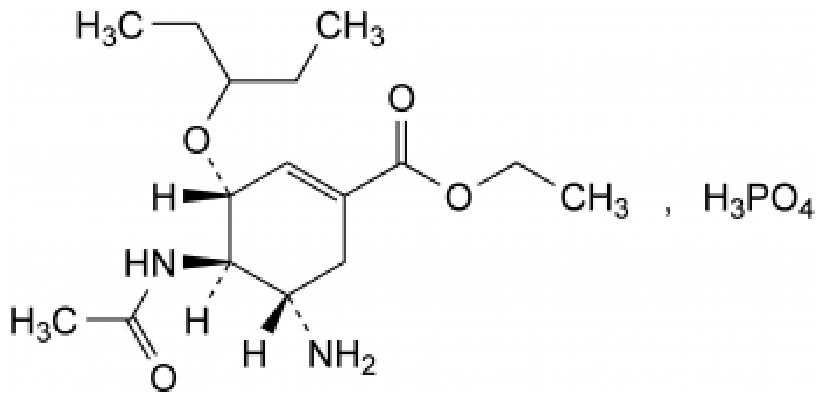
Figure 2.
Chemical transformation pathways of oseltamivir.
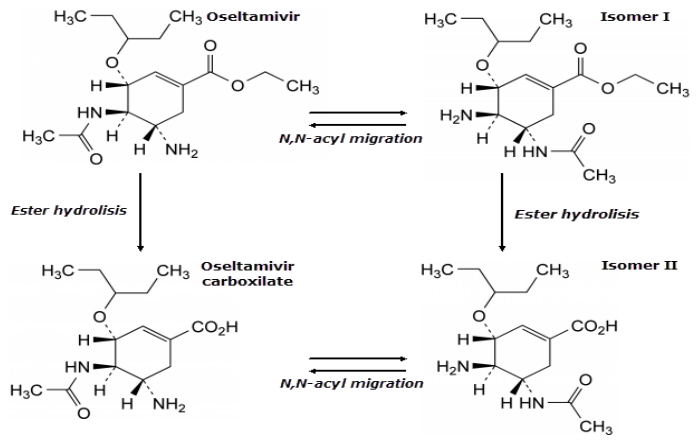
Figure 2.
Study design scheme.
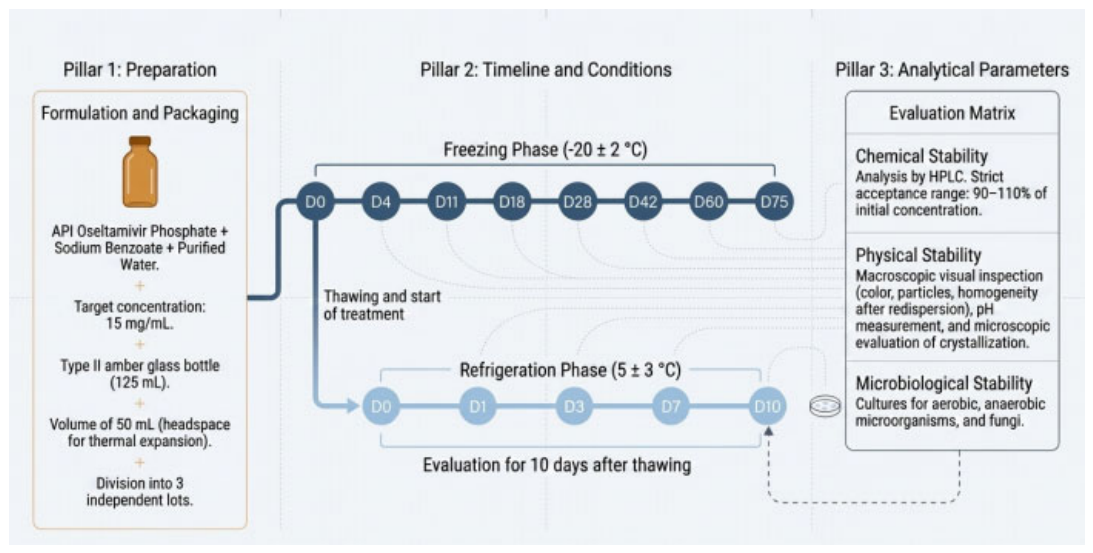
Figure 3.
Cromatograms of sodium benzoate, oseltamivir oral suspension and oseltamivir reference standard to characterize the sodium benzoate peak.
Figure 3.
Cromatograms of sodium benzoate, oseltamivir oral suspension and oseltamivir reference standard to characterize the sodium benzoate peak.
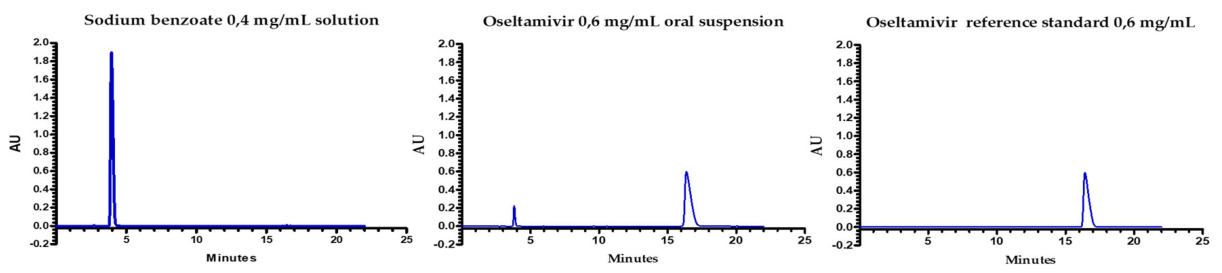
Figure 4.
Chromatograms of oseltamivir 15 mg/mL oral suspension in amber glass bottles under freezing conditions on days D0, D4-0, D28-0 and D75-0 (D+Number1 or D+Number1-Number2; Number 1 = Day of tawing and transfer to refrigerated group; Number 2 = Day of test in each refrigerated group).
Figure 4.
Chromatograms of oseltamivir 15 mg/mL oral suspension in amber glass bottles under freezing conditions on days D0, D4-0, D28-0 and D75-0 (D+Number1 or D+Number1-Number2; Number 1 = Day of tawing and transfer to refrigerated group; Number 2 = Day of test in each refrigerated group).
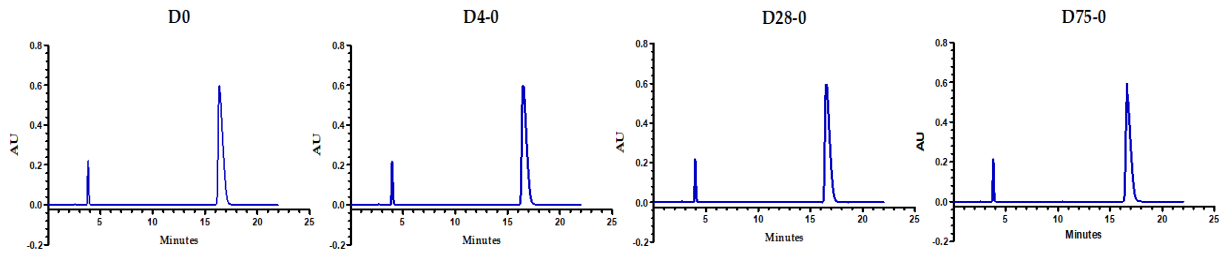
Figure 5.
Evolution of concentration of Oseltamivir 15 mg/mL* oral suspension in amber glass bottles under freezing condition. (*samples analyzed after prior 1:25 dilution with mobile phase, corresponding to a theoretical concentration of 0.6 mg/mL oseltamivir).
Figure 5.
Evolution of concentration of Oseltamivir 15 mg/mL* oral suspension in amber glass bottles under freezing condition. (*samples analyzed after prior 1:25 dilution with mobile phase, corresponding to a theoretical concentration of 0.6 mg/mL oseltamivir).
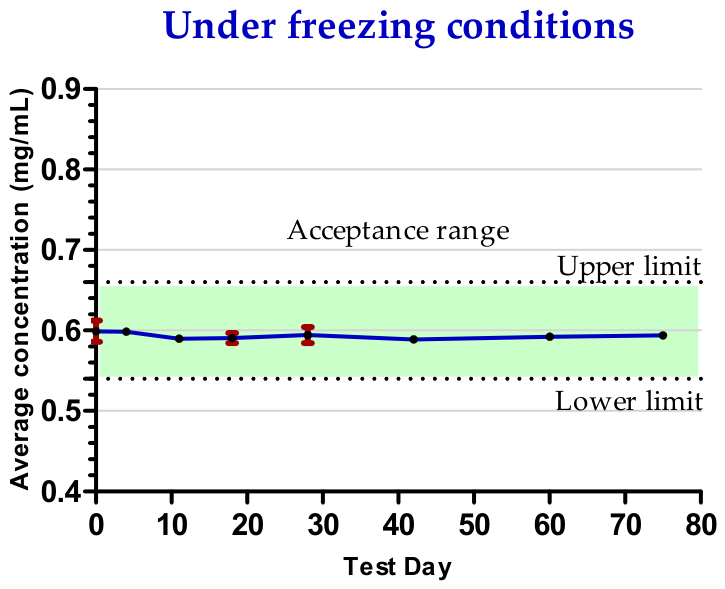
Figure 6.
Chromatograms of oseltamivir 15 mg/mL oral suspension in amber glass bottles under refrigerated conditions on days D0, D75-0, D75-10 (D+Number1 or D+Number1-Number2; Number 1 = Day of tawing and transfer to refrigerated group; Number 2 = Day of test in each refrigerated group).
Figure 6.
Chromatograms of oseltamivir 15 mg/mL oral suspension in amber glass bottles under refrigerated conditions on days D0, D75-0, D75-10 (D+Number1 or D+Number1-Number2; Number 1 = Day of tawing and transfer to refrigerated group; Number 2 = Day of test in each refrigerated group).
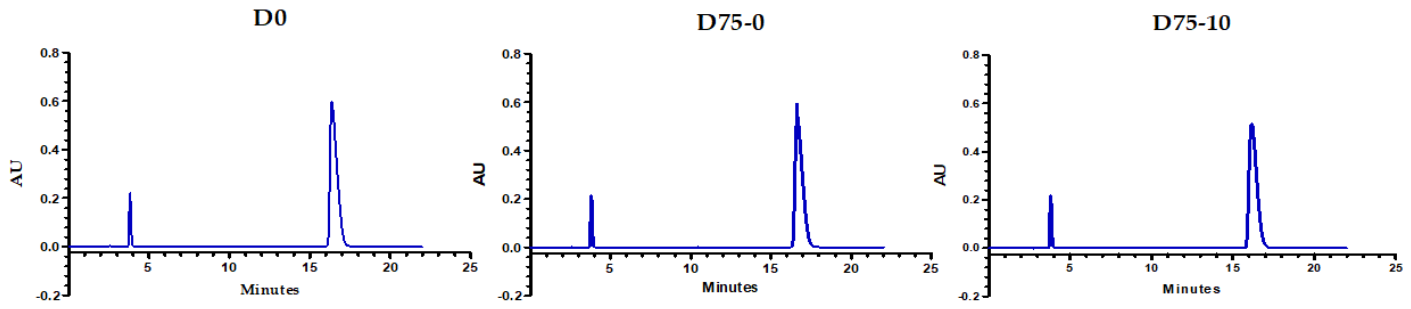
Figure 7.
Oseltamivir 15 mg/mL oral suspension in amber glass bottles under refrigeration conditions. Evolution of concentration (DF4-0, DF28-0, DF75-0 = Text day 4, 28 and 75 after thawing and before moving to the refrigerated group) during the 10 days of refrigeration.
Figure 7.
Oseltamivir 15 mg/mL oral suspension in amber glass bottles under refrigeration conditions. Evolution of concentration (DF4-0, DF28-0, DF75-0 = Text day 4, 28 and 75 after thawing and before moving to the refrigerated group) during the 10 days of refrigeration.
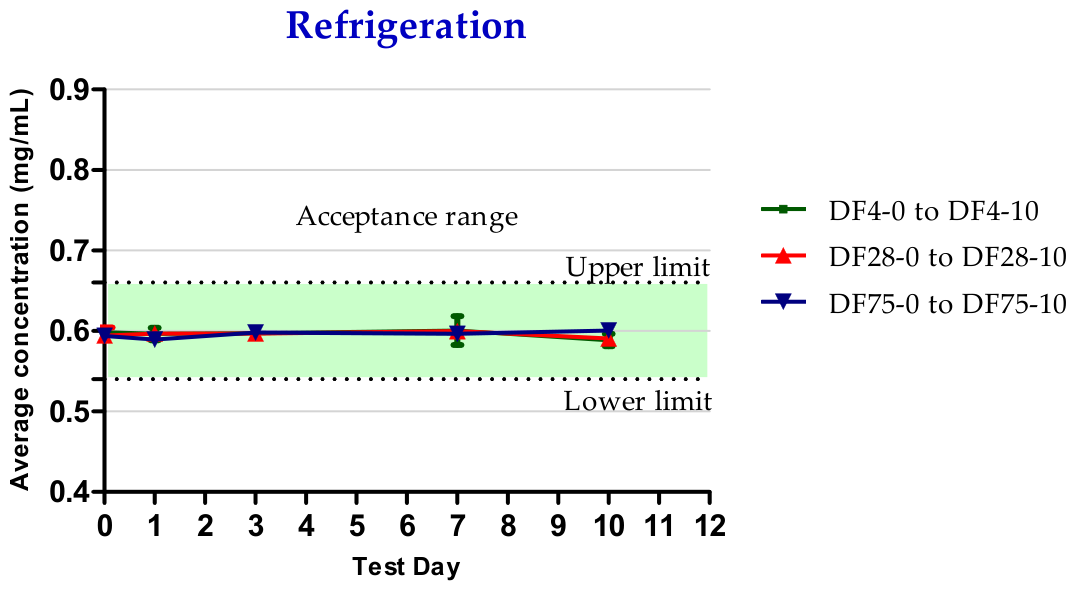

Table 1.
Composition of oseltamivir 15 mg/mL oral solution per 100 mL.
| Ingredients | Quantity |
|---|---|
| Oseltamivir phosphate * | 1.971 g |
| Sodium benzoate | 0.1 g |
| Purified water | to 100 mL |
| * Equivalent to 1.5 g of Oseltamivir | |
Table 1.
Intra-day repeatability of oseltamivir 15 mg/mL oral suspension samples at 67, 100 and 133% of the target concentration of 0.6 mg/mL.
Table 1.
Intra-day repeatability of oseltamivir 15 mg/mL oral suspension samples at 67, 100 and 133% of the target concentration of 0.6 mg/mL.
| Theoretical Concentration (mg/mL) |
0.4 (67%) | 0.6 (100%) | 0.8 (133%) |
|---|---|---|---|
| Mean (mg/mL) | 0.399 | 0.599 | 0.800 |
| SD | 0.001 | 0.003 | 0.005 |
| RSD% | 0.264 | 0.522 | 0.596 |
| Accuracy% | 99.750 | 99.793 | 100.038 |
| RSD%: Relative standard deviation; SD = Standard deviation | |||
Table 2.
Inter-day repeatability of oseltamivir 15 mg/mL oral suspension samples at 67, 100 and 133% of the target concentration of 0.6 mg/mL.
Table 2.
Inter-day repeatability of oseltamivir 15 mg/mL oral suspension samples at 67, 100 and 133% of the target concentration of 0.6 mg/mL.
| Theoretical Concentration (mg/mL) |
0.4 (67%) | 0.6 (100%) | 0.8 (133%) |
|---|---|---|---|
| Mean (mg/mL) | 0.399 | 0.600 | 0.802 |
| SD | 0.002 | 0.004 | 0.005 |
| RSD% | 0.378 | 0.712 | 0.608 |
| Accuracy% | 99.848 | 100.020 | 100.232 |
| RSD%: Relative standard deviation; SD = Standard deviation | |||
Table 3.
Physicochemical results of oseltamivir 15 mg/mL oral suspension in amber glass bottles under freezing conditions.
Table 3.
Physicochemical results of oseltamivir 15 mg/mL oral suspension in amber glass bottles under freezing conditions.
| Parameter | D0 | D4 | D28 | D75 |
|---|---|---|---|---|
| R% | 100 | 99.583 ± 0.001 | 99.332 ± 0.007 | 99.165 ± 0.003 |
| pH | 4.938 ± 0.037 | 5.011 ± 0.002 | 5.032 ± 0.003 | 5.047 ± 0.005 |
| Color | Off-white | Off-white | Off-white | Of-white |
| Homogeneity | Homogeneous | Homogeneous | Homogeneous | Homogeneous |
| Visible Particulates | Absence | Absence | Absence | Absence |
| Crystals ≥10 µm/mL | 0 | 0 | 0 | 0 |
| Results are expressed as mean ± SD (standard deviation) of triplicate determinations; AVR% = Average recovery percentage; D0 = Day 0 of analysis; D4 = Day 4 of analysis; D28 = Day 28 of analysis; D75 = Day 75 of analysis. | ||||
Table 4.
Physicochemical results of oseltamivir 15 mg/mL oral suspension in amber glass bottles under refrigeration conditions, after thawing.
Table 4.
Physicochemical results of oseltamivir 15 mg/mL oral suspension in amber glass bottles under refrigeration conditions, after thawing.
| DF | Test Day | Total days of study | SC | AVR% | pH | Color | Homogeneity | Visible Particulates |
Crystals ≥ 10 µm/mL | |||
|---|---|---|---|---|---|---|---|---|---|---|---|---|
| D0 | 0 | 100 | 4.938 ± 0.037 | Off-white | Homogeneous | Absence | 0 | |||||
| 4 | D4-0 | 4 | F | 99.583 ± 0.001 | 5.011 ± 0.002 | Off-white | Homogeneous | Absence | 0 | |||
| D4-1 | 5 | R | 99.555 ± 0.005 | 5.014 ± 0.007 | Off-white | Homogeneous | Absence | 0 | ||||
| D4-3 | 8 | R | 99.722 ± 0.002 | 5.020 ± 0.003 | Off-white | Homogeneous | Absence | 0 | ||||
| D4-7 | 11 | R | 100.278 ± 0.012 | 5.007 ± 0.008 | Off-white | Homogeneous | Absence | 0 | ||||
| D4-10 | 14 | R | 98.275 ± 0.005 | 5.023 ± 0.002 | Off-white | Homogeneous | Absence | 0 | ||||
| 28 | D28-0 | 28 | F | 99.332 ± 0.007 | 5.032 ± 0.003 | Off-white | Homogeneous | Absence | 0 | |||
| D28-1 | 29 | R | 99.666 ± 0.002 | 5.007 ± 0.008 | Off-white | Homogeneous | Absence | 0 | ||||
| D28-3 | 31 | R | 99.665 ± 0.006 | 5.033 ± 0.002 | Off-white | Homogeneous | Absence | 0 | ||||
| D28-7 | 35 | R | 100.111 ± 0.003 | 5.030 ± 0.003 | Off-white | Homogeneous | Absence | 0 | ||||
| D28-10 | 38 | R | 98.609 ± 0.002 | 5.032 ± 0.004 | Off-white | Homogeneous | Absence | 0 | ||||
| 75 | D75-0 | 75 | F | 99.165 ± 0.003 | 5.047 ± 0.005 | Off-white | Homogeneous | Absence | 0 | |||
| D75-1 | 76 | R | 98.386 ± 0.002 | 5.035 ± 0.005 | Off-white | Homogeneous | Absence | 0 | ||||
| D75-3 | 78 | R | 99.889 ± 0.003 | 5.027 ± 0.006 | Off-white | Homogeneous | Absence | 0 | ||||
| D75-7 | 82 | R | 99.555 ± 0.004 | 5.023 ± 0.004 | Off-white | Homogeneous | Absence | 0 | ||||
| D75-10 | 85 | R | 100.278 ± 0.003 | 5.033 ± 0.003 | Off-white | Homogeneous | Absence | 0 | ||||
| Results are expressed as mean ± SD (standard deviation) of triplicate determinations; AVR% = Average recovery percentage; D0 = Day 0 of the test; DF = Days of freezing before thawing; SC = Storage condition (F = Freezed; R = Refrigerated); Test day: Day of sampling (D+Number1-Number2; Number 1 = Day of thawing and transfer to refrigerated group; Number 2 = Day of test in each refrigerated group). | ||||||||||||
Disclaimer/Publisher’s Note: The statements, opinions and data contained in all publications are solely those of the individual author(s) and contributor(s) and not of MDPI and/or the editor(s). MDPI and/or the editor(s) disclaim responsibility for any injury to people or property resulting from any ideas, methods, instructions or products referred to in the content. |
© 2026 by the authors. Licensee MDPI, Basel, Switzerland. This article is an open access article distributed under the terms and conditions of the Creative Commons Attribution (CC BY) license (http://creativecommons.org/licenses/by/4.0/).
Copyright: This open access article is published under a Creative Commons CC BY 4.0 license, which permit the free download, distribution, and reuse, provided that the author and preprint are cited in any reuse.