

Submitted:
14 July 2026
Posted:
22 July 2026
You are already at the latest version
Abstract
Objectives: Exenatide is a glucagon-like peptide-1 receptor agonist (GLP-1 RA) that slows gastrointestinal (GI) motility. Whether exenatide produces clinically detectable GI motility slowing in real-world practice — and how this compares to other GLP-1 RAs — has not been systematically evaluated. We addressed this question using federated, electronic health record (EHR) data. Further, we present clinical data on vurolenatide, a long-acting variant of exenatide, in patients with short bowel syndrome (SBS), a condition defined by nutritional insufficiency where reducing GI motility could be beneficial to patient outcomes. Methods: We queried de-identified EHR data on the nSights platform to identify treatment episodes for exenatide, semaglutide, and tirzepatide among patients with documented GI hypermotility. Anti-constipation medication prescriptions, body weight, and HbA1c trajectories were compared between pre- and post-treatment periods. Given exenatide’s GI potency, we enrolled 9 SBS patients in a Ph 1b/2a study looking at vurolenatide, dosed subcutaneously every 2 weeks. Safety, tolerability, total urine output, and total stool output were the primary endpoints with the latter serving as a metric for GI motility. Results: We identified patients on exenatide (n=387), semaglutide (10,315), and tirzepatide (5,095) and found the prevalence of anti-constipation prescriptions increased significantly in the exenatide cohort over 12 months (11.09% to 18.62%; p=6.75×10⁻⁴). No significant change was detected with semaglutide (17.54% to 17.70%, p=0.734), and tirzepatide was associated with a decrease in use (18.72% to 14.84%, p<0.001). Exenatide did not impact body weight (-0.5%, p=0.299), compared to semaglutide (-3.95%, p<0.001) and tirzepatide (-8.44%, p<0.001), nor impact HbA1c (-0.02 %-points, p=0.926), compared to semaglutide (-0.26 %-points, p<0.001) and tirzepatide (-0.56 %-points, p<0.001). Consistent with exenatide’s potency at slowing GI motility, biweekly dosing of vurolenatide in human SBS patients showed immediate reduction in total stool output and in the number of bowel movements patients experienced. Conclusions: Exenatide is associated with potent slowing of GI motility in retrospective analysis of EHR data as well as in prospective treatment of SBS patients. This real-world signal proxies the mechanism underlying vurolenatide in SBS and provides a first-in-kind pharmacoepidemiological basis for GLP-1 RA–mediated modulation of GI motility.
Keywords:
GLP-1 agonists
; short bowel syndrome
; vurolenatide
Introduction
Glucagon-like peptide-1 receptor agonists (GLP-1RAs) have transformed the management of cardiometabolic disease by producing clinically meaningful weight loss while improving glycemic control and related metabolic risk factors [1]. Exenatide, an early incretin therapy based on a GLP-1 ortholog from the Gila Monster, demonstrated improvements in glycemic control accompanied by weight loss in individuals with type 2 diabetes (T2DM), providing initial proof that incretin agonism can couple metabolic efficacy with favorable weight trajectories [2]. In that 30-week Phase 3 trial, exenatide produced dose-dependent body weight changes of −3% at the 10 µg twice-daily dose [2]. The class has also progressed substantially since early agents like exenatide. For example, in the STEP 1 Phase 3 trial in subjects with overweight or obesity, once-weekly semaglutide (2.4 mg) yielded a mean −14.9% change in body weight at 68 weeks (vs −2.4% change with placebo) [1]. More recently, dual incretin agonism has further shifted response distributions, where, in the SURMOUNT-1 Phase 3 trial, once-weekly tirzepatide achieved mean −15.0%, −19.5%, and −20.9% changes in body weight at 72 weeks when dosed at 5 mg, 10 mg, and 15 mg, respectively (vs −3.1% with placebo) [3].
Beyond metabolic effects, GLP-1 signaling plays a central role in regulating gastrointestinal motility, including suppression of gastric emptying through vagal afferent–mediated mechanisms [4,5]. This “braking” effect is clinically relevant because gastric emptying is a major determinant of post-prandial glycemic excursions and nutrient delivery to the small intestine [5]. Importantly, GLP-1RA effects on gastric emptying can exhibit tachyphylaxis with sustained exposure, suggesting that the magnitude and persistence of motility effects may differ across agents and dosing paradigms [6]. Head-to-head clinical and mechanistic literature supports a nuanced distinction in the relative ability of clinically-approved GLP-1RAs to modulate GI motility compared to their ability to reduce fasting blood glucose and drive weight loss [7]. Consistent with this framework, exenatide has been shown by scintigraphy to substantially delay gastric emptying of solids and liquids in T2DM, linking motility slowing to post-prandial glucose lowering [8]. In contrast, semaglutide’s impact on gastric emptying is limited using paracetamol absorption [9], and while tirzepatide delays gastric emptying after initial dosing, its inhibitory effect diminishes with repeated exposure [10]. While intriguing, the patchy nature of these comparisons preclude robust conclusions around relative ability of GLP-1RAs to modulate GI motility.
At the same time, intentional slowing of intestinal transit is therapeutically valuable in disorders characterized by rapid transit and impaired absorption. Short bowel syndrome (SBS) is a leading cause of chronic intestinal failure, with malabsorption severe enough to require intravenous fluid and/or parenteral nutrition support in many patients [11]. Pharmacologic intestinal rehabilitation currently includes GLP-2 analog therapies, such as teduglutide (Gattex). In a pivotal randomized trial, after 24 weeks, teduglutide reduced parenteral support requirements by 34% in treated SBS patients, compared to a 17% reduction for placebo controls [12]. However, no patients were able to discontinue parenteral support, highlighting the limited efficacy of GLP-2s in SBS. On the other hand, limited clinical data suggests that GLP-1 agonism may lead to more profound improvements for SBS patients by improving bowel habits and nutritional status [13]. While the study was small (n=5), 3 SBS patients on exenatide therapy were able to cease parenteral support entirely, consistent with a “motility-limited absorption” hypothesis in which slowing transit increases contact time for nutrient and fluid uptake in the remnant bowel [13].
Against this backdrop, we used federated real-world electronic health record (EHR) data to test whether GLP-1RA-mediated motility slowing is clinically detectable at scale and whether it differs across exenatide, semaglutide, and tirzepatide-treated cohorts [14]. We operationalized downstream constipation-treatment prescriptions (laxatives, stool softeners, and related agents) as a pragmatic proxy for reduced gut transit in patients with baseline hypermotility, enabling a pharmacoepidemiologic readout of incretin effects on GI physiology in routine care [5,8].
These findings provide context for long-acting exenatide derivatives under clinical investigation for SBS, such as vurolenatide, which aim to pair exenatide-like GI potency with extended exposure suitable for chronic disease management [15]. Based on this, we also report on a prospective clinical trial to assess a long-acting variant of exenatide, vurolenatide, which is genetically fused to the protein XTEN. The XTEN fusion extends the half-life of the drug, increasing its hydrodynamic radius and reducing renal clearance rates, which could support biweekly subcutaneous dosing.
Results
Study Population and Baseline Characteristics
The analytic cohort comprised 16,184 patients (18,799 treatment episodes) across the nSights federated platform: 387 exenatide patients (162 Byetta, 225 Bydureon), 10,315 semaglutide patients, and 5,095 tirzepatide patients. Baseline characteristics are shown in Table 1. Cohorts were broadly balanced in sex distribution (64.8–76.5% female across drugs) and baseline BMI (35.6–36.5 kg/m² across drugs). Baseline weight was similar across all groups (mean 103.9–107.2 kg).
Several clinically relevant imbalances were noted. Tirzepatide users were significantly younger than exenatide users (median age 55.7 vs 61.9 years; p<0.001), reflecting established prescribing patterns. The prevalence of T2DM at baseline differed substantially: 66.7% in exenatide, 62.4% in semaglutide, and 45.7% in tirzepatide users (p<0.001 for each pairwise comparison). Within the exenatide group, T2DM prevalence was notably higher in Bydureon users (81.0%) than in Byetta users (48.4%; p<0.001).
Anti-Constipation Medication Prescribing
Figure 1B displays the pre-versus-post index prevalence of anti-constipation prescriptions across all GLP-1 RA groups and observation windows. Among exenatide-treated patients, the prevalence of anti-constipation prescriptions increased progressively with longer follow-up, rising from 1.25% (pre) to 4.05% (post), or +2.8 percentage points (pp), at 1 month (p=0.052), +5.28 pp at 6 months (5.71% → 10.99%, p=0.003), and +7.53 pp at 12 months (11.09% → 18.62%, p=6.75×10⁻⁴). Over the 12-month window, 71 patients who had not received anti-constipation medication before starting exenatide received it afterward, compared with 35 who received it before but not after (McNemar test, p=6.75×10⁻⁴). Consistent with this increase in overall prevalence, the distribution of anti-constipation prescription counts among exenatide-treated patients with greater than 0 anti-constipation prescriptions also shifted rightward at 12 months (Figure S1). Specifically, the number of exenatide-treated patients with any anti-constipation prescription increased from 44 in the pre-index window to 65 in the post-index window, while the fraction with only 1 prescription fell from 43.2% to 26.2% and the fraction with 6-10 prescriptions rose from 9.1% to 18.5%, indicating not only more anti-constipation prescribing after treatment initiation but also greater prescription burden among exposed patients.
To parse differing rates between exenatide formulations, we compared anti-constipation prescription prevalence between Byetta (twice-daily administration) and Bydureon (extended release, once-weekly administration) in Figure 1C. At the 2- and 3-month windows, Bydureon showed a significant increase in anti-constipation prescription prevalence, compared to a non-significant trend for Byetta. For example, at 3 months, Bydureon showed a +4.47 pp increase in prevalence (3.25% → 7.72%, p=0.037), whereas Byetta showed a non-significant trend of +2.06 pp (1.55% → 3.61%, p=0.343). At the 6-month window, significance flipped, and Byetta showed a significant +5.26 pp increase in anti-constipation prescription prevalence (3.35% → 8.61%, p=0.029), whereas Bydureon showed a non-significant +5.3 pp trend (7.58% → 12.88%, p=0.055). Similarly, at the 12-month window, anti-constipation prescription prevalence increased +10.00 pp for Byetta (6.67% → 16.67%, p=0.001) but only +5.60 pp for Bydureon (14.55% → 20.15%, p=0.092). Taken together, these results suggest no durable difference in the change in prevalence of anti-constipation prescriptions between short-acting Byetta and long-acting Bydureon. These results are not consistent with previous observations indicating progressive tachyphylaxis with long-acting GLP-1RA formulations [10].
While exenatide use was associated with a clear increase in prevalence of anti-constipation prescriptions, no significant change in prevalence was observed in semaglutide-treated patients at the 12-month window (+0.16 pp, 17.54% → 17.70%, p=0.734). This relative stability was also reflected in Figure S1: the number of semaglutide-treated patients with > 0 anti-constipation prescriptions was unchanged across windows (n=1,789 pre and n=1,789 post), although the distribution among these exposed patients showed only a modest shift toward higher counts. In contrast, tirzepatide was associated with a statistically significant decrease in anti-constipation prescription prevalence at 12 months (-3.88 pp, 18.72% → 14.84%, p=2.09×10⁻⁸), representing 554 patients who required new anti-constipation prescriptions offset by 758 who discontinued them. Consistent with this decline, the number of tirzepatide-treated patients with > 0 anti-constipation prescriptions decreased from 948 in the pre-index window to 740 in the post-index window (Figure S1). Figure S2 showed that the aggregate prescription signals were driven by a limited subset of medications. For anti-constipation prescriptions, exenatide was associated with the largest increases in docusate (+6.07 pp, p=8.91×10⁻⁴) and polyethylene glycol (+5.44 pp, p=1.50×10⁻³), whereas tirzepatide showed a decrease in polyethylene glycol (-3.23 pp, p=1.74×10⁻⁷). For anti-diarrheal prescriptions, exenatide showed reductions in cholestyramine (-2.31 pp, p=0.0266) and diphenoxylate (-2.30 pp, p=0.0034), while tirzepatide showed its strongest decrease for loperamide (-1.81 pp, p=4.40×10⁻¹⁰).
A complementary analysis of anti-diarrheal prescriptions showed significant post-index reductions across the three major GLP-1RA groups (Figure S3). Over the 12-month window, anti-diarrheal prescription prevalence decreased by -4.19 pp for exenatide (11.30% → 7.11%, p=0.0097), -1.77 pp for semaglutide (7.79% → 6.02%, p=5.23×10⁻¹¹), and -3.08 pp for tirzepatide (7.78% → 4.70%, p=3.41×10⁻¹⁵). For exenatide, this corresponded to 37 patients with anti-diarrheal prescriptions in the pre-index but not post-index window, compared with 17 in the post-index but not pre-index window. When stratified by exenatide formulation, both Byetta and Bydureon showed numerically lower anti-diarrheal prescription prevalence at 12 months (-4.76 pp, 9.52% → 4.76%, p=0.066; and -3.73 pp, 12.69% → 8.96%, p=0.100, respectively), although neither subgroup alone reached statistical significance. Taken together, the combination of increased anti-constipation and reduced anti-diarrheal prescription prevalence with exenatide is consistent with stronger net slowing of GI motility than observed with semaglutide or tirzepatide.
Weight Trajectories
Weight change trajectories over 12 months are shown in Figure 2. As expected from prior clinical evidence, exenatide resulted in substantially less weight loss than semaglutide or tirzepatide. At 12 months, mean percent weight change was approximately −0.5% for exenatide (p=0.299), −3.95% for semaglutide (p<0.001), and −8.44% for tirzepatide (p<0.001). Byetta and Bydureon showed comparable and modest weight reduction trajectories. These data confirm that the anti-constipation prescribing signal in exenatide users is unlikely to be attributable to weight-loss-mediated changes in GI physiology.
HbA1C Trajectories
HbA1c change trajectories over 12 months are shown in Figure 3. Consistent with their established glycemic efficacy, semaglutide and tirzepatide produced progressive HbA1c reductions from baseline, reaching −0.26 pp (p<0.001) and −0.56 pp (p<0.001) at 12 months, respectively. In contrast, exenatide showed negligible and variable HbA1c change across the 12-month window (−0.02 pp at month 12, p=0.926), consistent with a modest metabolic profile. This pattern held for both Byetta and Bydureon individually. In sum, these data reinforce that the anti-constipation prescribing signal observed in exenatide users is unlikely to be driven by improvements in glycemic control.
Off-Label Exenatide Therapy in Short Bowel Syndrome
Within the nSights platform, we identified a cohort of 41 patients with Short Bowel Syndrome (SBS) treated with exenatide at any point during their care. We performed a manual chart review of these patients. Patients in this cohort had a median age of 57 years at time of exenatide initiation and carried diagnoses of severe inflammatory bowel disease requiring extensive surgical intervention, including multiple bowel resections and colectomy with high-output ileostomy, over disease courses spanning up to 25 years. Prior to exenatide initiation, select patients had documented histories of parenteral nutrition dependence (partial or total) and chronic dehydration requiring IV fluid support multiple times per week, with associated complications including pancreatitis and sepsis. Following initiation of exenatide (5 µg SQ BID), clinical documentation indicated marked reductions (up to 70%) in ostomy output, with reported decreases from an average of 5–7 daily emptying events to 2–3, as well as improved predictability of bowel function. These improvements were sustained over follow-up periods of at least 6 months. No adverse events attributable to exenatide were reported, and patients demonstrated consistent adherence to the dosing regimen throughout the observed treatment course.
Clinical Study of Vurolenatide-Long-Acting Exenatide in Short Bowel Syndrome
Results thus far suggest that exenatide or exendin-4-based GLP-1RAs might exhibit the necessary pharmacology to activate the ileal break and reduce GI motility. Indeed, previously published data from a retrospective analysis of a clinical protocol looking at exenatide treatment in 5 patients with SBS, found that quality of life markedly improved in all patients in terms of reduced stool output and increased time to bowel movements after eating [13]. Moreover, all (3) patients that required parenteral nutrition were able to cease support after starting exenatide treatment.
We have developed a long-acting exenatide variant, vurolenatide. Vurolenatide’s half-life is extended by genetic fusion to another protein (XTEN). XTEN fusion has the effect of increasing the hydrodynamic radius of the drug and reducing renal clearance rates, ideally supporting biweekly (Q2W) subcutaneous dosing. To test this, 9 patients with anatomically-confirmed SBS diagnoses (< 90cm small bowel length) were enrolled in a Phase 1b/2a trial and randomized into 3 vurolenatide dosing arms (50 mg, 100 mg, 150 mg). All doses were administered twice subcutaneously, once at day 1 and again at day 15. Patients were then followed for 6 weeks after the second dose for primary outcomes (safety, tolerability, adverse events) and secondary outcomes (total stool output, bowel movement frequency). Patient demographics are reported in Table 2, reflecting the expected demographics in terms of age and BMI.
In this study design, vurolenatide was well tolerated at all doses. There were no clinically important changes in blood chemistry, serum glucose, or BUN/creatinine (data not shown). There were no occurrences of hypoglycemia or injection site reactions (not shown). 88% of adverse events were mild (Grade 1, 15/17), and resolved without intervention. 14 of reported AEs were GI related (nausea and vomiting), with 13 of those occurring in the first 24 hours after dosing.
Secondary outputs showed improvements, as shown in Table 3. Total stool output decreased within 48 hours after Dose 1 in all patients, and again after Dose 2 in all patients but one, reflecting the potency of exendin-4-based GLP-1RA to reduce GI motility, even in hypermotile patients. Furthermore, the number of bowel movements also decreased. While only 1 patient in the 50mg (605-02) and all patients in the 150mg cohort showed a reduction in the number of bowel movements after Dose 1, all patients except one (605-05, 100 mg cohort) showed a reduction after Dose 2. Serum pharmacokinetics data showed circulating drug concentrations that support the biweekly (Q2W) dosing regimen (not shown).
Discussion
In the first part of this paper, we present a federated real-world EHR study of 18,799 GLP-1RA treatment episodes in patients with baseline GI hypermotility, we found a statistically significant and clinically meaningful increase in anti-constipation medication prescriptions following initiation of exenatide, but not semaglutide or tirzepatide. These findings are consistent with a GI motility slowing effect that is detectable at population scale in routine clinical practice. Indeed, comparing mean percent body weight reduction, we see the expected responses insofar that patients do not see significant weight loss on exenatide, whereas next generation GLP-1RA (semaglutide) and GLP-1RA/GIPRA dual agonist (tirzepatide) show superiority in weight loss outcomes. HbA1c trajectories are similar: semaglutide and tirzepatide produce consistent glycemic lowering over 12 months, while exenatide does not, further ruling out metabolic confounding as an explanation for the exenatide-specific anti-constipation signal.
Among exenatide formulations, the increase in anti-constipation prescriptions was significant for Byetta using certain observation windows (6mo, 12mo) and significant for Bydureon at others (2mo, 3mo). Altogether, there is no clear pattern in prescription prevalence change for Byetta versus Bydureon, which is somewhat surprising given human and animal studies showing that long-acting or GLP-1RAs lead to blunted reduction of gastric motility [9,10,18]. While this may suggest durability in modulation of GI motility that is exenatide-specific, direct interrogation leveraging scintigraphy will be important to corroborate this finding.
These findings carry direct relevance for the vurolenatide clinical program, as described in the second part of this paper. Vurolenatide is a genetic fusion of exenatide with XTEN, an intrinsically disordered domain designed to extend circulating half-life for subcutaneous dosing in SBS [4]. The therapeutic rationale for vurolenatide rests on GLP-1–mediated GI slowing to increase intestinal transit time and improve nutrient absorption in patients with compromised bowel length. Our retrospective analyses demonstrate that exenatide produces a detectable slowing signal in patients with documented hypermotility conditions, providing epidemiological support for vurolenatide’s mechanism of action at population scale.
Prospective clinical data further support the hypothesis that long-acting exenatide variants like vurolenatide are ideally positioned to improve nutritional outcomes in SBS patients. Even limited dosing of vurolenatide showed immediate reduction total stool output and the number of bowel movements with a strong safety profile. While these results need to be extended in future clinical studies, they provide proof of principle that vurolenatide could be an effective tool for management of fragile metabolic states such as SBS. In future studies, it will be critical to evaluate treatment impact on parenteral nutrition support as well as time between meals and bowel movements, as these parameters are critical to patient quality of life.
Several limitations of this study warrant consideration. Anti-constipation prescriptions are a proxy for GI motility and may be influenced by prescribing practices, patient comorbidities, and concomitant medications not fully captured in our analysis. For example, metformin is commonly used in T2DM to inhibit hepatic gluconeogenesis, but a common side effect is increased GI motility often resulting in diarrhea. While we sought to exclude patients on metformin, which would be particularly prevalent in the exenatide cohort, other confounders like this may impact the GI motility phenotypes that we currently attribute to specific GLP-1RAs. Because our approach is limited by the tokens associated with routine clinical care, we did not have direct measurements of GI transit time or motility parameters from methods such as scintigraphy or manometry. Further, the exenatide cohort was substantially smaller than the comparator cohorts, limiting statistical power for subgroup analyses. The notable difference in baseline T2DM prevalence between Byetta (48.4%) and Bydureon (81.0%) users reflects real-world prescribing patterns and may introduce confounders, given T2DM’s own effects on GI motility [19]. Finally, as a pre-versus-post observational design, we cannot exclude regression to the mean or secular trends in prescribing as contributing factors.
In conclusion, exenatide is associated with a significant and progressive increase in anti-constipation medication prescribing in patients with baseline GI hypermotility, consistent with real-world GI motility slowing. The absence of a slowing signal with semaglutide, and a significant decrease in anti-constipation prescribing with tirzepatide, underscores that this effect is not a class-wide property of GLP-1RAs. These findings provide a pharmacoepidemiological foundation for the therapeutic mechanism of exendin-4-based GLP-1RAs, such as exenatide, lixisenatide, and vurolenatide. Our study suggests that patients suffering from nutritional insufficiency, whether due to anatomical constraints (SBS) or malabsorption progressing to intestinal failure (IBS-D, severe Crohns), may see significant benefits from carefully chosen GLP-1RA therapy, possibly reducing need for parenteral nutritional support and/or relief from attendant comorbidities.
Methods
Data Source
We conducted a retrospective cohort study using EHR data from academic medical centers in the United States via the nSights federated clinical intelligence platform (nference, Inc.) [16,17]. The study was conducted using de-identified data and was exempt from institutional review board oversight under the HIPAA Privacy rule.
Study Design and Cohort Selection
We identified all treatment episodes for exenatide (Byetta, a short acting twice daily preparation or Bydureon a longer acting weekly preparation), semaglutide (Ozempic or Wegovy- both weekly preparations), and tirzepatide (Mounjaro or Zepbound- both weekly preparations) initiated between 1 January 2015 and 31 December 2024. The index date was the date of the first qualifying prescription for each episode. Patients were required to have: (1) at least one documented ICD-10 code indicative of GI hypermotility (diarrhea, loose stools, rapid gastric emptying, or related functional bowel conditions: ICD-10 codes K59.1, K58.0, R19.7, K91.1, K90.0, and K90.2) during the 12 months preceding the index date; (2) de-identified prescription records available in both the pre-index and post-index periods; and (3) a minimum of 30 days of follow-up data. Episodes with prior use of the same GLP-1 RA within 12 months before the index date were excluded. Episodes were additionally excluded if patients had any documented ICD-10 code indicative of pre-existing slow GI motility (constipation, gastroparesis, or autonomic neuropathy: K59.0, K31.811, G99.0) in the 12 months preceding the index date. The cohort attrition process flow for exenatide patients is presented in Figure 1A and, though not shown, similar flows were applied for semaglutide and tirzeptatide.
Outcome: Anti-Constipation Medication Prescriptions
The medication-prescribing outcomes were the prevalence of anti-constipation and anti-diarrheal medication prescriptions in the post-index period relative to the pre-index period. Anti-constipation medications included polyethylene glycol, lactulose, bisacodyl, senna, docusate, lubiprostone, linaclotide, plecanatide, and prucalopride. Anti-diarrheal medications included loperamide, diphenoxylate, bismuth subsalicylate, eluxadoline, rifaximin, and cholestyramine. We defined symmetric observation windows of 1, 2, 3, 6, and 12 months before and after the index date, with the 12-month window designated as the primary endpoint. For each window, treatment episodes with at least one clinical encounter in both the pre-index and post-index windows were considered eligible. Each eligible episode was then classified according to whether at least one prescription in the medication category was present in the pre-index window and in the post-index window. McNemar’s test was used to assess the statistical significance of the paired within-episode change. For each drug group and observation window, the effect size was summarized as the difference between post-index prevalence and pre-index prevalence, expressed in percentage points.
Statistical Analysis
Baseline demographic characteristics were compared using Welch’s t-test (continuous variables) and Fisher’s exact test (categorical variables). Pre-versus-post differences in anti-constipation medication prevalence were assessed using McNemar’s test, which accounts for the paired within-patient design. For each treatment episode, the patient’s prescription status in the pre-index window was paired with their status in the post-index window. McNemar’s test compares the number of discordant pairs (pre-yes/post-no versus pre-no/post-yes) to determine whether the direction of change is statistically significant. Results are reported as pre-index prevalence, post-index prevalence, absolute change in percentage points (pp), and two-sided McNemar p-value. Mean percent weight change and mean absolute HbA1c change at month 12 were each tested against zero using a one-sample two-sided t-test. A p-value < 0.05 was considered statistically significant. All analyses were performed in Python 3.12 using scipy 1.14 and pandas 2.2.
Secondary Analyses: Weight and HbA1c Trajectories
We computed weight and HbA1c trajectories for each drug group over 12 months of follow-up. For weight, baseline was defined as the nearest body weight measurement within 90 days preceding the index date. For HbA1c, baseline was the nearest measurement within 365 days preceding the index date. For each episode with a valid baseline measurement, monthly values were computed as percent change from baseline (weight) or absolute change in percentage points (HbA1c) for all post-index measurements within a 12-month window. Per-episode monthly medians were first computed, then summarized as mean ± SD across episodes per drug group.
Vurolenatide Clinical Trial for Short Bowel Syndrome
In a separate prospective study, 9 patients with anatomically-confirmed SBS diagnoses (< 90cm small bowel length) were enrolled in a Phase 1b/2a trial and randomized into 3 vurolenatide dosing arms (50 mg, 100 mg, 150 mg). All doses were administered twice subcutaneously, once on day 1 and again on day 15. Subjects were then followed for 6 weeks after the second dose for primary outcomes (safety, tolerability, adverse events) and secondary outcomes (total stool output, bowel movement frequency). The trial identification number is NCT04379856 (https://clinicaltrials.gov/study/NCT04379856).
Ethical Considerations Statement for Vurolenatide Clinical Trial
For the Vurolenatide clinical trial, the study protocol was approved by the IRB at Cedars-Sinai (STUDY00000605) and all subjects gave informed written consent prior to commencing study activities. The study included male and female subjects aged 18-75 years with SBS secondary to surgical resection of small intestine, with or without an intact colon, who did not have active IBD or celiac disease, inadequate hepatic function, inadequate renal function, or a history of pancreatitis, among others. The full inclusion and exclusion criteria are presented in Supplemental Table S1.
Data Source and Selection
The retrospective portion of this study analyzed de-identified EHR data from a network of tertiary clinical centers tied to academic medical centers in the United States through the nference nSights Analytics Platform. nference, in collaboration with academic medical center (AMC) data partners, provided the de-identified data for this study. nference has established a secure data environment, hosted by and within each of the AMCs, that contains the AMC’s de-identified patient data. The provisioning of and access to this data are governed by an expert determination that satisfies the HIPAA Privacy Rule requirements for the de-identification of protected health information. Each AMC’s de-identified data environment is specifically designed and operated to enable access to and analysis of de-identified data without the need for Institutional Review Board (IRB) oversight, approval, or an exemption confirmation. Given these measures, informed consent and IRB review were not required for this study.
De-Identification and HIPAA Compliance Certification
In the retrospective portion of this study, prior to analysis, all EHR data were de-identified under an expert determination consistent with the Health Insurance Portability and Accountability Act (HIPAA) Privacy Rule (45 CFR §164.514(b)(1)). The de-identification methodology employed a multi-layered transformation approach to both structured and unstructured data fields [16,17]. In structured data, direct identifiers including patient names and precise geographic locations were excluded entirely, while indirect identifiers underwent specific transformations: patient identifiers, medical record numbers, and accession numbers were replaced with one-way cryptographic hashes using confidential salts to preserve linkage across patient encounters; all dates were shifted backward by patient-specific random offsets (1–31 days) to preserve temporal relationships while obscuring exact event timing; and continuous variables including age, height, weight, and body mass index were thresholded to prevent identification of extreme values. In unstructured clinical text, an ensemble de-identification system combining attention-based deep learning models with rule-based methods achieved an estimated >99% recall for personally identifiable information (PII) detection, with detected identifiers replaced by plausible fictional surrogates. [16]
Data Harmonization
To address heterogeneity in EHR data across sites on the nSights platform, we harmonized clinical variables including medications, diagnoses, and anthropometric measurements to standardized concepts. For medications, we constructed a standardized drug concept database combining the nSights knowledge graph [20] with RXNorm hierarchies to capture ingredient, brand, and dose-specific information. For diagnoses, we developed a hierarchical disease concept database from the nSights knowledge graph and mapped EHR diagnosis descriptions and codes to standardized ICD-10 concepts. This approach enabled consistent identification of GI hypermotility conditions and anti-constipation medications across sites while preserving institutional granularity.
Supplementary Materials
The following supporting information can be downloaded at the website of this paper posted on Preprints.org.
Guarantor of the article
Venky Soundararajan.
Financial support
No external entity funded, supported, or had any role in the study design, data acquisition, analysis, interpretation, manuscript preparation, or the decision to submit this work for publication.
Data Availability
This study involves the analysis of de-identified electronic health record (EHR) data via the nference nSights Federated Clinical Analytics Platform (nSights). Data shown and reported in this manuscript were extracted from this environment using an established protocol for data extraction aimed at preserving patient privacy. The data has been de-identified pursuant to an expert determination in accordance with the HIPAA Privacy Rule. Any data beyond what is reported in the manuscript, including but not limited to the raw EHR data, cannot be shared or released due to the parameters of the expert determination to maintain data de-identification. The corresponding authors should be contacted for additional details regarding nSights.
Code Availability
The code used in this study is not publicly available. Requests for additional information should be directed to the corresponding authors.
Conflicts of Interest Statement
K.M., C.G., and V.S. are employees of nference, Inc. R.M. reports equity interests in Salvo Health, Cylinder Health, GoodLFE, and Gemelli Biotech; has served as a consultant for Ardelyx and Eli Lilly; and Cedars-Sinai has licensing agreements with Hobbs Medical and Gemelli Biotech. M.P. reports equity interests in Salvo Health, Cylinder Health, GoodLFE, and Gemelli Biotech; has served as a consultant for Ardelyx and Eli Lilly; and Cedars-Sinai has licensing agreements with Hobbs Medical and Gemelli Biotech. These relationships are unrelated to the present study. No external entity funded, supported, or had any role in the study design, data acquisition, analysis, interpretation, manuscript preparation, or the decision to submit this work for publication. All analyses were conducted by the authors using de-identified electronic health record data.
Acknowledgments
We thank the nference engineering team for development and operation of the nSights federated AI platform, and the clinical informatics teams at partner academic medical centers for enabling this research.
References
- Wilding, J. P. H.; et al. Once-Weekly Semaglutide in Adults with Overweight or Obesity. N Engl. J. Med. 2021, 384, 989–1002. [Google Scholar] [CrossRef] [PubMed]
- DeFronzo, R. A.; et al. Effects of exenatide (exendin-4) on glycemic control and weight over 30 weeks in metformin-treated patients with type 2 diabetes. Diabetes Care 2005, 28, 1092–1100. [Google Scholar] [CrossRef] [PubMed]
- Jastreboff, A. M.; et al. Tirzepatide Once Weekly for the Treatment of Obesity. N Engl. J. Med. 2022, 387, 205–216. [Google Scholar] [CrossRef] [PubMed]
- Imeryüz, N.; et al. Glucagon-like peptide-1 inhibits gastric emptying via vagal afferent-mediated central mechanisms. Am. J. Physiol. 1997, 273, G920–7. [Google Scholar] [PubMed]
- Tong, J.; D’Alessio, D. Give the receptor a brake: slowing gastric emptying by GLP-1. Diabetes 2014, 63, 407–409. [Google Scholar] [CrossRef] [PubMed]
- Nauck, M. A.; Kemmeries, G.; Holst, J. J.; Meier, J. J. Rapid tachyphylaxis of the glucagon-like peptide 1-induced deceleration of gastric emptying in humans. Diabetes 2011, 60, 1561–1565. [Google Scholar] [CrossRef] [PubMed]
- Madsbad, S. Review of head-to-head comparisons of glucagon-like peptide-1 receptor agonists. Diabetes Obes. Metab. 2016, 18, 317–332. [Google Scholar] [CrossRef] [PubMed]
- Linnebjerg, H.; et al. Effect of exenatide on gastric emptying and relationship to postprandial glycemia in type 2 diabetes. Regul. Pept. 2008, 151, 123–129. [Google Scholar] [CrossRef] [PubMed]
- Friedrichsen, M.; Breitschaft, A.; Tadayon, S.; Wizert, A.; Skovgaard, D. The effect of semaglutide 2.4 mg once weekly on energy intake, appetite, control of eating, and gastric emptying in adults with obesity. Diabetes Obes. Metab. 2021, 23, 754–762. [Google Scholar] [CrossRef] [PubMed]
- Urva, S.; et al. The novel dual glucose-dependent insulinotropic polypeptide and glucagon-like peptide-1 (GLP-1) receptor agonist tirzepatide transiently delays gastric emptying similarly to selective long-acting GLP-1 receptor agonists. Diabetes Obes. Metab. 2020, 22, 1886–1891. [Google Scholar] [CrossRef] [PubMed]
- Pironi, L. Definitions of intestinal failure and the short bowel syndrome. Best Pract. Res. Clin. Gastroenterol. 2016, 30, 173–185. [Google Scholar] [CrossRef] [PubMed]
- Jeppesen, P. B.; et al. Teduglutide reduces need for parenteral support among patients with short bowel syndrome with intestinal failure. Gastroenterology 2012, 143, 1473–1481.e3. [Google Scholar] [CrossRef]
- Kunkel, D.; et al. Efficacy of the glucagon-like peptide-1 agonist exenatide in the treatment of short bowel syndrome. Neurogastroenterol. Motil. 2011, 23, 739–e328. [Google Scholar] [CrossRef] [PubMed]
- Allam, A.; Feuerriegel, S.; Rebhan, M.; Krauthammer, M. Analyzing Patient Trajectories With Artificial Intelligence. J. Med. Internet Res. 2021, 23, e29812. [Google Scholar] [CrossRef] [PubMed]
- ClinicalTrials.gov. Available online: https://clinicaltrials.gov/study/NCT04988997.
- Murugadoss, K.; et al. Building a best-in-class automated de-identification tool for electronic health records through ensemble learning. Patterns (N Y) 2021, 2, 100255. [Google Scholar] [CrossRef] [PubMed]
- Murugadoss, K.; et al. Scaling text de-identification using locally augmented ensembles. medRxiv 2024. [Google Scholar] [CrossRef]
- Umapathysivam, M. M.; et al. Comparative effects of prolonged and intermittent stimulation of the glucagon-like peptide 1 receptor on gastric emptying and glycemia. Diabetes 2014, 63, 785–790. [Google Scholar] [CrossRef] [PubMed]
- Chiu, Y.-C.; et al. Decreased gastric motility in type II diabetic patients. BioMed Res. Int. 2014, 2014, 894087. [Google Scholar] [CrossRef] [PubMed]
- Venkatakrishnan, A. J.; et al. Clinical nSights: A software platform to accelerate real world oncology analyses. J. Clin. Oncol. 2024. [Google Scholar] [CrossRef]
Figure 1.
Pre-versus-post index prevalence of anti-constipation prescriptions across GLP-1RA treatment groups as a function of observation windows (1, 2, 3, 6, and 12 months). (A) Cohort attrition flow diagram outlining derivation of GLP-1RA cohorts analyzed here, shown specifically for exenatide. At each step, the number of unique patients (N) and total number of clinical encounters (K) are shown at right. (B) Anti-constipation prescription prevalence shown as post-prescription (rx) prevalence minus pre-rx prevalence for exenatide (blue bars), semaglutide (green), and tirzepatide (red). Statistical significance was defined using McNemar’s paired test with p<0.05 (*), p<0.01 (**), and p<0.001 (***). (C) Anti-constipation prescription prevalence, as in B, but for Byetta (short-acting, dark blue) and Bydureon (long-acting, light blue) with significance indicated as in B. Exenatide combined N=387; Byetta N=162; Bydureon N=225; Semaglutide N=10,315; Tirzepatide N=5,095. Pp: percentage points.
Figure 1.
Pre-versus-post index prevalence of anti-constipation prescriptions across GLP-1RA treatment groups as a function of observation windows (1, 2, 3, 6, and 12 months). (A) Cohort attrition flow diagram outlining derivation of GLP-1RA cohorts analyzed here, shown specifically for exenatide. At each step, the number of unique patients (N) and total number of clinical encounters (K) are shown at right. (B) Anti-constipation prescription prevalence shown as post-prescription (rx) prevalence minus pre-rx prevalence for exenatide (blue bars), semaglutide (green), and tirzepatide (red). Statistical significance was defined using McNemar’s paired test with p<0.05 (*), p<0.01 (**), and p<0.001 (***). (C) Anti-constipation prescription prevalence, as in B, but for Byetta (short-acting, dark blue) and Bydureon (long-acting, light blue) with significance indicated as in B. Exenatide combined N=387; Byetta N=162; Bydureon N=225; Semaglutide N=10,315; Tirzepatide N=5,095. Pp: percentage points.
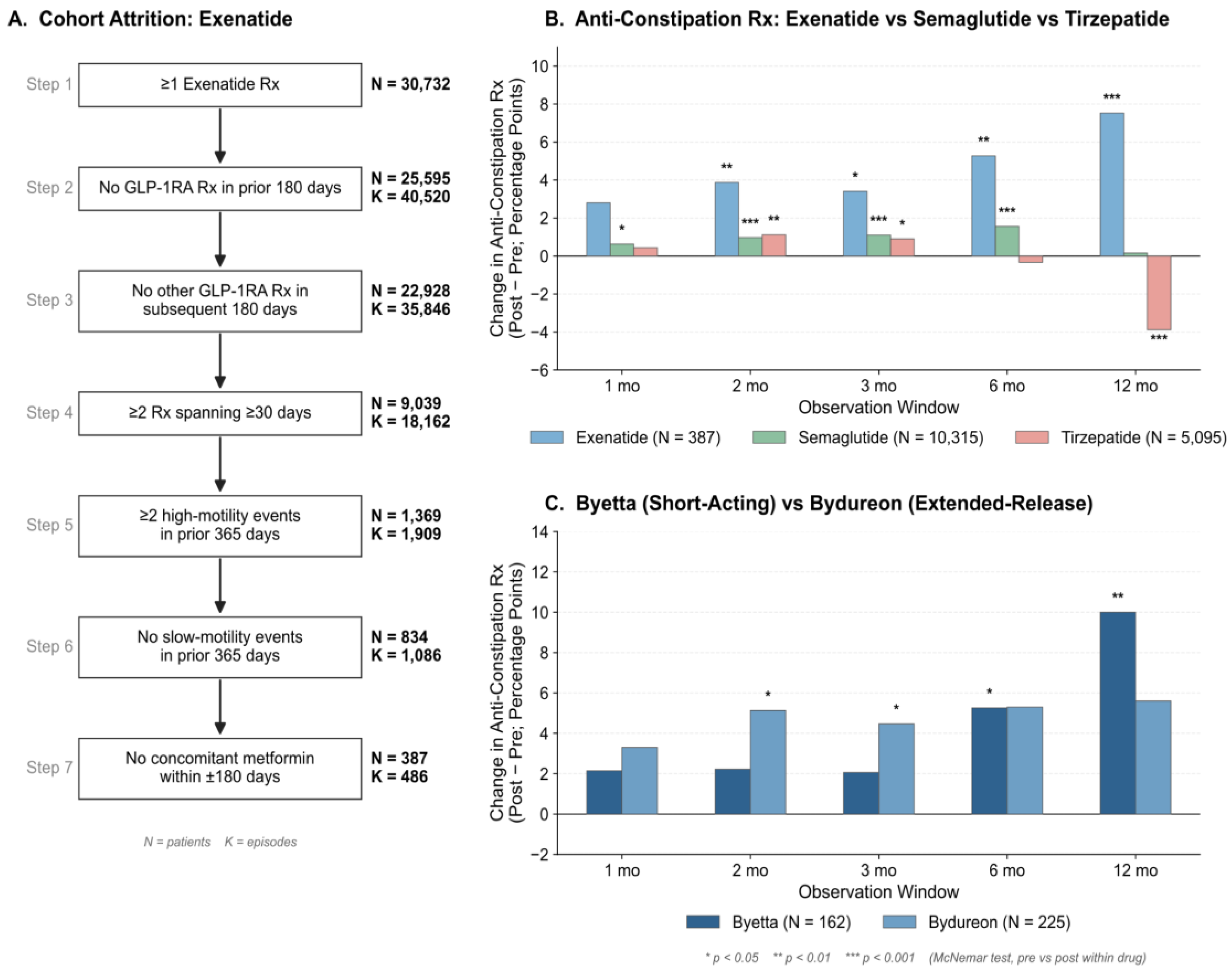
Figure 2.
Weight change trajectories over 12 months from GLP-1RA treatment initiation, reported as % change from baseline body weight at the time of prescription. Lines represent mean percentage weight change; shaded bands represent ±1 standard error. N in legend represents episodes with ≥1 post-index weight measurement. (A) Exenatide (Byetta and Bydureon combined) versus semaglutide versus tirzepatide. (B) Byetta (dark blue) versus Bydureon (light blue).
Figure 2.
Weight change trajectories over 12 months from GLP-1RA treatment initiation, reported as % change from baseline body weight at the time of prescription. Lines represent mean percentage weight change; shaded bands represent ±1 standard error. N in legend represents episodes with ≥1 post-index weight measurement. (A) Exenatide (Byetta and Bydureon combined) versus semaglutide versus tirzepatide. (B) Byetta (dark blue) versus Bydureon (light blue).
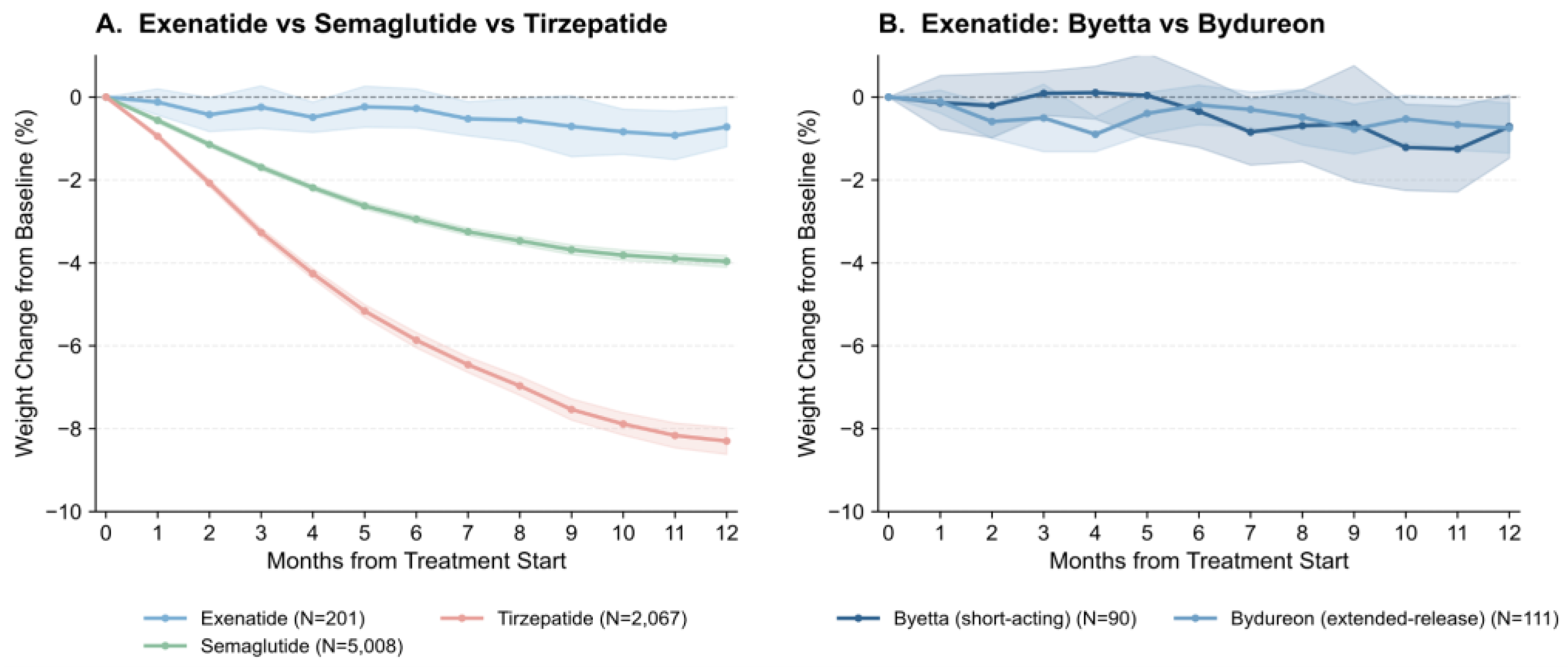
Figure 3.
HbA1c change trajectories over 12 months from GLP-1RA treatment initiation, reported as absolute change from baseline HbA1c (pp). Lines represent mean absolute change; shaded bands represent ±1 standard error. N in legend represents episodes with ≥1 post-index HbA1c measurement. (A) Exenatide (Byetta and Bydureon combined) versus semaglutide versus tirzepatide. (B) Byetta (dark blue) versus Bydureon (light blue).
Figure 3.
HbA1c change trajectories over 12 months from GLP-1RA treatment initiation, reported as absolute change from baseline HbA1c (pp). Lines represent mean absolute change; shaded bands represent ±1 standard error. N in legend represents episodes with ≥1 post-index HbA1c measurement. (A) Exenatide (Byetta and Bydureon combined) versus semaglutide versus tirzepatide. (B) Byetta (dark blue) versus Bydureon (light blue).
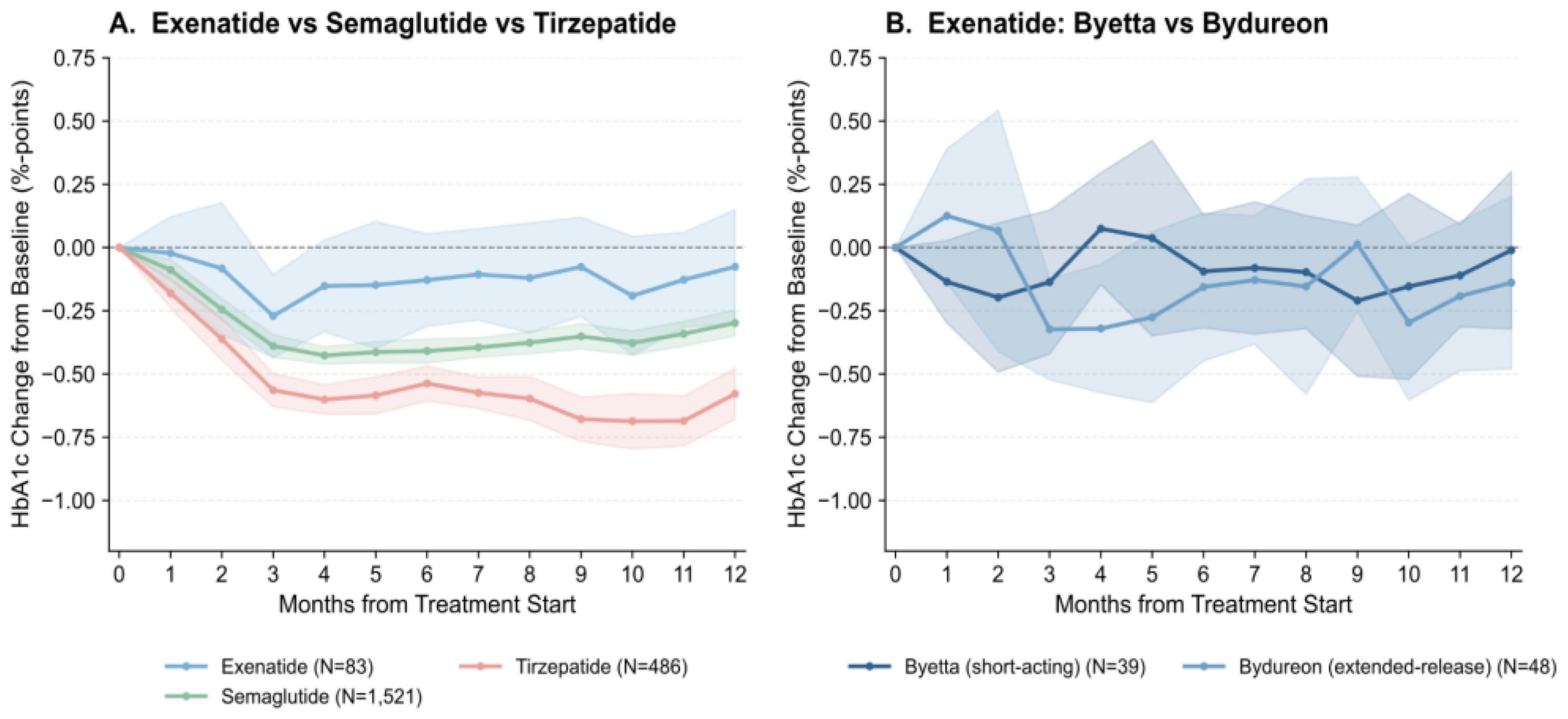

Table 1.
Baseline characteristics of GLP-1 RA treatment episodes in patients with documented GI hypermotility (nSights federated platform). Continuous variables: mean (SD) or median [IQR]; categorical: N (%).
Table 1.
Baseline characteristics of GLP-1 RA treatment episodes in patients with documented GI hypermotility (nSights federated platform). Continuous variables: mean (SD) or median [IQR]; categorical: N (%).
| Variable |
Exenatide (N=387) |
Byetta (N=162) |
Bydureon (N=225) |
Semaglutide (N=10,315) |
Tirzepatide (N=5,095) |
| N — treatment episodes | 486 | 213 | 273 | 11728 | 5334 |
| Female — N (%) | 340 (70.0%) | 163 (76.5%) | 177 (64.8%) | 7905 (67.4%) | 3835 (71.9%) |
| Age at index — Median [IQR] | 61.9 [52.4–68.4] | 61.3 [54.2–66.6] | 62.2 [51.4–70.4] | 59.2 [48.0–68.5] | 55.7 [44.6–65.3] |
| Race: White — N (%) | 395 (81.3%) | 180 (84.5%) | 215 (78.8%) | 9183 (78.3%) | 4489 (84.2%) |
| Race: Black / African American — N (%) | 71 (14.6%) | 23 (10.8%) | 48 (17.6%) | 1907 (16.3%) | 543 (10.2%) |
| Race: Other — N (%) | 20 (4.1%) | 10 (4.7%) | 10 (3.7%) | 638 (5.4%) | 302 (5.7%) |
| 1-yr pre-Index clinical events per patient — Median [IQR] | 310.3 [189.8–612.3] | 280.5 [162.2–468.9] | 375.0 [222.4–743.4] | 368.4 [206.5–691.2] | 341.7 [194.6–644.0] |
| 1-yr post-Index clinical events per patient — Median [IQR] | 271.0 [140.2–625.2] | 245.2 [134.4–545.4] | 335.1 [162.2–633.8] | 283.4 [139.0–575.6] | 209.1 [91.0–423.2] |
| T2DM at baseline — N (%) | 324 (66.7%) | 103 (48.4%) | 221 (81.0%) | 7324 (62.4%) | 2440 (45.7%) |
| Baseline weight (kg) — Mean (SD) | 105.6 (23.5) | 104.5 (24.6) | 106.5 (22.9) | 103.9 (24.4) | 107.2 (25.1) |
| Baseline BMI (kg/m²) — Mean (SD) | 36.2 (5.9) | 35.7 (6.5) | 36.5 (5.6) | 35.6 (6.3) | 36.4 (6.3) |
Table 2.
Phase 1b/2a Trial demographics.
| Demographic | 50 mg Arm | 100 mg Arm | 150 mg Arm | Overall |
| Gender (M/F) | 0/3 | 3/1 | 2/0 | 5/4 |
| Avg Age (yr) | 45.7 | 52.0 | 60.5 | 52.7 |
| Race (White/Black) | 3/0 | 3/1 | 2/0 | 8/1 |
| Avg. Height (cm) | 170.2 | 178.1 | 177.0 | 175.1 |
| Avg Weight (kg) | 58.1 | 72.5 | 74.2 | 68.2 |
| Avg. BMI (mg/m2) (Range) | 20.3 (14.2 to 27.0) |
22.6 (22.4 to 22.8) |
23.8 (22.7 to 24.8) |
22.2 (14.2 to 27.0) |
Table 3.
Total stool output following first and second vurolenatide dose.
| Subject | Dose | Number of bowel movements | Total stool output | ||||
| Bowel movements (n) | Change from baseline (n) | Baseline output (mL) | Change from baseline (mL) | ||||
| Baseline | Dose 1 | Dose 2 | Baseline | Dose 1 | Dose 2 | ||
| 605-01 | 50 | N/Aa | N/Aa | N/Aa | 22058 | -9958 | -8558 |
| 605-02 | 50 | 22 | -21 | -18 | 1900 | -1700 | -1600 |
| 605-06 | 50 | 5 | +3 | N/Ab | 1175 | -825 | N/Ab |
| 605-03 | 100 | N/Aa | N/Aa | N/Aa | 720 | -105 | -395 |
| 605-04 | 100 | 20 | 0 | -10 | 1285 | -856 | +1165 |
| 605-05 | 100 | 8 | +3 | +5 | 2280 | -280 | -340 |
| 605-07 | 100 | 22 | -5 | -12 | 5390 | -2380 | -2790 |
| 605-08 | 150 | 12 | -3 | -3 | 2570 | -420 | -1090 |
| 605-09 | 150 | 13 | -4 | -5 | 4850 | -950 | -1850 |
aSubject 605-01 had an end jejunostomy and 605-03 had an ileostomy, thus there is no bowel movement frequency for these subjects. bSubject 605-06 did not receive dose 2 due to BMI under the study inclusion limit at that point.
Disclaimer/Publisher’s Note: The statements, opinions and data contained in all publications are solely those of the individual author(s) and contributor(s) and not of MDPI and/or the editor(s). MDPI and/or the editor(s) disclaim responsibility for any injury to people or property resulting from any ideas, methods, instructions or products referred to in the content. |
© 2026 by the authors. Licensee MDPI, Basel, Switzerland. This article is an open access article distributed under the terms and conditions of the Creative Commons Attribution (CC BY) license (http://creativecommons.org/licenses/by/4.0/).
Copyright: This open access article is published under a Creative Commons CC BY 4.0 license, which permit the free download, distribution, and reuse, provided that the author and preprint are cited in any reuse.


