
Submitted:
21 July 2026
Posted:
21 July 2026
You are already at the latest version
Abstract
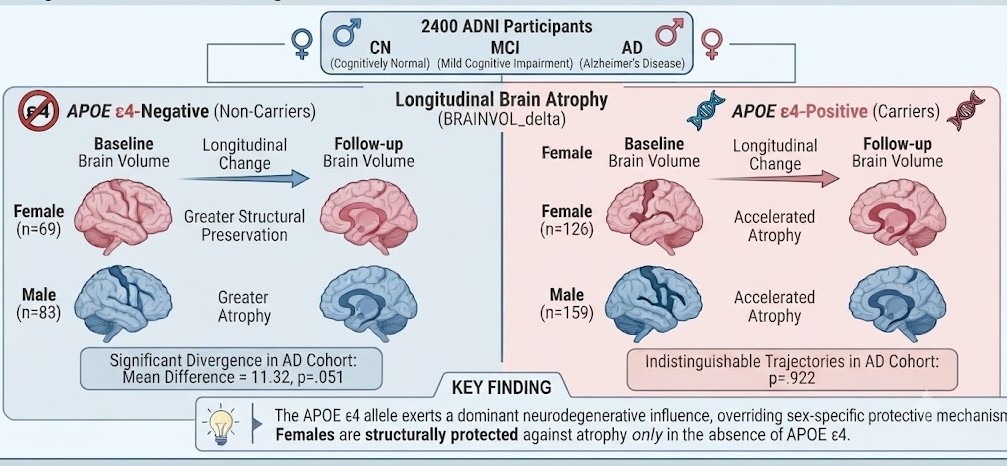
Background: The interaction between sex, APOE ε4 status, and clinical progression in Alzheimer’s Disease (AD) remains a subject of debate. While females are often considered at higher risk for AD, the underlying structural neuroanatomical trajectories and how they are modulated by genotype are not fully elucidated. This study aims to evaluate how sex and the APOE ε4 genotype interact to influence longitudinal brain atrophy across three clinical groups.
Methods: We analyzed longitudinal data from 2400 participants from the Alzheimer's Disease Neuroimaging Initiative (ADNI), stratified by clinical group (i.e., cognitively normal, mild cognitive impairment, and AD), sex, and APOE ε4 carrier status. Using Type III Sum of Squares ANCOVA, we modeled the longitudinal variation in brain volume, controlling for baseline brain volume, and baseline severity of neurocognitive impairment and age at entry.
Results: While main effects of sex and APOE genotype were not significant, the triple interaction (APOE * Sex * Clinical Group) was marginally significant (p = .051). Post-hoc analysis revealed a distinct pattern of structural dimorphism within the AD cohort among APOE ε4-negative individuals with females exhibiting significantly greater structural preservation compared to males (Mean difference = 11.32, p = .051). Among APOE ε4 carriers, atrophy trajectories for males and females were statistically indistinguishable (p = .922), suggesting that the ε4 allele exerts a dominant neurodegenerative influence that overrides sex-specific physiological differences.
Conclusion: These findings highlight the importance of jointly considering biological sex and APOE ε4 status to improve the characterization of Alzheimer's disease heterogeneity and support precision medicine approaches.
Keywords:
genotype
; precision medicine
; brain atrophy
; neurocognitive disorder
; Alzheimer’s disease
; APOE
Copyright: This open access article is published under a Creative Commons CC BY 4.0 license, which permit the free download, distribution, and reuse, provided that the author and preprint are cited in any reuse.


