
Submitted:
20 July 2026
Posted:
21 July 2026
You are already at the latest version
Abstract
Taste supports survival by helping animals identify useful nutrients and avoid harmful excess. Sodium is essential for extracellular fluid balance, osmotic regulation, nerve transmission, muscle contraction, and nutrient transport, but it is continually lost and must be replaced through diet. This review proposes the Sodium Priority Hypothesis: sodium is a primary nutritional target whose consumption is enabled by converging sensory mechanisms. Sodium chloride provides the dominant route to pure saltiness, while sodium-linked umami, bitterness suppression, and taste-mixture modulation may further support sodium acquisition and food acceptance. Potassium provides an important contrast because it is essential but has weaker salty quality, bitter or metallic side notes, and does not reproduce sodium’s bitterness-suppressing effect in model savory systems. By linking sodium detection, sodium-linked umami, bitterness suppression, and food-mixture modulation with appetite and potential pre-ingestive or post-ingestive regulation, the hypothesis extends the taste-nutrition interface to sodium acquisition. The hypothesis does not reject umami as a protein-related signal, but proposes that sodium-linked umami may have dual relevance for protein food recognition and sodium acquisition. This framework generates testable predictions and may inform sodium reduction, food reformulation, and dietary guidance.
Keywords:
sodium
; salt taste
; umami
; monosodium glutamate
; bitterness suppression
; sodium appetite
; flavor acceptance
; evolutionary nutrition
; sodium reduction
1. Introduction
Taste is a biological system that supports survival by guiding animals toward useful nutrients and away from harmful or excessive exposures [1]. Sweet taste is commonly associated with simple carbohydrate availability, bitter taste with avoidance of potentially toxic compounds, sour taste with acidity, salt taste with mineral balance, and umami with amino acids or protein-related foods [1]. These associations are useful, but they oversimplify the ecological and physiological roles of taste. Taste qualities function as flexible sensory signals that help animals evaluate foods in relation to nutritional need, physiological state, and environmental availability.
Sodium is an essential nutrient for animal life as it is the major extracellular cation and is required for extracellular fluid volume, osmotic regulation, nerve transmission, muscle contraction, and nutrient transport [2]. Sodium is continually lost through urine, sweat, and feces and must be replenished through diet. This is particularly important for terrestrial animals because sodium is unevenly distributed across land environments and can generate a specific motivational state of sodium appetite when depleted [3,4,5]. However, the modern food environment has changed the relationship between sodium need and sodium exposure. Sodium is now a cost-effective and widely used food additive that increases liking, improves flavour balance and is ubiquitous across the food supply. As a result, sensory systems that evolved to promote sodium acquisition under conditions of scarcity now operate in an environment where sodium is plentiful and frequently consumed in excess.
The central proposition of this review is that sodium may occupy a higher-order position in taste and food acceptance than has previously been recognised. Rather than functioning just as the stimulus for salt taste, sodium may act as a primary nutritional target that recruits multiple sensory mechanisms to promote food acceptance. It produces saltiness through sodium chloride, improves flavour balance through bitterness suppression and taste-mixture modulation, and contributes to savoury food liking through sodium-linked umami. In this sense, sodium is not simply one taste stimulus within the basic taste system, it is a central nutrient signal that uses several taste pathways to increase the detectability, palatability and consumption of sodium-containing foods. We propose the Sodium Priority Hypothesis, which argues that evolutionary biological pressure shaped taste systems to help ensure sodium was detected, accepted and consumed via multiple mechanisms (Table 1) [6,7,8,9,10,11]. This suggests that the sensory system may be especially tuned to sodium acquisition rather than to cations in general. In this model, chloride, glutamate, and other anions act as chemical and sensory vehicles that make sodium detectable, palatable, and behaviorally reinforcing.
This hypothesis is intentionally integrative. It does not argue that umami exists only to drive sodium intake, nor does it suggest that sodium intake is always beneficial in modern diets. Instead, it proposes that sodium-linked sensory systems that were adaptive under conditions of sodium scarcity may now contribute to high palatability and overconsumption of sodium-containing foods in modern food environments [6,12]. Understanding sodium as a multifunctional sensory and nutritional driver may improve approaches to sodium reduction, food reformulation, and dietary guidance.
Purpose and Scope of the Review
This narrative review critically synthesizes evidence from sodium physiology, sodium appetite, salt taste, anion effects, umami perception, taste-mixture interactions, and sodium reduction. The objective is to evaluate whether these literatures can be integrated through a common organizing principle - sodium as a primary nutritional target whose consumption is enabled by multiple converging sensory mechanisms. The review is conceptual rather than systematic. It is designed to identify converging evidence, unresolved tensions, and empirical predictions that arise when sodium is considered across physiological, sensory, and food-matrix domains. The central outcome is the Sodium Priority Hypothesis, a testable framework rather than an established model.
2. Literature Review Approach
Literature was identified through targeted searches of peer-reviewed publications in taste physiology, sensory science, food science, nutrition, and sodium-reduction research. Priority was given to studies and reviews addressing sodium appetite, sodium taste, potassium chloride and sodium substitution, anion effects on salt taste, sodium-mediated bitterness suppression, umami and monosodium glutamate, ribonucleotide synergy, and dietary sodium reduction. Important mechanistic papers, human psychophysical studies, animal sodium-deprivation studies, and food-matrix studies were included where they directly informed the proposed framework. Findings were evaluated according to their relevance to 4 questions: whether sodium has a distinctive physiological and motivational role; whether sodium has sensory effects beyond saltiness; whether sodium-linked umami differs conceptually from umami quality alone; and whether these mechanisms have implications for food acceptance, sodium reduction, and future research.
3. Sodium Physiology and Sodium Appetite
Life evolved in aqueous environments rich in dissolved ions. Early organisms were surrounded by solutions containing sodium, chloride, potassium, calcium, magnesium, and other ions. The transition from aquatic to terrestrial life changed the relationship between animals and sodium. Sodium was no longer continuously available from the surrounding environment and instead became patchily distributed across soils, plants, water sources, and animal tissues [3,4]. For terrestrial animals, this created an ecological and physiological challenge. Sodium is essential, but its availability can be limited. Many animals display sodium-seeking behaviors under conditions of deficiency or ecological scarcity including use of salt licks, geophagy, selective feeding, and increased acceptance of sodium-containing substances [3,4,5]. Such responses suggest that sodium appetite is not merely a learned food preference, but a biologically organized motivational state.
Evidence from controlled sodium-depletion studies supports this interpretation with experimental sodium depletion in humans producing moderate sensory changes and increases the attractiveness of salty foods, while sodium deprivation in rats alters sodium chloride ingestion patterns and gustatory responses [13,14]. The evidence that sodium depletion can alter sodium seeking and salt liking is strong. However, most studies have examined sodium chloride rather than sodium delivered through broader food matrices or sodium-linked savory compounds. Whether sodium appetite generalizes to monosodium glutamate, sodium-containing ribonucleotides, or other sodium-rich savory matrices remains uncertain and is central to the proposed hypothesis.
From an evolutionary perspective, a taste system that detected sodium and promoted ingestion within a useful range would have had survival value. At low concentrations, sodium salts may provide little meaningful sensory information while at moderate concentrations, sodium salts are often palatable and can enhance foods [6,7]. At high concentrations, saltiness becomes excessive and aversive [8]. This concentration-dependent response is consistent with a system that promotes sodium acquisition while protecting against excessive sodium intake.
4. Sodium Versus Potassium: Why Not a General Cation Appetite?
Potassium is an essential mineral and the major intracellular cation. Its importance for cellular function means that any sodium-specific hypothesis must explain why the sensory system would not show equivalent hedonic tuning toward potassium. The potassium contrast is therefore a useful boundary condition for the Sodium Priority Hypothesis. Potassium differs from sodium in several ways that are relevant to taste and diet. It is generally more abundant in plant-based terrestrial foods, reducing the ecological need for a strong targeted appetite. Potassium chloride can provide some salty quality, but it is typically weaker than sodium chloride and commonly introduces bitter or metallic side notes [6]. In addition, sodium, but not potassium, has been shown to reduce bitterness in simple model chicken broths [15]. These findings do not imply that potassium is physiologically secondary, rather they suggest that physiological importance alone does not guarantee a positive taste pathway. This contrast strengthens the sodium-specific argument. The Sodium Priority Hypothesis is not a theory of cation appetite in general, it is a sensory-nutrition hypothesis proposing that sodium has a distinctive combination of ecological scarcity, physiological necessity, salt taste, and flavor-modulating properties that may have favored sodium-specific acquisition mechanisms.
5. Anions as Sensory Vehicles for Sodium
Sodium exists in foods and biological fluids as Na+, a positively charged ion. As a cation, sodium cannot exist alone in stable food systems, it must be charge-balanced by an anion. The sensory system therefore does not encounter sodium in isolation, it encounters sodium paired with chloride, glutamate, citrate, phosphate, bicarbonate, acetate, lactate, or other anions [6,9]. This chemical constraint is central to our hypothesis. Sodium may be the nutritional target, but the accompanying anion shapes the sensory expression of sodium. Sodium chloride produces the most familiar and pure salt taste. Sodium glutamate contributes umami and savouriness [16,17]. Sodium citrate, sodium bicarbonate, and other sodium salts may introduce sour, alkaline, metallic, bitter, savory, or other sensory qualities depending on concentration and matrix [6,9].
Thus, sodium may be considered the common nutritional driver, while anions act as sensory modifiers. The anion does not simply provide charge balance, it influences palatability, taste quality, side tastes, temporal profile, and the suitability of a sodium compound as a food ingredient. This helps explain why sodium chloride dominates culinary salt use, while monosodium glutamate is primarily used for umami enhancement.
6. Sodium Chloride and the Pure Salt Route
Sodium chloride is the most familiar dietary source of sodium. It is abundant, soluble, stable and highly effective at delivering Na⁺ in foods. In culinary practice, sodium chloride provides the dominant route to saltiness and is central to food preservation, flavour enhancement and palatability [6,18]. Under the Sodium Priority Hypothesis, chloride is the dominant vehicle for pure saltiness, while sodium remains the primary nutrient target. This pairing is biologically plausible because chloride is a common natural counter-ion for sodium, Na⁺ and Cl⁻ dominate saline aquatic environments, and sodium chloride occurs naturally in brines, evaporite deposits and salt licks. Sodium chloride therefore provides a highly available and perceptually clear route to sodium detection. Its biological and cultural importance may reflect this combination of ecological prominence, chemical stability, solubility and a strong, recognisable salty quality. Other sodium salts can also produce salty sensations, but their sensory profiles vary depending on the accompanying anion; some may be less salty, more sour, more bitter, more metallic, more alkaline, more savoury or otherwise less acceptable [6,9].
7. Sodium as a Flavor Modulator in Foods
Sodium has multiple sensory effects in foods beyond producing saltiness. In complex food matrices it can suppress bitterness, modify taste-mixture interactions, enhance savouriness and improve overall flavour balance [6,10,11,12]. These effects are important because foods are not perceived as single taste stimuli, rather food perception reflects the integration of salty, sweet, sour, bitter and umami tastes with aroma, texture, temperature and chemesthetic sensations [19]. Sodium therefore contributes to food acceptance not only by producing saltiness, but also by shaping the overall sensory quality of foods.
Bitterness suppression is particularly important. Sodium salts can reduce the perceived bitterness of several bitter stimuli, including quinine, caffeine, magnesium salts, and potassium chloride [10,11,12]. This effect is not explained by simple cognitive masking and does not occur equally across all bitter compounds. Instead, sodium suppresses bitterness in a stimulus-specific manner, with evidence suggesting that sodium chloride may alter responses at selected human bitter taste receptor-stimulus combinations [20].
The evolutionary interpretation should not be taken to imply that ancestral foods were commonly salty in the culinary sense. Rather, sodium sources were likely intermittent and ecologically localized, including mineral-rich water or soils, animal tissues, and other sodium-containing environmental sources. Once sodium was encountered with food, its ability to reduce bitterness and improve mixture balance would have increased acceptance of the food vehicle delivering it. Human culinary practices later amplified this effect by deliberately adding sodium chloride or sodium-containing ingredients to foods. In this framework, sodium is both the target and the facilitator of ingestion: it signals an essential nutrient while also improving the sensory acceptability of the matrix in which that nutrient occurs. Therefore, sodium functions in at least 3 interrelated sensory ways in foods: it produces saltiness, suppresses bitterness, and improves taste mixture balance. These functions converge on the same behavioral outcome: increased acceptance of sodium-containing foods. This multifunctional sensory role provides a plausible mechanism by which sodium could have become a central driver of flavor acceptance and food selection.
8. Umami, Monosodium Glutamate, and the Sodium-Linked Savory Route
Umami is conventionally interpreted as a taste quality that signals glutamate, amino acids, or protein-rich foods [16,17,21]. Umami may also be interpreted as part of oral macronutrient sensing rather than as a taste quality that, on its own, fully satisfies classical basic taste criteria for protein in the absence of sodium-linked stimuli [22]. Glutamate is abundant in dietary proteins, and free glutamate is common in foods that are cooked, aged, fermented, hydrolyzed, or protein-rich [16,21]. Umami is also enhanced by 5′-ribonucleotides, including inosinate and guanylate, which are common in meat, fish, mushrooms, and other savory foods [17,23].
This interpretation is consistent with the alimentary taste concept, in which oral taste signals are considered alongside post-oral nutrient sensing and gastrointestinal feedback. Under this view, sodium-linked umami may be important not only because it produces a savory percept, but because it couples oral detection of glutamate with sodium availability and subsequent ingestion-related physiological responses providing a direct link between the Sodium Priority Hypothesis and the broader taste-nutrition interface [22].
The Sodium Priority Hypothesis proposes an additional layer: umami may function as a sodium-linked route to food liking when glutamate is paired with sodium. Monosodium glutamate is the prototypical umami stimulus and is the sodium salt of glutamic acid [16,17]. The glutamate contributes umami quality, whereas sodium contributes ionic value and may influence palatability, mixture balance, and appetite. Recent psychophysical work provides direct support for distinguishing glutamate-derived umami quality from sodium-derived saltiness. Assessment of umami discrimination status commonly uses sodium-matched triangle tests containing sodium chloride and monosodium glutamate, and a 24-trial method has been proposed to improve classification reliability [23]. In adults, glutamate-sodium discrimination status has also been associated with salt recognition threshold and habitual intake of discretionary foods and meat, suggesting that the ability to distinguish monosodium glutamate from sodium chloride may be relevant to dietary behavior and sodium-linked savory food acceptance [24].
The key proposal is that glutamate alone may provide umami quality, but sodium-linked glutamate may be especially relevant to consumption. In other words, glutamate can signal umami quality, but when glutamate is paired with sodium, the sensory system may receive a combined signal: savory food plus sodium availability, and sodium availability may increase food acceptance. Other salts of glutamate, such as potassium glutamate, provide an important test of this proposition. If non-sodium glutamate salts elicit umami quality but produce lower liking or weaker intake motivation than monosodium glutamate, this would support the view that sodium contributes to the behavioral relevance of umami beyond the perceptual quality itself. At present, this distinction remains insufficiently characterized and should be treated as an empirical prediction rather than an established conclusion.
Ribonucleotides and Sodium-Associated Umami Amplification
Umami quality is enhanced by 5′-ribonucleotides, especially inosinate and guanylate [17,25,26]. This synergy is one of the defining features of umami taste. In foods, glutamate and ribonucleotides often occur together, producing an umami intensity greater than either component alone [25,26]. The commonly used ribonucleotide flavor enhancers are sodium salts, including disodium inosinate and disodium guanylate which matters because the umami-enhancing system often links glutamate, nucleotides, and sodium in the same sensory matrix. Under the Sodium Priority Hypothesis, ribonucleotides act as amplifiers of the umami-sodium route as they increase the intensity and persistence of umami, thereby strengthening the palatability of sodium-containing foods [17,25,26]. In this model, umami synergy is not only a protein-related signal, it also increases the attractiveness of sodium-bearing umami foods. Whether non-sodium salts of these ribonucleotides occur in foods at meaningful levels, and whether they provide equivalent umami enhancement and palatability, remains an important boundary condition for the hypothesis.
9. Critical Synthesis: Established Evidence, Interpretive Links, and Gaps
The Sodium Priority Hypothesis is strongest where several independent literatures converge: sodium physiology, sodium appetite, concentration-dependent salt liking, sodium-mediated bitterness suppression, and the difficulty of replacing sodium in foods. These findings support the view that sodium is a distinctive nutritional and sensory target. The more speculative component concerns sodium-linked umami: whether monosodium glutamate and sodium-associated ribonucleotides promote intake more effectively than non-sodium umami stimuli when umami intensity is otherwise matched. Table 2 summarizes the major evidence domains, their relevance to the hypothesis, and key limitations. The table is intended to separate what is established from what is inferred. This distinction is essential because the hypothesis depends not only on known sensory effects of sodium, but also on the proposition that these effects converge on sodium acquisition as an evolutionary outcome.
10. The Sodium Priority Hypothesis: Integrated Framework
The Sodium Priority Hypothesis can be summarized as a hierarchy (Figure 1). First, sodium is the primary nutritional target because it is essential, continuously lost, and ecologically variable [2,3,4,5]. Second, sodium must be paired with an anion, and the identity of this anion shapes perception [6,9]. Chloride is the dominant vehicle for pure saltiness through sodium chloride, while other anions bring additional side tastes [16,17]. Third, at food-relevant concentrations, sodium also acts as a food-balancing agent by suppressing bitterness, rebalancing taste mixtures, and improving overall flavor quality [6,10,11,12,19,20]. Fourth, glutamate provides umami quality, but within a strict basic taste framework, umami as a protein-related signal has limitations when dissociated from sodium-linked stimuli and downstream appetite or consumption responses [16,17,21,22]. When paired with sodium as monosodium glutamate, glutamate becomes a sodium-linked umami vehicle. Fifth, ribonucleotides such as inosinate and guanylate amplify glutamate-associated umami, and commonly used nucleotide flavor enhancers are sodium salts [17,25,26]. Together, these converging routes support the Sodium Priority Hypothesis: sodium is not merely tasted as salt, but is embedded within multiple sensory mechanisms that increase the palatability, acceptance and consumption of sodium-containing foods..
The conceptual model can therefore be stated as follows: terrestrial animals require sodium but continually lose it; sodium availability is variable and often limited on land; sodium must be consumed with an anion; sodium chloride and other sodium salts provide saltiness; sodium suppresses bitterness and improves flavor balance; monosodium glutamate links sodium with glutamate-derived umami quality; sodium-associated ribonucleotides enhance umami intensity; sodium-containing foods become more palatable and more likely to be consumed; and sensory systems that promoted sodium acquisition may have increased survival in sodium-limited environments [3,4,5,6,7,8,9,10,11,12,16,17,19,20,21,22,23,24].
11. Taste-Nutrition Interface: From Sodium Detection to Physiological Regulation
The Sodium Priority Hypothesis aligns with the broader taste-nutrition interface because oral sodium and sodium-linked umami signals may do more than shape conscious liking. Taste signals contribute to food selection, initiation of ingestion, and anticipatory digestive processes. Within this framework, salt taste and sodium-linked umami may function as pre-ingestive cues that a sodium-containing food source has been encountered. This does not imply that oral sodium signals directly regulate systemic sodium balance in isolation; rather, it positions salt taste, umami, and mixture interactions as part of a sensory-nutritional system linking detection, appetite, ingestion, and post-ingestive regulation [22].
A further area for development is the relationship between oral sodium signals and post-oral nutrient sensing. Taste-related receptors and signaling pathways are expressed beyond the oral cavity, including in the gastrointestinal tract, where they can contribute to nutrient detection and gut feedback. Although the post-oral consequences of sweet, bitter, umami and fat-related signals have received increasing attention, sodium has been considered primarily through the lenses of salt taste, sodium appetite and fluid-electrolyte regulation. Less is known about how oral sodium signals, including sodium-linked umami cues, interact with gastrointestinal sensing, appetite regulation, fluid intake and post-ingestive electrolyte responses. This represents an important opportunity for testing the Sodium Priority Hypothesis within the special issue theme of how taste signals regulate physiological and metabolic responses.
12. Alternative Explanations and Boundary Conditions
Several alternative interpretations should be considered. First, umami may primarily signal protein rather than sodium. The Sodium Priority Hypothesis does not refute the protein-related role of glutamate and ribonucleotides; it proposes that sodium-linked umami may have additional behavioral relevance. Second, the liking associated with monosodium glutamate may reflect general flavor enhancement rather than sodium appetite. This alternative can be tested by comparing sodium and non-sodium glutamate salts when umami intensity is matched. Third, sodium liking may be substantially shaped by cuisine, exposure, and learning, but such learning does not invalidate the hypothesis because evolved sensory systems and cultural practices can interact. Fourth, modern sodium overconsumption may reflect processing, availability, and energy-dense food matrices rather than sodium priority alone. This limitation is important: an adaptive sodium-seeking system may be amplified by food environments that deliver sodium in highly palatable combinations. Fifth, potassium remains a key boundary condition. Its physiological importance shows that essentiality alone is insufficient to explain sensory liking. The weaker salty quality and bitter or metallic side notes of potassium chloride, together with its failure to suppress bitterness in model savory systems, suggest that sodium may have a distinctive sensory role despite potassium’s biological importance [6,15]. These competing explanations define the limits of the current hypothesis and identify where future experiments are most needed.
13. Testable Predictions and Future Research Priorities
The Sodium Priority Hypothesis generates several testable predictions. First, sodium depletion should increase liking for sodium chloride and increase acceptance of sodium-containing umami stimuli such as monosodium glutamate. Second, sodium-containing glutamate or ribonucleotide systems should be more palatable or more reinforcing than non-sodium analogues, such as potassium glutamate or non-sodium nucleotide salts, when umami intensity is otherwise comparable. Third, sodium’s bitterness-suppressing effect should increase acceptance of foods with bitter, harsh, or mineral notes, including foods formulated with potassium chloride. Fourth, individual differences in sodium loss, salt sensitivity, habitual sodium intake, and glutamate-sodium discrimination status should predict liking or intake of sodium-linked foods. Fifth, species or populations adapted to sodium-limited environments should show stronger behavioral responses to sodium-containing taste mixtures. These predictions could be tested using controlled sensory studies, sodium-depletion animal models, athletes after exercise, food matrix experiments, salt appetite paradigms, and comparative studies across species or populations.
Future research should prioritize direct comparisons between sodium and non-sodium umami stimuli. For example, studies could compare monosodium glutamate, potassium glutamate, calcium glutamate, and sodium chloride under sodium-replete and sodium-depleted conditions. Studies could also test whether sodium depletion increases preference for sodium-linked umami more than sodium-free umami when perceptual umami intensity is matched. Food matrix studies should determine whether sodium-mediated bitterness suppression increases intake of vegetables, legumes, protein hydrolysates, or potassium chloride-containing salt replacers independently of saltiness. Studies should also evaluate whether sodium taste or sodium-linked umami cues alter pre-ingestive responses, post-oral gut feedback, fluid intake, or electrolyte-related appetite signals, rather than only immediate liking or perceived intensity.
14. Implications for the Taste-Nutrition Interface, Sodium Reduction and Dietetics
The Sodium Priority Hypothesis has implications for the taste-nutrition interface, dietetics, public health, and food reformulation. Current dietary guidance appropriately emphasizes the reduction of excessive sodium intake because high sodium consumption is associated with elevated blood pressure and increased cardiovascular disease risk [27,28]. However, sodium reduction is difficult because sodium contributes to food acceptance through multiple sensory mechanisms [6,10,11,12,19,20]. Sodium does not simply produce saltiness; it also suppresses bitterness, improves taste-mixture balance, enhances savoriness, and increases the overall palatability of many foods. The taste-nutrition perspective extends this argument by asking whether these oral signals also coordinate food choice with post-ingestive or electrolyte-related responses.
For dietary counseling, sodium reduction strategies should focus not only on education, but also on sensory adaptation and flavor replacement. Gradual sodium reduction may allow consumers to adapt to lower salt concentrations over time [6]. Bitterness management, aroma enhancement, herbs, spices, acids, texture optimization, and umami-rich ingredients may help maintain food enjoyment while reducing sodium exposure. This is particularly relevant for older adults, individuals with reduced taste or smell function, and consumers transitioning toward diets higher in vegetables, legumes, or plant-based proteins.
Food reformulation should address the multiple roles of sodium: saltiness, bitterness suppression, savory enhancement, and mixture balance [6,10,11,12,19,20]. Ingredients such as monosodium glutamate, yeast extract, mushroom extract, tomato solids, seaweed, hydrolyzed proteins, herbs, spices, and aroma compounds may help maintain palatability at lower sodium chloride concentrations [6,18]. Potassium chloride can replace some sodium chloride and has public health relevance because increased potassium intake can support blood pressure reduction. However, potassium chloride often has bitter or metallic side notes and does not reproduce sodium’s bitterness-suppressing effect [6,15]. This contrast helps explain why potassium-based replacements frequently require additional flavor-balancing strategies.
15. Conclusions
Sodium occupies a central position in the evolution of salt taste, sodium-linked umami liking, and food palatability. It is essential, continuously lost, and ecologically variable. Because sodium exists as Na+, it must be consumed with an anion and chloride provides the dominant route to pure saltiness through sodium chloride. Other anions modify the sensory quality of sodium salts with glutamate providing an umami route through monosodium glutamate, linking sodium with umami. Ribonucleotides amplify this umami system, often through sodium-associated compounds.
The central strength of the Sodium Priority Hypothesis is that sodium has multiple positive effects at food-relevant concentrations. It signals an essential nutrient, produces appetitive saltiness, suppresses bitterness, improves mixture balance, and enhances food acceptance. These effects converge on one evolutionary outcome: increasing the likelihood that sodium-containing foods are consumed. In this framework, sodium is the primary nutritional target, and its consumption is enabled by multiple converging sensory effects.
Author Contributions
Conceptualization, R.K.; writing - original draft preparation, R.K. and L.R.; writing - review and editing, R.K., A.C., C.H. and L.R. All authors have read and agreed to the submitted version of the manuscript.
Funding
No funding was received for this work.
Institutional Review Board Statement
Not applicable.
Informed Consent Statement
Not applicable.
Data Availability Statement
No new data were created or analyzed in this review. Data sharing is not applicable.
Acknowledgments
Not applicable.
Conflicts of Interest
The authors declare no conflict of interest.
Use of Artificial Intelligence Tools
Generative artificial intelligence tools were used to assist with editing and formatting. All intellectual content was reviewed, revised, and approved by the authors, who take full responsibility for the final manuscript.
References
- Breslin, P.A.S. An evolutionary perspective on food and human taste. Curr. Biol. 2013, 23, R409–R418. [Google Scholar] [CrossRef] [PubMed]
- Strazzullo, P. Sodium. Adv. Nutr. 2014, 5, 188–190. [Google Scholar] [CrossRef] [PubMed]
- Rowland, N.E. Neurobehavioral mechanisms of sodium appetite. Nutrients 2023, 15, 620. [Google Scholar] [CrossRef] [PubMed]
- Leshem, M. Biobehavior of the human love of salt. Neurosci. Biobehav Rev. 2009, 33, 1–17. [Google Scholar] [CrossRef] [PubMed]
- Hurley, S.W.; Johnson, A.K.; Thunhorst, R.L. The biopsychology of salt hunger and sodium deficiency. Pflug. Arch. 2015, 467, 445–456. [Google Scholar] [CrossRef]
- Liem, D.G.; Miremadi, F.; Keast, R.S.J. Reducing sodium in foods: the effect on flavor. Nutrients 2011, 3, 694–711. [Google Scholar] [CrossRef]
- Chandrashekar, J.; Kuhn, C.; Oka, Y.; et al. The cells and peripheral representation of sodium taste in mice. Nature 2010, 464, 297–301. [Google Scholar] [CrossRef] [PubMed]
- Oka, Y.; Butnaru, M.; von Buchholtz, L.; Ryba, N.J.P.; Zuker, C.S. High salt recruits aversive taste pathways. Nature 2013, 494, 472–475. [Google Scholar] [CrossRef] [PubMed]
- Delwiche, J.; Halpern, B.P.; DeSimone, J.A. Anion size of sodium salts and simple taste reaction times. Physiol. Behav. 1999, 66, 27–32. [Google Scholar] [CrossRef] [PubMed]
- Breslin, P.A.S.; Beauchamp, G.K. Suppression of bitterness by sodium: variation among bitter taste stimuli. Chem. Senses 1995, 20, 609–623. [Google Scholar] [CrossRef] [PubMed]
- Breslin, P.A.S.; Beauchamp, G.K. Salt enhances flavour by suppressing bitterness. Nature 1997, 387, 563. [Google Scholar] [CrossRef] [PubMed]
- Keast, R.S.J.; Breslin, P.A.S.; Beauchamp, G.K. Suppression of bitterness using sodium salts. Chimia 2001, 55, 441–447. [Google Scholar] [CrossRef]
- Beauchamp, G.K.; Bertino, M.; Burke, D.; Engelman, K. Experimental sodium depletion and salt taste in normal human volunteers. Am. J. Clin. Nutr. 1990, 51, 881–889. [Google Scholar] [CrossRef] [PubMed]
- Garcia, J.M.; Curtis, K.S.; Contreras, R.J. Behavioral and electrophysiological taste responses change after brief or prolonged dietary sodium deprivation. Am. J. Physiol. Regul. Integr. Comp. Physiol. 2008, 295, R1754–R1761. [Google Scholar] [CrossRef] [PubMed]
- Wise, P.M.; Damani, S.; Breslin, P.A.S. Sodium, but not potassium, blocks bitterness in simple model chicken broths. J. Food Sci. Technol. 2019, 56, 3151–3156. [Google Scholar] [CrossRef] [PubMed]
- Kurihara, K. Glutamate: from discovery as a food flavor to role as a basic taste. Am. J. Clin. Nutr. 2009, 90, 719S–722S. [Google Scholar] [CrossRef] [PubMed]
- Yamaguchi, S.; Ninomiya, K. Umami and food palatability. J. Nutr. 2000, 130, 921S–926S. [Google Scholar] [CrossRef] [PubMed]
- Henney, J.E.; Taylor, C.L.; Boon, C.S. (Eds.) Strategies to Reduce Sodium Intake in the United States; National Academies Press, 2010. [Google Scholar]
- Green, B.G.; Lim, J.; Osterhoff, F.; Blacher, K.; Nachtigal, D. Taste mixture interactions: suppression, additivity, and the predominance of sweetness. Physiol. Behav. 2010, 101, 731–737. [Google Scholar] [CrossRef] [PubMed]
- Kumar, P.; Alhammadi, F.; Steltgens, S.; Meyerhof, W. Influence of sodium chloride on human bitter taste receptor responses. J. Agric. Food Chem. 2024, 72, 4662–4671. [Google Scholar] [CrossRef] [PubMed]
- Young, V.R.; Ajami, A.M. Glutamate: an amino acid of particular distinction. J. Nutr. 2000, 130, 892S–900S. [Google Scholar] [CrossRef] [PubMed]
- Keast, R.; Costanzo, A.; Hartley, I. Macronutrient sensing in the oral cavity and gastrointestinal tract: alimentary tastes. Nutrients 2021, 13, 667. [Google Scholar] [CrossRef] [PubMed]
- Hartley, I.; Orellana, L.; Liem, D.G.; Keast, R. Assessment of the triangle test methodology for determining umami discrimination status. Chem. Senses 2022, 47, bjac003. [Google Scholar] [CrossRef] [PubMed]
- Hartley, I.; Costanzo, A.; Liem, D.G.; Keast, R. Glutamate-sodium discrimination status in adults is associated with salt recognition threshold and habitual intake of discretionary food and meat: a cross-sectional study. Int. J. Env. Res. Public Health 2022, 19, 11101. [Google Scholar] [CrossRef] [PubMed]
- Schmidt, C.V.; Mouritsen, O.G.; Bredie, W.L.P. Umami synergy as the scientific principle behind taste-pairing champagne and oysters. Sci. Rep. 2020, 10, 20077. [Google Scholar] [CrossRef]
- Yamamoto, T.; Inui-Yamamoto, C.; Uneyama, H. The flavor-enhancing action of glutamate and its mechanism involving the notion of kokumi. Nutrients 2023, 15, 505. [Google Scholar] [CrossRef] [PubMed]
- World Health Organization. Guideline: Sodium Intake for Adults and Children; World Health Organization, 2012. [Google Scholar]
- World Health Organization. WHO Global Report on Sodium Intake Reduction; World Health Organization, 2023. [Google Scholar]
- Hartley, I.; Riis, N.; Liem, D.G.; Keast, R. Oral exposure to sodium chloride without subsequent consumption does not alter salt taste function in adults: a cross-over intervention study. J. Nutr. 2023, 153, 543–551. [Google Scholar] [CrossRef] [PubMed]
Figure 1.
Conceptual framework for the Sodium Priority Hypothesis. Concept map showing sodium as the primary nutritional target, with sensory routes through saltiness, umami, bitterness suppression, and ribonucleotide-enhanced umami converging on food acceptance and sodium acquisition.
Figure 1.
Conceptual framework for the Sodium Priority Hypothesis. Concept map showing sodium as the primary nutritional target, with sensory routes through saltiness, umami, bitterness suppression, and ribonucleotide-enhanced umami converging on food acceptance and sodium acquisition.
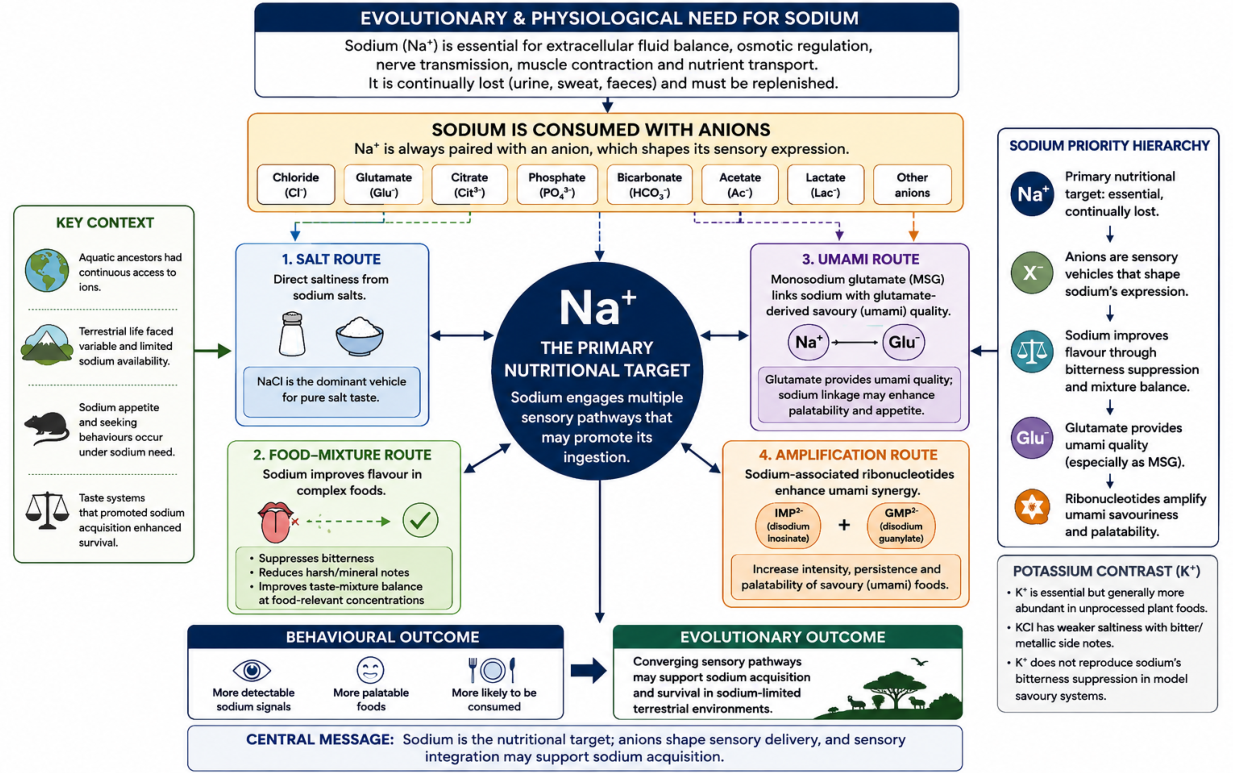

Table 1.
Sensory functions of sodium in foods and their relevance to the Sodium Priority Hypothesis.
Table 1.
Sensory functions of sodium in foods and their relevance to the Sodium Priority Hypothesis.
| Sodium function | Main sensory effect | Food relevance | Hypothesized evolutionary role |
|---|---|---|---|
| Sodium as sodium chloride | Saltiness | Direct salt taste and seasoning | Detect and consume sodium |
| Sodium with other anions | Modified saltiness and side tastes | Sodium citrate, bicarbonate, phosphate, and other salts | Different chemical routes to sodium |
| Sodium as monosodium glutamate | Umami quality | Savory foods, broths, and fermented foods | Link sodium with protein-related foods |
| Sodium with ribonucleotides | Umami amplification | Disodium inosinate and disodium guanylate | Enhance sodium-linked savory liking |
| Sodium in mixtures | Bitterness suppression | Vegetables, broths, protein hydrolysates, and potassium salt replacers | Improve acceptability of sodium-containing foods |
| Sodium in complex foods | Flavor balance | Increased palatability and reduced harshness | Increase likelihood of ingestion |
Table 2.
Critical synthesis of evidence domains supporting and limiting the Sodium Priority Hypothesis.
Table 2.
Critical synthesis of evidence domains supporting and limiting the Sodium Priority Hypothesis.
| Evidence domain | What is established | Relevance to hypothesis | Main limitation | References |
|---|---|---|---|---|
| Sodium physiology | Sodium is essential, extracellular, and continually lost. | Supports sodium as a nutritional target. | Does not by itself prove sensory priority. | [2] |
| Sodium appetite | Sodium depletion can increase sodium seeking and salty food attractiveness. | Supports a nutrient-specific motivational system. | Most evidence concerns sodium chloride rather than sodium-linked food matrices. | [3,4,5,13,14] |
| Salt taste | Sodium chloride has concentration-dependent liking and aversion. | Supports regulated sodium ingestion. | Human salt-taste mechanisms and individual differences remain complex. | [6,7,8] |
| Potassium contrast | Potassium is essential, but potassium chloride has bitter or metallic side notes and does not block bitterness in model broths. | Suggests sodium-specific sensory tuning rather than general cation liking; unlike sodium, potassium is generally abundant in unprocessed plant foods. | Potassium physiology and intake regulation require separate consideration. | [6,15] |
| Anion effects | Sodium salts vary in taste quality depending on the accompanying anion. | Supports the concept of anions as sensory vehicles. | Limited food-matrix comparisons across sodium salts. | [6,9] |
| Bitterness suppression | Sodium suppresses bitterness for selected bitter stimuli. | Supports sodium as a food-balancing agent. | Effect is stimulus-specific and not universal. | [10,11,12,20] |
| Umami and monosodium glutamate | Monosodium glutamate links sodium with glutamate-derived umami quality. | Supports a sodium-linked umami route. | Non-sodium glutamate salts are insufficiently characterized for liking and intake. | [16,17,21,22,23,24] |
| Ribonucleotide synergy | Inosinate and guanylate amplify umami. | Supports an amplification route for sodium-linked savouriness. | Sodium-specificity of nucleotide salts is not fully tested. | [17,25,26] |
| Sodium reduction | Sodium is difficult to replace in foods. | Supports a multifunctional sensory role. | Modern food environments confound evolutionary interpretation. | [6,18,27,28,29] |
| Taste-nutrition signalling | Oral taste signals contribute to food selection and may interact with post-oral nutrient sensing and digestive feedback. | Positions sodium taste and sodium-linked umami as part of a broader sensory-nutritional system linking detection, ingestion, and physiological response. | Direct evidence for sodium-linked umami effects on metabolic or electrolyte regulation remains limited. | [22,29] |
Disclaimer/Publisher’s Note: The statements, opinions and data contained in all publications are solely those of the individual author(s) and contributor(s) and not of MDPI and/or the editor(s). MDPI and/or the editor(s) disclaim responsibility for any injury to people or property resulting from any ideas, methods, instructions or products referred to in the content. |
© 2026 by the authors. Licensee MDPI, Basel, Switzerland. This article is an open access article distributed under the terms and conditions of the Creative Commons Attribution (CC BY) license (http://creativecommons.org/licenses/by/4.0/).
Copyright: This open access article is published under a Creative Commons CC BY 4.0 license, which permit the free download, distribution, and reuse, provided that the author and preprint are cited in any reuse.


