

Submitted:
20 July 2026
Posted:
21 July 2026
You are already at the latest version
Abstract
Background. The dominant clinical manifestation of aging is not mortality but the progressive depletion of functional reserve—the surplus physiological capacity separating independent function from disability. Existing geroscience frameworks describe the molecular processes of aging in extraordinary detail yet offer the point-of-care clinician little basis for prioritizing targets. Objective. To reframe functional aging as a control-systems problem and to define the minimum set of physiological capacities whose preservation maintains functional reserve. Framework. Aging is modeled as progressive instability within a coupled, bidirectional mitochondrial–epigenetic regulatory axis. Candidate capacities were evaluated against three operational criteria—independence, necessity, and modifiability. Results. Five capacities satisfy these criteria: bioenergetic capacity, endocrine signaling integrity, molecular quality control, adaptive (hormetic) stress response, and neuro-autonomic regulation. Each protects the central axis; together they govern the trajectory of functional reserve. Modifiable interventions are mapped onto these capacities in a separate operational layer. Conclusions. The framework yields a causally ordered, clinically actionable, and falsifiable architecture in which functional reserve is the primary therapeutic target and lifespan a downstream consequence. It is testable against existing longitudinal cohorts without new data collection.
Keywords:
functional reserve
; homeostenosis
; mitochondrial–epigenetic axis
; control systems
; physiologic resilience
; longevity medicine
1. Introduction
The twentieth century's signature medical achievement—the dramatic extension of human lifespan—has produced an unanticipated burden: large populations living longer without a corresponding compression of morbidity. The central clinical problem of aging is not death; it is the progressive, systematic erosion of the capacity to function—to perform activities of daily living, maintain independent mobility, preserve executive cognition, and sustain physiological resilience under stress.
Several influential frameworks have advanced the mechanistic understanding of aging. The Hallmarks of Aging [1,2] catalog the cellular and molecular processes; information-theoretic models demonstrate that loss of epigenetic information is itself a cause of aging [5]; mitochondrial theories emphasize declining bioenergetic capacity and impaired quality control. Each is indispensable, yet none translates the complexity of molecular aging into a prioritized, causally ordered set of targets usable at the point of care.
We propose that functional aging is more productively framed as a control-systems problem. The clinically decisive question is not how to prevent every molecular defect, but how to maintain stability within the control systems that preserve organized function across decades. This reframing inverts the clinical orientation—from “what goes wrong during aging?” to “what must be preserved for function to endure?”—and, as developed below, makes functional reserve the explicit organizing outcome.
2. Functional Reserve: The Central Construct
Definition. Functional reserve is the excess physiological capacity available beyond that required for basic independent function. It is the buffer that allows an organism to absorb acute stressors—infection, injury, surgery, metabolic challenge—and return to baseline without crossing into dependency.
This construct is not novel in isolation, and the framework does not claim it as original. Geriatric medicine already names physiologic reserve, describes its progressive narrowing as homeostenosis—the age-related contraction of the homeostatic operating range—and operationalizes its depletion as frailty [22,23]. The contribution here is architectural: to make reserve the explicit terminal outcome of the model and to specify the control systems that generate and defend it.
Measurable proxies. Reserve is already instrumented by markers validated in the prospective mortality literature: VO2 max [9], grip strength, gait speed [17], cognitive reserve, metabolic flexibility, and heart rate variability. The framework therefore inherits the predictive validity of these established outputs rather than proposing new ones.
The reserve view of aging. Aging is the progressive depletion of reserve toward the disability threshold. Crucially, interventions act not by abolishing molecular damage but by widening or refilling reserve—raising the ceiling, slowing the rate of drawdown, or restoring lost capacity. This reframes the therapeutic objective in terms a clinician can measure and a patient can experience.
3. Aging as Control Failure
A control system maintains a regulated variable within bounds despite disturbance, using sensors, a controller with defined gain, and actuators. Youthful physiology approximates a robust controller: wide reserve, intact feedback, rapid correction. Aging is the degradation of that controller—and homeostenosis is its signature. The framework identifies four canonical failure modes, each mapping to recognizable aging biology:

Table 1.
Aging reframed as failure modes of a biological control system.
| Control failure | Physiological correlate | Functional consequence |
| Loss of gain | Blunted corrective responses (attenuated trainability; weakened heat-shock and antioxidant induction) | Slower, smaller recovery from any perturbation |
| Sensor corruption | Deregulated nutrient sensing; insulin/leptin resistance | Fuel misallocation; metabolic inflexibility |
| Actuator failure | Sarcopenia; reduced mitochondrial density and output | Diminished force, power, and energetic ceiling |
| Setpoint drift | Epigenetic drift; loss of transcriptional fidelity [5] | Progressive identity loss in differentiated cells |
The clinical inversion follows directly: the physician's task is not to repair every cellular defect but to keep the controllers stable and reserve above the disability threshold. The remainder of this paper specifies which controllers, in what causal order, and how they are modified.
4. The Central Regulatory Axis: Mitochondrial–Epigenetic Coupling
We hypothesize that functional aging emerges from progressive instability within a tightly coupled, bidirectional mitochondrial–epigenetic axis:
Mitochondrial dysfunction → ↓ NAD+ → ↓ sirtuin activity → epigenetic drift → impaired mitochondrial biogenesis & mitophagy → mitochondrial decay
Declining oxidative phosphorylation reduces NAD+ availability, impairing sirtuin deacylase activity [3,4]. Reduced sirtuin activity accelerates epigenetic drift and loss of transcriptional fidelity [5,24,27]. Epigenetic disorganization, in turn, impairs mitochondrial biogenesis and quality control [25]—closing and amplifying the loop.
A thermodynamically disciplined statement. Living cells are open, dissipative systems: they sustain their highly ordered state only by continuously expending free energy on active maintenance and repair. Mitochondria supply that free energy as ATP. When supply falls, the rate of active correction drops below the rate of spontaneous disordering, and organized function erodes. We deliberately avoid framing this as a mystical “negentropy engine”; the claim is the conventional one that maintenance is energetically costly and the mitochondrion is its principal funder.
The framework does not claim mitochondria are the sole drivers of aging. It proposes that this axis is the central integrating hub through which diverse aging processes converge and amplify—a claim that is proposed, not proven (see Section 12).
5. Layer Zero: Biological Starting Conditions
Every individual begins with a unique substrate shaped by genetics, developmental epigenetic programming, and early-life exposures. Layer Zero is not classified as an operational determinant because it is not meaningfully modifiable in adulthood. Its inclusion is explanatory: it accounts for inter-individual heterogeneity in outcomes even when the determinants are implemented with high fidelity. The framework therefore seeks to optimize functional trajectory, not to predict or guarantee absolute lifespan. Importantly—and as a discipline on the model's falsifiability (Section 11)—Layer Zero is not to be invoked post hoc to rescue the framework from disconfirming cases.
6. Framework Methodology — and an Honest Note on Lineage
The framework uses a reductionist systems methodology: organize the biology around a single central axis, then identify the minimum set of distinct, non-substitutable, modifiable capacities required to protect it. Candidate capacities were evaluated against three operational criteria:
| Criterion | Test applied |
| Independence | Exerts a primary regulatory influence not fully substitutable by another capacity. |
| Necessity | Persistent, uncompensated dysfunction reliably predicts degradation of the central axis. |
| Modifiability | Meaningfully alterable through behavioral, nutritional, pharmacological, or technological means. |
On the methodological lineage — and why this is not a “magic number” argument. This work draws methodological inspiration from Verne Inman's reduction of human gait to a small set of energy-minimizing mechanisms [19,20]: the philosophy that apparent biological complexity can be organized around a minimum set implementing a single principle. We adopt the philosophy but explicitly do not inherit the number. Inman's count derives from the mechanics of bipedal locomotion and has itself been substantially revised by later dynamic-walking analyses [21], which showed several classical “determinants” contribute far less than originally claimed. The number of determinants in this framework is therefore a consequence of how many distinct, non-substitutable capacities survive the three criteria above—not a figure carried over from biomechanics. The architecture is also stated so as to be derivable without reference to any specific compound or modality; it is biology-first, not regimen-first.
Evidence grading. STRONG = multiple high-quality RCTs or large prospective studies; MODERATE = consistent observational and interventional data; EMERGING = promising mechanistic and early human data; EXPERIMENTAL = strong preclinical with limited human data.
7. The Five Determinants of Functional Reserve
Each determinant is a physiological capacity—a control system whose preservation defends the central axis—not an intervention. The compounds and modalities that act on these capacities are catalogued separately in Section 8.
I. Bioenergetic Capacity— Evidence: STRONG
The foundational substrate · systemic energy throughput and metabolic flexibility
Governs biological energy throughput and thermodynamic efficiency through three coupled components. Circadian entrainment coordinates NAD+ salvage and glymphatic clearance [6,7,31,32]. Physical movement is the primary mechanical stimulus for mitochondrial biogenesis via PGC-1α and the single strongest modifiable predictor of VO2 max and all-cause mortality [8,9,28,29]. Substrate handling determines electron-transport-chain efficiency and metabolic flexibility [10,33]. This capacity is the causal gatekeeper: it sets the energetic budget available to every other determinant.
- • Metabolic flexibility: ETC efficiency; substrate switching [10]
II. Endocrine Signaling Integrity— Evidence: MODERATE–STRONG
The macro-systemic communication layer
The communication layer translating environmental and substrate states into coordinated cellular programs—thyroid hormones, sex steroids, GH/IGF-1, and insulin. A direct mechanistic link to the axis distinguishes this capacity: the rate-limiting step of steroidogenesis, cholesterol side-chain cleavage by CYP11A1, occurs on the inner mitochondrial membrane. Mitochondrial decline does not merely correlate with hormonal decline—it causally contributes to it. This capacity cannot be reduced to lifestyle optimization alone.
- • Thyroid hormones: regulation of mitochondrial respiratory rate
- • Sex steroids: inner-mitochondrial-membrane synthesis (CYP11A1)
- • GH/IGF-1; insulin: tissue renewal; substrate selection and allocation
III. Molecular Quality Control — Evidence: MODERATE
The capacity to clear, refold, and replace damaged components
Reframed from “molecular maintenance” to the underlying capacity: proteostasis, autophagy, mitophagy, and redox buffering—the cell's ability to remove or repair damaged macromolecules and organelles before they accumulate. This is the determinant that targeted compounds act upon; the compound is a deposit into the capacity, never the capacity itself. It maps directly to the loss-of-proteostasis hallmark.
- • Proteostasis & autophagy: clearance/refolding of damaged proteins
- • Mitophagy: removal of dysfunctional mitochondria
- • Redox & membrane integrity: control of electron leakage and lipid peroxidation
IV. Adaptive (Hormetic) Stress Response — Evidence: EMERGING
The capacity to convert sublethal stress into durable resilience
Reframed from “environmental energy inputs.” The determinant is not the sauna or the cold plunge—those are stimuli. The determinant is the organism's responsiveness: the capacity to mount and resolve adaptive programs to sublethal thermal, hypoxic, oxidative, and energetic stress (heat-shock protein induction, PGC-1α–mediated biogenesis, brown-adipose/UCP1 activation, mitohormesis). This responsiveness declines with age and is itself trainable. Thermal stress shows dose-dependent reductions in cardiovascular mortality in prospective cohorts [11]; photobiomodulation excites cytochrome c oxidase (Complex IV) [12].
- • Thermal hormesis: HSP induction; PGC-1α biogenesis [11]
- • Hypoxic/oxidative hormesis: mitohormetic adaptation
- • Photonic input: Complex IV excitation via photobiomodulation [12]
V. Neuro-Autonomic Regulation — Evidence: MODERATE
The integrating condition · the state in which the other four operate
The integrated neurobiological state defined by autonomic balance (high HRV, vagal tone), regulated HPA-axis activity, and low chronic cortisol burden. Mitochondria express high densities of glucocorticoid receptors; chronic sympathetic and cortisol load fragments mitochondrial morphology and suppresses ATP output [14,15]. Conversely, sustained regulation protects telomere length and lowers systemic inflammation [16]. This capacity modulates the ceiling of the other four—a prediction made explicit in Section 11.
- • Autonomic balance: HRV; vagal tone
8. The Intervention Layer
The framework separates two layers that the clinician must not conflate: determinants (the capacities that must be preserved) and interventions (the modifiable inputs that act on them). A useful analogy: functional reserve is a bank balance; interventions are deposits. Exercise, sauna, and a supplement are deposits—they are not the account. Table 2 maps interventions onto their target determinants with evidence grades, and is the appropriate home for compound- and modality-level claims.
Figure 1.
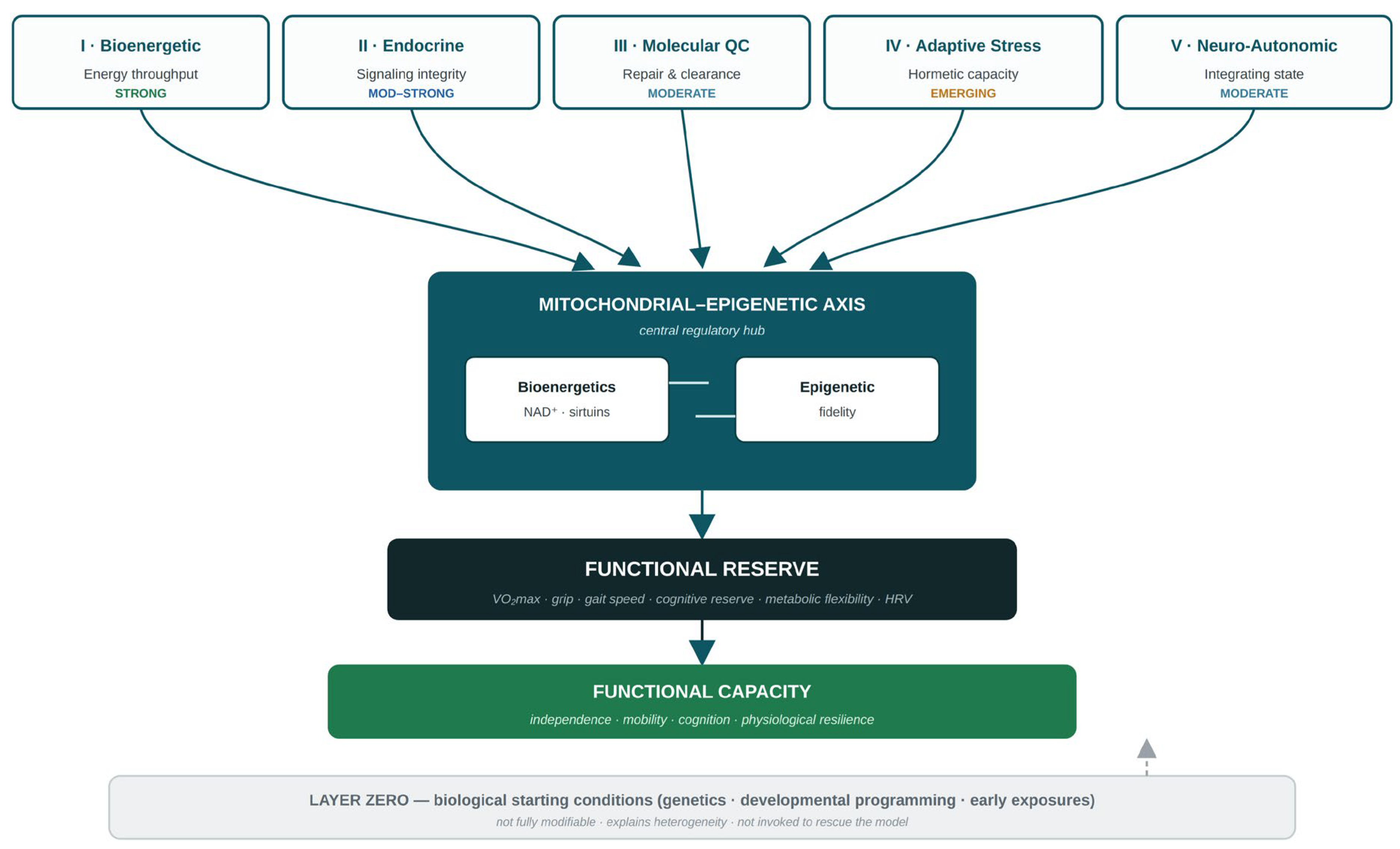
Architecture of the framework. Five modifiable physiological capacities (top) converge on and protect the mitochondrial–epigenetic axis (center), whose stability determines functional reserve and, in turn, functional capacity—the primary clinical outcome. Layer Zero is the non-modifiable substrate that conditions the trajectory. Modifiable interventions (Table 2) act on the determinants, not directly on the outcome.
Figure 1.
Architecture of the framework. Five modifiable physiological capacities (top) converge on and protect the mitochondrial–epigenetic axis (center), whose stability determines functional reserve and, in turn, functional capacity—the primary clinical outcome. Layer Zero is the non-modifiable substrate that conditions the trajectory. Modifiable interventions (Table 2) act on the determinants, not directly on the outcome.
9. Integration with the Hallmarks of Aging
The framework integrates rather than supplants established models [1,2]. The Hallmarks are reinterpreted as downstream manifestations of axis instability and capacity failure.
| Hallmark of Aging | Primary mapping | Systems interpretation |
| Mitochondrial dysfunction | Central axis + all determinants | Degradation of the master energetic engine |
| Epigenetic alterations | Central axis | Information loss within the primary control system [5] |
| Deregulated nutrient sensing | Determinant I + II | Sensor corruption; fuel misallocation |
| Loss of proteostasis | Determinant III | Failure of molecular quality-control capacity |
| Cellular senescence | Determinants I–V (systemic) | Terminal arrest after loss of bioenergetic/structural viability |
| Stem-cell exhaustion | Determinant II (+ signaling) | Depletion of renewal signals; niche degradation |
| Chronic inflammation | Determinants I–V (network) | Burden from accumulated uncompensated damage |
| Altered intercellular comm. | Determinant II + V | Corrupted endocrine and neuroendocrine transmission |
| Genomic instability | Layer Zero / Determinant III | Primary substrate; partly addressable via quality control |
| Telomere attrition | Determinant I + V (indirect) | Accelerated by oxidative stress; attenuated by exercise [8] and regulation [16] |
10. Determinant → Biomarker → Functional Outcome
Table 4.
Each determinant linked to validated or candidate biomarkers and the functional output it governs. Cross-cutting markers index reserve as a whole.
Table 4.
Each determinant linked to validated or candidate biomarkers and the functional output it governs. Cross-cutting markers index reserve as a whole.
| Determinant | Candidate biomarkers | Functional outcome |
| I · Bioenergetic | VO2 max [9]; lactate threshold; CGM-derived glucose variability | Aerobic capacity; metabolic resilience |
| II · Endocrine | Thyroid panel; free testosterone/estradiol; IGF-1; fasting insulin (HOMA-IR) | Anabolic capacity; body composition |
| III · Molecular QC | hs-CRP; oxidized LDL; autophagy markers (research-grade) | Tissue integrity; damage-clearance rate |
| IV · Adaptive stress | VO2 trainability; HSP induction (research); cold/heat tolerance | Resilience to acute stressors |
| V · Neuro-autonomic | HRV (RMSSD); morning cortisol/DHEA; sleep architecture | Recovery; cognitive and affective stability |
| Cross-cutting | Gait speed [17]; grip strength; DunedinPACE [18] | Integrated functional reserve |
11. Falsifiability and Testable Predictions
The framework is offered as a scientific hypothesis and must be falsifiable in practice, not merely in principle. We acknowledge the standard failure mode of grand frameworks: a model with an escape hatch for every observation can never be disconfirmed. To avoid this, we pre-commit to specific risky predictions and constrain the escape hatches (notably, Layer Zero is not available as a post-hoc rescue; Section 5).
Table 5.
Testable predictions, ordered from strongest (quantitative, risky) to most contingent. P1–P3 are evaluable against existing clinical-trial datasets; P4 against existing exceptional-cohort registries—none require new data collection.
Table 5.
Testable predictions, ordered from strongest (quantitative, risky) to most contingent. P1–P3 are evaluable against existing clinical-trial datasets; P4 against existing exceptional-cohort registries—none require new data collection.
| # | Prediction | What would count against the framework |
| P1 (primary) | Comprehensive multi-determinant optimization produces DunedinPACE [18] deceleration whose effect size increases with the number of determinants concurrently optimized. | Absence of a dose–response counts against the architecture; a non-monotonic result from intervention interference does not, as it bears on additivity rather than the architecture. |
| P2 | Interventions on Determinants III–V show attenuated efficacy under severe Determinant I deficiency, controlling for confounders. | Equivalent efficacy regardless of bioenergetic status falsifies the contingent hierarchy. |
| P3 | Neuro-autonomic dysregulation (chronic high cortisol / low HRV) predicts reduced response to equivalent interventions across the other determinants. | No ceiling effect falsifies Determinant V's modulating role [14,15]. |
| P4 | No cohort sustains exceptional, multi-systemic function with chronic uncompensated deficiency in a single determinant's core mechanism. | One robust counterexample (centenarian/Blue Zone registries) falsifies that determinant's necessity—decisively, with no Layer-Zero appeal. |
12. Limitations
Intellectual integrity requires explicit acknowledgment of the framework's limitations.
1 · Synthetically derived, not empirically derived. The determinants were identified through clinical reasoning and literature synthesis, not from a primary prospective dataset. This is a structured hypothesis, not a validated theory; prospective validation must precede any clinical guideline.
2 · Heterogeneous evidence base. Evidence ranges from strong (Determinant I) to emerging (Determinant IV). Necessity is asserted only for determinants supported by at least moderate human data; the experimental intervention rows in Table 2 are deliberately excluded from the necessity claim.
3 · The organizing principle is proposed, not proven. While the NAD+/sirtuin/mitochondrial cascade is well documented and its epigenetic arm is at least partially reversible [3,4,26], the claim that the mitochondrial–epigenetic axis is the primary organizing principle—rather than telomere attrition, proteostasis failure, or inflammaging—remains contested and cannot be excluded on current evidence.
4 · Overlap with established constructs. Functional reserve, homeostenosis, physiologic resilience, and frailty are established in geriatric medicine [22,23]. This framework reorganizes and operationalizes these constructs around a mechanistic axis; it does not originate them, and should be read as integrative rather than wholly novel.
5 · No companion measurement protocol. The framework specifies what must be preserved but not yet a standardized, cross-validated instrument for each determinant. Table 4 lists candidates; validated assessment protocols remain to be developed.
6 · n=1 derivation and stack-independence. Elements were informed by the author's monitored self-experimentation, which provides clinical face validity but not population-level evidence. To guard against rationalizing a personal regimen, the determinant architecture is stated so as to be derivable without reference to any specific compound; all compound-level claims are confined to the intervention layer and carry its lower evidence weight.
13. Discussion and Clinical Implications
The primary contribution is architectural, not mechanistic—the individual mechanistic claims are inherited from established literature. The contribution is the proposal that aging biology can be organized around a single bidirectional axis and a minimum set of modifiable capacities whose preservation maintains functional reserve, and that this organization has direct clinical utility. The control-systems reframe shifts the clinical question from “what goes wrong?” to “what must go right?”
The contingent hierarchy. Each determinant depends on the integrity of those preceding it. Receptor-mediated and molecular interventions are degraded in an insulin-resistant, circadian-disrupted cellular environment because the bioenergetic substrate required to execute them is absent. The hierarchy is not absolute—partial benefit from higher determinants can occur with incomplete lower-determinant optimization—but persistent uncompensated failure in a lower determinant systematically caps the ceiling of all higher ones.
On “self-reference”—stated modestly. Mitochondria contribute to several determinants: they fund the energetic budget (I), perform the inner-membrane steroidogenic step (II), and encode stress-signaling peptides (Table 2). We note this convergence as consistent with the axis's centrality, but we explicitly decline to elevate it to a deep structural theorem. Mitochondrial multifunctionality is expected, not surprising, and we do not rest any load-bearing claim on it.
Therapeutic prioritization. When resources are constrained, Determinant I yields the highest expected marginal return across all subsequent determinants; initial clinical evaluation should secure circadian health, physical-activity capacity, and metabolic flexibility before investing in higher-determinant assessment or the intervention layer's costlier options.
14. Conclusions
We have proposed a unifying, systems-oriented hypothesis that reframes human functional aging as progressive instability within a coupled, bidirectional mitochondrial–epigenetic axis, and identifies five modifiable physiological capacities required to preserve functional reserve. A separate intervention layer maps modifiable inputs onto those capacities, keeping the distinction between what must be preserved and what is done to preserve it.
Functional reserve is advanced as the primary therapeutic target; lifespan is its downstream consequence. The framework's distinguishing features—the control-systems inversion, the explicit reserve construct anchored in existing geriatric science, the two-layer determinant/intervention separation, and an honestly constrained falsifiability—differentiate it from purely descriptive models. It is offered not as settled science but as a structured hypothesis that meets the first requirement of productive scientific discourse: it can be proven wrong.
Disclosures
None declared.
Funding
None declared.
Conflicts of interest
None declared.
References
- López-Otín, C.; Blasco, M.A.; Partridge, L.; Serrano, M.; Kroemer, G. The hallmarks of aging. Cell. 2013, 153(6), 1194–1217. [Google Scholar] [CrossRef] [PubMed]
- López-Otín, C.; et al. Hallmarks of aging: an expanding universe. Cell. 2023, 186(2), 243–278. [Google Scholar] [CrossRef] [PubMed]
- Verdin, E. NAD+ in aging, metabolism, and neurodegeneration. Science. 2015, 350(6265), 1208–1213. [Google Scholar] [CrossRef] [PubMed]
- Imai, S.; Guarente, L. NAD+ and sirtuins in aging and disease. Trends Cell Biol. 2014, 24(8), 464–471. [Google Scholar] [CrossRef] [PubMed]
- Yang, J.H.; Hayano, M.; Griffin, P.T.; et al. Loss of epigenetic information as a cause of mammalian aging. Cell. 2023, 186(2), 305–326.e27. [Google Scholar] [CrossRef] [PubMed]
- Bass, J.; Takahashi, J.S. Circadian integration of metabolism and energetics. Science. 2010, 330(6009), 1349–1354. [Google Scholar] [CrossRef] [PubMed]
- Xie, L.; et al. Sleep drives metabolite clearance from the adult brain. Science. 2013, 342(6156), 373–377. [Google Scholar] [CrossRef] [PubMed]
- Holloszy, J.O. Regulation by exercise of skeletal muscle content of mitochondria and GLUT4. J. Physiol. Pharmacol. 2008, 59 (Suppl 7), 5–18. [Google Scholar] [PubMed]
- Myers, J.; et al. Exercise capacity and mortality among men referred for exercise testing. N Engl. J. Med. 2002, 346(11), 793–801. [Google Scholar] [CrossRef] [PubMed]
- Fontana, L.; Partridge, L. Promoting health and longevity through diet. Cell. 2015, 161(1), 106–120. [Google Scholar] [CrossRef] [PubMed]
- Laukkanen, J.A.; Laukkanen, T.; Kunutsor, S.K. Cardiovascular and other health benefits of sauna bathing. Mayo Clin. Proc. 2018, 93(8), 1111–1121. [Google Scholar] [CrossRef] [PubMed]
- Hamblin, M.R. Mechanisms and mitochondrial redox signaling in photobiomodulation. Photochem Photobiol. 2018, 94(2), 199–212. [Google Scholar] [CrossRef] [PubMed]
- Lee, C.; et al. MOTS-c: a mitochondrial-derived peptide regulating muscle and fat metabolism. Cell Metab. 2015, 21(3), 443–454. [Google Scholar] [CrossRef] [PubMed]
- Picard, M.; McEwen, B.S.; Epel, E.S.; Sandi, C. An energetic view of stress: focus on mitochondria. Front Neuroendocrinol. 2018, 49, 72–85. [Google Scholar] [CrossRef] [PubMed]
- Picard, M.; et al. Mitochondrial functions modulate neuroendocrine, metabolic, inflammatory, and transcriptional responses to acute psychological stress. Proc. Natl. Acad. Sci. USA. 2015, 112(48), E6614–E6623. [Google Scholar] [CrossRef] [PubMed]
- Blackburn, E.H.; Epel, E.S.; Lin, J. Human telomere biology. Science. 2015, 350(6265), 1193–1198. [Google Scholar] [CrossRef] [PubMed]
- Studenski, S.; et al. Gait speed and survival in older adults. JAMA. 2011, 305(1), 50–58. [Google Scholar] [CrossRef] [PubMed]
- Belsky, D.W.; et al. DunedinPACE, a DNA methylation biomarker of the pace of aging. eLife. 2022, 11, e73420. [Google Scholar] [CrossRef] [PubMed]
- Saunders, JBdCM; Inman, V.T.; Eberhart, H.D. The major determinants in normal and pathological gait. J. Bone Jt. Surg. Am. 1953, 35-A(3), 543–558. [Google Scholar] [CrossRef]
- Inman, V.T.; Ralston, H.J.; Todd, F. Human Walking.; Williams & Wilkins: Baltimore, 1981. [Google Scholar]
- Kuo, A.D. The six determinants of gait and the inverted pendulum analogy: a dynamic walking perspective. Hum. Mov. Sci. 2007, 26(4), 617–656. [Google Scholar] [CrossRef] [PubMed]
- Fried, L.P.; Tangen, C.M.; Walston, J.; et al. Frailty in older adults: evidence for a phenotype. J. Gerontol. A Biol. Sci. Med. Sci. 2001, 56(3), M146–M156. [Google Scholar] [CrossRef] [PubMed]
- Rockwood, K.; Mitnitski, A. Frailty in relation to the accumulation of deficits. J. Gerontol. A Biol. Sci. Med. Sci. 2007, 62(7), 722–727. [Google Scholar] [CrossRef] [PubMed]
- An, Y.; Wang, Q.; Gao, K.; et al. Epigenetic regulation of aging and its rejuvenation. MedComm. 2025, 6(9), e70369. [Google Scholar] [CrossRef] [PubMed]
- You, Y.; Wang, Z. Roles of SIRT3 in aging and aging-related diseases. Int. J. Biol. Sci. 2025, 21(11), 5135–5163. [Google Scholar] [CrossRef] [PubMed]
- Paine, P.T.; Nguyen, A.; Ocampo, A. Partial cellular reprogramming: a deep dive into an emerging rejuvenation technology. Aging Cell. 2024, 23(2), e14039. [Google Scholar] [PubMed]
- Wei, P.; Zhang, X.; Yan, C.; Sun, S.; Chen, Z.; Lin, F. Mitochondrial dysfunction and aging: multidimensional mechanisms and therapeutic strategies. Biogerontology. 2025, 26(4), 142. [Google Scholar] [CrossRef] [PubMed]
- Abrego-Guandique, D.M.; Aguilera Rojas, N.M.; Chiari, A.; Luciani, F.; Cione, E.; Cannataro, R. The impact of exercise on mitochondrial biogenesis in skeletal muscle: a systematic review and meta-analysis of randomized trials. Biomol. Concepts. 2025, 16(1), 20250055. [Google Scholar] [CrossRef]
- Lang, J.J.; Prince, S.A.; Merucci, K.; et al. Cardiorespiratory fitness is a strong and consistent predictor of morbidity and mortality among adults: an overview of meta-analyses representing over 20.9 million observations from 199 unique cohort studies. Br. J. Sports Med. 2024, 58(10), 556–566. [Google Scholar] [CrossRef] [PubMed]
- Yusri, K.; Jose, S.; Vermeulen, K.S.; Tan, T.C.M.; Sorrentino, V. The role of NAD+ metabolism and its modulation of mitochondria in aging and disease. npj Metab. Health Dis. 2025, 3(1), 26. [Google Scholar] [CrossRef] [PubMed]
- Hassan, N.U.; Smith, W.K.; Nawaz, H.A.; et al. The intricate link between circadian rhythms and aging: can resetting our circadian clock hold the key to longevity? Biogerontology. 2025, 26, 156. [Google Scholar] [CrossRef] [PubMed]
- Xiong, Y.; Yu, Q.; Zhi, H.; et al. Advances in the study of the glymphatic system and aging. CNS Neurosci. Ther. 2024, 30(6), e14803. [Google Scholar] [CrossRef] [PubMed]
- Ching, T.T.; Hsu, A.L. The impacts of different dietary restriction regimens on aging and longevity: from yeast to humans. J. BioMed Sci. 2025, 32(1), 91. [Google Scholar] [CrossRef] [PubMed]
- Trajano, LAdSN; Siqueira, P.B.; Rodrigues, MMdS; Pires, B.R.B.; da Fonseca, A.S.; Mencalha, A.L. Does photobiomodulation alter mitochondrial dynamics? Photochem Photobiol. 2025, 101(1), 21–37. [Google Scholar] [PubMed]
- Wan, W.; Zhang, L.; Lin, Y.; et al. Mitochondria-derived peptide MOTS-c: effects and mechanisms related to stress, metabolism and aging. J. Transl. Med. 2023, 21(1), 36. [Google Scholar] [CrossRef] [PubMed]
- Reid, D.M.; Choe, J.Y.; Bruce, M.A.; Thorpe, R.J.; Jones, H.P.; Phillips, N.R. Mitochondrial functioning: front and center in defining psychosomatic mechanisms of allostasis in health and disease. Methods Mol. Biol. 2025, 2868, 91–110. [Google Scholar] [PubMed]
- Lim, C.J.; Cech, T.R. Telomere function and regulation from mouse models to human aging and disease. Nat. Rev. Mol. Cell Biol. 2025, 26(4), 297–313. [Google Scholar] [CrossRef]
Table 2.
Modifiable interventions mapped onto the five determinants. Compound- and modality-level claims carry the evidence weight shown here, not the structural status of the determinants themselves. The experimental row is offered as future direction, not present recommendation.
Table 2.
Modifiable interventions mapped onto the five determinants. Compound- and modality-level claims carry the evidence weight shown here, not the structural status of the determinants themselves. The experimental row is offered as future direction, not present recommendation.
| Intervention | Target | Principal mechanism | Evidence |
| Aerobic + resistance exercise | I (+III, IV) | PGC-1α biogenesis; mitophagy; hormetic adaptation | STRONG |
| Circadian & sleep hygiene | I (+V) | NAD+ salvage; glymphatic clearance | STRONG |
| Dietary pattern / energy balance | I (+II) | ETC efficiency; metabolic flexibility; nutrient sensing | STRONG–MOD |
| NAD+ precursors (NMN/NR) | III | Sustain sirtuin substrate availability [3,4,30] | MODERATE |
| Urolithin A | III | Mitophagy activation; clearance of damaged mitochondria | EMERGING |
| CoQ10 · omega-3 · creatine | III | Electron-leak control; membrane fluidity; energy buffering | MODERATE |
| Sauna · cold · photobiomodulation · hypoxic conditioning · time-restricted eating | IV | Hormetic induction (HSP, UCP1, mitohormesis, Complex IV) [11,12,34] | EMERGING |
| HRV/contemplative training · psychosocial purpose | V | Vagal tone; HPA regulation; reduced inflammatory load [16,37] | MODERATE |
| Hormone optimization (where indicated) | II | Restoration of deficient endocrine signaling | MOD (context) |
| Mitochondrial-derived & targeted peptides (MOTS-c, secretagogues, bioregulators) | III / V signaling | Receptor-mediated transcriptional programs; mtDNA-encoded stress signaling [13,35] | EXPERIMENTAL |
Disclaimer/Publisher’s Note: The statements, opinions and data contained in all publications are solely those of the individual author(s) and contributor(s) and not of MDPI and/or the editor(s). MDPI and/or the editor(s) disclaim responsibility for any injury to people or property resulting from any ideas, methods, instructions or products referred to in the content. |
© 2026 by the authors. Licensee MDPI, Basel, Switzerland. This article is an open access article distributed under the terms and conditions of the Creative Commons Attribution (CC BY) license (http://creativecommons.org/licenses/by/4.0/).
Copyright: This open access article is published under a Creative Commons CC BY 4.0 license, which permit the free download, distribution, and reuse, provided that the author and preprint are cited in any reuse.


