

Submitted:
21 July 2026
Posted:
21 July 2026
You are already at the latest version
Abstract
This study investigates the impact of fintech on the monetary policy dynamics of the four major payment channels of banks in Nigeria, namely the automated teller machine (ATM), mobile payment (MOBPAY), web payment (WEBPAY), and Point-of-Sale (POS), from 2012 to 2025. The paper employs the Autoregressive Distributed Lag (ARDL) bounds testing approach to examine the relationships between the variables, whilst conducting a robustness check using dynamic ordinary least squares (DOLS). The study shows that POS transaction values have a positive and statistically significant impact on both the monetary policy rate (MPR) and the treasury bill rate (TBR). The findings also indicate that the savings deposit rate (SDR) increases both the MPR and the TBR, whereas the maximum lending rate (MLR) does not affect these policy rates. Mobile payments lead to significantly lower treasury bill and monetary policy rates. These findings empirically affirm that fintech channels have expanded over the years, driven by the central bank’s cashless policy and banks’ response to the introduction of fintech start-ups into the financial system. Thus, fintech channels are important determinants of monetary policy transmission, justifying the need for the monetary authority to examine channel-specific sensitivities to its effectiveness in Nigeria’s fast-growing digital payment ecosystem.
Keywords:
banks
; fintech
; payment system
; monetary policy
; point-of-sale
; treasury bill rate
1. Introduction
Technological innovations and developments, such as the Internet of Things, blockchain, big data, and, more recently, artificial intelligence, continue to shape the world of finance. Moreover, these technologies have enabled the emergence of financial technology (Fintech) to address frictions in the financial system. Fintech, therefore, refers to the combination of ‘financial’ and ‘technology’ innovations to address frictions within the financial ecosystem and unlock the potential for sustainable growth of the financial services industry (Boot et al., 2021; Gai et al., 2018). Fintech also refers to digital tools that automate processes, thereby improving efficiency and cost-effectiveness (Arner et al., 2015). The use of these technologies (digitalisation, biometrics, blockchain, automation, and identity management) has been instrumental in expanding Fintech adoption, enabling services for underserved populations in remote areas where traditional brick-and-mortar financial institutions cannot serve. Siddiqui and Rivera (2022) reaffirmed the existence of a fintech ecosystem with active participation from relevant stakeholders, including lawmakers, financial institutions, customers, investors, and information technology companies. Moreover, this is key, especially in developing countries, as fintech now offers opportunities across the financing and payment ecosystem, investment, and wealth creation (Elsaid, 2023). The existing literature has highlighted some of the important roles of fintech, including: efficient delivery of capital resources through its financial inclusion potential, especially to unbanked and hard-to-reach rural areas; reduced transaction costs; elimination of imperfect markets; investment in human capital; alleviation of poverty; financial system stability; sustainability; economic growth; improvement of information symmetry; reduction in risk-taking, and bank’s environmental performance (Badrous et al., 2025; Tay et al., 2022; Lagna & Ravishankar, 2022; Jonker & Kosse, 2022; Banna et al., 2022; Demir et al., 2022; Ahamed & Mallick, 2019; Allen et al., 2016).
Related studies, such as Mehrotra and Yetman (2014), examined how financial inclusion may impact monetary policy. Others, such as Attanasio et al. (2002), have examined the impact of fintech using ATMs as a proxy for fintech and interest rates, and report that these interactions or sensitivities enhance the financial system. Also, Kömürcüoğlu and Akyazi (2024), Hasan et al. (2024), and Mumtaz and Smith (2020) explored the impact of Fintech developments on monetary policy and sustainable finance. They found that fintech developments reduce the effectiveness of the monetary transmission channel. Several other studies, such as Fegatelli (2022), Sakharov (2021), Nabilou (2020), and Kesavaraj et al. (2022), examined fintech through the lens of central bank digital currency and its effects on various transmission channels. Also, several other studies focus on the monetary policy impact on money demand with inconsistent findings; studies by Ugwuanyi et al (2020) and Wasiaturrahma et al (2019) report that increases in fintech lead to an increase in money demand, contradicting studies by Mlambo and Msosa (2020) and Fujiki and Tanaka (2009), which affirmed that increases in variables used as proxies for fintech decrease money demand. Hundal and Zinakova (2021), in their study based on commercial banks in Finland, reported that fintech impacted the behaviours of customers, the dynamics of risk management, investors and operations within the financial services industry, as well as the competitiveness and future growth of the fintech ecosystem, with the COVID-19 pandemic having a more significant effect on the changes. Hoang and Lee (2026) found that increased competitive pressure from fintech innovations, as measured in a study of 29 commercial banks in Vietnam, negatively affected the profitability of traditional banks.
Whilst the literature on fintech is clear about the significant roles it plays within the financial system, there are inconsistencies regarding the interactions among monetary policy, the banking system’s transmission mechanism (stakeholders/banks), and payment systems. Therefore, our study contributes to the literature by examining monetary policy and banking system transmission through fintech channels and comparing transmission elasticities across payment system channels. This aspect of our study is very important, considering that between 2023 and 2025, Nigeria’s central bank adopted an aggressive tightening stance, with the MPR accelerating from 17.75% to 27.50%, one of the most unique trends in the world at a time when Nigeria recorded its most significant expansion in fintech adoption and channels. However, to the best of our knowledge, no study has examined whether these tightenings influenced payment system channels such as ATMs, internet banking, mobile money payments, and POS, nor has it examined causality vis-à-vis banking system transmission through savings and lending rates. The rest of our paper is structured as follows: in Section 2, we review the existing literature. Section 3 outlines the data and research methodology, with a focus on related studies. Section 4 presents the results; Section 5 discusses the analysis; and Section 6 summarises the conclusions, limitations, and recommendations for future studies.
2. Literature Review
Three major research approaches have dominated the existing literature on fintech: systematic and bibliometric analyses, case studies and conceptual research, and quantitative methods. Some studies explore the evolution of fintech and the financial system to establish trends through a systematic, bibliometric approach, in which researchers construct a comprehensive bibliometric map of the fintech and financial system landscape (Khan et al., 2026; Zakaria & Abdelhalim, 2025; Sahid et al, 2023; Garg et al, 2023; Sahabuddin et al., 2023; Tepe et al., 2021). Moreover, recent empirical research has examined how digital currencies and fintech, in particular, affect central bank monetary regulations (Nawaz et al., 2024; Ia & Miglionico, 2019; Mills et al., 2016). From a quantitative perspective, the theme has centred on how fintech impacts monetary and economic output (Mittal et al., 2023; Rehman et al., 2023; Kömürcüoğlu & Akyazi, 2024; Cornelli et al., 2024). There is indeed an integration gap between monetary policy transmission and fintech expansion and adoption, with most studies examining one or the other from a financial inclusion perspective (Ozili, 2023; Lee et al., 2022; Mehrotra & Yetman, 2014). This study simultaneously investigates how central bank rate decisions, via the monetary policy rate (MPR) and the Treasury bill rate (TBR), causally influence fintech adoption and, more generally, payment-system channels. Therefore, this study makes a very important theoretical contribution to the existing literature.
The monetary transmission mechanism theory provides a foundational pillar for answering our main research question: how do monetary policy rates influence fintech expansion and the entire payment system? We consider this from the perspective that the traditional monetary policy transmission mechanism, which has its origins in decades of central bank management of interest rates and the nominal money stock with a price stability goal, was preceded by the evolution of fintech. We therefore approach the theoretical lens through three major channels that remain relevant to fintech expansion and the payment system. Under the quantity theory of money (QTM), central banks have the mandate to deploy monetary policy with greater manoeuvrability and, to do so, aim to forecast money demand more effectively (Goldfeld, 1973). Also, monetary policy is deployed to control the level of liquidity. When liquidity or demand for money increases, deposit money banks (DMBs) meet the demand by borrowing from the central bank at the monetary policy rate. Cash demand is determined by factors such as inflationary pressures and seasonal demand for money.
Therefore, fintech developments, along with their various channels, affect the demand for money and the channels through which this demand is influenced (Kömürcüoğlu & Akyazi, 2024). Based on the QTM, existing studies have reported mixed findings on how changes in money demand impact Fintech. For instance, Mlambo and Msosa (2020), Wasiaturrahma et al. (2019) and Fujiki and Tanaka (2009) found that an expansion in fintech adoption decreases demand for money. These studies are contrary to other studies that found that expansion or increases in fintech channels adoption increase the demand for money (Ugwuanyi et al., 2020; Wasiaturrahma et al., 2019; Tehranchian et al., 2012). The monetary policy transmission mechanism in our study can operate through the bank lending channel. When a central bank raises interest rates, it automatically increases the cost of bank funding. In response to these higher MPRs, banks usually contract lending, thereby reducing their ability to create credit. However, the core of banking activities is the creation of credit; therefore, banks resort to credit rationing by increasing their lending rates. According to Winker (1999), this credit rationing, which is associated with rigidity of interest rates, is caused by ‘adverse selection’ and ‘switching costs’. As this happens, more bank borrowers, excluded by these high lending rates, are turning to fintech alternatives, suggesting that banks have transmitted monetary policy through fintech expansion, thereby displacing the bank credit channel. A study by Le et al. (2021) covering 80 countries from 2013 to 2017 confirmed a two-way relationship between fintech credit and traditional banks, in which a positive or negative relationship between the two affects banking system efficiency.
Under the monetary policy transmission channel through lending rates, existing studies have relied on industrial organisation theory to postulate that an economy’s market structure determines the pass-through or stickiness of lending rates. In this instance, factors such as the level of competition within the banking system, entry barriers, sophistication of the financial system, market concentration, as well as the role of state-owned institutions are major determinants of MPRs transmission through lending rates (Bendezu & Rodriguez, 2026; van Leuvensteijn et al, 2013). In contrast, some studies on developed and emerging markets find that the influence of MPR on lending rates depends on the degree of interaction within the financial institutions’ ecosystem. Therefore, the pass-through effect of MPR on lending rates is determined by factors such as the size of the institution, the banks’ risk appetite, the banks’ funding costs, source and type, as well as the banks’ liability structures, as they affect their share of deteriorating assets (Blot & Labondance, 2021; Altavilla et al, 2018; Holton & Rodrigues, 2015)
In the Technological Acceptance Model (TAM), for instance, monetary policy tightening is expected to increase the perceived usefulness of fintech adoption, as fintech reduces costs and improves efficiency. Beltrame et al. (2022), based on a study of fintech investments on a sample of 17 banks in Italy, asserted that there is a positive relationship between banks’ investments in fintech and their financial performance using the capital asset pricing model (CAPM), return on equity and price to book value as performance proxies. Wahab et al. (2025), in an expanded study covering 119 countries, examined the impact of fintech on financial literacy and development and reported that digital payment channels had a positive and significant effect on both. However, foreign currency volatility and exposure negatively moderate this relationship, especially with respect to financial development. Mahmud et al. (2022) report that customers’ adoption of fintech is determined by the levels of information security and government control, based on a sample of customers in Bangladesh. These findings are important as they deviate from the more common narrative of demographic variables. Ethical and privacy issues are therefore important safeguards to building trust in the adoption of fintech channels by customers, ensuring compliance with data protection laws (Aldboush & Ferdous, 2023)
Existing studies have used the number of automated teller machines (ATMs) as a proxy for fintech development when investigating its effect on monetary policy (Mabandla, 2026; Ugwuanyi et al., 2020; Mumtaz & Smith, 2020; Tule & Oduh, 2017). Others have used the number of points of sale (POS) devices, online/mobile digital/internet payments, central bank digital currency (CBDC), e-money, and crypto asset transactions (Ozili, 2023; Jiange et al., 2022; Saraswati et al., 2020; Mlambo & Msosa, 2020; Mumtaz & Smith, 2020). As reflected in the existing literature, studies that comprehensively investigate the relationship between money supply and demand and fintech expansion across the entire payment system are quite limited, and we found no study specific to Nigeria in this context. In a related study by Mittal et al. (2023), based in India, the authors report a positive relationship between financial inclusion (a proxy for monetary policy effectiveness) and fintech. Complementarily, a causality test conducted in the study indicates a bidirectional relationship between fintech and monetary policy effectiveness. In an expanded study across 19 countries, Cornelliet et al. (2024) investigated the impact of fintech and bank credit on changes in monetary policy. Their results show that fintech credit does not respond significantly to monetary policy shocks. A study by Al Sharif (2025) reports that fintechs have a positive impact on banks’ financial performance, manifested through direct and indirect channels, thereby enhancing banks’ soundness in Jordan.
Using a quantitative methodology, Hasan et al. (2024), based on a study of fintechs in Chinese provinces, employed Panel Vector Autoregression (PVAR) with interactions to examine the impact of fintech on monetary policy and found that fintech mitigates monetary policy transmission through regulatory arbitrage, competition, and counterfactual credit expansion. In a related study using panel data regression, Mansour (2024) examined bank profitability and reported that fintech expansion led to a decline in bank profitability and that an accommodative monetary policy stance can mitigate this effect among Chinese banks. Wang et al. (2025) reported similar findings, namely that fintech harms bank performance in China, using a fixed-effects panel regression model. Other studies in the Chinese context, such as Renzhi and Beirne (2025), Li et al. (2024), and Huang (2022), used a similar methodology. Other areas that have been empirically examined using quantitative methods include the study by Mlambo and Msosa (2020), which used the GMM panel technique to test the effect of fintech on money demand, based on 23 years of data from five sub-Saharan African countries, including Nigeria. This study by Mlambo and Msosa (2020) used variables such as the number of ATMs and mobile subscriptions as proxies for fintech and found that both negatively affect money demand. A similar method was used by Mumtaz and Smith (2020) on 25 developed and emerging countries. They reported that fintech, proxied by mobile and internet technologies, and digital currencies were robust determinants of money demand. In contrast, inflation, the real interest rate, GDP, stock market indices, and the level of financial development were not determinants of fintech expansion.
Mashamba and Gani (2023), based on a study of 56 banks across 19 Sub-Saharan African countries, found that traditional banks in Africa can resist fintech disruptions, primarily due to the resilience of their funding structures. Also, Mashamba and Gani (2024) postulated that, despite fintechs’ progress in credit expansion, traditional banks, through their branch networks, remain a crucial catalyst for lending growth and financial inclusion. This assertion confirms that fintechs complement traditional banks rather than compete with them. Moreover, mobile money, as a fintech instrument, has been reported to negatively affect the monetary policy rate, rendering monetary policy ineffective amid its expansion in Ghana (Wiafe et al., 2022). However, investments in fintech are positively and significantly associated with economic growth, especially in high-growth economies (Alalmaee, 2026). Fintech has also been attributed to strong customer satisfaction and retention (Ajouz et al., 2025), although concerns with security as it relates to data protection, information privacy, and limited government control hinder the adoption of fintech services (Mahmud et al., 2023)
Building on the above literature, we use bank-level data from the entire Nigerian banking sector to explore the relationships among monetary policy and the payment system via its various fintech channels, a distinct approach from the existing empirical review.
2.1. Background of the Nigerian Banking Sector
The banking sector in Nigeria is one of the most successful stories of the financial services development in sub-Saharan Africa. From the formal commencement of banking operations in Lagos in 1891 by the African Banking Corporation (ABC) and the entrance of other colonial banks and indigenous/local banks from 1945, Nigeria’s commercial banking system evolved long before the arrival of the regulator- the Central Bank of Nigeria (CBN). The CBN is a relatively latecomer, entering in 1959 (Uche, 1997). From 20 deposit money banks as of 1981 to 89 banks as of 2004, before declining to 25 recapitalised banks after the 2004 recapitalisation exercise. The number of banks has since increased to 35 as of 2024 (see Figure 1), dominated by indigenous banks, with over 8 banks with international authorisation operating within the African continent, Europe, the United Kingdom, Asia, and North America.
The government organises, influences, and controls a market economy through two principal means: monetary policy and fiscal policy. Whilst the government directly controls fiscal policy through its ministerial/departmental bureaucracy, it delegates monetary policy to an ‘independent’ specialised agency, the Central Bank. In the context of this study, monetary policy is the means by which a specialised monetary authority (CBN) influences, controls, and manages the pace of economic activity through tools that affect employment, production, growth, and the general price level. Moreover, one of these tools is the interest rate or the monetary policy rate (MPR). As noted by Friedman (2000), the core objectives of central banks in this era are to maintain general price stability or control inflation while also promoting economic growth.
Based on the data used in this study, we establish four phases of the monetary policy environment, as shown in Table 1.
Also, within the payment ecosystem, the Nigerian banking sector continues to rank amongst the top global leaders in the use of fintech channels. According to the International Finance Corporation (IFC) in its 2019 Special Report on Digital Skills in Sub-Saharan Africa, by 2030, over 230 million jobs in sub-Saharan Africa will be digital-skills-intensive, requiring the creation of almost 650 million training opportunities. The report estimates that the fintech industry, projected to deliver significant social benefits, can transform healthcare delivery, improve insurance access, and enhance the agricultural value chain across Africa. Moreover, this development contributes to improving financial inclusion, particularly for women, who bear the brunt of financial exclusion in most developing countries.
According to a CBN (2025) report on Fintech, Nigeria-based start-ups in the fintech ecosystem raised $520 million in 2024, accounting for 37% of the total $2.2 billion raised by start-ups in Africa. The Nigerian fintech ecosystem is indeed thriving, with two unicorns (start-ups valued at over $1 billion) as of May 2025. Developed countries such as Japan, South Korea, Switzerland, and Italy also have two unicorns, as shown in Figure 2 below.
The Nigeria Inter-Bank Settlement System (NIBSS), owned by all licensed deposit money banks and the CBN, operates an instant payment platform called NIP (NIBSS Instant Payment), which serves as the core interoperable infrastructure, providing all banks with access to process digital payments. The CBN also plays a vital role in regulation, and this framework influences the entire financial system, with fintechs embedded within the banking system through a shared, robust payment system. Therefore, these regulatory oversight efforts contribute to adoption rates and the financial system’s positive trajectory. Nigeria continues to make great strides in fintech innovation and adoption, becoming one of the earliest pioneers of digital financial infrastructure with the rollout of a real-time payment system in 2011, well ahead of many developed countries. Moreover, these achievements occurred despite macroeconomic headwinds, as the data shows (ACI Worldwide report, 2022), and over 25% of all electronic transactions in Nigeria were processed through real-time channels, driven by its robust payment infrastructure (CBN fintech report, 2025).
3. Research Methodology
3.1. Data Description
To investigate the impact of monetary policy on fintech expansion through the lens of banks’ payment systems in Nigeria, this study used secondary data sourced from the apex bank, the CBN. According to CBN statistics, the final sample comprises 21 deposit money banks (DMBs) in Nigeria as of 2021, rising to 33 as of 2025. The study used monthly panel data from January 2012 to June 2025 (162 months or 13 years) for the following reasons: first, the data were complete during this period; and second, this period better captures the evolution of the payment system and the monetary policy environment than any prior period. Secondly, the start period of 2012 was intentional because the CBN began implementing the cashless policy in January 2012 in Lagos, the commercial city where all the banks’ head offices are located, and by 2013, the policy had been extended nationwide. This study used Stata to process the data.
3.2. Variable Measurement
This study includes eight variables, with the Monetary Policy Rate (MPR) as the dependent variable, to assess the monetary transmission effect. The MPR is the benchmark interest rate set by the CBN, and all other interest rates and financial indices are anchored to it. The decision on the MPR is communicated in a communiqué at the end of a two-day deliberation by the CBN’s monetary policy committee (MPC), held in accordance with the MPC’s scheduled calendar for that year. The MPR unit of measurement is in percentage (%). Another important measure for assessing monetary policy transmission is the 91-day Treasury Bill Rate (TBR). The TBR is the discount rate for 91-day Treasury bills, expressed as a percentage (%), and serves as a measure of short-term liquidity and as a money market instrument that may influence the money supply. The independent variables are four major fintech mechanisms that dominate banks’ payment systems. These are the Automated Teller Machines (ATM), the Point of Sale (POS), the Web-Internet Pay (WEBPAY), and the Mobile Pay (MOBPAY). The unit of measurement for these fintech variables is the monthly total absolute value of transactions executed through these channels, in millions. This measurement is more relevant to this study than transaction counts, mobile banking users, or the number of ATMs, as used in some studies (Mabandla, 2026; Antwi-Wiafe et al., 2023), because we are examining how these fintech mechanisms are affected by monetary policy transmission through the money supply. The other two variables are the control variables: the DMBs’ Saving Deposit Rate (SDR) and the DMBs’ Maximum Lending Rate (MLR), both measured monthly as percentages. The use of these two control variables is based on the existing literature, which suggests the MPR may influence them. These eight variables are presented in Table 2, along with their measurement and data sources.
3.3. Model Specification
This research employed the Autoregressive Distributed Lag (ARDL) cointegration framework proposed by Pesaran et al. (2001), as it allows us to estimate and test the model specification regardless of whether the regressors in the MPR equation are stationary or non-stationary at levels. ARDL was considered appropriate for its ability to generate both short- and long-run estimates simultaneously. This ARDL estimation approach is important because it does not require the pre-testing often undertaken in other conventional models. And the fact that issues of endogeneity are not a major problem with the ARDL, since the model is often not associated with residual correlation (Baharumshah et al., 2009)
Therefore, the model used for empirical investigations of the relationships between the variables in this study is specified thus:
Since the variables are first-difference stationary, we can use the ARDL technique to re-specify equation (1), which yields the following:
where: denotes the difference operator, and represents the error term. While , , , , , and parameters are short-run dynamic coefficients, , …………depicting the long-run coefficients for ATM, MOBPAY, POS, WEBPAY, MLR, and SDR, respectively.
4. Results
4.1. Descriptive Statistics
The characteristics of the dataset used in the study are reported in Table 3. The policy rate variables MPR, TBR, MLR, and SDR have smaller standard deviations because they are measured in percentages rather than transaction values such as MOBPAY, POS, WEBPAY, and ATM.
The MPR mean is 14.71, with a median of 13.50%, ranging from a high (maximum) of 27.50% to a low (minimum) of 11.00%, indicating a sustained tightening stance. The MPR is also positively skewed at 1.95, as shown in Table 3 below, indicating that, for most of the period, the MPR was lower or moderate, with relative stability, and only started accelerating upwards in the later period, indicating a period of a high-interest-rate environment, as MPR and TBR showed the most variability, whilst the MLR remained stable. However, at a higher level, the SDR was much lower comparatively.
The TBR showed noticeable variation, with a mean of 9.28%, a median of 10.20%, and a standard deviation of 5.04%. In contrast, the MLR shows that the maximum lending rates of banks were relatively high at around the 20.00% level, with a mean of 27.99%, a standard deviation of 2.28%, and the SDR was less volatile than the MLR, with a mean of 3.36% and a standard deviation of 1.57%. The fintech variables all have much larger and more dispersed values than the MPR variables, with WEBPAY having the highest mean of 35,725,029.80 N’Mil, followed by MOBPAY, POS and ATM at 6,267,188.53 N’Mil, 3,455,330.48 N’Mil, and 1,250,810.17 N’Mil, respectively.
4.2. Unit Root Test
It is customary to examine the time-series characteristics of the variables used in the study to ascertain whether the mean and variance of the data series are time-invariant, that is, constant over time (stationary). Thus, estimation results from non-stationary time series are subject to the spurious regression problem (Bai & Perron, 2003), making them unsuitable for policy prescriptions. The results of the Augmented Dickey-Fuller (ADF) and Phillips-Perron (PP) are presented in Table 4.
From Table 3.1, the testing at levels and trend specifications indicates that all variables are first-difference stationary.
4.3. Cointegration Test
Cointegration must be established among the series for the coefficient interpretations regarding the long-run equilibrium relationship to be valid. Otherwise, even if statistically significant, the results will be considered spurious/degenerate (Mert & Çağlar, 2020). Thus, we used the F-bounds test results for long-run forecasts, and the error-correction model was used for analysis. Table 5 shows the Bound Test result.
The bound tests shown in Table 7, the F-statistic (3.92 > 3.28), and the upper critical values (I(1)) exceed the 5% significance level, hence confirming the existence of cointegration among the variables. Upon confirming the cointegrating relationship, the long-run effects of the Fintech payment system on monetary policy, estimated using the ARDL model, are reported in Table 6 below.
5. Discussion
The results from Table 6 showed that LNPOS was the only fintech variable of concern that exhibited a statistically significant relationship with MPR. It implies that MPR will increase by 4.562 per cent due to a percentage increase in the POS value at the 5% significance level. This positive and significant relationship between the use of POS by bank customers and MPR clearly indicates that increases in the value of POS activities may be related to either inflationary pressures or may be signalling the expansion or velocity of POS services, which in turn compels the monetary authority (CBN) to raise the MPR to target inflation and maintain price stability (Syafi’i, 2025). Our findings provide strong validation that POS and MPR are indeed positively and significantly correlated, as they are linked to currency in circulation and inflationary pressures, given the Nigerian economy’s growing retail and consumer services, especially in the informal sector. Related studies by Nathan (2023) and Ikechi et al. (2020) also confirm this positive and significant association.
LNATM is negative and insignificant in the ARDL long-run model, with a coefficient of -4.2344 and a p-value of 0.16. This insignificant relationship with the MPR is also confirmed by the DOLS results, as shown in Table 14. This result was expected, as ATM usage is typically cash-linked, and customers primarily withdraw cash from ATMs, which is not a significant determinant of long-run fintech payment system drivers within the monetary policy transmission mechanism. Banks mainly deploy ATMs to ease traffic in banking halls while providing customers with a smart, efficient way to withdraw cash from their deposit accounts.
WEBPAY has a negative, statistically insignificant association with MPR in both the ARDL long-run model (Table 6) and the Treasury bills rate (TBR) equation specification (Table 10). However, in the robustness check using DOLS, LNWEBPAY is positive and significant, with a coefficient of 0.6925 and a p-value of 0.02 (See Table 14). Meaning that WEBPAY or internet banking services offered by banks to their customers have some long-run relevance with the MPR, but are not robust across all estimators. We attribute these findings to a significant change in the data point, beginning in January 2020, when the CBN began including values for WEBPAY transactions conducted through the interbank system on behalf of bank customers, as well as those conducted through banks’ web/internet banking platforms. These findings also align with the study by Huang et al. (2024), which shows that digital money may indeed affect the MPR. Still, the magnitude of the impact depends on data coverage and on the determination of the fintech mechanism’s strength vis-à-vis the banking system, whether as a substitute or a complement to banks.
For MOBPAY, the long-run results indicate that LNMOBPAY is negative and not statistically significant with respect to the MPR. In contrast, in the short run, it is positive at the 10% significance level. Moreover, in the DOLS model and the TBR equation, the coefficients on MPR and TBR are strongly negative at the 1% significance level. These findings show that as more bank customers use their mobile devices for banking, there is less pressure on monetary policy rates. The existing literature has clearly documented that fintech mechanisms, such as mobile banking apps, enhance financial inclusion and efficiency, reduce costs, and reduce reliance on the banking system for liquidity management by reducing visits to banking halls (Vincent & Areghan, 2025; Oyadeyi, 2023; Tonuchi et al., 2021). Also, related to the result from WEBPAY is the fact that mobile money payment (MOBPAY) does serve as a substitute for cash holdings, thus decreasing the demand for cash from the CBN and banks, thereby restraining the monetary authority from adopting hikes in the policy rates, as collaborated by related studies by Iorngurum (2019), but a contrasting study by Kulu and Bondzie (2024) and Wiafe et al. (2022) reports that increasing value of mobile money actitives can weaken the effectiveness of monetary policy by creating huge liquidity that are outside the banking system, thus making it difficult for the apex bank to control system liquidity.
MLR and SDR showed negative and positive statistical relationships with MPR, respectively. This suggested that MPR would decrease by 1.34 per cent and increase by 2.06 per cent due to 1 per cent decrease in MLR and an increase in SDR, respectively. The SDR is positive and statistically significant when estimated using the main ARDL model and the DOLS MPR equation as a robustness check. This clearly indicates that savings deposit rates in Nigeria move in the same direction as the MPR, suggesting that they serve as a monetary transmission mechanism. In contrast, the MLR has a negative and significant relationship with the MPR in the ARDL model, but a very weak negative relationship in the DOLS estimation results. These findings are supported by similar studies, such as those by Ishaku and Yakubu (2025) and Oyadeyi (2023). In our view, this is due to the high lending rates in the Nigerian banking sector, where deposit money banks have significant pricing power over loans with no real competitors. As a result, there is a delayed pass-through of this channel in the policy rate transmission. This result also shows that the maximum lending rate (MLR) variable does not rely solely on the policy rate, but rather primarily on current macroeconomic-induced credit risk conditions and the borrowing customer’s risk profile and cash flows.
The short-run dynamics in Table 7 revealed that ECT(-1) is negative and statistically significant at the 1% confidence level, thus confirming the existence of a long-run equilibrium relationship among the variables. The results suggest that any short-run deviations from equilibrium would be corrected at an adjustment speed of 6.63 per cent per month.
Furthermore, MOBPAY and SDR are positive and significant at the 10% and 1% levels, respectively, implying that MPR would increase by 0.26% and 0.56% with a 1% increase in MOBPAY and SDR, respectively. However, MLR has no significant short-run impact on MPR, except for its previous value, which shows a significant positive impact, suggesting that a 1 per cent increase in its past realisation would cause a 0.11 per cent increase in MPR. The diagnostic test results in Table 8 below showed mixed outcomes. While linearity, partial stability, and serial correlation are not issues with the model, there are issues of normality and heteroskedasticity, perhaps due to the sample size.
5.1. The 91-Day Treasury Bill Rate (TBR) Equation
Regarding the TBR mode, the cointegration bounds test results are presented in Table 9. The F-statistic value of 2.6454 lies between the lower bound I(0) of 2.45 and the upper bound I(1) of 3.61. This suggests that cointegration cannot be determined using the F-statistic critical value. However, cointegration (a long-run relationship) can still be established, with the error-correction term having the expected negative sign and being statistically significant.
The estimated long-run coefficient showed that POS was the only variable of concern, with a significant impact on TBR. This suggests that TBR would increase by 7.11 per cent because of a percentage increase in POS. Meanwhile, the control variables, MLR and SDR, exhibited significant negative and positive effects on TBR, indicating that TBR would decrease by 1.66 per cent and increase by 2.44 per cent with a 1 per cent increase in MLR and SDR, respectively, as shown in Table 10 below.
The parameter estimates of short-run coefficients reported in Table 11 show evidence that the error correction term [ECT(-1)] is negative and statistically significant at 1%. This implies the existence of a long-run equilibrium relationship among the variables. Based on the results, any short-run deviation from equilibrium during the period under consideration would be corrected at an adjustment rate of 13.51 per cent per month. The short-run coefficients in the error-correction model indicate that MLR does not affect MPR. On the other hand, at the 5% significance level, POS and SDR would increase MPR by 1.73% and 0.81%, respectively.
The parameter estimates of short-run coefficients reported in Table 12 show evidence that the error correction term [ECT(-1)] is negative and statistically significant at 1%. This implies the existence of a long-run equilibrium relationship among the variables. Based on our results, any short-run deviation from equilibrium during the period under consideration would be corrected at an adjustment rate of 13.51 per cent per month. The short-run coefficients in the error-correction model indicate that MLR does not affect MPR. On the other hand, at the 5% significance level, POS and SDR would increase MPR by 1.73% and 0.81%, respectively.
The diagnostic results presented in Table 13 indicate that there are no issues with serial correlation or model linearity, and partial stability is established in the CUSUM plot, with the blue line lying within the 95% confidence interval. However, the dataset used in the study exhibits normality and heteroskedasticity, with a CUSUMSQ deviation that persists for some time before returning to equilibrium.
5.2. Robustness Check – DOLS
To enhance the empirical analysis of this study, we conducted a robustness check using dynamic ordinary least squares (DOLS). The dynamic ordinary least squares (DOLS) proposed by Stock and Watson (1993) is an alternative parametric technique that uses leads and lags to address endogeneity. It is a cointegration technique applicable regardless of the orders of integration, useful for both small and large sample sizes, and robust to serial correlation. The t-statistics generated by DOLS approximate the standard normal distribution better than those generated by OLS.
The estimated coefficients from the robustness check reported in Table 14 indicate that MOBPAY, POS, and WEBPAY significantly influence the monetary policy rate in Nigeria during the study period at the 1%, 1%, and 5% confidence levels, respectively. This suggests that the monetary policy rate will decrease by 3.06 per cent due to a 1 per cent increase in mobile money payments, whereas it would increase by 3.82 and 0.69 per cent due to 1 per cent increases in point-of-sale and web payments, respectively. On the other hand, the control variables have significant positive and negative effects on the monetary policy rate. It implies that the monetary policy rate would decrease by 0.29 per cent due to a 1 per cent increase in the maximum lending rate, but would increase by 2.01 per cent due to a 1 per cent increase in the savings deposit rate.
Regarding the treasury bill model shown in Table 15, there is evidence that mobile money payments and point-of-sale transactions have significant negative and positive effects on the treasury bill rate, respectively. A 1% increase in mobile money payments would cause a 5.24% decrease in the treasury bill rate, whereas the treasury bill rate would increase by 6.01% due to a 1% increase in point-of-sale transactions. Meanwhile, the savings deposit rate has a significant positive effect on the treasury bill rate, as a 1% increase in the former leads to a 1.68% increase in the latter.
From the above (Table 15), MOBPAY has a negative and significant relationship with TBR at the 1% level. In comparison, POS and SDR both show positive, highly significant relationships with TBR at the 1% level. Meanwhile, ATM, WEBPAY, and MLR all have no significant relationship with the TBR. Our estimation results therefore indicate that the point-of-sale (POS) and savings deposit rate (SDR) have a consistent positive relationship with both the monetary policy rate and the treasury bill rate.
6. Conclusion
Nigeria’s digital payment ecosystem has evolved over the years to become one of Africa’s most advanced and dynamic, driven by the convergence of traditional banks, fintechs, and finance start-up platforms, and has also witnessed increasing regulatory reform. This paper investigates how traditional banks have increasingly leveraged fintech-enabled channels across four major payment systems (automated teller machines, web pay/internet banking, mobile pay, and point-of-sale) and the effects of these channels on monetary policy transmission mechanisms. The analysis covered the period from January 2012, when the CBN introduced the cashless policy, through June 2025, capturing important milestones, including the COVID-19 pandemic in 2020 and the naira redesign policy in 2023. The analysis used unit root tests based on the Augmented Dickey-Fuller (ADF) and Phillips-Perron (PP) statistics, indicating that all variables are I(1). Furthermore, bounds tests for the ARDL model confirmed the presence of cointegration among monetary policy dynamics (the monetary policy rate and the treasury bill rate), the fintech payment system channels, and the control variables (the maximum lending rate and the savings deposit rate). The long-run ARDL shows that point-of-sale transaction value had a positive and statistically significant effect on both the monetary policy rate and the treasury bill rate. The Dynamic Ordinary Least Squares robustness check revealed that mobile payments are associated with significantly lower monetary policy and treasury bill rates, and that point-of-sale web payments increase the monetary policy rate. In contrast, point-of-sale increases the treasury bill rate after controlling for the maximum lending rate and the savings deposit rate.
More specifically, the results indicate that monetary policy and fintech payment-system channels in Nigeria are cointegrated. Among the fintech variables, point-of-sale is the most robust channel in both the ARDL and DOLS models, with a positive and significant effect on the monetary policy rate. Also, the savings deposit rate reveals a very significant traditional banking rate channel, affirming its role as a determinant of monetary policy transmission. Furthermore, automated teller machines, web pay/internet banking, and mobile pay are not significant determinants of policy rates in the baseline model. These findings have indeed contributed to the literature by affirming that fintech, particularly the four major payment system channels used by traditional banks, does not uniformly affect monetary policy transmission, contrary to what most studies imply when they combine all fintech channels into a single index. Lastly, the monetary authority needs to ensure that the monetary policy rate and treasury bills rate decisions are not based solely on inflationary pressures, the money demand and supply dynamics, and the macroeconomic environment, but also consider a detailed review of the various fintech channels, the banking system linkage of those channels, as well as effet of changes in the data to arrive at a more effective monetary policy transmission mechanism which compliments the banking sector and still provides fintechs start-ups with huge opprtunitys to deepen the payment and credit ecosystem. Our study is empirically sound in its applicability, methodology, and analysis of results. However, it is not without limitations. Having explored the impact of traditional banks’ use of fintech channels on monetary policy, there is a need to address another gap in the literature by examining how the regulatory framework affects fintech start-ups and banks.
Funding
We received no funding for this research.
Author contributions
Conceptualisation- EA, FOA; Methodology- FOA & EA; Formal Analysis- EA, FOA, & JI; Investigation- FOA, EA, & JI; Resources- EA, FOA, & JI; Writing-Original Draft- EA.; Writing – Review & Editing-FOA, EA, & JI; Visualisation- EA, FOA.; Project Administration-EA, FOA, & JI. All authors agree to be accountable for all aspects of the work.
Institutional Review Board Statement
Not applicable.
Informed Consent Statement
Not applicable.
Data availability statement
The data that support the findings of this study are available upon reasonable request.
Conflicts of Interest
Eze Okechukwu Agha was employed by the company Keystone Bank Head Office. The authors declare that the research was conducted in the absence of any commercial or financial relationships that could be construed as a potential conflict of interest."
References
- ACI Worldwide. Prime time for real-time. 2022. Available online: https://www.aciworldwide.com/wp-content/uploads/2022/04/Prime-Time-for-Real-Time-Report-2022.pdf.
- Ahamed, M. M.; Mallick, S. K. Is financial inclusion good for bank stability? International evidence. J. Econ. Behav. Organ. 2019, 157, 403–427. [Google Scholar] [CrossRef]
- Al Sharif, B. M. M. Digital finance strategy and bank performance in emerging markets: The role of financial soundness. Corp. Bus. Strategy Rev. 2025, 6(3), 401–410. [Google Scholar] [CrossRef]
- Aldboush, H. H.; Ferdous, M. Building trust in fintech: an analysis of ethical and privacy considerations in the intersection of big data, AI, and customer trust. Int. J. Financ. Stud. 2023, 11(3), 90. [Google Scholar] [CrossRef]
- Allen, F.; Demirguc-Kunt, A.; Klapper, L.; Peria, M. S. M. The foundations of financial inclusion: Understanding ownership and use of formal accounts. J. Financ. Intermediation 2016, 27, 1–30. [Google Scholar] [CrossRef]
- Aloulou, M.; Grati, R.; Al-Qudah, A. A.; Al-Okaily, M. Does FinTech adoption increase the diffusion rate of digital financial inclusion? A study of the banking industry sector. J. Financ. Report. Account. 2024, 22(2), 289–307. [Google Scholar] [CrossRef]
- Altavilla, C.; Boucinha, M.; Peydró, J. L. Monetary policy and bank profitability in a low-interest-rate environment. Econ. Policy 2018, 33(96), 531–586. [Google Scholar] [CrossRef]
- Antwi-Wiafe, K.; Asante, G. N.; Takyi, P. O. Is financial technology a complement or substitute for domestic financial institutions in Ghana? J. Financ. Econ. Policy 2023, 15(4-5), 424–443. [Google Scholar] [CrossRef]
- Arner, D. W.; Barberis, J.; Buckley, R. P. The evolution of Fintech: A new post-crisis paradigm. Univ. New South Wales Law. Res. Ser. 2015, 47, 1271. Available online: https://ssrn.com/abstract=2676553.
- Attanasio, O. P.; Guiso, L.; Jappelli, T. The demand for money, financial innovation, and the welfare cost of inflation: An analysis with household data. J. Political Econ. 2002, 110(2), 317–351. [Google Scholar] [CrossRef]
- Ayoade, O. V.; Areghan, I. Nigeria’s Financial System and Financial Inclusion. Afr. J. Account. Financ. Res. 2025, 8(2), 55–66. [Google Scholar] [CrossRef]
- Badrous, Y. M. L.; Tawfik, O. I.; Elmaasrawy, H. E.; Srour, M. I.; Sharaf, M. A. A. Fintech Adoption and Commercial Banks’ Environmental Performance: Do Green Accounting Practices Matter? Int. J. Financ. Stud. 2025, 13(2), 90. [Google Scholar] [CrossRef]
- Baharumshah, A. Z.; Mohd, S. H.; Masih, A. M. M. The stability of money demand in China: Evidence from the ARDL model. Econ. Syst. 2009, 33(3), 231–244. [Google Scholar] [CrossRef]
- Bai, J.; Perron, P. Computation and analysis of multiple structural change models. J. Appl. Econom. 2003, 18(1), 1–22. [Google Scholar] [CrossRef]
- Banna, H.; Mia, M. A.; Nourani, M.; Yarovaya, L. Fintech-based financial inclusion and risk-taking of microfinance institutions (MFIs): Evidence from Sub-Saharan Africa. Financ. Res. Lett. 2022, 45, 102149. [Google Scholar] [CrossRef]
- Beltrame, F.; Zorzi, G.; Grassetti, L. The effect of FinTech investments on listed banks: Evidence from an Italian sample. Risk Gov. Control Financ. Mark. Inst. 2022, 12(2), 47–55. [Google Scholar] [CrossRef]
- Bendezu, L.; Rodríguez, G. Lending rate sensitivity to monetary policy: a bank-level empirical analysis. J. Econ. Financ. Adm. Sci. 2026, 31(61), 35–55. [Google Scholar] [CrossRef]
- Blot, C.; Labondance, F. Beyond the interest rate pass-through: Monetary policy and banks’ interest rates during the effective lower bound. In HAL Open Science; 2021; Available online: https://hal.science/hal-04221606v1.
- Boot, A.; Hoffmann, P.; Laeven, L.; Ratnovski, L. Fintech: what is old, what’s new? J. Financ. Stab. 2021, 53. [Google Scholar] [CrossRef]
- Central Bank of Nigeria. Monetary Policy Communique. 2009-2024. Available online: https://www.cbn.gov.ng/Documents/mpc.html.
- Central Bank of Nigeria. Statistical Bulletin. 2014. Available online: https://www.cbn.gov.ng/documents/Statbulletin.html.
- Central Bank of Nigeria. Statistical Bulletin. 2024. Available online: https://www.cbn.gov.ng/documents/Statbulletin.html.
- Central Bank of Nigeria. Shaping the future of fintech in Nigeria: innovation, inclusion and integrity. 2025. Available online: https://www.cbn.gov.ng/Out/2026/CCD/CBN_FINTECH_REPORT_.pdf.
- Cornelli, G.; De Fiore, F.; Gambacorta, L.; Manea, C. Fintech vs bank credit: How do they react to monetary policy? Econ. Lett. 2024, 234, 111475. [Google Scholar] [CrossRef]
- Demir, A.; Pesqué-Cela, V.; Altunbas, Y.; Murinde, V. Fintech, financial inclusion and income inequality: a quantile regression approach. Eur. J. Financ. 2022, 28(1), 86–107. [Google Scholar] [CrossRef]
- Elsaid, H. M. A review of literature directions regarding the impact of fintech firms on the banking industry. Qual. Res. Financ. Mark. 2023, 15(5), 693–711. [Google Scholar] [CrossRef]
- Fegatelli, P. A central bank digital currency in a heterogeneous monetary union: Managing the effects on the bank lending channel. J. Macroecon. 2022, 71, 103392. [Google Scholar] [CrossRef]
- Francis, T. Timeline: 15 notable moments of the CBN naira redesign debacle. Foundation for Investigative Journalism. 2023. Available online: https://fij.ng/article/timeline-15-notable-moments-of-the-cbn-naira-redesign-debacle/.
- Friedman, B. M. Monetary policy. In National Bureau of Economic Research, Working Paper; 2000; Volume No. 8057, Available online: https://www.nber.org/papers/w8057.
- Fujiki, H.; Tanaka, M. Demand for currency, new technology and the adoption of electronic money: Evidence using individual household data. Institute for Monetary and Economic Studies, Bank of Japan. Paper No. 09-E-27. 2009. Available online: https://www.newyorkfed.org/medialibrary/media/research/conference/2010/econ/emoney_fujiki_tanaka.pdf.
- Gai, K.; Qiu, M.; Sun, X. A survey on FinTech. J. Netw. Comput. Appl. 2018, 103, 262–273. [Google Scholar] [CrossRef]
- Goldfeld, S. M.; Duesenberry, J.; Poole, W. The demand for money revisited. Brook. Pap. Econ. Act. 1973, 1973(3), 577–646. [Google Scholar] [CrossRef]
- Hasan, M. H.; Hossain, M. Z.; Hasan, L.; Dewan, M. A. FinTech and sustainable finance: how is FinTech shaping the future of sustainable finance? Eur. J. Manag. Econ. Bus. 2024, 1(3), 100–115. [Google Scholar] [CrossRef] [PubMed]
- Hoang, H. T. T.; Le, C. D. H. Assessing the impact of financial technology on bank profitability: The moderating role of bank size. Risk Gov. Control Financ. Mark. Inst. 2026, 16(2), 102–111. [Google Scholar] [CrossRef]
- Holton, S.; Rodríguez d'Acri, C. Jagged cliffs and stumbling blocks: interest rate pass-through fragmentation during the euro area crisis. In ECB Working Paper No. 1850; 2015; Available online: https://hdl.handle.net/10419/154283.
- Huang, J. Research on the Impact of Fintech on China’s Economic Growth and Tertiary Industry Development–Empirical Analysis based on Panel Data. In Proceedings of the 9th International Conference on Management of e-Commerce and e-Government, 2022; pp. 103–110. [Google Scholar] [CrossRef]
- Huang, Z.; Lahreche, A.; Saito, M.; Wiriadinata, U. E-money and monetary policy transmission. Int. Monet. Fund. Work. Pap. 2024, WP/24/69. Available online: https://www.imf.org/-/media/files/publications/wp/2024/english/wpiea2024069-print-pdf.pdf.
- Hundal, S.; Zinakova, T. Financial technology in the Finnish banking sector and its impact on stakeholders in the wake of COVID-19. Risk Gov. Control Financ. Mark. Inst. 2021, 11(1), 8–19. [Google Scholar] [CrossRef]
- Ia, G.; Miglionico, A. Artificial intelligence and automation in financial services: the case of the Russian banking sector. Law. Econ. Yrly. Rev. 2019, 8(1), 125–147. [Google Scholar]
- Ikechi, K.; Chinonso, E.; Anthony, N.; Eze, I. The use of e-payment products and their impact on the currency in demand in Nigeria. Int. J. Innov. Econ. Dev. 2020, 6(1), 31–46. [Google Scholar] [CrossRef]
- International Finance Corporation. Digital Skills in Sub-Saharan Africa. 2019. Available online: https://www.ifc.org/content/dam/ifc/doc/mgrt/digital-skills-final-web-5-7-19.pdf.
- Iorngurum, T. Gauging the Effects of Modern Payment Technologies Adoption on the Demand for Money in Nigeria. Econ. Anal. 2019, 52(2), 12–27. Available online: https://www.ceeol.com/search/article-detail?id=830116. [CrossRef]
- Ishaku, R.; Yakubu, M. Monetary policy rate and market interest rates in Nigeria. In Proceedings of the International Conference on Business, Economics & Management, 2025. [Google Scholar] [CrossRef]
- Jiang, S.; Qiu, S.; Zhou, H. Will digital financial development affect the effectiveness of monetary policy in emerging market countries? Econ. Res.-Ekon. Istraž. 2022, 35(1), 3437–3472. [Google Scholar] [CrossRef]
- Jonker, N.; Kosse, A. The interplay of financial education, financial inclusion and financial stability and the role of Big Tech. Contemp. Econ. Policy 2022, 40(4), 612–635. [Google Scholar] [CrossRef]
- Kesavaraj, S. V.; Jakhiya, C. M.; Bhandari, C. N. A study on upcoming central bank digital currency: opportunities, obstacles, and potential FinTech solutions using cryptography in the Indian scenario. In the 13th International Conference on Computing, Communication, and Networking Technologies (ICCCNT); IEEE, 2022; pp. 1–10. [Google Scholar] [CrossRef]
- Khan, M. A. H.; Adnan, A. T. M.; Sultana, R.; Sultana, H.; Uddin, M. B. Mapping the evolution of FinTech and digital payments: a bibliometric analysis of the shift to a cashless economy (2015–2024). Fintech Digit. Account. Rev. 2026, 1–27. [Google Scholar] [CrossRef]
- Kömürcüoğlu, Ö. F.; Akyazi, H. Novel analysis on the impact of FinTech developments on monetary policy: The case of Türkiye. Ekonomika 2024, 103(3), 70–90. Available online: https://hdl.handle.net/10419/323157. [CrossRef]
- Kulu, E.; Bondzie, E. A. Mobile money, credit to deposit ratio and monetary policy: Empirics from Ghana. Transnatl. Corp. Rev. 2024, 16(3), 200060. [Google Scholar] [CrossRef]
- Lagna, A.; Ravishankar, M. N. Making the world a better place with fintech research. Inf. Syst. J. 2022, 32(1), 61–102. [Google Scholar] [CrossRef]
- Le, T. D.; Ho, T. H.; Nguyen, D. T.; Ngo, T. Fintech credit and bank efficiency: International evidence. Int. J. Financ. Stud. 2021, 9(3), 44. [Google Scholar] [CrossRef]
- Lee, C. C.; Wang, C. W.; Ho, S. J. Financial aid and financial inclusion: Does risk uncertainty matter? Pac.-Basin Financ. J. 2022, 71, 101700. [Google Scholar] [CrossRef]
- Li, P.; Liu, T.; Li, J.; Ling, F. K.; Li, Z. Exploring the impact of fintech, natural resources, energy consumption, and international trade on economic growth in China: A dynamic ARDL approach. Resour. Policy 2024, 98, 105310. [Google Scholar] [CrossRef]
- Mabandla, N. Z. The Effects of Technology and Liquidity on Bank Capital Structure. Int. J. Financ. Stud. 2026, 14(4), 98. [Google Scholar] [CrossRef]
- Mahmud, K.; Joarder, M. M. A.; Muheymin-Us-Sakib, K. Adoption factors of FinTech: evidence from an emerging economy country-wide representative sample. Int. J. Financ. Stud. 2022, 11(1), 9. [Google Scholar] [CrossRef]
- Mansour, N. The Impact of Fintech Development on Commercial Banks’ Profitability. J. Organ. End. User Comput. (JOEUC) 2024, 36(1), 1–18. [Google Scholar] [CrossRef]
- Mehrotra, A. N.; Yetman, J. Financial inclusion and optimal monetary policy. In Bank for International Settlements; 2014; Available online: https://ssrn.com/abstract=2542220.
- Mert, M.; Çağlar, A. E. Testing pollution haven and pollution halo hypotheses for Turkey: a new perspective. Environ. Sci. Pollut. Res. 2020, 27(26), 32933–32943. [Google Scholar] [CrossRef] [PubMed]
- Mishkin, F. S. Monetary policy strategy; MIT Press: Cambridge, MA, 2007. [Google Scholar]
- Mittal, R.; Kathuria, T.; Saini, M.; Dhingra, B.; Yadav, M. Effect of financial inclusion and fintech on the effectiveness of Indian monetary policy: an empirical investigation. Int. J. Soc. Econ. 2023, 50(12), 1702–1718. [Google Scholar] [CrossRef]
- Mlambo, C.; Msosa, S. K. The effect of financial technology on money demand: evidence from selected African states. Int. J. Econ. Bus. Adm. 8 (1) 2020, 366–373. Available online: https://www.um.edu.mt/library/oar/handle/123456789/54589. [CrossRef]
- Mumtaz, M. Z.; Smith, Z. A. Empirical examination of the role of fintech in monetary policy. Pac. Econ. Rev. 2020, 25(5), 620–640. [Google Scholar] [CrossRef]
- Nabilou, H. Testing the waters of the Rubicon: the European Central Bank and central bank digital currencies: H. Nabilou. J. Bank. Regul. 2020, 21(4), 299–314. [Google Scholar] [CrossRef]
- Nathan, O. Monetary policy transmission channels on the performance of Nigerian stock market. Int. J. Econ. Financ. Manag. 2023, 8(3). [Google Scholar] [CrossRef]
- Nawaz, F.; Aysan, A. F.; Kayani, U.; Nasseredine, H. Do CBDCs promote financial inclusion and strengthen the monetary regulations? J. Infrastruct. Policy Dev. 2024, 8(8), 5870. [Google Scholar] [CrossRef]
- Oyadeyi, O. Financial development, interest rate pass-through and interest rate channel of monetary policy. Cogent Econ. Financ. 2023, 11(1). [Google Scholar] [CrossRef]
- Ozili, P. K. Impact of monetary policy on financial inclusion in emerging markets. J. Risk Financ. Manag. 2023, 16(7), 303. [Google Scholar] [CrossRef]
- Pesaran, M. H.; Shin, Y.; Smith, R. J. Bounds testing approaches to the analysis of level relationships. J. Appl. Econom. 2001, 16(3), 289–326. [Google Scholar] [CrossRef]
- Rehman, S. U.; Khan, S. N.; Subhani, W.; Mehboob, I.; Yaseen, M. N.; Qayoom, A. Impact of Distributed Ledger Technology (DLT) and fintech investment on central bank policy and monetary policy effectiveness. Bull. Bus. Econ. (BBE) 2023, 12(3), 202–210. [Google Scholar] [CrossRef] [PubMed]
- Renzhi, N.; Beirne, J. The nexus of peer-to-peer lending and monetary policy transmission: Evidence from the People’s Republic of China. Pac.-Basin Financ. J. 2025, 91, 102770. [Google Scholar] [CrossRef]
- Sahabuddin, M.; Sakib, M. N.; Rahman, M. M.; Jibir, A.; Fahlevi, M.; Aljuaid, M.; Grabowska, S. The evolution of FinTech in scientific research: a bibliometric analysis. Sustainability 2023, 15(9), 7176. [Google Scholar] [CrossRef]
- Sahid, A.; Maleh, Y.; Asemanjerdi, S. A.; Martín-Cervantes, P. A. A bibliometric analysis of the FinTech agility literature: evolution and review. Int. J. Financ. Stud. 2023, 11(4), 123. [Google Scholar] [CrossRef]
- Sakharov, D. M. Central bank digital currencies: Key aspects and impact on the financial system. Financ. Theory Pract. 2021, 25(5), 133–149. [Google Scholar] [CrossRef]
- Saraswati, B. D.; Maski, G.; Kaluge, D.; Sakti, R. K. The effect of financial inclusion and financial technology on effectiveness of the Indonesian monetary policy. Bus. Theory Pract. 2020, 21(1), 230–243. [Google Scholar] [CrossRef]
- Siddiqui, Z.; Rivera, C. A. FinTech and FinTech ecosystem: A review of literature. Risk Gov. Control Financ. Mark. Inst. 2022, 12(1), 63–73. [Google Scholar] [CrossRef]
- Syafi’i, A. Econometric analysis of inflation dynamics in digital payment ecosystems in emerging markets. J. Appl. Econom. 2025, 1(1), 9–15. [Google Scholar] [CrossRef]
- Tay, L. Y.; Tai, H. T.; Tan, G. S. Digital financial inclusion: A gateway to sustainable development. Heliyon 2022, 8(6). [Google Scholar] [CrossRef] [PubMed]
- Tehranchian, A. M.; Jafari Samimi, A.; Yazdandoust, A. The impact of modern technology on demand for money in Iran. Iran. Econ. Rev. 2012, 16(32), 133–148. [Google Scholar] [CrossRef]
- Tepe, G.; Geyikci, U. B.; Sancak, F. M. FinTech companies: a bibliometric analysis. Int. J. Financ. Stud. 2021, 10(1), 2. [Google Scholar] [CrossRef]
- Tonuchi, J.; Nwolisa, C.; Obikaomu, P.; Alase, G. Monetary policy effectiveness and financial inclusion in Nigeria: Fintech, ‘the disrupter’ or ‘Enabler’. Int. J. Appl. Econ. Financ. Accounting. 2021, 9(1), 19–27. [Google Scholar] [CrossRef]
- Tule, M. K.; Oduh, M. O. Financial innovations and the future of monetary policy in Nigeria. Econ. Innov. New Technol. 2017, 26(5), 453–476. [Google Scholar] [CrossRef]
- Uche, C. U. Banking developments in pre-independence Nigeria: A study in regulation, control and politics; London School of Economics and Political Science (United Kingdom), 1997. [Google Scholar]
- Ugwuanyi, U.; Ugwuoke, R.; Onyeanu, E.; Festus Eze, E.; Isahaku Prince, A.; Anago, J.; Ibe, G. I. Financial inclusion-economic growth nexus: traditional finance versus digital finance in Sub-Saharan Africa. Cogent Econ. Financ. 2022, 10(1), 2133356. [Google Scholar] [CrossRef]
- Van Leuvensteijn, M.; Sørensen, C. K.; Bikker, J. A.; Van Rixtel, A. A. Impact of bank competition on the interest rate pass-through in the euro area. Appl. Econ. 2013, 45(11), 1359–1380. [Google Scholar] [CrossRef]
- Wahab, A.; Bohari, S. A.; Ling, P.-S. Bridging financial gaps: How FinTech drives global financial literacy and development under currency exposure constraints. Risk Gov. Control Financ. Mark. Inst. 2025, 15(4), 65–75. [Google Scholar] [CrossRef]
- Wang, W.; Xiong, D.; Li, Y. The impact of fintech on financial institution performance and risk: An empirical analysis from China. SAGE Open 2025, 15(2). [Google Scholar] [CrossRef]
- Wasiaturrahma, D.; Wahyuningtyas, Y. T.; Ajija, S. R. Non-cash payment and demand for real money in Indonesia. J. Econ. Bus. Account. Ventur. (JEBAV) 2019, 22(1), 1–8. [Google Scholar] [CrossRef]
- Wiafe, E. A.; Quaidoo, C.; Sekyi, S. Monetary policy effectiveness in the advent of mobile money activity: Empirical evidence from Ghana. Cogent Econ. Financ. 2022, 10(1), 2039343. [Google Scholar] [CrossRef]
- Winker, P. Sluggish adjustment of interest rates and credit rationing: an application of unit root testing and error correction modelling. Appl. Econ. 1999, 31(3), 267–277. [Google Scholar] [CrossRef]
- Zakaria, E.; Abdelhalim, L. The rise of fintech: Bibliometric analysis of global growth, emerging themes and the quality of scientific contributions. Int. J. Innov. Res. Sci. Stud. 2025, 8, 1408–1423. [Google Scholar] [CrossRef]
Figure 1.
Number of Deposit Money Banks in Nigeria, Source: CBN Statistical Bulletin, 2014, 2024.
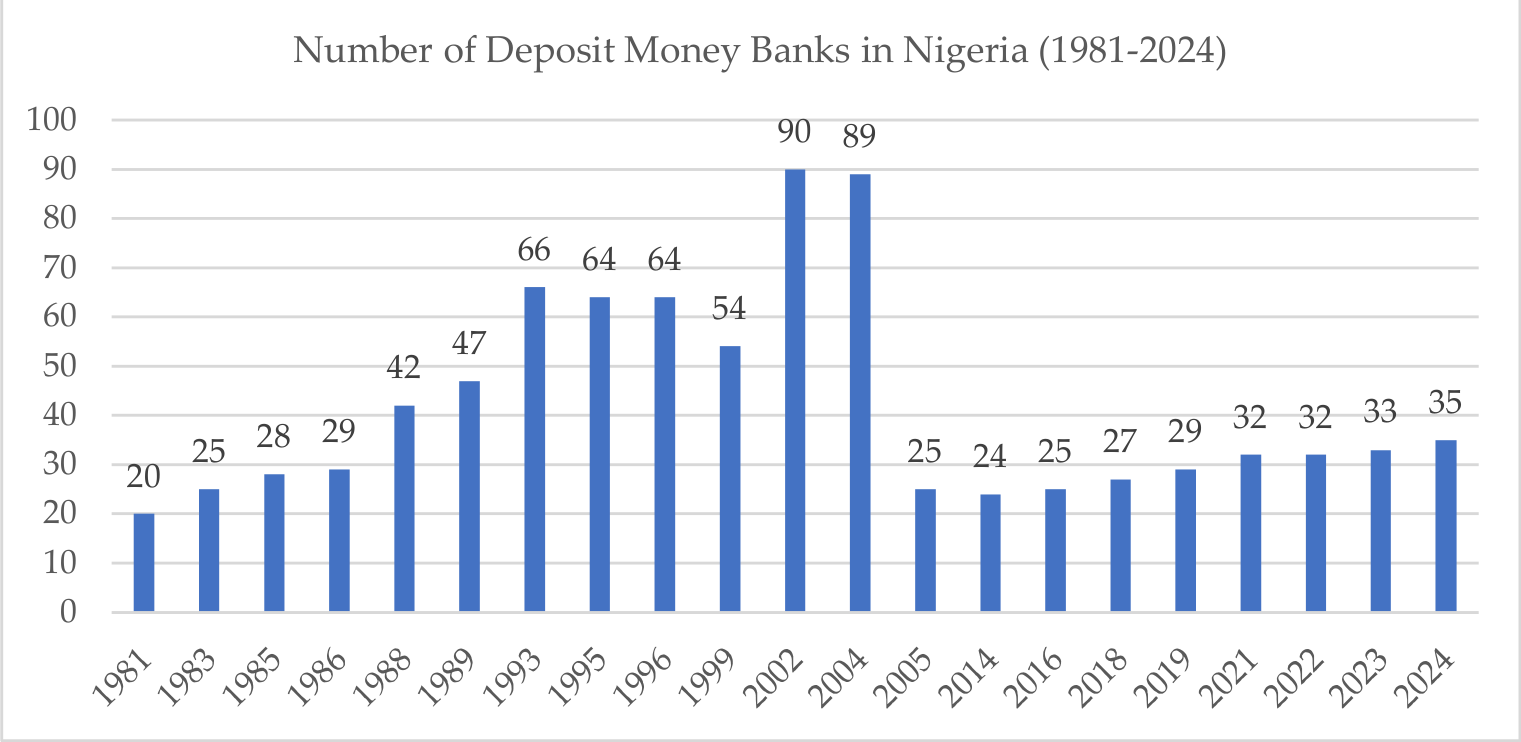
Figure 2.
Number of Fintech Unicorns. Source: CB Insights- Statista (2026).
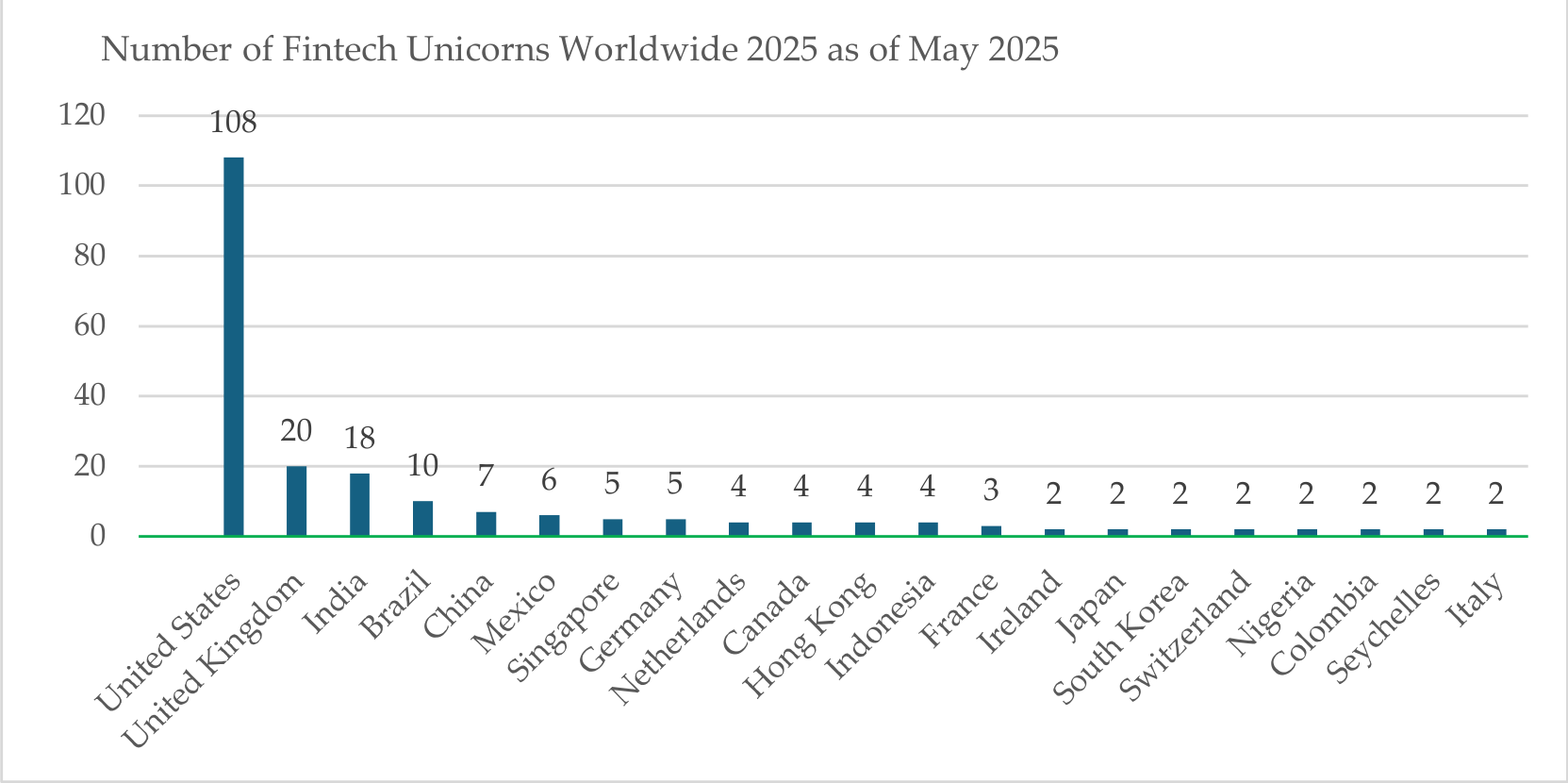

Table 1.
Phases of Monetary Policy Environment in Nigeria.
| Phases | Period | Monetary Policy Environment |
|---|---|---|
| 1 | 2009-2011 | The Crisis Accommodation: Banks in Nigeria faced a banking crisis in 2009, as about 9 banks failed a capital adequacy stress test conducted by the CBN and the Nigeria Deposit Insurance Corporation (NDIC). This crisis originated from the 2007-2008 global financial crisis. It was exacerbated by the 2009 banking crisis in Nigeria, which was attributed to excessive bank credit expansion into volatile sectors like oil and gas and to the abuse of margin trading in the stock market. During this period, the MPR declined from 9.75% in January 2009 to 6.00% in July 2009, then accelerated to 12% by October 2011. This period’s MPR reflected post-global financial crisis accommodative policy and Nigeria’s 2009 banking crisis. Similarly, the Treasury bill rates for the 91-day paper fluctuated from 2.00% in February 2009 to 14.27% by December 2011, reflecting liquidity challenges during the period. |
| 2 | 2012-2015 | The stability Era: The MPR was relatively stable at 12.00% from January 2012 to October 2014, then rose marginally to 13.00% from November 2014 to November 2015. Savings deposit rates averaged 2.71% during this period, whereas maximum lending rates hovered around 25.23%, indicating limited monetary policy transmission to deposit markets. |
| 3 | 2016-2022 | The tightening escalation: The gradual tightening of the MPR began during this period, as the CBN faced rising inflationary pressures and local-currency volatility against major currencies, leading to an increase from 13.00% in January 2016 to 16.50% by the end of 2022. |
| 4 | 2023-2025 | Aggressive tightening: With inflation still accelerating, the CBN adopted an inflation-targeting stance, using the MPR to stabilise currency volatility and reduce inflationary pressures, raising the MPR from 17.50% in January 2023 to a high of 27.00% by the end of 2025. This sharp increase over this period is among the most aggressive anti-inflationary stances in developing countries and emerging markets worldwide. |
Source: Authors (2026), based on CBN statistical data analysis.
Table 2.
Summary of variables and their measurement.
| Classification | Variables | Acronym | Measurement | Source |
|---|---|---|---|---|
| Dependent | Monetary Policy Transmission Variables | |||
| Monetary Policy Rate | MPR | Rate (%) | CBN | |
| Treasury Bills Rate (91-day) | TBR | Rate (%) | CBN | |
| Independent | Fintech Payment System Variables | |||
| Automated Teller Machines | ATM | Val (N’Mil) | CBN | |
| Point of Sales | POS | Val (N’Mil) | CBN | |
| WEB-Internet Pay | WEBPAY | Val (N’Mil) | CBN | |
| Mobile Pay | MOBPAY | Val (N’Mil) | CBN | |
| Control | Banking System Transmission Variables | |||
| DMBs’ Saving Deposit Rate | SDR | Rate (%) | CBN | |
| DMDs’ Maximum Lending Rate | MLR | Rate (%) | CBN |
Source: Author’s own compilation.
Table 3.
Descriptive Statistics.
| MPR | TBR | ATM | POS | WEBPAY | MOBPAY | MLR | SDR | |
|---|---|---|---|---|---|---|---|---|
| Mean | 14.71 | 9.28 | 1,250,810.17 | 3,455,330.48 | 35,725,029.80 | 6,267,188.53 | 27.99 | 3.65 |
| Median | 13.50 | 10.2 | 546,734.15 | 214,913.21 | 28,988.23 | 198,298.47 | 28.30 | 3.78 |
| Maximum | 27.50 | 19.07 | 7,435,155.65 | 31,841,337.26 | 194,487,474.20 | 50,284,471.46 | 31.56 | 7.56 |
| Minimum | 11.00 | 0.03 | 127,586.08 | 38.57 | 1,794.65 | 241.45 | 23.08 | 1.25 |
| Std. Dev. | 4.50 | 5.04 | 1,354,277.55 | 6,866,536.42 | 54,939,741.27 | 11,245,121.52 | 2.28 | 1.57 |
| Skewness | 1.97 | -0.15 | 2.02 | 2.37 | 1.55 | 1.96 | -0.26 | 0.62 |
| Kurtosis | 5.77 | 2.00 | 7.88 | 7.95 | 4.35 | 5.89 | 2.17 | 3.29 |
| Jarque-Bera | 150.02 | 7.36 | 256.31 | 302.36 | 74.79 | 152.81 | 6.63 | 10.6 |
| Probability | 0.00 | 0.03 | 0.00 | 0.00 | 0.00 | 0.00 | 0.04 | 0.00 |
Source: Authors computations.
Table 4.
Unit Root Test.
| CONSTANT - LEVEL | CONSTANT - FIRST DIFFERENCE | |||
|---|---|---|---|---|
| Variables | ADF | PP | ADF | PP |
| ATM | 1.3411 | 0.7734 | -15.0033*** | -14.9689*** |
| MOBPAY | 1.9050 | 1.4923 | -12.5455*** | -18.0498*** |
| POS | 1.2964 | 2.2311 | -10.5254*** | -12.2089*** |
| WEBPAY | 1.8187 | 2.4203 | -14.0395*** | -14.0141*** |
| MPR | 2.0503 | 1.2595 | -6.6689*** | -11.3072*** |
| MLR | -2.2394 | -2.2483 | -15.8346*** | -17.1873*** |
| SDR | -0.1708 | -0.4020 | -12.4910*** | -12.5708*** |
| TBR | -1.5035 | -1.5231 | -13.0866*** | -13.0821*** |
| CONSTANT and TREND – LEVEL | CONSTANT and TREND – FIRST DIFFERENCE | |||
| Variables | ADF | PP | ADF | PP |
| ATM | 1.5893 | -1.1699 | -15.2499*** | -15.2421*** |
| MOBPAY | -0.1324 | -0.5853 | -13.0937*** | -20.9549*** |
| POS | -0.2946 | 0.3002 | -11.0434*** | -13.3502*** |
| WEBPAY | -0.5680 | -0.2742 | -14.7609*** | -14.9059*** |
| MPR | 0.3101 | -0.2016 | -11.1782*** | -11.4804*** |
| MLR | -2.1588 | -2.2445 | -15.8437*** | -17.5453*** |
| SDR | -0.7379 | -0.9627 | -12.5078*** | -12.5769*** |
| TBR-0.1708 | -1.2199 | -1.1564 | -13.2114*** | -13.2238*** |
Note: *** and ** denote 1% and 5% significance levels, respectively.
Table 5.
Bound Tests Results.
| Model: k = 6 | |||
| Test Statistics | Critical Values | I(0) | I(1) |
| F-statistic 3.919 |
5% | 2.27 | 3.28 |
| 1% | 2.88 | 3.99 | |
Table 6.
Long Run Estimation Results.
| Dependent Variable: MPR | ||||
| Independent Variables | Coefficient | Standard Error | t-Statistic | Prob |
| LNATM | -4.2344 | 3.0094 | -1.4097 | 0.16 |
| LNMOBPAY | -0.8565 | 2.0878 | -0.4102 | 0.66 |
| LNPOS | 4.5620 | 2.1679 | 2.1043 | 0.04** |
| LNWEBPAY | -0.0890 | 0.6211 | -0.1432 | 0.89 |
| MLR | -1.3400 | 0.5280 | -2.5378 | 0.01** |
| SDR | 2.0605 | 0.5397 | 3.8175 | 0.00*** |
| CONSTANT | 57.6087 | 31.3329 | 1.8386 | 0.07* |
Note: *** and ** denote 1% and 5% significance levels, respectively.
Table 7.
Short-run and Error Correction Model Results.
| Variable | Coefficient | Standard Error | t-Statistic | Prob. |
|---|---|---|---|---|
| D(LNMOBPAY) | 0.2644 | 0.1586 | 1.6665 | 0.09* |
| D(MLR) | -0.0168 | 0.0535 | -0.3141 | 0.75 |
| D(MLR(-1)) | 0.1122 | 0.0537 | 2.0908 | 0.04** |
| D(SDR) | 0.5549 | 0.1293 | 4.2905 | 0.00*** |
| ECT(-1)* | -0.0663 | 0.0116 | -5.7306 | 0.00*** |
Table 8.
Diagnostic Test.
| Tests | Statistics | Prob. Value | Remarks |
|---|---|---|---|
| Normality – JB | 1486.94 | 0.000 | Non-normality |
| Serial correlation | 0.772 | 0.464 | No serial correlation |
| Homoskedasticity | 3.240 | 0.000 | Heteroskedasticity |
| Specification Error test | 0.110 | 0.912 | Linearity |
Table 9.
Bound Tests Results.
| Model: k = 6 | |||
|---|---|---|---|
| Test Statistics | Critical Values | I(0) | I(1) |
| F-statistic 2.6454 |
5% | 2.45 | 3.61 |
| 1% | 3.15 | 4.43 | |
Table 10.
Long Run Estimation Results.
| Dependent Variable: MPR | ||||
|---|---|---|---|---|
| Independent Variables | Coefficient | Standard Error | t-Statistic | Prob |
| LNATM | 0.1389 | 3.7543 | 0.0370 | 0.97 |
| LNMOBPAY | -4.7223 | 3.2020 | -1.4748 | 0.14 |
| LNPOS | 7.1088 | 3.3625 | 2.1141 | 0.04** |
| LNWEBPAY | -0.9039 | 0.9801 | -0.9223 | 0.36 |
| MLR | -1.6607 | 0.7495 | -2.2158 | 0.03** |
| SDR | 2.43967 | 0.8438 | 2.9587 | 0.00*** |
Table 11.
Long Run Estimation Results.
| Dependent Variable: MPR | ||||
|---|---|---|---|---|
| Independent Variables | Coefficient | Standard Error | t-Statistic | Prob |
| LNATM | 0.1389 | 3.7543 | 0.0370 | 0.97 |
| LNMOBPAY | -4.7223 | 3.2020 | -1.4748 | 0.14 |
| LNPOS | 7.1088 | 3.3625 | 2.1141 | 0.04** |
| LNWEBPAY | -0.9039 | 0.9801 | -0.9223 | 0.36 |
| MLR | -1.6607 | 0.7495 | -2.2158 | 0.03** |
| SDR | 2.43967 | 0.8438 | 2.9587 | 0.00*** |
Table 12.
Short-run and Error Correction Model Results.
| Variable | Coefficient | Std. Error | t-Statistic | Prob. |
|---|---|---|---|---|
| C | 3.7816 | 0.8720 | 4.3365 | 0.00*** |
| D(LNPOS) | 1.7301 | 0.7550 | 2.2915 | 0.02** |
| D(LNPOS(-1)) | -1.1290 | 0.7487 | -1.5078 | 0.13 |
| D(MLR) | -0.0045 | 0.1646 | -0.0278 | 0.98 |
| D(MLR(-1)) | 0.3541 | 0.1807 | 1.9599 | 0.05* |
| D(MLR(-2)) | 0.1573 | 0.1807 | 0.8706 | 0.38 |
| D(MLR(-3)) | -0.1905 | 0.1756 | -1.0848 | 0.28 |
| D(MLR(-4)) | 0.4233 | 0.1657 | 2.5554 | 0.01** |
| D(SDR) | 0.8143 | 0.3818 | 2.1327 | 0.03** |
| D(SDR(-1)) | 0.4693 | 0.3886 | 1.2076 | 0.23 |
| D(SDR(-2)) | -0.0342 | 0.3845 | -0.0891 | 0.93 |
| D(SDR(-3)) | -0.3219 | 0.3905 | -0.8244 | 0.41 |
| D(SDR(-4)) | -0.9993 | 0.4015 | -2.4890 | 0.01** |
| D(SDR(-5)) | -1.1492 | 0.4021 | -2.8581 | 0.00** |
| ECT(-1)* | -0.1351 | 0.0307 | -4.4007 | 0.00** |
Table 13.
Diagnostic Test of the TBR Equation.
| Tests | Statistics | Prob. Value | Remarks |
|---|---|---|---|
| Normality – JB | 3382.485 | 0.000 | Non-normality |
| Serial correlation | 1.750 | 0.178 | No serial correlation |
| Homoskedasticity | 1.752 | 0.033 | Heteroskedasticity |
| Specification Error test | 0.227 | 0.821 | Linearity |
Table 14.
Effect of Fintech on Monetary Policy Rate in Nigeria.
| Dependent Variable: MPR | ||||
|---|---|---|---|---|
| Method: Dynamic Least Squares (DOLS) | ||||
| Variable | Coefficient | Std. Error | t-Statistic | Prob. |
| LNATM | -2.0166 | 1.2376 | -1.6294 | 0.11 |
| LNMOBPAY | -3.0641 | 0.8007 | -3.8270 | 0.00*** |
| LNPOS | 3.8179 | 0.8009 | 4.7668 | 0.00*** |
| LNWEBPAY | 0.6925 | 0.3119 | 2.2203 | 0.02** |
| MLR | -0.2928 | 0.1495 | -1.9578 | 0.05* |
| SDR | 2.0105 | 0.1878 | 10.7072 | 0.00*** |
| C | 24.7405 | 11.4988 | 2.1516 | 0.03** |
| R-squared | 0.9485 | |||
| Adjusted R-squared | 0.9330 | |||
Table 15.
Effect of TBR on Fintech and Transmission Variables.
| Dependent Variable: TBR | ||||
|---|---|---|---|---|
| Method: Dynamic Ordinary Least Squares (DOLS) | ||||
| Variable | Coefficient | Std. Error | t-Statistic | Prob. |
| LNATM | -3.5503 | 2.4936 | -1.4238 | 0.16 |
| LNMOBPAY | -5.2384 | 1.6178 | -3.2379 | 0.00*** |
| LNPOS | 6.0113 | 1.6119 | 3.7293 | 0.00*** |
| LNWEBPAY | 0.2188 | 0.6300 | 0.3473 | 0.73 |
| MLR | 0.0576 | 0.3071 | 0.1877 | 0.85 |
| SDR | 1.6800 | 0.3767 | 4.4594 | 0.00*** |
| C | 37.4264 | 23.1631 | 1.6158 | 0.11 |
| R-squared | 0.8261 | |||
| Adjusted R-squared | 0.7731 | |||
Disclaimer/Publisher’s Note: The statements, opinions and data contained in all publications are solely those of the individual author(s) and contributor(s) and not of MDPI and/or the editor(s). MDPI and/or the editor(s) disclaim responsibility for any injury to people or property resulting from any ideas, methods, instructions or products referred to in the content. |
© 2026 by the authors. Licensee MDPI, Basel, Switzerland. This article is an open access article distributed under the terms and conditions of the Creative Commons Attribution (CC BY) license (http://creativecommons.org/licenses/by/4.0/).
Copyright: This open access article is published under a Creative Commons CC BY 4.0 license, which permit the free download, distribution, and reuse, provided that the author and preprint are cited in any reuse.


